


Introduction
Over the past decades, countries across the globe have increasingly made use of direct democratic decision-making (Altman, Reference Altman2011; Qvortrup, Reference Qvortrup2018). The growing importance of referendums stands in contrast with the relative scarcity of studies on turnout in direct democratic votes. Notwithstanding several important studies in more recent years, the argument that ‘(t)he comparative literature on referendums is disparate and attempts at general theorising are extremely rare’ by Szczerbiak and Taggart (Reference Szczerbiak and Taggart2004, p. 564) still holds nowadays. While voter turnout belongs to the core business of electoral research, the ever growing interest in it has mainly focused on electoral turnout, including both aggregate- and individual-level research, and studies combining contextual and individual variables (Cancela & Geys, Reference Cancela and Geys2016; Smets & van Ham, Reference Smets and van Ham2013). For turnout in referendums, a similarly abundant and comprehensive literature is missing.
As a consequence, scholars tend to rely on election-specific research and to assume that the common drivers of electoral participation equally influence participation in referendums. Indeed, election-specific models often work well to explain referendum voting, particularly when more stable factors such as ideology or social cleavages are linked with the referendum issue (LeDuc, Reference LeDuc2002a, Reference LeDuc, Farrell and Schmitt-Beck2002b). However, more volatile factors related to the campaign may differ in their influence on participation in elections or referendums. In fact, it has been argued that, because referendums involve less deeply held (ideological) beliefs, referendum campaigns have a stronger influence on voters than election campaigns (LeDuc, Reference LeDuc, Farrell and Schmitt-Beck2002b; Schmitt-Beck & Farrell, Reference Schmitt-Beck, Farrell, Farrell and Schmitt-Beck2002). Yet we still know little about these drivers of voter mobilization in direct democratic votes (for exceptions, see Bowler & Donovan, Reference Bowler and Donovan1998; Dyck & Seabrook, Reference Dyck and Seabrook2010; Kriesi, Reference Kriesi2005). While recent studies tested the influence of certain campaign characteristics (e.g. Nai, Reference Nai2013; Goldberg et al., Reference Goldberg, Lanz and Sciarini2019), we still lack a comprehensive analysis of individual and contextual determinants of direct democratic participation including both the mentioned ‘borrowed’ theories from election contexts and more referendum-specific factors.
The study of direct democratic participation and its underlying reasons is of importance for various reasons. First, quorum rules for referendums in several countries – commonly a participation of at least 50 percent – increase the relevance of getting enough citizens to participate in order to have a valid referendum (e.g. Aguiar-Conraria & Magalhães, Reference Aguiar-Conraria and Magalhães2010; Uleri, Reference Uleri2002). Second, as turnout fluctuates strongly in referendums, the possibility of turnout effects on the referendum outcome is much larger than in elections (LeDuc, Reference LeDuc2002a). Our study thus follows justified claims to analyse direct democratic participation in its required detail (Schoen, Reference Schoen and Schmitt-Beck2012).
Our article makes three contributions. First, we develop and test a comprehensive model of referendum participation including both individual and contextual factors. While we rely on common theories out of the literature – both focusing on elections and referendums – our main innovation is the simultaneous analysis of the multitude of potentially relevant factors. In comparison to studies that focus on only a couple of variables, the simultaneous testing of individual and contextual effects does not only help to avoid omitted variable bias – and to (get close to) estimate respective net effects – but also to assess the relative impact of individual and contextual factors (as done by Leighley & Nagler Reference Leighley and Nagler1992 for (presidential) elections).
Second, as a prerequisite for this comprehensive turnout model, we innovate by considering both the geographical context, as measured by the community in which citizens live and vote, and the referendum context, as measured by the characteristics of the submitted proposal and related referendum campaign. Considering influences of both these contextual levels is a more realistic representation of citizens' decision-making process and enables an estimation of which of the two contextual levels has a greater influence on referendum participation.
Third, we take advantage of the high frequency of referendums in the Swiss political system by testing our model on a rich set of turnout data covering almost 15 years (from 1999 to 2012) and more than 40 direct democratic votes. This high frequency of referendums and related variation within campaign factors enables us to examine theoretically important context variables that are usually hard to study as they often vary little between elections. Further, due to the far-reaching experience in direct legislation and the large variation between referendums, Switzerland lends itself particularly well to a study of how context-level variables influence voters' direct democratic participation (Kriesi, Reference Kriesi2005). Insights drawn from a context where direct democracy is well developed and routinely used are arguably more reliable than in contexts where direct democratic votes are exceptional and, therefore, more likely to be influenced by idiosyncratic factors.
Following the interest in contextual effects on the community level, for our empirical analysis we use data from the canton of Geneva. We use official instead of self-reported turnout data, which excludes usual survey data problems related to sampling, coverage, nonresponse bias and vote overreporting. We match this individual-level data with measures of referendum characteristics, such as campaign intensity or issue topic, and with measures of the community context (n = 45), such as wealth or urbanization. The results of the estimated cross-classified logit random-intercept multilevel models show significant context-related effects, more so at the referendum than the community level. The most important drivers of participation, though, stem from the individual level, in particular citizens' past participation record.
The impact of individual and contextual factors on participation
Electoral participation is one of the most studied topics in electoral research. Since the early studies of the 1940s/1950s (e.g. Lazarsfeld et al., Reference Lazarsfeld, Berelson and Gaudet1944), scholars have demonstrated the impact of various variables from different sub-theories. However, as Smets and van Ham (Reference Smets and van Ham2013) argue in their meta-analysis, most turnout studies concentrate on one theoretical framework only and do not represent empirical complexity by testing various frameworks in parallel. As a result, many turnout models are underspecified in theoretical and empirical terms, and thus unable to assess the relative strengths of competing factors (Smets & van Ham, Reference Smets and van Ham2013). While these problems exist in the very rich turnout literature looking at elections, the problem is even more severe in the sub-field of referendum participation. This is especially true for studies that also consider contextual influences, as the context might be more important for referendums (campaigns) than for elections (e.g. Schmitt-Beck & Farrell, Reference Schmitt-Beck, Farrell, Farrell and Schmitt-Beck2002; LeDuc, Reference LeDuc, Farrell and Schmitt-Beck2002b). A special focus of this article thus lies on the influence of context-related factors on turnout.
For the following overview of theories and empirical evidence to be as complete as possible, we discuss literature from both electoral and direct democratic research. Smets and van Ham (Reference Smets and van Ham2013) present an overview of common explanations distinguishing individual and contextual effects on participation into a resource, mobilization, socialization, rational choice, political institutional and psychological model. We discuss and use several of these explanations as well, but also include other explanations more specific to the direct democratic participation under study.
Individual effects on participation
Starting with the individual level, the resource model includes common socio-demographic characteristics. Age influences participation in a curvilinear form, with young people participating the least and the most active group being middle-aged people (e.g. Rosenstone & Hansen, Reference Rosenstone and Hansen1993). Married citizens participate more than singles or separated/widowed persons, owing to their higher levels of social stability and social integration (e.g. Leighley & Nagler, Reference Leighley and Nagler2013). While in the past men participated more than women (e.g. Verba et al., Reference Verba, Nie and Kim1978), the gender gap has closed over time (Norris, Reference Norris2002). Finally, people with higher education and higher income are also more likely to participate (e.g. Verba et al., Reference Verba, Nie and Kim1978; Wolfinger and Rosenstone, Reference Wolfinger and Rosenstone1980). For the more specific referendum literature, several studies confirm the relevance of socio-economic factors such as age and education (Kriesi, Reference Kriesi2005; Milic et al., Reference Milic, Rousselot and Vatter2014; Sciarini et al., Reference Sciarini, Cappelletti, Goldberg and Lanz2016).
A second group of individual determinants relates to civic culture and political attitudes, and can be subsumed into psychological factors (Smets & van Ham, Reference Smets and van Ham2013). Higher levels of interest in politics, political sophistication, party identification, or trust in the political system increase participation (e.g. Norris, Reference Norris2002). These characteristics usually result in a high propensity to vote or a high level of past participation, which are among the strongest determinants of participation in current vote (Smets & van Ham, Reference Smets and van Ham2013). Again, the referendum literature confirms the importance of these psycho-cognitive factors (e.g. Kriesi, Reference Kriesi2005; Nai, Reference Nai2013; Goldberg et al., Reference Goldberg, Lanz and Sciarini2019).
Contextual effects on participation
In contrast to common individual-level variables, it is important to define contextual effects as they may stem from a great variety of factors. Generally speaking, a contextual effect operates when the individual behaviour – after considering all individual determinants – depends on some external factor (Huckfeldt & Sprague, 1993, p. 286). Research typically distinguishes between long-term factors, often stemming from the geographical context (e.g. socio-structural composition), and short-term factors, often relating to a particular vote (e.g. electoral campaigns). Whereas the former are responsible for stability and durability in electoral behaviour, the latter account for volatility.
Many contextual studies focus on (long-term) effects from geographical contexts ranging from neighbourhoods and communes up to whole countries (Books & Prysby, Reference Books and Prysby1988, Reference Books and Prysby1991). There is no agreement about which geographical context is the most relevant one. For instance, Huckfeldt and Sprague (1993, p. 299) argue that it is not true that smaller, more intimate units are more important in influencing individual behaviour than larger contexts. When analysing voting behaviour, the constituency is a logical choice, as in there the offer of parties or candidates is different and sometimes even the electoral rules vary (cf. Marsh, Reference Marsh2002). The influence of short-term factors is often taken into account by the inclusion of election dummies. However, to disentangle short-term factors in more detail, one should look at more specific election (referendum) characteristics and their variation over time, which is one goal of this study. While geographical effects on turnout should be rather universal for both election and referendum turnout, the analysis of frequent referendums and related higher variations provides better conditions to study short-term factors than is possible with less frequently held elections.
Despite the importance of various contextual characteristics, only few studies consider the respective influence on individual participation. Quite to the contrary, most studies concentrate on one or a small set of context characteristics. Similar to the absence of relevant individual variables, the absence of relevant contextual variables may result in omitted variable bias (cf. Marsh, Reference Marsh2002). This hinders not only to confirm specific contextual effects, but omitting relevant contextual influences may also affect individual-level factors. The present article takes account of the diversity of contextual effects more realistically, by examining various contextual variables measured both in geographical terms, that is on the community level, and temporal terms, that is on the referendum level.
Theoretical expectations
Since individual predictors of participation have been theorized and tested extensively in the literature, we refrain from formulating (the same) hypotheses about them. Yet, in order to have our turnout model as complete as possible – including the individual level – we incorporate some of the most common and important individual-level variables in our analysis. For the following theoretical expectations, though, we focus on the two contextual levels under study.
Referendum-level effects
We start with the political-institutional level, in our case the characteristics of a referendum. Given the stable institutional settings for the referendums under study, especially interesting and relevant for our study are dynamic measures that differ over time such as the political campaigns. There is widespread agreement that intensive campaigns foster turnout (e.g. Holbrook, Reference Holbrook1996; Hobolt, Reference Hobolt and de Vreese2007). In the context of Senate elections, Kahn and Kenney (1999) highlighted the twofold mechanism through which campaign intensity plays a role, that is by increasing both the quantity of messages delivered to voters and the incentives to search for information. A similar argument holds for referendum campaigns (Bowler & Donovan, Reference Bowler and Donovan1998; Dyck & Seabrook, Reference Dyck and Seabrook2010; Kriesi, Reference Kriesi2005), in which campaign intensity in the form of media campaigns or party competition is said to be a major driver of citizens' participation (e.g. Hobolt, Reference Hobolt and de Vreese2007; Kriesi, Reference Kriesi2005; Goldberg et al., Reference Goldberg, Lanz and Sciarini2019; Szczerbiak & Taggart, Reference Szczerbiak and Taggart2004). Our first hypothesis thus expects that a more intense campaign increases individual participation (H1).
Relatedly, referendums, even more than elections, differ from each other with respect to the importance and complexity of the ballot proposals submitted to voters. To some extent, the salience of a referendum vote may be driven by the just discussed campaign intensity (Hobolt, Reference Hobolt and de Vreese2007). In the huge variety of proposals including all kinds of topics such as institutional, social, economic or international matters, some are more relevant to voters than others. For instance, the question of Switzerland's relationship to the European Union should be more important to citizens than some minor change in a tax regulation for firms. While the importance of ballot measures should – intuitively – influence turnout, the empirical evidence is mixed (e.g. Kriesi, Reference Kriesi2005). Still, and given the different ways how to operationalize importance, we hypothesize an increasing participation in more important referendums (H2).
Turning to complexity of referendum content, some issues are easy to understand and require little background knowledge to come to a simple yes/no opinion. Contrarily, other issues require much more knowledge to first understand the proposal and secondly to come to a decision. Complexity further increases with parallel ballot proposals on the same voting day, since voters need to inform themselves about all respective topics and not just one (cf. Cebula, Reference Cebula2017). When encountering a complex direct democratic proposal, citizens ‘may decide that the acquisition of “encyclopedic” information is not a worthwhile activity’ (Lupia, Reference Lupia1994, p. 63). While one option for those citizens is to rely on information shortcuts (Lupia, Reference Lupia1994), another and even easier solution is to not turn out at all. This is what happened in the 2005 referendums about the EU Constitutional Treaty, for which many citizens in France and the Netherlands reported to not have voted because of the too complex issue (Svensson, Reference Svensson, Pállinger, Kaufmann, Marxer and Schiller2007). Studies in Switzerland equally show that turnout decreases with the complexity of the ballot proposal (Kirchgässner & Schulz, Reference Kirchgässner and Schulz2005; Kriesi, Reference Kriesi2005). Our third hypothesis assumes that complexity reduces participation (H3).
Community-level effects
Next, we turn to effects from the social context on the community level. The community level is defined as municipalities, which form an administrative unit in the canton of Geneva (municipalities are the third institutional level after the federal and cantonal levels in Switzerland). We use the more general term ‘community’ throughout most of the article. By regarding municipalities as our geographical unit, we follow the recommendation of scholars who argue that national surveys often do not capture the relevant context people live in. For instance, Johnson et al. (Reference Johnson, Shively and Stein2002, p. 226) advocate ‘the need for survey data collected below the national level, but in relatively diverse populations, sampling residents in a variety of communities, neighbourhoods, census tracts, voting precincts, and the like’. Yet given that there are only few studies examining community-level effects, we also rely on theories and evidence from bigger and smaller contexts.
We start with socio-economic status (SES) or more generally, wealth of the community. When testing for, for example, income effects on the contextual level, most studies assume the same mechanism as for the common individual-level effect – that is, the imposed costs of direct democracy are more easily managed by people with higher SES, whereas lower resource voters have relatively higher costs to inform themselves and vote (Dyck & Seabrook, Reference Dyck and Seabrook2010). Indeed, various studies have shown that this mechanism holds on the contextual level, though partly measured in aggregate terms (e.g. Cox & Munger, Reference Cox and Munger1989; Leighley & Nagler, Reference Leighley and Nagler1992). An alternative opposite mechanism is put forward by Cebula (Reference Cebula2017), who argues that higher income people may be very busy and lack time to inform themselves sufficiently to make an informed choice or simply do not have the time to vote. Still, due to the more widespread argument of the traditional relation between high SES and political participation, our first community-based hypothesis states that the wealthier a community, the higher the participation of its inhabitants (H4).
Another speculation is that turnout is sensitive to city size or urbanization, albeit the expectations are mixed. Oliver (Reference Oliver2000) discusses that in bigger cities, social networks are loosely knit with less proximity and redundancy among citizens. In smaller towns, in contrast, social networks are more closely knit as people know their neighbours and other acquaintances living nearby. A higher mobilization within these stronger social networks in smaller communities is argued to result in higher participation (Blais, Reference Blais2006; Oliver, Reference Oliver2000). The meta-analysis of electoral turnout by Cancela and Geys (Reference Cancela and Geys2016) tends to support this expectation, especially in sub-national elections. A contrary argument states that the higher the physical proximity between people, that is in more urban and bigger communities, the higher the group pressure by other citizens, which fosters participation (Blais & Dobrzynska, Reference Blais and Dobrzynska1998). Such a positive effect of population density is for instance found by Endersby and Krieckhaus (Reference Endersby and Krieckhaus2008), though not uniformly across small and big nations. We thus rather follow the first argument and posit that urbanization has a negative impact on participation (H5).
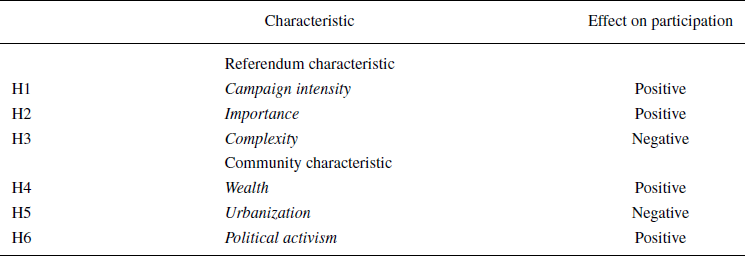
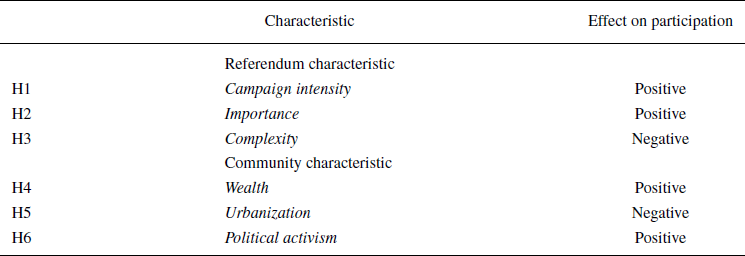
The effects of social networks and group pressure may be summarized under a neighbourhood effect. The social context literature argues that social interaction within people's communities and networks enhances political participation (e.g. Dyck & Seabrook, Reference Dyck and Seabrook2010). A neighbourhood effect may be present in explicit terms, for example actively communicating one's voting behaviour or observing neighbours walking to the polling station, or in implicit terms by showing a general interest in politics (Großer & Schram, Reference Großer and Schram2006). A person does not need to actively interact, but overhearing conversations in places such as the bank or local grocery store might be sufficient (Kenny, Reference Kenny1992). The neighbourhood as the contextual entity plays a particularly important role as it is a ‘relatively constant and inescapable source of political and social stimuli’ (Huckfeldt, Reference Huckfeldt1979, p. 580). Several studies provide evidence that living in a more active social environment has a positive effect on participation (e.g. Kenny, Reference Kenny1992). Hence, a last expectation is that the level of political activism in a community fosters individual participation (H6). Table 1 summarizes our expectations with respect to both the referendum- and community-related characteristics on turnout.
Overview of hypotheses
So far, all mentioned studies examined participation in either elections or referendums, and we have used them interchangeably to develop our hypotheses. The latter may be adequate as the (very) few studies comparing the determinants of participation in elections and direct democratic votes find mainly similar patterns, with few exceptions. For instance, Tawfik et al. (Reference Tawfik, Sciarini and Horber2012) find that young generations in Switzerland participate slightly more in direct democratic votes than in elections, in comparison with older cohorts. For Bavaria, Germany, Schoen's (Reference Schoen and Schmitt-Beck2012) study finds that partisanship plays a far smaller role for referendum participation than for elections, which fits the argument that referendums involve less deeply held beliefs such as party identification (e.g. Schmitt-Beck & Farrell, Reference Schmitt-Beck, Farrell, Farrell and Schmitt-Beck2002; LeDuc, Reference LeDuc, Farrell and Schmitt-Beck2002b)
In addition to applying theories borrowed from electoral participation research, the following results may travel beyond the Swiss direct democratic context, including implications for elections. The latter is due to two main reasons: First, whereas in most countries elections are the main mode for citizens to exert political influence, in Switzerland referendums are more relevant (Linder, Reference Linder2010). Second, two (campaign) factors that commonly distinguish elections from referendums are less distinct in the Swiss case: the type of actors and number of issues involved. Generally, elections are characterized by a set of political parties/candidates campaigning on various issues, whereas referendums usually focus on only one issue and do not necessarily involve political parties, that is referendums may be launched by all kinds of groups (Lupia, Reference Lupia1994; Schmitt-Beck & Farrell, Reference Schmitt-Beck, Farrell, Farrell and Schmitt-Beck2002). Yet, given the importance of referendums in Switzerland, in most cases political parties attempt to influence opinion formation through pro-actively campaigning for or against the ballot measure (Kriesi, Reference Kriesi2012). The known positions of parties on referendum issues may result in more predictable and familiar voting behaviour – that is, similar to election voting (LeDuc, Reference LeDuc2002a). Similarly, ballot days in Switzerland usually include more than one issue, that is citizens are asked to vote on several referendums in parallel (for instance, the average number of issues to vote on is around 2.8 in the ballot days under study here).
Data and method
For our analysis, we focus on all national direct democratic votes between 1999–2012 (N = 43 ballot days) voted on in the canton of Geneva, Switzerland. While Geneva is more urbanized and cosmopolitan than many other Swiss cantons, it displays turnout levels in national referendums that are very close to the national average. Further, while Switzerland is known as a low turnout country in comparative perspective, two remarks are in order. First, aggregate turnout varies greatly across direct democratic votes. Second, analysing citizens' participation in a series of successive ballots rather than in separate ballots qualifies the conventional view of Switzerland as a low turnout country (Dermont, Reference Dermont2016; Sciarini et al., Reference Sciarini, Cappelletti, Goldberg and Lanz2016). Official data on individual turnout show that the share of citizens who always abstain is lower than 10 percent, whereas occasional voters constitute the bulk (between two thirds and four fifths) of the electorate.
On the individual voter level, we employ registered turnout data for the entire period 1999–2012. In contrast to survey data that notoriously overestimate turnout (e.g. Sciarini & Goldberg, Reference Sciarini and Goldberg2017), our data provide official information about individual participation (or abstention) for the entire cantonal electorate (voting-eligible population), that is for roughly 210,000 people per ballot day. In the dataset, each citizen is identified with an anonymous code, which allows us to track her history of participation. In addition, the dataset provides information about basic socio-demographic factors. The dataset is organized in a way that citizens are nested into 45 municipalities and 43 ballot days.Footnote 1 The rows of our dataset represent an individual's participation decision, that is each person appears in as many rows as the number of ballot days this person was eligible to vote (maximum n = 43). Residence in a given municipality is measured in the columns and is mostly stable per citizen, but is allowed to vary over time.
We merge this individual-level dataset with contextual data collected for both the referendum and community level, comprising various data sources (see following operationalization section and the overviews in Figure A1 and Table A1 in the online Appendix). With the resulting combined dataset, we aim to address criticisms raised against contextual research. First, the average number of residents per municipality is around 4500, but more than one third of the municipalities comprise less than 1000 inhabitants. Especially for effects relating to social interaction, the use of a comparatively small community level is more adequate than the larger spatial units used in other research (for a criticism see, e.g., Johnson et al., Reference Johnson, Shively and Stein2002, p. 490). In the same vein, Johnston et al. (Reference Johnston, Propper, Burgess, Sarker, Bolster and Jones2005, p. 506) show that for party choice contextual ‘variations at the 2,000m (place) scale are more important than those at the smaller 250m locale’. Our community-level measure fits the former scale and, therefore, seems best-suited to capture context effects. Finally, to avoid the usual endogeneity problem, we follow van der Eijk's (Reference van der Eijk2002) advice and use real external data to measure our context variables.
Operationalization
Our dependent variable is a citizen's official participation on a ballot day. Notwithstanding that several national referendums may be held on the same day, the dataset only provides information regarding whether citizens participated or not. However, this is only a minor drawback, since turnout rates of different votes on one ballot day rarely vary more than one percentage point. In other words, the huge majority of voters do not pick certain votes only.
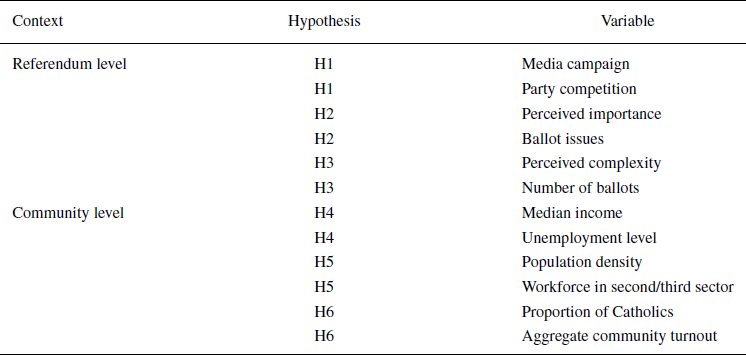
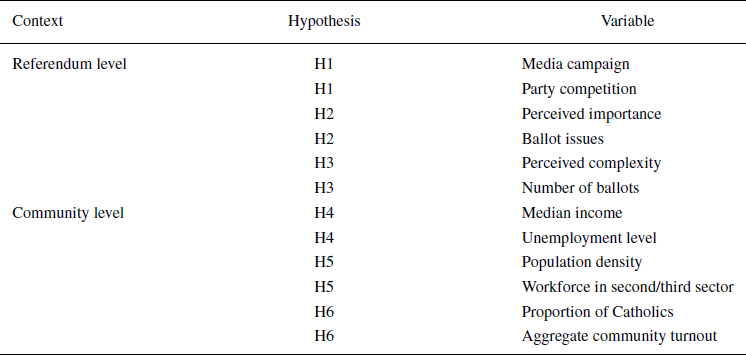
For the referendum level, we have six variables at our disposal (two per hypothesis). We start with two measures of campaign intensity: party competition calculates the vote share of parties that recommend accepting a ballot and those that recommend rejecting it. The resulting score varies between zero, indicative of no competition at all (i.e. all parties propose to either reject or accept the ballot), and one, indicative of a strong party division (i.e. both party camps represent the same amount of electors). The second variable measures the intensity of the media campaign based on Nai's (Reference Nai2014) data. Our measure adds up the absolute sizes (in $\text{cm}^2$) of all political advertisements for or against a policy proposal published in two major newspaper outlets in the French-speaking region (Tribune de Genève and Le Temps) during the 4 weeks prior to direct democratic votes.Footnote 2 For the importance of a ballot day, we first use the perceived importance on a 0–10 scale according to VOX surveys (in its aggregated form and restricted to French-speaking respondents). In case of multiple proposals per ballot day, we use the highest importance for any proposal. We further use six dummy variables for the issue topic at stake: international politics (including European integration, immigration and asylum policy), social issues, institutions, energy/environment, economy and culture/research. Note that various of these issues may appear in parallel on a given day. Finally, for complexity we first use the perceived complexity of ballot measures on a 0–100 scale, again taken from the VOX surveys. In case of parallel proposals, we use the lowest perceived complexity for any proposal. Our second indicator of complexity is the number of ballots held in parallel on a given day.
For the community level, we similarly use six different variables (again two per hypothesis), mainly stemming from the cantonal statistical office of Geneva. To measure wealth of the community, we rely on the median income per taxable resident and the level of unemployment in each community. For urbanization, we have information about the population density and the proportion of workforce employed in the second (manufacturing) and third (service) sector. Lastly, we rely on two measures of political activism: First, the proportion of Catholics living in each community. In the Swiss context religion, especially the level of Catholicism, is often considered as a contextual driver of political participation (Bühlmann & Freitag, Reference Bühlmann and Freitag2006). Second, we use the aggregated community turnout across all referendums.Footnote 3
Following the literature (cf. Books & Prysby, Reference Books and Prysby1988, Reference Books and Prysby1991), our indicators represent not only compositional variables (e.g. perceived importance/complexity or unemployment levels) but also include ‘real’ external variables in terms of structural (media campaign and party competition) and global types of factors (the number of ballots, their respective issues and both urbanization measures). The variation within all contextual variables (see Table A2 in the online Appendix) is sufficiently large to consider them as meaningful for potential effects (Books & Prysby, Reference Books and Prysby1988, p. 215). To ease comparison of the regression coefficients, all contextual variables are standardized (except of binary variables). Table 2 presents an overview of all contextual variables, and the hypotheses to which they relate.
Overview of contextual variables
As independent variables on the individual level we include socio-demographic variables covering age (simple and squared term), a dummy for women, two dummies for civil status (married and divorced/widowed, with single as reference category), two dummies for residence duration ( $<$10 years and between 10 and 20 years, with $>$20 years as reference category) and a dummy for Geneva citizenship. Swiss people hold a cantonal citizenship in addition to their national one, and residents with citizenship of another canton can still vote in Geneva. The values of these variables may change in the dataset during the period of study.
While the official dataset does not have additional information about common determinants of participation, we are able to calculate a past participation record for every citizen (from 1996 onwards). This variable is among the strongest determinants of current voting, but to some extent also captures the effect of factors such as political interest, education or partisanship (cf. Cutts et al., Reference Cutts, Fieldhouse and John2009; Smets & van Ham, Reference Smets and van Ham2013). We calculate this record (values between 0 and 1) by dividing the number of times a person participated in (national) referendums in the past by the number of possible referendums a person could have participated in (starting with the age of 18 or when the person moved to Geneva). This variable is dynamic and changes throughout our 43 ballot days. In addition to its relevance as such – by being among the strongest determinants of turnout in extant research – the inclusion of past participation in our models results in a conservative test for all other variables under study, that is, we can be more certain about their respective effects. As a robustness check and for a sub-sample of citizens, we are moreover able to include additional common individual-level variables taken from two surveys. We come back to that in the empirical section.
Method
Our analysis proceeds in three steps. First, we provide descriptive statistics about the variations in turnout for both context levels, the referendum and the community. Next, we regress overall turnout on community and referendum characteristics. For this, we created an aggregate dataset by calculating the turnout levels across 1935 referendum/community combinations (= 45 $\times$ 43) serving as the dependent variable. Given the repeated measurement of communities over time, we run feasible generalized least squares estimations with panel corrected standard errors.Footnote 4 This aggregate-level model allows us to examine the potential problem of an ecological fallacy when using aggregate instead of individual-level data.
In a third step, we fit cross-classified logit random-intercept multilevel models (Gelman & Hill, Reference Gelman and Hill2007, 244).Footnote 5 In these models, individual factors and factors from both contextual levels predict individual participation (for other multilevel approaches to predict turnout, see, for instance, Gallego, Reference Gallego2010; Singh, Reference Singh2011). The merged dataset includes on average around 210,000 individuals on 43 ballot days, which leads to a total number of 9,125,947 observations. As this number is too big to estimate the models with common statistical software, we drew a random sample of 150,000 observations, which we use in our final models. This equals between 3210 and 3795 individuals per referendum.Footnote 6 As robustness check, we drew 10 more random samples and repeated our main model using these additional samples.
Results
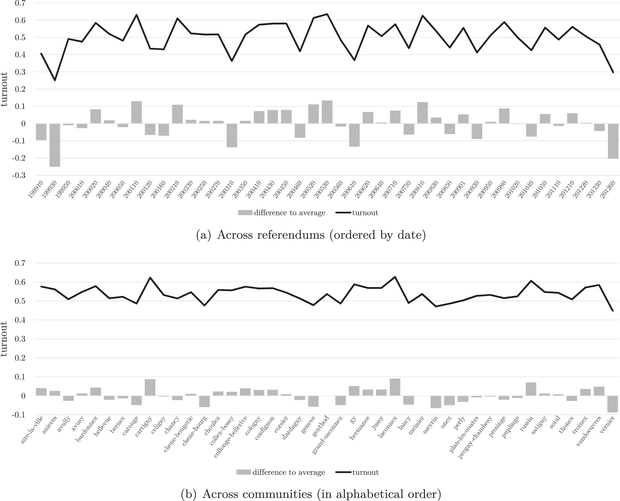
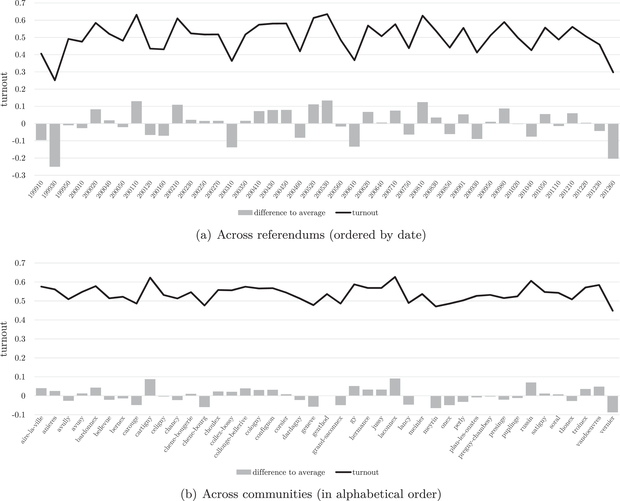
Figure 1 displays turnout levels (black line) and the difference to the overall average turnout level (grey bars) separately across referendums (A) and across communities (B). An obvious difference between both graphs is that turnout levels differ much more between referendums, that is across time, than across communities. There are not only more grey bars clearly different from zero in the top graph, but the maximum length of these positive/negative bars is also larger across referendums. In detail, the difference between the lowest (0.25) and highest turnout level (0.63) is around 0.4 for referendums, while the difference is around 0.2 (turnout between 0.45 (min) and 0.63 (max)) for communities, which is still substantial, though.
Turnout across referendums and communities.
Aggregate-level models
Next, we turn to an aggregate model regressing overall turnout on context variables (Table 3). Since aggregated turnout per community and referendum is the outcome variable, the model excludes the aggregated community turnout – an indicator of political activism – as an explanatory variable. Almost all contextual factors display significant effects on turnout, and all go in the expected direction. A more intense campaign – in terms of party competition – increases turnout, the same holds for more important referendums. The topic of the ballot proposals also matters, with especially strong positive effects for energy, international politics and economy. Complexity measured by both the perceived minimal complexity and the number of parallel ballots equally shows the expected negative influence on turnout.
Contextual effects on turnout
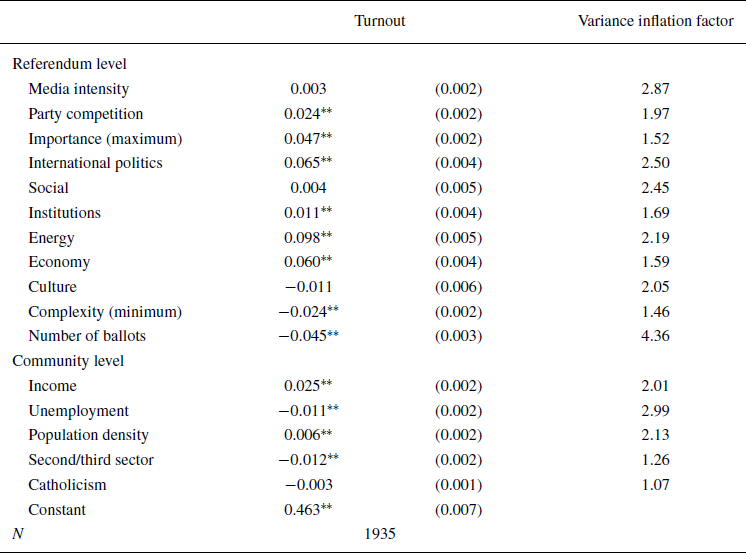
Standard errors in parentheses; * $p<0.05$, ** $p<0.01$.
The wealth of a community has a positive effect on turnout, as shown by the positive income coefficient and negative unemployment one. Urbanization also shows significant effects, but not in a coherent way. Whereas the share of workforce in the second and third factor displays the expected negative coefficient, the coefficient for population density is positive. These contradictory effects may to some extent be driven by the correlation of the two measures (r = 0.4). When excluding the workforce measure, density loses its significant effect, whereas the workforce effect remains stable when density is excluded. A negative effect of urbanization is thus more plausible. Finally, Catholicism shows no significant effect. Despite the potential problem of multicollinearity for urbanization, the displayed variance inflation factors (VIF) show low to medium values, without cause for concern.Footnote 7
Multilevel models including individual, referendum and community levels
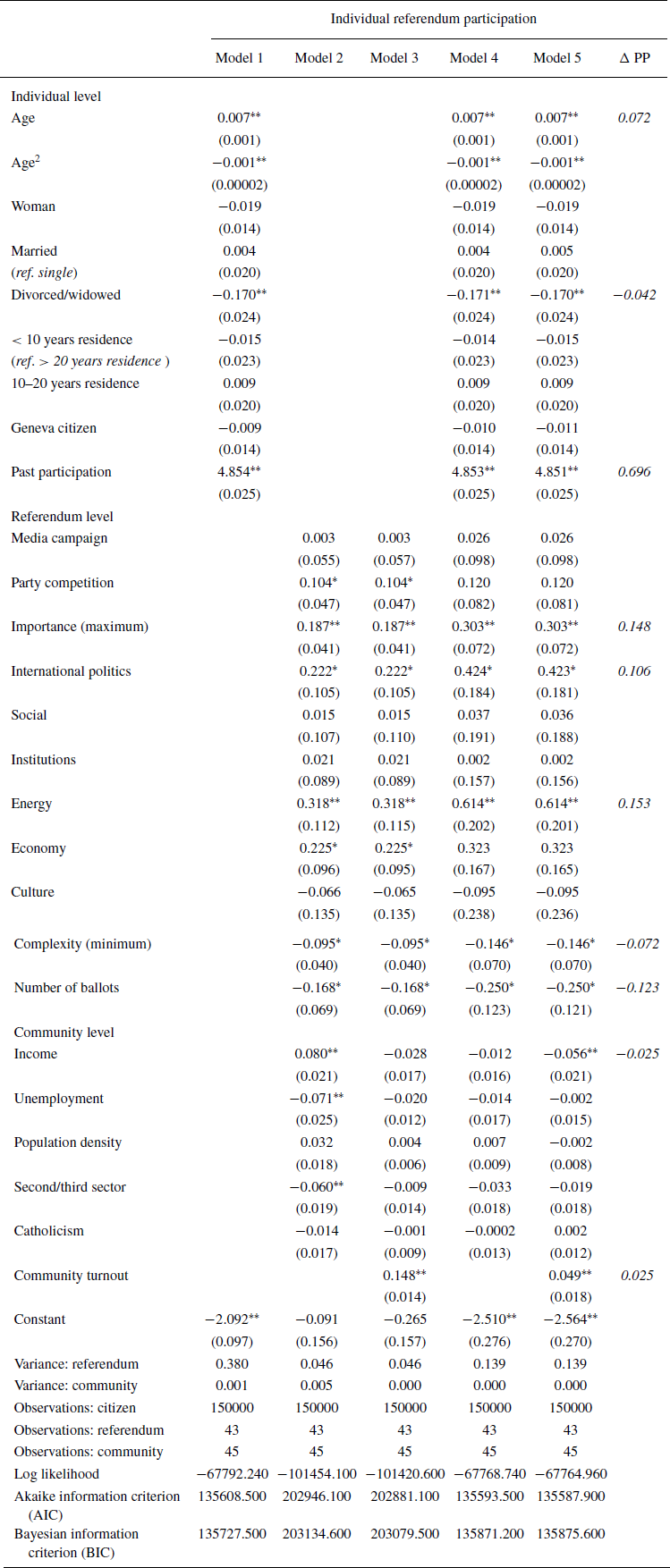
To put the aggregate results to a stricter test, we now turn to multilevel models including both individual and contextual variables. Table 4 shows five different model specifications, starting with only individual variables (1), only context variables similar to Table 3 (2), plus adding the aggregate community turnout variable (3) and two combined models without (4) and with the aggregate community turnout variable (5).
Multilevel models including individual, referendum and community variables
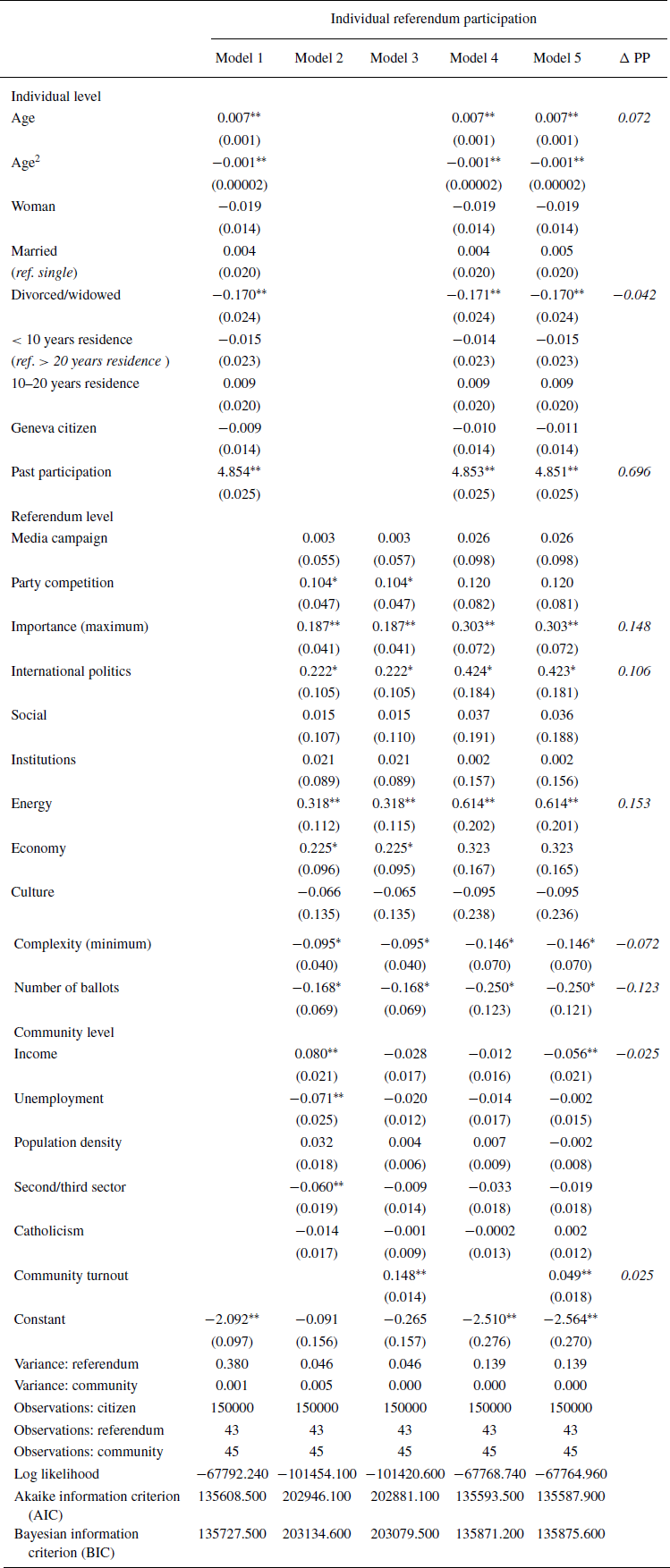
Note: Contextual variables (except for binary variables) are standardized to ease the interpretation of their respective effects; last column (Δ PP) represents changes in predicted probabilities between mean − 1SD and mean + 1SD (except for binary variables) based on model 5; standard errors in parentheses; $^{*}$p $<$ 0.05, $^{**}$p $<$ 0.01.
The individual model shows the common curvilinear age effect. We further see a negative effect for divorced/widowed persons, but no effect for married persons. Gender and residence duration display no significant effects either. Finally, and unsurprisingly, we observe a very strong positive effect of one's past participation. This effect is by far the most important explanatory factor for individual participation. To some extent, this strong effect eats up the effects of the other individual variables, which would be stronger and significant when excluding past participation (see first model in Table A6 in the online Appendix).
Comparing model 2 to the aggregate results in Table 3 shows several similar effects, but also important differences. Overall, less contextual variables are significant in the multilevel setting. At the referendum level, party competition, the importance of a ballot and three issue topics (energy/environment, international politics and the economy) drive individual participation. The effect of institutional issues is no longer significant. In contrast, the two complexity measures keep their negative effects on participation. At the community level, three variables still display a significant effect on individual participation. A higher median income has a positive effect and a higher level of unemployment a negative effect. Of the two urbanization measures, only the negative effect for the workforce in the second and third sector remains. Adding the aggregated community turnout in model 3, the second indicator for political activism, shows the expected positive influence on participation. Yet, when adding it, all other community-level measures lose their significant effects. By contrast, referendum-level effects are not influenced by the inclusion of the aggregated community turnout in model 3.
Individual- and referendum-level effects remain stable in the final two models 4 and 5, but several referendum coefficients change in magnitude. Interestingly, all referendum-level effects get stronger when including individual factors (see the differences between models 3 and 4/5), although the coefficients of party competition and economic topics lose their significance. The inclusion of individual variables has a larger impact on the community-level factors by first significantly weakening the community turnout variable. It further results in a now negative income effect running counter to our expectations and pointing to the alternative effect of income proposed by Cebula (Reference Cebula2017). However, we should not over-interpret the latter effect as it does not show up as significant in any of the 10 models based on additionally drawn samples (see Table A7 in the online Appendix).
In sum, both individual and referendum-level factors show consistent effects across model specifications, whereas community effects are less stable and overall weaker. The latter point is confirmed when considering changes in predicted probabilities displayed in the last column.Footnote 8 While higher levels of past participation substantially increase the likelihood to participate in the current vote by almost 70 percentage points, the effects of the referendum-level variables are also substantial with around 7–15 percentage points each. The community-level effects, in contrast, increase or decrease the likelihood of voting by less than three percentage points (if at all for income as discussed before).
Robustness checks
As a first robustness check, we compare the coefficients of our final model 5 with Table A7, which includes 10 similar model outputs across the 10 additional drawn random samples. At the individual level, and notwithstanding the single appearance(s) of significant effects of measures such as residence duration or being married in a few models, the results of the main model are confirmed. The same holds for the referendum level, with highly stable coefficients across models. Only for the topic economy and the perceived complexity, we spot some more statistical variation in terms of being just significant at the 0.05 level or not. Finally, in line with the already weaker and less stable effects at the community level in our main model setups, the additional model outputs confirm this instability by displaying no community-level measure with significant coefficients across more than four of the ten models.
As a second important check, we include additional individual-level variables by merging our data with survey data from the years 2011/2012 (see Figure A1 and the related explanation in the online Appendix for more details). The added value of the resulting models in Table A3 in the online Appendix is the more complete specification of the individual level. The downside is the smaller number of observations and the fact that survey respondents are not a perfect random sample of the voting eligible population, that is voters are overrepresented in the realized sample (see, for instance, Sciarini & Goldberg, Reference Sciarini and Goldberg2017, for a discussion of selection bias in survey research). The models still provide valuable results, while confirming the general pattern of effects. Some of the socio-demographics change in relevance, that is marital status loses its effect and residence duration partly turns significant. Several of the additional factors such as political interest, education and social class show significant effects (though in the case of production workers in a rather unexpected positive direction). Importantly, the referendum-level variables remain largely stable – albeit partly differing in being just (not) significant – which thus provides a strong confirmation of referendum-level effects throughout all our different models. Especially the effects of importance, complexity and the issue of energy stand out as highly similar to our main model results.
Similarly interesting are the partly different community effects in the survey-based model. For instance, participation now strongly decreases with higher unemployment levels and higher urbanization (second & third sector). On the one hand, these effects may be due to selection bias: The general problem of voter overrepresentation in surveys might be more severe in wealthier, less urbanized communities where voters more willingly participate in post-election surveys than in less affluent and more urbanized communities. On the other hand, it may also be that controlling for individual variables such as class, education or income that may affect one's residential choice is crucial to detect these contextual effects stemming from the community level. Replicating the main model with the survey data in Table A4 in the online Appendix, that is, without the additional individual factors, supports the selection bias explanation as the community-level effects are already stronger without the additional survey variables. The later discussion of the overall relevance of the contextual level further supports this first line of argumentation.
In a third robustness check, we excluded all citizens living in the community of Geneva (same name as the canton). Since this is the main community comprising the highest number of inhabitants and displaying some of the lowest (median income) and highest (unemployment, workforce in second/third sector and population density) values on the context variables, we tested our models with another random sample of 150,000 observations comprising the remaining 44 communities only. Table A5 in the online Appendix displays very similar effects than our main models.
In a final check, we added two more referendum-level measures as further controls, namely the inclusion of a popular initiative on a given ballot day and a parallel referendum at the cantonal level. The second model in Table A2 in the online Appendix shows the results (by reversely coding the absence of a popular initiative). While an additional cantonal referendum has no effect, the absence of a popular initiative decreases turnout. More importantly, the additional inclusion of these two variables does not affect the other referendum-level variables, except for complexity, which loses its significant effect. The latter makes sense as popular initiatives tend to be more complex because they commonly put forward new and fairly ‘extreme’ proposals.
Summary
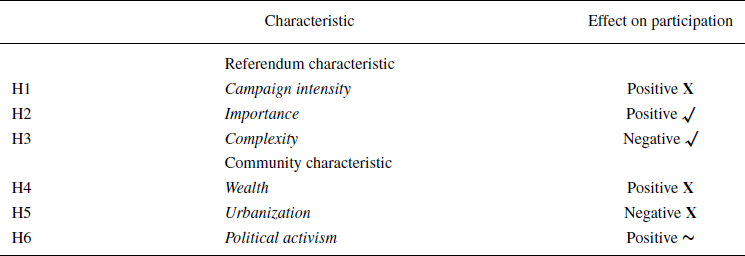
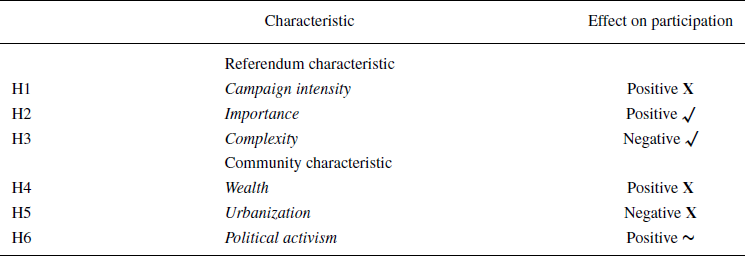
Table 5 summarizes our main findings regarding contextual effects on individual participation in direct democratic votes. Two of the three effects at the referendum level are largely confirmed: importance and complexity. Whereas more important issues increase participation, more complex ballot proposals decrease it. The effect of campaign intensity is not confirmed. While both coefficients for media intensity and party competition always point in the expected positive direction, we only find significant effects for our party competition measure in the aggregate and survey-based models. The effects for the community level are much weaker and highly unstable across model setups. Community turnout shows the relatively most consistent effect on individual participation, but not across all model setups, particularly not in the survey-based models. When summarizing the contextual effects, it is important to mention the problem of ecological fallacy. Whereas basically all contextual effects would be confirmed by relying on aggregate models, many of these effects get much weaker in models including individual-level factors. This holds especially true for community-level factors, which seem to be affected by compositional effects.
Overview of results
Finally, we have to discuss the overall relevance of any of the three levels. To determine the portion of the variance which can be explained by each level we ran additional ‘empty’ multilevel models based on our main dataset (as in Table 4) and the additional survey data (as in Table A3). While for our main dataset the resulting intra-class correlations (ICC) are 0.04 for the referendum and 0.01 for the community level, for the survey-based dataset the ICCs are 0.05 for the referendum and 0.17 for the community level. Although in both cases the majority of variance is due to individual differences, especially in the survey-based dataset the contextual level explains almost a quarter of the variance. Using a (perfectly) random sample thus results in a lower relevance of contextual levels than when using survey data, which most researchers (have to) use. This difference in contextual relevance is relevant to put some of the significant community-level effects in the survey model into perspective. These effects seem rather due to the non-random character of the survey sample and are less genuine context effects. Using a perfectly random sample results in little variance to be explained by community factors and thus explains the weaker and unstable community effects in the main models.
Discussion
Following the increasing importance and use of referendums in democracies around the world, our article is among the first to provide in-depth knowledge about the factors driving individual direct democratic participation. The main contribution to extant research is the comprehensive analysis of the influence of individual, referendum- and community-related factors on participation. While these factors have been theorized and examined in previous (electoral) research, no study so far has tested their simultaneous effects in a joint analysis. The simultaneous examination of various individual and contextual factors on individual turnout represents reality in a better way than focusing on specific aspects only. This comprehensive approach both reduces the risk of confounding variables and brings us close(r) to net effects of each determinant. We took advantage of the Swiss direct democracy, which due to the high frequency of referendums and large variations in turnout is particularly well-suited for such an endeavour.
Comparing the influence of individual and contextual factors on the individual decision to participate in referendums, our results show that individual determinants are (clearly) more important. This finding is in line with patterns for (presidential) elections, for which Leighley and Nagler (Reference Leighley and Nagler1992) equally reported a much stronger effect of individual-level factors compared to both long-term (geographical) and short-term (election-specific) systemic factors. Another similarity to election-specific findings is the by far strongest effect stemming from the past participation of a person (Smets & van Ham, Reference Smets and van Ham2013). This means that especially the individual history or personal habit of voting matters to decide whether to turn out or not in a referendum vote.
Yet, unlike the ‘almost nil’ effect assigned to systemic factors for electoral turnout by Leighley and Nagler (Reference Leighley and Nagler1992, p. 733) (see also few context effects of the political-institutional model in Smets & van Ham, Reference Smets and van Ham2013), we find that factors related to the referendum (campaign) show significant and consistent effects, in addition to the strong individual-level effects. One explanation of these differences may be our focus on more dynamic aspects that change between referendums, while election-specific research often compares more stable election characteristics across countries/regions. We find that especially more important issues and less complex ballot proposals increase citizens' participation.
In contrast, characteristics of the community people live in result in weaker and less stable effects on direct democratic participation. These results resemble electoral findings in the meta-analysis by Cancela and Geys (Reference Cancela and Geys2016), who, for instance, equally find no or only weak effects of geographical aspects such as population density or income (homogeneity). This also means that the assumed high relevance of the community-level context – compared to larger or smaller spatial units – on participation (Johnson et al., Reference Johnson, Shively and Stein2002) is not supported for referendum voting.
Our study further contributes to ongoing methodological discussions on how to best model participation. Although our aggregate turnout models displayed significant effects by basically all contextual variables under study, the majority of these effects disappeared in the multilevel models with individual participation as dependent variable. This calls for a careful interpretation of aggregate analyses, as they run the risk of ecological fallacy and may lead to very different (and erroneous) conclusions. In the same vein, robustness checks using survey-based data resulted in significant differences for some community-level effects on participation between the models. This stresses how crucial the quality of the sample, for example amount of selection bias, is to correctly estimate (community) factors.
The asset of having used official – instead of self-reported – participation data and the inclusion of a high number of variables on two contextual levels lends confidence to the robustness of the article's findings. Given the focus on Switzerland, a country with comparatively high numbers of referendum votes, our results may be of particular interest for cases such as Italy or several US states, which witness equal proportions of referendum usage (Uleri, Reference Uleri2002). From a methodological point of view and for the focus on smaller scale contextual effects on the community level, the restriction to one specific Swiss canton made sense, as to exclude other contextual differences on higher (cantonal) levels. However, and if similar data would be available, replications in other contexts are desirable to strengthen the generalizability of our findings. Yet, notwithstanding the lack of such replications, the various similar findings to election-specific research may also speak to a more universal nature of the findings, that may hold for other cases and for both referendums and elections. For instance, the community-level factors under consideration are not specific to the referendum context. The effects of importance and complexity are easy to adapt to elections as well. As is the case for referendums, most elections are dominated by one or two main current topics. The more important and less complex these dominating topics are, the higher the respective turnout may be. Having said this, the actual testing of an equally comprehensive model including both individual and context-related factors for elections is still a necessary next step. Ideally, this would result in a general model of (contextual) voting determinants compared to the existing rag rug of studies often focusing on only a subset of the here tested theories. However, we know that this strongly depends on data availability, which unfortunately is usually not as comprehensive as in the present study.
Acknowledgements
An earlier version of this article was presented at the Annual Conference of the Swiss Political Science Association in Geneva (2018) and at the workshop ‘Referendum practices at home and abroad’ organized by the Netherlands Institute of Government in Maastricht (2017). We wish to thank the participants and particularly Joost van den Akker, Lionel Marquis, Simon Hug and Alessandro Nai for helpful feedback. Finally, we are grateful for the constructive comments of the three anonymous reviewers and the editors of the EJPR for their help and support during the review process.
Online Appendix
Additional supporting information may be found in the Online Appendix section at the end of the article:
Figure A1: Overview of data (sources)
Table A1: Explanation of contextual data sources and variables
Table A2: Descriptive information about contextual variables
Table A3: Multilevel models using additional individual survey data
Table A4: Replication of multilevel models using survey data
Table A5: Multilevel models excluding all residents of the community of Geneva
Table A6: Multilevel models excluding past participation and additional referendum-level variables
Table A7: Robustness checks for complete model across ten randomly drawn sample
Data S2





 Open access

