


1. Introduction
China has a large number of mountain glaciers with a total area of 58 650 km2. Their temperature is of interest to glaciologists. Since 1959, every major investigation on glaciers has included temperature measurements, and much data has been obtained to date. The temperature measurements on glaciers in China can be divided into three periods depending on the technique of drilling and measuring. They are: (1) 1959–76, by manual drilling, drill depth not more than 10 m; measured by copper resistance thermometers, occasionally by thermistors, with an accuracy of 0.2 K. or so; (2) 1977–85, a steam drill was employed and on some glaciers a depth of 30 m was reached; quartz thermometers with an accuracy of 0.05 K were used; (3) since 1986, by using a hot-water drill and ice-core auger, drill depths have exceeded 100 m, and an integrated circuit sensor with an accuracy of 0.05–0.1 K has been used. By the end of 1988, there were 22 glaciers whose temperatures had been measured (Fig. 1; Table I). A summary of the temperature distribution of various glaciers is presented in this paper.
Index map showing the locations of the glaciers in China whose temperatures have been measured. Glacier names are listed in Table I.

Glaciers In China On Which Temperature Measurements Have Been Made

For comparison, the mean annual air temperatures (T a) at the equilibrium line are also presented. They are calculated on the basis of measurements at the nearest meteorological stations and on lapse rates determined by short-term measurements. A temperature jump from a non-glacierized area to a glacierized area is taken into account in the calculation. The uncertainty in air temperature is estimated to be about ±1 K.
2. The Classification of Glaciers in China
Reference Zuming and MaohuanLai and Huang (1989, 1990) suggested a new principle on which glaciers are classified by means of glaciological indices at the equilibrium line which can be used to classify numerically the glaciers in China. The indices are T a the mean air temperature in summer, the annual precipitation, 16 m temperature measured in the upper part of the ablation area, and a parameter of flow velocity. A fuzzy cluster analysis was conducted, then verified by stepwise discriminatory analysis. As a result, 22 glaciers in China were classified into types I, II, Ш, and IV. In the fuzzy cluster analysis, types II and III are clustered together when λ > 0.890, and then clustered with type I when λ > 0.878, where λ is the cluster level. Reference Zuming and MaohuanLai and Huang (1989a) named types I, II, Ш, and IV polar type, extra-continental type, sub-continental type, and maritime type, respectively. Incorporating comments of some Chinese glaciologists who do not agree that polar glaciers appear in mid-latitudes, Reference Zuming and MaohuanLai and Huang (1990) changed the names of the four types to quasi-polar, sub-polar A, sub-polar B, and temperate. In this paper we name them polar type, sub-polar type, and temperate type, respectively, so as to conform more closely to western terminology (Table II). The classification principle, however, is different from Reference AhlmannAhlmann’s (1935); we add the word “type” to every term for distinction.
Comparison Between The Changed Classification Terms

Glacier type is given in section 2 and Table II.
* Provided by Investigation Team on Utilization of Ice and Snow in the Qilian Shan, Lanzhou Institute Glaciology and Cryopedoloty, of Academia Sinica.
Stepwise discriminatory analysis (Reference Zuming and MaohuanLai and Huang, 1989, 1990) indicated that T a, the mean air temperature in summer, and the annual precipitation at the equilibrium line are the dominant variables, but that the ice temperature was not discriminatory. Because of this lack of discrimination by the 16 m ice temperature, we do not attempt to classify the glaciers on the basis of the glacier-temperature regime, but instead limit the following discussion to the temperature distribution of various glaciers in China.
3. Polar-Type Glaciers
Glaciers Nos 7–9 in Figure 1 and Table I are classified as polar type. Their T a, annual precipitation, and mean air temperature in summer at the equilibrium line are below −12°C, 450 mm, and −1°C, respectively. The ice temperature is quite low and the basal temperatures are generally below the melting point.
3.1. Chongce Ice Cap (No. 7)
Chongce Ice Cap, 18.1 km2 in area, was investigated by the Sino-Japanese Joint Expedition to the West Kunlun Mountains in 1987. at the equilibrium line (6000 m) is estimated to be −13.4°C, whereas the 16 m temperature was −13.2°C (Reference Wenzhang and LiuShao and Liu, 1990). Based on a model,Reference Tao and Jiankan Zhou and Han (1990) were able to draw a graph of the two-dimensional temperature distribution as shown in Figure 2. The ice temperature is quite low and the base is entirely frozen. In Zhou and Han’s (1990) model, the four measured temperature profiles shown in Figure 2 were used; in addition, heat conduction, advection and geothermal flux in the vertical direction, and internal heating were taken into account, on the asusmption that the glacier is in steady state.
Two-dimensional temperature distribution in a longitudinal profile of Chongce Ice Cap. West Kunlun Mountains (after Reference Tao and JiankanZhou and Han. 1990).

3.2. Dunde Glacier (No. 8)
In 1987, a Sino-U.S. Joint Expedition bored holes at the summit of Dunde Glacier (5324 m), a flat-topped glacier in the Qilian Mountains with an area of 57 km2. In one of the holes, 135 m deep, which reached the bed, a basal temperature of −4.8°C was measured (Reference LilunWang, 1990). T a at the equilibrium line (5200 m) is estimated to be −12.8°C
3.3. Glacier No. 12, Laohuguo (No. 9)
Glacier No. 12, Laohuguo, QiIian Mountains, is a valley glacier, 10km in length, on which temperature measurements have been made on many occasions. Its temperature is the lowest of those valley glaciers measured to date in China. In the upper part of the ablation area (4650 m, 50 m below the equilibrium line), and ice temperature of −12.8°C was recorded at a depth of 7 m on 31 July 1976, leading to an estimate for the 16 m temperature of −10.5°C (see section 4.5). In the middle of the ablation area, the base may locally reach the melting point. This is based on the observation that during 1960–61 the ratio of summer velocity to winter velocity was close to 1.6 near the middle of the ablation area (Reference Maohuan and ZuozheHuang and Sun 1982).
4. Sub-Polar-Type Glaciers
Physically, there is no difference between type II and type III glaciers in Table II. Chinese glaciologists have, in the past, usually regarded type II as extra-continental type and type III as sub-continental type, cf.Reference Yafeng, Maohuan and Ren Shi and others (1988). In this paper we combine both into one type — sub-polar type.
4.1. Icmperature profile in the active layer near the equilibrium line
Modifying the solution of the equation for heat conduction in a semi-infinite medium subject to an harmonic change in surface temperature, a semi-empirical formula

can be derived to describe the temperature profile in near-surface layers at or near the equilibrium line and where the surface elevation is changing only slowly (Reference Maohuan, Zhongxian and JiawenHuang and others, 1982b). In Equation (1) Ts
is an apparent amplitude of surface-temperature change, t is the time, y is the distance below the surface, k is thermal diffusivity, and  is the frequency of the surface-temperature change. We are interested in the change with a period of 1 year, i.e.
  . The equilibrium temperature T0(y) is found to change with depth and can be fitted to an empirical formula

where y0
is a unit of depth (1 m), and a1
and а2
are constants determined by regression analysis of observations, which vary from place to place. 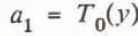 when у = 1m, i.e. a1
is the equilibrium temperature at a depth of 1 m. Usually
when у = 1m, i.e. a1
is the equilibrium temperature at a depth of 1 m. Usually 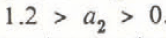 .
.
When temperature measurements are made at relatively shallow depths, say more than 5 m and less than 15 m, Equations (1) and (2) can be used to calculate the temperature at the base of the active layer at or near the equilibrium line as long as the measurements were taken at more than two different depths. For calculations, the values of T s, a 1 and a2 should be determined empirically. The active layer is defined as the uppermost layer of ice in which the amplitude of the annual temperature oscillation is more than 0.2 K. The thickness of the active layer is about 15–20 m.
4.2. Temperature regime in the infiltration zone
Considerable surface melting occurs in the infiltration zone of sub-polar-type glaciers during the summer. When melt water refreezes in the snow, latent heat is released, which warms the snow beneath. Percolation and refreezing become major processes of heat transfer in summer, and dominate the temperature profile of the near-surface layer in the infiltration zone all year-round.Reference Baolin, Zhichu and Maohuan Cai and others (1986) have suggested mathematical models for calculating the water-heat transfer and the temperature profiles in this zone based on experiments and observations made on Urumqi Glacier No. 1. According to their calculations, the warming effect of melt water may reach a depth of 20 m by the end of the melt season. Measurements made in the infiltration zone of the eastern tributary of Urumqi Glacier No. 1 showed that it was 0°C in the uppermost 11m and ≥−0.1°C down to a depth of 30 m during 20 July-10 August 1982 (Reference Jinhua, Jiawen and XinzhongZhang and others, 1984).Reference Hooke, Gould and BrzozowskiHooke and others (1983) found a similar penetration depth for this warming.
4.3. Longitudinal temperature profile
To describe quantitatively the changing temperature with elevation,Reference Maohuan, Zhongxian and Jiawen Huang and others (1982a, b) have suggested that the temperature at the base of the active layer should be used. They have developed a scheme which describes its variation with elevation. Their model has been verified by measurements on Urumqi Glacier No. 1 (Fig. 3). As shown in Figure 3, the temperature at the base of the active layer decreases with increasing elevation, as does the air temperature, but in the infiltration zone there is a maximum due to the greater warming effect of refreezing melt water. The temperature at the base of the active layer decreases from this maximum both up-glacier and down-glacier. However, down-glacier a minimum value does not appear at the equilibrium line, as the model ofReference Maohuan, Zhongxian and Jiawen Huang and others (1982a, b) suggests, but somewhere in the upper part of the ablation area. Because the warm ice in the infiltration zone is flowing down-glacier, it takes several years for it to be cooled. This was confirmed by measurements in deep holes in Urumqi Glacier No. 1 in 1986. Figure 4 shows the location of the holes and Figure 5 shows the temperature profiles. The profiles show that the temperature in the upper part of the ablation area (T2) is lower than that near the equilibrium line (T3) from the surface to a depth of 88 m (Reference Baolin, Maohuan and ZhichuCai and others, 1988).
Two measured temperature profiles showing how the temperature at the base of the active layer changes with altitude on Urumqi Glacier No. 1. E, east tributary; W, west tributary; ELA. equilibrium-line altitude; Ta. air temperature; at the summit it was measured at the base, 8.5 m deep, others at 16 m depth (by courtesy of Ren Jiawen).

A map showing the locations of holes for temperature measurement and the artificial tunnel in Urumqi Glacier No. 1.

Temperature profiles measured on Urumqi Glacier No. 1 on 27 September 1986. The dotted lines are extrapolated (afterReference Baolin Cai. unpublished).

The temperature at the base of the active layer of a sub-polar glacier may reach the melting point if the glacier extends to a sufficiently low elevation (Reference MaohuanHuang and others, 1982a, b; Reference Hooke, Gould and BrzozowskiHooke and others, 1983).
Measurements made on sub-polar glaciers show that the temperature at the base of the active layer is higher than T a at the same elevation.
4.4. Basal temperature
Among the sub-polar-type glaciers in China, the basal temperature has been measured only on Urumqi Glacier No. 1. It is estimated by radar sounding that the ice thicknesses at T 1 T 2 and T 3 (Figs 4 and 5) are 96, 138, and 106 m, respectively. Thus, the holes at T 3 reached and T 1 is close to the base of the glacier. Integrated-circuit sensors with an accuracy of ±0.05 K were used to measure the ice temperatures.
A temperature-distribution model based on the measurements in deep holes over a period of several months was made byReference Baolin Cai (unpublished). In the model, glacier flow and heat conduction in horizontal and vertical directions, and the geothermal flux are taken into consideration assuming that the temperature field is stable. As a result, it is found that the highest basal temperature, greater than −0.5°C, occurs in the middle of the ablation area, the thickest part of the glacier. We therefore believe that in sub-polar-type glaciers, as long as they are as large or larger than Urumqi Glacier No. 1, a small cirque-valley glacier, the base may be at the melting point at some locations.
In the terminus of Urumqi Glacier No. 1, a new tunnel (Fig. 4) was excavated in the autumn of 1988. The ice temperature was measured while the tunnel was being extended. The temperature profile is shown in Figure 6. Because the temperatures in the tunnel are below 0°C and, in view of the fact that permafrost is present in front of the glacier, the 0°C isotherm must lie at a depth of at least a few meters in the bed, as suggested by Reference Echelmeyer and ZhongxiangEchelmeyer and Wang (1987).
Section through the tunnel in Urumqi Glacier No. 1 with its temperature profile measured during excavation in September-October 1988 (by courtesy of Zhou Tao).

4.5. Regional features
Reference MaohuanHuang and others (1982a, b) have attempted to describe how the near-surface temperature changes with elevation using measured and calculated temperature at the base of the active layer as a temperature index of the active layer, and using the temperature at the base of the active layer at the equilibrium line as a characteristic temperature to determine the regional features of glacier temperature. As mentioned above, however, the temperature at the equilibrium line does not display significant characteristics. We prefer to take the minimum temperature at the base of the active layer in the upper part of the ablation area (T min) as the characteristic temperature for a glacier. However, it is difficult to determine T min owing to the spatial limitations of the measurements. Therefore, instead of T min, we take a temperature at the base of the active layer measured near the equilibrium line or in the upper part ot the ablation area, designated T′ min.
There are 14 sub-polar-type glaciers in China for which T′ min is known. These are listed in Table III together with the altitudes at which the measurements were made. The equilibrium-line altitudes and measurement years of the glaciers in Table III are shown in Table I. In Table III we take the 16 m temperature as the temperature at the base of the active layer. Equations (1) and (2) are used to calculate T′ min if the measured depth is less than 16 m. At Glacier No. 4, Shuiguanhe (No. 12), no measurement was made in the ablation area and therefore T′ min is not known for the glacier. The T′min for Glacier Rongbuk (No. 18) in Table III is higher than it should be, as the measurement point was in the lower part of the ablation area. For comparison, estimated T а at the measurement altitudes are also shown in Table III.
16 m temperature measured at the equilibrium line or in the upper part of the ablation area (T′ min) of sub-polar-type glaciers in china, compared with mean annual air temperature (T a)

* Calculated from shallow measurement. Other parameters are given in Table I.
Reference Hooke, Gould and BrzozowskiHooke and others (1983) analysed the complex process controlling the near-surface temperature in the lower part of the accumulation area and in the ablation area on polar and sub-polar glaciers, compared the ice temperature with T a, and pointed out that the principal controlling factors are snow-cover thickness, mean July temperature, and T a.
From Table III we can see that T′ min is, without exception, a few degrees higher than T a. T′ min for a flat-topped glacier, Glacier No. 7, Nakeduola (No. 17), is clearly lower than that for Yebokangjiale Glacier (No. 16), an adjacent valley glacier on the northern slope of Mount Xixiabangma. This is due to the thin snow cover on a flat-topped glacier, which reduces its winter insulating effect.Reference Kotlyakov and Krenke Kotlyakov and Krenke (1982) have mentioned that the accumulation on a flat-topped glacier may be less, at the most 30%, than the average annual precipitation at a fixed geographic position, but on a cirque glacier it is always more than the annual precipitation. The same reasoning could explain why T′ min is close to T a for Chongce Ice Cap (No. 7).
5. Temperate-Type Glaciers
Temperature-distribution studies on temperate-type glaciers are not as detailed as on sub-polar-type glaciers in China. Nos 19–22 in Figure 1 and Table I are temperate-type glaciers, which develop under conditions of the South Asian monsoon circulation. The precipitation on temperate-type glaciers in China is large in summer and low in winter. Therefore, the winter snow cover is not as thick as on other temperate glaciers, thus providing less insulation.
5.1. Accumulation area
In the accumulation area of temperate-type glaciers, there is no doubt that the main body of the glacier is at the melting point. The near-surface layer cools during the winter but quickly warms in summer due to melt-water percolation. A measurement made by Wang Lilun from 30 June to 11 July 1982 indicated that in the lower part of the accumulation area of Glacier No. 1, Baishuihe, a 10m thick near-surface layer consists of firn, which is at the melting point throughout. If the maximum elevation of a temperate-type glacier were higher than the upper limit of the warm-infiltration zone (wet-snow zone), it would have a temperature distribution similar to that of the cold-infiltration zone (percolation zone) of sub-polar-type glaciers. But, in the region of the temperate-type glaciers in the southeastern Qinghai-Xizang (Tibet) Plateau of China, the maximum elevation of the glaciers is usually below 6000 m a.s.l., which is still in the warm-infiltration zone.
5.2. Ablation area
In the near-surface layer, 10m or more thick, the temperature of temperate-type glaciers is below but close to 0°C Because of the thinner snow cover, the winter cold is able to penetrate deeper. But conductive warming in summer is inhibited by the fact that the ice temperature cannot exceed 0°C. Most of the heat received at the surface is used in melting. Therefore, summer warming cannot counteract winter cooling. Thus, it is one of the features in the ablation areas of temperate-type glaciers in China that temperate ice is often covered by a sub-freezing surface layer. Figure 7 shows two temperature profiles from the ablation areas of temperate-type glaciers in China, both of which have this cold surface layer.
Temperature profiles of two temperate-type glaciers, x upper part of the ablation area (4600 m) on Glacier No. 1. Baishuihe. 11 July 1982; middle part of the ablation area (4540 m) on Dagongba Glacier, 30 September 1982. The glacier surface at the time of measurement is taken as the origin of the depth coordinate (by courtesy of Wang Lilun).

For temperate-type glaciers in China, T min is 2.6–4.5 K higher than T a (Reference Zuming and MaohuanLai and Huang, 1989, 1990).
6. Conclusions
The minimum temperature at the base of the active layer in the upper part of the ablation area (T min) can be taken as a characteristic temperature of a glacier.
The classification suggested byReference Zuming and Maohuan Lai and Huang (1989, 1990) can be regarded as a basis for discussing the temperature distribution of glaciers in China. In this classification, which is different fromReference Ahlmann Ahlmann’s (1935), glaciers are numerically classified by multi-factors which are measured at a fixed place – the equilibrium line. Features of the temperature distribution of glaciers in China can be summarized as follows:
-
Polar-type glaciers – low surface-layer temperature, T min < −10°C, generally with a cold base except for large valley glaciers, where part of the base in the ablation area may be at the melting point. T min approximates or even equals T a.
-
Sub-polar-type glaciers – −10°C < T min < −1.0°C, usually with basal melting in the middle of the ablation area. The area of basal melting will extend to the terminus in a large valley glacier whose terminus reaches a temperate region. T min is generally higher than T a.
-
Temperate-type glaciers – the main body, including the base, is at the melting point. However, in the ablation area, the near-surface layer is below 0°C all the year round because of a thinner winter snow cover. T min is certainly higher than T a.
Acknowledgements
The author wishes to express his thanks to Wang Lilun, Ren Jiawen, and Zhou Tao for their courtesy in providing the data and graphs, to W.S.B. Paterson for his encouragement and discussion in the writing of the manuscript, and to R.LeB. Hooke and K. Echelmeyer for assisting with the revision.



