





Introduction
Living with a child who has a chronic illness or a life-limiting condition (LLC) has significant impacts on parents (Cohn et al. Reference Cohn, Pechlivanoglou and Lee2020), as well as any well-siblings (herein referred to as “siblings”) (Kelada et al. Reference Kelada, Wakefield and Drew2022). Chronic illnesses are defined as lasting longer than 6 months and requiring long-term care, such as cancer, epilepsy, chronic kidney disease and developmental disabilities (Australian Institute of Health and Welfare 2020). Chronic illnesses affect approximately 10–20% of Australian children (Australian Institute of Health and Welfare 2020). Further, LLCs are defined as conditions for which cure is highly unlikely and from which the child is ultimately expected to die (Fraser et al. Reference Fraser, Gibson-Smith and Jarvis2021, Reference Fraser, Miller and Hain2012). Children with LLCs may have a wide range of diagnoses, including end stage cancers, severe cerebral palsy, neuromuscular conditions, as well as a variety of congenital conditions (Fraser et al. Reference Fraser, Gibson-Smith and Jarvis2021; Hain et al. Reference Hain, Devins and Hastings2013). As potential treatment and management options are exhausted, it is possible that conditions initially regarded as chronic illnesses may become LLCs.
Children with a chronic illness or LLC commonly have extensive and complex healthcare needs which require careful symptom management and frequent medical appointments (Bösch et al. Reference Bösch, Wager and Zernikow2018; Namisango et al. Reference Namisango, Bristowe and Allsop2019). As such, parents often experience considerable emotional, social and financial impacts (Jaaniste et al. Reference Jaaniste, Cuganesan and Chin2022; Kelada et al. Reference Kelada, Wakefield and Vetsch2020). Research suggests that siblings living in these households commonly receive less parental time and attention and have poorer psychosocial functioning than controls (Jaaniste et al. Reference Jaaniste, Cuganesan and Chin2022; Kelada et al. Reference Kelada, Wakefield and Drew2022).
Family communication may be one important factor that can affect how siblings respond to, and cope with, stressors in their home environment, potentially serving as a protective factor against negative mental health impacts (O’Brien et al. Reference O’Brien, Duffy and Nicholl2009). Parent–sibling illness-related communication can help siblings to better understand and interpret complex medical information, as well as serve as emotional support for the siblings (Jaaniste et al. Reference Jaaniste, Tan and Aouad2020). Poor communication between parents and siblings may contribute to sibling social withdrawal and alienation (Fleary and Heffer Reference Fleary and Heffer2013), siblings’ internalizing or externalizing emotions (Knecht et al. Reference Knecht, Hellmers and Metzing2015), and poor family functioning (Herzer et al. Reference Herzer, Godiwala and Hommel2010). Improving the quality of parent–sibling communication may also indirectly improve sibling mental health (Haukeland et al. Reference Haukeland, Czajkowski and Fjermestad2020).
Research investigating the communication preferences of siblings who have a brother or sister with a chronic illness has identified that siblings often want more illness-related information from their parents (Long et al. Reference Long, Lehmann and Gerhardt2018; Lummer-Aikey and Goldstein Reference Lummer-Aikey and Goldstein2021). Parents, however, often report feeling overwhelmed and unsure of how to support and communicate with the siblings (Branstetter et al. Reference Branstetter, Domian and Williams2008). Parents often feel uncertain about how much information to share with siblings about their brother or sister’s illness (Graff et al. Reference Graff, Hankins and Graves2012). As such, there is a need to better understand how siblings and parents perceive their illness-related communication with each other. Such understanding in the context of child chronic illness and LLCs will help inform tailored advice and psychosocial interventions. Therefore, we aimed to qualitatively explore illness-related communication from the perspectives of siblings and parents – focusing on their perceptions of the level of openness of illness-relation communication, and the amount of illness-related information communicated. We also aimed to compare responses from siblings and parents of children with a chronic illness with those of siblings and parents of children with an LLC.
Methods
Design
Institutional ethics approval was granted by the Sydney Children’s Hospital Network Human Research Ethics Committee (HREC/17/SCHN/431 and LNR/18/SCHN/449). Data reported in this study were collected as part of 2 complementary larger studies that explored the psychosocial functioning of parents and siblings of children with a chronic (Kelada et al. Reference Kelada, Wakefield and Drew2022) illness and parents and siblings of children with an LLC (Jaaniste et al. Reference Jaaniste, Cuganesan and Chin2022). The 2 studies adopted similar methods and questionnaire items to enable the merging of data. Recruitment for these studies was completed between 2018 and 2020.
Participants
Study participants included the parents and/or siblings of children with either (1) a chronic illness (not treated by a palliative care team) or (2) an LLC (treated by a pediatric palliative care team). Siblings of children with a chronic illness were eligible if they were 12 years or older. Families of children with an LLC were eligible if the patient was diagnosed with an LLC at least 3 months prior and if siblings were aged 8 years or older. Siblings and parents of children with a chronic illness or LLC were ineligible if they had a cognitive impairment limiting their ability to complete questionnaires, if they had limited English ability, or if the patient was believed to be in the terminal phase and close to death. For the chronic illness group only, parent and sibling participation was independent of each other, meaning that parents could participate if the sibling chose not to, and vice versa.
Measures
All siblings were asked to answer 2 open-ended questions about the issues and challenges of communicating with their parents: (1) “Think about your brother/sister’s medical condition. What issues (if any) do you wish that your family spoke more openly about? Please list the issues or questions that you have so far not been able to talk about with your family.” (2) “Have there been any occasions when your parents have provided you with more information than you wanted or needed about your brother/sister’s medical condition? If yes, please describe.”
Siblings of children with an LLC were also asked a third question: “Children sometimes don’t talk with parents about things that are important to them. What things might sometimes get in the way of you talking with your parents about things that are important to you?”
All parents were asked the following question: “What issues (if any) do you think it best NOT to discuss with this sibling?Footnote 1”
All participants completed emotion thermometers to indicate their level of distress, anger, anxiety, depression, and need for help (Mitchell et al. Reference Mitchell, Baker-Glenn and Granger2010). The emotion thermometers are presented in a visual thermometer format ranging from 0 to 10. We used this data for risk management purposes (please see below).
Procedure
Siblings and parents of children with a chronic illness were recruited from various clinics and outpatient clinics of Sydney Children’s Hospital, Randwick, as well as via the researchers’ professional social media pages, and social media of various community organizations. Siblings and parents of children with an LLC were recruited from the pediatric palliative care service at Sydney Children’s Hospital, Randwick, the Children’s Hospital at Westmead, or Bear Cottage.
Eligible families were informed about the study by clinicians, who either provided families with information sheets and consent forms, or arranged for a researcher to contact them to discuss the study further. Researchers then telephoned or emailed these parents, informed them of the study, and sought permission to contact the eligible siblings. Researchers also recruited families of children with a chronic illness face-to-face from the wards and clinics, if deemed appropriate to approach by the treating team. If families agreed to receive further information, a hardcopy or online study pack (including the information sheet, consent form, questionnaire, and reply-paid envelope if applicable) were mailed, emailed or handed to eligible parents and siblings of children. Families of children with an LLC were also given the option to complete the questionnaire during a home visit by a researcher. Online questionnaire completion was the sole method of data collection used in 2020 due to COVID-19 restrictions.
Siblings were encouraged to complete the questionnaire on their own, without help from a parent. For the LLC group only, a researcher was present when children younger than 11 years completed the questionnaires to assist as needed. Following questionnaire completion, if a parent or sibling rated their current distress as 8 or more out of 10, the participant was phoned by a member of the research team, who further assessed their current mood and determined whether referral to additional support was necessary.
Data analysis
Qualitative content analysis was carried out following the guidelines of Elo and Kyngäs (Reference Elo and Kyngäs2008), using an inductive, iterative approach. This method contains 3 stages to data analysis: preparation, organization, and reporting, and was performed separately for parent data and sibling data. In the preparation stage, each of the participant responses were read multiple times by the 2 coders (RI and LK) to become familiar with the data. During the organization stage, one coder (RI) developed initial codes for the data, and then discussed and revised the codes with a second coder (LK). The codes were then organized into a coding tree and then into overarching categories (or themes) by the 2 coders. The frequency of responses was tallied for each theme. After initial coding was complete, matrix coding (Groenland Reference Groenland2018) was used to cross-analyze the data according to whether the unwell child in the family had a chronic illness or a LLC. As part of the reporting stage, we present each of our themes alongside illustrative quotations.
The broader project from which the data for LLC families was extracted included a longitudinal component, with questionnaires readministered at 6 months. For the purposes of the current study, to maximize the richness of the qualitative data, the responses of parents and siblings across the 2 time points were merged for analysis. Parents’ qualitative responses for all siblings in the family were included for analysis.
Results
Demographic information
Forty-five siblings and 151 parents of children with chronic illness participated in the larger study (response rates: 54.2% and 53.0%, respectively). Among the families of children with an LLC, 14 declined to participate, and 10 were unable to participate due to COVID-19 restrictions, leaving a total of 22 families who participated in the larger study (response rate: 47.8%).
A total of 93 siblings met inclusion criteria for the larger studies and completed the questionnaires. Of these, 32/45 (71.1%) siblings of children with chronic illness and 37/48 (77.1%) siblings of children with an LLC completed at least one of the open-ended questions.
A total of 193 parents met inclusion criteria and participated in the larger studies. Among the parents of children with a chronic illness, 86/151 (57.0%) parents completed the open-ended question. Among the parents of children with a LLC, 38/42 (90.5%) parents completed the open-ended question.
Sibling and parent demographic information are reported in Table 1. Siblings of children with chronic illness were on average older than siblings of children with an LLC (M = 15.16, SD = 3.33 vs. M = 12.97, SD = 3.63; t(67) = 2.59, p = .012).
Participant demographics
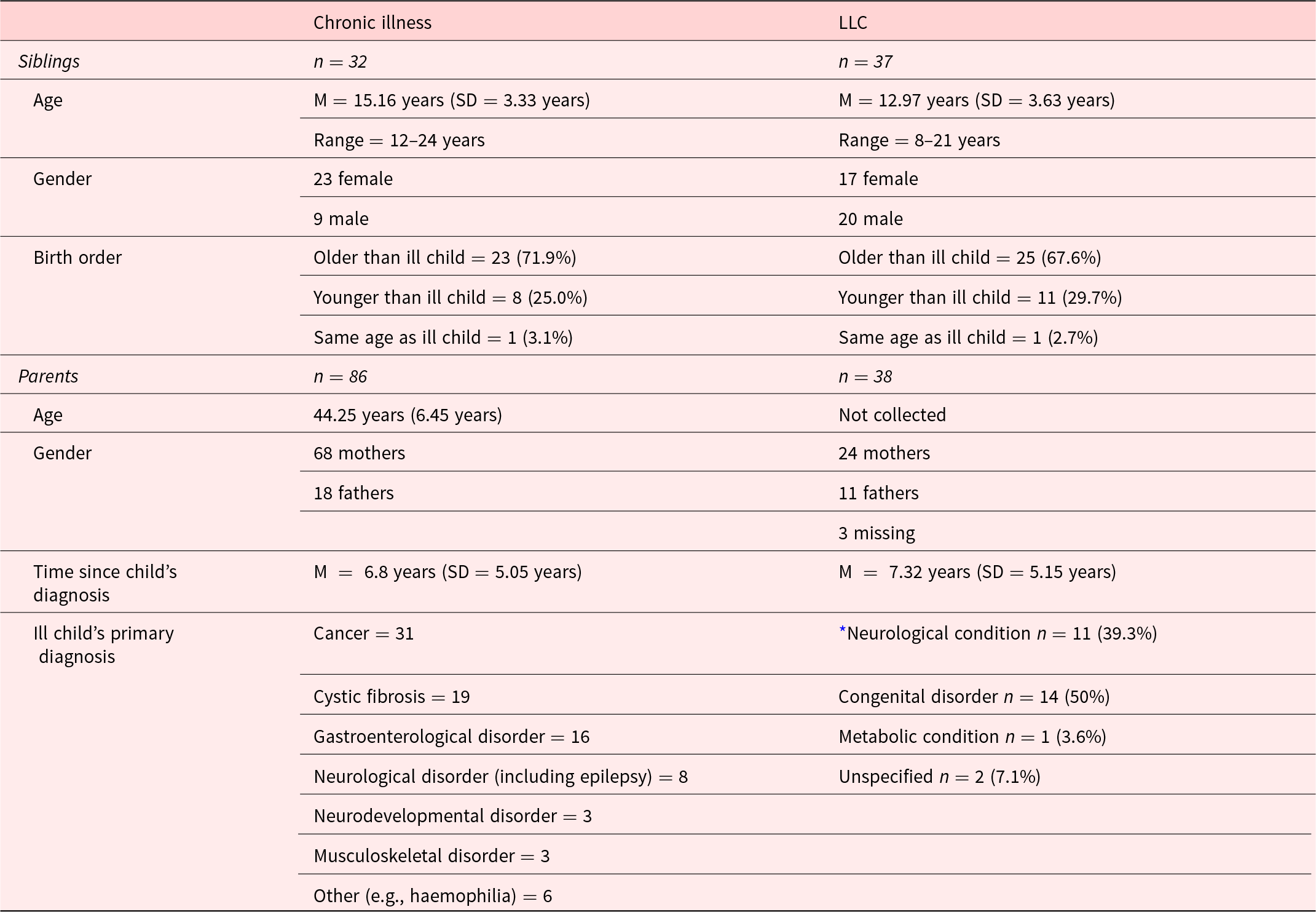
M = mean; SD = standard deviation.
* The number of primary diagnoses is less than the number of well-siblings as some patients had more than one participating well-sibling.
Sibling responses
We identified 3 themes from siblings’ responses: (1) openness of illness-related communication; (2) information overload from parents; (3) communication about mental health and peer support.
(1) Satisfaction with level of openness of illness-related communication
Most siblings reported that there was nothing more that they wished to be able to speak with their parents about regarding their brother or sister’s condition. Specifically, 22 siblings of children with chronic illness (68.8%) and 25 siblings of children with an LLC (67.6%) reported satisfaction with the level of communication with their parents. These siblings reported that they were satisfied with the level of communication because they perceived communication to be “very open.” “I think my family is open, if I have any questions I am not afraid to ask.” (16-year-old sibling of a child with chronic illness). “Everything about my brother’s medical condition has been talked openly about.” (15-year-old sibling of a child with an LLC).
Five siblings of children with chronic illness (15.6%) and 14 siblings of children with an LLC (37.8 %) reported that they wanted their parents to provide them with more information about their brother or sister’s medical condition. “Sometimes I wish my parents would tell me more about his current state.” (13-year-old sibling of a child with a chronic illness).
At the start, [I wanted my parents to] be open about what was actually happening. [They] waited a while to tell me it was a tumour so I was sitting in the dark trying to figure out why everyone was sad. (15-year-old sibling of a child with a chronic illness).
Three siblings wrote that their parents sometimes limited information based on their age, and agreed with their parents’ decision to do so.
My parents used to censor information regarding his health when we were a lot younger, but now they are completely transparent about everything. I understand why they did this and am glad they did. (20-year-old sibling of a child with a chronic illness).
Sometimes my parents will talk about things they worry will upset us so they talk in private at night - this doesn’t bother me as I’m sure in time they will tell me. (9-year-old sibling of a child with an LLC).
Unique to the siblings of children with an LLC, 4 (10.8%) of these siblings reported that they wanted parents to communicate information on their brother or sister’s life expectancy. “Wanting to know how long he would live.” (17-year-old sibling of a child with an LLC). Two additional siblings of children with an LLC (5.4%) also wondered what would happen after their brother or sister dies: “Because [my brother] is terminal he will eventually die with what he has. So what will happen when he dies?” (16-year-old sibling of a child with an LLC).
(2) Information overload from parents
Three siblings of children with chronic illness (9.4%) and 6 siblings of children with an LLC (16.2%) reported that at times, their parents provided them with too much information. “It’s just an overload in general.” (13-year-old sibling of a child with an LLC)
Sometimes I ask about one thing and then I get a thousand other answers. (11-year-old sibling of a child with an LLC).
These siblings also reported that information was “too much” when it centered around the severity of their brother or sister’s illness. “When I was told exactly how bad it was and that we might lose him. I wish I didn’t know that at all.” (19-year-old sibling of a child with a chronic illness).
(3) Communication about mental health and peer support
Three siblings of children with a chronic illness (9.4%) reported that they wanted to be able to speak with their parents about the impact of their brother or sister’s condition on their own mental health and all family members’ mental health.
I wish my family spoke more openly about the impact my brother’s illness places on our mental health, more than just updates on his condition. (18-year-old sibling of a child with a chronic illness).
Four siblings of children with an LLC (10.8%) wanted their parents to help them connect with other siblings in a similar situation with whom they could talk and share experiences.
[I want] someone to talk to who knows exactly what I am going through and someone who I can exchange experiences and advice with. (14-year-old sibling of a child with an LLC)
Parent responses
We identified 4 themes from parents’ responses about issues they believed it best not to discuss with sibling(s): (1) nothing is “off-limits,” (2) age-appropriate illness-related communication, (3) details about the sick child’s prognosis, and (4) limiting communication about impacts of the illness on family functioning.
(1) Nothing is “off limits”
Thirty-three parents of children with a chronic illness (38.4%), and 24 parents of children with an LLC (57.1%) reported that no topics were “off limits” and that they discussed everything with the healthy siblings. E.g., “I don’t hold back anything” (Parent of a child with an LLC).
(2) Age-appropriate illness-related communication
Eleven parents of children with a chronic illness (12.8%) and 5 parents of children with an LLC (11.9%) specifically mentioned either ensuring the information shared was age appropriate, or that it was conveyed using age-appropriate language. E.g., “Any sibling communication would need to be age appropriate, [for example] story book for very young kids…It depends on the age of the child.” (Parent of a child with a chronic illness)
Similarly, parents mentioned that they allow siblings to lead the conversation about their brother or sister’s health so that they can provide information that corresponds with their child’s informational needs: “if he asks more, I explain more” (Parent of a child with a chronic illness). “We’ve spoken to a number of different people, nurses, [a social worker] and they’ve advised to answer questions as they arise – which is what we are doing.” (Parent of a child with an LLC).
(3) Details about their child’s prognosis
Thirty-nine (45.3%) parents of children with chronic illness and 10 (23.8%) parents of children with LLC noted that they thought it was best to avoid discussing the medical prognosis of the ill child with siblings. Specifically, these parents avoided discussing “death,” “life expectancy,” and “coming close to losing our child due to illness.”
We always give hope and determination to kids, we never talk about negativity such as death etc. (Parent of a child with an LLC).
Two parents of children with LLC reported they avoided discussing “being asked to consider signing a DNR.”
(4) Limiting communication about impacts of the illness on family functioning
Nine parents of children with chronic illness (10.5%) and 1 parent of a child with an LLC (2.4%) avoided discussing the impact of their child’s chronic illness on themselves and family functioning dynamics with siblings. Among the parents of children with chronic illness, 6 parents (7.0%) listed personal impacts including carer workload and impacts on their personal mental health as avoided topics with siblings. One parent described avoiding discussion about depression and loss of hope, while others mentioned stress and anxiety. Three parents (3.5%) specifically avoided discussion of special parental treatment toward the ill child. The parent of a child with an LLC reported that they did not discuss the sorrow they experienced that the sibling “missed out on a playmate and a friend.”
Discussion
This study explored the quality of illness-related communication between siblings and parents of children with a chronic illness or an LLC. Over two-thirds of the siblings were satisfied with their illness-related communication with their parents about their brother or sister’s chronic illness or LLC. These siblings reported they were satisfied with the illness-related communication because they perceived it to be open and honest, with similar findings previously reported in other samples (Lummer-Aikey and Goldstein Reference Lummer-Aikey and Goldstein2021; Yang et al. Reference Yang, Mu and Sheng2016). A previous study of siblings of children with cancer suggested that siblings should be provided with regular updates and information relating to their brother or sister’s disease and treatment (Gerhardt et al. Reference Gerhardt, Lehmann and Long2015).
In the current study, parents of children with an LLC more frequently reported having open illness-related communication with siblings, and reported avoiding fewer topics of discussion with the healthy siblings, in comparison with parents of children with chronic illness. It may be that, due to the dire nature of LLCs, parents may feel they have no choice but to inform siblings about their brother or sister’s health status. In contrast, siblings of children with chronic illness in the current study, as well as in previous research (Lummer-Aikey and Goldstein Reference Lummer-Aikey and Goldstein2021), want their parents to communicate about illness-related information – in an age-appropriate way – from a young age.
A number of siblings expressed a desire to have more illness-related communication about prognosis and life-expectancy, which contrasted with some parents expressing the view that this information should be withheld from siblings. A previous study by Havill et al. (Reference Havill, Fleming and Knafl2019) suggested that when siblings lack complete information regarding their brother or sister’s illness, they may construct their own explanations built on self-blame, which can further drive emotional distress. Nevertheless, several other siblings reported that communication was “too much” when it centered around the severity of their brother or sister’s illness; the responses from these siblings were comparable with parents who wanted to withhold information about prognosis. Furthermore, there were a range of parent attitudes toward topics to avoid, with over one-third of parents of children with a chronic illness, and over half of parents of child with an LLC responding that they prefer completely open illness-related communication. These findings underscore the importance of age-appropriate and child-specific communication, which was directly mentioned by several parents. Individual siblings and families communicate differently, and parents should tailor the illness-related information they provide to the individual needs of each sibling.
Whereas some siblings reported that they wanted to speak more about the impacts of their brother or sister’s illness on the family, some parents believed these issues should not be discussed with the healthy siblings. Previous studies have described feelings of exclusion that siblings may experience when living with a child with a chronic illness (Deavin et al. Reference Deavin, Greasley and Dixon2018), and this may be explained by reciprocal silence between some parents and siblings. As parents limit their own illness-related communication, siblings are consequently likely to “return” this silence so to not burden their parents with their own emotional needs and worries (Deavin et al. Reference Deavin, Greasley and Dixon2018).
Strengths and limitations
Our study benefitted from eliciting the perspectives of parents and siblings of young people with a chronic illness or LLC. Nevertheless, the study had several limitations. First, siblings of children with a chronic illness were on average older than siblings of children with an LLC. Differences between these groups may have been age related. Second, the survey contained only a small number of open-ended questions, which were placed at the end of the questionnaire with no subsequent probing. Participants (especially younger participants) may have experienced survey fatigue and not provided the same detail they would have if these questions were earlier in the questionnaire. A qualitative interview, rather than an open-ended survey, may have provided richer information. Nevertheless, a considerable number of comments were provided by both parents and siblings in the survey. Third, the recruitment method used may have resulted in self-selection bias. Families who agreed to participate in a study on sibling wellbeing may have been more open communicators. Fourth, the time since diagnosis varied for participants; illness-related communication is likely to fluctuate across the illness trajectory. Finally, familial communication may have been impacted in various ways due to lockdowns in response to the COVID-19 pandemic, which occurred in Sydney during the end stages of data collection. For example, during lockdowns parents and siblings may have had less access to their usual extended supports, and been more reliant on each other. Moreover, the lockdowns may have placed greater stress on some families, particularly if there were concerns about accessing the desired level of support for the unwell child.
Research and clinical implications
Siblings in our sample discussed the importance of open illness-related communication in their families, which previous research has also affirmed (Yang et al. Reference Yang, Mu and Sheng2016). Having an open line of communication between family members throughout the illness journey may help siblings to better comprehend changing circumstances and feel safe to share their own concerns (Lummer-Aikey and Goldstein Reference Lummer-Aikey and Goldstein2021). Nevertheless, each child is different and parents should first enquire about the amount of illness-related communication that each individual sibling wants. Although many siblings in the current study expressed a desire for open illness-related communication, it has been reported elsewhere that some young people, especially boys, may not initiate difficult conversations, such as about death (Jaaniste et al. Reference Jaaniste, Cuganesan and Chin2022). Parents may benefit from guidance from healthcare teams about how to initiate open and age-appropriate illness-related conversations with siblings (Yang et al. Reference Yang, Mu and Sheng2016).
Researchers in Norway have developed a group psychosocial intervention for siblings and parents of children with chronic illness (“SIBS”) which aims to improve parent–sibling communication (Haukeland et al. Reference Haukeland, Czajkowski and Fjermestad2020). Early evidence shows that SIBS is effective in improving parent–sibling illness-related communication as well as sibling mental health (Haukeland et al. Reference Haukeland, Czajkowski and Fjermestad2020). In-line with the findings of this current study, SIBS allows siblings to express to their parents the amount of illness-related communication they want to know. Future research should examine the efficacy of this intervention in other cultures. Research should also examine whether SIBS is suitable for siblings and parents of children with LLCs.
Conclusions
This study provided important insight into siblings’ and parents’ perceptions of family communication across 2 illness categories: chronic illness and LLCs. Siblings were typically satisfied with family illness-related communication when it was open and age-appropriate and were dissatisfied when parents either withheld information or provided more information than they could manage. Parents generally favored an open illness-related communication style with the siblings, though this was more common among parents of children with an LLC than chronic illness. Our findings also show that each sibling is different, and parents should first enquire with the siblings about the amount of illness-related communication that they are comfortable with, in order to tailor information to the child’s maturity level, distress, and age.
Data availability statement
The data that support the findings of this study are available on request from the corresponding author. The data are not publicly available due to privacy or ethical restrictions.
Acknowledgments
The authors would like to thank all the siblings and parents who participated in this study. We would like to acknowledge Yuenn Teh Tong Tze, Lachlan Munro, and Nicholas Handelsman for their contributions to this study. Thank you to the SibStars team including A/Prof. Chee Y. Ooi, Dr. Elizabeth E Palmer, Prof. Ann Bye, Ms. Sandra De Marchi, Prof. Adam Jaffe, Dr. Sean Kennedy, Prof. Richard Cohn, Prof. Glenn Marshall, Prof. Tracey O’Brien, Dr Rani Sachdev, Ms. Rebecca Macintosh, Ms. Fleur Le Marne, Ms. Erin Beavis, and Dr Tejaswi Kandula. We thank the following organizations for their support of this study: Siblings Australia, Cystic Fibrosis Australia, and the Ronald McDonald House Charities Australia.
Funding
Prof. Wakefield is supported by the National Health and Medical Research Council of Australia (APP2008300). This work was supported by Luminesce Alliance – Innovation for Children’s Health for its contribution and support. Luminesce Alliance is a not-for-profit cooperative joint venture between the Sydney Children’s Hospitals Network, the Children’s Medical Research Institute, the Children’s Cancer Institute, the University of Sydney, and the University of New South Wales Sydney. It has been established with the support of the NSW Government to coordinate and integrate pediatric research.
Competing interests
The authors declare no conflict of interest.


 Open access

