


1. Introduction
Global challenges, such as climate change and the rising demand for sustainable food systems, have intensified attention on the efficiency and resilience of agricultural markets (Clark and Tilman, Reference Clark and Tilman2017; Valencia, Wittman, and Blesh, Reference Valencia, Wittman and Blesh2019). In this context, grain legumes play a crucial role due to their ecological benefits and nutritional value (Poore and Nemecek, Reference Poore and Nemecek2018). As nitrogen-fixing crops, legumes boost soil fertility, lessen reliance on synthetic fertilizers, and increase biodiversity, thereby supporting the shift toward more sustainable agricultural systems (Bues et al., Reference Bues, Preibel, Reckling, Zander, Kuhlman, Topp, Watson, Lindström, Stoddard and Murphy-Bokern2013; Watson et al., Reference Watson, Reckling, Preissel, Bachinger, Bergkvist, Kuhlman, Lindström, Nemecek, Topp, Vanhatalo, Zander, Murphy-Bokern and Stoddard2017; Reckling et al., Reference Reckling, Döring, Bergkvist, Stoddard, Watson, Seddig, Chmielewski and Bachinger2018).
Moreover, legumes such as field beans, lupins, and peas serve as viable regional alternatives to imported soy. With increasing consumer demand for plant-based proteins driven by growing interest in vegetarian and vegan diets, these crops have become more relevant for both food and feed markets (Alandia et al., Reference Alandia, Pulvento, Sellami, Hoidal, Anemone, Nigussie, Agüero, Lavini and Jacobsen2020). They offer farmers diverse income sources, especially as legumes gain popularity in European markets through protein isolates and plant-based products (Ferreira, Pinto, and Vasconcelos, Reference Ferreira, Pinto and Vasconcelos2021), which is why grain legume production is promoted by international (Common Agricultural Policy (European Commission, 2022)) and national policies (German Protein Strategy (BLE, 2020)).
At the same time, the German legume market demonstrates substantial untapped potential. In 2022, the country imported soybeans worth $2.4 billion and soybean products totaling $4.4 billion alongside $77.9 million in peas and $44.7 million in lentils (Chatham House, 2024). In 2023/24, Germany produced 670,900 tons of grain legumes itself, covering only 62% of domestic use (1.1 million tons) (Bundesanstalt für Landwirtschaft und Ernährung, 2025). The acreage of grain legumes in Germany is below the EU average (Eurostat, 2025; Notz et al., Reference Notz, Topp, Schuler, Alves, Gallardo, Dauber, Haase, Hargreaves, Hennessy, Iantcheva, Jeanneret, Kay, Recknagel, Rittler, Vasiljević, Watson and Reckling2023), although an expansion of this area (even in the whole Europe) would contribute to greater food and feed self-sufficiency (van Loon et al., Reference van Loon, Alimagham, Pronk, Fodor, Ion, Kryvoshein, Kryvobok, Marrou, Mihail, Mínguez, Pulina, Reckling, Rittler, Roggero, Stoddard, Topp, van der Wel, Watson and van Ittersum2023).
Despite these ecological advantages and the economic potential, the integration of grain legumes into European agricultural markets remains limited. In Germany, the cultivation and commercialization of legumes continue to face considerable economic and logistical challenges (Soisontes, Freund, and Laquai, Reference Soisontes, Freund and Laquai2023). While their agronomic potential is evident, market structures remain underdeveloped, hindering broader adoption (Reckling et al., Reference Reckling, Bergkvist, Watson, Stoddard, Zander, Walker, Pristeri, Toncea and Bachinger2016; Ferreira, Pinto, and Vasconcelos, Reference Ferreira, Pinto and Vasconcelos2021).
Beyond agronomic constraints like soil conditions and regional climatic disparities (Roßberg and Recknagel, Reference Roßberg and Recknagel2017), the economic structure of the legume market presents systemic barriers. According to market theory, competitive environments require numerous buyers and sellers, homogeneous products, and perfect information sharing (Sexton, Reference Sexton2013). In contrast, the German legume market is characterized by a limited number of buyers as only 287 traders operate nationally (Union zur Förderung von Oel-und Proteinpflanzen e.V., 2025), creating a market power imbalance. Farmers often outnumber buyers, limiting their bargaining power and leading to poor price transmission and low profitability (Rogers and Sexton, Reference Rogers and Sexton1994).
Furthermore, grain legumes are often traded in small, heterogeneous lots, discouraging elevator operators and supply chains from engaging in these markets (Reindl, Braun, and Nadler, Reference Reindl, Braun and Nadler2017; Soisontes, Freund, and Laquai, Reference Soisontes, Freund and Laquai2023). The result is a fragmented market structure, in which high transaction costs go beyond transportation expenses to include information asymmetries, institutional barriers, and cultural frictions (Goodwin and Piggott, Reference Goodwin and Piggott2001; Pan and Li, Reference Pan and Li2019; Serra, Gil, and Goodwin, Reference Serra, Gil and Goodwin2006; Sheldon, Reference Sheldon2017). In spatial terms, this fragmentation significantly affects farmers’ access to the legume market. Empirical evidence shows that proximity to traders influences farmers’ willingness to cultivate legumes. However, this influence drops markedly beyond a transport threshold of approximately 100 km, at which point logistical costs render long-distance trade economically unfeasible (Mittag and Hess, Reference Mittag and Hess2023). As a result, farmers in peripheral regions face limited selling options, which reinforces low profitability and reduces the attractiveness of grain legume cultivation.
This clear gap between demand and production suggests that the current underperformance of the domestic legume sector is not due to a lack of demand or agronomic viability, but rather reflects structural inefficiencies in market configuration, particularly regarding the spatial distribution of trading actors. This situation has led to a self-reinforcing cycle in the German legume market. Traders are hesitant to engage due to small volumes and irregular supply, while farmers avoid legumes because of limited market access and low returns. Consequently, production remains low and structural inefficiencies persist. A similar dynamic has been described by Magrini et al. (Reference Magrini, Anton, Cholez, Corre-Hellou, Duc, Jeuffroy, Meynard, Pelzer, Voisin and Walrand2016) as a “lock-in situation” in the French legume sector. While their analysis focused on technical and economic dimensions, the present study emphasizes the spatial dynamics between producers and traders, conceptualized as a cyclical pattern.
Although previous studies have addressed institutional and economic constraints in the German legume market (Mittag and Hess, Reference Mittag and Hess2023, Reference Mittag and Hess2022; Kopp and Salecker, Reference Kopp and Salecker2020), the spatial configuration of the trader network remains underexplored. Specifically, it is unclear how the geographic distribution of traders aligns with production regions and what spatial adjustments could improve market access for farmers. Therefore, the key research question of this study is:
How does the spatial structure of the legume trader network in Germany influence farmers’ market accessibility, and what spatial reconfigurations could improve market conditions?
To address this question, we apply a spatial optimization framework that simulates improved trader networks using k-means clustering (Chen et al., Reference Chen, Lin, Qi, Li, Gao, Chen, Lin, Qi, Li and Gao2017; Khalid and Herbert-Hansen, Reference Khalid and Herbert-Hansen2018) and Gaussian Mixture Models (GMM) (Reynolds, Reference Reynolds2015; Lanjewar, Mathurkar, and Patel, Reference Lanjewar, Mathurkar and Patel2015). This approach enables analysis of how trader location impacts market efficiency, comparing the current fragmented structure to an optimized spatial configuration based on clustering outputs. By contrasting these two scenarios, the results contribute to the broader literature on agricultural market design by highlighting spatial access as a key structural variable and offering policy recommendations to support a more competitive, regionally embedded, and sustainable agricultural economy.
The remainder of this article is structured as follows: Section 2 reviews relevant literature on market fragmentation, location theory, and the German legume market. Section 3 outlines the data sources and methodological framework. Section 4 presents the results of the spatial optimization analysis, and Section 5 discusses their implications. Section 6 concludes with key findings and policy recommendations.
2. Theoretical Background
2.1. Market Fragmentation and Concentration
Markets for agricultural goods rarely resemble perfectly competitive markets in terms of their structure and characteristics (McCorriston, Reference McCorriston2002; Bonanno, Russo, and Menapace, Reference Bonanno, Russo and Menapace2018). Sexton (Reference Sexton2013) argues that most markets for agricultural goods worldwide do not correspond to the concept of a perfect market. Rather, in addition to Sexton (Reference Sexton2013), Bonanno, Russo, and Menapace (Reference Bonanno, Russo and Menapace2018), Bergquist and Dinerstein (Reference Bergquist and Dinerstein2020), and Zhang and Sexton (Reference Zhang and Sexton2002) characterize most agricultural markets as imperfect markets in which heterogeneous goods are not necessarily traded, and individual market players have market power. In general, the precise definition of an agricultural market remains problematic. Especially for market integration and its opposite, Fackler and Goodwin (Reference Fackler and Goodwin2001) state that the terminology (including integration, fragmentation, segmentation, and isolation) is loosely applied as the exact words may involve distinctly different concepts in different studies.
According to Mittag and Hess (Reference Mittag and Hess2022), a fragmented market can be described as an environment in which prices do not reflect the marginal costs of production since high transaction costs characterize trading activity in such a market. Therefore, trading prices fail to have a coordinating effect, indicating a good’s relative scarcity or surplus (Romstad, Reference Romstad2008). Additionally, Sun, Loh, and Chen (Reference Sun, Loh and Chen2020) state that fragmented markets are often niche or emerging markets, in which only a few trading actors are present. Those that do appear seem to exhibit market power, as there is only a little competition.
In terms of the spatial market perspective, the segments (distinct regional or geographical areas) of a fragmented market often appear as so-called spatial markets, where the spatial distribution of trade actors significantly influences market activity (Goodwin and Piggott, Reference Goodwin and Piggott2001). In addition to customs borders, non-tariff barriers such as natural borders (rivers, coasts, etc.), political country borders, or distance-based borders are also considered borders of a fragment (Head and Mayer, Reference Head and Mayer2000). Most goods traded are challenging to transport, bulky, or perishable; thus, trade is only profitable within a certain distance due to high transport costs. According to Head and Mayer (Reference Head and Mayer2000), profit-maximizing actors, ceteris paribus, trade more with each other within a fragment than with actors outside a fragment. Mendelson (Reference Mendelson1987) examines the effects of market fragmentation and consolidation and shows that fragmented markets often have higher transaction costs and less efficient price discovery.
As shown by Jung, Sesmero, and Siebert (Reference Jung, Sesmero and Siebert2022), Sexton and Xia (Reference Sexton and Xia2018), and Bailey, Brorsen, and Fawson (Reference Bailey, Brorsen and Fawson1993), buyer concentration and spatial isolation can enable market power and reduce the bargaining position of farmers. In such contexts, expanding the number of price offers available to producers is not merely a logistical improvement, but a structural intervention intended to reduce oligopsony power and increase allocative efficiency. Indeed, existing literature suggests that higher buyer competition can significantly improve market outcomes. For example, Jung, Sesmero, and Siebert (Reference Jung, Sesmero and Siebert2022) demonstrate that reduced buyer concentration in spatially differentiated agricultural markets lowers price markdowns, directly increasing farmgate revenues. Similarly, Levi et al. (Reference Levi, Rajan, Singhvi and Zheng2020) report that the unification of fragmented wholesale markets in India resulted in substantial price gains for farmers, particularly those operating on thin profit margins. These studies reinforce the idea that access to multiple, spatially diverse buyers is a key determinant of producer welfare in fragmented agricultural systems. Rogers and Sexton (Reference Rogers and Sexton1994) show that a small number of buyers in primary agricultural processing can exert significant oligopsony power, leading to systematically lower farmgate prices. This challenges the notion that buyer market power is economically negligible.
2.2. The Location Selection Problem
Facility location decisions are critical for long-term profitability, requiring careful consideration of future uncertainties (Owen and Daskin, Reference Owen and Daskin1998). The right location serves as a strategic asset, enhancing market share and customer profitability. An optimal geographical location maximizes economic advantages by improving logistical efficiency and optimizing distribution networks. For instance, Hanson (Reference Hanson2005) shows that agricultural producers located in regions with high market potential – characterized by strong purchasing power and proximity to urban centers – tend to achieve higher wages and employment levels. However, selecting the best location is complex, as it involves evaluating numerous qualitative and quantitative factors, for example, proximity to raw materials, availability of skilled labor, infrastructure quality, land and construction costs, tax incentives, and transportation expenses (Athawale and Chakroborty, Reference Athawale and Chakroborty2010). High transaction costs, particularly in search and transport, further emphasize the need for efficient geographical location selection to improve trading performance (Fafchamps and Gabre-Madhin, Reference Fafchamps and Gabre-Madhin2001). The spatial distribution of agricultural processing firms and their pricing strategies jointly influence market competitiveness and efficiency. When firms can simultaneously decide on location and pricing, market outcomes tend to be more competitive and cost-efficient than previously assumed, challenging conventional views on market power in agricultural procurement (Graubner and Sexton, Reference Graubner and Sexton2023; Graubner, Balmann, and Sexton, Reference Graubner, Balmann, Sexton, Graubner, Balmann and Sexton2011).
Location choice in agriculture is crucial for resource optimization and market access (MacDonald et al., Reference MacDonald, Brauman, Sun, Carlson, Cassidy, Gerber and West2015). Strategic siting enhances efficiency and reduces costs, particularly in large countries (Zhi-lin and Dong, Reference Zhi-lin and Dong2007). For small agribusinesses, proximity to customers, raw materials, and labor is relevant. The fundamental principles of land use and the associated location and allocation decisions date back a long time: Ricardo emphasizes that agricultural location is influenced not only by land quality but also by urban demand (Ricardo, Reference Ricardo1817). Von Thünen expands on this perspective by highlighting the role of economic rent and transportation costs in land use (Thünen, Reference Von Thünen1842). Modern adaptations explicitly integrate transportation costs (Kellerman, Reference Kellerman1989). However, the theory is criticized for its unrealistic assumptions, such as an isolated market and the perfectly rational farmer (Kellerman, Reference Kellerman1989; Mäki, Reference Mäki2004; Walker, Reference Walker2022).
The importance of location choice in agriculture is not fixed, but varies depending on the type of crop and the market structure. While it is commonly assumed that farmers transport their harvest to traders – especially for bulk commodities like grains – this pattern does not apply universally. For certain perishable or high-frequency products, such as milk (Chen, Wang, and Huang, Reference Chen, Wang and Huang2021) or legumes (Magrini et al., Reference Magrini, Anton, Cholez, Corre-Hellou, Duc, Jeuffroy, Meynard, Pelzer, Voisin and Walrand2016), traders often collect the produce directly from farms. This is particularly beneficial for small quantities per farm, as traders can gather goods from multiple farmers within their trading area to fully load their truck before transporting it either to their storage facility or directly to the processor – a practice also known as drop-shipping (Peinkofer et al., Reference Peinkofer, Esper, Smith and Williams2019). Drop-shipping in agricultural trade enhances efficiency by eliminating intermediate storage and reduce transport costs, facilitating direct transactions between producers and end customers like processors and retailers – particularly beneficial for niche markets (Merener et al., Reference Merener, Moyano, Stier-Moses and Watfi2016). This model reduces logistical challenges for smaller farms by shipping orders directly from growers to buyers (Dimitrov, Koprinkova-Noncheva, and Dimitrova, Reference Dimitrov, Koprinkova-Noncheva and Dimitrova2023). Aligned with sustainable agriculture, drop shipping reduces CO2 emissions, fosters local value chains, and improves transparency (Jensen, Carlsson, and Hauggaard-Nielsen, Reference Jensen, Carlsson and Hauggaard-Nielsen2020). Logistics networks adapted to seasonal variations and perishability enhance efficiency, mitigate overstocking, and optimize distribution (Orjuela-Castro, Orejuela-Cabrera, and Adarme-Jaimes, Reference Orjuela-Castro, Orejuela-Cabrera and Adarme-Jaimes2021).
2.3. The German Market for Grain Legumes
Germany is a significant market for grain legumes (dry peas, field beans, sweet lupins, and soybeans) for feed and food use. Mainly, grain legumes are produced for Germany’s intensive livestock and dairy industry (BLE, 2024). However, producing grain legumes for food use as part of a more sustainable and healthy diet has become more prominent during the last years (BLE, 2024; Alandia et al., Reference Alandia, Pulvento, Sellami, Hoidal, Anemone, Nigussie, Agüero, Lavini and Jacobsen2020). To support German protein production, significant governmental efforts have been taken to encourage grain legume production in recent years (BLE, 2020; Sponagel et al., Reference Sponagel, Angenendt, Zimmermann and Bahrs2021).
Exploiting the favorable soil conditions in Germany (Roßberg and Recknagel, Reference Roßberg and Recknagel2017) for cultivating grain legumes and thereby reducing the country’s substantial protein imports would seem obvious. However, only 2.5 % (in 2022) of Germany’s arable land was cultivated with grain legumes (Statistisches Bundesamt, 2023), which is below the EU average of about 3 % (Notz et al., Reference Notz, Topp, Schuler, Alves, Gallardo, Dauber, Haase, Hargreaves, Hennessy, Iantcheva, Jeanneret, Kay, Recknagel, Rittler, Vasiljević, Watson and Reckling2023; Eurostat, 2025).
Figure 1 shows the cultivated area of legumes on the left side and the percentage of legumes in relation to the total agricultural land on the right side. Grain Legumes include soybeans, dry peas, sweet lupins, and field beans. The data is available at district level for a total of 402 German districts. No data is available for individual sub-areas, for example, at the farm or field plot level. Data is also not available for every district. The figure shows that the absolute cultivation area of legumes is particularly high in the north and northeast of Germany. However, this pattern levels off somewhat when considering the share of grain legumes in agricultural land. In particular, in the northwest, west, and certain parts of southern Germany, both the absolute cultivation area and the percentage of grain legumes are comparably low.
Legume cultivation in Germany. Legend: left map – total area under legume cultivation; right map: share of legumes in total agricultural crop production; data on district level; legumes include soybeans, dry peas, sweet lupins, and field beans; a value of 0 can also mean that there is no record for this. Source: own representation based on Statistische Ämter des Bundes und der Länder (2023).

Grain legumes’ individual distribution is shown in Figure 2: Soybeans (Figure 2d) dominate the market for protein-rich feed in Europe. In the EU, soybeans are primarily used as animal feed due to their high protein content (Henseler et al., Reference Henseler, Piot-Lepetit, Ferrari, Mellado, Banse, Grethe, Parisi and Hélaine2013). There is a high demand for plant-based proteins, and around 87% of the demand for protein-rich feed is met by imported soy. This dependence has set Europe as its goal of diversifying protein supply through local production (Watson et al., Reference Watson, Reckling, Preissel, Bachinger, Bergkvist, Kuhlman, Lindström, Nemecek, Topp, Vanhatalo, Zander, Murphy-Bokern and Stoddard2017). In 2024, the area under soybean cultivation in Germany amounted to 41,000 hectares, about 2.5 times as much as in 2016 (BMEL, 2025). The main growing regions are Bavaria and Baden-Württemberg, which together account for 80% of the total soybean cultivation area (Statistisches Bundesamt, 2021; BMEL, 2025). The strong market position of soybeans is supported by imports, which cover the majority of the soy protein needed in whole Europe (Martin, Reference Martin2015). Field peas and beans (Figure 2a and b) are primarily used as animal feed, despite their suitability for human consumption. Approximately two-thirds of the production is directed toward livestock feeding. While regional cultivation of these crops is increasing within Germany, their use for human nutrition remains limited (Walter et al., Reference Walter, Zehring, Mink, Quendt, Zocher and Rohn2022). Although food applications exist, particularly in meat alternatives (Mergenthaler et al., Reference Mergenthaler, Kezeya, Stauss and Muel2020), the feed market offers broader demand and more economic incentives (Karkanis et al., Reference Karkanis, Ntarsi, Kontopoulou, Pristeri, Bilalis and Savvas2016).
Area of dry peas, field beans, sweet lupins, and soybeans grown in Germany. Area under cultivation: a) dry pea, b) field bean, c) sweet lupins, d) soybean; darker shades indicate higher values; a value of 0 can also mean that there is no record for this. Source: own representation based on statistische Ämter des bundes und der Länder (2023).

Sweet lupins (Figures 2c) are less common compared to soybeans, peas, and field beans and are mostly used as animal feed (Ferreira, Pinto, and Vasconcelos, Reference Ferreira, Pinto and Vasconcelos2021). When examining the nationwide distribution of individual species, Figure 2 reveals the following: While dry peas, field beans, and sweet lupins are primarily grown in northern and northeastern Germany, soybeans are mainly cultivated in the south. It can be seen that for none of the four crops, nationwide data is available.
Even though the cultivation of grain legumes and the positive ecosystem services they provide (Watson et al., Reference Watson, Reckling, Preissel, Bachinger, Bergkvist, Kuhlman, Lindström, Nemecek, Topp, Vanhatalo, Zander, Murphy-Bokern and Stoddard2017; Bues et al., Reference Bues, Preibel, Reckling, Zander, Kuhlman, Topp, Watson, Lindström, Stoddard and Murphy-Bokern2013; Ditzler et al., Reference Ditzler, van Apeldoorn, Pellegrini, Antichi, Bàrberi and Rossing2021) are becoming more prominent in the global discourse on the sustainable transformation of agricultural systems (Ferreira, Pinto, and Vasconcelos, Reference Ferreira, Pinto and Vasconcelos2021), economic constraints still remain a significant barrier to legume production (Mawois et al., Reference Mawois, Vidal, Revoyron, Casagrande, Jeuffroy and Le Bail2019; Soisontes, Freund, and Laquai, Reference Soisontes, Freund and Laquai2023). A key challenge in Germany is the limited marketability of grain legumes due to a lack of interest from elevators and supply chains, which often hesitate to buy them due to small, heterogeneous lots or insufficiently homogeneous supplies (Specht, Reference Specht2009; Soisontes, Freund, and Laquai, Reference Soisontes, Freund and Laquai2023; Reindl, Braun, and Nadler, Reference Reindl, Braun and Nadler2017). Legumes are also traded via drop shipping by traders: The economic benefits of direct collection of legumes simplify processes and strengthen market positioning (Magrini et al., Reference Magrini, Anton, Cholez, Corre-Hellou, Duc, Jeuffroy, Meynard, Pelzer, Voisin and Walrand2016). Drop shipping offers a promising approach to optimize the spatial distribution of traders and reduce market inefficiencies in the grain legume sector. By enabling direct transactions between farmers and buyers, it increases competition, improves price transparency, and lowers costs – especially for small-scale producers (Ciaian et al., Reference Ciaian, Guri, Rajcaniova, Drabik and Paloma2018; Merener et al., Reference Merener, Moyano, Stier-Moses and Watfi2016). It also enhances logistics and reduces the need for storage, making it suitable for niche markets (Chiang and Feng, Reference Chiang and Feng2010). Additionally, drop shipping can reduce transport distances and associated CO2 emissions, aligning with environmental goals and supporting sustainable value chains (Reckling et al., Reference Reckling, Döring, Bergkvist, Stoddard, Watson, Seddig, Chmielewski and Bachinger2018).
Furthermore, grain legumes are considered economically unattractive due to low producer prices (Meynard et al., Reference Meynard, Charrier, Fares, Le Bail, Magrini, Charlier and Messéan2018), as cultivation decisions are often made based on a simple gross margin comparison. So, it is hard to quantify precisely the positive crop rotation effects and ecosystem services in monetary terms for a specific location and, therefore, cannot be fully included in the calculations (Sponagel et al., Reference Sponagel, Angenendt, Zimmermann and Bahrs2021; Preissel et al., Reference Preissel, Reckling, Schläfke and Zander2015). The cultivation of grain legumes in Germany is limited by market fragmentation and low price transparency (Mittag and Hess, Reference Mittag and Hess2022; Kezeya et al., Reference Kezeya, Stauss, Stute and Mergenthaler2018), while a higher density of agricultural traders increases acreage, economic viability diminishes beyond 300 km due to high transaction and transport costs (Mittag and Hess, Reference Mittag and Hess2023). Currently, 287 dealers are listed as buyers of legumes in Germany (Union zur Förderung von Oel-und Proteinpflanzen e.V., 2025). As a result, obtaining reasonable prices remains challenging, often leading farmers to opt for more profitable crops such as grains, oil crops, and sugar beets (Soisontes, Freund, and Laquai, Reference Soisontes, Freund and Laquai2023). Soisontes, Freund, and Laquai (Reference Soisontes, Freund and Laquai2023) highlight that price is a crucial factor in farmers’ decisions to expand grain legume production, with limited marketing structures being a primary reason for their low competitiveness and acreage in Germany.
For Germany, existing digital platforms such as LeguNet and LeguDash present promising approaches to address market fragmentation. LeguNet is a network aimed at promoting grain legumes by improving market and price transparency and strengthening regional value chains (Kezeya et al., Reference Kezeya, Zerhusen-Blecher, Köpp, Schäfer and Mergenthaler2023). It focuses on reducing information asymmetries and providing farmers with aggregated market data to enhance their bargaining power. Studies indicate that such asymmetries significantly hinder market access and lead to pricing disadvantages for producers (Mittag and Hess, Reference Mittag and Hess2022). LeguDash, a digital extension of LeguNet, has been developed to aggregate price data and market indicators for grain legumes, making this information accessible to stakeholders throughout the value chain. The platform collects data from various sources, including price listings for substitute crops, regional price reports, and forecasting models, enabling informed price assessments (Köpp et al., Reference Köpp, Bertram, Kezeya, Zerhusen-Blecher, Schäfer, Gültas and Mergenthaler2024; Köpp et al., Reference Köpp, Bertram, Wernze, Zerhusen-Blecher, Schäfer, Gültas and Mergenthaler2025).
While climate and market conditions in southern Germany support long-term soybean cultivation, these factors make expansion difficult in the north (Zimmer and Böttcher, Reference Zimmer and Böttcher2021). Mauser et al. (Reference Mauser, Klepper, Zabel, Delzeit, Hank, Putzenlechner and Calzadilla2015) argue that beyond yield potential, market access and trade conditions ultimately determine the feasibility of expanding soybean production. Similarly, Kebede (Reference Kebede2021) emphasizes that efficient trade structures are essential for integrating legumes into agricultural systems and improving their transport and marketability. Although highlighted in the literature, the spatial market structure for local and regional trade in grain legumes in Germany and its potential to influence on cultivation decisions and the resulting land use changes have so far not been analyzed empirically. Due to poor data availability proximity to processing facilities and trading companies and access to extension services, regional networks and training programs as influencing factors for protein production have not been tested yet (Ore Barrios, Mäurer and Lippert, Reference Ore Barrios, Mäurer and Lippert2019).
3. Methodology
The general procedure is illustrated in Annex 1. Based on available data concerning legume cultivation from 402 German districts (Statistische Ämter des Bundes und der Länder, 2023), the estimated number of farms growing legumes is first determined for each district. Due to data constraints, no distinction is made between different types of legumes. The estimated number of farms cultivating legumes in each district is calculated as follows:
 $$\textit{legume}\_ \textit{farms}={\textit{legume}\_ \textit{cultivation}\_ area \over \textit{agricultural}\_ area}\textit{*number}\_ of\_ \textit{farms}$$
Afterward, this precisely calculated number of points is selected as random locations within each district, since the exact locations of farmers cultivating legumes are not known. This is intended to illustrate the actual situation – the points may be situated within built-up areas and genuine farms, as well as outside on agricultural land, to simulate the collection of harvested products directly from the field. However, areas of water were excluded from the selection of locations. To account for potential inaccuracies, a simulation loop was implemented that repeated the entire process 10 times, generating 10 separate legume_farm layers with randomly assigned points. Each of the 10 layers contains 3220 simulated legume_farm points (Figure 3, right side).
Current legume dealers (left) and simulated legume farm points (right) in Germany. Left: current grain legumes dealer in Germany; right: one of the 10 samples of randomly generated legume farms. Source: own representation, dealer locations based on Union zur Förderung von Oel-und Proteinpflanzen e.V. (2025).

As a first step, the current state of the market was analyzed. For this purpose, the legume farms from the 10 simulation runs were compared with the actual existing traders. Currently, there are 287 dealers (Figure 3, left side) for grain legumes listed in Germany (Union zur Förderung von Oel-und Proteinpflanzen e.V., 2025).
To check for the current market situation, a distance matrix was first created between all legume farms and all dealers. Subsequently, for each legume_farm point, the number of dealers located within 30, 50, 75, and 100 km was counted.
In the next step, the goal was to determine how many dealers would be required for varying distances between dealers and legume_farm points: To determine the minimum number of spatial clusters required to ensure sufficient local coverage, we applied a k-means clustering approach to a series of 10 geospatial datasets containing the simulated Legume farms. K-means clustering has been adopted, among others, from Chen et al. (Reference Chen, Lin, Qi, Li, Gao, Chen, Lin, Qi, Li and Gao2017) aiming to establish multiple service sites to attract the maximum number of customers. The approach effectively reduces the search space and provides a near-optimal solution. The algorithm can also be applied on a larger scale: Khalid and Herbert-Hansen (Reference Khalid and Herbert-Hansen2018) employed a K-means clustering technique for international location decisions, using multiple indicators to group countries and assist in selecting optimal locations. The method offers a quantitative, rapid, and flexible decision support framework. K-means clustering is widely used in various applications due to its simplicity and efficiency (Ikotun et al., Reference Ikotun, Ezugwu, Abualigah, Abuhaija and Heming2023; Kanungo et al., Reference Kanungo, Mount, Netanyahu, Piatko, Silverman and Wu2002; Mucherino, Papajorgji, and Pardalos, Reference Mucherino, Papajorgji, Pardalos, Mucherino, Papajorgji and Pardalos2009).
Each of the 10 datasets was processed individually using a distance-based iterative evaluation method. For each dataset, we tested a range of distance thresholds from 35 km to 150 km, in increments of 5 km. For each threshold, the k-means algorithm was applied. The core objective was to identify the smallest number of clusters (k) such that each point in the dataset lies within the specified distance threshold from at least three cluster centroids. If this condition was not satisfied for the initial k, the value was incrementally increased until the criterion was met or an upper limit (total number of points) was reached. For each distance threshold and dataset, the resulting minimal cluster count was recorded. Datasets with insufficient point count (<4 points) or those for which no valid solution could be found were excluded or marked accordingly. The centroids of these newly formed clusters are considered the ideal locations for new dealers. This approach aimed to ensure that each farmer would fall within the radius of at least three dealers for the respective distance threshold. The number three was chosen based on the discussion in Section 2.1, which demonstrates that increased market access and a higher number of traders significantly improve conditions for farmers. If only one dealer were nearby, this would result in a (at least local) monopsony; with two, an oligopsony would exist. Therefore, we assumed that having at least three dealers within reach (depending on the chosen radius) is necessary to ensure competitive market structures. The approach was implemented as follows.
-
1. Initialization of point data and clustering:
Let X= {X 1, X 2, …, X N } be a set of N spatial points (legume farms), where each point Xi = (xi,yi) represents a location in projected Cartesian space – the location of the simulated farm. The goal is to cluster these points such that each point is within a given distance r ∈ {35, 40, …, 150} kilometers of at least three distinct cluster centroids. Since Mittag and Hess (Reference Mittag and Hess2023) showed that only in the model with a 100 km radius (in addition to 300 km and 500 km) the number of trading companies in a district had a significantly positive effect on the legume cultivation area, we focused our analysis on shorter distances. At the beginning, the number of clusters ni is set to an initial value. The k-means algorithm parts the data into n k clusters C 1, C 2, …, C n by minimizing the total within-cluster sum of squared distances:

where μj is the centroid of the cluster Cj and ||.|| represents the Euclidean norm.
-
2. Distance Calculation and Cluster Check:
For each point X i , we compute the distance to all cluster centroids μ j :
 $$d_{ij}=\left| \left| X_{i}-\mu _{j}\right| \right|$$
The distance matrix D has dimensions N* n k . For each legume_farm point i, the algorithm checks how many trader points (cluster centroids) are located within the predefined distance r between the legume farmer and the trader point, using the indicator function:
 $$\textit{Count}_{i}=\sum\nolimits_{j=1}^{n_{k}}{\bf 1}(d_{ij}\leq r)$$
where ${\bf 1}(\cdot)$
is an indicator function that returns 1 if d
ij
≤ r and 0 otherwise.
${\bf 1}(\cdot)$
is an indicator function that returns 1 if d
ij
≤ r and 0 otherwise.
-
3. Stopping Condition:
The clustering is considered successful when:
 $$\textit{Count}_{i}\geq 3\forall i\in \left\{1,\ldots, N\right\}$$
If this condition is not met, the number of clusters is incrementally increased:
 $$n_{k+1}=n_{k}+n_{e}$$
This process repeats until the condition in equation (4) is satisfied or a maximum number of clusters is reached
-
4. Creation of Cluster Polygons and Centroids:
Once the final number of clusters is determined, a convex hull (polygon) is computed for each cluster C j . The convex hull of a cluster is the smallest convex polygon that encloses all points in that cluster. The geometric centroid μ j of each cluster is also computed as a representative point for the cluster.
-
5. Storage and Visualization:
The cluster polygons and centroids are exported as Shapefiles and visualized in QGIS. The cluster polygons denote the spatial extent of each cluster, while the centroids signify the central points of each cluster.
This procedure was carried out for all 10 legume_farm layers. Subsequently, for each radius, the mean number of required clusters (i.e., dealers), as well as the standard deviation, minimum, and maximum, were calculated across all 10 runs.
Although k-means clustering is frequently used due to its efficiency and ease of interpretation, several methodological limitations must be considered: it assumes spherical clusters of similar size, is sensitive to outliers, and struggles with irregular or uneven data distributions. To assess the robustness of our findings, we additionally applied a GMM (Reynolds, Reference Reynolds2015; Lanjewar, Mathurkar, and Patel, Reference Lanjewar, Mathurkar and Patel2015)
4. Results
This section presents the results of the analysis. First, the current situation is outlined, followed by specific suggestions for improvement. In particular, we examine how many traders would be required to ensure adequate coverage, given certain maximum distances between traders and agricultural producers. Subsequently, a case study is used to demonstrate how improved trader location choices can increase market access for farmers across various distance thresholds.
First, the current situation of dealers in the German grain legume market was determined: Figure 4 illustrates the number of market offers available to grain legume farmers from dealers, categorized by different distances (30 km, 50 km, 75 km, 100 km). The figure highlights strong regional disparities, with southern and western Germany experiencing more intense competition among traders, whereas the northern and eastern regions show significant gaps. As the radius increases, more price offers become available, but at the cost of longer transport distances.
Number of dealers within different distances for legume farms. Number of dealers/market entries for 30, 50, 75, and 100 km distance radius; results over all 10 simulations; white areas indicate limited market access with dealers, suggesting noncompetitive structures, while darker red shades represent better market diversity. Source: own representation.

Across the 10 simulations with different random point distributions, the results show that, on average, 1.5 dealers are located within 30 km, 3.9 within 50 km, 8.3 within 75 km, and 14.0 within 100 km of each legume_farm point. The greater the radius – whether reflecting the distance a farmer is willing to travel or the operating range of a dealer collecting products – the more alternative marketing options and market access opportunities become available to the individual farmer. For all 10 simulations of the 10 legume_point layers, we tested how many dealers would be required at various radii ranging from 35 to 150 km. A radius of 35 km was chosen as the lower bound because the simulation failed at 30 km – more dealers would have been needed than available random points. The mean values across the 10 simulations are presented in Figure 5. The results were also validated through clustering using a GMM, which showed deviations only within a low single-digit percentage range. Detailed results, including means, standard deviations, minima, and maxima for both clustering methods, can be found in Annex 2.
Optimized number of dealers at different distances between dealers and farmers. Source: own calculations.

The results show that as the radius decreases, the number of traders needed increases significantly. For larger radii, fewer traders are required to cover all farms, but this comes at the cost of longer transport distances. Conversely, smaller radii improve market accessibility and competition but demand a much denser trader network.
Although optimal dealer locations were computed for all 10 simulations, only one exemplary result is presented here on the map to enhance clarity, highlighting the newly optimized dealer sites with the radii 35, 50, 75, and 100 km. The results of this analysis are presented in Figure 6.
Optimized dealer locations. optimized dealer locations at radii of 35, 50, 75, and 100 km. Source: own representation.

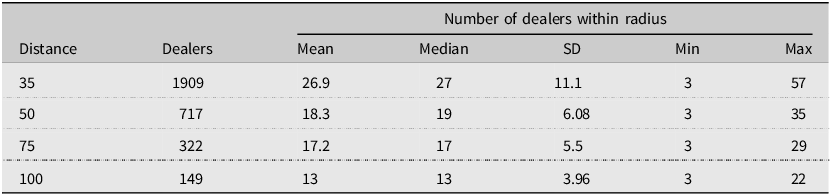
The results indicate that with a 100 km radius, 149 traders located all over Germany are adequate, ensuring that each farmer has access to three different traders and therefore receives three different price offers, whereas a radius of 75 km necessitates 322 traders. For a radius of 50 km, the number of traders increases significantly to 717 and to 1909 at 35 km, respectively. The results in Table 1 also show that, in the case of this set of random legume_farm points, the average number of dealer access points per farmer is 26.9 at a 35 km radius, 18.3 at 50 km, 17.2 at 75 km, and 13.0 at 100 km. By fixing the minimum number of three trades accessible by the farms, the maximum was calculated by a radius of 35 km, where one single farmer has up to 57 dealers within the distance.
Number of dealers available for farmers within different radii

SD = standard deviation.
Source: own calculations.
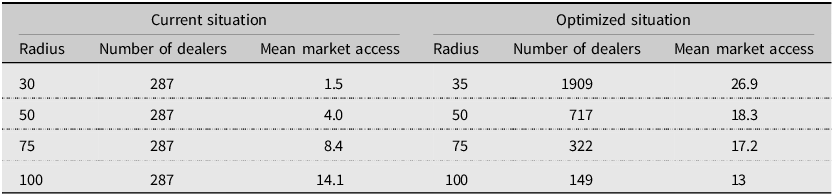
Table 2 presents a comparison between the current situation, involving 287 traders, and the optimized scenarios across 10 simulations with randomly selected points. It shows the average number of market accesses per legume farmer for each radius. In the optimized version, the corresponding number of traders required at the same radius is displayed, along with the resulting average market access for farmers. The results indicate that, in the current situation, the number of accessible traders increases with growing radius. In contrast, the optimized scenario consistently yields a (significantly) higher average number of accessible traders except at a 100 km radius, where it is slightly lower. However, in this case, the required number of traders is nearly halved.
Comparison of the current with the optimized situation

Source: own calculations.
In all cases under the current situation, the minimum number of market accesses is zero. This means that, regardless of the chosen radius, there are always legume farms with less than three, or even zero, market accesses. In contrast, in the optimized scenario, the minimum was consistently three, meaning that every legume farmer had access to at least three markets at each simulated distance.
5. Discussion
The results of the study show that the German market for grain legumes, due to its geographical fragmentation and limited range of price options, is particularly challenging for smaller producers. The prevailing noncompetitive structures make the cultivation of grain legumes unattractive for farmers. The analysis of trader distribution reveals significant regional disparities in Germany. Northern and eastern regions have fewer traders, leading to noncompetitive structures where farmers receive limited price offers, weakening their bargaining power. In contrast, southern and western areas have higher competition among traders, enabling better price transparency. This fragmented structure, which has been explained in this study through the spatial arrangement of the trader network, is consistent with Mittag and Hess (Reference Mittag and Hess2022). In regions where more legumes are cultivated, there are also more traders purchasing legumes as shown in this study. However, even within a radius of 100 km, not all legume farms receive at least three price offers. Consequently, a noncompetitive market prevails in many parts of Germany. This poses a challenge, as according to Mittag and Hess (Reference Mittag and Hess2023), the presence of a nearby trader would be an important incentive for farmers to grow legumes.
It remains unclear why the area of legumes cultivated is lower than the EU average – whether the lack of price competition discourages farmers from cultivating legumes in areas with suitable conditions, or whether the low supply of legumes makes it unprofitable for traders to specialize in them. This describes the self-reinforcing cycle where limited trade infrastructure and low cultivation levels mutually perpetuate each other. But what could break this cycle?
One opportunity to break the cycle could be drop shipping, for the reasons already outlined in Section 2.3: by enabling direct transactions between farmers and buyers, it increases competition, improves price transparency, and lowers costs – especially for small-scale producers (Merener et al., Reference Merener, Moyano, Stier-Moses and Watfi2016; Ciaian et al., Reference Ciaian, Guri, Rajcaniova, Drabik and Paloma2018). In addition, drop shipping can ease the logistical burden on farmers, as they no longer need to transport goods themselves. Leveraging more professional logistics – either through the traders or their logistics partners – makes it possible to cover longer distances at lower transaction costs. If more traders operate across wider areas, individual farmers benefit by gaining access to a larger network of buyers. By bundling products at a local level potentially supported by cooperatives and combining this with drop shipping, a more efficient and inclusive distribution system could emerge. Through drop shipping, farmers would also benefit from reduced storage requirements.
Our study also shows that the overall number of legume traders in Germany is not too low. With a network radius of 100 km, 150 trader locations (instead of the current 287) would already be sufficient for every legume_farmer to be within three dealer networks. The results of the spatial optimization using the k-means clustering algorithm (Chen et al., Reference Chen, Lin, Qi, Li, Gao, Chen, Lin, Qi, Li and Gao2017; Khalid and Herbert-Hansen, Reference Khalid and Herbert-Hansen2018) suggest that increasing the number of traders in strategic locations could significantly enhance market access and create more competitive market structures. These findings align with previous studies on agricultural supply chains, which highlight that spatial distribution influences market efficiency (Graubner and Sexton, Reference Graubner and Sexton2023; Graubner, Balmann, and Sexton, Reference Graubner, Balmann, Sexton, Graubner, Balmann and Sexton2011). However, a key insight from the study is that additional traders may be unnecessary if the drop shipping areas are sufficiently large, or the farmers are willing to drive larger distances. The model demonstrates that when drop shipping radii reach a critical size, even with fewer traders than currently present in the German legume market, each simulated legume farm receives at least three offers from dealers. This creates competitive structures without increasing the number of traders. For the future selection of trader locations, whether for new traders or those looking to open additional sites, the key question arises as to whether expanding the current radius for the entire market may be more efficient than establishing new trader locations. However, if the radius is increased while the number of traders is reduced to allow each farmer at least three market entrances, the result is a similarly uncompetitive market structure as at present. Conversely, if there were more traders buying grain legumes, smaller trader networks would lead to a more competitive market structure than fewer traders with larger radii.
Furthermore, the larger the network of traders collecting grain legumes from farmers, the more competitive the market becomes, as farmers receive more price offers at their locations. Conversely, this also means that farmers who are willing to travel further and seek traders within a broader radius will have access to more price offers and, therefore, potentially better bargaining power. However, this results in higher transaction costs due to transportation, making it worthwhile primarily for sufficiently large farms or cooperatives (e.g., in the form of producer organizations). On the other hand, it is also in the interest of traders to purchase more legumes. Increased purchasing would strengthen the market, encouraging more farmers to grow legumes, which would ultimately benefit traders as well. This mutual reinforcement between supply and demand actors reflects key principles of modern agricultural markets, which are increasingly shaped by vertical coordination, market interdependence, and strategic behavior across the value chain – also known as the modern agricultural markets paradigm (Sexton, Reference Sexton2013). In such systems, traders are not merely passive buyers but may proactively stimulate supply in response to downstream demand or policy incentives. Market gaps identified through this analysis could motivate current traders to expand their operational radius or establish additional locations to enhance market coverage. This finding indicates that market efficiency can be attained not only by increasing the number of traders but also through optimized spatial distribution and trade network coverage.
In addition to drop-shipping and physical trade networks, digital platforms offer a promising strategy to overcome market fragmentation. By enhancing price transparency and reducing information asymmetries, such platforms can improve farmers’ bargaining power and mitigate noncompetitive market conditions (Mittag and Hess, Reference Mittag and Hess2022). Evidence from India shows that unifying agricultural markets through digital systems like the Unified Market Platform increased prices by 3–5% and significantly improved profitability for quality producers, highlighting how digital integration supports price discovery and efficiency (Levi et al., Reference Levi, Rajan, Singhvi and Zheng2020). In Germany, platforms such as LeguNet and LeguDash follow similar principles, aiming to strengthen legume markets by aggregating price data and supporting regional value chains (Köpp et al., Reference Köpp, Bertram, Kezeya, Zerhusen-Blecher, Schäfer, Gültas and Mergenthaler2024; Kezeya et al., Reference Kezeya, Zerhusen-Blecher, Köpp, Schäfer and Mergenthaler2023; Köpp et al., Reference Köpp, Bertram, Wernze, Zerhusen-Blecher, Schäfer, Gültas and Mergenthaler2025).
From the farmers’ perspective, increased competition among traders – either through physical presence or digital price platforms – can lead to more favorable and transparent pricing. Access to price information across regions reduces information asymmetries and may incentivize farmers to sell beyond their immediate area if better prices are available. For traders, expanding their sourcing radius – for example, via drop-shipping models – can intensify competition by allowing access to larger volumes and more attractive supply bundles. Although this expansion results in higher transaction costs, these can be mitigated by economies of scale and more efficient logistics.
However, as the analysis focuses exclusively on Germany, the findings may not be directly transferable to other markets with different agricultural structures and regulatory frameworks. Moreover, while the dataset is unique, it does not guarantee completeness due to the voluntary nature of trader listings with the UFOP (Union zur Förderung von Oel-und Proteinpflanzen e.V., 2025), which limits the comprehensiveness of the spatial analysis and the ability to draw precise regional comparisons. Distinguishing between legume species would have offered additional insights, but this was not possible due to data limitations. Additionally, the legume_farm locations used in the simulations were not actual farm sites but were constructed based on available data, which may not fully reflect logistical and geographical realities. Finally, the study does not thoroughly analyze the role of contract farming or the power dynamics between large traders and smaller producers, which would necessitate further investigation.
6. Conclusion and Policy Recommendations
Limited access to multiple buyers remains a structural barrier for legume farmers in Germany. In the current market, a self-reinforcing cycle persists: farmers lack incentives to grow legumes because there are too few local buyers, while traders have little motivation to purchase legumes due to low supply volumes and weak regional demand. Our study helps to break this cycle by identifying spatial inefficiencies and simulating optimized market structures for the German legume sector.
The spatial analysis shown here indicates that market inefficiencies are not merely about the number of traders but also their distribution across space. Large areas of the country, especially in the northern and eastern regions, lack adequate access to buyers, with many farmers having fewer than three viable trading options even within a radius of 30–100 km. By applying k-means clustering and GMMs, we show that competitive conditions, defined here as access to at least three buyers per farm, can be achieved without increasing the overall number of traders. What matters is not quantity but spatial coverage. Well-placed trader locations can ensure that all farmers are within a 30–150 km radius of multiple traders.
Digital platforms like LeguNet and LeguDash can assist farmers in identifying trading opportunities beyond their local area by enhancing price transparency and market visibility. For these platforms to be effective, they need active participation from both sides. Policymakers should support this through pilot projects that encourage traders to share offers and prices, ideally as part of broader regional initiatives. In the long term, minimum transparency standards such as compulsory price publication could help create a more level playing field.
Logistical models like drop shipping, where traders (or their logistics partners) collect directly from farms, can expand market access without passing transport costs onto farmers. To make this feasible, cooperatives could organize harvests regionally, increasing efficiency for traders. Publicly funded pilot projects can test such models and reduce barriers to adoption for all parties involved.
Supplementary material
The supplementary material for this article can be found at https://doi.org/10.1017/aae.2025.10028.
Data availability statement
The data that support the findings of this study are available at Union zur Förderung von Oel-und Proteinpflanzen e.V. (2025).
Acknowledgments
None.
Author contributions
Conceptualization: N.B., F.M., P.B. Methodology: N.B. Formal analysis: N.B. Data curation: N.B., F.M. Writing – original draft: N.B., F.M. Writing – review and editing: N.B., F.M., P.B.
Financial support
Publishing fees are supported by the Funding Programme Open Access Publishing of the University of Hohenheim.
Competing interests
The authors declare that there is no conflict of interest.
AI contributions to research
This study used AI tools such as ChatGPT-4o for language improvement and Code Copilot for coding support.




 Open access

