


INTRODUCTION
Since a previous review of progress to develop a UK network of marine protected areas (MPAs) (Jones Reference Jones1999), there has been much progress. This could lead to a network of MPAs that fulfils international obligations and makes significant contributions to the conservation and recovery of marine ecosystems around the UK. As the processes of designing, implementing and managing these MPAs proceeds, many governance challenges are being met. These are related to issues such as addressing uncertainty, the role of the government, the role of non-governmental organizations (NGOs) and the relative influence of different marine sectors.
The marine area around south-west of England provides a very good context for analysing such governance challenges. Maritime activities, such as coastal tourism, marine recreation, commercial fishing and sea angling, are of particular socioeconomic importance in these predominantly rural communities, and the region is a focus for the development of marine renewable energy. The region also has several designated and proposed marine special areas of conservation (SACs). SACs must be designated for listed habitats and species, referred to as features, under the European Community Directive on the Conservation of Natural Habitats and of Wild Fauna and Flora (92/43/EEC, see URL http://ec.europa.eu/environment/nature/legislation/habitatsdirective/index_en.htm) henceforth referred to as the Habitats Directive.
South-west England is also one of four regions in which recommendations for a network of marine conservation zones (MCZs) have been developed, through the Finding Sanctuary project. I have followed the development of the Finding Sanctuary project since its inception in 2004; it started as a project in its own right prior to the Marine and Coastal Access Act (2009, see URL http://www.defra.gov.uk/environment/marine/mca/), which I henceforth refer to as the Marine Act, and the national MCZ project. I undertook detailed qualitative research between April 2010 and July 2011, involving direct, but non-participant observations of the workshops of the Finding Sanctuary stakeholder groups, including discussions with participants and analyses of related reports.
These stakeholder groups consist of representatives of fishing, regional economic development (particularly marine renewable energy and ports), recreational boating, sea angling, historical heritage, marine science and conservation NGO sectors, as well as representatives of the nature conservation agencies. Their task was to develop, discuss and agree on a network of MCZs that complied with the Ecological Network Guidance (NE [Natural England] & JNCC [Joint Nature Conservation Committee] 2010). The findings from my observations of these working groups were qualitatively analysed, through the development of themes, also known as open codes, such as the interactions between top-down (central government-led) and bottom-up (community and user-led) approaches; I draw on some of the results in the following discussion. MCZs represent a particularly interesting policy framework for exploring how top-down and bottom-up approaches can be combined, as the Marine Act requires them to be designated and effectively managed, but official policy emphasizes that users should be fully involved with the design of the MPA network.
This paper discusses progress and some of the emerging governance challenges in the development of a UK network of MPAs (particularly SACs and MCZs), introducing the concept of MPA governance, and then describing the principles, components and legal framework of the proposed UK MPA network. After outlining the specific policies for MCZs and SACs, the paper reviews progress in designating them. The challenges of combining top-down and bottom-up governance approaches are considered, drawing on my qualitative research on MPA design processes in south-west England. Finally, the implications of these challenges and the prospects for addressing them through ongoing processes to designate and manage a UK network of MPAs are assessed.
MPA GOVERNANCE
Governance can be defined as ‘steering human behaviour through combinations of people, state and market incentives in order to achieve strategic objectives’. Incentives are defined as ‘particular approaches (agreements, laws, interactions through markets, etc) that are designed to encourage people to behave in a manner that provides for specific strategic objectives to be fulfilled’ (Jones et al. Reference Jones, Qiu and De Santo2011). As debates move on from whether MPAs are needed to how many MPAs are required, where they should be and how to design MPA networks, there is growing interest in the challenges surrounding MPA governance. Accepting that MPAs are focused on the achievement of a range of strategic biodiversity and resource conservation objectives (Jones Reference Jones2001), their governance can be considered in terms of how different incentives can be combined in order to best support the fulfilment of such MPA objectives.
The generally accepted policy recommendation in this respect is that the ‘design and management of MPAs must be both top-down and bottom-up’ (Kelleher Reference Kelleher1999) but what does this actually mean in practice? Three marine SACs in the UK were previously categorized, in a United Nations Environment Programme (UNEP) study on MPA governance, as a government-led approach under a clear legal framework, as were case studies from Australia and the USA (Jones et al. Reference Jones, Qiu and De Santo2011). This does not, however, mean that such government-led MPAs are enforced solely through a top-down legislative approach. All MPAs need to combine economic, interpretative, knowledge, legal and participative incentives if the governance framework is to be effective, equitable and resilient. Political commitment to MPAs and political will across different sectors was considered to be a key factor in this respect (Jones et al. Reference Jones, Qiu and De Santo2011). Given that the legal framework for MCZs is similar to that for SACs, the governance of UK MPAs can be considered from the analytical perspective of the UNEP MPA governance study (Jones et al. Reference Jones, Qiu and De Santo2011), with a particular focus on how top-down and bottom-up approaches are combined.
DEVELOPING A UK MPA NETWORK
Principles and components
The UK government's plans to implement a network of MPAs around the UK were set out in a statement by the Minister for Marine and Natural Environment (DEFRA [Department of Environment, Food and Rural Affairs] 2010), as required by Section 123(6) of the Marine Act. This stated that the design of the MPA network will be underpinned by seven principles: representativity, replication, viability, adequacy, connectivity, protection and use of best available evidence. The government committed to have substantially established the UK MPA network by the end of 2012 (DEFRA 2010).
This MPA network will consist of Ramsar sites under the Ramsar Convention (1971); sites of special scientific interest (SSSIs) under the Wildlife and Countryside Act (1981); special protection areas (SPAs) under the European Birds Directive (2009); special areas of conservation (SACs) under the Habitats Directive; and MCZs under the Marine Act, along with parallel acts for Northern Ireland and Scotland. Ramsar sites, SSSIs and SPAs are predominantly intertidal, though three entirely marine SPAs have been designated for sea birds.
Marine SACs and SPAs are collectively referred to as European Marine Sites (EMSs) under UK policy, and as Marine Natura 2000 Sites under European Union (EU) policy. Sub-tidal marine biodiversity conservation will mainly be achieved through SACs and MCZs, therefore these will be the main focus in this paper. Many important provisions for the protection of SACs under the Habitats Directive also apply to SPAs, although the selection process for SPAs differs and is based on different annexes.
Legal framework
The Marine Act is one of the largest pieces of legislation to have been passed by the UK Parliament in the last 100 years and is ambitious in its scope (Appleby & Jones Reference Appleby and Jones2012). It provides for the creation of a new Marine Management Organization (MMO), the development and implementation of an integrated marine spatial planning system, the improvement and streamlining of the system for licensing marine activities, and the reformation of inshore fisheries management. Whilst these provisions are an important context for MPAs, the Marine Act also includes specific provisions to designate and implement a network of MPAs, specifically referred to as marine conservation zones (MCZs), around the UK. This will include the whole continental shelf, but exclude the territorial sea (inside 12 nautical miles) of Scotland and Northern Ireland; these devolved countries will provide similar marine acts for MPAs in their seas. The Marine Act repealed the provisions for marine nature reserves under the Wildlife and Countryside Act (1981), which were a key focus of the previous review (Jones Reference Jones1999), as these have been superseded by MCZs.
The UK government intends that the Marine Act will also contribute to the fulfilment of several regional obligations, particularly to designate an ecologically coherent and representative network of MPAs by 2016 under the Marine Strategy Framework Directive (2008) as a contribution to the achievement of good environmental status through an ecosystem approach, and to contribute to an ecologically coherent network of MPAs under the OSPAR Convention on the Protection of the Marine Environment in the North East Atlantic (1992). The Marine Act will also contribute to the fulfilment of several international commitments, particularly the establishment of representative networks of MPAs by 2012 under the plan of implementation from the World Summit on Sustainable Development (2002), and the designation of at least 10% of coastal and marine areas as MPAs by 2020 under a decision at the 10th Conference of the Parties to the Convention on Biological Diversity (2010).
The Department of Environment, Food and Rural Affairs (DEFRA) is the central UK government department with the main responsibilities for fulfilling these commitments. It is also responsible for fisheries management and wider nature conservation policies, though some responsibilities are devolved to Wales, Scotland and Northern Ireland. Natural England (NE) is a statutory agency responsible for advising and reporting on nature conservation in England, including inshore MPAs within 12 nautical miles. The Joint Nature Conservation Committee (JNCC) is an agency responsible for advising and reporting on nature conservation across the UK, including offshore MPAs beyond 12 nautical miles. NE and JNCC are collectively referred to as statutory nature conservation bodies (SNCBs).
Special areas of conservation (SACs)
Marine SACs are designated on the basis of the significant representation of one or more listed features, which must then be maintained at or restored to favourable condition. In particular, Article 6 of the Habitats Directive requires that any plan or project that could potentially affect the conservation status of a habitat or species for which an SAC has been designated needs to be subject to a step-wise assessment process; developments that may have significant effects on such features may only go ahead if there are imperative reasons of overriding public interest, including those of a social or economic nature. Detailed guidance on how to establish Marine Natura 2000 sites and introduce necessary fisheries management restrictions has been provided by the European Commission (2007).
The formal moderation process for agreeing national lists of SACs is ongoing, but there are currently 96 marine SACs, covering 4.8% of the total UK marine continental shelf area (JNCC 2011a ). Five possible additional marine SACs, that are currently under consultation, will increase cover to 5.6%. The obligations under the Habitats Directive to protect SACs have been transposed into UK legislation by four sets of regulations, which essentially place a duty on any authorities that have statutory functions relevant to the management of EMSs to exercise these functions in a manner that ensures compliance with the Directive (see Jones Reference Jones1999 for further details). The jurisdiction of UK fisheries authorities to protect SACs and other MPAs is, however, limited, as most fishing around the UK is directly regulated by the European Commission (EC) under the Common Fisheries Policy (CFP). The UK authorities only have complete fisheries management jurisdiction within six nautical miles of the coastline, and within this CFP quotas for certain stocks still apply.
Marine conservation zones (MCZs)
Marine SACs, along with marine SPAs, will not fulfil the UK's requirement to designate ecologically coherent and representative networks of MPAs under the Marine Strategy Framework Directive (2008). The Marine Act (along with similar provisions in parallel acts for Scotland and Northern Ireland) therefore also includes detailed provisions to designate and protect nationally important marine areas as MCZs (Part 5, Chapter 1, Articles 116–148). The designation of MCZs is required as a contribution towards a representative and coherent network of MPAs, along with the other MPA network components. Once designated, any authority with functions that are relevant to the conservation of MCZ features, or of the processes on which such features are dependent, must exercise these functions in a manner that furthers or, where this is not possible, least hinders the fulfilment of MCZ conservation objectives, unless the public benefits of the proposed activity outweigh the risk of environmental damage (Articles 125 and 126). Activities that are not currently regulated by any relevant authority can be controlled through the introduction of by-laws by the MMO (Articles 129–144).
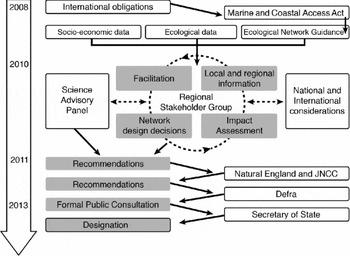
These legal provisions are supported by many official policy guidance documents (DEFRA 2011a ; JNCC 2011b ; NE 2011). The March 2010 ministerial statement (DEFRA 2010) outlined the principle that users should be fully involved with the design of the MPA network in order to integrate conservation with sustainable use, minimize socioeconomic impacts and promote support for the MPA network. The policies and official guidance on how to implement the MCZ provisions (Table 1) set out an MCZ network design process (Fig. 1) that provides for the participation of stakeholders who represent sectors that could be impacted by MCZ restrictions. This process was followed through four separate regional MCZ projects in England (Fig. 2); I here focus on the regional project for south-west England, Finding Sanctuary. A national interactive mapping web page (see URL http://www.mczmapping.org) allows users to view and add to the information layers on which the MCZ network design draws, including the distribution of different activities, species, habitats and marine SACs.
MCZ designation process. Redrawn from figure at http://jncc.defra.gov.uk/page-4882.
Key policy guidance documents for MCZs in England.

MCZs recommended by the four regional projects in England. Redrawn from figure at http://www.naturalengland.org.uk/ourwork/marine/protectandmanage/mpa/mcz/default.aspx.

In September 2011, the four regional projects each sent their recommendations for a regional network of MCZs (see Lieberknecht et al. Reference Lieberknecht, Hooper, Mullier, Murphy, Neilly, Carr, Haines, Lewin and Hughes2011 for Finding Sanctuary report) to the science advisory panel (SAP), which assessed whether they were consistent with the Ecological Network Guidance (NE & JNCC 2010). The SAP's detailed recommendations were published in November 2011 (DEFRA 2011b ). These concluded that ecological coherence could be achieved if all the recommended MCZs were implemented, but that there were deficiencies and uncertainties in the evidence-base for many of the recommendations. The SNCBs have commissioned surveys to gather further evidence to address these deficiencies and uncertainties, and will then make their recommendations on the MCZ network to DEFRA. A full official public consultation on the proposed MCZ network will then be undertaken. A final decision on the configuration of the MCZ network was due to be taken by the Minister for Marine and Natural Environment before the end of 2012, but this deadline was extended to 2013 by a second ministerial statement (DEFRA 2011c ). This also stated that a phased approach to the designation of the MCZ network will be followed. MCZ proposals with a sufficiently robust evidence base will be designated in a first phase in 2013. Further studies will then be undertaken to build the evidence base for future MCZ designations. This statement includes a commitment to consult on all the MCZs recommended by the regional projects, including proposals for such further studies to develop a robust evidence base for future phases of MCZ designations. However, marine conservation NGOs are concerned that the potential for a coherent MCZ network is being undermined by such delays, and that the evidence requirements for marine SACs (Graham-Bryce et al. Reference Graham-Bryce, Pullin, Widdicombe and Davies2011) are being applied to MCZs, despite the very different basis and policy framework for these designations.
The UK government intends that the MCZs, along with other designations that constitute the MPA network, will be fully implemented by 2016, in keeping with the Marine Strategy Framework Directive deadline. A total of 127 MCZs have been recommended by the regional projects. These cover 37 164 km2 and represent 15.3% of the total marine area under English jurisdiction (Fig. 2), SACs and SPAs covering 12.8% of the English marine area, taking the total MPA coverage (excluding overlaps, some areas having more than one designation) in the English marine area potentially to 27.1%. SACs and SPAs tend to be concentrated in inshore waters (territorial sea inside 12 nautical miles), where they cover 23% of the English inshore area, alongside recommended MCZ cover of 13.9%, taking the total English inshore MPA coverage (excluding overlaps) potentially to 34.2%.
MPA targets
Many conservation NGOs had campaigned for the inclusion in the Marine Act of a statutory target for no-take MPAs, where all extractive and disturbing activities are banned, of 30% of the national marine area, in keeping with previous recommendations (RCEP [Royal Commission on Environmental Pollution] 2004; Jones Reference Jones2008, Reference Jones2009). Such targets are based on evidence that no-take MPAs result in greater biomass densities than partially protected MPAs and therefore provide greater potential benefits (Lester & Halpern Reference Lester and Halpern2008). The Marine Act does not include a no-take MPA target, nor does it require any no-take MPAs. Instead, it maintains the flexibility to provide the appropriate level of protection in each case, based on the available evidence (Appleby & Jones Reference Appleby and Jones2012). The March 2010 ministerial statement (DEFRA 2010) provides for a range of levels of protection, including MPAs that accommodate compatible uses and no-take reference areas. Specific reference area guidance has been produced which states that each broad-scale habitat type and feature of conservation interest (FOCI) should have at least one viable reference area within each of the four regional MCZ project areas, where all extraction, deposition or human-derived disturbance is prohibited (Table 1). Viability is based on the minimum patch diameter required to maintain the integrity of the habitat or feature and be self-sustaining. Reference areas are intended to provide a benchmark against which the effectiveness of partially protected MCZs can be assessed. The 127 recently proposed MCZs include 65 such reference areas (Fig. 2), which constitute nearly 2% of the total MCZ area.
Broad-scale habitat types are based on level three marine habitat types under the European Nature Information System (EUNIS) classification, each of which should have a reference area with a minimum diameter of 5 km. FOCI are particular habitats or species that are rare, threatened or declining around the UK, each of which should have a reference area with a minimum diameter that ranges in size from 0.5 km to the whole patch size. The total coverage of reference areas is likely to fall far short of the 30% no-take MPA target recommended by a previous expert committee (RCEP 2004), as the recommended no-take reference areas cover < 0.3% of the total English marine area, or just 1% of the 30% no-take MPA target. The inclusion of any such targets nevertheless represents a major concern for many marine use sectors, particularly fishers (Jones Reference Jones2008, Reference Jones2009) and anglers. Meanwhile, the NGO campaign for 30% coverage of no-take MPAs has been relaunched (MRC [Marine Reserves Campaign] 2011).
The Ecological Network Guidance (NE & JNCC 2010) also includes targets for the proportion of each of 17 different broad-scale habitats that should be protected within each of the four regional MCZ areas (Table 2). These need not all be protected as no-take reference areas, and other types of MPA, such as SACs and SSSIs, can contribute to these targets. Even though it does not meet the 30% no-take MPA target, the Ecological Network Guidance represents the first official and systematic set of targets for MPA coverage in the UK.
Proportion of each broad-scale habitat that should be protected by MPAs within each of the four regional MCZ project areas (after NE & JNCC 2010, p. 38).

MPAS IN SOUTH-WEST ENGLAND
Challenges of achieving compliance through participation
The processes for designing an MPA network around south-west England raise some interesting governance challenges. A wide range of marine interests were represented on the Finding Sanctuary stakeholder working groups. People with marine interests were also able to participate through four local stakeholder groups, through fishing industry liaison officers employed by the project, a fishing industry MCZ planning group, and the interactive MCZ web site; the information provided was collated for the stakeholder groups. The representatives on the stakeholder working groups were responsible for developing the MCZ recommendations. This participative transparent process was, however, subject to the requirement to develop an MCZ network that complied with the Ecological Network Guidance (NE & JNCC 2010), in combination with the other MPA network components, within an 18-month period. Progress reports on the development of the MCZ proposals were officially assessed by the SAP on four occasions to provide interim feedback on compliance.
This process was supported by an independent facilitator, but, as it proceeded, many representatives became increasingly aware that it was driven by obligations and instructions, rather than guidance and advice, and that the facilitator's key role was to support compliance with these requirements. This role was therefore one of ‘tempered’ rather than neutral facilitation (Jones & Burgess Reference Jones and Burgess2005), in that the facilitator frequently had to be quite strict in reminding the working groups of the requirements of the Ecological Network Guidance and of the need to stick to a timescale, and to strategically steer the discussions accordingly.
From the outset, it was clear that some of the fishing industry representatives did not support the legal obligation to designate a network of MCZs, one of them stating that his role was simply to minimize the damage to the industry caused by MCZs. This is consistent with previous research that involved interviews with fishing industry representatives in south-west England, which found that 74% of the 57 interviewees did not support no-take MPAs for biodiversity conservation purposes, though many did support partial/seasonal closed areas to protect spawning/nursery grounds (Jones Reference Jones2008). It thereby follows that the requirement to designate no-take reference areas became a particular issue as the process progressed. Two of the four fishing industry representatives formally declared that they could not support any such proposals. They argued that the reference areas were based on an imposed, unjust and unjustified requirement. They also stated that they would refuse to participate in any discussions related to reference area proposals, though they actually did participate to limit the impacts of particular reference areas.
Towards the end of the participative working group process, the stakeholder representatives became increasingly concerned that the network recommendations would subsequently be taken out of their hands. The regional stakeholder groups were formally disbanded once the MCZ recommendations went forward for final scrutiny by the SAP. Many representatives had developed a shared sense of ownership of the MCZ recommendations, and they were concerned that the MCZs would subsequently be decided by scientific, statutory and political processes (see Fig. 1), without the input of the stakeholder groups. This reflected growing recognition that the requirement to fulfil the Ecological Network Guidance and comply with the Marine Act meant the process was largely driven by legal obligations and science, rather than being driven by stakeholders. This was contrary to statements made by senior NE representatives at the launch of the MCZ process in 2009 that the process would be a bottom-up (Phillips Reference Phillips2009) and stakeholder-led (J. Marsden, Director Marine, Natural England, unpublished statement 2009).
It could be argued, however, that a degree of top-down government control is required if strategic wider-scale and longer-term MPA objectives are to be met (Jones & Burgess Reference Jones and Burgess2005). The role of the Ecological Network Guidance, the SAP, the SNCBs and the Marine Act, along with the top-down process by which the final MCZ network will be decided by the minister, may represent an appropriate degree of government control. This is consistent with arguments that the process by which MPAs were designed in California was largely based on decisions made by scientists, coupled with a general legal obligation (Hilborn Reference Hilborn2012). This consistency is no coincidence, as the governance structures and processes for recommending English MCZs were an adaptation of those for Californian MPAs. This was partly based on a study of the California MPAs by Finding Sanctuary's MPA planner (Lieberknecht Reference Lieberknecht2008), which were concluded to be both participatory and science-based. It would seem that this is a more accurate description of the MCZ design process, in that it provided for stakeholder participation, but was ultimately top-down and was steered by scientific guidelines which are underpinned by a legal obligation. This has provided for socioeconomic priorities to be considered through the participation of stakeholder representatives, in keeping with article 117(7) of the Marine Act. This has proved particularly important in order to avoid MCZs in areas of high socioeconomic interest, where alternatives areas can be proposed as MCZs, provided the overall network still complies with the Ecological Network Guidance. This was deemed a damage limitation approach by some representatives, particularly those from the offshore fishing sector, who still felt that MCZs had essentially been imposed on them in a manner that would lead to their constituents bearing an unfair share of the costs.
The process for marine SACs has, by contrast, been even more top-down in that SACs are proposed solely on the basis of scientific evidence. Stakeholders are consulted on the proposals, though responses can only address the scientific basis of the proposed SAC. This is consistent with the Habitats Directive and the Lappel Bank (case reference C-44/95) and Severn Estuary (C-371/98) judgments (see http://eur-lex.europa.eu/en/index.htm), by which only ecological considerations can be taken into account when selecting and defining the boundaries of SACs. This precludes consideration of socioeconomic impacts, on which many consultation responses are based. Whilst this SAC selection approach has caused concern for many marine users, particularly commercial fishers, there is recognition that this requirement has been imposed by the EC, an institution most fishers mistrust, at the least, as a result of their negative perceptions of the Common Fisheries Policy.
Prospects for management
Stakeholder concerns about the processes by which MPAs are selected are essentially a prelude to their main concerns about the prospects for MPA management, particularly, but not solely, amongst commercial fishers. Whilst some SACs in south-west England have been designated for several years, others have only recently been designated or are currently subject to consultations. This temporal convergence has led to confusion between the designation of SACs and MCZs amongst many stakeholders, and this has added to their concerns about the prospects for future management restrictions. The two designations became conflated as MPAs, with much uncertainty as to what activities will be allowed within them and what activities will be restricted. Even once SACs and MCZs have been distinguished, much uncertainty remains.
The MCZ provisions are, as is outlined above, similar to the regulations that transpose the Habitats Directive for marine SACs into UK law, though they are not subject to the potential for the legal intervention of the EC and European Court of Justice under the Habitats Directive. This is an important difference, as it means that the designation and management of MCZs is under national jurisdiction, whereas the designation and management of SACs is ultimately under European jurisdiction. Whilst MCZs are required to constitute a network under the Marine Strategy Framework Directive (2008), EC officials have indicated to member state representatives that this Directive is largely considered a supportive and enabling framework, as compared to the Habitats Directive, which is more strictly enforced, including referrals to the European Court of Justice for non-compliance. This difference has important implications with regards to the prospects for management restrictions for SACs and MCZs.
As is outlined above, all authorities with responsibilities for the management of activities that could potentially be incompatible with the conservation of a given MCZ feature are obliged to manage these activities in a manner that ensures that the MCZ conservation objectives are fulfilled. However, there is still great uncertainty as to which activities will actually be restricted. Guidance is available in the form of compatibility matrices that list which activities are likely to need restrictions to protect specific features, but these are only in draft form. Furthermore, the draft conservation objectives for the recommended MCZs, which are important as they affect compatibility assessments in stating whether a feature should be maintained or restored, were actually provided by the SNCBs towards the end of the working group process, rather than being decided by the stakeholders. This led to major concerns amongst some potentially affected stakeholders, as it again highlighted the top-down nature of some elements of the MCZ network design process, as well as exacerbating concerns that activities that were assumed by the stakeholders to be compatible would subsequently be considered as incompatible by the SNCBs.
The acceptability of many MCZs was based on such assumptions, which constitute an official element of the MCZ recommendations, but there is great uncertainty over whether these assumptions will be incorporated into final management decisions by the relevant authorities, subject to the official advice of the SNCBs. There are major concerns that the eventual management restrictions will be much more stringent than had been assumed by the stakeholders. Such uncertainties and concerns have undermined the stakeholders’ ownership of the MCZ recommendations, alongside the loss of ownership associated with the scientific, legal and political basis for the final decisions on the MCZ network following the dissolution of the stakeholder groups.
There is also uncertainty as to how management restrictions will be enforced. The draft guidance (DEFRA 2009, p. 16) states that voluntary measures should be considered as an alternative to legal restrictions, as they can, in the right circumstances, be appropriate for the control of local activities before the impacts become significant. They also have the advantage of being more flexible than regulations and can encourage greater levels of engagement, buy-in and cooperation amongst users. It is no coincidence, however, that a conservation NGO has recently published a report that concludes, on the basis of eight UK MPA case studies, that voluntary approaches are only effective in small bottom-up MPAs with broad stakeholder support, and that statutory approaches are more appropriate for top-down MPAs that require restrictions on economically significant activities (Prior Reference Prior2011). Given that MCZs are most likely to be considered as top-down MPAs, there is considerable uncertainty not only over the configuration of the final MCZ network, but also over what the official conservation objectives of a given MCZ will be, what management restrictions will be deemed necessary to achieve these objectives and how these restrictions will be implemented.
Lessons from Lyme Bay
In the midst of such major uncertainties over how MCZs will be managed, it is important to consider how marine SACs have been managed, as these have had a longer history and the experiences that stakeholders and relevant authorities have had with them influence their views on the prospects for the management of MCZs. Fishers’ views continue to be particularly strongly influenced by the sequence of events in Lyme Bay. This large bay includes some important reef habitats, particularly for pink sea fans (Eunicella verrucosa), and, in 2001, prior to the area being proposed as part of an SAC, the Devon Wildlife Trust brokered a voluntary closure to trawlers of two small but important reef areas (total two square miles). The recovery of these reefs was monitored, but, in 2006, it became evident that this voluntary agreement was being breached. The regional inshore fisheries regulators considered that they were not in a position to implement legal restrictions through local by-laws, partly because there was no SAC or other MPA designation requiring such protective measures. NE considered that conservation measures were needed, as pink sea fans were listed in 1991 under the species protection provisions of the Wildlife and Countryside Act (1981). As the reefs were threatened by scallop dredging, NE applied to the central fisheries regulator, DEFRA, for a prohibition on trawling in a 60 square mile area of Lyme Bay.
This encouraged the local fishers to form an association, and they agreed to better abide by the voluntary agreement for the original two closures along with closures of two additional areas, protecting a total of 12 square miles. Despite this, there were reports that the voluntary reef closures continued to be breached and, in September 2006, DEFRA launched a public consultation on the protection of the reefs and the pink sea fans they supported. This considered three options: rely on the existing four voluntary closures (12 square miles), legally ban trawling in an enlargement of these areas covering 25 square miles, or legally ban trawling in a single 60 square mile box encompassing all the reef areas in question and a wider area. The majority of responses, mainly from the wider public, favoured the last option, and, in June 2008, DEFRA announced that trawling would be banned in the 60 square mile area under a Fishing Restrictions Order (2008, No. 1584, see URL http://www.legislation.gov.uk/uksi/2008/1584/contents/made) under the species protection provisions of the Wildlife and Countryside Act (1981), creating a de facto MPA.
The fishers and their leaders strongly objected to this closure, the chair of their association formally withdrawing (albeit temporarily) from the Finding Sanctuary steering group as a protest, even though the closure was not related to MCZs or Finding Sanctuary. A subsequent statement by the Chief Executive of NE that scallop dredging in Lyme Bay represented ‘rape and pillage’ resurrected this issue, the chair of the fishers’ association claiming that this had ‘exposed deep-seated prejudice and has insulted the scallopers and their families, whose livelihoods have been decimated by the closure’ (Fleming & Jones Reference Fleming and Jones2012).
In the wake of this controversy, a wider area of Lyme Bay was subsequently proposed by the UK government as part of the Studland to Portland SAC in November 2009, but consultation revealed the need for boundary revisions, so this area was instead included in the Lyme Bay and Torbay SAC proposed to the EC by the UK government in August 2010. The scientific evidence base for the 2008 closure and for this SAC designation was challenged by south-west fishing industry representatives. This led DEFRA's Chief Scientific Advisor to commission an independent review of the evidence base for the selection of this and two other south-west marine SACs in March 2011. The report concluded that the evidence base was sufficient, though there was scope for improvements in project management and record keeping (Graham-Bryce et al. Reference Graham-Bryce, Pullin, Widdicombe and Davies2011).
The most recent development in this saga is that NE have argued that the legal protection provided by the MMO for the Lyme Bay and Torbay candidate SAC, is insufficiently proactive or strong (Marsden Reference Marsden2011). Two NGOs (Client Earth [CE] and the Marine Conservation Society [MCS]) have also launched a legal challenge which argues, under the precautionary principle and Article 6 of the Habitats Directive, that all fishing operations should be legally prohibited from all European Marine Sites until there is sufficient evidence that a given operation in a given site will not have a significant effect on the conservation features in question. Lyme Bay and Torbay is one of three marine SACs in south-west England on which this challenge is based (CE & MCS 2011). In a parallel development in Northern Ireland, the EC has begun infraction proceedings against the Department of Environment, Northern Ireland (DOENI). This follows a complaint by an NGO that a ban on all fishing operations in Strangford Lough SAC, needed to conserve horse mussel (Modiolus modiolus) reefs, has not been implemented (Ulster Wildlife Trust 2012). These arguments are all underpinned by the UK government's obligations to comply with the Habitats Directive and it is likely that there will be further such legal challenges, particularly from NGOs.
Conversely, fishing industry representatives have argued in their industry newspaper that the Lyme Bay closure demonstrates that NE cannot be trusted in their role as scientific advisors on MCZs (Portus Reference Portus2010) and that the legal challenge from CE and MCS represents ‘irrational zealotry’ (Lockwood Reference Lockwood2011). They also fear that MCZs will be the NGOs’ next target for such challenges (Oliver Reference Oliver2011).
These complicated but typical cases reveal that there are major concerns about the future management of MPAs in south-west England that are illustrative of similar concerns around the UK. The fishing industry fears that both marine SACs and MCZs will lead to further restrictions on trawling, but potentially also static fishing, adding to the many major pressures on the industry: ‘Society and politicians do not care about fishermen so if no-take MPAs are the final nail, so be it as far as they are concerned’ (quote from a fisherman, Jones Reference Jones2009). The SNCBs and NGOs are concerned that the MPAs will not be sufficiently protected under the inshore fisheries regulatory framework, potentially becoming paper MPAs. Both argue that the burden of proof should be placed on the other, the fishing industry on the basis of the need for a firm evidence base to justify use restrictions, the conservationists on the basis of the precautionary principle.
The only concern that they probably share is that the reformed CFP will not provide for the protection of MPAs beyond six nautical miles, where stocks are shared with fishers from other European countries, under the relative stability principle, and directly regulated by the EC. The motives for these concerns are, however, very different. UK fishers fear that MPA restrictions beyond six nautical miles will be unilaterally imposed on them, a concern that is reinforced by the recent unilateral ban on pair trawling by English vessels to protect cetaceans in the south-west approaches (De Santo & Jones Reference De Santo and Jones2007). However, conservationists fear that restrictions on fishing for MPAs will not be provided for, and that conservation objectives will therefore be undermined, reinforcing their concerns about the potential for paper MPAs.
DISCUSSION
It could be argued that as both fishers and conservationists have concerns of a similar gravity but opposite nature, a balance between top-down and bottom-up approaches in UK MPA governance has probably been achieved. However, it must also be recognized that, whilst other stakeholders, such as anglers, recreational boatmen and divers have some reservations, particularly with regards to no-take reference areas, there is also considerable support for the MCZ network recommendations and anticipation of benefits for their constituents. The main concern of such stakeholders is that the final MCZ network will include significant changes to their recommendations and that their ownership of the initiative will be undermined, as it becomes more top-down and less participative.
Other major commercial stakeholders, such as marine renewables and ports have, like the fishing industry, endeavoured to minimize the risk of potential restrictions that could lead to costs for their sectors, by influencing the location of recommended MCZs and including certain assumptions about potentially compatible activities. However, these sectors are also aware that they may be able to argue that the public benefits of their activity outweigh the risk of environmental damage, given the strategic and economic importance of these major commercial sectors, compared to fishing. Most sectors are also preparing to make representations and challenges during the national consultation on the MCZ network recommendations, certainly including political lobbying and potentially including legal challenges.
Such governance storylines tend to be typical of MPAs in temperate countries that are more economically developed and have relatively mature democratic systems, coupled with relatively well developed legal, bureaucratic and political systems, and relatively organized stakeholder sectors, such as North American, Australasian and European countries. In the same way that Caveen et al. (Reference Caveen, Sweeting, Willis and Polunin2012) distinguished MPAs in terms of conservation biology on the basis of broad biogeographic regions, MPAs can be distinguished in terms of governance on the basis of broad geopolitical classifications. Countries such as those discussed here tend to have relatively high governance capacities and employ government-led approaches, including for MPAs and related sectoral policies. That is not to say, however, that such MPAs need be managed solely on a top-down basis, as the key to successful governance is to employ as high a diversity of governance incentives as feasible (Jones et al. Reference Jones, Qiu and De Santo2011). The Wash and North Norfolk Coast marine SAC is a good example of such a statutory partnership approach, whereby participative and other incentives have been combined with legal incentives to achieve some, but not all, socioeconomic development and biodiversity conservation objectives (Roberts & Jones Reference Roberts and Jones2009).
CONCLUSIONS
In the UK, rapid progress is being made toward increasing the number and coverage of MPAs, rising from < 6% to potentially c. 30% of the national marine area in less than five years. These emerging MPA networks will form a basis of the ecosystem approach element of the wider marine spatial planning framework, which the Marine Act also provides for, in keeping with the Marine Strategy Framework Directive (Appleby & Jones Reference Appleby and Jones2012). Combining top-down and bottom-up approaches in the governance of MPAs in temperate government-led geopolitical contexts requires many particularly challenging but necessary issues to be addressed, as outlined in this paper, particularly the integration of national and regional fisheries policies with MPAs.
It is critically important to consider the context when considering the transferability of what appears to be good practice from one MPA to another (Jones & Burgess Reference Jones and Burgess2005), recognizing both biogeographical and geopolitical elements. The rapid development of MPAs in the UK will hopefully be able to positively contribute to such debates and initiatives in working towards an effective combination of top-down and bottom-up approaches. Some major challenges, however, remain to be addressed, and political commitment to designating a coherent MPA network coupled with political will to address the apparent impasse is likely to be vital.
ACKNOWLEDGEMENTS
This research was funded by the European Commission's Monitoring and Evaluation of Spatially Managed Marine Areas (MESMA) project (www.mesma.org) under the 7th Framework Programme. I am grateful to the Finding Sanctuary project team and stakeholder working group members for allowing me to observe their workshops, to Natural England for the MPA coverage data, and to Miles Irving and Louise Lieberknecht (Department of Geography, UCL) for redrawing Figures 1 and 2.


 Open access

