

INTRODUCTION TO THE LEAGUE OF LEGENDS LORE
League of Legends (LoL) was released in 2009 and is freely available to play online; it is produced by Riot, a game developer based in the United States. LoL (https://www.leagueoflegends.com/en-us/) is a combat game, or a multiplayer battle arena game, in which teams of two to five players fight each other. The company makes most of its money through the add-ons—such as character skins (costumes)—sold within the game. Teams can be composed of either friends or online communities of players from around the world. The goal of LoL is to take over the other team's home territory, killing the enemy team along the way. Because the objective of the game is to fight the opposing team for its home territory, following a story line or narrative is not required. Consequently, it is unlike other games often associated with the portrayal of archaeology, such as Ancestors: The Humankind Odyssey (Snyder Reference Snyder2022), Assassin's Creed: Odyssey (Politopoulos et al. Reference Politopoulos, Mol, Boom and Ariese2019), World of Warcraft, Heaven's Vault, or Sky Rim. Nonetheless, LoL is one of Riot's most popular games, with millions of players (Boost Royal 2020).
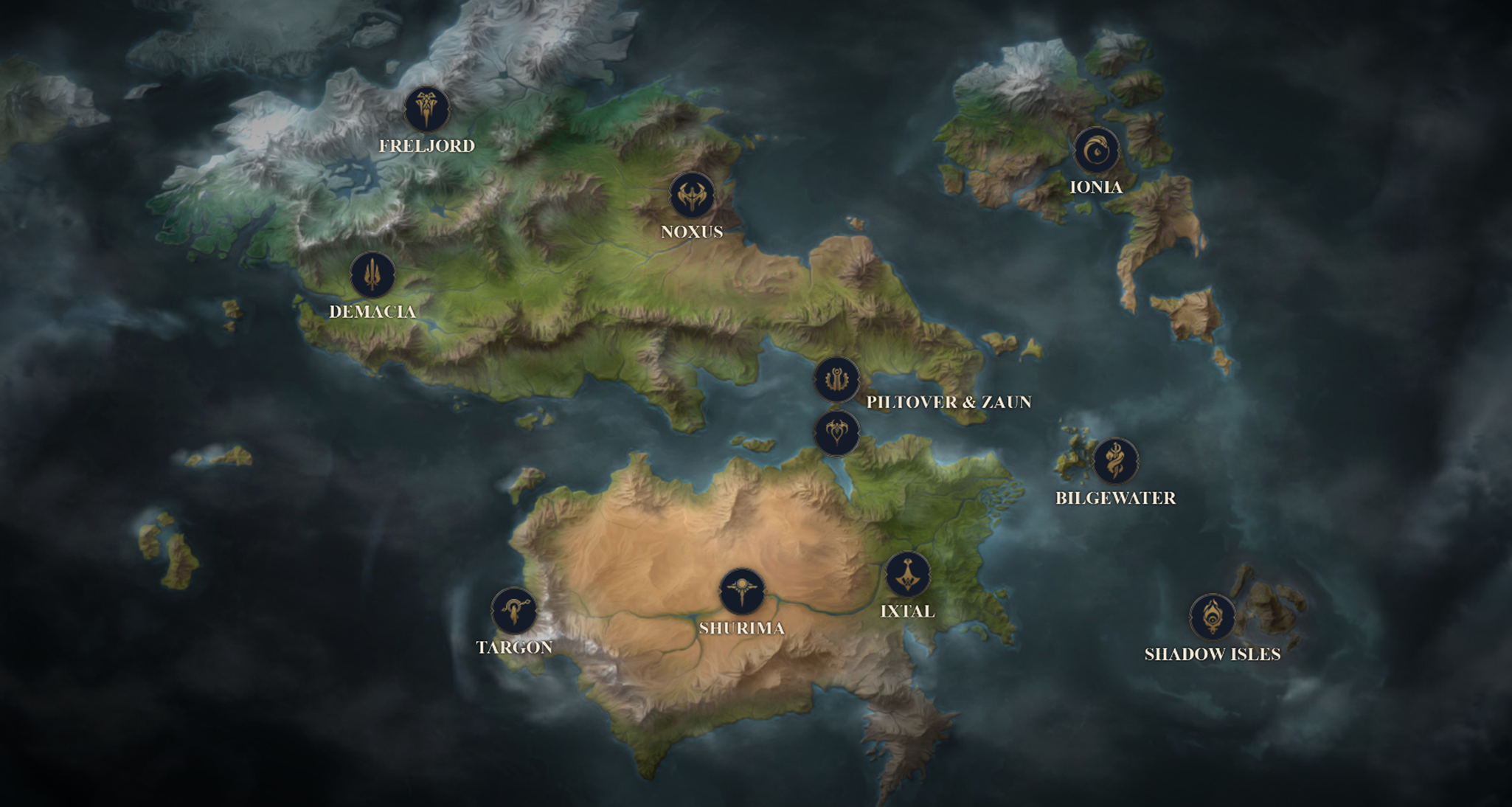
The LoL characters exist within the fictional world of Runeterra, which means “magic earth” (https://map.leagueoflegends.com/en_US; Figure 1). The geography of Runeterra is central to the LoL lore. Beyond the game, Riot presents the lore in the Netflix series Arcane (https://www.youtube.com/watch?v=fXmAurh012s), books such as League of Legends: Realms of Runeterra (Riot Games 2019), and a large and detailed website. These multiple venues allow anyone anywhere to engage with the LoL lore. Therefore, we observe storytelling used to grow and support a fan community and enhance the video game product. Although the lore is not required to play the game, it acts as supplemental material for those who are interested in the background of the characters they are choosing as their avatars. Perhaps the best place to explore the LoL world is on the website Universe of League of Legends (https://universe.leagueoflegends.com/en_US/ ). The Champions subpage of this website introduces the LoL characters, together with additional characters present in the lore but not in the game. There, one can find biographies of characters—such as Ezreal, an explorer and the son of two archaeologists—as well as links from the character stories to the physical map of Runeterra. The Regions subpage highlights the fictional places in Runeterra, bringing to light the cultural histories of each location. One can explore the significance and backstory of places such as the regions of Ionia and Targon. Finally, the Map subpage allows one to explore Runeterra through an interactive map, and it has connections to characters, such as a hyperlink to Ezreal's field journal, which is an important archaeological representation in the lore. Significant effort has been put into the website even though it is not directly profitable for the company, which highlights the perceived potential of storytelling to engage an audience.
Map of Runeterra (magic Earth), where the League of Legends lore takes place (Riot Games 2023).
ARCHAEOLOGICAL REPRESENTATIONS IN RUNETERRA
An integral component of the LoL lore is the story of the fictional archaeologists, which helps to piece together the histories and cultures of Runeterra. Much of Runeterra's history was gathered by two archaeologists from the fictional city Piltover. Little is known of the archaeologists in the lore because they disappeared during their research. However, more is known of their son, Ezreal, who is an explorer akin to the antiquarians of the late nineteenth century. As Ezreal attempts to relocate his parents, he explores Runeterra, taking active field notes of his journeys. His narratives of the cultural history of Runeterra build on those of his parents, who documented and recorded the histories of places such as Ionia and Targon. The creation of these characters as part of the LoL lore allows Runeterra to be viewed through an archaeological lens, even if most players are, of course, not themselves archaeologists (Snyder Reference Snyder2022). The common trope of “archaeologist as adventurer” is clearly represented through Ezreal. As with many pop-culture products, this trope is used to tell an exciting story of exploration while simultaneously providing information on the places, people, and histories of Runeterra.
The histories of Targon and Ionia are presented based on the detailed records of Ezreal's parents (the archaeologists). The integration of archaeological practices such as careful record keeping and interpretations of past societies in the LoL lore provides the viewer with a rudimentary introduction to the ways archaeologists study and interpret the past. Rather than fighting Nazis, raiding tombs, and falling into pits full of snakes, the archaeologist must piece together puzzles of the past through detailed documentation and recordkeeping. The work of the archaeologists trickles down to Ezreal's field notes. These field notes are published online as an interactive map—a means for the user to engage with the fictional world. Ezreal visits places throughout Runeterra and describes them in detail in his field notes (Figure 2). His interpretations are, of course, unlike those of a real archaeologist, who keeps detailed records of each site and artifact, writing down measurements, observations, and interpretations in a field notebook (Figure 3). Although Riot attempts to replicate the look of an archaeologist's journal, Ezreal's is more like that of an explorer or traveler describing adventures in far-off lands. One wonders how the authors of the website conceived of this type of presentation and what sort of research underpins the decisions they made along the way.
Ezreal's field notes (Riot Games 2023).

Rendition of archaeologist field notes from the excavations at Targon (created by Yesenia Rubi Landa).

GEOGRAPHY AND THE ARCHAEOLOGICAL RECORD OF RUNETERRA
Riot created an intricate world, tying each character to a place of origin and detailing the rich histories of these places. Runeterra consists of several continents split into 13 regions, with topographic features such as islands and mountains. The world and lore allow members of the online community to develop connections with Runeterra based on meanings and attachments they create for this setting while they explore via the website or books. Through these websites and books, we can explore how aspects of archaeology are visible in Runeterra (specifically, in Ionia and Targon).
Targon is a mountainous region, containing the eponymous Mount Targon and the home of the Rakkor tribes. The tribal communities are scattered across the landscape, with villages filled with markets, seasonal homes, and ceremonial chambers carved out of the mountains themselves. The origin stories of Targon make it a place of pilgrimage for the people of Runeterra. It is said by the people of Targon that the mountains themselves were forged by divine intelligences. Some believe that shapes carved in the mountain are part of a great map depicting other realms; others believe the shapes depict a prophecy that will cause a great war. These shapes are also similar to their settlements, which are carved into the mountain (Figure 4).
Mount Targon settlements carved into mountains (Riot Games 2023).

In contrast to Targon, a place of sacred origin, Ionia is important because it is the First Lands. The First Lands is a liminal space between the material and spiritual realms. Ionia's inhabitants and habitats are older than most of those in Runeterra. Magic lives in every part of Ionia: in the people, the history, and the physical landscape itself. The inhabitants see themselves as part of the natural world and find ways to adapt and live alongside the flora and fauna. The people of Runeterra believe that the history of Ionia is longer and richer than anybody could ever claim to know. Evidence of wars from ages ago are present, similar to historic battlefields or archaeological evidence of warfare. Like a historic battlefield, the evidence of war on Ionia was left in situ as a reminder of the past and a sign of respect for those involved. Similarly, the temples and monasteries in Ionia have an unknown history, but the Ionians understand that they are important and should be respected (Riot Games 2019, 2023). The people of Ionia maintain a close relationship with their landscapes, often described as “living architecture.” All of this fictional storytelling can remind one of the efforts archaeologists make to interpret how people in the past negotiated their relationships with their surroundings. As one example, archaeologists have been exploring how, among the Classic (AD 250–800) Maya, architecture mimics and is integrated into landscapes. At the city of Dos Pilas in modern Guatemala, the royal palace is situated above a cave that releases water during the rainy season, which was likely used to control and restrict access to water by the ruler (Brady and Ashmore Reference Brady, Ashmore, Ashmore and Knapp1999).
ARCHAEOLOGY . . . OR NOT?
In pop culture, archaeologists are often portrayed as action-packed explorers diving into water-filled caves and opening tombs filled with ancient treasures (Khan Reference Khan2022). The League of Legends portrayal of archaeology is no different. Although Ezreal has some training in archaeology, most of his entries are written in the form of an explorer's journal. His journal often describes faraway, exotic locations with treasures ready to be discovered. In one entry he says, “I guarantee there's some interesting stuff buried out there. Old stuff. Priceless stuff” (Riot Games 2023). Although entertaining for the general public, most archaeologists today have not chosen this discipline for “treasures ready to be discovered” or to collect rare artifacts. Rather, we seek to work respectfully, carefully documenting the provenance of artifacts and features to inform the past (Cobb et al Reference Cobb, Earley-Spadoni and Dames2019; Petrosyan et al. Reference Petrosyan, Azizbekyan, Gasparyan, Dan, Bobokhyan and Amiryan2021). In international field work, the rarest finds are, today, securely stored with local collaborating institutions. Although it is true that archaeology's history is rooted in the colonial exploration of new and “exotic” worlds, today it is a discipline whose goal is to share knowledge with others. What does it mean to have yet another pop-cultural product that, despite its detailed storytelling, does not reflect this contemporary reality?
TARGON THROUGH THE EYES OF ARCHAEOLOGISTS
To explore and contrast these problematic ideas of pop-culture archaeology, we undertook our own thought experiment. We asked ourselves how a real archaeologist might approach this fictional world to enable us to better understand the people of the past in that world.
Geoarchaeological Interpretations (by Landa)
From the perspective of a geoarchaeologist, I would research the human–environmental interactions of the ancient inhabitants of Targon, a place where humans are constantly interacting with their landscape. The features of the landscape are important not only for ritualistic purposes but also for subsistence. Whereas the mountains and trails are seen as sacred places to perform migration ceremonies, the low-lying valleys are important for subsistence. The mountainous regions of Targon are too harsh for cultivation, but the low-lying valleys are perfect for hunting, foraging, and growing crops. To understand the past of Targon, the archaeological methods of excavation and artifact analysis along with the collection of soils to conduct geochemical analysis, radiocarbon dating, and palaeoecological analysis should be completed. The excavation and artifact analysis would allow us to understand the past inhabitants of Targon. Soil analyses would enable us to reconstruct the paleoenvironment of Targon. Together, we can better understand how the ancient inhabitants of Targon may have lived and interacted with their landscape.
Landscape and Settlement Pattern Perspectives (by Thompson)
The mountainous regions of Targon show ample evidence of anthropogenic landscape modifications, with intricate carvings and staircases detailed into the cliff faces. The steep terrain and bedrock outcrops of the valley floor result in an environment that is less than ideal for households. Rather, it seems that houses (or perhaps tombs) are carved into the walls of the cliffs, similar to the houses carved into the stone at Bandelier (in the US Southwest) by Ancestral Puebloans and at Petra (Jordan) by Nabateans (Figure 5). If these are homes, they are similar in size, showing no noticeable variation in wealth or status. The decorations on the exterior circular access points to the houses appear nearly identical among the small sample size. Although these houses are located along the cliff edge, they appear clustered together. Perhaps additional clusters of houses are present in other areas along the cliff, forming small spatially discrete neighborhoods. Future survey would include transects along the cliff edges, documenting the location of household features as well as their size and complexity. Through these methods, and incorporating geospatial analyses, we could gain insights into past lifeways of the 99% residing in Targon.
Comparison of houses carved into cliff faces at Mount Targon (left), Bandelier in the US Southwest (middle; photo by Micah I. Smith), and Petra in Jordan (right; photo by Amy E. Thompson).

CONCLUDING REMARKS
Storytelling through lore offers a way to engage an audience in media products such as video games. By considering stories like the ones created by Riot Games, we can think more about how people write, read, and otherwise interact with the lore. Although Riot's website is interesting and allows the public to be introduced to archaeology, it is not an accurate depiction of the field. Regardless of whether archaeologists agree, most people first hear of archaeology through pop culture references, such as Indiana Jones, The Mummy, and even League of Legends. Despite the associated misperceptions, we believe that these references can still provide an important starting point for introducing people to some of the basic concepts of what archaeology is and how archaeologists study past human cultures. Therefore, the limited archaeological portrayal in the LoL lore may serve to invite the public to learn more about archaeology. Many video games are specifically designed to follow an archaeologist or real historical events, such as Heaven's Vault (Hagenauer Reference Hageneuer2021) and Assassin's Creed (Politopoulos et al. Reference Politopoulos, Mol, Boom and Ariese2019). Because archaeology is the main point of those games, they tend to reflect archaeology more accurately than games such as League of Legends or Minecraft (Styles Reference Styles2016). These examples show that the portrayal of archaeology in entertainment falls along a spectrum.
If we consider that references to archaeology in pop culture can be challenging due to a lack of accuracy that can drive false notions in the public, we should also recognize that this is partly the result of the power of storytelling. Consequently, we should keep a critical eye on how public representations of archaeology are articulated, and we should start to drive conversations about the discipline and how we can create more accurate portrayals in media (Emmitt Reference Emmitt2022). Even though the narrative is not integral for the gameplay for LoL, it is beneficial for the user because it can create a more intimate relationship between the story and the heroes they are choosing to play as. This lore creates a meaningful attachment between a fictional world and the fan base, players, and developers. These stories excite people, and we as archaeologists can help guide the narrative that is being created. But perhaps we should also examine whether and why in the fictional stories archaeologists must be portrayed inaccurately in order for those stories to be more attractive. How do sensationalism, lore, and archaeology intersect, and what does this mean for our field?


 Open access

