

1. INTRODUCTION: THE ENFORCEMENT DEBATE AND ITS IMPORTANCE FOR DEVELOPMENT POLICY
Between 2000 and the beginning of the global financial crisis, much of the corporate and securities law scholarship—both by legal and economics scholars—debated the relative merits of various legal systems for protecting the interests of investors in publicly listed companies. The context for this debate was the understanding that investor protection contributes to (or is at least strongly correlated with) the development of a capital markets-based financial system.Footnote 1 During the debate, it became apparent that high-quality law and regulations were not enough to guarantee fair and balanced regulation.Footnote 2 Good laws and rules could be enacted or issued by a jurisdiction, regulatory body, or securities exchange to signal quality oversight to the world, yet not be effectively enforced. Enforcement could also be selective or biased in such a way that the announced ends of the regulatory framework are not supported or are even thwarted. In such a case, regulation for fairness and efficiency would be signalled but not realized. Such a regulatory Potemkin village would give casual observers unfounded reassurance of regulatory soundness while luring investors into a potentially high-risk environment. For this reason, the debate turned to include enforcement of investor protection laws as an important criterion for assessment, and criteria going deeper than the letter of the law were sought for purposes of this assessment.Footnote 3
One aspect of this analysis was the comparative law question of whether judicial action by damaged shareholders (private enforcement) or a combination of administrative and judicial action by public authorities (public enforcement) was the most effective route to protect investors. An early and enormously influential verdict by a team of economists was that private remedies are more effective than public.Footnote 4 This argument was accepted and advocated by the World Bank,Footnote 5 among others.Footnote 6 Responses by legal scholars Jackson, Roe, and Coffee argued the opposite.Footnote 7 The question is particularly important for developing countries like China, where the legal system is still a work in progress, and for international financial centres (IFCs) like Hong Kong, which continuously review their law and institutions in a competitive bid to attract the favour of the world financial community’s investments and deals to their jurisdiction.Footnote 8 IFCs are expected to meet international opinion as to best practices in financial regulation, and are rated accordingly. As Hong Kong is a part of China and has a relatively young financial regulatory system compared to other leading IFCs like London and New York, the debate on the quality of enforcement model is of particular importance for Hong Kong’s continued development. In addition, Hong Kong could aspire to be not only a student of what has previously been done in the West, but also to innovatively develop a better framework for good governance and financial regulation. Thus, a detailed analysis of enforcement in an IFC like Hong Kong, which has been rated as a “global leader” for a number of years by one ratingFootnote 9 and highly competitive by others,Footnote 10 yet faces particularly strong challenges in the policing of its market, presents a useful case for understanding the parameters of effective enforcement for the broader debate.
Hong Kong also offers interesting patterns for the broader debate on law and development with respect to whether good law leads to financial market development or the reverse. History shows that the causal relationship between the quality of law and the existence of a financial centre in Hong Kong goes two ways. First, there is evidence to suggest that Hong Kong was deliberately chosen to be built up as a financial centre in order to serve China’s economic development needs.Footnote 11 Hong Kong would have been favoured over Shanghai for a number of reasons: it had a working legal system originating from the respected English tradition and a solid scandal-free judiciaryFootnote 12 ; it also had a currency that was fully and freely convertible (unlike the RMB of mainland China). Moreover, Hong Kong’s semi-autonomous status allowed its legal system to maintain the characteristics trusted by foreign financial institutions without disrupting the Chinese central government’s control over other regions in its territory. Thus, although Hong Kong law could not in any way be considered exceptional when the accord was signed in 1984 to transfer the region back to China,Footnote 13 over the last 30 years, the legal system has been consistently built up to its current state, which easily meets international best practices, as this paper and other studies have shown.Footnote 14
Here we focus on one salient aspect of the Hong Kong legal system: the enforcement of corporate and securities law in Hong Kong is achieved almost solely through public authorities. In jurisdictions where private enforcement is effective, it enjoys structural buttressing through the rules of the legal profession and procedural forms of action: in particular, contingent feesFootnote 15 and class actions.Footnote 16 Neither of these is currently possible in Hong Kong.Footnote 17 Given the economic risk of entering into derivative litigation (in which any damages payment goes to the company) or securities litigation (where an individual investor’s losses might not be substantial), few Hong Kong investors initiate a derivative or securities fraud actions.Footnote 18 Hong Kong courts’ use of the English rule for litigation costs can also contribute to this hesitation to sue.Footnote 19 As a result, beyond the few corporate derivative and unfair prejudice actions filed annually, as discussed in Section 3.3, all corporate and securities law enforcement in Hong Kong is undertaken by public bodies.Footnote 20 As such, if we were to evaluate effective enforcement focusing primarily on the output of private actions, we would find Hong Kong investor protection to be greatly lacking. However, Hong Kong law functions at a highly competitive level globally while regulating a market largely comprising foreign companies incorporated in jurisdictions whose governance records are questionable.Footnote 21 This feat stands in stark contrast to a conclusion that Hong Kong law lacks quality because of too public an enforcement model.
The determinants of effective corporate and securities law enforcement as drawn from the current state of the debate on investor protection referred to above also indicate that public enforcement is likely to be more important than private enforcement for the success of a financial system.Footnote 22 These determinants will be discussed in Section 2 of this paper. Section 2 takes from this debate that an assessment should focus on three elements: (1) laws and rules regulating the market and its participants, including both potential penalties and abstract regulatory powers, (2) the “inputs” (funding and staffing) into supervisory bodies, and (3) the “outputs” (actions and sanctions) of those bodies, but argues that ultimate “outputs” should be given the most weight. Section 3 examines the Hong Kong institutional context. This includes a summary of key corporate and securities law rules, avenues for private actions, the powers and competencies of its supervisory authorities (including the stock exchange), and the “inputs” into those bodies. Section 4 presents data on “outputs” of institutional enforcement (public bodies plus the stock exchange), the types and numbers of enforcement actions undertaken, and their success rate. To allow readers to understand the Hong Kong enforcement context completely, both public and private actions are explained, and data are offered for both types of actions. This section expressly considers the various levels of sanctions imposed, with particular focus on the “disqualification” from holding a director position, and how its impact differs from that of civil damages. Section 5 presents our conclusions.
2. DETERMINANTS OF EFFECTIVE ENFORCEMENT
As will be explained in Section 3, Hong Kong is both relatively new as a financial centre and has an economy in which financial activity is crucial. Its stock market capitalization greatly exceeds its gross domestic product (GDP) and the largest segment of its labour force engages in financial and related professional services.Footnote 23 It can even be argued that Hong Kong’s level of political autonomy and the state of its human rights protection are at least indirectly dependent on its continued importance as an international financial centre for China.Footnote 24 It is therefore no exaggeration to say that effectively dealing with the protection of investors is of crucial importance to the success of Hong Kong.
Simple but popular methods used to evaluate the quality of corporate and financial regulation range from collecting anecdotes from persons engaged in the financial industryFootnote 25 to cataloguing abstract prohibitions and regulatory powers as culled from reading the corporate and securities laws or a survey done on the same, or interviewing experts familiar with the law.Footnote 26 Both of these approaches lack requisite concrete objectivity. Objectivity is a problem because the opinions of market participants interviewed may be both random and self-serving. Questionnaires sent to attorneys may be incorrectly formulated due to a preliminary lack of knowledge, and the answers to the same may be cautiously bland, safely adhering to the letter of the law or regulation. Hence while the work of LLSV and others concludes that private law enforcement is more important than public enforcement,Footnote 27 more recent studies found problems with their analysis.Footnote 28 It is also worth noting because “common-law” jurisdictions are often lumped together that, despite the similarity of law and regulation in the UK and US, very significant differences in approach exist.Footnote 29
Concrete understanding thus is necessary because corporate and securities laws of course operate in the context of other laws and rules, and are applied within an institutional framework. The behaviour of persons charged with implementing a regulatory framework is subjected to various restrictions, incentives, and disincentives—legal, institutional, and economic. The behaviour of the persons targeted by enforcement also arises within a rich institutional context, including the presence or absence of insurance to pay for liabilityFootnote 30 and the potential impact on reputation and damage to it.Footnote 31 Thus, the complexity of the legal dimension is matched or exceeded by the multiplicity of relationships within the institutional and social dimensions of both enforcement officials and the economic actors they regulate.Footnote 32 As Coates has recently observed, “the main units of variation and change in finance are not things, or even individuals, but groups of people—groups with not only economic but also social and political relations.”Footnote 33 The problem of effective enforcement thus presents at least three interrelated fields of relationships: that of the rules, that of the regulators, and that of the regulated. Analysis encompassing legal, institutional, economic, and social contexts is not only highly complex and deeply interesting,Footnote 34 but is one on which we appear to be making progress.Footnote 35
Since the early 2000s, a significant body of objective and concrete work has been produced on corporate and securities law enforcement, combining legal expertise of detail, a deep knowledge of market realities, and rigorous empirical analyses of broad datasets.Footnote 36 In a series of important articles, Cox and Thomas explained the relationship between public and private enforcement,Footnote 37 the role of institutional investors—and plaintiffs generally—in securities class actions,Footnote 38 and the correct regulatory framework to optimize the utility of such actions.Footnote 39 This research significantly expanded the set of variables that we understood as necessary to examine in evaluating law in the enforcement context, and provided detailed instruction on the complexity of interrelationships between these variables. In a set of important articles going well beyond an evaluation of the Delaware General Corporation Law and applying a fine balance of legal expertise, market understanding, and empirical rigour, Armour, Black, and Cheffins examined the evolving position of Delaware as a venue for litigation in its competition for corporate charters. They use empirical evidence to raise the novel issue that Delaware’s much-praised judiciary may be of little avail in regulatory competition because corporate litigation is migrating elsewhere, and explained the fine balance that must be achieved between pleasing both incorporating directors and the plaintiff’s bar.Footnote 40 They also show that the quality and tenor of the Delaware judiciary are not the only or even the main causal factors for this trend, and provide economic historical evidence of developments in the legal profession that have dislocated important corporate actions from their original venue in Wilmington.Footnote 41
Two important articles among this newer scholarship have specifically focused on enforcement in securities markets, and are directly applicable to the project of this paper. In the first, Jackson and Roe empirically examined the assertion that judicial action by private plaintiffs is more closely correlated to financial market growth than is the creation of (even powerful) regulatory bodies.Footnote 42 Their study points out that an abstract cataloguing of regulatory powers cannot alone explain how regulation works, given the rich institutional and motivational environment in which enforcement activity takes place.Footnote 43 As an alternative to an abstract list, they plot ratios between regulatory bodies’ budget and national GDP and staffing in relation to national population and the size of a jurisdiction’s capital markets, showing that resources expended in public regulation strongly correlate with the success of a financial centre.Footnote 44 Importantly for this paper, Jackson and Roe explain that they have chosen to focus on input factors rather than enforcement outcome for three reasons, one of which is the unavailability of output data.Footnote 45 By examining Hong Kong data in detail, this paper helps to address that lack, at least for one jurisdiction. The second two factors Jackson and Roe provide for using input rather than output are that, first, enforcement volume could be ambiguous in that low volume could indicate either a shirking regulator or a law-abiding market (perhaps cowering in awe of potential regulatory power) and, second, “the mechanisms of enforcement differ across national boundaries,” with some relying on “informal discussion” (e.g. the UK), while others need formal actions as deterrent.Footnote 46 In the case of Hong Kong, because companies, their owners, and their directors come from every part of the world, it is difficult to make a judgement about a uniform enforcement culture. However, strong enforcement in Hong Kong can be assumed for our purposes as useful because many economic actors in Hong Kong have been shaped by mainland Chinese history, in which traditional economic law was first condemned in a Marxist sense as a tool of class oppression, then pragmatically understood post 1978 as a hurdle to business that could be adjusted or avoided with the right connections.Footnote 47 Given the limited size of the Hong Kong financial community and the proximity of regulators, the importance of informal discussion cannot be overestimated but, if, behind the friendly consultation, stands strong enforcement, this would tend to concentrate the mind wonderfully.Footnote 48 As such, information about enforcement output is in our opinion highly relevant to the quality of corporate and securities law in Hong Kong.Footnote 49
A second article on the determinants of enforcement that is directly applicable to our paper is a theoretical study by Coffee, which sets out to build on work by Jackson and uses available empirical data on enforcement inputs and outputs for both private and public actions.Footnote 50 The paper analyses the data in the context of incentives for actors, the needs and interests of various constituencies, and the relationship of enforcement to financial services development. His view of the necessary determinants, which we have found instructive and adopted in this paper, can be summarized as follows:
-
1. the regulatory structure, and the allocation of regulatory powers and discretion among regulators and private actors;
-
2. the resources invested, in terms of budget and staff, in securities regulation; and
-
3. the number of actions securities regulators initiate, and the sanctions they impose.Footnote 51
A particularly important point Coffee raises is that enforcement measures must be calibrated to create real deterrence affecting potential wrongdoers. On this point, he argues that high civil damages against companies and directors in the US are
both too little … and too much—too little in that the outside professionals are rarely sued and corporate officers often pay nothing, and too much in that the corporation itself is regularly sued and settles at the shareholders’ expense.Footnote 52
Coffee finds that this consideration supports the efficacy of enforcement actions by the US Securities and Exchange Commission (SEC).Footnote 53 This has relevance for the nature of the deterrent often employed in Hong Kong, which is disqualification from holding a director position.Footnote 54
The following Sections 3 and 4 present the enforcement of corporate and securities laws in Hong Kong based on the law seen in context and actual output. Section 3 examines the institutional framework for enforcement, including laws and regulatory bodies, and Section 4 presents data on enforcement output, with a focus on actions to disqualify directors.
3. THE HONG KONG MARKET AND THE INSTITUTIONAL FRAMEWORK FOR ENFORCEMENT
3.1 The Hong Kong Market
The Hong Kong capital market is greatly a product of the rise of the Chinese economy over the three decades from 1980, and its regulatory framework was largely created as a channel to finance this growth during the same period. The market capitalization of the Stock Exchange of Hong Kong (SEHK) grew by about 17-fold between 1976 and 1991, from about HK$56.7 billion to HK$949.2 billionFootnote 55 —an absolute increase of about HK$892 billion. Then, in the two decades from 1992, the year before the first mainland Chinese enterprise was listed,Footnote 56 its market capitalization multiplied again by another 17-fold, to exceed HK$24 trillion by the end of 2016Footnote 57 —an absolute increase of about HK$23.8 trillion. Between the announcement of Hong Kong’s return to China and 2016, SEHK market capitalization increased about 60-fold.Footnote 58 “Mainland enterprises”Footnote 59 constitute more than 62% of 2015 SEHK market capitalization.Footnote 60 Thus the Hong Kong capital market is both new and greatly dependent on its ability to serve as a window for international investment in Chinese enterprises. This background has made Hong Kong in recent years a market that remains focused on raising capital (rather than trading existing listings), and its volume of initial public offerings (IPOs) has retained a prominent place globally.Footnote 61
Figures for 2015 in US$ millionFootnote a
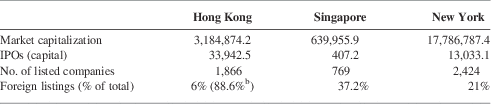
a Source: World Federation of Exchanges.
b HKEx provides information on only a few companies under the rubric “foreign” because it has created a category of acceptable overseas jurisdictions for companies to cross-list, although those companies are in fact not incorporated under Hong Kong law. These are referred to as “overseas” companies and, if they are counted as “foreign” (which they factually are), then only 11.36% of companies listed on the SEHK are not foreign-incorporated.
Hong Kong is unquestionably a financial centre, and traded assets dwarf productive activity, such that the market capitalization of SEHK in 2016 was more than ten times Hong Kong’s GDP of HK$2.48 trillion.Footnote 62 Companies listed on the SEHK are rarely incorporated in Hong Kong, and can be divided into five groups, with 48.9% incorporated in the Cayman Islands, 26.3% incorporated in Bermuda, 12.2% incorporated under the law of mainland China, only 10.7% incorporated in Hong Kong itself, and the remaining 1.87% incorporated elsewhere.Footnote 63 Regardless of where these companies are incorporated, most have their major business operations in China, and thus bring with them into Hong Kong the regulatory risks of mainland China. Moreover, the leading constituent stocks of the Hang Seng Index (HSI), except for the financial companies, all have controlling shareholders,Footnote 64 which can reduce agency problems between managers and shareholders, but brings its own challenges of controlling shareholder abuse.
The supervision of securities trading in the Hong Kong market is facilitated by the fact that the market structure for equity trading in Hong Kong is mainly concentrated on one exchange, but complicated by the large number of broker-dealers and the significant discrepancy in size and sophistication between local intermediaries and the multinational broker-dealer banks.Footnote 65 As at March 2016, the SEHK had 537 exchange participants (about the same number as the New York Stock Exchange (NYSE)),Footnote 66 but only about 12% of these were also admitted to trading on the HKFE.Footnote 67 This dual membership can serve as a proxy for large, internationally active broker-dealers, providing evidence of participant size on the SEHK. As is evident from Table 1, Hong Kong’s market is nearly six times smaller than New York’s, the world’s largest market, but about five times larger than Singapore’s, a fellow IFC in Asia. However, unlike Singapore and even more unlike New York, the majority of companies listed in Hong Kong are foreign-incorporated, and thus this large IFC with a small domestic economy must regulate companies incorporated under foreign laws, the shape of which it cannot control.
Hong Kong’s regulatory infrastructure, which will be discussed in the following sections,Footnote 68 is nearly as new as its post-1984 skyrocketing increase in market volume. The first secondary market legislation was adopted in 1974Footnote 69 and the law reached its current shape with the codification of the Securities and Futures Ordinance (SFO) in 2003.Footnote 70 The governmental market regulator, the Hong Kong Securities and Futures Commission (SFC), was created in 1989.Footnote 71 The stock market was formed in 1986 from a consolidation of four smaller venuesFootnote 72 and the parent company that finally brought the stock and futures exchanges together within one collateral management system was created in 2000.Footnote 73 The first major rewrite of the Hong Kong corporation law in about 140 years came into effect in 2014.Footnote 74
3.2 Key Rules for Investor Protection
A reading of Hong Kong’s rules designed to protect investors shows them to compare well to those of other major financial centres, in both corporate and securities law. This section will briefly outline the kinds of rules that the enforcement actions discussed in Section 4 carry out and offer supplementary information as necessary to understand the specific shape of the Hong Kong legal framework. The provisions of law and regulation presented are those in corporate law designed to address the three relationships often characterized as agency problems—between shareholders and management, between majority and minority shareholders, and between shareholders and creditors—for which company law has developed countervailing strategies.Footnote 75 In Hong Kong, these are found in the Companies Ordinance and the common law on companies, as expressed in the decisions of Hong Kong, UK, and Commonwealth courts.Footnote 76 The provisions of securities law discussed are those designed to govern what are seen as the central concerns of securities regulationFootnote 77 : the governance and disclosure of corporate issuers and fair and orderly secondary market trading. These provisions are found in the SFO.
The Companies Ordinance contains a two-stage duty of care, consisting first of an objective functional standard and second of a subjective add-on component. It requires that a director exercise the “care, skill and diligence” of a director carrying out the “functions” of a director in relation to the company, and also requires that the director exhibit “the general knowledge, skill and experience that the director has.”Footnote 78 The provision expressly states that this duty is owed to the company (not to the shareholders, another constituency, or to the company for the benefit of the shareholders).Footnote 79 Hong Kong also applies the common-law director’s fiduciary duty, requiring “a director to act in the best interests of the company,” so that a director “may not put himself or herself in a position where his or her interest and duty conflict.”Footnote 80
These duties may be enforced judicially through actions prosecuted by company members or by the SFC (if the company is listed). The ordinance also contains statutory rules requiring that material conflicts of interest be disclosed to the boardFootnote 81 and prohibiting most loans to directors absent specific approval from shareholders.Footnote 82 As explained above, because the vast majority of listed companies are not incorporated in Hong Kong, these duties will not apply directly to most listed companies. However, an outreach provision in the Companies Ordinance provides that both derivative and unfair prejudice actions may be filed against foreign companies listed in Hong Kong (referred to as non-Hong Kong companies).Footnote 83 Also, the SEHK Listing Rules contain both a duty of care and a fiduciary duty, and the SFC has the authority to file actions against all listed companies for breach of duty or other misfeasance.Footnote 84 In this way, all local and non-local companies listed in Hong Kong are bound by the Hong Kong directors’ duties.Footnote 85
Since 1911, the Companies Ordinance has contained provisions imposing civil liability for material untrue statements in securities prospectuses.Footnote 86 To these, criminal liability provisions were added in 1972, and both are currently found in the Companies (Winding Up and Miscellaneous Provisions) Ordinance (CWUMPO),Footnote 87 but should eventually be transferred to the SFO. No change in the provisions on prospectuses has been discussed, other than a possible clarification that underwriting sponsors will also be liable for the prospectus. Despite the provision’s 100-year history, however, there is no record of any private action ever being filed alleging the publication of untrue or misleading statements in a securities prospectus. Since 2014, the Companies Ordinance also contains a criminal sanction for the intentional or reckless omission of material statements from an auditor’s report,Footnote 88 but this provision remains untested.
Like the primary market, the secondary market is governed by a standard assortment of rules specifying prohibited acts. The SFO prohibits false or misleading disclosures,Footnote 89 insider dealing,Footnote 90 and a number of forms of market manipulation.Footnote 91 Hong Kong expressly prohibits combinations of trades likely to create unsupported price pressure and is thus well placed to combat algorithms designed to engage in trade-based market manipulation by both moving price and harvesting the differences of such movement.Footnote 92 The SFC uses the Nasdaq SMARTS surveillance system to monitor for this and other patterns that might evidence market abuse. The SFO also imposes a duty on listed companies to disclose inside information that “has come to its knowledge”Footnote 93 as rapidly and fairly as practicable unless the information is a trade secret or concerns ongoing negotiations and the confidentiality of the information is preserved.Footnote 94
The SEHK Exchange Rules are ordinary in that they require regular (albeit not quarterly) disclosure,Footnote 95 shareholder voting on board composition and major transactions,Footnote 96 and insert both non-executive independent directors and committees (audit and remuneration) dominated by the latter into the board.Footnote 97 In contrast to rules on US exchanges, the SEHK expressly requires that all issued shares of a listed company have equal voting rightsFootnote 98 and, standing by this strict position in 2013, lost Hong Kong Alibaba, one of the largest listings in history, to New York.Footnote 99 Another peculiar—and, for Hong Kong, necessary—set of rules are the far-reaching provisions on connected party transactions that require not only disclosure, but abstention from voting for connected parties and an annual review of approved arrangements.Footnote 100 The concept of “connected person” reaches out to include not only economically connected parties, controlled companies, family members, and companies of the latter, but can also include extended family members like grandparents, grandchildren, and nephews, as well as companies owned by them.Footnote 101
3.3 Available Private Actions
3.3.1 Derivative Action
Hong Kong law has both the common-law shareholder derivative action first discussed in the 1843 case of Foss v. Harbottle Footnote 102 and a statutory derivative action that was introduced into the Companies Ordinance in 2004.Footnote 103 The statutory route exists independently of the common-law action and may be filed against directors for “misconduct,” which includes fraud, negligence, a breach of the duty of care, a breach of the fiduciary duty (duty of loyalty), and any failure to comply with a rule of law.Footnote 104 Under the statutory scheme, leave from court must be obtained before a derivative action can go forward, and the statutory hurdle is less burdensome than the common-law principles expressed in Foss and its progeny. The CO contains a four-part test for new proceedings brought by shareholder:
-
1. the company must not have brought the same proceedings already;
-
2. the shareholder must have given the company at least 14 days’ notice of the proceedings;
-
3. the action must appear, on the face of the application, to be in the company’s interest; and
-
4. the proceedings must present a serious question to be tried.Footnote 105
Hong Kong courts have found that the plaintiff’s burden to show the action is “on the face of the application in the interest of the company,” “is not a high one.”Footnote 106 They have held that a court “should be slow to find against the Plaintiff unless his prospects are so slim that he cannot be said to have any expectation of success.”Footnote 107 Nevertheless, despite this judicial welcome to such actions, very few have been filed, as will be shown in Section 4.
3.3.2 Unfair Prejudice Action
While derivative actions are designed to prevent or punish the illegal behaviour of directors (“misconduct”), an unfair prejudice action is meant to stop legal behaviour of management that is legal but unfairly prejudicial (referred to in the case-law for some reason as “mismanagement”).Footnote 108 The Companies Ordinance contains express provision that a member may seek relief from the court if “the company’s affairs are being or have been conducted in a manner unfairly prejudicial to the interests of ‘one or more member’.”Footnote 109 This is a direct, rather than a derivative action, and it provides relief against the oppressive behaviour of majority shareholders. It is applied when the controlling party has behaved unfairly, which the courts understand as breaching “equitable constraints” on behaviour.Footnote 110 Such constraints have traditionally been seen to exist primarily in small companies that could be called “quasi-partnerships” but the Hong Kong courts have held that, even in the case of a listed company, assumed compliance with the Listing Rules also presents an equitable constraint, so that shareholder conduct causing the breach of such rules can be unfairly prejudicial.Footnote 111 As a result, the existence of Listing Rules provisions also provide a basis for an action against unfairly prejudicial conduct of members.
3.3.3 Professional and Procedural Hurdles to Private Actions
In Hong Kong, the legal profession may not be compensated on a scheme of contingent fees and the rules of procedure do not provide for a class action. Thus, unlike in the US, the fee structure does not give lawyers incentive to carry the risk of an action. As a result, if the damage award will go to the company rather than to the plaintiff (derivative action) or the possible award for fraud or unfair prejudice will not be large, plaintiffs have little incentive to initiate an action. Hong Kong is considering adoption of class action rules, but no decision or date for decision has been made known.Footnote 112 With a loser-pays-costs structure and the lack of class actions, plaintiffs undertaking either derivative or unfair prejudice actions are few. In the case of a listed company, however, the SFC can undertake both types of actions.Footnote 113
3.4 Supervisory Agencies Authorized to File Actions
3.4.1 The Securities and Futures Commission
The Hong Kong SFC is less than 30 years old and was created in response to the “Black Monday” market crash of October 1987, which halved the Heng Seng Index and bankrupted the Hong Kong Futures Exchange guarantee system.Footnote 114 At that time, the exchanges were largely unregulated except for the need to consult with an informally staffed Commissioner.Footnote 115 Furthermore, in 1988, the chairman of the SEHK, Ronald Li Fook Shiu, was convicted of violating the Prevention of Bribery Ordinance by accepting allotments of shares in return for favourable decisions on listing applications.Footnote 116 The government then appointed a committee of experts whose chief recommendation was to create an independent supervisory authority.Footnote 117 The SFC was established as a statutory body outside of the civil service and given jurisdiction over the Hong Kong securities exchanges by force of the Securities and Futures Commission Ordinance of 1989.Footnote 118 Rather than being “independent,” it is more accurate to think of the SFC as balancing between the twin forces of government and market influence. From the government side, the Chief Executive of the Hong Kong Special Administrative Region (HKSAR) appoints the chairperson and other commissioners of the SFCFootnote 119 and the chief executive may also instruct the SFC on how to carry out its duties.Footnote 120 From the market side, an “advisory committee” drawn from the financial community in Hong Kong meets “at least” quarterly with the SFC chairperson and chief executive officer to advise them on matters of policy.Footnote 121 SFC performance and procedures are reviewed annually by an independent “Process Review Panel” operating out of the HKSAR Financial Services Branch and originally created by the chief executive in 2000.Footnote 122 The Panel reviews, inter alia, the licensing and regulatory activity of the SFC
on the adequacy of [its] internal procedures and operational guidelines governing the actions taken and operational decisions made by [it] and its staff in the performance of its regulatory functions, including the receipt and handling of complaints, licensing and inspection of intermediaries, and disciplinary action.Footnote 123
Like other supervisory bodies of this type, the SFC’s statutory mandate is “to maintain and promote the fairness, efficiency, competitiveness, transparency and orderliness of the securities and futures industry,” educate and protect the investing public, and “reduce systemic risks in the securities and futures industry.”Footnote 124 Its powers and duties include the licensing of market participants,Footnote 125 as well as the continued policing of their behaviour,Footnote 126 and the creation of rules and guidelines to govern these activities.Footnote 127 The SFC is divided into five divisions, which respectively focus on markets supervision, intermediary licensing, corporate finance, China market integration questions, and enforcement. The enforcement division separates its actions into corporate disclosure and governance, intermediary misconduct and unlicensed behaviour, and market manipulation and insider dealing.Footnote 128
When dealing with its own licensees, the SFC can impose licence-related sanctions without recourse to any court or tribunal.Footnote 129 When acting against market misconduct, the SFC may file a civil action in a special-purpose Market Misconduct TribunalFootnote 130 or, in the Court of First Instance, particularly for injunctive relief,Footnote 131 file a minor criminal action in a magistrate’s court,Footnote 132 or ask the Department of Justice to file a criminal action in the District Court or the Court of First Instance.Footnote 133
In 2012, differences of opinion arose between the SFC and the Hong Kong Director of Public Prosecutions, who expressed concern about the role of the SFC as both regulator and prosecutor, stating a fear of it “becoming judge of its own cause” and arguing that “it is imperative to keep the prosecutorial responsibility separate from regulatory or investigatory agencies.”Footnote 134 For its part, the SFC responded that the Public Prosecutor’s office appeared understaffed in respect to securities fraud cases.Footnote 135 In 2016, the two sides seem to have come to an agreement with the signing of a Memorandum of Understanding.Footnote 136 It states that the two have “mutual interest” in dealing with corporate wrongdoing and formalized the handling of cases under the SFO. The Department of Justice also stated that the “power of the SFC to prosecute in its own name does not derogate from the powers of the Secretary for Justice in respect of the prosecution of criminal offences.”Footnote 137
The SFC is funded by a tariff imposed on trading and has not requested funding from government budget since 1993. At least for the current period, the idea of “inputs” as budgeted expenditure for the SFC is not likely to be as important as enforcement “outputs” because the SFC receives much more money than it can spend and, in 2015, had accumulated reserves up to 4.6 times its projected annual expenditure.Footnote 138 Between 2005 and 2015, the SFC reported annual expenditures more than trebling from HK$497 million in 2005 to about HK$1.7 billion in 2015, with an increase in expenditures from 2009 to 2015 of 138%.Footnote 139 Despite tripling its spending over the ten-year period, the SFC still showed a surplus of more than HK$6.3 billion. The SFC reports that an average of approximately 21% of its staff was dedicated to its enforcement division for the period 2000–16.Footnote 140 In its 2015 annual report, the SFC notes that “[s]taff costs accounted for about 69% of our total expenditures. Over the past three years, our staff costs increased 45% while many regulatory activities increased in both number and complexity.”Footnote 141 Details on the type, number, and success rate of judicial actions filed are discussed in Section 4, below.
3.4.2 The Official Receiver
The Official Receiver (OR) of the HKSAR dates back to 1931 and was modelled on its British equivalent. The current OR is organized under and receives its powers from the Hong Kong Bankruptcy Ordinance.Footnote 142 Its mandate is to provide for the orderly management of insolvency proceedings over both individuals and companies where no other provision for a liquidator has been made.Footnote 143 For purposes of this paper, its most important function is to prosecute persons, including corporate directors,Footnote 144 for violations of law in proximity of bankruptcy.Footnote 145 Actions filed by the OR are heard in the Court of First Instance.Footnote 146
Of the four entities discussed in this paper, the OR alone is listed on the general budget of the HKSAR. Over the ten-year period between 2007 and 2016, the OR had average planned annual budgets beginning at approximately HK$147 million and increasing to around HK$190 million in 2016–17, with about two-thirds of that going to staffing.Footnote 147 In 2015, the OR’s total staff numbered 242.Footnote 148 The OR has reported that the prosecution office of its enforcement division is staffed by at least seven solicitors, two of whom are designated as “Senior Solicitors,”Footnote 149 but the actual number of employees assigned to this office is not fully disclosed. Details on the type, number, and success rate of judicial actions filed are discussed in Section 4, below.
3.4.3 The Registrar of Companies
Like the OR, the Hong Kong Registrar of Companies was created with functions and duties tracking its British equivalent. In addition to registering the establishment of companies and providing a preliminary screening of company names,Footnote 150 the Registrar issues guidelines on important questions of company lawFootnote 151 and receives a large array of filings and disclosure statements from existing companies. These include “annual returns”Footnote 152 that contain information similar in detail to that filed in other jurisdictions only by listed companies,Footnote 153 “statements of capital,”Footnote 154 “return of allotments,”Footnote 155 and notices setting out any other changes in a company’s capital structure,Footnote 156 such as any repurchase or redemption of shares.Footnote 157 The Companies Registry also records the debt positions of companies through keeping the returns of allotment of debenturesFootnote 158 and the register of “charges,”Footnote 159 as well as notices by creditors who enforce such charges.Footnote 160 The Companies Registry enforces these various filing obligations with powers of deregistration and fines, as well as by filing judicial actions for the disqualification of directors. We discuss details on the type, number, and success rate of judicial actions in Section 4, below.
Unlike the OR, the Companies Registry is independent of government funding and operates under commercial principles as a self-financing “trading fund.”Footnote 161 It does so very successfully such that, rather than receiving funds from public budget, it pays the government a handsome dividend. For the ten-year period from 2007 to 2016, the Companies Registry operated in substantial surplus, booking an annual average post-tax profit of HK$204 million and paying the Hong Kong government average dividend of HK$197 million per year.Footnote 162 The registry’s staff has increased gradually from 333 in 2007 to 386 in 2016, with an annual average staff for the whole period of 358.Footnote 163 Approximately 14% of staff is engaged in enforcement.Footnote 164
3.4.4 Hong Kong Exchanges and Clearing Limited (HKEx)
The SEHK is the primary regulator of listings and public offerings of securities in Hong Kong.Footnote 165 The SFO gives recognized exchanges like the SEHK (currently the only stock exchange in the HKSAR) the power to adopt binding rulesFootnote 166 and allows the SFC to delegate part of its regulatory functions to such a company.Footnote 167 Both the SEHK and its parent company, the HKEx, are tied to the government. The SFO gives the Financial Secretary the right to appoint up to eight members to SEHK’s board of directors,Footnote 168 the HKEx’ articles of association subject appointment of its chairperson to the approval of the HKSAR chief executive,Footnote 169 and the SFC may veto any proposed appointment to the post of chief executive or chief operating officer of the HKEx.Footnote 170 As such, although the HKEx is a private corporation in which the government has only a 5.88% holding,Footnote 171 its activities can be thought of as quasi-public in nature. Moreover, the SFC has legally transferred to the SEHK its power under the CO to examine and authorize prospectuses for the sale of securitiesFootnote 172 and the SFC has adopted rules placing authority for approving listing applications primarily in the hands of the SEHK.Footnote 173 The result is that the SEHK, unlike other stock exchanges (e.g. the NYSE or the London Stock Exchange (LSE), whose regulators review listing documents and determine their contents), administers nearly all of the disclosure regulation for listed companies, including the content and approval of securities prospectuses and annual reports.
As discussed in Section 3.2, above, aside from restriction on dual classes of shares and rather extensive rules on connected party transactions, the SEHK Listing Rules are largely the same as those used on other major stock exchanges. They are enforced by the SEHK Listing Division, which may bring a listed company, its substantial shareholders, or its officers or directors before the Listing Committee for a breach of the Listing Rules,Footnote 174 and may impose sanctions ranging from a private reprimand to the suspension or cancellation of the listing.Footnote 175 For the year 2016, the HKEx reported spending HK$2.06 billion, or 58% of its operating expenses, on staff.Footnote 176 It does not provide a breakdown on the portion of staff dedicated to enforcement matters. Details on the type, number, and success rate of disciplinary actions commenced are discussed in Section 4, below.
4. EXAMINING THE DATA ON ENFORCEMENT ACTIONS IN HONG KONG
4.1 Data Examined
The data examined in this Section 4 are taken from publicly available sources and—where actions were publicly initiated and the enforcement authority’s staff members were able and willing to provide additional data beyond what had already been published—supplemented by interviews with the relevant supervisory authority staff. For private actions, the judicial decisions used are those reported in two online databases—WestLaw and Lexis—combining the set where one includes a case decision not published in the other. The cases obtained from these commercial services have been checked against the decisions listed by the Hong Kong judiciary on its website as a control against underinclusion by the commercial databases. Actions counted are limited to those in which either a derivative or an unfair prejudice claim is of central importance to the plaintiff’s case, and each set of facts is only counted once, regardless of how far the case may be appealed or how many secondary rulings (such as on motion to amend a pleading or on costs) have been published. SFC actions taken under SFO sections 212–214 that include a claim of unfair prejudice or request action against a director for breach of duty to his or her company are not included in this group of private actions, but separately presented as SFO actions.
Information on SFC actions was assembled using the same commercial databases, plus the SFC’s annual reports and enforcement news reporter.Footnote 177 These actions are divided into two groups: actions taken against listed companies to counter director misconduct and actions taken against market misconduct, particularly insider dealing and market manipulation. The vast majority of SFC’s other actions, which involve the disciplining of persons licensed to perform brokerage, investment, and advisory services, are not discussed in this paper.Footnote 178 The data regarding Companies Registry actions were similarly assembled on the basis of the registry’s annual reports and reported enforcement activity, plus correspondence with registry staff.Footnote 179 As will be seen from the data, the registry files thousands of summons annually and does not provide a case-by-case breakdown of the individual grounds for each action. Thus our discussion of the actions taken will be general, based on correspondence with Companies Registry staff. The data for OR actions to disqualify company directors were assembled from the OR’s periodic publicly disclosures on its website.Footnote 180 The OR primarily acts to ensure the orderly winding-up of insolvent debtors in Hong Kong, and the fact that it will take over the records and control of an insolvent company likely has a deterrent effect on the behaviour of corporate directors. However, the information examined here is restricted solely to judicial actions taken either to disqualify directors or to hold them liable for civil damages to the company.
4.2 Private Actions
4.2.1 Derivative Actions
As Figure 1 makes clear, although the introduction of the statutory derivative action in 2004 strongly correlates with a 440% increase in the number of actions filed and a near doubling of the absolute number of actions that annually survived dismissal, the total number of actions is still very small. In the period from 2005 to 2016, a total of 36 derivative actions were heard, of which 24, or about 66%, were successful. The figures indicate a possible trend towards an increase in the filing of derivative actions, but even the historical high of six actions during the year 2014 means that plaintiffs tended to file less than one action for every 225,000 corporations operating in Hong Kong.Footnote 181
Statutory derivative actions: reported and leave granted

Aside from the numerical discrepancy between active companies and actions, a look at the facts of the derivative actions filed shows that the abuse complained of in such actions is as much that of a controlling shareholder as a director. The derivative action is often understood to be an “anti-director” tool with which weak and dispersed shareholders of a Berle and Means corporation can seek justice against professional managers. However, Hong Kong companies are characterized by controlling shareholders.Footnote 182 When controlling shareholders also directly dominate the board, tensions can arise between minority shareholders and controlling shareholders connected to the latter’s service on the board, and this can form the basis of a derivative action. If we examine the facts of Hong Kong derivative actions for which leave was granted between 2005 and 2016, we see that, in 19 of the 24 successful actions, the defendants were not only directors of the company, but also substantial shareholders or persons acting in concert with them.Footnote 183 The root of the problem in most of these actions is therefore the controlling shareholders for, if a dominant shareholder cannot achieve an end otherwise, she may attempt to do so by using access to power or information within the company board. This is not the scenario normally envisaged for derivative action relief, but rather one for which the law would better provide an avenue for direct action against abusive controlling shareholders. In the next section, we present the available data on this remedy: the action against unfairly prejudicial conduct by those in control of the company.
4.2.2 Unfair Prejudice Actions
Figure 2 sets out the number of unfair prejudice actions for which decisions were published during the period 2005–16. Few published Hong Kong decisions actually examine in detail the merits of alleged unfair prejudice petitions regarding the management of a company, and instead nearly all were decided on procedural points (such as whether security should be posted, an injunction issued, or petitions be struck) with summary view of facts as presented in the pleadings.Footnote 184 From the published cases referring to unfair prejudice actions, we have made a rather strict selection, including only those decisions where we think the court disposed of the case as an unfair prejudice action (because no other decision on the same facts is published and the determination would appear to have allowed that theory) and excluding actions where it appears from the decision that the court found the unfair prejudice claim to be frivolous or otherwise far-fetched. It would certainly be possible to interpret the constellation of unfair prejudice actions more inclusively, avoiding the kind of judgement calls we have made in focusing on these 69 decisions.Footnote 185
Unfair prejudice actions: filed and successful

There are on average about six actions annually and a success rate of about 50%. However, as discussed briefly in Section 3, a problem existed in the manner the unfair prejudice action had been restricted to companies in which close or personal relationships existed, allowing the kind of equitable commitments to arise among members primarily as a “quasi-partnership.”Footnote 186 In 2013, the Hong Kong Courts of Appeal and Final Appeal took a step away from this restrictive reading by affirming that, in the case of a listed company, the tacit understanding that Listing Rules should be complied with also presents an equitable constraint, the breaching of which may constitute unfairly prejudicial conduct.Footnote 187 As a result, listed companies are now eligible for an action against unfairly prejudicial conduct. Even so, at an average of just under six actions per year, there was only about one unfair prejudice action filed for every 200,000 companies operating on a regular basis in Hong Kong. This hardly presents a strong deterrent against management and controlling shareholder misconduct.
4.3 SFC Actions
4.3.1 Actions to Disqualify Directors
In Hong Kong, all judicial actions taken against false and misleading securities prospectuses or to punish violations of rules against insider dealing or market manipulation have been commenced by a public body. In 2007, the SFC also began filing actions to disqualify corporate directors who breach applicable standards of care or fiduciary duties, or disclose false information to the public, in most cases after they have driven their company into insolvency.Footnote 188 Two associated characteristics of the disqualification action make it attractive: first, it cannot be indemnified against through D&O insurance, as it attaches directly to the director’s person, and, second, although it shares this in personem characteristic with a criminal sanction, the standard of proof used is that for civil cases.Footnote 189 The maximum period of disqualification is 15 yearsFootnote 190 and the case-law has divided this into three bands of five years each for differing degrees of culpability.Footnote 191
After the SFC first made the strategic decision to brings such actions using SFO section 214,Footnote 192 between 2007 and 2014, it obtained 28 disqualification orders in such actionsFootnote 193 —40% more than the 20 successful Hong Kong statutory derivative actions against director misconduct during the same period (Figure 3). Although the initial actions were filed against companies already under investigation, censure, or suspension of listing by the HKEx, the SFC is now beginning to target the misconduct of directors who have not yet driven their companies into insolvency. An example is action taken to disqualify four directors of Minth Group Ltd, a listed company in the autoparts industry with business primarily in mainland China. The SFC action alleged that the named directors engaged in undisclosed related party transactions resulting in the tunnelling of funds out of the group through overpriced acquisitions made by a Minth subsidiary.Footnote 194 The SFC now began to combine disqualification actions with substantial civil suits against the same directors for disgorgement of profits and compensation of damages, such as its HK$420 million (US$53.8 million) in compensation awarded against former directors of GOME Electrical Appliances Holding Ltd.Footnote 195
Directors disqualified by SFC actions

The SFC was clearly encouraged in its enforcement activity by a 2013 victory in a landmark challenge to its direct recourse to the Court of First Instance (CFI) in civil matters. In the case, the SFC sought an injunction pursuant to SFO section 213 in the CFI against a hedge fund, Tiger Asia Management LLC, to block use of what it alleged were the proceeds of insider dealing. The CFI read the SFO as restricting the SFC for all civil matters to the Market Misconduct Tribunal (MMT),Footnote 196 which is not formally a “court” within the Hong Kong judiciary.Footnote 197 This stopped the injunctive action and was likely to stymie future SFC enforcement activity. The SFC appealed, and both the Court of AppealFootnote 198 and the Court of Final AppealFootnote 199 held on the contrary that the SFC was not restricted to the MMT, but could seek relief immediately in the CFI under SFO section 213. It was shortly after this Court of Final Appeal decision that the Director of Public Prosecutions warned of excessive SFC power, as discussed above. As the Department of Justice’s opinion of SFC power was probably known to the latter long before it was officially expressed, the Tiger Asia litigation was of great significance for the continuation of broad SFC enforcement efforts.
SFC-initiated actions are also beneficial for enriching Hong Kong case-law. The few derivative actions filed are inevitably settled after leave is granted. Although the SFC also has a formal procedure for settling petitions with a bargained period of disqualification,Footnote 200 such actions are not usually settled with respect to all directors charged. Thus the SFC-initiated actions provide the primary source of judicial decisions on the merits regarding directors’ duties. This source of case-law is especially useful because the facts of the Hong Kong cases—in which complex multinational groups with a controlling shareholder find creative ways to tunnel funds to shareholder-directorsFootnote 201 —often differ from cases decided in the UK and the Commonwealth on similarly formulated duties.
4.3.2 Actions against Market Misconduct
In addition to policing licensed broker-dealers and investment advisers for compliance with licensing requirements,Footnote 202 the SFC is also the primary enforcer of rules against market misconduct, primarily insider dealing and various forms of market manipulation. Figure 4 presents these enforcement actions in four categories of activity: persons charged in either a civil or criminal action, and persons charged with either insider dealing or market manipulation. The aggregate figures for civil and criminal actions greatly exceed the sum of insider dealing and market manipulation actions because these are only two of about 20 different types of charges arising in SFC enforcement activity, many of which regard behaviour of broker-dealers vis-à-vis clients and their funds.Footnote 203
Total SFC actions

Beginning in 2006, the SFC began a “pragmatic shift in … enforcement activities … to send a potent message when breaches occur … to take action which drives changes in behavior.”Footnote 204 This meant that raw numbers of enforcement actions decreased while the number of high-profile, labour-intensive cases increased.Footnote 205 For example, in 2008, the SFC exercised a hitherto dormant power provided under SFO section 385Footnote 206 to intervene in a scheme of arrangement hearing through which PCCW Ltd (a company dominated by Richard Li, son of Hong Kong’s wealthiest man, Li Ka-shing) sought to squeeze out its public shareholders at an historically low price and delist voluntarily from the SEHK.Footnote 207 Although a scheme designed by Li and his allies to manipulate voting rights was approved at the CFI, the SFC took it to the Court of Appeals, where it was held unfair, which rendered approval for the roll-up transaction invalid.Footnote 208 In 2011, the SFC charged a Cayman Island company listed on the SEHK, Hontex International, with publishing misleading statements regarding its accounts in a securities prospectus. The SFC used SFO section 213 to obtain an order that Hontex must make a repurchase offer to all damaged shareholdersFootnote 209 at a value of HK$1.03 billion.Footnote 210 The SFC also revoked the licence of Hontex’s lead manager (sponsor) for the listing, Mega Capital (Asia), levied a HK$62 million (US$8 million) fineFootnote 211 and proceeded to issue new rules that would expressly subject such sponsors to a regime of duties and prospectus liability. Under this enforcement policy, actions for insider dealing have also been brought against persons connected with Citic Pacific LtdFootnote 212 and ABN Amro Asset Management (Asia) Ltd.Footnote 213 In 2012, the Court of Appeal upheld conviction of an officer of Morgan Stanley Asia Ltd in a case for insider dealing, although the defendant managed to get a reduced prison sentence of six years.Footnote 214 The fine was also reduced from HK$23.3 million in appeal to around HK$1.7 million, but only in order to compensate for losses sustained by investors; in subsequent proceedings, the SFC obtained restoration orders requiring the former managing director to compensate a total of over HK$23.9 million (US$3 million) to 297 affected investors to restore their pre-transaction positions.Footnote 215
4.4 Companies Registry Actions
The Companies Registry is by number of actions the most active supervisory body of corporate law in Hong Kong, but by purpose perhaps the most benign. Nearly all of the actions filed by the Companies Registry serve to chase outstanding filings, which the company could have omitted as a result of mere carelessness or which could also be a symptom of more serious offences being committed within the company. As discussed in Section 3, the Hong Kong Companies Ordinance contains a very large number of regular filings that all of the 1.3 million local and registered foreign companies with a place of business in Hong Kong must file regularly with the registry. These filings make Hong Kong one of the most transparent jurisdictions in the world, and range from statements of indebtedness and outstanding charges, to the structure of share capital, all the way up to reports prepared by directors presenting significant risks and challenges facing the business of the company. In most cases, failure to make a filing constitutes an offence, for which the offender may be brought into court and sanctioned. Sanctions include fines and the striking of the company out of the registry, but can also include under appropriate circumstances disqualification of company directors. Figure 5 presents the available public data on enforcement supplemented through correspondence with the Companies Registry. It includes total summons issued, the success rate up until 2008, and thereafter from 2009 the rate of compliance after the issuing of a summons. Most of the registry’s actions are for fines and other penalties, rather than for disqualification of directors. The graph shows rapidly increasing case numbers between 2000 to 2007, followed by a downward trend since 2014. As per the Company Registry, this decrease in formal actions resulted from the availability of a power under the new Companies OrdinanceFootnote 216 allowing the registry to forgo prosecution of a company in breach of the ordinance if it pays a required fee, thus settling the matter at the administrative level and reducing court costs.Footnote 217 From 2014, the gap between number of summons and rate of compliance continues to narrow, which would be consistent with an increasing efficacy of enforcement.
Actions by Companies Registry: summons, convictions, and compliance

4.5 Official Receiver Actions
When the OR assumes control of a company entering into winding-up, it obtains very good information on the state of the company and a substantial amount of information on the behaviour of the management in the lead-up to the company’s collapse. The CWUMPO gives the receiver power to seek the disqualification of a director if it “is in the public interest that a disqualification order” be made.Footnote 218 The receiver can also seek action against a director for “fraudulent trading” that drives the company into insolvency, which can result in the director becoming liable for the company’s debts, committing a criminal offence, and being disqualified from management office for the longest period permitted under the statute.Footnote 219 Figure 6 sets out the record of the OR on disqualification orders sought and obtained during the most recent period of ten years, including 2016.
Official Receiver: summons and disqualifications

In the actions plotted above, the average period of disqualification obtained in each year ranges from 2.57 years to 4.11 years and, for the entire the period, disqualification averages about 3.3 years. The impact of such disqualification actions could be understood as essentially similar to rules in some civil-law countries against the directors of an insolvent company resuming the position of director,Footnote 220 albeit probably less harsh, given the high bar for the disqualification application and the significant discretion of the court in crafting the order. Nevertheless, these orders serve not only to protect future investors, but also to deter the misconduct of existing directors, and are thus very useful for investor protection purposes. Barma J. (as he then was) explains the policy behind disqualification:
[T]he court will bear in mind first, the need to protect the public against the future conduct of persons who have shown themselves to be a danger to those dealing with the companies of which they are directors; and second, the need to provide a general deterrent by ensuring that the sentence reflects the gravity of the conduct complained of, thus sending a message to company directors that breaches of trust will be properly punished.Footnote 221
Disqualification by the OR or the SFC presents a real deterrent for serious misconduct—one that cannot be insured against—while sanctions sought by the Companies Registry provide a deterrent against failure to provide regular information to the public. To these bodies, the HKEx can be seen as providing similar reinforcement of the many governance and disclosure standards expressed in its Listing Rules.
4.6 HKEx Actions
The HKEx has at its disposal a limited number of enforcement powers, ranging from a private reprimand to a public one, to the cancellation of an issuer’s listing. Essentially, it can make public that a listed company has failed to meet its standards, and let the market inflict punishment on the company’s cost of capital or deny the same issuer access to its stock market. Figure 7 uses data drawn from HKEx annual reports and enforcement reports to show investigations, censures, suspensions, and delistings for the period from 2003 to 2015. The number of delistings is interpreted in the strictest possible sense, meaning only those issuers that were forcefully removed from the exchange during the year, and excluding those which received a warning of delisting and those that voluntarily delisted. The latter companies could have made such decision as a form of settlement with the exchange, and they have been included in the figures for delisting elsewhere.Footnote 222
HKEx disciplinary actions against listed companies

The rise and fall of investigations and suspensions between 2003 and 2007 parallel a similar trend in total SFC enforcement actions. As discussed above, the SFC made a deliberate choice to reduce the number of enforcement actions in favour of selected, high-impact enforcement. This could have set the tone for the HKEx. A spike of enforcement actions might well have been expected in the mid-2000s because this was a time of rapid growth for the SEHK. The absolute number of SEHK Main Board listings increased about 67% between 2004 and 2007, from 49 to 82.Footnote 223 The significant difference for the entire period between the number of investigations and delistings reflects the HKEx attempt to rehabilitate and reinstate companies that it had warned or even suspended. This is a classic conflict of interests for a securities exchange, and the HKEx is not free of it. The low rate of delistings could well indicate a tendency of the HKEx to keep as many issuers as possible listed on the SEHK, so as to build large market capitalization, but the lack of subsequent scandals affecting such companies may indicate that this practice has not been dangerous for investors.
Given the unique position of the HKEx in China, moreover, pandering to market capitalization size seems unlikely. The main commodity—aside from a freely convertible currency—that the HKEx sells to mainland Chinese companies seeking a (semi-)offshore listing is good governance. Thus, in trying to attract these companies to the SEHK, the HKEx has been in the comfortable position of pleasing its customer the more vigorously it regulates them. If it were to lose its reputation for rigorous supervision, the HKEx would deflate one of the principal reasons that a Chinese company seeks a listing in Hong Kong. The importance to the HKEx of strong governance was evidenced in its rejection of Alibaba’s request to allow the listing of two classes of shares with unequal voting rights. This conflicted with the SEHK Listing Rules and with a policy of equal voting that have allowed the SEHK to establish a market dominated by both family concerns and state-owned enterprises of the People’s Republic of China (PRC), all of which have retained complete control of their companies while receiving funds from their IPOs. Relinquishing the hitherto largest IPO in history to New York provided solid evidence that the HKEx and the SFC take governance seriously.
4.7 Direct Democratic Action: Hong Kong’s Fifth Wheel
In the context of studying Hong Kong’s public enforcement model, it is worth examining a tool that has occasionally been used in Hong Kong, but is not provided for in any law or Constitution. It might be thought of as an appeal to quasi-customary principles. On occasion, when a part of the Hong Kong population sees itself as treated unjustly, it goes to the streets and in many cases the government responds by providing remedy.Footnote 224 It is unclear whether the existence of this mechanism is a result of the small size of Hong Kong, where everyone is no more than an hour’s commute from the seat of government, or from the fact that the government has lacked full democratic legitimacy, or from some other cause. Regardless of the reason, on a number of occasions, public protest has prompted the government into action. This “direct democratic action” was used during the global financial crisis to override the existing contract and securities law, and compensated many Hong Kong investors.
Between 2003 and 2008, about HK$21 billion of Lehman Brothers arranged credit-linked notes locally called “minibonds” were sold to some 34,000 retail investors in Hong Kong.Footnote 225 The securities prospectus used for most of these sales stated clearly that the notes were not guaranteed as to principal, and investors received credit support only through a swap agreement with a Lehman entity. Nevertheless, they were marketed and sold in Hong Kong to retail investors who needed safe assets to create a steady stream of retirement income. When Lehman entered insolvency proceedings, it was reasonable to assume that most of the HK$21 billion investment would be lost.Footnote 226 The damaged investors took to the streets and to the Legislative Council, arguing that, although the sale of the instruments might have been technically legal, what had happened was unfair.
In response, the Hong Kong government convinced the SFC and the Hong Kong Monetary Authority (HKMA) to negotiate a settlement with the distributing banks in Hong Kong for repurchase agreements.Footnote 227 As a result, most of these investors received nearly 100% repayment on their investment, and another group received about 70% repayment (the difference being attributable to levels of collateralization on different tranches of notes).Footnote 228 The settlement was achieved without any public enforcement action or private class action lawsuit, through negotiated settlement between the public authorities and the distributing banks, as might be done with a natural disaster relief fund (or, indeed, a bailout). Like a probable bailout for systemically important institutions, the possibility of such a “reverse bailout” (protecting taxpayers at the expense of the institutions rather than institutions at the expense of taxpayers) can be factored in when evaluating investor risk in Hong Kong.
5. CONCLUSIONS
The data on judicial actions taken pursuant to corporate and securities laws clearly show that such enforcement in Hong Kong is primarily public. This sharply contrasts to jurisdictions like the US, where private actions play a leading role, and contradicts much of the (older) scholarship on what works in corporate and securities regulation. The dominance of public enforcement in Hong Kong does not appear to be the result of statutory or judicial requirements for derivative or unfair prejudice actions being unusually restrictive. In fact, not only do the statutory rules compare well internationally, but Hong Kong courts have expressed a desire to accommodate and support shareholder protection. These courts have even broken with the general doctrine in UK and Commonwealth decisions to affirm an unfair prejudice action in the context of a listed company. However, the structure of lawyers’ fees and types of actions in Hong Kong do not facilitate this form of private enforcement in the way that exists in the US legal system.
If private actions were taken as the touchstone of quality, as much of the (older) scholarship argues they should be, then this difference in litigation between the US and Hong Kong would indicate that Hong Kong investor protection is inadequate and unsuited to financial market growth. Facts clearly indicate otherwise. Hong Kong consistently ranks as the world’s leading jurisdiction for IPO volume. Moreover—unlike the US, where all foreign contact is sanitized through use of American Depositary Receipts so that, on US markets, US-law securities trade exclusively in US dollars—Hong Kong must deal with an extremely unruly market in which it has no control over the corporate law of its issuers whose securities trade in every imaginable currency. Such listing volume in a very dangerous environment combined with a lack of instances in which fraud (on the scale of an Enron or Bernard Madoff) has been successful or public regulators have been entangled in scandal indicates that public enforcement is successful in Hong Kong. The data indicate that the various bodies prosecuting enforcement in Hong Kong are all well funded, and have generated a healthy output following rational enforcement policies.
Apparently, as Jackson, Roe, and Coffee all argue, public enforcement is indeed effective for financial market development, even in a jurisdiction regulating mostly foreign companies from jurisdictions with substandard systems of governance. Moreover, as Coffee has argued, enforcement mechanisms should not be designed to punish the victims.Footnote 229 If, under the US model, shareholders ultimately pay for large civil judgments against the companies of offending directors, victims are further burdened while wrongdoers go free, absent some reputational damage. The primary by-products are a transfer of wealth to the legal profession and a general deterrent effect given the transaction costs and reputational impact of such litigation. This is not an efficient arrangement, and Hong Kong indicates that it need not be emulated. The penalties imposed through public enforcement actions in Hong Kong—fines, disgorgement, and disqualification—may well have more impact on directors than do civil damages, as they cannot all be covered with D&O insurance.
Were studies of the type undertaken in this paper to be replicated in enough jurisdictions globally, the missing data that kept Jackson and Roe from incorporating “outputs” into a quantified opinion on the relationship between public enforcement and financial market development would be available. A solid recommendation on successful corporate and securities enforcement mechanisms would be very useful for the policy formulation of developing countries and IFCs. Any such recommendations should go beyond exporting a leading model, and seek their basis in full data incorporating the entire context of the enforcement process.



