


Introduction
Making stone tools requires a complex combination of neurological, cultural and dexterous traits and leaves a ‘fossil’ record of hominin behaviour. Lithic technology thus represents the best preserved and most ubiquitous record of the cognitive, social and physical evolution of our Pleistocene ancestors. The ability to manufacture stone tools requires much learning and practice and can take decades to master (Callahan Reference Callahan, Apel and Knutsson2006; Stout Reference Stout2002; Wynn & Coolidge Reference Wynn, Coolidge, Nishiaki and Jöris2019). This process of knapping-skill acquisition is governed by a suite of systems of memory. Under investigation here is our procedural memory, a component of long-term memory responsible for sub-consciously performed manual and other embodied tasks. Our ability to undertake skilful tasks like stone toolmaking can be stored in our procedural memory via repetitive practice (proceduralization). As lithic technology involves long sequences of repetitive and predictable tasks, procedural memory is likely to play a significant role in knapping-skill acquisition (Wynn Reference Wynn2008; Wynn et al. Reference Wynn, Coolidge and Bright2009; Wynn & Coolidge Reference Wynn, Coolidge, Nishiaki and Jöris2019).
The last decade has seen an increased focus on the various cognitive components of knapping skill. Executive functions (Coolidge & Wynn Reference Coolidge and Wynn2001; Reference Coolidge and Wynn2005; Stout et al. Reference Stout, Hecht, Khreisheh, Bradley and Chaminade2015; Wynn & Coolidge Reference Wynn and Coolidge2016), recursion (Hoffecker Reference Hoffecker2007; Pelegrin Reference Pelegrin, Roux and Bril2005; Reference Pelegrin, de Beaune, Coolidge and Wynn2009; Shipton et al. Reference Shipton, Clarkson and Pal2013; Reference Shipton, Clarkson and Cobden2019), combinatoriality and compositionality (Putt et al. Reference Putt, Anwarzai, Holden, Ruck and Schoenemann2022), theory of mind (Cole Reference Cole, Overmann and Coolidge2019; Shipton Reference Shipton2010; Stade Reference Stade2017; Reference Stade2020), expert performance (Herzlinger et al. Reference Herzlinger, Wynn and Goren-Inbar2017b; Wynn & Coolidge Reference Wynn and Coolidge2004; Reference Wynn, Coolidge, Nowell and Davidson2010b; Reference Wynn, Coolidge, Nishiaki and Jöris2019) and hierarchical reasoning (Mahaney Reference Mahaney2014; Moore Reference Moore, Nowell and Davidson2010; Reference Moore2011; Muller et al. Reference Muller, Clarkson and Shipton2017; Putt et al. Reference Putt, Anwarzai, Holden, Ruck and Schoenemann2022; Shipton Reference Shipton2016; Stout et al. Reference Stout, Toth, Schick and Chaminade2008) have all been proposed as important components of skill acquisition for different knapping technologies. In particular, the role of working memory in toolmaking and tool use has been thoroughly explored (Belfer-Cohen & Hovers Reference Belfer-Cohen and Hovers2010; Coolidge & Wynn Reference Coolidge and Wynn2005; Coolidge et al. Reference Coolidge, Haidle, Lombard and Wynn2016; De Beaune et al. Reference De Beaune, Coolidge and Wynn2009; Haidle Reference Haidle, de Beaune, Coolidge and Wynn2009; Reference Haidle2010; Reference Haidle2012; Lombard & Haidle Reference Lombard and Haidle2012; Putt et al. Reference Putt, Wijeakumar, Franciscus and Spencer2017; Reuland Reference Reuland2010; Wynn & Coolidge Reference Wynn and Coolidge2010a,Reference Wynn, Coolidge, Nowell and Davidsonb; Reference Wynn and Coolidge2014; Reference Wynn and Coolidge2016; Reference Wynn, Coolidge, Nishiaki and Jöris2019).
Despite this recent attention on systems of cognition and memory, seldom has the role of procedural memory been explicitly considered in stone toolmaking (but see Bleed et al. Reference Bleed, Douglass, Sumner, Behrendt and Mackay2017; Herzlinger et al. Reference Herzlinger, Wynn and Goren-Inbar2017b; Sumner Reference Sumner2011). However, it has been flagged by Wynn and Coolidge (Wynn Reference Wynn2008; Wynn et al. Reference Wynn, Coolidge and Bright2009; Wynn & Coolidge Reference Wynn, Coolidge, Nishiaki and Jöris2019) as one of the types of cognition probably most significant to lithic technology, and related concepts like chunk-based learning and cognitive versus perceptual motor skills have been quantified in recent experiments (Pargeter et al. Reference Pargeter, Khreisheh and Stout2019; Stout et al. Reference Stout, Hecht, Khreisheh, Bradley and Chaminade2015; Reference Stout, Chaminade, Apel, Shafti and Faisal2021). To explore the role of procedural memory further, we attempt to quantify the propensity for proceduralization on four different lithic technologies present at various times during most of the Palaeolithic: discoidal, handaxe, Levallois and prismatic blade knapping. We conducted a knapping experiment aimed at identifying portions of lithic reduction sequences that most lend themselves to proceduralization, namely their repetitive and predictable elements.
Proceduralization
For the purposes of understanding skill acquisition in stone toolmaking, Pelegrin (Reference Pelegrin1990; Reference Pelegrin, Bethelet and Chavaillon1993) argued that knappers incrementally accrue both connaissance [knowledge] and savoir faire [know-how]. Typically, connaissance is learned via explicit instruction and may include information such as where on a core it is best to strike, or what type of hammer is best suited to different stages of the knapping process. On the other hand, savoir faire is mostly accrued via repetitive practice which solidifies our understanding of sequences of action and motor control. Connaissance and savoir faire are not mutually exclusive, of course, and their acquisition does not occur independently of one another. Their uptake is best conceptualized as a helical curriculum, in which knowledge of a skill is accrued by observing a teacher; this skill is practised until bodily assimilated, and then this process repeats in a positive feedback loop in which new skills may be obtained (Shipton & Nielsen Reference Shipton, Nielsen, Di Paolo, Di Vincenzo and De Petrillo2018; Whiten Reference Whiten2015). In any case, the connaissance that we mostly learn and the savoir faire that we mostly practise are both stored in our long-term memory.
Our long-term memory system is primarily governed by declarative memory (memories of facts and events) and procedural memory (memories of actions and skills) (Lum et al. Reference Lum, Conti-Ramsden, Page and Ullman2012; Sali & Egner Reference Sali and Egner2020; Squire Reference Squire2004; Squire & Zola Reference Squire and Zola1996; Ullman Reference Ullman2001; Reference Ullman2004; Reference Ullman, Hickok and Small2016). Declarative memories pertain to knowledge, explicit learning and conscious attention. Within declarative cognition are our semantic and episodic memory systems, which oversee our memories of words and events, respectively (Cabeza & Moscovitch Reference Cabeza and Moscovitch2013; Eichenbaum et al. Reference Eichenbaum, Sauvage, Fortin, Komorowski and Lipton2012; Ullman Reference Ullman2004). On the other hand, procedural memories involve implicit and un- or sub-conscious learning of behavioural routines and sequences of motor actions (Ullman Reference Ullman2001; Reference Ullman2004; Reference Ullman, Hickok and Small2016). Thus, our archaeological conceptions of connaissance and savoir faire correlate relatively well with cognitive science's conceptions of declarative and procedural memory, respectively (Wynn & Coolidge Reference Wynn and Coolidge2004; cf. Pargeter et al. Reference Pargeter, Kreisheh, Shea and Stout2020).
Proceduralization is the process of converting declarative memories into procedural ones via repetitively undertaking a task. Proceduralization has long been understood as a key driver for skill acquisition, via which learning is undertaken in three stages (Anderson Reference Anderson1982; Fitts Reference Fitts and Melton1964). The first stage involves only declarative memories (cognitive stage), the second involves both declarative and procedural memories (associative stage), and the third involves only procedural memories (autonomous stage). These three stages are also relevant for cognitive skill acquisition, not just motor skills (VanLehn Reference VanLehn1996). The three stages of skill acquisition of Fitts (Reference Fitts and Melton1964) and Anderson (Reference Anderson1982) map relatively well onto the classifications of knapper skill often given in lithic experiments: novice, intermediate and expert. These three skill categories are often ill defined and oversimplify the continuous, not discrete, process of skill acquisition. Learning trajectories are also not linear nor unidirectional, but instead can be characterized by plateaus and even setbacks (Gray & Lindstedt Reference Gray and Lindstedt2017). However, these categories roughly characterize the learning journeys of trainee knappers. Truly novice knappers must think consciously about every action they take, while expert knappers need to access their declarative memories of knapping routines very infrequently, if at all. The second stage, or intermediate skill level, thus represents the bulk of skill acquisition, whereby the ratio of declarative to procedural memory becomes progressively smaller with more practice.
The shift in emphasis from declarative to procedural memories during skill acquisition occurs alongside a myriad of other cognitive processes. Foremost among them are the related notions of cognitive and perceptual motor skills (VanLehn Reference VanLehn1996). Pargeter et al. (Reference Pargeter, Kreisheh, Shea and Stout2020) suggest that cognitive and perceptual motor skills are even better analogues to connaissance and savoir faire than declarative and procedural memory. For cognitive and perceptual motor skills, Newell and Rosenbloom (Reference Newell, Rosenbloom and Anderson1981) observed a power regression of learning and practice, which sees a rapid initial uptake of new skills followed by an eventual plateau. Different models have been proposed to explain this power curve. Anderson (Reference Anderson1993) explained this pattern with proceduralization, wherein more deliberately and slowly accessed memories are converted into more rapidly accessed procedural ones. Alternatively, Newell and Rosenbloom (Newell & Rosenbloom Reference Newell, Rosenbloom and Anderson1981; Rosenbloom & Newell Reference Rosenbloom, Newell, Klahr, Langley and Neches1987) explained this phenomenon with chunk-based learning (Miller Reference Miller1956), involving the ‘chunking’ of smaller pieces of knowledge into larger ‘chunks’, making skills achievable with fewer units of knowledge.
Chunking has been hypothesized to assist the memorization of long procedural sequences by dividing them into smaller and easier to memorize ‘chunks’, relieving the strain on both short-term and long-term memory (Ericsson & Kintsch Reference Ericsson and Kintsch1995; Graybiel Reference Graybiel1998; Sakai et al. Reference Sakai, Kitaguchi and Hikosaka2003; Thalmann et al. Reference Thalmann, Souza and Oberauer2019). Gobet et al. (Reference Gobet, Lane, Croker, Cheng, Jones, Oliver and Pine2001) distinguished goal-oriented chunking from perceptual chunking, which are respectively deliberate versus automatic. Perceptual chunking thus bears some similarities to the process of proceduralization and may even involve the activation of similar brain structures (Huang et al. Reference Huang, Fan and Luo2015). In any case, the repetitive and predictable aspects of stone-knapping sequences that are predisposed to proceduralization are also probably predisposed to being stored in chunks.
Our procedural memories also work in tandem with working memory, or the temporary integration of moment-to-moment perception with long-term memories (Baddeley Reference Baddeley1992; Reference Baddeley2001). The relationship between working memory and proceduralization has been primarily considered in relation to working memory's role in retrieving long-term declarative memories, which can then be converted into our procedural memory (Jackson et al. Reference Jackson, Leitão, Claessen and Boyes2020; Sali & Egner Reference Sali and Egner2020; Suzuki et al. Reference Suzuki, Yokosawa and Aline2022; Weissheimer & Mota Reference Weissheimer and Mota2009). According to Wynn and Coolidge's (Reference Wynn, Coolidge, Nishiaki and Jöris2019) model of expert performance, working memory acts as an interface between memories of procedures stored in our long-term memory and the problem at hand, allowing us to deploy procedures relevant to a skilfully demanding task.
Proceduralization also relates to the concept of embodied cognition, which posits that cognition is influenced by the body, not just the brain (Kiverstein & Miller Reference Kiverstein and Miller2015; Varela et al. Reference Varela, Thompson and Rosch1991). The idea that the body is integral to cognition is well suited to the study of procedural memory, as repeated motor actions undertaken by the body are the main mechanism for proceduralization. Including the body in models of cognition helps reveal the complex interplay between the procedural and declarative memory systems, which, instead of being mutually exclusive, are better understood as improving or even activating each other (Ianì Reference Ianì2019).
Much of our practical understanding of proceduralization comes primarily from studies of child development (Jackson et al. Reference Jackson, Leitão, Claessen and Boyes2020; Kamhi Reference Kamhi2019), memory disorders (Cohen & Squire Reference Cohen and Squire1980; Squire & Wixted Reference Squire and Wixted2011), neuroimaging studies (Schendan et al. Reference Schendan, Searl, Melrose and Stern2003), cognitive science (Sali & Egner Reference Sali and Egner2020) and linguistics. In linguistics, declarative memories are most associated with the idiosyncratic elements of our native language, like words with irregular morphologies, as well as idioms and slang, while procedural memories are more responsible for the rules of syntax, phonology and morphology (Ullman Reference Ullman, Hickok and Small2016). Proceduralization is fundamental to language acquisition (Kamhi Reference Kamhi2019; Suzuki et al. Reference Suzuki, Yokosawa and Aline2022) and is seen as crucial to achieving fluency (Towell et al. Reference Towell, Hawkins and Bazergui1996; Weissheimer & Mota Reference Weissheimer and Mota2009). In our native tongues we rarely consider the explicit grammatical rules that govern our speech. Instead, thanks to years of immersion and repetition in childhood, we know these rules intuitively and sub-consciously. But, during the process of learning an additional language, until we approach fluency, we frequently consciously access our declarative memories of explicit rules.
Proceduralization in the archaeological record
Much progress has already been made in reconstructing the process of skill acquisition for the four technologies investigated here. For instance, discoidal cores, with their self-maintaining biconical morphology, require skilful bifacial and centripetal flake removals (Delpiano & Peresani Reference Delpiano and Peresani2017). The process of skill acquisition for handaxe making has been explored both experimentally (Herzlinger et al. Reference Herzlinger, Goren-Inbar and Grosman2017a; Pargeter et al. Reference Pargeter, Khreisheh and Stout2019; Reference Pargeter, Kreisheh, Shea and Stout2020; Shelley Reference Shelley1990; Winton Reference Winton, Roux and Bril2005) and archaeologically (Shipton Reference Shipton2016; Reference Shipton2018; Shipton et al. Reference Shipton, Clarkson and Cobden2019). Meanwhile, Eren and colleagues (Eren et al. Reference Eren, Bradley and Sampson2011a,Reference Eren, Lycett, Roos and Sampsonb) comprehensively charted Levallois skill acquisition according to raw material efficiency, Levallois flake symmetry, and how effectively the upper core surface was exploited. Lastly, the features of blade knapping characteristic of skilled versus unskilled knappers have been identified experimentally (Crabtree Reference Crabtree1968; Finlay Reference Finlay2008) and applied archaeologically (Andrews Reference Andrews, Apel and Knutsson2006; Assaf et al. Reference Assaf, Barkai and Gopher2016). Comparing the skill acquisition among different technologies has rarely been attempted, however. Moreover, instead of knapping skill (Muller et al. Reference Muller, Shipton and Clarkson2022b), we are here interested in whether these technologies lend themselves to proceduralization, and if so, how this proceduralization is achieved.
The only attempt thus far at explicitly quantifying proceduralization archaeologically was conducted by Sumner (Reference Sumner2011), who reconstructed the minutiae of the reduction sequence of Levallois cores from Taramsa-1 to investigate the involvement of procedural memory in the Middle Palaeolithic. More recently, a series of experiments have charted the power-learning curves of Palaeolithic knapping, finding the similar concept of chunking, wherein several tasks can be encoded into easier-to-memorize ‘chunks’, to be fundamental to skill acquisition (Pargeter et al. Reference Pargeter, Khreisheh and Stout2019; Stout et al. Reference Stout, Hecht, Khreisheh, Bradley and Chaminade2015; Reference Stout, Chaminade, Apel, Shafti and Faisal2021). For instance, Pargeter et al. (Reference Pargeter, Khreisheh and Stout2019; Reference Pargeter, Kreisheh, Shea and Stout2020) conducted a large longitudinal experiment of many novice knappers and quantified this power-curve and chunking process according to both the quality of handaxes and the success of flake removal. This learning curve tracks the beginning of the proceduralization process for these learning knappers. Additionally, Stout et al. (Reference Stout, Chaminade, Apel, Shafti and Faisal2021) encoded the actions involved in Oldowan and Acheulean knapping and quantified the amount of predictable structure to these actions using Context Free Grammars and Hidden Markov Models. This study revealed the hierarchy, compressibility and predictability of these sequences, showing Acheulean knapping to be more complex. The simplicity of Oldowan knapping probably leaves little reduction sequence to be proceduralized. The portions of both sequences that are more predictable and compressible are likely to have more potential for proceduralization. Overall, based on the repetitive elements of knapping, Wynn and Coolidge conclude that procedural cognition must play a crucial role in lithic technology (Wynn Reference Wynn2008; Wynn et al. Reference Wynn, Coolidge and Bright2009; Wynn & Coolidge Reference Wynn, Coolidge, Nishiaki and Jöris2019).
In theory, the proceduralization of knapping routines should occur during the learning process, as a greater proportion of the reduction sequence becomes embedded in the procedural memory system and the knapper comes to rely less on their declarative memories. Procedural memory can be thought of as a series of automatically accessed rules pertaining to conditions and actions (Sumner Reference Sumner2011). The conditions define the circumstances to which a rule should be applied, and that rule is carried out by the corresponding action. In stone toolmaking for instance, a condition may be the presence of a weak platform and abrasion is its corresponding action.
The concept of proceduralization should be intuitive to experimental knappers. Just like driving a car, or learning a musical instrument, the early stages of learning how to knap are accompanied by learned routines and focused attention on the task at hand. Once accruing more experience, knappers naturally start to remove flakes and manipulate the core more automatically and sub-consciously, reacting to its changing morphology almost without explicit thinking. For these reasons, we argue that the shift from declarative to procedural memories may provide a powerful model for knapping-skill acquisition.
Methods
To explore the long-term evolution of knapping-skill acquisition, we filmed and subsequently recorded the technical actions and sequences of gestures involved in discoidal, handaxe, Levallois and prismatic blade knapping. This footage was derived from a series of recent experiments in which we filmed an expert knapper (CC) conducting different percussion technologies and collected the resultant flakes (Muller et al. Reference Muller, Clarkson and Shipton2017; Reference Muller, Shipton and Clarkson2022b; Muller & Clarkson Reference Muller and Clarkson2016; Reference Muller and Clarkson2022). Each strike, rotation and instance of platform preparation was recorded in sequence by AM. Where there was any ambiguity in the actions, the knapper was consulted for clarification. Following the methods outlined in Muller et al. (Reference Muller, Clarkson and Shipton2017; Reference Muller, Shipton and Clarkson2022b), the duration of each action was timed to the nearest tenth of a second using the video player timestamp. From these results, we estimated the propensity for proceduralization inherently involved in these technologies by quantifying the repetitiveness and predictability of these sequences.
Knapping occurred under controlled laboratory conditions, using high-quality Texan flint. A copper-headed billet was used as a more durable and standardized alternative to antler, bone and stone hammers (Clark Reference Clark and Desrosiers2012; Crabtree Reference Crabtree1968; Eren et al. Reference Eren, Lycett, Patten, Buchanan, Pargeter and O'Brien2016; Sheets & Muto Reference Sheets and Muto1972). Although copper was not used by Palaeolithic knappers, we rarely know which natural hammers were used to create an individual flake, meaning that using only one natural hammer may introduce bias to the results. We previously found copper billets to produce flakes statistically indistinguishable from those produced by natural hammers (Muller et al. Reference Muller, Shipton and Clarkson2022b; Muller & Clarkson Reference Muller and Clarkson2016). While natural hammers are recommended for more phenomenological or replicative knapping experiments, we find copper billets suitable for the controlled experimental conditions necessitated here.
We focus on discoidal, handaxe, Levallois and prismatic blade knapping as they each represent key innovations in the evolution of lithic technology throughout the Palaeolithic. More detailed descriptions of each technology and the reduction sequences the knapper followed can be found in Muller et al. (Reference Muller, Clarkson and Shipton2017). In brief, the knapper followed well-established reduction sequences that have been both experimentally and archaeologically reconstructed for discoidal (Boëda Reference Boëda1993; de la Torre et al. Reference de la Torre, Mora, Domínguez-Rodrigo, de Luque and Alcalá2003; Peresani Reference Peresani1998), handaxe (Bordes Reference Bordes1961; Newcomer Reference Newcomer1971; Roche & Texier Reference Roche and Texier1991; Roe Reference Roe1969), Levallois (Boëda Reference Boëda, Dibble and Bar-Yosef1995; Chazan Reference Chazan1997; Schlanger Reference Schlanger1996; Van Peer Reference Van Peer1992), and prismatic blade knapping (Bar-Yosef & Kuhn Reference Bar-Yosef and Kuhn1999; Sollberger & Patterson Reference Sollberger and Patterson1976). Handaxes that resemble those from both the earlier and later parts of the Acheulean were included by allowing techniques like platform preparation and ‘turning-the-edge’ for the later handaxes, but not the earlier ones. Although more recent handaxes are not always better made (Caruana & Herries Reference Caruana and Herries2021; Couzens Reference Couzens2012; Li et al. Reference Li, Kuman and Li2016; Muller et al. Reference Muller, Barkai, Shemer and Grosman2022a), these techniques are hypothesized to feature in the later Acheulean (Shipton Reference Shipton, Overmann and Coolidge2019). To capture better the breadth of variability in some of these technologies, we conducted more iterations of the experiment for more varied technologies (see Table 1, below, for a summary). We conducted two iterations for discoidal knapping, four for handaxe knapping (two each for earlier and later Acheulean varieties), five for Levallois knapping (including preferential, recurrent and point varieties) and four for prismatic blade knapping (including unidirectional and bidirectional varieties).
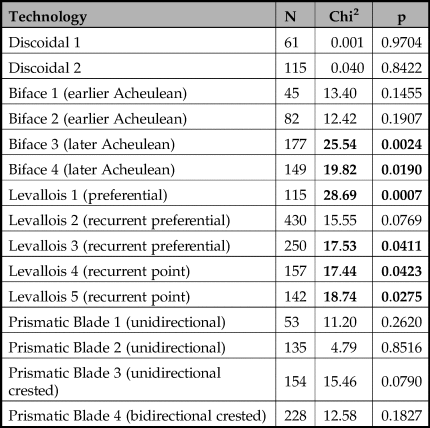
Results of the Markov chain tests, showing the number of rotations per iteration and their statistical results. Values in bold are significant to an α level of 0.05, meaning their sequences involve predictable transitions between states (rotation types 1, 2, 3, or 4).
Much has been learned from recent work charting the skill-acquisition process among learning knappers (Lombao et al. Reference Lombao, Guardiola and Mosquera2017; Pargeter et al. Reference Pargeter, Khreisheh and Stout2019; Reference Pargeter, Kreisheh, Shea and Stout2020; Putt et al. Reference Putt, Woods and Franciscus2014; Stade Reference Stade2017). These studies explore how learning occurs for individuals. For instance, Pargeter et al. (Reference Pargeter, Khreisheh and Stout2019) conducted a long-term study on a large number of novice knappers, charting the start of the proceduralization process for these individuals. Here instead, we attempt to quantify the inherent propensity for proceduralization of each of the different lithic technologies themselves. Thus, the skill of the experimental knapper was kept constant by using one knapper throughout the experiment. While most experiments in skill acquisition observe either novice or expert knappers (but see e.g. Eren et al. Reference Eren, Bradley and Sampson2011a), it would also be worthwhile in the future to explore the proceduralization process on intermediate knappers, as this phase probably involves the most frequent encoding of declarative memories into procedural ones. It is also likely that different expert knappers have proceduralized certain portions of reduction sequences differently and at different rates. Although this is beyond the scope of this initial study, we hope this variability among different experts will be explored in future work. In an effort to minimize this problem, the knapper was abundantly and approximately equivalently familiar with each of the four technologies. Thus, if we find evidence that portions of the reduction sequences have been proceduralized by the expert knapper, then we assume this level of proceduralization approaches the maximum that the technology can be proceduralized.
Footage analysis
The abundance of affordable, high-resolution cameras and footage-processing software has led to a growing number of studies in which experimental knappers are filmed and their actions analysed (Bayani et al. Reference Bayani, Natraj, Khresdish, Pargeter, Stout and Wheaton2021; Cueva-Temprana et al. Reference Cueva-Temprana, Lombao, Morales, Geribàs and Mosquera2019; Geribàs et al. Reference Geribàs, Mosquera and Vergès2010; Harlacker Reference Harlacker, Apel and Knutsson2006; Hoshino et al. Reference Hoshino, Mitani, Miura, Tanabe, Nagai, Akazawa, Ogihara, Tanabe and Terashima2014; Lombao et al. Reference Lombao, Guardiola and Mosquera2017; Mahaney Reference Mahaney2014; Roux et al. Reference Roux, Bril and Dietrich1995; Stade Reference Stade2017; Stout et al. Reference Stout, Chaminade, Apel, Shafti and Faisal2021). There is no way yet to measure directly the amount of a task that has been proceduralized in the mind of a knapper. However, we can quantify elements of a skill that are most amenable to proceduralization.
Core rotation is a repeated task undertaken during most lithic technologies, yet it is probably more repetitive in some technologies than others. As each core surface is the product of previous removals, rotations sometimes follow predictable patterns. Thus, we extract the sequence of core rotations from knapping footage to compare each technology's repetitiveness and predictability as a proxy for their propensity for proceduralization. More repetitive and predictable technologies are likely to have more components that can be proceduralized. We emphasize the importance of core rotation as it represents a radical step in knapping, altering the surface on which the knapper is directing their attention. A recent gaze tracking experiment found rotations (‘core repositioning’) to be a focus of attention and a meaningful action throughout knapping sequences (Bayani et al. Reference Bayani, Natraj, Khresdish, Pargeter, Stout and Wheaton2021).
After each strike, a knapper examines the core and chooses a new platform, either on the same surface, or they may turn or flip the core to work a new surface. This sequence of rotations reveals where the knapper's attention is directed. To track how the knapper's attention shifts throughout the sequence, the type of each rotation was noted. We recorded whether the core was rotated to a different part of the same surface, rotated to the opposing surface, or completely flipped. To do so, core surfaces were divided into halves or quadrants while viewing the knapping footage based on the inherent morphologies of the cores (Fig. 1). As discoidal cores have no hierarchically ordered surfaces, and no features that can be used to orient them longitudinally, they were divided into halves according to the intersection between each hemisphere. Meanwhile, handaxes were divided into quadrants based on the plane of intersection between both hemispheres and the line of least asymmetry from the tip. Levallois cores were divided into quadrants according to the plane of intersection between the lower and upper hemispheres, and the midsection between the proximal (closest to the most recent preferential platform) and distal sections of the core. Lastly, prismatic blade cores were divided to four quadrants centred on the primary platform and blank removal surface.
Diagram demonstrating an example of how each of the cores were divided into halves for discoidal cores (a) and quarters for handaxes (b); Levallois cores (c); and prismatic blade cores (d). The ‘current surface’ is based on where the core was last struck. The coloured halves and quadrants show the possible regions for a subsequent strike following a type 1 (same surface), type 2 (opposite half), type 3 (opposite hemisphere), or type 4 (opposite half and hemisphere) rotation. The ‘current surface’ and thus the other core regions will differ based on the location of the previous strike.

Each core rotation that followed a strike was annotated from the knapping footage, including the surface to which the knapper rotated, type 1 being to a new portion of the same surface, while types 2, 3 or 4 represent the knapper shifting to a new half or quadrant. The core halves and quadrants are based on the location of the last strike, meaning that the location of the various rotation types varies based on this ‘current surface’. Here, we refer to ‘rotation’ in the broadest sense, meaning any change in the orientation of the core, even a minute change. Technologically, type 1 rotations represent no rotation at all; they represent a shift to the same platform surface. For the purpose of tracking the knapper's attention on the various regions of the core, however, we record these as type 1 ‘rotations’.
For handaxe, Levallois, and prismatic blade cores, type 2 rotations represent a rotation to the other longitudinal side of the same core hemisphere. Type 3 rotations represent a rotation to the other hemisphere, but same longitudinal side (i.e. flipped), whereas type 4 rotations represent those to the other hemisphere and other longitudinal side. By tracking how long the knapper directs their attention to a particular region of the core and how they shift their attention during the reduction sequence via these rotations, we can begin to quantify how this element of the knapping process lends itself to proceduralization in different schemas, using the following variables.
Repetitiveness: duration of platform preparation
One of the most repetitive elements of knapping repertoires is the action of platform preparation. Removing excess stone from the platform edge, via flaking either onto the platform (faceting) or onto the flaking surface (overhang removal), serves to strengthen the platform and increase the likelihood of successful flake removal. Although it represents a key innovation in lithic technology and points to a knapper's understanding of principles of fracture mechanics, the action of repetitively striking or abrading a platform edge is not an especially cognitively taxing task in itself. Moreover, Stout et al. (Reference Stout, Chaminade, Apel, Shafti and Faisal2021) recently found platform preparation (‘light percussion’) to increase the amount of compressibility in knapping sequences. The time spent conducting periods of platform preparation is a strong contender for an element of a reduction sequence that could easily be proceduralized.
The more time spent on each instance of platform preparation, the larger the portion of the reduction sequence that could easily be converted from declarative to procedural memories. A novice knapper may need explicitly to recall their teacher's instruction to remove excess and fragile stone on the platform's edge. They may even have to extract from their declarative memories the fact that platforms require strong platforms with particular external platform angles. Meanwhile, an expert knapper is implicitly aware that each flake removal usually leaves a small amount of weakened stone on the platform edge and that this must be removed. Relatively early in the learning trajectory of trainee knappers, they begin removing this excess stone, seemingly without conscious consideration. We suggest that they rapidly proceduralize this task. Thus, we quantify the duration of each individual instance of platform preparation during each of the iterations of the experiment.
Repetitiveness: duration of rotations
Rotating a core to select a new platform on which to strike can be a cognitively intensive task. After each strike, the knapper must inspect the core and decide where to strike next. If the forthcoming strike is simple or pre-planned, this rotation can occur quickly and without much thought. Sometimes, however, the knapper may spend more time deliberating and choosing where to strike next, based on the location of suitable platforms or the overall morphology of the core. Therefore, we are interested in quantifying the time taken by the knapper to decide which surface to strike and to choose where on this surface to strike. Following the rotation types outlined above in Figure 1, we are interested only in type 2, 3, and 4 rotations. Type 1 rotations (rotations to a new area of the same surface) are excluded, as the active attention of the knapper was already directed to this surface.
Less proceduralized sequences, when the decision-making is explicit and requires direct attention, should involve longer periods of core rotation and examination. For instance, when a knapping mistake occurs or an impurity in the raw material is encountered, declarative memories may be needed to overcome these problems. In any of these scenarios we expect the core rotations to take more time. Technologies with more propensity for proceduralization should thus involve core rotations of shorter durations.
Repetitiveness: duration spent on same surface
As well as quantifying the duration of rotations, we also quantify the time spent in between rotations. Specifically, we are interested in the time between each core rotation that shifts the knapping to a new surface (i.e. excluding type 1 rotations) or to a new task after a period of core examination (even if selecting the same surface). This amount of time spent on the same core surface is calculated by summing the duration of knapping activities that occur in between rotations. When a knapper spends a large amount of time on one surface, their attention is directed there for a particular purpose. As the knapper is fulfilling the same task repeatedly, there is a high likelihood that this portion of the reduction sequence can be heavily proceduralized.
Repetitiveness: repeating strings
Thus far we have put forward features of the reduction sequences that we suspect are most prone to proceduralization through repetitiveness. To confirm which sequences are more repetitive in a blind manner (i.e. not based on our own experiences), we turn to measures of sequence repetitiveness.
Within bioinformatics, much work has been devoted to the identification and quantification of repetitive strings of nucleobases (A, C, G and T or U). The size and complexity of these sequences necessitate finding repetitive elements to analyse and store the information better. To do so, repeating strings within these sequences are identified and quantified (e.g. De Bustos et al. Reference De Bustos, Cuadrado and Jouve2016; Koch et al. Reference Koch, Platzer and Downie2014). These repeated strings (k-mers), of length k, occur with different frequencies and comprise varying amounts of the original sequence.
Instead of repetitive strings of nucleobases, we search for repeating strings of rotation types (1, 2, 3, or 4). Here, we find repeating strings and compute the percentage of the rotation sequence comprised of these repeating strings. More repetitive rotation sequences will be comprised of more and longer repeating strings.
Predictability: Markov chains
Proceduralization relies not only on repetitiveness, but also on predictability. If knapping gestures occur in a predictable sequence, there is likely to be less of a need for active attention and declarative memory. Markov chain tests are well suited for quantifying predictability, as they identify whether numbers in sequence are independent of one another (Pyke Reference Pyke1963). They have been applied only occasionally to the study of stone artefacts. For instance, Mahaney (Reference Mahaney2014) and Stout et al. (Reference Stout, Chaminade, Apel, Shafti and Faisal2021) used Markov models to quantify the structural complexity of lithic sequences and to link these action grammars with grammars of language.
As described above, the different types of core rotations (Fig. 1) were rendered to a sequence of integer values (1, 2, 3 and 4), representing how the knapper shifted their attention around different regions of the core. Among the actions involved in knapping, we consider here only the rotation types, as we are most interested in the predictability of the decision-making process of each lithic technology. After almost any rotation, the core can either be struck for a flake removal or struck or abraded for platform preparation. The choice between these options is dictated more by the realities of the stone after a strike (i.e. platform strength) rather than the decisions necessitated by the particular lithic technology. By analysing only rotation types, the Markov chain analysis can quantify the predictability of the decision-making process and how the knapper's attention is directed to various regions of the core.
Markov chains are sequences where the state of an item is partly dependent on the previous item in the sequence. Therefore, significant values indicate the tendency for preferential transitions in these numbers. It models the extent to which a sequence is ‘mindless’ (Mahaney Reference Mahaney2014). In other words, we can identify if the sequence of core rotations for each iteration of the experiment is random, or if there is at least a somewhat predictable pattern to how the knapper shifted their attention around the core. Technologies with a more predictable pattern of core rotations should have more potential for proceduralization.
Results
The key to identifying proceduralization in lithic technologies is finding components of their reduction sequences that are repetitive and predictable. The results of a suite of proxy metrics for rotation and platform preparation repetitiveness are shown in Figure 2.
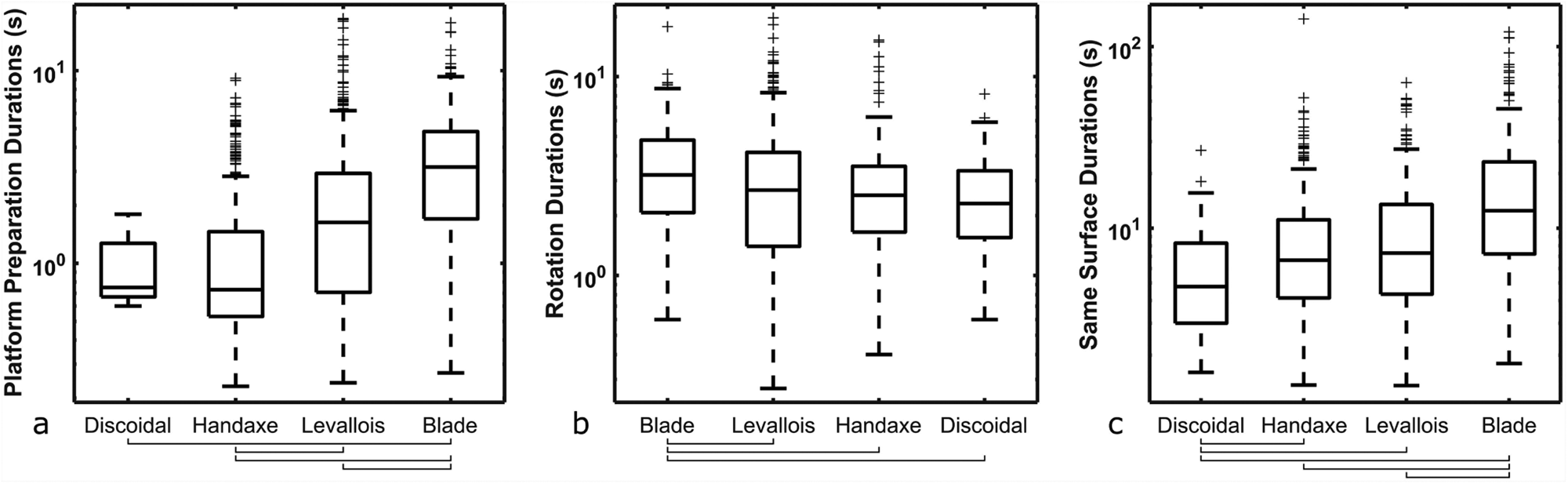
Boxplots of (a) the duration of each instance of platform preparation; (b) the duration of each rotation; (c) the time spent on an individual surface (i.e. the time in between rotations). Note the logarithmic y-axes. Horizontal square brackets denote significance at an α level of 0.05. The technologies on the x-axes are ordered left to right with ascending propensity for proceduralization.
Repetitiveness
Figure 2a shows the duration of each instance of platform preparation. A Kruskal-Wallis test (H = 370.4, df = 1432, p < 0.001), with Bonferroni corrected Mann-Whitney U tests, reveals that while discoidal and handaxe knapping involved equivalent lengths of time spent on instances of platform preparation, Levallois platform preparation durations were significantly longer than for the handaxes (U = 66325.5, df = 907, p < 0.001), and the prismatic blade durations were significantly longer than those for Levallois knapping (U = 68255.5, df = 941, p < 0.001). Thus, prismatic blade knapping, and to a lesser extent Levallois knapping, involve long periods of time spent preparing platforms: actions that easily lend themselves to proceduralization.
Figure 2b shows the times spent on individual core rotations for each technology. Discoidal, handaxe and Levallois knapping all involved equivalently short times spent rotating the core to select a new platform. Meanwhile, the rotations that occurred during the prismatic blade experiments were significantly longer than the discoidal (U = 6806.5, df = 302, p < 0.001), handaxe (U = 21336.5, df = 475, p < 0.001) and Levallois (U = 40968, df = 676, p = 0.003) iterations. The longer periods of time spent rotating the blade cores and deliberating on subsequent platform choice probably suggest that prismatic blade knapping required more frequent use of declarative memories. The more rapid selection of platforms in discoidal, handaxe and Levallois knapping reflects a greater chance that portions of these sequences could be proceduralized.
Figure 2c shows the time between each core rotation that shifts the knapping to a new surface, thereby showing the time devoted to one half or quadrant of the core. Compared with handaxe (U = 8865.5, df = 356, p < 0.001) and Levallois knapping (U = 14281, df = 557, p < 0.001), discoidal knapping involved the shortest time spent on individual surfaces, suggesting there was less chance for proceduralization, possibly owing to the relative simplicity of discoidal knapping which would necessitate very little information to be converted to procedural memories. The handaxe and Levallois iterations involved statistically similar amounts of time on individual surfaces. Meanwhile, prismatic blade knapping displayed the most time spent on the same surface compared with both the handaxe (U = 16701.5, df = 475, p < 0.001) and Levallois (U = 32451.5, df = 676, p < 0.001) iterations. Of the technologies examined here, prismatic blade knapping involved the longest stretches of time devoted to one surface, and thus more opportunity for proceduralization of the flaking occurring from that surface.
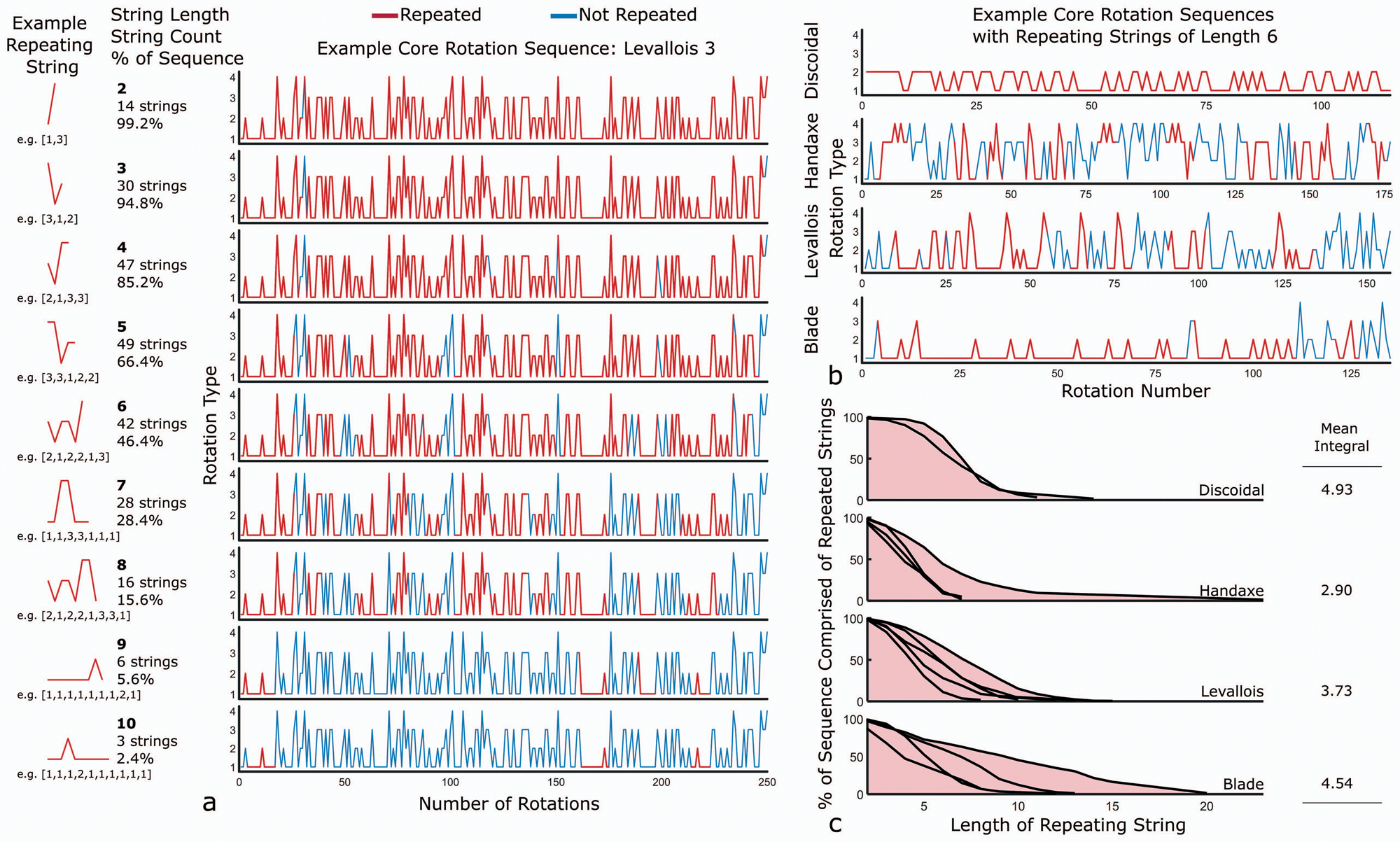
Lastly, we compute the amount of each reduction sequence comprised of repetitive strings of rotation types (1, 2, 3 and 4). Figure 3a shows the sequence of rotations for one iteration of this experiment (Levallois 3) as an example. Each row shows the amount of this sequence comprised of repetitive strings of variable lengths (2–10). For instance, with strings of length 2, 99.2 per cent of the rotation sequence is comprised of repeated strings. However, as we observe only the longer repeating strings, the amount of the sequence comprised of repeats reduces. Examples of strings of different lengths are shown on the left, but the repeating portion (red) of each row is comprised of multiple such strings. This process was repeated for each iteration of this experiment. An example rotation sequence for each technology can be seen in Figure 3b, showing only the repetitive strings of length 6. Calculating the amount of each sequence comprised of strings of various lengths results in Figure 3c. Sequences made up of longer repeating strings possess curves further skewed to the right. Thus, the average integral (area under each curve) for each technology serves as a quantification of the repetitiveness of these rotation sequences. Using this metric, discoidal and prismatic blade knapping displayed more repetitive rotation sequences, followed by Levallois and handaxe knapping, respectively. The discoidal reduction sequences appear comparably repetitive to the prismatic blade sequences, but this is probably affected by discoidal knapping possessing only two rotation options (rotation types 1 and 2). Overall, these results conform with the other measures of repetitiveness shown above, wherein prismatic blade knapping tended to involve the most repetitive sequence of core rotations.
(a) An example sequence of rotations (Levallois 3) showing the amount of the sequence comprised of repeated strings (red) versus the unique portions of the sequence (blue) for repeating strings of different lengths. Each shows the amount of the sequence comprised of repeating strings of certain lengths (2–10); (b) Example rotation sequences for each technology showing how much of each sequence is comprised of repeating strings of length 6; (c) The percentage of each rotation sequence comprised of repeats plotted against the length of repeating string. Mean integral values estimate repetitiveness for each technology.
Individually, these metrics do not serve to reliably quantify proceduralization. Taken collectively, however, they begin to illustrate how these four technologies differ in their potential for proceduralization. The type of core rotations, time between core rotations, and time spent on platform preparation all hint at the repetitiveness of prismatic blade knapping in particular. The other technologies also involve these repetitive elements, but to a lesser extent. However, prismatic blade knapping involved long periods of time spent rotating and selecting a new platform. Discoidal, handaxe and Levallois technology appears to possess a quicker and easier to proceduralize sequence of core rotations. There may be multiple pathways to proceduralization. To explore this further, we turn to the predictability of these rotations.
Predictability
We posit that proceduralization relies not only on repetitiveness, but also on predictability. Using the same sequence of rotation types described above, we use Markov chains to model the predictability of these integer sequences. Table 1 shows the significance values of the Markov chain tests for each iteration of this experiment. Values in bold are significant to an α level of 0.05, the remainder conform to the null hypothesis that the sequence of core rotation type transitions are independent of one another and are thus unpredictable. The two later handaxes and all but one of the Levallois iterations involve predictable and patterned transitions between rotation types, thereby lending themselves most to proceduralization.
Markov models compute the probabilities of transitioning from one state to another. The corresponding transition matrices are graphically represented in Figure 4. The likelihood of transitioning from one type of core rotation to another type are represented by the values associated with the arrows, which show the direction of the transition. These values are averaged from each repetition of the same technology and the text is scaled according to their probability. These transition matrices reveal a sense of the structure of the reduction sequences of the four technologies examined here.
Markov model transition matrices, showing the probabilities (0–1) of transitioning from one rotation type (1–4) to another based on the actual sequences of rotations in this experiment. For example, in discoidal knapping, after a type 1 rotation, there is a 0.55 chance of next conducting a type 2 rotation.
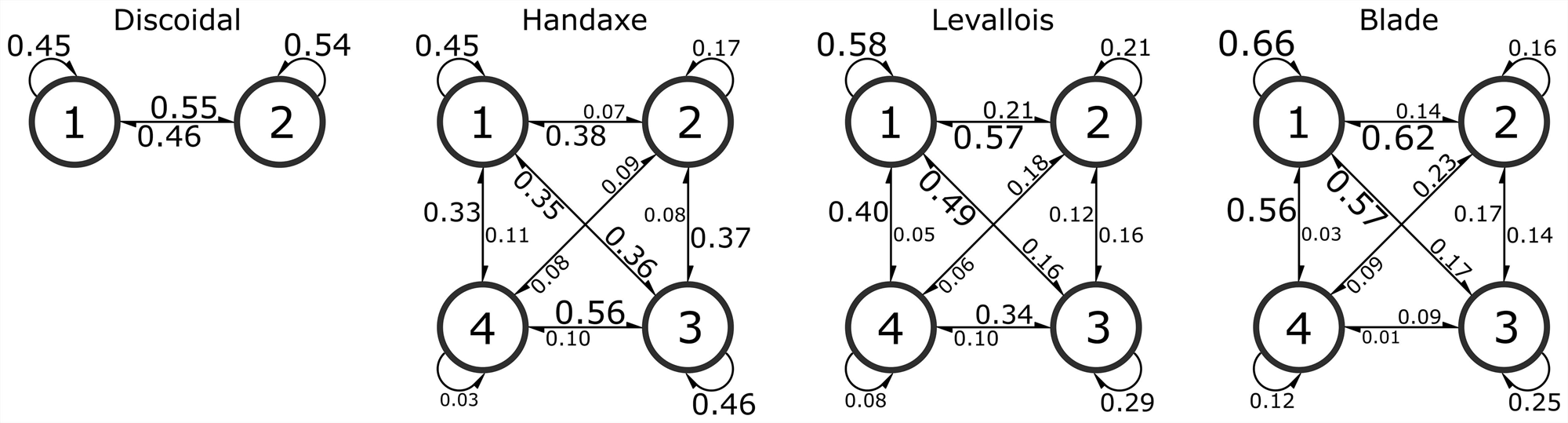
From the transition matrix for discoidal knapping, it is almost equally likely that any rotation type will be followed by another. By contrast, making a handaxe involved preferential transitions, especially towards type 1 and type 3 rotations, reflecting the tendency to work both faces along the same edge via flipping the core during bifacial knapping. As Levallois core preparation is based on similar bifacial principles, a similar structure is seen in its transition matrix.
Interestingly, prismatic blade technology involves transitioning to many type 1 rotations, with other rotations occurring less frequently. Thus, after almost any rotation it is most likely that the subsequent actions will be undertaken on the same surface. However, the Markov model results in Table 1 found these to be unpredictable transitions. We suspect this is due to the unpredictable nature of blade blank removal, where the core is typically only rotated to new surfaces when the platform or core surface requires maintenance or rejuvenation. This maintenance usually occurs when mistakes occur, when raw material impurities are encountered, or when a long sequence of blank removals naturally results in lower platform angles. The first two of these phenomena occur unpredictably. Meanwhile, handaxe and Levallois core preparation involves a more codified sequence of bifacial and centripetal removals. This more predictable pattern of core rotations among Levallois technology and later handaxes hints at a higher propensity for proceduralization.
Discussion
Taking these results collectively, it appears that proceduralization can be achieved through various pathways. For instance, prismatic blade knapping involved the most time spent on the same surface, the most time spent on the repetitive task of preparing platforms, and a repetitive sequence of rotations. These metrics point to the high potential for proceduralization of blade technology. However, prismatic blade knapping also involved the most time devoted to rotating the core. This additional attention and deliberation hints at the involvement of more explicit and attentive memory systems, as opposed to procedural memory. The rotations involved in prismatic blade knapping were also unpredictable, owing to the need for significant rotation mostly when unforeseen problems arise.
Meanwhile, the Levallois and handaxe iterations of this experiment involved less platform preparation and less time devoted to individual surfaces, implying less chance for within-rotation proceduralization. However, these rotations were faster and more predictable. Like Sumner (Reference Sumner2011), we thus found Middle Palaeolithic Levallois knapping to bear much proceduralization potential. The rapid and predictable sequence of core rotations in Levallois knapping speaks to the complex hierarchical structure of its reduction sequence (Muller et al. Reference Muller, Clarkson and Shipton2017), which appears to necessitate little deliberation over rotations and leaves little room for random platform selections.
Like most of the Levallois iterations of the experiment, the later Acheulean handaxes involved predictable core rotations according to the Markov chain analysis, but not the earlier handaxes. Compared with Oldowan knapping, it has been hypothesized that Acheulean bifaces require more working memory (Putt et al. Reference Putt, Anwarzai, Holden, Ruck and Schoenemann2022; Stout et al. Reference Stout, Hecht, Khreisheh, Bradley and Chaminade2015) and they have been shown to involve a more complex set of actions (Stout et al. Reference Stout, Chaminade, Apel, Shafti and Faisal2021) as well as more motor-control and auditory feedback (Putt et al. Reference Putt, Wijeakumar, Franciscus and Spencer2017). It is notable that the handaxes made using the ‘turning-the-edge’ technique known from the later Acheulean possess more propensity for proceduralization via predictable rotations than those made without.
Finally, discoidal knapping appears to possess the least inherent potential for proceduralization, with unpredictable rotations and little time spent on individual surfaces before rotating. However, with the fastest rotations, discoidal cores appear to involve little attention directed towards the task of selecting new platform surfaces. It is possible that the bifacial and centripetal pattern of discoidal flaking is so regularized that the results for discoidal knapping (unpredictable rotations and little time spent on one surface) could be explained instead by the simplicity of the strategy. Stout et al. (Reference Stout, Chaminade, Apel, Shafti and Faisal2021) similarly found the relative simplicity of Oldowan knapping to be less compressible and predictable than Acheulean knapping, probably leaving less structure to chunk or proceduralize. We hope that future work will address the interplay between sequence complexity and repetitiveness, particularly taking into account the durations of the actions involved in these sequences.
Among the four technologies we examined, the path to proceduralization appears to differ. It can be achieved either via the repetitive exploitation of the same core surface (like prismatic blade knapping), or by the exploitation of a predictable sequence of platforms (like later handaxe and Levallois knapping).
The fundamental involvement of procedural memories in much of lithic technology is significant to the process of skill acquisition, as proceduralization facilitates the more cognitively efficient storage of skills. Storing skills like knapping more efficiently unburdens other components of our memory from the minutiae of repetitive and predictable reduction sequences. More attention and cognitive effort can be devoted to the more complex aspects of a lithic technology, allowing that technology to be undertaken more skilfully. As was seen from the refitted reconstruction of Marjorie's core (Schlanger Reference Schlanger1996; Wynn & Coolidge Reference Wynn, Coolidge, Nowell and Davidson2010b; Reference Wynn, Coolidge, Nishiaki and Jöris2019), prehistoric knappers adapted flexibly to the inherent unpredictability of flaking. More cognition and attention can be directed towards these unpredictable, and potentially ‘un-proceduralizable’, aspects of a lithic technology if its other components are heavily proceduralized. Thus, proceduralization is integral to phenomena such as expert performance (Wynn & Coolidge Reference Wynn and Coolidge2004; Reference Wynn, Coolidge, Nowell and Davidson2010b; Reference Wynn, Coolidge, Nishiaki and Jöris2019), a trait that involves long-term working memory and an integration of well-practised procedural routines with contingencies at hand.
These results may bear implications for the evolution of language also. The overlap between language and stone toolmaking has been thoroughly explored (Greenfield Reference Greenfield1991; Higuchi et al. Reference Higuchi, Chaminade, Imamizu and Kawato2009; Mahaney Reference Mahaney2014; Morgan et al. Reference Morgan, Uomini and Rendell2015; Putt et al. Reference Putt, Woods and Franciscus2014; Ruck Reference Ruck2014; Stout et al. Reference Stout, Toth, Schick and Chaminade2008; Reference Stout, Chaminade, Apel, Shafti and Faisal2021; Stout & Chaminade Reference Stout and Chaminade2012; Uomini & Meyer Reference Uomini and Meyer2013), but their co-evolution remains difficult to verify. Language acquisition has recently been re-envisioned as a form of skill acquisition (Chater & Christiansen Reference Chater and Christiansen2018; Christiansen & Chater Reference Christiansen and Chater2016). Proceduralization being responsible for large portions of the skill-acquisition process for both toolmaking and linguistic skills may help explain their potential co-evolution.
The last decade of research in cognitive archaeology has linked stone toolmaking to key cognitive strategies. Hierarchically ordered reasoning, whereby subordinate tasks are subsumed within overarching ones, has been found to be involved in handaxe, Levallois and blade manufacture (Mahaney Reference Mahaney2014; Moore Reference Moore, Nowell and Davidson2010; Muller et al. Reference Muller, Clarkson and Shipton2017; Shipton et al. Reference Shipton, Clarkson and Pal2013; Stout Reference Stout2011; Stout & Chaminade Reference Stout and Chaminade2012; Stout et al. Reference Stout, Toth, Schick and Chaminade2008; Reference Stout, Passingham, Frith, Apel and Chaminade2011; Reference Stout, Apel, Commander and Roberts2014; Winton Reference Winton, Roux and Bril2005; Wynn & Coolidge Reference Wynn, Coolidge, Nowell and Davidson2010b). Likewise, recursion, involving self-referentially creating potentially infinite permutations from component elements, is probably involved in at least recurrent Levallois knapping (Hoffecker Reference Hoffecker2007; Pelegrin Reference Pelegrin, Roux and Bril2005; Reference Pelegrin, de Beaune, Coolidge and Wynn2009; Shipton et al. Reference Shipton, Clarkson and Pal2013; Reference Shipton, Clarkson and Cobden2019). Storing components of lithic technologies hierarchically and/or recursively, rather than sequentially, could make proceduralization more efficient. Rather than remembering long sequences of iterative stages, a knapper can instead store hierarchical and recursive loops that more efficiently summarize a task in their procedural memory. The results presented here lead us to place proceduralization alongside cognitive features like working memory that have long been recognized as crucial to lithic technology. A full comprehension of skill acquisition in lithic technology necessitates an exploration of the repetitive and predictable knapping procedures that facilitate easier and more rapid uptake of knapping skill.
These results are a preliminary investigation of the process of converting declarative memories of knapping into procedural ones. While we did not directly quantify how much these technologies were proceduralized, we demonstrated how these technologies could be proceduralized. Procedural memory has seldom been explored explicitly in archaeology. We hope this study has provided a baseline understanding of the role of procedural memory in stone toolmaking. The next step is to quantify more directly the extent to which technologies are proceduralized by both learning and expert knappers, and to observe how procedural memory interacts with other systems of cognition and memory.
Acknowledgements
We sincerely thank Dietrich Stout and an anonymous reviewer for their thoughtful and helpful comments that greatly improved the manuscript. Sincere thanks also to Leore Grosman for providing valuable comments on an earlier draft. We also thank Emilija Nicolosi, Chat Marasinghe, and the School of Social Science at the University of Queensland for equipment and logistical support. Special thanks to Michael Manoel for scanning the artefacts in Figure 1. AM was funded via the Asian Sphere Program, of the Hebrew University and the University of Haifa, and scholarships from the Computational Archaeology Laboratory and the Institute of Archaeology of the Hebrew University of Jerusalem.


 Open access

