





Introduction
Humidity is one of the key abiotic factors that influence the abundance and distribution of terrestrial insects (Cahill et al. Reference Cahill, Aiello-Lammens, Fisher-Reid, Hua, Karanewsky and Ryu2013; Rozen-Rechels et al. Reference Rozen-Rechels, Dupoué, Lourdais, Chamaillé-Jammes, Meylan, Clobert and Le Galliard2019), for which maintaining water balance is a constant challenge (Barton-Browne Reference Barton-Browne1964). As climate warms, rainfall patterns also change (Dore Reference Dore2005; Hicke et al. Reference Hicke, Lucatello, Mortsch, Dawson, Domínguez Aguilar and Enquist2022), which could accentuate or dampen the effects of warming on water stress in terrestrial insects (Cahill et al. Reference Cahill, Aiello-Lammens, Fisher-Reid, Hua, Karanewsky and Ryu2013; Rozen-Rechels et al. Reference Rozen-Rechels, Dupoué, Lourdais, Chamaillé-Jammes, Meylan, Clobert and Le Galliard2019). However, little recent research on insect responses to a changing environment has examined the impact of water stress (Bale et al. Reference Bale, Masters, Hodkinson, Awmack, Bezemer and Brown2002; Chown et al. Reference Chown, Sørensen and Terblanche2011).
Many species of forest Lepidoptera overwinter as eggs (Danks Reference Danks1987). The eggs have only the fixed reserve of energy and water provided by their mother in the fall to survive overwintering, embryonic development, hatching, and settlement on the host plant. As a result, the eggs and first-instar larvae of these forest Lepidoptera are particularly vulnerable to water stress due to their limited water reserves and high surface-area-to-volume ratios (Potter and Woods Reference Potter and Woods2012; Klockmann and Fischer Reference Klockmann and Fischer2017; Kühsel et al. Reference Kühsel, Brückner, Schmelzle, Heethoff and Blüthgen2017). In the spring, egg hatching usually coincides with the early stages of foliage expansion, a high-quality food source (Feeny Reference Feeny1970; Leather Reference Leather1986; van Asch and Visser Reference van Asch and Visser2007). This foliage is often the sole source of nutrients and water available to first-instar larvae, which need to replenish their reserves after overwintering (Zalucki et al. Reference Zalucki, Clarke and Malcolm2002). Climate change can affect insect and plant phenology differently, which may result in a mismatch between egg hatching and the most suitable host phenology (Parmesan Reference Parmesan2007; van Asch and Visser Reference van Asch and Visser2007). A similar mismatch may occur if moisture alters the insect’s growth rate, as suggested by Tauber et al.’s (Reference Tauber, Tauber, Nyrop and Villani1998) “development modulator” hypothesis. In addition, young larvae may die of starvation or desiccation while searching for feeding sites (Zalucki et al. Reference Zalucki, Clarke and Malcolm2002). This mortality of young larvae before they settle on the host plant may be accentuated by low ambient humidity or by the initial hydration state of the larvae, as suggested by Woods’s (Reference Woods2010) “neonate desiccation” hypothesis. However, the impact of water stress on the embryonic development and its potential cross-stage effect in the forest Lepidoptera remain largely unexplored.
The hemlock looper, Lambdina fiscellaria (Guenäe) (Lepidoptera: Geometridae), is a native univoltine moth whose larvae periodically defoliate the coniferous forests of Canada (Martineau Reference Martineau1984). In September, females lay their eggs singly on sites, such as soil, mosses, lichens, and tree branches and stems, where humidity conditions are highly variable (Carroll Reference Carroll1956). The eggs undergo an obligatory diapause that lasts about three months, after which they remain in quiescence until spring warming triggers the resumption of embryonic development (Delisle et al. Reference Delisle, Royer, Bernier-Cardou, Bauce and Labrecque2009). Egg hatching occurs from mid-May to late June in eastern Canada and generally coincides with an elongation of 25–35% of the maximum annual growth of balsam fir, Abies balsamea (Linnaeus) Miller (Pinaceae) (Butt et al. Reference Butt, Quiring, Hébert, Delisle, Berthiaume, Bauce and Royer2010). This synchronism between hatching time and the phenology of its preferred host tree results in optimal insect survival and fitness (Butt et al. Reference Butt, Quiring, Hébert, Delisle, Berthiaume, Bauce and Royer2010), provided that the first-instar looper larvae can reach the new shoots. The first-instar larvae must travel from the laying sites to the current year foliage to feed, a movement facilitated by the larvae’s responses to gravity and light (Royer et al. Reference Royer, Delisle and Labrecque2021). Because the consumption of new foliage is crucial to young looper larvae survival, high mortality can occur when eggs are laid far from preferred feeding sites and abiotic conditions are unfavourable (Carroll Reference Carroll1956). Therefore, the ambient humidity and the initial hydration state of the larvae could influence their ability to survive and settle on host trees.
The hemlock looper mainly occurs in a band of about 10° latitude straddling the Canada–United States of America border from coast to coast, from Newfoundland and Labrador to British Columbia in Canada and from Maine to Washington State in the United States of America (Martineau Reference Martineau1984; McGuffin Reference McGuffin1987). The species can also be found in remote areas, such as Labrador, Alaska, Georgia, Oregon, and California (Torgersen and Baker Reference Torgersen and Baker1971; Martineau Reference Martineau1984; McGuffin Reference McGuffin1987; Turnquist Reference Turnquist1991; Crummey Reference Crummey2007). In Canada, major outbreaks occur in Newfoundland, the Maritime provinces, Quebec, Ontario, and British Columbia, mainly along coasts and in humid inland forests (Carroll Reference Carroll1956; Otvos et al. Reference Otvos, Clarke and Durling1979; Turnquist Reference Turnquist1991). Although humidity seems to play a key role in hemlock looper outbreaks, to date, no studies have investigated the effect of humidity on the performance of the looper stages that may be most vulnerable to water stress, such as eggs and first-instar larvae.
The present study aims to quantify the effect of air humidity (40, 60, and 80%) on hemlock looper hatching success, time to hatch, and lifespan of unfed first-instar larvae in spring. Experiments were carried out at two temperatures (10 °C and 22 °C) to determine the extent to which this factor can attenuate or exacerbate the impact of humidity. First, the effect of humidity and temperature on hatching success was quantified to test the null hypothesis that these two abiotic factors have no influence. Second, the time to hatch was quantified to test the development modulator hypothesis, assuming that humidity has no effect. Finally, the effect of humidity at the egg and larval stages on the lifespan of unfed first-instar looper larvae was assessed to test the neonate desiccation hypothesis. No cross-stage effect of humidity was expected.
Materials and methods
In winter 2001, diapausing eggs of the Newfoundland hemlock looper were obtained from the Canadian Forest Service’s Insect Production and Quarantine Laboratories (Sault Ste. Marie, Ontario, Canada). Upon receipt, the eggs were stored in total darkness at 2.5 ± 0.5 °C and 95 ± 5% relative humidity until they were used in spring experiments.
To obtain the targeted humidity of 40, 60, and 80% (Table 1), supersaturated solutions were prepared by dissolving salts or sugars in distilled water heated to boiling point (Winston and Bates Reference Winston and Bates1960). The solutions were cooled and decanted into plastic boxes (11.4-L storage box; Rubbermaid Inc., Wooster, Ohio, United States of America). One box for each humidity was then placed in growth chambers at 10.0 ± 0.5 °C or 22.0 ± 0.5 °C. Historically (1991–2020), mean daily relative humidity during the month preceding egg hatching on the west coast of the island of Newfoundland ranges from 56.3% to 82.4%, and mean daily temperatures vary from 6.9 °C to 12.1 °C, with maximums reaching 18.6 °C (Environment Canada 2025a). However, daily mean temperatures in the Lac Saint-Jean region of Quebec, where outbreaks are less frequent, vary from 10.2 °C to 16.0 °C, with maximums of 22.3 °C, and mean relative humidity ranges from 47.5% to 78.5% (Environment Canada 2025b). These data show that the temperatures selected for the present study are encountered in the current range of the species during the month preceding egg hatching. The low humidity tested in the study was slightly lower than the natural conditions observed, but it was chosen to assess the insect’s ability to adjust its physiology.
Mean relative humidity and temperature recorded in the various treatments during the experiment

To determine the combined effect of humidity and temperature on hatching success and time to hatch, hemlock looper eggs were placed individually in Beem capsules (size 3; SPI Supplies, West Chester, Pennsylvania, United States of America). Capsule lids were partially closed to prevent egg loss, leaving an open space for internal and external humidity equilibration. Groups of 50 randomly selected capsules were put in 127-mL plastic cups (model TP400; Solo Cup Co, Lake Forest, Illinois, United States of America), which were pierced with 0.5-cm holes to balance the internal humidity of the cup with the external ambient conditions. The cups were then transferred to wire grids suspended two centimetres off the supersaturated solution in the treatment boxes that were placed in the growth chamber at the desired temperature. The actual relative humidity and temperature conditions of each treatment box were recorded using data loggers (Model HOBO® H08-004-02; Hoskin Scientific Ltd, Saint-Laurent, Quebec, Canada) and are presented in Table 1. Eggs were checked daily to estimate hatching success and time to hatch. The time spent away from treatment was minimised as much as possible and was equivalent for each treatment. To calculate the time to hatch, day 0 corresponded to the day eggs were taken out of cold storage and transferred to growth chambers. At the end of the experiment, unhatched eggs were classified according to three categories: no apparent development, collapsed, and fully developed first instar inside the egg, hereafter called “pharate” larvae (Stacey et al. Reference Stacey, Roe and Williams1975). A percentage of each category of unhatched eggs was calculated based on total mortality for each temperature and humidity. Ten cups of 50 eggs were tested for each humidity and temperature treatment.
To assess the effect of humidity during the egg and larval stages on the survival of unfed first-instar larvae, two cups of 50 eggs were reared in each combination of humidity and temperature because high mortality was expected in some treatments of the previous experiment. Larvae from these additional cups were added to those from the previous experiment. Upon hatching, neonates were randomly reassigned to one of three humidity treatments – 40, 60, and 80% humidity – but were maintained in their initial temperature treatment (10 °C or 22 °C). This resulted in a total of nine treatments per temperature. Table 2 shows the number of larvae per treatment, and the survival of which was checked daily. The lifespan of 1001 and 873 first-instar larvae was assessed at 10 °C and at 22 °C, respectively.
Number of hemlock looper first-instar larvae whose lifespan was monitored to determine the effect of humidity (40, 60, and 80%) at the egg and larval stages at two temperatures (10 °C and 22 °C)

Statistical analyses
The appropriate distribution or transformation of data on hatching success, percentage of dead eggs that reached the pharate larval stage, and time to hatch was determined through an Individual Distribution Identification procedure, based on an Anderson–Darling test. Analyses of variance were then used to estimate the effect of humidity and temperature treatments, as well as of their interaction on hatching success and the squared percentage of dead eggs that reached the pharate larval stage. Following the procedure to identify the distribution or transformation, the natural logarithm of the time to hatch was averaged for each cup (Delisle et al. Reference Delisle, Royer, Bernier-Cardou, Bauce and Labrecque2009). Each log-scale mean was weighted by the number of eggs that hatched in the cup, and the variance of these means was analysed using a model that had as fixed effects temperature, humidity, and their interactions (Delisle et al. Reference Delisle, Royer, Bernier-Cardou, Bauce and Labrecque2009). All these analyses were followed by a comparison of all pairs of means using the Bonferroni method, with an overall confidence level of 95%. The means of the original untransformed data and their standard errors of the means are presented in Figures 1 to 3, and all interpretations were based on the original untransformed data. In addition, linear relationships between hatching success and time to hatch per cup were established for each temperature using the 10 replicates per humidity treatment.
Combined effect of humidity (40, 60, and 80%) and temperature (10 °C and 22 °C) on the mean hatching success (± standard error of the mean) of hemlock looper eggs under a 16:8–hour light:dark photoperiod. Means followed by different letters are significantly different at P = 0.05 (analysis of variance followed by a Bonferroni test).

Combined effect of humidity (40, 60, and 80%) and temperature (10 °C and 22 °C) on the mean percentage (± standard error of the mean) of dead hemlock looper eggs having reached the pharate larval stage under a 16:8–hour light:dark photoperiod. Means followed by different letters are significantly different at P = 0.05 (analysis of variance followed by a Bonferroni test).

Combined effect of humidity (40, 60, and 80%) and temperature (10 °C and 22 °C) on the mean time to hatch (± standard error of the mean) of hemlock looper eggs under a 16:8–hour light:dark photoperiod. Means followed by different letters are significantly different at P = 0.05 (analysis of variance followed by a Bonferroni test).

To assess the effect of humidity on the probability of larval survival at each temperature, a Distribution ID Plot procedure was first conducted to identify the probability distribution that best matched the survival data of first-instar larvae. The least-squares method was used to estimate the population parameters, fit a regression line that minimises the sum of squared deviations (least-squares error), and calculate a Pearson correlation coefficient. The Weibull distribution was selected because it obtained the highest correlation coefficients (R 2 10 °C > 0.96, R 2 22 °C > 0.89). A regression with life data (reliability/survival) analysis for each temperature was then conducted to determine whether humidity during egg or larval stages affected the probability of survival of unfed first-instar larvae, assuming a Weibull distribution. The full model included humidity during the egg and larval stages and their interaction as factors. The probability plot for the Cox–Snell residuals produced by this analysis confirmed the chosen Weibull distribution assumption. All statistical tests were performed using Minitab Statistical Software, version 18 (Minitab; eBase Solutions Inc., Vaughan, Ontario, Canada).
Results
The hatching success of hemlock looper eggs was lower at 22 °C than at 10 ° C under all humidity treatments except 40% humidity, when the opposite was observed (Table 3; Fig. 1). Decreased humidity reduced the hatching success, but this effect was more pronounced at 10 °C than at 22 °C. The percentage of dead eggs that reached the pharate larval stage did not differ with humidity at 10 °C and corresponded to more than 89% of dead eggs (Table 3; Fig. 2). The remaining dead eggs either showed no development (8.2 ± 1.6%) or collapsed (1.6 ± 0.6%). At 22 °C, the percentage of dead eggs reaching the pharate larval stage rose from 69% to 85% when humidity decreased (Table 3; Fig. 2). The other eggs died with no apparent development.
Summary of variance analyses assessing the influence of humidity and temperature on hatching success, squared percentage of dead eggs reaching the pharate larval stage, and natural logarithm of time to hatch per cup of hemlock looper eggs

Time to hatch was five times longer at 10 °C than at 22 °C (50.5 days versus 8.9 days at 40% humidity and 38.6 days versus 8.4 days at 80% humidity) and was inversely correlated with humidity (Table 3; Fig. 3). The humidity effect was more pronounced at 10 °C, when eggs reared at 40% humidity took 31% longer to hatch than those reared at 80% humidity (50.5 and 38.6 days, respectively). Time to hatch explained 92% of the variation in hatching success at 10 °C (F 1, 28 = 307.50; P < 0.0001; y = –4.97x + 275.92; R 2 = 0.92) and 45% of the variation in hatching success at 22 °C (F 1, 28 = 22.70; P < 0.0001; y = –19.66x + 218.30; R 2 = 0.45).
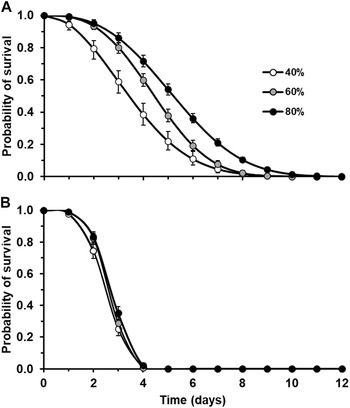
Humidity during the larval stage did not adversely affect the survival probability of unfed first-instar larvae at 10 °C or at 22 °C (Table 4). However, humidity during the egg stage influenced the survival probability of larvae at low temperature but not at high temperature (Table 4). An increase in humidity at the egg stage prolonged the survival probability of larvae kept at 10 °C (Fig. 4A), as predicted by Woods’s (Reference Woods2010) neonate desiccation hypothesis. Indeed, the average 50% survival probability of unfed first-instar larvae was 3.8 ± 0.1, 4.4 ± 0.1, and 5.2 ± 0.1 days when eggs were reared at 40, 60, and 80% humidity, respectively. In contrast, the 50% survival probability of larvae reared at 22 °C was only 2.6 ± 0.1 days on average, regardless of humidity treatments (Fig. 4B). However, daily observations may not have been sufficiently frequent to detect small differences in this temperature. Therefore, a small humidity impact cannot be ruled out.
Summary of regressions assessing the effect of humidity during egg (RHegg) and larval (RHlarva) stages on the survival probability of hemlock looper first-instar larvae at 10 °C and at 22 °C

Effect of humidity (40, 60, and 80%) at the egg stage on survival probabilities of hemlock looper first-instar larvae A, at 10 °C and B, at 22 °C. Survival data of first-instar larvae subjected to the different humidity levels during the larval stage were pooled. Error bars represent the 95% confidence interval.

Discussion
In the context of climate change, warmer, drier springs and summers are predicted in some areas of eastern Canada (Williamson et al. Reference Williamson, Colombo, Duinker, Gray, Hennessey and Houle2009; Hicke et al. Reference Hicke, Lucatello, Mortsch, Dawson, Domínguez Aguilar and Enquist2022), and marked rainfall deficits have already been observed (World Meteorological Organisation 2024, 2025). This study shows that (1) spring mortality of hemlock looper eggs increases with increasing temperature and decreasing humidity, (2) warm temperatures speed up embryonic development, but low humidities slow it down, and (3) humidity at the egg stage has a greater influence on survival of subsequent larvae than does humidity during the larval stage.
The sessile eggs of hemlock looper cannot alleviate thermal or water stresses by moving. As a result, their survival depends on the limited reserves of energy and water provided by their mother in the fall and the microhabitat where she chose to lay her eggs. In the present study, looper hatching success was reduced at high temperatures and low humidity levels, suggesting that warm and dry springs are likely to affect the population densities of this species. The high mortality rate of looper eggs in warm and dry environments could be explained by exchange mechanisms between the eggs and their environment, similar to those demonstrated in Manduca sexta (Linnaeus) (Lepidoptera: Sphingidae). In this species, eggs adjust their shell conductance to delay water loss under dry conditions, but these changes are accompanied by a decrease in oxygen and carbon dioxide exchanges with the environment (Ludwig and Anderson Reference Ludwig and Anderson1942; Woods et al. Reference Woods, Bonnecaze and Zrubek2005; Zrubek and Woods Reference Zrubek and Woods2006). High temperatures amplify the vapour pressure gradient between the eggs and the environment (Wharton and Richards Reference Wharton and Richards1978) and increase the metabolic rate of eggs (Woods and Singer Reference Woods and Singer2001), which increases the eggs’ oxygen demand and water loss (Woods and Hill Reference Woods and Hill2004). However, water loss and reduced gas exchange cause a decrease in the metabolic rate, which prolongs embryonic development and leads to death if unfavourable conditions persist (Chaplin Reference Chaplin2001; Woods and Hill Reference Woods and Hill2004; Woods et al. Reference Woods, Bonnecaze and Zrubek2005; Zrubek and Woods Reference Zrubek and Woods2006; Rozen-Rechels et al. Reference Rozen-Rechels, Dupoué, Lourdais, Chamaillé-Jammes, Meylan, Clobert and Le Galliard2019). In the present study, the loopers’ time to hatch did indeed increase at lower humidities under both temperature treatments, which is in line with Tauber et al.’s (Reference Tauber, Tauber, Nyrop and Villani1998) development modulator hypothesis. Hatching success was also inversely correlated with the time to hatch in the present study, suggesting that the effects of humidity depend on exposure time, similar to what Godfrey and Holtzer (Reference Godfrey and Holtzer1991) observed in Ostrinia nubilalis (Håbner) (Lepidoptera: Crambidae). However, in the present study, the effect of humidity was less pronounced at 22 °C than at 10 °C because the time to hatch was shorter at this temperature. At the two temperatures studied here, mortality of hemlock looper eggs occurred late in embryonic development, with more than 69% of dead eggs reaching the pharate larval stage. Possible reasons for this late mortality include desiccation, hypoxia, or both (Ludwig and Anderson Reference Ludwig and Anderson1942; Woods et al. Reference Woods, Bonnecaze and Zrubek2005; Zrubek and Woods Reference Zrubek and Woods2006), weakening of the larvae by resource depletion, desiccation-caused chorion hardening, and the resultant prevention of hatching (Buxton Reference Buxton1932; Clark Reference Clark1935), or a combination of these factors.
In successful hatchlings, the probability of survival was unaffected by humidity at the larval stage, regardless of temperature regime. The cuticle of Lepidoptera larvae is generally impermeable to water (Wigglesworth Reference Wigglesworth1945), and water loss can be reduced by regulating gas exchange at the spiracles (Buxton Reference Buxton1932; Buck Reference Buck1962). However, larvae also face a trade-off between metabolic gas exchange and water conservation. The probability of survival for 50% of unfed larvae was greater at 10 °C than at 22 °C, as the latter temperature accelerated their metabolism. The effect of humidity during the egg stage on larval survival was only detected at 10 °C. At this temperature, the probability of survival decreased by about 15% for each 20% decrease in humidity during the egg stage. This result suggests that the physiological state of the looper at hatching affects the probability of subsequent larval survival, which is consistent with Woods’s (Reference Woods2010) neonate desiccation hypothesis. Such a cross-stage effect could be widespread in forest insects that overwinter as eggs and exploit the trees in early spring. Spring conditions that shorten the survival of unfed first instars reduce the time during which hemlock looper larvae can search for suitable feeding sites, thereby also decreasing the likelihood they will settle on host trees (Schneider Reference Schneider1980; Leather Reference Leather1986). Overall, drier and warmer springs, as are predicted under climate change, are expected to reduce the survival of looper eggs and larvae. Further studies are recommended to quantify the simultaneous effect of temperature and humidity gradients on water loss and gas exchange in looper eggs and larvae, with particular attention paid to the impact on time to hatch because any change could disrupt the trophic interactions of the hemlock looper in areas of its range affected by unfavourable conditions.
The timing of hemlock looper egg hatch is crucial because larval survival and growth depend on the host plant’s phenology. Hatching of looper eggs is usually synchronised with a 25–35% elongation of balsam fir shoots, which allows larvae to achieve the highest fitness (Butt et al. Reference Butt, Quiring, Hébert, Delisle, Berthiaume, Bauce and Royer2010). Spring drought can compromise this optimal timing, with low humidity prolonging the embryonic development of the hemlock looper, as seen in the present study. Indeed, the hatching time at 10 °C was extended by 12 days at 40% humidity compared to hatching time at 80% humidity, which may be enough to shift hatching beyond the most suitable foliage window for looper larval development. Such a mismatch leads to reduced survival, size, and fecundity (Carroll Reference Carroll1999; Butt et al. Reference Butt, Quiring, Hébert, Delisle, Berthiaume, Bauce and Royer2010). Warmer temperatures may also cause mismatches. Bud development in mature conifers in boreal forests is mainly driven by soil temperature and photoperiod cues (Delpierre et al. Reference Delpierre, Vitasse, Chuine, Guillemot, Bazot, Rutishauser and Rathgeber2016), whereas embryonic development of hemlock looper eggs depends on air temperature (Delisle et al. Reference Delisle, Royer, Bernier-Cardou, Bauce and Labrecque2009). However, in spring, the air tends to warm faster than the soil does. Warmer temperatures may thus shift hatching earlier than the most suitable looper–foliage window. Butt et al. (Reference Butt, Quiring, Hébert, Delisle, Berthiaume, Bauce and Royer2010) found that only 30% of the first-instar larvae placed on balsam fir before bud break survive, and survivors pay a high fitness cost. Any decoupling between the phenological phases of the insect and those of its host plant may contribute to a decline of hemlock looper populations.
Spring conditions can also affect hemlock looper interactions with its natural enemies. The prolongation of embryonic development as humidity falls can lengthen the window of time during which eggs are vulnerable to parasitoid attack in spring. Adding to this risk, natural enemies seem less sensitive to changes in temperature and humidity than their hosts or prey species are (Thackeray et al. Reference Thackeray, Henrys, Hemming, Bell, Botham and Burthe2016). Among parasitoids of hemlock looper eggs, Telenomus coloradensis Crawford (Hymenoptera: Scelionidae) is the most abundant (Pelletier and Piché Reference Pelletier and Piché2003; Carleton et al. Reference Carleton, Royer, Hébert, Delisle, Berthiaume, Bauce and Quiring2009), and its attack depends on host density (Carleton et al. Reference Carleton, Quiring, Heard, Hébert, Delisle and Berthiaume2010). Telenomus adults are active at temperatures as low as 4 °C and can live for more than 55 days at 24 °C (Legault et al. Reference Legault, Hébert, Blais, Berthiaume, Bauce and Brodeur2012). They are also able to mitigate the effect of low air humidity by drinking dewdrops or choosing moist microhabitats. Any increased overlap between host and parasitoid can significantly reduce hemlock looper populations, as Telenomus can cause them to collapse (Hébert et al. Reference Hébert, Berthiaume, Dupont and Auger2001). On the other hand, the period of egg vulnerability to Telenomus attack is expected to decrease when temperatures warm because the time to hatch was about five times shorter at 22 °C than at 10 °C. Such a change in the window of egg vulnerability may also impact hemlock looper populations.
The present study shows that dry springs can lead to high mortality of looper eggs, prolong looper embryonic development, and reduce the survival of pre-feeding looper larvae, thereby decreasing their chances of settling on the host tree. Drier springtime conditions could also cause the timing of looper–host development to decouple and increase the eggs’ vulnerability to its dominant egg parasitoid. Warmer temperatures may exacerbate the effects of dry springs on looper mortality but could mitigate the impacts of low humidity on larvae–host mismatches. In the context of climate change, these results suggest that a multidimensional approach that includes temperature and humidity would be more appropriate to predict changes in hemlock looper range and abundance. In addition, phenological models based solely on temperature can wrongly predict looper hatching time, which is delayed significantly under low-humidity conditions. Integration of a humidity component would help to improve the models used to plan control interventions for this pest, as Godfrey and Holtzer (Reference Godfrey and Holtzer1991), Ortega-López et al. (Reference Ortega-López, Amo-Salas, Ortiz-Barredo and Díez-Navajas2014), and Liu et al. (Reference Liu, Li, Ali, Li, Liu, Yang and Lu2015) have demonstrated with other species. The new, integrated models that take account of water conditions would help to improve hemlock looper management and our understanding of the pest’s seasonal and demographic responses to climate change.
Acknowledgements
The author thanks Amanda Follett and Julie Robbins for technical assistance, as well as Anne-Marie Dion, Alain Labrecque, and three anonymous reviewers for their constructive comments on earlier versions of this manuscript. Natural Resources Canada, Canadian Forest Service funded this research.
Competing interests
The author declares that she has no competing interests.



 Open access

