

Activists and nongovernmental organizations (NGOs) have long accused extractive companies and state security forces of colluding to suppress opposition to extractive projects, often via means of violence, sabotage, or repression. For instance, an unpublished government report from Colombia in the 1990s accused British Petroleum of collaborating with Colombian army units involved in kidnappings, torture, and murder of social leaders and union members (Gedicks Reference Gedicks2001, 59–60). Joint public-private security forces hired by Skye Resources, a Canadian mining company, were accused of gang-raping eleven Maya Q’eqechi women near a mining project in Guatemala (Granovsky-Larsen Reference Granovsky-Larsen2023, 320). Beyond Latin America, Shell admitted to providing logistical and weapons support in the 1990s military bombardment of protestors in Nigeria (Gedicks Reference Gedicks2001, 45–46). Such proven cases of collusion are rare, and governments and companies often dismiss them as the work of “rogue agents” or a few “bad apples.” Yet a growing body of literature demonstrates industry-wide strategies of violence by joint public-private forces against communities that protest extractive projects on or near their land (Villa et al. Reference Villa, Braga and Ferreira2021; Jespersgaard Jakobsen et al. Reference Jespersgaard, Line and Serrano Zapata2024; Valdivia Reference Valdivia2015; Jaskoski Reference Jaskoski2012; Jakobsen Reference Jakobsen2020; Perreault Reference Perreault2022).
This article tests claims from this comparative extractive literature by examining how state-company linkages shape civil society mobilization in extractive zones. We leverage a novel panel dataset of nearly six hundred contracts signed between Colombia’s armed forces and judiciary bodies with extractive companies around issues of security from 2002 to 2020. In essence, these cooperation contracts (CCs) allow private companies to hire military battalions or other government entities to protect private company installations or project infrastructures throughout the country. The majority of the companies engaged in these contracts with the government are those operating in extractive industries, such as petroleum and mining companies. We pair this statistical analysis with fieldwork in two case study sites: the Ariari region of Meta and Jericó, Antioquia. In both contexts, CCs have been in place for over a decade. We employ this mixed-methods approach to address two questions: First, how do CCs operate within extractive companies’ broader repertoires of community control in zones of current or planned resource exploitation? Second, how do these contracts shape civil society mobilization; how are they activated, experienced, and contested over time?
Our panel data indicate that the effects of these agreements on civil society are conditioned by the type of company listed on the contract. CCs signed to protect oil installations are associated with an increase in reported threats and arbitrary detentions of civilians in municipalities covered by their remit. CCs signed with mining companies, however, are correlated with lower rates of homicide in the municipalities where they are in force. Our fieldwork, meanwhile, reveals a much more complex reality: CCs are not static in their effects but can be activated by companies to become more forceful or repressive at particular moments—often in response to acute threats to their projects.
This article makes two important contributions to the fields of security studies and studies of extractive industries. Our first contribution is an empirical one in its usage of the CC dataset. The introduction of this dataset makes visible what activists and scholars have long claimed: that state security forces are explicitly contracted and financed by private companies (Becerril Reference Becerril2018; Gedicks Reference Gedicks2001; Granovsky-Larsen Reference Granovsky-Larsen2023). The dataset we present here allows us to go beyond existing studies of single (Jakobsen Reference Jakobsen2020) or a handful of cases (Jaskoski Reference Jaskoski2013) to examine these relationships systematically. This also allows us to theorize more fully about the repertoire of actions that a company might take within the corporate counterinsurgency (co-COIN) space, building from previous academic work.
Second, this article speaks to a growing field of study about the criminalization of protest (Doran Reference Doran2017; Rasch Reference Rasch2017; Lindt Reference Lindt2023) and the way that co-COIN strategies are used in concert to impose control on communities and/or civil society opponents. Past studies have looked at various uses of the state apparatus (Arce and Nieto-Matiz Reference Arce and Nieto-Matiz2024; Becerril Reference Becerril2018) as major impediments to civil society organization. Most of these studies examine one or a handful of case studies or describe general trends without identifying specific actors (Middeldorp and Le Billon Reference Middeldorp and Le Billon2019). With our dataset, we are able to look across time and geography to unpack how state repression and criminalization play out across hundreds of cases and systematically identify factors that increase risks to civil society.Footnote 1 Our qualitative fieldwork allows us to further complicate and theorize the impact that these types of agreements have on civil society.
This article proceeds as follows: we situate our study in the literature on co-COIN and community control to situate CCs within a larger repertoire of firm strategies. We then present four hypotheses regarding how CCs may impact civil society in extractive zones. We describe our mixed-methods approach, including data limitations, before turning to hypothesis testing. We then discuss our case studies in Antioquia and Meta and different tactics of control and counterinsurgency in these contexts. Last, we place this work within a larger conversation about repertoires of control and directions for future research.
Literature review
We ground our thinking on CCs in the corporate counterinsurgency and community control literature, which examines how extractive firms quell dissent. This theoretical framework allows us to understand how formalized security contracts between companies and state forces represent a particular manifestation of broader strategies of corporate control. A rich literature in Latin America documents how extractive industries manage socioenvironmental conflict by mobilizing state and private security forces against communities. While some earlier works recognize patterns of repression (Bebbington and Bury Reference Bebbington and Bury2013; Gedicks Reference Gedicks2001; Valdivia Reference Valdivia2015), recent scholarship has provided a more systematic theorization of these dynamics under the rubric of corporate counterinsurgency (co-COIN) (Becerril Reference Becerril2018; Brock and Dunlap Reference Brock and Dunlap2018).
These studies show how companies systematically deploy violence and coercion to secure extraction. Becerril (Reference Becerril2018, 100–101), for instance, identifies “a complex system of private repression” that includes intelligence networks, infiltration of community organizations, blackmail, and targeted violence against specific leaders—tactics deliberately designed to demobilize resistance without provoking public backlash. Dunlap (Reference Dunlap2019, 14), meanwhile, describes extractive coercion as “low-intensity warfare,” combining intelligence operations, psychological campaigns, and military contracts that create a “self-reinforcing cycle: the military is deployed to guard extraction in progress and extraction revenues are in turn invested in the military.” Other studies document how private military contractors surveil activists and stigmatize antiextractive mobilization as terrorism (Granovsky-Larsen and Santos Reference Granovsky-Larsen and Santos2021), while layered security systems around sites such as Colombia’s Cerrejón mine rely on paramilitaries as “glue” holding together fragmented, legal security arrangements (Jakobsen Reference Jakobsen2020; Jespersgaard Jakobsen et al. Reference Jespersgaard, Line and Serrano Zapata2024).
Co-COIN, therefore, reflects an industry-wide security strategy that combines direct violence, intimidation, and surveillance. These tactics, combined with increasing trends which judicialize and criminalize protest, reflect a kind of “hard” repression that demobilizes potential opponents of extractive firms while punishing those who do speak up (Lindt Reference Lindt2023; Rasch Reference Rasch2017; Taylor and Bonner Reference Taylor and Bonner2017). Violence silences and instills fear of physical harm, while criminalization represents a state-supported effort to delegitimize opposition by shifting conflicts from social to penal arenas, allowing companies to leverage judicial institutions as weapons against activists (Arce and Nieto-Matiz Reference Arce and Nieto-Matiz2024; Doran Reference Doran2017; Sieder Reference Sieder, Foblets, Goodale, Sapignoli and Zenker2020; Svampa Reference Svampa2019).
Co-COIN also encompasses “softer” forms of control. Rather than relying on force alone, companies reshape the social and political environment to reduce the likelihood of protest emerging or co-opt local conflict narratives. This represents the “hearts and minds” component of counterinsurgency, adapted from traditional military doctrine to extractive contexts (Dunlap Reference Dunlap2019). Corporate social responsibility (CSR) programs, consultations, and development projects can be used as tools that splinter communities, erode cohesion, and channel dissent into institutional arenas controlled by companies and the state (Haslam Reference Haslam2021; Jaskoski Reference Jaskoski2022; Schilling-Vacaflor and Eichler Reference Schilling-Vacaflor and Eichler2017). These dynamics extend to everyday social relations, where debates about extraction reshape local networks of trust and solidarity, creating new forms of social control and pressure that discourage public opposition (Warnaars Reference Warnaars, Bebbington and Bury2013).
While this literature provides rich documentation of co-COIN tactics, most studies focus on informal or ad hoc arrangements between companies and security forces. Less attention has been paid to how these dynamics might operate when corporate-state security arrangements are explicitly formalized through legal contracts.
Formalizing corporate counterinsurgency: Colombia’s cooperation contracts
Most literature on co-COIN describes informal public-private security arrangements: Companies employ former state agents in their security teams, share intelligence with military commanders, or turn a blind eye to illegal armed groups that intimidate opponents (Granovsky-Larsen and Paley Reference Granovsky-Larsen and Paley2019; Jakobsen Reference Jakobsen2020). The CCs we analyze in this article, however, represent a more explicit and institutionalized version of these arrangements. Through these contracts, extractive companies directly finance military battalions, police units, and judicial offices to provide security for corporate installations (see Appendix A for text of an example contract).
Despite their potential importance for understanding contemporary forms of corporate counterinsurgency, these contracts have received scant scholarly attention. Scholars have noted the presence of these arrangements alongside other forms of community control in case studies (Becerril Reference Becerril2021; Dunlap Reference Dunlap2019; Jakobsen Reference Jakobsen2020; Jaskoski Reference Jaskoski2012), while activists and NGOs have long alleged that these agreements enable the militarization of rural communities and the persecution of social leaders. To our knowledge, however, there has been little to no systematic analysis of the impacts of CCs across contexts and cases. Understanding CCs as formalized manifestations of corporate counterinsurgency raises important theoretical questions about how institutionalizing these relationships may alter their effects on civil society.
Hypotheses: Cooperation contracts and civil society impacts
Building on the literature outlined here, we develop four hypotheses about how CCs may impact civil society in extractive zones. Our first hypothesis concerns the intensification of hard repression. By allowing companies to contract security forces, these agreements could enable targeted intimidation of activists, surveillance of community organizations, and selective use of lethal force. Research demonstrates that co-COIN often relies on personalized threats and killings designed to dismantle social networks of resistance (Arce and Nieto-Matiz Reference Arce and Nieto-Matiz2024; Middeldorp and Le Billon Reference Middeldorp and Le Billon2019; Rasch Reference Rasch2017). If CCs function as formalized tools of militarization, we expect to see increases in related violence in municipalities where they are in force. Specifically, we predict that the introduction of a CC will be associated with an increase in threats (H1) and targeted assassinations of social leaders (H2).
Second, we theorize that CCs may facilitate legal repression—the use of judicial and policing institutions to delegitimize dissent. As mentioned previously, the criminalization of protest has become a widely used tool in Latin America, allowing authorities to prosecute activists as terrorists or criminals (Cavalcanti et al. Reference Cavalcanti, Celi, Gomes, Squires, Cavalcanti and Waseem2023; Doran Reference Doran2017; Taylor and Bonner Reference Taylor and Bonner2017). In Colombia, there is a well-documented history of environmental defenders and union leaders being detained on spurious charges in extractive regions (Gill Reference Gill2016; Rutas del Conflicto Reference Rutas2019). Because CCs finance police and prosecutorial offices, they may enhance both the state’s capacity and incentive to use arrests and judicial harassment to suppress mobilization. In other words, we predict that the introduction of a CC will be associated with an increase in arbitrary arrests in a municipality (H3).
Finally, while CCs may heighten repression around extractive operations, they—like other co-COIN tactics—are designed to protect the company, not the broader community. As such, they are unlikely to improve general community security. Jaskoski’s (Reference Jaskoski2012, Reference Jaskoski2013) interviews with Peruvian security officials involved with CCs suggest this is a likely possibility. Officers she spoke to described how companies directed military units to divert patrols away from towns and toward corporate assets, leaving ordinary citizens unprotected from other forces of violence. If Colombian CCs operate similarly, we expect no significant reduction in general security indicators that are not directly related to company operations (H4).
In sum, we theorize that CCs provide institutional channels through which firms can embed repressive tactics within state security apparatuses, representing a formalized and institutionalized extension of corporate counterinsurgency.
Data and methods
We employ a mixed-methods research design to evaluate our hypotheses. Our approach uses panel data analysis to directly test hypotheses, followed by case studies that probe mechanisms and explore contextual variation. This sequential research design allows us to identify broad patterns across hundreds of contracts while investigating how these arrangements operate on the ground in specific localities.
Panel data analysis
We begin by analyzing an original dataset of contracts gathered by Rutas del Conflicto, an investigative journalism organization based in Colombia (replication data available at Shenk and Gillooly Reference Shenk and Gillooly2026). In 2019, Rutas del Conflicto published a database of 198 contracts signed between private firms and branches of the Colombian armed forces and/or judiciary (Rutas del Conflicto and La Liga Contra el Silencio 2019). Most of these contracts were signed between 2010 and 2019. In 2024, Rutas journalists shared with us PDF copies of an additional 458 contracts valid from 2002 to 2010. For each contract, we hand coded the years for which the agreement was valid, the municipalities the agreement covered, and the type of project being carried out.
We exclude from our dataset contracts that do not list any municipality under their zone of coverage, as we are interested in the localized effects that these agreements have on civil society in the municipalities where they are in effect. We also exclude from our analysis contracts that list Colombia’s capital, Bogotá. None of the companies that signed contracts in our data held or currently hold titles for extractive projects within the city limits. We therefore assume these contracts list Bogotá as their main location to account for their firm’s headquarters rather than an active project site.Footnote 2 This assumption was corroborated during interviews with Rutas del Conflicto journalists and leaves us with a total N = 585 contracts in our database.Footnote 3
From these data, we generate a municipality-year panel dataset that covers all Colombian municipalities where data is available for our measures of interest from 2001 to 2020 (see Appendix B). The resulting sample consists of 22,422 municipality-years. We code municipalities using a dichotomous variable (convenio) that captures the presence of any CC in a municipality-year. We use this variable as our primary explanatory variable. We also consider that it may take time for the military to deploy its troops or for a CC to come into effect. To account for these delays, we generate a time-lagged, dichotomous variable that captures whether a municipality was under a contract in the previous year (t – 1 year). Finally, we consider whether the type of extractive project conditions the effects of cooperation contracts. Previous research suggests that different extractive industries may generate distinct patterns of social conflict, with firm characteristics and the economic potential of different minerals affecting company-community dynamics (Arce and Nieto-Matiz Reference Arce and Nieto-Matiz2024; Haslam and Ary Tanimoune Reference Haslam and Ary Tanimoune2016). To capture these industry-specific effects, we interact the convenio variable with dummy variables that code for whether the project is signed with an oil company (oil) or metals mining company (metals).
We construct dependent variables for our four hypotheses from different sources. To measure threats against civilians, we use the Universidad de los Andes’ (2022) Center for Studies on Economic Development (CEDE) panel dataset’s threat occurrence variable. This indicator measures the number of threats issued against civilians in a municipality, counting threats made against multiple people as a single case. Data on the assassination of social leaders was collected in 2021 from Datasketch, a website that compiles reports from various human rights and media organizations in Colombia. While observers noted that the targeting of social leaders constituted a serious problem to Colombian civil society throughout the country’s armed conflict, organizations across the country only systematically began collecting data on the assassination of social leaders as a specific category of violence after the 2016 peace agreement with the Fuerzas Armadas Revolucionarias de Colombia guerrilla group (Albarracín et al. Reference Albarracín, Corredor-Garcia, Milanese, Valencia and Wolff2022). Our analysis of the relationship between contracts and social leader assassinations is thus restricted to the years 2017–2020, and our sample size drops to n = 6,705 municipality-years.
We draw data for our third outcome variable, arbitrary detentions, from the Center for Research and Popular Education’s (CINEP) Noche y Niebla database. CINEP maintains its database using a combination of media and NGO reports, victim testimony, and reports from its staff in the location to identify human rights abuses (CINEP 2024). We included all cases coded by CINEP as “arbitrary detentions” where one or more of the perpetrators was identified as a state agent (e.g., police, army, navy, special investigative unit) and generated a count variable of the number of arbitrary detentions per municipality-year. We then manually checked the data to exclude cases that involved paramilitary groups. State forces frequently colluded with paramilitary groups to target communities and social leaders during the Colombian armed conflict (Gill Reference Gill2016). However, we are primarily interested in actions that state forces could justify under the auspices of a CC, so we include only cases where all perpetrators are legal agents. Finally, we again use CEDE data on homicides generally and confrontations between military and nonstate armed groups to test whether the presence of a contract is associated with changes in general security indicators.
We fit Poisson models to our data and cluster standard errors by municipality. We also include control variables that could affect our outcomes of interest. Specifically, we control for royalties and the presence of coca cultivation. Controlling for royalties helps ensure that we capture the relationship between cooperation contracts and our dependent variables rather than other extractive-related phenomena, such as an influx of male workers increasing crime rates in a municipality (Ruiz Ruiz et al. Reference Ruiz, Yaneth, de Herrera and Forero Niño2018). Previous work also shows that the presence of coca cultivations and other illegal industries is associated with the assassination of social leaders (Albarracín et al. Reference Albarracín, Corredor-Garcia, Milanese, Valencia and Wolff2022). This variable also displays high collinearity with other indicators of armed group presence. All models include two-way fixed effects (municipality and year) to account for location- and time-invariant unobservables.
Case studies
To both triangulate around missing data and probe possible mechanisms, we complement this panel data analysis with case studies. We select “on-the-line” cases—cases that seem to fit our panel data results but allow for deeper exploration of causal mechanisms (Lieberman Reference Lieberman2005). Our two case study sites, therefore, represent different extractive industries and regional contexts: the Ariari region of Meta where Ecopetrol, Colombia’s state oil company, has signed cooperation contracts in the context of ongoing labor disputes with the oil workers’ union (USO), and Jericó, Antioquia, where the South African mining giant AngloGold Ashanti has signed a number of cooperation contracts around its Quebradona copper mining project.
In each case, we conducted interviews with local activists, community members, and NGO officials. We also visited extractive project sites to observe the presence of state security forces. We complemented interview transcripts and field notes with secondary document analysis of local reports, news coverage, and NGO documents. Fieldwork was carried out over multiple trips between 2023 and 2025.
Data limitations
Before proceeding to our results, it is important to note the limitations of our data. The most significant issue is that of missing data. While Rutas del Conflicto were able to obtain data on many contracts, they informed us that there are likely many agreements they were not able to access and code.Footnote 4
It is possible that the Colombian government has been more reticent to release information on contracts precisely where its agents have been involved in human rights abuses, such as threats, physical harm, and arbitrary detentions. That said, the distribution of contracts in our panel data suggests that the passage of time may make Colombian governments more willing to release data on contracts signed by previous administrations. Data from contracts signed between 2002 and 2010 account for 68 percent of the municipality-year observations in our dataset. We therefore include robustness tests that rerun our models with a restricted sample of contracts signed between 2002 and 2010 to account for possible bias in our dependent variables (see Appendix C).
The relationship could also point in the other direction. CINEP data relies on victims, local leaders, and observers to report human rights abuses as they happen. Yet victims and leaders may be less likely to report abuses where state agents are involved and issue threats against them. Similarly, abuses are more likely to be reported where human rights observers are present, leading other areas to suffer from underreporting. That said, Noche y Niebla is considered the gold standard for data on violence in Colombia (Aponte González et al. Reference Aponte González, Hirschel-Burns and Uribe2024), and issues of underreporting are a common problem with violence data.
Our case studies are designed to triangulate around these missing data issues by providing on-the-ground perspectives that may not appear in official databases. More broadly, we view this analysis as opening a conversation around CCs that will enable future research as more data becomes available through ongoing freedom of information efforts and investigative journalism. With these methodological considerations in mind, we turn to our findings.
Panel data analysis
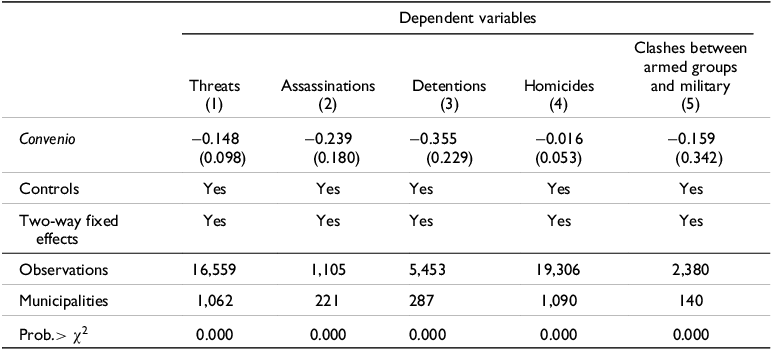
Results from panel data analysis, presented in Tables 1 and 2, indicate that the relationship between CCs and civil society repression is mixed and conditioned by the type of project in question. Our convenio dummy variable, which codes whether one or more CCs are present in a given municipality-year, has no statistically significant effect on any of our dependent variables—threats, assassinations, arbitrary detentions, homicides, or armed confrontations (Table 1, Models 1–5). These results run counter to our baseline expectations that CCs, regardless of sector, would be associated with increased repression (H1–H3) or changes in broader security indicators (H4).
Poisson regression results with convenio as the primary independent variable

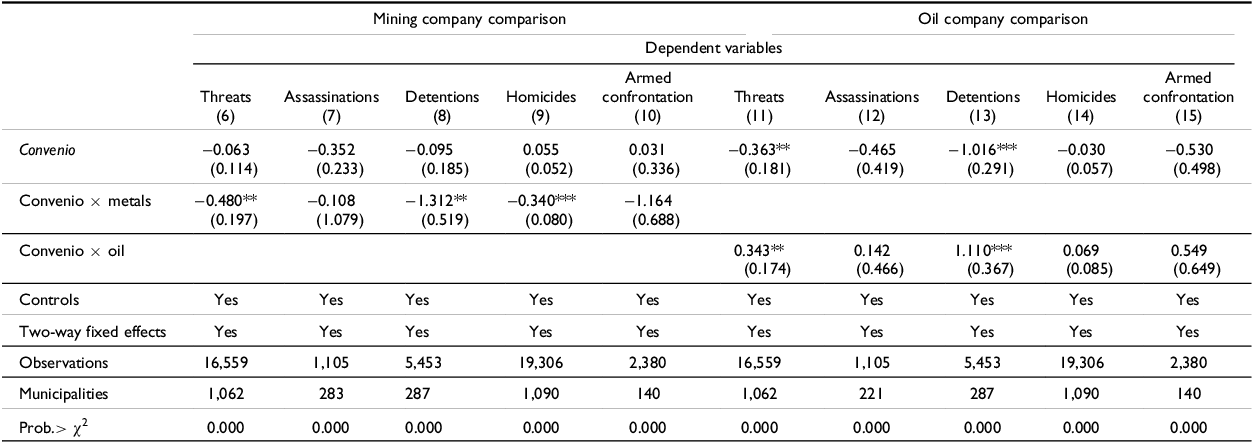
Poisson regression results with interaction terms for mining and oil companies

***p < .01. **p < .05. *p < .1.
The interaction terms presented in Table 2 (Models 6–15) reveal that sector matters for the relationship between CCs and our measures of civil society repression. The negative associations in our baseline models appear to be driven by agreements signed with mining companies. In the mining sector, the introduction of a CC is correlated with a statistically significant decrease in threats (Model 6) and arbitrary detentions (Model 8). Mining CCs are also associated with reductions in homicides, potentially suggesting modest improvements in the state’s broader policing function (H4).
By contrast, oil sector CCs display the opposite pattern. Oil CCs are correlated with statistically significant increases in threats (Model 11) and arbitrary detentions (Model 13). Coefficients for assassinations, homicides, and armed confrontations in the oil sector are positive but not statistically significant (H2, H4). These associations are not limited to the year of signature. Lagged models (Appendix D) show that the mining sector interaction remains negative and statistically significant for threats and homicides one year later, while the oil sector interaction remains positive and significant for threats and detentions. This persistence strengthens the interpretation that sectoral context shapes not only whether CCs are linked to certain modes of repression but also the durability of the effects over time. While the negative coefficients for mining CCs could suggest a protective effect for civil society, robustness checks using the restricted (pre-2011) sample do not replicate these results, indicating that they are either weak or emerge primarily in the later years of our dataset. Conversely, the positive and persistent association between oil CCs and repressive events offers consistent evidence in support of H1 and H3 for that sector.
There are a few possible reasons our results differ depending on the type of resource being extracted. One explanation is that large-scale mining has a much shorter history in Colombia than oil extraction. Many of the mining projects represented in our dataset were or are in the early stages of development, when companies invest significant resources in winning local support and approvals, and signal their participation in prior consultation processes. CSR—investment in local organizations, festivals, and public works—commonly serves as a kind of “softer security” that forestalls opposition or “divides and conquers” local communities (Shenk Reference Shenk2022; Schilling-Vacaflor and Eichler Reference Schilling-Vacaflor and Eichler2017) in ways that would not show up in our data. CSR investment could also explain why mining CCs are associated with improvements in security indicators.
A second explanation relates to the distribution of foreign versus domestic firms in the mining and oil sectors. Nearly all the CCs protecting oil projects in our database name Ecopetrol—Colombia’s state-owned oil company—as the primary company contracting state forces. In contrast, most of the mining CCs included in our database are multinational firms or Colombian subsidiaries of international firms. High-profile cases highlighting the involvement of multinational firms and gross human rights abuses in conflict zones, particularly in relation to mining projects, have likely shifted the calculus for foreign firms involved in extractive projects in recent years. As a result, the mining companies represented in our data could have strong incentives to closely monitor and control the actions of the state forces that they contract to prevent human rights abuses and avoid international scandal or sanctions that might scare off liberal-minded or scandal-wary international investors.
This same logic could also suggest that our results are the outcome of reporting bias. Civil society groups and government officials may be pressured not to report threats, detentions, homicides, and armed group presence where multinational firms invest in their municipalities. This could also explain why we see a positive relationship between mining companies and security indicators only in the full sample and not in our restricted sample; norms may not have shifted sufficiently before 2011. In contrast, Ecopetrol, as a state-owned firm, does not have to respond to the same international shareholder concerns and therefore has less incentive for rigorous monitoring of its security contracts. Indeed, other scholars and activists (see, e.g., Gill Reference Gill2016) have painstakingly documented Ecopetrol’s long history of human rights abuses and collaborations with both the Colombian armed forces and paramilitary groups. This history may be part of the explanation for the distinct patterns we observe between mining and oil CCs and their respective impacts on civil society.
Finally, there is a possibility that our results are affected by missingness in the data. As we note in our methods section, the Colombian government has refused to release a full dataset of CCs. It is possible that the government has systematically excluded certain agreements from disclosure, whether because of their association with particular companies, instances of human rights abuses, or sectors. If CCs linked to severe human rights violations are missing from the dataset, our results likely underestimate the relationship between CCs and civil society repression. We investigate some of these possibilities through our case study analysis.
The Case of Ariari, Meta: Ecopetrol and the USO
The region of Ariari, Meta, is an important one in the world of Colombian petroleum extraction and production; it is home to the Apiay-Ariari oil field, which is responsible for approximately 41 percent to 50 percent of Colombian oil production in recent years (Cortes et al. Reference Cortes, Niño, Polo, Tobo, Gonzalez and Siachoque2013). In 2000, Ecopetrol acquired a controlling interest in the field, which it continues to manage. Today, one of the largest extraction and refinery sites in the country is located about a twenty-five-minute drive from the town of Acacías, Meta—Estación Chichimene. In July 2025, we conducted fieldwork to explore the dynamics of Ecopetrol’s presence and relationship with the Colombian armed forces, with whom they have signed multiple CCs. To understand more explicitly the impact of CCs on civil society and mobilization, we focused on the case of the Union Sindical Obrera (USO)—Colombia’s largest and oldest oil workers’ union—as it has become one of Ecopetrol’s primary opponents in the region, clashing with the company over labor disputes. During our fieldwork, we conducted semistructured interviews with USO members in the region. On the basis of our panel data results, we would expect to see a higher risk of repression in this context. Our fieldwork, as well as a timeline of when CCs were signed between companies and the Colombian government, confirms this.
Initially, our interlocutors reported no real changes when Ecopetrol took over the field. In 2004, USO organized strikes that slowed construction of the Chichimene station due to disputes over labor conditions. Afterward, they described growing militarization and repression in the area. This coincided with two CCs signed between Talisman Energy Colombia and the army in 2008 and 2009. From then on, interlocutors saw police and soldiers operating in ways that directly served the companies: “When there is a labor dispute, the first to arrive, in this order, are Ecopetrol, the police, and immediately after, the army,” one USO member described.Footnote 5 The company justified militarization and the presence of armed forces to USO members as guarantors of the negotiations that the company and workers enter, despite the fact that having armed forces present in such spaces is a violation of civil rights in Colombia.Footnote 6
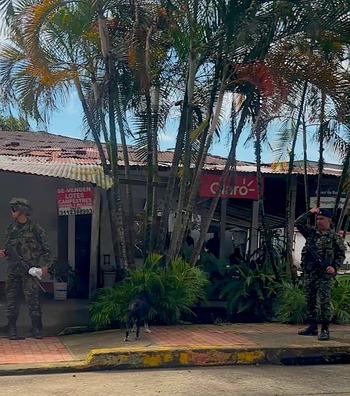
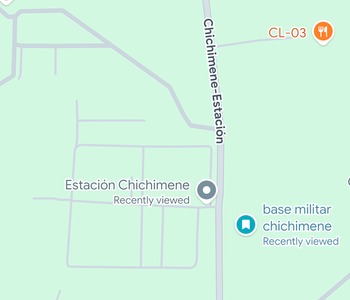
During our fieldwork, we saw for ourselves the manifestation of militarization due to CCs. Directly across the small road from Chichimene station sits a military barracks that houses the same battalion with which Ecopetrol has repeatedly signed CCs. As we slowly drove by, we watched as the soldiers stationed there monitored the comings and goings of workers heading into the plants for their shifts (Figure 1). “They see you all the time, you get to know them [the soldiers] a bit, they recognize your face, they kind of say hello as you go in and out [to work at the station],” one USO member described.Footnote 7 In this way, the CCs materialize not just as contractual arrangements but as visible forms of militarization shaping the everyday landscape. The literal proximity of the battalion to Ecopetrol’s operations in the area underscores the institutionalized and formalized security role these agreements facilitate (Figure 2).
Screengrab of two soldiers on patrol nearby the Chichimene Station, from video recorded by authors. Meta, Colombia. July 7, 2025.

Author’s elaboration via Google Maps showing the locations of the Chichimene Station and the military base directly across the street from the entrance of the station.

Judicialization and escalating conflict
Troop deployment is not the only co-COIN strategy our interviews detailed Ecopetrol using. Echoing our panel data, several of our interlocutors also experienced arbitrary detentions and judicialization because of their opposition to the company. In 2013, USO collaborator Oscar was detained and prosecuted for leading strikes at Chichimene station.Footnote 8 Charges against him included blocking public roads, property damage, environmental damage, and arson. Specifically, police alleged that he had broken a pipe holding crude oil and lit it on fire, endangering the savannah plains of the region and contaminating nearby streams.Footnote 9 Yet neither the police nor Ecopetrol found evidence for these claims, and he was eventually released, free of all charges. Union leaders like Oscar have also faced threats, surveillance, and stalking, including masked men attempting to break into their homes. “It’s now just second nature to sit with our backs to the wall, even in public places, wherever we go. We know that we are watched.”Footnote 10 This environment of surveillance continued as other CCs were signed, including a 2015 contract between Ecopetrol and the army.
In 2018, another group of community leaders and USO-affiliated syndicates was arrested under charges of terrorism. In our conversation with Camila, a USO affiliate arrested at that time, she told us: “I came to work my shift at night [in Chichimene Station] as usual, and they arrested me there at the station. It was as if they were going to capture the worst criminal in the world. There were like ten motorcycles of soldiers, two armored trucks, there was a plainclothes police colonel. I mean, that was … believe me … I think I collapsed right there because it was a terrifying scene.”Footnote 11 Prior to her detention, Camila had led calls for Ecopetrol and their third-party contractors to comply with required work safety procedures at the station, like replacing the massive trucks used to transport crude oil in and out of the station in a timely fashion.
USO’s legal team found that the 2018 charges were brought under a CC between the Colombian Prosecutor’s office and Ecopetrol. From our fieldwork and secondary reporting, we estimate this CC was established after Oscar’s 2013 arrest, around 2014, and before the 2018 arrests of Camila and others. Through Rutas del Conflicto, we obtained a copy of a CC signed in 2018, likely the contract governing Camila’s detention (see Appendix E). It lists the National Police, Attorney General’s Office, and Fondo Rotatorio de la Policía (FORPO)—a financial and administrative office within the Colombian National Police which manages budgetary resources, procurement, and infrastructure projects for the police—as members of the support structure, tasked to “prioritize situations and cases, paying special attention to reinforce its judicial and investigative capacity to repress delinquent activity which affects Ecopetrol.”Footnote 12 Such contracts mark a shift in corporate strategy not captured by our panel data: beyond militarization, firms directly enlist Colombia’s judicial institutions in the protection of extractive capital, embedding corporate interests within the very bodies meant to protect citizens’ rights.
Ecopetrol in charge
Our interviews also suggest that it is Ecopetrol that drives this repressive approach to civil society, encouraging international firms not to negotiate with opponents. USO, for instance, frequently engages in strikes that close roads or refinery stations and cause significant loss of income not only for Ecopetrol but also for other multinational corporations in the area. Oscar and Andrés estimate that USO’s longest strike in the area lasted approximately six months. Andrés shared with us during one of our interviews, “We apparently cost Halliburton a lot of money that time,” which made them both laugh.Footnote 13 They told us that Ecopetrol had explicitly instructed Halliburton not to negotiate; instead, the company filed a formal criminal complaint against striking workers for environmental damage.
Ecopetrol also surveils and controls informational access in the area. This control of the larger media environment is yet another part of the repertoire Ecopetrol deploys, particularly when labor disputes escalate or take time to resolve. As Oscar described:
[Ecopetrol] somehow captured the media, captured the security forces, so they use that to defend themselves. For example, this departmental strike, if it’s reported on Caracol for two minutes, it’s a lot. They don’t report on it any more [than that], the same with RCN. When the tough issue [strikes and labor dispute] of Pacific Rubiales Energy was discussed, they dedicated two days; two minutes on the second day and five minutes on the first day, and they simply called us terrorists, terrorists who were involved in Campo Rubiales. The terrorists of the USO, I remember that so vividly, that was what they said on RCN.Footnote 14
Oscar and Andrés went on to tell us that they very infrequently saw international media covering their activities in the area, despite the Apiay-Ariari field’s national importance for Colombia’s economy, and that they have only been able to harness some international attention by publishing information about their actions via social media. These strategies are a part of a broader repertoire that Ecopetrol can choose to deploy as necessary when a dispute arises: national media is deployed to create a public discourse of labor union members as terrorists and criminals in tandem with escalating militarization in the area, along with the judicialization of key leaders.
Because of Ecopetrol’s status as a state-run company and its centrality to the country’s oil economy, it has the ability to shelter the interests of multinational companies,Footnote 15 deploying military force in a highly repressive risk context to make mobilization that might be pricy to companies via demands for better working conditions or better shifts, more costly to those who engage in it. Through CCs in force with the armed forces, police, and even judicial institutions, Ecopetrol has managed to turn labor disputes and workers’ protests into criminal actions and subject USO leaders to surveillance, detention, and stigmatization as “terrorists.” This aligns with our large-N findings of oil companies being linked to more repressive activity, but our fieldwork clarified how companies draw from multiple different types of security arrangements to construct that context of repression. This construction shields not only the company’s own interests but also those of multinational partners, ensuring a flow of extractive capital at the expense of civil and political rights.
Jericó, Antioquia: AngloGold Ashanti and the Quebradona project
If the Ariari case illustrates the routinization of repression under oil sector CCs, then Jericó offers a more ambiguous and low-visibility counterpart. At first glance, the case of Jericó appears to confirm our regressions, suggesting that mining sector CCs are not correlated with heightened violence; the signing of new CCs in the municipality was not followed by increases in our repression indicators. Yet fieldwork reveals that AngloGold Ashanti (AGA) has used CCs flexibly over time, layering legal harassment, surveillance, and episodic militarization to contain local opposition to its Quebradona copper project. These dynamics suggest that companies can use CCs as latent instruments of corporate counterinsurgency, activating them more forcefully at moments of acute threat to their operations, which complicates the picture of sectoral difference painted by our panel data.
Our analysis of Jericó draws on a combined six weeks of fieldwork conducted over two trips in 2023 and 2025. We carried out semistructured interviews with local activists, campesinos, and community leaders, including several directly implicated in legal proceedings filed by AGA. These interviews were complemented by participant observation at community meetings and protest events, as well as a focus group with thirteen campesinos in 2025. We also interviewed staff from NGOs familiar with the case and drew on secondary materials, including local press coverage. This mixed methodology allows us to triangulate across different sources and capture both the observable presence of state forces and the less visible forms of surveillance and judicialization that we cannot capture with our large-N analysis.
Background and early community perceptions
Jericó is a small, agricultural municipality nestled in the mountains of southwestern Antioquia. Long favored as a retreat for Medellín’s elites, this status has historically insulated the town from Colombia’s armed conflict, which has affected much of the surrounding region.Footnote 16 That relative tranquility began to shift in 2007, when AGA acquired the mining title for the Quebradona copper deposit. That same year, Avasca—a joint venture between AGA and Bema Gold—signed a CC with the Colombian Ministry of Defense, funding the operations of the Batallón Nutibara across five municipalities, including Jericó. In the years directly following the signing of this CC, residents we spoke to described observing soldiers conducting exercises in the corregimiento of Palocabildo, the exploration zone of the mine. This was the first instance they could recall of seeing any sustained military presence in the municipality.Footnote 17 At this time, the presence of soldiers, while unsettling, was not overtly repressive, as residents insisted that the soldiers did not interact directly with them.
Throughout the 2010s, AGA continued to sign additional CCs with the Ministry of Defense, including two new agreements in 2016 and 2017 with the same battalion. During this same period, activists and residents began organizing protests against the proposed mine site, concerned that the project would impose severe environmental and social damage to the community. These confrontations with the company, however, rarely escalated into violence, despite the presence of state security forces. For instance, one activist remembered an event in May 2019 as a rare occasion when military and antiriot police attempted to directly interact with protestors. Yet even then, the situation was diffused when the town’s mayor intervened to mediate. As Luisa recounted, the military commander deferred to the mayor, recognizing him as “chief of police here in the municipality,” and heeded his instructions to stand down absent “violent intervention” by protestors.Footnote 18
At the same time, AGA invested heavily in CSR programs in the region. The company created its own foundation to sponsor local sports tournaments and cultural activities.Footnote 19 It flew local schoolchildren and politicians to observe mining operations in Brazil to convince them of the benefits of extraction.Footnote 20 They made direct overtures to local residents, offering money and paint for home improvement projects.Footnote 21 These CSR initiatives, combined with limited militarization, align with the patterns suggested by our panel data; mining CCs are associated with relatively limited repression and even slight security improvements. Rather than targeting opponents directly, AGA initially pursued a dual strategy of subtle militarization without confrontation and co-optation through CSR.
A turning point
Dynamics in Jericó shifted in 2021. That year, Colombia’s National Environmental Licensing Authority (ANLA) rejected AGA’s application for an environmental license—a prerequisite for moving the Quebradona project from the exploration phase to commercial extraction. The denial not only stalled AGA’s plans but also marked a turning point in the company’s relationship with local civil society, as activists recall a clear escalation in the company’s tactics following the ANLA’s decision. In the words of Luisa, “There is a face of AngloGold before their environmental license was rejected and another after the license was rejected.”Footnote 22 Following the rejection, AGA signed another CC with the Ministry of Defense in 2021.
The activists we spoke to suspected that AGA ramped up its surveillance of local leaders and residents from 2021 onward. By 2022, they believed that the company and local prosecutors were clearly building a case against opposition leaders with the goal of silencing protests against the project. That year, the company began filing querellas—minor legal complaints—against the antimining movement’s most prominent figures. Activists described these cases as deliberate “provocations” intended to stigmatize the movement. Staff from a human rights NGO that has closely followed AGA’s actions in Jericó affirmed this perception. They emphasized that such complaints rarely carry weight in Colombia, but in Jericó, they were pursued quickly and aggressively as a “first stage of criminalization” through legal harassment.Footnote 23
The nature of state security force presence in Jericó also shifted after 2021. Activists noted that soldiers and police began to appear more regularly at protest events. In contrast to Meta, soldiers did not regularly patrol the area or have an explicitly visible presence like in the barracks in front of Chichimene station, but as Jhon, one local leader, described, “We do not see them [all the time], but when something happens, they are there immediately…. From one moment to the next, pum, there are six, eight, ten heavily armed soldiers.”Footnote 24 Again, in contrast to Meta, Jhon clarified that the soldiers did not engage in violence against the protestors. Rather, their presence is understood to mean intimidation without aggressive intervention. The presence of soldiers, however, still represented a significant shift in the community’s relationship with state security officials following the signing of new CCs in 2020 and 2021.
By 2025, AGA’s targeting of opposition figures escalated again with the judicialization of eleven campesinos, known as “los 11 de Jericó.” Prosecutors accused the activists—a group that included an eighty-six-year-old resident of Palocabildo—of kidnapping, theft, and related charges stemming from protest actions carried out in 2022 and 2023 (La Semana 2025). For the activists and NGO workers we spoke to, however, these charges represented an effort to criminalize environmental defenders rather than prosecute actual crimes. As Jhon explained: “This already borders on persecution, on threats, on the violation of human rights and the rights to privacy. Well, on everything.”Footnote 25
Those we spoke to consistently linked this escalation to AGA’s licensing struggles. After the ANLA denied the company’s environmental license in 2021, AGA was left operating on temporary extensions of its exploration permits, which were set to expire in late 2025. At that point, AGA faced existential pressure over the viability of Quebradona: Without the license, the project could not advance to exploitation, threatening to strand years of investment and undermine the company’s flagship presence in Colombia.Footnote 26 Against this backdrop, judicialization functioned as a strategic tool: reframing opposition as delinquency, legitimizing repression under the veneer of legality, and attempting to neutralize civil society resistance at the precise moment when the project’s survival was most in doubt.
What the Jericó case ultimately shows is the gap between what appears in our large-N analysis and what is lived on the ground. At the national level, mining sector CCs appear “protective”: Our quantitative indicators register no increase in threats, homicides, or arbitrary detentions. Yet fieldwork demonstrates that repression was not absent—it simply took less visible forms. CCs facilitated surveillance, enabled rapid but temporary deployments of armed forces at protest sites, and provided institutional cover for the criminalization of local leaders. These strategies were not constant but calibrated: muted during periods of low contention and sharply escalated after ANLA’s denial of AGA’s environmental license in 2021. The Jericó case therefore challenges a simple reading of mining CC as benign, showing instead how they function as flexible instruments within a broader corporate counterinsurgency repertoire.
Jericó also highlights the limits of reputational constraints. AGA initially emphasized social investment and avoided overt violence, consistent with expectations that multinational firms are more reputation-sensitive than state-owned companies. Yet the company’s reliance on CCs and its activation of strategies of surveillance and judicialization demonstrates a willingness to risk scandal when the project’s survival is in question. In this sense, CCs do not only militarize territory—they embed companies within state legal institutions, allowing repression to shift from overt coercion to latent forms that are harder to detect but no less effective in undermining mobilization.
Even the assumption that foreign firms are consistently more constrained by international scrutiny is open to question. As one NGO representative reflected, “In reality, it is very hard to find investors that stop investing because a company [does bad things].” In other words, reputational costs may matter in some situations, but in others they are outweighed by operational risks. The same interviewee noted pointedly that AGA’s head of human rights was a former military officer: “This tells you how much their reputation matters to them. If they cared about their reputation, they would have a human rights expert in that post.”Footnote 27
In contrast to Meta, where CCs routinize visible repression, Jericó shows how the same legal framework can underwrite subtler strategies of community control. By funding security forces that can be rapidly deployed and embedding company interests within prosecutorial offices, CCs enable firms to calibrate repression to specific contexts. The result is a form of low-visibility counterinsurgency: less about everyday violence or a conspicuous militarization, and more about surveillance, intimidation, and legal pressure. This heterogeneity underscores the importance of a mixed-methods approach. Panel data alone would miss the dynamics in Jericó, but fieldwork reveals how CCs embed repressive potential within state institutions even in the absence of overt violence.
Conclusion
This article investigates how CCs operate as mechanisms of control in service to capital. This study provides new empirical leverage and theoretical insights into the phenomenon of company-state security assemblages. We constructed a novel panel dataset that tracks CCs at the municipality level, revealing differences between mining and oil contracts. In the oil sector, CCs are consistently associated with heightened repression, particularly via arbitrary detentions and increased threats that may work to constrain mobilization. By contrast, panel data analysis does not show the same clear association with mechanisms of repression as we initially hypothesized.
Fieldwork in Jericó suggests that this reflects a subtler approach to security rather than the absence of repression. There, CCs operate through informal channels of surveillance, selectively deployed judicialization, and anticipatory deterrence rather than an overt militarization, as in the case of Meta. This variation is important: It underscores that CCs are not uniform instruments but rather context-sensitive mechanisms. In some cases, they are overtly repressive, working to criminalize mobilization and militarize everyday contexts. In other words, their influence is more diffuse, shaping the field of possibilities for contestation depending on the needs of a company and how those needs might change over time. In moments of acute conflict or opposition, CCs provide ready-made frameworks to channel resources into militarization and judicialization. In other contexts, they may sit dormant until a need arises. This flexibility suggests that CCs should be understood not as stand-alone instruments but as part of a broader repertoire of control—a set of tools that can be layered, combined, and sequenced to shape contentious politics in extractive zones.
Broader implications for democratic concerns
This research speaks to ongoing debates in the literature on co-COIN and the criminalization of protest. Much of this scholarship has emphasized how corporations and states collaborate informally to manage dissent, whether through patronage, policing, or media campaigns (i.e., Doran Reference Doran2017; Gill Reference Gill2016; Jakobsen Reference Jakobsen2020; Jespersgaard Jakobsen et al. Reference Jespersgaard, Line and Serrano Zapata2024). Our work on CCs further extends this discussion by analyzing the consequences of the formalization of these arrangements: They are contractual and legally recognized tools of cogovernance, putting the state at the service of capital flows. From this perspective, CCs represent a formalization of co-COIN behavior and strategy.
By allowing the state to criminalize and judicialize protest, these agreements reshape the terrain of contestation available to communities—they serve to narrow the democratic space available and threaten the exercise of political and civil liberties. Additionally, CCs create greater asymmetry for communities in their contestation of projects—communities encounter not only the traditional challenges of resource asymmetries but also the legal weight of contractual cooperation that legitimizes repression. CCs tilt the playing field of contestation, institutionalizing barriers to democratic participation precisely in the places where accountability is most necessary.
This raises troubling questions about the role of the state in such contexts. CCs could risk normalizing a model of governance in which corporate interests and state security agendas converge, systematically undermining the exercise of rights that democratic systems should center. Because CCs operate through legal frameworks, this makes them harder to challenge than overt acts of violence or corruption. They are, in a sense, repression and state violence made legal.
Directions for future research
First, this project points to the need for comparative research across Latin America and beyond in an examination of CCs and other such structures of governance. While this analysis is focused on Colombia, we know that CC-like arrangements exist in other contexts. Systematic comparison could reveal whether the sectoral variation observed here holds elsewhere or whether different political regimes shape the trajectory of CCs in distinctive ways.
Second, the project highlights the importance of data transparency and availability. Much of the difficulty in studying CCs lies in their partial visibility: Contracts are sometimes public but often buried, redacted, or treated as private. Without greater transparency, it is challenging for researchers, activists, or policymakers to fully assess their implications. Building collaborative data infrastructures across contexts and country case studies will be essential to deepen our understanding of the impact of these types of governance structures and their consequences for political and civil rights.
And last, future research should probe more directly how CCs fit into the broader repertoire of community control. Do they displace older mechanisms of patronage, co-optation, and direct forms of violence or threat, or do they layer on top of them, creating a multilevel web of influence? A rigorous examination into these questions will help illuminate the evolving dynamics of resistance in a world where legal-corporate tools of repression and criminalization are increasingly normalized.
Supplementary material
To view supplementary material for this article, please visit https://doi.org/10.1017/lar.2026.10134
Acknowledgments
The authors profoundly thank the journalists at Rutas del Conflicto, Oscar Parra and Pilar Fuentes, members of the USO legal team, and research participants in Meta and Jericó for sharing their data, time, and expertise. This article benefited immensely from feedback by participants at the Violence, Instability, and Peace Workshop, 2024 Pre-LASA Conference in Crime, Conflict, and Security Institutions, and 2024 International Studies Association Annual Convention, as well as anonymous reviewers at LARR. The authors thank Rafael Chacón Molina for his excellent research assistance. Last, the authors thank one another for the camaraderie, patience, and emotional support they provided to one other while staring at hotel room ceilings throughout rural Colombia.


 Open access

