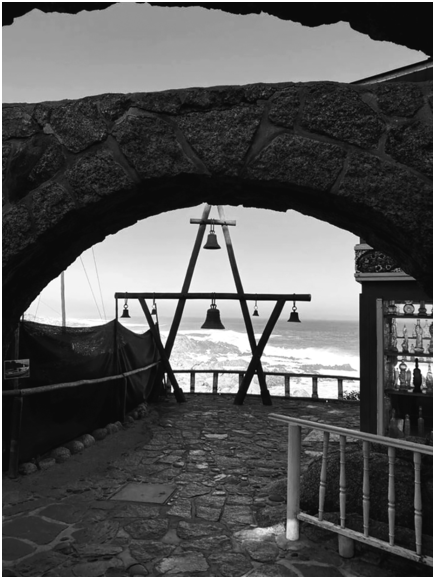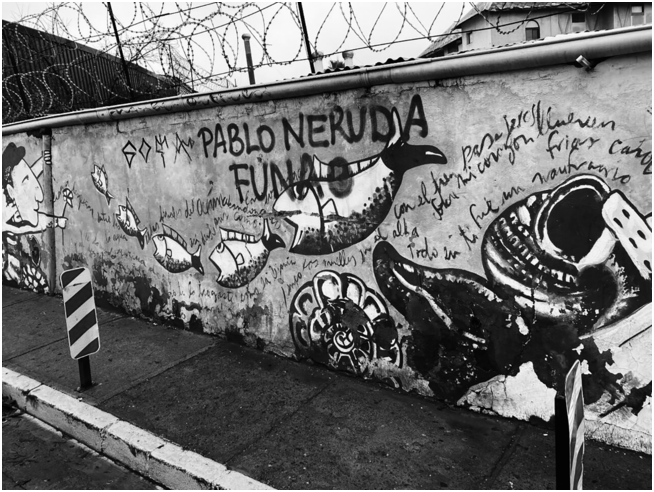


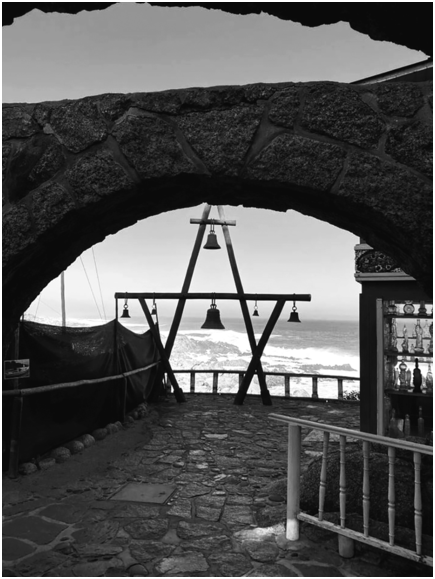
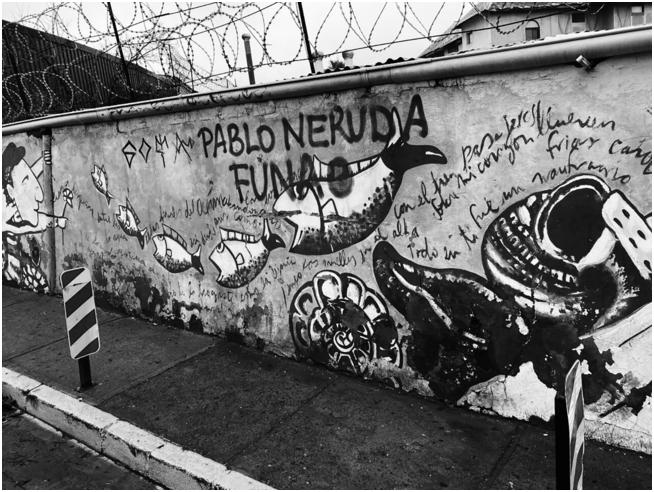
In the summer of 2023, I took a taxi to one of the bus stations in Santiago, Chile. The friendly driver asked me where my bus was taking me, and when I told him that I was going to Isla Negra to visit one of Pablo Neruda’s houses (Figure I.1), his facial expression drastically changed and an awkward silence followed.Footnote 1 Later, as if he could not contain himself, the cab driver proceeded to proffer a list of epithets regarding the poet, which began with “That communist!” After a second awkward silence, he asked me the reason for my visiting Isla Negra, and I calmly responded that, regardless of any personal flaws that Neruda may have had, he was still one of the greatest and most influential poets in any language, and that I have always admired his oeuvre. The day before, I had visited another of Neruda’s three beautiful houses, the one in Santiago known as La Chascona. As I was leaving, I noticed graffiti over the murals celebrating Neruda near the museum house. One said: “Pablo Neruda, funao” (Figure I.2). The Chilean slang verb “funar” refers to a public denunciation (or “funa”), usually in front of their house, against someone or an institution that is perceived to have committed a wrongdoing or crime. Basically, the graffiti declared that Neruda had been canceled.
Wooden structure with bells at Neruda’s house in Isla Negra.
And here is the dilemma: How do we read and evaluate today the oeuvre of masterful authors whose legacy has been marred by the revisiting of dark episodes in their biography? From Latin American writers who seemed to be too cozy in the company of dictators or openly supported dictatorships in the region to others who affiliated themselves with questionable ideologies, not to mention those who have been accused of rape, plagiarism, and other wrongdoings, the Latin American “Republic of Letters,” like the World Republic of Letters in general, is not immune to these types of ineffaceable stains. The case of the great Chilean poet Pablo Neruda (1904–1973), one of the most read, influential, and translated poets of all times in any language, is of particular interest. Neruda was indeed far from being perfect as a human being, but there is no doubt that his impressive and varied oeuvre, and particularly his poetry collections Veinte poemas de amor y una canción desesperada (Twenty Love Poems and a Song of Despair, 1924), Residencia en la tierra (Residence on Earth, 1933, 1935, and 1947), Canto general (Canto general: Song of the Americas, 1950), and Odas elementales (Elemental Odes, 1954–57), have left a deep-seated mark among readers and inspired numerous writers all over the world.
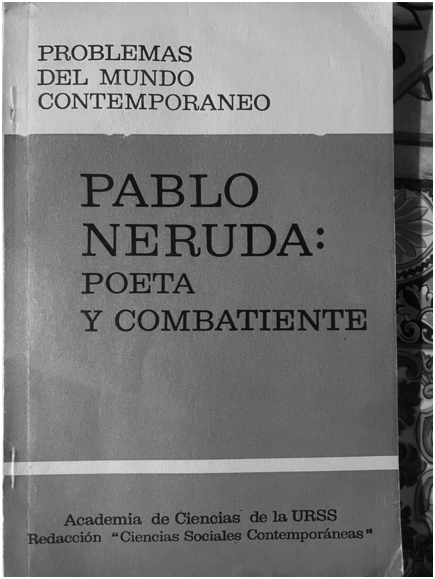
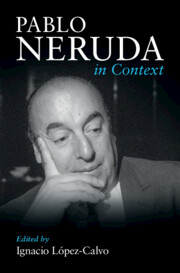
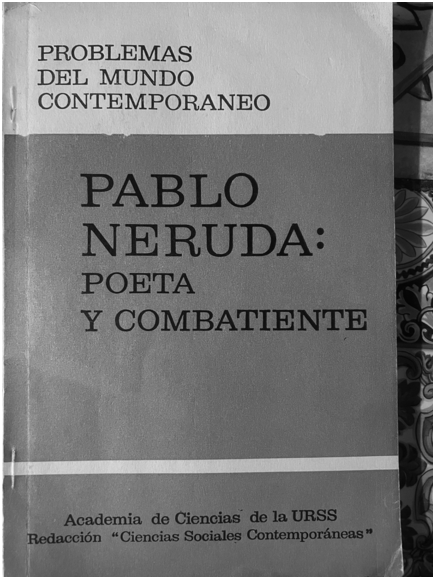
Moreover, as a diplomat, senator for the Chilean Communist Party, former presidential precandidate,Footnote 2 and receiver of major literary awards in the Soviet Union, Neruda was also influential in Chilean and world politics during the second half of the twentieth century, and a key figure to understand the cultural Cold War in Latin America. This perception is illustrated in the title of a Spanish-language book published by the Academy of Sciences of the USSR and titled Pablo Neruda: Poeta y combatiente (Pablo Neruda: Poet and Combatant, 1974; this book was also published in Buenos Aires in 1975) (Figure I.3). Likewise, the fact that he was plausibly poisoned by the Chilean military junta suggests that they saw him as a major political threat and a symbol of the resistance, particularly after they had eliminated the militant singer Víctor Jara and President Salvador Allende had committed suicide. In this sense, I concur with Matías Rivas when he states:
Judging a writer by episodes of his biography is an exercise in cultural barbarism with disastrous precedents in history, especially when the Inquisition was active. However, these practices continue in the name of goodness, of a future without abuses, which implies the censorship of protagonists of the past in an act of posthumous justice. Neruda was erased from the commemoration of the 50th anniversary of the Coup, even though he died a few days later and was a key cultural figure in the times of the Unidad Popular (Popular Unity).… Neruda’s misdeeds consist of dedicating an Ode to Stalin, confessing sexual outrages, and abandoning a sick daughter. They are vile, there is no doubt; but they should not be confused or overshadow his success as a poet when describing nature and love. Few have managed to move so many generations with verses full of ambiguity and passion.Footnote 3
Along these lines, Chilean author Isabel Allende declared to The Guardian: “Like many young feminists in Chile, I am disgusted by some aspects of Neruda’s life and personality. However, we cannot dismiss his writing” (Otis n.p.).
Cover of the book Pablo Neruda: Poeta y combatiente (Pablo Neruda: Poet and Combatant, 1974).
Indeed, the silence surrounding Neruda during the commemorations of the fiftieth anniversary of the coup d’état led by General Augusto Pinochet on 11 September 1973 was deafening. Five years earlier, when the Chilean Congress was considering changing the name of the Santiago airport to Pablo Neruda airport (it had been originally proposed in 2011), there was a public outcry, particularly among feminist collectives, who proposed to rename it, instead, after the Chilean Nobel laureate poet Gabriela Mistral. Pamela Jiles, a journalist and representative for the Leftist Partido Humanista (Humanist Party), condemned the proposed measure: “These are not the right times to pay homage to someone who mistreated women, abandoned his sick daughter, and confessed to having raped a woman. It does not help the image of the country.”Footnote 4
Neruda’s daughter, named Malva Marina Reyes Hagenaar and born in Madrid in 1934, was hydrocephalic. In a notorious letter, an indolent Neruda derogatively described his neglected, ill daughter as “a perfectly ridiculous being, a kind of semicolon, a three-kilogram vampire.”Footnote 5 In 1936, at the beginning of the Spanish Civil War (1936–39), Neruda sent his wife Marijke Antonieta Hagenaar VogelzangFootnote 6 and Malva to Monte Carlo, whence they traveled to the Netherlands. Henceforth, he failed to support them despite Marijke’s demands. In this way, Neruda replaced his first wife with Delia del Carril, a leftist Argentinean artist twenty years his senior. Lacking the means to support their daughter, Marijke had to leave Malva with a family in Gouda, in the Netherlands, and was able to visit her only once a month. The girl died on 2 March 1943 in Gouda. Reportedly, Neruda never answered Marijke’s telegram informing him and asking to meet with him. His first wife ended up doing forced labor in a camp. This sad story about his hydrocephalic daughter was disseminated in a novelized account titled Malva by Hagan Peeters in 2016. The Fundación Pablo Neruda (several members of the foundation participate in this volume) answered, however, that Neruda did visit his daughter in 1939, the last time he could go to Europe (Sáez Leal n.p.).
In short, after his eventful life was revisited under a renewed scrutiny, Neruda went from being one of the most important poets of the twentieth century and the “Ambassador of Chileanness to a universal scale,”Footnote 7 as Abraham Quezada Vergara, one of the contributors to this volume, calls him in his 2023 book Pablo Neruda, memorias virreinales (Pablo Neruda, Viceroyalty Memoirs), to being radically canceled in his own country. Half a century after his death (plausibly poisoned with a lethal injection by the military junta, as his chauffeur Manuel Araya maintained), Neruda has gone from being a victim and a martyr of the dictatorship, as the Communist Party and part of Neruda’s family still maintain, and an iconic monument that made Chileans proud to being considered a perpetrator of serious abuses, as he is now seen by the Chilean feminist movement.
Chilean women were seen marching with banners stating “Neruda, cállate tú” (“Neruda, shut up”), in reference to the controversial Poem XV, included in Veinte poemas de amor y una canción desesperada, which starts with the famous line “I like you when you’re silent, for you seem as if you’re gone.”Footnote 8 In contrast with these recent feminist readings of Neruda’s early poetry in Chile, however, the chapters by Irene Gómez-Castellano, María Rosa Olivera-Williams, and Kemy Oyarzún in this volume accurately question the purported sexism, arguing, instead, that the poetry in Neruda’s first books is sexually liberating for both the poet and the women who inspire his writing, and that women in his poetry tend to have agency. Olivera-Williams, for instance, points out how Poem XV ends with lines that contradict that interpretation: “Then just one word, one smile of yours will do. / And I’m happy, so happy that it is not true.”Footnote 9
In any case, although I find the protests against the renaming of the Santiago airport in his honor understandable and justified, I still agree with Rivas, aside from hagiographies, that it would be a great mistake to disregard Neruda’s opus, regardless of the shocking flaws in his private life. Consistent with this viewpoint, the Chilean writer Alejandro Zambra recently stated in an article in the New Yorker that he “is hopeful that the revisionism will bring people closer to Neruda’s poems. (‘To read him out of his own myth is to read him better’).” I concur and firmly believe that Neruda’s pathbreaking and influential literary works should continue to be read and studied. This volume is a collective effort in this direction.
In events such as the “Discurso al alimón sobre Rubén Darío” (Joint Speech about Rubén Darío), which took place at the Buenos Aires PEN Club in 1933 and in which Neruda joined forces with his Spanish friend Federico García Lorca to pay a lighthearted homage through a humorous dialogue to the influential Nicaraguan poet Rubén Darío, “the poet of America and Spain,” one can find the pan-Hispanic dimension of the Chilean’s literary leadership. The speech ends with the following words:
Lorca: Pablo Neruda, a Chilean, and I, a Spaniard, share a language and the great Nicaraguan, Argentine, Chilean, and Spanish poet Rubén Darío.
Neruda and Lorca: In whose homage and glory we raise our glass.Footnote 10
Indeed, as surprising as it may seem nowadays, there was a time, not long ago, when Neruda was still considered the poet of the people, a sort of literary rock star for the masses (“one of the last rock-star poets,” according to Adam Feinstein, one of the contributors to this volume [Mochkofsky n.p.]). As evidence of his once enormous popularity, on 15 July 1945 he read his poetry in honor of the communist revolutionary leader Luís Carlos Prestes in front of an audience of 100,000 at the Pacaembu Stadium in São Paulo, Brazil, even though this is a Portuguese-speaking country. Decades later, after receiving the Nobel Prize in 1971, his poetry reading at the Estadio Nacional in Santiago de Chile reached an audience of 70,000. Yet, as mentioned, in recent years he has gone from receiving the Nobel Prize for Literature, among many other notable awards, and being universally admired and applauded – the Nobel laurate Gabriel García Márquez famously described him as “The greatest twentieth-century poet in any language”Footnote 11 – to being the target of cancellation debates. This turn of events is mostly the result of revelations about his sexual assault of a Tamil, Dalit domestic worker in Colombo, Ceylon (now Sri Lanka), when he was a twenty-five-year-old, low-level consul of Chile in 1929. He openly confessed this in a passage of his 1974 posthumous memoirs Confieso que he vivido (Memoirs) that had been surprisedly overlooked for decades:
One morning, I decided to go all the way. I got a strong grip on her wrist and stared into her eyes. There was no language I could talk with her. Unsmiling, she let herself be led away and was soon naked in my bed. Her waist, so very slim, her full hips, the brimming cups of her breasts made her like one of the thousand-year-old sculptures from the south of India. It was the coming together of a man and a statue. She kept her eyes wide open all the while, completely unresponsive. She was right to despise me. The experience was never repeated.Footnote 12
These transgressions have contributed to staining the impressive achievements of his poetic legacy. As could be expected, it is not always easy to reconcile authors’ scandalous personal flaws with their awe-inspiring creativity. Studying the geographical, historical, cultural, and sociopolitical contexts of an oeuvre, however, should shed light on new meanings and deeper understandings of the ambiguities and complexities of authors and their works, which is not to say, of course, that it validates any sort of wrongdoing.
As is well known, Neruda was a major figure in the field of the Latin American avant-gardes,Footnote 13 leading the way in conceiving experimental art as inseparable from the struggle for social justice and political change. Like his admired peer, the Peruvian César Vallejo, but without the latter’s dialogue with Christian imagery, Neruda is known for an engaged poetry informed by the Marxist discourse that guided much of his adult life (during his youth, he leaned more toward anarchism), especially after his stay in Spain and the assassination of García Lorca by General Francisco Franco’s Nationalist forces in 1936.
Interestingly, in a televised interview, the Argentine writer Jorge Luis Borges addressed this thematic change in Neruda’s writing with his characteristic penchant for controversial, sarcastic, and at times contradictory takes on contemporary authors: “Neruda? Well, I disbelieve in, let’s say, socialism, communism. But undoubtedly, communism was very useful for Neruda, because Neruda began as a mediocre sentimental poet and was a great public poet, one of the great sons of Whitman, whom he loved so much.”Footnote 14 In other words, Borges claims that Neruda’s political conversion dramatically improved his writing. In this regard, it is worth noting that, along with his fellow poets Vallejo and the Cuban Nicolás Guillén, or novelists such as the Brazilians Oswald de Andrade and Mário de Andrade, the Cuban Alejo Carpentier and the Guatemalan Miguel Ángel Asturias, Neruda was one of the authors who attempted to vindicate the voices of Latin Americans of Indigenous and African ancestry (see María Luisa Fischer’s and Sarah Quesada’s chapters in this volume); yet he has also been accused of appropriating the voice of these indigenous groups, as several chapters in this volume point out.
As a politician, public figure, and world-renowned poet, Neruda led an intense, peripatetic life, marked by diplomatic stints in Latin America, Europe, and Asia, often interrupted by other travels and even exile (see Darío Oses’s essay). Yet he always claimed his belonging to the southern region where he grew up and lamented the environmental destruction of native forests in the area. After his stay in Mexico, Neruda returned to his country in 1945, where he joined the Communist Party of Chile and was elected senator. Because of his denunciation of conservative President Gabriel González Videla’s repression of striking miners in 1947, and the subsequent outlawing of communism in Chile, a warrant was issued for the poet’s arrest. As a result, he had to go into hiding for months between 1948 and 1949 in the basement of a friend’s house in the Chilean port of Valparaíso, before eventually escaping into exile in Argentina on horseback through a mountain pass near Maihue Lake. He would live in several European countries until returning to Chile in 1952.
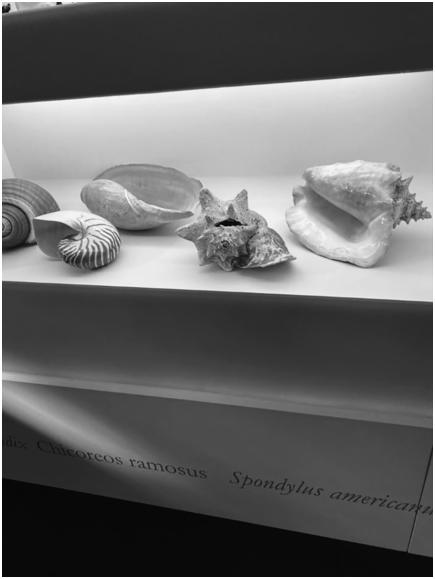
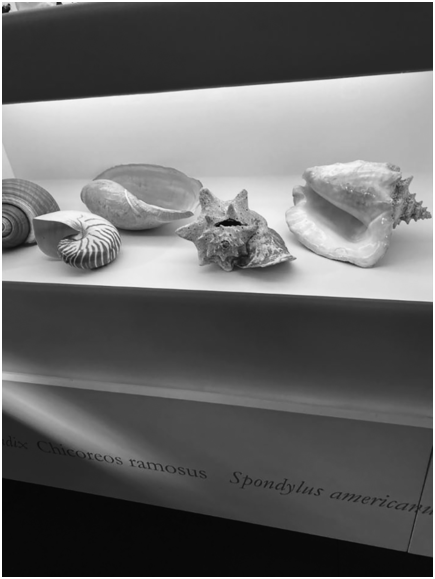
Many of these lived experiences influenced Neruda’s poetry, both during the early neoromantic and post-modernista phase reflected in his first two books, Crepusculario (At Twilight, 1923) and Veinte poemas de amor y una canción desesperada (Twenty Love Poems and a Song of Despair, 1924), and in the ensuing avant-garde poetry, closer to surrealism, in Tentativa del hombre infinito (Venture of the Infinite Man, 1926) and his short novel El habitante y su esperanza (The Inhabitant and His Hope, 1926), and later in Residencia en la tierra (Residence on Earth) (Verani 41). For instance, the publication of his Odas elementales (Elemental Odes, 1954) and his Nuevas odas elementales (New Elemental Odes, 1956), which marked one of his creative periods as a mature author after his return to Chile in 1952, responded to nothing else but an invitation by Miguel Otero Silva, the director of the Caracas journal El Nacional, to a weekly collaboration, which the poet envisioned as an opportunity to offer a chronicle of the daily life of his time, its people, and the everyday objects that surrounded them. This anecdote led the way for Neruda’s “impure” poetry to challenge the assumed range of topics for poetic discourse, beyond his reputation as the poet of love earned thanks to his youthful poetry collections. In his odes, the poet writes in a simpler, more direct style, occasionally resorting to humor, for and about common people and their daily lives. Incidentally, his odes to common objects, animals, and everyday situations (a sock, an onion, or a cat, whom he calls “Oh little / emperor without a sphere of influence / conqueror without a country, / smallest living-room tiger, nuptial / sultan of the sky, / of the erotic roof-tiles”),Footnote 15 could be associated with the many objects, including seashells, butterflies, masks, spurs, bottles, devils, and figureheads, which he collected, from his many travels around the world, in his beautiful house by the Pacific Ocean in Isla Negra (Figure I.4).
Part of Neruda’s shell collection at his house in Isla Negra.
Still, some of these odes carry political undertones. Consider, for example, his “Oda al mar” (“Ode to the Sea”), which is not just a simple praise or glorification of the ocean, as one could expect from the title; instead, it ends up being an inroad for revolutionary discourse addressed to the lower classes. Thus, in the opening lines, the poetic voice first asks the sea to stop being so haughty and start providing fish every day for the poor and hungry, so that poverty on earth can be forever eradicated. At one point, the tone of the poem suddenly changes and the humble fishermen begin to threaten the personified ocean with punishment, unless it meets their demands: They will spit on the ocean and cut its waves with a fiery knife; tie its hands and feet up; tame it and dominate its soul; force it to perform miracles and provide fish for the poor, because the miracle, the poetic voice declares in the closing lines, is in the struggle. In this way, the ocean becomes a metaphor for the owner of the means of production, who is being threatened by a struggling working class that will no longer tolerate economic injustice.
Those youthful poems of his first collections, full of melancholy, (neo)romantic love, and admiration for the austral landscapes that he enjoyed growing up in Temuco, give way to consciousness raising and the concerns of a communist activist, thus bringing his discourse closer to a political manifesto. This politically engaged poetry was, of course, diametrically opposed to the “poesía pura” (“pure poetry”) advocated by his hated countryman Vicente Huidobro (to whom he dedicated the harsh poem “Aquí estoy” [“Here I am”]Footnote 16 and even a few negative lines in his Nobel speechFootnote 17); the Mexican poet, essayist, and future Nobel laureate Octavio Paz; and the Spanish poet and Nobel laureate Juan Ramón Jiménez, who once famously described Neruda as “a great … bad poet.”Footnote 18
As Hugo Verani points out, although, in contrast with Huidobro, Neruda never tried to lead a literary movement and rarely articulated his aesthetic principles (39), he did describe what he meant by “impure poetry” in some essays:
“Hacia una poesía sin pureza” [Toward a Poetry Without Purity] summarizes his poetics, the vital and non-aesthetic character of a type of poetry attached to material reality and nature, to man and his passions, agonies and pathos, a type of poetry that responds to natural impulses, to the chaotic diversity of the world. Neruda proclaims to incorporate the totality of life into poetry, to write “a poetry impure like a suit, like a body, with stains of nutrition and shameful attitudes, with wrinkles, observations, dreams, wakefulness, prophecies, declarations of love and hate, beasts, shocks, idylls, political beliefs, denials, doubts, affirmations, taxes.” In the third article, “Conduct and Poetry,” Neruda repudiates “artistic” poetry and once again testifies to the approach of his poetry to life, to identifying it with natural forces.Footnote 19
By contrast, Huidobro tried to erase any kind of sentimentality from his poetry. This impure poetry is manifested in the main four poetic outlooks in Neruda’s prolific writing, which make him an original and extraordinary poet: the melancholy love poetry in Veinte poemas de amor y una canción desesperada; the existential angst in Residencia en la tierra; his epic, engaged, and Whitmanesque poetry in Canto general; and the poetry of everyday things in Odas elementales.
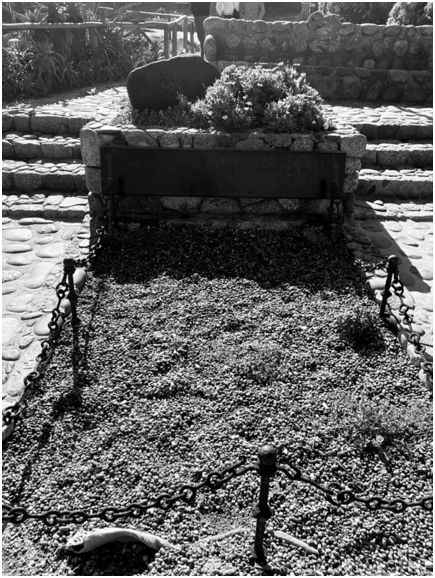
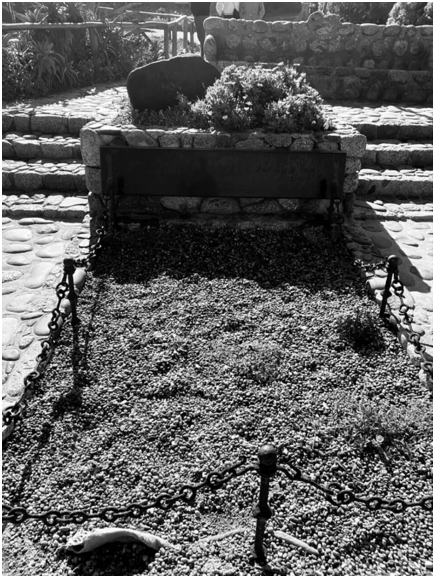
Neruda died two years after winning the Nobel Prize and only twelve days after General Augusto Pinochet’s coup against socialist President Salvador Allende’s government on 11 September 1973. Following his wishes, on 12 December 1992 he was buried, together with his wife Matilde Urrutia, in his house in Isla Negra (Figure I.5). As mentioned, although it was initially believed that Neruda had died of cancer, recent investigations suggest that he may have been poisoned. In early October of 2023, the Communist Party of Chile, claiming that there is now a new antecedent, protested the fact that judge Paola Plaza closed the case on 25 September 2023, after being investigated for twelve years by two different judges. Although General Pinochet denied permission to turn his funeral into a public event, thousands of Chileans ignored the curfew and risked their lives to pay their respect to a figure who, they felt, represented them, in effect participating in the first public protest against the military coup. Several photographs of these demonstrations figure prominently in the Museo de la Memoria y los Derechos Humanos (Museum of Memory and Human Rights) in Santiago de Chile. Neruda had become a symbol of freedom.
The Book and Its Organization
Pablo Neruda in Context consists of an introduction and forty essays by some of the main experts on Neruda’s biography and writing throughout the world, including, of course, his native Chile. Whereas some chapters include close readings of Neruda’s texts, the main goal of this volume, as its title suggests, is to locate and contextualize his oeuvre within six different, albeit interrelated frameworks. The opening section of this volume, Part I, “Residence and Travel,” focuses on spatial and geographical contexts, looking at how his travels and places of residence throughout the world changed his life and influenced his writing. The second one, Part II, “Landmark Events and Relationships,” looks at how major historical events as well as personal experiences affected his political and writerly worldviews. In turn, Part III, “Literary Influences and Poetic Evolution,” explores which authors were the most influential throughout his life and traces the factors behind the evolution of his poetical aesthetics over time.
Beyond poetry, the main genre for which he was known worldwide, Neruda also wrote a play, a novel, letters, speeches, memoirs, and other works. Building on the previous section, Part IV, “Other Genres,” veers toward the contexts surrounding his non-poetical writing, as well as musical and filmic renditions of his work and life. Part V, “Politics, Race, and Ecocriticism,” considers how Neruda’s political affiliation and activism affected his writing and transformed his life. Three other essays focus on his representation of people of Indigenous and African ancestry, as well as on the ecocritical outlook of his poetry.
The closing section of this volume, Part VI, “Worldwide Influence, Reception, and Legacy,” is particularly innovative in that it traces, from a postcolonial and South-South perspective, the worldwide influence of Neruda in Asia, the Arab world, the Anglophone world, the Soviet Union, and other areas, providing examples of major authors (Rabindranath Tagore, Kim Soo-young, Ai Qing) who confessed their admiration for Neruda, as well as others who influenced him, like Tagore. It also addresses the poet’s literary and cultural legacy, as well as his place within the “World Republic of Letters” and world literature.
Part I, on residence and travel, is composed of six essays, addressing first Neruda’s formative stay in Burma (Myanmar), British Ceylon (Sri Lanka), and Java (in Indonesia), between 1927 and 1932, where he served as a diplomat. Through the letters to his friend Héctor Eandi and his travel chronicles, we discover how his feeling of isolation during these years contributed to the existentialist mood in his breakthrough, surrealist poetry collection Residencia en la tierra (Residence on Earth, 1933). He also developed an anti-colonialist stand after witnessing the injustice suffered by colonized people. Chapter 2 offers an urban methodological approach to the study of Neruda’s stay in the Buenos Aires of 1933. It considers his network in the city, including Sara Tornú, Norah Lange, Oliverio Girondo, and Federico García Lorca.Footnote 20 The essay reveals how Neruda’s official positions and international fame facilitated quick access to existing literary spaces, such as the PEN Club and Editorial Sur.
Chapter 3 analyzes Neruda’s diplomatic stays in Barcelona and Madrid between 1934 and 1937, where at one point he witnessed the horrors of the Spanish Civil War and learned about the assassination of his friend García Lorca at the hands of General Francisco Franco’s Nationalist soldiers. This tragedy radicalized Neruda’s political stand, as echoed in España en el corazón. The essay reveals how, through the dialogic use of apostrophe in this poetry collection, the poetic voice speaks to both the fascist and republican sides. As reviewed in Chapter 4, Neruda also lived in France in three different periods. In 1939, he began to reside in Paris and accepted an appointment from Chilean President Pedro Aguirre Cerda as Special Consul for Spanish emigration. During his first two years in France, he led an effort of which he would be proud for the rest of his life: chartering the SS Winnipeg, an old French steamer, with republicanos who were stranded in internment camps in France. About this humanitarian effort, he famously stated: “Let the critics erase all my poetry, if they want. But this poem, which I remember today, no one will be able to erase.”Footnote 21 Although the poet would later be accused of helping only those with a Communist Party affiliation card, he only chose a few of the 2,200 Spanish refugees who would eventually arrive at Valparaíso, Chile, on 3 September 1939. It is also during these years that he met the great Spanish artist Pablo Picasso. While in Paris, he began to write his poetry collection España en el corazón (Spain in Our Hearts, 1937), inspired by his affinity with Spanish republicanos and printed at the front during the Spanish Civil War. This was the starting point of his more overtly sociopolitical writing. A recent book, Escrito sobre España (Written About Spain, 2023), edited by José Carlos Rovira and Abel Villaverde, explores precisely the deep mark that Neruda’s experience in Spain, starting in 1934, left in his oeuvre and worldview, as evidenced in such texts as “Viaje al corazón de Quevedo” (Journey to Quevedo’s Heart) and “Explico algunas cosas” (I Explain a Few Things).
Chapter 5 details Neruda’s experiences while he served as Chile’s Consul General in Mexico from 1940 to 1943. There, he met future Nobel laureate Octavio Paz and the muralist David Alfaro Siqueiros, whose ideologically engaged murals were more in tune with the Chilean’s radical lyrical expression at the time than Paz’s writing. In 1950, during his period in exile, Neruda returned to Mexico, where he published his masterpiece Canto general. Neruda’s other journeys, his motivations for traveling, as well as the meaning of the metaphor for the journey (including the return to the starting point, the southern Chile of his childhood) in his life and opus are dealt with in Chapter 6, the closing chapter of Part I.
In turn, Part II includes chapters dealing with landmark events and personal relationships that changed Neruda’s life and writing. Chapter 7 zeroes in on the effect that the Cuban Missile Crisis, the Vietnam War, and the rest of the main episodes of the Cold War and the cultural Cold War had on Neruda’s writing, including works such as Canto general (1950) and Incitación al Nixoncidio y alabanza de la revolución chilena (1973). In particular, this chapter addresses the attacks aimed at Neruda from both conservative groups and fellow leftists from Cuba. Chapter 8 deals with the numerous international awards bestowed on Neruda, which increased his visibility and popularity as both a poet and a public figure. Whereas some of them, like the Lenin Peace Prize (1953) and the Stalin Peace Prize (1953), had clear political overtones, others, such as the 1971 Nobel Prize “for a poetry that with the action of an elemental force brings alive a continent’s destiny and dreams,” positioned him firmly within the World Republic of Letters. Because of Neruda’s communist political activism, however, at the time this Nobel Prize was quite controversial.Footnote 22 Other important recognitions received by Neruda are the International Peace Prize (1950), Doctor Honoris Causa by Oxford University (1965), Honorary Member of the Academia Chilena de la Lengua (1969), and the Golden Wreath Award (1972).
Chapter 9 reveals Neruda’s personal poetics as suggested in his 1971 Nobel lecture “To the Splendid City,” along with his criticism of the world system at the time and his celebration of Salvador Allende’s recent victory in the 1970 Chilean presidential elections. The eulogistic speech celebrates the beauty of the Chilean landscape and the creativity of its people, all the while establishing his identity and literary persona as a Latin American writer. Chapter 10 proposes a new approach to Neruda’s poetry: While it has been traditionally understood through a Cold War hermeneutic lens (the battle between capitalism and communism, national liberation processes in the Global South), an interpretation beyond this historical framework is also possible, reading his works, instead, in today’s neoliberal, global, Anthropocene context. Chapter 11 centers on his participation in the 1966 International PEN Club conference in New York City, the controversies it sparked, and the impressive attention it attracted. For instance, it provoked the wrath of members of the Cuban Revolution, who felt that Neruda’s participation in this event constituted a betrayal of that revolution. The essay interprets Neruda’s remarks in the two panels in which he participated, along with the visa waiver he received, and other activities, such as poetry readings in New York City and travels throughout the United States. Chapter 12 switches to the subject of gender and his love life, exploring the influence of women in Neruda’s life and writing. The essay argues that, rather than being just muses, women always have agency in Neruda’s poetry and in his life. It also claims that Neruda’s poetry establishes a dialogue with women poets such as the Swiss-Argentine Alfonsina Storni. The closing essay, Chapter 13, analyzes Veinte poemas de amor y una canción desesperada from decolonial and feminist perspectives, focusing on the poet’s exploration of love and otherness in the context of current cancellation attempts.
Moving on to Part III, the opening chapter, Chapter 14, explores how Neruda emulated and engaged in quotations, comments, homages, and intertextualities with precursors who influenced him, including Dante Alighieri, Alonso de Ercilla, Francisco de Quevedo, Rubén Darío, Gabriela Mistral, Arthur Rimbaud, and Walt Whitman. In this way, he indirectly inserted himself within a poetry tradition. In mapping out these literary precursors, the essay explores how Neruda negotiated this “debt” and used his chosen precursors for political purposes. The following five chapters of this section trace Neruda’s poetic evolution. Chapter 15 covers the first period, with poetry collections such as Crepusculario and Veinte poemas de amor y una canción desesperada, which combine an adolescent and self-centered thirst for revenge with profound sadness and loneliness. It examines the art of (self-)love embedded in these youthful poems, keeping in mind that we are dealing with the poetry of a teenager who identifies with anarchism and tries to find his voice while studying far away from home. As in other chapters in this volume, here Neruda’s poetry is described as sexually liberating for the poet as well as the women who inspire him.
Chapter 16 centers on the following period, which would be marked by alienation and existentialism, as well as surrealist and avant-garde techniques in Residencia en la tierra I and II (Residence on Earth, 1933, 1935). Without giving up experimentalism, his Tercera residencia (1947) became, according to this chapter, more realist and politically committed. The chapter also emphasizes the significant influence of anarchism on his worldview and considers other historical, political, and personal events that informed the realist aesthetic embedded, along with hermetic, avant-garde ones, in these works. In the end, the chapter argues, his feeling of alienation is offset by his political commitment, his relationships with women, and his admiration for nature.
Chapter 17 traces the increasingly political and historicist agenda in España en el corazón (1937) and Canto general (1950), underscoring how first the Spanish Civil War and then World War II solidified his Marxist affiliation, utopian thinking, and hope for future revolutions. Chapter 18 revisits Neruda’s three books of “elemental odes” (1954–57), his main works during a period in which the poet opted for writing in a simpler way about common people and things, and for a new type of popular readership. Chapter 19 closes the study of Neruda’s poetic evolution by discussing visionary, post-millennial futurity in the late and posthumous poems included in Aún (Still Another Day, 1969), Fin de mundo (World’s End, 1969), and his posthumous 2000 (1974).
Beyond his poetry, Part IV of the book considers other literary genres, such as his play Fulgor y muerte de Joaquín Murieta (The Splendor and Death of Joaquin Murieta, 1967), which is analyzed in Chapter 20 in the context of the European tradition of political theater. In particular, it considers the influence of the German Bertolt Brecht and the Spanish Rafael Alberti in the writing and staging of the play. Chapter 21 zeros in on the so-called dispersed Nerudiana (the fifth volume of his complete works is titled Nerudiana dispersa), composed of interviews, speeches, prologues, notes, and letters. In particular, the essay claims that the poet’s epistolary writing offers a hidden self-portrait and a window to his daily life. Chapter 22, in turn, discusses the translations of his works and his own translations of other poets’ works, including Whitman, Shakespeare, and Baudelaire, as well as his translations from previous translations in French of works by Rilke, Hikmet, Kirsanov, and Mickiewicz, among others. The essay pays particular attention to Neruda’s participation in a translation program (one of his translations from French) implemented in Romania during the Cold War years: an anthology of contemporary, avant-garde Romanian poets, including Hélène Vacaresco, Benjamin Fondane, and Ilarie Voronca, titled 44 poetas rumanos (44 Romanian Poets, 1967). This work is analyzed in the context of the negotiation of the writer’s autonomy from the demands of socialist realism and censorship. Ultimately, the article suggests the inclusion of this work in Neruda’s complete works for a more nuanced exploration of his view on translation and his role as an agent of international literary transfer.
Chapter 23 studies the figure of Neruda as a collector of objects from his many travels, including figureheads, seashells, devils, bottles, butterflies, masks, and spurs. It explores the collecting gesture as a matter of poetic experience in Residencia en la tierra, Canto general, and Odas elementales, arguing that it articulates the cultural history embedded in objects with the material quality of words. In the end, Neruda’s poetry transforms the act of possession into a critique of the histories contained in words and things, pointing to their revolutionary potential. Chapter 24 looks at Neruda’s memoirs as an attempt to find a whole in the different parts of his self. The memorialist embraces his own contradictions without falling into self-aggrandizing; instead, the chapter argues, he presents a complex self that is at times heroic, while other times not at all. Chapter 25 examines Neruda’s “cultural afterlife” as represented in three musical compositions and adaptations of his Canto general: Aparcoa’s 1970 adaptations of sections of “Canto general,” Mikis Theodorakis’s Canto General Oratorio (1972–80), and Los Jaivas’s epic adaptations of sections from “Alturas de Machu Picchu” (1980–81). The closing chapter of this part, Chapter 26, is devoted to Neruda’s presence as a character in Antonio Skármeta’s novel El cartero de Neruda (previously titled Ardiente paciencia [Burning Patience], 1985) and the impact it had on both sides of the Iron Curtain in its two media versions: the play and the film Il Postino (The Postman, 1994).
Chapter 27 opens Part V by exploring Neruda’s Marxist political commitment and critique of capitalist modernity, and how it is reflected in his poetry. Resorting to Foucault’s term “parrehsía,” the essay also focuses on his commitment to the fatherland, support of Allende, and opposition to Pinochet. Along these lines, Chapter 28 addresses the relationship between Neruda and the political period that goes from 1960 to 1973. Concentrating on the poems “Walking Around” and “Alturas de Machu Picchu,” as well as prose works, such as his Nobel Prize speech, “Poetry Shall Not Have Sung in Vain,” and “Poetry Is Rebellion,” the essay explores how Neruda reconciled literature and the concept of revolution, while avoiding the precepts of socialist realist dogmatism and embracing avant-garde aesthetics. It also underscores how, besides echoing his political conversion, “Alturas de Macchu Picchu” blends left-wing poetry with avant-garde’s achievements. Still within the framework of Neruda’s political commitment, Chapter 29 examines how his Marxist worldview, which was more intuitive than discursive, shaped political poems such as “La United Fruit Co,” “La huelga” (“The Strike”), “Cristóbal Miranda (palero-Tocopilla),” and “Los dictadores” (“The Dictators”). The essay deals with Neruda’s take on the subordination of labor, class conflict, ordinary folk-history-from-below, and the functioning of the dialectic in history.
Chapter 30 centers on Neruda’s relationship with the Afro-Caribbean world, as well as his solidarity with the Cuban Revolution and Cuba’s Black internationalism, as expressed in his book Canción de gesta (Song of Protest, 1960). It addresses the sociopolitical motivations for his poetic representation of the Atlantic slave trade and its aftermath in Canto general (1950). It evaluates the influence of the Martinican poet Aimé Césaire’s concept of “Négritude” and the Cuban poet Nicolás Guillén’s Negrismo movement. The chapter closes by inquiring about the political reasons behind the critical neglect of Neruda’s Black Atlantic in Canción de gesta. To continue with issues associated with race, Chapter 31 studies the Mapuche poet Elicura Chihuailaf’s 1996 selection and translation of Neruda’s poetry to Mapudungun in the 1996 bilingual Mapuzugun/Spanish Todos los cantos/Ti kum ul, a creative rereading that exposes both Neruda’s virtues and shortcomings in his interpretation of the Mapuche world. This anthology reinterprets Neruda’s poetry in ways that allow for the presence of the Mapuche voice and worldview. The chapter problematizes Neruda’s tendency to speak for indigenous people in essays such as “Nosotros, los indios” and in Canto general (1950), particularly in the poem “Los hombres” (“The Men”), which was modified by Chihuailaf in the bilingual anthology. It also analyzes Neruda’s influence on the Mapuche poets Leonel Lienlaf, Daniela Catrileo, and Jaime Huenún. Closing Part V, Chapter 32 carries out an ecocritical reading of Neruda’s works and his contribution to environmental history, with an emphasis on his criticism of the ideology of progress.
Part VI, the final part of the volume, surveys Neruda’s worldwide influence, reception, and legacy, shedding new light on his opus from the global, postcolonial perspective. Thus, Chapter 33 defines Neruda’s poetry as world literature. We learn that its impressive level of international circulation in non-Western and communist countries of the former Eastern Bloc began as early as the mid-1940s. It also claims that the reasons behind this wide circulation beyond hegemonic centers in the World Republic of Letters are the same ones that delayed its reception in Western Europe. According to the author, an evaluation of the translations of his poetry into non-hegemonic languages demonstrates that this level of international influence has not yet been achieved by Latin American narrative, including the Latin American Boom. Therefore, it is incorrect to claim that Latin American literature only entered international markets during the 1960s via the Boom novel. Chapter 34 evaluates the political, literary, and historical significance of India in his oeuvre, beyond a mystifying Indophilia. It argues that Neruda’s two sojourns in India in 1927–28 and 1950 corresponded to two major phases in his political thought, which were associated with decolonization and the anti-imperialist peace movement. It then considers his influence in India, his admiration for Bengali author and 1913 Nobel laureate Rabindranath Tagore, and the latter’s influence on Neruda’s writing. Finally, the authors focus on the influence of his 1951 long poem on India “Las uvas de la historia” (The Grapes of History) among major Indian writers and artists.
Chapter 35 veers toward Neruda’s legacy and cultural receptions in China and Japan. Between 1949 and 1979, we learn, he was among the most translated foreign writers in China. He served as a cultural diplomat for the Chinese government and established a friendship with the poet Ai Qing (1910–96). In Japan his influence was smaller, but the author argues that contemporary Japanese artists such as Taeko Tomiyama (1921–2021) and Nobu Takehisa (1940–) found inspiration in Neruda’s works. Two chapters in this section explore Neruda’s reception in the Arab world, where he was, since the mid-twentieth century, the best-known Latin American poet. Drawing on the translation and reception of Neruda in the Arab world, Chapter 36 analyzes poetry by the Iraqi poet Badr Shakir al-Sayyab and the Palestinian poet Mahmoud Darwish, and highlights Neruda’s reappearance in poetry and popular culture during the January 25 Revolution in Egypt. Along the way, the chapter reveals the little-known Arab–Latin American internationalism of Global South solidarity and nationalist politics. Relatedly, Chapter 37 studies his love poetry in connection with that of Nizar Qabbani and Mahmoud Darwish, the national poets of Syria and Palestine, respectively. Chapter 38 delves into his cultural engagement with the Anglophone world through translations and travels, as echoed in his own memoirs, as well as in literary studies and his legacy in popular culture.
Chapter 39 documents Neruda’s encounters with intellectuals such as Ilya Ehrenburg and his complex relationship with the Soviet Union (as reflected in his memoirs), from his initial fascination with Soviet socialism to his disillusionment with Stalinism, and how they affected his literature and political convictions. In Chapter 40, the great Chilean poet Raúl Zurita discusses Neruda’s enduring legacy in his native Chile as well as in the rest of the world, from the rescue of 2,000 refugees from the Spanish Civil War on the Winnipeg to the reconciliation with the Spanish language, which was imposed through violence in the Americas, in poems from Residencia en la tierra and Canto general. Neruda’s attitude toward the Spanish language is contrasted with that of his Peruvian contemporary César Vallejo.
Together, these essays reveal the complex and contradictory world of a poetic genius, who, like his contemporary Pablo Picasso within visual arts, went through very distinct creative periods, reinventing himself and showing amazing originality, adaptability, and flexibility. After Neruda, other poets such as the Chilean Nicanor Parra tried to steer away from the hymn and the song, choosing instead a more low-key, conversational poetry. Yet today we still can find echoes of Neruda’s monumental epic poetry of Canto general in collections such as the Chilean (born in Temuco, where Neruda grew up) Gustavo Gac-Artigas’s hombre de américa/man of the americas (2022), which sings a song of sorrow but also of resistance to the suffering of Latin America since the times of the Spanish conquest.