





Handwashing is one of the most basic and effective measures to prevent the spread of disease in general [Reference Jarvis1] and of upper respiratory infections in particular [2]. Handwashing is notably recommended during pandemics [Reference Rewar, Mirdha and Rewar3]. Unfortunately, compliance remains a constant issue even among physicians and nurses, who are professionally trained to do so [Reference Whitby, McLaws and Ross4].
Given that health communication, such as messaging and reminders, has positive effects on handwashing behaviour [Reference Updegraff5, Reference Morrison and Yardley6], it is advisable to identify, inform and prompt at-risk populations to regularly wash hands during a pandemic. Moreover, to economise on limited resources while having optimum impact, health organisations, governments and other parties may want to focus their health messaging on less compliant groups.
This study aims to identify predictors of handwashing to help identify such less compliant groups. Specifically, we examine time spent on social media, which is a key channel for health communication during pandemics [Reference Chan7]. Social media has the advantage that less compliant groups, once identified, can be directly targeted with health information via the same platform. However, to our best knowledge, there exist no studies linking social media use to handwashing during a pandemic. This study identifies social media use and several demographic variables as predictors of handwashing that may be useful when deploying targeted health information campaigns on hand hygiene during pandemics.
We conducted a survey of working adults in Malaysia between 2 May and 8 May 2020, six weeks after Malaysia implemented a cordon sanitaire preventive measure to contain coronavirus disease-2019 (COVID-19). To collect a sample with broad coverage in Malaysia, a multi-lingual and multi-ethnic country, a questionnaire prepared in English was translated into Malay and Mandarin, the country's major languages. Links to the survey in English, Malay and Mandarin were distributed via WhatsApp, Facebook Messenger and email, via two-stage stratified sampling in terms of geographical area, ethnicity, gender and age. The survey was approved by Tsinghua University (20200322), and all survey participants consented online before enrolling in the survey. The respondents could opt out at any time and were ensured confidentiality and anonymity. No personally identifying information was collected.
The demographic variables of interest in this study comprise of gender, number of children living in the same household, age, educational level and overall health condition [Reference DeSalvo8, Reference Roelen9]. The behavioural variables of interest are social media usage (measured in hours per day) and frequency of handwashing after touching things outside the home (seven-point Likert scale: 1 = never (0% of the time); 2 = rarely (less than 10% of the time); 3 = occasionally (about 30% of the time); 4 = sometimes (about 50% of the time); 5 = frequently (about 70% of the time); 6 = usually (about 90% of the time); 7 = every time (100% of the time)).
We obtained 674 valid responses from adults across all Malaysian states and federal territories. 51.5% (347) respondents were female and 48.5% (327) male. Almost half of the respondents were living without children in the household (48%, 324), and progressively fewer people were living with an increasing number of children, e.g. 17.1% (115) indicated to be cohabiting with one child and only 0.6% (4) were living with more than five children.
Some 2.8% (19) of respondents indicated they never or rarely washed their hands after touching things outside the household. 45.5% (307) respondents indicated they usually or always washed their hands. 51.6% (348) indicated handwashing frequencies in between. Social media use was widespread in our sample. While 29.7% (200) of respondents reported less than two hours of social media use per day, 29.8% (201) reported between two and just below four hours, and 40.5% (273) reported four or more daily hours. Detailed descriptives for all predictors can be found in Table 1.
Descriptive findings and predictors of handwashing (n = 674)
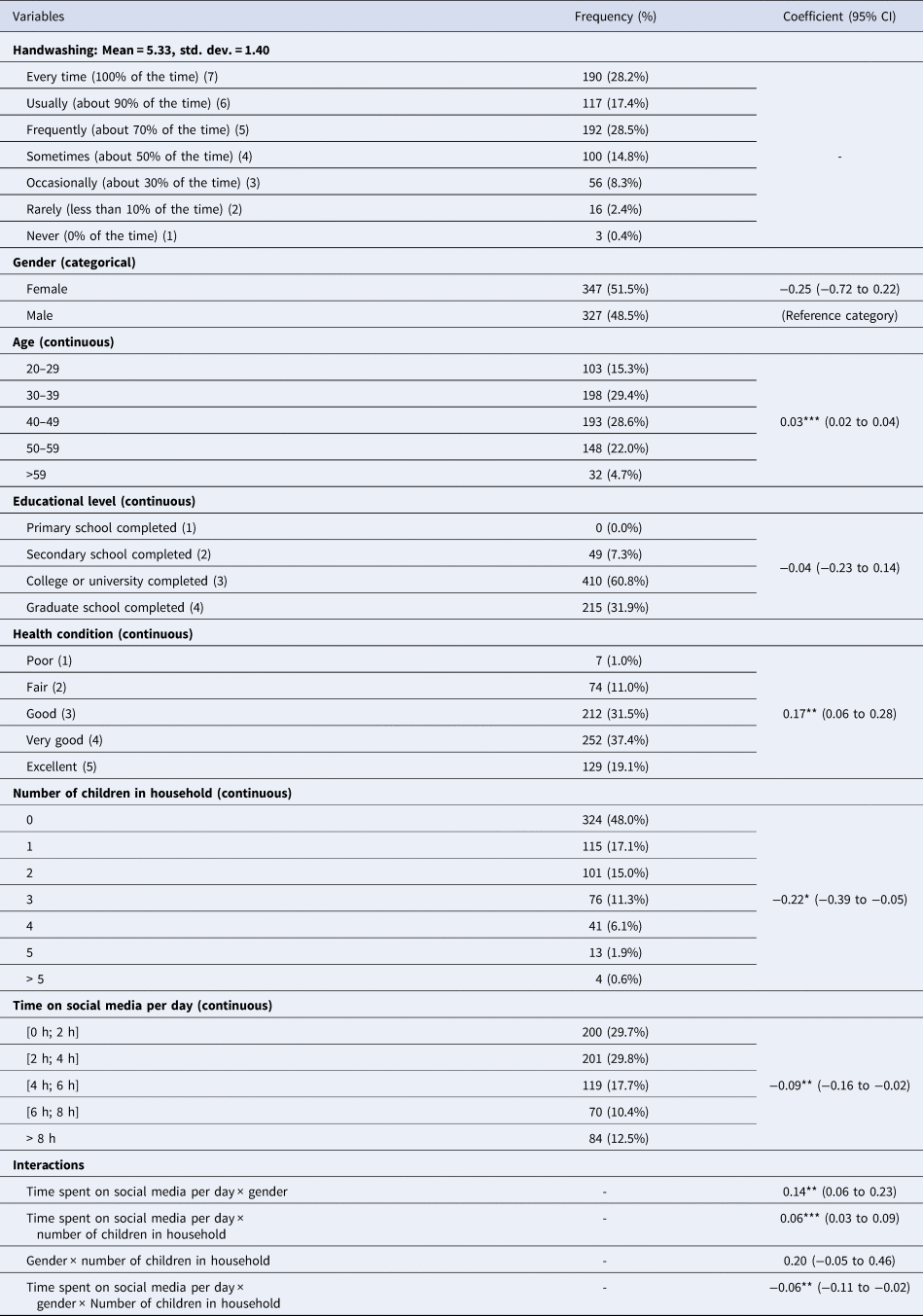
Note: * p < 0.05; ** p < 0.01; *** p < 0.001.
We used Stata 16.1 to perform an ordinary least squares (OLS) linear regression on the unweighted data with a significance level of 0.05. All tests were performed two-tailed.
Table 1 shows the regression results for handwashing (F(10, 663) = 6.81, p = 0.000). Age (b = 0.03, 95% CI: 0.02 to 0.04, p = 0.000) and health condition (b = 0.17, 95% CI: 0.06 to 0.28, p = 0.003) were associated with frequency of handwashing, with older and healthier people washing their hands more frequently. Number of children (b = −0.22, 95% CI: −0.39 to −0.05, p = 0.010) and time spent on social media per day (b = −0.09, 95% CI: −0.16 to −0.02, p = 0.007) were significantly negatively related to handwashing.
The relationship between time spent on social media and handwashing, however, was significantly moderated by gender (b = 0.14, 95% CI: 0.06 to 0.23, p = 0.001) and number of children (b = 0.06, 95% CI: 0.03 to 0.09, p = 0.000). Furthermore, there was a significant three-way interaction between time spent on social media, gender and number of children (b = −0.06, 95% CI: −0.11 to −0.02, p = 0.006).
A margin analysis of the interaction results (see Fig. 1) shows that social media use predicts handwashing, and that this predictor exhibits distinct patterns depending on gender and number of children. First, more time spent on social media was positively associated with the frequency of handwashing for males with three or more children living in the same household (e.g. for those with three children: b = 0.09, 95% CI: 0.02 to 0.17, p = 0.010). However, for males with no children in the same household, more time spent on social media was negatively associated with frequency of handwashing (b = −0.09, 95% CI: −0.16 to −0.02, p = 0.007). The association between time spent on social media and handwashing was not significant for males with one or two children. For females in general, the association between social media use and handwashing was significant and positive (b = 0.05, 95% CI: 0.01 to 0.09, p = 0.030). However, a margin analysis showed that more time spent on social media was significantly linked to more handwashing only for females with one child (b = 0.05, 95% CI: 0.01 to 0.09, p = 0.028) and only marginally significant (p < 0.10) for females without children or with two children. The association between time spent on social media and handwashing was not significant for women with three or more children.
Predicted handwashing frequency at different values of significant predictors (handwashing frequency: 4 = sometimes (about 50% of the time); 5 = frequently (about 70% of the time); 6 = usually (about 90% of the time); 7 = every time (100% of the time)).
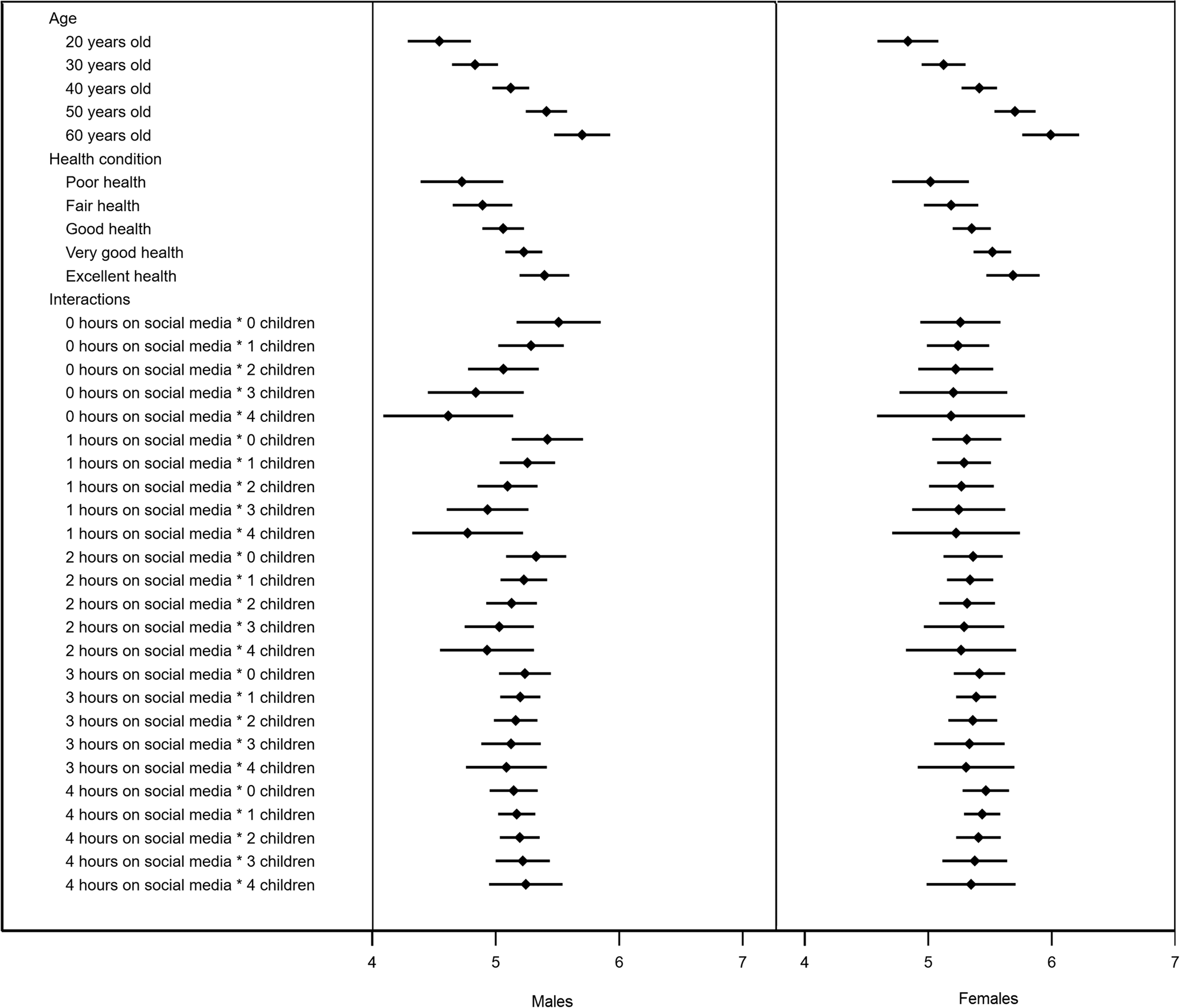
Second, prior studies frequently identified gender as a predictor of handwashing, finding that women generally wash their hands more frequently than men both during pandemics and in other circumstances [Reference Bish and Michie10, Reference Borchgrevink, Cha and Kim11]. While our results corroborate this direct effect of gender (b = 0.29, 95% CI: 0.08 to 0.50, p = 0.006), we also found that the gender difference was more nuanced and depended on social media usage and the number of children. Specifically, our study revealed that there was no gender difference in handwashing between females and males who spent three hours or less on social media (p > 0.10 across all cases). The gender difference, i.e. the notion that females wash hands more frequently than males do, was significant for those who spent more than three hours per day on social media and had at most one child (e.g. four hours per day on social media and no children: b = 0.32, 95% CI: 0.05 to 0.59, p = 0.020). The gender difference was not significant for those with two or more children. Hence, the gender difference commonly found in the literature is not universal but instead depends on both social media use and the number of children: Gender is a useful predictor of handwashing largely for people who spend lots of time on social media and have at most one child.
Third, this study unveiled the number of children in the household as an important predictor of handwashing. Number of children negatively predicted handwashing among males who did not use social media (b = −0.22, 95% CI: −0.39 to −0.05, p = 0.010) and who averaged one hour per day on social media (b = −0.16, 95% CI: −0.30 to −0.02, p = 0.028). In contrast, number of children positively predicted handwashing among males who spent lots of time on social media (b = 0.21, 95% CI: 0.09 to 0.34, p = 0.001). For females in general, the number of children did not predict handwashing.
Taken together, these results suggest that research on handwashing should not rely on gender, number of children or social media use alone but must consider all three and their interaction effects simultaneously to yield better predictions. This finding is relevant as social media is an increasingly important information channel but females and males tend to vary in their interests and social circles on social media [Reference Putzke12] and people with varying numbers of children may similarly gravitate towards different interest groups. Thus, people are exposed to social information – also regarding pandemics – differently depending on their gender and family situation. This study, as the first to identify social media use as a predictor of handwashing, suggests that it is helpful to take social media usage into account in predictive models of human behaviour during a pandemic. More specifically, we identify social media usage as a marker to screen for people who are vulnerable to COVID-19 infection due to their lack of handwashing. Such people have a higher likelihood to become agents to contract and spread virus. The identification of such people can, in turn, help to ease the pandemic or ‘flatten the curve.’ The identification of vulnerable populations via social media usage is especially promising as it directly enables targeted health communications via social media platforms to those populations.
Our results also provide evidence as to the efficacy of other predictors of handwashing during the COVID-19 pandemic. Extant work found mixed evidence on the association between age and protective behaviours such as handwashing during virus pandemics [Reference Bish and Michie10]. Our results suggest that there is indeed a positive relationship between age and handwashing, suggesting more targeted handwashing campaigns should focus on younger adults in epidemics. Prior work also found that more educated people tend to exhibit greater protective behaviour during pandemics, although some results were inconclusive [Reference Bish and Michie10]. In our sample, there was no significant association between education and handwashing. However, our sample was skewed towards college graduates and cell sizes for other levels of education were small, so we are cautious in interpreting this result. Our nonsignificant findings on education suggest the need for more research to further examine the predictive effect of education on protective behaviour during epidemics. We did, however, find a significant association between health condition and handwashing. During the COVID-19 pandemic, healthier people indicated greater handwashing frequency – a finding that is new to the literature. Although people with comorbidities suffer more from COVID-19 infections, they behaviorally protect themselves less from the virus due to their less frequent handwashing. This new finding indicates handwashing communication campaigns should specifically target people with suboptimal health conditions.
This study has several limitations that present opportunities for future research. First, the cross-sectional nature of our research precludes claims of causality, which is not a key concern as we are primarily interested in the predictive utility for screening less compliant groups. Second, although our survey was completely anonymous, self-reported handwashing compliance rates might be inflated due to social desirability [Reference Borchgrevink, Cha and Kim11]. Additionally, the anonymity of the survey makes it impossible to test if multiple respondents might be from the same household. Third, we did not explicitly collect data on how frequently respondents left their homes, making it conceivable that some respondents rarely or even never did. Fourth, we strived for broad coverage of the Malaysian population by using two-stage stratified sampling in terms of geographical area, ethnicity, gender and age, but Malaysia is a multi-faceted society and our sample includes a large share of college graduates, so the sample should not be considered strictly representative of the entire population. Fifth, social media usage was very high during the COVID-19 pandemic in Malaysia due to the implementation of a cordon sanitaire preventive measure, and future studies may examine our model in less severe pandemics without such a strict lockdown. Sixth, Malaysia is an upper-middle income country, where clean water for handwashing is generally accessible. Studies in countries with heterogeneous access to clean water might yield different results. Finally, this study focused on handwashing as a single hygiene measure. Future research might wish to study additional measures, such as the use of protective equipment or hand sanitiser, either in isolation or in combination with handwashing.
In conclusion, this study identifies several new predictors of handwashing during a pandemic, most notably people's use of social media. Consequently, it helps in identifying less compliant groups and enables health organisations, governments and other stakeholders to deliver more targeted handwashing communications campaigns, especially via social media. As prior research found that reminders [Reference Morrison and Yardley6] and signage [Reference Updegraff5] about handwashing are effective in increasing handwashing, but that most social media posts during a pandemic contain very little practical advice [Reference Vos and Buckner13], targeted social media campaigns based on the results of this study are likely to be effective in increasing handwashing in less compliant groups.
Acknowledgement
We acknowledge the support of Tsinghua University-INDITEX Sustainable Development Fund (Project No. TISD201904).
Data availability statements
Data are available upon request from the authors.
Conflicts of interest
The authors declare that each author has no conflicts of interest with respect to the research, authorship and/or publication of this paper.


 Open access

