


Introduction
Speleothem-like deposits in urban areas, a natural archive that was poorly known until very recently, are a powerful record of the historical anthropogenic imprint on the environment. The study of key geochemical tracers such as lead or sulfur isotopes within these carbonate deposits can enable the sources of contaminants contained within the water generating their deposition to be identified (Pons-Branchu et al. Reference Pons-Branchu, Ayrault, Roy-Barman, Bordier, Borst, Branchu, Douville and Dumont2015, Reference Pons-Branchu, Roy-Barman, Jean-Soro, Guillerme, Branchu, Fernandez, Dumont, Douville, Michelot and Phillips2017).
The precise chronology of these secondary carbonate deposits is a key issue for the accurate time reconstruction of environmental conditions. In a few favorable cases, these deposits can be dated using the uranium-thorium (230Th/234U) chronometer, with an appropriate correction for detrital thorium, but in many cases, their low uranium content and high detrital thorium prevent this reconstruction. Surprisingly, the study of lamination on two of these deposits from an underground aqueduct in Paris, coupled with U/Th dating, revealed that in this case, lamination is bi-annual, (Pons-Branchu et al. Reference Pons-Branchu, Douville, Roy-Barman, Dumont, Branchu, Thil, Frank, Bordier and Borst2014), as observed in speleothems from natural caves (Allison Reference Allison1926; Broecker et al. Reference Broecker, Olson and Orr1960; Baker et al. Reference Baker, Smart, Edwards and Richards1993; Shopov et al. Reference Shopov, Ford and Schwarz1994). This implies that, at least in some cases, lamination could have the same origin (organic matter content, and/or CaCO3 porosity, facies or mineralogical differences) in natural cave systems and in underground urban structures, but this has to be demonstrated from other cases before generalization. Unfortunately, urban speleothem-like deposits are not always laminated, and new dating tools have to be investigated. As for speleothems from natural caves, 14C chronology in these deposits is hampered by the presence of dead carbon from calcareous host rock or old organic matter contained within the soil (Goslar et al. Reference Goslar, Hercman and Pazdur2000; Griffiths et al. Reference Griffiths, Fohlmeister, Drysdale, Hua, Johnson, Hellstrom and Zhao2012; Noronha et al. Reference Noronha, Johnson, Hu, Ruan, Southon and Ferguson2014). The purpose of this paper is to identify the 14C bomb pulse in recent urban speleothems, as previously observed in speleothems from caves (e.g. Delibrias et al. Reference Delibrias, Guillier and Labeyrie1969; Genty and Massault Reference Genty and Massault1997; Hodge et al. Reference Hodge, McDonald, Fischer, Redwood, Hua, Levchenko, Drysdale, Waring and Fink2011; Hua et al. Reference Hua, McDonald, Redwood, Drysdale, Lee, Fallon and Hellstrom2012) and discuss its applicability to these natural archives and the information provided about carbon transfer within an urban/anthropic context.
Site and samples
The two sites studied are located in the Paris region ca. 20 km apart, in two contrasting urbanized zones: the first one under a street in Versailles, beside Versailles Palace, and the second in the northeastern part of Paris. Both sites are built on Oligocene sedimentary deposits (sand stone in Versailles, sandstone and limestone id Paris) overlain by anthropogenic backfill.
Palace of Versailles Technical Gallery
Ever since the 1600s, water supply has been an important issue for the inhabitants of Versailles and for the famous fountains of the palace gardens. Works undertaken to bring large amounts of water to the Palace and the gardens included diverting water from two rivers (the Seine and the Bièvre), the construction of artificial ponds, some of them several tens of kilometers away from Versailles, and the construction of kilometers of aqueducts and ducts (Barbet Reference Barbet1907; Soullard Reference Soullard1997). At Versailles, numerous underground galleries were built under the gardens and the fountains in order to distribute the waters to the fountains and play the “Grandes Eaux” performance. These historical galleries contain pipes that were maintained over the centuries. Speleothem-like deposits are found in some of them, deposited by water dripping from the roof of the galleries (either from rainwater or leakages directly from the fountains). The F4 samples (see Figure 1) were taken during 2013 from the wall of a technical gallery that connects Versailles Palace with the “Service des fontaines” above the René de Cotte street, ca. 2 m below the street. In this gallery, the only water source is water infiltrating from rainfall. The host rock of the gallery is Fontainebleau Sandstone, overlain by anthropogenic backfill (thickness estimated between 1.5 and 3 m according to nearby geological drilling reported by BRGM/Infoterre).
a) Location b) F4 sample from Versailles underground gallery before sampling (top), and picture of the thin section showing laminae (with the black vertical bar representing 2 mm); c) Saint Martin spring and the CaCO3 crust sampled (arrow), SM B core (with black bar representing 20 mm) and picture of thin section within the laminated level (with the black vertical bar representing 2 mm).

This 32 mm thick deposit displays lamination (see Figure 1b).
Saint Martin Spring
In the northeastern part of Paris, in the Malassis plateau, two perched aquifers developed within Fontainebleau sandstone and Brie limestone (Oligocene). These groundwaters have been drained since the 1100s by religious communities for their needs. In the following centuries, an extensive network of drains leading to several underground aqueducts was developed by the City of Paris. Known as the “Northern Springs”, many vestiges of this network still exist, and water still flows from some of the springs. During field work in underground galleries and manholes, speleothems -like deposits on the roof, the walls and the floor (mainly sodastraws and flowstones, and in some places stalagmites) were identified. This is the case of the Saint-Martin manholes, which host calcareous deposits. The Saint-Martin spring drains water from a small urbanized watershed that has been heavily impacted by human activities since the 1800’s (road, building constructions, etc.). These water flow in a small gallery with an irregular slope, where CaCO3 deposits, similar to flowstones in natural caves (see picture in Figure 1c). The water that permitted the deposition of these calcareous crusts originates from the spring, because no dripping water from the roof was observed during field work. The crusts was cored (in 2012) at two locations 10 cm apart. SM-A is a 10 cm high core. The first 4/5 mm from the top are laminated, followed by an 8/9 mm thick porous zone, and a second laminated level. At the base (from ca. 4.5 cm to the base), the core is made of building stone (limestone).The top most section of SM A was already studied for lead isotopes (Pons-Branchu et al. Reference Pons-Branchu, Ayrault, Roy-Barman, Bordier, Borst, Branchu, Douville and Dumont2015).
SM-B is a 5 cm long core sampled ca. 10 cm away from SM-A. The top 7 mm are laminated, followed by 18 mm of porous CaCO3, and a 6/7 mm laminated level. The base of the sample (from ca. 30 to ca. 50 mm) is made of concrete. A thin CaCO3 layer suspended in the water (SM fl) was also collected.
Methods
Laminae Counting
Polished sections of SM-A, SM-B and F4 were observed and photographed under a stereo microscope (LEICA S6D) using a video camera (Sony e SSC-DC14/14P/18P) at CEREMA laboratory. One (for SM-A and SM-B) to four (for F4) transects of each section were photographed. Lamina counting was performed on these images. Several counting using several images of the same depth range (for F4 sample) or using different portions of the same image (for SM-A and SM-B) were performed. The difference in the number of laminae between the various counts was used as the error bar for derived age.
Stable Isotope Analyses (δ 18 O-CaCO 3 )
Sixteen samples were taken as powder along the growth axis of SM A and SM B (including the base of SM-A made of building stone), and a small piece of SM fl, for O analysis.
δ18O in calcite was obtained from a few mg of CaCO3 powder which was reacted (at 25°C during 24 hr) with H3PO4 to give CO2(g). The gas was used for isotope (δ18O) measurements on a VG SIRA 10 mass spectrometer. The stable isotope analyses (isotope ratios) were measured at the GEOPS laboratory (Orsay, France) and are expressed in delta notation per mil versus V-PDB. They were determined with inter-laboratory analytical precision of 0.2 ‰.
14C Analysis
Along the growth axis of the three speleothem-like deposits, 21 samples (10 to 15 mg) were taken as fragment for 14C measurements: 13 for SM A and SM B cores, and 8 from F4 sample, The topmost section of SM-A was not sampled for 14C analysis.
Pure calcite samples were prepared according to the protocol described by (Tisnérat-Laborde et al. Reference Tisnérat-Laborde, Poupeau, Tannau and Paterne2001; Dumoulin et al. Reference Dumoulin, Comby-Zerbino, Delqué-Količ, Moreau, Caffy, Hain, Perron, Thellier, Setti, Berthier and Beck2017). The calcite was reacted with orthophosphoric acid (pure H3PO4, heated previously for 3 days at 105°C) under vacuum and the CO2 produced was converted to graphite (Vogel et al. Reference Vogel, Southon, Nelson and Brown1984; Dumoulin et al. Reference Dumoulin, Comby-Zerbino, Delqué-Količ, Moreau, Caffy, Hain, Perron, Thellier, Setti, Berthier and Beck2017) and then measured using the accelerator mass spectrometer (LMC14 - Artemis) at CEA Saclay (Cottereau et al. Reference Cottereau, Arnold, Moreau, Baqué, Bavay, Caffy, Comby, Dumoulin, Hain, Perron, Salomon and V Setti2007; Moreau et al. Reference Moreau, Caffy, Comby, Delqué-Količ, Dumoulin, Hain, Quiles, Setti, Souprayen and Thellier2013) in the framework of INSU national service.
Results
Saint-Martin Deposits: δ18O Results and Depth Scale Adjustment
δ18O measured on SM-A and SM-B are presented in table 1 and figure 2a. A slight shift (ca. 0.3 ‰) toward lower δ18O values is observed for the samples corresponding to porous levels. Considering that i) the values for the topmost levels (laminated) and for the porous levels are comparable in the two cores; ii) that similar facies (porous vs laminated) are present in both cores but with a different development; iii) they belong to the same CaCO3 crust; we suggest that similar mechanisms (including potential isotopic fractionation) and environmental factors drive their development, and that they differ by different growth rates (twice as high for SM-B) and with an earlier growth start for SM-A. In order to compare 14C results of the two cores, an adjusted depth scale is proposed for SM-A: the facies (laminated/porous) transitions and the isotopic shift has been aligned to the SM-B’s one. This corresponds to a higher growth rate (by a factor of ca. 2) in SM-A compared to SM-B. Using this adjusted depth scale, porous zones in the two cores are superposed, and δ18O values change similarly in both cores for the different facies.
δ18O measured on SM-A and SM-B with proper depth scale (a) and adjusted depth scale (b); 14C values according to adjusted depth scale.

Lamination
In a location nearby at the Belleville main aqueduct, which is only 500 m away from the Saint-Martin spring, the lamination in urban speleothem-like deposits has been shown to be bi-annual (Pons-Branchu et al. Reference Pons-Branchu, Douville, Roy-Barman, Dumont, Branchu, Thil, Frank, Bordier and Borst2014). The laminae were therefore also assumed to be bi-annual within the three samples studied here.
F4 (Versailles): 136.5±4 laminae are visible on the whole section, corresponding to a 68.2±2 years deposition, and a growth start in 1945±2 AD.
SM-B (Paris): 52±2 laminae are visible on the laminated portion at the top of the core, 14±1 within the porous zone and 50±2 laminae for the deepest laminated level (just above the concrete). Assuming that lamination is bi-annual and that there were laminae deposits every year (including during the deposition of the porous level), the base of this core is 58±2.5 years old, with the start of growth in 1954±2.5 AD. This laminae counting suggests that the growth rate was higher during porous level deposition than during the other periods.
SM-A (Paris): 54±2 laminae are visible on the laminated portion at the top of the core. No laminae were distinguished within the porous zone (see Pons-Branchu et al. Reference Pons-Branchu, Ayrault, Roy-Barman, Bordier, Borst, Branchu, Douville and Dumont2015). The lamination in the lowest portion of the core was poorly visible and were not counted.
With the same number of laminae, the deposition of the laminated levels at the top of the two cores from Saint-Martin manhole could thus be contemporaneous, with deposition starting 26 to 27 years before sampling (1985–1986 AD), just after deposition of the porous level (between 1985/1986 and 1978/1979 AD). For the levels older than the porous level, age determination using laminae counting was possible only for the topmost section.
Taking into account the sampling thickness for 14C analysis (sampling fragments and not powders), the error on laminae-derived ages for 14C analysis is ca. 4 years for the three samples.
δ18O (‰ vs PDB) analyses on CaCO3 samples from Saint-Martin spring manhole (Paris). SM-A 47-49 is the base of the core (construction rock).

Radiocarbon
14C results, reported as Fraction modern, Fm, are presented in table 2. They range between 0.73 and 0.93. Results for the F4 speleothem-like deposit (Versailles) are presented according to laminae-counting derived age (Figure 3).
14C trend vs laminae counting derived age for F4 sample (Versailles gallery)

14C measurements on CaCO3 samples from Saint-Martin spring manhole (Paris, SM A and SM B samples) and Versailles underground gallery (F4 sample).
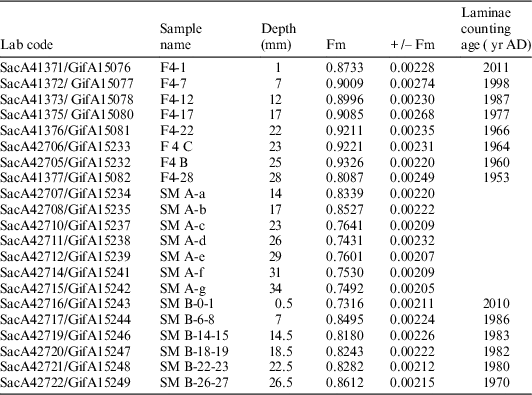
In this sample, 14C activity strongly increase from 1953±4 years AD to 1960±4 AD and decrease until the level representing the year 2011.
Results for the SM-A and SM-B cores are presented according to the adjusted depth scale (Figure 2c). 14C activity increase between 34 and 17 mm (adjusted depth scale) and decrease between 17 mm and the top most level.
This decrease is not contemporaneous with the transition between porous and laminated CaCO3, indicating that the difference of the laminae structure has no influence (or impact) on the 14C record.
For SM-A, using the laminae-derived chronology, this decrease corresponds to the period 1970–2010 (years AD).
Discussion
Radiocarbon Recording within Urban Speleothems
The general trend for the F4 sample is similar to the atmospheric 14C bomb curve, with a significant and rapid 14C increase during the 1960s, and a gradual fall toward younger levels (Figure 4). Similarly, the trend observed for SM cores with low 14C within the oldest levels (SM-B) and an increase of 14C around ~1960–1970 reminds the atmospheric trend.
Top: Comparison between Saint Martin and Versailles 14C records. Bottom: Comparison between atmospheric (Hua et al. Reference Hua, Barbetti and Rakowski2013) and speleothem 14C records.

However, the maximum 14C reached within the speleothems differs from one site to the other, and is significantly lower than that of the atmosphere (maximum of 0.93 fm and 0.86 fm for the F4 speleothem from Versailles and the Parisian cores, respectively).
The radiocarbon bomb pulse has already been observed within young speleothems from natural caves, with very different shapes and intensities (e.g. Genty and Massault Reference Genty and Massault1997, Reference Genty and Massault1999; Mattey et al. Reference Mattey, Lowry, Duffet, Fisher, Hodge and Frisia2008; Smith et al. Reference Smith, Fairchild, Spötl, Frisia, Borsato, Moreton and Wynn2009; Hua et al. Reference Hua, McDonald, Redwood, Drysdale, Lee, Fallon and Hellstrom2012; Hodge et al. Reference Hodge, McDonald, Fischer, Redwood, Hua, Levchenko, Drysdale, Waring and Fink2011; Fohlmeister et al. Reference Fohlmeister, Kromer and Mangini2011).
This “bomb peak” can i) be lowered by the presence of dead carbon, from geological origin and/or old organic matter stored in the soil resulting in a low (with respect to the atmosphere) 14C peak; ii) be delayed with respect to the atmosphere due to C time transfer from atmosphere/soil to dripping water in the cave; iii) show an amplitude attenuation (or damping effect) of the bomb pulse recorded within speleothems compared to the atmospheric one.
The F4 and SM speleothems come from very different sites, both in an urban environment. The development of F4 is due to water percolating from the outside (rainfall), across a ca. 2 m thick “soil” overlain by a heterogeneous surface (mainly tarmac and paving stones) and across an artificial gallery (calcareous rock). The F4 host rock of the gallery is not calcareous. The SM crust deposits are due to water flowing from the Saint-Martin spring that drains waters from a small intensively urbanized watershed (buildings, tarmac, paving stones, and very few gardens). Host rocks are limestone and sandstone. Chemical analysis of Saint-Martin waters suggests a rapid flow (some weeks) of anthropogenic tracers (e.g. salts, CEREMA, personal communication).
The comparison between atmospheric and speleothem 14C suggests common features for the two studied sites: i) the lack of delay between the atmospheric 14C bomb pulse and its appearance within urban speleothems suggests a very fast (less than 2 years) C transfer; ii) this peak is significantly lower within the two speleothems suggesting the addition of non-atmospheric 14C; iii) the shape of the speleothem 14C record after the maximum displays a slow decrease (buffering effect) compared to the atmospheric 14C, suggesting a pool of longer time transfer C.
The parameters traditionally used for radiocarbon studies within “natural” speleothems are calculation of the dead carbon proportion (or DCP, carbon from host rock and old organic matter), and of the damping effect (attenuation of the atmospheric signal).
DCP were calculated using pre-bomb pulse 14C (atmospheric levels and older CaCO3 levels), following Genty and Massault (Reference Genty and Massault1997). We obtain DCP=17.2±0.3 % for F4 (Versailles) and DCP=21.7±0.2 % for SM-A c (Paris), assuming a “pre bomb age” around 1950 for this level.
Following Genty and Massault’s (Reference Genty and Massault1999), Rudzka-Phillips, et al. Reference Rudzka-Phillips, McDermott, Jackson and Fleitmann2013 and Lechleitner et al. Reference Lechleitner, Baldini, Breitenbach, Fohlmeister, McIntyre, Goswami, Jamieson, van der Voort, Prifer, Marwan, Culleton, Kennett, Asmeron, Polyak and Eglinton2016, the damping effect (DE) was calculated using the following equation:
 $${\rm DE}{\equals}\left[ {1-\left( {{\rm a}^{{14}} {\rm C}_{{{\rm int}{\rm .max}}} {\rm - a}^{{14}} {\rm C}_{{{\rm int}{\rm .min}}} } \right)/\left( {{\rm a}^{{14}} {\rm C}_{{{\rm atm}{\rm .1964}}} -{\rm a}^{{14}} {\rm C}_{{{\rm atm}{\rm .}}} _{{1950}} } \right)} \right]{\asterisk}100{\rm }\,\%\,.$$
With i) a14Cint.max and a14Cint.min respectively the maximum and minimum 14C initial activities (measured corrected for radioactive decay) within the CaCO3 deposits and ii) a14Catm.1964 and a14Catm.1950 the atmospheric 14C activities for respectively the years 1964 (14C maximum) and 1950. DE is 86.9 % for F4 (using data from levels at 23 and 28 mm). This parameter has to be used with caution in our case, because the “real” 14C maximum could be missing, due to the method of sampling. For SM cores (Paris), the lack of precise chronology for the oldest levels (before 1970 AD) and the low resolution sampling make the DE calculation difficult.
A comparative study of these parameters in speleothems from European natural caves (Rudzka-Phillips et al. Reference Rudzka-Phillips, McDermott, Jackson and Fleitmann2013) showed that high damping effects are found in stalagmites from sites characterized by a thick soil cover and dense, well developed vegetation, under a humid climate and high mean annual air temperatures. In these natural sites with high DE, the carbon incorporated in the stalagmites originates predominantly from old recalcitrant organic matter, which can be mixed with young atmospheric carbon. High DCP has been related to natural sites with a dense vegetation cover (such as forests), and related to intense host rock dissolution due to soil activity (roots and microbial organic matter decomposition, Genty and Massault (Reference Genty and Massault1997), or to old organic matter incorporation.
The urban sites studied here are not covered by dense vegetation, but old organic matter may be stored within the Parisian site at least, since before its urbanization during the 1800s, cultivated fields were present within the watershed of the spring (Huard Reference Huard2011; DelaGrive Reference DelaGrive1870) and wastes from the inhabitants of Paris were used as fertilizer (Delamare 1722–Reference Delamare1738; Barles Reference Barles1999). It may seem contradictory to have a high DE and a fast transfer of C from the atmosphere to the speleothem (as suggested by the lack of delay, within uncertainties, between the 14C rise within CaCO3 and the atmospheric 14C bomb pulse). This can be explained if during the fast transfer of the atmospheric carbon to the speleothem there is a continuous (and fast) mixing with some non-atmospheric carbon (most likely a mixture of carbon derived from soils and limestones when they occur). The signature (a14Cna) and the fraction (fna) of this non-atmospheric carbon can be estimated by assuming that they remain identical before and during the bomb pulse, while the atmospheric signature was different before (a14Ca_1950) and during the pulse (a14Ca_pulse).
The 14C signature of the speleothem before and after the bomb pulse is given by:
 $${\rm a}^{{14}} {\rm C}_{{{\rm spel}\_1950}} {\equals}{\rm f}_{{{\rm na}}} {\times}{\rm a}^{{14}} {\rm C}_{{{\rm na}}} {\plus}\left( {1{\minus}{\rm f}_{{{\rm na}}} } \right){\times}{\rm a}^{{14}} {\rm C}_{{{\rm a}\_1950}} \left( {{\rm before}\,{\rm the}\,{\rm bomb}\,{\rm pulse}} \right)$$
 $${\rm a}^{{14}} {\rm C}_{{{\rm spel \_pulse}}} {\rm {\equals}f}_{{{\rm na}}} {\times}{\rm a}^{{14}} {\rm C}_{{{\rm na}}} {\plus}\left( {1{\rm {\minus}f}_{{{\rm na}}} } \right){\times}{\rm a}^{{14}} {\rm C}_{{{\rm a\_ pulse}}} \left( {{\rm during}\,{\rm the}\,{\rm bomb}\,{\rm pulse}} \right)$$
it follows that:
 $${\rm f}_{{{\rm na}}} {\rm {\equals}}\left( {{\rm a}^{{14}} {\rm C}_{{{\rm spel\_}1950}} {\rm {\minus}a}^{{14}} {\rm C}_{{{\rm a\_}1950}} } \right){\rm /}\left( {{\rm a}^{{14}} {\rm C}_{{{\rm na}}} {\rm {\minus}a}^{{14}} {\rm C}_{{{\rm a\_}1950}} } \right)\,\left( {{\rm before}\,{\rm the}\,{\rm bomb}\,{\rm pulse}} \right)$$
 $${\rm f}_{{{\rm na}}} {\rm {\equals}}\left( {{\rm a}^{{14}} {\rm C}_{{{\rm spel\_ pulse}}} {\rm {\minus}a}^{{14}} {\rm C}_{{{\rm a\_ pulse}}} } \right)/\left( {{\rm a}^{{14}} {\rm C}_{{{\rm na}}} {\rm {\minus}a}^{{14}} {\rm C}_{{{\rm a\_ pulse}}} } \right)\,\left( {{\rm during}\,{\rm the}\,{\rm bomb}\,{\rm pulse}} \right)$$
Combining these 2 equations, we deduce:
 $$\eqalignno{ {\rm a}^{{14}} {\rm C}_{{{\rm na}}} & {\equals}\left\{ {{\rm a}^{{14}} {\rm C}_{{{\rm a\_}1950}} {\rm \,/\,}\left( {{\rm a}^{{14}} {\rm C}_{{{\rm spel\_}1950}} {\rm {\minus}a}^{{14}} {\rm C}_{{{\rm a\_}1950}} } \right){\rm {\minus}a}^{{14}} {\rm C}_{{{\rm a\_pulse}}} /\left( {{\rm a}^{{14}} {\rm C}_{{{\rm spel\_pulse}}} {\rm {\minus}a}^{{14}} {\rm C}_{{{\rm a\_pulse}}} } \right)} \right\} \cr & /\left\{ {1\,/\,\left( {{\rm a}^{{14}} {\rm C}_{{{\rm spel\_}1950}} {\rm {\minus}a}^{{14}} {\rm C}_{{{\rm a\_}1950}} } \right){\rm {\minus}}1/\left( {{\rm a}^{{14}} {\rm C}_{{{\rm spel\_pulse}}} {\rm {\minus}a}^{{14}} {\rm C}_{{{\rm a\_ pulse}}} } \right)} \right\} $$
Using the following numerical values (for F4): a14Cspel_1950=0.81, a14Cspel_pulse=0.93, a14Ca_1950=1.0, a14Ca_pulse= 1.3 -2.0 (to take into account the uncertainties on the chronology), we obtain:
 $${\rm a}^{{14}} {\rm C}_{{{\rm na}}} {\equals}0.73\,\pm\,0.5$$
and
 $${\rm f}_{{{\rm na}}} {\equals}74\,\pm\,15\,\%\,$$
Clearly, a14Cna does not correspond to a simple dead carbon reservoir and must contain some relatively young soil carbon.
High DE and fast atmospheric C transfer could thus be attributed to a mixing between “fast C” (fast turn over within urban soil) and a small fraction of “long time C” (from old organic matter stored within urban soils), as observed for some natural caves (e.g. Rudzka-Phillips, et al. Reference Rudzka-Phillips, McDermott, Jackson and Fleitmann2013). A second aspect of our urban sites is the possible incorporation of old anthropogenic carbon (as particles or as reduced atmospheric 14C) due to fossil carbon (gasoline/fuel/coal) burning. A local Suess effect, with urban atmospheric 14C lower than “general” trends, has been reported in several industrial metropolises or regions (Awsiuk and Pazdur Reference Awsiuk and Pazdur1986; Quarta et al. Reference Quarta, D’Elia, Rizzo and Calcagnile2005; Rakowski et al. Reference Rakowski, Nakamura, Pazdur, Charro, Villanueva and Piotrowska2010; Svetlik et al. Reference Svetlik, Povinec, Molnár, Vána, Šivo and Bujtás2010) and could cause apparent DCP and DE increases when compared with clean-air 14C curves. DCP is higher at Saint-Martin spring (Paris), than at the Versailles site. Possible explanations for this higher values could be i) a higher Suess effect, as Paris is subjected to higher levels of fossil carbon burning (more populous); ii) a longer water-transfer time, with higher exchange with host rock for Saint-Martin (Paris) site respect to Versailles; iii) more old carbon stored within the soils in Paris.
Further work will be undertaken to characterize the carbon from present day waters and work at a higher spatial resolution for CaCO3 analysis, but also to analyze new urban sites.
Lamination and Porous Level within Urban Speleothem-like Deposits
For the Saint Martin spring flowstone, we found the same facies change and the alternation of laminated and porous levels with the same chronology, in two locations close to each other (SM A and SM B), despite different growth rates at the two locations. Even if very poorly defined within the porous level, the chronology derived from laminae counting along the cores (assuming two laminae per year) is coherent with the 14C bomb pulse record. The porous level identified within the two cores is characterized by a higher growth rate and lower δ18O values than the laminated levels. Further work will determine the origin of this change in relation with environmental / anthropic factors (water pathway and quality, site ventilation, impact of urbanization on water circulation, etc.). The comparison between laminae counting and the 14C bomb pulse record confirms the bi-annual rate of laminae deposition in the Versailles underground (F4 sample). As mentioned previously, the Versailles (F4 sample) and Paris sites (SM-A and SM-B) present contrasting contexts, particularly for the water sources and pathways: water from a perched aquifer (small watershed infiltration and potential water leaks from drinking and/or waste water, see Pons-Branchu et al. Reference Pons-Branchu, Douville, Roy-Barman, Dumont, Branchu, Thil, Frank, Bordier and Borst2014) for Paris (SM samples), and precipitation infiltrating urban soil for the Versailles gallery (F4). Despite these different water pathways (and possibly different time transfer), bi-annual lamination was found in both sites. In natural sites, the lamination (visible or UV-luminescent) has been characterized by density or textural/mineralogical differences, and/or different organic matter content (e.g. Shopov et al. Reference Shopov, Ford and Schwarz1994; Borsato et al. Reference Borsato, Frisia, Fairchild, Somogyi and Susini2007; Baker et al. Reference Baker, Smith, Jex, Fairchild, Genty and Fuller2008). This lamination could be caused by different factors: seasonal variations in drip rate, seasonal variations in water supersaturation, cave ventilation (relative humidity, CO2), organic matter flushed from the soil during autumn causing the formation of a thin brown and UV-luminescent layer during this period (Baker et al. Reference Baker, Smith, Jex, Fairchild, Genty and Fuller2008 and references therein; Borsato et al. Reference Borsato, Frisia, Fairchild, Somogyi and Susini2007).
Further work on urban speleothem-like deposits will focus on characterization of the visible laminae in urban sites, with no (or very rare) vegetation cover, but also on organic matter characterization within these natural archives in order to understand their formation and the link with environmental parameters.
Conclusion and perspectives
Three speleothem-like deposits from two historical urban undergrounds in Versailles and Paris (France) were studied for their 14C content, and compared, when possible, with lamination counting. The radiocarbon bomb pulse recorded in these urban deposits is in agreement with a bi-annual lamination, with at least for one site, no delay between atmospheric pulse and the CaCO3 record. For both sites, comparison between CaCO3 urban deposits and the atmospheric record (Hua et al. Reference Hua, Barbetti and Rakowski2013) highlight high dead carbon proportion (between 17.2±0.3 % and 21.7±0.2 % for respectively Versailles and Paris), and a high damping effect (86.9 %) for Versailles site, suggesting i) fast carbon transfer from the atmosphere to the urban underground, ii) the influence of old “geological” carbon (calcareous host rock and/or construction stones or backfills), and/or the possible influence of old recalcitrant organic matter, causing a damping effect and high dead carbon proportion; iii) the possible influence of local anthropic carbon (black carbon and Suess effect).
This study has shown that 14C analysis can be used for chronological purposes in these very poorly-studied natural archives in urban sites, and opens up new perspectives for the study of those without lamination. These archives have a very high potential as historical records of past water quality and the influence of urbanization on the urban water cycle, and the coupling between precise chronology and isotopic tracers of the water cycle and/or human activities (e.g. Sr or Pb isotopes) offers new perspectives for historical reconstructions.
Acknowledgments
We thank the LMC14 staff (Laboratoire de Mesure du Carbone-14), ARTEMIS national facility, UMS 2572 CNRS-CEA-IRD-IRSN-MCC, for the results obtained with the accelerator mass spectroscopy method.
This work was financed by Paris municipality (Paris 2030 call “Histoires d’eau souterraine” project), by the “Fondation des Sciences du Patrimoine/LabEx Patrima” (ANR-10-LABX-0094-01) and by the CNRS INSU institute for 14C analyses (INSU/ARTEMIS national call).
The authors thank the ASNEP Association (Association Sources du Nord – Etudes et Préservation) and the City of Paris (Direction des Affaires Culturelles) for access to the Belleville aqueduct, sampling facilities and historical information, and F Barbecot for help during SM sampling.



