





Introduction
How do women in parliament shape trade in clean and dirty products? Women and men have different preferences depending on the policy issue. At least two empirical patterns of gendered preferences endure in high-income democracies. First, women relative to men tend to prefer more protectionist trade policies (Mayda and Rodrik Reference Mayda and Rodrik2005; Mansfield and Mutz Reference Mansfield and Mutz2009; Guisinger Reference Guisinger2016; Betz, Fortunato and O’Brien Reference Betz, Fortunato and O’Brien2021). Second, women in high-income democracies tend to worry relatively more about the environment and prefer stronger environmental action (McCright and Dunlap Reference McCright and Dunlap2011; Franzen and Vogl Reference Franzen and Vogl2013; Egan and Mullin Reference Egan and Mullin2017; Bush and Clayton Reference Bush and Clayton2023). Studies have shown that the former has consequences for trade politics because more women in parliament result in more protectionist trade policies for consumer goods (Betz, Fortunato and O’Brien Reference Betz, Fortunato and O’Brien2023). The latter empirical pattern, however, has not been used to explain trade patterns. In this paper, I examine how women’s descriptive representation shapes trade in dirty/clean products. The dirtiness/cleanliness of a product is defined as the amount of CO2 that is emitted per monetary unit of output (eg per dollar or euro) (Shapiro Reference Shapiro2021).
If women worry more about the environment and prefer stronger environmental action, we should also expect gendered descriptive representation to have consequences for the cleanliness of traded products. Recent research has found that more women in parliament are related to the introduction of more ambitious environmental policies (Ramstetter and Habersack Reference Ramstetter and Habersack2020; Salamon Reference Salamon2023; Kandemir, Lone and Simsek Reference Kandemir, Lone and Simsek2024; Kostakis, Angeletopoulou and Polyzou Reference Kostakis, Angeletopoulou and Polyzou2024). By raising costs on dirty products, more ambitious environmental policies can function as a ‘beneficial constraint’ (Streeck Reference Streeck, Hollingsworth and Boyer1997), forcing firms to specialize more in developing and producing relatively cleaner products. This should result in a relative disadvantage for firms producing dirty products and a relative advantage for firms producing clean products. As a result, one should expect the export of dirty products to decrease relative to clean products, as more women enter parliament.
Leveraging gender quota shocks (Clayton Reference Clayton2021) and a variety of country, firm, and product data from European Union (EU) member countries, I examine in three studies how women’s descriptive representation shapes the cleanliness of economies and international trade. First, with data on environmental regulation stringency, I find that gender quotas increase the stringency of environmental regulation. Second, relying on a large set of firm panel data, I provide evidence that gender quotas shape how well firms perform economically, depending on the cleanliness of the firms’ production: dirtier firms fare relatively worse, whereas cleaner firms fare relatively better economically. Third, exploiting that member countries of the EU have identical trade policies but vary in gender quota implementation, I examine how women’s descriptive representation shapes trade patterns. Leveraging a newly compiled product-level dataset from the EU’s COMEXT database on exported and imported goods, I find that gender quotas reduce exports of dirty products relatively more than clean products. Interestingly, I find no evidence that this leads to increasing outsourcing of dirty production. I finally provide suggestive evidence for the mechanism that women’s descriptive representation shapes trade in clean versus dirty products by introducing more stringent environmental regulation. The findings, in a nutshell, suggest that increasing women’s descriptive presence in national parliaments makes economies and international trade relatively cleaner. Since international trade accounts for a substantial part of global CO2 emissions (Copeland, Shapiro and Taylor Reference Copeland, Shapiro, Taylor, Gopinath, Helpman and Rogoff2022), gender quotas can both increase women’s descriptive representationFootnote 1 and be an important part of the puzzle in addressing global warming and climate change.
The paper makes three main contributions to the existing literature. First, the broader literature on descriptive and substantive representation (Franceschet and Piscopo Reference Franceschet and Piscopo2008; Wängnerud Reference Wängnerud2009; Greene and O’Brien Reference Greene and O’Brien2016) shows that women in parliament tend to address women’s preferences and concerns. A growing literature finds that because women have stronger preferences for environmental protection, women’s descriptive representation tends to increase the ‘greenness’ of policies and improve environmental outcomes of domestic economies (Ramstetter and Habersack Reference Ramstetter and Habersack2020; Salamon Reference Salamon2023; Kandemir, Lone and Simsek Reference Kandemir, Lone and Simsek2024). This paper contributes to this literature in two ways. First, these debates have mainly focused on domestic economies. It is, however, well established that high-income democracies have outsourced dirty production overseas (Copeland, Shapiro and Taylor Reference Copeland, Shapiro, Taylor, Gopinath, Helpman and Rogoff2022), effectively ‘greenwashing’ supply chains. I contribute with an international perspective, showing that women’s descriptive representation makes trade cleaner without outsourcing dirty production. Improving women’s descriptive representation may therefore improve environmental outcomes not only domestically but also globally. Moreover, by relying on gender quota shocks, the evidence presented here further substantiates the recent literature on the link between women’s descriptive representation and environmental policies by leveraging an approach that exploits plausible exogenous variation in women’s descriptive representation in the study of gendered representation and the environment.
Second, while the international political economy literature has examined the importance of gender (Rickard Reference Rickard and Martin2015), there has been less focus on gendered representation and international trade (Betz, Fortunato and O’Brien Reference Betz, Fortunato and O’Brien2021). The literature on trade and descriptive representation shows that women’s descriptive representation shapes tariffs on consumer goods (Betz, Fortunato and O’Brien Reference Betz, Fortunato and O’Brien2023). I show that women’s descriptive representation shapes trade patterns not only via trade policies, which are most directly associated with trade, but also indirectly via environmental policies. Complementing existing work on gender and trade, I stress how women’s descriptive representation shapes trade patterns in accordance with women’s preferences for the environment.
Third, the literature on the environment and trade (Nguyen, Huber and Bernauer Reference Nguyen, Huber and Bernauer2021; Shapiro Reference Shapiro2021; Shapiro Reference Shapiro2025) highlights how trade policies and institutions shape trade in dirty/clean products. I add to this literature the importance of women’s descriptive representation – an important and overlooked factor in understanding the cleanliness of international trade. Gender quotas can consequently function as a comparative (dis)advantage for (dirty) clean firms. This has broad implications not only for environmental outcomes but also for distributional outcomes, as this shapes who wins and who loses in domestic economies. I reflect on the politics of this toward the end of the paper.
Gender and preferences for the environment
An important literature finds that women – especially in high-income democracies – worry more about the environment and prefer stronger environmental action. Individual-level research finds that women are more knowledgeable about the environment, worry more about climate change than men do, and are also more likely to take environmental action. Relying on survey data, McCright (Reference McCright2010), for example, finds that women are more knowledgeable about climate change, Hunter, Hatch and Johnson (Reference Hunter, Hatch and Johnson2004) find that women take more environmental action, and Bush and Clayton (Reference Bush and Clayton2023) find that there is a gender gap in environmental worries – especially in developed democracies. Corroborating that women worry more about environmental issues, the online Appendix 1 also presents results showing that women in Europe worry more about climate change relative to men.
The existing literature has established two links between women’s environmental preferences and environmental policy outcomes. First, women’s descriptive representation may translate into substantive representation of women’s environmental preferences. A burgeoning literature now demonstrates that the descriptive representation of historically marginalized political groups effectively addresses these groups’ preferences. As Mansbridge clearly states, for the link between gender representation and substantive representation: ‘[D]escriptive representation by gender improves substantive representation outcomes for women in every polity for which we have a measure’ (Mansbridge, Reference Mansbridge2005: 622). It is beyond the scope of this text to survey all the existing links between women’s descriptive representation and substantive representation, so I will highlight a few here. Some have, for example, noted how shared experiences among women in and out of parliament link descriptive representation with substantive representation. Others have stressed that women in parliament, regardless of their past experiences, want to address gender inequalities – inequalities that have persisted for centuries, if not millennia (Franceschet and Piscopo Reference Franceschet and Piscopo2008).
Since women worry more about the environment and prefer stronger environmental action, one should expect women’s descriptive representation to shape environmental policies and outcomes. Some studies find support for this argument (Ramstetter and Habersack Reference Ramstetter and Habersack2020; Salamon Reference Salamon2023; Kandemir, Lone and Simsek Reference Kandemir, Lone and Simsek2024; Kostakis, Angeletopoulou and Polyzou Reference Kostakis, Angeletopoulou and Polyzou2024). Kandemir, Lone and Simsek (Reference Kandemir, Lone and Simsek2024) find, based on a large panel dataset covering 160 countries, that women in parliament are positively associated with environmentally friendly fiscal policies such as environmental taxes. Kostakis, Angeletopoulou and Polyzou (Reference Kostakis, Angeletopoulou and Polyzou2024), moreover, find based on panel data for European countries that women in parliament are associated with lower CO2 emissions. Relying on roll call votes by male and female members of the European Parliament, Ramstetter and Habersack (Reference Ramstetter and Habersack2020) find that female members, to a larger extent, support pro-environmental policies. Salamon (Reference Salamon2023) finds, with panel data for 100 democracies, that women in parliament are associated with increases in renewable energy sources and that these effects are most immediate in high-income democracies.
Other studies are more skeptical of the link between women in parliament and (environmental) policy outcomes. For example, women are in the minority in most legislatures, and thus their influence on the political agenda is often limited since they are placed in less powerful committees, blocked from leadership roles, and male members of parliament do not necessarily support their legislation (Kerevel and Atkeson Reference Kerevel and Atkeson2013). As a result, women’s bill approval rates are lower than those of men (Senk Reference Senk2020). Some studies also challenge the notion of whether women in parliament represent female voters’ preferences regarding more cross-cutting issues, such as the environment, and instead point out that women’s voter turnout or the effective number of parties matters for representational links (Reher Reference Reher2018; Dingler, Kroeber and Fortin-Rittberger Reference Dingler, Kroeber and Fortin-Rittberger2018).
While some are skeptical about whether individual members of parliament can influence party positions significantly, a growing body of research shows that women’s descriptive representation translates into changes in party positions as well as the diversity of issues being addressed by parties, even in policy areas that are not very gendered. Greene and O’Brien (Reference Greene and O’Brien2016), for example, find that increasing women’s descriptive representation pushes parties more toward the ‘left’ of the political spectrum. Kittilson (Reference Kittilson2011) also finds that women’s descriptive representation influences notions of justice. Betz, Fortunato and O’Brien (Reference Betz, Fortunato and O’Brien2023), moreover, find that women’s descriptive representation makes party policy platforms more protectionist. Although some scholars are skeptical of the link between women in parliament and (environmental) policy outputs, we should generally expect the following:
H1: An increase in women’s descriptive representation is associated with more stringent environmental regulation.
Women’s descriptive representation and the cleanliness of production
I argue that women’s descriptive representation shapes trade patterns not only via trade policies, which are most directly associated with trade, but also indirectly via public policies more generally, and environmental policies in particular. If women in parliament, to a larger extent, address environmental concerns by introducing stricter environmental regulations, this will increase production costs differentially depending on the dirtiness of the products firms produce. This, in turn, shapes which products can feasibly be produced domestically. By implication, dirty products will be relatively more costly and difficult to produce, and clean products will be relatively easier to produce. Gender differences in descriptive representation may, therefore, not just have consequences for environmental outcomes, but also broader, large-scale consequences for distributional outcomes within countries.
This argument bears some resemblance to a long-standing scholarship in comparative political economy on how public policies shape economies. Social policies – including environmental policies – shape which firms perform relatively better. By imposing restrictions on how to produce and structure what feasibly can be produced, policies can incentivize firms to redirect their production into new product markets. The notion of ‘beneficial constraints’ (Streeck Reference Streeck, Hollingsworth and Boyer1997) highlights that policies increasing production costs may incentivize firms to pursue high productivity product markets because low productivity product markets are not feasible. A strand of literature in comparative political economy contends that social policy and solidaristic wage bargaining can condition which firms perform well in domestic economies (Manow Reference Manow2001; Erixon Reference Erixon2010; Schröder Reference Schröder2013; Etzerodt Reference Etzerodt2021). This scholarship contends that institutions that make it difficult to pursue low-wage production incentivize firms to specialize in high-end quality production, which can give firms a relative advantage in these product markets (Streeck Reference Streeck, Hollingsworth and Boyer1997; Martin and Swank Reference Martin and Swank2004). While this literature largely has had difficulties pinpointing exactly which firms are productive and which are not and tends to rely on case studies, it nonetheless highlights how institutions and policies can shape a firm’s behavior and performance.
A related literature that is part of the broader discussion on Varieties of Capitalism (Hall and Soskice Reference Hall and Soskice2001) also stresses how institutions condition individuals’ tendency to invest in specific versus general skills and, consequently, in which contexts industries operating in specific skill markets may have a relative advantage (Estevez-Abe, Iversen and Soskice Reference Estevez-Abe, Iversen, Soskice, Hall and Soskice2001; Iversen Reference Iversen2005). Strong job protection may increase workers’ incentives to invest in specific skills, which gives industries in product markets that rely on specific skills a relative advantage in countries with strong employment protection policies. As Iversen (Reference Iversen2005: 74) writes: ‘firms do not develop competitive advantages in spite of systems of social protection but because of it’.
While my argument bears some resemblance to these strands of literature, it is different. It does not distinguish between productive versus nonproductive firms, nor between skill-specific or general skill industries. My argument instead stresses how gendered representation shapes production costs depending on the dirtiness of the products that firms are producing. If more women in parliament increase costs put on dirty firms – for example, by introducing more stringent environmental regulation – then dirty firms will be relatively more hurt than clean firms as the cost of producing dirty products will increase. This will, everything else equal, make it more difficult for dirty firms to stay profitable and give cleaner firms a relative advantage. For example, following the introduction of a gender quota in Poland, the country implemented excise duties on coal in 2012 and on natural gas in 2013 (OECD 2015). Although exceptions remain to the excise duties, these energy taxes act as an implicit carbon price for firms relying on these energy sources because they increase the cost of energy inputs. The higher energy costs translate into higher production costs for firms reliant on inputs produced using fossil energy. This permeates throughout production networks, increasing cost not only for firms producing these fossil fuels but also indirectly for firms relying on inputs based on these energy sources.
A series of studies in political science and economics supports this argument. Empirically, studies have shown that stricter environmental regulation increases the relative costs put on polluting firms (Broner, Bustos and Carvalho Reference Broner, Bustos and Carvalho2012; Dechezleprêtre and Sato Reference Dechezleprêtre and Sato2017; Kennard Reference Kennard2020; Shapiro and Walker Reference Shapiro and Walker2018). If firms are punished economically for damaging the environment, they will either improve the cleanliness of their production or switch production to products that are cleaner, and those who do not change (or cannot change) will run the risk of being squeezed out of the market altogether. The consequence is that cleaner firms will get a competitive edge and will perform relatively better economically. In this sense, environmental policies can function as a policy-induced process of creative destruction (Schumpeter Reference Schumpeter2013), forcing the economy to ‘destroy’ dirty production and rebuild around cleaner production. Hence, women’s descriptive representation can give firms a relative (dis)advantage in the production of (dirty) clean goods. As a consequence, we should expect women’s descriptive representation to influence how well firms fare economically, depending on their cleanliness:
H2: An increase in women’s descriptive representation is associated with relatively poorer economic performance for dirtier firms, and relatively better economic performance for cleaner firms.
Women’s descriptive representation and comparative advantages
These arguments should also have implications for international trade patterns. If women’s descriptive representation has consequences for how well dirty versus clean firms perform domestically, this should also shape comparative advantage in global product markets and, by implication, trade patterns.
A well-established empirical pattern in international political economy is that women have stronger preferences for protectionist trade policies. Based on survey data from the United States, Mansfield and Mutz (Reference Mansfield and Mutz2009) and Mansfield, Mutz and Silver (Reference Mansfield, Mutz and Silver2015) find that women have a lower probability of supporting free trade and free trade agreements and are, in general, in favor of more protectionist trade policies. Survey data from the United Kingdom also suggests that women support free trade relatively less (Vasilopoulou, Talving and Keith Reference Vasilopoulou, Talving and Keith2024). Relying on survey data from a broad array of countries, Mayda and Rodrik (Reference Mayda and Rodrik2005) find that these single-country findings in gendered differences in free trade also translate across countries: men tend to have more pro-trade preferences and women tend to have more protectionist trade preferences.
Moreover, recent work argues that gendered differences in trade preferences have implications for trade policies. Betz, Fortunato and O’Brien (Reference Betz, Fortunato and O’Brien2021) show that women in parliaments, to a larger extent, represent women’s interests by using their political power to address apparel tariffs – tariffs that are discriminatory against women. Betz, Fortunato and O’Brien (Reference Betz, Fortunato and O’Brien2023) also show that more women in parliament result in party platforms that are more trade protectionist, and that tariffs for consumer goods are higher. These findings suggest a nuanced link between women’s representation and trade, which is important for understanding trade policy and substantive representation even in areas that are not very gendered.
One implication from the literature on women’s representation and trade policy is that when more women enter parliaments, some goods will be traded less due to higher tariffs. This should decrease economic globalization and international trade integration in some product markets. I exploit a design where the most directly associated policy with trade – namely, trade policies – is constant across countries. In the EU, individual member countries cannot nationally decide to change trade policies. These policies are negotiated by the EU on behalf of EU member countries. Consequently, it is unlikely that regular individual members of national parliaments have any major say in EU trade policies. Introducing gender quotas domestically in EU member countries may, therefore, not shape trade directly via trade policies.
However, women in national parliaments may introduce domestic policies and regulations that shape trade more indirectly. When addressing women’s environmental concerns, for example, by introducing more stringent environmental regulations, women legislators can shape a firm’s costs differently depending on how dirty the firm’s production is. If the costs of producing dirty goods increase relative to the costs of producing clean goods, firms producing dirty products will get a comparative disadvantage, and firms producing clean products will get a comparative advantage. This means that by addressing women’s environmental concerns, women legislators can shape trade patterns indirectly. By shaping what type of firms will do well, women parliamentarians can also address women’s concerns about environmental degradation, increasing women’s substantive representation.
I am not the first to stress that policies and institutions can shape trade in dirty and clean products via comparative (dis)advantages. To my knowledge, the study by Shapiro (Reference Shapiro2025) is the first, and currently only, to examine how institutions shape comparative advantages in dirty versus clean production and, by implication, environmental outcomes stemming from comparative advantages. Shapiro (Reference Shapiro2025: 1) examines how ‘strong institutions provide comparative advantage in clean industries’, focusing on financial institutions, legal institutions, and labor market institutions across the globe. I add to this new research agenda by focusing on how gender quotas shape trade in dirty versus clean products and, by implication, how gender quotas influence environmental outcomes.
While I have stressed that women’s descriptive representation shapes trade in dirty versus clean products via environmental regulation, other potential mechanisms may also be present. Clayton, O’Brien and Piscopo (Reference Clayton, O’Brien and Piscopo2019), for example, show that a more balanced gender representation increases institutional legitimacy and institutional trust. An implication of Shapiro’s (Reference Shapiro2025) study is that clean firms have a comparative advantage in strong, trust-based institutional contexts. If a more balanced gender representation can increase institutional trust, gender quotas can function as a comparative institutional advantage for clean firms and a comparative disadvantage for dirty firms. Moreover, a stronger representation of women in parliaments may inspire women in the private sector to strive for leadership positions. Some studies on role model effects in political science find that in contexts with more women politicians, (younger) women engage more in politics and have higher ambitions (Campbell and Wolbrecht Reference Campbell and Wolbrecht2006; Wolbrecht and Campbell Reference Wolbrecht and Campbell2007). As more women assume political leadership positions, including those that are highly visible, people may become increasingly inclined to associate women with roles of political authority and power. While this literature has paid less focus on spill-over effects to firms and the private sector, more women in parliament will likely inspire (young) women to strive more for leadership positions in private firms as well. Doing so can level gender inequalities in management in private firms and subsequently firms’ focus on addressing environmental concerns.
Based on these expectations, we should expect women’s descriptive representation to shape trade patterns in dirty versus clean products. In contexts where more women are represented in parliament, firms producing clean products should have a comparative advantage, and firms producing dirty products should have a comparative disadvantage. This should translate into which products firms will export relatively more and which products they will export relatively less. We should therefore expect the following:
H3: An increase in women’s descriptive representation is associated with relatively fewer exports, the dirtier the product is, and relatively more exports, the cleaner the product is.
Data and research design
In three analyses, I leverage a series of country, firm, and product-level data to examine the hypotheses. I will explain each of the respective datasets and dependent variables for each analysis in the results section. The focus is on the European context, in particular on EU member countries. This provides a rich cross-national context for studying how women’s representation influences the production and trade of dirty and clean products. This cross-country context is especially attractive for analyzing how gendered representation shapes trade, as trade policies are identical across EU countries, since the design allows one to hold trade policies constant while exploiting time-series cross-national differences in gender quota implementation. This is, in particular, important for the trade analysis, as one can hold one of the most directly associated policies with trade flows constant, namely, trade policies.
Common for all studies is that gender quota shocks are used as the main independent variable to predict how women’s descriptive representation influences policies, firm performance, and trade in clean versus dirty products. Clayton and Zetterberg (Reference Clayton and Zetterberg2018) argue that gender quota reforms may influence policy outputs through a signaling mechanism, whereby the process of adopting quotas increases legislators’ awareness of gender equality issues more than after the implementation of these reforms. As they put it, ‘[i]ncreased awareness about gender-related issues may generate a reorientation of all MPs’ priorities toward areas that they believe better reflect women’s preferences’ (919). However, this mechanism is likely less relevant in high-income democracies, where gender equality is already a salient and institutionalized topic in parliamentary debate. In such contexts, the adoption itself of a gender quota may not provide substantial new information or signal a markedly stronger commitment to gender equality. What should matter most is the change in women’s numerical presence resulting from the implementation of reformFootnote 2 .
The logic behind leveraging gender quota shocks is that more women will enter government after the implementation of gender quotas than if the gender quota had not been implemented. A large literature shows that when designed correctly, gender quotas are effective in leveling inequalities in gendered representation in national parliaments and hence in increasing the descriptive representation of women in national parliaments (Hughes, Paxton, Clayton et al. Reference Hughes, Paxton, Clayton and Zetterberg2019; Clayton Reference Clayton2021). As Betz, Fortunato and O’Brien (Reference Betz, Fortunato and O’Brien2021: 313) note, gender quota shocks allow one ‘to identify a plausibly causal treatment effect’ of women’s descriptive representation.
A concern with this approach is that gender quotas reflect broader changes in societal values. To address this, I provide evidence in the online Appendix 2 that gender values are not associated with the implementation of gender quotas, that is, countries that have more ‘progressive’ gender values do not adopt and implement gender quotas more frequently than countries that have relatively more conservative gender values. Quotas, hence, seem to function as a plausible shock because they do not reflect broader changes in societal attitudes.
To measure gender quota reforms, I rely on data from the Quota Adoption and Reform over Time (QAROT) (Hughes, Paxton, Clayton et al. Reference Hughes, Paxton, Clayton and Zetterberg2017, Reference Hughes, Paxton, Clayton and Zetterberg2019). The QAROT dataset contains data for 190 countries from 1947 to 2015 and includes data on all EU member countries. Following Betz, Fortunato and O’Brien (Reference Betz, Fortunato and O’Brien2021), the main interdependent variable, ‘Years since quota implementation’, measures the log of years since a country has implemented a gender quota in national parliaments. The intuition behind logging the quota implementation variable is that the effects of implementing quotas should be more immediate. The log captures decreasing returns to scale: moving from 1 to 2 years is a much larger relative change than moving from 10 to 11 years. This expectation also follows from the literature on gender and substantive representation, showing that newly elected women tend to represent women’s preferences more strongly than later in their political careers (Beckwith Reference Beckwith2007; Itzkovitch-Malka and Oshri Reference Itzkovitch-Malka and Oshri2024). Note that since Italy did not have a quota in place the year after it was first reformed, it will not be counted as a reform country.
Figure 1 plots a graph showing when and which EU countries implemented gender quotas from 1990 to 2015. A total of 10 EU countries have, at one point in time, from 1990 to 2015, implemented gender quotas. With the exception of a temporary quota in ItalyFootnote 3 in 1994, Belgium was the first country to permanently implement a gender quota reform starting in 1999. France and Romania also implemented quota reforms comparatively early, although Romania removed its gender quota 5 years after its implementation. Slovenia and Spain both implemented reforms in 2008, followed by Portugal in 2009 and Poland in 2011. Greece (2012) and Croatia (2015) are the most recent cases of reform countries in the dataset. Note that the log years since implementation measure does not include Italy as a reform country, since Italy did not have a quota in 1995 (the year after the quota was implemented).
Quota implementation over time in EU countries, 1990–2015.
Note: Dark blue bars show years with quotas. Light blue bars show years without quotas. White bars show missing values.

Results
I present results from three studies leveraging a mix of (panel) data at the country, firm, and product level. Analysis 1 examines how gender quotas influence environmental regulation. Analysis 2 examines how gender quotas influence firm performance depending on firm cleanliness. Analysis 3, moreover, examines how gender quotas influence trade depending on the cleanliness of products.
Analysis 1: Gender quotas and environmental regulation
I have argued that women’s presence in national parliaments increases the stringency of environmental regulation. This is an important link in the argument, as it highlights how women’s descriptive representation can shape production conditions via environmental regulation and, in turn, relative firm performance and comparative advantages. In this section, I provide evidence for the link between gender quotas and environmental regulation, and in Analysis 3, I provide suggestive evidence for the link between environmental regulation and trade.
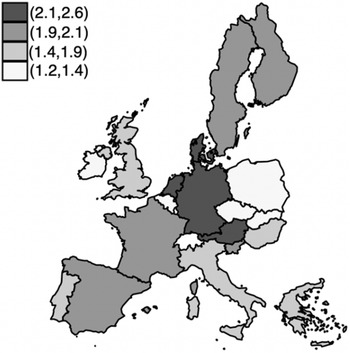
To examine this, one needs data on changes in women’s descriptive representation and environmental regulation. To measure a plausible external increase in women’s descriptive representation, I rely on gender quotas, as discussed in detail above. To measure environmental regulation, Analysis 1 leverages OECD’s widely usedFootnote 4 environmental policy stringency indexFootnote 5 (Botta and Koźluk Reference Botta and Koźluk2014). Botta and Koźluk (Reference Botta and Koźluk2014: 14) define environmental policy stringency as policies that impose ‘higher, explicit or implicit, cost of polluting or environmentally harmful behaviour’. The index covers 19 EU countries from 1990 to 2015. The index includes a series of market-based indicators (eg tax on emissions of NOx, diesel tax, etc.) and nonmarket indicators (eg emission limit value for NOx for large-size coal-fired plants). The environmental stringency variable has a mean of 1.86 and a standard deviation of 0.90, with a minimum of 0.35 (Hungary in 1990) and a maximum of 4.13 (the Netherlands in 2010). I use this measure as a proxy for environmental regulation stringency, where higher values correspond to more stringent environmental regulation. Figure 2 depicts a map of the 19 EU countries in the sample and their average environmental stringency scoreFootnote 6 . The countries with the most stringent environmental regulations on average are Denmark, Germany, Austria, and the Netherlands. Among the countries with the least stringent environmental policies are Ireland, the Slovak Republic, Belgium, and Czechia.
Environmental regulation in 19 EU countries (mean values).
Note: Own elaboration based on the OECD data. Shape files to construct the graph are from Eurostat. Overseas territories are not depicted.

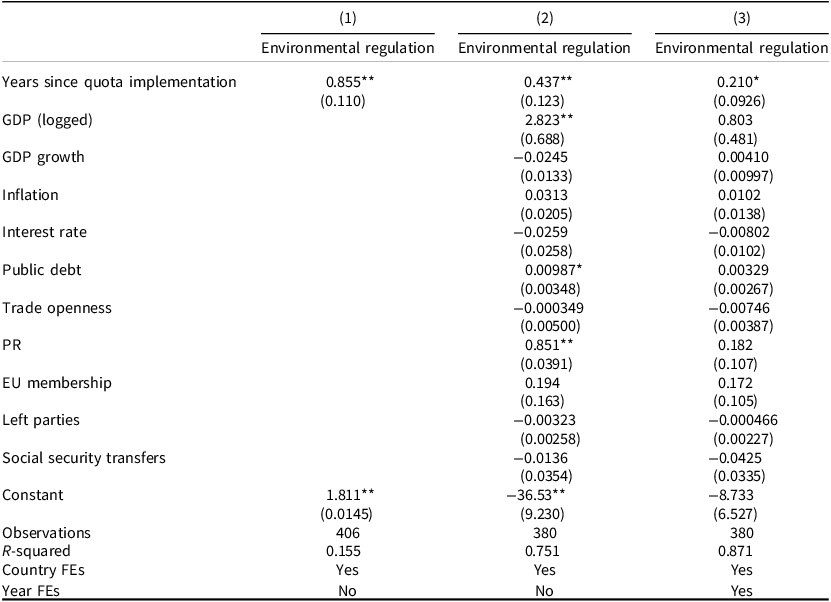
To examine the relationship between gender quotas and environmental regulation, I leverage linear (OLS) models with standard errors clustered at the country level. All models are fixed effects panel regressions with standard errors clustered at the country level. The main independent variable, years since gender quotas, is lagged by 1 year, as one should not expect environmental regulation to change instantaneously in response to more women getting elected. Column 1 shows the baseline model. Years since quota implementation are positively and statistically significantly associated with an increase in environmental regulation stringency. Several country-specific factors, such as economic conditions and the composition of parties in parliaments, may vary over time. Omitting these variables may result in bias, so a series of controls for economic and political country characteristics that vary over time are included in Column 2. A dummy variable indicating EU membership is also included, as some countries entered the EU during the studied period. Years since quota implementation remains statistically significant at the 5%, and the estimate is approximately half the size of the baseline model. Column 3, moreover, adds year fixed effects, controlling for all common year effects such as economic shocks and international events. Including year fixed effects does not alter the qualitative interpretation: years since quota implementation remains statistically significant at the 5% in this specification. The quantitative interpretation, however, changes seeing that the coefficient size is notably smaller than in the baseline model – approximately a quarter of the baseline model. Based on the full model in Column 3, a 1-year increase in (log) years since quota implementation from t1 to t2 increases environmental policy stringency by around 0.15Footnote 7 . This is a moderate effect size corresponding to approximately one-sixth of a standard deviation in the environmental regulation stringency variable.
In Appendix 2, several robustness checks are run, addressing alternative explanations and specifications. First, a concern with the results presented in Table 1 pertains to international agreements: countries that have ratified international environmental agreements will, everything else equal, have to act accordingly and change policies domestically. Countries that have ratified more international environmental agreements may therefore also increase the stringency of their environmental policies, irrespective of the gender composition in parliament. Leveraging data from Bellelli, Scarpa and Aftab (Reference Bellelli, Scarpa and Aftab2023), I therefore run a model that controls for the ratification of international environmental agreements. Second, changes in environmental policies may be driven by broader ‘progressive’ second-dimensional values in society. Based on aggregated individual-level data from the European Values Survey (EVS), I therefore run a robustness check controlling for gender values. The country coverage of this variable is more limited compared to the models presented in Table 1. Needless to say, years since gender quota implementation remain statistically significant when controlling for changes in values. Third, some of the control variables may also take a longer time to influence environmental regulation. I therefore run a model where all the controls are also lagged by one year to account for potential lagged effects in the controls. The results remain robust to this specification as well. Fourth, since Italy removed its quotas, this may influence the results. To examine this, I also run specifications with the full set of controls, where Italy is excluded from the sampleFootnote 8 . The results remain robust to this as well. Taken together, these findings suggest that an increase in the descriptive representation of women in parliament via quotas increases the stringency of environmental regulation.
Gender quotas and environmental regulation: country-level evidence

Note: Standard errors are clustered at the county level.
** p < 0.01,
* p < 0.05. The drop in observations in Columns 2 and 3 is due to listwise missingness in the control variables. Controls are from the Comparative Political Data Set (CPDS) (Armingeon, Engler, Leemann et al. Reference Armingeon, Engler, Leemann and Weisstanner2023) and the Penn World Table (PWT) (Feenstra, Inklaar and Timmer Reference Feenstra, Inklaar and Timmer2015).
Analysis 2: Firm performance
At the core of my argument is the proposition that gendered descriptive representation shapes which firms perform well, depending on the cleanliness of the firm’s production. Since more women in parliament increase production costs differently for clean and dirty firms, we should expect a firm’s performance to change in response to gender quotas. Consequently, gender quotas should increase relative firm performance, the cleaner the firm is.
To examine this proposition, one would ideally have cross-sectional panel data on individual firms and the cleanliness of their products. To the best of my knowledge, such a firm-level dataset does not exist. A second-best approach is, instead, to rely on individual firm data and then induce cleanliness/dirtiness based on which sector firms operate in. To do so, I leverage data from the Orbis database sourced by Baccini, Guidi, Poletti et al. (Reference Baccini, Guidi, Poletti and Yildirim2022) on 715,692 unique manufacturing firms (with over 4.2 million firm-country-year observations) from EU27 countries and the UK from 2003 to 2016. Orbis provides the arguably best public data for comparing firms over time between countries (Kalemli-Özcan, Sørensen, Villegas-Sanchez Reference Kalemli-Özcan, Sørensen, Villegas-Sanchez, Volosovych and Yeşiltaş2024) and has recently gained popularity for this reason in political science and economics (Autor, Dorn, Katz et al. Reference Autor, Dorn, Katz, Patterson and Van Reenen2020 I; Baccini, Guidi, Poletti et al. Reference Baccini, Guidi, Poletti and Yildirim2022; Johns and Wellhausen Reference Johns and Wellhausen2021).
To measure firm performance (the dependent variable), I simply measure firm log revenues, which is widely accepted as a measure of individual firm performance. To capture the cleanliness/dirtiness of an industry, I rely on data from Shapiro (Reference Shapiro2021) on US industries’ total carbon dioxide (CO2) emissions per dollar of output. Based on input–output tables from 2007, Shapiro (Reference Shapiro2021) calculates the total of carbon dioxide emissions per dollar of output for 379 US six-digit NAICS manufacturing industries, effectively measuring the ‘dirtiness’ of industries. Shapiro calculates total CO2 emissions based on ‘direct’ and ‘indirect’ emissions. Direct emissions capture the CO2 required to produce 1 dollar of output in an industry but do not take the emissions of (intermediate) inputs into account. Indirect emissions (also known as value chain emissions) capture the emissions of intermediate inputs used to produce 1 dollar of output in an industry. Shapiro (Reference Shapiro2021: 842) uses the example of the production of cookware to highlight the difference between direct and indirect emissions. The emission of cookware measures the fossil fuels used to convert steel into a pan (direct) but does not account for the fossil fuels used to make steel (indirect). Simply, the sum of direct and indirect emissions captures total CO2 emissions per 1 dollar of output. I rescale the dirtiness measure, so higher values capture cleaner industries and lower values capture dirtier industries.
Since industry identifiers in the firm dataset are at the NAICS four-digit level, I take the average cleanliness of NAICS four-digit industries to merge the two datasets. I finally merge the gender quota dataset by using country-year identifiers. Merging these three datasets gives a total of 4,236,015 firm-country-year observations with 715,692 unique firms.
I estimate a linear (OLS) model with standard errors clustered at the country–firm pair. To assess how gender quota shocks influence firm performance across various levels of firm cleanliness, an interaction term between log years since quota implementation and firm industry cleanliness is included in all models. Based on the argument, we should expect years since quota implementation to increase firm revenues, the cleaner the firm is. Years since quota implementation are measured identically to the approach in Analysis 1.
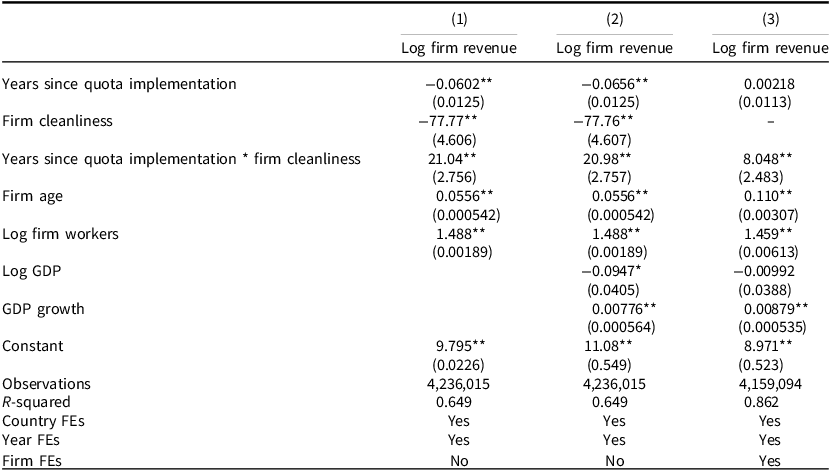
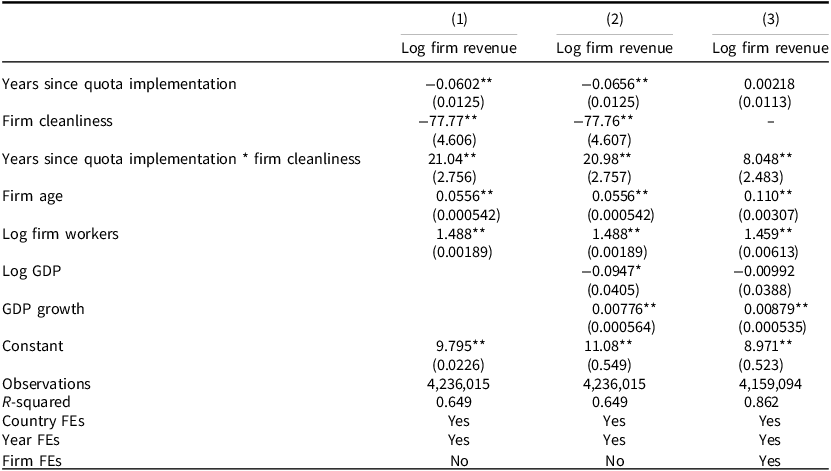
The results are presented in Table 2. Column 1 estimates a linear model including country fixed effects and year fixed effects as well as basic firm-level controls (age and log workers). The interaction term in Column 1 is positive and statistically significant at the 5% level, indicating that years since the implementation of gender quotas is increasing firm revenues, the cleaner the firm is. A concern pertains to broader economic trends in the countries where the firms operate. Firms operating in economies that grow more for reasons that are not captured in the year and country fixed effects may also have better economic performance. To address this, Column 2 adds time-varying country-level economic variables (log GDP and GDP growth) that likely shape firm performance. Controlling for country-level economic performance does not alter the main findings: the interaction term remains positive and statistically significant at the 5% level when macro-level economic controls are included.
Quota shocks and firm revenues: firm-level evidence
Note: Standard errors are clustered at the country-firm pair.
* p < 0.05,
** p < 0.1. Unique firms = 715,692. The n-value drops with 76921 observations in Column 3, as firms that only appear once in the panel are dropped due to the firm FEs. Since firm cleanliness is constant within firms in the dataset, the firm FEs omit the constitutive term in Column 3.
While basic time-varying economic controls for firm size (log workers) and age are included, several factors are unique to firms and to the industries in which firms operate. This can induce omitted variable bias. Including firm FEs addresses this, controlling for all constant firm heterogeneity, and hence reduces omitted variable bias substantially. Note that including firm fixed effects omits the constitutive term of firm cleanliness because they are perfectly collinear with the firms’ cleanliness measure. However, the coefficient and standard errors of the interaction term remain. This means that one cannot derive marginal effects, but one can determine if the association between the independent variable is increasing or decreasing depending on the level of the conditional variable. This specification, hence, shows whether the effect of gender quotas on firm revenues increases or decreases as a function of firm cleanliness. Even though the constitutive term of firm cleanliness drops out, including firm fixed effects is attractive as it omits factors that are constant within firms, substantially reducing omitted variable bias. Column 3, therefore, includes a specification with firm fixed effects. Note that the sample drops since 76921 firms only appear once in the panel and are dropped due to the firm fixed effects specification. Even though the constitutive term of firm cleanliness drops out in this specification, the interaction term remains, and it remains positive and statistically significant at conventional levels. This indicates an increasing positive effect of gender quotas on firm revenues at higher levels of firm cleanliness.
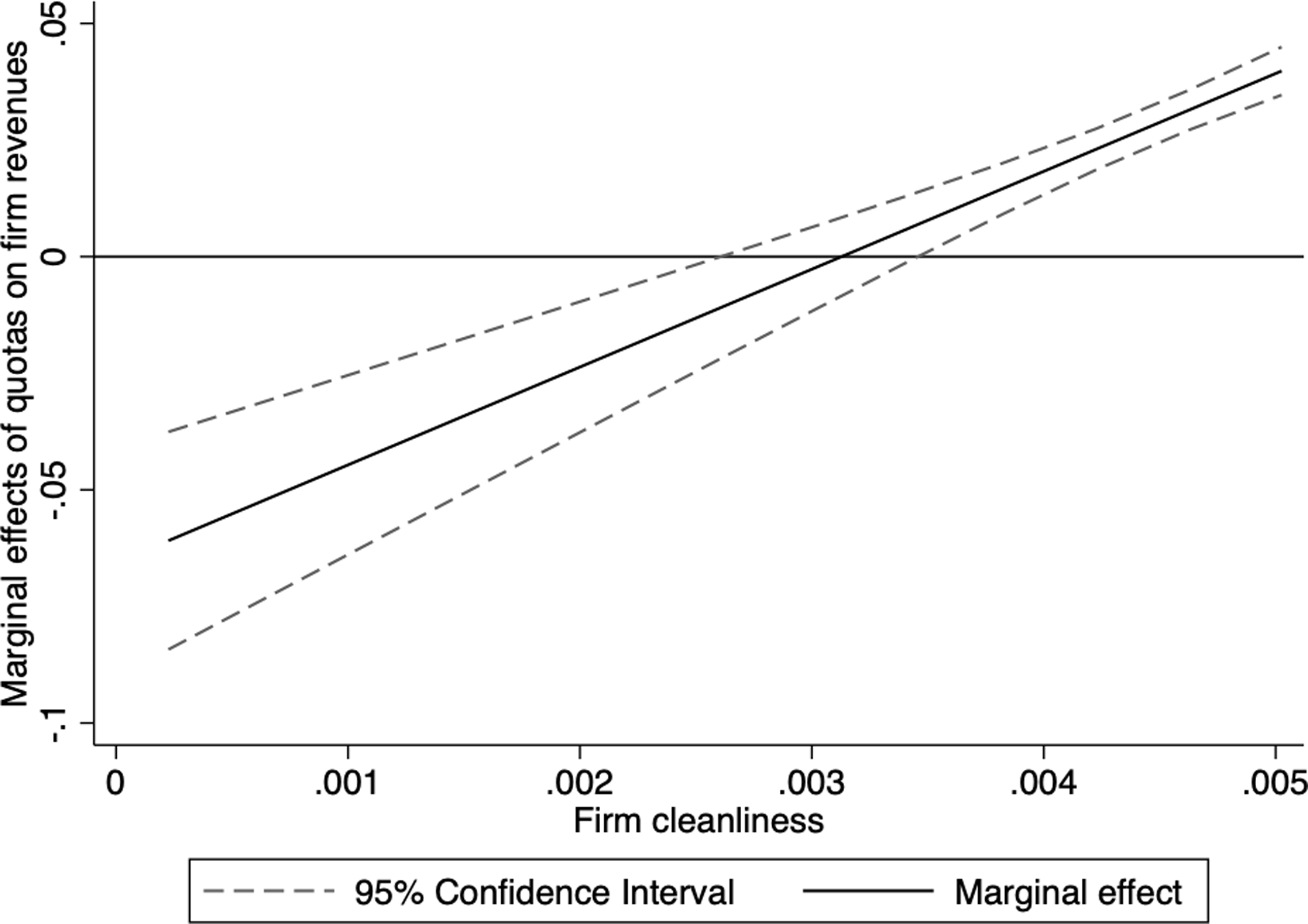
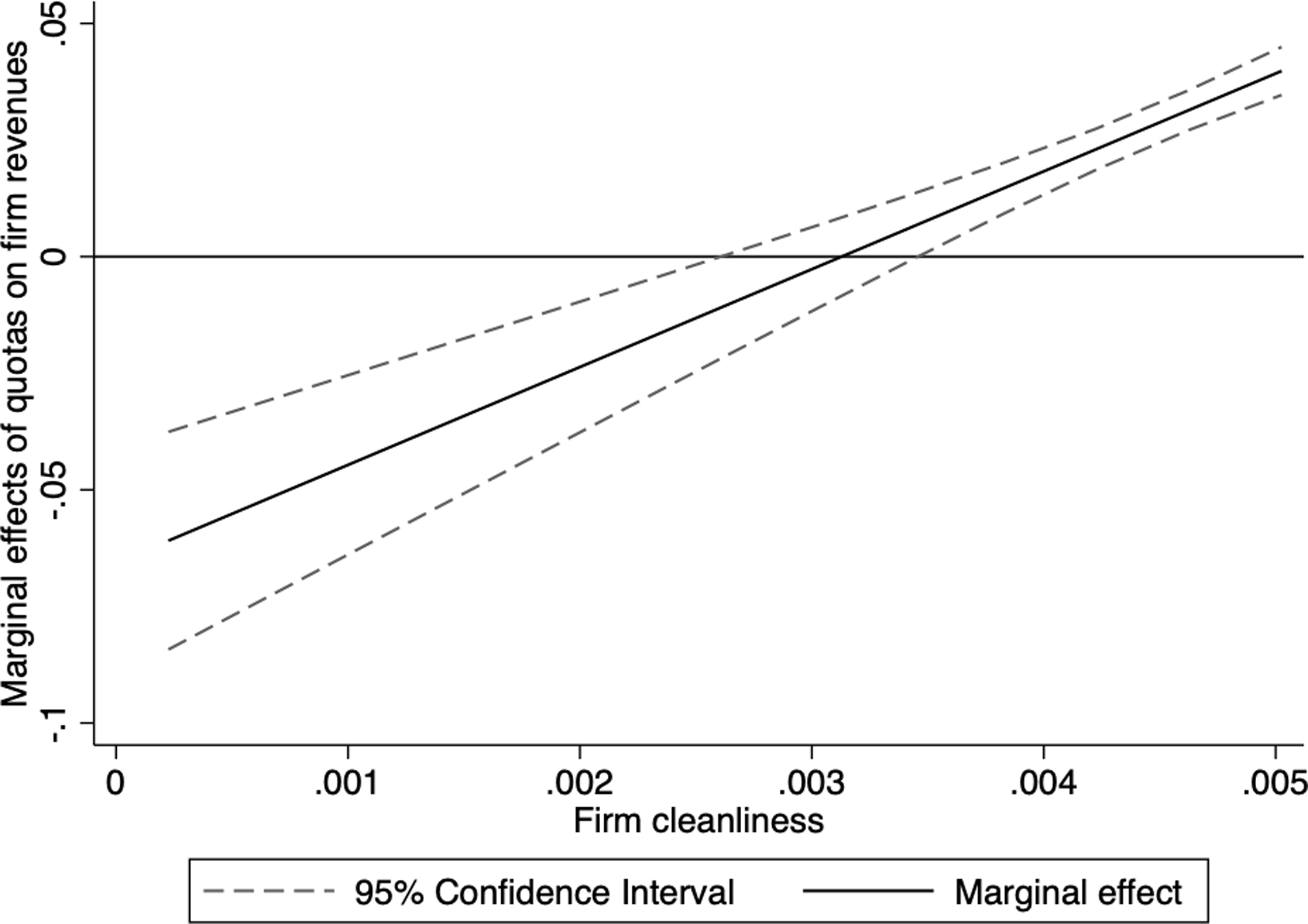
Figure 3, moreover, plots the marginal effects at various levels of firm cleanliness, based on Column 2. The plot shows that gender quotas reduce firm revenues at low levels of cleanliness (ie among relatively more dirty firms) and increase firm revenues at higher levels of firm cleanliness. Above 0.0035 on the cleanliness measure, the marginal effects are statistically significantly different from 0 and positively associated with firm revenues. Below 0.0027 on the cleanliness measure, the opposite holds. Based on the estimates in Column 2, a one-year increase since quota implementation from 1 to 2 years for the cleanest firms increases firm revenues by around 3%. For the dirtiest firms, the effect is around 4% on firm revenues. Together, this amounts to a difference of around 7% in revenues between the cleanest and dirtiest firms. This is a nontrivial effect size.
Marginal effects of gender quota implementation on firm revenues.
Note: Based on estimates in Column 2 in Table 2.
In Appendix 3, robustness checks are provided. First, like in Analysis 1, a concern may relate to international agreements: ratification of international environmental agreements may change firms’ production conditions domestically. Clean firms will likely stand to benefit from international environmental agreements, while dirty firms will likely stand to lose. It is, therefore, important to control for international environmental agreements. I do so by leveraging the data on ratified international agreements described in Analysis 1. Second, similar to Analysis 1, a concern may be about a change in ‘progressive’ values. Countries that become more ‘progressive’ on second-dimensional issues over time may change production toward cleaner product markets. This can give clean firms a competitive edge in domestic markets. Based on the EVS data in Analysis 1, I therefore include a control for values. The main results remain robust to the inclusion of these additional tests for alternative explanations. Third, I find that the results are robust to aggregating the data and different clustering. Fourth, I exclude Italy and Romania, as in Analysis 1. These tests corroborate the main findings from this section: gender quotas increase firm revenues, the cleaner the firm is.
Taken together, these results suggest that increasing women’s descriptive representation in parliaments via gender quotas shapes distributional outcomes domestically, depending on how clean/dirty firm production is. Firms engaging in dirty production fare relatively worse economically after introducing gender quotas, while firms engaging in clean production fare relatively better economically.
Analysis 3: Trade in clean and dirty products
To what extent does women’s descriptive representation shape trade in clean versus dirty products? I have argued, and provided empirical evidence with firm data, that women’s descriptive representation shapes firm performance depending on the cleanliness of production. This should not only shape distributional outcomes domestically but also shape trade patterns. By influencing the marginal costs of products differently across the cleanliness of products, gender quotas should shape trade in products based on their cleanliness. I exploit a research design where trade policies are identical between countries, but where gender quota implementation varies. This allows me to examine how gender quotas shape trade, holding trade policies constant. This study, hence, examines how women’s descriptive representation shapes countries’ comparative advantages in dirty/clean products. Toward the end of this section, I also examine how environmental regulation is associated with trade, providing further evidence for the proposed mechanism between women’s descriptive representation and trade in clean/dirty products.
To examine this proposition, one needs (detailed) data on traded products linked to product cleanliness. I have therefore sourced data from the EU COMEXT database that covers total exports of goods for each EU 27 country + the UK from 2000 to 2019. The product data is at the Harmonized System 6-digit (HS6) level, containing more than 5000 individual product categories, which gives me a highly disaggregated representation of trade flows, making this dataset suitable for analyzing the link between women’s descriptive representation and exports of productsFootnote 9 . The main outcome of interest is changes in the export of goods. To measure changes in exports of products, I calculate the yearly change in the logarithm of exports for each product-country-year observation. Restricting the sample to 2000–2019 reduces a lot of noise, partly because of the coronavirus pandemic that affected trade patterns in unprecedented ways and partly due to Brexit. These events influenced trade patterns in ways that likely had nothing to do with gendered representation and may therefore bias the estimates substantially.
To merge the industry dirtiness measure from Shapiro (Reference Shapiro2021) at the NAICS level with the product-level data from COMEXT at the HS6 level, I rely on an updated version of Pierce and Schott (Reference Pierce and Schott2012). Pierce and Schott (Reference Pierce and Schott2012) provide code that merges NAICS’ six-digit sector codes with HS product codes from 1989 to 2017. To merge the data, I extend the Pierce & Schott concordance data for 2018–2019, assign a NAICS code to each HS6 product, and merge in the dirtiness measure. I once again reverse the dirtiness measure, so higher values indicate relatively cleaner products, and lower values indicate relatively dirtier products. Reversing the scale does not change the findings – only the directionality of the estimates. To measure gender quota shocks, I rely on the same data and approach as in studies 1 and 2 above. The final dataset consists of a total of 1,695,006 product-country-year observations for which there are data on exports, product cleanliness, and gender quota implementation.
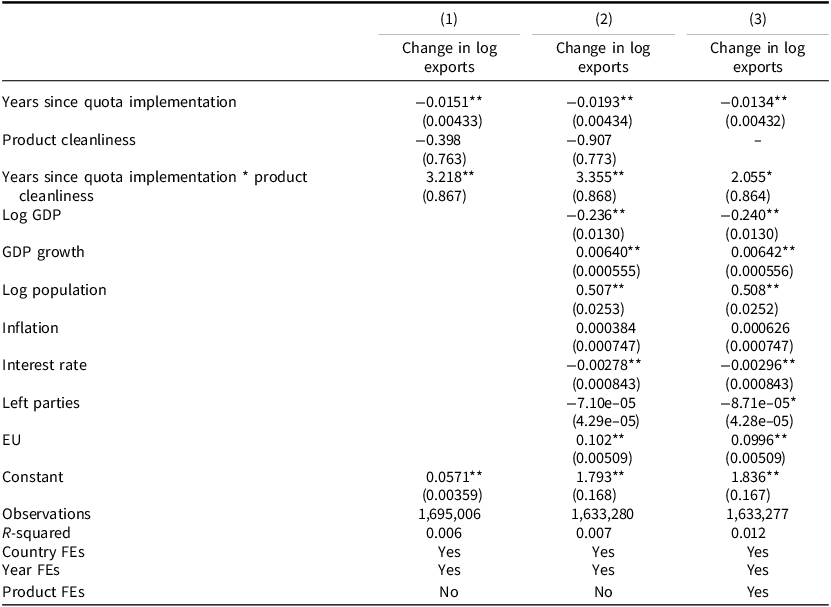
I estimate linear (OLS) models with standard errors clustered at the country–product pair. To examine how gender quotas are associated with exports depending on the cleanliness of a product, I include an interaction term between years since quota implementation and product cleanliness. Based on my argument, we should expect gender quotas to increase exports relatively more, the cleaner the product is. That is, we should expect a positive interaction term between years since quota implementation and product cleanliness. Years since gender quota implementation are measured identically to studies 1 and 2.
The results from Analysis 3 are presented in Table 3. Column 1 presents the baseline model including country FEs and year FEs, as well as the interaction term between years since quota implementation and product cleanliness, and the two constitutive terms. The interaction term is positive and statistically significant at the 5% level, indicating that the effect of gender quotas on exports is increasing in the cleanliness of products. Or put differently, dirty products are exported relatively less than cleaner products after introducing gender quotas. Column 2 includes a set of basic economic and political controls that vary over time and may influence trade flows. For example, economic growth may stimulate more exports, and the partisan composition of parliaments may influence economic policies that can shape trade. Also, since all EU28 member countries in 2019 were not members of the EU during the entire studied period, a dummy capturing EU membership is also included as a control. The interaction term remains positive and statistically significant when controlling for these factors. A series of factors is specific to individual products. It is therefore important to include product fixed effects to reduce a substantial amount of omitted variable bias. Including product fixed effects omits the constitutive term of product cleanliness because they are perfectly collinear with the cleanliness indicator. The coefficient and standard errors of the interaction term, however, remain. Like in the specification with firm-specific effects in Analysis 2, this means that one cannot derive marginal effects from this specification, but one can still determine if the effect of quotas is increasing exports, the cleaner the product is. This specification, hence, shows whether the effect of gender quotas on exports increases or decreases as a function of product cleanliness. Column 3 includes a specification with product fixed effects. Although the constitutive term of product cleanliness drops out in this specification, the interaction term remains. As shown in Column 3, the interaction term is still positive and statistically significant, even after controlling for product fixed effects. This further strengthens the main result obtained from Table 3: gender quotas increase exports relatively more, the cleaner the product is.
Gender quotas and exports: product-level evidence
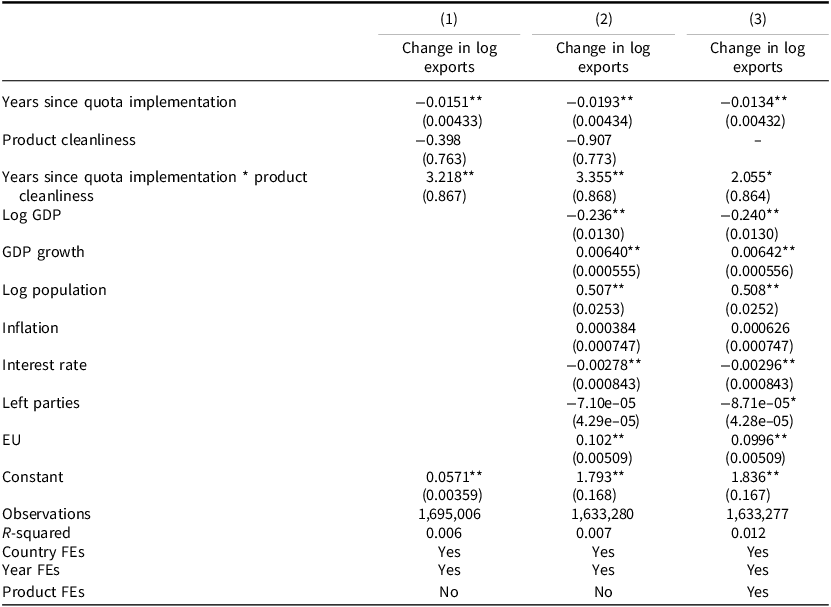
Note: Standard errors are clustered at the country-product pair.
** p < 0.01,
* p < 0.05. The sample drops slightly in Columns 2 and 3 due to missingness on some of the country-level variables and due to collinearity with product FEs.
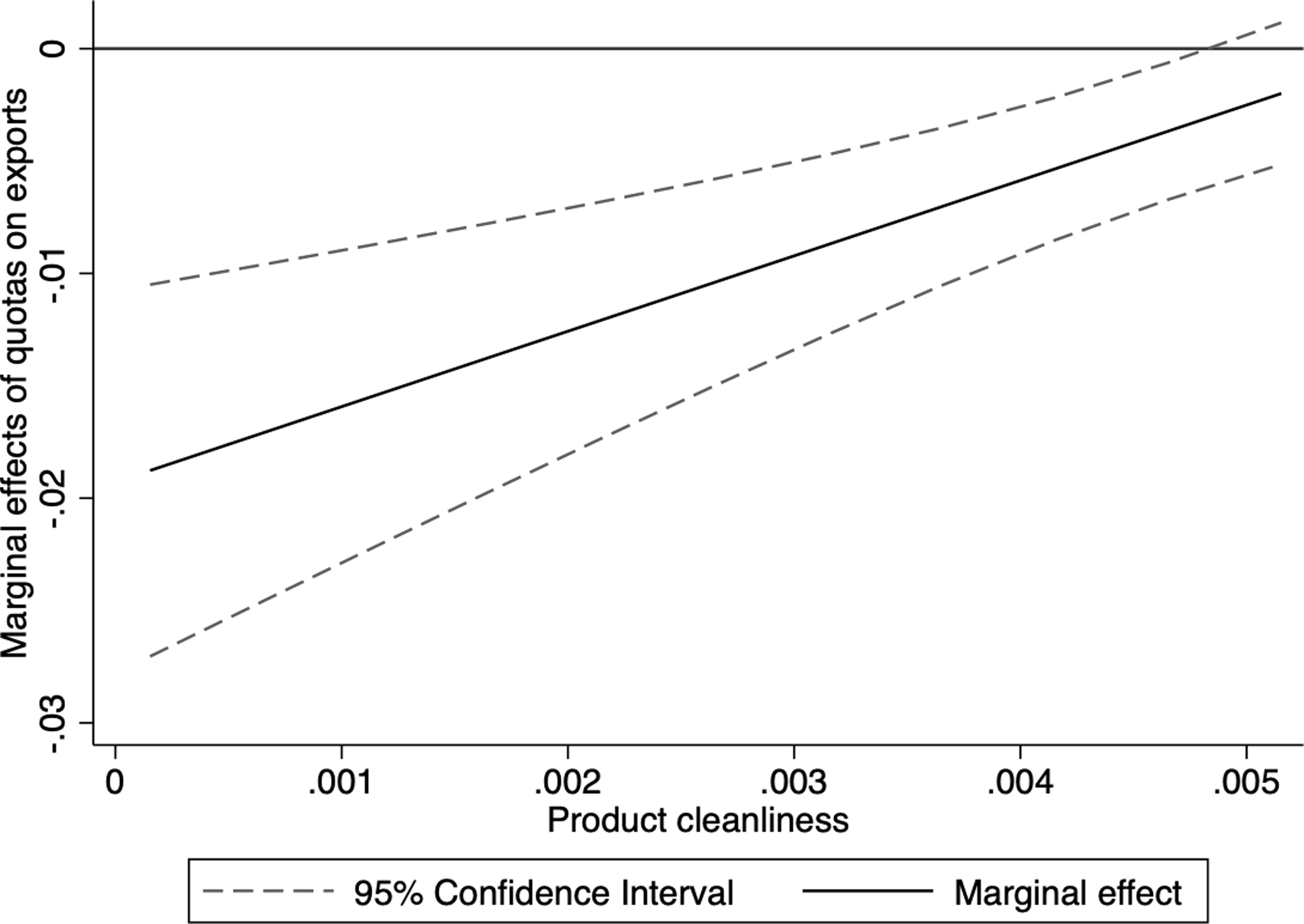
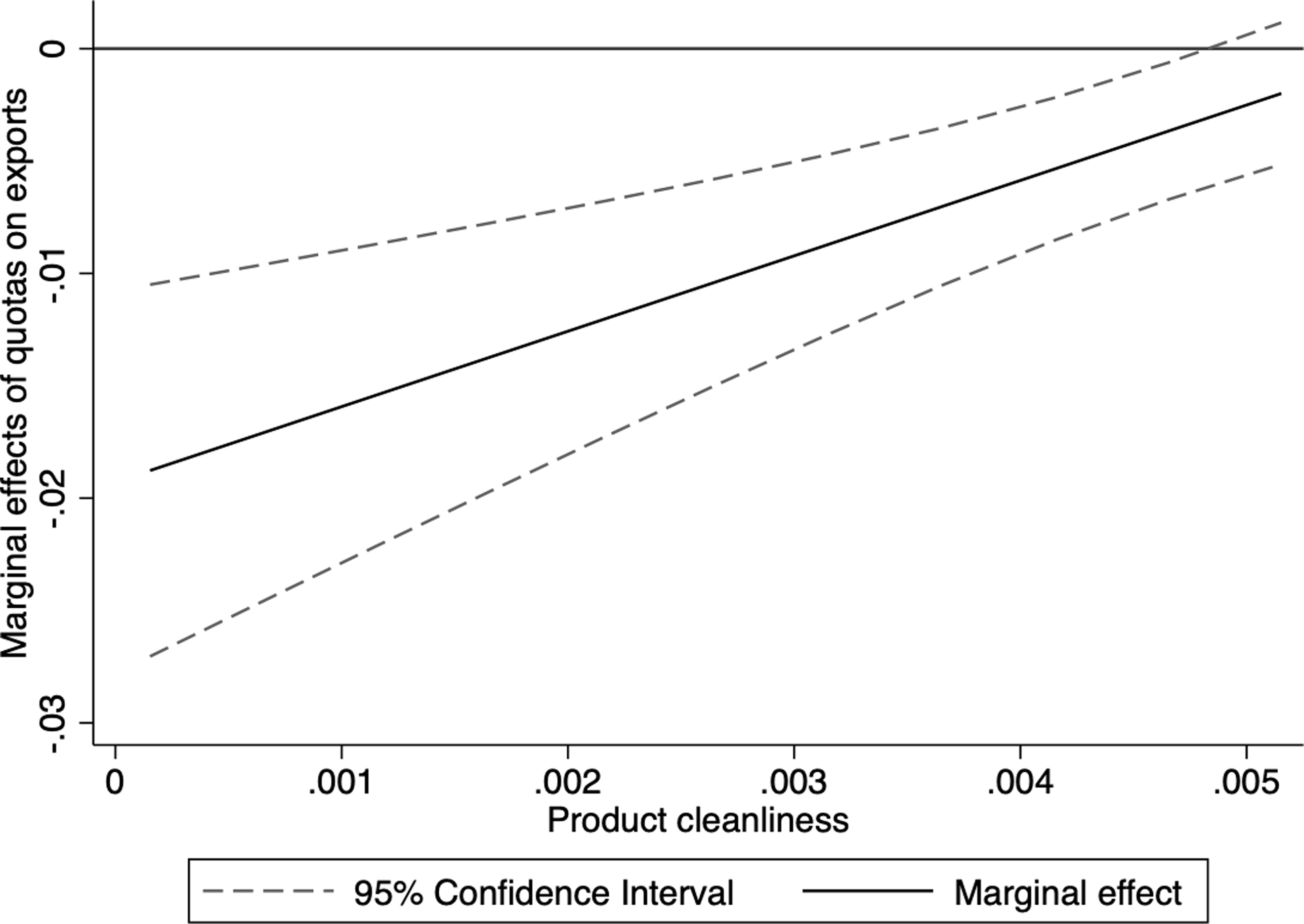
A marginal effects plot is depicted in Figure 4, based on the estimates in Column 2 in Table 3. The plot shows that the effect of gender quotas on exports is increasing in the cleanliness of products. At medium and low levels of cleanliness (ie relatively dirtier products), gender quotas are decreasing exports relatively more. At very high levels of product cleanliness, the effect of gender quotas on exports is not statistically different from 0. At the lowest level of product cleanliness, a change in t 1 to t 2 in years since quota implementation is associated with around a 1.5% decrease in exports. These results suggest that firms exporting dirty products in countries that have implemented gender quotas have a comparative disadvantage, while firms exporting cleaner products have a comparative advantage.
Marginal effects of gender quota implementation on exports at various levels of product cleanliness.
Note: Based on estimates in Column 2 in Table 3.
In Appendix 5, I run a series of robustness checks controlling for alternative explanations. First, a concern, similar to Analysis 1, pertains to international agreements: countries that have ratified more international environmental agreements may experience a change in trade as a response. It is likely that especially clean firms will benefit from international environmental agreements, making it relatively easier for firms to export their products globally. It is, therefore, important to control for international agreements. I do so by leveraging the data on ratified international agreements described in Analysis 1. Second, countries vary in the development of green technologies. Firms in countries with better access to green technologies may have a comparative advantage in producing and exporting clean products. Addressing this, I rely on green patent data from the OECD (2025). The OECD measure captures the number of green patents filed per 1 million capita per country-year. Third, the extent to which gender quotas change policy outputs – including the stringency of environmental policies – and how effectively these policies will be implemented may vary across countries. To address this, I rely on the World Governance Indicators (WGI) data from the World Bank on regulatory quality (World Governance Indicators 2024). According to the WGI, the regulatory quality index measures ‘perceptions of the ability of the government to formulate and implement sound policies and regulations (…)’. I use this indicator as a proxy for countries’ abilities to effectively implement policies. Fourth, the results may be driven by changes in foreign demand for goods. If countries abroad, for example, desire more products – especially products of varying cleanliness – in specific EU countries, this may be driving the results. To address this, I calculate the change in log total exports (ie the sum of exports) per country-year. This measure captures overall changes in exports, that is, foreign demand, effectively controlling for general changes in foreign demand. Fifth, like in Analysis 1, a concern may pertain to changes in societal values. Firms operating in countries that are more ‘progressive’ on second-dimensional preferences may find it easier to operate in clean product markets. Based on the EVS data in Analysis 1, I therefore run a robustness check controlling for gender values. The main results remain robust to the inclusion of all these additional tests for alternative explanations. Since the gender quota dataset ends in 2015, a concern might be that extending the period to 2019 is problematic, as I do not have data on potential new quota implementers in this period. In Appendix 5, I therefore also estimate the models in Table 3, ending the sample in 2015. The results remain robust to this specification.
Another concern with the trade analysis is that it only focuses on exports. It is well known that firms – especially in high-income democracies – ‘greenwash’ their supply chains by outsourcing dirty production and importing dirty products (Copeland, Shapiro and Taylor Reference Copeland, Shapiro, Taylor, Gopinath, Helpman and Rogoff2022; Lerner and Osgood Reference Lerner and Osgood2023). One way to address this concern is by examining how imports of dirty versus clean products change in response to implementing gender quotas. If countries implementing gender quotas export relatively less dirty products, but instead import relatively more dirty products, this will de facto outsource dirty production. To address this, I have sourced import data for EU27 member countries and the UK at the HS6 product level from COMEXT covering the same period as in the export analysis (2000–2019). I follow the same merging procedure, as described above, and end up with a dataset consisting of around 1.8 million product-country-year observations. I then estimate a series of models identical to the export analysis in Table 3, but with the change in log imports as the dependent variable instead of the change in log exports. These results are presented in Appendix 6. I interestingly find no evidence of outsourcing. Instead, I find some evidence that gender quotas are increasing imports at higher values of product cleanliness. This result is, however, not robust to the inclusion of product fixed effects, suggesting that omitted product factors that are constant over time are driving the results. Needless to say, these results strongly suggest that more women in parliament do not result in the outsourcing of dirty production. Taken together, these results indicate that more women in national parliaments make trade relatively cleaner.
Moreover, I have argued that women’s descriptive representation shapes trade via environmental regulation stringency. Analysis 1 provides evidence that a plausible exogenous increase in women’s descriptive representation via the implementation of gender quotas increases the stringency of environmental regulation. If the proposed mechanism should be at work, we should expect environmental regulation to shape trade depending on the cleanliness of products: more stringent environmental regulation should be associated with a relative increase in exports, the cleaner the product is. To address this, I estimate a series of regression models identical to those in Table 3, where the environmental regulation variable from Analysis 1 is interacted with product cleanliness. These results are presented in Appendix 7. The Appendix shows, consistent with my argument, that environmental regulation is positively associated with exports at increasing levels of product cleanliness. These results are robust to a series of fixed effects as well as the country-level economic and political controls. These findings provide suggestive evidence for the argument that women’s descriptive representation shapes trade flows via environmental policies. A concern could be that the cleanliness of countries’ export profiles influences the tendency to adopt gender quotas and to introduce more stringent environmental regulations. This is addressed in Appendix 5, finding no support for these concerns, which is reassuring.
I finally address how gender quotas are shaping trade depending on the level of economic development. Bush and Clayton (Reference Bush and Clayton2023) show that gender differences in environmental preferences are larger in economically more advanced countries. If this is the case, we should expect gendered descriptive representation to shape trade more in more economically advanced countries. To address this, I include a triple interaction between gender quotas, product cleanliness, and (log) GDP and estimate a series of models similar to those in Table 3. These results are presented in Appendix 8. This set of tests provides suggestive evidence that gender quotas are increasing exports of cleaner products relatively more in countries that are economically more advanced, which is consistent with Bush and Clayton’s theory (Reference Bush and Clayton2023).
Conclusion
One important difference between men and women is their preferences for the environment: women worry more about the environment and prefer stronger environmental action. This stylized empirical fact has consequences for firms’ performance and trade flows. I provide evidence for three claims. First, increasing women’s descriptive representation in parliament via gender quotas increases the stringency of environmental regulation. Second, gender quotas give dirty firms a relative disadvantage and clean firms a relative advantage. Third, this translates into trade in dirty versus clean products. Introducing gender quotas decreases the exports of dirty products. I interestingly find no evidence that quotas lead to ‘greenwashing’ of supply chains and outsourcing of dirty products. I also provide suggestive evidence that women’s descriptive representation shapes trade via more stringent environmental regulation. This suggests an economic logic by which, as more women enter parliament and introduce more stringent environmental regulations, some firms will win, and others will lose: dirty firms perform relatively worse; clean firms perform relatively better. This, in turn, has consequences for the types of products that are being traded. As women’s preferences for trade protectionism at the mass level can transfer into politics at the elite level (Betz, Fortunato and O’Brien Reference Betz, Fortunato and O’Brien2023), so can women’s preferences for the environment at the mass level. These findings have broad consequences for the production and trade of dirty and clean products and, by implication, environmental outcomes. By shaping firm behavior, women in parliament can make economies and international trade cleaner.
These results contribute to a large literature on women’s descriptive and substantive representation (Franceschet and Piscopo Reference Franceschet and Piscopo2008; Wängnerud Reference Wängnerud2009; Greene and O’Brien Reference Greene and O’Brien2016). I provide evidence that women parliamentarians act more on women’s environmental concerns and preferences and, by doing so, improve women’s substantive representation. Since women in high-income democracies are descriptively underrepresented in politics, their environmental concerns and preferences are not substantively represented. By introducing gender quotas, women’s descriptive representation improves, and with better descriptive representation comes better substantive representation, at least for environmental preferences. I have provided evidence that improving women’s descriptive representation improves environmental outcomes both domestically and internationally. As such, the struggle for more political gender equality is also a struggle for a cleaner planet.
This has important consequences not only for women’s substantive representation but also for the contours of the global economy. The findings suggest that women’s representation is important for understanding patterns of international trade and economic globalization. This also adds to a new research agenda on how institutions shape trade in dirty versus clean products and, by implication, environmental outcomes (Shapiro Reference Shapiro2025). The novelty in focusing on the cleanliness of products also suggests that women’s descriptive representation has heterogeneous effects on trade flows. This has implications for scholars of international political economy and environmental studies and shows that a gendered approach is important for understanding both study areas.
The findings, moreover, have consequences for distributional outcomes and political cleavages. By shaping which firms win and lose, gendered representation shapes distributive outcomes. I provide evidence that improving women’s descriptive representation makes dirty firms relative losers and clean firms relative winners. This may have consequences for voting and politics in high-income democracies. Cavallotti, Colantone, Stanig et al. (Reference Cavallotti, Colantone, Stanig and Vona2025), for example, provide evidence that workers in dirty occupations tend to vote less for and workers in clean occupations tend to vote more for parties with more environmental policy agendas. Improving women’s descriptive representation may therefore create a political cleavage domestically between workers in dirty firms and workers in clean firms. To the extent that more women work in relatively cleaner industries and more men in relatively dirtier industries, this may also create cleavages between genders. Consequently, improving women’s descriptive representation may both increase support and opposition to the climate transition, potentially fueling the ground for polarization over environmental issues. This points to an exciting research agenda on how transitioning into a cleaner economy creates new economic and political cleavages. More research is needed to examine how this dynamic unfolds and to what extent it is different from other structural changes (Etzerodt Reference Etzerodt2026).
Although this paper has focused on a country context where national elected politicians cannot influence trade policies, it remains an open question if women, relative to men – both at the mass and elite levels – think about how environmental policies influence trade patterns, and if they think environmental protectionism and trade protectionism are complementary or involve nuanced trade-offs.
Supplementary material
The supplementary material for this article can be found at https://doi.org/10.1017/S1475676526101078.
Data availability statement
Replication material can be found at https://dataverse.harvard.edu/dataset.xhtml?persistentId=doi:10.7910/DVN/V8ZHOA.
Acknowledgments
I would like to thank Timm Betz and the three anonymous reviewers for exceptional feedback. I would also like to thank the editorial team for support throughout the review process.
Funding statement
The author acknowledges funding from the European Research Council (Grant Agreement No. 101041658, Project PINPOINT, PI Timm Betz), funded by the European Union. Views and opinions expressed are those of the authors only and do not necessarily reflect those of the European Union or the European Research Council Executive Agency. Neither the European Union nor the granting authority can be held responsible for them.
Competing interests
The author has no competing interests (economic, political, etc.).



 Open access

