

Introduction
Water evokes a very powerful image among the Ifugao. It is a recurring theme in Ifugao oral traditions, particularly on the beginning and end of life (Barton Reference Barton1946). The story of the Ifugao great flood symbolizes death, rebirth, and cleansing. As a people whose identity and subsistence is tied to their rice production system, this symbolism is translated into both sacred and practical realms of the Ifugao cosmos.
Water symbolism is also manifested in the Ifugao pantheon, which is made up of more than two thousand deities (Barton Reference Barton1946; Lambrecht Reference Lambrecht1962), half of which are deities associated with rice agriculture rituals. The number of required rituals in each stage of Ifugao wet-rice production indicates the centrality of wet-rice in Ifugao culture. Indeed, wet-rice is the basis of customary Ifugao wealth and prestige.
This paper looks at the agriculture-focused rituals in Ifugao and relates them to the ecology of the Ifugao agricultural system. In Acabado's previous work (Acabado Reference Acabado2012a), he described the Ifugao agricultural system as an “agro-cultural complex”, a term popularized by O'Connor to describe the interlocking nature of agricultural practices, social systems, and political, historical, and, cultural change (O'Connor Reference O'Connor1995). This is an apt term because for the Ifugao, wet-rice cultivation is part of a larger production system that includes swiddening and agroforestry. Following the work of Lansing (Reference Lansing1991, Reference Lansing and Kremer1993), the rituals associated with the Ifugao wet-rice production appear to have practical functions: they ensure availability of labour, minimizes conflicts by synchronizing field agricultural activities, and functions as reinforcement of Ifugao social organization.
In this article, we look at the concept of puntunaan (a ritual plot or parcel in the centre of an agricultural district), the tomona (the ritual leader of an agricultural district), and cooperative labour groups (uggbu and baddang) as important synchronizing strategies in the Ifugao agro-cultural system. We focus on the role of self-organization within a complex adaptive system framework as defining principles behind uggbu and baddang (Acabado [Reference Acabado2013] initially employed the self-organization concept to define Ifugao social organization in an archaeological application). Based on four years of ethnographic work in the region, we argue that rituals and the control of water in Ifugao are tantamount to having enough food (rice) and a stable order (elite control). Without a strong water control system (managerial and infrastructural), the subsistence pattern and political economic system in Ifugao would collapse. Even with the rapid transformation of Ifugao political and economic systems, the link among water symbols, wet-rice rituals, and ecological applications remains strong (Acabado and Martin Reference Acabado, Martin, Willems and van Schaik2015).
The Cordillera Lands of Wet-Rice Terraced Pondfields
More than one million people now inhabit the Cordillera Central of northern Luzon (Philippines), a 20,000 sq. km region that now houses six provinces: Abra (Tingguian), Apayao (Isneg), Benguet (Kankanaey, Ibaloi), Ifugao (Ifugao), Kalinga (Kalinga, Isneg) and Mountain Province (Kankanaey) (Figure 1). Most inhabitants belong to one of these ethnolinguistic groups, though perhaps 10% of the Cordillera residents are Ilocano immigrants from the lowlands (De Raedt Reference DeRaedt, Rambo and Gillogly1991: 355). Each of these ethnolinguistic groups has its own traditions, but despite these clear differences, the Spanish collectively called them the Ygorrotes (Igorots) soon after colonization in the 16th century (Scott Reference Scott1974: 2).
Major ethnolinguistic groups in the Philippine Cordilleras.

Dominant narratives in Philippine history consider the Ifugao “uncolonised”, which has become a key feature of Ifugao identity (Scott Reference Scott1969). The dichotomy between highland and lowland Philippines is also largely constructed in this historical narrative, which suggests that the northern highland Philippines resisted Spanish domination. Spanish cultural footprints in the province are scant, owing to the failure of the colonial power to establish a permanent presence in the region (Scott Reference Scott1970, Reference Scott, McCoy and de Jesus1982). Nevertheless, major economic and political shifts in the highlands coincided with the arrival of the Spanish in the northern Philippines (Acabado Reference Acabado2016).
The recent findings of the Ifugao Archaeological Project (IAP) indicate that wet-rice varieties were introduced into the region after AD 1600 (Acabado Reference Acabado2009, Reference Acabado2015, Reference Acabado2016). Subsequent landscape modification (terraced wet-rice cultivation) also intensified between c. AD 1600 and AD 1800, suggesting increased demand for food, and a settlement pattern shift toward more densely populated villages.
Villages and hamlets were established close to major junctions of rivers and tributaries and these waterways identify relationships between villages. The flow of the river and its power seem to be an attractive force for people to establish their villages – adequate water pressure assures a sufficient water supply needed for their agricultural fields. More importantly, water serves to anchor intra- and inter-village relationships, as cooperation is needed to ensure the stability of the water flow. Indeed, disruptions to the water distribution system remain the major source of conflict in Ifugao.
Ifugao lies on the east of the Cordilleran divide, 17° north of the equator. Settlements and human made features in the landscape lie 1,000–1,500 meters above sea level (Conklin Reference Conklin1980: 1). The year-round abundance of water (annual rainfall exceeds 3,000 mm) and strong river flow makes wet-rice agriculture, even steep slopes, feasible with landscape modification. Irrigated ponded terraces and interspersed patches of woodlots occupy the gentler slopes often occurring with settlements in the lower portions of valleys (Conklin Reference Conklin1980: 1) (Figure 2).
The Ifugao rice terraces.

The origins of the Ifugao people are a topic of scholarly debate. There are two poles in this debate, in the ‘old history model’ (from Barton Reference Barton1919 and Beyer Reference Beyer1955) Ifugao settlement in the region began as early as 3000 years ago. A contrasting ‘short history model’, which we support (Acabado Reference Acabado2009, Reference Acabado2010a, Reference Acabado2010b), using recent archaeological evidence, argues instead that 16th century Ifugao groups from the Magat Valley moved to the interior of the Cordillera to avoid the colonial aims of the Spanish. It is also likely that the ultimate origins of the Ifugao is somewhere in the lowland valleys east of the Cordilleras, in present-day Isabela and Cagayan Provinces.
Ifugao migration to the mountains necessitated a shift in agro-cultural system as initial taro pondfields were transformed into wet-rice pondfields (Acabado Reference Acabado, Spriggs, Addison and Matthews2012c; Peterson and Acabado Reference Peterson and Acabado2015; Eusebio et al. Reference Eusebio, Ceron, Acabado and Krigbaum2015). The drastic increase in population that followed this migration would have stimulated the shift to a more labour-intensive agricultural production, and perhaps the adoption of pondfield-adapted rice varieties. The agricultural and irrigation systems in the highlands then, are fairly recent; so too might be the ethnogenesis of the Ifugao ethnolinguistic group.
Water as Death, Rebirth, and Cleansing among the Ifugao
Water symbolizes the beginning and the end in Ifugao mythology. The Ifugao cosmos is made up of six realms, with five of these located in the spirit world: Kabunyan (Skyworld), Dalom (Under World), Daya (Western World), Lagud (Eastern World) and Kadungayan (the spiritual place where the linnawa or souls of mortals go after death). The realm of humans is called Pugaw or the physical world, where mortals and other classes of spirits dwell. The origin myth of the Ifugao tells of a settlement founded by Bugan and Wigan. The basic premise of the Tuwali-Ifugao origin is similar across numerous versions of the myth. The myth may differ in detail depending on the narrator, but fundamental aspects of the myth remains more or less the same. The main characters of the narrative are Bugan and Kabigat, the children of Skyworld/Kabunyan deities. It is set between the Skyworld and the physical world, where humans live. The story begins as Bugan descends to the physical world from Skyworld through Kiyyangan (the gateway between mythological realms and the physical world). The reasons for this trip vary, some say it was to hunt and others say that it was to dig tubers. Whatever the reason may be, Bugan was in the human realm when Kabigat took advantage of his sister at night. A suspicious Bugan rubbed lime on her belly one night, only to find lime on her brother the following morning. After this, whether with the blessing of their parents or as a punishment, the two were married, and they settled in Kiyyangan, where they prospered.
After several generations, a great drought dried up all the rivers. The old men suggested digging in a riverbed to find the soul of the river. After three days of digging, a great spring gushed forth rapidly enough to kill many of the diggers. While the Ifugaos celebrated the waters, a storm came, the river kept rising, and the elders advised people to run for the mountains because the river gods were angry. Only two people made it to safety, a brother and sister, Balitoc and BuganFootnote 1 , who escaped to separate mountains, Amuyao and Kalawitan. Both had enough food on the summits, but only Bugan had fire. After six months, the waters receded; creating the rugged terrain that exists today. Balitoc reunited with his sister on Mt. Kalawitan and they settled in the valley. The sister later found herself with child and ran away in shame, following the course of the river. The god Maknongan, appearing as an old man, assured her that her shame had no foundation, since she and her brother would repopulate the world (Demetrio Reference Demetrio and Dundes1988). The great flood myth is shared by other Cordillera groups and seems to evoke the power of water.
Another important Ifugao ritual that involves water is associated with the “cleansing” property of water. The tobotbal di danum (call on the water) is an episode in several performances that invokes the gods of the Skyworld to wash away evil, malaise, and sorrow from the village, particularly during times of sickness and death. Villagers wash themselves by the river to either signify the start of the mourning period, or to end it.
Water is also used by the Ifugao to communicate with their deities. The Hapao people practice the punnuk, in which the Ihapao converge in the river to celebrate the end of a successful harvest season. Water games are played. Head ornaments made of dongla and straw scarecrows are sent downstream. The river is supposed to bring these to the deity, Binongbong, to inform him that harvest is over so he can lift the seasonal ban on certain ritually prohibited foods.
The water and agriculture rituals in Ifugao appear to be a cultural strategy to regulate activities that are detrimental to community cooperation. In this sense, the sacred and the secular intersect in Ifugao systems of water management and agricultural production.
Subsistence Strategies
The Ifugao are agriculturalists who have cultivated wet-rice for at least 300 years. Their agro-cultural system (Acabado Reference Acabado2012) exhibits a complementary strategy combining the management of private forests (muyong), swidden cultivation of sweet potatoes (uma), pond-field cultivation of rice (payo), inter-cropping of many secondary domesticates (i.e. sweet potatoes, potatoes, cabbage, and other cash crops), and the raising of pigs, chickens, and other forms of livestock (Conklin Reference Conklin1980: 36).
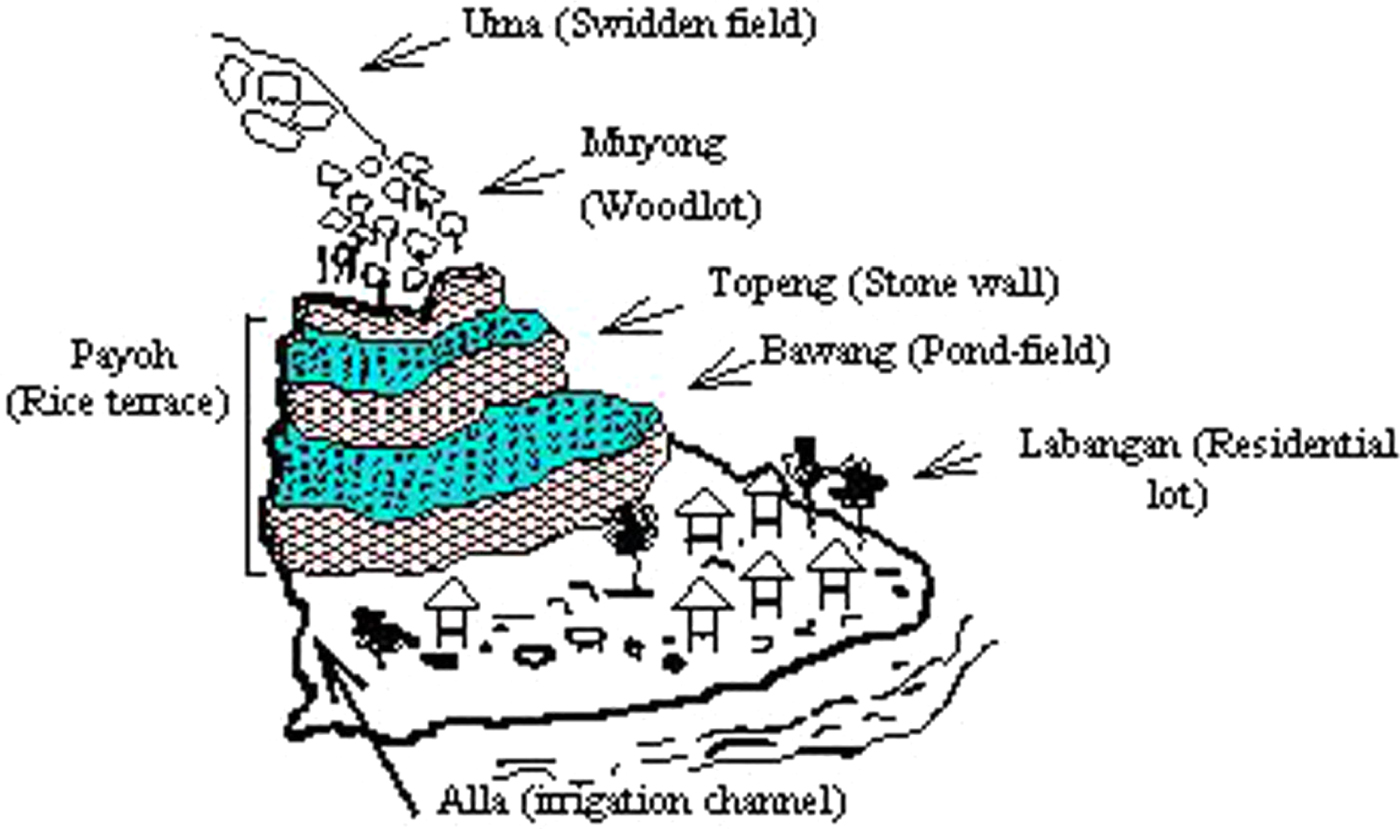
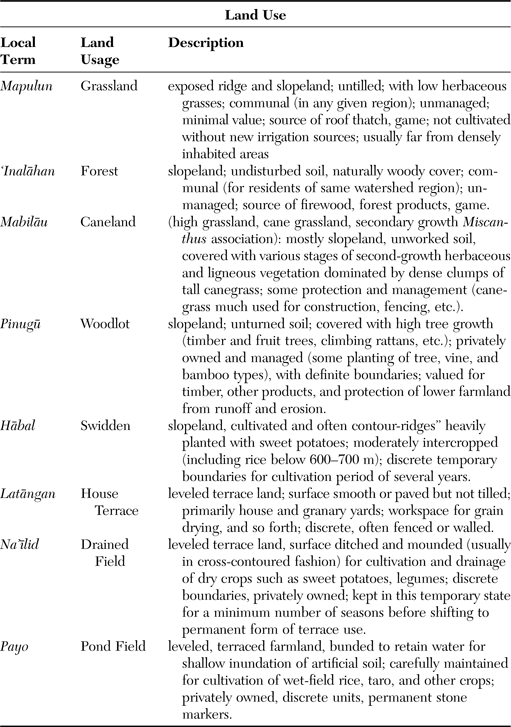
The agricultural pattern of the Ifugao is complex. Ecological, social, and cultural factors, including indigenous knowledge of how these factors are linked to each other, and efficient utility affects this pattern. Within a particular watershed, several types of land use categories comprise the agricultural system. There are two types of forest cover: Inalahan/hinuob which are upslope communal forest often composed of open access communal areas; and muyong/pinugo which are privately owned woodlots and managed with definite boundaries. There is also uma (swidden) which is unirrigated slopeland cultivated with root crops, usually sweet potatoes; latangan (house terrace) located on a residential site; na-ilid (drained field) a levelled terraced area for cultivation of dry crops such as sweet potatoes and legumes; and payo (irrigated rice field) situated on levelled, terraced farmland, bunded to retain water. Figure 3 illustrates the suite of agricultural strategies in Ifugao, while Table 1 (below) summarizes the land use categories of the Ifugao.
Profile of an Ifugao terrace system (from Acabado Reference Acabado2010: 83).
Land use categories of the Ifugao (adapted from Conklin Reference Conklin1980:7–8).
An important aspect of Ifugao agricultural terrace ecology and maintenance is the land use category of muyong/pinugo, or privately owned woodlots. These woodlots serve as the watershed of a particular terrace system and are invaluable for terraces whose primary source of water are the springs located in these woodlots. Hydrologic studies (Hamilton and King Reference Hamilton and King1983; Bruijnzeel Reference Bruijnzeel1990; Saberwal Reference Saberwal1997) in the last three decades suggest that heavy forest cover actually result in more usage of groundwater. Yet, it remains the case that these woodlots protect low-lying fields from runoffs and erosion, maintain a supply of surface and irrigation water through cloud-interception, stabilize relative humidity, and improve soil's nutrients and physical and chemical properties (Conklin Reference Conklin1980). Indeed, increases in logging activities in the vicinity of Banaue in the early 1980s accelerated runoffs and evapotranspiration, intensifying water shortage during the dry season (Eder Reference Eder1982).
Wet-Rice Cultivation
In past studies, anthropologists primarily focused on intensive systems of cultivation to describe the relationship of subsistence patterns to social complexity (Adams Reference Adams1966; Hunt and Hunt Reference Hunt, Hunt, Downing and Gibson1971; Morrison Reference Morrison1994). The central management of large irrigation systems, and intensification associated with these systems, has been seen as the stimulus for the emergence of social complexity. However, there are a significant number of irrigation systems run by local community organizations in Southeast Asia and very little attention has been paid to these systems. The result is a significant gap in scholarly knowledge (Barker and Molle Reference Barker and Molle2002).
Examples of these community-based irrigation systems include densely populated lowland-Philippine areas of Ilocos and less densely populated province of Isabela that practice the zanjera system. Zanjera is a cooperative system of agricultural management developed in the northern Philippines (Coward Reference Coward1979). It involves the organization of water allocations, maintenance of common agricultural structures (i.e. irrigation channels and ditches), as well as a management system for conflict resolution. In other words, a zanjera is a large, participatory, and communal irrigation system devoid of large-scale state intervention. Currently, the National Irrigation Administration of the Philippines manages dams and water reservoirs. The zanjeras, in contrast, operate canals and water distribution.
Henry Lewis provides a description of the zanjera irrigation societies in the northern Philippine provinces of Ilocos and Isabela (Lewis Reference Lewis1971). Lewis writes that the Philippine zanjera system developed in the province of Ilocos, historically a densely populated region in the country. After the Second World War, the Philippine government sponsored migration to less-densely populated areas in the country, similar to transmigrasi program in Indonesia. It was during this time that Ilocano migrants settled in the province of Isabela. These Ilocano migrants were originally members of community-organized irrigation associations or zanjeras. However, the migrants did not form local zanjera associations in their newly settled place. Lewis suggested that differences in the resource base between Ilocos and Isabela inhibited the formation of zanjera associations. The easily available water source in Isabela from the Cagayan River and its tributaries, as well as lower population densities in the province eliminated the need for community management of agricultural resources. The rapid population growth in Isabela in the last four decades, however, necessitated the establishment of irrigation cooperatives in the province, albeit under the direct supervision of the state's Department of Agriculture.
In Ifugao, we do not see formal irrigation organization such as the zanjera, although there is a customary cooperative system (uggbu or baddang) that functions as reciprocal labour. Most rice fields in Ifugao share a common water source, as such, cooperation among fields sharing a water source is apparent. The need for this cooperation is most emphasized in areas of intense population pressure or limited water supplies, or both. In these places, the organization of community labour and management is essential to gain access to and share water, and to minimize conflicts (Tang Reference Tang1992; Ostrom Reference Ostrom1992). Similar to the examples cited previously, the Ifugao case provides an illustration of a communal cooperative system, as necessitated by topographic/environmental limitations.
Complex Adaptive Systems and Self-Organization
The nature of Ifugao social organization counters Karl Wittfogel's hydraulic theory that the organization of complex irrigation systems requires a strong centralized state (Reference Wittfogel and Steward1955), while closely aligning with J. Stephen Lansing's (Reference Lansing1991) well-known Balinese case study. Although the social organization of the Ifugao differs remarkably from the Balinese, the intensive agricultural system and management of irrigation are similar. As opposed to the Wittfogelian model, both the Balinese and the Ifugao case studies do not seem to have a centralized irrigation management, at least in the ethnographic present. In fact, both systems support a model that points to the emergence of self-organization (Kauffman Reference Stuart A.1993, 1995; Scarborough et al. Reference Scarborough, Schoenfelder and Lansing2000; Schoenfelder Reference Schoenfelder2000).
Ifugao methods for organizing their agricultural production and political economy might best be understood as a Complex Adaptive System (CAS). Anthropologists employ the term Complex Adaptive System as a nonlinear model of culture change that questions the hierarchical positions of certain actors. Holland (Reference Holland1995: 4–6) describes CAS as a dynamic network of many agents that may represent cells, species, individuals, firms, nations, and so on acting in parallel, constantly acting and reacting to what the other agents are doing. The control of a CAS tends to be highly dispersed and decentralized. If coherent behaviour arises in the system, it is due to competition and cooperation among the agents themselves. The overall behaviour of the system is the result of a huge number of decisions made every moment by many individual agents. As such, CAS models change through a consideration of agency and human decision-making. The most notable use of CAS in anthropology is as a model for the emergence of order within the population level. Processes once assumed that result from chance at individual level, are now viewed as predictable at the societal level (Lansing Reference Lansing2003: 185).
John Schoenfelder describes Lansing's (Reference Lansing1991) work in Bali as a model wherein self-organization emerged due to a “need to balance multiple agro-ecological concerns in a crowded landscape of terraced rice fields that could feasibly have been responsible for the emergence of Bali's yield-enhancing autonomous ‘complex adaptive system’ of agriculture-managing water temple congregations” (Schoenfelder Reference Schoenfelder2003: xv). This is comparable to Ifugao terrace systems where the expansion of terraced fields placed pressure on land and water and resulted in pest increase. These pressures provided the impetus for villages/settlements whose fields are contiguous to share a water source and work together to pool resources. This process corresponds to a “self-organizing model”; a term used by complexity theorists to describe the ways that order is generated by events within the system and not by outside influences (Kauffman Reference Stuart A.1993). Park (Reference Park1992) and Lansing and Kremer (Reference Lansing and Kremer1993) have applied the CAS and self-organizing in their studies of political stratification and irrigation management.
Utilizing the self-organizing model, we suggest that the local irrigation management of the Ifugao is a result of the need for cooperation to control water and land distribution as well as pest management. The synchronization of farming activities – headed by the tomona and signalled by rituals – substantiates this assertion. Hamlets within a watershed/agricultural district form an informal group (baddang) that is tasked with agricultural-related activities. Similar to Bali, rituals and function-specific informal groups may have been a result of self-organizing processes.
Self-organization in Ifugao must be directly associated with the synchronization of agricultural activities and its effects on productivity, pest management, and water distribution. We hypothesize that the role of the tomona and the synchronization of activities is directed towards pest management, labour availability, and irrigation distribution; and that these processes are analogous to the Balinese subak system (Lansing Reference Lansing1991; Schoenfelder Reference Schoenfelder2003).
Water Management in Ifugao Culture
Locations for Ifugao rice terrace construction are based on the availability of freshwater springs. Water flow trumps slope angle in decisions on terrace locations, and Ifugao farmers cut terraces into slopes of more than a 40° gradient (Acabado Reference Acabado2012a: 510–516). Terrace construction begins with excavating an irrigation channel. Expansion of the terraced construction uses existing irrigation structures, and involves a payment (adang), usually in pigs, to the original builder/owner of the channel. It also requires that all canal users consent to channel maintenance and repair.
The Ifugao water management system is a community-based irrigation system where farmers sharing a common irrigation source coordinate their activities and share in the maintenance of the irrigation infrastructure. The system also illustrates the complementary nature of swidden fields, forest cover, and irrigated terraces (Acabado Reference Acabado2013a). Swidden fields and communalFootnote 2 forests are considered commons property, while irrigated terraces and forest cover on top of a terrace system is considered private property. Irrigation infrastructure is a commons property.
Most anthropologists agree that agrarian-focused water systems entail some form of management, but disagree over the degree of organizational complexity in traditional systems (Lansing Reference Lansing, Kohler and Gumerman1999; Earle and Doyel Reference Earle, Doyel, Pool and Cligget2008; cf. Kolata Reference Kolata1991). Conflict mediation and preventing system disruptions are clearly the greatest challenges in water management; how these conflicts are resolved depends on the nature of organizational complexity. Water management systems require cooperation and compromise, which are often structured through law. The more flexible the rules of access and usage, the greater the resilience of the system (Scarborough Reference Scarborough, Schoenfelder and Lansing2000: 3).
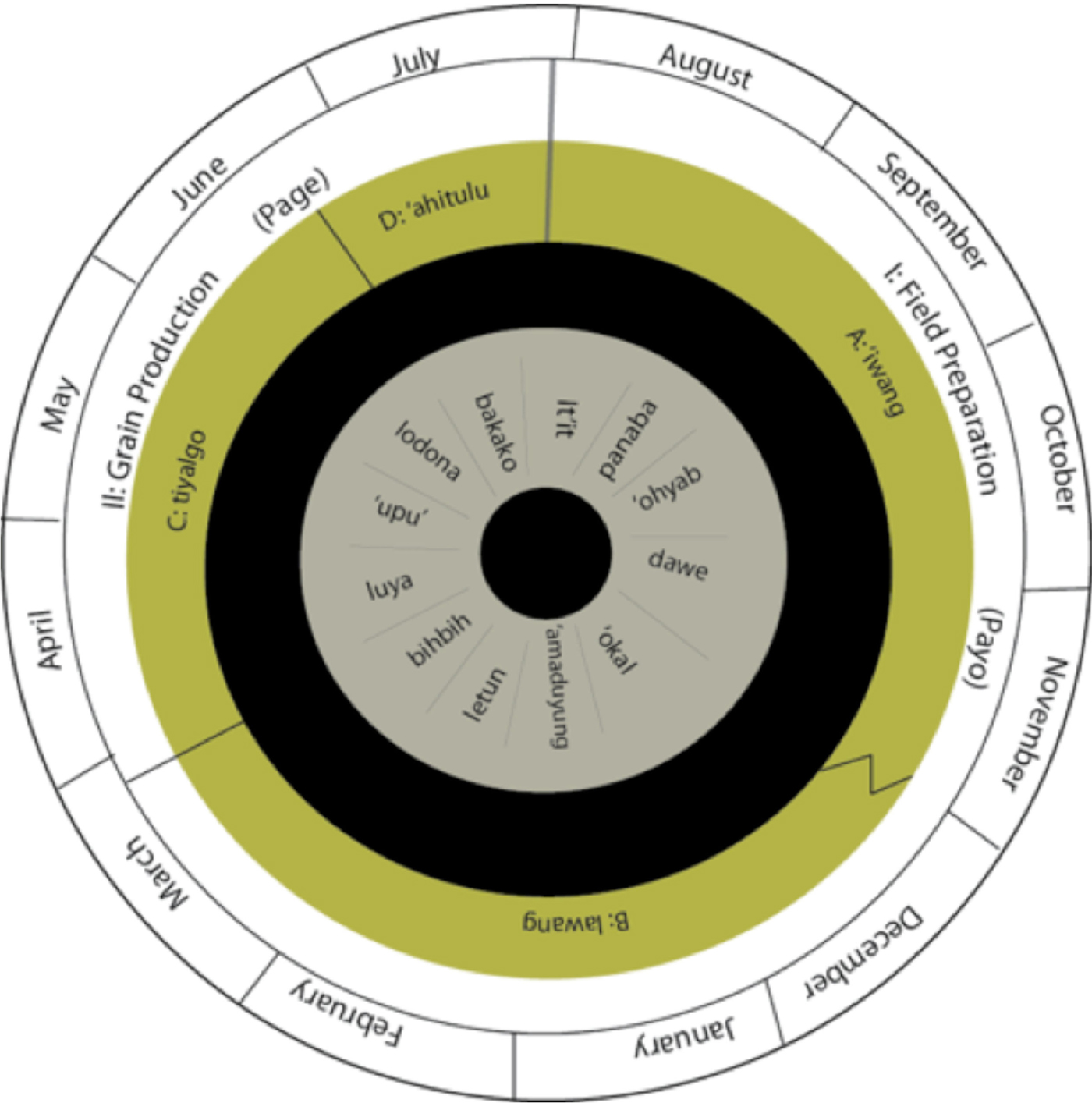
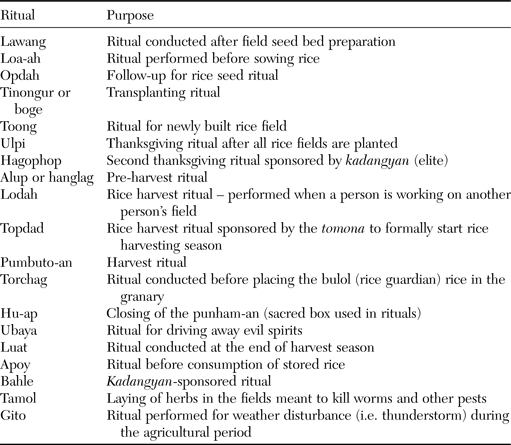
Water management demands are interrelated to the structure of Ifugao social life, which as Conklin describes (1980: 110), centres on the local community, the puntunaan (ritual plot), and the tomona (the ritual leader) (see Figure 4 below). The tomona must synchronize agricultural activities, manage available labour, control water use and pest management, and sponsor ritual activities. The customary communal workgroup (uggbu and baddang) forms the foundation of this work. The puntunaan plot is customarily the first to be cleaned, planted, transplanted, harvested, and is where other activities related to terrace agriculture take place. Once a tomona has performed the ritual (Table 2) and started a particular agricultural activity, other members of the himpuntunaan (agricultural district) can start to work on their fields; however, larger fields which are owned by the elite (or kadangyan) will be worked on first because of labour requirements. Similar to the Balinese subak system (Lansing Reference Lansing1991), this synchronization has something to do with water and pest control, labour distribution, and productivity. Although the locations of these puntunaan do not appear to be important in controlling the aspects mentioned above, the rituals that signal the start of every agricultural activity provide the mechanism where the Ifugao cope with the problems associated with terrace agriculture
Agricultural Districts (himpuntunaan) and the locations of ritual plots (puntunaan) in North Central Cordillera about here.

The Ifugao agricultural calendar (illustrated with the Gregorian calendar months [outer ring]; major Ifugao agricultural activities; agricultural seasons [third ring from the outer-most ring]; and, Ifugao lunar months [spoked inner ring]) (adapted from Conklin Reference Conklin1980).
Tomona-sponsored Ifugao rituals associated with rice production and consumption in Banaue, Ifugao (adapted from Pagada 2006).
Implications
The ecology of the Ifugao landscape and the needs of wet-rice agriculture require a strategy that minimizes conflict, particularly access to water. In our work in Ifugao, it appears that there is a link between the tomona system and the scheduling of agricultural activities, a system that Acabado (Reference Acabado2013) described in his previous research as self-organization. As a self-organizing system, the practice of puntunaan and tomona applies directly to the ecology of Ifugao agricultural terraces. The Ifugao acquire water for their fields from streams, springs, and rivers. There are no dams or irrigation tanks to store water. However, the rivers that they tap into have sufficient water to supply most of the fields. Terraces fed by streams and springs are different. They rely on the seasonality of water flow and the locations of terraces and relative optimality for rice production is associated with their value. Tapping rivers and streams requires the construction of kilometres-long irrigation channels, beginning at a weir upstream to divert part of the flow into irrigation channels. These irrigation channels, in turn, supply water to terrace systems. There are also irrigation channels that are supplied by all three water sources: rivers, streams, and springs.
According to Lansing (Reference Lansing1991: 39), to appreciate the level of precision required for the system to work, it is necessary to understand the basic dynamics of the paddy ecosystem. This includes knowledge about nutrient cycles that characterize the wet and dry nature of paddy fields. The cyclical nature of paddy-rice cultivation implies a need for synchronization and cooperation among farmers.
Mutual support among farmers within a terrace system, thus, is paramount to the effectiveness of drying or flooding fields as a method of pest control. A single farmer's attempt to reduce pests on a field without the coordination of other farmers would be futile because pests will simply migrate from one field to another. However, when all fields in the system are burned or flooded in coordination, the pest population is reduced. The synchronization of activities make both kinds of fallow (burnt or flooded) effective for reducing rice pests. Just as individual farmers manage their paddies by controlling the flow of water, so do larger social groups control pest cycles by synchronizing agricultural activities.
The synchronization is evident in the concept of puntunaan and tomona. Although more work is necessary for a deeper understanding of these processes, the main principle revolves around organization and ecology of rice production. Self-organization seems to have emerged amidst the need to maintain Ifugao societies. Cooperation, rather than centralized control, is vital in the endurance of Ifugao societies.
Acabado and Martin (Reference Acabado2015) reports that as of July 2014, only three himpuntunaan still practice the tomona system: Hapao, Batad, and Hengyon. According to Ifugao elders, all himpuntunaan practiced puntunaan as late as the 1970s. These three himpuntunaan appear to have enough local labour force to work in their fields while other himpuntunaan import field workers from other districts during planting and harvesting season. The sequencing and synchronizing feature of the tomona rituals enable local farmers in these three villages to ensure enough labour during peak agricultural activities. The power of the tomona, however, is waning. In 2014, during our fieldwork in Hapao we documented the harvesting of a particular field that lasted for three days. Hapao farmers stated that in past years, it would have taken them just a day to complete the activity. They lamented the breakdown in the tomona system and the decreasing influence of the uggbu and baddang.
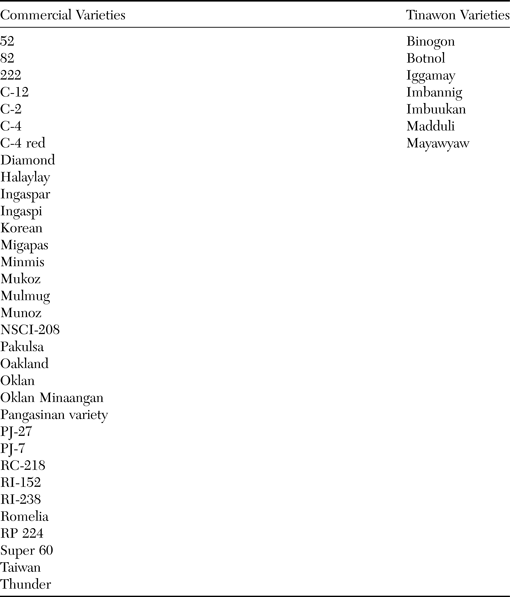
In Kiangan, Ifugao, the practice of puntunaan and tomona have been abandoned for generations, we have observed a large-scale importation of labour and a total breakdown of the Ifugao agro-cultural system. When the tomona disappeared, rituals were abandoned. This was followed by the introduction of commercial rice varieties (Table 2) that modified the rice cycle. There was no synchronization of agricultural activities resulting in cross infestations and the introduction of new types of pests such as the golden snail. Chemical pesticides and synthetic fertilizers followed suit. Field workers were imported from other towns, even from the lowlands. A rise in community conflicts also increased because of uncoordinated water use.
The rapid assimilation of the Ifugao in the market economy and state politics has also spelled danger to the Ifugao social and agricultural systems (Acabado and Martin Reference Acabado2015). Reciprocal labour is disappearing and state-sponsored politicians are taking over the authority of the tomona. As an example, the National Irrigation Administration, a state agency, has taken the lead in the maintenance of irrigation systems in Ifugao. This activity is associated with funds provided by the national government. Although it is still the farmers who carry out the repairs and maintenance of the system, they are paid in cash by the project. This has immense implication for the sustainability of the Ifugao agricultural system because it signals the erosion of the basic socio-political dynamic that long regulated the social and ecological fabric of Ifugao life. As a case in point, the National Irrigation Administration sponsored a project to convert the Ifugao irrigation system into concrete structures in Hapao, Hungduan in 2003 (Figure 6). The principle behind the structural change was conceived by engineers who thought that concrete irrigation channels require less maintenance than earthen structures. Most of the workers who were hired to help with the constructions were local farmers. They were paid monetarily, based on the prevailing wage standards. However, a few weeks after the completion of the project, a typhoon caused several small landslides that buried segments of the system. The local farmers could not muster enough workers because they preferred to wait for the national government to pay them to repair the damaged portions of the system. In the summer of 2014, the system was still inoperable.
The Hapao Terrace Cluster.

Water distribution has also become a source of conflict among Ifugao farmers. Previously, the customary Ifugao socio-political organization has controlled the synchronization of water distribution among fields sharing a common water source, but because of the erosion of the cooperative principle, it is now normal to see farmers guarding their irrigation channels with guns.
Known and named commercial and local rice varieties cultivated in Kiangan and Hungduan Municipalities (from Acabado and Martin Reference Acabado, Martin, Willems and van Schaik2015).
Conclusion: Water is Sacred, Water is Power, Water is Life
Water is key to the economic, political, and spiritual realms of the Ifugao. Water is sacred as it is a recurring theme in their oral tradition. These water symbolisms are also demonstrated in their practical existence where they comprise the organizing force behind Ifugao politics and economics. Thus, water links the sacred and the secular.
For the Ifugao, the saying that water is life applies literally and figuratively to their history and heritage. The economic value of and importance of water to subsistence activities in Ifugao life are immense because water anchors their economic, social, and spiritual existence. Recently, the importance of water has been subsumed by the centrality of rice in Ifugao culture and history, but disruptions in the Ifugao water management system are causing major fractures in the Ifugao world.
The assimilation of the Ifugao into the larger Philippine society has lasting repercussions on their way of life. Rice production has become an economic activity rather than an anchor to their identity and heritage. These changes indicate that, currently, the primary goal of producing rice in Ifugao is to gain monetarily which is stimulating transformations in the culture. To give just one example, this has resulted in a shift in gender roles. Men have taken over the responsibility of planting and harvesting. As a consequence, women as repositories of customary Ifugao agricultural knowledge will likely fade in a generation. The terraces have become a source of income, and thus, we can expect a shift in the social institutions that will come to govern the emerging agricultural system in the region.
Acknowledgements
We thank Dr. Lindsay Lloyd-Smith and Dr. Eric Tagliacozzo for organizing the Symposium, Water in Southeast Asia: Navigating Contradictions, where a version of this paper was presented with Dr. Miriam Stark as a co-presenter. We are also indebted to two peer reviewers who provided valuable comments. Funding for the Ifugao research was provided by an NSF Dissertation Improvement Grant (BCS 07-04008), a Luce Foundation/ACLS Dissertation Fellowship, NGS-CRE (NGS 9029-12), and a National Museum of the Philippines Research Grant. The argument for a self-organizing system in Ifugao was initially articulated by Stephen Acabado in “Defining Ifugao social organization: “House”, field, and self-organizing principles in the northern Philippines”. Asian Perspectives 52(2), 161–189. Portions of this paper appeared in Acabado 2013 and Acabado and Martin 2015.



