


Festive Culture, Urban Reticulation, Embodied Communities
The leisure-time space of the nineteenth-century European city, with its sociability and its café culture, fostered a climate for entertainments that in turn would be platforms for the assertion of national identity. National dances in cafés-chantants became a feature from Zagreb (with its tamburica ensembles and kolo dances) to Zaragoza (with its zarzuelas and jota). But city life was, in this century, also internationally enmeshed: the polka, first made popular in Prague in the 1830s as a national Slavic–Bohemian dance, became a veritable craze in mid-1840s Paris and went as global as the Viennese waltz.1
Polka and waltz exemplify the matryoshka scalarity that we also encountered when dealing with aggregation levels of language. Leisure-time sociability can oscillate effortlessly between the local and the transnational. The primary ambience for such activities is that of the town or city. As similar cultural leisure pursuits spread from city to city, these can reticulate (as we have seen in the case of choirs) into networks that have a regional or even national function. Leisure activities pursued locally mesh into trends with nationwide or even international outreach and influence.
Sports and athletics follow this same pattern. Football is at the same time global and celebrated in England, where it originated, as a specifically local-cum-national tradition. Some sports are pursued in a powerfully nationalizing context. Events such as the Eleven Cities ice-skating tour in Friesland or cross-country skiing in Sweden and Norway symbolically assert the nation’s culture, tradition and identity. The Swedish Vasaloppet and the Norwegian Birkebeinerrennet are both named after nationally legendary historical exploits (see Figure 8.8). Sports associations such as the Gaelic Athletic Association in Ireland and the Sokol athletics clubs in many Slavic lands became nationalistic gathering places, and their sports events functioned as public mass demonstrations of nationalist commitment. Even mountain hiking was undertaken in a nationalizing spirit: for example, Slovak hiking tours in the Tatras or the activities of the Catalan excursionistas.2
One form of reticulation is competitive imitation – as when Estonians and Lithuanians used the German template of the choral society for their own national agendas. The athletic assertion of nationality had been heralded by the German Turnvereine, established in the 1810s by the firebrand nationalist Ludwig Jahn. Their German chauvinism excluded non-Germans from membership; and so Czechs in Prague and Jews in various cities engaged in competitive imitations. The former associated in the Sokol clubs, which became a powerful Austro-Slavic nationalizing platform and reticulated into most Slavic lands under the Habsburg crown. The latter formed Maccabi and Bar Kochba associations, which aimed to develop what Max Nordau called ‘muscular Jewry’ (Muskeljudentum) and which ultimately led to the international Maccabiah Games; these have been held every four years in Israel since 1932. A similar combination of global outreach and national positioning was articulated in the earliest Olympic Games (Athens 1896), developed as an international event but serving as a powerful projecting platform for Greek identity. From the local urban to the global, the national level is somewhere midway, a powerful public validator of leisure culture.3
Across urban stepping-stones, a culture of modern, middle-class leisure amusements reticulated and created ‘embodied communities’ everywhere – with singers joining in a chorus, or dancers dancing together, or athletes competing on the field before a convivial crowd of spectators. The nineteenth century is not only the century of the ‘imagined community’ but also that of the ‘embodied community’. We encountered the Trachtenvereine earlier on, as well as the most prominent specimen of embodied sociability, choral singing. The enabling ambience of the embodied community was not restricted to inconsequential leisure-time amusements: the nineteenth century is also the century of the mass demonstration, and any mass event, culturally, could become a political one – as the Baltic ‘singing revolution’ showed. In the 1820s and 1830s, the Irish agitator for Catholic emancipation Daniel O’Connell harnessed the power of the mass rally to press home political points to an unwilling government; elsewhere, cultural occasions (such as the public funerals we have come across) provided a suitable respectability for assembling together in large numbers in urban squares and thoroughfares. Literary commemorations provided an important crypto-political platform. German commemorations of Schiller’s birth and death allowed the celebration of the author who had issued a clarion call for freedom of conscience (Gedankenfreiheit) in his Don Carlos, and who in his Wilhem Tell had celebrated the power of the people, once united beyond their local divisions, to shake off the yoke of tyranny: ‘Seid einig! einig! einig!’ (Figure 10.1). The Schiller commemorations of 1839, 1845 and especially 1859 (leaving traces in the dozens of Schiller statues and the many hundreds of Schiller Streets in Germany and also in the US) were ostensibly celebrations of a literary giant, and as such wholly unobjectionable, but they carried a potent connotation of ongoing resistance against reactionary politics in the different German statelets.
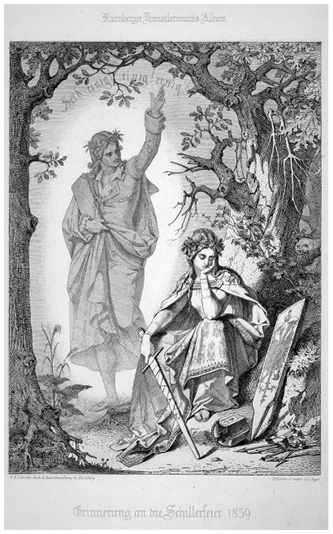
The impact of the 1859 commemoration in Switzerland was especially noteworthy – and for good reason, because Schiller’s Wilhelm Tell had canonized that country’s foremost national hero. When Schiller was honoured with a monument in 1860, the Mythenstein, that occasion led to Gottfried Keller’s agenda for a nationally Swiss festivity: the mass-participation cultural Festspiel. The fifth centenary of the Battle of Sempach as celebrated in 1886 took the form of such a Festspiel: choral tableaux with collectively spoken texts and incidental music evoking important episodes from the national past. After Sempach 1886, Festspiele were held with increasing frequency throughout the 1890s and up to 1914. In addition, the Tellskapelle (a fresco-ornamented chapel recently constructed, marking the spot where Tell had made his daring leap into Gessner’s boat) became the destination of an official civic pilgrimage, held annually from 1884 on.
Commemorations of national poets carried particular weight in the non-sovereign communities of Central and Eastern Europe: Mickiewicz, Mácha, Gundulić and Prešeren in Poland, Bohemia, Croatia and Slovenia. But also in established states, a tsunami of statues washed over cities’ public spaces, each one the focus for wreath-laying, speeches and choral cantatas – from Camões in Lisbon to Runeberg in Helsinki, from Moore in Ireland and Burns and Scott in Scotland to Byron in Athens.4 A particular type of Festspiel had also emerged further west. The Welsh eisteddfod has been mentioned: it had long ago been a poetic gathering and was now reinvigorated from near obsolescence by cultural nationalists around Thomas Price in the 1820s and 1830. Not only did it inspire Bretons and other Celts, but it has developed to become an important annual event in Welsh culture. Cultural revivalists in Ireland and Scotland adopted the template for their Oireachtas and Mòd festivals.5
Between the Pyrenees and the Alps something altogether remarkable took shape along literary-historicist lines.6 During the Bourbon restoration, the city of Toulouse reinvigorated its own, very ancient but somnolescent literary festival, the jeux floraux (floral games). The tradition went back to the late Middle Ages as a form of poetic contest (of the type also celebrated in Wagner’s Die Meistersinger von Nürnberg). Like so many medieval heirlooms it was now Romantically reinterpreted: as a vestigial, urban continuation of the region’s underlying troubadour tradition, which itself had of late been rediscovered and celebrated by philologists such as Fauriel. As they saw it, the troubadours had been the earliest to use the Latin-descended vernacular language to express a refined poetic sensibility. Their achievements antedated the development of a literary culture in Paris and Castile. And the city poets competing in their floral games were the civic successors of these chivalric Ur-poets. This was the prestige now shedding lustre on the revivified floral games. A youthful and as yet very conservative Victor Hugo made his literary debut by successfully competing in the floral games of 1819 and 1820, and the tradition had gathered steam by the mid-century.
From here, we can see the pattern of urban ‘reticulation’ setting in, much as in the urban concatenation of choral festivals in Germany: the format spreads from one town to the next. Each town, in adopting the festive format, ‘does its own thing’ locally as a form of urban sociability, with occasional exchange visits at most; but the repertoire they draw on is translocal and carries a national collective significance. Following the Toulouse example, Barcelonese city culture rediscovered its troubadour roots in the 1850s. When Verdi’s opera Il Trovatore premiered there in 1854, it was lost on no one that the storyline was based on the successful Spanish play El trovador by Antonio García Gutiérrez (1836). Whereas Welsh, Breton and Cornish poets were beginning to see themselves in ‘bardic’ terms at their eisteddfods and Gorsedds, here, poets were framing themselves as heirs to the troubadours of old. In 1859 Barcelona hosted its own first floral games, involving literary performances and contests and making many references to medieval troubadour and amour courtois culture. The successful contestants were given prizes of flowers wrought in precious metal, and pre-eminent writers were given the special title of ‘Master of the Joyful Arts’ (Mestre en gai saber). Barcelona closely followed the Toulouse pattern, and its Jocs Florals soon became a huge launchpad for a regionalist, and later nationalist, Catalan literary culture. The driving force was the philologist–poet Antoni de Bofarull, who in 1858 brought out a collection of contemporary poets writing in Catalan under the title The New Troubadours. In the same process, the familial relations between the regional Romance languages was renegotiated. Hitherto the regional idioms around Toulouse, Aix-en-Provence and Valencia had been referred to by more or less vague labels such as ‘Limousin’; but now their troubadour ancestry and their independent descent from late Latin were asserted (and hence their autonomous standing alongside Spanish and French) and their mutual relations redefined. (Not definitively, or to everyone’s satisfaction: the relationships between Occitan and Provençal and between Catalan and Valencian are still sensitive issues.) Catalan was definitively lifted to the A-list of European literary languages as a result of this movement, known as the Renaixença.7
The Barcelona festival in turn spawned floral games in Valencia, in Galicia (La Coruña and Santiago de Compostela) and in the Basque country, all of them regions that looked back to local feudal autonomy before the centralization of the modern Spanish state. There was also a backwash into France: across the Pyrenees there were joint initiatives, and when Catalan authors took refuge there from political repression, the result was a strengthening of ties and a further reinvigoration of Occitan/Provençal revivalism under the aegis of the Félibrige movement. These encounters inspired formatively influential writers such as Jacint Verdaguer and Frédéric Mistral, respectively. But the ideological trajectories diverged sharply: the Félibrige in France aligned itself with nostalgic conservative regionalism after 1871, while the Catalan movement remained radical in its pursuit of autonomy from Madrid’s reactionary autocratic rule. In both cases, what is nonetheless remarkable is how urban cultural festivals could reticulate, forming networks of mutual inspiration and mutual recognition that were translocal, transregional and indeed transnational as much as national.8
The City as Showcase: Modernity, Memory, Belonging
Walter Benjamin’s collection of notes and observations known as the Passagenwerk or ‘Arcades Project’ is organized around the covered shopping arcades of Paris, with their girder-and-glass roofs. For Benjamin, these were the new habitat for a modern leisure consumerism. They were places for loitering strollers (flâneurs) and chance encounters between strangers. They were also intensely scopic, visual: shops would offer their wares in windows that were like museum showcases or display cabinets; advertisement billboards and columns (the ubiquitous ‘Morris columns’) dotted Haussmann’s boulevards, bedecked with advertisements; even street-walking sex workers would join in this display culture, advertising themselves to lure potential customers. The key word for Benjamin was ‘panoramic’: named after coin-operated attractions where viewers could gaze at stereoscopic photographs of exotic locations. These commercial attractions formed part of a wider scopic regime that also included dioramas, waxworks, museums, viewing towers, zoos, botanical gardens, trade fairs and, later, the cinema. This display culture affected not only the city’s inhabitants and boulevardiers but also its visitors and the tourist industry: the modern city becomes an object of sightseeing and becomes itself a display platform. And often the displays would draw into their field of vision the wider world abroad: with its panoramas, botanical gardens and zoos, the city becomes a microcosm capturing global variety.9
This turn towards the spectacular Nebeneinander was also a turn away from narrative Nacheinander (see Chapter 8). As things were arranged visually in side-by-side displays, their historicity, the narrative one-thing-after-another was abolished. In the display cabinet called Paris, all of France and all the world were collapsed into a single location and all of the past was present in the urban here-and-now. That pattern had been initiated by the Paris-based, Cologne-born architect Hittorf, who in the 1830s had redesigned the large square between the Tuileries and the Champs-Elysées into what was called, aspirationally and programmatically, the Place de la Concorde. It had become the locus of multiple incompatible memories palimpsestically inscribed by the country’s successive regime changes since 1789: dedicated to Bourbon monarchs but also the place where Louis XVI had been guillotined. In order to retrieve a spatial sense of unity from the divided narratives of history, Hittorf’s design abolished all temporal references in favour of geographic ones. Two huge fountains on the oval’s focal points evoke the aquatic aspects of France: the country’s coastlines and its rivers. In the middle, an Egyptian obelisk was placed in 1836 (donated as a diplomatic gesture by Muhammad Ali Pasha). Its erection was a publicity stunt that demonstrated the tour de force of the French navy bringing it over with its new paddle-steamers and that carried overtones of the country’s imperial ambitions in Northern Africa (France was in these years engaged in the colonial conquest of Algeria). Around the square were placed eight statues of personified cities: Bordeaux, Brest, Lille, Lyon, Nantes, Marseille, Rouen and Strasbourg. They function almost as signposts pointing at distant places. The co-presence of these signposts (seated statues of female municipal deities) symbolically draws the various outlying corners of France, like so many spokes in a wheel, into the Place de la Concorde as a unifying hub of the country as a whole. And so Space serves to suspend Time, and Paris becomes a microcosm of the national territory. Hittorf repeated this gesture in his later Gare du Nord, that temple of modern transport, with on its roofline classicist statues representing all the cities now connected by the railways fanning out from that station. The statue of Paris stands in paramount position as the centre of it all, allegorizing what Benjamin would call the ‘Capital of the Nineteenth Century’.10
This spectacular spatialization was, of course, an overlay on the lingering influence of historicism. Even as Hittorf glorified space, distance and modernity, memorial statues to historical figures sprang up like mushrooms here as in all European cities, recalling a set of historical actors rendered canonical by Romantic historians and placed in public thoroughfares to assert the undiminished presence of the national past. Between 1830 and 1900, the Panthéon developed into the shrine to the great French fatherlanders that it still is today, with on the façade its dedication ‘To our great men: the grateful fatherland’ (Aux grands hommes la patrie reconnaissante). Some seventy-five free-standing statues were erected in Paris alone during this period (including twenty-two historical queens in the Luxembourg Gardens, and three to Joan of Arc), as well as some 300 smaller ones (or busts) that were set in the façade niches of the Hôtel de Ville, the Louvre, the Sorbonne, the Garnier Opera and other prominent public buildings.11
In many European cities, neighbourhoods newly constructed post-1870 outside old (formerly walled) city centres were programmatically given historicizing names, so as to provide a sense of continuity in these new streetscapes. Thus Barcelona’s Eixample and the expansion belt in Amsterdam, where the streets were named after admirals and painters from the country’s seventeenth-century ‘Golden Age’. The interplay between modern urban space and national memories is illustrated nowhere better than in the ground plan of the Parisian metro, familiar to anyone who has ever visited that city. The metro, a prime example of the accelerated technological modernity of the nineteenth century, is now a tangled web of linking connections. The stations usually take their names from the streets nearby;12 these are medieval in the old city centre (Châtelet, Louvre, Temple, Bastille, Notre Dame and many other church names); they evoke glorious events and victorious battles in the immediately adjoining belt (Rivoli, Vosges, Volontaires, Iéna, Alma, Austerlitz, Solférino, Wagram, Campo Formio, Pyramides, Crimée, Sébastopol, Trocadéro, Bir-Hakeim, Stalingrad), far-flung and, deeper in the suburbs, also longer ago (Tolbiac, Alésia). Marshals and generals are in evidence (Ségur, Hoche, Kléber, Daumesnil, Duroc, Drouot, Lourmel, Bizot, Molitor, Mouton-Duvernet, Pelleport and the defiant Waterloo hero Cambronne) as well as statesmen and politicians (Richelieu, Malesherbes, Mirabeau, Robespierre, Félix Faure, Gallieni, Gambetta, Vavin, Clémenceau, Charles de Gaulle, Louis Blanc, Jean Jaurès) and anti-Nazi resistance heroes (Bonsergent, Fabien, Lamarck, Guy Môquet, Gabriel Péri, Léo Lagrange). In the residential areas, we encounter names from arts, learning and literature (Balard, Curie, Jussieu, Mabillon, Monge, Pasteur, Réaumur, Louis Aragon, Victor Hugo, Raymond Queneau, Edgar Quinet, Voltaire, Emile Zola).
These lists give a sense of two things. The first is how many different ideological strands of political life in France are included, from Richelieu to Robespierre – with, to be sure, the radical ones concentrated in the more left-wing quartiers and arrondissements of Paris and the august literati in the more settled bourgeois parts. Second, the ultracanonical sits cheek by jowl with obscure names that by now need explaining (or looking up in Wikipedia, as I have done): the list ranges from celebrated household names to footnotes in specialized history. But even for those who are familiar with French history and culture and with the historical connotations of the more famous station names individually, the condensed and aggregated list may be somewhat startling in showing how very numerous and densely seeded all these names in fact are. The national-mnemonic background noise is much louder than we thought.
To be sure, the effect of a metro trip across Paris cannot amount to a propagandistic history indoctrination: in many cases, the unaware traveller will not even know if a name refers to a locality, a landmark or a person (‘Vavin’?). The semantic cloud that is the Parisian metro map is nothing if not diffuse, with many of the references hardly amounting to anything referential at all. But for all its diffuseness, the total effect of this accumulation of mnemonic signals is nonetheless powerful: it does not pedagogically ‘inform’ the metro traveller (i.e. guide them from ignorance to knowledge), but it offers a constant reaffirmation of the familiarity of these historical names and their droit de cité in the public sphere that is Paris (and, by implication, France). These names belong here, they are visible like endlessly repeated mantras at every stop and on dozens of signs, and this render the names, if not a concrete national reference, then at least a point of recognizability, a sense of belonging, and a habitual presence in one’s experience of public space. Habitual, that is, in the specific sense as defined by Bourdieu: a socio-cultural response that is so steadily and unremittingly present in one’s life that it ceases to be perceived as such and becomes unconscious, natural, like drawing breath or blinking one’s eyes.13
As such, the ‘habitual’, an ambient and latent presence, is the opposite of something we may call the ‘sensational’: something that is eminently noticeable, saliently standing out from the ordinary. And in the scopic regime of modern cities, much effort went into making display culture precisely that: noticeable, sensational.
But even as modern cities were developing into an archipelago of display platforms for the sensation of modernity, the countryside with its timeless peasantry was enshrined firmly in how the nation was imagined. That paradox – how in an increasingly urban modernity, the repertoire of the national identity became more rustic – will be addressed in what follows.
Narratives of Timelessness, Rustic Spectacles
The culmination of the nineteenth-century historical novel is Tolstoy’s War and Peace (1865–1869). It recalls the years 1805–1812. In the hands of a writer such as Tolstoy, the historical novel had outgrown its progenitor, Walter Scott. For one thing, War and Peace uses not the single ‘privileged witness’ protagonist but an entire palette of main characters, all with their own individual personalities and behaviours and together forming the collective tableau of an entire social class. Despite some sentimental vignettes of commoners – most importantly the meek and naively wise cobbler Platon Karatayev – the class at the centre of the book is firmly aristocratic: the action is set in mansions and among military officers. At the same time, Tolstoy sees the events as collectively experienced and somehow historically fated: great figures such as Napoleon may dream of ordaining, by their might and willpower, the course of events, but what determines the outcome of the war is ultimately the Russian Volksgeist as a transcendent instrument of the inexorable course of history – something that is intuited both by the visionary commander-in-chief Kutuzov and the saintly everyman Karataev. The moral tale of War and Peace is how an enervated aristocratic elite, conversing in French and pursuing its high-society life, finds its true character in the crucible of war: the Byronic prince Andrej Bolkonsky, the wavering count Pierre Bezukhov, the high-strung adolescent Natasha Rostov.
One celebrated episode revolves around Natasha’s winter visit to a relative’s country estate. Her uncle, though a nobleman, is rusticated and lives surrounded by his peasant servants. It is here that Natasha witnesses a song-and-dance evening with Russian folk music and is inspired to dance herself. Almost mystically, Tolstoy evokes how the movements of the folk dance come naturally and untaught to Natasha, like a slumbering instinct.
Where, how and when could this young countess, who had had a French émigrée for governess, have imbibed from the Russian air she breathed the spirit of that dance? … the spirit and the movements were the very ones – inimitable, unteachable, Russian – which ‘Uncle’ had expected of her. … Her performance was so perfect, so absolutely perfect, that Anisya Fyodorovna [a servant], who had at once handed her the handkerchief she needed to dance, had tears in her eyes, though she laughed as she watched the slender, graceful countess, reared in silks and velvets, in another world than hers, who was yet able to understand all that was in Anisya and in Anisya’s father and mother and aunt, and in every Russian man and woman.14
As a set piece, this scene has become famous and has furnished the title to an important cultural history study tracing the interaction between elite and folk culture in Russian history, Natasha’s Dance (Figes Reference Figes2002). My reason for highlighting it here is related specifically to the Romantic evocation of national character as an innate agency, truly a Volksgeist, and how indispensable traditional peasant culture had become by the 1860s as a validator of national authenticity: even in a historical novel and a novelistic philosophy of history. This turn from ‘past to peasant’ is noticeable both in literature and in painting over the course of the Romantic century (Figure 10.2). Not only does the modern state impose its national state structures on a backward-lagging peasantry (as described in Eugen Weber’s classic study Peasants into Frenchmen, 1976); the peasantry is at the same time canonized as an enduring, timeless presence at the heart of evolving modernity.
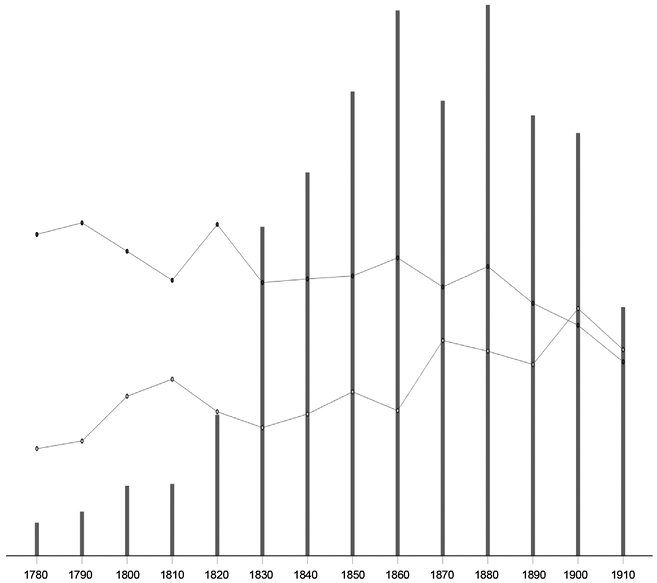
We have come across the sentimental presence of folk culture in Romanticism before, mainly in the Romantics’ interest in folksongs and folktales. For Herder, this interest was largely an assertion of the value of spontaneous, untaught art in comparison with the artificial requirements of (classicist) formalism; it dovetailed with Rousseau’s cult of innocent childhood and ‘noble savages’. The idyllic preference for a simple, rustic life over the stilted conventions of life at court or in high circles is of very long standing indeed, going back all the way to the arcadian and bucolic literature of classical antiquity.15 With Grimm and the Romantics, the ascendency of spontaneous authenticity over artificial contrivance gains a national-identitarian flavour: popular traditional culture is celebrated for having been unaffected by cosmopolitan or foreign-imposed ‘high’ culture and for having remained true to the nation’s proper, primitive, pre-civilizational origins – in other words, for being authentic in the root sense of that word.
Much of the medievalism of Romanticism – the fascination with a chivalric past – is already shot through with a folkloric interest in traditional rustic culture; and rustic idyll becomes increasingly prominent once historicist interest tapers off. Many ‘realistic’ tales and novels of the mid-century hold up life in the countryside as a wholesome alternative to the modernizing city, or as a sentimental alternative to modern pragmatic soullessness. The opposition systematized in the 1880s by the sociologist Ferdinand Tönnies was already in the air: between the traditional rural community (Gemeinschaft) and modern urban society (Gesellschaft). Community life, be it among the peasantry or on noble country estates, is evoked in German Biedermeier (post-Romantic) literature by such authors as Annette von Droste-Hülshoff (Die Judenbuche, 1842; Bei uns zulande auf dem Lande, posthumously published); it is what Dickens’s David Copperfield (1850) escapes to when he flees, on foot, from the London slums to his aunt’s cottage in Kent. The lure of the traditional countryside is evoked by George Sand (La Mare au diable, 1846); and it suffuses, with a cheerful nostalgic glow, Mickiewicz’s Pan Tadeusz (1834). We see its loving, lingering traces in St Mary Mead (Miss Marple’s village) and Downton Abbey, in the Provençal tales of Alphonse Daudet and Marcel Pagnol, in the ‘Piccolo mondo’ of Don Camillo and Peppone.
To be sure, the countryside became the location for tragic and fraught tales as well as idyllic escapism: thus in George Eliot’s The Mill on the Floss (1860) or Thomas Hardy’s Tess of the D’Urbervilles (1891), or in Janaček’s peasant opera Jenůfa (1904). But even in these works, life in the countryside is still represented as ‘timeless’ and representative of deep ethnographic structures and emotional sincerity; and what is selected for ‘comfort viewing’ are still adaptations of Eliot’s and Hardy’s happier-ending tales: Silas Marner (1861) and Far from the Madding Crowd (1874).
Mass-appeal literature commodified rustic local colour into a comfort zone for undemanding readers. In France, there was the regionalism of the Languedoc. Gounod’s opera Mireille (1864) was based on Frédéric Mistral’s dramatic poem in Occitan, Mirèio (1859; Figure 10.3); Mistral also inspired Alphonse Daudet, for example with L’Arlésienne, which was staged as a melodrama with music by Bizet (1872).16 In Germany, there was the phenomenon of Heimatliteratur and, later, the Heimatfilm, escapist idylls set in a timeless, unspoilt countryside with picturesque peasants and predictable plotlines (Berthold Auerbach, Village Tales from the Black Forest, 1842); this heile Welt or ‘unmarred world’ filled a market need in the suburbs of the modernizing industrial cities of the nineteenth century and in the guilt-burdened and war-ruined Germany of the 1950s. The peasant is here an essentially exoticist presence (not unlike Tolstoy’s Anisya Fyodorovna): always described as being alluringly different from the life-world of the readership. Heimat literature and the Dorfgeschichte (‘village tale’) accordingly became ‘domestic exoticism’ for the suburban lower middle classes.17
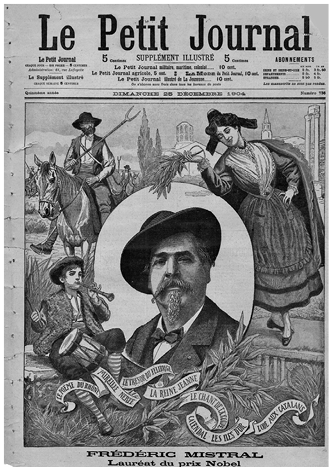
Figure 10.3 Long description
Front page of Le Petit Journal carries a color portrait of Mistral surrounded by rustic figures in a Provençal landscape: a farmer on horseback, an elegant young woman in traditional dress, a boy playing fife and drum. Underneath the portrait, there is a palm branch and scroll with the titles of his works.
The juxtaposition of traditional countryfolk and rustic landscape gives both an extrahistorical, ‘timeless’ quality. That effect had already been announced in Wordsworth’s ‘Solitary Reaper’ (1807), in which a singing maiden seen from afar, reaping corn in a wide valley, makes the poet (who cannot understand her, since she sings in Scots-Gaelic) wonder how historical, ancient or timeless her song is. The technique was also used by Thomas Hardy, whose Wessex novels often begin by describing, panorama-style, huge, brooding landscapes with a solitary wandering figure; as that figure is slowly zoomed in upon, the narrative detaches itself from the spectacle. Scott had used similar openings, but whereas he patented the trope of a cavalcade of knights making their way to a distant castle, Hardy’s wayfarers are peasants, countryfolk.18
In the transition from Wordsworth’s Romanticism to Biedermeier sentimentalism and Hardy’s naturalism, we see a ‘peasant turn’ even as Romantic historicism gave way to contemporary concerns. That transition from ‘past to peasant’ was powerfully affected by a sea-change in painting technique.
The Tube and the Dirndl: Plein-air Painting and National Costume
In 1841, John G. Rand patented a squeezable tin (or lead) tube for artist’s paint. Oil paint could now be kept from drying out and transported; it need no longer be mixed and used within the confines of the studio but could be taken on field trips, which heretofore had only been used for preliminary sketching or at best water-colour painting. Open-air oil painting had become a possibility.
One of the first to avail himself of this possibility was Gustave Courbet, the harbinger of a new current in painting that he himself called ‘Realism’. Rejected for an Academy salon in the mid-1850s, he mounted a private exhibition that he entitled Le réalisme. This challenge was all the more resonant because Courbet’s Pavillon du Réalisme formed part of a totally new type of display platform: that of the world fair or exposition universelle. The first world fair had been held in London – the Great Exhibition of 1851; it was followed by the Parisian Exposition Universelle of 1855. This was the noisy fairground that Courbet sought, bustling with five million visitors seeking a new type of commercial, leisure-time mass entertainment. It was a new ambience for cultural display, as Walter Benjamin was to observe later, expressing itself in commercial concourses such as dioramas, panoramas, zoos and shopping arcades. As the contemporary critic Champfleury noted, Courbet’s pavilion represented, for some, an audacious appeal to the public at large, bypassing institutions and selection committees, a sign of liberation; while for others it was an anarchic scandal, sullying art in the mud of fairgrounds. The controversy marked the beginning of an adversarial antagonism between succeeding generations, putting an end to the master–pupil filiations fostered by the academies. A few years later, in 1862, there was a crest in protests against the venerable Academy salon as the official showcase of academically endorsed art, as works by (among others) Courbet and Manet were rejected. As a palliative measure, a ‘Salon des refusés’ was organized; it included some of the more unconventional new work of the period and became a hatching ground for modern art. The Academy was losing its grip on the visuals arts.19
Ironically, these intensely urban, metropolitan developments changed the thematization of, precisely, the countryside. Fontainebleau and its great forest had become accessible by railroad. The railway station at Melun had opened in 1849, and the village of Barbizon was reachable from there; that soon became a haunt of plein-air painters armed with lead tubes and portable easels. They mainly did landscape and genre paintings of village scenes and evinced the new taste for ‘realism’, with its depiction of scenes from ordinary contemporary life. The brushwork became looser, crisp outlines made way for an evocation of shimmering, dappled natural light, and artists began to gather not in the studios at or around academies but in convivial, bohémien (and mixed-gender) countryside gatherings. The Barbizon school was the prototype of the artist colonies that would spring up all around Europe, taking over from the academies as the nurseries of great art.20
Plein-air painting, almost tautologically, focused on life in the countryside. ‘Realism’ à la Courbet, Cézanne and Van Gogh, or in the style of the Russian Peredvizhniki group and their colony at Ambramtsevo, tried to capture the modest, day-to-day essentials of life, often in all their poverty and with implied social criticism. That was a sharply different direction from the celebratory depiction of the nation’s historical heroism and glories. But in the process, the depiction of peasant figures in their traditional dress became a fixture, a pictorial icon. They are usually de-individualized, anonymous representatives of a class marginal to the art market but inspiring to artists and their social consciences; they are depicted in their habitual domestic, religious or agricultural pursuits (weddings, processions, milking or harvesting); and, if female, they are usually presented in a flattering light, with their colourful and exotic traditional dress as an eye-catching accessory setting off their elegant bearing to advantage (Figure 10.4).
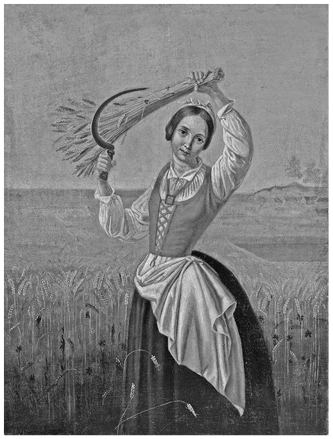
Those genre paintings of young peasant women in traditional settings are so ubiquitous across Europe, from Brittany and the Basque country to the Baltic and the Bucovina, as to become mere ambient background noise to spectators nowadays. But they represented a new, anti-academic movement in nineteenth-century art that shifted the symbolic representation of the nation’s authentic character away from historical grandeur to what was, in the English phrase of that period, ‘racy of the soil’. And they also document traditional practices such as markets and fairs, seasonal feasts and religious processions, lovingly representing the colourful garb in which this all took place.
The depiction of nationally representative costume is not a Romantic invention but goes back to earlier centuries. The earliest examples antedate the invention of print. Maps of the seventeenth century habitually represent, in their margins, figures from various lands in their specific costumes as a display gallery of cultural diversity. Costume books, often depicting colourful sartorial traditions such as those of Spain, the Netherlands and the Scottish Highlands, profited from improved printing techniques and provided a panorama of local colour to armchair travellers, who could enjoy the genres of Voyages pittoresques or Los Españoles pintados por su mismos; book illustrations added their weight to this ambient tradition.21
Costumes themselves acquired the function of signalling a national identity. Romantic German students dressed in an ‘Old German’ fashion proclaimed by Arndt in 1814 and inspired by Dürer portraits (as in the hairstyle and the outfit of Hoffmann von Fallersleben, Figure 4.4), with tight waistcoasts and open collars: rejecting all the frivolous elegance of French style. Caroline Pichler expressed a hope in 1815 that her Old German dress for ladies would be worn both in Berlin and in Vienna. A military element was added for those in the armed forces. Military uniforms were specific to the armies of different countries and regimes and tended to follow vernacular sartorial traditions (Hussars, Cossacks, Bersaglieri, Highland regiments). In the course of the nineteenth century, these obtained a powerfully national symbolism at a time when formal (civil) dress for men was becoming increasingly transnational and nationally indistinct. George IV wearing a Highland kilt during his Edinburgh visit of 1821 marked an adoption of this vernacular dress code as prestigiously ‘national’. The nobility of Hungary prided itself early on its Hussar-style, tight-waisted and heavily embroidered ‘Attila’ jackets and its tight, embroidered breeches, with the aristocratic accessory of the sabre like the one given to Liszt (Chapter 9). This style was that of the Empress Maria Theresa’s Hungarian Guards; it had become fashionable in Vienna and had been worn in the 1780s as an expression of protest against Joseph II’s attempts to centralize and Germanize the empire. A similar jacket style was worn by the Polish nobility (the so-called czamara), and that frog-and-loop jacket became popular as the čamara among Czech supporters of the Polish Uprising of 1831 and again in 1848 among supporters of Hungarian independence. From there it became a pan-Slavic signal, influencing the uniform of the many Sokol athletics clubs that sprang up in Bohemia and other Habsburg–Slavic regions from the mid-century (Figure 10.5).22
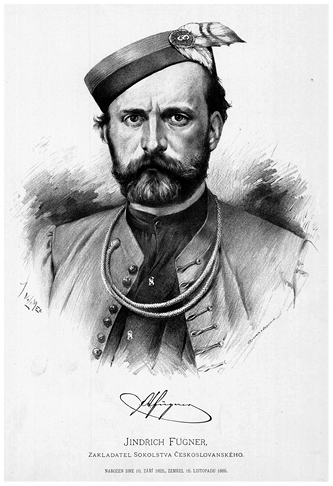
Thus traditional and ‘national’ dress began to make its way into the urban middle classes. But the main thrust of that development fanned out from the Alps. The mountain-dwelling population of the Tyrol had gained great sympathy and symbolic prestige following their 1809 insurrection against Napoleonic rule; the leader, the innkeeper Andreas Hofer, was glorified in song and later in painting and statues.23 Tyrolean garb shared in this prestige: woollen or leather knee-breeches (Lederhosen) and felt hats became the preferred dress code for leisure-time huntsmen and hikers.
Even before Hofer’s insurrection, in 1806, the Bavarian agricultural scientist Joseph von Hazzi had compiled a description of peasant dress styles in lower Bavaria as part of the new statistical inventory of state culture (Trachten aus Niederbayern nach den statistischen Aufschlüssen über das Herzogtum Baiern). Later, the historian Felix Joseph von Lipowsky published a collection of Bavarian popular costumes, to which he gave the epithet ‘national’ (Sammlung Bayerischer National-Costüme). The various regions of Bavaria (flanked by neighbouring Tyrol, the Black Forest and Switzerland) were at the forefront of this national-traditionalist dress revival under the Romantically minded Ludwig I of Bavaria. In 1842, the wedding of the Bavarian Crown Prince Maximilian with the Prussian Princess Marie featured Bavarian peasants in traditional costume; in 1853, the same Maximilian (by then King Maximilian II) ordained a decree for the ‘Encouragement of national feeling and especially of traditional dress’ in order to oppose ‘general homogenization and levelling’. The first societies with the express aim of cultivating traditional dress (Trachtenvereine) were founded (again in Bavaria, more particularly in the Alpine regions) in the 1850s. They joined into a regionwide federative association (Gauverband) in 1883; the number of its affiliates grew from fifteen associations in 1891 to sixty-one in 1906. Meanwhile other regional federations were founded, and in 1925 they merged into a Bavarian federation. The motivation was avowedly conservative-national: in 1886 King Ludwig II had ordained a decree to encourage the foundation of such societies ‘in order to preserve the beautiful dress of the mountain regions and the old dances … and to foster in these societies a communal feeling and love of the homeland and the fatherland’. Accordingly, such Trachtenvereine proclaimed as their aim ‘to throw up a barrier against the modern age while cultivating, and preserving for posterity, the dress, mores and traditions of our ancestors’.24
While Bavaria and neighbouring Tyrol were the heartlands of the Trachtenvereine, the trend spread across the German lands, from the Alps to the north Frisian islands and including Austrian and Swiss societies and associations. A generic women’s style known as the Dirndl (a blouse under a tight, often low-cut bodice, loose long skirt with apron, white stockings) emerged in the 1870s; it was originally worn by servant girls and as such became known to the urban tourist patrons of rural hotels and inns. Like the Lederhosen it became a popular fashion, also in non-rural settings, in the twentieth century. Having originally been fostered by royal patronage, the success of the Dirndl was mainly commercially carried: the Munich fashion house Wallach, established in 1900, specialized in these dresses and sponsored them being worn by servers at the Munich Oktoberfest,Footnote * when that event celebrated its centenary in 1910.25 The success of the Dirndl thus marks the adoption of peasant culture by the urban middle classes, facilitated by festive culture, leisure consumerism and countryside tourism (Figure 10.6).
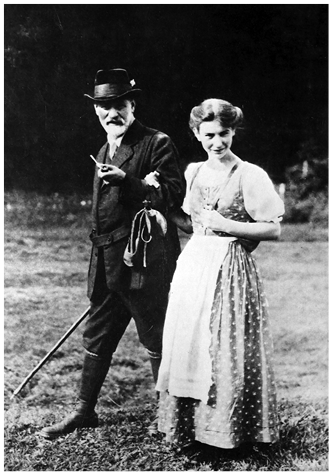
A similar pattern is noticeable everywhere in Europe: folk traditions became commodified and an inspiration for middle-class leisure pursuits, although the particulars were very different from country to country. In Sweden and Norway, traditional patterns were used by feminist activists. In Sweden, Hanna Winge and Sophie Adlersparre, founders in 1874 of the still active ‘Friends of Manual Craftwork’, attempted to create cottage industries for rural women. In Norway, where photographs of peasants in traditional dress became popular from the 1880s, bunad (traditional dress) was used in a 1902 performance by the folklorist and folk-dance expert Klara Semb. This inspired the pamphlet Norsk klædebunad (1903) by her mentor Hulda Garborg, a social radical and cultural revivalist who was also active in the fields of traditional cookery, amateur theatre and women’s rights. We shall encounter this remarkable combination of stylistic traditionalism and social reformism further on, when discussing the Arts and Crafts movement that inspired Garborg.26
In the wholly different social context of Central and Eastern Europe, emergent cultural sociability found an outlet in choral singing. As women increasingly participated in mixed choirs, they opted for traditional local dress as a collective stage costume. Some of them may have had inherited specimens of such dresses in their wardrobes; if not, the presence of many plein-air paintings in the various local galleries and museums provided patterns from which to work.27 The fashion caught on in the Slavic portions of the Habsburg Empire and also in western provinces of Russia: the Baltic, Poland and Ukraine. In Lithuania, German Romantics such as the polymath Georg Sauerwein organized festivals where Lithuanians were invited to appear in traditional costume. Photographs were taken on those occasions, and Sauerwein used these as illustrative material in his lectures. Sauerwein also exhorted Lithuanians to maintain or to revive their ancient garments so as to display their nationality.28
At his suggestion, the choral director Vydūnas (pseudonym of Wilhelm Storost) had his Tilsit Singers’ Society perform in Lithuanian costume (for the women: white aprons, white embroidered shirts, the heads decorated with blue ribbons and green myrtle wreaths). National dress henceforth became a matter of Lithuanian self-identification; and, as in Latvia and Estonia, it was part of collective-performative public presence involving choral singing and amateur theatre. The attire was home-made (possibly after collective consultations).
From the Munich Oktoberfest to the Tilsit choral festival: the adoption of national costume is a veritable performance of national identity. The performers belong to the emerging modest middle classes, sensitized to national identity and traditional culture; the repertoire is that of traditional peasant culture, initially perceived through the ‘male gaze’ of plein-air painters and costume ethnographers, then appropriated by the wearers themselves. And the setting is something that emerges in the context of late-nineteenth-century modernity, along with its proto- or early-feminist undercurrents: that of the leisure-time display platform – festivals and fairgrounds, where town audiences could watch country performances. The countryside with its nationally characteristic traditions was exhibited.
Exhibiting the Nation: World Fairs and Nation-Branding
London’s Great Exhibition of 1851 was launched out of a pre-existing tradition of public trade and industry fairs. Like them, it displayed the products of agriculture, manufacture, trade and industry (with an emphasis on technologies and design innovation); but it was held in a dedicated new space, the famed Crystal Palace, with its novel girder-and-glass design – made possible by the invention of sheet glass in 1832, which was then widely used for railway stations and large greenhouses in botanical gardens. The Crystal Palace, as the embodiment and prototype of the exhibition platform, became itself a meta-exhibit, both containing the items of display and being one in its own right. This nesting recursivity was to become one of the defining features of world fairs henceforth: they became a telescoping sub-space, a window on the world and at the same time a microcosm of the world, where one could lose oneself among pavilions, and, within the pavilions, among the many exhibits on display there. These displays were often themselves of a compound nature, uniting various elements and performative practices – dances or musical performances with ‘authentic’ costumes and instruments, or ditto tea ceremonies. The Crystal Palace, copied or imitated in numerous other venues (New York’s Crystal Palace, 1853, Amsterdam’s Paleis voor Volksvlijt, 1855, Porto’s Palacio de Cristal, 1865, the Grand Palais in Paris, 1897), shared its pavilion typology and glass/girder ceiling with the century’s great shopping arcades and marked the transition from a fair (in the meaning of ‘marketplace for economic exchange’) to fairground (in the meaning of ‘a venue for multiple spectacular and immersive entertainments’): ‘sensational’ rather than ‘habitual’ culture.29
The Crystal Palace remained a venue for mass entertainment beyond the immediate occasion of its construction; as we have seen, a large choral festival was held there in 1861. It also heralded a new type of metropolitan landmark. While the fairs themselves were short-lived events, the sites tended to endure, and in some instances for longer, and more prominently, than one might expect. They needed to be constructed, often hastily, under the pressure of a commercial budget and an organizational timeline, and they needed to encapsulate a maximum of space in a minimum of building material; in that respect they were more like circus tents than real ‘palaces’, as they grandiloquently styles themselves. The term ‘pavilion’ does their ephemeral and thin, hollow nature greater justice. They could be removed to make place for successor buildings (like the Parisian Palais de l’Industrie, 1855–1897, and Palais du Trocadéro, 1878–1935), and they were prone to accidental destruction by fire. The New York Crystal Palace went up in flames in 1858, the Amsterdam Paleis voor Volksvlijt in 1929, the London Crystal Palace itself in 1936. Or they could just drop out of fashion, lose their function and be demolished. But in a surprising number of instances, things that were conceived as follies, extravaganzas or temporary hangars became fixtures in the cityscape. Besides the flagship examples of the Brussels Atomium (1958) and the Parisian Eiffel Tower and Grand Palais (1889 and 1900), we encounter, also in Paris, the Palais de Tokyo and the Palais de Chaillot (1937); in Prague, the Jugendstil Palace of Industry and the neo-Gothic Tourist Pavilion (1891); in Rome, the Fascist-era Palace of Italian Civilization (1942) and the neo-baroque Pan-Latin lighthouse on the Gianicolo hill (1911, Figure 10.7); in Lisbon, the huge waterfront Monument to the Discoveries (1940); in Barcelona, the waterfront Columbus Monument and the Triumphal Arch leading into the Parc de la Ciutadella (1888); in Seville, the enormous, tilework-embellished Plaza de España (1929) – to name only some prominent examples within Europe.
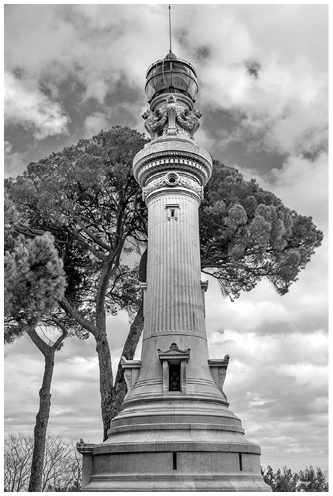
As these examples show, world fairs played an important role, in tandem with the rise in mass tourism, in turning cities into tourist attractions, studded with places of interest and entertainment spaces. As commercial enterprises, world fairs relied on mass attendance to succeed, and indeed on a larger attendance than the local population could provide. A logic clicked into place whereby the necessary crowds at world fairs would come from far away and stay only for a limited amount of time – the time of a holiday excursion. Their communal presence was, as a result, both numerous and transitory, and their engagement with the spectacle and its exhibits was necessarily and almost by definition superficial; hence also the great number of take-home souvenirs. What was proffered was a sampler of a world of goods and sights, and what was done by the audience was precisely that: they sampled. Heterogeneous cultural products from very different countries were taken in and tried out in quick succession. To be sure, some cultural exhibits could strike a responsive chord (the European interest in Japanese tea, in Indonesian gamelan music and wayang shadow-puppetry, or in Indian raga music are sometimes linked to world fair encounters) and play a role in cultural transfers; but in the majority of cases they left little more impact than a ‘flavour’, a vague familiarity based on a remembered and confused sense of local colour.
The exhibition tradition had until 1851 been intra-national, aimed at strengthening a country’s inner resources. The world fairs added to this a new, mercantilist dimension: that of an international arena in which many nations participated and in which competition and exchange were equally important and equally justified. Not only did nations vie with each other and boast of their own achievements, they also took a mutual interest in each other. What could a country expect from the world as a sphere of operations? What could it expect by way of imports, exports and trade opportunities? For each country to expect interest being taken in what it had to offer, it had to reciprocate by taking an interest in what the others were offering. As manifestations of growing economic internationalism, world fairs were giving the nation a new setting: not the enmity of its Other but its participation (both competitive and collaborative) in an international economic order.
The economic internationalization that world fairs exemplified and encouraged was counterbalanced by national self-positioning. As might be expected, culture provided the repertoire for that. World fairs themselves became an internationally coordinated enterprise, taking place, now in this, then in that metropolis and gradually crystallizing into a fixed system.Footnote * But universal and global as they claimed to be, the format very early on explicitly required participants to display themselves also in their local colour and national specificity, with exhibits of traditional lifestyles or cottage industries. And whereas technological progress and the intensification of world trade tended to lead to convergence between modern industries and economies, countries positioned themselves as individually recognizable point of interest – thanks to their cultural traditions.
This led to a triangle of possible registers in which participating nations presented their individuality to the world: either in attractively playful, highly decorated but makeshift pavilions in the style of fairground attractions; or as dynamically modern, internationally engaged and forward-looking (this leading to the great fashion of an almost futuristic ‘international modern style’ in pavilion design); or, finally, as rooted in authentic traditions that gave each country a national character of its own. These three modalities between them reflect the triangle of ‘amusement, modernity and memory’ that we have seen at work in the Parisian cityscapes as analysed by Walter Benjamin; and in that triangle, traditional peasant culture, historicism and high modernity are brought together in the nation’s international projection of its self-image. The use of vernacular architecture is a key element in the display repertoire, using either historicist pastiches of ancient landmarks or quaint, popular structures: Ottoman kiosks, Byzantine churches, Alpine chalets, American wigwams, rustic villages and traditional Flemish or Merry Old English townscapes. An expo fairground had to be experienced as an architectural zoo; and a specific and authentic culture became a trademark, a ‘unique selling point’ for participants.30
The eclecticism and mixing of registers (something that nowadays counts as the very definition of kitsch) was of course part and parcel of the format. This was a kermesse, a bazaar. The underlying constant was that the nation’s particular identity was here used as an identifying ‘brand’ in a trade emporium that mashed up the entire world into a welter of economic and cultural encounters and exchanges. In this light, the hoopla-national profiling that world fairs called for may represent the first step in a development that would ultimately lead to the condition of ‘banal nationalism’. World fairs came into their own in the century of trade internationalization. Trademarks had come into use around the time of London’s Great Exhibition, and by 1891 an attempt was made to regulate their use internationally (the Madrid Agreement Concerning the International Registration of Marks). By this time, nationality itself was beginning to develop into a trademark of sorts. Geographical indications of product provenance were first imposed by the British country-of-origin legislation of 1883, initially a protectionist measure against imports falsely pretending to be British-made. However, the imposition of labels such as ‘Made in Germany’ or ‘Swiss Made’ soon became boastful marks of quality; and between 1905 and 1919 France enacted a number of Appellation d’origine laws. Thus, as the mesh of international trade grew more tight-knit, a dual necessity took shape: the identification of a product’s national point of origin, and at the same time the identifiability of the nationality itself as a recognizable point of origin. Hence the use of national flags as brands and logos on representative ‘national’ products: watches, pocket knives and chocolate with Swiss flags, tulip bulbs and cheeses with Dutch flags, skiing resorts with Austrian flags. In this bidirectional dynamics – closer involvement of the nation-state in an international mercantile world order; greater need for the nation to set itself apart as recognizably different from the others – world fairs played a leading role.
A national flag on a consumer product such as a pizza box, pocket knife or pickled-herring snack is almost a textbook definition of what Michael Billig (Reference Billig1995) has termed ‘banal nationalism’. As with the names of the Parisian metro stations, the effect is one of ambient habituation. The diffuse and trivial carriers (pizza box, pocket knives or herring) turn the nation into a ‘hidden persuader’, giving to a consumer product a trademark or logo with an instant, automatic feel-good factor. The national brand is used not as a crude exhortation to ‘buy this product because it represents an admirable country’ but in a more indirect way: ‘We who bring this product to your attention do so on the basis of what we think is a shared affect between us and you, the customer: a reliance on the national values symbolized by this flag and applicable to this product.’ In advertising terms, the use of the flag is a ‘reason to believe’: it sends not a message in its own right but a meta-message serving to enhance the message that it accompanies, providing it with a subliminal feel-good factor.31
Alongside this ‘habitual’, unobtrusive nationalization, the display of exotically local-coloured culture has a more ‘sensational’ effect. The reliance on culture to provide characteristic distinctness and authenticity is now firmly co-opted by the modern state as a self-profiling strategy: for states, with their economic and trading policies, were the institutional participants in world fairs. World fairs, in other words, feed into the increasing instrumentalization of national identity for the benefit of state interests.
To be sure, these were not yet the nation-states that would emerge from the Great War; many of them were empires with colonies worldwide and considerable cultural diversity within their peripheral provinces. As a result, there is a fluid scalarity in their self-presentation. Historicism and technocratic modernity are used to project the metropolitan heartland; but at a sub-imperial level, the rustic provinces and the colonies were used to provide traditionalism, local colour and exoticism. In the cafés, cafeterias and beer gardens, regionally specific food would be served (coffee, tea, lager and sausages), enlivened by national music performances; with ‘Gypsy’ musicians being a particularly exotic and popular feature for Hungarian and Romanian cabarets (Figure 10.8).32
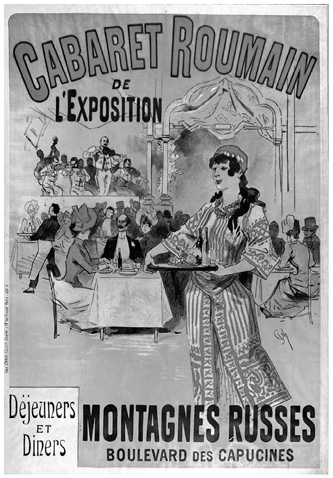
As the presence of those Romany musicians indicates, human subjects themselves were exhibited as local-colour features, in their traditional costumes. Sweden displayed mannequins in traditional peasant clothes and sold postcards depicting these; the Ottoman empire for its Vienna participation provided a sumptuous album of all the local costumes worn in its various provinces, from the Balkans to the Maghreb. Outside the immediate framework of the world fair, the Russian empire would follow that Ottoman template when it brought out a lithographed album of ethnic costumes in order to mark the Empire’s millennium; and in 1883 the imperial conspectus of its rich diversity would culminate in the Austro-Hungarian Kronprinzenwerk, a twenty-four-volume encyclopedic panorama of minority folk traditions under the benevolent aegis of the Habsburg crown prince. A highly specific development took place in Albania. The Garibaldist insurgent Pietro Marubi took refuge from political persecution in Shkodër and started a photographic studio there, soon specializing in portraits of locals in their traditional costumes. Over the decades, the Marubi studio remained active as the founder’s son and grandson took over, and their local postcards became popular among visitors, tourists and soldiers stationed in the area. This sustained production amounts to 150,000 negatives documenting a wealth of traditional costume and culture; it is now incorporated in Albania’s Marubi National Museum of Photography.33
Meanwhile, back at the fairground, some displays went one better than mannequins in display cases, photographs and lithographs: performers were on display in local-colour settings, employed in traditional handicrafts and wearing traditional apparel. This type of ‘folk village’ anticipated what would become the many open-air folk museums of Europe, beginning with Sweden’s Skansen resort near Stockholm (1891; the staff, like that at the Munich Oktoberfest, were dressed up in folk attire to enhance the sensation of authenticity). A similar performative turn was taken in the display of the trading empires’ colonial outposts: Indonesian dance and gamelan music were performed in Dutch exhibits featuring a Javanese folk village, Buffalo Bill displayed the horsemanship of his ‘Cowboys and Indians’ Rough Riders, and, notoriously, ‘primitive’ people from the colonies were put on display in ‘human zoos’. Thus the scalarity of imperial self-display ranged from the national heartland to the rustic periphery to the outlying colonies.
Used as we are nowadays to the power distribution inherent in ‘the gaze’, we cannot but consider the reduction of local cultures into an object of metropolitan spectacle as anything other than degrading. The colonial exhibitions held within Europe were part of a Eurocentric exploitation both of the natural resources and of the inhabitants of the colonies and their cultural riches, and as such these exhibitions form a standing reproach, a century later, to this European legacy. The sites that were designed to celebrate European colonialism (such as the ones at Brussels in 1897 and Paris in 1931) have now been refashioned into postcolonial reflections on this problematic heritage: the AfricaMuseum in Tervuren and the Cité de l’Immigration in Paris.
Degrading the ‘human zoos’ certainly were. The Jardin d’acclimatation in the Bois de Boulogne, where they became a fixture, had originally been a zoo, founded to test the possible domestication of exotic animals. Most of its animals were eaten during the siege of Paris in 1870–1871. In 1877 the management started to mount ‘ethnographic spectacles’, twenty-two in total over the next decades. These were discontinued in 1931 and the Jardin became the amusement park it is today. ‘Acclimatizing’ was a misnomer: the subjects were exhibited with insufficient clothing in the uncongenial Parisian temperatures, and thirty-two of them died of exposure.34 The entire set-up confirmed or expressed existing power relations and was complicit in their underlying injustice. But such exhibitions were the outer end of a sliding imperial centre–periphery scale on which the ‘nation’ was as yet uncertainly positioned. Nor were all ‘existing power relations’ necessarily perpetuated or consolidated by these displays; world fairs were reflections and manifestations not only of centre–periphery imbalanc but also of shifts in that balance. Local-colour advertisement was quickly adopted by non-European empires or states to gain access to a new globalized market economy – especially by Japan and the United States, but also by the Ottoman Empire and independent Latin American states. As world fairs came to be hosted outside Europe (Philadelphia 1876, Melbourne 1880, Chicago 1893, St Louis 1904, San Francisco 1915), non-European countries found a platform for self-presentation bypassing the central position that the old continent had arrogated for itself. The careers of the important nation-building artists Raja Ravi Varma of India and Kakuzo Okakura of Japan were launched, tellingly, at the Chicago’s World’s Fair in 1893, which also provided a global rostrum for the fin-de-siècle guru Swami Vivekananda. And the ‘colonial’ expositions held in Calcutta (1883, 1923) and Hanoi (1902) and in various Australian cities (Sydney 1870 and 1879, Melbourne 1872 and 1888, Adelaide 1887) exhibit a striking difference from the ones in Paris or Brussels. No human zoos there; rather, those events signal colonies taking a more self-focused stance as regards their economic position in the world, announcing a presence in world trade that, at odds with a mere exploitative extraction economy, would later in the century lead into its logical consequence: independence. Autonomous participation in a world fair would also become a newly independent country’s manifestation of its place in the twentieth-century’s international order, as we can see from the presence of former imperial peripheries – Lebanon, Poland, Ireland and the Baltic states – at the Chicago Century of Progress Expo, 1933, and Paris’s Exposition Internationale des Arts et Techniques dans la Vie Moderne, 1937. Europe’s Asian and African colonies would follow suit after World War II.
There is a parallel of sorts between the developing presence of extra-European colonies and intra-European imperial peripheries. The large ethnographic exhibition mounted by the Russian empire in Riga in 1896 was to some extent colonial vis-à-vis Russia’s inner minority cultures, to some extent also a Slavophile manifestation of pan-Russianism, but not insignificantly an event putting Riga on the map as the empire’s most important city after Moscow and St Petersburg, and a boost for Latvian awareness. The Bosnian-Herzegovinian pavilion that the Austro-Hungarian Empire (having annexed that territory) put up in Paris 1900 was designed by Alphonse Mucha, who used his unique combination of art nouveau style and pan-Slavic political sympathies to deliver an oblique message unintended by the imperial rulers. The intense regionalism that was deployed by Spanish designers fed into the localism of Barcelona, which co-hosted the 1929 event together with Seville; the Spanish presence was thus being riven between a Catalan wing at one end and an ‘Ibero-American’ one at the other.35
Late-nineteenth-century regionalism was, if anything, strengthened by a cult of traditional arts and crafts in the empires’ rustic peripheries. Patronizingly celebrated as ethnographic infotainment at the world fairs, the local artists and intellectuals nonetheless took strength and inspiration from a sense that Europe, like the world at large, was a transnational palette in which each cultural community could find its own way towards modernity and a coequal standing. What counted as quaint local colour in the fairground ambience became nationally iconic when repatriated into its home country: the Finnish Pavilion in Paris 1900 furnished the baseline design for the Finnish National Museum in Helsinki. Similarly, a Byzantine pavilion at the Paris 1900 Expo, designed by the Frenchman Lucien Magne, was re-erected, iron columns and girders and all, in Athens where it was consecrated as the church of Agios Sostis, Christ the Saviour. And in many countries, open-air museums of traditional peasant dwellings turned into internal, localized fairs celebrating the country’s own identity. Skansen near Stockholm was copied across Europe, with an agenda of internal identity affirmation rather than external local-colour display. Ironically, much as Heimat nostalgia is a form of ‘domestic exoticism’, cultural nationalism in subaltern regions often begins as internalized exoticism.
Europe’s imperial peripheries differed from actual colonies in a number of respects. Both lacked self-determination; both were in a subaltern position and had known violent subjection in their past. But the imperial provinces were not, on the whole, subject to an extraction economy; in the local cities and market towns there was an educated class, as well as a petty bourgeoisie and a white-collar working class with sufficient spare time to pursue cultural interests; and cultural interests could enjoy patronage and fostering from a home-grown elite. Scotland, Ireland, Catalonia/Aragon, the Basque country, Poland-Lithuania, Bohemia, Hungary and Croatia all had vestiges of an indigenous feudal past and could look back on their own high-prestige histories, which were frequently invoked as a morale-booster against contemporary subordination.Footnote * It is in the context of these sub-imperial peripheries that we see a particular flourishing at the fin-de-siècle of a new type of sub-imperial, culture-driven, late-Romantic nationalism, characterized by a new way of combining traditional vernacular culture with progressive politics. The spark-off moments came from the Arts and Crafts movement in London (on which more later in the chapter) and from an amateur theatre in Western Norway.
Henrik Ibsen and the Theatre
In the 1780s, Schiller had hailed the theatre as a ‘moral institution’ allowing for the development of a public sphere in modern Germany as it had once done in ancient Athens. Certainly the dramatic collaboration between him and Goethe in Weimar had created a rejuvenation of German letters. But for all that, the Romantic generation tended to prefer lyrical poetry and prose fiction to the drama. Goethe’s Faust (1808/1832) and Shelley’s The Cenci (1819) had been all but unplayable; theatres tended to provide social entertainment rather than exploring new artistic horizons. Even in France, where the advent of Romanticism had been heralded by Hugo’s Hernani (1830; or rather, its preface–manifesto), the theatres drifted to boulevard amusements with easy-going plays lavishly produced. The point of gravity for theatre productions shifted to musical performances, with grand opera as the prestigious flagship, surrounded by a flotilla of more popular ‘variety’ entertainments, from operetta to zarzuela and vaudeville. Occasionally a nationalizing impulse could emanate from here, but only incidentally. Thus Kajetan Tyl’s operetta The Shoemakers’ Feast of 1834 featured the nationally sentimental song ‘Kde domov můj?’ (‘Where is My Homeland?’), which grew in popularity to become the Czech national anthem in 1918.36
One place where the theatre played a fully national role was Copenhagen, where Adam Oehlenschläger set the tone with his dramatic evocations of the past (starting with his 1809 Lord Håkon the Rich). Oehlenschläger’s influence radiated out to Christiania (now Oslo), which recently had moved from Danish to Swedish rule but where Danish was still the language of high culture. In Norway, a budding writer, Henrik Ibsen, marked Oehlenschläger’s death in 1848 with the elegy ‘The Skald in Walhalla’; Ibsen, too, would at the beginning of his career write history plays in the Oehlenschläger mode. Now largely forgotten, they included Lady Inger of Ostrat (1855), The Vikings at Helgoland (1858) and Pretenders to the Throne (1863).
What was formative and innovative in Ibsen’s career as a playwright was his work for a small amateur theatre company in the provincial town of Bergen.37 Ibsen stayed there from 1851 to 1857, then relocating to the Christiania theatre until its closure in 1862. When Ibsen moved abroad (he would not return to Norway until 1891) he abandoned the thematics of semi-legendary heroic warriors. For his Brand (1864) and Peer Gynt (1867), he turned, tellingly, to the countryside: Brand is a moral tragedy set in a rural parish, and Peer Gynt relates the tall tales of a larger-than-life strongman (the play is now known mainly for the incidental music that Edvard Grieg composed for it in 1876). But from the mid-1870s on, Ibsen’s taste for realism (now no longer just a pictorial but also a literary current) came to the fore, and he turned to the emotional and moral problems of the contemporary middle classes living in post-Romantic and post-religious disenchantment. Plays such as The Pillars of Society (1877), A Doll’s House (1879), Ghosts and An Enemy of the People (1882) drew on a stagecraft of frugality that he had learned in Bergen but now disseminated globally: the plays premiered in Munich, Copenhagen, Chicago and Oslo respectively. As critics internationally hailed his work, Ibsen became the figurehead of a new approach to drama altogether, ‘literary theatre’. Literary theatre eschewed the glitz of the lavish boulevard productions; its audiences were small and the plays that were performed were muted in their production values, relying mainly on the dramatic and literary appeal of the plays’ dialogue. Ibsen’s unforgiving exposure of the soul-destroying nature of social conventions inspired avant-garde circles in the 1880s; G. B. Shaw and James Joyce were both card-carrying ‘Ibsenites’, and many small theatre troupes availed themselves gratefully of his sparse, almost spartan production values.
Ibsen’s influence took a specific turn in Dublin, where the London-raised Irish poet W. B. Yeats wanted to establish a literary theatre. Yeats’s taste (he had pursued his early career among fin-de-siècle aesthetes and ‘decadents’, and he was a snob) did not run to Ibsenite middle-class realism or naturalism; his penchant was more for symbolism, as performed in Parisian theatres staging the rarefied aesthetes Maurice Maeterlinck and Auguste Villiers de l’Isle-Adam. But Yeats’s political loyalty lay firmly with Ireland, culturally fallow ground in his view, and a literary theatre in Dublin could make use of amateur companies that had, for their part, certainly been inspired by Ibsen. The resulting Irish Literary Theatre was a hybrid in many senses, uneasily straddling the social radicalism of Ibsenites and Yeats’s elitist avant-garde aestheticism. Its use of the term ‘national’ was in effect glossing over two contradictory meanings of that term: for Yeats, ‘national’ was the opposite of ‘provincial’, meaning that Ireland could outgrow its drab vulgarity and take its place in cosmopolitan European modernity; for others, it fitted more in the mold of Douglas Hyde’s ‘de-anglicisation’, meaning that Ireland should abandon alienating foreign influences and return to its native-rooted cultural strength. Cosmopolitan or nativist? The history of the Irish Literary Theatre was marked by vehement altercations between these two wings throughout its existence.38 The plays in its repertoire similarly oscillate between international avant-garde and de-anglicizing propaganda.
What was beyond doubt was the high quality of the repertoire and of the acting: this theatre was innovative and inspiring, and at its best it managed to draw on Irish themes and settings (both legendary-heroic and contemporary-rustic, past and peasantry) to implement a non-complacent, nonconformist, innovative agenda. The unprofessional background of the actors became an asset: they delivered their lines without ‘hamming it up’, in a pensive manner that suited the theatre’s ‘literary’ nature. The Irish theatre acquired a high reputation, also in Britain and the US, and deliberately positioned itself as ‘artistic inspiration coming from the margins’. What Bergen was to Swedish-dominated Norway, Dublin was to the English-dominated British Empire.
The Ibsenite turn inspired many grass-roots ‘national’ theatre companies and playwrights in other sub-imperial cities across Northern Europe: Reykjavík had its Ibsenite moment in 1897 when the Leikfélag Reykjavíkur (Reykjavík Theatre Company) was founded; the instigators were mindful of the work of the Norwegian theatre in Bergen and were influenced, obviously, by impulses from Copenhagen (where the multitalented Sigurður Guðmundsson, painter, costume designer and national activist, had often visited the theatre). In 1908 the Reykjavík Theatre Company produced the first work of Jóhann Sigurjónsson, who would later reach an international audience with his Eyvind of the Mountains (1911) and Loftur the Magician (1914). In Helsinki, a long-struggling Finnish Theatre Company successfully performed Ibsen’s ‘A Doll’s House’ in Finnish, and from the 1890s it staged Kalevala-themed plays to increasing public response; it moved to a newly built National Theatre (designed in national-Romantic style) in 1905.39 A Dublin reverberation also reached the budding Galician movement in Spain, where a Brotherhood of Friends of the Language was founded in 1916 in obvious imitation of the Gaelic League; their founder Antón Villar Ponte translated the most nationalistic of Yeats’s plays, Cathleen Ní Houlihan (a historical allegory set in a peasant cottage), into Galician in 1921.40
In all these cases, the idealism driving these grass-roots companies thrived on an osmosis with manifestations of reformist ideals in other fields, all of these interlinked as communicating vessels. The Irish literary revival drew on Douglas Hyde’s Gaelic League (Hyde himself even performing in a production of a one-act farce in Gaelic); and the Gaelic League was more than a mere provider of Gaelic language courses. They also cultivated Irish traditional dance and music, salvaging these art forms in the face of their dwindling demographic base and ensuring their survival among Ireland’s urbanized population. Another flanking development was that of a nationally committed women’s movement, the Daughters of Ireland. They staged national-allegorical tableaux vivants, and among their ranks were playwrights such as Alice Milligan and firebrand activists such as Maud Gonne. From there we see the social mycelium of the literary revival mesh with almost all of the many utopian reform movements that proliferated so widely in the period 1890–1910: anti-alcoholism, vegetarianism, naturism, suffragette feminism including ‘rational dress’, the co-operative movement, alternative medicine and biodynamic food, Esperantism, Jaeger’s woollen clothing and Allinson’s bread, and so on. Shaw was involved in practically all of these; Yeats spent an inordinate amount of his time in occultist pursuits and associations.41
The many utopian–reformist pursuits of this period cut a wide swath across Europe. First-wave feminists mentioned in the foregoing pages include Hulda Garborg and Adlersparre; the German-Lithuanian Storost-Vydunas was a vegetarian theosophist. But the influence of William Morris and of the Arts and Crafts movement stands out.
Arts and Crafts in Fin-de-siècle Nation-Building
The Arts and Crafts movement was part of the complex legacy of world fair phenomenon. The Great Exhibition in London had set a pattern of showcasing mass-produced utensils, often (as the taste was then) in heavily ornamented style yet cheaply affordable. Later fairs had drawn on the local colour of cottage industries and handcrafted manufacture from the rustic peripheries, while within England, the use of lavish ornamentation for modern mass-produced utensils was rejected as kitsch. And so ‘craft’ was doubly idealized as the antithetical opposite of industrial mass-production. Small-scale, low-tech and lovingly executed by dedicated, trained labourers, ‘craft’ shifted from being a form of mere manufacture to something dignified, tasteful and close to artistry. The notion of the ‘decorative’ and ‘ornamental’ arts arose alongside the ‘fine arts’ in these decades, and colleges of design were opened in many European locations. Many of them, such as the Slade School in London, would align themselves with the avant-garde and with reformist utopianism. Progressive spirits criticized, in Marxist terms, the ‘alienation’ of modern industrial workers from their mode of production, and craftsmanship was therefore both nostalgic and radical: it represented an unalienated, involved and dignified form of manual labour, redolent of tradition and resisting modern capitalism.
No one propounded this ideal of traditional craftsmanship as a progressive radical mobilizer better than William Morris, a socialist visionary, writer and artist steeped in the Romantic tradition of the Pre-Raphaelites. His acolytes and adepts were numerous across Europe – we have already encountered Hanna Winge and Hulda Garborg in Sweden and Norway; like Morris himself, they would design wallpaper, house decorations and books in a post-Pre-Raphaelite style, aiming to bring discerning taste into middle-class households and to restore dignity to the production of household goods.
Morris’s post-Pre-Raphaelite style was often medievalist but also drew on natural forms: stylized animals and plants. The repercussion across Europe was twofold: an agenda of integrating artistic design into all manner of everyday goods and house decorations, ideally in a totalizing form as part of an overall architectural-cum-interior design, and a new formal language opting for gently curved and subtly decorated patterns, austere yet playful. The style was called Sezession in Vienna, art nouveau in French; Jugendstil in German and modernisme in Catalan. Its forms could be angular, like those of Rennie Mackintosh in Glasgow, mixing restrained elliptical curves with rectilinearity as in Viennese or Italian neo-baroque (as in the Gianicolo lighthouse, Figure 10.7), or lushly and colourfully curvaceous as in the posters by Alphonse Mucha (Figure 10.9), the glassware of Lalique or the buildings of Gaudí. Over time, the tendency towards a more crystalline, angular linearity became more pronounced; the buildings of Hendrik Berlage in Amsterdam, Victor Horta in Brussels and Henri van de Velde (also in his furniture design) in Ghent and Weimar exemplify this trend. The 1925 Exposition internationale des arts décoratifs et industriels modernes in Paris coined, for the later phase of this stylistic register, the term art déco.
Art nouveau posters for national events: the Barcelona Floral Games (left; 1908, Ramón Casas) and the Sokol sports festival in Prague (right; 1912, Alphonse Mucha).
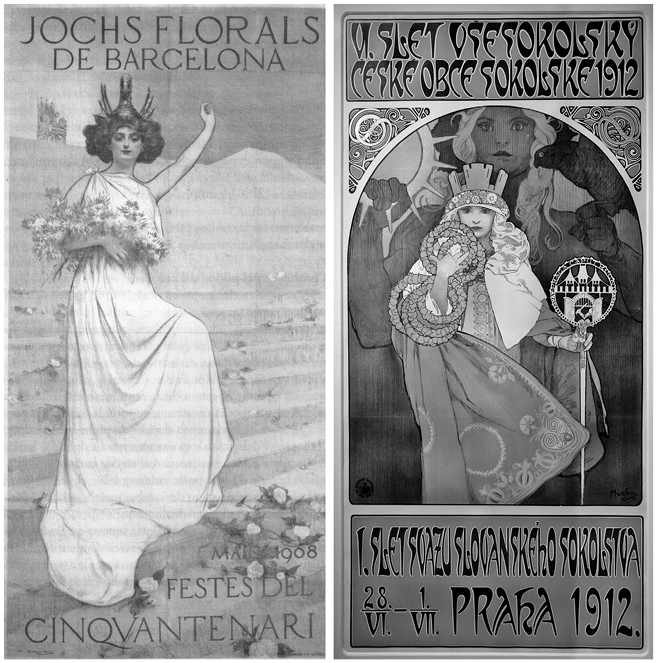
Figure 10.9 Long description
Two posters feature idealized, allegorical females. One symbolizes Catalan literature standing on steps leading up to a throne, and holding flowers, the other Slavic sports wearing a city crown and holding a symbol of the city of Prague, and bearing trophy wreaths.
From this miniature evocation of so many places, names and trends, it can be seen that a sudden and overwhelming heyday was experienced by the decorative arts in the decades around 1900, all of it, ultimately, a repercussion of Arts and Crafts. Morrisite design and art nouveau design came to the fore when the utopian reformists in Europe’s sub-imperial capitals began to make their mark in public affairs, and that also affected the promotion of national ambitions. The art nouveau panorama across Europe shows how new, progressive aesthetics provided a new channel for the expression of national distinctness.42 In Barcelona, the buildings of the nationally committed bourgeoisie were in an exuberant new style, following the 1878 manifesto of the architect Lluís Domènech i Montaner, En busca d’una arquitectura nacional; that search for a national architecture would lead him to Barcelona’s fin-de-siècle modernisme with his St Paul Hospital (1901–1930) and the landmark Palau de la Música Catalana (1908). Gaudí, too, formed part of this Catalan modernisme, although he moved in a very idiosyncratic direction – from the Sagrada Família (started in 1882/1883) to Park Güell (1914), Casa Batlló (1906) and Casa Milà (1910).
In Prague, Mucha designed symbol-heavy tile tableaux in the style of his Parisian advertisement posters; a tile tableau embellished the front of the headquarters of Hlahol, the nationally minded Czech choral movement; Mucha designed posters for the athletic festivals of the Sokol sports clubs (see Figure 10.9) and, later, Czech currency and banknotes.
In Budapest, the Turanian-minded József Huszka advocated the nationalization of Hungarian architecture in his manifesto Past and Present of our National Architecture by means of Persian and Central Asian stylistic ‘quotations’; this dominated Ödön Lechner’s Museum of Applied Arts (1892–1896) and the Postal Savings Bank (1899–1901); the invocation of ‘Turanian’ formal elements is still obvious in the much more recent Yurt-shaped Millennium Church of Csikszereda/Miercurea-Ciuc, a Romanian town with a Székler-Hungarian majority population (Figure 6.2).
In Riga, to conclude our tour d’horizon, a ‘Nordic style’ was adopted and reached its peak between 1905 and 1910. This style had spread throughout Finland in the late nineteenth century and gained popularity, not only in the other Scandinavian countries but also in the Baltic region. Traditionalist in form and functional in application, it took inspiration from local nature, the nation’s ancient history, folk culture and mythology. As such, it was itself close to the German ‘homeland traditional style’, Heimatschutzstil. Latvian architects sought to manifest their specific national inflection by introducing stylized folk-art motifs, both on facades and in interiors.
The moral of this whirlwind tour of turn-of-the-century-Europe is not meant to say ‘Look! This, too, was all nationalistic’. I bring these diverse and heterogeneous pointers together to show how adaptable the repertoire of nationalism was: how the expression of a cultural sense of national distinctness could evolve from the neo-Gothic historicism of early Romanticism to a much modern cultural climate, progressive and emancipationist, anti-imperial and even international in its sense of a Europe-wide avant-garde.
The practice of drawing on folk design and on local traditions, on past and peasants, was not necessarily an exercise in hidebound nostalgia. It could be used as an element of modernity itself, as a liberating force (as it was in the music of Bartók and De Falla) to prompt the exploration of fresh, unconventional sources of inspiration. Even in the modern, forward-looking cultural climate of the pre-1914 decades, with its utopian reformers and artistic innovators, there was still room for that celebration of the nation (defined in its language, history and cultural character) as an inspiring ideal for artistic expression which is part of our definition of nationalism as given in the Introduction to this book. To what extent this facilitated an instrumentalization of that expression in political consciousness-raising (as per the second half of our definition) varied from case to case; it was a possibility, but not an inevitability. But everywhere in Europe’s imperial peripheries, the nation could, as it was doing in Dublin, self-distinguish against hegemonic empire in two modes: either by taking recourse inwards to its nativist heritage or by turning outwards in a cosmopolitan ambition.
Nothing appears more surprising to those who consider human affairs with a philosophical eye, than the easiness with which the many are governed by the few; and the implicit submission, with which men resign their own sentiments and passions to those of their rulers. When we enquire by what means this wonder is effected, we shall find, that, as force is always on the side of the governed, the governors have nothing to support them but opinion. It is therefore on opinion only that government is founded; and this maxim extends to the most despotic and most military governments, as well as to the most free and most popular.
Public Opinion, Public Rancour
Inter arma silent musae … well, not quite. The Muses in nineteenth-century Europe did not fall silent amidst warfare: on the contrary, they raised their voices to lend moral support to the fatherland. In returning to the rousing songs and films that we noted in Chapter 1 of this book, we also return to the main geological fault-line in the political landscape of Western Europe: the competing German and French claims on the Rhine – either as a French natural frontier or as a German national artery.
German–French wars since the 1790s have always spawned battle songs, foremost among them ‘La Marseillaise’ and ‘Die Wacht am Rhein’; and we have seen how cultural geopolitics post-Waterloo put Alsace-Lorraine and the Low Countries high on the agenda of intellectuals such as Arndt. Throughout the nineteenth century there is a steady trickle of Romantics cheering on their national causes (Liszt and his sabre) or even intervening proactively in their political activities: Shelley distributing seditious pamphlets from a Dublin lodging-house, Byron joining the Greek War of Independence, Wergeland in Norway and Petőfi in Hungary staging national declamations in public. These poetic interventions, and more specifically their embodied proclamation in the form of songs and anthems, fed into a force that became increasingly powerful in the course of the century: public opinion. The hapless Napoleon III after his defeat stated that it was public opinion that had made the 1870 war inevitable, and this is supported not only by the opening pages of Zola’s searing novelistic account Le Débâcle (1892; Zola wrote about the Parisian run-up from personal experience) but also by the memoirs of various public figures. General François-Charles du Barail, for instance, in listing the many anti-Prussian parties that lured France into a hasty declaration of war, finishes his list with ‘the extreme right-wing chauvinists, who hoped that the war would restore authoritarian rule’ and, finally,
the people in the streets: the workers shouting ‘On to Berlin!’; the patrons of brasseries and elegant cafés breaking their glasses of beer or liqueur over the heads of those unfortunates who had the temerity of speaking up for peace; the theatres full of crowds singing the Marseillaise and also shouting ‘On to Berlin!’; the ignorant and the learned, from the streetcorner porter to [the journalist] Emile Girardin, laying wagers as to the date when we would march into Berlin.1
The mention of ‘La Marseillaise’ need not surprise us. On the German side, it was this war that lifted the older ‘Wacht am Rhein’, composed in 1840, to the status of a nationwide battle anthem.2 The battle songs of earlier conflicts were reprised, as they were to be reprised in their turn during the World Wars of the next century. (We have seen how choirs in the 1860s had already intoned their readiness to do battle over the Rhine). That alone should alert us that the culture of warfare is not an ad hoc accompaniment to the events of the day; it is a constantly available repertoire for the events of the day to dip into should the occasion so require. The successive cross-Rhenian confrontations between Germany and France amply illustrate the formation and persistence of that repertoire, latently quiescent during the intervals of peace, saliently prominent during the succeeding crisis moments – in 1792, in 1813–1814, in 1840, in 1870, in 1914, in 1939–1940. It is, in fact, the persistent availability of that repertoire and that accumulating sedimentation of memory, as much as the long-term foreign policy aims of states, that connects those crises into an echo-chamber of hereditary hostility. The older texts were recalled and amplified at each new occasion, and fresh ones were added to them.3
The crushing Prussian victory was compounded by the terrible events around the Parisian Commune, which ripped fraternité up into fratricide. The Third Republic drank to the dregs the bitter potion of defeat and, as Wolfgang Schivelbusch has shown in his Culture of Defeat, carried a destabilized and dysfunctional public opinion into the fin-de-siècle. Its grievance politics would include various strands of Bourbon, Orléans and Bonapartist restorationism, reactionary ultramontanism (the National Pledge campaign, culminating in the building of the Sacré-Coeur on MontmartreFootnote *), paranoid anti-Semitism (the grinding, endless Dreyfus affair) and the seeds of a rancorous nationalism. The word ‘nationalism’ was coined by the journalist Maurice Barrès (in the writings collected in his Scènes et doctrines du nationalisme, 1902); as a political programme, Barrès-style nationalism organized itself into a Ligue de la patrie française that spawned, in 1899, the proto-Fascist Action française journal and movement.4
Victorious Prussia, for its part, realized that it was now facing a deeply embittered, vengeful neighbour. Peace terms were imposed that aimed to thwart the vanquished foe in future war efforts. ‘Reparation’ payments were imposed that recalled those imposed by Napoleon on vanquished Prussia in 1810 and that would in turn be remembered when heavy burdens were laid on Germany after 1918. In a back-and-forth of victories and defeats between France and Germany since 1815, the successive iterations of Schivelbusch’s Culture of Defeat may well be seen as a repeated ‘tit-for-tat culture’ – witness also the annexations and reannexations of Alsace and Lorraine. In 1871 Alsace and Lorraine were annexed in large part to make sure that future French attacks would have a more distantly removed base of operations than Strasbourg.Footnote ** Emperor Wilhem I in a letter to Empress Eugénie ruefully acknowledged the likelihood of another, future war, and continued: ‘This sad consideration, and not the desire to enlarge my fatherland (whose territory is sufficient in size), forces us to insist upon territorial transfers which are only intended to push back the starting base of such French armies as will want to attack us in the future.’5 This is in line with the habit among bellicose states to present attack and annexation as a forms of self-defence; but in any case this military geopolitical pragmatism was not how the transfer was sold to the public at large. The justification before the court of public opinion was cultural and historicist, in the very same terms that had been used by Arndt: Alsace and Lorraine, it was asserted, culturally belonged to Germany, had seen their political ties with Germany severed by unnatural force, and were now harmoniously reunited with their true fatherland. The Prussian historian Treitschke repeated Arndt’s pamphlet ‘The Rhine, Germany’s River, Not Germany’s Border’ of 1814 practically verbatim, adding that he had, in fact, very little to add to the masterful arguments that Arndt had put forward half a century previously.
Were I to marshal the reasons which make it our duty to demand this, I should feel as if the task had been set me to prove that the world is round. What can be said on the subject, was said after the battle of Leipzig, in Ernst Moritz Arndt’s glorious tract, ‘The Rhine the German river, not the German boundary’; said exhaustively, and beyond contradiction, at the time of the Second Peace of Paris [1815], by all the considerable statesmen of non-Austrian Germany – by Stein and Humboldt, by Münster and Gagern, by the two Crown Princes of Wurtemberg and Bavaria; and confirmed, since that time, by the experience of two generations.6
Treitschke’s arguments were aimed both at a domestic audience and an international one; his ‘What Do We Demand of France?’ appeared in 1870 in the Preussische Jahrbücher and also as a brochure, and an English translation appeared in London that same year. Another direction was taken by the revered classical historian Theodor Mommsen. He addressed a series of open letters to Italian periodicals, also published in brochure form as Agli italiani. Mommsen argued that, much as the Italians had in their Risorgimento lawfully annexed Milan and Venice (and he injected also some anticlerical notes by reminding the Italians how the Papal States had long been kept out of Italy by French interference), so too the Germans were justified in rounding off their unification movement by the incorporation of Alsace and Lorraine.
What was new here was that the justification for the nation was now delivered not in exhortatory poems but in discursive prose; not by poets but by history professors. The intellectual professions were now finding a new role as national apologists; the heyday of the ‘political professor’ had arrived. After 1918, this ‘intellectual nationalism’ (Martha Hanna’s phrase) would be bitterly denounced by Julien Benda in his Le trahison des clercs (1927).7 But knowledge production and the sphere of intellectual pursuits had never been quite aloof or separate from a commitment to the nation; it merely found a new field of application in the developing medium of war propaganda.
Political Professors: Fichte to Fustel
Treitschke’s overt recall of Arndt is significant: the anti-Napoleonic Wars of Liberation (Befreiungskriege) of 1813 were remembered as a glorious alliance between military and cultural mobilization, with Arndt, Schleiermacher, Görres and others celebrated as the intellectuals who had prepared the people and the Prussian state for insurgency. Here lay the prototypes of the ‘political professors’ of the generation of Treitschke and Felix Dahn. Foremost among them was Johann Gottlieb Fichte, he of the Reden an die Deutsche Nation. He had enlisted when in 1813 anti-Napoleonic citizen militias were mobilized. The figure he cuts as a fifty-one-year-old, martially brandishing a sabre and carrying holstered pistols in a belt around his portly girth, is not altogether impressive (Figure 11.1); learning and armed combat are, as we can see here, two very different callings. That they converged in the 1813 moment had proved highly memorable.
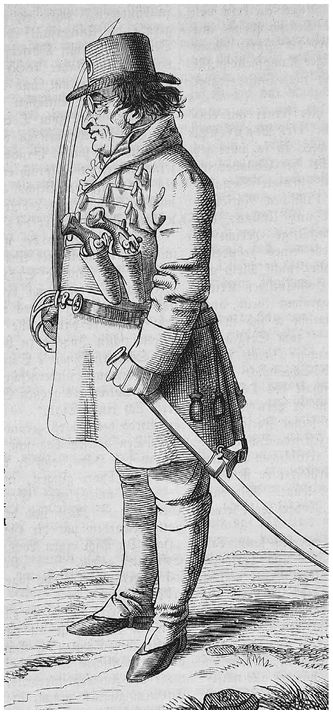
When, after the Napoleonic wars, academics wanted to prove their usefulness to the fatherland they usually did so as ‘brains’ rather than ‘muscle’, and mostly in peacetime deliberations on domestic policy rather than under the direct shadow of actual action in the field. The mobilization of Treitschke and Mommsen manifested the type of public–political leverage that Grimm and the Germanisten had tried to obtain in the 1840s; and it shows how a new type of professor had come to wield considerable influence as public intellectuals. A class of ‘German mandarins’ has even been defined as such by Fritz Ringer in a landmark study.8
France responded in kind. If Germany had the Preussische Jahrbücher, France by now had the Revue des Deux Mondes. Such opinion-making periodicals, independent but semi-official and addressing educated readers, were among the important new platforms of the period. Ernest Renan from the beginning countered German triumphalism by warning them sternly that hubris comes before a fall; Schivelbusch rightly read that as a somewhat pedantic one-upmanship on the part of defeated enemies, part of the see-sawing alternation of boastful victors and peeved losers.9 Something altogether new and more important crystallized when an academic refugee from Strasbourg arrived in Paris to take the floor: Numa Fustel de Coulanges. Breton by birth and Parisian normalien by education, he had taught archaeology and ancient history in the Alsatian capital but left the city and its university when it was annexed into Germany. In Paris he would find employ at his École normale supérieure and ultimately at the Sorbonne, and he would become an inspiring voice from that position. It was Numa Fustel de Coulanges who first tackled the German justification for the annexation of Alsace and Strasbourg. In his L’Alsace est-elle allemande ou française? Réponse à M. Mommsen (1870) he developed what later became such a powerful line of reasoning in Renan’s Qu’est-ce qu’une nation? (Reference Renan1883): that in deciding the question of national belonging, what should weigh most heavily was the self-identification of the people concerned. Fustel’s riposte to Mommsen has been overshadowed by Renan’s more famous, indeed classic tract; but it is worth zooming in on because it states things more crisply than Renan and illustrates a telling conjunction of intellectual and political trends.
Fustel was a close colleague of Mommsen. Both had done path-breaking work in the study of Roman institutions (Mommsen’s Römische Geschichte, 1854–1856; Fustel’s La Cité antique, 1864). In the course of his own work on ancient history, Fustel had become convinced of two things. One was that the Roman conquest of Gaul had laid the preconditions for the French state by imposing an institutionalized governance on what had been an assemblage of different tribes. In this view, he followed Romantic historians such as Thierry and Michelet. Where he differed from those Romantic forerunners, however, was in his view of the subsequent Frankish conquest of Latinized Gaul. In his view, this had been a matter of gradual infiltration rather than a ‘conquest’ properly speaking. This neatly subverted the Romantic two-nations view, according to which the conquering Franks had been the ancestors of the nobility, ruling the country by right of conquest; whereas the subjected Gallo-Romans were the ancestors of the Third Estate. In that view, the French Revolution had been the long-awaited reassertion of popular Gaulish rights against the conquering Frankish aristocracy. The two-nations view was certainly appealing; it could draw on eighteenth-century roots, even on a turn of phrase in Sieyès’s What is the Third Estate?; it had an analogue in the Saxons-and-Normans polarity in English history writing, as propounded in Walter Scott’s wildly popular Ivanhoe; and it had inspired, in the course of the century, many a popularizing history account by the likes of the historian Henri Martin, and the novelists Alexandre Dumas (Francs et gaulois) and Eugène Sue (Les Mystères du peuple). But Fustel himself drew from his historical studies a different conclusion, and in the process came to reject the entire ethnohistorical paradigm of Völkergeschichte, whereby modern societies were seen as the outflow of the patterns established in ancient tribal warfare.10
It must have been particularly irksome to Fustel that this ethnohistorical argument, which he had been at pains to purge from his historical analysis, was precisely the justification that was invoked by the likes of Treitschke and Mommsen, with Treitschke even falling back, overtly, on old Arndt. That was the background to Fustel’s feisty rebuttal of Mommsen’s Agli Italiani. Is Alsace, he asks, German or French?11
Prussia thinks that it can resolve that question by might; but Prussia is not satisfied by force alone, and would like to add Right to that. Thus, while your armies invaded Alsace and bombarded Strasbourg you tried to prove that it was your Right to do so …. Alsace, you assert, is a German region and therefore must belong to Germany. It used to once, and you conclude that it must therefore be given back to you. German is spoken there and you infer that this gives Prussia the right to annex it. … This you call the nationality principle.
Fustel explodes this in successive stages. He begins by exposing the invocation of the ‘nationality principle’ as a mere pretext for raw power politics.
As you see it, that principle would authorize a powerful state to appropriate a province by force because it is inhabited by the same race. Most of Europe, more commonsensically, would understand that principle as authorizing a region or a population to reject the rule of a foreign hegemon. … It may bestow certain rights on Alsace itself, but none on you to overrule it. In invoking that principle regarding Schleswig and Alsace … Prussia is misapplying it. It is a right for the subaltern, not a pretext for expansionism; the nationality principle is not a new way of saying that Might makes Right.
The further argument then sets out to demonstrate that the Fichtean nationality markers of language and descent (‘race’) are futile.
If the nationality principle means that Alsace has the right not to be ruled by foreigners, then the question becomes: who is the foreigner here, France or Germany? You assert, Sir, that Alsace is of German nationality. Are you sure about that? … How do you recognize a nationality, a fatherland? You think you have proved the German nationality of Alsace because the population is German by language and race. But it baffles me that a historian like yourself chooses to overlook the fact that neither language nor race makes a nation.
Fustel’s demonstration boils down to the points that ethnically similar populations have founded different states, and that states can gather into a shared nationality linguistically mixed populations of diverse (and usually mixed) ethnic descent. This line of reasoning has become familiar: Renan (Reference Renan1883) argued along similar lines in Qu’est-ce qu’une nation? But for Fustel in 1870, this is a hard-won fresh insight based on his historical and archaeological work and on his own rejection of the French two-nations model.
From there, like Renan after him, he goes on to locate the true bedrock of national identity, emically, in the nation’s act of self-identification.
Nations are distinguished neither by race nor by language. People feel in their hearts that they belong together once they share ideas, interests, emotions, memories and hopes. That is what constitutes a fatherland. That is why people wish to walk, work, fight together, live and die for each other. A fatherland is what you love. It may be that Alsace is German by race and language, but by nationality and in its sense of fatherland it is French. And do you know what made it French? It was not the conquest by Louis XIV, but our revolution of 1789.
To bolster this case, Fustel asserts that the feelings of the Alsatians are, in fact, pro-French and anti-German, and that the civic legacy of the French Revolution has left more vivid and important traces in the present than the ancient roots of language and ethnicity. Fustel contradicts German assertions as to the German-mindedness of the population. He states that he himself never experienced anything like the purported reservations against Parisians (‘I pride myself on knowing how kindly Alsace receives them’) and instead offers numerous examples of the stubborn resistance of the local population to the invading German armies (‘they spoke your language, but they did not consider themselves your compatriots’). All this follows to some extent the yea–nay patterns of wartime propaganda – Grimm in 1814 had argued that the Alsatians had remained German-minded despite generations of French rule,12 and now Fustel argues the opposite. What is the historian to make of it? In asserting the French-mindedness of Alsace, Fustel was to some extent invoking existing French attitudes: as expressed, for example, in the Alsatian-propagandistic romans nationaux of the popular novelistic duo Erckmann/Chatrian and the emerging vogue for brasseries alsaciennes on the Parisian boulevards.13 But his assertion of a deep-seated anti-German feeling among the Alsatian population is more believable: the Germans themselves developed an almost phobic mistrust of the figure of the franc-tireur, the armed civilian who behind the lines snipes at German troops. For Germans, this was a sign of Gallic treacherousness, and their fear of it was such that in Belgium in 1914 mass executions were carried out among the civilian population on the basis of rumoured franc-tireur activities.14 That phobia cannot have grown out of an open-armed welcome by fraternal fellow Germans in 1870–1871.
Be all that as it may, the most important point is reached when Fustel fundamentally denies that deep historicism as such, Völkergeschichte-style, can have any use whatsoever when discussing contemporary issues.
For Alsace, the fatherland is France, and Germany is foreign. None of your lucubrations will change that. You may invoke ethnography and philology, if you will, but we are not in a university lecture-hall here. … So let us speak no more of nationality and above all stop saying to the Italians that ‘Strasbourg belongs to us the way Milan and Venice belong to you’; for the Italians might reply that they never bombarded either Milan or Venice. … You, Sir, are an eminent historian. But when we discuss current affairs, let us not get fixated on history. … History may tell you that Alsace is a German land; but the present proves to you that it is French. It would be childish to argue that it should revert to Germany because some centuries ago it used to form part of it. Are we going to re-establish everything that once used to be? And in that case, if you please, what Europe would that be?
This is truly a new turn in the discussion of national identity. Cultural-historicist arguments, so long dominant (including within France), are now dismissed in favour of a modern, ahistorical approach: a legal one, announcing the idea of international law and the principle of self-determination.
Let us be of our own time, rather. We have something to guide us that is better than history. We possess in this century a principle of public law which is infinitely clearer and more incontestable than your pretended nationality principle. Our principle is that a population can only be governed by institutions which it freely accepts, and that it should not belong to a state unless by its own will and free consent. … What is all this talk of ‘claims’? Strasbourg belongs to no one. Strasbourg is not an object to be possessed or rendered. Strasbourg is not ours, it is with us. We feel that Alsace should remain a French province, but take note on what basis we do so. Do we say so because it was conquered by Louis XIV? By no means. Do we say so because our defence requires it? No. … France has only one reason for wanting to keep Alsace, and that is that Alsace has bravely demonstrated that it wished to remain with France. Bretons and Burgundians, Parisians and Marseillais, we fight you over Alsace; but let there be no mistake: we fight, not to maintain a hold over it, but we fight to prevent you from doing so.
Whatever was said, more famously, by Renan a decade later is said much more clearly and pointedly here. When Renan gave his lecture Qu’est-ce qu’une nation? at the Sorbonne in 1883, he pointedly avoided any mention of Alsace, Lorraine or Strasbourg, and thus also pre-empted the charge of special pleading: his stance is not that of a champion of his country against Germany but that of a dispassionate philosopher seeking to establish the truth. If Renan refers to Germans at all, it is only as the tunnel-visioned intellectual tradition that deterministically and essentialistically wants to define nationality etically (in terms of its component cultural factors); whereas he, with ‘French’ clear-sightedness, argues that nationality is defined emically, by how people experience their culture and their allegiance. That disinterested stance has ensured for Renan’s analysis a classic status in the theory of national identity, and deservedly so. Much of what he says about the importance of memory in national collective identification (memories glorious and painful, triumphant or grievous, and even memories elided or sanitized) is still authoritative 150 years later. But for his audience, the point, though unstated, was lost on no one, and if Renan called national identity an ‘everyday plebiscite’ (i.e. an ongoing collective commitment), the challenge to the Germanization imposed from above on Alsace and Lorraine was obvious. And here, again, Renan had the intertext of Fustel’s earlier arguments to rely on.
What Renan does in Qu’est-ce qu’une nation? is to transmute the political French–German antagonism over Alsace-Lorraine into a philosophical French–German incompatibility between civic voluntarism and ethnic-essentialist determinism. He presents ethnohistorical essentialism, generally and without reference to the contested Alsatian annexation, as ‘the German way’ of seeing national identity, while presenting democratic, self-choosing voluntarism as ‘the French way’. Ever since, this perspective has burdened the debate on the shifting ethnic/civic weightedness of national identity discourse: ‘ethnic’ nationalism is denounced as a German-obscurantist bad-cop side of the coin as against the French-enlightenment good-cop side of ‘civic’ nationalism (as if Gobineau, the Dreyfus affair, Barrès’s vitriolic xenophobia and the Action française somehow don’t count). In the twentieth century Hans Kohn (Reference Kohn1950, Reference Kohn1955), writing in the Cold War climate, aligned ‘civic’ nationalism with ‘Western’ values and ‘ethnic’ nationalism with Oriental despotism.Footnote * To be sure, German intellectuals in the century after Arndt did themselves no favours by following a völkisch sliding scale that led from Felix Dahn to Houston Stewart Chamberlain of unhallowed memory. A discourse continued to hold sway that had been forged when Arndt and his generation repudiated the overpowering might of Napoleonic tyranny; but that discourse was now quite out of date, overtaken by Bismarck’s victoriously aggressive expansionist wars of the period 1864–1871. Even in the triumphant, overpoweringly mighty new Reich, its international position continued to be viewed in the ingrained terms of the 1813 moment and through the defensive lens of Arndt’s anti-Napoleonism.
This is not lost on Fustel. The victorious Germany of 1871 cannot claim the same position as the underdog Germany of 1813; Treitschke’s recycling of Arndt is an incantation, not an analysis. That said, Fustel’s rebooting of the nationality debate, shifting it from historicism to international law, is also a little self-serving. He is rather conveniently forgetful of the burden of the past and of the fact that France itself had pursued geopolitical expansionism with strong-arm tactics of the ‘Might makes Right’ type. Fustel may consider Louis XIV’s conquest as being water under the bridge, and he never even mentions Napoleon, but that was easier for him as a Frenchman than for the Germans remembering the devastations of those wars of conquest. The picturesque ruins dominating the Romantic imagery of the Rhine valley had in most cases been turned into ruins by Louis XIV’s rampaging armies. And the justification for Louis’s expansionism had in fact not been so very different from that of the Prussian expansionism that Fustel denounces. Louis’s marshal Vauban had aimed to consolidate the territory of France by gaining the Rhine as its natural frontier in the east; and that expansionism was maintained, across regime changes, by Danton, by Napoleon, by Thiers (during the 1840 Rhine Crisis). Even a young lieutenant Charles de Gaulle bought into it, if his 1915 correspondence is anything to go by. He optimistically predicted a ‘decisive victory’ ‘which will chase the enemy out of Belgium, which will enable us, if we can muster the necessary audacity, to take their place in that country, and which will yield to us, if we can will it, our natural frontier: the Rhine.’15 Small wonder that Germans, mindful of their history, were a little defensive about the Rhine, or that French occupation policies in the post-1919 Rhineland touched a raw nerve in Germany.16 Il y avait de quoi.
It makes perfect sense to abandon the stranglehold of historicism in favour of a more ‘modern’ approach to the nationality principle; but modernity cannot abolish memories. The year 1871 itself turned into such a memory for both warring parties. In 1914, both saw the new war, as Wilhelm I had foreseen, as a rematch of the older one. One thing that had carried over from 1871 to 1914 was the anthropologization of the terms of conflict. In their 1871 defeat, French writers adopted the rancour that Germans such as Arndt had displayed under Napoleon. In no way were the French–German wars seen as state conflicts ‘continuing diplomacy by different means’; they were wars between nations with incompatible attitudes and world-views. An ethnotypical opposition clicked into place, schematizing the imputed character traits of the two enemies on ruthlessly binary, incompatible terms (Figure 11.2).Footnote *
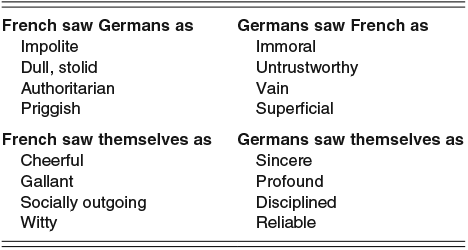
Figure 11.2 Long description
The data mentioned is as follows. French saw Germans as impolite, dull, stolid, authoritarian, and priggish. Germans saw French as untrustworthy, vain, and superficial. French saw themselves as cheerful, gallant, socially outgoing, and witty. Germans saw themselves as sincere, profound, disciplined, and reliable.
Readers will notice how the left-hand column opposes boorish Germans with chivalric Frenchmen. From the time of Herder and Goethe (mid eighteenth century) onwards, a prevailing rejection of aristocratic values and a turn towards middle-class virtues had led to a revalorization of those ethnotypes, as per the right-hand column: French aristocrats were now deprecated, while the land of Kant, Goethe and Beethoven was admired.
In the vertical (top vs. bottom) alignment of these characterizations, the respective self-images (bottom pair) pan out as temperamental opposites. Aligned diagonally, we recognize the positive or negative valorizations of similar behavioural characteristics. What Germans considered, in themselves, as their characteristic sincerity, profundity, sense of discipline and integrity would in a French discourse be represented as signs of boorishness, dullness and an authoritarian and pedantic streak.
We can trace this in the shifting stock figure of the ‘German Professor’. Until 1870 he is an eccentric, an object of affectionate irony: the Bible-translating Professor Wittembach in Mérimée’s story ‘Lokis’; or the Hamburgian Professor Lidenbrock in Jules Verne’s Journey to the Centre of the Earth (1864). After 1870 he becomes the insufferable Professor Knatschke (Figure 11.3: a caricature created by the artist known as ‘Hansi’, Jean-Jacques Waltz) throwing his weight around in the annexed Alsace; or the murderous genocidal industrialist Dr Schulze, designer of the cannon-producing ‘Stahlstadt’ in Jules Verne’s The Begum’s Fortune (1879); Doktor Schulze’s evil plans are thwarted by the idealistic French hero Sarrasin and his Alsatian (!) assistant.17
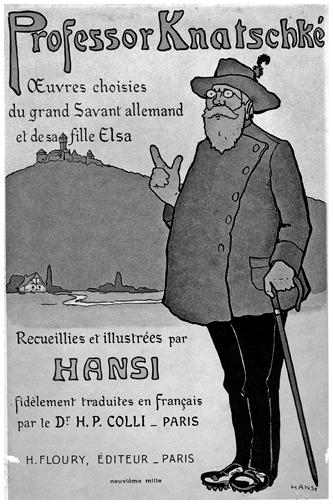
Figure 11.3 Long description
Cartoon-style book cover. In front of a stylized Alsatian landscape, with on the horizon the castle of Hohkönigsburg, stands the portly title figure, dressed in the style of a German hiking tourist. He wears hobnailed boots, a woolen jacket, and a hunting hat with a small plume. He carries a pointed Alpenstock walking stick and lifts a pedantic finger. His eyes are tiny behind his strong spectacles, and his features are hidden behind a bushy beard.
Similarly, what Germans denounced in the French as their immorality, untrustworthiness, vanity and superficiality would be seen by the French themselves as their light-heartedness, polite manners, awareness of social appearances and clear-sightedness. It is obvious that these traits aligned thus create polar opposites between the two nations’ respective temperaments. They were adroitly and venomously summarized by Ernest Renan when he gave his acceptance speech on becoming a member of the Académie française in 1878. No, he argued, France was not beaten down. Morally, France was still the superior nation it had always been, a beacon of civility that the self-proclaimed victors, still wallowing in their uncouth boorishness, could not hold a candle to. This is how he addressed his fellow académiciens:
You, like me, will mistrust a Kultur which fails to make people kinder or better. Nations which to be sure are very serious (for they reproach us our levity) are mistaken if they think that this will ingratiate them to the world. … Pedantic self-obsessed learning, a literature without cheer, a glum political life, an elite without glamour, an aristocracy without wit, a bourgeoisie without politeness: all that will not dispel the memory of our traditional French social life, with its glittering brilliance, so courteous, so eager to please. Only when a nation, by means of what it calls its seriousness and its thoroughness, has achieved what we have achieved by means of our frivolousness – better writers than Pascal or Voltaire, more charming women than those who smiled upon our philosophy, an enthusiasm more striking than that of our Revolution, more graceful manners and a more gracious life-style – only when it has become, in short, a more pleasant and spiritual society than that of our ancestors – only then shall we have been vanquished.18
I have here translated Renan’s culture with its German analogue. Kultur was becoming a key element in the German self-image as it opposed itself to France. The French had civilisation, which implied polite manners and an elegant, harmonious conformity of public standards, but which was also seen as something snobbish and superficial; to this was opposed the German idea of a more profound, deep-rooted Kultur, something inherited and naturally spontaneous rather than educationally or socially imposed – witness Fichte’s and Grimm’s link between love of the fatherland and deep affects such as filial piety, parental solicitude and homesickness from abroad. Kultur and civilisation became antithetical proxies to capture the incompatibility between the French and German national characters. A similar antithetical homology was that between Geist and esprit: the German word connoting earnest soulfulness, the other nimble wit.19 Thomas Mann invoked precisely this discourse in his wartime writings (Chapter 1).
Such ethnotypes had, over the preceding century, slowly become common currency in the world of learning; a Zeitschrift für Völkerpsychologie und Sprachwissenschaft had been established in 1860, and since the 1820s anthropologists and ethnographers had come to rely increasingly firmly on the principle of ‘national characters’.20 National stereotyping suffused the oppositional discourse of the decades between 1871 and 1914, when essentialist ethnotypes flourished as never before or since, almost abolishing the distinction between nation and race. They carried with them all the authority of the academics who endorsed them. Much of that discourse was debunked or dismissed in the course of the twentieth century; national clichés are now used more sparingly and back-handedly, often jocularly. But when wielded in earnest, ethnic cliché was best backed up by authors’ scholarly or intellectual prestige; and this in turn reinforced the importance of public intellectuals as authorities in the public debates about international frictions and conflicts.
These public intellectuals came out in full force in 1914.
Kultur, War, Propaganda
Wars were increasingly fought before the court of public opinion. The advent of photography and journalism on the battlefields of the Crimean War and the American Civil War had rendered the home front aware of its conduct, as Tennyson’s ‘Charge of the Light Brigade’ (1854) also testifies, and as is indicated by the careers of Florence Nightingale (who rose to fame among the Crimean wounded) and Henri Dunant (who conceived of the Red Cross on the battlefield of Solferino, 1859). Atrocities against civilians, now reported in large-circulation media, became a matter of public outrage; the philhellenic denunciation of the Ottoman-inflicted Massacre of Chios (1822) had been an early sign. The murderous repression of an anti-Ottoman revolt in Bulgaria in 1876 was widely reported and became notorious as the ‘Bulgarian horrors’; it led Gladstone to denounce the cruel Turks in ethnotypical terms as congenitally disposed to ruthless sadism and unfit for imperial rule. As a direct result, the Ottoman Empire was ordered to grant self-rule to the Bulgarian exarchate by the western powers at the Conference of Constantinople (1876); this was subsequently enforced by the treaty of San Stefano (which concluded the Russo-Turkish War of 1877–1878).
In these decades, people sought to control the horrors of modern warfare as these became noticeable to the general public. The first Geneva Convention (1864) was to be followed by additional ones in 1907, 1929 and 1947. In the drafting of such conventions, legal scholars found a new application for their expertise. Drawing on earlier texts such as Schmalz’s Europäisches Völkerrecht (1816), Klüber’s Droit des gens moderne (1819) and Bluntschli’s Das moderne Völkerrecht (1868), international law rose to prominence in the post-1871 decades, trying to control Might with Right. In time, legal opinion crystallized into institutions. Frédéric Passy’s Ligue permanente et internationale de la paix of 1868 was transformed into a Société française pour l’arbitrage entre nations in 1889. It set up a permanent court of arbitration in The Hague and further buttressed its mission by establishing a first Hague convention in the same year, followed in 1907 by a second one. At that second conference, one influential presence was that of the Institut de droit international, founded in 1873, partly in response to Germany’s high-handed annexation of Alsace-Lorraine.21
Thus as Europe drifted towards the abyss of 1914, there was at the same time a growing internationalism aimed at preventing war, or at least its worst excesses, and regulating international affairs. It profited from wealthy donors such as Andrew Carnegie (who footed the bill for the Peace Palace in The Hague, 1907–1913) and Alfred Nobel, who instituted his Peace Prize in 1901. Its first recipients in that year were Henri Dunant and Frédéric Passy, founders of the Red Cross and the arbitration court; in 1904 the Nobel Peace Prize went to the Institut de droit international. An associate of these pacifist individuals and institutions, the activist Bertha von Suttner, won the Nobel Peace Prize in 1905, largely on the strength of her novel Die Waffen nieder!
This budding pacifist internationalism formed part of the utopian–reformist climate that we have encountered as the enabling ambience for the spreading the Arts and Crafts movement (Chapter 10). That climate itself should be recalled to understand the shock that was caused by the outbreak of the 1914 war and especially by the fate of neutral Belgium. Yes, the war may have been greeted by fervently patriotic crowds on the streets of the European capitals, each singing their respective national anthems; but what soon came into view was the conduct of the German troops on their way towards Paris, torching the city of Visé and the Louvain university library and executing Belgian citizens in their hundreds. Tellingly, the wholesale executions of Serbian villagers by Austrian troops attracted comparatively little notice.22 Even though the war had been sparked off in Sarajevo and its conduct in the Balkans was especially murderous, all eyes were on Germany and Belgium. That in itself indicated the importance of publicity and the effectiveness of the aspersions that had been cast upon the German character by French revanchistes in the preceding decades. The discourse of propagandistic denunciation had been prepared ever since 1871 and was primed for deployment. How could Germany pride itself on anything like Kultur if it violated Belgian neutrality, of which it was itself one of the international guarantors, and behaved as barbarously as it did towards the civilian population?Footnote *
Initial reports, bad as they were, were gruesomely exaggerated as they echoed around the outraged media. This was the case on both sides: German justified their retaliatory executions by referring to the sadistic treacherousness of the duplicitous Belgians, women and children not excepted; but setting a medieval university library on fire was definitely not the way to win hearts and minds.
In fact, this war had three fronts: east, west and international public opinion. Germany lost the battle on the third front early on in the war, even though its public intellectuals came to the fore in great numbers. This is how the troops were disposed. Within Germany, there were public lectures and public statements by reputable academics such as Rudolf Eucken, Ernst Haeckel, Friedrich Meinecke, Werner Sombart and Ernst Troeltsch; their lectures came out in collections entitled Deutsche Reden in schwerer Zeit.23 Similarly in France, the Quai d’Orsay (the ministry for foreign affairs) banded leading intellectuals into a committee, led by the highly regarded and fervently nationalist historian Ernest Lavisse, with the aim of directing public opinion through their publications. The Comité Lavisse included Emile Durkheim, Joseph Bédier, Henri Bergson, Ernest Denis and Gustave Lanson. In Britain, a new institution was created, the War Propaganda Bureau; it brought together leading authors to advocate for the British cause in writing.24
In most cases, the discourse generated in the war years was largely concerned with the assertion of the rightfulness of the country’s war aims,Footnote * defensive as they were of course, and the denunciation of the enemy’s pernicious, long-plotted aggression and their soldiers’ savagery. Cases in point (all from 1915) are the collection Qui a voulu la guerre? by Emile Durkheim and Ernest Denis (documents gathered from diplomatic and official sources), Joseph Bédier’s Les crimes allemandes d’après les témoignages allemands (edited from the field diaries of captured or killed German soldiers), and the notorious Bryce Report on Alleged German Outrages, compiled for the British War Propaganda Bureau. These texts were published both for domestic consumption and, on neutral ground such as in the New York Times, with the aim of swaying the sympathies of the United States. Bédier’s book was published in 400,000 copies, and 25,000 copies in English translation were shipped to the US.
German self-justification before the court of international public opinion started immediately after the invason of Belgium with a declaration by Wilhelm II, which, characteristically overstated and grandstanding, demonstrated not Germany’s righteousness but its emperor’s self-righteousness.
Since the foundation of the Reich forty-three years ago, my ancestors and I have done our utmost to preserve peace in the world and in that peace to forcefully promote our development. But there are enemies who begrudge us the fruit of our labour.
We have borne all the open and secret enmity coming from the east, from the west, and from across the sea, aware as we were of our responsibilities and our force. But now we are to be humiliated. We are expected to stand by passively as we watch our foes arm themselves for a treacherous attack, and we are denied the right to support, in steadfast fidelity, our ally [Austria] in its struggle to maintain its position as a major power, and whose humiliation would also destroy our power and our honour.
So let the sword decide. In the midst of peace our foes have assaulted us. To arms, then! Any delay or dithering would be a betrayal of the fatherland.
What is at stake is the existence or annihilation of the Reich that our fathers re-established; the existence or annihilation of German power and the German identity.
We will defend ourselves to the last breath of man and horse. And we will win this struggle, even against a world of foes. Never yet was Germany vanquished if it stood united.25
One month later, in September 1914, as the conduct of the German army had provoked widespread outrage, ninety-three prominent German professors and public intellectuals issued an ‘Appeal to the Civilized World’ (Aufruf an die Kulturwelt). Consisting of six brief paragraphs, each containing a single assertion, it followed the lapidary style of the theses that Martin Luther had nailed to the Wittenberg church doors in 1517; but this erudite subtlety may have been lost on readers abroad. The statement declares that ‘the undersigned representatives of German learning and culture denounce to the civilized world the slanderous lies with which Germany’s enemies have tried to tarnish its just cause in the grievous existential struggle with had been forced upon it’. Then follow the six denials, each paragraph beginning with the large-printed words Es ist nicht wahr, daß …. (‘It is untrue that ….’). In conclusion, the civilized world (Kulturwelt) is once again addressed:
We cannot defuse our enemies’ poisonous mendacious weaponry; we can only proclaim to the world that they bear false witness against us. To you who know us, you who have until now been guardians, together with us, of the most cherished inheritance of humankind, to you we call out: Believe us! Believe, that we will fight this battle to the end as a civilized nation [Kulturvolk], which holds the inheritance of Goethe, Beethoven and Kant as sacred as its hearth and home. To this we sign our names and our honour!26
Many of the signatories are authoritative indeed: eminent writers and artists, prominent scholars from all academic disciplines, including a good few Nobel Prize laureates. Notwithstanding, the overall effect was a tone-deaf rhetorical failure, reminiscent more of Professor Knatschke than of Luther:
It is untrue that our conduct of the war disregards international law … But in the East, the earth is soaked by the blood of women and children butchered by Russian hordes … The claim to defend European civilization is unbecoming for those who have allied themselves with Russians and Serbians and who offer the world the degrading spectacle of turning Mongolians and Negroes loose on the white race.
As Martha Hanna (p. 80) put it, ‘the Manifesto of 93 soon became the most vilified document to come out of Germany in the early war’. A rebuttal by French and British intellectuals soon followed, again marked by recrimination, self-righteousness and prestigious signatories. The names on both documents included the luminaries of the day: on the German side Rudolf Eucken, Ernst Haeckel, Karl Lamprecht, Friedrich Naumann, Max Planck, Wilhelm Röntgen, Wilhelm Windelband and Wilhelm Wundt; on the British side Thomas Hardy, G. O. Trevelyan, Arthur Conan Doyle, Rudyard Kipling, J. M. Barrie and H. G. Wells – they had gathered in the preceding week at a conference organized by the War Propaganda Bureau. In a follow-up British statement, 117 prominent scientists and academics signed as well. And that in turn unleashed the massive Erklärung der Hochschullehrer des Deutschen Reiches, signed by no less than 3,000 academics. Something like an arms race: a brains race.27
Such altercations demonstrate how important the voice of academic scholarship had become as a prestigious support for the state’s war efforts; the argument generally turned around the question how Germany could reconcile its belligerence and militarism with its self-image as the nation of Kultur and earnest sobriety. Outside Germany, such a notion of Kultur was howled down with scorn; as a German loanword in italics, with a hateful Teutonic Knatschke-K belying its Latin derivation, it became a mongrel, an oxymoron, the more so since it was constantly linked to the brutalities (real, exaggerated and imagined) of the German army against their civilian victims. The German scholars, writers, artists and Nobel laureates had hoped to raise their country’s reputation by associating their prestige with its war efforts; in the event, they lowered their own prestige by the association.
In the general discourse of French war justification, we see a remarkable prominence of three alumni of the Ecole normale supérieure, Fustel de Coulanges’s erstwhile workplace now headed by Ernest Lavisse. One of them, Camille Jullian, an ancient historian like Fustel, we shall encounter further on. The other two were Ernest Denis and Emile Durkheim, both members of the Comité Lavisse; they jointly authored Qui a voulu la guerre?, a documentation based on diplomatic and official sources aiming to demonstrate that Germany (despite its protestations that it had been unwillingly forced towards a pre-emptive strike) had been deliberately working towards a premeditated expansionist war.28
That ‘Who started it?’ debate has never quite been laid to rest. The question of Germany’s aggressive or defensive war aims resurfaced in 1961 with Fritz Fischer’s Griff nach der Weltmacht, which itself has continued to feed historiographical controversies up to and including Perry Anderson’s Disputing Disaster (2024). Political and diplomatic historians who wish to derogate the blame laid exclusively at Germany’s door in 1918 (e.g. Christopher Clark’s authoritative The Sleepwalkers, Reference Clark2014) tend to discredit evidence of German hawkishness pre-1914, as in the 1907 memorandum by the British diplomat Eyre Crowe warning against appeasement. And, archive-based as their work is, it tends to downplay the importance of published sources (e.g. the tract Deutschland und der nächste Krieg by general Friedrich von Bernhardi, 1912) and of press campaigns.29 But public opinion and press campaigns were by no means inconsequential, and they should be factored into an analysis of the culture of belligerence that was rife in 1914. Public opinion, especially of the hawkish kind, was even more influential in 1914 than it had been in 1870;30 and the years leading up to 1914 still echoed with the memories of 1871. To ignore that fact, or to argue it away, is as one-sided as to accept the propaganda at face value.
A genre of ‘invasion novels’ or ‘future war novels’ had emerged in English literature immediately after the German victory over France in 1871: in that year The Battle of Dorking evoked a German landing in England. Notable examples of the genre were The Riddle of the Sands (1903), When William Came: A Study of London under the Hohenzollerns (1913) and John Buchan’s The Thirty-Nine Steps (1915). In 1897, William Le Queux’s The Great War in England had still imagined the invaders to be the accustomed enemies, France and Russia; but ten years later, in Le Queux’s The Invasion of 1910 (1906), the invading enemy had, as per the conventions of the genre, become Germany. That book came out in a great media blitz, serialized in the Daily Mail with newspaper vendors dressed up as Prussian soldiers displaying maps of their armies’ progress. The book edition sold a million copies.
That was the public sounding board to Eyre Crowe’s diplomatic memorandum of 1907. How intricately the media, fiction and diplomacy were linked is indicated by the fact that Le Queux’s book was a fictionalized platform for the war alarmism of Field Marshal Roberts, former commander-in-Chief, whose anti-German speeches of the period appeared in 1907 as A Nation in Arms.31 Indeed the novels created a veritable invasion scare in England, similar to the Napoleonic one of 1803. Matters were stoked up further by Le Queux’s sequel, Spies of the Kaiser: Plotting the Downfall of England (1909). The resulting moral panic caused members of the public to write to Le Queux about suspected sightings; these communications were placed at the disposal of the nascent bureau of military intelligence. Indeed, one historian suggests that Le Queux himself believed in the veracity of the alarmist tales he put before the public. War propaganda thus preceded the outbreak of hostilities by a good few years: historical memories of 1870 (in France and Germany) and imaginative fiction (in England) primed the public for 1914.
Another point of continuity from 1871 to 1914 was the question of the Rhine and Alsace-Lorraine. Camille Jullian, like Fustel de Coulanges an archaeologist and an École normale supérieure alumnus, wrote a number of firebrand pamphlets with juicy titles such as Pas de paix avec Hohenzollern! But his most remarkable contribution was a veritable counterpiece to Arndt’s old Rhine tract of 1813. It was called Le Rhin gaulois (1915) and aimed to demonstrate that since prehistoric and classical times, the population on the banks of that river had been Celtic. He relied heavily on Fustel’s view of history to make that case. Yes, even after the incursions of the Germanic tribes, the new settlers adopted the Celtic attitudes of the earlier inhabitants into which they were absorbed and developed an essentially Celtic-rooted, Gaulish relationship with that river, whose Celtic character thus remained unbroken.
Jullian’s efforts were amplified by a weightier study published in two volumes in 1916–1917: Ernest Babelon’s Le Rhin dans l’histoire, which surveyed the long history from Gaulish–Germanic conflicts to French–German ones. The author was the leading numismatist of his generation and a professor at the Collège de France. Both he and Jullian were part of the Comité d’études, consisting of prominent historians, geographers and archaeologists, which had been set up in the closing years of the war to prepare the government’s claims to a return of Alsace and Lorraine. Among its members we encounter, unsurprisingly, various members of the Comité Lavisse. The Comité d’études published L’Alsace-Lorraine et la frontière du nord-est in 1918; it became an important document during the Paris peace negotiations of 1918–1919, in particular for the annexation of the Saarland. Clémenceau abandoned the principle of self-determination so passionately advanced by Fustel and Renan and applied by the League of Nations in all other contested borderlands in Europe; in 1918–1919 he pushed through a straightforward and immediate French reannexation of Alsace-Lorraine without bothering with a plebiscite.
Emile Durkheim’s propaganda efforts are of particular interest. He wrote a long tract denouncing Treitschke and, through Treitschke, a ‘German mentality’: L’Allemagne au-dessus de tout: La mentalité allemande et la guerre (1915). Durkheim constantly dovetails Treitschke’s name (redolent of the 1870–1871 confrontation) with that of the notorious warmongering General Friedrich von Bernhardi. His book Deutschland und der nächste Krieg is presented by Durkheim as the logical military application of Treitschke’s cultural and moral nostrums. In twinning Treitschke and Bernhardi as the ‘brain and muscle’ of Prussian supremacism, Durkheim clearly betrays his propagandist intent, invoking the ingrained trope of the hateful Knatschke-cum-Junker duo.
Durkheim’s tract, obvious war propaganda, is driven by anti-German animus and reifies the ‘mentality’ it attacks. But like Renan’s Qu’est-ce qu’une nation?, the argument also rises above its immediate propagandistic pugilism and offers, even beyond its overt anti-German intent, an interesting and insightful analysis of a more general principle: that of a ‘might makes right’ ethics of the national interest, a self-serving moral exceptionalism in international relations. We may call it by a name that Durkheim had coined in another context: anomie. ‘Anomie’ can be translated as the more current term ‘narcissism’ – not just as exaggerated, boastful vanity, but in the pathological sense. As a pathological disorder, narcissism involves self-aggrandizement, a lack of empathy, erratic wilfulness, the inability to admit the relativity of one’s own point of view, the self-exemption from the moral standards that one holds up to the rest of the world. All this tallies with what Durkheim called anomie.
Durkheim had identified anomie in certain individuals deviating from general moral normativity. As Dominick LaCapra Reference LaCapra1972 has pointed out, that typology of deviant self-righteousness also applies to unilateralist or imperialist states that consider their own national interests to be categorically rightful. Anomie stands for an erosion (linked to social modernity) of one’s embeddedness in moral obligations and its replacement by a notion of volition. Durkheim had developed the concept in the 1890s, in his work on labour division and on suicide; it also informed, tacitly, his wartime critique of a specifically ‘German’ moralistic egotism and self-serving unilateralism. Anomie is what informs that line in Felix Dahn’s motto for the Alldeutscher Verband: ‘a nation’s highest good is its right’ (Das höchste Gut des Volkes ist sein Recht).
Durkheim’s ‘down with the beastly Germans’ reflex is of course mere wartime ire; but his diagnosis of anomie as a facilitator of self-righteous unilateralism is more suggestive. In the course of the nineteenth century, increasing importance is given to the notion of will as a moral agency in German thought. Goethe had already juxtaposed sollen (‘duty’, in the classical tragedy of impossible moral obligation) with wollen (‘will’, in the modern tragedy of impossible self-realization). The concept’s trajectory thenceforth is suggestive: from Schopenhauer’s Die Welt als Wille und Vorstellung (1819) by way of Nietzsche’s Wille zur Macht (posthumously published in problematic editions, 1901 and 1906, but announced in a nutshell in Also Sprach Zarathustra) to Leni Riefenstahl’s film Triumph des Willens (1935). In the run-up to the charismatic leadership so lavishly glorified in Riefenstahl’s film, the celebration of willpower is an unmistakable element. Nor is this identification of anomie, as ‘Will makes Right’, merely an argument of convenience for bashing the Germans. Justifying ruthless aggression from the categorical imperatives of the nation’s interest and ‘military necessity’ went against the fledgling idea of an international legal order and has remained an identifying characteristic of unilateralist states in general. Anomie can be applied to cases such as Putin’s Russia (in 2020 Ukraine) or the ‘Dahiya’ use of disproportionate force by Likud-governed Israel (in various conflicts since 2006); I will return to it in the conclusion of this book.32
National Identity at Stake
Thus the intellectuals did their patriotic duty in propaganda battles and provided diplomacy with ammunition. The result of their interventions was also that the war was lifted from a conflict of state interests to a confrontation between incompatible nations, each with their specific characters and temperaments. Character assassination of the enemy has, of course, been a tool of warfare since warfare began; what was new was the fact that the notion of ‘national character’ had in the preceding century become a thing that philologists, historians, sociologists and ethnographers felt they could discuss with scientific authority; hence their new role as war propagandists.33
Poets and versifiers continued to do their patriotic bit as of old. The most interesting altercations took place between Germany and ‘England’ (that cultural name was habitually used, especially in Germany, to describe the British Empire); it is ‘England’ that draws the indignation of German apologists, possibly because they had believed in a Germanic–Anglo-Saxon kinship until recently, such as had been experienced in the days of Carlyle and Prince Albert. But Carlyle and Prince Albert were dead. Carlyle’s intellectual successor had been Matthew Arnold, who under Renan’s influence and with a Cornish mother saw himself as half-Celtic; and the Prince of Wales had married a Danish princess, Alexandra, who was resentfully mindful of the Prussian attack on her country in 1864. After he had ditched Bismarck, Wilhelm II had given free rein to grandiose ambitions for Germany to become a colonial world power with a navy rivalling the British one; that had driven British public opinion away from their German cousin. Britain’s Entente Cordiale with France had been concluded in 1904, and the British public was exposed, as described earlier in the chapter, to a steady diet of novels warning of a future German invasion. The sudden swerve of British public opinion and foreign policy away from Germany and towards France, and increasingly belligerent, caught German commentators unaware, and this sudden unpleasant surprise was what most agitated their pens.34
The most extreme example is probably the ‘Song of Hatred against England’ by Ernst Lissauer. It ends as follows:
Strong stuff, but by no means unrepresentative. The Haßgesang was widely popular; printed as a pamphlet, it was distributed among the troops in the field. The poet (who also coined the slogan ‘Gott Strafe England’ – ‘God punish England’ – which went viral) was given Prussian and Bavarian decorations. But while Lissauer’s vehemence may have gone down well at home, internationally (the English translation quoted here, by Barbara Henderson, was published in the New York Times in October 1915) it served only to demonstrate an embarrassing furor teutonicus. Failing to woo international readers, Lissauer left the moral high ground wide open. The one to take it was the venerable Thomas Hardy, august novelist from the previous century, who in his old age was also called to serve the War Propaganda Bureau. This is how he replied:
And so the mutual sniping at each others’ moral character formed part of the hostilities, with the German side from the outset fatally caught in a cleft stick that was partly of its own making. The harsh and ruthless pursuit of war aims meant that ‘military necessity’ ran afoul of an international climate that in the previous decade had come to place its hope in the pacifist and humane restraints of the Geneva Conferences and the court of arbitration. The apologia that this war had been forced upon a peaceful Germany, which had no other choice than to defend itself, rang hollow in light of the fact that this self-defence was conducted on foreign soil, and also in the light of the ambitious, expansionist war aims that were trumpeted about domestically in triumphalist German media, as if no one else would notice them. The memories of 1870–1871 could not but colour what was universally seen as its 1914 rematch. And finally, there was the toxic ethnotypical frame that had been devised for the German character by French intellectuals since 1871: all too easily could this war be seen as motivated by a mentalité de boche, combining egotistal priggishness with a ruthless disregard for the rights and even the viewpoints of others. All that made the propaganda war a lost cause from the outset. Germany fought that war with obsolete weaponry – indeed, it was fighting, as the saying has it, the previous war: Germany’s self-definition as a Kulturnation was, by 1914, as outmoded as its sense of kinship with England.
The net result of this cultural warfare was to bind intellectuals, as leaders of public opinion, to the national interest. Also, the World War placed the nation, its personality and characteristics, under the aegis of the state; the war as fought on the cultural propaganda front required the robust vindication of the nation’s character amidst other nations. The war gave the state the supreme ownership of the nation’s sense of identity and a mandate to assert it in the wider world. The end result of that process can be seen in the famous opening paragraph of Charles De Gaulle’s memoirs, one World War later, in which he expounds what France (a transcendent France, Michelet-style) means to him:
All my life I have had a specific idea of what France stands for [une certaine idée de la France]. That feeling inspires me as much as my critical judgement. Emotionally I automatically imagine France, like a fairy-tale princess or frescoed Madonna, as being dedicated to a high and exceptional calling. I have the distinct impression that Providence has created her for exemplary achievements or miseries. If occasionally her deeds and experiences should, even so, be marked by mediocrity, this strikes me as an absurd anomaly, due to the shortcomings of Frenchmen, not to the spirit of the fatherland. But even the factual side of my personality convinces me that France is only really herself when she occupies the first rank: that only the greatest enterprises are capable of outweighing the centrifugal ferment which her people carry within themselves; that our country, being as is it – amidst others, being as they are – must, on pains of mortal peril, aim high and stand tall. In short, as I see it, France cannot be France without grandeur.37
In this respect (entrusting the state with the ownership and guardianship of the nation’s identity) the propaganda of 1914–1918 effected the same thing in wartime that the world fairs had prepared in peacetime. States were now, automatically, about nationality as much as they were about taxation and governance. We may expand Charles Tilly’s dictum slightly: States made war, and the war made states national.38
Dulce et Decorum
It was, automatically, the state that took charge of its wartime bereavements, acting as chief mourner. The need to keep up morale during the hostilities prevented too much hand-wringing while the war was still going on, but a considerable amount of cultural bandwidth was taken up by public commemorations of the war dead after 1918.39 The state took charge of the nation’s pomp and circumstance (to recall Elgar’s tune of ‘Land of Hope and Glory’). France’s Bastille Day, with its huge military parade between the Arc de Triomphe and the Place de la Concorde, had been fixed as a fête nationale in 1880 (the senator in charge of that measure had been the Gaul-obsessed Romantic historian Henri Martin, founding member of the Ligue des patriotes), and in 1894 a Fête nationale de Jeanne d’Arc et du patriotisme was first mooted, to be officially established in 1920 on the official proposal of the Action française leader Maurice Barrès. To this nineteenth-century legacy of state-curated triumphalist remembrance was now added the modality of collective grief. Unknown soldiers were retrieved from dispersed war graves and solemnly reinterred, with eternal flames, under the Arc de Triomphe and in the Vittorio Emmanuele monument in Rome. War cemeteries (a twentieth-century phenomenon in Europe) were arranged from the Alps to Flanders to give an honourable resting place to the millions of casualties. Every village square in France, every parish cemetery in Germany and Austria, every English cathedral has its monument honouring the casualties from the local community. No previous war had had this effect of sublimating grievous loss into a nationwide, all-pervasive public culture of decorous mourning. Decorum: the solemn respect rendered to the dead was linked to the notion that their deaths had been a sacrifice for the fatherland and as such were something heroic and dignified, the fulfilment of a high duty. As of 1915, ‘Mort pour la France’ became an officially regulated honorific mention in a person’s état civil, like an academic degree or a title in the nobility; it was appended to the name so distinguished whenever that name was mentioned, and the underage children of someone mort pour la France enjoyed some state patronage as ‘wards of the nation’ (pupilles de la nation).
Wards of the nation: that word could not have been used thus in previous centuries. Despite the lofty sentiments in Henry V’s ‘Band of brothers’ speech (‘For he to-day that sheds his blood with me shall be my brother; be he ne’er so vile, this day shall gentle his condition’), public monuments for fallen soldiers had previously been reserved for commanding field officers; the rank and file were at best honoured collectively, as regiments. Personal military distinctions such as the Médaille militaire and the Victoria Cross (both established during the Crimean War) made glory and social prestige newly available for enlisted men, placing rank and file so decorated at eye level with commanding officers; hence, perhaps, the often-heard saying that the military experience of war acts as a great blender for distinctions within the nation, throwing together people from different regions and walks of life. Jean Renoir’s war film La Grande Illusion (1937) represents the French soldiery as consisting of carefully chosen representatives of the full palette of French society (as in his La Marseillaise of the following year). The aristocratic understanding and well-bred courtesy between two nobly born officers (the German Rauffenstein and the French Boïeldieu) is nullified by the latter’s national bond with his French fellow captives: the lieutenants Maréchal (working class) and Rosenthal (a banker’s son of Jewish descent). That is what ‘nation’ comes to mean as reforged in the crucible of war: society at large unified, beyond class and region of origin, by the experience and memory of shared glory and suffering – for so we may summarize Renan.40
This usage, with these connotations, may be specific to the French word nation and the French history of its usage. Much as it would be difficult to think of a similar usage pre-1800, so it would be difficult to think of an analogous usage in German. The word die Nation had fallen into disuse after Fichte (although derivations such as national and Nationalität remained current) and was by and large replaced by its near-synonym Volk. But even the thought experiment of trying to conceive of war orphans to be adopted as Schützlinge des Volkes drives home the very different connotations, with Volk connoting the specificity of class or ethnicity rather than the all-inclusive societal fraternity that la nation can evoke; one would more easily conceive of such patronage being extended on behalf of the Vaterland as a moral collective.
Whatever the semantic minutiae, it was the nation or the fatherland that was invoked as the agency that could idealize and sublimate brutal carnage into something that had, in the Latin root sense of the word, decorum. We know with what bitter sarcasm Wilfred Owen cited Horace’s Dulce et decorum est pro patria mori when evoking the death-throes of someone dying in a mustard-gas attack; or, in ‘Anthem for a Doomed Youth’, harshly juxtaposing the decorous rituals of a funeral service with the bestial experiences of ‘those who die as cattle’. That traumatized perspective has come to dominate our view of the Great War, and even of warfare as such. Even so, we must not underestimate the consolation that this decorum, and all the pomp and circumstance of commemorative acts, offered to the bereaved families and surviving comrades. We may recall the palliative of the Chanson de Roland for 1870s France (‘that douce France for which one could already die such a good death at Roncesvalles’). Their palliative power rendered the Parry/Elgar setting of ‘Jerusalem’ and the Holst-scored ‘I Vow to Thee, My Country’ cherished classics in the public repertoire. They gained their initial popularity during World War I commemorations, but they have featured at royal weddings and the funeral of Margaret Thatcher. The ambivalence of wartime condolence and a generalized cult of the nation is pre-inscribed; we have seen the fey national fanaticism coupled with the stately, pensive melody of Holst’s ‘Thaxted’ hymn. In Laurence Binyon’s ‘For the Fallen’ what we recall is mainly the high-minded stanza that begins ‘They shall not grow old’, but we overlook that the poem as a whole begins ‘With proud thanksgiving, a mother for her children/England mourns for her dead across the sea. Flesh of her flesh they were, spirit of her spirit’ – nationality monopolizing the sum total of what the war dead were and stood for.
Decorum cuts both ways. The state can bestow pomp and circumstance, ritual, dignity and decorum on acts of collective mourning, and in return can draw credit from that mourning as the place to turn to when the people are in need of succour. The importance of the function of national decorum can be gauged from the situations where it is in short supply, as tends to be the case when wars are, embarrassingly, lost. In Weimar Germany, the bitterness of war memories was unalleviated, burdened by the ‘stab in the back’ legend peddled by a self-serving Hindenburg (Reference Hindenburg1920) and expressed in the traumatic art of Otto Dix and Erich Maria Remarque. An analogue of sorts is noticeable in the fraught aftermath of the Algerian war of liberation in France (which was not even officially classified as a ‘war’ until 1999). In the US, Sylvester Stallone’s Rambo: First Blood film (1982) thematizes the traumas of an awkwardly non-remembranced Vietnam war. The manic killing spree that Rambo belatedly unleashes on the Vietnamese in First Blood Part II (1985) shows the inability to come to terms with defeat (‘Do we get to win this time?’) and seeks its blood-soaked catharsis in claiming a reciprocity between the soldier’s love of country and the country’s decorous gratitude. ‘I want what … every other guy who came over here and spilt his guts and gave everything he had wants: for our country to love us as much as we love it. That’s what I want.’41 Rambo: First Blood was filmed during the Reagan years, while the Thatcherite media in Britain were whipping up jingoistic fervour over the Falkands War. Those years mark an upsurge of strident, chauvinistic nationalism in Hollywood cinema, which will be addressed more closely in Chapter 12. Rambo’s traumatized eagerness to re-engage in battle during the post-Vietnam ‘culture of defeat’ reminds one of the refusal by German war veterans – who organized into so-called Freikorps militias – to lay down their arms in 1919, and indeed of the many post-Armistice hostilities that continued to rage around Europe after 1918. It also suggests an interesting side aspect of the ‘culture of defeat’ as analysed by Schivelbusch: the post-traumatic embitterment disorder that follows lost wars is exacerbated by a perceived lack of proper, official decorum with regard to the sufferings, losses and casualties sustained.42
What can we say of the overall impact of the Great War on the cultural history of nationalism in Europe? As a result of the all-devouring belligerence, the culture and cultivation of national identity was rendered both more and less visible. On the one hand, there was the ultrapolitical stridency of war propaganda, the bitter, mortal national enmity; on the other hand, there was the unpolitical nation as a comfort zone, serene even in its grief, a beleaguered haven of domesticity – the things that soldiers in the trenches pined for; the green fields and unspoilt countryside of the home country, the tender, affective and, yes, peaceful bonds of familial home life and community. Then again, there was the hard-bitten rejection of all that sentimentality, an anti-idyllic and anti-nostalgic look at life. That fed the sensibility of modernist avant-gardism (in the realm of culture), technocratic scientism (in knowledge production) and revolutionary ideologies, mass movements and personality-cult leaders (in politics).
What survived the Great War was the ingrained assumption, both as a political doctrine and as an unpolitical maxim, that the cultural identity of the nation and the political sovereignty of the state are two sides of the same coin. That dogma is what Romantic nationalism has bequeathed to us even in this twenty-first century. That, and the anachronistic belief that the nation, as a permanent, tranquil essence, transcends the turbulent vicissitudes of history.
Romantic Afterlife in a Modern Century
We began this book with the long tail of Romantic nationalism in post-1918 Europe, from ‘Die Wacht am Rhein’ to Alexander Nevsky, tempered in the fire of wartime experiences; Chapter 11 ended with the war that gave those memories their enduring stature and their ambivalent nature as ultranational and unpolitical at the same time. That war ended with the Paris Peace Treaties, governed by the Wilsonian principle of national self-determination. The assertion of national identity – something that had been aspirational in the century of empires – became a default in the century of nation-states. What had been an agenda became a habit, subsisting in a post-1918 dominated by technological modernity and rejecting Romanticism and its (re-) enchantments.
Even so, a century after the Paris Peace Treaties, nationalism is once again the strongest ideology worldwide, as it was in 1914. These days, it is accompanied by new forces such as neoliberalism and political Islam and proves capable of inflecting both. From Trump’s USA to Xi’s China, from Putin’s Russia to Erdoğan’s Turkey, from Modi’s India to Netanyahu’s Israel, we see how nationalism rides high, regardless of the specifics of states, their histories and local politics.
The way nationalism survived into the twenty-first century is astounding. Across the totalitarian ideologies of Communism, Fascism and Nazism; across a World War that dwarfed even the ruinous frenzy of the first one, with an unprecedented wholesale slaughter of entire populations; across, also, a half-century of liberal internationalism in the West and anticolonial self-liberation in the Global South, nationalism has proved its resilience and adaptability.
The resurgence of nationalism in public culture is aptly illustrated by plotting, on a timeline, the erection of national commemorative monuments (Figure 12.1). The graph visualizes the distribution of around 7,500 monuments; the bars represent the totals per decade (highest: 841 in 1900–1910, 279 of which in Germany), the lines the proportional share of the various nationalities.
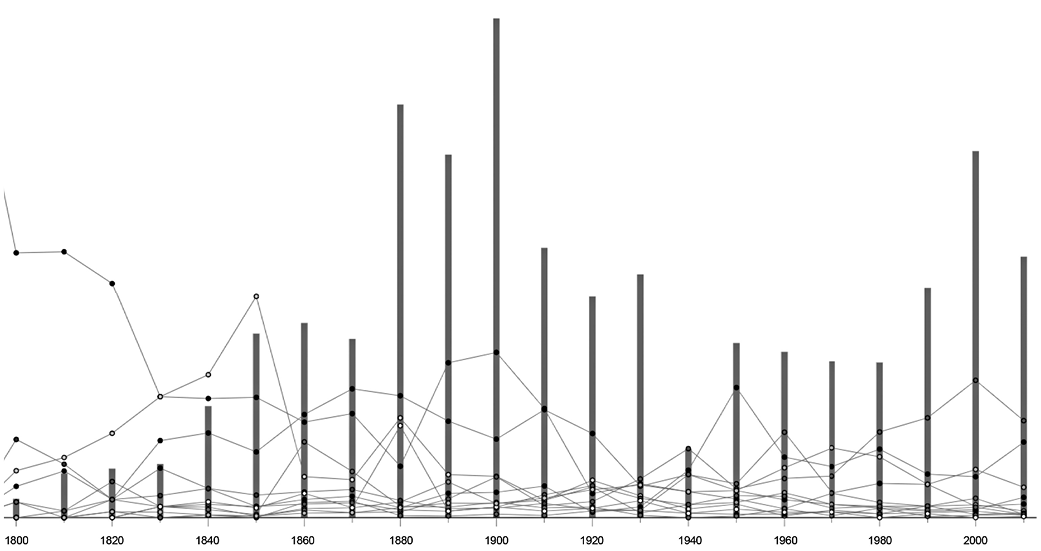
The totals offer a profile something like a suspension bridge. A sudden rise after 1800 peaks between 1880 and 1910; then the curve descends to a low point in the 1940s, followed by restrained productivity into the 1980s; and then a renewed rise into the 2000s and after. Production is dominated in the nineteenth-century heyday by German, Italian and French statues and in the period 1980–2010 by Hungarian, Russian and Polish ones. Obviously, the post-communist countries went through a ‘catching up’ exercise in public-space historicism when, belatedly, they were in a position to do so, and at a time when the fashion had already passed in Western Europe. That offers a vivid illustration of the often-noted asymmetry between the ‘old’ and the ‘new’ Europe, the ‘old’ being the western half that was liberated from totalitarian dictatorships in 1945 and the ‘new’ being the eastern half, which would have to endure tyranny until 1989. But there is also a deeper asymmetry between the two halves: in the west, the state system continued much as it had been in 1913; whereas most of the states of Central and Eastern Europe were carved out of dismembered empires in 1919.
The American delegation had come to the 1918 Paris peace conference charged with Wilson’s ‘Fourteen Points’ agenda, stipulating the right of ‘peoples’ to self-determination. How those ‘peoples’ could be mapped onto territories had been intensely studied, by way of preparation, by geographers and other scholars (a group known as ‘The Inquiry’, including Walter Lippmann). We have seen the comments of one of their collaborators, Leon Dominian, concerning Serbia as ‘the country of the gusle’ (Chapter 5). The self-determination principle was applied somewhat selectively: mainly in order to dismember the empires on the losing side (Hohenzollern, Habsburg, and the Ottoman Empire, at least its European portion). The situation was more chaotic for the outlying provinces of Russia (the southern Caucasus, the Baltic lands, Ukraine), which had gone through a revolution and a separate peace treaty with the central powers (Brest-Litovsk, March 1918). Warfare in fact continued after 1918 from Finland to Armenia as new states consolidated themselves under contested regime choices and then tried to stave off incorporation into the new USSR. The states of Western Europe were on the whole left intact; Norway was confirmed in the independence from Sweden that it had peaceably obtained in 1904, the foundations for Icelandic self-government under the Danish crown were laid, and Ireland was engaged in a war of independence that would lead to a self-governing Irish Free State with dominion status in 1922. Cultural minorities in the west, such as Brittany, the Basque country and Catalonia, continued an agenda of identity-assertion in a spectrum ranging from regionalism to separatism.
The newly sovereign states all asserted their status by proclaiming their national distinctness and authenticity, fully in the mode of the Romantic nationalism of the preceding century, but of course in a drastically modernized climate. Most of them in their new constitutions prefixed a clause affirming that the state was predicated on the nation’s identity and established the national language as its language of affairs and education. Indications of how Romantic nationalism was expressed in a modern century can be inferred from the examples of Latvia, Ireland and Poland.
In Latvia, an epic silent film was made in 1930 under the title Lāčplēsis. It celebrates the heroic vindication of the national cause in a story set during the recent War of Independence and its aftermath. A wicked German attempts to rape a young woman but is thwarted by a hero-figure, the independence fighter Jānis, who saves the day. That action is presented, however, as the contemporary iteration of a deeply underlying myth: that of the legendary hero Lāčplēsis freeing the medieval heroine Laimdota from the evil Black Knight. The same actors play the mythical and the contemporary roles, and the film creates visual overlays, double-exposure transitions and echoic repetitions between the modern and the mythical. The film made use of the Latvian epic of the same name (‘the bear-slayer’), one of those many national epics that had been produced across Europe (Chapter 4); the Latvian author Andrejs Pumpurs had begun his version of Lāčplēsis in order to create a counterpart to the Estonian Kalevipoeg, and after toying with the idea of a pseudo-ancient counterfeit presented it in 1880 as a modern text based on local legends. Pumpurs’s Lāčplēsis looks back to the medieval Livonian crusades, when the Teutonic Order subdued the Baltic lands; the incorporation of that tale in the modern anti-German film brings history around full circle. The young hero Jānis, whose imagination has been fired by reading a dog-eared copy of Pumpurs’s epic, has magically been made receptive to the spirit of the mythical hero and recognizes in the arrogant Prussian the ancient wicked Black Knight. The epic hero is, in the most literal sense, an inspiration for modern freedom fighters. And so a modern melodrama of national independence and evil rapists is calqued onto the Romantic-national epic; this is done, however, in a film drawing heavily on the modern, avant-garde stylistic techniques of German expressionist cinema (The Cabinet of Dr Caligari) and Sergey Eisenstein (Battleship Potemkin) and intercut with newsreel footage.
This remarkable film is only one example of the many ways in which modern, independent Latvia was channelling the spirit of Lāčplēsis.1 Lāčplēsis memorials dot the country and testify to its historical vicissitudes. One, on the façade of the Riga parliament building, replaced an earlier statue of the Teutonic Landmeister Walter von Plettenberg; it was itself removed under Communist rule in the 1950s and a replica was put up in 2007. Similarly, Lāčplēsis defeating the Black Knight was the subject of a 1932 statue (inscribed ‘To the liberators’) honouring the Latvian troops that had taken Jelgava in 1919; erected in 1932, it was destroyed in or after World War II and restored in 1992.2
A statue of Lāčplēsis was also included in 1935 on the plinth of the remarkable symbolist/art deco ‘Freedom Monument’ that towers over downtown Riga. Here, the bear-slayer is rendered much as in the film (woollen skullcap, bobbed haircut). He was similarly represented on a postage stamp of 1932, where, as in the film, his face hovers in the clouds above the Riga skyline like a protective spirit (Figure 12.2).Footnote * Thus we see the national hero remediated from epic poem to statuary to film and postage stamps. The first step in that progress moves within the established ambit of traditional art forms. Then film and stamps provide new, twentieth-century distribution media.3 The postage stamp in particular was a ubiquitous platform. Signifying the independence of the state, its currency and its postal service, it habitually featured the nation’s semi-official iconography and provided it with possibly the deepest and widest social penetration ever achieved by the graphic arts. The trend started in 1896 when Greece issued classically themed stamps to celebrate the Olympic Games held in Athens. Only in the decades of post-1945 internationalism, when many small countries and newly independent colonies began to make use of stamps as a cheap but popular marker of international presence, do we see an internationalization of philatelic icons – Marie Curie, Leonardo and in the Communist world Karl Marx.4
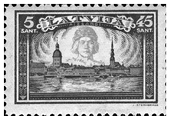
Similar dovetailings of historicism and modernity are noticeable at the presence of newly independent states such as Ireland and Poland at world fairs of the interwar period. Both countries considered themselves to be anciently rooted states now restored to their erstwhile sovereignty. Both used the modern, forward-looking and even futuristic platform of the world fair to showcase both their modern viability and their ancient rootedness. The Irish self-presentation was more traditionalist. At the 1933 Century of Progress Exposition in Chicago, a ‘Pageant of the Celt’ was held, harking straight back at the legendary-historicist repertoire of the Irish Literary Revival (which remained popular anyway among the Irish-American diaspora); more pragmatic was the distribution of an instructive Handbook of the Irish Free State, with geographical and statistical information, presented in a sumptuously neo-Celtic design modelled on the country’s greatest cultural heirloom, the medieval Book of Kells.5
The Polish state, well aware of its parlous position between Germany and the USSR, saw in the world fairs of the 1930s a necessary tool of cultural diplomacy and invested much in its pavilions; it opted for a modernistic pavilion style replete with references to the rich Polish past. On the very eve of Hitler’s invasion, in 1939, it marked its presence at the New York World’s Fair with a striking flat-roofed prefab building, fronted by an openwork tower constructed out of 1,200 gilded shields and overlooking an old-school, traditionally academic-style equestrian statue of the medieval king Jagiello I brandishing two crossed swords (Figure 12.3). The New York public failed to get the historical reference in this modern building, some people believing that the statue represented the contemporary Polish strongman leader Marshal Piłsudski – as well they might, since some of the material had been transported to New York on a freight ship named Piłsudski.6
Polish pavilion at the 1939 New York World’s Fair.
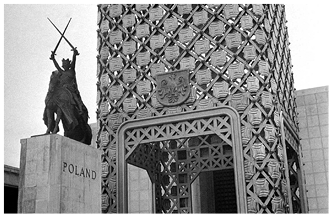
And so world fairs resumed their function after the Great War had ended. The former imperial peripheries of Europe as sovereign state participants continued their Romantic-nationalist identity affirmations by other means, embedding it in modernist forms and shapes. And it was not only the new states; even the very oldest caught the tide of post-Romantic cultural nationalism. In Lisbon, a World Exhibition was held in 1940 to mark 800 years since the foundation of Portugal and 300 years since the restoration of independence from Spain. The fair was a publicity exercise of the authoritarian regime, the Estado novo; it was opened by Marshal Carmona, the country’s nominal president, with de facto dictator Salazar also in attendance. Various streets around the fair grounds were renamed in the following years to evoke the period of colonial discoveries; but the eye-catcher was a large monument glorifying the nation’s achievements in the colonial voyages of discovery – perpetuating the triumphalism of the Columbus monument at the Barcelona Universal Exposition of 1880. In 1960 it was replaced by a stone successor, still one of Lisbon’s main landmarks (Figure 12.4). Portugal in 1960 still considered itself a colonial empire, and Salazar was still in power.7
Monument to the Portuguese Discoveries, Belém, Lisbon (António Pardal Monteiro and Leopoldo de Almeida, 1960).
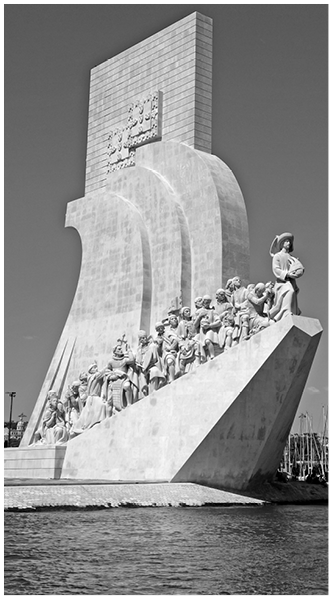
Democracy and Ethnocracy
Names such as Piłsudski and Salazar alert us to the fact that the continuance of Romantic nationalism in the twentieth century was not only affected by a modernist shift in aesthetics and media technology; the political ground was shifting as well. Our view of the interwar years tends to be dominated by the twin juggernauts of Hitler and Stalin, with, as afterthoughts, Mussolini and Franco. But the cases of Poland, Portugal and Latvia alert us to the fact that those dictators were not an anomaly: they represented a general European trend. We have encountered the strong, indeed charismatic leaders of former war commanders in the post-war states, Piłsudski among them. In some cases, they represented a continuity from the imperial pre-1914 days: Hindenburg in Germany, Mustafa Kemal Pasha (Atatürk) in Turkey, Horthy in Hungary. In other cases, they had used their military know-how to ensure their new country’s independence: Mannerheim in Finland, Piłsudski in Poland. Mannerheim honourably relinquished power after losing the 1919 elections, but in Poland Piłsudski abolished parliamentary government and became de facto dictator as of 1926. Other coups d’état involving military leaders were those of Primo de Rivera (1923) and Franco (1936) in Spain, Óscar Carmona in Portugal (1926) and Ioannis Metaxas in Greece (1936). We may even include France’s Philippe Pétain in that list; his rise to power in Vichy France was dictated by war circumstances, but he undoubtedly used his charisma (having been the heroic defender of Verdun) as a springboard towards running a nationalist dictatorship.8
If we add to those generals the other autocratic leaders of nationalist non-democracies, the list grows to dismal proportions. The poet-turned-pilot Gabriele D’Annunzio started the trend by proclaiming himself duce of the Istrian city of Fiume/Rijeka; Italy’s Mussolini followed suit in 1922. Then came Zogu in Albania (1925, ‘King Zog’ as of 1928), Antanas Smetona in Lithuania (1926), Engelbert Dollfuß and Kurt Schuschnigg in Austria (1932 and 1934), Konstantin Päts in Estonia and Kārlis Ulmanis in Latvia (both 1934), Boris III in Bulgaria (1935), Carol II in Romania (1938, followed by Ion Antonescu in 1940), Vladko Maček in Yugoslavian Croatia (1939). Hitler’s power grab in 1933 was only one in a series. From 1917/1922 (the coups of Lenin and Mussolini) to 1975/1989 (the deaths of Salazar and Ceauşescu), the European twentieth century is mostly one of dictatorships.
That is how the application of the Wilsonian principle of national self-determination derailed. The notion of national self-determination, involving the people’s liberation from alien overlordship and imperial oppression, had originally been meant as a democratic gesture. Sieyès, the champion of the tiers-état and godfather of its assemblée nationale in 1789, would have firmly approved of Wilson’s programme. But the newly constituted nation-states, many of them liberated from the rule of imperial overlords, eagerly ditched their democratic freedoms in favour of authoritarianism or dictatorships.Footnote * Many countries in Eastern and Central Europe, which subsequently got mangled between Hitler’s Third Reich and Stalin’s USSR, recall those succeeding tyrannies with anguish but with a historical foreshortening that makes it seem as if this Nazi–Bolshevik double whammy put an end to their recently acquired liberty and self-determination. Not so: almost all of them had already, of their own volition, imposed dictatorships on themselves in the run-up to the Molotov–Ribbentrop Pact.
Many of these anti-democratic movements justified their power grabs by claiming that the imminent threat of a communist revolution had to be averted; we even encounter this, bizarrely, in Ireland’s Blueshirt movement. Surely Ireland in 1930, a self-governing, Catholic, agricultural and traditionalist country, was almost as impervious to a communist takeover as the Vatican; in the end, the Blueshirt movement remained quixotic, though it inspired the national poet W. B. Yeats to write anti-democratic ‘marching songs’ for it, and the spectre of a Bolshevik threat was widely used as a scare tactic. In fact, Ireland is, like Finland, one of the few new (post-1918) countries where democratic stability prevailed and manifested itself in the peaceful transfer of power following general elections – even though both had gone through ruinously divisive internal wars in the early days of their independence. As of 1933, the government of Ireland, though by no means authoritarian, was under the strongly paternalistic leadership of Eamon De Valera. A deeply committed Irish nationalist, he had been an anti-British separatist insurgent and was prone to a type of Catholic integralism also practised in Spain and Portugal. Still, that was not ipso facto anti-democratic: a similar national paternalism characterized anti-Fascist leaders such as Charles De Gaulle, Winston Churchill and Queen Wilhelmina of the Netherlands, strong-willed personalities who all believed in their transcendentally imposed (rather than democratically mandated) stewardship of the nation.Footnote *
Not all nationalists, then, were authoritarians; but all authoritarians (west of Stalin, that is) were nationalists. The B-list of European dictators of the interwar years all invoked a mission to vouchsafe the survival of the nation and the fatherland. Overtly so, as we can tell by the names and mottos of the movements they headed: the Patriotic Union for Primo de Rivera, the falangists with their shouted call-and-response España: una – España: grande – España: libre, the Lithuanian Nationalist Union for Smetona, the Fatherland Front for Dollfuß and Schuschnigg, the Action française and so on. From the days of the Ligue des patriotes to the Front national, the invocation of the nation and the flag-waving assertion of national identity is massively overrepresented on the right wing of the political spectrum. It is among the political right that that national flag is the most sought-after cloak to wrap one’s politics in.9
The track record of post-imperial European nation-states in the 1920s in retrospect appears like a prefiguration of the more recent drift (usually linked to the notion of ‘populism’) towards strongman authoritarian leaders with a charismatic media presence and a nationalist agenda. Once liberated from foreign-imposed tyranny, the newly independent Central European governments turned, as Spain, Portugal and Italy had done, to homegrown nativism and xenophobic nationalism, invoking it if necessary to derogate the powers of parliament, the independence of the judiciary, the international rule of law as established by treaties and the freedom of the press. All this was rationalized by the categorical imperative of national identity, and the legacy of Romantic historicism was heavily drawn on, instrumentalizing a national past as canonized by nineteenth-century historians and artists.
That inter-war trend has been echoed across Europe in recent decades, Italy under Berlusconi leading the way to Boris Johnson and Victor Orbán and their ilk. What this parallel across the intervening decades suggests is that there may well be an inherent instability in the very concept of the ‘nation-state’, even though now it is often accepted as the default model for a democracy.
Scholars in nationalism studies are keenly aware of the heuristic distinction between civic and ethnic nationalism. It has been overworked in the past but is nevertheless an indispensable distinction since, as we have repeatedly seen in the foregoing pages, the very concept of the nation hovers between two connotations: the nation as the common society that derives a sense of shared purpose and solidarity from being co-responsible for the state and its governance; and the nation as the cultural community that derives its sense of joint identity from a shared descent and inherited culture (language and memories). In most cases, the two are intermingled; but the proportion in which the two are commingled can be established only if we have a sense of the ideal-typical, civic versus ethnic nature of the ingredients that make up the mix. Those components are habitually called by the two Greek names for ‘the people’ in a political or a cultural sense: demos and ethnos. The shifting emphases with which nationalism presents itself as civic or ethnic reflects the way in which the nation is defined, or self-defines, as demos (the citizen stakeholders of a state) or ethnos (the people sharing the same culture).
The ambivalence in the very concept of the nation-state is a direct consequence of the vacillation in the self-definition of the nation as demos or ethnos. As stated before, the Wilsonian self-determination of peoples was initially meant as a democratic principle. It is for that very reason that Churchill, an old school imperialist, resisted its readoption, post-1945, in the Atlantic charter and by the United Nations: it could be invoked by colonially subjected peoples and Churchill, as a British imperialist, was not prepared to allow that.
Although the idea of national self-rule was meant democratically, as citizens’ freedom from foreign overlordship, we note that in many cases it gravitated in a direction we may call ethnocratic: the rule not of the demos (the people as a social body) but of the ethnos (the people as a cultural community). The rhetoric of contemporary populism oscillates between demotically motivated anti-elitism and ethnically motivated nativism. The denunciation of over-educated, smugly liberal elites, out of touch with the worries that affect the common people, can always emerge out of, or shade into, the warnings against swarms of immigrants or unassimilated denizens from a culturally hostile world, aided and abetted by those cosmopolitan elites.10
The nation-state may be inherently vulnerable to a gravitation from democracy towards ethnocracy. And despite the intervening totalitarian dictatorships and a World War, and despite the horrified recoil from totalitarianism in post-1945 internationalism, that ethnocratic gravitation, away from democracy, affects the nation-state today as much as it did a century ago.
Nationalism after Decolonization
Studying the ‘afterlife’ of Romantic nationalism after 1918 would require a multi-volume work rather than this single chapter – given the seismic intensity, the magnitude and the ongoing duration of the political turbulence in the century since the Treaty of Versailles. Globalization, and the decentring of Europe’s position in the world, had been announced in the world’s trading economy (witness the world fairs) and was now vastly amplified by the end of the European empires. The break-up of the Romanov, Habsburg, Hohenzollern and Ottoman Empires in 1917–1919 was accompanied in Western Europe by the imperial breakdown of Spain (Cuba and the Philippines, 1898), Britain (Ireland 1922, South Africa 1931, India and Pakistan 1947, Kenya 1964), Denmark (Iceland 1944), the Netherlands (Indonesia 1948), Belgium (Congo 1960), France (Indochina 1954, Algeria 1962) and Portugal (Angola and Mozambique, 1975). Each of those dates (and the list is only indicative) represents a hugely complex process. Remarkably, that imperial break-up was a process that spanned across the worst and most ruinous war in human history.
Nationalism in Europe’s former colonies was, on the whole, driven less by a ‘cultivation of culture’ than by political and economic independence. Asserting the right to self-determination among disenfranchised colonials is primarily a struggle against political and economic injustice rather than Romantic identity assertion as in nineteenth-century Europe. Identity-driven, nativist nationalism can, however, be encountered globally: a drift towards ethnocracy was as noticeable outside Europe as it was within Europe’s new nation-states. By way of example (random but telling) I point readers to places as far apart as South Africa, Israel and India. In South Africa, a mythology emerged during the Boer Wars of stalwart, biblically devout Boer intransigence, exemplified and commemorated in events such as the ‘Great Trek’ and the exodus of the Boers in trains of ox-drawn wagons to a new home in the Transvaal. Afrikaner nationalism was the result; it combined post-defeat grievance politics with equal measures of fundamentalist Calvinism and white supremacism. Afrikaner nationalism found a radical champion in Oswald Pirow, a Nazi sympathizer who in 1940 published a ground plan for a ‘New Order’ in South Africa, ambiguously inspired by Salazar’s Estado novo and/or by Nazi Germany. The political figurehead of Afrikaner nationalism, the Calvinist preacher Daniel François Malan, leader of a Reunited National Party, formalized South Africa’s system of apartheid in 1948. In 1958, Pirow acted as chief prosecutor in the ‘treason trials’ that saw Nelson Mandela arraigned for the first time, accused not of just of sedition but of high treason against the South African republic. In Israel, the two-state Zionism of David Ben-Gurion vied with the Jewish supremacist revisionist Zionism of Ze’ev Jabotinsky, the Mussolini-inspired intellectual godfather first of the Hatzohar and Herut movements and ultimately, indirectly, of Likud. In India, Gandhi’s anticolonialism was accompanied by a wide palette of Hindu nationalist movements. Many of these were inspired by the Hindutva (‘Hindu-ness’) nationalism of Vinayak Damodar Savarkar, who after 1938 became an admirer of Hitler; the Bharatiya Janata Party eventually issued from that Hindutva-inspired tradition.11
Within the European heartlands of the former empires, post-imperial nostalgia took hold. The loss of colonies and of trans-European power coincided with, or amplified, a more general nostalgic undercurrent under the surface of high modernity. Miguel de Unamuno’s journeys inwards to the various regions and villages of the Spanish heartland (recounted in Paisajes, 1902; De mi país, 1903; Andanzas y visiones españolas, 1922) were part of a cultural reaction to the calamitous colonial losses of the (proverbially traumatic) year 1898. In Germany, the tradition of the idyllic Dorfgeschichte continued in force after 1918 and engendered the rustic tales of ‘blood and soil’ as well as the first cinematic versions of rustic idylls.Footnote * These Heimatfilms became all-dominant in the post-1945 period of defeat and Wiederaufbau (‘economic reconstruction’).12
In Britain, the nostalgic mode of ‘Englishness’ similarly drew on nineteenth-century sentimental idyll, continued in the downmarket fiction of the 1920s known as ‘love and loamchild’, as well as the magic realism of John Cowper Powys and various Powell and Pressburger films, hinting at the lingering presence of ancient memories encoded within the English landscape itself.13 An eternal England, remembered from childhood and outlasting history and the Empire itself, was evoked by Conservative Prime Minister Stanley Baldwin in his famous lecture to the English nationalist Society of St George in 1924:
The sounds of England, the tinkle of hammer on anvil in the country smithy, the corncrake on a dewy morning, the sound of the scythe against the whetstone, and the sight of a plough team coming over the brow of a hill, the sight that has been in England since England was a land, and may be seen in England long after the Empire has perished and every works in England has ceased to function, for centuries the one eternal sight of England.14
That evocative, practically verbless conspectus of sights and sounds leads naturally enough to the conclusion that ‘The love of these things is innate and inherent in our people.’ Fichte would have approved. The sentiments were echoed (with some sarcasm, but still) in George Orwell’s reflection on the war effort, The Lion and the Unicorn (1941), from which Conservative Prime Minister John Major cherry-picked one soundbyte in 1993 and inserted it in a neo-Baldwinesque context:
Fifty years from now Britain will still be the country of long shadows on county grounds, warm beer, invincible green suburbs, dog lovers and pools fillers and – as George Orwell said – ‘old maids bicycling to Holy Communion through the morning mist’ and if we get our way – Shakespeare still read even in school.15
Reading Shakespeare in school: that sting in the tail is, of course, a dogwhistle to a national, traditionalist educational policy. It also circles back to the fountainhead of this type of English nationalism: Thomas Carlyle’s celebration of Shakespeare as a cornerstone of English identity in On Heroes and Hero-Worship.
National nostalgia is still with us, and it, too, alternates between salience and dormancy. The Heimatfilm dropped steeply out of fashion in Germany in the mid-1960s, to the point of becoming proverbial as the nadir of kitsch after 1968. As such it was evoked in 1984, with ironic back-handedness, as a point of departure for Edgar Reitz’s experimental film/TV series Heimat (with sequels in 1992 and 2004), which combined a coming-of-age story with a regionalist exploration of the communal and generational memories of a fraught German century. Since then, the layered ironies of the 1980s have evaporated, and the Heimatfilm has become once again, straightforwardly, a romance genre for undemanding mass consumption (now, of course, featuring strong female characters). Such are the alternations and dialectics of cultural taste.
Similarly, in France, after the nouvelle vague had trashed the cinéma de papa (their term for the complacent commercial movies of the 1950s) and had produced, across the 1960s and 1970s, an edgy, urban avant-gardism, the 1980s saw mellow regionalism return in force: the twin films Jean de Florette and Manon des Sources (1986, based on works by the regionalist author and film-maker Marcel Pagnol). A similar resurgence of nostalgic comfort viewing occurred around the same time in British cinema: after the ‘swinging sixties’, period costume drama returned in the 1980s, lovingly evoking Victorian or Edwardian England (Chariots of Fire, 1981), with at best some vestigial ironies inherent in the source material (the Merchant-Ivory productions of E. M. Forster’s A Room with a View, 1985, and Howards End, 1992). The BBC produced many idyllic costume dramas, drawing on canonical works of Victorian vintage (George Eliot, Charles Dickens, Elizabeth Gaskell, Anthony Trollope), and serialized the rural memoirs of Flora Thompson (Lark Rise to Candleford, published 1939–1943, broadcast 2008–2011). In the 2010s, marked by austerity and leading up to Brexit, there was the remarkable vogue of Downton Abbey (TV series 2010–2015, film spin-offs 2019, 2022 and 2025), with its mellow afterglow of a Baldwin-style harmony of squires and servants, castles and cottagers.Footnote *
These examples, few and somewhat randomly chosen as they are, do have indicative value and offer food for thought. For one thing, the dates of Heimat, Chariots of Fire and Jean de Florette suggest that a return to a nostalgically national cultural repertoire preceded the downfall of communism in 1989, coinciding with the Falklands War and the growth of Rambo-style martial action-hero movies in the US; and that therefore it is problematic to explain the revival of nationalism at the end of the twentieth century purely and simply as a response to ‘1989’. The new nationalism is often represented as a palliative to the agoraphobia of globalization and the disintegration of a bipolar world system post-1989; but the cultural material suggests the gestation a new nationalism starting in the 1980s. When communism vanished from the political landscape as an ideological presence, and well before globalization went into overdrive by the end of the century, the feel-good factor of national identity was already there, poised, standing by.
The Nation at the Movies
In flagging the post-1918 alternating dormancy/salience cycles of national nostalgia, I have drawn on examples from cinema and television, the twentieth-century’s new media par excellence. Those particular new media proved their power in many genres: documentaries, love stories, adventure romance, psychological drama and so on. Among all those things, it was highly suitable for dramatizing and visualizing the nation, uniting the narrative and the spectacle of national identity, either as a foregrounded theme or as an underlying frame. As such, cinema offered a new platform for Romantic nationalism in a technological, post-Romantic age.
Given that function, we can use film history data as an Ariadne’s thread through the mixed, mashed-up track record of the twentieth century. Instead of attempting, in these closing pages, an exhaustive conspectus of cultures of nationalism in twentieth-century Europe, I trace instead a single cultural tradition through the labyrinth, tracking post-Romantic nationalism in its cinematic articulation. Cinema, the century’s stand-out new art form, has been encountered numerous times across the pages of this book, from Casablanca to Birkebeinerne. Of all narrative genres, cinema was and is truly representative of the twentieth century: high-tech, mass-audience, global, reaching from downmarket commercialism to art-house aesthetics.16
We have seen how the Latvian film Lāčplēsis recycled national-Romantic legends in the new medium of film, even with its avant-garde aesthetics. Even before 1918, cinema had proved its suitability for patriotic, Romantic-historical narratives, largely in the mode of the dramatization of great national figures. Tables 12.1a, 12.1b and 12.1c indicate a productivity that is fairly evenly distributed across Europe.Footnote *
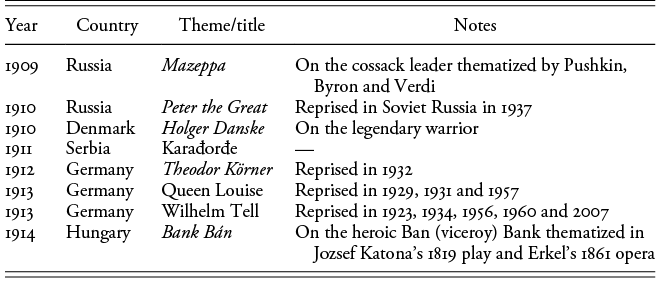
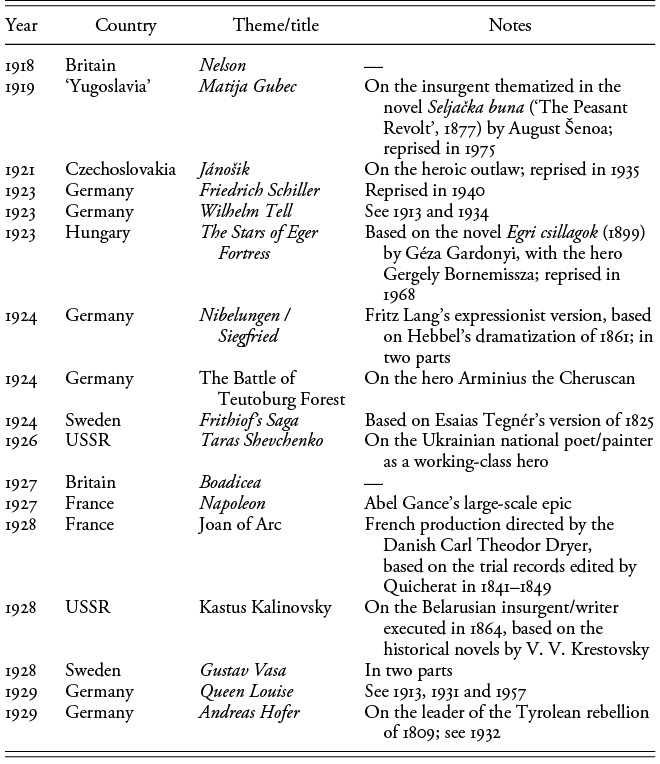
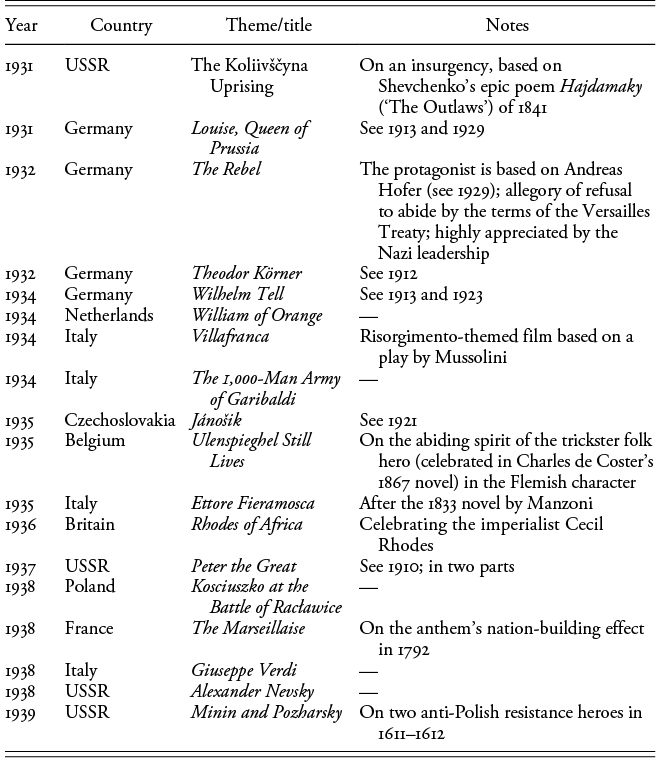
A few striking patterns emerge from this list. The production spread was pan-European (albeit skewed towards Germany, Central–Eastern Europe and Italy). The themes are almost invariably of nineteenth-century vintage. Even when themes or heroes from an earlier period are thematized, the film versions tend to follow the canonized version of events as laid down by Romantic writers and historians (Schiller being the main conduit for Wilhelm Tell). In that sense, most of these films are remediations of nineteenth-century Romantic historicism in a new, high-tech medium. What is also noticeable is the thematic repetitiveness: many of these films return to the themes of earlier ones. That is partly due to the technical innovations of the medium. Sound film would return to topics covered previously in silent movies, now obsolete, and the later advent of colour or extra-large formats would stimulate similar recyclings.
On the other hand, that pattern is also characteristic of canonicity as such. Whatever enjoys canonical status is, almost by definition, a repeatedly reactivated – not a dormant or inert – cultural presence: like repeated performances of Shakespeare plays or reprints of Les Misérables. What is more, canonicity seems to project these repetitions and reactivations across different media and makes use of new media as they emerge: operas and films based on Shakespeare plays; graphic-novel renderings of Les Misérables as well as audio books and films and musicals, and musicals turned into films. And so we can phrase the principle both ways: film is a new habitat for classics of Romantic-nationalist vintage; and also the cultural canon established by Romantic nationalism was successfully remediated into the emerging new media of cinema and television.
In the present century, DVD and then streaming video have become the dominant platforms for viewing, eroding the centralized distribution of the twentieth century (cinemas, broadcasting corporations); at the same time, this more diffused mode of home-viewing distribution has been counterbalanced by a collectivized, internet-based mode of reviewing (websites, blogs, discussion channels, social media). But ‘cloudification’ (domestic consumption, online discussion) affects only the distribution and reception patterns of cinematic drama. Production costs have remained high, and studios and broadcasting corporations remain important producers.
Even in the 1920s and 1930s, the signs of globalization were there. In India, a film was produced about the nation-building King Harishchandra as early as 1913. Post-1918, the foundations were laid for what later would become the largest film industry worldwide. Some early films are already national consciousness-raisers invoking the subcontinent’s proud past and rich heritage. Bhakta Vidur (‘The devotion of Vidura’, 1921) dramatized an episode from the classic Mahabharata epic, but it was banned by the British authorities because they felt it to be an allegorical endorsement of Gandhi. Gandhi’s presence was also noticeable in the first Indian talking movie in Tamil and Telugu, Kalidas (1931, now lost), which celebrated the Sanskrit poet of that name but included publicity songs of the Congress Party and in praise of Gandhi. The first Marathi talkie, The King of Ayodhya (1931, with a Hindi-language version in 1932) returned to the figure of King Harishchandra. The 1933 historical drama Sinhagad was an adaptation of a 1903 historical novel by Hari Narayan Apte celebrating the inspiring figure of the Marathi warrior-monarch Shivaji, a widespread lieu de mémoire in modern India’s developing national consciousness; he would be thematized again in films in 1952, 2018 and 2019. The 1936 biopic of the seventeenth-century Saint Tukaram (Marathi, again) marked the breakthrough of Indian cinema on the international scene: it won high praise at the 1937 Venice film festival. Inside India it was seen as an exemplification of the non-violent values of Gandhi-style nationalism.
And there was, of course, Hollywood. The films discussed here are from a period that is bracketed by two American classics. The earlier one was D. W. Griffiths’s Birth of a Nation (1915), a landmark of American cinema and, be it added, a diatribe of southern states resentment, white supremacism and Ku Klux Klan glorification (it was based on Thomas Dixon’s racist novel The Clansman, 1905). The American south was also the setting of the period’s later-date bookend: Gone With the Wind (1939), in which cinema exploded into full-colour large-screen spectacle. The premiere took place in Atlanta, the city whose burning marks the film’s dramatic high point midway; a screening was held in 1961 to mark the centenary of the Civil War’s outbreak. In successive reissues, its format was enlarged to widescreen and then to 70mm. Its status as a national classic stands at odds with the middlebrow book that provides the screenplay: Margaret Mitchell’s 1938 novel was typical of the bodice-ripping romances into which the Scott format of the historical novel had declined. No War and Peace this; yet it aptly caught the most incisive crisis in American history in a passionate combination of private, feminine-focused romance and national historical epic. Its enduring persistence in post-war American culture was compounded and reinforced by a similarly constructed television series, North and South (1985–1994), based on the 1980s trilogy by John Jakes.Footnote *
The cases of India and the US indicate strong lines of continuity across World War II. Within Europe, the years 1940–1945 marked a caesura.
Cold-War Asymmetries
The years 1940–1945 saw some historicist propagandistic films in the ‘Great Men’ mode: Soviet films on the Cossack hetman Khmelnitsky (1941), on the victorious general Suvorov (1941), on the Armenian hero Davit Bek (1944). The Third Reich produced films on Schiller and Bismarck (both 1940) and – embracing Dutch/Afrikaans – Rembrandt (1936) and the Boer leader Kruger (1941); Portugal chipped in with a biopic on Camões (1941).
The most notable nationalist film to come out of the war years was Goebbels’s massive pet project Kolberg (1945), a lavish full-colour production completed even as the Third Reich was collapsing. Its storyline, set in the days of Napoleonic hegemony, was meant to encourage the German public in its dire straits: how a town held out against overwhelming odds, mobilizing the population one and all, until as if by a magic dispensation the fortunes of war turned and the mighty foes were vanquished. The anti-Napoleonic wars of liberation were a favourite point of reference for Goebbels, with frequent references to the verse of Theodor Körner.Footnote * But the film, like the Reich itself, sank in ruination.
The years of the Cold War show a remarkable asymmetry in production on the two sides of the Iron Curtain. Much propagandistic English-language movie entertainment, increasingly enmeshed in a Hollywood-dominated anglosphere, celebrated the heroism of the bygone war effort, first during the war years and afterwards as well. Wartime propaganda continued to be produced well after the war had actually ended and became a form of popular celebratory remembrance. In the Netherlands, the 1971 memoirs of a resistance hero were filmed by Paul Verhoeven, first as film (Soldier of Orange, 1977) and then as a television miniseries (For Queen and Country, 1979). The film in turn was made into a musical that premiered in 2010; Soldaat van Oranje has been on an uninterrupted run since then, with 3.5 million tickets sold, and is arguably the country’s most important mnemonic platform in its remembrance of the Nazi occupation.
War commemoration was couched and made popular in dramatic action tales – also, in the G. A. Henty tradition, for boys, witness the ‘Biggles’ series by Captain W. E. Johns, and comic strips with such titles as Commando, Warlord and Battle Picture Weekly – pulp comics that rendered shouts of Achtung! and Schnell, schnell, Schweinhund! widely familiar.17 For Johns, the war never really ended: to the initial Biggles stories, set in the Great War, were added tales of the plucky pilot battling first the Nazis and then, after 1945, international communists and criminals. The timeline of military-hero comics also gravitates from the 1960s to the 1980s: War Picture Library ran from 1958 to 1984, Commando from 1961 to the present, Warlord from 1974 to 1986 and Battle Picture Weekly from 1975 to 1988. As those dates indicate, this mass-produced cartoon view of history continued right up to the moment when cinema took up the cue, Indiana Jones snarled his ‘Nazis! I hate those guys!’ and Rambo ‘got to win this time’.
Throughout these Cold War decades, John Wayne starred multifunctionally, either as a sheriff in the Wild West or as an officer fighting the Nazis or the Japanese; British cinema evoked the exploits of navy vessels under their benign paternalist captains, from In Which we Serve (1942) and We Dive at Dawn (1943) to The Cruel Sea (1953). World War II movies morphed into heroic action in the 1960s (The Guns of Navarone, 1961; The Longest Day, 1962; The Great Escape, 1963; The Dirty Dozen, 1967). The genre then moved into the cheaper domain of television serials (the comedy Dad’s Army, 1968–1977; Colditz, 1972; Secret Army, 1977–1979; the spoof ’Allo ’allo, 1982–1992). National self-glorification in the epic pre-1940 mode took a back seat to a simple scheme of ‘we the heroes’ versus ‘them the villains’. At best these productions deployed, seriously or comically, standard ethnotypes to characterize heroes and villains in the national-characterological clichés of 1914 vintage: sadistic, technocratic or rigidly unimaginative Germans versus mercurial French charm, quietly courageous English ‘pluck’ and energetic American ‘can-do’.
In the West, war movies such as these largely supplanted the patriotic-heroic epic of earlier decades. Still, a steady trickle of Romantic-historicist dramas continued in Western Europe after 1945, with Franco’s Spain as an added production area (see Tables 12.2a and 12.2b). The genre subsided into ambient unobtrusiveness.
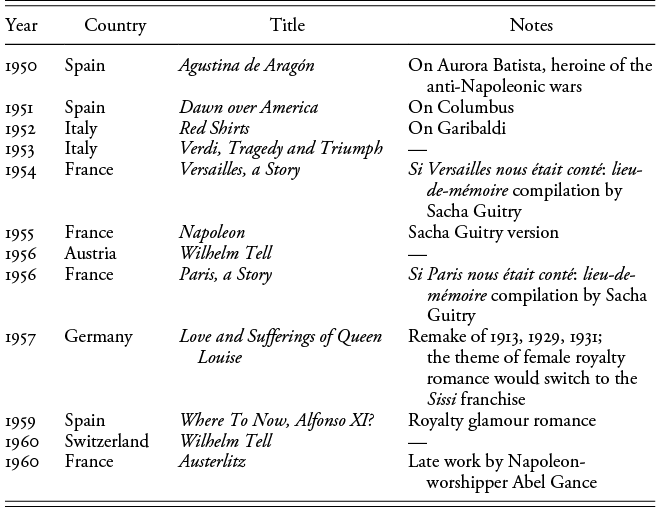
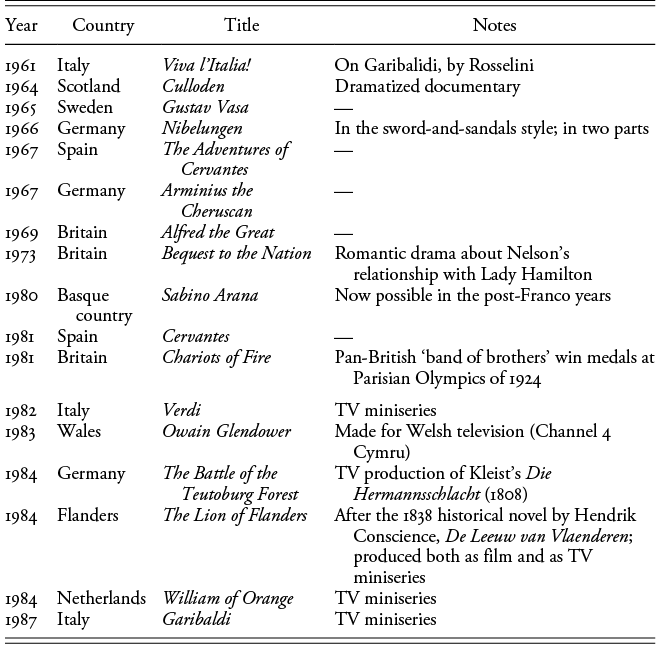
The decline of French cinematic productivity after the end of the Fourth Republic in 1958 is striking – coinciding with the vehement rejection of the cinéma de papa. The temporal dynamics here are almost exactly in tandem with the periodicity of the decline and revival of idyllic rusticism as noted earlier, reaching a low ebb in the 1960s and 1970s and reviving in the 1980s with a shift towards TV. Heroic historicism goes into an almost total eclipse in the 1970s, which may perhaps be correlated with the coming of age of a baby-boom cohort that combined anti-authoritarianism with an anti-historicist turn. There is, however, an emergence of sub-national, regionalist films on Basque, Scottish, Welsh and Flemish themes, extolling the subaltern. And here as in the case of rusticism, a pronounced revival of patriotic history films begins in the 1980s, drawing markedly on the medium of television.Footnote *
As the mention of the nouvelle vague indicates, there was a general shift in tastes. Westerns and war movies were receding as well, overtaken by contemporary-set drama, thrillers, romantic comedies both urban and rustic-idyllic, and magic realism and science fiction. Even the war movies, dedicated to heroism in the national service, situated this heroism in a struggle not against other nations but against Nazism. In Western Europe’s post-1945 ideological landscape, nationalism was, for once, a weak force – as we can also see from the steep drop in national commemorative monuments around this time (Figure 12.1). Internationalism thrived instead. The trend for multinational co-productions and multinational all-star casts became pronounced, and politically international relations were dominated by multilateralist organizations such as the United Nations, the European Economic Community and NATO – for the main enemy was now the Communist bloc.
The cinema of the Communist eastern bloc presents a different aspect, with a more intensive and sustained productivity that patently continues the cinematic remediation of Romantic nationalism (nineteenth-century heroes, and themes made familiar by nineteenth-century novels). For the Cold War years, Tables 12.3a, 12.3b and 12.3c list a lone Albanian film (on the nation’s über-hero Skanderbeg) and a single East German one, two films from Bulgaria, four from Czechoslovakia (including a bizarre trilogy where Jan Hus appears to be motivated by a Stalinist class consciousness), five from Yugoslavia, six each from Hungary and Romania, eight from Poland and ten from the USSR (including the Soviet republics of Estonia and Azerbaijan). That total of forty-two national-heroic film productions is fifty per cent higher than that of Western Europe during the same period.
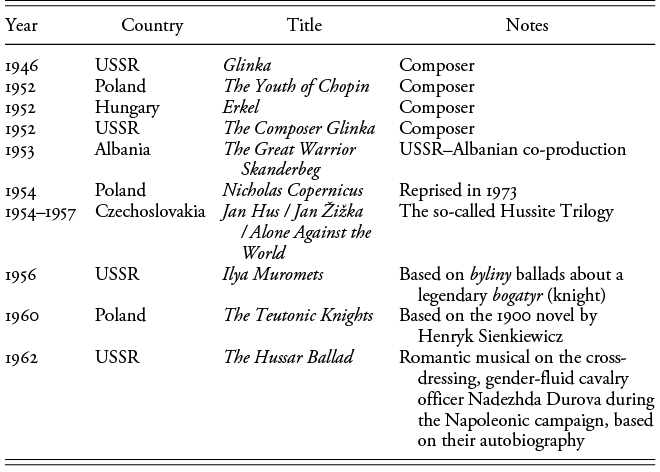
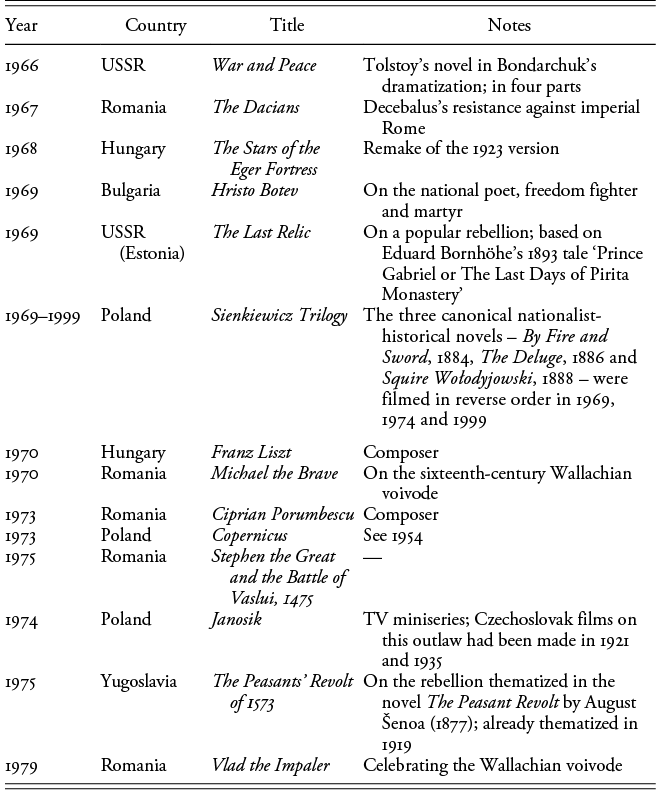
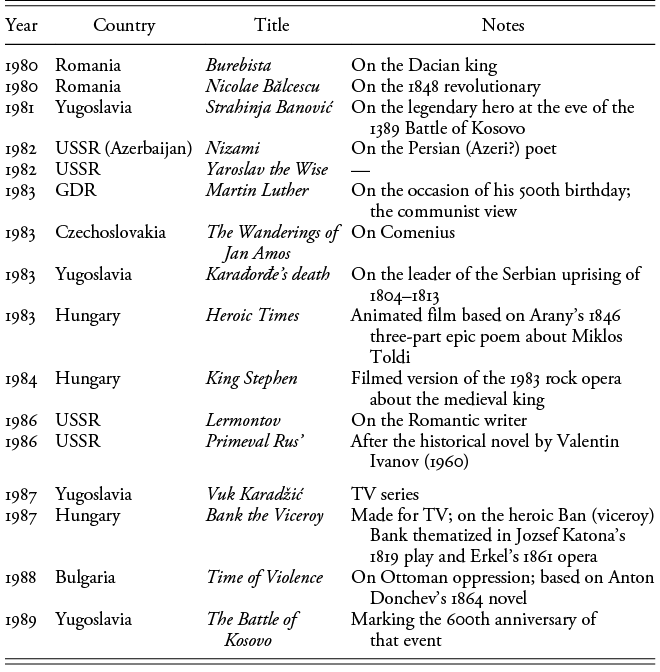
Again, in many cases, the screenplays were based on pre-1914 novels or history books (Sienkiewicz, Bornhöhe, Šenoa, Arany, Donchev). The heroes represent a peculiar sociological selection: monarchs/warlords, proletarian outlaws/revolutionaries, and a slew of composers, poets and intellectuals.
Readers are probably bewildered by this array, some of whose names (Chopin, Copernicus) stand out amidst the numerous unfamiliar ones. But none of the names in Tables 12.3(a-c) are obscure. The monarchs, warlords, insurgents and artists/intellectuals: all have monuments and thoroughfares named after them in their countries’ capitals, and they appear on banknotes and postage stamps. The films merely add to the commemorative cult that for each and every one of them had begun in the Romantic historicism of the nineteenth century. Much more remarkable is their sociological background, which emphatically includes and celebrates the elite, and which follows in the footsteps of a canon established by pre-socialist, ‘bourgeois-liberal’ authors, lacking class consciousness. That wholesale adoption by the communist regimes is puzzling. To account for this apparent anomaly, we should realize that in Marxist literary and cultural criticism ‘bourgeois patriotism’ was seen as an unobjectionable albeit obsolete stage in society’s historical progress towards class consciousness and class struggle. These ‘bourgeois-patriotic’ productions apparently were acceptable enough for the communist regimes to be recycled as entertainment, if necessary draped in some class-consciousness or as prefigurations of the present-day leaders. Many of these films became popular and were fixtures, broadcast annually on TV on public holidays. (And a turn towards TV production is noticeable here, as elsewhere, in the 1980s.) Some of the productions were instrumentalized by post-1968 communist leaderships (gestures towards youth culture during the later Kadar regime in Hungary; Ceauçescu’s Romanian exceptionalism and his leadership cult). Others laid the foundations for what after the fall of communism would become foregrounded preoccupations in the new cultures of nationalism, for example the Kosovo myth in Serbia or the Polish sense of being surrounded by enemies on all sides (the dominant self-image in Sienkiewicz’s novels).
The ongoing cultural presence of post-Romantic national historicism during the Cold War years stands in contrast to the genre’s decline in the West in the decades of the baby-boomers’ counter-culture. The sudden resurgence of nationalism as the leading ideology after the downfall of communism in Eastern Europe cannot be seen in isolation from the latent persistence of ‘bourgeois patriotism’ and the ongoing affirmation of the nation as a feel-good factor under communist rule. While in the West between 1945 and 1989 nationalism was frowned upon, or at best ambient and ‘banal’, it remained discreetly influential in communist Eastern Europe.18
Meanwhile, outside Europe
In India, now an independent country, cinematic nationalism was neither dormant nor latent but very much present. Here the film industry was burgeoning, and the dominance of patriotic content continued in the early post-independence decades.19 This persisted without much discontinuity across the 1989 divide and intensified after 2000 in a climate of growing Hindu nationalism (Tables 12.4a and 12.4b).
These films from various parts of India celebrate a mix of historical nation-builders (from ancient and more modern periods) and anticolonial activists. Production seems to have stagnated somewhat in the decades 1970–2000 (six noteworthy productions in thirty years). This period was marked by the Congress Party’s decline (first election loss in 1977, the assassinations of Indira and of Rajiv Gandhi in 1984 and 1991). Post-2000, another surge in production occurred: fifteen noteworthy productions in twenty years, culminating in 2022 with the extravaganza RRR, which received worldwide fame through Netflix. In the panoply of glorified national heroes, old monarchs and modern insurgents alike, the post-2000 production was able to pick up from the pre-1970 tradition: there were remakes of the films dedicated to Shivaji, Maharana Pratap Singh, Prithviraj Chauhan and the fighting Queen Lakshmibai of Jhansi.
RRR, for all its intensely Indian, Hindutva content, achieved global fame on a newly burgeoning, transnational video streaming platform; it deserves a brief extra comment. A lavish action-hero extravaganza, the film fictionalizes the imagined interaction between two historical figures, anticolonial activists from the 1920s. A Telugu production (the initials in the title stand for Raudraṁ Raṇaṁ Rudhiraṁ, ‘Rage, War, Blood’), but co-produced by companies from various parts of India, the film focuses on the plight and resistance of the Adivasi tribal communities of Southern India. The film portrays the representatives of British rule as cartoonishly evil; the resistance triumph is almost literally an apotheosis, as one of the heroes takes on the looks and guise of the mythical Rama, hero of the Ramayana epic. The finale celebrates a selection of personalities as a veritable lineage, from various parts of India, in the tradition of anti-British resistance: twentieth-century activists such as Subhas Chandra Bose, Vallabhbhai Patel and Bhagat Singh, and canonical historical figures such as Queen Lakshmibai and Chhatrapati Shivaji. That tableau de la troupe is set to a song-and-dance exhortation to honour the national flag. The flag that is featured visually is the 1907 flag of Indian independence, emblazoned with the long-standing nationalist Vande Mataram mantra/slogan, which is repeatedly chanted in the course of the film.20
The visual spectaculars and song-and-dance interludes are pure Bollywood (stretching that term to include Telugu ‘Tollywood’ and other production hubs in the subcontinent outside Mumbai); and the heroes and historical memories are as homegrown Indian as the Bollywood production style. Even so, I would venture to suggest that RRR is also an example of what Bob van der Linden has termed ‘Romantic nationalism in India’.21 It displays all the hallmarks: linking together a series of activists from different periods and regions into a transcendental lineage asserting une certaine idée de l’Inde (for what is Hindutva other than such an ideal essence of cultural identity?); the invocation of national myth (Rama and the Ramayana) as the ultimate validator of national authenticity; the positioning of culture and its lieux de mémoire as an inspirational and motivating force in the resistance against foreign rule – and doing so, to boot, in a movie that tightly dovetails narrative and spectacle. In all those respects RRR answers to the very definition of Romantic nationalism. It would be simplistic to reduce RRR to ‘the influence of Walter Scott and Jules Michelet’; but it would be equally wrong to deny that influence altogether. The Romantic historicism of Scott and the national idealism of Michelet entered not only into a European circulation of ideas but into a global one, and it reached not only Latvia and Iceland but also the US and India, inflected meanwhile by a multitude of local and global circumstances. Specific to India were the repertoire of a prestigious historical culture native to the subcontinent and a lineage of Indian intellectual and artistic activists with an anticolonial agenda. But inflected and assimilated as it was, the mode of Romantic nationalism forms part, and recognizably so, of the style and substance of such films as RRR. Romantic nationalism after the century of globalization can no longer be studied in European isolation.
Epic Nationalism: Outrage into Charisma
Plotting a timeline of the worldwide production of nationally themed entertainment cinema offers a curve that is highly reminiscent, albeit on a different timescale, to the one illustrating the production of commemorative statues (Figure 12.1): a sudden onset, a mid-twentieth-century dip, and a remarkable resurgence post-1990 (Figure 12.5).
Production of films with national-heroic content per decade.

‘Romantic nationalist’ cinema comes in a variety of styles and genres. There are the reverent recyclings of national classics; the historicist celebrations of the lives of national heroes (such as Queen Lakshmibai of Jhansi, or Winston Churchill, or Napoleon); the fictionalized/narrative evocations of critical turning points in the nation’s history (often based on classics in the Walter Scott tradition). There is also a much more ‘unpolitical’ genre, where the nation is unobtrusively present only as a mellow feel-good factor, as in period dramas (Chariots of Fire), royalty glamour (the various Queen Louise iterations) and the rustic-idyllic register (Jean de Florette). And finally, there is the strident genre of the national action-hero movie. That, I would suggest, is the way in which national epic is nowadays presented to mass audiences. In many cases, epic lies at the heart of it: not only through cinematic versions of the Nibelungenlied or Beowulf, but also in that an entire sub-genre is dedicated to Hegelian hero-figures and how they brought the nation into being (Gustav Vasa and Wilhelm Tell) or ensured its survival at a critical juncture (King Stephen of Hungary).
The sheer number of these films post-1989 is overwhelming. From 1991 (yet another Alexander Nevsky version, Russian) to 2020 (yet another thematization of Arminius the Cheruscan in the German Netflix series Barbaren), the total comes to something like seventy-five (excluding almost twenty Indian productions). Many of the post-1989 instances revert to canonical figures already celebrated in earlier thematizations. Between them, they are a heterogeneous lot,Footnote * but all of them exemplify the enduring power of hero-worship almost two centuries after Carlyle. National epics share a small twenty-first-century world, with DVDs marketed through Amazon and streaming services wrapping the globe in a single cloud, pooling the heroic resources of all nations into a single entertainment market.
Small wonder, then, that despite the huge cultural and geographic span of these national epics, there should be a strong stylistic family likeness between all these action movies. A certain global convergence of the format is noticeable, favouring similar production values and marketing strategies for similar products. The posters, for instance, tend to follow a highly standardized iconography. A stern, defiant figure is foregrounded against a stormy sky or scenes of battle, symbolizing both the heroic stature of the protagonist and the crisis in which his (or in some cases her) heroism manifests itself. The hero’s facial expression is aggressively battle-ready to match the occasion.
More importantly, perhaps, similarities can be explained from a common thematic DNA. We can trace these common elements through the focusing lens of Mel Gibson’s Braveheart (1995). Gibson came out of a generation of masculine action stars in a genre that, following Rambo, had already begun to make use of patriotism and family values to motivate and ethically justify their blood-soaked violence. William Wallace, title hero of Braveheart, is marked as a ‘good guy’ by his tender attachment to his fiancée and his happily integrated life in his home community; the rape and murder of that fiancée are what drive him into berserker mode, painting his face blue and inspiring his armies with the roar of ‘Freedom!’ It is in fact a remarkable dramatic transmutation: the cruel depiction of outraged and violated women is transmuted into righteous anger against invading armies, and the spoliation of the home community provokes a nationwide war to cleanse the country as a whole. Private affect is evoked in painful, lingering detail; the horribly evil villains, the heart-rendingly innocent and vulnerable victims and the admirable, outraged heroes are depicted in stark black-and-white contrast. Epic meets melodrama: neither does ‘subtle’, and mixed feelings and moral dilemmas are left to more high-minded genres. Black-and-white contrast is also applied to the happy, harmonious and familial scenes of the homeland community and its hideous disruption by sadistic invaders. The technique of the fête interrompue is frequently applied: scenes of cheerful festivity precede the sudden disaster that interrupts them. The powerful, primary emotions that are depicted are easily empathized with by popcorn-snacking audiences; these passions then trigger and motivate a revenge campaign, in which the private becomes political and the agitated viewer shares the heroes’ anguish and glory.22
All this emotive sound and fury cloaks a political sleight of hand. The communitarian man of the people, even as he takes up the banner of freedom, becomes an authoritarian leader. ‘Freedom’ becomes a battle cry for commanders barking orders and imposing discipline. Moral outrage about individual fates morphs into a territorial strategy about a fatherland. The innocent victims may or may not be individually avenged on the actual perpetrators, but the anger at their fate serves to invest their self-appointed avenger with the authority of righteousness and the power to command his followers in the territorial crusade to cleanse the country. Outrage is transfigured into charisma.
That rhetoric is not exclusively cinematic, of course; readers will have no trouble thinking of examples from populist politics. And Braveheart did not invent it – we can find the tropes already in the epic followers of Walter Scott, such as Sienkiewicz and Conscience, and in early epic films such as The Birth of a Nation and Alexander Nevsky. In the former, liberated slaves (played by actors in blackface) chase and rape terrified young women (white, of course); in the latter, morose Teutonic Knights ritually throw toddlers into a fire. The screams of the innocent are transmuted into roars of vengeance: raised by the Ku Klux Klan in Griffiths’s film, by the title hero in Eisenstein’s (liberating Russkaya Zemlya, the Russian Land). Braveheart’s rousing call to ‘Freedom!’ segues into a roared Alba gu bragh (‘Scotland for ever’).
The dramatic scheme is crude (as it is in epic by nature) but effective, and post-Braveheart it is applied again and again in the national action movie. The ERNiE checklist gives close to 100 titles post-1990 answering to this description, with a worldwide distribution concentrated in Britain, Russia and India and in a forked belt reaching from Turkey to the Baltic (Figure 12.6).
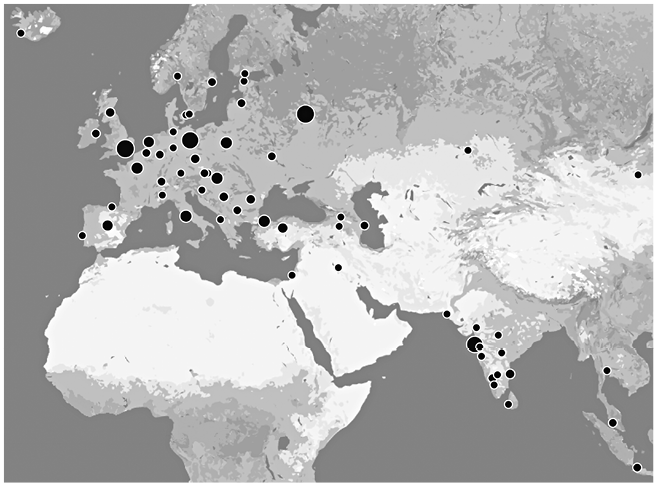
Like statues, such films are expensive to produce but cheap to get access to; in their distribution they are as ‘unrestricted’ as postage stamps or banknotes (to recall Bourdieu’s terms as discussed in the Introduction). On the whole, they target not art-houses but large audiences seeking entertainment, and they rely on a commercial investment-and-return model rather than on cultural subsidies.
All this turns commercial mass-entertainment cinema into a congenial habitat for popularized nationalism. In noticing the worldwide prevalence of nationalism in the twenty-first century, it is impossible not to take account of this widespread, sustained and deeply penetrative cinematic presence. These films are not in themselves remarkable – they do not often figure in the film festivals and awards presentations; outside their country of origin they are often marketed direct-to-DVD or by streaming services, and their cultural presence is unobtrusive. That unobtrusiveness has been described as ‘banal’ by Michael Billig. Such terms have been used across the pages of this book to hint at that unobtrusiveness of nationalism: diffuse, unpolitical, latent. It is now time to focus more sharply on this aspect.
Diffusion Condensed
I noticed the most ‘banal’ presence of cinematic nationalism in 2018 in a British garden centre. In that shopping emporium for the comfortable middle classes, I spotted a display of DVDs on special offer. They promised cheap, domestic comfort viewing for those Sunday afternoons or Monday evenings when we cocoon and withdraw from the real world. Prominently displayed were Upstairs, Downstairs (a popular 1970s social/domestic drama series set in Edwardian London) and the many BBC costume dramas based on Jane Austen, the Brontës, Charles Dickens and Anthony Trollope, with lashings of local-colour Englishness and period feel. In the next stand, targeting the male rather than the female customers, there was a selection of war movies; Roman Polanski’s The Pianist was flanked by The Great Escape, The Bridge over the River Kwai and Dad’s Army; there were generous helpings of Churchill and gung-ho military stuff, all of it recalling Britain’s finest hour when she proudly stood alone. Remaindered DVDs in a garden centre: it doesn’t get much more banal, or trivial, than this. But here, I felt, I came face to face with the deep cultural undercurrents that delivered Brexit when nobody was expecting it. By that time, the Falklands War of 1982 had become yesterday’s news, submerged and unrecalled, superseded by so many new crises and conflicts. Forgotten, too, was how that conflict had instantaneously resuscitated the Dunkirk Spirit in a jingoistic publicity blitz from the red-top press, unleashing waves of flag-waving belligerence in a country that the year before had mellowed out over Chariots of Fire.23 Latent nationalism is to be found not even in new productions but in the ongoing, cheap, ‘unrestricted’ availability of half-forgotten older ones.
Much of this book was, in a way, a pre-history of this trickled-down cultural residue. Walter Scott, Jacob Grimm, Franz Liszt, Jules Michelet, Hermann Wislicenus and Max Müller have come to this. The nation is still an operative factor, but homeopathically diluted down from its actual political meaning; an unpolitical cliché, like ‘family values’, to tell the Good Guys from the Bad Guys – a far cry indeed from Sieyès and Fichte. Can this unpolitical nation in mass consumer culture have any mobilizing force at all?
The way in which political nationalism (the ‘politics of the nation’) interacts with cultural nationalism (the ‘culture of the nation’) is in itself a diffuse and widely ramifying topic. It covers knowledge production (linguistics, history writing, philology) and artistic production (literature, painting, music); and while political nationalism manifests itself in a specific country or society, the culture of the nation can spread across borders and eventually diffuse itself across the globe. In addition, we have seen how this culture of the nation can move from celebrated artists and scholars to the general public (like the Grimms’s fairy tales or Walter Scott’s Ivanhoe). Diffusion across fields, across countries, across the social spectrum. To trace all that diffusion – to, in a word, condense it all into historical data – is like retro-engineering the vapour of criss-crossing contrails in the sky into flight paths and airplanes and the history of aviation. The massive undertaking of the Encyclopedia of Romantic Nationalism in Europe made it possible for me to attempt such as condensation, to see the forest through the many, many trees.
The pattern that stands out in the twentieth century, which brings this book to its close, is a dynamics of alternating states that I call latency (or dormancy) and salience. Nationalism has manifested itself in culture, sometimes as a fervently professed political ideal, sometimes unpolitically as a general feel-good factor or an background noise, sometimes not at all.
The re-emergence of fervently professed, foregrounded nationalism after 1989 happened both in politics and in cultural production; and at that time, after the Cold War and two World Wars, it appeared (at least within the narrowly European purview) to come out of nowhere. How did it rise from oblivion? Many commentators saw it as an anomaly, an erratic response to unprecedented social change. The answer I suggest here is that the intervening ‘oblivion’ was not all that absolute; a nationalistic affect had persisted in a latent state, as an inert, deactivated but still available repertoire, in the ambient camouflage of everyday culture as an unpolitical feel-good factor. As cinematic evidence shows, that national affect was rising again in intensity from around 1980 on, reactivated in movies either rustic-nostalgic or action-heroic. One can liken the alternation between latency and salience to the progress of a dolphin. It startles us and attracts our attention when it rises above the water’s surface, glistening in the sunlight, briefly. Now you see it – and then you don’t. But wherever it surfaces, it is always the same dolphin; its trajectory is defined by the underwater periods between the moments of its salient visibility. Similarly, we need to understand nationalism, crucially, when it is submerged, becomes unnoticeable (Figure 12.7).

These submerged, unnoticeable states could be called ‘banal’ or ‘trivial’, but they are neither. Something that can exercise such a powerful ideological influence without even being noticeable deserves a better terminology. I prefer, therefore, the notions of ‘salient’ and ‘latent’ cultural nationalism; more or less what Billig calls ‘hot’and ‘banal’ in political nationalism. The alternation of latency and salience corresponds also to the two-way traffic between cultural memory and what Aleida Assmann has called ‘archival memory’: the cultural repertoire that is not actively present in society but is on standby, available in books and cultural products, passively ready for activation.24 This also explains the fact that much of cultural nationalism works by way of reappropriation, recall, recycling and remediation, in ever more ‘unrestricted’ formats: from manuscripts found on forgotten library shelves to outdated nineteenth-century novels recycled into action movies. To trace the history of cultural nationalism is like following the forward-moving trajectory of a rearview mirror, constantly catching new things in the past as it moves into the future.
Nationalism is a highly flexible, adaptable ideology. That poses a challenge to those who want to establish a specific typology or periodization. Our survey has followed how it bobbed and weaved in and out of political force fields, sometimes virulent, sometimes anodyne, how it swirled around the political and social crisis moments of the last two centuries, how it spread among highly dissimilar societies, art forms and communicative media, always molding itself into its changing surroundings. It is thanks to that plasticity and adaptability that nationalism has survived the twentieth century to become, once again, the most powerful ideology worldwide. But beneath the shifting shapes and hues, the cultural historian can detect that the new nationalism is not so very new after all; it plays on the same affects, uses the same tropes and principles, as what began around 1800 along the grinding edges of Europe’s empires.
The Wave and the Turbulence
Over the preceding pages we have seen how the culture of nationalism ran its course from a sudden onset in the decades around 1800 to its many manifestations in the artistic and intellectual fields and to its steady, soft influence in how people envisioned states and their sovereignties. We have seen how its long, tapering aftermath was capable of infusing popular leisuretime culture as this emerged after 1850, and capable also of generating strident war propaganda after 1870 and political discourse in 1914, surviving the upheavals of the twentieth century in the sanctuary of popular culture. The pattern reminds us of a wave, cresting and crashing with foaming violence in its onset, then levelling off but leaving turbulence in its wake. It is during such a period of renewed turbulence that I am finishing this book. A newly virulent nationalism has carried over from the realm of a popular culture still breathing the spirit of wartime propaganda into the field of domestic politics and international relations. At the same time, this ultra-political virulence is counterbalanced by a sentimental celebration of the home nation in terms of the long continuance of its historical traditions and its idyllic communitarianism. These tropes are so ambient and all-pervasive that it required a long hard look at them to see that they all originated in the decades around 1800: the war propaganda, the traditionalism and the idyllic sentimentalism, which celebrates the nation as a political extension of familial domesticity, tranquil, benign and utterly inoffensive, yet capable of rousing its citizens into righteous battle fury. To render visible this ambient, diffuse ideological force, I had to note its manifestations in diverse fields of knowledge production (linguistic history and philosophy, philology, ethnography and folklore, history writing, mythological studies) and in art forms in different media (textual, musical, visual, performative); and I also had to trace how these cultural manifestations could be encountered in societies all over Europe, despite their considerable differences as regards economy, class relations and governance.
After exploring this complex turmoil, we must ask ourselves if any patterns can be extrapolated by way of conclusion. What are the takeaways?
Shape-Shifting, Thin-Centred, Soft-Powered
Complexity and turbulence are in themselves features of nationalism, thrown into sharp relief as we traced its cultural manifestations – those would be far less multifarious if we traced the art forms inspired by communism or Fascism. This is partly because of the greater longevity of nationalism, but then again, that longevity is itself an interesting characteristic. We have seen how nationalism was a revolutionary force challenging the might of empires in Odessa and Belfast; how it had become a state-affirming, reactionary force by the time of Treitschke and Barrès; how the nation allowed border-straddling minorities (‘non-dominant ethnic groups’) to develop a unified political ideal, feeding into emancipationism and separatism among its various constituents; how it could inspire the progressive, utopian reformism around the Arts and Crafts movement as well as the intolerant authoritarianism of illiberal states in the 1920s and 2000s. Nationalism is, among the political ideologies, the ultimate shape-shifter. It is chimerical, almost, and weaves in and out of near-invisibility, ranging from a mere feeling to a fully fledged social movement.1
Throughout this book, we have traced the latent and salient states of nationalism: now anodyne, ‘unpolitical’, cultural; now strident, confrontational, ultra-political; sometimes a mere feel-good flavour, sometimes a resounding call to arms. In those shimmering alternations, the culture of nationalism has over the centuries spread across the European landmass and across cultural fields and media. In all that mobility, nationalism has adapted itself to different circumstances: whether the country was at peace or at war; whether an economy was agricultural and serf-based or rapidly industrializing; whether there was an advanced public sphere carried by print capitalism and a dense media distribution, or a society with low literacy-rates and largely lacking printed matter; whether the cultural centres gravitated to courts, monasteries or middle-class urban sociability; regardless of religion (Protestant, Catholic, Orthodox, Jewish, Muslim or secularist): across all those divides nationalism could adapt itself, survive by shape-shifts and mutations.
This adaptability appears to be typical of nationalism. For this reason, nationalism has been called ‘thin-centred’ – a characterization also, interestingly, applied to populism (on which more in what follows).2 Nationalism is, to be sure, an ideology properly speaking, in that it ‘consists of a body of tenets and prejudices constituting both a world-view and a value system’,3 but it seems capable of attaching itself to any other political doctrine on the political right or left. There are nationally tinged inflections not only in its siblings on the far right but also in the political middle ground – conservatism, (neo-)liberalism, Christian democracy – and even in social democracy, socialism and communism. The epithet ‘thin’ may carry a misleading connotation of weakness and inconsequence with it, but that is certainly not the point. I take the notion of ‘thinness’ to connote precisely this flexible adaptability. Nationalism is almost a meta-ideology, an inflection of other political doctrines, and something that can camouflage itself as being unpolitical, merely an extension of family values.
Thinness does not mean weakness. But it does mean that we cannot measure its importance in terms of power, the capacity to enforce social change despite opposition or inertia. Compared to the power of the state, certainly pre-1914, the power of nationalism is indeed weak – as weak as a fishbone lodged in the throat of a champion weightlifter. As we have seen, direct confrontations with the power of the state almost invariably panned out in favour of the state; but the repeated defeats of national movements eventually led to their political ascendancy in the century after 1918. Nationalism has exercised, over a long period of time, influence rather than raw power. It has vested the nation, against the oppression of tyrants and the perceived danger coming from foreigners, with a lasting reservoir of soft power. It has given the nation its charisma: that is to say, the power to inspire and to nudge political developments at moments of crisis and political dissolution.
This brings us back to the longevity of nationalism. Although my periodization of nationalism brands me a ‘modernist’, we must realize that this ‘modern’ history of nationalism by now spans fully a quarter of a millennium. Its sustained survival along such a long time-span reminds us of the endurance of culture, which displays the same adaptability and shape-shifting flexibility in the remediating presence of its canonical works, surfing in self-perpetuation from books to operas to streaming video. And this also leads me to conclude that we cannot understand nationalism unless we understand it historically, as a persistent influence in modern history.
The Presence of the Past
Scattered across the preceding pages are the many traces left by Romanticism. From glamourized queens and empresses to patriotic verse echoing in the minds of post-1945 politicians (even Boris Johnson could not stop himself from muttering Kipling’s ‘Mandalay’ while on a state visit to Myanmar), such traces may each individually have opened a single sight-line, an anecdotal anachronism, a trailing presence of the Then in the Now. Between them these individual threads form a web, something coherent and significant. Medieval epics and Romantic novels adapted to streaming video; anthems sung across the centuries with undiminished fervour; heavy metal bands recycling Germanic runes and sagas; Viktor Orbán’s turanism allowing him access to a post-communist Eurasian support network; Slavophilia in the policies of Vladimir Putin; juvenile-Romantic national-imperial chauvinism in the thought of conservative politicians such as John Major, Michael Gove and Jan-Peter Balkenende; modern cityscapes suffused with national-historicist street names and monuments.
When I set out to trace the typology, manifestations and repertoire of Romantic nationalism, I envisaged this initially as an almost antiquarian project, dealing with neo-Gothic buildings and bourgeois medievalism; I soon discovered that many of those neo-Gothic buildings were dedicated to modern, technological purposes and that the statues, paintings and historical novels of nineteenth-century vintage had obtained a fresh lease of life on banknotes and postage stamps and in films. While the erection of national monuments went through a noticeable dip in the twentieth century, the resurgence of that type of cultural production since 1990 was unmistakable (Figure 12.1). The ongoing recycling and availability of the Romantic-historicist nineteenth-century repertoire in new, mass-diffused and unobtrusive media seemed to span the mid-century dip and to connect the nationalist heydays of 1910 and 2020. It is then that I saw the ‘bump-dip-bump’ shape of those graphs as the trajectory of that metaphorical dolphin that visibly surfaces, dives into invisibility and elsewhere surfaces again.
The power of nationalism to condense time and to abolish historical distance is remarkable. The culture of nationalism has become the great enabler of anachronism. It creates short-cuts of memorability, recognizability and identification across decades and centuries of changing circumstances, adding up to the most potent anachronism of all: that of ‘timeless nations’ with their abiding national identities.4 National memories have an enormous power and presence in the here and now, and whoever would study nationalism only within the temporal parameters of a given social situation or a political moment would lose sight of that cardinally important potency. Nationalism can invoke memories and traditions spanning many centuries; it can pack all that temporality into a mighty ideological punch. Culture spans many centuries, but its national cultivation is concentrated in a handful of decades.
National Culture Transnationally Pursued
The cultural manifestations of nationalism take a similar form in highly dissimilar societies. Architecture, choral singing, the mural, amateur theatre and the decorative arts develop in parallels modes from Riga to Barcelona, Dublin to Iaşi. Academic scholars were aware of what was going on internationally in their field of expertise. Modern entrepreneurial formats such as the world fair developed standardized modes of showcasing the national individuality of the participants. The historical novel, academic history painting, the collecting of folktales were vogues enveloping all of Europe in their spread. Taken together, all this adds up to a strong counter-argument to the common wisdom that culture develops as a response to its surrounding societal conditions. The parallels are too numerous, too patently evident in various cultural fields, too diverse as to their societal backgrounds to be explained infrastructurally – certainly in the light of the many documented instances of communicative transfer. Culture has responded not just to ‘this society over here’ but also to ‘those other cultures over there’.
Nationalism is capable of spanning geographical distances. To illustrate a pattern that is visible all over this book, I recall only two instances: oral epic echoing back and forth between Ossianic Scotland and the Balkans, with ricochets reaching Goethe, Grimm, Mérimée and Pushkin; and a Parisian edition of Greek popular poetry by the philhellene Fauriel (1824) inspiring the Irish antiquarian Hardiman to publish Gaelic anti-English ballads in 1831, with an introduction stating that the relationship between London and Dublin is like that between Istanbul and Athens. We have repeatedly seen the culture of nationalism leapfrog across the European continent in two or three great bounds. Culturally, the European space is tightly and densely entangled. In the field of knowledge production, Europe was a single, homogeneous space: the Republic of Philology. The world of academic learning heaved with ‘Grimm Ripples’ (as Terry Gunnell has called them, Reference Gunnell2022). We have seen the visualizations of dense epistolary networks. In the fields of literature and the arts, we have encountered the remarkable paradox of ‘universal exceptionalism’: national authenticity was celebrated as being ‘different from the rest’ for each nation separately, but this was asserted by all nations in highly similar ways. The cultural thought of Herder, the historical novels of Scott, the philology and folktales of the Grimms, the rhapsodies of Liszt, the aesthetics of national-history painting, the agendas of language revivalism: these were taken up everywhere in Europe from Reykjavík to Tbilisi, Helsinki to Santiago de Compostela. Parallel movements occurred across huge cleavages. The cultures are all distinct, but their cultivation is a transnational process. Rien de plus international que le nationalisme.5
Cultural Entanglement, Political Localism
This transnational fluidity of cultural patterns stands in contrast to the more society- or state-specific workings of national movements as forms of activism. Activism characterizes what Miroslav Hroch has termed the ‘B’ and ‘C’ phases of national movements; cultural consciousness-raising commences in (but is not restricted to) his ‘A’ phase.6
The ‘cultivation of culture’ that I consider fundamental to national consciousness-raising (Figure I.3) takes shape as part of Hroch’s Phase A, in three successive and intensifying modes: ‘recollection’, ‘production’ and ‘propaganda’. These continue beyond phase A to inspire and accompany the social demands and the activist mobilization phases of national movements – and, I may add, in the nationalism of sovereign states. What is unmistakable in the successive chronological overlays of Hroch’s phases is a change in spatiality. The social and political action that characterizes phases B and C takes place in the context of a specific society or state. Cross-national patterns here became more anomalous, certainly after 1848. As national movements assert their social demands and mobilize their followers, they do so in a particular place in specific circumstances. By the time people start petitioning their governments or waging publicity campaigns, the transnational fluidity of everyone reading Herder or Walter Scott, or listening to Liszt becomes irrelevant.
And so, as the cultivation of culture moves across its stages of intensification, and as Hroch’s phase model moves from A to B to C, an initially diffuse condition of communicative transnationalism crystallizes into the specificity of localized action. This is represented schematically in Figure 13.1.
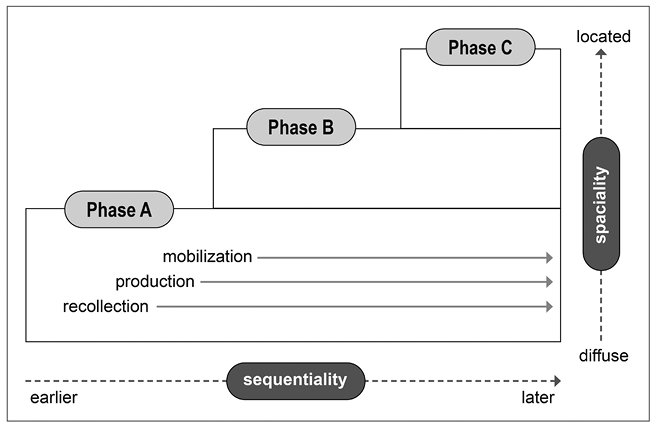
This suggests another type of historical dynamics: between diffusion and condensation. Culture diffuses, activism condenses. Ideas and cultural fashions can be spread far and wide by books, songs, music: in short, by cultural communication. This form of ‘broadcasting’ is untargeted, a bit like the sower sowing his seeds in the biblical parable: only a portion of the indiscriminately scattered seeds yields a harvest, while others land on fallow or rocky ground.7 Models for cultural organization and manifestation (choirs, sports associations, festivals, Matica book clubs) likewise proliferate, but in a slightly different mode, which I have termed ‘reticulation’: imitatively spreading from city to city across the European map, as often as not across cultural boundaries, with local associations often linking up in federative associational networks. But the social and political mobilization that is inspired by this, such as the Slavic Congress in 1848, or the choral mass demonstrations in the Baltic countries, or Patrick Pearse proclaiming Irish independence from Dublin’s General Post Office: each of these is concentrated in a specific society, subject to its social and political conditions, often occurring in urban spaces. And in turn those activist moments can resonate far and wide, like the Galician Irmandades da Fala emulating the Irish Gaelic League in 1916, or Catalan activists setting up a human chain across the land in 2013 in imitation of the Baltic one of 1989.8
Transnational and Intimate: Scalarity and Affect
The wide span of these processes across space and time has been contrasted repeatedly with their immediacy in the here and now. But where is here? The culture of nationalism can be sensed and registered at many levels. It can affect a far-flung aggregate such as the self-defining ‘Slavs’ of 1848; or a country (the Irish programme of de-Anglicization by way of Gaelic sports and language revivalism), a region (the Flemish-speaking part of Belgium) or a city (Valencia asserting its stature alongside Barcelona).9 How exactly the units are spaced on that scale is moot. Are Wales and Brittany regions or countries? And when the Slavs gathered at their 1848 Congress, was that event affecting their entire community, or the city of Prague, or both at the same time? And if the latter, what effect did that have on the communitarian tensions between Prague’s German and Czech inhabitants? In factoring in such scalar complexities, this book has moved beyond a comparative approach to a transnational one. The comparative method has traditionally tended to juxtapose nations as modular country-by-country units. A transnational approach has allowed me to take the multiscalarity of nesting levels of aggregation into account. A city or region is part of a country but may itself be culturally hybrid (Anglo-Irish Dublin, Spanish–Catalan Barcelona, German–Czech Prague, Danish–German Schleswig). Differences run within as well as between the aggregates we compare, and the smaller aggregation level may be as complex as the larger, outer ones. Even the single individual may go through changes, or feel conflicted, as to the culture(s) they feel they belong to, or the name they should call themselves (Douglas Hyde or Dubhghlas de h-Íde, Friedrich Tirsch or Miroslav Tyrš). And those scalar levels and juxtaposed units overlap and interpenetrate, as in the case when nationally-minded philologists from different regions and countries met in Vienna at the Stammtisch of Jernej (or Bartholomäus) Kopitar; or when Christian Bunsen and Max Müller, Britain-based Germans, drew Dwarkanath Tagore, as a ‘fellow-Aryan’, into the ambit of a Welsh eisteddfod.
And so nationality is also a yo-yo, bobbing up and down the gradations of scalarity from large, far-flung associations (Aryans, Slavs, Celts, Germans) to small, local ones. Languages can be lumped together or split into particularist component variants. Valencian revivalism sometimes distinguishes its culture, together with the Catalan Renaixença, against Madrid; and sometimes distinguishes its local culture from its Catalan-hegemonic neighbour Barcelona.Footnote *
Amidst all that scalar fluidity, a heuristic end-point in the here and now is reached within the bosom of the individual affected emotionally by the culture of nationalism. Its emotive power comes to the fore prominently in the performative arts as they affected ‘embodied communities’ and participants – lyrical-poetic declamation, oratory, music. The ecstatic upward gaze encountered in so many instances is a form of secular religion, or rather a response to the nation’s charisma. That selfsame gaze had traditionally, in baroque religious art, been a sign of mystical fervour; it was now transplanted to the realm of national culture. To recall this book’s opening pages, and the powerful affect inspired by communally singing ‘Die Wacht am Rhein’ or ‘La Marseillaise’: nationalism, before it becomes an explicit political doctrine or ideology, is experienced as a private feeling; and even at the heart of the fully fledged ideology, that emotive state remains quite, quite powerful.10
Charisma, Disenchantment, Narcissism
There is a sliding slope from seeing the nation as a sovereign subject rationally pursuing its goals towards seeing it as the bearer of a transcendent world-historical mission. This ‘charismatic supercharging of the idea of nationality’11 was noticeable in the German ‘conservative revolution’ and as such formed part of that country’s ‘culture of defeat’ post-1918, in which bitterness and rancour were rife and people turned to the extraordinary appeal of charismatic leaders. That appeal is by no means specific to Weimar Germany, nor even to countries in defeat (although it has been pointed out that charismatic leadership is better suited to ‘states of exception’ than to routine governance12) – but there is, I argue, a meaningful correlation between the new political force of charisma and the decline of the two other forms of Weberian authority, dynastic and institutional, a decline accelerated as a result of the Great War. In addition, we have seen a general, long-term alternation between the Weberian notion of disenchantment (as a concomitant of the modernizing process) and the Romantic appeal of the nation, which I have linked to Romanticism’s poetics of re-enchantment. I have drawn attention to the renewed presence, in European culture, of a thematics of disenchantment as the power of Romanticism, and the Romantic re-enchantment of the world, declines, and with the rise of realism and naturalism. Romanticism and lyricism were rejected scornfully by the post-1918 avant-garde (subsisting only in downmarket comfort reading); but the charisma of the nation, and the derived charisma of the new type of leaders who spoke for the nation, remained a political force that became increasingly important in the 1920s. People whom the events of 1914–1918 had robbed of many a fond illusion bought into the enthusiasm of a new nationalism under charismatic leadership, fervently attended huge rallies and dedicated themselves to the cause of their nationality. The nation’s charisma became, in other words, a palliative to the disenchantment of twentieth-century modernity. It could be that it still functions as such. The nation, as a tranquil, serene, communitarian essence transcending the unpredictable sound and fury of a conflicted world, uniting the people across society and uniting the generations across history, is a powerful antidote to a modern sense of disorientation and deregulation. It gives modern people in a secular world something to believe in, something to cherish and to adore – the political equivalent of football fans devoted to their home teams. Hence the upward-gazing ecstasies that the nation can inspire. This may explain how nationalism, as the power of the nation’s charisma, has survived across revolutions and regime changes from empires to restored monarchies to republics and nation-states to dictatorships and back; it is still thriving, in its ethnopopulist form, in a globalized neoliberal world order.
There is a downside to this. Whether the nation is a sovereign subject rationally pursuing its goals or the bearer of a transcendent world-historical mission, it may become a moral validator of the goals the state chooses to pursue. As the state’s national interest is underwritten by a transcendent, charismatic nation, it obtains a specious moral-categorical justification: ‘My country, right or wrong’. Yes, that facile phrase was memorably exploded by G. K. Chesteron, who sarcastically likened it to ‘My mother, drunk or sober’. But Chesteron’s ridicule had a serious undertone. The question of whether one’s mother takes to drink, or whether one’s country is in the right or in the wrong, should be a matter of grave concern, not of ‘gay indifference’.13
The state cannot do whatever it finds expedient on the grounds that it does so on behalf of a cherished nation. What Chesterton is driving is it that the jingoistic cult of ‘My country, right or wrong’ suspends the higher criteria of morality and lawfulness in a national narcissism. We have noted how a similar narcissism in Germany (Dahn’s phrase that ‘a nation’s highest good is its rightful entitlement’) was denounced by Emile Durkheim as a form of anomie: the idea that the will to realize the nation’s needs constitutes a rightful justification, surpassing international laws and treaties. In other words: the more fervently we buy into the nation’s charisma, the more prone we are to unilateralism and reckless self-righteousness. ‘Anomie’ was coined by Durkheim from the Greek word for ‘lawlessness’, a replacement of rules and regulations by willpower and self-interest.14 The applicability of that principle to post-1989 manifestations of ruthless, self-righteous nationalism is obvious, both within the state and in the field of international relations. Narcissism is a possible side effect of the nation’s charisma.
Small Government, Big Flags
While this book does not set out to analyse contemporary politics, it does furnish an explanatory background – by no means an all-explaining one, but relevant nonetheless. To understand the ethnopopulist turn that has dominated politics in the first quarter of the twenty-first century, we must see its reliance on the culture of nationalism not as an incidental proclivity that happens to affect populist politicians, like a case of bad breath, but as an intrinsic core element of their political repertoire and discourse. Nationalism is not an occasional feature of populism; populism is the new carrier of nationalism.
Seen in this light, populism is not a political novelty emerging in a realigning social order; it is the latest manifestation of a shape-shifting phenomenon with long, deep historical roots, and this book has demonstrated how deep and widely-ramified those roots run. Anti-immigrant xenophobia amidst the resurgent hard right in European politics is just not a symptom of generic bigotry; Donald Trump’s desire to annex Canada or Greenland is not just a mark of his flippant eccentricity; these things are, very pointedly, motivated by the nationalist commitment to expand the nation’s territory, to keep it unsullied by foreign admixture, to maintain the body politic’s cultural line of descent. The heaving gestures of populist rhetoric draw on a centuries-old, ingrained discourse. The mobilizing power of Donald Trump on 6 January 2021 was not mere rancorous rabble-rousing but involved – could not possibly have done without – the ubiquitous inspirational invocation of nationalist symbols and a patriotism so fervent and yet so ambient as to be unquestionable and almost unnoticeable in the sound and fury of the events. The rune-tattooed Capitol-storming ‘QAnon Shaman’ (Figure 5.3) was filmed marching along, Braveheart-style, with shouts of ‘Freedom!’ Footage shows that he, too, like Rouget de Lisle, Ossian, Liszt and the Serbian guslar (Figures 1.3, 3.1, 5.1 and 9.1), had his eyes fervently turned heavenwards and must have felt his commitment intensely, privately, while tapping into into global internet memes to obtain his neopagan tattoo designs. Those were not just decorative anecdotal ornaments or incidental whimsies: they are the internalized insignia, bodily indentured into his skin, of an ethnicist challenge to the political order. The meme is the message.
Populism insistently and consistently draws on the congenial rhetoric and symbols of nationalism. The proliferation of national flags in the public appearances of populist leaders is an indicator. This is all the more remarkable since many of those politicians (Silvio Berlusconi, Donald Trump, British Conservatives of recent vintage) are avowedly neoliberal and in favour of ‘small government’. As the regulatory and fiscal powers of the state are being steadily whittled away, the symbolic emblems of the state’s nationality are being multiplied and magnified. As the government is made small, the nation is ‘Made Great Again’.15 In the neoliberal view of the nation-state, the ‘nation’ and the ‘state’ are in direct inverse proportionality, like the opposite ends of a see-saw. The ‘state’ is being diminished and relinquished to market forces, the ‘nation’ with its symbols and pomp and emotive appeal to our loyalty is bombastically enlarged. Illiberal and authoritarian states are equally dedicated to the inflation of the symbols of nationhood; and so the nation is proclaimed fervently everywhere, by every sort of state, while everywhere its democracy is deregulated and ceding to autocracy or ethnocracy.
Stating that ethnopopulism draws its water from the well of nationalism raises the question of how it differs from nationalism’s earlier iterations.16 One important novelty is the shift from experts (Michael Gove: ‘the people of this country have had enough of experts’17) to influencers. In public opinion, a radical epistemic intransigence has taken hold, denying evidence-based, institutionally scrutinized authority and relying, instead, on the swarm knowledge of the internet. The importance of social media in political debate marks a deep paradigm shift in societal relations, fundamentally altering the workings of the public sphere and the production of public opinion. It is difficult, and still too early in the current century’s erratic developments, to tell how these new media affect, specifically, the culture of nationalism. First impressions suggest that in the lapidary brevity and ephemeral transience of social media, the repertoire of that culture is becoming more formulaic, selective and abbreviated, like headlines or the ten-second digests of football matches showing only the goals (including slow-motion replays) and the cheers.
The historical dynamics I have summarized so far tend to be of a bi-stable nature, oscillating between latency and salience, diffusion and condensation, wider and narrower scalarities or temporalities. If these phase changes are triggered by anything specific, it would be the ‘culture of defeat’. To the cases analysed by Schivelbusch (Reference Schivelbusch2004) we can add the various instances of loss of empire: for example Spain in 1898 and the defeats of Austria, Turkey and Russia in 1866, 1878 and 1904 as experienced in those empires’ heartlands; and in that context also, perhaps, the evaporation of the nation-state’s sovereignty in a globalizing world. The Dutch intellectual Menno ter Braak, when discussing National Socialism in the 1937, spoke of an ‘ideology of rancour’ (rancuneleer, Braak Reference Braak1937); mutatis mutandis, defeats appear to have something to do with the politics of rancour, resentment, grievance.18
What seems steadily unidirectional in all this is the shift from restricted to unrestricted cultural production: the culture of nationalism appears to have relied increasingly, over the past century and a half, on popular rather than ‘high’ culture. That slow, steady shift has been driven by the emergence of new mass-diffusion media and seems to have gone into overdrive now that communication, and what we may call ‘recreational opinioneering’, are produced in the cloud by self-replicating viral memes, by influencers and possibly even by bots and troll-farms. What is also unidirectional is the tendency for the nation-state to gravitate from democracy to ethnocracy; we saw it happen in the 1920s and 1930s and it is happening again in these decades. The cry of ‘Freedom!’ intoned by Mel ‘Braveheart’ Gibson and the QAnon Shaman has shifted away from democratic to populist usage; it had been originally raised by the insurrectionists of 1789, 1830 and 1848 as the nation tried to wrest sovereignty from haughty monarchs. After 1848, nationalism has increasingly allied itself with the political right, and since the days of George W. Bush and Boris Johnson, the cry of ‘Freedom!’ has been appropriated by the far right. It is now used in an exclusivist and exclusionary sense: freedom is claimed only, exclusively, for one’s own nation, to the exclusion of foreigners and minorities. This shift from democratic solidarity towards populist intolerance, the gravitational slide from democracy to ethnocracy, seems unidirectional and appears to occur in tandem with the shift towards ‘unrestricted’ cultural production.
That may be a glum note on which to end this book; but the book has studied the culture of nationalism not to celebrate it but to diagnose it – in the Greek root sense of that word: to ‘see through it’. Once we see how it works, what its appeal is and what its foibles are, we can perhaps also work out how, while opposing its intellectual complacency, its political narcissism and its bigoted intolerance, we can salvage its message of communitarianism, social cohesion and civic solidarity.
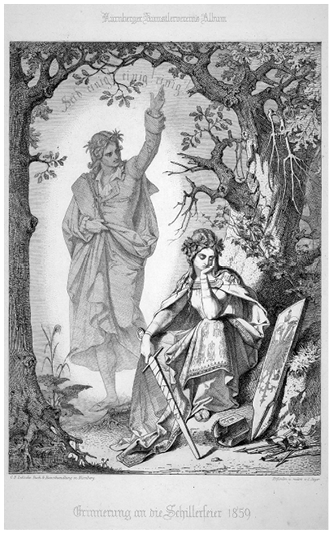
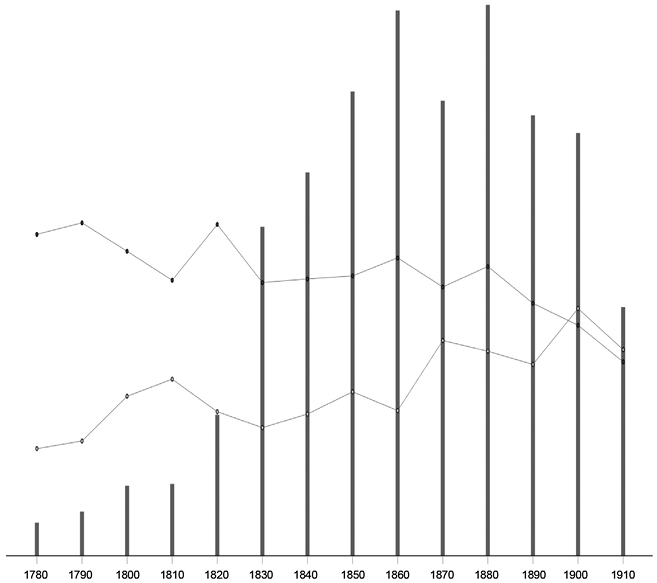
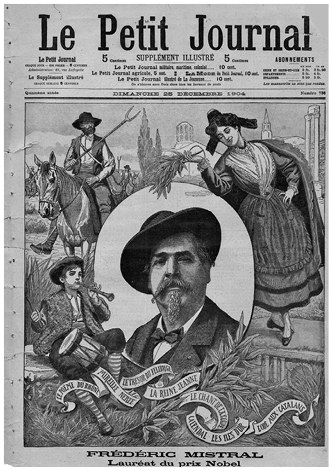
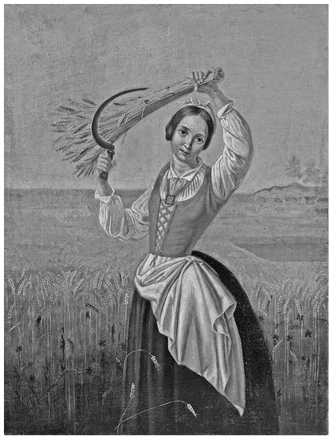
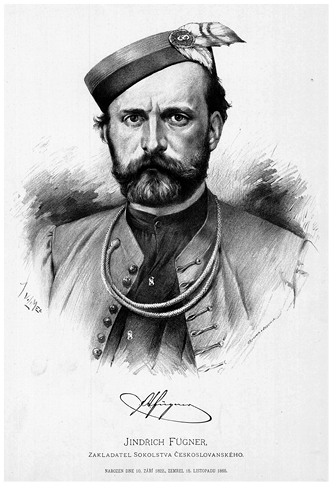
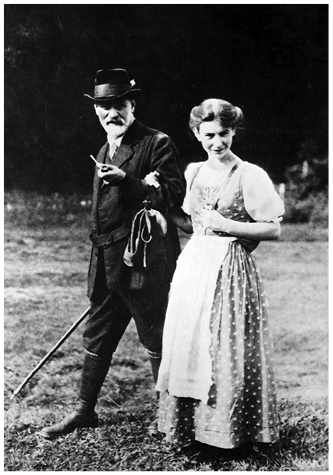
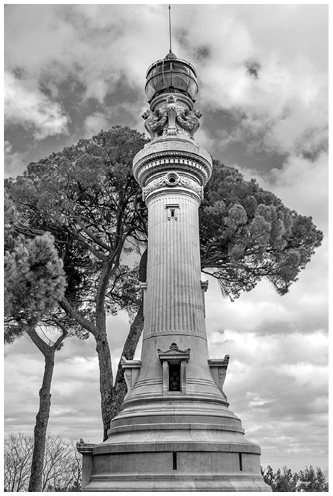
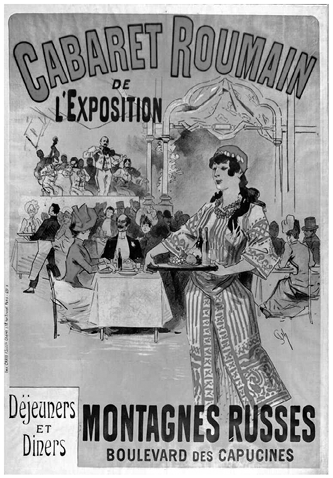
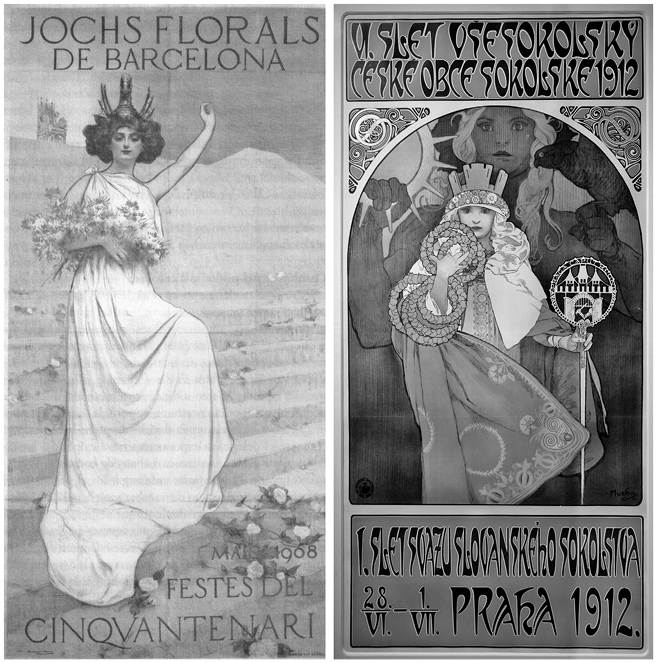
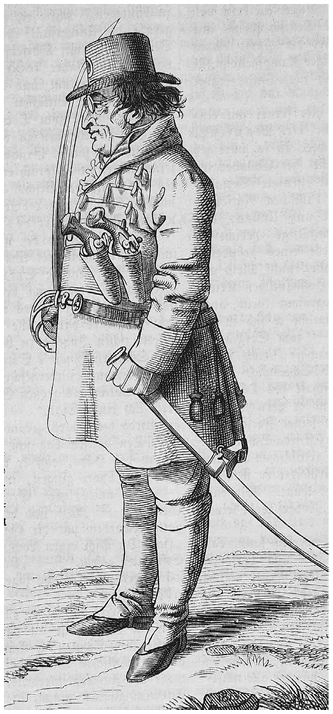
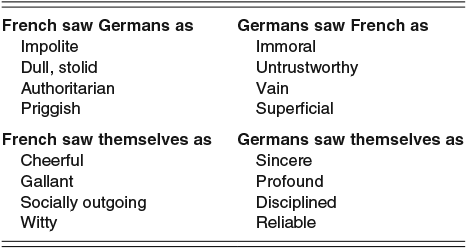
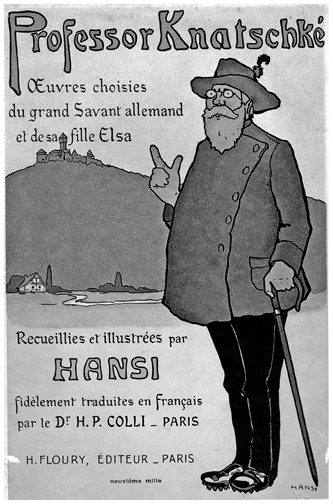
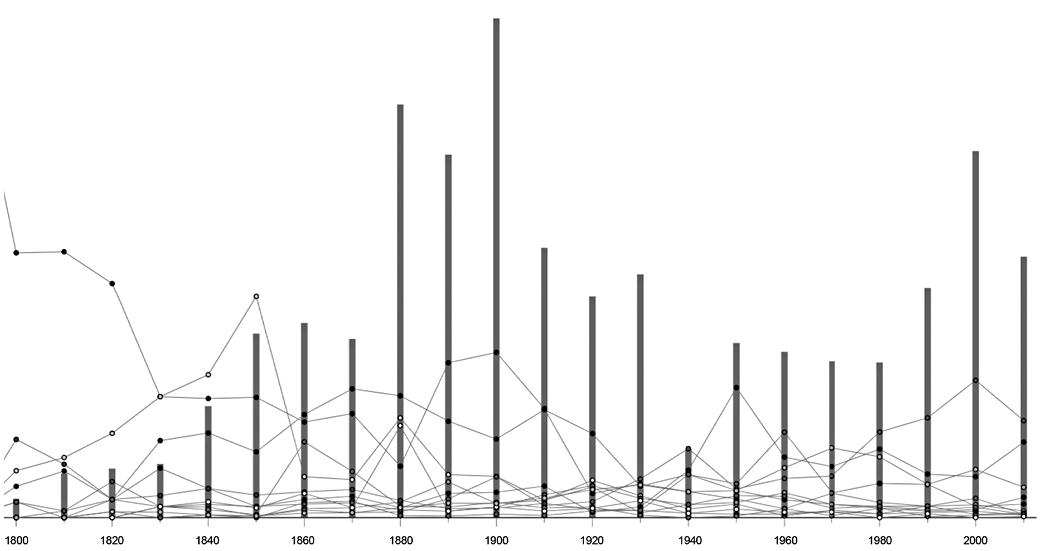
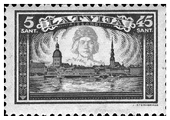
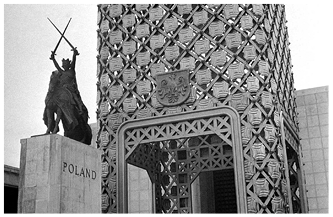
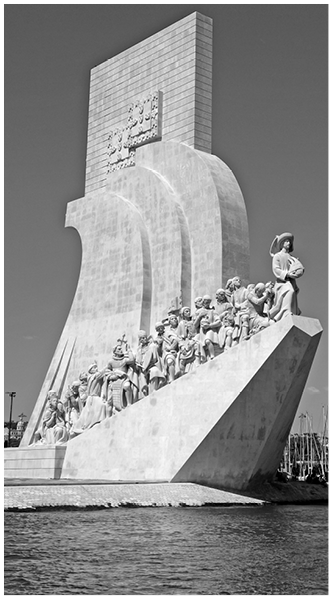
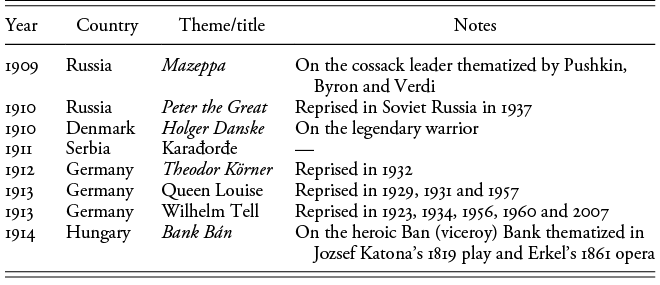
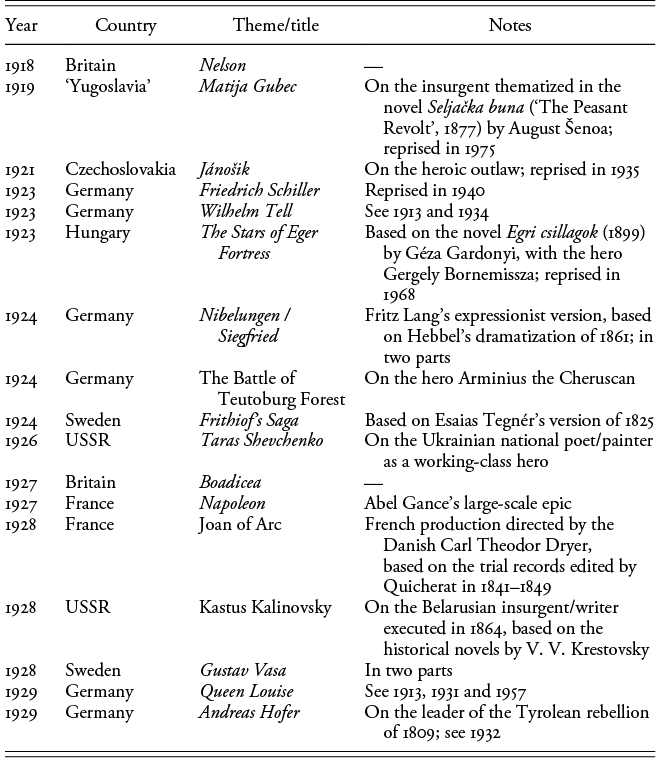
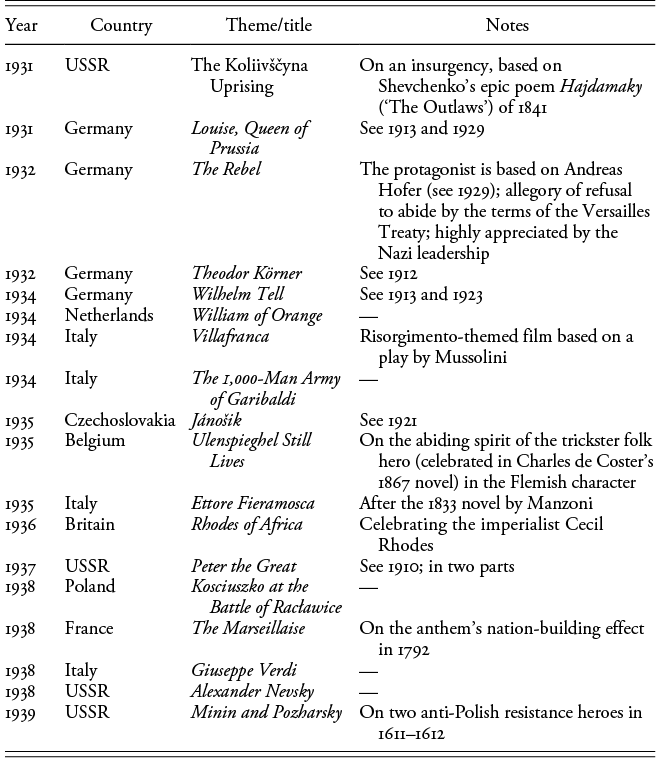
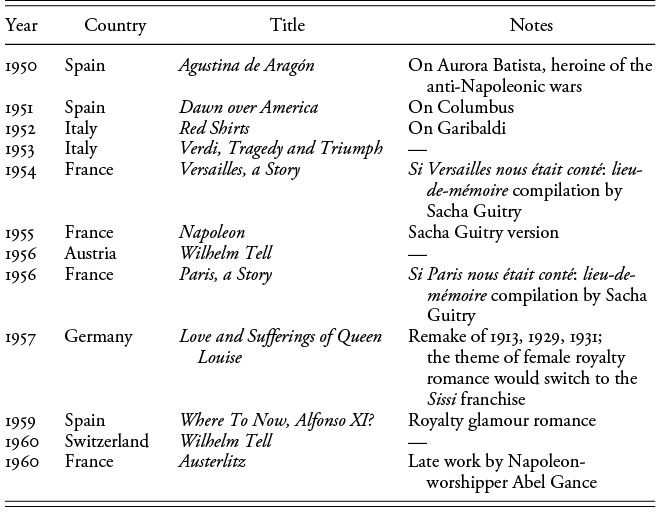
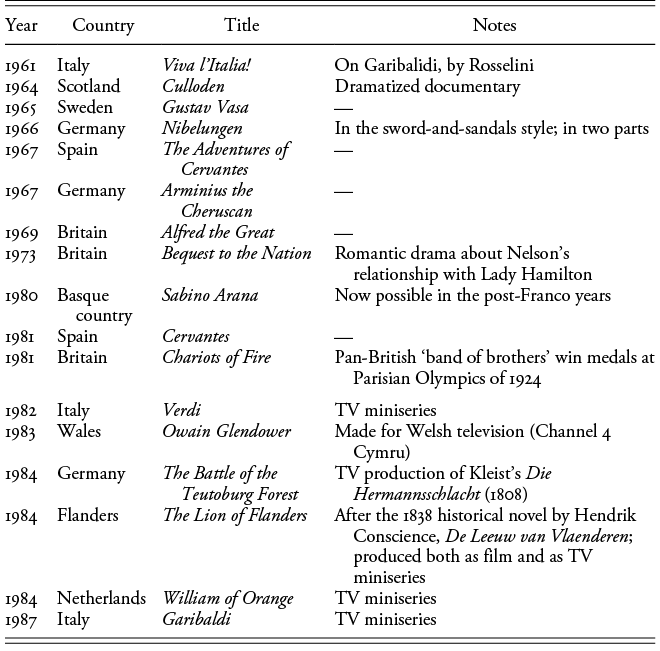
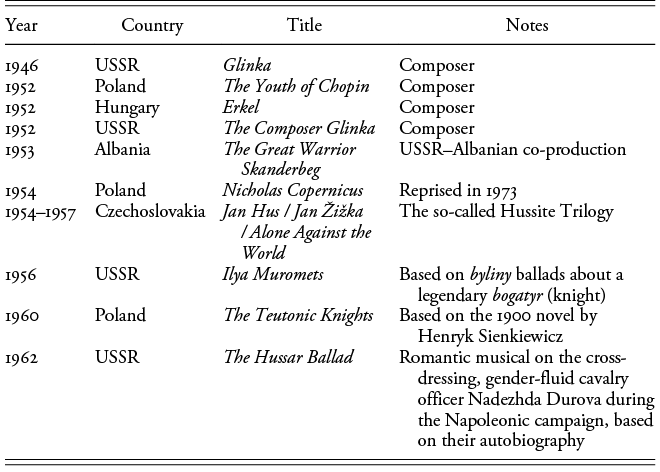
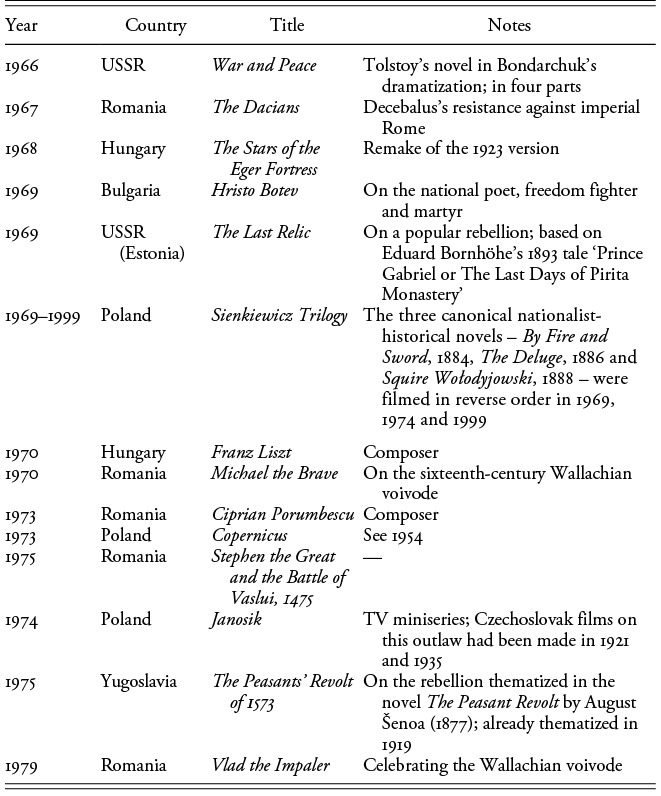
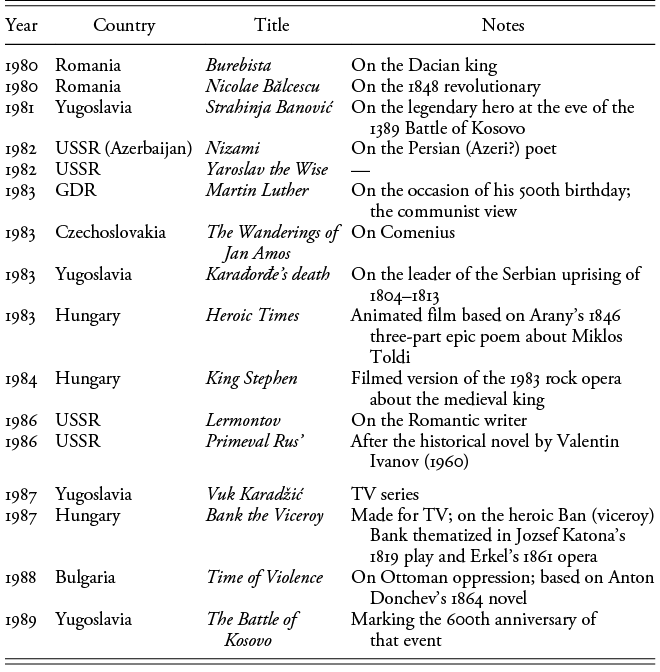
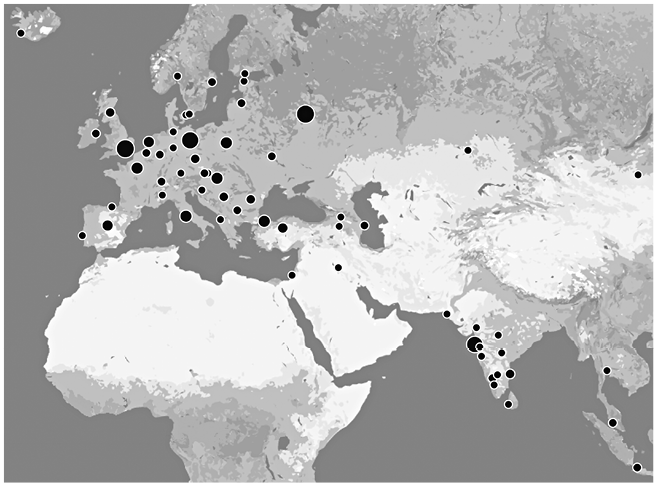

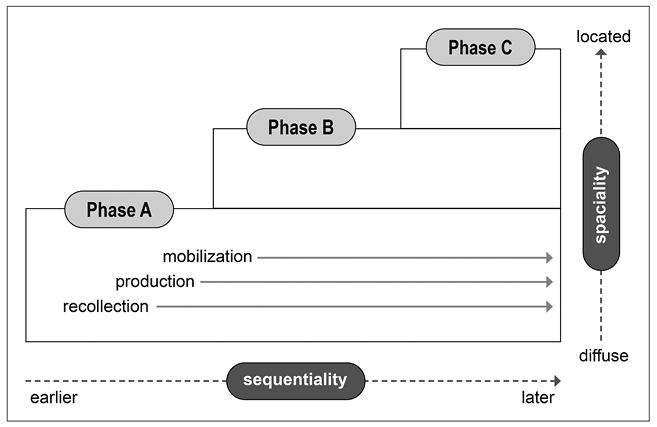

 Open access