

I. Introduction
Research into solar radiation modification (SRM)Footnote 1 offers tentative hope of averting some of the risks of otherwise unavoidable climate change. Yet such technologies bring novel risks, and arguably merit attention only because of the increasingly severe, potentially existential, threats of climate change.Footnote 2 A typical analysis argues that SRM “is not ethically and politically desirable in and of itself but may become a necessity.”Footnote 3 SRM is thereby portrayed as a potential “exceptional measure,”Footnote 4 meriting consideration only because it might be necessary to secure the continued existence of a valued entity or state of affairs.
In this context advocates for more SRM research have increasingly called for some form of ‘risk–risk analysis’ (RRA) to evaluate the desirability of developing such high-risk climate interventions. Wieners et al, for example, argue that: “The risks of researching, developing and possibly implementing SRM must be balanced against the climate risks SRM would attenuate.”Footnote 5 Or as Gernot Wagner puts it: “The decision is all about risk–risk tradeoffs, putting the risks of unmitigated climate change against the risks of potentially pursuing solar geoengineering.”Footnote 6
Such claims – focused almost exclusively on climate effects – follow a typical structure, which first acknowledges that SRM is risky, but then counters that climate change threatens extreme harms, and thus suggests that this justifies consideration of measures that might otherwise be unthinkable. Earlier advocacy for SRM research made similar arguments, but typically framed the mitigation of climate risks as a “benefit” to be measured against the “risks” of SRM.Footnote 7 Conventional “risk–benefit” analysis of geoengineering – such as that undertaken by the Royal Society back in 2009 – already attends to climate risks, insofar as they are affected by geoengineering.
Two factors seem to have encouraged the adoption of ‘risk-risk’ terminology as opposed to ‘risk-benefit’. On the one hand publics and climate activists often responded to SRM with extreme caution, perceiving it as so risky as to reject it out of hand, or at least only meriting consideration in extreme, emergency circumstances.Footnote 8 On the other, continued procrastination over climate action has not only increased the anticipated harms from climate change, but reduced confidence in the prospects of preventing those risks through mitigation alone.
The “risk–risk” framing has spread beyond academia, deployed by SRM-lobby group Silver Lining,Footnote 9 appearing in popular literatureFootnote 10 and mediaFootnote 11 and adopted in a series of high-profile reports on solar geoengineering,Footnote 12 often linked to concerns that continued climate change might trigger irreversible tipping points in the climate system.
In the abstract, it might appear simple common sense to assess a poorly understood and potentially risky technology in the context of the risks it would be intended to mitigate. But the risk–risk framing forms part of an increasingly polarised solar geoengineering debate. A proposal for a non-use agreement,Footnote 13 with its associated calls to eschew public funding for development, and exclude SRM from intergovernmental climate assessments, has provided a lightning rod for dispute. The risk–risk framing rejects a widely held view that the risks of solar geoengineering might be so great as to remove it from consideration, regardless of its potential benefits.Footnote 14 It implies that opponents either overestimate the risks of geoengineering or underestimate the risks of climate change, or both. At an extreme, invoking existential risks from climate change, and a possibility to mitigate them with solar geoengineering, risk–risk advocacy rhetorically implies only one conclusion.
In such a polarised debate, the adoption of a “risk–risk” approach must be carefully interrogated. This article examines and analyses existing suggestions as to how risk–risk analysis might function. It discusses practical and ethical limitations of such proposals, placing them within analysis of their ideological and political foundations, in particular locating them in a modernist technocratic social imaginary and associated risk management repertoire. Finally, it offers methodological and governance proposals to improve future efforts to implement risk–risk analysis.
II. Review and analysis
So far risk–risk framings have been predominantly deployed to advocate for more research, yet they remain primarily conceptual and rhetorical, rather than methodological in nature. They appear to be influencing how the technologies of SRM are perceived, but not – as yet – having significant impacts on how they are materially assessed or researched.Footnote 15
Nonetheless, the reports from UNEP, OSTP and the COCFootnote 16 give a helpful indication of the potential scope of risk-risk analysis,Footnote 17 and hints as to how it might be pursued in practice. Both biophysical and socio-political risks should be considered, according to these sources. Relevant risks of SRM include delayed recovery of the ozone layer, acid rain, regional climatic and ecological impacts, redistributed disease hazards, weakening mitigation efforts, termination shock, geopolitical disruption and international conflict. Attention should be paid not only to magnitude and probability of such risks, but also to their distribution, both internationally and socially. These reports all endorse more research and modelling, amongst other things suggesting development of standardised scenarios, expert review and assessment processes, and (at least small scale) outdoor experimentation. They also identify methodological needs for more participation, wider disciplinary involvement, greater international cooperation and better research governance, especially to ensure transparency.
These reports also all reinforce, or echo the idea that SRM would be an exceptional response, needed because of the existential severity of climate risks. The Overshoot Commission effectively takes this as its starting point, and proposes what would be understood as exceptional measures in several domains – including a fossil fuel phase out and massively elevated climate finance transfers alongside merely “exploration” of SRM. They state that “Under no circumstances should it be used today [but] prudent risk management also demands learning more about SRM in case conditions continue to deteriorate.” UNEP describes SRM explicitly as an “alternative emergency option” to restrain temperatures. The report concludes that “SRM deployment is not currently warranted and would be unwise… [but] This view may change if climate action remains insufficient.”Footnote 18
This explicit rejection of (at least near-term) deployment of SRM, in part, seems to arise because of serious uncertainties regarding SRM’s effects: uncertainties that the reports tend to presume could be reduced or resolved by additional research. This presumption itself should be interrogated: first, research does not necessarily reduce uncertainties, especially those related to sociocultural or geopolitical risks; and second, pursuing research may itself increase risks in those domains (notably exacerbating the risk of mitigation deterrence, by increasing expectations regarding SRM).Footnote 19
There is a similar paucity of critical literature on the risk-risk approach. One exception highlights dangers in the risk–risk framing and suggests some key requirements for productive risk-risk analysis.Footnote 20 These are: careful definition of the scenarios to be compared and inclusion of interaction and rebound risks; early and iterated assessment; broad, symmetric and balanced treatment of risks, including those from non-ideal configurations of, or motivations for, geoengineering; and for careful attention to the distribution of risks and the sources of vulnerability to them.
While these reports and papers are helpful indications of the potential form, scope and problems of risk–risk analysis, detailed proposals for risk–risk analysis are extremely scarce. Indeed, there is only one clear proposal so far published, and that in grey literature: a report for the Carnegie Climate Governance (C2G) initiative.Footnote 21 In the following this proposal is subjected to detailed scrutiny in terms of definition, timing, scope, balance and attention to risk distribution, revealing a series of inconsistencies and asymmetries.
1. Risk-tradeoff analysis: asymmetries and inconsistencies
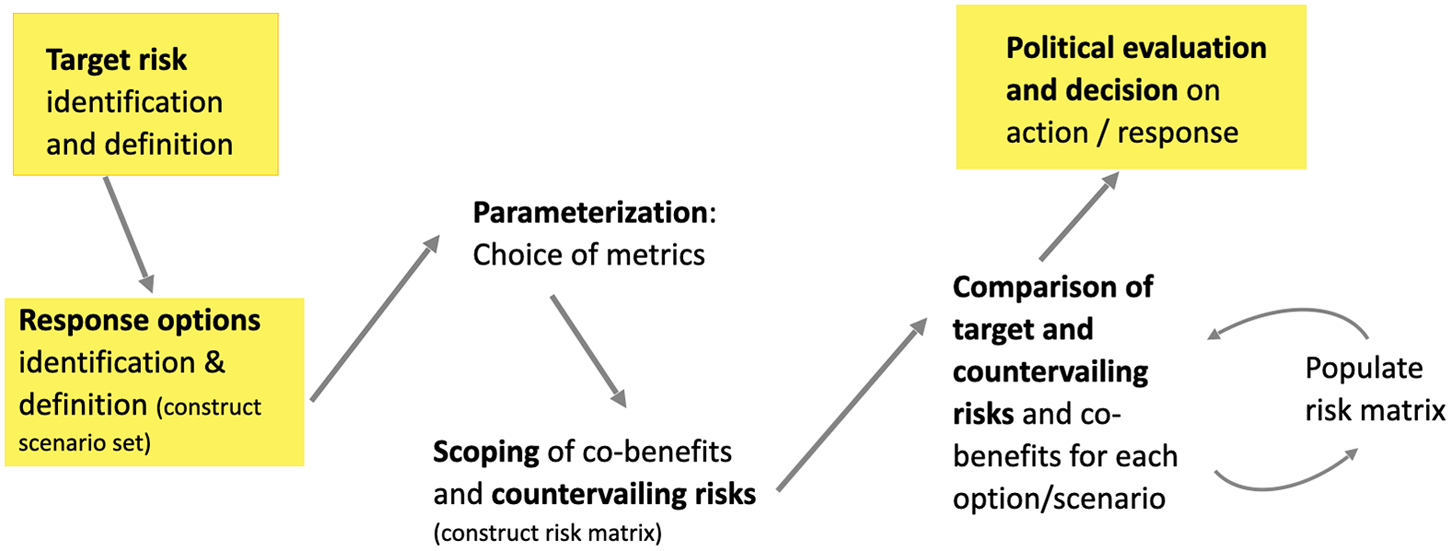
In the C2G report, Tyler Felgenhauer and colleagues seek to revive and apply risk-tradeoff analysis (RTA)Footnote 22 to provide a framework for risk-risk analysis of SRM. The report sketches some of the dimensions of risk involved, while indicating where knowledge is lacking for a complete assessment. Figure 1 provides an outline of the key steps involved in RTA.
Simplified process flow of RRA / RTA.
Source: Author, based on descriptions in Felgenhauer et al. (note 21) and Graham & Wiener (note 22).

RTA is based in quantification and comparison of risks. It has previously been applied where risks can be made comparable, typically using life-year metrics. RTA offers an analytic framework to assess and compare effects of interventions on both target risks and on ancillary or countervailing risks or benefits, with attention to mechanisms by which risks might be offset, transferred or transformed in terms of their nature and distribution.Footnote 23 Through assessment of relative risks, RTA promises the possibility of identifying “risk superior” approaches. Its advocates suggest that its broad scope can help draw decision-makers’ attention to a more comprehensive set of considerations, even if some of them cannot be quantified or compared on the same metrics. In practice however, measurable risks tend to be more influential,Footnote 24 and the report argues for “focus on cumulative or net present value measures of risk” (p 36) to help decide between possible interventions.
The report establishes the target risk as “climate risk,” and suggests a headline comparison of “climate risks in a world with and without SRM” (p 2). Departing from the tendency noted above – although the report invokes potential “irreversible tipping points” – climate risks are not described as existential or catastrophic, merely “multiple and interacting” (p 2). Nonetheless, the narrow specification of climate risks could be problematic and misleading. But the report extends discussion to political, social and economic consequences of climate impacts, and to “countervailing societal risks” generated by SRM. Here a “comprehensive risk-risk analysis” is seen as necessary “to assess these multiple risks thoroughly and holistically, to reduce overall risk, and to address any residual risks from SRM decisions”.Footnote 25 On the other hand, no other alternative interventions that might reduce residual climate risk are discussed.
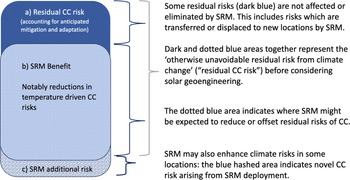
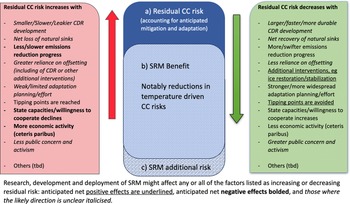
This limitation flows through into how the report establishes a benchmark for risk comparison. To measure the reduction of the target risk, it conceptualises a “level of residual climate risk that might be addressed by SRM” (p 4) as determined by the extent of mitigation and adaptation. But SRM would only influence certain effects of climate change, and cannot perfectly counter the impacts of greenhouse gas forcings, so not all residual risk is susceptible to SRM (see Box 1). The report cites multiple modelling studies that seek to quantify the climate effects of SRM on particular parameters in particular scenarios. Discussion of whether these different effects can all be achieved in the same plausible real-world scenarios is largely lacking, despite a discussion of the prospect of “risk correlation.” Nor is there any effort to determine how much of the residual risk which SRM could mitigate is otherwise avoidable through other (less risky) interventions.
Starting with clear definitions

The report considers a set of scenarios based on otherwise low, medium or high levels of mitigation – where the most ambitious scenario is based on the Paris Agreement (p 32ff). Although SRM is initially presented in the report purely as a supplement: an additional climate action, these scenarios treat mitigation and SRM as at least partial substitutes. And they are constructed and described in such a way that the reader is left with the impression that the level of residual risk (arising from the level of mitigation and adaptation) is entirely exogenous rather than partly reflecting decision-makers expectations regarding the availability and efficacy of SRM.Footnote 26
The potential risk tradeoffs considered include both biophysical risks arising directly from the intervention; and sociopolitical risks from actors using and responding to SRM strategically. The report, however, pays somewhat asymmetric attention to these distinctive risks. The biophysical risks (and benefits) are set out in detail across ten pages with dozens of references to modelling studies, while the sociopolitical risks get three sides of brief qualitative discussion, some of which is speculative and even dismissive in tone.
This reflects the distribution of studies in the existing peer-reviewed literature.Footnote 27 Yet for different reasons both sets of risks are presented in ways that underestimate their potential seriousness. The assessment of biophysical risks is based on simplified and idealised modelling which tends to provide an overly optimistic impression of SRM,Footnote 28 in part because it rarely examines the effect of SRM interventions on “otherwise unavoidable impacts of climate change,” but rather the outcome of interventions which presume exogenously determined levels of mitigation.Footnote 29 Thus the biophysical risks appear both limited in impact and scientifically well constrained, although that is a false impression based on unrealistic assumptions of effective governance baked into the models.
The sociopolitical risks are also framed as manageable – but in ways that climate risks (and countervailing risks associated with mitigation and adaptation responses) have so far proved unmanageable. The report argues that sociopolitical risks can be abated by good governance, while ignoring the shortcomings of and opposition to such governance found elsewhere in the climate sphere.Footnote 30 This results in further asymmetry: the risks associated with SRM are limited by idealised implementation and governance; while the risks on the other side of the trade-off (those associated with climate change) are not similarly constrained.Footnote 31 RTA’s role in helping identify possible ways to constrain or mitigate countervailing risks is valuable, but building such measures into the calculus on one side only introduces a potentially seriously harmful bias.
Theoretically, in RTA, through attention to risk offsets or transfers, the distribution of risk is also considered. In this report the relevance of risk distribution is repeatedly stressed, yet also then downplayed: the analysis only once addresses the issue, with a brief statement that the distributional effects might be either positive or negative. Nor is any attention paid to the factors that might contribute to differentiated vulnerability to either biophysical or sociopolitical risks, and how these in turn might be affected by different interventions.
A further asymmetry becomes clear when we turn to how the concern of potential mitigation deterrence is treated. The risk that pursuit of SRM might distract from mitigation is presented as a major countervailing sociopolitical risk (alongside conflict generation and termination shock), although described as “moral hazard” or “abatement displacement.” But the literature cited here is highly partial and one-sided, relying primarily on the dismissive assessments of ReynoldsFootnote 32 who misinterprets the problem through a neoclassical individualist economic lens. Similar weight is given to the unsubstantiated argument that consideration of SRM might instead galvanise climate action (because of the perceived risks of SRM), which downplays the risk of mitigation deterrence.Footnote 33 Yet however unlikely, the risk of deterrence merits serious consideration because of the potential for irreversible impacts: should deterrence arise, and SRM fail, then there is no possibility to retrospectively increase mitigation.
Notably in the C2G report no scenario is considered in which the risks generated by SRM exceed the risks mitigated, despite plausible circumstances for such an outcome. These include, first, that feasible planned or possible future mitigation is traded away in favour of SRM which then proves technically or politically impractical: with the net effect of increased overall risk.Footnote 34 Secondly, if SRM is introduced but terminated while masking appreciable levels of warming, the result would be much more biophysically and sociopolitically harmful accelerated warming: again increasing overall risk. Arbitrarily ruling out such scenarios is particularly problematic in that in alternative (non-utilitarian) maximin ethical decision-making approaches, alternative strategies would be ranked not by average risk, but by maximum risk avoided.Footnote 35 The possibility of this scenario of termination shock would eliminate SRM from consideration under such a rule but has no effect in this proposal for RTA.
The report acknowledges the asymmetry of evidence between sociopolitical and biophysical risks, and the limited scope for quantifying the former. The authors’ response is to suggest a qualitative assessment of such risks to make trade-offs and weightings explicit. Yet, they still pursue quantified metrics for most factors, and treat uncertainties not as inherently unpredictable or unknowable factors,Footnote 36 but merely as a measure of the variability of predicted likelihoods or magnitudes. This reflects a modernist technocratic and calculative conception of risk.Footnote 37
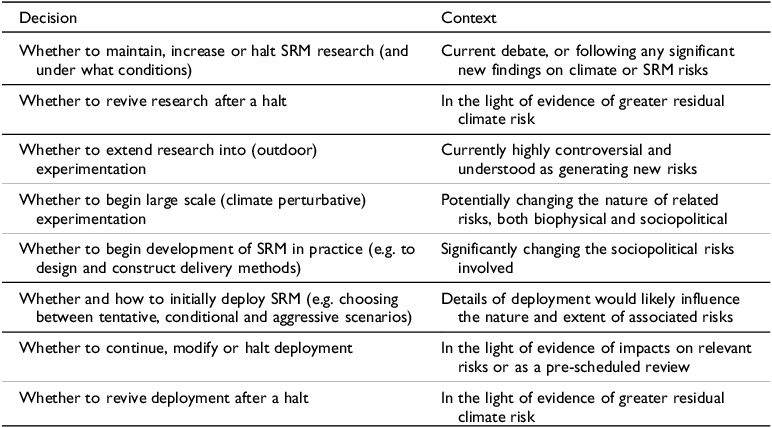
Here again, uncertainties are presented as susceptible to reduction by further research. Both this, and the structure of the sketched RTA implies that the process might be iterated, as knowledge expands. However, they are not explicit about the case for repetition, nor about the distinct decision points – regarding enhanced research, outdoor experimentation or delivery technology development, as well as deployment itself – which might be informed by such analysis (see Table 1).
Decision points at which RRA / RTA might help

This brief review has identified methodological shortcomings and asymmetries in the proposed RTA which seem to persistently favour considering the SRM option. In theory these might be corrected by including a full range of alternatives and scenarios, defining the risks involved with more care to ensure appropriate comparisons are being made, considering interaction effects in detail, paying more attention to the distribution (and causes) of risks and vulnerabilities. However, such corrections may not prove easy if the shortcomings are rooted in cognitive framing limitations, particular social imaginaries, or associated political or ideological presumptions. Nor if the motive for proposing risk-risk assessment is in fact intended to promote consideration of SRM. In the following sections, I turn to consider the politics of RTA, and subsequently the ideological frames and imaginaries of risk–risk approaches more generally.
2. The politics and social imaginaries of RTA
It’s not enough to assess the logical consistency and objectivity of the methodology. We need to ask how the introduction of such approaches might serve to influence the politics of geoengineering discourse. Such choices are not without rhetorical or ideological effects, which might be more significant in influencing policy choices than the content of a risk assessment exercise.
The history of RTA offers some insights here. RTA emerged as a challenge to perceived regulatory overreach in the 1970s, and formed part of the Reaganite de-regulatory agenda in the 1980s. It is rooted in a technocratic risk management culture dominated by statistical analysis of economic costs and impacts on health and life. In contrast to emerging ideas of a “risk society”Footnote 38 which were more influential in European politics, RTA helped sustain a “modern.” social imaginary in US politics. Here I use the term social imaginary to describe widely shared presumptions about “how the world works” socially, politically and economically,Footnote 39 and following Christopher Groves,Footnote 40 understand the dominant imaginary as modernist and technocratic.
In practice RTA was mobilised to roll-back regulation, providing a method to support industry concerns about the economic harms arising from allegedly unbalanced or overly precautionary pollution and safety regulations. One of the primary developers of RTA ran the Office of Information and Regulatory Affairs for a period, implementing corporate friendly decisions. An influential critique of RTA published in 2002 found that it paid excessive attention to the countervailing risks of environmental regulation and too little attention to ancillary benefits.Footnote 41 But the critique also defended the underlying model of Cost Benefit Analysis (CBA) – despite problems of incommensurability – as a tool for making regulatory decisions. One of the authors of that critique was more recently appointed by Biden to run OIRA, a decision which might be seen as a riposte to Trump’s rejection of “rational policy.”
RTA is still promoted as “rational” policy today. The C2G report adopts the language and framing of CBA, and explicitly rejects “non-rational” public responses (p 3) to SRM and counter-poses “science” as a way to avoid “biases and heuristics” (p 5). It also repeatedly insinuates that existing policy may be “distorted” by irrational responses.Footnote 42 However, rationalist presumptions are not necessarily helpful in assessing options and interventions. For example, presuming rational, optimised SRM deployment in a world of irrational public opinion and policy making means risks of SRM are easily underestimated.
In other words, far from being a neutral, objective tool, RTA is highly politicised. It is not only an appeal to the politics of rationalist modernism, but one that also more than nods to the anti-regulatory political right. In a debate where the political right remains often sceptical of the case for climate action, this might, arguably, encourage such actors to embrace action. However, previous research suggests that if such an effect materialises, the action embraced would likely be to replace mitigation with geoengineering, not to supplement it.Footnote 43 This likelihood is increased if RTA is understood as “normalising” SRM as a climate policy option to be traded off against mitigation according to relative costs and benefits, rather than as an exceptional measure only justified by existential risks.
In the present context, RTA is being advocated ostensibly not to resist regulation, but to add a new response in the face of inadequate regulation. However, the past record of RTA demands that we are particularly attentive to whether the structure of the methods proposed might instead imply using SRM as a substitute for other climate action. In the following section I turn to discuss this and other implications of risk–risk approaches for climate policy making.
III. Discussion: the policy challenges of a risk–risk framing
RTA has a specific political history, but the risk–risk framing in general also constructs the issues under debate in particular ways. Here I identify and briefly discuss policy challenges generated by the ways which the modernist, technocratic social imaginary and its associated ideological and cognitive presumptions surface in risk–risk framings.
1. A false binary?
Any claim about the nature of plausible pathways to climate safety depends on presumptions about the feasibility of rapid social change, carbon removal techniques and the acceptability of temporary temperature overshoot which merit interrogation. The risk–risk frame however, tends to imply that the only alternative to climate harms is solar geoengineering. This has two related consequences which I examine below – that we face a choice between a greater and a lesser evil, and that the two scenarios are otherwise independent of one another – but in itself establishes a false duality, despite the rapidly depleting carbon budget for 1.5°C. Even if alternative pathways might involve other risks and harms, they should not be excluded from assessment if RTA’s objective of identifying potential “risk-superior” pathways is genuinely to be pursued.
Some rehearsals of the risk–risk framingFootnote 44 even suggest that the alternative to solar geoengineering is unmitigated climate change, as if no further emissions reduction or adaptation can be foreseen. Other risk–risk accounts create space in which existing and possible further mitigation might be accounted for. This includes the C2G report, but that still treats the residual risk within any given scenario as not only all susceptible to SRM, but also immune to other measures.
The binary framing not only establishes SRM as the only alternative to further climate harms, but it also implies that all the risks of climate change might be eliminated by SRM (albeit replaced by a new set of risks). However, this is false: ocean acidification is the most obviously unaffected impact, but there are multiple ways in which the forcings from SRM are not reciprocal with those from greenhouse gases. Some harms and risks would remain, however well designed, implemented and governed the SRM intervention is.Footnote 45 Moreover, this binary approach risks overlooking other ways in which harm and vulnerability to it might be reduced, especially those which counter the ways in which neoliberal economies actively create inequality and vulnerability.Footnote 46
If RRA is to be helpful to policymakers the appropriate comparison would be comparing the risks introduced by adding SRM with the otherwise unavoidable residual risks (after foreseeable mitigation and adaptation) arising from the climate change factors it could affect. Box 1 and Fig. 2 suggest ways of more clearly specifying and categorising the (climate) risks involved. This should help ensure that the potential benefits of SRM are not exaggerated. It also adopts a deliberately precautionary starting point: placing an onus on those suggesting a novel untested technology with acknowledged serious risks to demonstrate that other measures cannot deliver the same benefits at less risk.Footnote 47
Understanding residual risk.

2. The “lesser evil”
The risk–risk binary suggests a choice must be made between undesirable options, and implies that the appropriate choice would that with less risk: the “lesser evil.” If there are only two options and both are bad, the implication here is that our moral obligation is to choose the one that is “less bad” on aggregate. Such analysis is morally consequentialist (and utilitarian) – a standard element of modern “realist” ethics, in which leaders are urged to “assess rival policies against their likely consequences and to seek the ‘lesser evil’ among feasible choices.” Footnote 48 Lesser-evil choices are suggested to be particularly appealing if the alternative is catastrophic or existential risk.
But such a comparison of harms is not necessarily the most ethical approach. Stephen Gardiner argues that the “lesser evil” justification would be susceptible to “moral corruption,”Footnote 49 and choices made in line with the convenience and interest of those with the power to decide. The false binary arises here because alternative strategies are not (or have not been) seen as feasible by the powerful countries and wealthy elites shaping the policy decisions (and responsible for the existing state of the climate). A lesser evil approach based on utilitarian aggregation also risks downplaying the issue of distribution of harms. By contrast, many ethical theories suggest a need to avoid additional harm to the less well-off, or at least would weight such concerns disproportionately.Footnote 50 This is not to argue that one school of ethics is correct and the other incorrect, but to recognise that RRA methodologies presume an ethical approach which is contested.
For RRA to be useful to decision makers the embodied ethics must be part of the debate, not just about how to interpret risk–risk analysis, but also whether to use it in the first place. In turn this implies a need for broad public participation and international deliberation.
3. Independency or interaction
Modernist technocratic social imaginaries are firmly rooted in scientific reductionism, which struggles to understand co-evolving and interconnected systems. In some applications of risk–risk analysis the risks are clearly independent: for instance the likelihood of the earth being hit by an asteroid does not change if we consider building a nuclear armed asteroid destruction capability.Footnote 51 But the risk of climate catastrophe is a product of human actions, not astrophysics. Its likelihood does change when we consider developing SRM: shrinking if the “galvanisation” hypothesis is correct or dominant, growing if the mitigation deterrence effect is dominant. This socially constructed impact is separate from considering the material risk-mitigation possibility of developing these techniques in practice.
But RTA engages poorly with such systemic interaction effects between the development and deployment of SRM and residual climate risk. Mitigation deterrence is a major ethical concern for SRM – whether understood as an emergent effect, or a consequence of vested interests; not only because of potential addition to climate harm if SRM proves ineffective, but also because of additional side-effects (e.g., millions of deaths from continued particulate pollution from fossil fuel combustion) even if SRM is effective. The challenge of mitigation deterrence has to be included and strongly weighted. While the C2G report recognises interdependence of risks, and the prospect of “unjust applications of SRM,” they imply these problems can be easily overcome by design and governance despite the persistent failures of efforts to establish effective international climate governance.
Moreover, as noted already, the report downplays deterrence risks, citing the “galvanisation” claim. But there is a contradiction here in that SRM is being considered because there are (implicitly) no other ways to increase mitigation (or otherwise reduce risks). Uniquely granting SRM the power to galvanise additional mitigation is entirely unjustified.Footnote 52
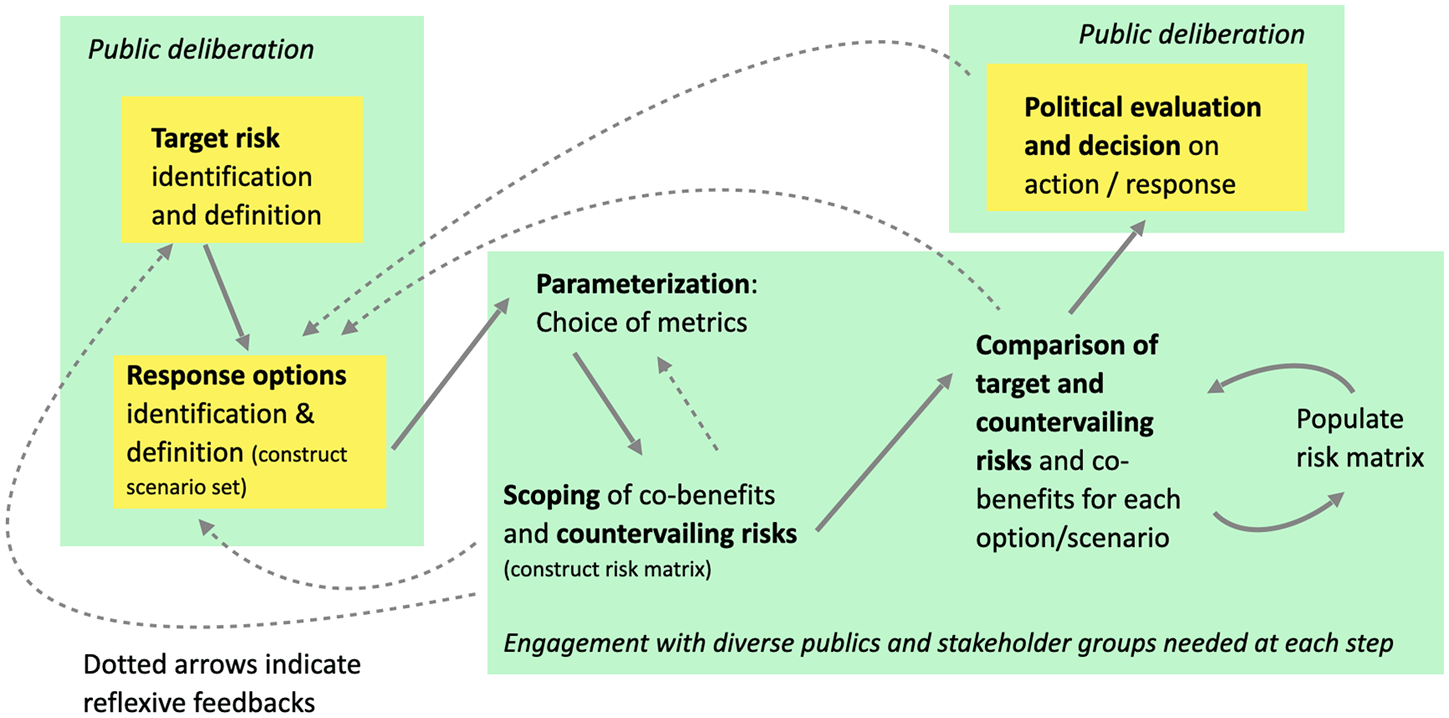
Thus, for RRA to be useful for decision makers it has to encompass reflexive analysis of the prospect of mitigation deterrence, and to extend to other possible ways of stimulating mitigation in excess of the limited scenarios included by C2G. Figure 3 suggests one way this might be conceptualised.
Incorporating interaction into RRA.

4. Exceptionality
Most advocacy for a risk–risk framing justifies consideration of SRM in the context of the potentially existential risks it might abate. This positions SRM as an exceptional measure (a view also widely held by policy makers).Footnote 53 If “exceptional measures” are legitimately acceptable responses to existential climate risks, then “radical” or transformative proposals to phase out fossil fuels, overturn consumerist values and behaviours, or even to embrace “degrowth” should be considered alongside the dominant model of technological innovation and market-based policies.Footnote 54 But such measures are generally rejected as impractical within the modernist social imaginary in which technological innovation both drives economic growth and tames risk.
And if assessments inspired by “existential risk” rhetoric then fail to consider other “exceptional responses” to climate risk, or apply risk management techniques that are not designed for existential risks, this creates what might be called an “exceptionality paradox.” This might even be described as a “bait and switch” move, if the assessment is justified by existential risks, but then adopts conventional CBA style methods, founded on fungibility and aggregation. Such methods may be suited to everyday issues such as road safety regulation, but cannot quantify the most serious risks involved here.
Managing existential risks with exceptional measures is not simple and raises further political concerns. Notably, exceptional responses are often justified in emergencies – with rapid decision making which might exclude normal political and democratic processes. The idea that a “climate emergency” might justify SRM deployment is not new, but has been widely criticised on ethical grounds – that exceptional measures undermine democratic politics and the international collaboration needed to deliver mitigation (and that would also be essential to deliver just and ethical solar geoengineering).Footnote 55
For RRA to be useful to policy makers, it should not retreat into technocratic methodologies, but examine a wider range of potential responses, with methods that can both reflexively evaluate uncertain and extreme risks, and enable democratic consideration of radical responses (see Fig. 4).
Reflexive and participatory RRA.

5. Excluding other logics
Insofar as the risk–risk approach frames assessment in terms of climate risks, it excludes other logics for undertaking solar geoengineering. It ignores the prospect that SRM might be deployed (or avoided) for reasons other than seeking to reduce climate change itself. To research advocates, steeped in climate science, reducing climate impacts might seem the only possible rational reason for considering such a risky option. But to security experts, and students of political science, geoengineering appears as a hybrid, dual-use security technology.Footnote 56 Its deployment might involve climate-related goals, but that could merely mean masking impacts enough to justify continued exploitation of fossil fuels for geopolitical reasons.Footnote 57 The risk equation in a world of high continued emissions, masked by solar geoengineering, would probably look very different from one where an idealised intervention helps “shave the peak” of emissions related temperature rises.Footnote 58 The implications of geoengineering initiated, or manipulated as a security intervention for relative national advantage might look very different again.Footnote 59
For RRA to be useful to policy makers, the implications of deployments following non-climate logics,Footnote 60 as well as those arising in non-ideal, but still climate-motivated, deploymentsFootnote 61 must be assessed too.
6. Governance and risk repertoires
Despite the justificatory rhetoric of climate risk as an existential threat to some valued referent object – such as civilisation, thus meriting consideration of the otherwise unthinkable, the risk–risk approach, and RTA in particular, invokes specific concepts of risk that are largely embedded in a conventional technocratic risk management repertoire closely wedded to the modernist social imaginary. Risk is understood as undesirable: “any chance of an adverse outcome to human health, the quality of life, or the quality of environment;”Footnote 62 yet tame-able.Footnote 63 Risk here is quantifiable, objective, subject to aggregative calculus and technically manageable. Uncertainties and the unknown are spaces colonisable by research, advancing a frontier of knowledge and certainty. Decisions about acceptability of risk are treated as matters for expert estimates rather than public deliberation. Public perceptions of risk – especially regarding novel technologies – are irrational and should be corrected by improved knowledge.Footnote 64
The heritage of CBA and risk-benefit approaches is clear.Footnote 65 But this risk repertoire is inappropriate for addressing potentially existential risks and exceptional responses to them, not least in how it treats uncertainty. There is good reason to consider that the risks of climate change have been underestimated by quantifying modelling techniques in the technocratic paradigm. This might well justify the addition of SRM to the basket of responses we should consider. But we should beware of then using the same methods that underestimate the risks of climate change to assess the risks of SRM.
This leads to the same conclusion as the exceptionality paradox: if the reason for assessing SRM is the threat of existential risk, then the appropriate risk assessment and management repertoire is more like that of security: worst case scenarios, focus on low probability but high impact events, and not treating incommensurate risks as fungible. But a securitised risk management repertoire would also face serious problems, not least regarding justice and ethics.
There would seem no technical reason to prevent RRA being reconfigured to form part of a novel, genuinely precautionary, risk management repertoire that helps humanity live with uncertainty, supports meaningful action to avoid worst-case outcomes, and reflects an ethics of care.
Such a redesign would mean multiple changes, including the following: Assessing both the risks and ethics of a full range of exceptional responses without trying to wedge them into a calculative framework. Ensuring balanced treatment of sociopolitical risks as well as biophysical, and of possible risk mitigation measures. Fully acknowledging uncertainties and unknowables and developing non-quantitative ways to assess them. Building in systemic analysis of interaction effects, including those triggered by early decisions on research or experimentation. More generally avoiding misleading aggregation and not treating distinctive risks as commensurable. Examining worst cases, and non-ideal scenarios – on both sides – and giving them ethically appropriate weight. Incorporating the risks of misuse, or suboptimal deployment, not just presuming good faith efforts to optimise climate outcomes and manage side effects. Putting the distribution of risk and vulnerability at the centre. Embedding public participation and deliberation at every step. And enabling deliberation and debate over appropriate ethical bases for assessment and decisions.
Providing anything more than a sketch of such an alternative risk management repertoire is beyond the scope of this article, but given the proliferation of “existential threats” and a state of “polycrisis” such development would seem urgent.
Whether RRA’s advocates would support such transformative methodological and epistemological changes is at best an open question – even laying aside the possibility that such advocacy might be serving a predetermined view regarding the value of SRM – given the stickiness of social imaginaries and ideological presumptions. But without them, RRA seems unlikely to provide practical and meaningful information to decision-makers wrestling with multiple and intersecting crises.
IV. Conclusions
Justifying SRM as an exceptional response, without considering the political and social implications of such a response seems irresponsible. Justifying its consideration by framing the target risk as existential, but then using methods designed for more mundane, statistical risks, is also inappropriate. But retreating from an “exceptional” frame, and normalising SRM is also problematic, especially where radical transformation is needed to achieve emissions cuts. Recent moves in SRM discourse (and the RTA proposal) hint at such a retreat from the “exceptional” framing, and efforts to position SRM as less disruptive than radical mitigation measures. In this respect adoption of SRM as part of societal securitisationFootnote 66 – for reasons largely unrelated to climate implications – seems plausible, but highly risky in both climatic and political terms.
The analysis here suggests three lessons for future (climate) governance as it comes to terms with risky technological interventions such as SRM. First, broad public participation mechanisms are urgently needed to shape democratic responses to growing climate risk. Second, rigorous consideration of the systemic risks and benefits of a wider range of exceptional responses to climate change is needed, situated in consideration of the political, cultural and economic circumstances faced by actual decision makers, so as to avoid overly optimistic assessments of potential risk mitigation. And third, effective anticipatory governance must be developed in advance of accelerated development of solar geoengineering (or any other exceptional response), so unacceptable consequences can be avoided or its development or deployment halted.
These three steps could form the bones of a genuinely precautionary, care-oriented repertoire of existential risk management, within which a reconfigured RRA would be a valuable tool. Within such a risk repertoire SRM might yet find a temporary place as part of a portfolio of climate responses focused on delivering justice and sustainability; and supporting economic, social and political transformation. This would be in a stark contrast to SRM justified as a substitute for emissions cuts, and sustaining extractive, growth-obsessed, neoliberal capitalism.
Acknowledgments
Initial research for this article was undertaken under a Climate Intervention Fellowship at the University of California, Los Angeles (UCLA) School of Law. The author wishes to thank colleagues at UCLA, participants in a colloquium at the University of Washington in January 2024, and at the EJIS conference “Security in a time of Polycrisis” at Leeds in May 2023 for their constructive feedback on earlier critiques of risk–risk approaches to SRM.
Financial support
No funding to declare
Competing interests
The author wishes to disclose that he is a signatory to the proposal for a Non-Use Agreement on SRM.

 Open access

