

A notorious puzzleFootnote 1
One of the most thorny issues of Roman Britain is that of the precise date, nature and context of the Hadrianic expeditio Britannica. The campaign, bringing over a 3,000-strong legionary reinforcement from Spain and Upper Germany, must have taken place somewhere in the 120s based on the career inscriptions of two participating officers, Pontius Sabinus and Maenius Agrippa.Footnote 2The latter is also known, and appears to have fulfilled his part in the expedition, as the commander of Cohors I Hispanorum at Maryport.Footnote 3In this capacity he dedicated four altars of the famous series of dedications to Jupiter Optimus Maximus — another branch in this complex maze.Footnote 4With Maryport being part of the Hadrianic Tyne–Solway frontier, and the expeditio likely taking place around its founding years, the vagaries of Hadrian’s Wall have naturally become entangled with the debate. Over the years, this has led to a whole range of proposed contexts for the expeditio Britannica: at the start of Hadrian’s rule, c. 117–19, when we hear that ‘the Britons could not be held under control’;Footnote 5in the run-up to Hadrian’s visit of 122;Footnote 6shortly after the decision to add a dozen forts to the Wall, traditionally in 124/5;Footnote 7in the later 120s;Footnote 8or even in the 130s.Footnote 9
Until recently, another conundrum, the eclipse of the Ninth Legion (legio IX Hispana), seemed only marginally relevant to the dossier, as the unit was generally believed to have left Britain by c. 120.Footnote 10The British troubles at the start of Hadrian’s reign had once seemed the obvious occasion for the loss of the Ninth, but Ritterling’s famous 1925 article on the Roman legions had made it clear that the unit was still in existence in the early 120s.Footnote 11For a while, the Bar Kokhba revolt of 132–35, and Hadrian’s call upon Britain’s governor Iulius Severus to suppress it, seemed a fitting context for the transfer, and the loss, of the Ninth.Footnote 12Matters changed in 1967, when the Dutch archaeologist Jules Bogaers published a few stamps and inscriptions showing the Ninth, or part of it, to have been based at Nijmegen, in the 120s he suggested, including the unit’s expectant camp prefect.Footnote 13Eric Birley pursued this lead: with the Ninth’s successor at York, VI Victrix, having come over to take part in the Wall project, surely together with Hadrian in 122, he proposed a temporary base for IX Hispana in the Carlisle area, based on a small regional scatter of tile stamps; and with the Wall supposedly completed by c. 126, the Ninth might have then moved to Nijmegen, and been taken further east a few years later by Iulius Severus, to perish in the Judaean revolt or in 161 at Elegeia, against the Parthians.Footnote 14The latter option gained credence with the publication of a new military diploma in 1972, seemingly showing that a military tribune of the Ninth, Numisius Iunior, had risen to the consulate in 161, so that he would not have served in the legion much earlier than c. 140.Footnote 15
Meanwhile, retracing the whereabouts of the Ninth on the Continent proved to be a challenge. In an overview of the successive garrisons at Nijmegen, Bogaers suggested that only part of the legion could have been based there in the 120s.Footnote 16Haalebos later returned to the tile-stamp evidence, arguing that the detachment stayed at Nijmegen earlier, between c. 104 and 120, as part of the vexillatio Britannica, attested by over 100 stamps.Footnote 17Nor did the Ninth fare better in the East. The Jewish revolt was known to have cost many Roman lives, but nothing pointed to IX Hispana having been involved.Footnote 18In 1989 Lawrence Keppie critically reviewed the evidence for a continued existence of the Ninth in the east, including the new diploma, but could find nothing conclusive.Footnote 19An important paper by Nick Hodgson recently published in this journal has confirmed and amplified Keppie’s findings: Legio IX Hispana vanished from the epigraphical radar after the early 120s, with its last attested officers on record around 124, and no reliable traces left on the Continent after that date.Footnote 20This opens up the intriguing possibility that the loss of the Ninth may, after all, have happened in Britain, the legion’s last attested base.Footnote 21In such a scenario, the much-debated expeditio Britannica readily presents itself as a potential context. This brings us back to the issue of the expedition’s date.
In the last two decades, expert opinion has come broadly to agree that the British expedition equated with Hadrian’s visit of 122, seeing that the term expeditio normally implies the presence of the Emperor.Footnote 22This coupling is not without its own problems, firstly because several exceptions to the rule are known, as we shall see shortly.Footnote 23One of those may well be the expeditio Britannica, Maenius Agrippa’s career inscription stating that he was ‘chosen by the late emperor Hadrian and sent on the British expedition’.Footnote 24In his contribution to the debate, Sheppard Frere has rightly emphasised that the term expeditio always occurs in a context of serious fighting, as the reinforcements from overseas seem to confirm in this instance.Footnote 25However, Hadrian’s leisurely tour through the north-western provinces in 121–23, announced one or two years in advance, judging the milestones and implied road works that paved his wayFootnote 26and taking ample time to inspect all manner of military infrastructure, inaugurate public buildings and elevate the status of market towns,Footnote 27seems difficult to rhyme with the kind of acute military crisis implied by the word expeditio, the named reinforcements and, potentially, the loss of a legion. One would expect ‘that if the fighting was so fierce, in the presence of the emperor, it would have been mentioned by the author of Hadrian’s biography.’Footnote 28To avoid these problems, it has been proposed that Hadrian in 122 simply took the credits for a victory that had been won following the troubles that had broken out around 117.Footnote 29But that victory appears to have been secured, and widely publicised in Britain through targeted coin shipments, by c. 119Footnote 30— with IX Hispana apparently surviving. Before long, moreover, preparations for the building of Hadrian’s Wall must have been under way, in synch with the felling of trees, in the winter of 119–20, for the new palisade in Upper Germany,Footnote 31leaving only a narrow time window for the unfolding of a major new security crisis and the staging of an expedition supported by transmarine reinforcements to stamp it out in time for the imperial visit.
Meanwhile, a coupling of the loss of the Ninth, the transfer of the Sixth and the expeditio Britannica remains an attractive, and economic, solution to a centennial conundrum — and well within the bounds of evidence, as Hodgson has recently demonstrated.Footnote 32But if the expeditio equates with Hadrian’s visit of 122, where might the loss of the Ninth fit in? Did Britain lose one of its legions in the run-up to the imperial visit? The facts are that around the time radio silence around the Ninth started, the project of Hadrian’s Wall was under full steam. What can the study of the Wall itself contribute to this notorious puzzle?
A fresh approach
The historiography of this debate has become so branched and opinionated that a fresh approach seems advisable. While it is tempting to follow the branches as they have grown and pick up debate where it stands, there is an inherent danger that we lose sight of other possibilities, or start narrowing time windows too soon as we argue towards a solution. The opposite approach may be more productive, which is to deconstruct this complex issue and dissect it into a series of independent elements, each with their own date range, as if they were pottery types represented by sherds. We are lucky to have quite a few of such diagnostic ‘sherds’, and the proposition here is to simply tabulate their years of currency and see what pattern emerges. These involve the careers of a handful of officers, some of them later advancing to the consulate. In the proposed approach it is crucial that we work with normally expected intervals and ages, rather than stretch the date ranges to fit our argument as we proceed.
It is expressly not the aim of this paper to engage at length with earlier positions, nor to aspire to bibliographic completeness, much work having been done already, on the Ninth by Keppie, on the expeditio Britannica by Breeze, Dobson and Maxfield, and on both by Hodgson just recently.Footnote 33Instead, this contribution will bring into discussion a few new elements, potentially related and with relatively narrow date ranges. Reference will also be made to recent advances in our understanding of the early sequence of Hadrian’s Wall.Footnote 34The mere aim of this paper is to offer for consideration a scenario that, to the author’s knowledge, has not been tried earlier, at least not in this specific combination and context.Footnote 35In a debate of such significance for our understanding of Roman Britain it is important that we keep all our options on the table.
The term expeditio
Before deconstruction can start, a few words with respect to terminology are in place, expeditio having a specific meaning and reserved usage. There are two aspects that bear renewed discussion.
Active campaigning
Frere has rightly emphasised that ‘unlike the English word “expedition”, expeditio when used in a military context is invariably associated with active campaigning against the enemy.’Footnote 36A trawl through the most used online epigraphic database gives 147 instances.Footnote 37Most of these expeditions are identifiable, all entailing Frere’s ‘active campaigning’, like the Danubian wars of Domitian, Trajan’s Dacian and Parthian campaigns, Hadrian’s suppression of the Bar Kokhba revolt, Pius’ Mauretanian campaigns, the Parthian expedition of Lucius Verus, the Marcomannic wars under Marcus Aurelius, the Parthian campaigns of Septimius Severus and Severus Alexander. The expeditio Britannica, for all its obscurity, is in respectable company. Sabinus’ career inscription provides the precious detail that he came over to Britain as commander (praepositus) of a force of 3,000 men detached from legions VII Gemina, VIII Augusta and XXII Primigenia, based at Léon (Hispania Tarraconensis), Strasbourg and Mainz (Germania Superior), respectively.Footnote 38The latter two units also appear to have provided troops for the later Scottish campaign of Antoninus Pius.Footnote 39But there may be a difference here: whereas the advance of the British frontier in the 140s appears to have been a carefully planned move, prepared by the building of storage facilities at Corbridge,Footnote 40the summoning-up of reinforcements from more than one province, certainly in the context of an expeditio, is more suggestive of a security crisis. One is reminded of the reinforcements Nero sent to Britain in response to the Boudiccan revolt.Footnote 41Hodgson may well be right that Sabinus’ 3,000 men came over ‘following heavy losses’.Footnote 42
There is no shortage of evidence of unrest and warfare in Britain under Hadrian. After a relative lull under Trajan, we see a surge in coin-hoarding in the early Hadrianic period, with the north of England slightly overrepresented and with a clear spike of depositions closing with coins issued between 118 and 122/3.Footnote 43At the beginning of Hadrian’s reign we hear that ‘the Britons could not be kept under control’.Footnote 44Caution is in place, as the Historia Augusta often places events during a reign in a general statement at the start of it.Footnote 45Trouble in Britain, in particular, may seem to be the compiler’s stock-in-trade when inaugurating a new imperial reign.Footnote 46However, Pat Southern has pointed out that there may well be an underlying logic to this pattern, in that agreements with communities outside the sphere of direct Roman administration tended to be made on a personal basis, thus becoming null and void upon the death of one of the two parties.Footnote 47The earlier-mentioned Britannia issue of c. 119 is often referred to as confirming the reality of trouble at the start of Hadrian’s reign.Footnote 48There is also the curious inscription found reused in Jarrow church which may reproduce phrases from an address Hadrian held in 122 but clearly echoes the dire situation at the start of his reign.Footnote 49One line speaks of ‘the shattering’ (diffusis) — obviously of enemies. Other sources point to the seriousness of warfare under Hadrian. Fronto, offering consolation to Marcus Aurelius after heavy losses incurred during the early stages of the Parthian war, reminded his former pupil ‘what a number of soldiers were killed, under the rule of your grandfather Hadrian, by the Jews, what a number by the Britons.’Footnote 50A tombstone from Vindolanda dateable to the first quarter of the second century or thereabouts informs us that T. Annius, centurion of the First Cohort of Tungrians, ‘was killed in the war’ — no specification needed, apparently.Footnote 51The use of the term bellum is suggestive of major fighting, not some local security incident.Footnote 52
The proximity of the emperor
Much has been made of the adjectival form Britannica — too much, perhaps. In recent discussions of Hadrian’s British expedition, the coupling of expeditio with a geographical adjective has come to automatically imply the participation of the emperor.Footnote 53It is worth retracing this development. At the origin is Ronald Syme’s review of the fine scholarly monograph by Helmut Halfmann on Roman imperial travels, Itinera principum (Reference Halfmann1986). Towards the end, Syme discusses Hadrian’s whereabouts during the expeditio Iudaica launched against the Bar Kokhba revolt of 132–35. ‘No doubt can be entertained anywhere’, Syme states, ‘when to “expeditio” is attached the name of a nation or a country’: the combination of the two implies the vicinity of the emperor.Footnote 54Far from asserting that Hadrian took active part in the Judaean campaign of 133, the point Syme is trying to make merely is that, in the winter of 132–3, the emperor’s station was ‘somewhere within reach of Palestine’ where he could coordinate the first military response.Footnote 55In 2014, the late Antony Birley took this a step further in a lengthy excursus on the expeditio Britannica which he had always preferred to identify with Hadrian’s visit in 122. Birley extensively references Veit Rosenberger’s (Reference Rosenberger1992) study Bella et expeditiones, who is quoted saying that the known instances of expeditio combined with a people’s name in adjectival form, with only few exceptions, pertain to campaigns in which the emperor took part in person.Footnote 56
Before we go into the exceptions, let us get the essence right. There can be no doubt that the term expeditio was reserved, in principle, for major military campaigns that were officially led by the emperor. Roman imperial ideology dictated that the emperor could be seen, or understood, personally to direct the military campaigns that were launched in his name. Battlefield prestige was a jealously guarded imperial prerogative, only to be bestowed upon imperial princes like Drusus, Tiberius and Titus, and even that only rarely — other achievers of military success were inherently at risk of being ousted or worse, as accomplished generals like Corbulo and Agricola were to experience. In the Roman world, in short, ‘all major wars … are implicitly held to require the presence of the — or an — emperor’.Footnote 57This could result in rather grotesque episodes, like Claudius coming over to Britain for sixteen days in 43, to claim in person the subjection of the Trinovantes and other tribes.Footnote 58If the emperor decided to stay in Rome, like Antoninus Pius did, much investment was made in the public image of the emperor being in control of things, ‘like the helmsman at the tiller of a ship of war’, as Fronto put it.Footnote 59The result of this war monopoly was that the emperor usually took care to show himself present, or in proximity, close enough at least to pretend his personal command.
In Latin, the most common way to distinguish all those glorious past expeditions was to use the adjectival form of the territory or tribe in question. The result of all the foregoing, unsurprisingly, is that we have many records of expeditiones specified by a geographical adjective with the emperor in proximity. But was this specific combination a formula reserved for those occasions where the emperor had actively participated? The reality appears to be more fluid. First of all, there is no strict rule that the adjectival form was always used when the emperor had taken part in the campaigning. Marcus Aurelius could certainly be understood to have participated in his expeditio against the Quadi and Marcomanni, but we find the campaign specified by the tribes’ names in substantive form.Footnote 60Caracalla’s German campaign of 213 is called expeditio Germaniae — no adjectival form required.Footnote 61The campaign to stamp out the Bar Kokhba revolt could be referred to as either expeditio Iudaica (adjective) or expeditio Iudaeae (substantive in genitive).Footnote 62
The Jewish campaign of 132–35, in particular, prompts the question how close the emperor needed to be to the theatre of war to justify the pretension of his presence. During the winter of 132–3, Hadrian had certainly coordinated the first response to the Judaean revolt from somewhere in the East, perhaps Antiochia, but he is not known to have taken part in the actual campaigning, summoning up ‘his best generals’ instead, with Iulius Severus in command of the operations.Footnote 63En route from Britain, Severus probably picked up a detachment led by Lollius Urbicus, legate of X Gemina at Vienna, perhaps meeting up somewhere in the Balkans with Hadrian, who was travelling back to Rome in the spring of 133.Footnote 64Interestingly, Urbicus served in the Jewish campaign, perhaps second in command, as legatus imp(eratoris) Hadriani in expedition(e) Iudaica Footnote 65— as Hadrian’s legate, that is, with the emperor elsewhere. Fifty years later, Commodus launched an expeditio III Germanica, but in this case the emperor appears to have made quite a show of his pretending to prepare for a third profectio but being ‘held back by the senate and the people’.Footnote 66Again, what mattered was the pretension of the emperor’s helmsmanship.
The imperial war monopoly promoted the development of special formulae. Missus is the term we sometimes find used in the context of expeditiones, always with the specification ‘by the emperor [name]’, to underline that the latter, while not taking part senso strictu, was firmly holding the reins. Thus, Sextus Attius Senecio was one of the men ‘sent (missus) by the late emperor Hadrian on the Jewish expedition to lead detachments’, likely accompanying Lollius Urbicus (and Iulius Severus?) from Pannonia Superior to Iudaea.Footnote 67C. Valerius Rufus, similarly, was ‘sent with a detachment on the expedition to Cyprus by the emperor Trajan [full title]’, who did not take part in this side show, but was close enough.Footnote 68The formula occurs several times in the context of the Mauretanian war of Antoninus Pius, likewise absent, but with the emperor expressly ‘sending’ the officer in question, like the primipilus Sextus Flavius Quietus who was ‘sent with an army on the Mauretanian expedition by the emperor Antoninus’.Footnote 69M. Valerius Maximianus, finally, was ‘elected and sent’ by Marcus Aurelius to make wide-ranging logistic preparations along the Danube for the upcoming expeditio Germanica.Footnote 70The formula used for Maenius Agrippa falls in this category: he was ‘chosen by the late emperor Hadrian and sent on the British expedition’. Agrippa’s career inscription proudly underlines his closeness to the emperor, whom he once hosted, but the text does not say that Agrippa accompanied Hadrian on the British expedition: the emperor sent him thither.Footnote 71
The events and their date ranges
With the relation between emperors and expeditiones somewhat loosened up, it is now time to discuss the date ranges for our ‘sherds’ independently. But first a few words on the one fixed point of reference we have: Hadrian’s visit to Britain in 122. While most of the events discussed below stand on their own, for some the date range depends on the year we assign to the ‘fort decision’, the shorthand term for the complex of incisive changes that befell the Wall project shortly after its inception.Footnote 72Lately, there has been increasing favour for the imperial visit of 122 as the likely occasion for this event.Footnote 73There are sound reasons for this.
The fort decision was part of, and may well have triggered, a much wider reorganisation of the British deployment, touching around 20 out of 55 garrisons.Footnote 74In a crucial paper, Marcus Reuter has shown that decisions involving the move of multiple units required express imperial consent.Footnote 75So there is much economy in having the early Hadrianic overhaul of the British fort landscape set in motion by the imperial visit. The changes we see on the Tyne–Solway frontier, in particular, would be very aptly described in a statement by Dio that would otherwise be difficult to explain: ‘Some of these [garrisons] he moved to more desirable places, some he abolished, and he also established some new ones’.Footnote 76There are many signs of the emperor’s proximity to the Wall project. A strong case has been made that Hadrian was personally involved in the Wall’s design.Footnote 77The resulting structure may actually have been known as ‘the Aelian Wall’ (as much as ‘Hadrian’s Wall’) in his lifetime.Footnote 78Hadrian himself appears to have presented the new frontier barrier as the outcome of a ‘divine injunction’, a ‘necessity’.Footnote 79The context for his alleged heavenly guidance probably had been the legitimacy crisis of c. 118, which had included the toxic element of wide dissent with the recent abandonment of Trajan’s conquests.Footnote 80By the winter of 119/20, work on a new frontier barrier in Germany had started, with the emperor visiting the project-in-progress in 121.Footnote 81The same sequence may be inferred for Britain. Road works, a sumptuous building at Vindolanda and an imperial appeal on one of the famous writing tablets indicate that Hadrian actually visited the Tyne–Solway frontier,Footnote 82and it seems clear which decision followed from this. Whereas the original blueprint for the Wall, with its metronomic rigour, looks like an ideal model which was hatched far away from realities on the ground,Footnote 83the fort decision was clearly informed by knowledge of the local situation — hence the likely outcome of 122.
In the following, wherever relevant, we will also consider the received chronology, with the Wall project launched by Hadrian during his visit and the fort decision following c. 124. It bears pointing out, though, that the alternative will only make the expeditio Britannica move further away from the time window that has recently been proposed for it.Footnote 84We may now turn to the events that interest us.
Pontius Sabinus: around 124
T. Pontius Sabinus was unusual in that he started on the normal equestrian career path of the tres militiae, serving as prefect of a 500-strong cohors quingenaria first and a legionary tribune next, but then switched to the centurionate after having been decorated by Trajan for his service in the Parthian war of 114–17.Footnote 85As a legionary centurion he successively served in XXII Primigenia in Upper Germany, XIII Gemina in Dacia and, as the highest-ranking one (primus pilus), in III Augusta in Numidia, before moving on to bring over the 3,000 legionaries from Upper Germany and Spain as part of the expeditio Britannica.Footnote 86While the primipilate normally lasted one year,Footnote 87the main problem here is the expected duration of Sabinus’ preceding posts.
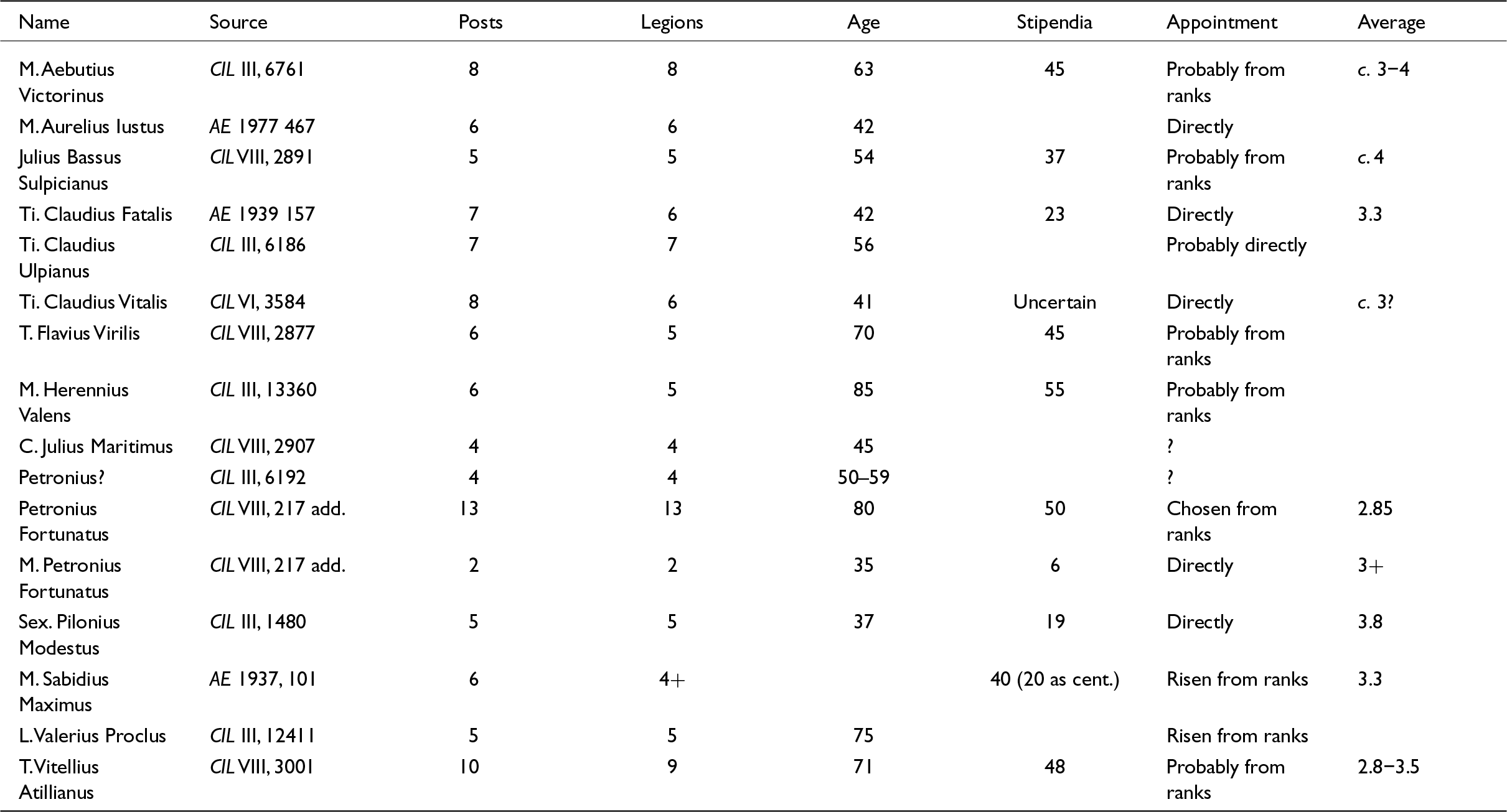
In their valuable contribution to the debate, Breeze, Dobson and Maxfield referenced a handful of centurial careers, arriving at ‘an average of at least three years for each post of centurion’ which, if accepted as a rule, would place Sabinus’ part in the expeditio Britannica ‘not before 124’.Footnote 88Michael Jarrett had earlier argued that Sabinus, being admitted to the centurionate directly rather than having risen from the ranks, might have reached the primipilate on a relatively fast track, being admitted to the primi ordines of the centurial rank system straight away.Footnote 89This certainly seems possible in the case of Sabinus, although the fast-tracking primarily manifests in the small number of his preceding centurial posts, not necessarily in a shorter duration of them. An expanded list of multi-centurionate careers (table 1) confirms both aspects:Footnote 90there is little evidence to suggest that the centurial posts of directly admitted holders lasted shorter,Footnote 91with the average for both career paths (directly admitted and risen from the ranks) being a little over three years.
Table 1. List of holders of multiple centurionates who boasted four posts or more, or whose number of stipendia are recorded. The table gives the number of posts, the number of legions served in, the age and number of stipendia at death, the mode of appointment (mostly based on Summerly Reference Summerly1990) and the average duration of the centurial posts. There is always a margin of uncertainty as it is not known whether the last held post came close to the full normal duration or lasted only for a short while.

The other issue is from where we count. ‘The Parthian War ended in 117 and, although decorations were sometimes awarded during campaigning, the end of the war is the likely date of the decoration; in any case, this is the most probable date for the end of his tribunate.’Footnote 92Strobel rightly emphasised that Sabinus was likely not released from his legion while the Parthian war continued.Footnote 93It may also be noted that Sabinus’ successive posts in Parthia, Upper Germany, Dacia, Numidia and his pick-up point for the 3,000 legionaries were widely separated, easily requiring half a year of travelling. If we work with normal patterns and durations, then, c. 124 is a fine average expectation for Sabinus to have reached Britain with his expeditio. Frere has also pointed to a possible issue with Sabinus’ age. On normal expectancies, he may have been born around 80 or a couple of years earlier.Footnote 94With the primipilate normally not held before the age of 50 (the youngest primipilus on record was 49Footnote 95 ), Sabinus’ career becomes more normal for every year we can push his tenure further into the 120s.
Maenius Agrippa: probably 123–6
Our second protagonist is Maenius Agrippa who was ‘chosen by the late emperor Hadrian and sent on the British expedition’.Footnote 96On the career inscription from his hometown of Camerinum in Italy, the mention of the expeditio Britannica comes between the first and second of a classic tres militiae, the three military posts held at the start of an equestrian career, usually leading on to a series of procuratorships, as in this case. Antony Birley has rightly emphasised that Agrippa’s assignment to the British expedition, rather than representing a separate post,Footnote 97took the form of his command of the part-mounted cohors I Hispanorum equitata.Footnote 98As this was Agrippa’s second command, carrying with it the title of tribunus, the implication is that the First Cohort of Spaniards, at that time, was a cohors milliaria.
The cohors I Hispanorum was the Hadrianic garrison of Maryport on the Cumberland Coast, the western flank of the Tyne–Solway frontier. The list of the unit’s commanders attested by the famous series of altars, four of them dedicated by Maenius Agrippa, easily fills up the whole period between c. 122 (or 123/4, if that date is preferred for the ‘fort decision’) and c. 140, when the unit was replaced by the cohors I Delmatarum.Footnote 99One of the complications is that, while two of the attested commanders, Agrippa and C. Caballius Priscus, carried the title of tribune, the others were all prefects. The implication is that the First Spaniards were either upgraded from or, as most experts agree, reduced to a 500-strong cohors quingenaria while based at Maryport.Footnote 100How the unit’s changing size relates to the visible and archaeological remains of the fort has been the subject of much discussion.Footnote 101A similar lack of clarity also continues as to possible Flavian and Trajanic precursors of the fort, whether on site or nearby.Footnote 102
Whatever Maryport’s antecedents, the strong likelihood is that its Hadrianic garrison, cohors I Hispanorum, was placed there as part of the incisive revision of the military deployment in Wales and northern England which the ‘fort decision’ entailed.Footnote 103Only a few of the units that were to occupy the new Wall forts were simply moved forward from existing Stanegate sites, like the 800-strong cohors I Tungrorum of Vindolanda which would move on to nearby Housesteads.Footnote 104Other units were necessarily transferred from further afield. A recent analysis of how the Vallum, the earthwork at the back of the Wall, aligns with the south corners of the new Wall forts sheds interesting light on ongoing thinking about required garrison types and sizes in the immediate aftermath of the fort decision.Footnote 105While the 500-strong, part-mounted cohors equitata, ‘the work-horse of Roman frontiers’,Footnote 106appears to have been the default option, Benwell and Birdoswald were apparently upgraded to full cavalry forts while the planning and construction of the Vallum were taking place.Footnote 107Special thought was also given to the deployment of the milliary units. An 800-strong cavalry unit was placed at Stanwix, the centerpoint of the combined Wall and Cumberland Coast systems.Footnote 108The new fort scheme also provided for a milliary unit, infantry this time, at Bowness-on-Solway, the western terminus of the Wall.Footnote 109The placing of the 800-strong, part-mounted cohors I Hispanorum at Maryport, occupying a commanding position at the centre of the Cumberland Coast system, fits in this pattern.
The strong likelihood, then, is that cohors I Hispanorum came to Maryport in the context of the fort decision. Assuming that the emperor will not have reached the northern frontier before the advanced summer,Footnote 110and given the logistic and social impact of the fort decision,Footnote 111it is questionable whether the cohors I Hispanorum can have been properly based, and performing its dedications, before somewhere well into 123 (or one or two years later according to the traditional chronology).Footnote 112According to most experts, as we have seen, the First Spaniards started at Maryport as a milliary unit, befitting the central and prominent place of Maryport in the chain of forts along the Cumberland coast. This sequence is supported by the altar of M. Censorius Cornelianus, a prefect this time,Footnote 113who appears to have been an expectant centurion of the Judaean legio X Fretensis at the time of his dedication. This would likely place this altar in 132 and quite possibly provide an occasion for the reduction in size of cohors I Hispanorum.Footnote 114An alternative context for its downgrading could be the general review of the Wall garrison that appears to have taken place in c. 130, possibly as part of the mandata of Britain’s new governor, Iulius Severus.Footnote 115Both solutions would place Maryport’s two (or three?Footnote 116 ) tribunes between c. 123 and 130/2. The parallel participation of Pontius Sabinus in the expeditio Britannica would strongly favour the earlier time slot for Agrippa: c. 123–26. This would also make sense of Agrippa’s prestigious hosting of the emperor, likely at his hometown in Picenum: this is likely to have followed shortly after his British posting, when Hadrian visited the area in 127.Footnote 117
The end of the Ninth: not much before 123/4
After all the good work that has been done by Keppie and Hodgson,Footnote 118the disappearance of IX Hispana, strange as it may sound, need not occupy us very long, the only point being its last attested moment of existence. We are lucky to have the careers of three high officers serving in what appear to be the final years of the legion, as well as the disinterested judgment of the late Antony Birley.Footnote 119Lucius Aninius Sextius Florentinus is known from his magnificent tomb at Petra in Jordan to have been legatus legionis of IX Hispana before moving on to governorships in Narbonensis and Arabia, successively.Footnote 120In this last post he is attested on a papyrus of 2 December 127.Footnote 121The preceding proconsulate of Narbonensis ought to have fallen in 123–4 or 124–5.Footnote 122Florentinus, therefore, ‘is unlikely to have left the legion much before 124.’Footnote 123We also have two tribuni laticlavii. The first, L. Aemilius Karus, is now known to have held his consulate in March 144.Footnote 124In a standard career his tribunate would have come about 20 years earlier, around 124. Karus’ career showing clear signs of imperial favour (he was quaestor Augusti after his two tribunates), there is no reason to assume a much longer interval.Footnote 125The other, L. Novius Crispinus Martialis Saturninus, was consul designate in 149, perhaps at a slightly later age than expected, but his praetorship must have come around 135, as Birley carefully argues.Footnote 126On that basis, ‘Crispinus can hardly have been tribune earlier than the mid-120s.’Footnote 127Hodgson rightly concludes that ‘the[se] careers rule out the traditional loss of the legion in 117–19 but are compatible with loss or disbanding at some point in the 120s.’Footnote 128It is of course possible to conjecture that one of the officers may have had his career retarded by some circumstance.Footnote 129The point here is that the combined weight of normal expectancies favours a date for the disappearance or disbanding of the Ninth not much before 123/4. The question of the whereabouts of the legion in the preceding two decades will be addressed in the Discussion section.
The transfer of VI Victrix: broadly around 123
The transfer of the Sixth legion ‘from Germany to Britain’ is, uniquely, mentioned in the career inscription of its senatorial tribune M. Pontius Laelianus Larcius Sabinus.Footnote 130Ever since Ritterling’s famous article on the Roman legions, it has been taken for granted that Hadrian ‘took’ VI Victrix with him in 122,Footnote 131without proper consideration, it seems, of the logistical nightmare of combining a legionary house move with the slow progress of the imperial court caravan with an estimated few thousand attendantsFootnote 132— not to mention the frequent stops for inspection and festivities, like the promotion and renaming of the civitas capital of Forum Hadriani in the Rhine delta.Footnote 133In this connection it may be noted that Laelianus’ inscription, for all its verbosity and eagerness to display his proximity to successive emperors, does not say that he accompanied Hadrian to Britain. It is best therefore to set aside the link as unproven and work backward from the date of Laelianus’ consulship, now known to be 145.Footnote 134His career showing clear signs of continued imperial favour,Footnote 135the normally expected date for Laelianus’ post in the Sixth, and the legion’s move to Britain, would be broadly around 123, with an unknown part of the tribunate spent in Germany.Footnote 136
A coin-hoard horizon, c. 123–5
A few coin hoards closing with early Hadrianic issues have been found in the Wall zone. Two were found inside the fort of Birdoswald in 1930 and 1949. The first, contained in a pot-base, was reported to have been ‘pushed into the floor’ of a building at the junction of the via decumana and via quintana. The second, a bronze wrist-purse with its content, was found in the earth backing of the fort wall during consolidation works.Footnote 137The 1930 hoard closes with two Hadrianic denarii dated ‘c. 120 (late)–121’ in Abdy’s new seriation; the 1949 hoard has one, similarly dated.Footnote 138All three coins were described as being in mint condition. The composition of both hoards is very similar to the one found at Thorngrafton near Vindolanda in 1837.Footnote 139This closes with four coins of Hadrian, all apparently in mint condition, one datable to 118, the other three to ‘c. 120 (late)–121’.Footnote 140All three hoards contain a significant proportion of Republican denarii. Because of their higher silver content these largely went out of circulation in the course of the 120s.Footnote 141The prolific coinage with the new HADRIANVS AVGVST(VS) obverse legend starting in 124/5 is not represented. Context and composition of the three deposits are suggestive of a single hoard horizon which apparently followed upon the fort decision.Footnote 142Its date should be somewhere around 123–5.
The phenomenon does not stand in isolation but is part of a much broader, early Hadrianic surge in hoarding, with a marked peak of depositions closing with coins issued between 118 and 121/2. A detailed analysis falls outside the scope of this paper, but a few points can be made. First, the deposition date of many hoards will be one or two years after their closing issue, as we shall see for Birdoswald shortly. What is clear, is that the great bulk of them post-date 117–18 — the traditional years in which ‘the Britons could not be held under control’. Second, apart from the Wall zone, there is a slight but unmistakable overrepresentation, compared to the distribution patterns of surrounding reigns, of north-west England.Footnote 143
A cessation of work on the Wall, c. 123?
In 2003, David Breeze published a short, but thought-provoking paper titled ‘Warfare in Britain and the building of Hadrian’s Wall’. In this he argued for the possibility of a security crisis happening shortly after the implementation of the fort decision, based primarily on the observed breaks early in the building sequence of the forts at Birdoswald and Housesteads as well as milecastle 37.Footnote 144A response came in 2006, by Tony Wilmott, who noted that the fort under construction at Birdoswald would have been the turf-and-timber installation postulated by Richmond and Simpson, so that another explanation is required for the observed breaks.Footnote 145
But how solid is the evidence of the turf-and-timber fort? The ‘very distinctive pitching of sharp freshly-quarried stones’ found behind the south wall of the stone fort by Richmond and Simpson clearly served as the foundation for ‘an earthwork rampart of some kind’ (fig. 1).Footnote 146However, this element has fine parallels in the kerbed foundations for the earth backing of the stone fort walls at Housesteads, Stanwix and Maryport, and is strikingly similar to the arrangement at the Saalburg in Upper Germany.Footnote 147The drain found under the east rampart in 1929 and believed to predate itFootnote 148is perfectly in line with the normal fort-building practice where drainage always came first.Footnote 149The occupation material found in the earth backing of the stone fort may be due to earlier activity on site or to later reconstruction work which is plainly in evidence on the south side.Footnote 150There is also the anomaly that the postulated turf-and-timber fort would have been almost immediately replaced by the stone fort, construction of which started before the formation of the ‘hiatus soil’ which developed during the long break in the fort’s construction in the middle Hadrianic period. The findspot of the 1949 coin hoard, in the earth backing of the fort wall north of the main east gate, further supports the conclusion that the installation that came under construction soon after the fort decision was none other than the projecting stone fort as we know it.Footnote 151

Fig. 1. Plan of the fort wall, the realigned stone Wall and the modern buildings at Birdoswald, with the 1929 and 1987–2000 excavations outlined in white and the approximate minimal extent of the ‘hiatus soil’ indicated in grey (redrawn from Wilmott, Cool and Evans Reference Wilmott, Cool, Evans and Wilmott2009, fig. 308 and 313; courtesy Historic England). The contour of the morass is based on Richmond Reference Richmond1931, fig. 1. The archaeological finds and observations are referenced in the text.
Meanwhile, the black ‘hiatus soil’ of Birdoswald calls for our closest attention. The formation has been observed, up to 20 cm thick, all over the western praetentura and under the via principalis.Footnote 152At the west gate, the layer was found to be stratigraphically later than the raft foundation and the first course of the gate piers and passage walls, but earlier than the primary gate-sill and one of the foundation blocks of the western spina, which was cut into the hiatus soil.Footnote 153The implication is that work on the west gate, and the fort’s defences generally, stopped at a very early stage and was only resumed after the formation of the hiatus soil. No traces of internal buildings have been found stratigraphically preceding the hiatus formation in the western praetentura.Footnote 154Soil-chemical analysis has suggested that there was ‘continued human activity during the accumulation of these soils, and this was followed by a period of undisturbed plant growth’, and that ‘the site was extensively used for animal housing or penning until just before the completion of the Stone Fort was started.’Footnote 155
When did this sudden cessation of work occur? If we follow the early timetable, with the fort decision issuing from Hadrian’s visit, a terminus post quem would be the advanced summer of 122. Much rethinking, replanning, resourcing and redeployment would have followed, not least because of the completely novel elements of the projecting forts and the Vallum. The social and security impact of all the unit transfers has been mentioned already. At Birdoswald, there was a change of plan, with the future garrison upgraded, probably to full cavalry size, and the footprint of the fort adjusted at a point where work on the Vallum had started.Footnote 156Besides, the place was not a blank canvas: ‘The sheer volume of labour involved in site preparation at Birdoswald cannot be overemphasised; the clearance of a large area of woodland followed by the drainage of a marsh would have involved huge effort.’Footnote 157It is difficult to imagine actual construction of the fort defences starting before the new work season of 123,Footnote 158with the break following somewhere in spring at the earliest and the two coin hoards sealing it. How long the following hiatus lasted is difficult to tell, perhaps until c. 130.Footnote 159
Similar hiatuses are in evidence at Great Chesters and Housesteads. On spacing grounds both were primary Wall fortsFootnote 160and the Vallum builders duly provided a crossing for each. At Great Chesters, a start appears to have been made with the fort defences, but these were only completed in or after 128.Footnote 161At the north gate of Housesteads (and nearby milecastle 37), Peter Hill found the same evidence for disruption of work, and resumption at a much lower standard, as at Birdoswald;Footnote 162the iconic fort was not occupied before c. 130.Footnote 163Burgh by Sands was also a primary fort, based on spacing and the alignment of the Vallum. The Wall ditch crossing the site appears to have been filled in with Turf Wall material, which ought to mean that a projecting fort was in the pipeline. But occupation only started in the later Hadrianic period.Footnote 164The fort at Bowness-on-Solway, likewise, was in full view of the Vallum builders, but the apparent foundation deposition found under one of its barracks dates not much earlier than the same broad 130 threshold.Footnote 165Most surprising of all is the 0.75 m thick deposit of peat and clay that developed in the Wall ditch inside the fort at Chesters. The ditch had apparently been left open, possibly to serve as a handy rubbish tip during construction. A building hiatus of many years is implied.Footnote 166So at four sites at least (Housesteads, Great Chesters, Birdoswald, Burgh-by-Sands), we can see the Vallum builders anticipating a fort, a start being made with construction (or site preparation), and a break following, lasting about 5–10 years. This long hiatus must be the same that is in evidence at several points in the central sector of the Wall where a considerable period of soil formation and/or scrub development occurred between abandoned Broad work and the Narrow Wall, the latter dating to c. 130 or shortly after.Footnote 167So the detailed sequence and chronology we started with at Birdoswald opens our eyes to, potentially, a complete cessation of work, at least in the central and western sectors of the Wall. The abandonment of work at the forts, in particular, occurring so shortly after it had vigorously started with decent gate masonry and carefully constructed Vallum causeways, calls for an explanation out of the ordinary, certainly if all of this happened just months (in terms of effective building time) after the imperial visit.
A levy in Spain, spring of 123
‘After having arranged matters in Britain’, the Historia Augusta tells us, Hadrian crossed over to Gaul, inaugurating a basilica for Plotina at Nîmes, and spent the winter at Tarraco, the capital of Iberia’s northernmost province. Here he called all the Spanish communities for a conventus, likely early in the travelling and sailing season. At this meeting, Hadrian appears to have ambushed the delegates with a levy (dilectus), which caused great discontent.Footnote 168Antony Birley has plausibly suggested that this measure was intended to bring Spain’s legion VII Gemina up to strength following (or anticipating, one might gloss) the departure of 1,000 men to Britain as part of the expeditio Britannica.Footnote 169Hadrian’s sojourn in Spain was apparently cut short by an imminent crisis on the Euphrates.Footnote 170The emperor was in Antioch probably by June 123.Footnote 171
Unusual coin issues with military associations, c. 123
In 1987, John Casey, in a review of the Hadrianic coinage of Alexandria, hinted at Britain as the only place of possible fighting that might explain the local Nike issues of 124–5 and 125–6.Footnote 172Since 1992, much work has been done by the Roman Provincial Coinage project. Apart from the 10-volume publication series, there is an exhaustive website.Footnote 173A trawl combining the search criteria Hadrian, Alexandria and Nike yields no less than 77 items. Nike appears to occur rather randomly, in many variants, along with other types with a victorious ring. It looks much like a general theme, one of a local pool of reverse variants (sailing ship, emperor in quadriga, Athena, Zeus, etc.) recycled every one or two years. There are other coins, of the central mint, that are more deserving of our attention.
First, there are the issues with EXPED(editio) AVG(usti) on the reverse, with Hadrian on a horse in various poses.Footnote 174The theme first occurs on the bronze coinage with contracted obverse legend IMP CAESAR TRAIAN HADRIANVS AVG which starts in the course of 122 or 123, and is continued into the new HADRIANVS AVGVSTVS phase starting in late 123 or 124.Footnote 175Richard Abdy sees the type as a generic reference to Hadrian’s ‘great expedition’ of 121–25.Footnote 176However, the term expeditio is hardly appropriate for Hadrian’s long journey through Gaul, Germany, Britain, Spain, the East, Anatolia and Greece. The theme was not used on the prolific later coinage in commemoration of Hadrian’s extensive touring of the Empire. Interestingly, the obverse image, with the mounted emperor holding a spear, is of the same type as the profectio coins of Marcus Aurelius and Septimius Severus connected with their respective Danubian and eastern campaigns.Footnote 177
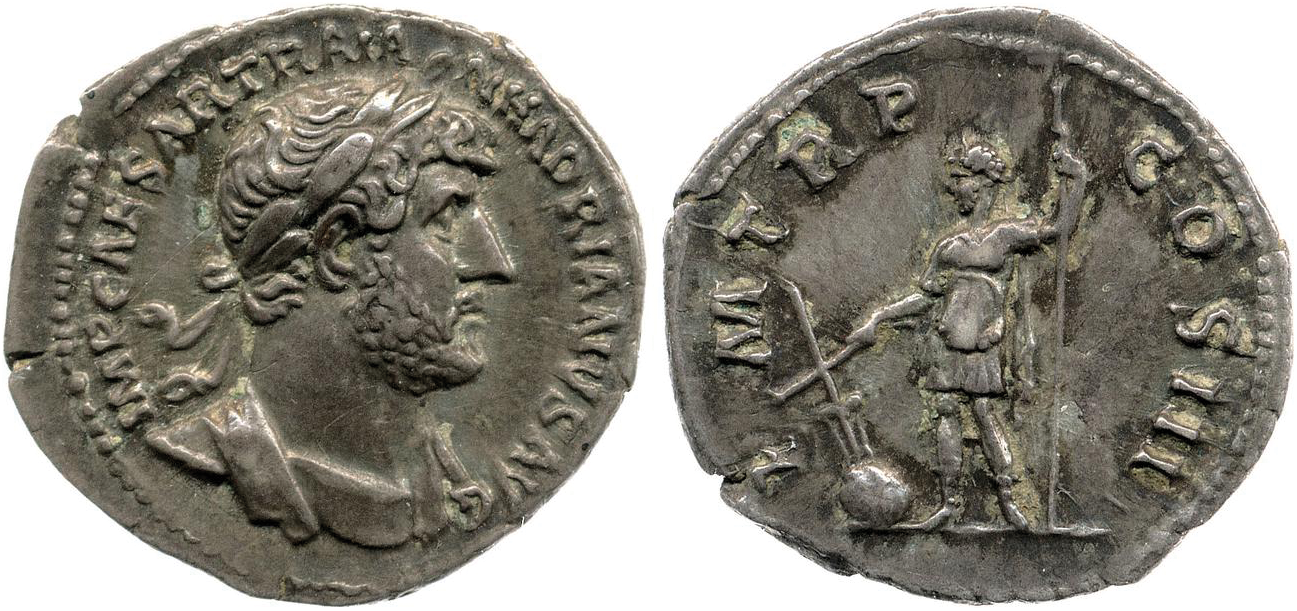
Apart from the EXPED(editio) AVG(usti) series, there are a few broadly contemporary issues with unusual imagery on the obverse. First there is ‘the unprecedented image of the Emperor himself, in military dress, syncretised with the attribute of Fortuna’s rudder …, leaving one to wonder whether it is intended to show Hadrian as the master of the state’s fortunes’ (fig. 2). One is reminded of Fronto’s metaphor of Antoninus Pius steering his military campaigns from Rome like a helmsman. In Abdy’s new seriation, ‘this type seems very late in the denarii of the period late 121–23’.Footnote 178More or less contemporary are various medallions showing Victory, Roma and Hercules sitting on weapons, the latter possibly referring to Hadrian’s stay in Spain. Abdy sees ‘a military background reflecting Hadrian’s achievements during his journey … probably referring to the conflict in Britannia or the motus Maurorum.’Footnote 179This calls for a closer examination.

Fig. 2. Denarius of Hadrian datable about midway through his first journey (121–25), the reverse showing the emperor in military attire holding a rudder on a globe (RIC II.3, no. 569, © American Numismatic Society).
Antony Birley saw the EXPED(editio) AVG(usti) series as covering ‘the visits to Britain, to Mauretania and to the eastern frontier’.Footnote 180A qualification is in place. The Historia Augusta mentions the motus Maurorum (‘the disturbance in Mauretania’) after Hadrian’s stay in Spain, but clearly in a general section (‘During this period and on many other occasions also’), where various events are bundled, in this case including the German palisade visited two years earlier.Footnote 181So the suppression of the motus Maurorum may well hark back to the earlier mentioned tumultum Mauretaniae at the start of Hadrian’s reign.Footnote 182The short campaign to Mauretania in 123 conjectured by Birley was firmly dismissed by both Halfmann and Syme, as the visit to Spain was clearly cut short by an emergency situation in the east which was dealt with by a conference on the Euphrates later in that year.Footnote 183This is not to deny that Hadrian may have had more than one security problem to deal with while in Spain.Footnote 184What may be noted, though, is that the coin issues discussed in this section, closely coupled as they are with others reflecting Spanish themes, may well have started before news of Parthian problems reached Hadrian.
The London fire, around 125
‘Soon after Hadrian’s visit to Britain in A.D. 122, London was overwhelmed by a catastrophic fire.’ Dominic Perring’s recent biography of Londinium handsomely brings together the scattered pointers to, potentially, one of the major events in the history of Roman Britain. ‘Taken collectively, the evidence indicates that little of London north of the Thames survived, leaving a smouldering wasteland over some 64.5 hectares.’Footnote 185The Walbrook had not worked as a fire-break and even Southwark, with its high-status building complex, may not have wholly escaped. In an accidental fire, ‘one would expect to find buildings upwind of the fire’s starting point that escaped destruction. This doesn’t appear to have been the case, and the comprehensive nature of destruction along areas of ribbon development leading into the city hints at deliberate action.’Footnote 186
The received date for the conflagration is c. a.d. 125, based primarily on the large warehouse assemblage of fire-damaged samian recovered at Regis House in 1929–31 and 1994–96.Footnote 187Fire debris at 1 Poultry produced a significant corpus of central Gaulish samian with a similar date range of c. 105–25.Footnote 188It is true that both contexts yielded one or two items with a conventional post-c. 125 date, but it is the statistical peak of the overlapping date ranges in 120–25 that must weigh strongest here, certainly in a situation where the sifting and moving of fire debris (with occasional admixture of fresh rubbish) appears to have gone on for several years.Footnote 189Perring makes a strong case for post-fire rebuilding of London’s waterfront being under way by 128, if not by the winter of 126–7.Footnote 190Reconstruction work was probably supported by the military and may have taken one or two years before it started in earnest, certainly in the case of heavy portuary infrastructure, as we now know for the aftermath of the Boudican revolt.Footnote 191
Other post-fire measures are also strikingly reminiscent of that earlier cycle of rebellion, reprisal and rebuilding. A fort was constructed, at Cripplegate this time, measuring some 4.7 ha internally and capable of housing an estimated 1,200 men.Footnote 192Perring rightly underlines the uniqueness of the arrangement, military personnel on the governor’s staff not normally being housed in forts.Footnote 193Part of the new military presence on the city’s north-west fringe, which appears to have included its own vicus, was a new road over the Walbrook valley constructed around 130.Footnote 194The road is crucial in contextualising the contemporary ‘spike in the volume of human remains scattered on the city borders’. Buried under the road was a surface scatter of semi-articulated body-parts that had apparently been ‘treated in a similar fashion to the disturbed Neronian bodies suggested to have been victims of retributive abuse after the Boudican revolt’.Footnote 195A series of unusual burials along the road shows an exceptional 4:1 male/female ratio and includes several cases of decapitation and red-hot chaining — ‘victims of military punishment and execution’.Footnote 196Finally, there are the hundreds of skulls found around the upper Walbrook valley over the years, often redeposited, most of the more recent discoveries coming from contexts datable c. 120–60, including the ditches of the new road. ‘Those that have been examined are disproportionately from young males, and some show evidence of violent treatment’.Footnote 197
Road repairs in the Rhine delta, winter 124–5
Serious trouble or raised military activity in Britain usually affected its continental lifelines. This had been the case in 43, when the Roman invasion had been prepared by three years of investment in the logistic and security infrastructure of the Rhine delta.Footnote 198The same ‘fortified transport corridor’ saw various modifications in 61–2, following the Boudican revolt which had ravaged the developing British province.Footnote 199The great expedition of Septimius Severus of 208–11 had been thoroughly prepared by investment in the military and portuary infrastructure of the Rhine delta in the three preceding years.Footnote 200Before launching his invasion of Britain in 296, Constantius Chlorus had felt the need to restore Rome’s hold on the Dutch river area.Footnote 201The scale that such continental investment could take is reflected in the canal that was commissioned (but eventually not constructed) between the Saône and the Moselle to support Nero’s renewed forward policy in Britain in 58.Footnote 202Against this background, the Hadrianic construction phase of the limes road in the Rhine delta calls for our attention. The felling dates of the timbers for a series of high-grade repairs uniformly fall between the autumn of 124 and the spring of 125.Footnote 203Dutch archaeologists have always struggled with the fact that the timbers for the road works supposedly connected with Hadrian’s passage through the Rhine delta should only have been felled more than two and a half years after the imperial visit in the spring of 122. In light of the foregoing a possible British connection cannot be ruled out.
Discussion
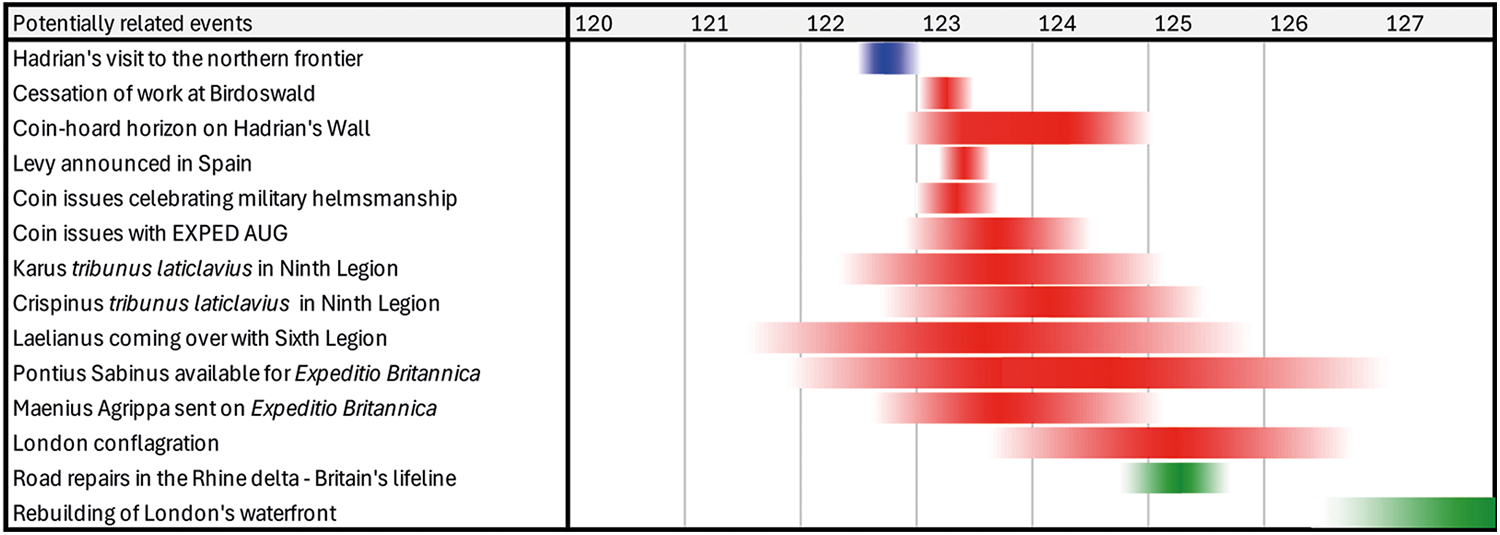
Although this paper is principally intended to explore the contours of a possibility, it is now time to discuss the potential joins between the ‘sherds’ that have been studied and approximately dated in the foregoing. The resulting date ranges are represented as ‘heat’ bars in fig. 3. The consistent post-122 point of gravity is obvious. One of the remaining challenges is to see how far the events may be connected and relate to Britain. The obvious starting point is: IX Hispana, certainly now that we know that the legion was probably still in existence when the Wall project came under steam, whether that was in 120, 121 or 122.

Fig. 3. Chart with the approximate date ranges for the events discussed in this paper represented by heat bars.
If Sixth was Ninth
‘Since the 1970s’, Hodgson has pointed out in his recent contribution, ‘the possibility that the Ninth was in Britain when it ceased to exist has disappeared so thoroughly from the educated public consciousness that many believe its departure from the island to be a matter of fact.’Footnote 204Let us return to the few anchor points we have. At least a detachment of the Ninth was stationed at Nijmegen for some time in the early second century.Footnote 205Several scholars have plausibly suggested that this was triggered by the departure of X Gemina from Nijmegen in c. 104.Footnote 206Those intent on writing the Ninth out of Britain usually assumed that the unit came over in full strength.Footnote 207However, the archaeology of the legionary fortress does not support the presence of a complete legion after c. 104.Footnote 208What is massively attested at Nijmegen in the early second century, by over a hundred tile stamps, is a VEX(illatio) BRIT(annica).Footnote 209The strong likelihood is that a detachment of IX Hispana, the British legion logistically closest to the Rhine delta, was part, and in charge, of that vexillatio.Footnote 210Crucially, though, whatever the size and expected duration of this mission, the Ninth was busy rebuilding its home base at York in stone in 107/8.Footnote 211The broad contemporaneity of similar work at Caerleon and Chester has been taken as an indication that Britain’s legionary disposition was considered definitive.Footnote 212The posting of a detachment of the Ninth at Nijmegen, certainly if this happened in the context of a vexillatio, had been a temporary arrangement from the outset, perhaps intended to finish a series of building projects that had been started by the Tenth.Footnote 213
Various occasions may be proposed for the subsequent withdrawal of the vexillatio Britannica and the detachment of the Ninth. Serious work on the Stanegate infrastructure, both road and installations, must have taken place in the decade and a half following c. 103/5.Footnote 214A detachment of the Ninth was active in the Carlisle area, probably somewhere in that period, perhaps preparing a branch base on the northern frontier.Footnote 215Evidence of this is a small scatter of tile stamps found at Carlisle, Stanwix and the works depot at Scalesceugh.Footnote 216It cannot be excluded that a vexillatio Britannica, whatever its remaining size and composition, was still based at Nijmegen by the death of Trajan. Possible weak spots in the British provincial garrison might help explain the troubles we hear about at the start of Hadrian’s reign. Whatever the state of deployment of IX Hispana in 117, if the crisis in Britain was serious enough to merit a victory issue two years later, any remaining British troops posted at Nijmegen would likely have been repatriated to help deal with the problems.Footnote 217
By c. 119, plans for the upcoming imperial journey were circulating, explaining the regional spike in road works in Gaul, Upper Germany and Britain in the following years. In the winter of 119–20 trees were felled for the palisade Hadrian was to inspect in Upper Germany. Around the same time, the emperor’s vision for the frontier in Britain will have been communicated, if it had not been part of the initial mandata for governor Falco (c. 118–22). Logistic preparation for a project like Hadrian’s Wall must have started well in advance. This would have covered the logistics of feeding a five-figure work force with all its animals, adequate infrastructure and harbourage, and such potential bottlenecks as transport vehicles, tools and scaffolding material.Footnote 218Even if one should prefer the received scenario, with the emperor launching actual construction only in 122, preparations must have been under way by c. 120.Footnote 219If any soldiers of IX Hispana remained in Nijmegen by the start of Hadrian’s reign, these would surely have been summoned up now, to help prepare for the upcoming megaproject, knowing how much legionary personnel was necessary even in normal times to keep the provincial administration and economy running.Footnote 220By 120/1, then, we can safely assume that all three British legions were preparing for, if they had not started building, their part in the Wall project. With IX Hispana still in existence in the early 120s, the normal course of events would have the ill-fated legion in the north, ready to take up its part in the megaproject.
On the Antonine Wall, the initial (?) 20 miles of the linear works were broken down into three work stints of 6,666 paces, with the legions deployed side by side, to fire up competition.Footnote 221The same practice is in evidence in miles 7–22 of Hadrian’s Wall. Here, minor constructional differences, often styled legionary ‘signatures’, form a series of three consistent five-mile blocks, generally believed to represent the first full season of work on the stone Wall.Footnote 222The centurial stones demonstrate that the legions II Augusta and XX Valeria Victrix were active in this sector, but which legion was the third? There is no evidence for involvement of the Sixth at this stage,Footnote 223so why cannot the third legion be IX Hispana? One might object that the building signatures seen in Wall miles 7–22 remained in use in the later stages of the Wall project, when we know the Sixth was involved. The truth is that, after the neat picture of Wall miles 7–22, we see a complete jumble.Footnote 224This is quite apart from it still being impossible to identify the three legionary signature sets.Footnote 225Moreover, the documented variants of milecastle gates suggest a measure of experimentation, not to mention the possible copying of designs that proved to work better than others. The same strand of evidence, interestingly, points to a takeover by a different unit in Wall miles 17–22.Footnote 226In sum, there is little evidence on the stone WallFootnote 227(and still less on the Turf WallFootnote 228 ) that rules out the possibility that IX Hispana was part of the initial workforce.
Potential couplings
With IX Hispana restored to its British base, it is now time to explore the possible relations between the events tabulated in fig. 3. The first potential coupling now suddenly has become straightforward: if the careers of Karus and Saturninus mean that the Ninth still existed in the early 120s, and Laelianus came over with the Sixth broadly around 124, simple economy prompts us to consider whether VI Victrix can have been shunted to Britain as a one-on-one replacement for IX Hispana. If so, and if the ensuing radio silence around the Ninth reflects a new reality, the legion may have been lost, or dishonourably disbanded, somewhere in the early days of the Wall project. The same date, around 123/4, surfaces as the approximate optimum for both known participants in the expeditio Britannica, all students agreeing that Agrippa’s and Sabinus’ career inscriptions, with their identical spelling errors, must relate to the same event. We have seen that the very term expeditio normally implies serious fighting, and this is supported by the legionary reinforcements from Upper Germany and Spain. The levy that roused the indignation of the Spanish communities in 123 is almost certainly connected. The same Spanish station of Hadrian’s journey saw a series of unusual coin issues celebrating his military helmsmanship, probably including that unprecedented image of the emperor in military attire with a rudder at his side as well as the first emissions of the EXPED(itio) AUG(usti) type.
The other potential couplings are equally straightforward. According to the revised Wall sequence, with the fort decision resulting from Hadrian’s visit and the whole Wall project thoroughly dislocated and rethought as a result, not much fort building is to be expected before the next work season. This would place the cessation of work at Birdoswald somewhere around the spring of 123, a date that is supported by the coin hoards. With similar sequences observed in the early stages of work on the gates of Birdoswald, Housesteads and milecastle 37, it is but a small step to propose a common trigger for the observed early abandonment of work at a handful of fort sites in the central and eastern sectors. Surely this must count as one of the greater surprises of recent research on Hadrian’s Wall, namely that work at so many fort sites apparently stopped shortly after a start had been made — barely a few months (in effective building time) after the emperor had ordered the forts, and probably the Vallum, to be built and, apparently, prioritised. Clearly, something major had intervened.Footnote 229The pause of work at Chesters, Housesteads, Great Chesters, Birdoswald, Burgh by Sands and Bownes-on-Solway lasted many years and must broadly coincide with the observed cessation of work on the Wall in the central sector generally.
Contours of a crisis
The year that surfaces from this whole exercise clearly is a.d. 123. The sequence at Birdoswald and the likely resonances in Spain point to the first half of the year, likely spring. The Spanish conventus is particularly interesting: the meeting had undoubtedly been planned in advance, but what had clearly not been communicated with the invitation was the levy that was announced during the meeting. It caused great resentment among the attendants, the communities of Italian settlers apparently being immune from this burden since Trajan.Footnote 230The strong impression gained is of an unusual step. If the levy was meant to replace the 1,000 legionaries destined for Britain, the implication is that this transfer was going to be permanent, likely to make up for losses incurred in Britain. There is an interesting further implication: the reinforcements brought in by the expeditio Britannica came from Upper Germany and Spain — not Lower Germany, the nearest available army pool. This could well mean that it had already been decided that Lower Germany would contribute the entirety of VI Victrix, possibly as a replacement for IX Hispana.Footnote 231All of this would add up to the conclusion that an undocumented trigger-event had taken place early in 123, half a year or so after Hadrian’s visit to Britain, with the emperor managing the crisis, and launching an expeditio, from Spain, and with a series of special coin issues emphasising his personal helmsmanship. Ten years later, a similar scenario unfolded with the Bar Kokhba revolt and the expeditio Iudaica.
It would seem that something very major had happened in Britain, quite possibly the disaster Fronto was referring to almost 40 years later. Even if the duration of the building hiatus on Hadrian’s Wall should only partly be due to it, a serious crisis is implied, potentially with a long tail.Footnote 232If related, the coin hoard horizon of the early 120s may give us an idea of the impact on the British province. It is difficult to resist the suspicion that the conflagration of London, too, may be related. It is true that pre-modern cities burn down easily, but the ubiquity of the fire deposit, including peripheral ribbon developments, the subsequent building of that unusual citadel at Cripplegate, and the apparent mass executions in the Wallbrook area all suggest a violent context. Should the road works in the Rhine delta follow the usual pattern of Britain’s continental lifelines being activated on the eve of action or in the wake of crisis, serious damage to the provincial economy is implied. If a Boudica-like scenario applies, with Britain’s main logistic hub destroyed and the Rhine corridor re-activated in response, this would narrow down the date of the London fire to 123 or 124.Footnote 233After the major discharge of July 122, the releasing of emeriti from the auxilia had resumed by mid-September 124, perhaps indicating that the greatest difficulties were over.Footnote 234
There is no way of telling the source of trouble. Many security crises had their origin within the Roman frontiers. Rebellions were easily mismanaged, so that some of them dragged on for several years.Footnote 235In the case of Hadrianic Britain, one might imagine a complex, phased scenario, with initial internal unrest drawing troops from the northern frontier and inviting hostility from beyond in a next stage. We can only speculate about causes and coalitions. If trouble broke out so shortly after the imperial visit of 122, one might suspect that it was one of the ‘many matters corrected’ by Hadrian that triggered revolt and, quite possibly, led to his famous bronze head being crudely hacked off an imperial statue and thrown into the Thames.Footnote 236Perring discusses possible evidence for raised taxation levels in the early Hadrianic period; more may soon have followed — perhaps singling out Britain’s capital for destruction.Footnote 237Others have pointed to the new iron curtain that henceforth was to divide the communities north and south of the lower British isthmus.Footnote 238Whereas the initial design, with a gateway every mile, may have been equivocal in terms of intention, the adapted plan, with a dozen forts aggressively projecting from the Wall and the Vallum soon sealing the isthmus, was explicit in its purpose. Perhaps more consequentially, the Wall project seriously disturbed the British security landscape as it had settled in the previous decades. Thousands of legionaries were going to be away in the north for years, to take part in the building or support it logistically. The fort decision would only add to the disruption, notably in Wales and north England, with c. 20 units and their dependent communities and suppliers uprooted in the wake of 122. One can think of several ways in which the announced withdrawal of so many garrisons might affect local loyalties, lingering resentments, hopes for continuation of army contracts, etc. It may well be that Hadrian and his Wall only brought havoc to Britain, initially.
Epilogue
Post-fire reconstruction in London was apparently under way by 128, if not by the winter of 126–27, surely including the new Cripplegate fort.Footnote 239If suspended completely, work on Hadrian’s Wall resumed within two or three years, sensibly concentrating on completion of the forts, and the linear works presumably, in the eastern sector and a series of milecastles in the central sector.Footnote 240The unusual duration of Nepos’ governorship may indicate that he had been retained in office to deal with the crisis and its immediate aftermath. Like several others, he later fell from Hadrian’s favour, conceivably for having mismanaged the situation in Britain.Footnote 241One thing is clear enough: a serious security crisis ravaging Britain in the wake of the imperial visit, possibly involving the loss of one of Rome’s legions, was not something to be broadly publicised. Understandably, a debacle like this would not have been given a large place in the autobiography Hadrian wrote towards the end of his life.Footnote 242What had happened in Britain after the imperial visit of 122 would remain one of the better kept secrets of the restless emperor’s rule. As a consequence, the events can now only be pieced together from disparate strands of circumstantial evidence. The resulting scenario is, of course, no more than a possibility.