


Introduction
Electrocution at power lines and support structures is a major cause of non-natural mortality in birds of prey (Lehman et al. Reference Lehman, Kennedy and Savidge2007). Several populations of raptors are known to be directly affected by electrocution as a result of unsustainably low adult and juvenile survival probabilities (Sergio et al. Reference Sergio, Marchesi and Penteriani2004, González et al. Reference González, Margalida, Manõsa, Sánchez, Oria, Molina, Caldera, Aranda and Prada2007, Jenkins et al. Reference Jenkins, Smallie and Diamond2010, Boshoff et al. Reference Boshoff, Minnie, Tambling and Michael2011, Guil et al. Reference Guil, Fernández-Olalla, Moreno-Opo, Mosqueda, Gómez, Aranda, Arredondo, Guzmán, Oria, González and Margalida2011, Perez-Garcia et al. Reference Perez-Garcia, Botella, Sanchez-Zapata and Moleon2011). Long-distance migratory raptors can suffer from various sources of non-natural mortality along their travel routes, and for many species more information is needed about the sources of mortality on migration.
The Egyptian vulture Neophron percnopterus is a small vulture that breeds in Africa, southern Europe, the Middle East, Central Asia and the Indian subcontinent, and is a long-distance migrant in the northern part of its range. Substantial population declines have been recorded in Europe, Africa and Asia (BirdLife International 2011). Mortality during migration and winter can have a large effect on population trends (Grande et al. Reference Grande, Serrano, Tavecchia, Carrete, Ceballos, Tella and Donázar2009), and understanding the causes of mortality outside the breeding season is crucial for the development of conservation plans.
Egyptian Vultures from Europe and a large part of Western Asia migrate to Africa and spend the winter in the Sahel zone and the Afar triangle (Meyburg et al. Reference Meyburg, Gallardo, Meyburg and Dimitrova2004, Cortes-Avizanda et al. Reference Cortés-Avizanda, Almaraz, Carrete, Sánchez-Zapata, Delgado, Hiraldo and Donázar2011, pers. obs.). Vulture populations in Africa and Europe have suffered from poisoning and direct persecution in the past decades (Thiollay Reference Thiollay2006a,Reference Thiollayb, Hernández and Margalida Reference Thiollay2009), but electrocution is another potentially significant source of non-natural mortality (Nikolaus Reference Nikolaus1984, Reference Nikolaus2006). The Egyptian Vulture is prone to electrocution due to its habit of perching on power lines in desert areas where no trees are available for roosting (Donázar et al. Reference Donázar, Palacios, Gangoso, Ceballos, González and Hiraldo2002, pers. obs.). Mortality events at power lines have been found to be common on the Canary Islands (Donázar et al. Reference Donázar, Palacios, Gangoso, Ceballos, González and Hiraldo2002). In Sudan, Nikolaus (Reference Nikolaus1984, Reference Nikolaus2006) recorded high mortality due to electrocution among migratory Egyptian Vultures at a migration stopover and wintering site (48 on 2 October 1982; 2 in March 1983; 5 in autumn 2005). Although the electrocution of Egyptian Vultures could be a serious problem in Africa (Nikolaus Reference Nikolaus1984, Reference Nikolaus2006), the lack of large-scale surveys hinders any assessment of how pervasive and persistent this problem is. Here we report on the continuing high mortality of Egyptian Vultures at this stopover site in Eastern Africa over the past three decades. We use this information to highlight that electrocution could potentially have population-level effects on Egyptian Vultures in the Western Palearctic.
Study area and Methods
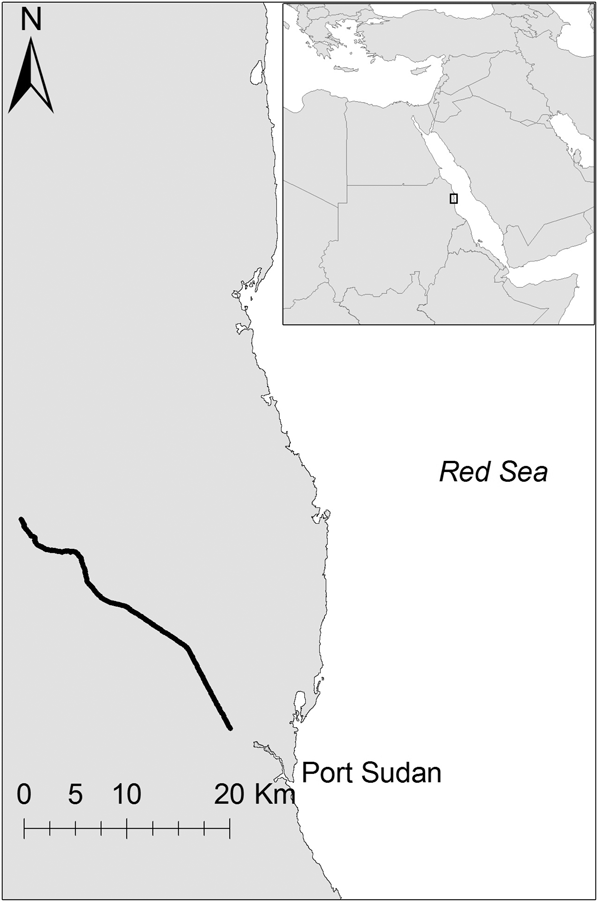
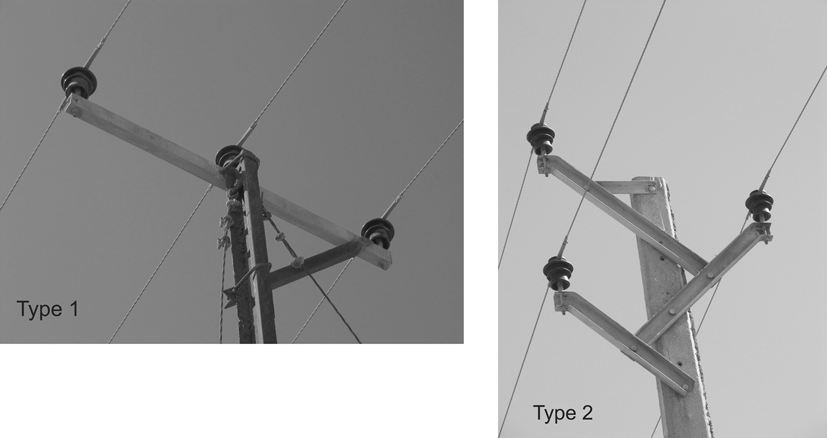
The work was conducted along a 31-km long power line connecting Port Sudan (19°36’N, 37°13’E) and a reservoir in the area of Khor Arba’At (19°50’N, 36°58’E) on the western Red Sea coast in Sudan (Figure 1). This power line has been in operation since the 1950s (data provided by Sudan Electricity Company), and consists of three overhead conductors supported by two types of poles (Figure 2): tubular and rail steel poles with a T-structure supporting the conductors above the horizontal cross-arm (type 1); and tubular concrete poles with three lateral steel cross-arms inclined at 45° and attached to the pole at different height on alternating sides (type 2). The distance between two poles is 100 m, both types support similar lengths of the power line, with type 2 poles irregularly interspersed between older type 1 poles.
Map detailing the route of the powerline
The two types of poles used in the powerline connecting Port Sudan and the reservoir in the area of Khor Arba’Attubular. Type 1 - rail steel poles with a T-structure supporting the conductors above the horizontal cross-arm; Type 2 - tubular concrete poles with three lateral steel cross-arms inclined at 45° and attached to the pole at different height on alternating sides.
The first surveys of this power line were conducted in 1982 and 1983 (Nikolaus Reference Nikolaus1984) and repeated in 2005 (Nikolaus Reference Nikolaus2006). We repeated these surveys on 30 September and 1 October 2010 to document whether the problem of electrocution persisted 28 years after the first survey. Based on the stage of decomposition, we determined the age since death of the carcasses found as: < 1 month old (complete birds), between 1 and 6 months (scattered parts and remains from birds) and > 6 months old (most of the remains naturally buried by sand). Because different pylon types vary in their electrocution risk to birds (Lehman et al. Reference Lehman, Kennedy and Savidge2007, Tintó et al. Reference Tintó, Real and Mañosa2010, Guil et al. Reference Guil, Fernández-Olalla, Moreno-Opo, Mosqueda, Gómez, Aranda, Arredondo, Guzmán, Oria, González and Margalida2011) we report our results separately for each type of pylon
Results
In September 2010, we found carcasses of 17 Egyptian Vultures under the 31-km segment of power line, or 0.055 dead birds per pylon. Among the dead birds were five adults, one in fourth year plumage, five in third year plumage, and three in second year/juvenile plumage. All carcasses were found under power poles; 15 (88%) were found under metal poles (type 1) and two (12%) under concrete poles (type 2). More than half of the carcasses were > 6 months old (n = 10; 59%), and only three carcasses (18%) were < 1 month old.
Discussion
Our recent survey highlights that mortality of Egyptian Vultures in Sudan has persisted for almost three decades despite early warnings that this power line could cause a large number of deaths, especially of migratory individuals (Nikolaus Reference Nikolaus1984). All the carcasses we found were underneath power poles, and electrocution was the most likely cause of death. The surveyed power line is a small sample of an aging grid of similar structures throughout East Africa. Hence, there is considerable potential for electrocution mortality of both adult and juvenile Egyptian Vultures during their non-breeding period in East Africa, affecting population dynamics of Egyptian Vultures (Grande et al. Reference Grande, Serrano, Tavecchia, Carrete, Ceballos, Tella and Donázar2009). As a result, it is possible that the persistent non-natural mortality caused by electrocution in East Africa may have contributed to population declines of this species.
Both a recent survey (Nikolaus Reference Nikolaus2006) and our survey found fewer Egyptian Vulture carcasses under the same power line than in the 1980s (Nikolaus Reference Nikolaus1984). These differences could potentially be caused by lower mortality risk, or by changes in the local scavenger community affecting the persistence of carcasses (Flint et al. Reference Flint, Lance, Sowl and Donnelly2010, Ponce et al. Reference Ponce, Alonso, Argandoña, García Fernández and Carrasco2010). Alternatively, the lower number of carcasses found in recent surveys may be a result of the reduction in the species population size.
Over the past 10 years the older metal pylons (type 1) were partly replaced with newer concrete pylons (type 2). We found fewer dead birds under concrete than under metal pylons, hence it is possible that mortality risk may have decreased. However, the power line is still supported by a large number of metal pylons, and we did not find a dead bird under each metal pylon as reported in 1983 (Nikolaus Reference Nikolaus1984). The replacement of metal by concrete pylons is therefore insufficient as sole explanation for the observed decline in the number of carcasses found. By contrast, large concentrations of Egyptian Vultures had been recorded near Port Sudan in the first half of the 20th century, with roosts of 200 birds on telegraph poles and “many more” roosting on the ground (Meinertzhagen Reference Meinertzhagen1954). To our knowledge, nobody has observed or reported such congregations at Port Sudan in the past two decades (Nikolaus Reference Nikolaus2006), indicating that far fewer birds are exposed to electrocution today than several decades ago. These anecdotal data sources cannot determine whether Egyptian Vultures may have changed their flyway and now use stopover sites outside the study area, or whether populations actually declined. However, the Egyptian Vultures at Port Sudan are attracted to large livestock farms, a slaughter house (about 350 animals slaughtered daily) and vast rubbish dumps, which offer an easily accessible abundance of food. We therefore believe that declining populations, as reported throughout the range of Egyptian Vultures (Baumgart Reference Baumgart1991, Khoury Reference Khoury2000; Kirwan et al. Reference Kirwan, Boyla, Castell, Demirci, Özen, Welch and Marlow2008, BirdLife International 2011) may be largely responsible for lower numbers of carcasses found during our survey.
The origin of the Egyptian Vultures migrating and wintering along the western coast of the Red Sea is unknown. However, recoveries of two birds ringed in Israel and the former USSR (Ash Reference Ash1981, Levy Reference Levy, Muntaner and Mayol1996) suggest that most of the autumn migrants roosting near Port Sudan may originate from populations in Israel, Syria, Turkey and Jordan rather than from European populations (Meyburg et al. Reference Meyburg, Gallardo, Meyburg and Dimitrova2004, Ceccolini et al. Reference Ceccolini, Cenerini and Aebischer2009). In this sense, large population declines have been recorded in these populations (Baumgart Reference Baumgart1991, Khoury Reference Khoury2000, Kirwan et al. Reference Kirwan, Boyla, Castell, Demirci, Özen, Welch and Marlow2008), with the best studied population being in Israel, where 500–1,000 pairs were estimated in the middle of the 20th century, declining to 133 pairs in 1986–1989 (Shirihai Reference Shirihai1996) and about 40 pairs in 2010 (O. Hatzofe in litt.). It is very likely that the power line near Port Sudan has caused the death of hundreds, perhaps thousands of Egyptian Vultures over the past 50 years. Although speculative, the magnitude of the mortality is fully consistent with observed population declines in potential source populations, and highlights that electrocution-caused mortality may potentially have population-level effects over a broad geographic scale (Boshoff et al. Reference Boshoff, Minnie, Tambling and Michael2011, Guil et al. Reference Guil, Fernández-Olalla, Moreno-Opo, Mosqueda, Gómez, Aranda, Arredondo, Guzmán, Oria, González and Margalida2011, Pérez-Garcia et al. Reference Perez-Garcia, Botella, Sanchez-Zapata and Moleon2011).
Given the ongoing increase in the electricity network throughout Sahelian Africa, the introduction of non-lethal installations and retro-fitting of existing structures are sorely needed to reduce electrocution mortality of vultures and other large raptors. Because temporary insulation materials erode over time and retro-fitted pylons may deteriorate to lethal structures in the future, the use of safer pylon designs should be given priority over temporary solutions (González et al. Reference González, Margalida, Manõsa, Sánchez, Oria, Molina, Caldera, Aranda and Prada2007, Guil et al. Reference Guil, Fernández-Olalla, Moreno-Opo, Mosqueda, Gómez, Aranda, Arredondo, Guzmán, Oria, González and Margalida2011).
Acknowledgements
Wildlife Administration in Sudan helped with logistics and communication with authorities and local communities. Funding was provided by the African Bird Club, Mohamed bin Zayed Species Conservation Fund, Vulture Conservation Foundation and the Royal Society for the Protection of Birds. We thank Dobromir Dobrev for designing the map. We appreciate the constructive comments of J. A. Donázar, A. Margalida, and an anonymous reviewer on a previous version of the manuscript.



