

INTRODUCTION
Sarsen is synonymous with Wiltshire. Although it occurs across other parts of southern England,Footnote 1 nowhere does it exist as plentifully as on the Marlborough Downs of north Wiltshire. Its abundance enabled it to be exploited extensively in the prehistoric monuments of the county either in an unaltered state, as at Avebury, or reaching its apotheosis in the structure involving complex stone working at Stonehenge. Sarsen working was not restricted to Stonehenge but also featured extensively throughout prehistory for smaller, more utilitarian purposes, including hammer stones, rubbing stones, quern stones and hearth stones.Footnote 2 Some of these divergent aspects to sarsen use required no surface modification, while others, with abrasive functions, undoubtedly benefitted from repeated surface dressing to maintain their effectiveness. Activity of a more unsystematic natureFootnote 3 may have been linked to acts of ritual destruction.Footnote 4
Despite this broad range of uses from the area, consideration of the working properties of the stone throughout prehistory has remained largely theoretical and focused on Stonehenge. Some of these sarsen related studies have benefitted from contributions funded by the Society of Antiquaries of London.Footnote 5 This small project has adopted a practical approach to sarsen working to provide some preliminary observations that may be relevant to future studies.
GEOLOGY
Sarsen is a hard silcrete formed by surface sand that is cemented in a silica matrix,Footnote 6 a component that accounts for more than ninety per cent of the fabric and enables some forms to be flaked in a similar way to flint. It has been classified into four silcrete fabric types: conglomeritic, matrix, floating and grain-supported.Footnote 7 Most of the sarsen boulders from the downs of north Wiltshire are probably of the grain-supported fabric type, which is sugary in texture leading it to be classified by archaeologists as saccharoidal.Footnote 8 These forms are relatively softer and break sub-conchoidally with varying degrees of consistency, according to variable silica content. It occurs as blocks up to 1m thick where sandy geological conditions existed for the formation of this variety of sarsen.Footnote 9 Sedimentary conditions across the central parts of Salisbury Plain differed and led to the creation of quartzitic varieties, which are proportionally harder and denser. These finer-grained varieties occur in the coombe bases and contain less well-defined characteristics of percussion; however, the differences in the two types can be poorly separated.
Howard recognised that some saccharoidal sarsen,Footnote 10 which formed the principal components of the Stonehenge monoliths,Footnote 11 crumbled easily, while other examples were less friable. She considered that quartzitic varieties were ‘virtually impossible to break’.Footnote 12 The coarse differential grain size and distribution within sarsen creates a dense stone that is challenging to work. It can be sawn using specially prepared diamond tipped blades, but its silicate structure fractures most effectively by passing shock waves through the material by direct or indirect percussion. Stone age communities, as with anyone familiar with flint working, were undoubtedly aware of the conchoidal flaking qualities of sarsen,Footnote 13 but also appreciated the limitations and techniques needed to work it.
SARSEN USE
Sarsen-working in Wiltshire can be traced from the Early Neolithic period. Smith reconstructed a process whereby blocks of stone were split and trimmed to create rectangular or circular querns at Windmill Hill.Footnote 14 Fracture may have been undertaken using a maul, similar to that weighing 3.56kg and made from a massive flake of saccharoidal sarsen, that was found in a pit at Barrow Clump, Netheravon.Footnote 15 Nine flakes with dressed surfaces, of which two refitted, from an Early Neolithic pit at BulfordFootnote 16 were probably derived from a quern or rubbing stone, objects that were frequently trimmed by flaking around the circumference.Footnote 17 The study of Late Neolithic material has frequently focused on collections from Stonehenge;Footnote 18 however, large flakes, including one weighing 790g, and debris have also been found from contemporary activity in the surrounding landscape at the Tor Stone, Bulford,Footnote 19 WoodhengeFootnote 20 and Durrington Walls.Footnote 21 Unsystematic flaking strategies are also represented by a sub-angular block of saccharoidal sarsen, weighing 15kg, that had been reduced by rudimentary flaking from a Late Neolithic posthole at MOD Durrington.Footnote 22 Sarsen remained a vital material for the production of quern stones throughout prehistory; large collections of Late Bronze Age manufacturing debris have been recorded from the Marlborough Downs, demonstrating continued output on an industrial scale into this period.Footnote 23 These utilitarian objects were made on large flakes, the modification of which also created numerous trimming flakes. Extensive exploitation of sarsen continued in this area for building blocks, gateposts and kerb stones through the nineteenth and twentieth centuries. This activity decimated large spreads of sarsen boulders, generating quantities of waste material.Footnote 24
Heat has also been associated with sarsen, most notably to facilitate breaking large saccharoidal blocks. However, like other silicates, this form of sarsen reacts badly when subjected to excessive heat, becoming sugary and unresponsive to controlled fracture.Footnote 25 Debris of this type frequently occurs on archaeological excavations,Footnote 26 where it can be difficult to attribute it to intentional stone working or use in domestic hearths. AubreyFootnote 27 and StukeleyFootnote 28 observed and described an apparently unsystematic quartering process of sarsen breaking involving thermal shock using fire pits at Avebury. This activity, which Aubrey indicated could be achieved ‘without any great trouble’,Footnote 29 was fuelled with straw and wood to envelop the stone with fire and break it by direct percussion. The description made no reference to how much this provided control over the fracture; indeed, Gillings et al,Footnote 30 commenting on a print of 1724,Footnote 31 provided a scenario depicting a dynamic process that offered little prospect of providing a controlled linear fracture. This view was supplemented by archaeological results indicating that the process produced large fragments that could be flaked for subsequent use in buildings,Footnote 32 but that heat control was indeed variable, with excessive temperature invariably also creating heavily burnt, sugary debris.
PROJECT BACKGROUND
Gowland, following excavations at Stonehenge,Footnote 33 proposed a tripartite model for working saccharoidal sarsen at the monument involving splitting, flaking and pecking. These phases were probably founded on theories drawn from ethnographic observations and descriptions by AubreyFootnote 34 and Stukeley,Footnote 35 with supplementary knowledge obtained from contemporary stone workers,Footnote 36 although Whitaker questioned the appropriateness of applying this approach to prehistoric methods.Footnote 37 Gowland regarded the primary stage, splitting, as ‘not a matter of great difficulty’ and proposed that this could be achieved by igniting strips of wood along a preplanned line and cooling the stone with water before using direct percussion.Footnote 38 Apparent confirmation of the splitting process has been revealed by laser scanning on three stones at Stonehenge;Footnote 39 the authors conceded that it was difficult to demonstrate that heat had been used to achieve this. The survey also noted traces of flaking, most notably a large scar on the outer surface of Stone 3 and other similar traces that were exposed during excavations around the base of Stone 30.Footnote 40
Gowland also gave consideration to the range of tools used to prepare each monolith. He recognised five classes of stone ‘implements’ from excavations at Stonehenge,Footnote 41 including those with traces of percussion, which he classified as hammers and mauls. Hammers were identified by traces of battering that were frequently extensive. Damage of this type can result from any routine percussive activity, including flint working, but was regarded in the context of Stonehenge as having been created in the construction of the monument. Hammers of flint were placed in Classes ii and iii, with those of sarsen into Class iv. Large sarsen mauls, which were up to 29kg in weight, were placed in Class v and were frequently formed from rounded quarzitic boulders that were obtained from gravel that is present in the coombes around Stonehenge. Gowland’s classification has been widely adopted,Footnote 42 although Whitaker, in a comprehensive study focusing on the way in which they might have been selected and worked, has questioned the complex division, preferring to classify them collectively as hammers.Footnote 43
The fundamental techniques to split and flake sarsen using direct percussion have remained largely untested in archaeological study despite current widespread interest in experimental archaeology. Embryonic attempts to dress sarsen were undertaken by Gowland, who commissioned Mr Stallybrass, a stone mason, to replicate peck dressing using a quartzite hammer stone.Footnote 44 The results matched those on stones at Stonehenge, although Gowland remained sceptical that flint could be used to dress anything but the softer sarsen and volcanic rocks at the monument. The process was subsequently repeated by a professional stone mason, who produced six cubic inches of sarsen dust in an hour using a stone maul.Footnote 45 Zaminski similarly used mauls weighing 4.5kg and 2.2kg to peck dress a flat sarsen surface covering approximately 0.09sq m in a day.Footnote 46
METHODOLOGY
Study of sarsen debris from Stonehenge was hampered until the late twentieth century by the lack of large, well documented assemblages. Montague noted that, apart from material collected by Pitts, the largest concentration of material was that collected by Gowland.Footnote 47 This situation has been improved by subsequent excavations at the monument,Footnote 48 which have produced large quantities of sarsen flaking debris with associated detailed specialist reports.Footnote 49 Informal discussions of these assemblages and the results led to consideration regarding hammer mode to produce sarsen flakes and mirror similar studies undertaken in flint technology.Footnote 50 The interest focused on whether sarsen flakes removed by a stone hammer, which might relate to monument construction at Stonehenge, differed from those detached using metal hammers during Romano-British and post medieval destruction. Debate extended to what processes or hammers might be employed to produce flakes of similar size to trimming flakes found on the site.
Hammers used in the initial parts of this study to consider these issues related to flaking. They comprised a sub-spherical cobble of Bunter quartz, weighing 454g, and a standard ball pein hammer, weighing 794g. A 7lb (3kg) sledgehammer was added subsequently as the project was widened to include sarsen splitting. These hammers, despite being predominantly of metal, were all of comparable weight to Gowland’s Class iv sarsen ‘hammer stones, more or less rounded’.Footnote 51
The final process, peck dressing, was replicated using five separate flint hammers and the Bunter quartzite cobble. These objects most closely approximate to Gowland’s Type iii and iv hammer stones, which are frequently characterised by battered, chamfered edges. The flint examples were produced using bifacial/alternate flaking to create a ‘chopper core’ type tool with an irregular, acute edge that was sufficient to degrade or peck the sarsen. These hammers were used to peck the surface of the saccharoidal sarsen block by hand for periods lasting fifteen minutes. Debris from the process, comprising flint and sarsen flakes with miscellaneous micro-debitage, was collected and sieved through 9.5mm, 4.0mm, 2.0mm and 1.0mm mesh at the conclusion of each stage.
In use, the hand-held stone hammers proved to be the least attractive options for both flaking and peck dressing. These tools were both tiring and jarring to use for anything other than simple trimming. The sledgehammer was swung in a forceful but controlled manner to maintain a precise point of impact. The addition of a handle inevitably increased the inertia upon impact, possibly raising it to something approximating to Gowland’s larger mauls. Indeed Gowland speculated that some of these cumbersome pieces may have required teams of workers to swing and maximise their accuracy and effectiveness.Footnote 52 It is possible that some of the smaller hammers were also fitted with a handle to improve their efficiency.
Heating the sarsen as part of the production process has similarly received limited attention in practice to consider whether its application may be beneficial or detrimental.Footnote 53 Application of heat, up to 400 degrees C, has been shown to improve the working properties of some silicates by releasing water from the stone and reordering the crystalline structure, producing a glassy surface texture on unpatinated knapped flint.Footnote 54 Higher temperatures impair the internal structure of flint, rendering it unworkable and creating grey, heavily crazed material that is instantly recognised as ‘burnt flint’. Sarsen similarly becomes sugary when heat is excessive.
This small project confined its study to peck dressing to identify whether efficiency might be improved when the stone was heated. A small bag of lumpwood (hard wood) barbeque charcoal, weighing 1.25kg, was fired directly on top of the sarsen block and allowed to burn for approximately two hours before the sarsen was exposed, allowed to cool naturally and pecked with a flint hammer. The exercise was repeated using two similar sized bags of charcoal. No attempt was made to record temperatures accurately; however, two flint flakes and two of sarsen were inserted as ‘controls’ to evaluate the extent to which the stone was burnt and visually assess temperature levels.
The entire project was undertaken using an unprovenanced boulder of saccharoidal sarsen with a plano-convex cross section, weighing 54kg and measuring 0.37m long, 0.32m wide and 0.2m thick. One end was snapped with two negative flake scars, 0.14m and 0.18m long, but the block was otherwise unworked.
RESULTS
The results presented here follow Gowland’s tripartite model reflecting technological order: splitting, flaking and peck dressing.Footnote 55
Splitting
This process formed the principal component for Gowland’s reconstruction of monolith formation at Stonehenge. The fracture mechanics were not described in detail but were based on methods for working sarsen in the nineteenth and twentieth centuries when the tool kit comprised wedges and hammers of varying sizes,Footnote 56 techniques that followed traditional patterns of stone working.Footnote 57 Former sarsen extraction sites in Buckinghamshire and Wiltshire contain industrial waste,Footnote 58 which shows clearly that the process involved chiselling out a row of sockets into which iron wedges were inserted. These were used individually or with sleeves, the wedge and feather technique, to split the stone using indirect percussion. Improved control over the fracture may be made by carving a guideline, tracing a line or by placing a support beneath the stone.Footnote 59 This technique, known as point loading, provides a linear pivot against which to snap the stone by blows delivered from above. Adaptations of these traditional techniques may have been used by prehistoric communities who relied on direct percussion, employing a tool kit comprising hammers of varying sizes.
The realisation of how direct percussion might be used to split the sarsen, in the sense of cleaving as distinct from flaking, arose during the production of flakes using a ball pein hammer. These removals were frequently detached by delivering a single blow; however, in more than one case repeated blows to the same impact point were required before a flake was eventually detached. The process was repeated using a hand-held stone hammer, when blows delivered to a single impact location produced a flake that was larger than other removals created using the same stone hammer.
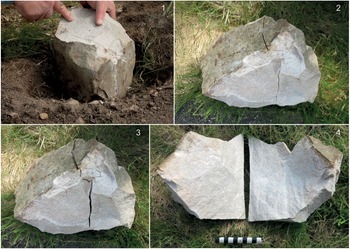
This unexpected observation was confirmed on a larger scale using a sledgehammer (fig 1.1) and was replicated successfully to confirm the process (fig 1.2–4). In each case, repeated strikes to the same point of percussion widened an incipient fracture that had formed in the stone, effectively using the proximal end of the partially detached block as a punch to split the stone. It demonstrated a previously unappreciated progressive development of the fracture line in the sarsen in contrast to the spontaneous response that is more familiar in flint.
Splitting sarsen: 1) incipient fracture in the sarsen block after one blow using a sledge hammer; 2) a subsequent fracture created by one blow; 3) crack opened by a repeat blow; 4) the split block. Photographs: author.

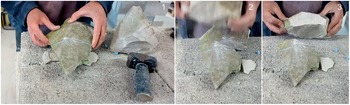
Point loading: 1) showing block resting on sarsen supports; 2) the blow delivered; 3) the resulting squared fracture. Photographs: author.

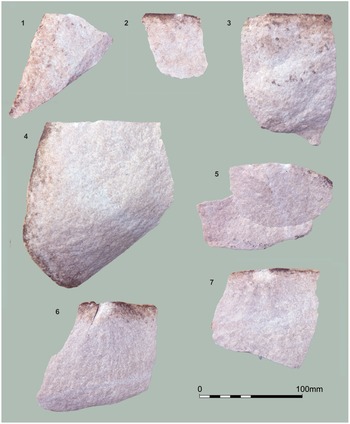
Flake removals showing mode characteristics: 1–2) quartzite hammer; 3–5) ball pein hammer; 6–7) sledge hammer. Photographs: author.

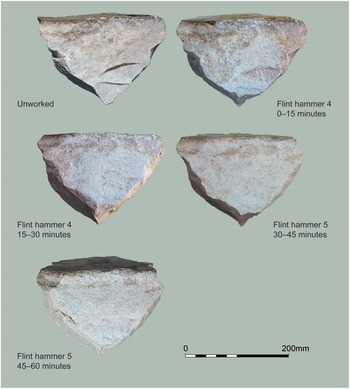
Changes to the visual appearance to the surface of the sarsen block by peck dressing using flint hammers 4 and 5 over periods of fifteen minutes. Photographs: author.

The results produced by this simple repeated demonstration focused attention on the conchoidal properties of the stone and the way in which these attributes might be employed to use direct percussion to split sarsen in a more controlled fashion. Subsequent adaptations successfully divided a small fragment of sarsen to create an angular block using point loading by resting the stone on a row of sarsen boulders to provide a pivot point (fig 2). This modification mirrors the use of an anvil (sur enclume) in flint working, a technique that was known to Palaeolithic knappersFootnote 60 and modern gun flint knappers,Footnote 61 although its use through the Neolithic period is less certain.Footnote 62 The process produced little or no diagnostic waste products and required limited secondary trimming. Further improvement within the available Neolithic technology may theoretically have resulted by pecking a groove, ‘tracing a line’, to weaken the stone along a predetermined fracture line.
Flaking
The direct percussion process inevitably produced quantities of debris including waste flakes.Footnote 63 However, these removals are often technologically undiagnostic and, apart from impact removals from hammer stones, may relate to construction or subsequent destruction of monoliths at Stonehenge.
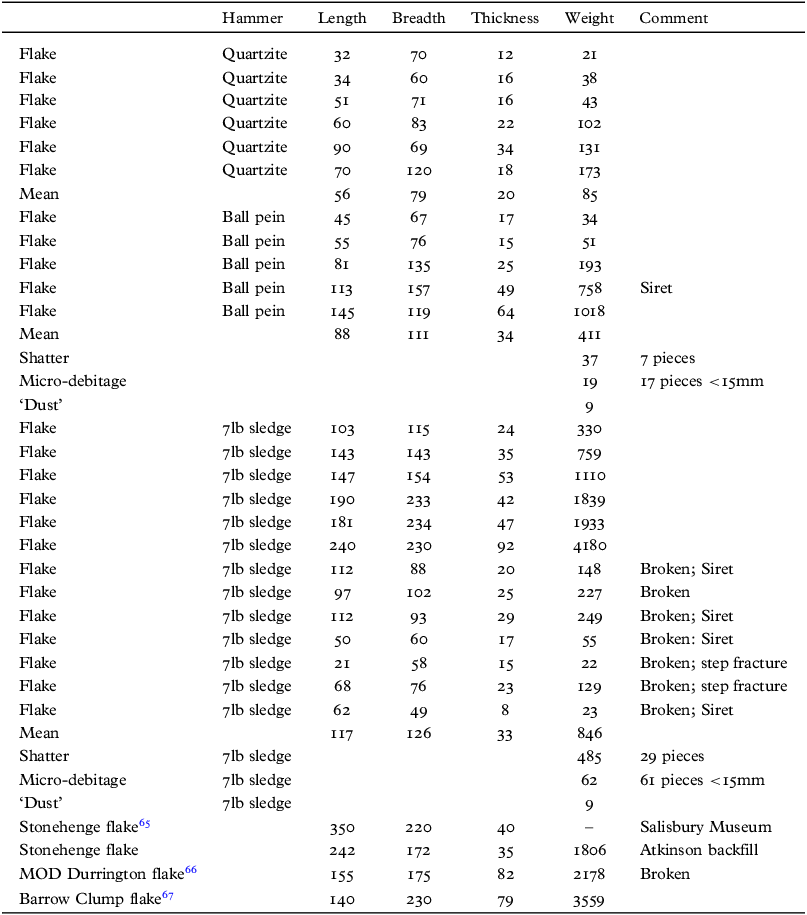
Previous studies have failed to note characteristics of hammer mode or consider to what extent flaking could be undertaken in a controlled systematic way to create large blanks for other purposes, including quern stones. Table 1 catalogues hammers used and dimensions of flakes that were removed in this project with supplementary details of the largest flakes from Stonehenge, MOD Durrington and Barrow Clump. ‘Shatter’ comprises miscellaneous fragments that formed around the point of percussion that retained distinct flake-like characteristics. Micro-debitage was assessed as material measuring less than 15mm long.
Flake removals shown by hammer, length (mm), breadth (mm), thickness (mm) and weight (g) with relevant comment.

Twenty-five flakes were generated using the three different hammers. All flakes were characterised by relatively broad plain butts where the point of impact was securely seated behind the edge of the striking platform. Bulbs of percussion were generally diffuse, as noted by Gillings et al, Footnote 64 with cones of percussion predominantly absent and conchoidal rings indistinct, which collectively provided no identifiable differences between stone or metal hammers (fig 3). These undifferentiated characteristics may also be attributed to the coarse-grained texture of the stone. Five flakes were broken by Siret fractures, an accidental breakage that is more prevalent in worked flint industries with the use of hard hammers. Flake production could be maintained, provided the angle of percussion, as in flint, remained acute. A number of flakes terminated with hinge or snapped distal ends, terminations that became more prevalent when the angle of percussion at the edge of the block increased.
Flake dimensions show that only four flakes measured less than 50mm long, figures that are comparable with saccharoidal sarsen flakes from Trench 44 at Stonehenge.Footnote 68 Flake size resulting from the use of each hammer shows some overlapping of dimensions between removals produced by individual percussors; however, a heavier hammer, especially when connected to a handle, not surprisingly created larger flakes than a small hand stone hammer. The removal of a flake with dimensions approaching the largest recorded examples from Stonehenge, using only a 7lb (3kg) sledgehammer, suggests that mauls of Gowland’s Class v, weighing up to 29kg, were undoubtedly capable of removing flakes of similar size. The rarity of such large flakes at the site may endorse the idea that mauls of extreme weight functioned primarily for splitting and were not intended as flaking hammers.
The most distinctive flakes were those with traces of percussion at the proximal end of the dorsal surface that were detached from the base of the flint hammers during peck dressing. These pieces were extracted from sieved debris and included ninety-four examples in the 9.5mm residues, of which forty-four were heavily fractured. Unbroken flakes were consistently less than 30mm in length and breadth and 6mm thick, measurements that replicate flake size dimensions for flint and quartzitic sarsenFootnote 69 removals from hammer stones at Stonehenge. Butts on these flakes were consistently crushed, broken or linear, which resulted from the point of percussion on the hammer having been initiated by a glancing blow against the sarsen and not seated intentionally on the striking platform as might result from controlled flaking.
Pecking
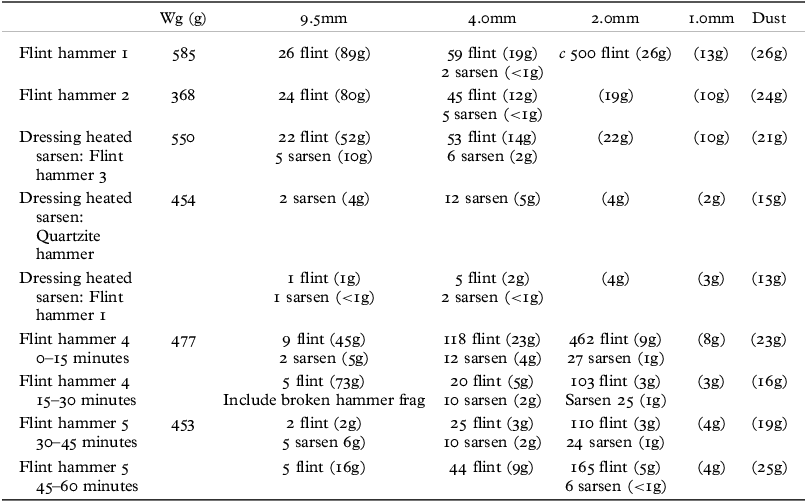
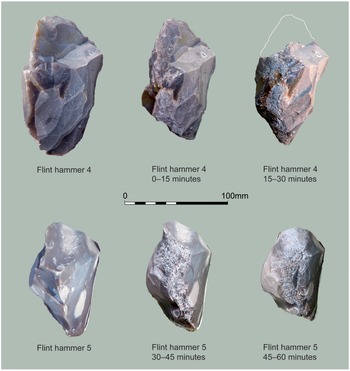
The flint hammers used in this activity showed a rapid rate of attrition that probably necessitated regular replacement, as indicated by the relatively large numbers recovered from excavations at Stonehenge.Footnote 70 The individual episodes of pecking produced variable quantities of debris (table 2) that were influenced by factors including the structure of the hammer or area of working on the stone. Hammer 1 retained a relatively sharp edge after fifteen minutes work; however, hammer 2 became severely flattened with an apparent corresponding loss of efficiency.
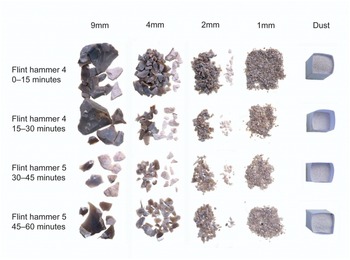
Sarsen peck dressing by hammer and process listing flint and sarsen flakes with miscellaneous micro-debitage by weight, and sieved mesh residues. Debris from flint hammers 4 and 5 is shown in fig 4 and the resulting surface in fig 5.

No perceptible positive or negative alterations were detected in the working properties of the stone when the material was heated using of a single bag of charcoal. The surface of the sarsen block was reddened by the heat but produced no other visible changes. The flint flakes inserted as controls when two bags of charcoal were used became crazed, indicating that the temperature had apparently exceeded 400 degrees C. One of the sarsen flakes could be snapped relatively easily, confirming modification to the matrix at this temperature. Apart from these clear changes to the structure of the flakes, heat penetration within the internal fabric of the block appeared to be insignificant, as demonstrated by quantities of ‘dust’ that showed slight reductions when the surface was processed using an unmodified quartzite pebble and flint hammers 3 and 1 (table 2).
Hammers 4 and 5 were both used twice for periods of fifteen minutes. These episodes made it possible to note how the pecked surface of the block changed visually in an hour (fig 4), variations in the debris produced (fig 5) and changes to the hammers (fig 6). Observations could be made at the end of each stage that highlighted the progress in this laborious process using similar hammers to those found at Stonehenge. Attrition of arêtes in the initial fifteen minutes was relatively rapid but slowed as the surface areas to be worked across the block increased.
Variations in residues by sieve mesh size and time using flint hammers 4 and 5 to peck dress one surface of the block in a period lasting sixty minutes. The blue boxes represent 1cu inch (16.38cu cm). Photograph: author.

Flint hammers 4 and 5 used for peck dressing. Images show condition as made with subsequent changes in edge damage resulting from use for periods of fifteen minutes. Photographs: author.

Removals from the flint hammers used in this activity (fig 5) produced individual idiosyncrasies in the composition of the debris. Sarsen flakes over 10mm long also increased when pecking was undertaken near the edge of the block, as in hammer 5 after thirty to forty-five minutes. Removals from the flint hammers were easily distinguishable by colour and texture in 9mm, 4mm and 2mm residues from those of sarsen. Sandy, white ‘dust’, which colour indicates is composed largely of crushed sarsen, represented the most diagnostic confirmation of stone dressing by pecking. This component passed through the finest mesh size, rendering it archaeologically irrecoverable and unrepresented in excavated residues. It was produced in more consistent quantities, averaging 20g in each fifteen-minute phase, totals that equate to approximately 16.38cu cm, slightly lower than the 1.5cu inch obtained by Stone.Footnote 71 Hammers with an acute edge angle were especially prone to shatter, creating more flakes or broken fragments, when they were freshly used, as seen in the initial use of hammer 4. This hammer subsequently broke during the second period of use, reducing its efficiency (fig 6), and rapidly acquired a more rounded, battered surface that is characteristic of hammers from the site.
DISCUSSION
This small project was initiated to investigate hammer mode characteristics of both stone and metal hammers in sarsen working. The scheme widened to observe the broad working qualities of sarsen from a practical point of view, noting associated challenges and limitations and studying the effects of heating the stone. The principal achievement has been to consider the mechanics of direct percussion involved in this stone. These properties have rarely been observed or replicated in studies of prehistoric sarsen working to support any discussion on the subject despite forming proposed stages of monolith manufacture at Stonehenge.
The theories surrounding sarsen working have largely drawn on models conceived by Gowland,Footnote 72 which have remained virtually unchallenged. Using his training as an engineer and observer of Japanese stone workers, he proposed that monoliths might have been manufactured by percussion using massive mauls. When these were used in sequence, he suggested that the technique could be used to split large, naturally tabular blocks along a preconceived fracture line. This ‘sledgehammering’Footnote 73 process could be improved by the prior use of fire to heat the stone. It is unclear to what extent his experiences extended to a clear understanding of the flaking properties of silicates as a geologist or engineer or whether he was aware of them in practice as a craft worker with supplementary personal knowledge derived from the local sarsen industry.
Gowland’s model was endorsed by Atkinson,Footnote 74 who, invoking techniques employed by sarsen workers and related quarrying industries, suggested that wedges might be used, replacing metal examples with wooden ones. This tenuous suggestion relied on conveniently located natural cracks in the sarsen to be successful. Its use remains entirely speculative, untested or confirmed in practice, and largely inappropriate for prehistoric sarsen shaping at Stonehenge.Footnote 75
The results presented here have indicated that direct percussion does provide a plausible technique for working this silicate using techniques and materials available to prehistoric communities. In the process it has confirmed that sarsen remains fiendishly difficult to work, especially where controlled reduction strategies are intended. Many boulders that were selected for the construction of Stonehenge from the proposed source at West WoodsFootnote 76 may well have included rounded or sub-rounded surfaces in their natural state, making them poorly suited for preliminary flaking and thereby increasing the value of splitting. This process utilises the conchoidal properties of a durable silicate that responds to shock waves. The attribute can be ably demonstrated at Stonehenge by Stone 55, part of the central trilithon, which toppled over and ‘broke its back’ when it fell, a process that may have been increased by impact against the recumbent Altar Stone. Neolithic communities would unquestionably have been familiar with these conchoidal properties through the manufacture of flint tools, although they may have developed specialist stone workers with specific skills to undertake the task when working sarsen.
The practical experience afforded by the project has made it possible to witness the development of cracks from shock waves created by repeated, accurate blows. These fractures can be enlarged by further impact or by inserting wooden wedges, as proposed by Atkinson. It is possible that the coarse, granular structure of saccharoidal sarsen helps the progressive fracture process by creating an element of elasticity in the stone. This attribute may help reduce flexion breakage or shatter, as may occur in brittle, microcrystalline flint especially around the point of impact. The observed results add detail to Gowland’s ‘sledgehammering’ technique.Footnote 77 The repeated demonstration that a block of saccharoidal sarsen, approximately 0.2m thick, can be split in this way, using a 7lb (3kg) sledgehammer, suggests that the technique may be scaled up and applied effectively to fracture blocks approaching 1m thick, as represented by the Stonehenge monoliths, and using mauls averaging 20kg in weight. Gowland recognised that persistent use of these giant mauls would have benefitted from some form of developed handle,Footnote 78 or elementary drop hammer using a tripod or A frame to maximise the efficiency and use of such heavy weights. The increased impact imparted by dropping a heavy spherical object made from dense quarzitic sarsen from height, and the resulting concentrated force to a focal point of aim, may have enhanced the successful fracture of the stone. Efficiency might also have been improved by dropping several weights repeatedly from a given height along a predetermined line of impact points. The effective use of these fundamental principles of conchoidal fracture may have been further improved by point loading or tracing a line to create relatively angular blocks.
The sub-conchoidal properties of the sarsen also allowed flake production by following basic technological principles adopted from flint working. Maintaining an operational flaking angle of percussion formed a vitally important consideration, especially when attempting to develop a systematic reduction strategy. Understandably, the weight of the sarsen made it impossible to rotate this relatively small block with ease to modify and control the flaking angle as it is when flaking a relatively small hand-held flint nodule or core. An inevitable increase in the angle of percussion at the edge of the stone limited or eliminated the potential for further flake removals and, as with flint, often resulted in the sarsen shattering at the point of impact or terminating in a step fracture. The trial piece invariably developed into a block with multiple striking platforms, using a rotating core reduction strategy, similar to that excavated at MOD Durrington.Footnote 79
The proposition that flaking may have been a significant part of monolith shaping can be questioned. To be effective, it would have required the creation of a removal of sufficient length to cross the mid line to thin and shape the stone. This principle forms a crucial function in the production of flint and stone axes, implements with a lenticular cross section.Footnote 80 The process of removing flakes with comparable attributes becomes more problematic if percussion is envisaged to shape a large block of coarse-grained raw material with a rectangular cross section of comparable size to the monoliths at Stonehenge. Significantly, none of the recorded flakes from Stonehenge or from this flaking exercise were of sufficient length to have crossed the mid line of even the thinnest part, the width, of monoliths at Stonehenge. These technological limitations indicate that, although individual flakes of comparable dimensions to the largest examples found at Stonehenge and Barrow Clump have been found, flaking was unsuited for thinning or shaping monoliths as applies in the manufacture of bifacial core tools. It suggests that the role of flaking in monolith production may have been restricted to one of supplementary trimming and dressing of split blocks.
Despite the relative ease with which flakes could be produced from a single block of sarsen when the basic principles of knapping were followed, removals remain relatively rare at Stonehenge. Chan and Richards recorded only 693 sarsen flakes over 50mm long from the stone working area in Trench 44,Footnote 81 of which 538 (78 per cent) were of quartzitic sarsen and probably derived from hammer stones. Small numbers of sarsen flakes, which were rarely more than 20mm long, have also been noted from the Stonehenge layer inside the monument,Footnote 82 where only twelve per cent of the assemblage comprised flakes that may have resulted from the removal of minor overhang at the edge of a split sarsen block. Atkinson considered that the shortfall of flakes at the monument endorsed the idea that stones were shaped and dressed at the extraction site.Footnote 83 Alternatively, flaking may have formed a relatively insignificant part of monolith manufacture. Deep remnant flake scars of the type that could not be obliterated by extensive stone dressing are relatively rare on monoliths at Stonehenge, although they frequently survive on polished flint and stone axes as areas that resisted grinding and polishing.
The laborious task of pecking is likely to have formed a familiar task from its use to dress quern stones. The process may also have borrowed from techniques used in many Neolithic stone axe factories, where raw material with no conchoidal properties was pecked into shape. The process influenced not only the construction of Stonehenge but also the final appearance of the monument as one characterised by the unoxidised light grey of freshly worked sarsen. Replication, using flint hammers similar to those from the monument, has produced comparable surface finishes and quantities of dust to those produced by Gowland and Stone,Footnote 84 challenging the former’s assertion that flint hammers were unsuited for stone dressing. Mauls, possibly linked to some form of mechanical device, may also have provided improved efficiency.
The final issue involved considering to what extent heat may alter the surface composition of the stone and make peck dressing more efficient. Studies have indicated that controlled heat can help improve the working qualities of flint.Footnote 85 However, projects that have isolated individual chemical, crystallographic and water-related properties,Footnote 86 knapping force,Footnote 87 and chronological,Footnote 88 geographicalFootnote 89 and experimentalFootnote 90 variables have recognised that not all modifications resulting from heat to the silicate structure are beneficial. These experimental studies have primarily focused on tool manufacture where heat can be transferred evenly through the internal structure of relatively small masses. Reproducing the process with large saccharoidal sarsen boulders, as advocated by Gowland and Atkinson,Footnote 91 is unachievable where differential degrees of heating are likely to arise between the surface exterior of the block through to the inner core of the stone, producing mixed results when the material is worked. Willies confirmed that,Footnote 92 when breaking a boulder of saccharoidal sarsen using this technique, temperatures varied dramatically between 750 degrees and 800 degrees C, yet some areas, away from the flames, reached only 150 degrees C. This published source apart, Gillings et al,Footnote 93 in detailed analysis of eighteenth-century stone breaking debris, noted the lack of comparable data or observations on appearance, structure or penetration by which to assess the results produced by heat on the workability of the stone when classifying heat-treated sarsen. They adopted a five-fold subdivision of debris types when analysing a collection from excavated fire pits related to sarsen breaking at Avebury:Footnote 94 spalls, defined as thermal pot-lids created on the outer surface of the stone where the heat was greatest, crested pieces and flakes that resulted from mechanical fracture, with lumps and miscellaneous debris. They were unable to identify any visible changes to the structure of the stone, apart from noting reddening of the surface or smoke blackening at presumed lower temperatures with unworkable, sugary, angular material resulting where the stone had been exposed to excessive heat.
This body of data provides no clear support to show that the application of heat produces clear benefits to improve the working qualities of the stone. The evidence is endorsed by the lack of any evidence for the general use of heat to modify silicates in British prehistory. Flint, which formed the primary raw material for prehistoric tool manufacture, is sufficiently even textured to work well without heat treatment, and this may also have applied to sarsen. Boulders were also routinely broken using direct and indirect percussion by nineteenth- and twentieth-century stone workers,Footnote 95 who split the stone without recourse to heat.
CONCLUSIONS
This small project was undertaken primarily by someone who is more familiar with flint technology than sarsen working, but expanded to consult practising stone workers, geologists, academics and engineers. The multi-disciplinary approach has attempted to demystify sarsen and reawaken understanding and appreciation of the potential provided by direct percussion to split and shape this notoriously intractable coarse-grained silicate successfully and repeatedly without using wedges. The hardness of sarsen creates a unique set of challenges. Using the limited tool kit available to Neolithic communities, the project has drawn on the sledgehammering technique as theorised by Gowland, but who offered nothing to explain how it might have worked in practice to split sarsen. The brief discussion, using only a single block of saccharoidal stone, has suggested control may have been improved using techniques common to modern stone masons.
Flaking appears to offer no benefits to the primary shaping of the stone. There is similarly nothing to indicate that heating may have been used to control its fracture. The laborious nature of peck dressing remains unquestionable, but produced comparable results to previous attempts using similar methods to replicate the process. These conclusions in no way claim to have comprehensively resolved the complex technological challenges linked to this stone or explain how it was done. They hope to document some fundamental thoughts on previously unexamined fracture mechanics of sarsen that may be of interest to future workers who choose to pursue the process in more controlled experiments. They will unquestionably acquire admiration for the skill and persistence of the prehistoric workers in the process.
ACKNOWLEDGEMENTS
This work would not have been possible without the encouragement and support of numerous individuals most notably the late Tim Darvill, FSA, Geoff Wainwright, FSA, Alistair Barclay, FSA, and Josh Pollard, FSA, who all encouraged me to persist when the project stalled. Katy Whitaker, FSA, and David Nash provided useful comments on the draft text, while Bob Baker approached the issue as an engineer, with Henry Gray, Tam Gray and Sam MacArthur offering significant contributions as practical stone workers. Rob Goller, Wessex Archaeology, prepared the figures. Final thanks must be extended to the two anonymous referees for their constructive comments to make this submission more complete.

 Open access

