


Voluntary engagement, when defined as nonremunerated work in the so-called third sector (e.g., non-profit organisations and social services; Zimmer & Priller, Reference Zimmer, Priller, Birkhölzer, Klein, Priller and Zimmer2005), is essential for the functioning of democratic societies. At the level of the individual citizen, voluntary engagement allows to build and extend social networks, to maintain and increase social status (Erlinghagen & Hank, Reference Erlinghagen, Hank, Hank, Schulz-Nieswandt, Wagner and Zank2019; Hank & Erlinghagen, Reference Hank, Erlinghagen, Harper and Hamblin2014; Putnam et al., Reference Putnam, Leonardi and Nanetti1994), and to stand up for one’s interests in the political arena (Dalton, Reference Dalton2020; Erlinghagen, Reference Erlinghagen2003; Erlinghagen & Wagner, Reference Erlinghagen and Wagner2002). At the macro-level of societies, citizens’ volunteering can complement state institutions (Erlinghagen, Reference Erlinghagen2002) by closing supply shortfalls (e.g., in education or social welfare, Bartels et al., Reference Bartels, Cozzi and Mantovan2013; Stadelmann-Steffen, Reference Stadelmann-Steffen2011; Tõnurist & Surva, Reference Tõnurist and Surva2017) and by providing a political sphere outside the institutionalised political process (Zimmer & Priller, Reference Zimmer, Priller, Birkhölzer, Klein, Priller and Zimmer2005). As a result, an active third sector and with it a vibrant civil society has been considered a key element of democracies (Chan et al., Reference Chan, To and Chan2006; Putnam, Reference Putnam, Crothers and Lockhart2000; Schiefer & van der Noll, Reference Schiefer and van der Noll2017).
Over the last decades, scholars have documented substantial dynamics in voluntary engagement in various countries. For instance, in (West-)Germany, volunteering in formal organisations has been increasing since the mid-1980s (Burkhardt & Schupp, Reference Burkhardt and Schupp2019). In the USA, volunteering reached its peak after the terrorist attacks on the World Trade Centre and has declined since then (Grimm & Dietz, Reference Grimm and Dietz2018). Scholars have not yet reached consensus on what drives these over-time dynamics and proposed three basic explanations on why people engage. A first body of research has stressed individuals’ resources and with it the importance of social structural correlates (such as employment status and gender), a second body of research suggested that socialisation is key for engagement and that cohorts who share certain societal experiences in their formative years may be more likely to engage throughout their lifespan. A third body of literature documented changes in engagement as a result of current exceptional political and societal events and external shocks.
Ample evidence exists for each of the three explanations, suggesting that they are complementary (e.g., van Ingen, Reference van Ingen2008). However, empirical analysis that brings the three explanations together and compares the relative strength of social structure, cohort membership, and period is scarce and limited in their methodological approach. Here, we disentangled and quantified the relative contribution of social structural, cohort, and period effects to the historical changes of voluntary engagement in Germany.
Social Structural, Cohort, and Period Effects in Previous Research
As already mentioned in the introduction, scholars have mainly focussed on three factors that can explain different levels of volunteering within societies over time. A first set of studies pointed out how different segments of the population are more or less likely to take up voluntary engagement. For instance, previous research indicated that education, income, time, and social capital are crucial for the uptake of engagement and that a redistribution of those resources can change levels of engagement (Oesterle et al., Reference Oesterle, Johnson and Mortimer2004; Şaka, Reference Şaka, Scherger and Vogel2018; Wilson & Musick, Reference Wilson and Musick1997). Specifically, there is a large body of research, which focusses on the correlation of retirement and volunteerism. It is postulated that especially retired people in old age volunteer in order to maintain social networks and to keep on doing purposefully work after the end of the professional career (Erlinghagen, Reference Erlinghagen, Erlinghagen and Hank2008; Erlinghagen & Hank, Reference Erlinghagen and Hank2006; Hank & Erlinghagen, Reference Hank and Erlinghagen2010a, Reference Hank and Erlinghagen2010b). Similarly, gainful employment and higher education have been repeatedly shown to increase engagement since networks at the workplace or universities offer opportunities to do so (e.g., Strauß, Reference Strauß2008; Syvertsen et al., Reference Syvertsen, Wray-Lake, Flanagan, Wayne Osgood and Briddell2011). On the contrary, being an immigrant appeared to be associated with lower voluntary engagement due to structural differences within migrant communities where informal engagement appears to be more pronounced than volunteering in formal associations (Greenspan et al., Reference Greenspan, Walk and Handy2018; Voicu & Şerban, Reference Voicu and Şerban2012; Wilson, Reference Wilson2012). Finally, various studies reported a gender gap with men being more often engaged than women (Erlinghagen et al., Reference Erlinghagen, Şaka and Steffentorweihen2016; Vogel et al., Reference Vogel, Simonson, Ziegelmann, Tesch-Römer, Simonson, Vogel and Tesch-Römer2017). This is presumably so because women are more often engaged in care work and, therefore, lack opportunities and resources for formal voluntary engagement (Hook, Reference Hook2004) which, on top, oftentimes forms around paid work (Einolf, Reference Einolf2018; Quaranta & Dotti Sani, Reference Quaranta and Dotti Sani2018; Samtleben, Reference Samtleben2019; Taniguchi, Reference Taniguchi2006). All these effects translate into social structural differences (e.g., by gender due to care work) between the engaged and not engaged. These differences can explain over-time changes in volunteering either if the distribution of the socio-demographics changes in the population and/or if the influence of certain socio-demographic factors on engagement changes over time.
A second body of research suggested that socialisation is key for engagement and that cohorts who share certain societal experiences in their formative years may be more likely to engage throughout their lifespan (e.g., Caren et al., Reference Caren, Ghoshal and Ribas2011; Künemund & Vogel, Reference Künemund, Vogel, Stadelbacher and Schneider2020; Şaka, Reference Şaka2016, Reference Şaka, Scherger and Vogel2018). The West German cohort of the so-called 68 is an illustrative example: a generation born at the end of World War II in constant intergenerational conflict with their parent’s participation in the Nazi-regime, who later became a synonym for a progressive civil society movement, which seem to be more likely to engage in old age (Einolf, Reference Einolf2009; Jennings & Stoker, Reference Jennings and Stoker2004; Şaka, Reference Şaka, Scherger and Vogel2018).
A third body of literature documented changes in engagement as a result of current exceptional political and societal events and external shocks, in which all members of a society are affected simultaneously. Evidence for substantial period effects is more nascent. However, there are ample and strong case studies that demonstrate changes in the level of voluntary engagement after external shocks—e.g., the increasing number of refugees in 2015/2016, the end of the German Democratic Republic (Jacobsen et al., Reference Jacobsen, Eisnecker and Schupp2017; Priller & Winkler, Reference Priller and Winkler2002).
At a closer look, these explanations are intermingled, and the constellation of factors is analytically complex. Long-term changes in social structure are often conflated with belonging to certain cohorts and/or manifest in certain periods. Moreover, cohorts are a product of certain periods. For example, higher education was not available in the same manner over the last decades and, therefore, across cohorts due to labour market structures and restrictive schooling systems. Value change went hand in hand with increased female employment, which may have resulted in increased rates of formal engagement of women, and, thus, overall engagement. Hence, social structural effects might be specific to certain younger cohorts, and therefore not stable over time, but only stable across cohorts. For instance, an increase in life expectancy and therefore a reconfiguration of the life course could lead to differences in the uptake of voluntary engagement. Similarly, cohort differences in the uptake of voluntary engagement may be period effects in disguise, when singular periodic changes are considered to constitute a unique feature of one or only a few cohorts (e.g., the financial crises; see also Schröder, Reference Schröder2018, Reference Schröder2019).
Even though social structural, cohort, and period effects are intertwined, empirical studies that looked at them simultaneously and disentangled the relative strength of each effect are scarce. We assume that this is mainly due to a lack of appropriate data. Identifying period effects in addition to cohort and social structural effects is methodologically challenging without panel data that allow observing the same individuals of different cohorts across long periods of time. Earlier attempts to synthesise these approaches usually worked with rolling cross-sectional data and were thus prone to bias because the individuals traced across time were not the same (e.g., Syvertsen et al., Reference Syvertsen, Wray-Lake, Flanagan, Wayne Osgood and Briddell2011). Estimated differences could therefore be due to unobserved heterogeneity on the individual level. More sophisticated attempts relied on data from certain societal subpopulations (e.g., Şaka, Reference Şaka, Scherger and Vogel2018). As a consequence, the relative importance of period effects may have been systematically underestimated.
Volunteering in Germany
Germany qualifies as a case study to investigate long-term dynamics of volunteering due the high structural importance of volunteering to the German society. Non-profit organisations gained relevance with the beginning of industrialisation, the end of feudalism, the emergence of “free” labour and the rapid movement into cities (for a historical overview, see Erlinghagen, Reference Erlinghagen, Mau and Schöneck2013). Non-profits and other civil society associations took over important structural functions such as the representation of workers (e.g., unions), the organisation of communal and political work (e.g., associations), or care work. These organisations developed into a complementary to the (welfare) state.
Until today, volunteering fulfils important functions in the German society (see contributions in Nitschke, Reference Nitschke2005). Scholars particularly attribute important functions to volunteering for the time after retirement (for an overview of recent debates, see Künemund & Schupp, Reference Künemund, Schupp, Erlinghagen and Hank2008). Volunteering can help to maintain social networks, self-efficacy, and social status. This is beneficial for individuals since it helps to alleviate the stress that is attributed to job-loss. Beyond that, it is beneficial for the public economy in a rapidly ageing society such as Germany. Through volunteering, older citizens are integrated into society—they remain active, stay healthy and thus reduce the overall costs for care and medical treatment.
Finally and more abstract, volunteering is said to be capable of building bridges between different segments in the German society. In contrast to paid labour, volunteering is less dependent of credentials, previous experiences, and other forms of social and cultural capital. More recently, high rates of volunteering in a society are therefore considered a key indicator for social cohesion (Chan et al., Reference Chan, To and Chan2006).
Method
We set out to disentangle the relative strength of social structural, cohort, and period effects using Germany as a case study. Germany is a suitable nation since formally organised civil society is of high structural importance.
Data
To address our research question, we used data from the German Socio-Economic Panel study (SOEP). The SOEP is one of the largest and longest-running household surveys worldwide. The SOEP data are publicly available free of charge for research purposes.
Overall, in each wave, the SOEP comprises about 30,000 individuals living in about 20,000 randomly sampled households in Germany which are annually interviewed, most of them by means of face-to-face interviewing (Goebel et al., Reference Goebel, Grabka, Liebig, Kroh, Richter, Schröder and Schupp2019; Liebig et al., Reference Liebig, Goebel, Schröder, Grabka, Richter, Schupp, Bartels, Fedorets, Franken, Jacobsen, Kara, Krause, Kröger, Metzing, Nebelin, Schacht, Schmelzer, Schmitt and Schnitzlein2021). Since its instalment in 1984, the SOEP has regularly asked for voluntary activities. Using data up to 2019, we could employ 23 panel waves, starting with data from West Germany and including along the reunification data from East Germany from 1990 onwards. This large number of panel waves allowed us to identify and differentiate the relative strength of social structural, cohort, and period effects over time.
For our analysis, we worked with data from all survey years that monitored voluntary engagement (1984, 1985, 1986, 1988, 1990, 1992, 1994, 1995, 1996, 1997, 1998, 1999, 2001, 2003, 2005, 2007, 2008, 2009, 2011, 2013, 2015, 2017, 2019). After listwise deletion of missing values in dependent, independent, and control variables, pooling the SOEP created a sample size of N = 400,955 person/years with 78,776 distinct individuals. Regarding time-invariant independent variables, the unweighted sample consisted of 52.5% women and 47.5% men. 79.5% belonged to the native-born ethnic majority, 16.5% immigrated to Germany, and 4.0% were descendants of immigrants. Regarding time-varying independent variables, out of the pooled unweighted sample 52.8% were employed, 6.7% were in education and 40.5% were non-working (including unemployment and retirement). Moreover, 19.9% had primary and lower, 55.1% secondary, and 25.0% tertiary Education.
Measures
Outcome
We defined voluntary engagement as nonremunerated work in the so-called third sector. Thus, we only focussed on voluntary engagement that is formally embedded by taking place in organisations and civil services. In line with previous research on formal voluntary engagement that relied on the SOEP (e.g., Erlinghagen, Reference Erlinghagen2010; Şaka, Reference Şaka2016, Reference Şaka, Scherger and Vogel2018), we operationalised it using the SOEP question that asked whether respondents take part in “volunteer work in clubs or social services” in their free time. Answer options were 1 “at least once a week”, 2 “at least once a month”, 3 “less often”, 4 “never”. We coded categories 1 to 3 as “volunteer work", whereas 4 was coded as “no volunteer work”.
Predictors
We worked with three classes of predictors: social structural determinants, cohorts, and periods. We used SOEP data on social structural determinants that had emerged as essential in our literature review: gender (male, female); migration status (native-born ethnic majority, first generation immigrant, descendant of immigrant); education (collapsed ISCED-11 categories: primary and lower, secondary, tertiary); post-government household income (in deciles); employment status (regular employed, non-working, in education or vocational training).
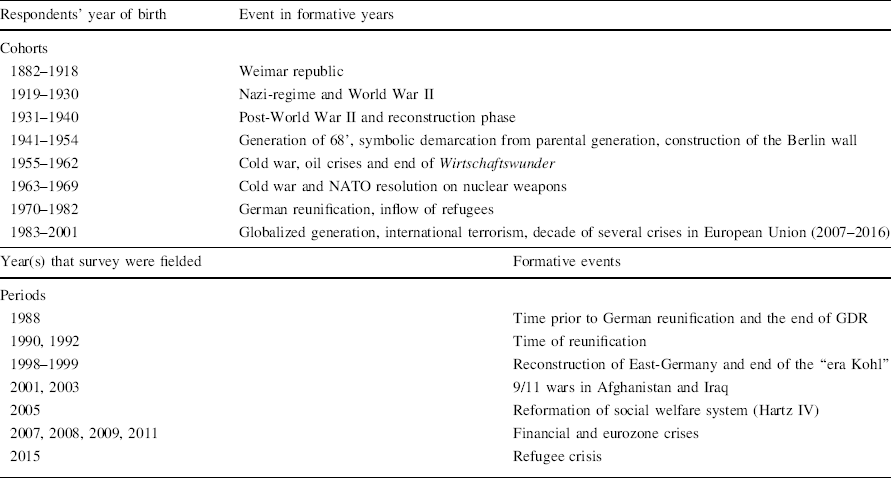
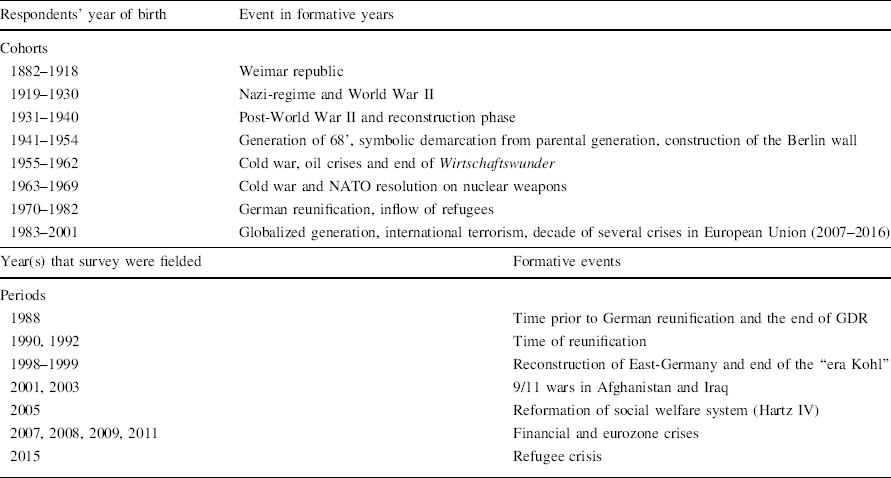
We assigned our respondents into eight cohorts using the rationale of Mannheim (Reference Mannheim1928) who argued that cohorts build around formative and shared events (e.g., periods of war or economic decline) of individuals during their youth (approximately age 15). The actual country-specific grouping of current cohorts (see Table 1) was based on the grouping introduced and discussed in detail by Schmidt (forthcoming). In line with Mannheim, Schmidt theoretically identified key events in the last decades that may justify constructing distinct cohorts.
Grouping of birth years into cohorts and survey waves into periods
Respondents’ year of birth |
Event in formative years |
|---|---|
Cohorts |
|
1882–1918 |
Weimar republic |
1919–1930 |
Nazi-regime and World War II |
1931–1940 |
Post-World War II and reconstruction phase |
1941–1954 |
Generation of 68’, symbolic demarcation from parental generation, construction of the Berlin wall |
1955–1962 |
Cold war, oil crises and end of Wirtschaftswunder |
1963–1969 |
Cold war and NATO resolution on nuclear weapons |
1970–1982 |
German reunification, inflow of refugees |
1983–2001 |
Globalized generation, international terrorism, decade of several crises in European Union (2007–2016) |
Year(s) that survey were fielded |
Formative events |
|---|---|
Periods |
|
1988 |
Time prior to German reunification and the end of GDR |
1990, 1992 |
Time of reunification |
1998–1999 |
Reconstruction of East-Germany and end of the “era Kohl” |
2001, 2003 |
9/11 wars in Afghanistan and Iraq |
2005 |
Reformation of social welfare system (Hartz IV) |
2007, 2008, 2009, 2011 |
Financial and eurozone crises |
2015 |
Refugee crisis |
Grouping of cohorts based on Schmidt (forthcoming)
We grouped the fielding time of the SOEP surveys into seven periods (see Table 1). We base this grouping of the survey waves on distinct and relatively clearly defined historic events that had outstandingly politicising effects in the German public. These events were usually based around fundamental moral questions about prosociality and social responsibilities and were often accompanied by the mobilising of movements. Examples are the German reunification, the eurozone crisis, or crisis caused in the wake of an increase in arriving refugees in 2015/2016. As laid out above, we believe that the very shared experience of these specific events may have led to a collective activation of the civil society in the whole of a society (not just in population segments in their formative years), not only in terms of political participation, but also in terms of voluntary engagement. It should be noted though that the years 1991 (process of reunification), 2010 (eurozone crisis), and 2016 (refugee crisis) could not be assigned to a respective period because the SOEP did not ask for voluntary engagement in those years. Nevertheless, since these crises span more than one year, our definition of periods allows us to observe changes in engagement in the following years).
Control Variables
To account for regional differences in the distribution of engagement, we controlled for federal state (Bundesland). Because age can operate as a moderator or a mediator (e.g., linking key social structural variables such as job status to and voluntary engagement), we additionally controlled for respondents’ age (and age squared to capture nonlinear effects). Although periods were a core predictor, we additionally employed a control variable for each survey year. This was necessary to account for unobserved heterogeneity that could be triggered due to differences in the field phase of the SOEP (which might lead to changes in the measured level of volunteering over time).
Analysis
We proceeded in two analytical steps. In the first step, we described the general trend of voluntary engagement in Germany between 1984 and 2019. We started by describing the general changes in engagement over time. We then explored how the engaged population changed over time. Towards this aim, we described the socio-demographic profile (age, gender, employment status, mean household net income, migration status, and education) of a person who engaged in 1984 and contrasted it with a person who engaged in 2019 using mean statistics.
In the second step, we ran multivariate models to examine whether differences in voluntary engagement over time were due to changes in social structure, cohort membership and/or periodic events. To account for repeated individual observation over time, we employed a random intercept on the individual level in all models. We employed four multivariate linear probability models for which we pooled all survey waves. The outcome variable displayed whether volunteering was carried out in a certain year. In the first model (M1), we only employed social structural variables as predictors. In the second model (M2), we added cohort fixed effects. In the third model (M3), we additionally entered period fixed effects as well as survey year as control variable. In the fourth model (M4), we explored whether the relative influence of our social structural variables changed over time and period (see e.g., Miranti & Evans, Reference Miranti and Evans2019). Therefore, we included interaction terms of all social structural core predictors (gender, education, employment status, income, migration status) with the specified cohorts and periods. This allowed us to identify whether the estimated effects in models M1 to M3 were time or cohort dependent.
One final note: in any Age-Period-Cohort-Effect-analysis, age, cohorts, and periods are collinear. This can lead to an inefficient estimation of effects sizes and increased confidence intervals. We are confident that our conclusions are not biased by collinearity for two reasons. We included cohort and period dummies and implemented age as the only linear variable. This is a common and robust approach to tackle collinearity in this type of analysis (for a technical discussion, see Bell, Reference Bell2020: 211; for an application, see Schröder, Reference Schröder2018). On top of that, our large sample size should bolster against ineffective estimations.
Results
Description of Change in Voluntary Engagement
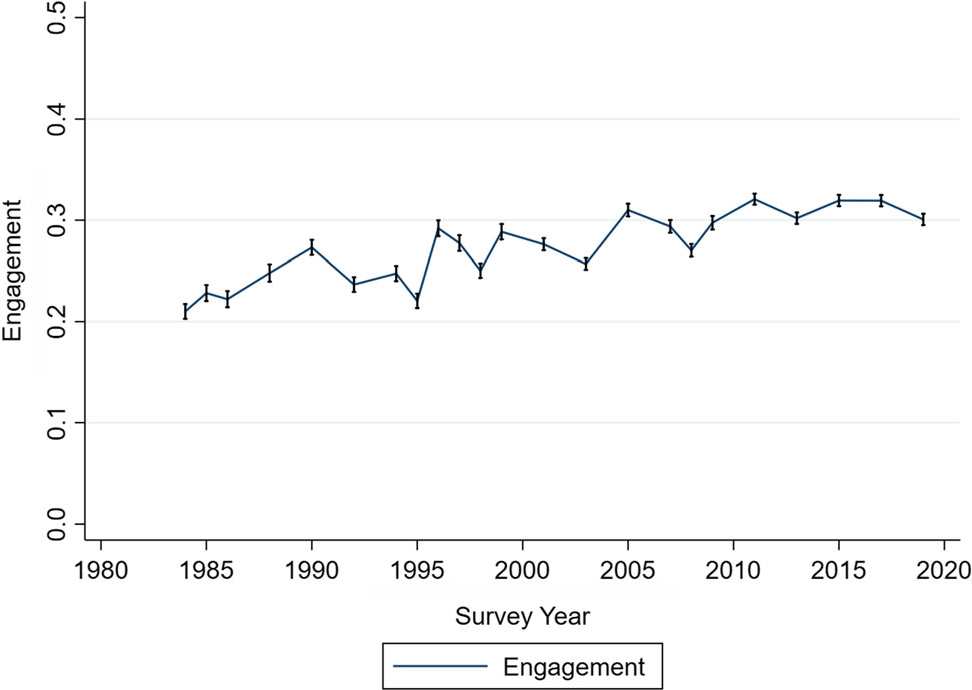
Figure 1 displays the share of individuals engaged in formal settings over time in Germany in the last four decades. In accordance with prior research (e.g., Burkhardt & Schupp, Reference Burkhardt and Schupp2019), we found that the share of people who reported a voluntary engagement increased in the long run—between the mid-1980s and 2019 by slightly less than 10 percentage points (from 22 to 30 per cent). On average, levels of volunteering have been higher since the turn of the century. Yet, the peaks in 1990, 1996, and 2005, and 2012 indicate that periodic events may have notably affected engagement on a societal level beyond the long-term trend.
Proportion of people who voluntarily engage over time. Note Vertical lines display 95% confidence interval, the x axis displays the survey year, the y-axis displays the share of engaged people. Data from the SOEP, v.36eu, own calculations, weighted
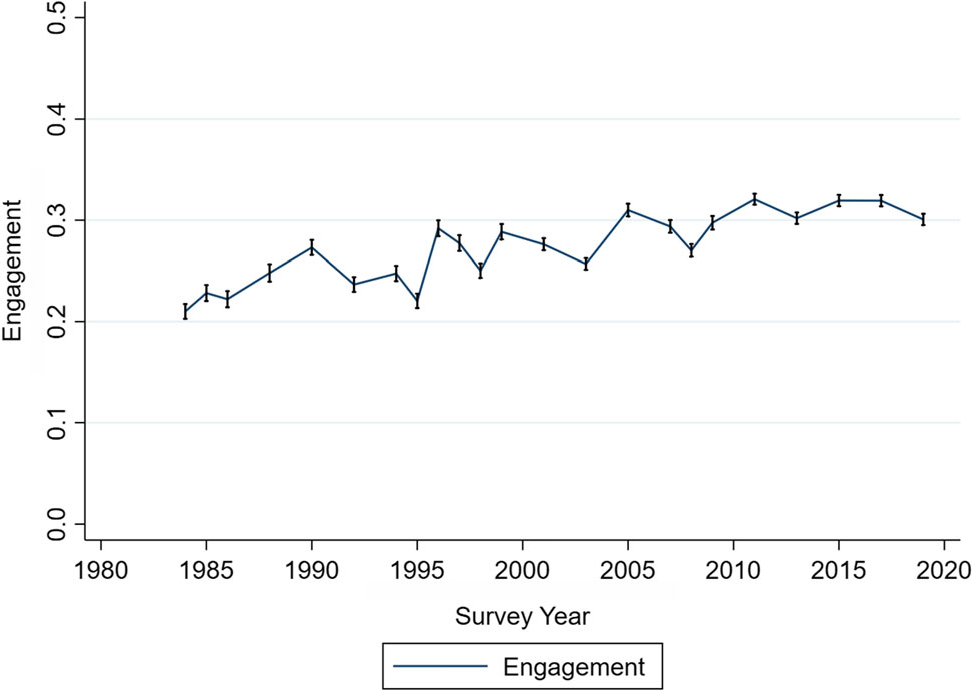
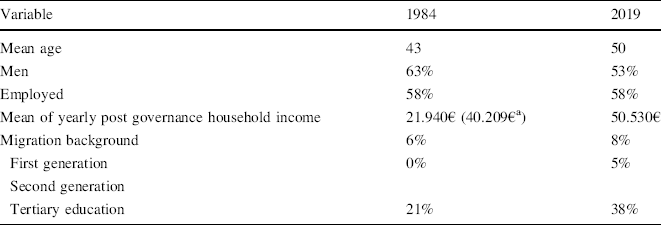
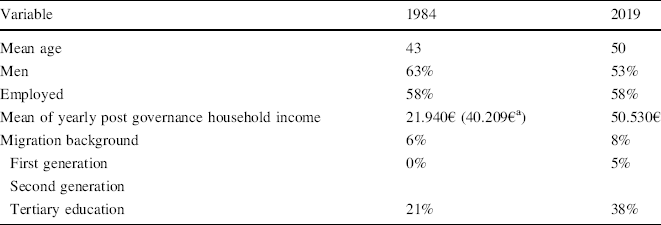
Table 2 displays how the prototypical socio-demographics of those who engaged in West Germany in 1984 differ from those who engaged in the united Germany in 2019. While on average, more men reported to volunteer, the share of women among engaged citizens increased from 1984 to 2019 by roughly 10 percentage points. The shift in nominal net household income of engaged citizens was substantial, too – this more than doubled for engaged persons and, accounting for inflation, an increase of around ten thousand euro remained. This was paralleled by an increase in highly educated people among engaged citizens—almost 40% of all formally engaged people in 2019 have tertiary education, compared to only 21% in 1984. We found no differences regarding employment. Last, we saw an increase in people who immigrated to Germany or were a direct descendant of an immigrant among engaged citizens—from 6% in 1984 compared to 15% in 2019. Notably, it was particularly the group of descendants of immigrants who increasingly engaged in the third sector—rising from 1984 to 2019 by 5 percentage points.
Comparison of the Social Demography of Engaged People in 1984 and 2019
Variable |
1984 |
2019 |
|---|---|---|
Mean age |
43 |
50 |
Men |
63% |
53% |
Employed |
58% |
58% |
Mean of yearly post governance household income |
21.940€ (40.209€a) |
50.530€ |
Migration background First generation Second generation |
6% 0% |
8% 5% |
Tertiary education |
21% |
38% |
Data from SOEP. v.36eu, own calculations, weighted. Modal values for categorical variables. a Value accounts for inflation from 1984–2019
Multivariate Analysis to Test Relative Strength and Over-Time Variation of Predictors
The descriptive statistics suggest that the prototypical engaged citizens have a particular socio-demographic profile which is different today than it was in the 1980s. However, the observed change in socio-demographics may only reflect changes in the general population (respectively the composition of the SOEP) and not changes in the nature of voluntary engagement. For instance, parallel to the increase in voluntary engagement in Germany, the share of highly educated and the mean age increased. To understand what drove the changes in the average socio-demographic background of those who were formally engaged, we needed to take cohort and period effects into account.
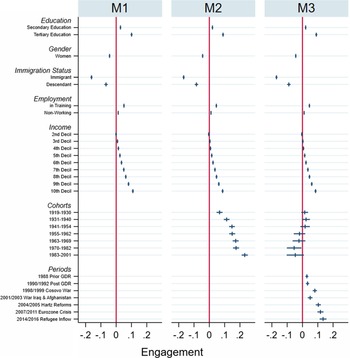
Figure 2 shows average marginal effects (AME) of various multilevel linear probability models (for exact point estimates and confidence intervals, see the Appendix tables A1 in ESM). In Model 1, we only entered socio-demographics. As expected from the descriptive statistics, we found that higher education went hand in hand with a significant increase of voluntary engagement (AME around 10% in all three models). Women were significantly less engaged than men (AME around 4–5% in all three models). Immigrants (AME 16–17% in all models) and their descendants (AME 8–9% in all models) were significantly less engaged than respondents without a migration history. With regards to employment, we found only small but significant differences between people in regular employment and those still in education (AME 5% in all models) and those non-working (AME 1% in all models). Finally, higher income deciles were associated with significantly more voluntary engagement.
Cohort, period, socio-demographic analyses. Note Multivariate linear probability model. Coefficients are average marginal effects including 95% confidence intervals. All models control for age and age-squared, and federal state, M3 controls in addition for survey year (full models in the Appendix table A1 in ESM). Reference categories include: education = primary and lower, gender = men, immigration status = native-born ethnic majority, employment = regular employment, income = first decile, cohorts = 1882–1918, data from the SOEP, v.36eu, own calculations, weighted
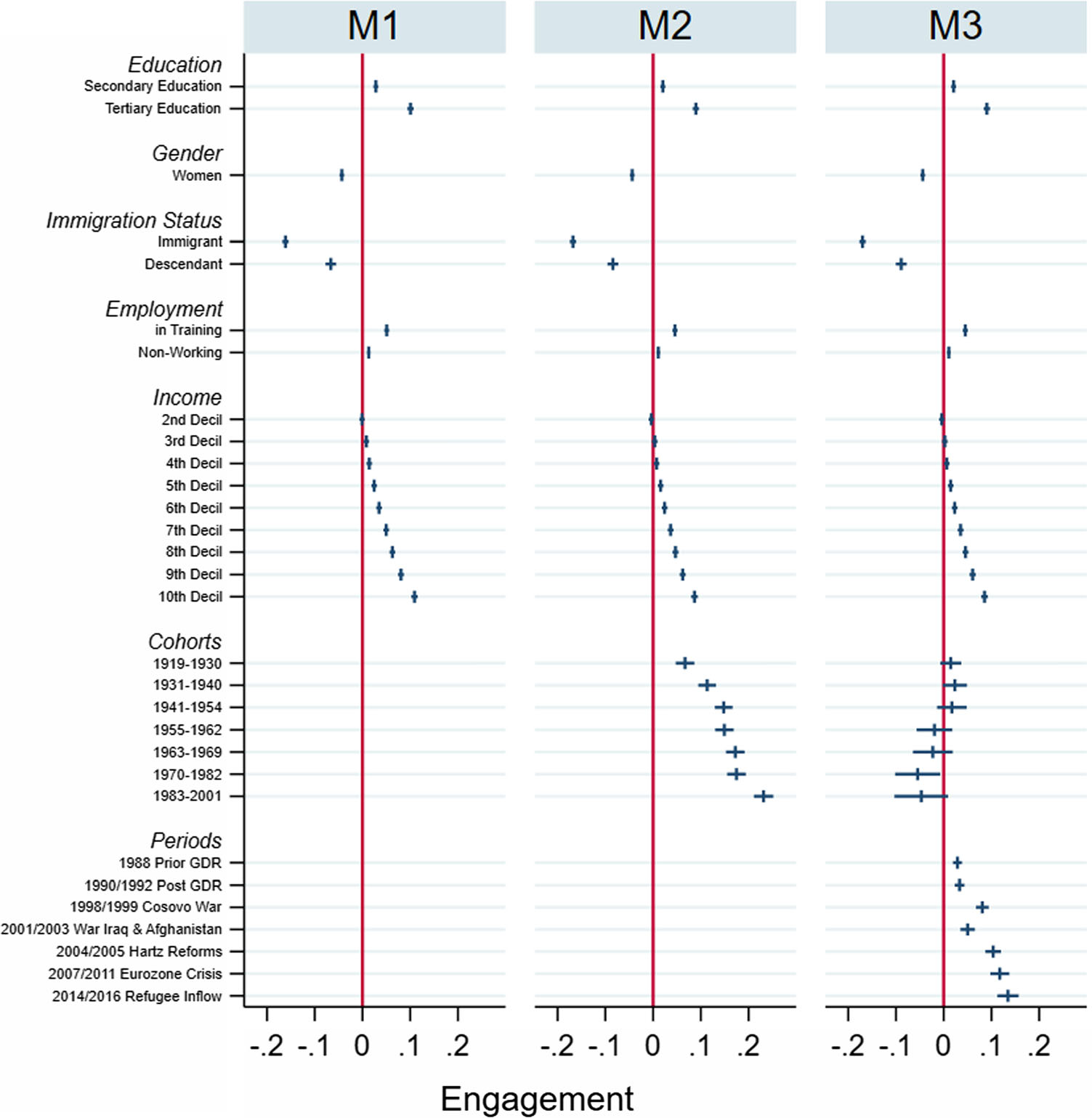
In model 2, we added cohorts and estimated their fixed effects (see Fig. 2). The first notable finding was that the coefficients of social structural variables remained the same as in model 1. Apart from that, controlling for age and age-squared, younger generations showed a significantly higher likelihood to engage, amounting to a notable AME = 23% for the cohort of 1983–2001 in comparison to the cohort of the reference category (1882–1918).
In model 3, we further added periods (and survey year as control; see Fig. 2). Again, the effects of social structural variables remained the same. In contrast, the effects of cohorts changed in effect direction and size once we entered period effects and year of survey in model 2. Once we factored in the period, older generations showed a higher likelihood to engage, although the effects were not significant at p = 0.05 except for the generation born between 1970 and 1982. The period effects, on the other hand, were marked. Particularly in the period of the European migration crisis (2015), many people have been mobilised—with significant average marginal effects amounting to 13%. The financial and Eurozone crisis (2009–2011) and the time of the introduction of more restrictive social welfare policies (2005) also went hand in hand with significant increases in voluntary engagement. This implies that higher levels of voluntary engagement after the turn of century that we found in the over-time trend (see Fig. 1) were likely driven by moments of crises and politicisation.
In our last model 4, we tested whether the effects of the socio-demographic variables were more pronounced in certain periods and cohorts. Due to the high number of interaction terms, we summarise findings here (for full results, see Table A2 in the Appendix in ESM). Most notable was the changing influence of gender on voluntary engagement. With regards to the interaction between gender and cohorts, we found that gender made no significant difference with regards to voluntary engagement for younger cohorts, starting with the cohort of 1955–1962. The interaction between gender and periods reproduced this finding of a closing gender gap. Whereas males were more likely to engage in the period before German reunification in the late 1980s, males and females were equally likely to engage voluntarily in the 1990s. After the turn of the century, women were even more likely to engage voluntarily than men.
With regards to all other social structural variables, we found little to no variation in influence on voluntary engagement across cohorts and periods. We did not find marked differences across cohorts or across periods for the effect of employment status. The same was indicated for income, where no consistent pattern can be identified despite the fact in some periods that individuals with a medium income seemed to engage more often compared to other periods. For migration status, we found that the gap between immigrants of the birth cohorts 1882–1918 (AME = 14.8% / 95% CI 6.2–23.4), 1919–1930 (AME = 5.0% / 95% CI 1.4–8.6) and the native-born ethnic majority was larger than in the youngest cohorts. The same is true for the descendants of immigrants in the birth cohorts of 1941–1954 (AME = 11.9% / 95% CI 4.1–19.7) and 1955–1962 (AME = 6.8% / 95% CI 0.8–12.8). However, the confidence intervals were large, so that it was difficult to judge how substantial these differences were. We did not find marked differences across periods with point estimates either being not significant or the lower bound of the confidence interval being only three decimal points above zero. Finally, the effects for education hardly differed between cohorts and periods. Higher education had a larger positive effect on voluntary engagement among those born between 1983 and 2001 than among those born between 1963 and 1982 (AME = − 0.03% / 95% CI − 0.05 to − 0.01) and 1970–1982 (AME = − 0.02% / 95% CI − 0.04 to − 0.01). Moreover, in all periods after the wars in Iraq and Afghanistan, the lowest educated were less likely to be engaged than the highest educated. However, the point estimates are small and, again, the confidence intervals almost included zero.
Discussion
Synthesis
Using data from the SOEP, we disentangled the relative influence of social structural factors, cohorts, and periods on the uptake of formal voluntary engagement in Germany in the last four decades. Our analysis contributes to the existing literature on voluntary engagement in various substantial ways.
To start with, this paper replicated earlier findings about the importance of social structural factors and showed that the influence of many of those factors is largely time-independent. We found that respondents with higher education, with higher income and the native-born ethnic majority were more likely to engage. While we saw that the typical engaged person did change its demographic profile from 1984 to 2019, the relative influence of each of the factors for engaging hardly changed over time. To understand this, we believe that it is helpful to look in more detail on some of the underlying variables that could mediate the effects of the aforementioned social structural factors.
The education effect results from the fact that people with higher education spend on average more time in institutions of tertiary education and, later on, in better paid employment trajectories. We argue that in these settings, volunteering can be considered social norms, giving respondents blueprints on how to get active (prominent examples for this line of argument are e.g., doctors without borders or clubs such as Rotary International). Finally, people with higher education may find it easier to participate in unknown social settings and to take over gratifying positions of responsibility in a volunteering context. With regards to income, we assume that it is first and foremost the available time that allows to engage voluntarily, but again, it may also be network effects. Finally, the lower levels of formal engagement among respondents with a migration history—particularly those who have immigrated themselves rather than their parents—can probably be explained by language barriers, experiences of discrimination and exclusion—either in the volunteering context or in general in contact with the native-born ethnic majority population, and a lack of resources to invest time beyond paid work. The crucial part is that all these mechanisms should work largely independently of the actual distribution of characteristics within a society at a given point in time.
While the influence of education, income, migration, and employment status are largely persisting over time, the gender gap in voluntary engagement decreased with women becoming more and more involved in formal engagement across cohorts and even more engaged than men after the turn of the century. This finding is in line with abundant empirical evidence from many other areas of psychosocial functioning that existing gender disparities are narrowing over time (e.g., Gerstorf et al., Reference Gerstorf, Drewelies, Duezel, Smith, Wahl, Schilling, Kunzmann, Siebert, Katzorreck, Eibich, Demuth, Steinhagen-Thiessen, Wagner, Lindenberger, Heckhausen and Ram2019). There are several potential explanations why the gender gap decreased over time in Germany: First, gender stereotypes have changed to a certain degree. In general, men have been expected to be more agentic (e.g., assertive, competent, dominant, responsibility seeking) whereas women have been expected to be more communal (e.g., kind, understanding, likeable, sentimental; Hentschel et al., Reference Hentschel, Heilman and Peus2019). As such, male stereotypes may align closer with volunteer work in the third sector, whereas female stereotypes may align closer with informal social services (Hook, Reference Hook2004). However, as far as agentic traits are increasingly attributed to women, women nowadays might similarly harbour stronger control beliefs (Gerstorf et al., Reference Gerstorf, Drewelies, Duezel, Smith, Wahl, Schilling, Kunzmann, Siebert, Katzorreck, Eibich, Demuth, Steinhagen-Thiessen, Wagner, Lindenberger, Heckhausen and Ram2019), feel competent, and seek responsibility in formal engagement. In addition, women may have traditionally lacked the time and emotional resources to invest energy into formal volunteering work because they have been facing a “double burden” to combine paid work and unpaid family responsibilities (Hook, Reference Hook2004). Whereas women are still more involved (Baldez, Reference Baldez, Krook and Women2010), men have been slowly increasing their participation in family responsibilities and care work in the last decades. This in turn may have either freed-up resources for women, or bound resources for men to engage in voluntary work in the third sector.
In contrast to previous publications, our analyses suggested that differences between cohorts may have been overstated in explaining long-term dynamics of volunteering. We do not want to argue that there may have been one or a few single generations who had a genuine relationship to voluntary engagement. However, we did not find a systematic effect. Once we added periods to the picture, the effects of cohorts largely disappeared. It is possible that generation effects may largely result from a combination of (small) effects of age, effects of age-related correlates (like occupational status), and period effects.
The effects of periods were notable in themselves. Although the confidence intervals of our period effects were largely overlapping—especially after 1999—the general pattern suggested that the influence of periods increased over time. Moreover, our data suggest—in line with studies that investigated single crises—that periods of crises, especially the period of the increasing number of refugees and the financial crisis, send a strong impulse to the activation of civil society in Germany.
Limitations
In closing, we note several limitations of our study. To start with, we constructed our cohorts following a conceptual rationale (Schmidt, forthcoming), but such construction always involves arbitrary decisions. Defining which moments in historical time have the potential to be formative and which not leaves researchers with many degrees of freedom. As such, independent replications in different contexts are clearly warranted.
Working with the secondary data from the SOEP, we had to focus on voluntary engagement in organisational settings. We cannot draw any inferences about more informal engagement in loosely organised units of the civil society. Informal forms of engagement often happen ad-hoc, come with low costs and are sporadic in nature (e.g., Borbáth et al., Reference Borbáth, Hunger, Hutter and Oana2021; Lahusen, Reference Lahusen2020). We, therefore, speculate that the observed increases of engagement after crises will even be stronger for more informal forms of engagement. Scrutinising more informal types of engagement were also interesting with regards to the observed narrowing of the gender gap. For a long time, women were more inclined to more informal forms of engagement due to double burdens at home (Hook, Reference Hook2004). We wonder whether the increased participation of women in formal settings went hand in hand with a decrease in women’s’ informal engagement.
Finally, our analyses are also blind to institutional changes in voluntary engagement itself. As we just laid out, in some instances, respondents might not terminate their formal engagement, but rather adopt an informal engagement or political forms of participation. These changes can happen over time on the societal level. For instance, in the USA, there is a general decline in formal voluntary engagement, but an increase in political activism (Caren et al., Reference Caren, Ghoshal and Ribas2011). Such changes cannot be captured with the SOEP items. Future analyses of voluntary engagement should therefore not only be sensitive to the differences in periods and cohorts, but additionally be aware of the structural setting of engagement itself.
Conclusion
Our findings provide important insights into the nature and correlates of voluntary engagement. Employment, income, and education had a basically time-independent influence on voluntary engagement in organisations and civil services. This hints to the fact that resources, in the sense of human capital, are a persistent crucial factor. At the same time, the strong negative effect of immigration status indicates that social exclusion is a factor too. Beyond that, we provide indication that civil society is especially activated in periods of crisis where such engagement is deemed necessary and may offer coping mechanisms. Finally, the near absence of relevant cohort effects raises doubts on the impression that cohorts play an important role in value formation and, subsequently, for the question whether individuals deem it desirable to start voluntary engagement. Future research should further explore engagement in other institutional settings. For this article, we conclude that voluntary engagement is mostly influenced by individual resources and second by periodic events such as societal crises that have a high potential for mobilising people. In order to increase voluntary engagement in formal settings, barriers to engagement need to be lowered in order to make individual resources less relevant for the uptake.
Acknowledgements
We thank Luise Burkhardt for her thorough and thoughtful criticism on earlier versions of this manuscript. We thank Katja Schmidt for sharing her concept of Cohorts. We thank the Berlin University Alliance that funded this research by means of their Grand Challenge Social Cohesion. Finally, we thank two anonymous reviewers who have considerably increased the quality of this manuscript.
Funding
Open Access funding enabled and organized by Projekt DEAL.
Declarations
Conflict of interest
The authors have no conflicts of interest to declare that are relevant to the content of this article.
Informed Consent
Informed consent was obtained from all individual participants included in the study
Human and Animal Participants
All procedures performed in studies involving human participants were in accordance with the ethical standards of the institutional and/or national research committee and with the 1964 Helsinki Declaration and its later amendments or comparable ethical standards. The data collection of the survey data was approved by the Survey Committee of the German Socio-Economic Panel at the German Institute for Economic Research.


 Open access

