


Scholars have increasingly examined the rise of explicit racial rhetoric in American political discourse (Jardina Reference Jardina2021; Jardina and Piston Reference Jardina and Piston2023; Valentino, Neuner, and Vandenbroek Reference Valentino, Neuner and Vandenbroek2018).Footnote 1 It is now well established that there is an increased correspondence between the racial attitudes of whites and partisan identities during this period. How have Black and Latine Americans responded? As American politics has become increasingly defined by explicit racial rhetoric, understanding how these dynamics shape the political attitudes of marginalized groups—the target of such rhetoric—is vital. Understanding how all groups are responding to the increased salience of race is critical for assessing the durability of multiracial democracy and the evolving nature of partisan identity in the United States.
The literature has tended to center around white Americans’ growing acceptance of explicit racial rhetoric (Berinsky et al. Reference Berinsky2011; Huber and Lapinski Reference Huber and Lapinski2008; Mendelberg Reference Mendelberg1997; Valentino, Hutchings, and White Reference Valentino, Hutchings and White2002; White Reference White2007). President Trump has drawn on themes that resonate with white identity politics, including both implicit and explicit appeals to white grievance and nationalism, which appears to have strengthened his support among voters with strong white racial identities and conservative views on race and immigration (Sides et al. Reference Sides, Tesler and Vavreck2019). Such findings are consistent with evidence demonstrating a growing connection between racial attitudes and political factors, such as partisanship (Enders and Scott Reference Enders and Scott2018), policies (Tesler Reference Tesler2013), and vote choice (Tesler Reference Tesler2012; Reny et al. Reference Reny, Collingwood and Valenzuela2019). Existing evidence from the pre-Obama-Trump era shows that negative explicit racial rhetoric about Black (White Reference White2007) and Latine Americans (Pérez Reference Pérez2015) can activate positive in-group identification in response. However, comparatively less research has focused on how the recent increase in the salience of race is influencing these groups.
In this paper, we examine the relationship between partisan identification and a measure of racial affect—what has been termed “affective differentiation,” which is the difference in ratings between one’s own group and another racial group (e.g., Bobo and Zubrinsky Reference Bobo and Zubrinsky1996), in our case white Americans—among Black and Latine Americans.Footnote 2 Our goal is to assess both the strength and the direction of the relationship between these two orientations.Footnote 3 To do so, we use data from the American National Election Studies Cumulative File 1976–2020 to initially establish that (1) affective differentiation has increased in recent years and (2) it shares an increasingly strong relationship with partisanship. Against this backdrop, we employ panel data from the two most recent presidential elections using the American National Election Studies 2016–20 Panel Sample to trace the direction of influence between the two orientations.
Our results extend the research on racial attitudes and partisanship for Black and Latine people indicating that as the parties have polarized on the use of explicit racial rhetoric, the electorate has responded. Specifically, we find that Black and Latine partisans update their feelings about racial groups. In other words, as the current political climate has become increasingly and explicitly racialized, we observe an increased difference in how individuals rate their own group relative to others, on average. Further, we observe an increasing correspondence between partisanship and racial attitudes among different groups in the electorate, which suggests partisan divisions will remain challenging to overcome. As Mason and Wronski (Reference Mason and Wronski2018, 274) state, the “convergence of social identities along partisan lines makes in-party preference more powerful and out-party tolerance ever more difficult.”
Our analysis of the panel data further underscores the substantial influence that partisanship has on other political and social attitudes. In particular, we find that while previous values of affective differentiation are unrelated to partisanship, partisanship in 2016 predicts racial attitudes in 2020. Namely, as Black and Latine people increase their attachment to the Democratic Party, they exhibit higher levels of affective differentiation. This result is robust to a series of modeling choices. A subsequent analysis indicates that partisanship shares a stronger relationship with feelings about one’s own group than with feelings about whites, similar to the expectations of Huddy and Bankert (Reference Huddy and Bankert2017).Footnote 4
Race and Partisanship in the United States
Political parties in the United States function fundamentally as coalitions of social groups, each vying to advance their interests and policy goals within the political system (Bawn et al. Reference Bawn2012). From this perspective, individuals align with parties based on how well the party represents the agendas of the groups they identify with, highlighting the group-based nature of partisan dynamics (Mason Reference Mason2016). This process of social sorting—where identities such as race, religion, and class increasingly align with partisan affiliation—intensifies both evaluative judgments of and emotional attachments to political parties (Mason and Wronski Reference Mason and Wronski2018).
Miller et al. (Reference Miller1981) argue “group consciousness”—a sense of shared interests and collective political awareness within social groups—shapes political participation and party support. Such consciousness acts as an understanding of the group’s relative societal position, awareness of the group’s commitment to political action, and perceptions of how closely other social groups align with political parties (Miller and Wlezien Reference Miller and Wlezien1993). Groups form connections to a political party when members associate that party with specific policies (Miller and Wlezien Reference Miller and Wlezien1993) and “attachment to party-aligned groups is significantly related to party identity strength” (Mason and Wronski Reference Mason and Wronski2018, 270). That is, individuals interpret political parties through a group-centered lens where the party’s ideological or policy-driven objectives are proxies for social group interests. Given the close connection between group identity and partisanship, race emerges as a central dimension in how individuals understand politics and relate to political parties.
Indeed, a large body of evidence shows that race and racial group dynamics play an integral role in shaping party attachments (Frymer Reference Frymer1999; Huddy et al. Reference Huddy, Mason and Horwitz2016; Hutchings and Valentino Reference Hutchings and Valentino2004; Wamble et al. Reference Wamble2022). Since the post-civil rights era, the Democratic Party has generally been perceived as representing the interests of people of color, while the Republican Party is more often associated with representing the interests of white Americans. However, this group-party link is not only driven by policy positions as it also reflects how parties are perceived socially, including how voters experience racial discrimination and social exclusion (Kuo et al. Reference Kuo, Malhotra and Mo2017; Berry et al. Reference Berry, Cepuran and Garcia-Rios2020).
Several studies highlight the connection between racial attitudes and political factors including partisanship (Enders and Scott Reference Enders and Scott2018) and policies (Tesler Reference Tesler2013). The Implicit/Explicit (IE) model tells us white Americans resisted explicit racial appeals due to a social acceptance of the egalitarian antiracist ideals in America (Huber and Lapinski Reference Huber and Lapinski2008; Mendelberg Reference Mendelberg1997). The theory of symbolic racism suggests that society has moved away from overt expressions of racism, whites relied on subtler expressions of racism that align with cultural values (Kinder and Sanders Reference Kinder and Sanders1996; Kinder and Sears Reference Kinder and Sears1981; McConahay and Hough Reference McConahay and Hough1976; Sears Reference Sears, Katz and Taylor1988). However, recent studies suggest a notable shift whereby explicitly racialized rhetoric has reemerged and become increasingly acceptable in mainstream political dialogue (Abramowitz and McCoy Reference Abramowitz and McCoy2019; Tesler Reference Tesler2013; Valentino et al. Reference Valentino, Neuner and Vandenbroek2018). Southern whites’ realignment to the Republican Party was significantly driven by racial conservatism, and in turn, the party adopted platforms that appeal to whites through both implicit and explicit racial appeals (Mendelberg Reference Mendelberg1997; Valentino and Sears Reference Valentino and Sears2005).
While the political significance of racial attitudes among white Americans is well established, less is known about how Black and Latine Americans respond to negative racial cues, and how these cues shape the relationship between their racial attitudes and partisanship. Typically, negative explicit racial appeals about Black and Latine Americans can activate positive in-group identification (Pérez Reference Pérez2015; White Reference White2007). Furthermore, experiences of prejudice can lead to an increased identification with one’s own group (Branscombe et al. Reference Branscombe, Schmitt and Harvey1999) suggesting that a racialized political climate heightens in-group solidarity and increases affective distance from whites. However, Herring et al. (Reference Herring, Jankowski and Brown1999) find that Black identity is not necessarily associated with negative feelings toward whites. Additionally, increased strength in cultural pride among Black and Latine people can counterintuitively lead to favorability toward whites unless they believe that the out-group views them negatively (Sullivan and Ghara Reference Sullivan and Ghara2014). We explore what the Republican Party’s shift towards explicitly negative racial rhetoric means for Black and Latine Americans, who are often the subject of these appeals.
Black Partisanship
Linked fate, a key model for understanding Black political decision making, is a cognitive shortcut where Black Americans use their perceptions of racial group interests to guide their decision-making (Dawson Reference Dawson1994). In low-information settings, linked fate operates as a bounded rationality tool, where an individual’s well-being is perceived as intertwined with group outcomes. However, linked fate alone does not explain why Black Americans have historically chosen to support the Democratic Party and are largely still united in their support for the party (Tate Reference Tate1993).
Black Americans widely view political unity as essential for having their collective demands recognized (White et al. Reference White, Laird and Allen2014; White and Laird Reference White and Laird2020), reflecting a broader strength of solidarity within the Black community and consistent with longstanding arguments about the need for collective Black political action to challenge systemic racial injustice (Shelby Reference Shelby2005). This collective strength is reinforced through social sanctions, which discourages political behavior that diverges from community norms—particularly when it comes to Black partisanship (Wamble et al. Reference Wamble2022; White et al. Reference White, Laird and Allen2014; White and Laird Reference White and Laird2020). Epithets such as “Uncle Tom” and “sellout” are a manifestation of preservation efforts within the group to encourage Democratic Party support because no one wants to be seen as hindering group progress (White and Laird Reference White and Laird2020). This social constraint within the community is reflected in Black conservatives, who are more likely to identify with the Democratic Party in the presence of other Black community members (Wamble et al. Reference Wamble2022).
Black Americans are not a monolith of shared political ideology; however, favorability toward their own racial identity can, in part, be derived through their attachment to the Democratic Party because partisanship can act as an indicator of support for Blackness (White and Laird Reference White and Laird2020). White (Reference White2007) finds that explicit racial cues activated Black Americans’ in-group identification across two non-racial policy issues, further supporting the idea that explicit racial messages can play different roles in activating Blacks’ racial group identification and Whites’ racial group resentment. Therefore, the development of Black partisan attachments through racial cues is arguably also sensitive to the explicitness of the racial appeals. We assess how the contemporary change in political communication norm—particularly by the Republican Party—has additionally influenced Black partisanship in a meaningful way. This shift may reinforce the symbolic and social boundaries separating Black voters from the Republican Party (Frymer Reference Frymer1999), strengthening in-group Democratic identification and intensifying the difference between out-group evaluations.
Latine Partisanship
Trump’s rhetoric framing immigrants crossing the U.S.-Mexico border as “criminals,” “rapists,” and “murderers” prompted political science and race and ethnicity scholars to theorize that Latine people would increasingly begin to reject Trump (Cadena Reference Cadena2023, Igielnik et al. Reference Igielnik, Scott and Hannah2021). However, exit polls revealed up to 30% of Latine voters voted for Trump in 2016 (Jones-Correa et al. Reference Jones-Correa, Al-Faham and Cortez2018). Although a majority of Latine voters identify with the Democratic party, the presence of a significant ideologically conservative segment within the Latine population complicates the application of theories developed to explain Black partisanship, such as linked fate and group consciousness. Instead, scholarship on Latine partisanship and voter behavior identifies national origin identity, religion, and racial policy positions as key influences of Latine party identification (Affigne Reference Affigne2000; Alvarez and Garcia-Bedolla Reference Alvarez and Garcia-Bedolla2003; Hero et al. Reference Hero2000; Kelly and Kelly Reference Kelly and Kelly2005; Wong Reference Wong2000). These key identifiers combine into a process of assimilated consciousness (Cadena Reference Cadena2023).
Latine partisan choices reflect diverse experiences within America’s complex racial hierarchy, including conformity to whiteness through assimilation and social treatment aimed at achieving mobility and acceptance from white Americans (Golash-Boza and Darity Reference Golash-Boza and Darity2008; Cadena Reference Cadena2023). Political discourse in the United States often flattens the diversity of what it means for individuals to identify as a Latine person—e.g., a Mexican American and a Cuban American are categorized as Latine in the same way a person born in the U.S. territory Puerto Rico is categorized as Latine. This underscores the pivotal role of racial self-identification as a signal of alignment with whiteness in Latines. Among Latines, those who more strongly identify with their cultural group are stronger Democratic partisans (Huddy et al. Reference Huddy, Mason and Horwitz2016). Likewise, policy positions reveal that Latines who support affirmative action are more likely to identify as Democrats (Alvarez and Garcia-Bedolla Reference Alvarez and Garcia-Bedolla2003). Furthermore, racial attitudes among Latines—specifically racial resentment and adherence to color-blind racial ideologies—strongly correlate with Republican identification (Cuevas-Molina Reference Cuevas-Molina2023). When Latine people immigrate to the United States, they are faced with new definitions of race and undergo a process of race acculturation that challenges their existing racial self-identifications (Roth Reference Roth2012). In fact, 58% of Hispanics in the 2020 U.S. Census identified as white, or white in combination with other races (Cuevas-Molina Reference Cuevas-Molina2023). Cuevas-Molina (Reference Cuevas-Molina2023) finds that self-identified white Latines exhibit a higher likelihood of identifying with the Republican Party compared to their counterparts. As such, Latine partisanship cannot be explained by a monolithic “Latine/Hispanic vote.” Recognizing this heterogeneity is essential for understanding how racialized social structures shape partisanship among Latines and for moving beyond reductive frameworks that obscure the nuances of Latine political identity.
Expectations
We argue that the return to explicit racial rhetoric by the Republican Party and its support from many white Americans has reshaped the political calculations of Black and Latine Americans. In particular, we anticipate that as race has become more salient at the national level and as the parties have taken distinct stands on the type of rhetoric used, we should see partisan identity increasingly bound up with racial affect. The timeframe we consider covers a period in which there were visible racially salient actions by the government. For example, the murder of George Floyd—which exemplified the excessive use of force by police—was followed by Trump’s supportive response to the event and his negative reaction to the subsequent protests. Similarly, the early response to the COVID-19 pandemic left American minority groups uniquely vulnerable as evidenced by the disproportionately poor outcomes across a variety of metrics (e.g., Magesh et al. Reference Magesh2021; Reyes Reference Reyes2020). Key to our argument is that these incidents all had, to some degree, a partisan element potentially connecting feelings about race to partisan identity among members of the electorate. Such events may have contributed to polarization by reinforcing a sense of group-based threat and solidarity among communities of color. We argue that the contrast between the treatment of their own racial or ethnic group and the perceived indifference of broader society—especially among white Americans—should heighten in-group attachment and out-group resentment.
While these dynamics may unfold differently for Black and Latine Americans, we expect that increasing racial polarization will heighten the salience of racial identity as it becomes more entangled with partisan attachments across both groups. For Black Americans, whose partisanship often stems from linked fate and a sense of racial unity, the Republican Party’s rhetoric may further strengthen Democratic identification as an act of collective resistance. Among Latine Americans, where partisanship is more varied and shaped by assimilation, national origin, and strength of Latine identity, reactions to Republican rhetoric may depend more on how individuals navigate their racial position within the U.S. hierarchy.
Within this framework, the Republican Party’s electoral success using explicit rhetoric serves as a signal of dominant white racial attitudes to both Black and Latine communities. These appeals would not result in electoral gains if they were widely rejected by white voters; their continued success thus suggests, minimally, tacit approval or acceptance. Consequently, some may begin to associate whiteness itself with the racially exclusionary messages promoted by the party. Further, perceptions of threat influence racial attitudes, especially when two groups are perceived to be in conflict (Stephan et al. Reference Stephan2002). In other words, we expect that a shift away from a political environment that once upheld principled racial egalitarianism and norms against overt racism, toward a more racially hostile and polarized political climate will strengthen the relationship between partisanship and racial affect. We therefore anticipate that over time, identification with the Democratic Party will be associated with higher levels of affective differentiation.
This brings us to our next, and central, question: how do these orientations influence one another over time? The first possible outcome is that racial attitudes dominate, such that shifts in these attitudes drive changes in partisanship. This expectation is consistent with a well-established body of research highlighting the central role of group-based feelings in shaping political behavior (e.g., Miller et al. Reference Miller, Wlezien and Hildreth1991; Dawson Reference Dawson1994; García Bedolla Reference García Bedolla2005). The second avenue of influence is from partisanship to racial attitudes; political parties actively structure group competition (De Leon et al. Reference De Leon, Desai and Tuğal2009), which is consistent with the argument that group evaluations are not necessarily exogenous to politics (Clifford et al. Reference Clifford, Simas and Suh2025). This expectation aligns with the literature’s long focus on partisanship as a stable orientation that affects other politically relevant attitudes, supported by ample evidence (e.g., Campbell et al. Reference Campbell1960) and is consistent with what we observe among white Americans in recent years (Engelhardt Reference Engelhardt2021) and panel data indicating partisanship predicts perceptions of discrimination among Black and Latine Americans (Hopkins et al. Reference Hopkins2020). The third and final possibility is that because both racial attitudes and partisanship can serve as “first movers,” we will observe a reciprocal relationship between the two.
In addition to examining overall affect, there is reason to examine the relationship between partisanship and feelings of one’s own group and whites separately. For example, intergroup bias results mainly from in-group favoritism rather than out-group derogation (e.g., Hewstone et al. Reference Hewstone, Rubin and Willis2002), including with respect to race (e.g., Dovidio and Gaertner Reference Dovidio and Gaertner2000) and among white Americans, feelings toward out-groups share a stronger relationship with vote choice and candidate evaluations by 2016 compared to other racial groups (Jardina Reference Jardina2021). For example, Trump’s campaign connected job losses for white workers with government policies favoring the interests of nonwhites and immigrants, fueling the strengthening of racial resentment and partisanship in white Americans (Abramowitz and McCoy Reference Abramowitz and McCoy2019; Knuckey Reference Knuckey2011; Knuckey and Kim Reference Knuckey and Kim2015).
Data
We employ the Cumulative File from the American National Election Studies (ANES) as well as the 2016–20 ANES Panel Sample, in which respondents from 2016 were re-interviewed in 2020. Our analysis proceeds in three steps. We initially use the Cumulative File from 1976–2020 to examine how racial affect has changed over time as well as track the relationship between affect and partisanship. Next, we make use of 2016–20 panel data to examine the direction of influence between the two orientations. We do so for a pooled sample as well as for both Blacks and Latines separately. Finally, we analyze ingroup and out-group feelings separately using both the 2016–20 panel data as well as pooled cross-sections from 2012 to 2020. We now detail our variables of interest.
Affective Differentiation
This variable captures “positional commitments with a difference score” between one’s own self-reported racial group and another racial group (Bobo and Zubrinsky Reference Bobo and Zubrinsky1996, 892). Stated differently, this measure gauges the “emotional preference” for one group compared to another (e.g., Jackman and Crane Reference Jackman and Crane1986) and can also be thought of tapping feelings of ethnocentrism (Bobo and Zubrinsky Reference Bobo and Zubrinsky1996). In other words, affective differentiation refers to the degree to which individuals express differing emotional evaluations toward their own racial or ethnic group compared to other racial or ethnic groups such that higher levels of affective differentiation indicate that individuals feel more positively about their own group compared to others. For our purposes, affective differentiation is constructed using feeling thermometers of the respondent’s own self-identified racial group and that of whites.Footnote 5 We subtract the rating of whites from one’s own group so that higher values indicate relatively more favorable views of one’s own group.
The measure is related to feelings of social distance (Bobo and Zubrinsky Reference Bobo and Zubrinsky1996), and among whites is correlated with racial resentment (Goren and Plaut Reference Goren and Plaut2012).Footnote 6 Moreover, in Section E of the supplementary material (SM), we demonstrate the political relevance of the variable by showing it relates to vote choice even after controlling for a host of other relevant variables, including partisanship. The measure is related to that of Kam and Kinder’s (Reference Kam and Kinder2007; Reference Kam and Kinder2012) measure of ethnocentrism. Their measure subtracts the average rating of other racial and ethnic groups from one’s in-group rating and thus focuses on one’s in-group preference relative to all other groups rather than just one. Given our theory’s focus on the political rhetoric of white politicians—as well as the dominant position white Americans have in the political system—we focus on ratings of just whites rather than an average of group ratings.Footnote 7 We argue this measure aligns with a view of party politics as a form of group competition, and this dyadic comparison of racial affect thus captures a politically and socially relevant dimension.
Partisanship
The other primary variable of interest is partisan identification, which is measured using the standard seven-point scale. We code partisanship so that it ranges from strong Republican to strong Democrat.
Control Variables
We control for a series of demographic variables. We include sex, where we code females as one and males as zero. Education, which is a five-point scale ranging from less than high school to advanced degree. Region is measured using census bureau coding—Midwest, West, South, with Northeast as the omitted reference category. Income is measured using a 28-point scale ranging from less than $5,000 to $250,000 or more. Age is measured in years. We also control for issue attitudes using a scale created from six issue questions—attitudes about defense spending, spending on services, aid to minorities, health insurance, guaranteed jobs, and abortion (α = 0.782). The issues are coded so that higher values represent more conservative responses. Finally, we control for church attendance, ranging from (1) never to (5) weekly. Each of the control variables is measured in 2016. Further details, including coding instructions, are included in SM Section A. In the SM (section G), we estimate models that control for ratings of Trump in 2016. Results are substantively identical to those presented below.
For each set of data, we initially pool Black and Latine respondents to increase our sample size. We note it is inappropriate to assume this dynamic operates the same across racial groups. Political science scholarship often aggregates racial and ethnic minorities under broader categorizations such as “people of color,” but doing so risks obscuring the distinct group-level mechanisms driving partisan attachments. Because the measure of racial affect is made up of just two items, we cannot formally assess measurement invariance across the two groups (e.g., Steenkamp and Baumgartner Reference Steenkamp and Baumgartner1998). We do, however, segment the samples to assess if we reach similar conclusions when examining Black and Latine Americans separately. We examine this in more detail when discussing the results.
The data collection in 2020 was done almost entirely online due to the pandemic while a portion of respondents were originally interviewed face-to-face in 2016. Our primary analysis is limited to those who were interviewed online in both years given the possibility of mode effects on the measurement of racial attitudes (e.g., Simmons and Bobo Reference Simmons and Bobo2015). Doing so allows us to rule out the change in mode among some respondents as a potential confounder. This choice does not drive our conclusions as we detail when discussing the results. As such we are left with 184 Black and 174 Latine respondents from the Panel Sample for our primary analysis. While this somewhat smaller sample size is lamentable, there are no other datasets that have both characteristics needed to test the expectations as this is the only panel data with the requisite variables. For example, the 2020 Collaborative Multiracial Post-Election Survey—which includes large samples of Black and Latine respondents as well as questions that might be suitable to operationalize racial attitudes—is cross-sectional.
Affective Differentiation and Partisanship 1976–2020
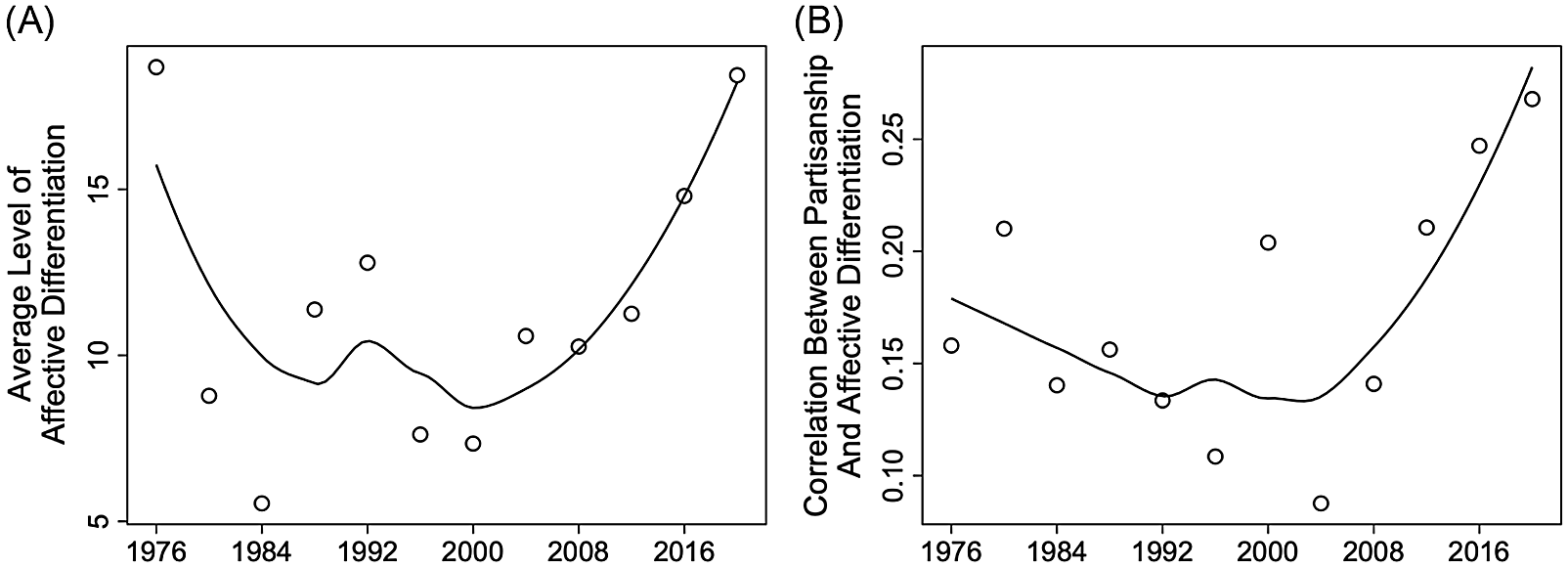
Before examining the 2016–20 panel data, we begin by tracking the change in affective differentiation and its correlation with partisan identity over time to place our primary analysis in context.Footnote 8 Panel A of Figure 1 displays the average level of affective differentiation from 1976 to 2016, with a LOWESS curve included. We observe a decline in affective differentiation from the 1970s through 2000, followed by an increase which accelerates in 2016 and 2020. In 2020, there is a gap of about 18.4 points where Black and Latine respondents rate their own group, on average, about 83.0 while rating whites 64.6, compared to, for example, ratings of 80.7 and 73.6 in 2000, for a difference of 7.1. In short, levels of affective differentiation are meaningfully higher in recent elections.
Average level of affective differentiation among Black and Latine respondents, where higher values indicate greater in-group favoritism (panel A) and its correlation with partisan identification (panel B) with LOWESS curves. Data: ANES Cumulative File, n = 7,422.
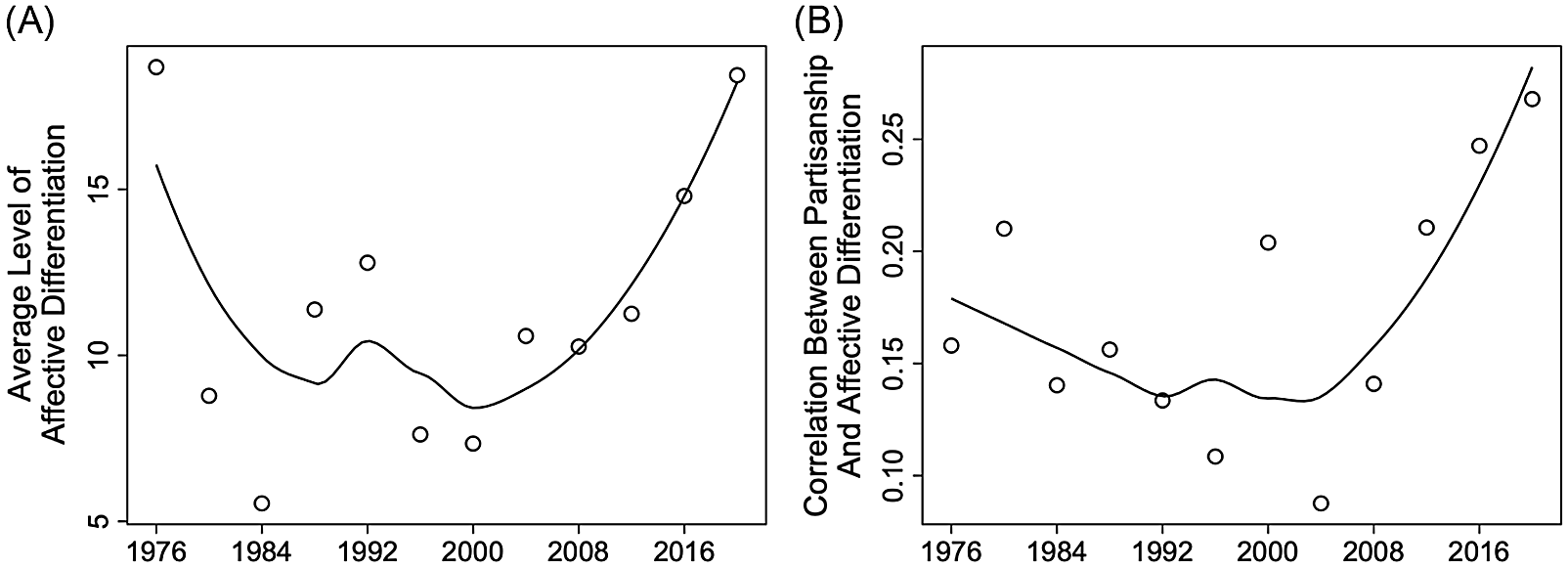
We next turn to the correlation between partisanship and affective differentiation, displayed in panel B of Figure 1. We find that the two share a stronger relationship in recent elections. The correlation declined in magnitude from the 1970s through 2004, followed by a marked increase from 2012 onward. The correlation reached a nadir of 0.088 in 2004, compared to an average of 0.242 from 2012 to 2020.
Not only has affective differentiation increased, but it also now shares a stronger relationship with partisanship. Among Black and Latine respondents, we observe increasingly different racial attitudes across partisan groups. Given the relatively low sample sizes of these groups—especially in earlier years—the change in the correlation is not always significant from year to year. However, when we pool years into three-election periods to increase the sample size, the most recent period is distinguishable from earlier periods. We discuss this in more detail in Section C of the SM.
What do these trends look like if we disaggregate the measure and look at in-group and white ratings separately? We assess this in more detail in the SM (Section D) but let us briefly discuss the general patterns here. We find that feelings toward one’s own group have held relatively steady since the late 1980s, with average ratings in the low 80s. Ratings of whites, on the other hand, have declined by roughly 9 points from 2000 to 2020, from 73.7 to 64.5. Turning to the relationship of each with partisanship, the correlation between partisanship and in-group affect has shown some fluctuation election-to-election but has remained relatively stable since 2004, averaging 0.182 during this period. The correlation between white affect and partisanship has increased in strength during this period, from a low of 0.034 in 2008 to –0.118 in 2020. While the correlation between ratings of whites and partisanship has strengthened, the relationship between partisanship and in-group feelings has been stronger in each year from 1976 to 2020. Interestingly, in the panel data we employ, ratings of whites show greater stability (r = 0.346) than ratings of one’s in-group (r = 0.215). We also note that both in-group and white ratings exhibited comparable levels of change from 2016 to 2020: the average absolute change for in-group ratings was 16.7, while for whites it was 18.6.
Assessing The Direction of Influence Between Partisanship and Affective Differentiation
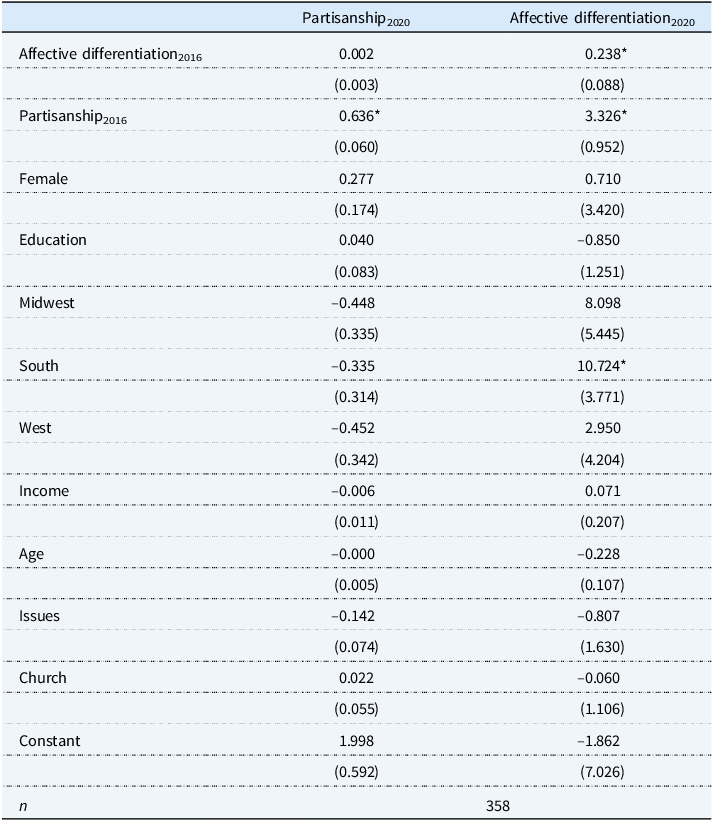
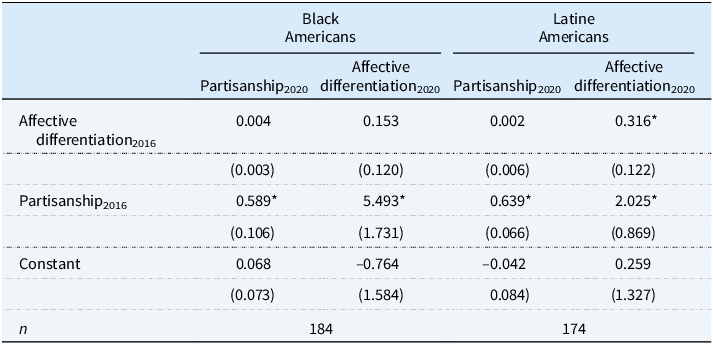
To investigate the direction of influence between the two orientations, we utilize the 2016–20 ANES Panel Sample. To do so, we specify a cross-lagged model (CLM), which allows us to assess the causal ordering of the variables (e.g., Enders and Lupton Reference Enders and Lupton2021; Finkel Reference Finkel1995; Evans and Neundorf Reference Evans and Neundorf2020). In the model, 2016 values of each variable predict values in 2020. We wish to be clear about the limitations of this analysis. In particular, we have a relatively small sample size and are restricted to only two waves. Further, while a CLM allows us to assess the relative contribution of lagged values, our model cannot definitively establish causality, as any causal interpretation hinges on having a correctly specified model. Moreover, while we control for observed confounders, we cannot eliminate all sources of bias, particularly from time-invariant unobserved factors and time-varying shocks between 2016 and 2020.Footnote 9 As such, while our analysis allows us some degree of confidence about the ordering of the two variables, its results are best characterized as associational. Given panel attrition, we weight the data to the 2016 electorate and estimate the model with full information maximum likelihood.Footnote 10 Results are presented in Table 1 where entries are coefficients (with standard errors in parentheses).
Cross-lagged model predicting partisanship and affective differentiation among Black and Latine respondents, 2016–2020. Data: ANES 2016–20 Panel Sample
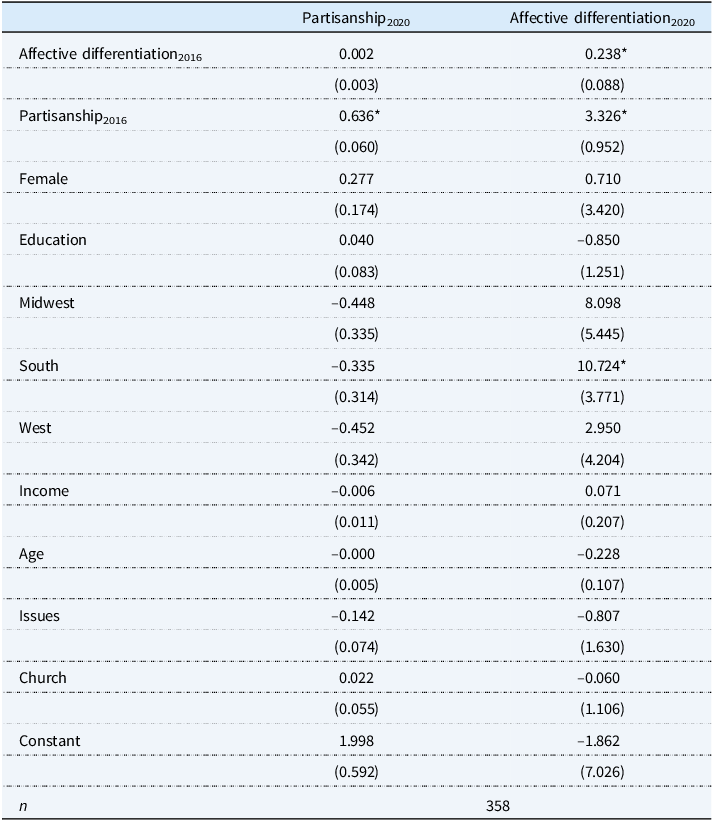
Note: Entries are MLE coefficients with standard errors in parentheses for variables of interest. *p < 0.05.
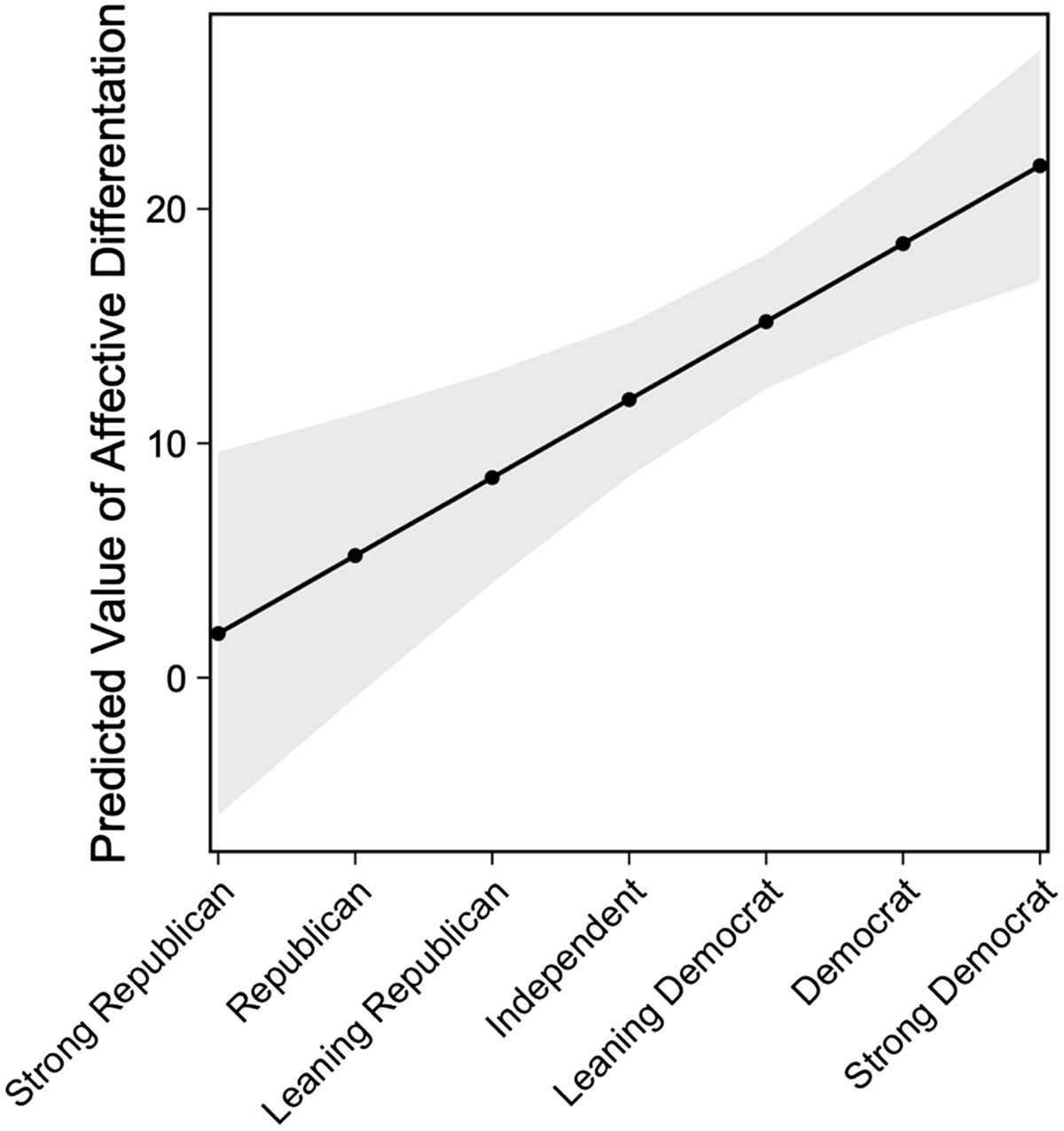
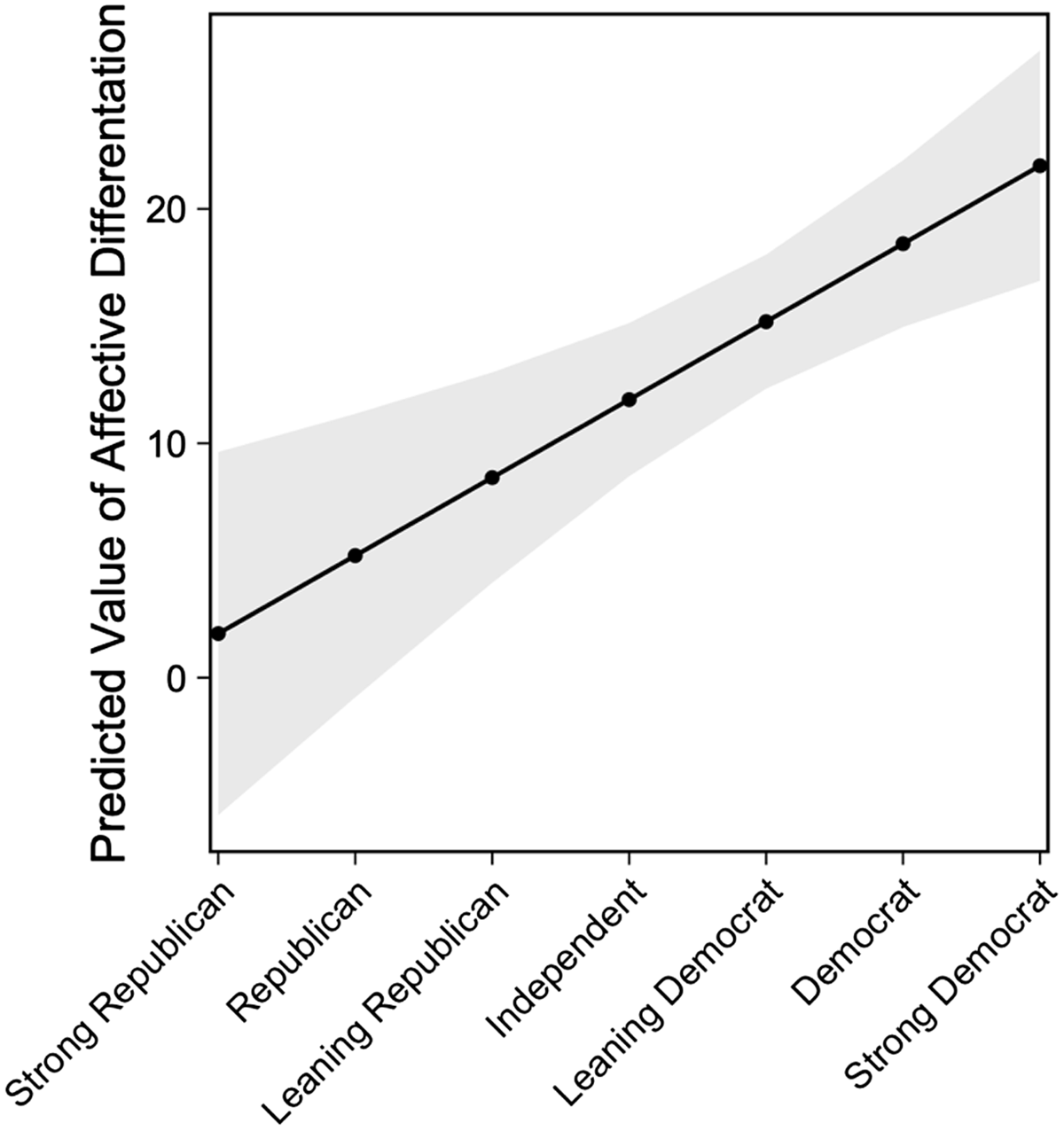
Our results suggest that as race has become more central to American politics, partisans have updated their racial beliefs, consistent with substantial evidence documenting the centrality of partisanship as a social identity. We observe that 2016 levels of partisanship predict both affective differentiation and partisanship in 2020 (p < 0.001). On the other hand, 2016 levels of affective differentiation predict current levels in 2020 (p = 0.007) but are unrelated to partisanship in 2020 (p = 0.465). To get a sense of the substantive relationship, we calculate predicted values and find that moving from pure independent to strong Democrat is associated with an increase of affective differentiation of 9.979 (95% CI: 4.379, 15.579). We display predicted values across the entire range of partisanship in Figure 2. Among Republicans and strong Republicans, the average difference in how one rates their own group relative to whites is indistinguishable from zero. While this owes in part to increased uncertainty due to a smaller number of observations, the levels of affective differentiation are quite low among these groups.
Predicted values of affective differentiation.
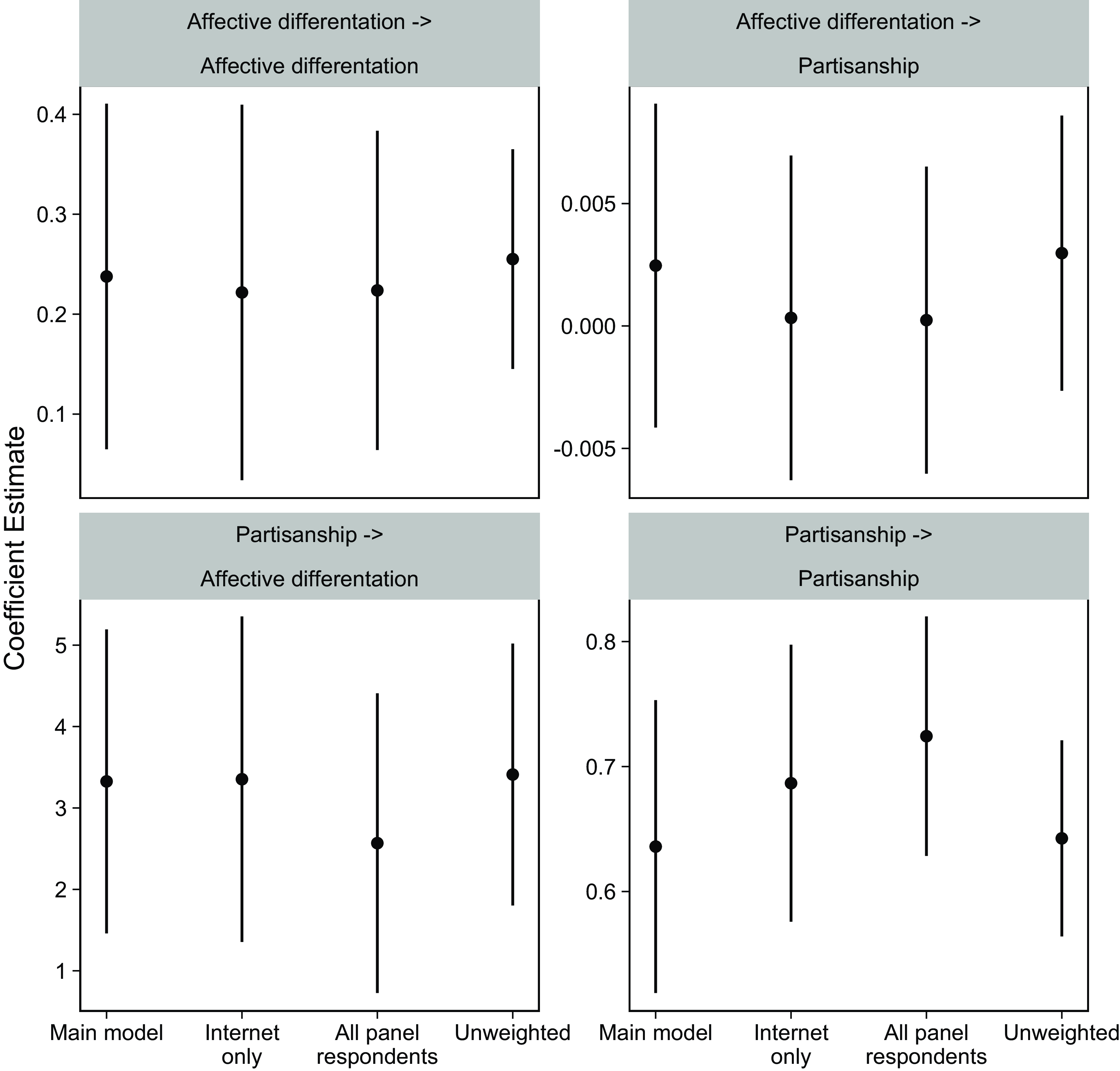
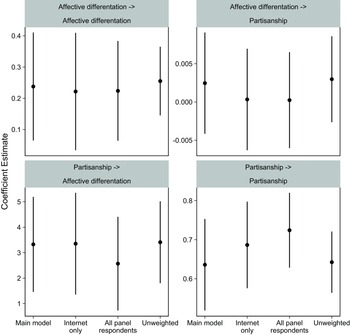
We examine the robustness of this result in several ways. First, we continue to restrict our sample to those interviewed online but exclude respondents with missing data. Second, we include the face-to-face sample from 2016. In both cases, we continue to weight to the 2016 electorate. Finally, we demonstrate that the decision to use weights does not drive our result. Full results of these analyses are presented in Section B of the SM. We present the coefficients of interest (with 95% confidence intervals) from each model, along with those from Table 1 as a point of comparison, in Figure 3. In the figure, the rows represent the independent variable while the columns represent the dependent variable. For example, the upper-right panel (“Affective differentiation -> partisanship”) displays the coefficients where affective differentiation is the independent variable and partisanship is the dependent variable. In other words, the top row of panels displays affective differentiation as the independent variable, while the bottom row of panels displays partisanship as the independent variable. In each case we observe that the estimates are quite similar across the choice of which respondents to include in the analysis and if we weight the data.
Estimated coefficients from primary model in Table 1 as well as alternative models to examine the sensitivity of the estimate to choices about respondent inclusion. Data: ANES 2016–20 Panel Sample.
As our main analysis pools Black and Latine respondents to increase the sample size, it is worth examining if the result holds for each group separately. We have argued that the measure should share a similar relationship with partisanship for both groups, but ultimately this is an empirical question. To assess, this, we estimate models for both groups and present the quantities of interest in Table 2, with full results in Section B of the SM. Columns 1 and 2 present the model for Black respondents, with models for Latine respondents in columns 3 and 4. The results are very similar to those in Table 1. In both cases, partisanship in 2016 is a significant predictor of both affective differentiation (p < 0.05) and partisanship (p < 0.05) in 2020, whereas affective differentiation in 2016 is unrelated to partisanship in 2020 for both Black (p = 0.208) and Latine (p = 0.783) Americans. A shift from independent to strong Democrat is associated with an increase in affective differentiation of 16.480 among Black and 6.076 among Latine respondents. In summary, analyses of over-time trends and recent panel data lead us to conclude that the increasingly strong relationship between partisanship and affective differentiation among Black and Latine respondents is largely driven by partisanship: stronger Democrats exhibit increased levels of affective differentiation.
Cross-lagged model predicting partisanship and affective differentiation among Black and Latine respondents, 2016–2020, for Black and Latine Respondents Separately. Data: ANES 2016–20 Panel Sample
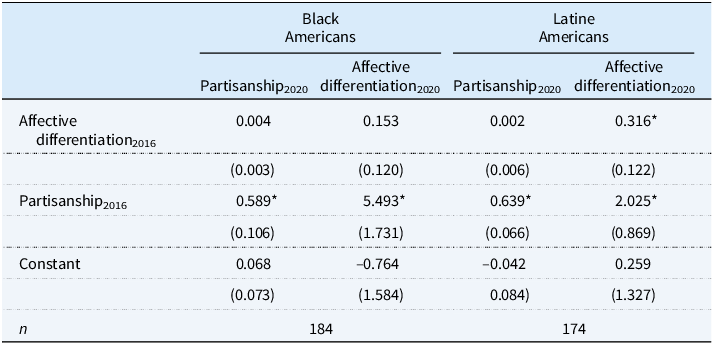
Note: Entries are MLE coefficients with standard errors in parentheses for variables of interest. Full results presented in SM (Section B). *p < 0.05.
Examining In-Group and Out-Group Ratings Separately
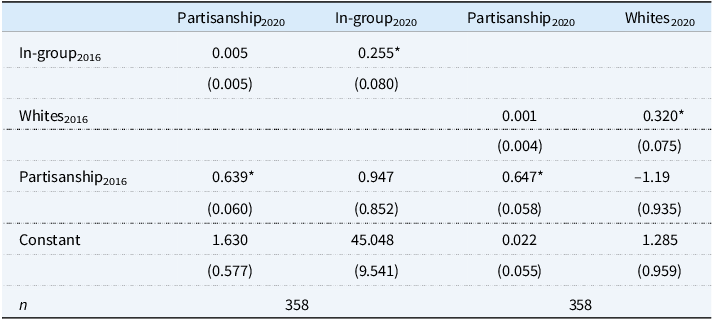
Having established that partisanship can predict affective differentiation, our focus now shifts to exploring the connection between partisanship and in-group and white thermometer scores separately. As noted, there are reasons to anticipate an asymmetric relationship between partisanship and the ratings of one’s own group and whites. As an initial test, we again utilize the 2016–20 panel data. However, the results are inconclusive. Consistent with the model in Table 1, we find that lagged values of feelings toward both groups are unrelated to partisanship. However, we find partisanship in 2016 is unrelated to feelings of either group on its own in 2020. We present the coefficients of interest in Table 3 with full results presented in the SM (Section D).
Cross-lagged models predicting partisanship and in-group rating (columns 1–2), partisanship and rating of whites (columns 3–4) among Black and Latine respondents, 2016 to 2020. Data: 2016–20 Panel Sample
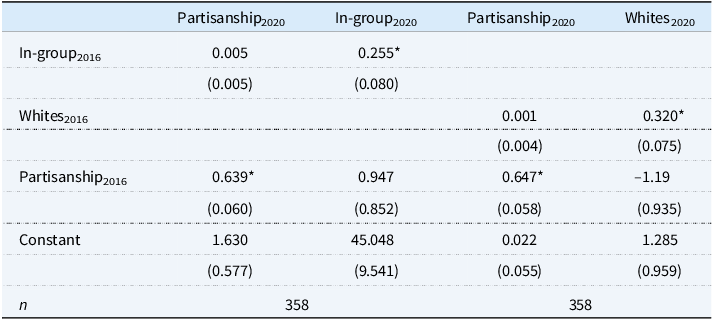
Note: Entries are MLE coefficients with standard errors in parentheses for variables of interest. Full results presented in SM (Section D). *p < 0.05.
To further examine the relationship between partisanship and racial attitudes, we increase our sample size by estimating a cross-sectional model in which we pool the ANES from 2012 to 2020 resulting in 1,539 Black and 1,709 Latine respondents to examine the contemporaneous association between the two orientations. We limit our analysis to these years given the increased correlation between partisanship and affective differentiation identified in Figure 1, where 2012 onward marks a meaningful shift relative to earlier years. Advantageously, the 2012 ANES includes an oversample of both groups increasing our sample size. We again utilize survey weights for this analysis.
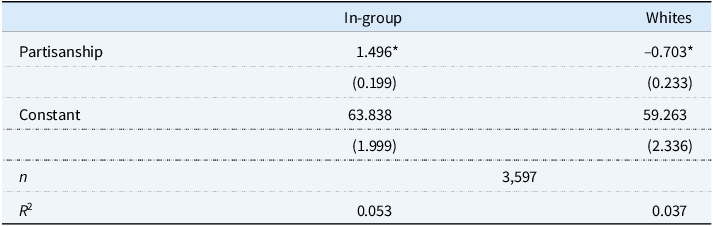
To assess the relationship between partisanship and feelings about one’s own group and whites, we estimate a seemingly unrelated regression (SUR) in which partisanship predicts feeling thermometer ratings of both one’s own group and whites. The SUR model allows for us to compare the size of the coefficient (in absolute value) for partisanship across the two dependent variables. Our justification for this model specification—with partisanship as the independent variable—follows from our earlier panel results in Table 1. We present the coefficients of interest, with standard errors in parentheses, in Table 4. Full results are presented in the SM (Section D).
The relationship between partisan identification and ratings of one’s own group and whites among Black and Latine respondents. Data: 2012–2020 ANES
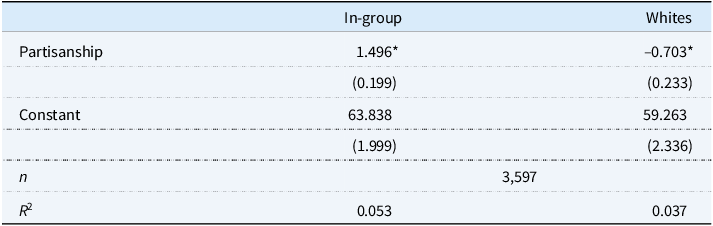
Note: Entries are coefficients with standard errors in parentheses for variable of interest. Full results presented in SM (Section D). *p < 0.05.
We observe that partisanship is associated with both feelings about one’s in-group and about whites. Most importantly for our purposes, the coefficient for partisanship in the in-group models is more than twice the size (in absolute value) compared to the model predicting ratings of whites and we can reject the null hypothesis that the coefficients are equal in absolute value (p = 0.028). Moving from a pure independent to a strong Democrat is associated with an increase of 4.5 points toward one’s own group and a decline of 2.1 toward whites. While feelings about both one’s own racial group and whites are related to partisanship, the relationship is meaningfully stronger for one’s own group.
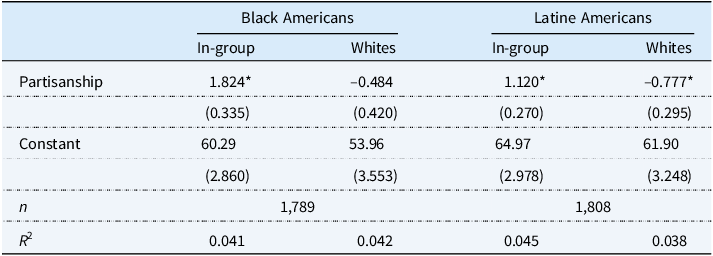
Earlier we found that affective differentiation shared a similar relationship with partisanship across both groups. Is this also the case with ratings of one’s in-group and whites separately? Though we have argued that the measure of affective differentiation should operate similarly for both, it is possible its individual components may not given the different dynamics at play in terms of partisanship for both groups. We re-estimate the model presented in Table 4 for both Black and Latine respondents separately. Coefficients of interest, those for partisanship, are presented in Table 5. Here we find among Black respondents only feelings about their own group relate to partisanship, while feelings about both groups share a significant relationship for Latine respondents. Moreover, among Latine respondents, we cannot reject the null hypothesis that the coefficients are equal in absolute value (p = 0.483) while we do for Black respondents (p = 0.033). This analysis indicates that while comparative evaluations of one’s own group and whites—as captured by the measure of affective differentiation—operate similarly across the two groups, this is not the case for the individual components that make up the measure of affective differentiation. The result suggests among Latines, identifying with the Republican party makes one more favorable toward whites, consistent with evidence that white identification is associated with Republican support (e.g., Cuevas-Molina Reference Cuevas-Molina2023), reflecting the dynamic nature of Latine identification.
The relationship between partisan identification and ratings of one’s own group and whites among Black and Latine respondents. Data: 2012–2020 ANES
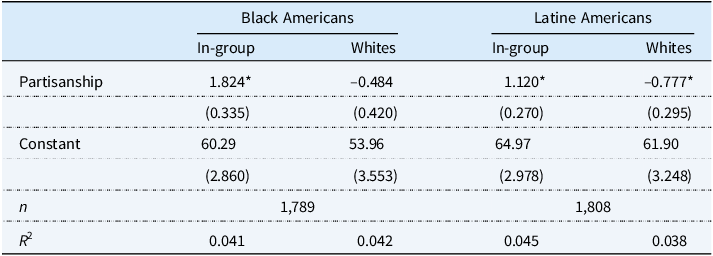
Note: Entries are coefficients with standard errors in parentheses for variable of interest. Full results presented in SM (Section D). *p < 0.05.
Conclusion
In this paper, we endeavored to extend research on feelings about racial groups and partisanship by focusing on Black and Latine Americans during a period marked by a heightened political significance of race. We found that like whites, there is an increased correspondence between the two orientations over the last 20 years. Panel data from two recent elections indicate that it is partisans updating their racial attitudes rather than increased partisan sorting by affective differentiation. Such a result is consistent with substantial evidence of partisanship as a powerful influence on other political orientations. A subsequent analysis demonstrates that partisanship relates more strongly to one’s in-group than to white Americans in our pooled sample and among Black respondents; among Latine respondents we find that partisanship shares a similar relationship with both ratings.
Our finding that partisanship drives this relationship is consistent with recent evidence among whites. Following Trump’s surprise victory in 2016, it seemed plausible that we were observing a sorting of racially resentful whites into the Republican Party. Yet, panel data indicates that it was partisanship (Engelhardt Reference Engelhardt2021) and candidate support (Enns and Jardina Reference Enns and Jardina2021) that were driving a change in racial attitudes rather than racially resentful whites abandoning the Democratic Party. Recent evidence indicates that many trends among whites do not necessarily extend to others in the electorate neatly (e.g., Enders and Thornton Reference Enders and Thornton2022; Zingher Reference Zingher2023). Here, however, we find that the pattern of partisanship influencing feelings about racial groups does indeed generalize beyond whites. Our findings are also consistent with evidence that recent anti-immigrant rhetoric has not meaningfully altered partisanship among Latine people (Hopkins et al. Reference Hopkins, Kaiser and Perez2023).
Our results have several substantive implications. First, increasing levels of affective differentiation that are more strongly related to partisanship indicate these identities—racial and partisan—could become increasingly linked over time. For Black and Latine Americans, this means that Democratic partisanship is increasingly intertwined with positive racial in-group affect—suggesting that the Democratic Party is not only a political home but also a symbolic one, affirming racial group identity in a political context marked by increasingly explicit racial rhetoric. This has implications for Democratic coalition maintenance, as it points to an emotional and identity-based anchor that may foster loyalty—but also may make societal divisions intractable (e.g., Mason and Wronski Reference Mason and Wronski2018). Moreover, our results also suggest that ambitious politicians may be able to further inflame existing divisions by increasingly tying feelings about racial groups to partisanship.
Our results also speak to the literature on Latine partisanship. While the literature on race and partisanship for both Black and white Americans is well-developed, less is known about Latine Americans. Evidence indicates that patterns of Latine party identification are unique in important ways, as they are shaped by country of origin and time spent in the U.S. (Alvarez and García-Bedolla Reference Alvarez and Garcia-Bedolla2003; Cain et al. Reference Cain, Kiewiet and Uhlaner1991) as well as if they were born in the U.S. (Abrajano and Alvarez Reference Abrajano and Alvarez2011). Our results squarely suggest that regarding the items considered here, Latine partisan identification operates in a manner similar to that of White and Black Americans. Further, our results are consistent with Cadena Jr. (Reference Cadena2023, 806), who finds that Latine Republicans minimize Republicans’ racial rhetoric and distance themselves from other Latines. In other words, by “positioning themselves in opposition to other racialized people” such individuals consequently express lower levels of affective differentiation. Similarly, Huddy et al. (Reference Huddy, Mason and Horwitz2016) find it is Democratic identifiers who most strongly identify as Latino. As the Latine electorate becomes more politically diverse (Corral and Leal Reference Corral and Leal2024), our expectation is that the relationship between partisanship and feelings about race will continue to strengthen. Further, given that our analyses indicates that partisanship predicts racial affect, a reasonable takeaway is that if Latine (and Black) voters move toward the Republican Party—as they appear to have in 2024—we should see lower levels of affective differentiation among these individuals. Examining the relationship between partisanship and racial attitudes among this set of voters is clearly needed moving forward.
No study is, of course, without its weaknesses. One weakness we identify is the relatively broad measure of racial affect based on feeling thermometers, which lack nuance and may be prone to noisy responses, limiting reliability. Future work might build on recent innovations measuring racial attitudes toward whites (e.g., Davis and Wilson Reference Davis and Wilson2022). An additional limitation is that, while panel data can be suggestive of the causal ordering between two variables, the models employed here cannot definitively establish causality and we need to be especially cautious with only two waves. Future experimental work might more thoroughly examine the possibility that partisanship can polarize racial attitudes by, for example, altering partisan framing to examine its influence on such sentiments. We conclude by nothing while the discipline has made strides to better understand the attitudes of the public beyond white Americans, future data collection efforts might focus on the dynamic nature of the attitudes of people of color in the U.S. Similarly, while we focus on Black and Latine Americans, future work might examine how other groups have responded to increased racial salience—for example, the response of Native American communities to elected officials using language similar to that during the Indian Removal Era (Allread Reference Allread2023). A broader understanding of how diverse groups interpret political cues will help build a more complete picture of public opinion in the United States.
Supplementary material
The supplementary material for this article can be found at https://doi.org/10.1017/rep.2025.10017
Funding statement
The authors declare that there are no funding sources to report.
Competing interests
The authors declare that there are no conflicts of interest associated with this submission.


 Open access

