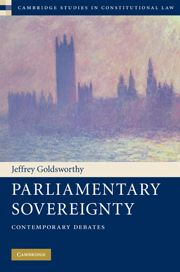
Book contents
- Frontmatter
- Contents
- Detailed table of contents
- Acknowledgments
- 1 Introduction
- 2 The myth of the common law constitution
- 3 Legislative sovereignty and the rule of law
- 4 Homogenising constitutions
- 5 Abdicating and limiting Parliament's sovereignty
- 6 Trethowan's case
- 7 Requirements as to procedure or form for legislating
- 8 Judicial review, legislative override, and democracy
- 9 Parliamentary sovereignty and statutory interpretation
- 10 Challenging parliamentary sovereignty: Past, present and future
- Index
- References
10 - Challenging parliamentary sovereignty: Past, present and future
Published online by Cambridge University Press: 05 October 2010

Book contents
- Frontmatter
- Contents
- Detailed table of contents
- Acknowledgments
- 1 Introduction
- 2 The myth of the common law constitution
- 3 Legislative sovereignty and the rule of law
- 4 Homogenising constitutions
- 5 Abdicating and limiting Parliament's sovereignty
- 6 Trethowan's case
- 7 Requirements as to procedure or form for legislating
- 8 Judicial review, legislative override, and democracy
- 9 Parliamentary sovereignty and statutory interpretation
- 10 Challenging parliamentary sovereignty: Past, present and future
- Index
- References
Summary
Introduction
Some critics portray the doctrine of parliamentary sovereignty as a myth that conceals the true nature of constitutionalism in Britain and other common law jurisdictions. In reality, they say, Parliament and the courts are engaged in a ‘collaborative enterprise’, with sovereignty divided between them; or the constitution is ultimately based on a common law ‘principle of legality’ which the courts, rather than Parliament, have ultimate authority to interpret and enforce.
Sometimes the critics really seem to be suggesting that the constitution is evolving inexorably in this direction. In fact, there are at least four different claims they might be making, which are not all mutually compatible. The first is that Parliament was never sovereign: that the doctrine of parliamentary sovereignty was always mistaken as a matter of law. The second is that, even if Parliament is accepted as sovereign today, this is a relatively recent deviation from a venerable constitutional tradition that should now be restored. The third is that even if Parliament was once sovereign, recent developments mean that it no longer is. The fourth is that even if Parliament was and still is sovereign, times are rapidly changing, and it is unlikely to retain sovereignty for much longer. Those who make the second, third or fourth claim often argue that parliamentary sovereignty is a doctrine of judge-made common law, which the courts may therefore unilaterally curtail. That argument has already been refuted.
Information
- Type
- Chapter
- Information
- Parliamentary SovereigntyContemporary Debates, pp. 267 - 318Publisher: Cambridge University PressPrint publication year: 2010
References
, ‘Parliament, the Courts, and the Collaborative Enterprise’ King's College Law Journal 15 (2004) 321 at 333Google Scholar
, Constitutional Review Under the UK Human Rights Act (Cambridge: Cambridge University Press, 2009), p. 414Google Scholar
, ‘Debunking the Idea of Parliamentary Sovereignty: the Controlling Factor of Legality in the British Constitution’ Oxford Journal of Legal Studies 28 (2008) 709CrossRefGoogle Scholar
, Judges and Unjust Laws, Common Law Constitutionalism and the Foundations of Judicial Review (Ann Arbor: University of Michigan Press, 2008)CrossRefGoogle Scholar
(ed.), Common Law Theory (Cambridge: Cambridge University Press, 2007), ch. 8.CrossRefGoogle Scholar
, ‘Dr Bonham's Case and “Void” Statutes’ Journal of Legal History 27 (2006) 111CrossRefGoogle Scholar
, ‘Bonham's case, Judicial Review and the Law of Nature’ (2009) J. of Legal Analysis 325CrossRefGoogle Scholar
, The Sovereignty of Parliament, History and Philosophy (Oxford: Clarendon Press, 1999), pp. 165–73Google Scholar
and (eds.), The Challenge to Westminster; Sovereignty, Devolution and Independence (East Lothian: Tuckwell Press, 2000), 22 at p. 24Google Scholar
, The Government of Scotland 1560–1625 (Oxford: Oxford University Press, 2004), p. 86.CrossRefGoogle Scholar
, ‘The Legal Provisions in the Acts of Union’ Cambridge Law Journal 66 (2007) 106 at 136, n. 137CrossRefGoogle Scholar
, Law and Opinion in Scotland During the Seventeenth Century (Oxford: Hart Publishing, 2007), pp. 322–4, 326 and 428Google Scholar
, Constitutional and Administrative Law in New Zealand (3rd edn) (Wellington: Thomson/Brookers, 2007), p. 544Google Scholar
, Introduction to the Study of the Law of the Constitution (10th edn) (London: Macmillan, 1959), p. 72Google Scholar
, ‘The Myth of Constitutional Dialogue: Final Legal Authority, Parliament and the Courts’ (2004) Bell Gully Public Lecture, 5 (unpublished, on file with author)Google Scholar
, Constitutional and Administrative Law in New Zealand (2nd edn) (Wellington: Brookers, 2001), pp. 3, 16Google Scholar
, ‘Of Fig Leaves and Fairy Tales: The Ultra Vires Doctrine, the Sovereignty of Parliament and Judicial Review’ Cambridge Law Journal 55 (1996) 122CrossRefGoogle Scholar
, ‘Constitutional Foundations, the Rule of Law and Supremacy’ Public Law 92 (2003) esp. at 107–10Google Scholar
, ‘The Common Law, Shared Power and Judicial Review’ Oxford Journal of Legal Studies 24 (2004) 237CrossRefGoogle Scholar
and , ‘Constitutional Analysis, Constitutional Principle and Judicial Review’ Public Law 763 (2001) esp. at 768–71.Google Scholar
, ‘Legislative Supremacy and Legislative Intent: A Reply to Professor Craig’ Oxford Journal of Legal Studies 24 (2004) 563CrossRefGoogle Scholar
, ‘The Theoretical Controversy Concerning Judicial Review’ Modern Law Review 64 (2001) 500, esp. at 501–6CrossRefGoogle Scholar
, and , Judicial Review of Administrative Action (3rd edn) (Sydney: Lawbook Co., 2004), pp. 101–2Google Scholar
, ‘Reading Down Statutes’, in (ed.), The Statute; Making and Meaning (Wellington: LexisNexis, 2004), p. 123Google Scholar
, ‘Courts, Statutes, and Public Policy: the Case of the Murderous Heir’ Southern Methodist University Law Review 53 (2000) 37Google Scholar
, Playing By the Rules: a Philosophical Examination of Rule-Based Decision Making in Law and Life (Oxford: Clarendon Press, 1991), pp. 209–10Google Scholar
, ‘Legislative Supremacy and the Rule of Law: Democracy and Constitutionalism’ Cambridge Law Journal 44 (1995) 111 at 127Google Scholar
, Constitutional Justice; a Liberal Theory of the Rule of Law (Oxford: Oxford University Press, 2001), pp. 211–12Google Scholar
, ‘Plaintiff S157: A case-study in common law constitutionalism’ Australian Journal of Administrative Law 12 (2005) 115 at 117 and 125Google Scholar
, and (eds.), The European Court and National Courts; Doctrine and Jurisprudence (Oxford: Hart Publishing, 1998), 195 at p. 204Google Scholar
, ‘The Statutory Protection of Rights and Parliamentary Sovereignty: Guidance From the United Kingdom?’ Public Law Review 17 (2006) 188 at 195Google Scholar
, EC Membership and the Judicialization of British Politics (Oxford: Oxford University Press, 2001), p. 182CrossRefGoogle Scholar
, Constitutional Review Under the UK Human Rights Act (Cambridge: Cambridge University Press, 2009), ch. 11Google Scholar
, An Introduction to the Study of the Law of the Constitution (10th edn), , (ed.) (London: Macmillan, 1959), p. 40Google Scholar
, ‘Supremacy of Parliament and the European Law’ Law Quarterly Review 96 (1980) 511 at 513Google Scholar
and , Federal Constitutional Law, A Contemporary View (2nd edn) (Sydney: Lawbook Co., 2006), pp. 226–41Google Scholar
, Constitutional Problems of the European Union (Oxford: Hart Publishing, 1999), pp. 172–3
and (eds.), The Changing Constitution (6th edn) (Oxford: Oxford University Press, 2007), 84 at p. 97Google Scholar
, ‘Reflections on Jackson v. Attorney-General: questioning sovereignty’ Legal Studies 27 (2007) 1 at 12–13CrossRefGoogle Scholar
, ‘The Human Rights Act and the Politicians’ Legal Studies 24 (2004) 451, esp. at 454–5CrossRefGoogle Scholar
, ‘Parliamentary Sovereignty and the New Constitutional Order: Legislative Freedom, Political Reality, and Convention’ Legal Studies 22 (2002) 340CrossRefGoogle Scholar
, ‘United Kingdom: Parliamentary Sovereignty Under Pressure’ International Journal of Constitutional Law 2 (2004) 545CrossRefGoogle Scholar
, ‘Section 7 of the Charter: Substantive Due Process’ (1984) 18 UBC Law Review 201 at 242Google Scholar
, ‘The Changing Approach to the Interpretation of Statutes’ Victoria University of Wellington Law Review 33 (2002) 981 at 982–3Google Scholar
, ‘Nationality, Alienage and Constitutional Principle’ Law Quarterly Review 123 (2007) 417 at 417Google Scholar
and , Statutory Interpretation in Australia (5th edn) (Sydney: Butterworths, 2001), p. 131Google Scholar
and , ‘Quasi-Constitutional Law: Clear Statement Rules as Constitutional Lawmaking’ Vanderbilt Law Review 45 (1992) 593Google Scholar
, ‘Legislative Supremacy and the Rule of Law: Democracy and Constitutionalism’ Cambridge Law Journal 44 (1985) 111CrossRefGoogle Scholar
, ‘Controlling the Use of Parliamentary History’ New Zealand Universities Law Review 18 (1998) 1 at 44Google Scholar
, ‘Parliamentary Sovereignty Under the New Constitutional Hypothesis’ Public Law 562 (2006) 575 (emphasis added)Google Scholar
, A Course of Lectures on the English Law Delivered at the University of Oxford 1767–1773, (ed.) (Madison: University of Wisconsin Press, 1986), vol. I, p. 141Google Scholar
, ‘Review of Inquiry into the Rise and Growth of the Royal Prerogative in England, by James Allan’ Edinburgh Review 52 (1830) 139 and 142Google Scholar
, The Province of Jurisprudence Determined, H.L.A. Hart (ed.) (London: Weidenfeld & Nicholson, 1954), pp. 257–8Google Scholar
, ‘Beyond the Rule of Law: Towards Constitutional Judicial Review’ Public Law 671 (2000) 675Google Scholar
and , Cases in Constitutional Law (4th edn rev.) (Oxford: Clarendon Press, 1959), p. 10Google Scholar
, ‘Illegality and the Problem of Jurisdiction’, in M. Supperstone and J. Goldie (eds.), Judicial Review (2nd edn) (London: Butterworths, 1997), 4.17Google Scholar
Accessibility standard: Unknown
Why this information is here
This section outlines the accessibility features of this content - including support for screen readers, full keyboard navigation and high-contrast display options. This may not be relevant for you.Accessibility Information
Accessibility compliance for the PDF of this chapter is currently unknown
and may be updated in the future.