

Windows there are none in our houses: for the light comes to us alike in our homes and out of them, by day and by night, equally at all times and in all places, whence we know not. It was in old days, with our learned men, an interesting oft-investigated question, “What is the origin of light?” and the solution of it has been repeatedly attempted, with no other result than to crowd our lunatic asylums with the would-be solvers.
Edwin A. Abbott, Flatland, A Romance of Many DimensionsElizondo and Mathematics
“Grünewalda o una fábula del infinito,” a narration by the Mexican author Salvador Elizondo included in his 1969 collection El retrato de Zoe y otras mentiras, begins with an epigraph taken from The Principles of Mathematics, a book written by Bertrand Russell in 1900 and first published in Reference Russell1903: “Mathematics uses a notion which is not a constituent of the proposition which it considers, namely the notion of truth.”
The truth is one of the most fundamental concepts in mathematics and the preoccupation for this notion is shared by both Elizondo and Russell. But this is not the only overlap between mathematics and Elizondo. He uses mathematics in many ways throughout “Grünewalda.” For example, he discusses specific mathematical and logical problems and proposes his own literary solutions; he utilizes mathematical symbolism in such a way that important parts of “Grünewalda” give the impression of being taken directly from a mathematical textbook. And last but not least, his writing resembles the structure and nature of mathematical logic discourse.
It was the so-called Pythagoreans who most likely first assumed that the principles used in mathematics apply to all existing things. They arrived at this notion on the basis of their work on arithmetic, the branch of mathematics that deals with properties and manipulation of numbers. They claimed not that numbers are things but that all things are numbers. They discovered that the properties and relations of musical harmony correspond to numerical relationships and that in other natural phenomena analogies corresponding to numbers are found. Pythagoreans also believed that planets and stars move according to arithmetical rules that correspond to a musical partiture and thus produce an inaudible symphony of heavens.
But this arithmetization proposed by the Pythagoreans had a tragic outcome. The well-known Pythagoras theorem led to the discovery of incommensurables, which appeared to disprove his whole philosophy (Reference RussellRussell 1945, 35). This event is said to had been so shocking that Pythagoreans first tried to keep it in secret. And when Hippasus of Metapontum, one of the members of the scholar community founded by Pythagoras, revealed its content, he was drowned at sea, apparently as a punishment from the gods.
This arithmetization of the universe and of its corresponding way of knowing it has been revisited in many occasions with comparable tragic outcomes, in particular, at the end of the nineteenth century, when the German mathematician Georg Cantor audaciously explained infinity and when the concept of number was properly defined by fellow German philosopher, mathematician, and logician Gottlob Frege and by the English philosopher, logician, mathematician, and writer Bertrand Russell. As a consequence, in a variety of fields, this approach was adopted. Systems of knowledge were modeled and developed, and theoretical problems were undertaken—in philosophy, symbolic representation, language, logic, and mathematics—around a strategy of assimilating different notions and properties to number-related principles.
Two important moments of arithmetization can then be singled out. A first one around the Pythagoras time, about 532 BC, and a second one around the end of the nineteenth century. In both cases, the emphasis is on reasoning and thought and not on technical properties and practical applications of numbers. Moreover, the work of Pythagoras gave birth to the notion of pure mathematics in the sense of demonstrative deductive argument. This fact directly connects with the works on numbers carried out at the end of the nineteenth century around the flaws in the definition of number. To fix these fundamental problems once and for all, an extremely complex abstract system—the mathematical logic—was developed. This article shows how Elizondo skillfully crafts a literary version of this general approach by means of an arithmetization of writing and how that process helps contextualize “Grünewalda.”
The narrative work of Elizondo is frequently described as an original and uncertain writing adventure. His fragmented, experimental, complex, and above all, personal aesthetic agenda redefines the acts of writing and reading. In his so-called novels, such as Farabeuf, crónica de un instante (1965) and El hipogeo secreto (1968), and in some of his collections of stories—El retrato de Zoe y otras mentiras (1969), El grafógrafo (1972)—the reader is exposed to a fabric of extreme incoherence and lack of conventionality in both plot and characterization.
A number of scholars have established connections between Elizondo’s fictional work and Western philosophy and critical theory. For example, Victorio G. Agüera (Reference Agüera1981, 16) claims there is an affinity between the mental image proposed by Elizondo and the one defined by both Edmund Husserl’s phenomenology and by Ludwig Wittgenstein in his Tractatus Logico-Philosophicus. Carol Clark D’Lugo points out the shift from story to discourse in Elizondo’s writing in Farabeuf, which for Agüera is no other than an example of Derrida’s écriture. The focus on discourse rather than on story, however, has been commonly associated with Alain Robbe-Grillet and the nouveau roman. D’Lugo (Reference D’Lugo1985, 155) explains that in Elizondo’s Farabeuf, as in many novels of the twentieth century, the attention is put “on the way of telling instead of on what is the telling.”
It is very likely that some of those theories and authors used to study Elizondo’s work are precisely the same ones he actually read and admired. It is also plausible to affirm that most of his direct and indirect references to Frege, Cantor, and Russell, and to mathematics and logic in general, might have been filtered through his readings of Ludwig Wittgenstein, Rudolph Carnap and other authors associated with the logical empiricism of the Vienna Circle. In fact, in the preface to his Tractatus Logico-Philosophicus, Wittgenstein (Reference Wittgenstein and Ogden2009, 4) acknowledges his debt to “the great works of Gottlob Frege and the writings of my friend Bertrand Russell.” Consequently, it is perhaps Frege and Russell, and not Wittgenstein, who are the main reason behind Elizondo’s writing of, for example, “Tractatus rethorico-pictoricus” and “El objeto,” two of the twenty texts included in El grafógrafo. In what follows, I provide what is probably the first mathematical reading of Elizondo’s “Grünewalda.” It is certainly possible to determine certain recurring plots and themes in most of his texts, namely the representation of reasoning and thought, and the addressing of notions of truth and identity, that are akin to the raw material used by mathematicians and logicians in their work. In fact, it is in the overlap with logic and mathematics where Elizondo’s characters, plots, and feverish fable most remarkably surface.
Writing the Act of Writing
Agüera, an early critic of his work, explained in 1981 that Elizondo’s writing shows explicitly the strategy of its own construction, affirms the impossibility of its narration, and becomes the narration of this impossibility. He goes on to stress Elizondo’s Platonism, which leads the Mexican writer to update Descartes’s cogito ergo sum, or I think therefore I am, to scribo ergo sum, I write therefore I am. Rather than conveying traditional, conventional, and realistic narrations of stories, Elizondo seems to privilege the rhetorical components of language, a writing for writing’s sake style. Elizondo himself hinted that his preoccupation was not narrating stories but writing itself. This, in turn, coincides with the way mathematical logic operates.
It is in his “Tractatus rhetoricus-pictoricus,” the twelfth narration included in El grafógrafo, that Elizondo (Reference Elizondo2000, 63–64) establishes writing as the only possible real and concrete form of thought.Footnote 1 This precept has at least two main visible features. On the one hand, it has a powerful yet chaotic temporal connotation: not only is the conventional flow of time totally subverted (Elizondo diminishes the organizing function of time in narration), but time becomes a self-referential element of the narration. On the other hand, to capture the act of writing, he adopts what he calls a photographic style of writing. Given that writing is cursive and successive, it is impossible to attain its instantaneity; instead, only a reflex of such instantaneity is achievable, which leads him to this photographic solution.Footnote 2
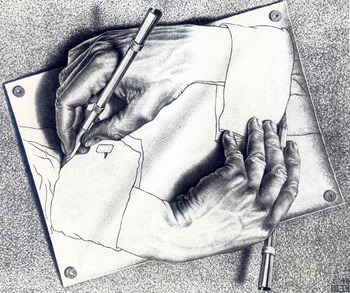
As a consequence, as their constructions unfold, his texts typically display strong visual structures. In fact, an image might be useful to illustrate this. Drawing Hands (Figure 1), the 1948 lithograph by the Dutch artist M. C. Escher, shows how, from two wrists drawn on a sheet of paper, emerge two hands that are drawing themselves.
Drawing Hands, lithograph by M. C. Escher, 1948 (Reference Escher and BrighanEscher 2007, 69).

The notion of drawing the act of drawing, and of capturing the hand in the process of drawing itself, is similar to Elizondo’s take on writing. More important, it conveys the idea of elevating a sensible experience—drawing, writing—to a predominant mental status. The text ends up writing itself and therefore behaves as a space-time traveler. One of Elizondo’s goals is to shorten the distance between original conception and its formal conception through the writing process. But it also makes explicit an enthralling identification between character, writer, and writing in a narration. He credits the procedure he followed to compose the short story “La historia según Pao Cheng,” included in the 1966 collection Narda o el verano, as a turning point in his work. The order he displays in this text, he explains, is visual and constitutes the backbone of the narration sequence. This allows him to play, at the same time and level, with the character and the writer. In this way, he declares, he experienced the epiphany of what was to become his artistic stance (Reference RuffinelliRuffinelli 1977, 38).
Texts Traveling through Time
It may be argued that the basic plot and the selected cast of characters of “Grünewalda” are conveniently used not only to freely represent a literary fable but also to mirror a key part of the common theoretical and historical evolution of mathematics and logic. In a similar way that, for example, many concrete and transcendental historic events or figures are the source of inspiration for countless artistic creations, a subtle account of a crucial chapter in the history of mathematics, where mathematics was found to be derivable from logic, seems to constitute the foundation of “Grünewalda” and, in general, of Elizondo’s writing.
Elizondo himself reinforces this assessment of his own art. In El extraño experimento del profesor Elizondo (dir. Gerardo Villegas Rodríguez, Mexico, 2007), a documentary produced in 2007 to commemorate the first anniversary of Elizondo’s death, he can be seen explaining the essence of his approach. After making a distinction between spoken, literary and technical languages, Elizondo declares that his intention had been modifying the order of literary writing by means of assimilating and adapting technical languages (e.g., medical, mathematical, logical) to produce another type of literature. This, according to him, represents his only original contribution to the art of writing. In the same documentary, the Mexican filmmaker Pablo Sigg corroborates this by affirming that Elizondo writes in an unusual, neutral and somehow scientific Spanish, a language with no clear literary antecedents.
It is very likely that Elizondo chose the name “Grünewalda” (from the German grünewald meaning “green forest”) after the sixteenth-century German painter Matthias Grünewald, the creator of the Isenheim Altarpiece, currently at the Alsatian Musée d’Undertlinden, in Colmar, France. The structural concepts of this altarpiece coincide with those of Elizondo’s narrations. An altarpiece is conceived to be an ensemble of several panels, mainly painted on wood, that allows both simple and compound views depending on the opening or closing of those panels.Footnote 3 Therefore, like in Elizondo’s stories, the altarpiece represents a simultaneous assembly of time and space and of superposed narrative planes.
At least two plot levels are depicted in “Grünewalda.” First, there is what appears to be a conventional story: Grünewalda goes through a failed mathematical or surgical procedure to stay forever young, but she dies during the procedure, while her young daughter, Karola, ends up with Grünewalda’s lover, the narrator. On another level, the narration conveys a complex mathematical-logical and temporal intrigue. These two plots are so essentially intertwined that the narration makes them indistinguishable and interchangeable. In fact, this type of blend, typical of Elizondo’s texts, matches a process, and its implications, used in mathematical logic. Invoking numbers as abstract entities, not related to any concrete geometrical reference, studying their properties in mere theoretical fashion and developing an abstract realm with no regard to any physical experience, along with a practical system of notation—almost an artificial language—represents a strategy used in mathematical logic that may be assimilated to a process modeled after arithmetic. The theoretical bodies thus constructed have the property of laying out a chain of interchangeable levels in which elements belonging to different categories interact. In the case of Elizondo, texts are treated as abstract entities, not related to any concrete reference; and they have the property of laying out a chain of innumerable and interchangeable levels, just like the panels of the Isenheim Altarpiece, in which elements belonging to different manifolds of reality and fiction interact.
This last property can be verified, for example, in the ninth fragment of “Mnemothreptos,” the ninth text of El grafógrafo. In this text, the Mexican writer presents a dialogue between Sydney Greenstreet and Peter Lorre, both of them actors in films starring Humphrey Bogart, The Maltese Falcon (1941) and Casablanca (1942), respectively. However, by intervention of the author, Greenstreet eventually ends up talking not to his fellow actor, but to Joel Cairo, Lorre’s character in The Maltese Falcon. This triggers a complex interaction between different levels of reality and fiction, as well as between different narrative levels.
In a similar twist, in “Futuro imperfecto,” the fourteenth narration of El grafógrafo, Elizondo and Enoch Soames, the main character (and title) of a short story by the English author Max Beerbohm, are put in the same level of narrative reality. This, besides being consistent with the spirit of Beerbohm’s text, suggests not only a celebration of the literary possibilities time travel provides but also, most importantly, a reaffirmation of the imbrication of the reading and writing levels as the key element of his beliefs.Footnote 4
The character of Enoch Soames in Beerbohm’s story is an aspiring writer, initially described as dim or invisible, and later on portrayed as a rather tragic figure, who would die for want of recognition. To find out whether posterity treats him well, Soames makes a pact with the devil in order to travel to 1997, one hundred years in his future, so he can visit the British Museum’s reading room to consult the catalogs, for he must verify if his name is there. But the only publication he finds associated with his name is a short story written by Beerbohm (Reference Beerbohm and Cecil1970, 55–86). When he goes back to 1897, he urges Beerbohm, the character, to write that story, which is actually the same one that Beerbohm, the author, has been unfolding. In “Futuro imperfecto,” a character named Elizondo is given the assignment of writing about the future. As he considers ideas for this text, he ends up talking with a strange visitor who happens to be none other than Enoch Soames. This incarnation of Soames gives Elizondo the final version of the text, the one he is about to start writing. Elizondo claims that all he has to do, in order to comply with his assignment, is to type it. Once he does that, he burns Soames’s copy and sends the new one to his publisher. And that is precisely the plot of the story anybody can read in “Futuro imperfecto.”
We can find similar manipulations of time, space, and reality and fictional levels in “Grünewalda.” The narrator’s perspective fluctuates between a seemingly linear plot, the procedure Grünewalda goes through at a Doctor Kristalo’s surgical-mathematical laboratory, and the retelling of how this event is being written. This is carefully seasoned by an erratic performance of time: one hundred years seem to be the same as thirty-three minutes, or three years. It comes as no surprise that the narration deals simultaneously with both the story of Grünewalda and the prefiguration of writing about it.Footnote 5
In Search of the Truth of Infinity
Russell’s epigraph, the opening line in “Grünewalda,” contends that the notion of truth is somehow an external measurement to the propositions mathematics considers. It is like the truth belongs to the realm of logic and not to that of mathematics. Hence, the epigraph alludes to a proposal that looks for a solution to this gridlock. According to author David M. Burton (Reference Burton1999, 631), this situation called for an “uncompromised insistence that logic and mathematics were related as earlier and later parts of the same subject, that mathematics was ultimately derivable from logic alone.”Footnote 6 Thus, Burton concludes, logic was not simply an instrument in the construction of mathematical theories; mathematics became the offspring of pure logic. And the process at the interior of logic to achieve this goal revolved around the foundations of arithmetic. In other words, this process represented an arithmetization of logic. The reason for Elizondo to include this epigraph is therefore relevant and meaningful.
To make matters more complicated, Elizondo makes sure that a text that begins to be built around the notion of truth quickly turns its attention to the equally stubborn concept of infinity, another paramount philosophical and mathematical problem. There is an initial tone of nostalgia in the narration of “Grünewalda” apparently due to the fact that infinity, a concept so closely associated with principal and traditional human preoccupations—death, hell, love, night—seems to have become just another subdued topic, a derivative of astronomy and mathematics. However, and more importantly for the turn of events in the narration, beyond addressing the pertinence of this yearning and the possible meanings of infinity, Elizondo focuses on the related verbal consequences such an inquiry implies. While infinity is a very unique word, asking about its significance is not particularly different than asking about the significance of any other word. And yet the word defiantly stands out for it also entails the meaning of all of the existent words. It is at this point that Elizondo proposes an unattainable task: determining the truth of infinity. Elizondo explores the connections between mathematics and literature to test both systems’ explanatory logics. Ultimately, he argues that literature can go where mathematics can’t, that is, to questions of truth rather than mere exactitude.
What options are then left for a writer like Elizondo? In this light, instead of pondering the notion of truth, the only plausible alternative seems to be exploring the notion of falsity. Thus, to Elizondo, the obvious answer to the question about the truth of infinity is to lie. To fable about infinity. This literary and logical upgrade of lying (let’s not forget that “Grünewalda” is one of the texts included in El retrato de Zoe y otras mentiras) is therefore what is behind Elizondo’s notion of fabling. In fact, this scheme epitomizes what writing is about for him. In “Grünewalda” he claims that the true essence of lying has to be the truth and that, in spite of the synthetic nature of such reasoning, it is the result of efficiently applying logic.Footnote 7
The narration, the character of Grünewalda and the surgical-mathematical procedure exemplify Elizondo’s futile attempt to capture, like in a snapshot, the instant reflex of writing and the impossibility of its narration. Elizondo proclaims in “Grünewalda” that the relationship between the Impossible and the Infinite (he capitalizes both words) is not so inexplicable after all. That relationship, in agreement with his photographic approach, can be specified as an act of sight. But on pondering the notions of infinite, truth and identity, he eventually takes a verbal detour. It is at this moment that he explicitly invokes the philological aspects of the surgical-mathematical operation he is narrating and of the considerations he is making. He suggests that the actual goal of the operation is to achieve the conjunction of geometry and grammar.Footnote 8
This reasoning is consistent with what Bertrand Russell himself stated regarding mathematical knowledge. According to Russell, mathematical knowledge is not empirical and not a priori knowledge about the world. It is in fact merely verbal knowledge.
The operation on Grünewalda is not only a surgical-mathematical procedure. It is also a verbal one. Above all, it is an impossible writing effort. Grünewalda pretends to defy time so she can go back to a certain point in the past to stay there and remain forever young. But she does not anticipate that this cannot be, by any means, an isolated event. Everything and everybody will be affected. Most notably her fifteen-year-old daughter, Karola. For if the operation is successful and Doctor Kristalo manages to turn the time back to that point in the past, then the mere existence of Karola will be neglected. This troubling realization gets worse when the mathematical implications of the procedure—the complexities of the mathematical notion of infinity—surface. As things start to go wrong and as the anxiety about Grünewalda’s uncertain status increases, the narrator takes time to lustfully contemplate Karola as Grünewalda’s replacement. It is not clear how, but the intervention of an expert mathematician is desperately required and obtained. An old Professor Frege, using what appears to be a mix of high school algebra and advanced symbolic notation, rather than making the decisive mathematical contribution for the triumph of the operation, proves its impossibility on the grounds of the potential disappearance of Karola. The final outcome of this first plot is that Grünewalda’s attempt to get younger and live forever fails. She dies, and Karola and the narrator end up romantically involved.
The Alephs
The other characters in the story are displayed at the rhetorical level and belong to mathematical and logical backgrounds. At times, this plot resembles a very ambitious and specialized academic text, only that it lacks references and exhaustive explanations. The discussion between the Impossible and the Infinite, however, initially leads to challenging linguistic departures from the logical-mathematical scope. Aspects such as plausible equivalence, attributed to a Professor Köffenitz of Friburg, between the terms used to design the basic interminable line or letter in the roots of Indo-Germanic languages, and the continuous linear look at the Tantric secret patrimony, give way to a litany of distinguished names whose diverse academic fields and works seem to be related to the evolution of linguistic studies: the British Tibetologist David Smellgrove (1920–2016), the Austrian ethnologist Cristoph von Fürer-Haimendorf (1909–1995)—Elizondo refers to him as “von Führer-Heimensdorf”—the Austrian psychiatrist and creator of analytical psychology Carl Jung (1875–1961), the Romanian historian of religion Mircea Eliade (1907–1986), and the fourteenth-century medieval philosopher and grammarian Thomas of Erfurt.
But it is in the mathematical-logical realm—Elizondo seems to dismiss one narrative for the other—where the characters have an effect on the story’s outcome. This plot not only mimics the fundamental concepts of the turn-of-the-century period, but it also references specific events and characters. Some of those characters are explicitly summoned, like Bertrand Russell or George Boole. Elizondo brings up a controversy between these two English scholars regarding the truth of the true identity of falsehood. Professor Frege, in contrast, is none other than Gottlob Frege. There is another central character whose name is never mentioned but whose presence is indisputable and essential throughout the narration: Georg Cantor, whose work on the notion of infinity led to the creation of the revolutionary transfinite numbers and of set theory.
Elizondo seems to be aware of the real-life plot that connects Cantor, Frege, and Russell and conveniently uses it as backdrop for the story of “Grünewalda.” Cantor, for example, spent most of his late years going in and out of sanatoriums, until his death in 1918. Stephen Hawking refers to Cantor as someone who “scaled the peaks of infinity and then plunged into the deepest abysses of the mind: mental depression” (Reference HawkingHawking 2007, 1331). Frege had major academic setbacks, most notably because of a fundamental error in his theory found by Russell. Another dramatic ingredient of this real-life plot that Elizondo somehow captures in “Grünewalda” has to do with the perception of Cantor and Frege by their contemporaries. While Cantor was a mathematical heretic (Reference BurtonBurton 1999, 607), Frege was overwhelmingly ignored (Reference Potter, Ricketts and PotterPotter 2010, 28).
In a similar fashion to what happened with, for example, cosmology or geometry, the traditional and accepted classical Aristotelian logic was revised at the end of nineteenth century and a modern logic was created.Footnote 9 The founder of modern logic was Gottlob Frege and his work can be described as mathematical logic. Frege’s goal was to reduce arithmetic (and numerical analysis) to logic. He looked to define arithmetic notions from pure logic notions and to deduce arithmetic theorems from logical principles. In this way he created a more precise, flexible and powerful logic. In 1879 he published a book whose German language title, Begriffsschrift, is usually translated into English as “Ideography,” “Concept Writing,” or “Concept Notation.” Frege developed a formula language for pure thought, modeled on that of arithmetic. In other words, his ideography is a language constructed from special symbols that are manipulated according to definite rules. Frege’s attempt may be thus labeled as an arithmetization of thought and represents an extraordinary departure from Aristotle’s limited system of reasoning. Frege’s effort represents, with no literary intent whatsoever, a first attempt to relate arithmetic and writing that turns out to be similar to Elizondo’s take on writing. Among Frege’s fundamental contributions, it is usually mentioned the truth-functional propositional calculus; the analysis of a proposition into function and argument(s) instead of subject and predicate; the theory of quantification; and a logical definition of the notion of mathematical sequence (Reference van Heijenoortvan Heijenoort 1967, 1).
Begriffsschrift was “a mere booklet of eighty-eight pages” (Reference van Heijenoortvan Heijenoort 1967, 1), which was also very slow in winning recognition. In fact, it was mostly ignored. Then, in 1902, having completed The Principles of Mathematics, Bertrand Russell began to study the works of Frege. He found that many of the views put forward in his book had been anticipated by Frege (Reference Russell and GriffinRussell 1992, 243). Russell explains that, for example, Frege had already conceived the idea of deriving arithmetic from logic and had anticipated his own definition of number, especially through his logical treatment of words like some and all.
Frege, in turn, was mainly inspired to write this book by the works on the notion of infinity performed by Cantor. Cantor developed the idea of an infinite set, based on the fact that numbers are intuitively known to have no end. And from there, he focused on defining the infinite and on establishing mechanisms to compare the magnitudes of collections of infinite numbers. Along with these inquiries, Cantor conceived the notion of set, a turning point in the evolution of mathematics that led him to the creation of set theory.Footnote 10 A set, also known as a class, is a collection of objects. Cantor attempted to measure the size of sets by counting their number of elements. The most interesting part of this inquiry was to count the number of elements of an infinite set.
Technically speaking, Cantor found out a point by point correspondence between different sets of numbers, like for example the one known to exist between even numbers {2, 4, 6, … } and whole numbers {1, 2, 3, 4, 5, 6, … }: it was possible to argue that there are as many even numbers as whole numbers. This counterintuitive result implied that an infinite set and one of its infinite parts or subsets can be comparable in terms of size, which, according to Cantor, constitutes the signature of infinity. A set is infinite when it is possible to determine a one-to-one correspondence with one of its subsets. This implies that, for an infinite set, the whole and each of its infinite subsets might have the same size.Footnote 11
That is how he arrived at the notion of an actual infinite, in contrast to the hitherto predominant notion of potential infinite. The potential infinite was understood as an abstraction that helped to explain groups of things that continue without terminating and that look as finite when any part of that group is being examined locally. The actual infinite, in contrast, was conceived as a concrete entity that represented never ending groups of things within a space that has a beginning and an end. Furthermore, Cantor held that there is a smaller infinite entity, that of the whole numbers, which later was known as aleph null, or ℵ0. His notion of an actual infinite set disturbed critics who saw it as an abstraction to which there could be no correspondence to physical reality—there was no evidence that infinite collections of physical objects existed. But Cantor did more than that: he determined a second and greater level of infinity, one corresponding to the size of real numbers, aleph-one or ℵ1. Cantor contended that there was no other infinite number between ℵ0 and ℵ1 and that they were actual numbers that can be arithmetically manipulated, like any other number. That explains why we can talk about transfinite numbers. It is possible to determine a region on the number line where not only ℵ0 and ℵ1, but other transfinite numbers (ℵ2, ℵ3, ℵ4, ℵ5, …) can be located. Thus, the transfinite numbers are formally a sequence of alephs.
In “Grünewalda” Elizondo follows both Pythagoras and Cantor to present the characters of Grünewalda and her daughter Karola and to describe their relationship. He states that Grünewalda hates arithmetic as much as she hates Karola. He goes on to affirm that Karola is the other term of an equation whose solution never corresponds to the term she represents. He describes the distance between Grünewalda and Karola as infinite and compares it with the distance between Achilles and the Tortoise, something that is possible, he affirms, only in the world of numbers. And then he most specifically appeals to Cantor’s notion of infinity and to his transfinite numbers, which ultimately reinforces Elizondo’s arithmetization approach. He contends that the infinite distance between Karola and Grünewalda or between Achilles and the Tortoise is akin to the one posed by intercolumniation in Doric Temples. But if the distance between two columns in these temples is infinite, he argues, then the distance that mediates between three columns implies the notion of two infinites; and the one between the intercolumniation of four columns implies the notion of three infinites.Footnote 12 Those five infinites Elizondo ends up mentioning are most likely incarnations of Cantor’s alephs.
Cantor, Borges, and the Mengenlehre
Cantor achievements had many notable consequences. For starters, because his main ideas were developed around the notion of set, some problems arose from the relationships between sets and elements and sets and subsets. The very liberal conceptual approach used by Cantor found no major problem in, for example, making no distinction between objects and symbols used to represent them; or between sets of objects and sets of sets of objects.Footnote 13 In the case of mathematics, this provided the framework for a metamathematical discipline that, instead of dealing with concrete mathematical problems, dealt with the rules governing the general rules of mathematics. It was just as if, for instance, when studying cooking somehow one ended up studying how to write and edit cooking books without any consideration for cooking itself. Or, in the case of writing, if instead of dealing with rhetorical figures, themes, styles, stories or characters, the main subject is the writing about the act of writing. A metaprinciple that essentially invokes the existence of different levels of reality, including symbolic ones that freely and dynamically interact, is another strong sign of arithmetization.
Elizondo is not the only author from Latin America to connect mathematical theories to innovative approaches to writing. Another good example of the intersection of Cantor’s ideas and literature can be found in some of the works by the Argentine Jorge Luis Borges. In “La doctrina de los ciclos,” a text published in 1934, Borges, while attempting to refute Nietzsche’s notion of the eternal return, brings up Cantor’s definition of infinity based on numerical sets to make his case. His reasoning for such refutation consists in drawing attention to the infinite nature of time and space, which makes the repetition of events impossible:
Cantor destroys the foundation of Nietzsche’s hypothesis. He asserts the perfect infinity of the number of points in the universe, and even in one meter of the universe, or a fraction of that meter. The operation of counting is, for him, nothing else than that of comparing two series. For example, if the first-born sons of all the houses of Egypt were killed by the Angel, except for those who lived in a house that had a red mark on the door, it is clear that as many sons were saved as there were red marks, and an enumeration of precisely how many of these there were does not matter. Here the quantity is indefinite; there are other grouping in which it is infinite.
The set of natural numbers is infinite, but it is possible to demonstrate that, within it, there are as many odd numbers as even. (Reference Borges, Weinberger, Allen, Levine and WeinbergerBorges 1999, 116)Footnote 14
Later on, after alluding to Cantor’s demonstration that there are as many even numbers as odd numbers, he affirms:
A jocose acceptance of these facts has inspired the formula that an infinite collection—for example, the natural series of whole numbers—is a collection whose members can in turn be broken down into infinite series. (Or rather, to avoid any ambiguity: an infinite whole is a whole that can be equivalent of any of its subsets.) The part, in these elevated numerical latitudes, is no less copious than the whole: the precise quantity of points in the universe is the same as the quantity of points in a meter, or a decimeter, or the deepest trajectory of a star. (Reference Borges, Weinberger, Allen, Levine and WeinbergerBorges 1999, 117)Footnote 15
Both transfinite numbers and set theory, Mengenlehre in the German language, are mentioned by Borges in the Posdata del primero de marzo de 1943 of “El Aleph”:
There are two observations that I wish to add: one, with regard to the nature of the Aleph; the other, with respect to its name. Let me begin with the latter: “aleph,” as we all know, is the name of the first letter of the alphabet of the sacred language. Its application to the disk of my tale would not appear to be accidental. In the Kabbalah, that letter signifies the En Soph, the pure and unlimited godhead; it has also been said that its shape is that of a man pointing to the sky and the earth, to indicate that the lower world is the map and mirror of the higher. For the Mengenlehre, the aleph is the symbol of the transfinite numbers, in which the whole is not greater than any of its parts. (Reference Borges and HurleyBorges 1998, 285)Footnote 16
The incorporation of these concepts by Borges is integral and goes far beyond the straightforward references to Cantor. This particular story, “El Aleph,” for example, has an indeterminate amount of textual levels and frames in which different narrative categories are mixed up: two epigraphs; several excerpts of a poem (“La tierra”) in the process of being written by one of the characters; allusions to the topographic poem Polyolbion, by Michael Drayton; two footnotes; and the already-mentioned Posdata. The content of those subtexts possesses a clear and functional thematic connectivity. This connectivity applies not only to this particular short story but also can be extended to the work of Borges as a whole: one more instance in which, somehow, the parts contain as many terms as the whole. No wonder the infinite is one of Borges’ recurrent themes.
Impossible Achievements in the Vicinity of Infinity
According to the historian of mathematical logic Jean van Heijenoort (Reference van Heijenoort1967, vi), because of being the most important single work ever written in logic, Begriffsschrift opened a great epoch in the history of this discipline, a science that, up to that point, “many felt had reached its completion and lacked any future.” But, most important for any considerations about writing, Frege managed to create a system to express a content through written signs in a more and precise and clear way than it is possible to do through words. Van Heijenoort (Reference van Heijenoort1967, 1) explains: “The imprecision and ambiguity of ordinary language led him to look for a more appropriate tool: he devised a new mode of expression, a language that deals with the ‘conceptual content’ and that he came to call Begriffsschrift. This ideography is a ‘formula of language,’ that is a lingua characterica, a language written with special symbols, ‘for pure thought,’ that is, free from rhetorical embellishments, ‘modelled upon that of arithmetic,’ that is, constructed from specific symbols that are manipulated according to definite rules.” Hence, the notion of an arithmetization of writing, as long as it deals with the theoretical aspects of writing, is consistent with the problems, methods and results proposed by both Cantor and Frege.
When Russell focused his attention on another book by Frege, Grundgetzese der Arithmetik (Foundations of Arithmetic), whose first volume was published in 1893, and whose second volume was meant to be published at around the same time as Russell’s The Principles of Mathematics, he was very impressed. He found many things in it he believed he had invented. Even though The Principles of Mathematics was already with the publisher, he resolved to add an appendix to his book dealing with Frege’s work (Reference Russell and GriffinRussell 1992, 243). But he also discovered a fundamental contradiction in Frege’s logical system. This contradiction is now known as Russell’s paradox.
The paradox is the result of defining the set of all sets that are not members of themselves, a sort of absolute and ultimate reference frame for all collections. Russell realized that if that set is not a member of itself, then, according to its definition, it must contain itself; but if it contains itself, then it contradicts its own definition as the set of all sets that are not members of themselves. The paradox is commonly illustrated by referring the situation of a barber who shaves all who do not shave themselves. The answer to the question does this barber shave himself? results in a contradiction for if he does not shave himself, he should be shaved by himself.
On June 16, 1902, Russell wrote a letter to Frege. After praising Frege’s work and asking him for copies of his articles and books, Russell went on to explain the contradiction. He ended the letter by writing: “I have permitted myself to express my deep respect to you. It is very regrettable that you have not come to publish the second volume of your Grundgetzese; I hope this will still be done” (Reference van Heijenoortvan Heijenoort 1967, 125). Frege promptly answered Russell. On June 22, 1902, he wrote, “Your discovery of the contradiction caused me the greatest surprise and, I would almost say, consternation, since it has shaken the basis on which I intended to build arithmetic” (Reference van Heijenoortvan Heijenoort 1967, 127). He just had the time to compose an appendix to Grundgetzese, which was finally published in Reference Russell1903. He wrote there: “A scientist can hardly meet anything more undesirable than to have the foundations give way just as the work is finished. I was placed in this position by a letter from Mr. Bertrand Russell as the printing of the present volume was nearing completion” (Reference BurtonBurton 1999, 625).
Frege was devastated. To make matters worse in his personal life, his wife died in 1904. He began to take time off work for nervous illness as early as 1905. Frege was known to experience several depressive episodes in his life even before these personal tragedies. He was an introvert and an extremely shy professor, who often turned his back to his students during his lectures, speaking almost entirely to the blackboard. He finally retired at the end of 1918, and died a bitter man in 1925, convinced he was a failure.
Elizondo’s “Grünewalda” not only organically depicts the theoretical elements of the mathematical logic, which leads to a poetic articulation of the arithmetization of writing, but also incorporates the Frege-Russell drama. In fact, as it has been stated, it starts with an epigraph taken from Russell’s The Principles of Mathematics and ends with the intervention of Professor Frege.
Before starting his mathematical-surgical procedure, Elizondo’s Professor Frege, after declaring that he is not interested in personal feelings or memories, approaches a blackboard with a piece of chalk in his hand. This part of the narration of “Grünewalda” is hard to follow. Professor Frege tries to persuade his audience of the accuracy of his reasoning. To do so, he employs far too complicated symbolic notation, a resemblance of Frege’s cumbersome symbolism, full of variables and arrows (e.g., Grünewalda is G, Karola is K, Grünewalda’s age is x, Karola’s age is y). The intervention of Professor Frege showed Grünewalda’s immortality problem to be insoluble. It is not possible to reverse the flow of time. Thus, her story is about the Impossible. Furthermore, Grünewalda’s life and death problems are not only paradoxical, and syntactic and semantic in principle, but also a reflection of Frege’s misfortunes.
“El Aleph,” by Borges, recounts the literary version of dealing with the problem of infinity, along with its corresponding solution. To enumerate the infinite, when he arrives at the ineffable center of his tale, upon contemplating the aleph and facing the dilemma of how to describe it, he finds himself trapped between the simultaneous and the successive. In spite of the limitations of language, which transpires in succession, he declares that he might be able to capture something of the simultaneous experience and then, through a finite sentence, he manages to determine the infinite Aleph.
Elizondo arrives at the same writing hurdle as Borges in “Grünewalda” and proposes a similar solution. It is as if all of his writing consists of describing his own aleph. To him, given that writing is cursive and successive (notice the contrast between Borges’ simultaneous and successive and Elizondo’s cursive and successive), it is impossible to attain its instantaneity. Instead, only a reflex of such instantaneity is achievable, but only through the instantaneity of the act of reading. Thus, his literary answer to the problem is the display of an endless sequence of different levels of those alternate reflexes in order to achieve the continuous fixity of the instantaneity of writing. That is ultimately another way to describe both Grünewalda’s fable and Elizondo’s arithmetization of writing.
“Grünewalda” is consequently the story of impossible accomplishments in the vicinity of infinity: the writing of Elizondo, the eternal life of Grünewalda, the consistency of Frege’s logical system, and the absolute truth. In this way, the incessant interplay of reading and writing in “Grünewalda,” and in all of Elizondo’s texts, constitutes a humble and poetic effort to spend that which is interminable as if it were spare change. Or, at least, that is the fable we are told.

 Open access

