In medieval England, de Sire meant ‘from Syria’ and sounded like longing. The word ‘desire’ had recently entered Middle English from the Old French desirrer, deriving from the Latin desidere, originally meaning ‘from the stars’. These celestial and earthly regions were out of reach, transcendent: the origins of desire. The English yearning for Syrian commodities was a movement upwards, reaching out towards what was already travelling outwards. This was the impulse which motivated Sturmy’s voyage: all of the objects on his ships had once travelled de Sire. At the trials of the Genoese in 1458, Sturmy’s partner John Heyton was a key witness, as were other survivors. Heyton submitted an inventory of their lost cargo, as evidence for the prosecution. These are the goods which were kept on Sturmy’s lost ships:
swete wynes as Tyer and Malvesies …
alome foile and roche …
dyvers spices …
bowstavys …
carpetys …
grete chestes and coffers and mo stuffid with clothes of silke …
purses, rynges and presious stonys …
coyne and plate …
mennes clothyng …
Summa totalis of the seid 2 shippes with thapparailles, merchaundises and goodes as is aforesaid … £18,166 13s 4d.1
Labelled as Syrian in English marketplaces and imaginations, these goods gained commercial and spiritual credibility. Their value increased through association with the global marketplaces and sacred sites of Mamlūk Syria. These origins were sometimes real and sometimes fictive: ‘Syriana’ sold alongside authentic products. The objects on Sturmy’s ship were gone by the time Heyton recorded them. But other ships did manage to bring these goods to medieval England – as well as bring the English to Syria.
Travelling to Syria, by Ship or in the Mind
As Robert Sturmy’s ship was leaving England, other boats were setting sail in the same direction, carrying groups of pilgrims destined for the holy sites. The former bursar of Eton William Wey travelled to Jerusalem in 1458 as part of the same pilgrimage group as William Denys, who testified at the trials of the Genoese.2 William Wey and Sturmy had crossed paths before: both men voyaged to Compostella in 1456, joining company at Plymouth.3 Wey returned home to England, but was not called to testify in the trials. He wrote his own record of his journey, titled The Matter of Jerusalem, addressing other English pilgrims who were planning to go to the Holy Land.4 He advises them to ‘take no Englysch gold with yow from Brussels for ye shall lose in the exchange, and also for the most part of the way they will not exchange it’. The English gold coin, the noble, was seen as useless abroad – showing the failure of the English attempt to intervene in the gold standard.5 Instead Wey recommends that:
In Surrey you shall have dremes and halfe dremes; ii dremes be worth iii Venyse grotes. … Doketys, grotys, grosettis, and soldys of Venice, will go well in Surrey; that is to say in the holy londe, and none other, without great loss. Here ye may know diversity of moneys as from Englond unto Surrey in the holy londe.6
The label ‘Surrey’ refers not to the English county – it is the Middle English spelling for ‘Syria’, defined in relation to the Christian Holy Land. Here, as in many of the premodern texts which form the basis of this project, ‘Syria’ effectively acts as a premodern shorthand for Greater Syria, the region known as Bilad al-Sham, stretching across the eastern Mediterranean. As such, the desire for Syria contains within it the yearning for Palestine, Lebanon, Turkey, and Jordan. Discussing these sites through medieval quotations as ‘Syrian’ is not intended as an erasure of national identities, but as a way of paying attention to the historic modes of mapping which existed centuries before the 1916 Sykes–Picot Agreement. Wey’s advice is practical, based on an up-to-date understanding of currency exchange. The ‘dreme’ refers to the Arabic dirham.7 The Venetian ducat was the supreme international gold currency from the fourteenth century. English readers of Wey’s text visualised ‘Syria’ as a sacred, but not an abstract location: this was a region at the intersection of the major devotional and trading networks.
Addressing curious readers, the English author John Trevisa’s fourteenth-century translation of Bartholomaeus Anglicus’ Latin encyclopaedia On the Properties of Things includes a catalogue of nations. The entry ‘De Siria’ describes a place which:
is most riche of wax and swete spices and of metal, most stronge with cities and castles, moyste with most noble rivers, lakes and pondes; and hath noble havens of the sea … The men be stern and great warriors, and occupied in diverse countries and lands with divers chaffare and marchaundyse.8
Unlike Wey’s, this description does not assume the desire to travel to Syria – static readers in England were also keen to know about the world. Trevisa’s description does not focus on Syria as a sacred location but on its economic and military strength, its architecture of fortified cities, its landscape of rivers and coastal harbours, and its produce. The sweet spices and extracted metals travel through the ‘havens’, the seaside ports which brought these products to England – as Sturmy had intended to do.
Medieval English churchgoers, readers, and travellers would have had access to maps of the Holy Land, which were designed variously to be hung in chapels for contemplation, to be opened out at the beginnings of manuscripts, and to provide practical information.9 From the mid thirteenth century onwards, medieval maps increasingly emphasised Jerusalem as a geographic as well as a spiritual centre.10 These medieval English texts and images of Syria were based both on direct observations of the region, and on biblical, Classical, and crusader-era sources, which created the sense of a transhistorical connection forged across the Mediterranean. It was understood that travel across the seas between Syria and Europe was spiritually and practically essential – these routes had been retraced for centuries.11
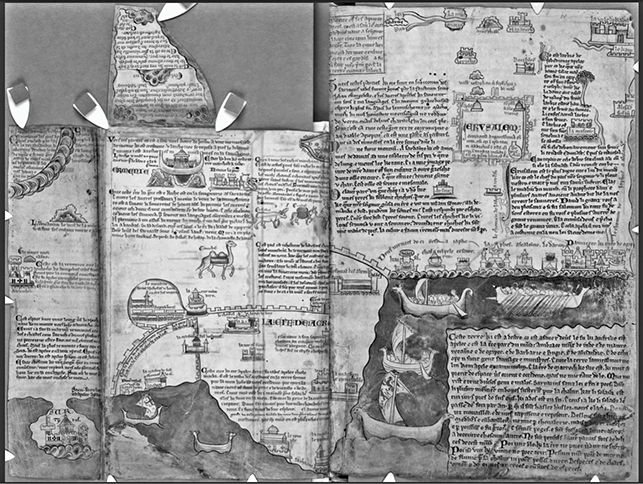
The Benedictine monk, chronicler, and artist Matthew Paris wrote his Chronica Maiora [Great Chronicle] in St Albans between 1240 and 1259. These chronicles tell the history of the British Isles, situated in a global context. One manuscript of the text opens with a map of the journey to Jerusalem, with inserted parchment strips which the reader has to open in order to see the full route [Figure 0.1].12 Jerusalem is shown as a square, walled city, containing three holy sites: the Dome of the Rock, ‘Solomon’s Temple’, and the Holy Sepulchre. The book encourages a contemplative encounter with the space. To see the full map, the reader needs to open out the flap – a physical gesture that might aid the imagination of travel. A camel walks jauntily through the desert carrying merchandise. Matthew Paris had likely never visited the Holy Land – these details would have been based on the reports of returning travellers. At the time when Matthew Paris drew this map, the crusader settlement of Jerusalem was already lost: the capital of the Christian Kingdom was Acre. The ships travelling through the green Mediterranean look like they are heading towards Acre – an unfortified, wavy coast. Images like this map continued to preserve the idea of these sites as significant to Christian identity, long after the last crusader settlement had fallen too.

The 1291 conquest of Acre consolidated the region under Mamlūk rule: Syria was divided into seven Mamlakas [kingdoms]. The Mamlaka of Damascus was the largest and most powerful, containing modern-day central Syria and the majority of Palestine.13 The city of Jerusalem was a subdistrict (wilaya), receiving administrative direction from Damascus.14 Medieval texts – like Wey’s – which describe the Holy City as being ‘in Syria’, recall both memories of the crusader settlements and contemporary Mamlūk administration. The Mamlūk rulers’ extensive building programmes between 1260 and 1517 transformed the architectural landscape of Jerusalem, with new mosques, colleges, schools, hospitals, fountains, and pilgrim houses, often repurposing crusader structures and establishments.15 When medieval English travellers visited and described Syria, they observed these Mamlūk projects: their traces are found throughout later medieval English images of arches and minarets, an iconography of Jerusalem with a distinctly Mamlūk style.
This study begins in 1291 and ends in 1516, before the Ottoman conquests of Egypt and Jerusalem, which signalled the end of Mamlūk rule over the Holy Land. In 1517, the shift to Ottoman command was immediately apparent to English travellers: the Norfolk parson Richard Torkington, who left Rye in March 1517 and arrived in the Holy Land in July, recorded that ‘the great Turke having in Dominion All the holi londe … we were received by the Turkys and Sarasyns’.16 Torkington arrived at a transitional moment, describing being ‘admitted by the lordes, Turkes, and Mamolukes of the Citie, to enter in to the Temple of the holy Sepulcre’.17 The ‘Turk’ was an emergent racialised category in the Middle Ages, which – as the Ottoman Empire gained control of the Holy Land – became preeminent in early modern English discourses of Islam and the Orient.18 The exchanges which took place between medieval English travellers and the Ottoman Empire are beyond the scope of this project, as are exchanges which occurred between the Mamlūk Empire, the Mongol Empire, and the Ming Dynasty, among other major global powers. The entangled histories which I have researched here reach out towards these other encounters – every project has a boundary line, and I hope that mine is porous enough to speak to other knowledge after its completion.
Chaucer’s Syria
A group of Syrian merchants is central to the ‘Man of Law’s Tale’, one of the narratives in the collection The Canterbury Tales, by Geoffrey Chaucer (d. 1400). The author was a clerk who used to rent a tenement house in the chapel gardens at Westminster Abbey. When he died, as a former tenant, Chaucer was entitled to be buried with a plain slab near the entrance to the south transept of St Benedict. In 1556 he was dug up and reburied inside the Abbey as the indifferent first resident of ‘poet’s corner’, and unwittingly became known as ‘the father of English literature’. In the General Prologue to the Tales, the narrator – also named Chaucer – joins a group of pilgrims in a tavern in Southwark. Intending to travel together to the shrine of Thomas Becket, in Canterbury, the Host suggests a game to make their journey less dull: a storytelling competition. The group includes a Knight back from the crusades, a Prioress, a Miller – and the Man of Law, who works in the London Inns of Court. The lawyer is dressed neatly, wearing a silk belt, with small stripes.19 He waits patiently to tell his tale, and when he is called to speak, he first gives credit to his sources: ‘O riche marchauntz’ (II. 122), the ‘fathers of tidynges | And tales’ (II. 129–30). Working near the London docks, the lawyer has had plenty of opportunity to speak with traders, who brought back stories as well as goods from their travels. The tale which follows was, he says, taught to him by a merchant whom he met long ago (II. 132–33).
The lawyer’s tale begins: ‘In Surrye whilom dwelte a compaignye | Of chapmen riche’ – in Syria once dwelt a company of rich merchants – who were ‘sadde and trewe’, trustworthy and honest (II. 134–5). These Syrian merchants ‘wyde-where sent their spicerye, | Clothes of gold, and satyns rich of hue’ (II. 136–137). Based on a merchant’s report, these Syrian traders are central both to the narrative and to the economic system within which they are placed. The goods which these merchants sell are those which were found on Sturmy’s ships – they are realistic, proximate items. The merchants travel ‘wyde-where’ – a word which conveys the scale of ‘everywhere’ but with an enhanced sense of marvel, evoking the globalised trading networks through which spices and silks travelled from Syria.20 The angle at which the tale is positioned places England as part of the mysterious ‘wyde-where’, and Syria at the known centre from which movement flows.
In Chaucer’s tale, the Syrian merchants set the action in motion. Having travelled to Rome for business and pleasure, where they hear of the great beauty of the Christian Emperor’s daughter, Custance, they go ‘hoom to Surrey’ (II. 173) – home, to Syria. Their identity as a group is not specified; critics have typically assumed that these merchants were Muslim or Christian, but Jewish traders also moved around the Mediterranean.21 Hearing that his favourite merchants are back, the Sultan – like Chaucer’s lawyer – is keen to hear their ‘tidynges’ – their reports, their tales of wonder (II. 181). When they are summoned, they tell the Sultan about the beautiful Custance. Based on description alone, the Sultan decides he must marry her. He sends for his counsellors, who advise that if he wants to marry Custance he must convert to Christianity, which he does. Informed of the Sultan’s conversion, the Emperor agrees to send his daughter to be wed. The report of a beautiful Christian girl is enough to cause Christianity to spread from Rome to Syria – the spontaneous conversion of the Muslim ruler drawing on enduring fantasies of the Christian recovery of the Holy Land.
Chaucer’s tale illustrates the ways in which imagination and reality overlap and combine in medieval tales. The tale is supposedly set in the sixth century, when Syria was actually part of the Christian Byzantine Empire – but the travelling merchants and the Muslim rulers evoke a context closer to the Mamlūk Empire, contemporary with Chaucer’s composition. The past was not forgotten in the present, but it inflected the ways in which medieval travellers and readers continued to experience the world.
Post-Acre Melancholia
The objects on Sturmy’s ship arrived in the aftermath of the collapse of the crusader settlements which – like the former territories of the British Empire today – were ambivalently remembered and preserved in medieval England. Late medieval trade took place along the same routes which had once led to and from the crusader states, via Venice and Rhodes. The commodities which became medieval Syriana had first been transported from the Frankish settlements. They were overlaid with the recollection of their original significance, as signifiers of Christian rulership in the Holy Land.
To understand the implications of these post-crusading contexts, I turned to Paul Gilroy’s concept of postcolonial melancholia. Gilroy invokes the Freudian frameworks of Alexander and Margarete Mitscherlich, who diagnosed post-WWII German society with melancholia, prompted by the inability to mourn the national loss of moral legitimacy. In Gilroy’s analysis of contemporary British society, melancholia describes a neurotic syndrome dating to the decline of the British Empire.22 For Gilroy, this syndrome is characterised by the urge towards homogeneity – the refusal of cultural hybridity – combined with a love of exotica.23 The refusal to process the traumas of the past leads to a nation-building ethnocentric fiction: a partial account of the present given false lineage by an equally partial account of history. After the Christian failures of the crusades, the sense of loss – of territory, of power, of status – resulted in a state of mind which, following Gilroy, I term post-Acre melancholia.
I define post-Acre melancholia as a neurotic syndrome dating to the decline of the Christian Kingdom of Jerusalem. As with its post-imperial equivalent, post-Acre melancholia creates a problem of time: forcing the fantasy of the past in front of the realities of the present. For Gilroy, the body of the ‘postcolonial migrant’ has become an ‘anachronistic figure bound to the lost imperial past’.24 That is: the refusal to include Empire and decolonisation in the narrative of British history creates a continued mist of imperial fantasy, which distorts the perception of lived experience.
The British Empire still lives in the imagination of many today; the Kingdom of Jerusalem lived in imaginations in late medieval England. Post-1291, many were unable to accept the irrecoverable loss of Acre as part of the narrative of Christian identity. An illusory narrative of history creates an unstable, illusory narrative of the present. In my study, the figures of Syrian merchants and English knights bring the lost settlements to life in late medieval texts. Further symptoms of post-Acre melancholia include hostility to immigrants and international traders, whose existence challenged the security of the nostalgic fantasy. As Aziz Atiya has shown, crusading remained central to European politics for over two-hundred years after the fall of Acre, both as an idea and as an active, albeit futile, political endeavour.25 Critics have drawn attention to the genre of late medieval romance as a site in which the crusades were reimagined.26 I build on these insights, showing how the produce of interfaith contact in Mediterranean marketplaces was reimagined as the loot of crusading conflicts, lending a material basis to fantasies of – and attempts at – resettlement and reconquest.
There was no specific English involvement in the 1291 battle of Acre, and the contribution of specifically English forces to the establishment and maintenance of the Crusader Kingdom was limited in comparison to – for example – French men-at-arms. As such post-Acre melancholia does not relate to an ideal of England so much as an ideal of Christendom – according to which, the failures of French forces are relevant to the English ego because they articulate the failure of common Christian desires. In that sense there is a dual process of denial in these melancholic English narratives, which deny the marginal role of English knights and commanders during the crusades, in addition to denying the failure of the Christian states. As it features in the medieval English imagination, post-Acre melancholia projects a fantasy of continued Christian power and a fantasy of English involvement in that collective power. The realities obscured are those of Christian failure and English impotence. Lauren Berlant describes melancholia as ‘the subject’s desire to temporize an experience of the loss of an object/scene with which she has invested her ego continuity’.27 The word ‘temporize’, meaning ‘to delay’ as well as ‘to evade’, draws attention to the fact that post-Acre melancholia creates both a psychic and a temporal disjuncture.
The premodern experience of time was not linear: especially when navigating space in the Holy Land, biblical histories were experienced as simultaneous with present realities. In addition, objects and texts remained part of the current intellectual landscape for hundreds of years. A manuscript copied in the twelfth century could remain part of the university syllabus in the fifteenth century. In churches, generations of priests continued to repair and wear the same vestments for hundreds of years: the evidence of excavations shows that eleventh-century silks were still in use in Aldgate in the fourteenth century. Reflecting these habits of re-use, at times my analysis moves quickly between centuries, allowing chronologies to collapse through a long lens, or leaping between crusading, classical, biblical, and heavenly moments. In the minds of many medieval illuminators, surgeons, and labourers, history had gone nowhere, and the future had already begun. Throughout this book I keep an eye on historical events, situating texts, images, and objects in their specific contexts, aiming to balance an awareness of the impact of proximate historical events with a sense of the longer (historical and imaginative) traditions which shaped cultural production.
The medieval conception of the Holy Land as a self-evidently Christian territory had an enduring influence, with its residue in present-day borders. In 1917, the British conquest of Jerusalem was covered as a long-overdue ‘victory’ in the medieval struggle between Christendom and Islam: one cartoon in the magazine Punch showed (instead of General Allenby) the English crusader King Richard the Lionheart overlooking the city, and was captioned ‘The Last Crusade’.28 The establishment of the British Mandate of Palestine was the precondition for the establishment of the state of Israel, as contractually determined in the Balfour Declaration; in that sense a line could be traced from medieval imaginative geographies to the current occupation. The complex colonial afterlives of the medieval are not the subject of this text, which is focused on the premodern – although I remain aware of the fact that these histories are read in – and have implications for – the present.
For me, post-Acre melancholia describes how crusading continued to shape late medieval identity.29 Affixing the ‘post-’ of ‘postcolonial’ to ‘Acre’ rather than ‘colonial’ in my study, I acknowledge both the historically contingent alterity of the medieval, and the influence of postcolonial theory on my work.30 Post-Acre melancholia persisted in English imaginations throughout the period of my study, but never prevailed in active form, and could never erase the realities of cross-cultural contact against which the syndrome struggled. Reports from returning travellers and in translation brought knowledge which contradicted the melancholic narrative, reinforcing the historic truth of the loss of Christian settlements and creating desires which exceeded the single desire for the recovery of land. Across medieval England, alternative perspectives subverted the supposedly hegemonic desire for Christian supremacy.
The Arrival: Rakowitz’s Lamassu
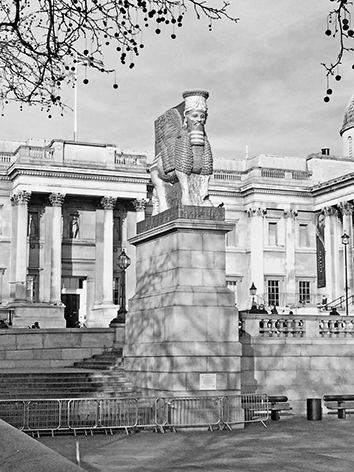
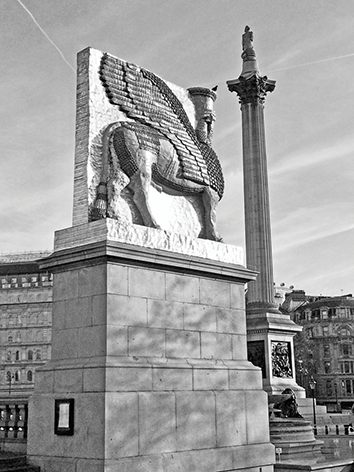
When I began working on this project in 2018, there was a bright sculpture on the Fourth Plinth in London’s Trafalgar Square: a glittering recreation of a lost Assyrian Lamassu [Figures 0.2 and 0.3]. The flanks of the guardian deity were plastered with shining Arabic packaging: made from tins of Iraqi date syrup. The sculpture is part of artist Michael Rakowitz’s project The invisible enemy should not exist, an ongoing series of recreations of Assyrian artefacts which have been stolen or destroyed.31 The cleaned tins are sticky, politically: the ancient date plantations have been decimated during the Iraq wars, significant responsibility for which resides in the British Parliament at Westminster, a short distance from the square in which the Lamassu stood. This recent history of destruction interrupted the two-thousand-year-long global movement of Iraqi dates. Rakowitz’s work brings out the dense entanglement of trade, conflict, consumption, dialogue, and human mobility.

Michael Rakowitz, The invisible enemy should not exist (2).
Rakowitz is the descendant of Iraqi-Jewish date traders, a personal background which he interrogates in his practice. In the participatory artwork RETURN (2004–), he reopened his grandfather’s import business, Davidsons & Co., in New York.32 The catalyst for the project was Rakowitz’s realisation that Iraqi dates were already covertly entering America, in cans of Basra syrup labelled ‘Made in Lebanon’, repackaged to avoid UN sanctions on Iraq. Rakowitz made contact with Al Farez Co., a date export business based in Baghdad, who agreed to send a shipment. The dates were flown to Damascus airport, where they were held in transit, as customs officers demanded additional charges. To avoid the delay, the general manager of Al Farez Co. suggested that the dates be declared as ‘product of Syria’ – a suggestion which Rakowitz, after consultation, declined, in case the dissonance between the origins of the dates on the boxes and in the documents caused issues at US customs. The delayed cargo was abandoned in Damascus, and a new shipment was ordered.
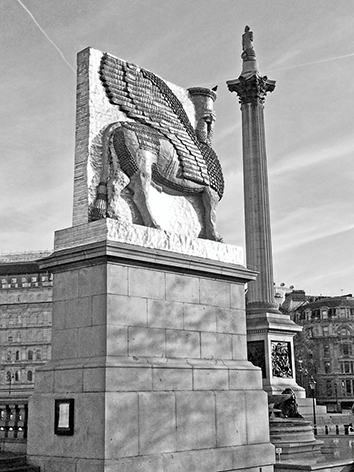
Reconstructed from the durable cans of these perishable goods, Rakowitz’s Lamassu pointed its noble features towards Nelson’s Column [Figure 0.3]. These proximate monuments – one temporary, one fixed, for now – provide alternative models of transnational travel. The presence of the Lamassu in Trafalgar Square was both a distinct projection of its origins and a distinct statement of arrival, asking the viewer to recall the traumas of war and the vitality of dialogue. The Lamassu was not enclosed, like the many Assyrian sculptures in the British Museum collection, a short walk away. The solid walls of the museum were substituted for open air, the hazards of pigeons, and the sunlight and seasonal changes passing across its back. The sculpture haunted the postcolonial city. A proximate incarnation of that colonial past, the lions at the base of Nelson’s statue (as Rakowitz points out) are made from reclaimed melted canons of ships captured at the battle of Trafalgar. Nelson gazes out in his plumed hat towards imperial waters, the imagined seascape of his victories. Beneath the anchored feet of the Lamassu, the plinth became a pier, a harbour.
My research project reconfigured itself in light of Rakowitz’s tin-can Lamassu. Instead of the more straightforward literary study which I had planned, I restructured my research into a study of the mobile commodities – bought, stolen, and recreated – which travelled to England. In Rakowitz’s Lamassu, the past and the present are brought into dissonant, complex contact within one apparently static object: the bright tin fused with the antique form. In his ongoing series May the obdurate foe not be in good health (2011–), Rakowitz applies the same practice of reconstruction to missing and endangered antiquities in Syria, in the era of civil war, plastering papier mâché votive statues and astrolabes with food wrappers.33 These ostentatious forgeries speak through the materials of contemporary consumables. Alexander Nagel and Christopher Wood argue that Renaissance architecture and artworks are not merely passively anachronistic but actively ‘anachronic’, holding ‘incompatible models in suspension without deciding’.34 Rakowitz’s artworks inhabit that same condition, of suspended incompatibility – their imitative skins draped over fragile histories, preserving and recreating statues. Taking the wrappers off their papier mâché moulds will not reveal the original: these ghosts have arrived in a new time and space, in a remade condition.
Syriana Reconstructed
In the Middle Ages, craftspeople based in Christian Europe were industriously employed in the imitation business. In medieval Lucca, Italian weavers were recorded as the producers of ‘soriani’ – knowingly imitating Syrian fabrics.35 These medieval forgeries speak to Rakowitz’s artworks – they hover between histories and places, without the option of return to their origins, given that the origin is fictive or half-remembered. The category of Syriana is not reliable: it includes faux-Mamlūk creations, pseudo-Syrian objects absorbed into medieval imaginations of the Holy Land. Syriana is hybrid, a melange of the authentic, the translated, and the mistranslated which speaks to the realities of cross-cultural contact and production. There was an appropriative, exoticising impulse in the aspirational European desire to become Syrian, to make Syriana – but an appropriative impulse developed in an alternative global system, in which English appropriation did not rest on imperial wealth. I see Syriana as the unstable fabrics from which English culture was constructed, a construction which undermined itself in its own making.
Using the category of ‘Syriana’, I have chosen to evade the critical concepts of the ‘Orient’ and the ‘Islamicate world’, tactically grouping together a disparate range of locations under a term which allows me to tell a different narrative. The category of Syriana, produced in economic conditions of European dependence on non-Christian networks, is a European category which seeks to become non-European, and a Christian category which seeks proximity to the non-Christian – desires which are often acknowledged ambivalently, uneasily, enviously.
Syriana is a collection of objects, a catalogue of surrogates which memorialise Christian ‘Syria’ – but which also remember alternative histories. Syriana came into existence in contact zones across the eastern Mediterranean.36 In the fourteenth-century Travels of John Mandeville, Jerusalem is described as a ‘myddes’: a space ‘in the midst’ of the world.37 Kim Philips has proposed the development of ‘precolonial studies’ in parallel with the continuation of postcolonial approaches to the Middle Ages, based on themes of encounter.38 While I share common ground with Philips, I do not use the terminology of the ‘precolonial’, since many of these cross-cultural encounters took place in the shadows of the expansionist missions of the crusades, in Mamlūk imperial territories and Italian trading colonies.39 These are alternative but not straightforwardly de-territorial scenes, which occurred while English lordships were extending into Ireland, Wales, and Scotland.40 The divergent elements in medieval English culture – ethnonationalist territorialism and an alternative reality of relational existence – create contradictions which I aim to sustain within my narrative, not flatten into false coherence.
Nagel and Wood write that: ‘The institution of pilgrimage was a culture’s way of acknowledging that it knew what authenticity really was, even if most of the time it chose to forget all that and make replicas.’41 Across Europe, replicas of the Holy Sepulchre both affirmed the significance of sacred space, and deconstructed that concept through the devotional attachment to visibly constructed versions. I see this contradictory affirmation of and deconstruction of origins as the intellectual basis for the making of Syriana.
Physical artefacts did travel from Syria to medieval England. Now displayed in the Victoria & Albert Museum, the ‘Luck of Edenhall’ is an enamelled Mamlūk glass vessel. It was likely made in Syria c. 1350, and kept on arrival in Europe in a leather case embossed with ‘IHS’ [Jesus].42 Embossed with the name of Christ, the cover repackages its contents, signalling the Christian appropriation of the object. Maria Georgopoulou writes: ‘It was the Syrian/Levantine origin of these gilt enamelled beakers that made them precious relics of the Christian Holy Land, even if they were made by non-Christian hands in Muslim territories.’43 As Esin Atil has argued, the Mamlūk period was a moment of artistic renaissance, with profits from global trade channelled into substantial patronage systems.44 The production of new containers for these items was an act of reframing, but it was also a marker of esteem, both of the artistic merits and of the origins of the vessels. It was difficult to take these fragile vessels on long journeys – they had to be placed in expertly made woven baskets.45 The leather case of the ‘Luck’ had a symbolic and practical function. Elsewhere in Europe the same practice of reframing is in evidence: in France, a Syrian enamelled cup known as the ‘Cup of Charlemagne’ was given a French gilded silver foot; Arabic-inscribed pilgrim flasks became Christian reliquaries.46 The ‘Luck’ was treasured as a relic in England, becoming associated with narratives of magical power which gave rise to its name. Relabelled on arrival, the ‘Luck’ still shines in Mamlūk glass, a transparent reminder of the hands and tools which made it, carefully preserved by those who understood it differently. The meaning of the ‘Luck’ hovers between the frame and its contents. Imitative ‘Syrian’ objects aspired to be worshipped like the ‘Luck’, placed carefully in treasuries, becoming transcendent through the absorption of the sacred aura.
Rakowitz’s artworks, as imitations, produce an aura gleaming in tin, not stone, which remembers the historic but is expressed in the new marvel of contemporary packaging: a bright and fragile surface which now cannot be discarded in the search for the rediscovery of the original object. These are precious forgeries, irreplaceable with the non-substitutable original, articulating a new kind of identity, asserting their position as a state of being in between: in between times and places. The objects and ideas which travelled out from Jerusalem passed through a series of islands and harbours across the Mediterranean, al-Baḥr al-Abyaḍ al-Mutawassiṭ – the white intermediate sea, containing within it the islands of the Aegean archipelago, an embayment of encounters and dangerous liasons.47 In England, mixed and collaged replicas coexisted with attested originals – both the original and the imitation travelled through the same routes before arriving.
Reframing Muslims and Jews
The desire to Christianise extended to people, not just objects. In Chaucer’s lawyer’s tale, sorrowing for Custance’s fate, the lawyer can only narrate, not control her journey: ‘forth I let her saille’ (II. 321), he says, as Custance sets out to Syria. Meanwhile, lamenting her son’s conversion to Christianity, the Sultaness decries that he ‘will leave his olde sacrifices’ (II. 325). The misconception that Muslims, Jews, and pagans alike engaged in idolatry and sacrifice was common in medieval England – including among those who, like the lawyer, were in contact with those who lived and worked in cross-cultural communities. The distorted image of Islam simultaneously forgets and remembers the realities of Mamlūk Syria, reflecting its power and status at the same time as these are officially disparaged. Custance does not arrive alone: she comes in a company of Christians. But the Sultaness plots against her son, his new bride, and their companions: on her orders, they are ‘al tohewe and stiked at the bord’, all hewn apart and stabbed, while they are sat at their table (II. 430). The action of the knives on the bodies of these guests brings cannibalism into association with the mass slaughter. The Syrian converts, including the Sultan, are killed – but are not eaten, their carved bodies lie bleeding out on the floor of the dining hall.
Patricia Clare Ingham and Michelle R. Warren have noted: ‘If Conrad’s novella [Heart of Darkness] is part of the “canon” of postcolonial scholarship on English modernism, Chaucer’s “Man of Law’s Tale” occupies a similar position in medieval English studies.’48 These critiques have opened up into the field of premodern critical race studies. Suzanne Akbari has identified medieval Orientalism as a historically contingent representational discourse which emphasises the bodily and the religious alterity of the ‘Saracen’ and the ‘Jew’, from which modern Orientalism developed.49 Geraldine Heng has interrogated the intersection between premodern trade and racialisation, arguing that cross-cultural trade resulted in a European religious-racial category which she describes as ‘Saracens, Inc.’50 The employees of this fictive enterprise were the means by which Syriana arrived in England. In this book I draw on the work of Akbari and Heng but move sideways, towards an understanding of the ways in which the lines of Muslim and Jewish identities became blurred, both in representations and reality.
The cultural theorist Ella Shohat has written of the need to restore forgotten histories of the ‘Judeo-Muslim hyphen’.51 Shohat’s argument responds both to the Israeli state partition between Jews and Palestinians, and the American political and cultural landscape, in which her Arab-Jewish identity is seen as an impossible contradiction. As a religious-racial category, the ‘Saracen’ was imprecise: Jewish and Muslim merchants were often seen through the same lens. Following Shohat, I read this imprecision as a sign of community: assimilated Jews misread as ‘Saracens’ remember those who lived in transnational neighbourhoods. Reflecting the conditions of their lives, which were at once mobile and locally embedded, the lingua franca of Jews across the premodern Mediterranean was Judeo-Arabic: Arabic written in Hebrew letters. As Jessica Goldberg has shown, Jewish merchants operated across the Mediterranean, creating a transnational community which was the site of cultural – that is, not purely financial – exchange.52 This Jewish presence has often fallen between the gaps in analysis of the relationship between the ‘Latin West’ and the ‘Islamic World’, as figured in medieval English texts.53 But although the Jews had been expelled from England in 1290, medieval English travellers continued to encounter Jews across the eastern Mediterranean.
Excavating these fragmentary histories, these scenes arrive in the present as ambivalent artefacts. Since its inception, the modern state of Israel has used archaeological methods in order to justify the possession of land on the basis of the historic presence of Jewish communities, deploying the lithic as a literal foundation for ideology.54 Israeli archaeological digs have often marginalised finds dating from the Mamlūk period, which are, in Eyal Weizman’s words, ‘dismissed … discarded … or simply left alone to rot and crumble’.55
Across the Mediterranean, travellers and immigrants adopted new idioms and bought new clothes, forgot to adhere to religious laws or began asserting their religion more intently. Jews living within the Mamlūk Empire were integrated into legal and social frameworks: they were not the rulers of the region, but neither were most of the Muslim population, the workers in the sugar factories, the silk-weavers. Retracing the arrival of Judeo-Muslim texts, material goods, and technologies in England, my work responds to Shirin Khanmohamadi’s argument for the existence of a ‘late medieval ethnographic poetics’ characterised by ‘a profound openness to alternative perspectives and voices’.56 Following Khanmohamadi’s Bakhtinian attention to the dialogic elements of medieval works, I find that heterogeneous voices repeatedly interrupt and complicate Middle English texts, with figures speaking against and within their own misrepresentation.
Reading through the mask of the ‘Saracen’ to find the historical presence of these complex interwoven communities, I find these histories affirm Paul Gilroy’s sense of ‘the intercultural history of the diaspora concept’.57 In the conclusion of his work The Black Atlantic, Gilroy turns to Jewish theorists – including Ella Shohat – in a gesture of intellectual solidarity, drawing a link between the concept of the Jewish diaspora and the diaspora as an articulation of Black identity. Reading Rakowitz, Shohat, and Gilroy backwards into the Middle Ages, I see the historic existence of Judeo-Muslim communities as the bedrock on which this intercultural concept was developed. That is: the diaspora becomes an intercultural concept because the diaspora has always been intercultural. Instead of trying to sort out and recategorise these layers, I stay with that original sedimentary entanglement. But instead of taking that entanglement as denying an identity-based analysis, I contend that the records of specific communities – Jewish, Muslim – can still be read from texts in which their lines are blurred. A non-essentialised reading of these hybrid histories returns the communities of the past to view in their historic state of undefinition.
I do not know what condition of the world this text will be received in, but I know that as I prepare to submit the final version of this manuscript, a genocide is unfolding in Gaza. The histories which I set out to remember – histories of interwoven Judeo-Muslim communities and a complex, intercultural diaspora – seem more out of touch than ever with present geopolitical relations. In a sense this collection has become an archive both of the premodern and of the recent past during which I completed my research: it is hard to say what book would have been written if I had started from the present moment. I am aware that the shadow of that event will fall over this text. I persist in thinking that complex, ambivalent narratives have a place even in these times.
Commodity Studies
In addition to blurring lines of identity, the category of medieval Syriana absorbs and confuses objects with variable functions: relics become saleable, souvenirs become worthy of veneration. Syriana is a property category which reveals a desire for the unpossessable – knowing that the object of desire always exceeds ownership. These are commercial objects which speak to their premodern conditions of production and consumption, asserting their position within an alternative economic and political structure.
In The Social Life of Things, Arjun Appadurai drew critical attention to the cultural status of commodities, showing how across time, the value of economic objects has been determined by political and imaginative frameworks.58 Nearly forty years on from the publication of that pathbreaking volume, cultural critics continue to find new insights from analysing the social lives of commodities past and present.59 The desire for commodities has been exposed as a driving force of colonial expansion – at the same time as colonialism shaped modern commodity cultures.60
In the Middle Ages, the term ‘commodite’ was already in use to describe objects of economic value.61 The capacity for economic exchange is fundamental to the objects in my study, from manufactured silks to harvested spices to extracted minerals – all belonged on the merchant’s ship. But these were objects with cultural and sacred significance: relic-like, fit for rituals. In Annabel Wharton’s economic and art historical study Selling Jerusalem, she surveys ‘Western’ modes of possessing the Holy Land from medieval to contemporary sources, considering the ‘relic’, the ‘souvenir’, and the ‘replica’ as distinct categories across time.62 The ‘relic’, derived from the Latin reliquae [remains], is venerated as an authentic object or fragment derived from a holy site or body: relic discourse elevates the material to sacred, transcendent status.63 Personal ‘souvenirs’ were typically bought or stolen, tokens of human travel instead of divine miracle.64 The medieval ‘relic’ and the commercial ‘souvenir’ were often inseparable. That realisation was often highly disturbing to medieval consumers, who found their religious rites tainted with the atmosphere of the market – a market which was dominated by non-Christian traders.65
In his essay ‘The Otherness in the Focus of Interest: Or, If Only the Other Could Speak’, art historian Avinoam Shalem asks: ‘Can one compare our encounters with the foreign object with human encounters?’66 The ‘foreign objects’ which Shalem has in mind are the portable Islamic items (such as beakers and pilgrim flasks) recorded in the Church treasuries of the Latin West. Shalem considers these objects as revealing the role of migratory artefacts as ‘carriers of information in an intercultural context’.67 The commodities treated as Syriana were mostly luxury items – with the exception of alum – but their impact was not only felt by the elite who were able to own them. Many of the craftspeople working with imported materials were themselves immigrants to, or within, England, living and working in cosmopolitan areas of cities. These objects remember their journeys in merchant vessels, jars, woven baskets, and travellers’ pockets.
In my study, influenced by Rakowitz’s artworks, Shalem’s approach to premodern mobile objects, and critical developments in commodity studies, I consider the goods on Sturmy’s ship as political, aesthetic, and communicative artefacts.68 These are goods which arrived here – and continued to recall their origins. Like the Lamassu casting its shadow towards the steps of the National Gallery, these imported objects left traces wherever they landed. Following the lives of medieval Syriana on their arrival reveals a narrated Syrian presence in premodern spaces often seen as more straightforwardly ‘English’, such as household larders, workshops in which wools were dyed, and the altar of Westminster Abbey.
The objects on Sturmy’s ship arrived in Libya – not in England. This movement records the fact that the commodities which became Syriana in medieval England existed in other collections and categories around the world. As Syriana, these objects variously grieve the impossibility of their return, discard grief in favour of the production of gaudy new selves, or oscillate between these states of grief and self-invention. The alternative lives of Syriana under other names drift across the horizon of this project – but this study takes place at my home port.
Medieval Collections of Arabic Books
In a footnote of his work Poetics of Relation, Glissant writes that: ‘The thought of the Centre was monolingual. The poetics of Relation requires all the languages of the world. Not to know or to ponder them, but to know (feel) that it is essential for them to exist.’69 Glissant’s theory was based on his observation of cultural formation in the Caribbean archipelago. He contrasts these multilingual poetics with a monolingual, colonial perspective. These contrasting forms of language – multilingual and monolingual – are the products of contrasting ways of being in the world. Glissant’s theory has had a widespread influence in artistic and academic spaces: Jane Hiddleston and Wen-Chin Ouyang have argued that Glissant’s concept of multilingualism could provide an alternative to current academic disciplinary categories – instead of the ‘English’ department, ‘multilingual literatures’.70
Glissant wondered if the poetics of Relation might have existed in medieval Europe, before the rise of the colonial Voyages. Discussing creolisation as a synthetic process, in which African and European languages are combined without becoming fixed, he is curious as to whether his observations might apply to other ‘languages in formation – here, for example, we would have to study the European Middle Ages’.71 I take up Glissant’s off-hand invitation for the study of the poetics of medieval relation. These poetics are not the same as those described by Glissant, which were formed in the conditions created by the transatlantic slave trade and the plantation. The medieval poetics of Relation reflect the unfixity of premodern languages and the unfixity of premodern global relationships.
In contact zones and through translations, borrowed words entered the English language. The arrival and translation of Arabic books in England intertwine with and frame the stories which follow.72 The Graeco-Arabic translation movements in Syria, Palestine, and Baghdad from the eighth to tenth centuries CE preserved and extended the works of Aristotle and Galen, forming an influential Arabic corpus of scientific learning which transformed understandings of the body and the stars.73 The twelfth- and thirteenth-century Arabo-Latin translation movements in the crusader Levant, Italy, and Spain disseminated this science throughout medieval Europe, with Arabic sources consistently foregrounded.74 As Charles Burnett comments, crusader Antioch ‘was a conduit through which Arabic works arrived in Europe’.75 Mamlūk systems of patronage funded learning institutions and scriptoriums across the Empire: the book was a significant commodity.76
The late medieval period saw a surge of translations of Arabo-Latin texts into vernacular European languages. Critical work has recognised this phenomenon: in 1977, Dorothee Metlitzki showed that Middle English texts were situated amidst libraries of Hebrew and Arabic.77 Archives and excavation sites have preserved medieval English collections of textiles, ceramics, and coins inscribed with Arabic script, which, like books, were seen and treasured.78 But as Shazia Jagot argues: ‘English literary studies has yet fully to embrace the possibilities that emerge from situating Arabic (along with Hebrew) as language(s) of multilingual medieval Britain.’79 Fourteenth- and fifteenth-century English texts popularised Arabic translations to a new, non-Latinate audience. There is often an aesthetics of display in medieval translations of Arabic works, a foregrounding of origins.80 Throughout the colonial era, Classical Greek and Roman texts were presented as providing a lineage for European civilisation, excising Arabic from the narrative of Classical reception. In contrast, premodern European translators of these Graeco-Arabic and Arabo-Latin texts continued to locate authority in their Arabic sources. Through these processes of textual transmission, Europe was decentred as a site of cultural production. Medieval Latin acted like the Mediterranean Sea – it was a midpoint, a cross-over space which absorbed and transmitted meaning in multiple directions.81
Geoffrey Chaucer is best known as a poet, but he also wrote scientific prose: the Treatise on the Astrolabe.82 The astrolabe was a portable astronomical calculating device developed in the Islamic world which became seen as essential for navigation both on land and at sea, and for taking measurements using the stars. Chaucer’s treatise addresses his ten-year-old son, Lewis, giving instructions for how to use the instrument. Two-thirds of Chaucer’s text is based on a Latin edition of the works of Māshā’ Allāh, an eighth-century Persian Jewish astrologer, who wrote in Arabic. He explains that he has translated the work
in Englissh, since you can’t read much Latyn, my little son. But don’t worry, these trewe conclusions will be just as adequate to you in English, as the noble clerkes Grekes find them in Greek, and the Arabiens in Arabik, and the Jewes in Ebrew, and the Latyn folk in Latin, which Latin folk translated them first out of other dyverse languages.83
Identifying Greek, Arabic, Hebrew, and Latin as languages of transnational dialogue, Chaucer focuses attention on the intellectual outputs of the Graeco-Arabic translation movements. The present tense allows the reader of Chaucer’s work to experience a kinship, a shared experience of thinking transnational conclusions in a local language. English reaches out towards Arabic, Hebrew, and the other ‘diverse languages’ which, although not necessarily known, are felt to be essential to exist.
In reaching beyond Latin towards the unread sources, medieval translators created texts which I call ‘Arabo-English’, the hyphen preserving the desire of the English text to touch the origin, the moment of crossing. The prefix ‘trans-’ means ‘across’, a process of becoming. In the Middle Ages the term ‘trans-lation’ and its equivalents in various languages – the act of ‘carrying over’ – was used to describe both the movement of meaning between languages and the movement of sacred relics between shrines. When moving the fragments of a saint’s body, the pieces of earth from a holy site, the origins of these objects remained essential to their veneration in their new location. Likewise, borrowed words, which once arrived are held tightly, rely on their origins for their full meaning. These translations do not become static having been ‘carried over’. The crossing continues, they continue to pull their new environment back towards the routes from which they have arrived, and which they continue to remember. Late medieval English translations of Arabic books are cultural and political vessels, carrying fragile and ambiguous histories into the present – their survival creating another crossing, the transhistorical.
Chaucer’s Syria, Part II
In Chaucer’s tale, news and letters travel rapidly across the seas from Rome to Syria, and the Syrian merchants in Rome are a familiar sight, but Chaucer’s heroine Custance shudders at the prospect of going – ‘she wepte’ for being ’sent to strange nation’. ‘Allas’, the Man of Law says, pitying her (II. 267–8). ‘Allas’, Custance sighs – she calls her destination ‘the Barbre nacioun’, the barbarous nation (II. 281–2). Although the lawyer’s description of Syria has been an aspirational scene, characterised not by the ‘barbarous’ but by scenes of elite counselling, he does not criticise his heroine’s language – but only her father’s lack of forethought. He should have spoken to his astrologers before arranging her transport.
Sympathising with Custance’s dread at going to Syria, Chaucer’s lawyer cries: ‘O Mars, o atazir!’ (II. 309). Deriving from the Arabic al-ta’thīr, ‘atazir’ means ‘influence’. The term ta’thīr was used to describe astral influence in Arabic astrological and magical texts, circulating in the works of Abū Ma’shar (787–886), a renowned astrologer of the ‘Abbasid court of Baghdad. The lawyer continues to lament Custance’s journey, crying that if the Emperor had consulted a ‘philosophre’, he would have been told that it was not an auspicious moment for her to travel. Since rich ‘folk of high condition’ typically know their birth time, this information should have been used before planning travel (II. 310–14). This advice is taken from a Latin version of the astronomer Ibn Bishr’s Kitāb al-Ikhtiyārāt [‘The Book of Elections’, or in its Latin version, ‘De Eleccionibus’]. Sahl ibn Bishr al-Israili (82–850) was an astrologer and mathematician based in Baghdad – a contemporary of Abū Ma’shar. His name, ‘al-Israili’, speaks to his Jewish heritage. In medieval Europe, he was known as ‘Zael Benbriz’. Ibn Bishr’s works were available in Latin from 1138, the date of their translation by Herman of Carinthia.84 His works survive in at least fifty-seven Latin manuscripts.85 In the margin of the Hengwrt manuscript – one of the earliest and most authoritative copies of Chaucer’s Tales – the scribe has copied out a Latin translation of Ibn Bishr’s work beside the Man of Law’s speech:
Everyone agrees that astrological calculations are weak except in the case of the rich, for they possess the time of their birth, that is the root of their fortunes, which strengthens all unstable planets, as for journeys, etc.86
Including the Hengwrt manuscript, this passage of Ibn Bishr’s text is preserved by Chaucer’s scribes in the margins of twenty-seven manuscripts of the Tales.87 In at least one instance, the scribe has moved Ibn Bishr’s Latin text from the margin into the main text itself to appear before the Man of Law’s adaptation, as in a late fifteenth-century copy made in Greenwich.88 These scribes saw Ibn Bishr’s text as an essential part of Chaucer’s poetry – actively recopying it into the margins. These medieval readers recognised Ibn Bishr’s works more easily than modern editors of Chaucer’s poetry have typically done. The English scribal fragment has lost its authority – has lost its Arab-Jewish author, the ‘philosopher’. Re-centering Ibn Bishr as a presence in the text, Chaucer’s lawyer’s speech becomes audible as an Arabo-English tale.
Reading Chaucer’s Syria Now
Once in Syria, Custance survives the Sultaness’s attack – but is taken and put into ‘a ship al steereless’ – a raft without a rudder (II. 439). The attackers tauntingly ‘bid her learn to sail | Out of Syria again back to Italy’ (II. 440–1). ‘O my Custance’ (II. 446), gasps the Man of Law. She prays, set adrift. The lawyer describes how for ‘years and days fleet this creature’ – she floated through ‘the See of Grece unto the Strate | Of Marrok’, through the Mediterranean to the Strait of Gibraltar (II. 463–5). Custance is alone in the ‘wilde waves’ (II. 468). Knowing how terrifying the scene will be to his audience, the lawyer reminds us of reassuring biblical precedents – remember, he says, that God saved the Hebrew people from ‘drenchynge’, drowning (II. 489). Leaving the unconvertible Syrians behind her, Custance is afraid, but ultimately secure as she crosses the sea of faith.
Today the scene resonates with a different, ongoing reality: the experiences of those who have to sail across the same marine routes in fishing boats and dinghies, and who are not saved.89 Asylum seekers cast adrift in rudderless boats are closed in by a legal system offering less sympathy than Chaucer’s lawyer. On 18 April 2015, a fishing boat carrying an estimated 1,100 people collided with a freight boat attempting rescue, and only 28 survived. In May 2023, a boat without a working engine, which was carrying 500 asylum seekers, sank in the Mediterranean, 400 miles from Malta and Sicily. On 14 June 2023, a fishing boat carrying an estimated 750 people from Syria, Egypt, Pakistan, Afghanistan, and Palestine sank, forty-seven nautical miles off the coast of Pylos, Greece, having left Libya for Italy. Since 2014, the Missing Migrants Project has counted more than 32,345 missing migrants in the Mediterranean, the vast majority assumed to have died by drowning.90
In Chaucer’s tale, Custance is washed from Syria through the Mediterranean until: ‘she driveth forth into our ocean | Throughout oure wilde see’ (II. 505–6). She has reached the North Sea, approaching the British Isles, the journey recalling the plotting points of medieval sea charts.91 At last ‘in Northumberland the wave her cast, | And in the sand her ship stiked so fast | That thence would it not, for a whole tyde’ (II. 505–10). The boat digs itself into the shore. The tide cannot drag it back out into open waters. In Middle English, ‘tyde’ also means time – an hour, a day, a night, a season, or ‘the interval between high tides’ The fantasy of the rudderless ship is also a fantasy of miraculously facilitated arrival. Imagining the journey between Syria and England, Chaucer sketches a picture of two connected coasts.
When Custance arrives in England, she speaks a ‘manner of Latyn corrupt’ (II. 519), in which broken speech she is able to communicate. She might always have spoken like that, or her speech might be post-traumatic. The lawyer tells us that Custance has been ‘mazed in the see’ – confused, dashed in the waves – so that she has lost her mind (II. 526–7). A sequence of dramatic events follows – Custance is framed for murder, marries King Alla of Norhumberland, gives birth, and is betrayed by her new mother-in-law, Donegild. Based on counterfeited documents, Custance is put ‘in the same ship’ as she was found – ‘her, and her young son’ – and ordered to be cast ‘from the land’ (II. 799–801). The small boat is pushed back out.
‘O my Custance’ (II. 803), grieves the Man of Law. Arriving on a rudderless ship, Custance finds herself on that same deadly raft, this time with a baby. ‘Peace, little son’, she soothes him (II. 836). She places her handkerchief over his eyes and rocks him to sleep as she prays. The idealised figure of the innocent Custance with her child echoes Christian iconography of the Virgin nursing Christ. Her ship passes back through the ‘narrow mouth’ of Gibralter until it arrives back in Rome, where the story began (II. 946–7). When Custance is found in Italy, she is so traumatised that she cannot speak at all – ‘she nyl seye’ (II. 972). Unable to act to prevent these past events, the lawyer narrates, repeating ‘allas’, ‘O my’.
Since 2015, the Refugee Tales project has taken Chaucer’s tales as a model for using storytelling as a mode of solidarity: walking and talking through the countryside to the coast, as part of a campaign to end indefinite detention in the UK. The project provides a space for asylum seekers, refugees, and those who have experienced immigration detention to speak – or to tell their narratives, anonymised, to a writer. In Dragan Todorovic’s contribution ‘The Migrant’s Tale’, translated extracts of Chaucer’s ‘Man of Law’s Tale’ are interleaved with a contemporary narrative of forced migration from Syria to Italy, and back to Syria, before ‘Aziz’ arrives in England. In Todorovic’s version, the organised violence of the Sultaness’s troops is juxtaposed with the violence enacted by Assad’s regime, during the Syrian Civil War (2011–).92 The medieval text provides a historic lineage for present-day experiences, asserting the transhistorical realities of human movement. Translating from the reaction of Chaucer’s lawyer enables there to be language when otherwise no words can be found.
Chaucer’s text reflects the present back to itself through a medieval mirror: showing an image of traumatic forced migration over recognisable and deadly seas. These texts continue to provide material for new literary imaginations of society and identity.93 Here Chaucer’s Syria provides a starting point for a new narrative of medieval English culture: based on recollected texts, images, and objects which were produced in the ‘wyde-where’, made from the materials and stories which had been sent across the Mediterranean, I have not collected these stories for their contemporary resonance alone, but for the practice of restoring to view the remains of the past – not discarding what has been kept in archives.
What to Expect
In Chaucer’s dream vision The House of Fame, the narrator is brought to a spinning house, shaped like a cage. Through the gaps in the walls arrive stories: brought by ‘shipmen and pilgrimes, | With scrippes brimful of lesinges, | Intermeddled with tydynges’.94 These are satchels of scraps. The true ‘tidings’ – reports – are mixed up with ‘lesinges’ – lies, which are inseparable in the bags and become more so as the building spins. The word ‘lesinge’ has another meaning: ‘gleaning’. The sailors and pilgrims bring bagfuls of what they have ‘gleaned’ on their journeys: a mixture of facts and fictions. In Agnes Varda’s film The Gleaners and I (2000), she observes acts of ‘gleaning’ – recording those who sift through the end of the harvest, or urban rubbish bins. These scenes of precarity become an image for her own practice as a documentary maker – making narratives out of ‘gleanings’ – collecting the debris. I have tried to present medieval culture in its intermingled state, without trying to sort my sources into neat piles of fact and fiction, fakes and originals.
I have aimed for a style of criticism which (like labels on curated artefacts) introduces, guides, and provides contexts but also allows texts and images to speak. To me this aim has meant translating and re-narrating more, not less, than in a traditional critical mode, in order to make Middle English sources more easily audible outside of the medieval academy, as well as – I hope – defamiliarising aspects of texts to scholars used to reading them. Having said that, it does not feel accurate to the present state of critical discourse to say that this approach to texts is ‘untraditional’. Following (in particular) Rita Felski’s argument that the critic’s attachment to their source material should be integrated into the process of analysis, and Saidiya Harman’s formulation of ‘critical fabulation’ as a way of approaching the gaps in historical records, there is a growing movement of criticism which seeks to integrate the imagination into the process of writing.95 In a sense these approaches are especially appropriate for the Middle Ages: as Carolyn Dinshaw has argued, the discipline of medieval studies rests on – and continues to be enriched by – the work of ‘amateur’ scholars, from non-professionalised editors of texts to the organisers of re-enactments.96 Taking inspiration from creative-critical methodologies, I have left myself present at brief moments within this text, not through my own biography, but through allowing my own visualisation of medieval scenes to remain within the frame: letting imagination guide my analysis without discarding the knowledge of these sources which my research has given me.
Along the way, we will read medieval pilgrim texts, travel narratives, romances, devotional, political, and moralistic poetry, dream visions, saints’ lives, lapidaries, recipe books, the inventories of travellers, private wills, church treasuries, household books, parliamentary bills and legislation, herbals, dyers’, and surgical manuals – and will look at manuscript illuminations, excavated silks, tapestries, enamelled glass, and museum displays.
Part I, ‘The Dispensary’, focuses on the consumables on Sturmy’s ship: sweet wines and spices, reflecting on their medicinal, spiritual, and commercial value. Chapter One, ‘Sweet Wine / The English Taste for the Blood of the Holy Land’, analyses Eucharistic images which presented sweet wine as the Christian blood of the Holy Land, providing an ethnonationalist rationale for the essentialised Christianity of the lost crusader territories. Chapter Two, ‘Spices / English Digestion and Indigestion’, explores medieval English recipe books, poetry, and drama in light of the legacies of the crusades.
Part II, ‘The Treasury’, begins in Westminster Abbey, where imported silks and jewels were highly visible, and considers the difference between medieval practices of display and contemporary museum practice. Chapter Three, ‘Silks and Velvets / The Fabrics of English Identity’, unravels the meanings of Arabic and Pseudo-Arabic textiles in medieval England, as devotional and resistant texts. Chapter Four, ‘Jewels / English Possession and the Unpossessable’, addresses jewels as excavated geological witnesses of the Christian nature of the Holy Land, reflecting on their discomforting association with – and disassociation from – Jewish communities.
Part III, ‘The Workshop’, unpacks the cultural significance of the mineral alum, which was imported in bulk, as an essential mordant for the cloth industry. Chapter Five, ‘Alum / The Demand for Sodomite Salt in England’, revives the origin narrative of the essential mineral as the product of the Dead Sea – which itself was seen as the ashes of the destroyed cities of Sodom and Gomorrah. These narratives continued to inform the uses of alum in alchemical, surgical, and book-making practices. In the ‘Coda’ to Part III, ‘The English Market as the Temple of Jerusalem’, I reflect on the relationship between late medieval religious and economic practices, brought together through the theme of alchemy.
In the Conclusion, ‘Christopher Columbus in Chios’, I return to the relationship between Sturmy’s voyage and the other ships which crossed the seas in the late fifteenth century. And finally – the moment you will have been waiting for – in the Epilogue, ‘The Verdict of the Trials of the Genoese’, I reveal the outcome of Heyton’s case, reflecting on what these trials say about medieval English immigration laws, and their legacies today.
These fragments defamiliarise and reconstitute premodern English culture as a site of instability, fuelled by the desire for what came from Syria.