





Introduction
Antibiotic stewardship programs (ASPs) reduce unnecessary antibiotic use, both in the hospital and in outpatient settings. 1,Reference Sanchez, Fleming-Dutra, Roberts and Hicks2 However, ASPs rarely evaluate antibiotic prescribing at the time of discharge when patients transition from the hospital to the outpatient setting. A recent survey of pediatric ASPs revealed that only 19% of ASPs review discharge antimicrobial prescriptions. Reference Wang, Felder and Newland3 This represents an important gap in the oversight of antimicrobial use. Antibiotics prescribed at discharge account for a substantial proportion of overall antibiotic days and approximately 30% of hospitalized children are prescribed antibiotics at the time of discharge. Reference Dyer, Dodds Ashley and Anderson4–Reference Hersh, Newland and Gerber7 In a multicenter study of adults hospitalized with pneumonia, two-thirds of patients received excess antibiotic therapy, and antibiotics prescribed at discharge accounted for over 90% of that excess duration. Reference Vaughn, Flanders and Snyder5 Single center studies have found that 20%–27% of antibiotics prescribed at the time of discharge are suboptimal. Reference Hersh, Newland and Gerber7–Reference Zhang, Paturi, Puckett, Scheinker, Schwenk and Joerger9
As part of a multicenter study seeking to improve discharge antibiotic prescribing, we aimed to characterize baseline discharge prescribing, defined as optimal choice and duration of therapy (DOT), for 3 of the most common infections for which antibiotics are prescribed to hospitalized children: community-acquired pneumonia (CAP), urinary tract infections (UTI), and skin and soft tissue infections (SSTI), across 4 children’s hospitals with established ASPs. Insights from this analysis can inform the design of stewardship interventions focused on discharge prescribing.
Methods
Eligibility criteria
We conducted a retrospective cohort study of children <18 years of age admitted to Children’s Hospital of Philadelphia, St. Louis Children’s Hospital, Primary Children’s Hospital, and Seattle Children’s Hospital from January 1, 2021, to December 31, 2021. We used the electronic health record (EHR) to identify children discharged with an International Classification of Diseases, Tenth Revision, Clinical Modification (ICD10) code for CAP, UTI, or SSTI (Supplemental Table 1). To limit the evaluation to generally healthy children with uncomplicated community-acquired infections who could reasonably be expected to receive guideline-recommended first-line antibiotics and durations, we excluded children with complex chronic conditions, Reference Feudtner, Feinstein, Zhong, Hall and Dai10 children who received immunosuppressing medications (Supplemental Table 2), those who did not receive antibiotics within the first 2 calendar days of their admission, children admitted to the intensive care unit (ICU), and children hospitalized for more than 7 days. For UTI only, we also excluded children with ICD10 codes for complex genitourinary anatomy (Supplemental Table 3). To focus on discharge prescribing of oral antibiotics, we excluded children who did not receive antibiotics at the time of discharge, children prescribed intravenous, nasogastric, or gastric tube-administered antibiotics at discharge, and those with incomplete discharge prescription information (eg, duration or end date was not available in the EHR). We also excluded prescriptions with durations >21 days and prescriptions that were labeled “refill,” which were thought to represent either prophylaxis or excessive durations that likely reflected additional diagnoses or more complicated infections. We also excluded children with ICD10 codes for additional infections because these could have required longer DOT or alternate antibiotic choice (Supplemental Table 4). This study was a baseline evaluation of discharge prescribing practices as part of a multicenter mixed-methods implementation science study evaluating an intervention to improve discharge antibiotic prescribing (ClinTrials.gov NCT05826873). It was approved by the Children’s Hospital of Philadelphia Institutional Review Board.
Data collection
Encounters meeting eligibility criteria were identified using ICD10 codes through the electronic medical records at each hospital. Demographic data, encounter diagnosis codes, problem list diagnoses, medications administered in the hospital, antibiotics prescribed in the hospital and at discharge, antibiotic allergies, duration of hospital stay, and admission to the ICU were collected.
Definitions
Primary outcomes were the percentage of subjects prescribed optimal therapy based on current national guidelines and available evidence as of 2023. The optimal antibiotic choice for CAP was defined as amoxicillin. We also performed a secondary analysis for CAP considering any choice of antibiotic appropriate for children with penicillin allergy. We did not have access to microbiologic data. Therefore, based on national guidelines as well as each hospital’s institutional guidelines, clindamycin, amoxicillin-clavulanate, cephalexin, and trimethoprim-sulfamethoxazole (TMP/SMX) were all considered optimal choices for SSTI. For UTI, cephalexin, amoxicillin, amoxicillin-clavulanate, TMP/SMX, and nitrofurantoin were all considered optimal. Regimens with multiple antibiotics were considered optimal for choice as long as one of the antibiotics was optimal. Optimal DOT, including both inpatient and outpatient antibiotic days, was defined as 5 days for CAP and SSTI and ≤7 days for UTI, with a window of +/– 1 day for each condition (ie, 4–6 days for CAP and SSTI, ≤8 days for UTI). For patients with more than 1 antibiotic prescription with different DOT, we included the longer DOT.
Racial and ethnic disparities in antibiotic prescribing have been reported in some settings, so we also evaluated optimal discharge antibiotic prescribing across different racial and ethnic groups. Race and ethnicity data were self-reported at all 4 hospitals. Race categories were defined as Black, White, and Other, which included patients who identified as Asian, American Indian or Alaskan Native, Native Hawaiian or Pacific Islander, or multiple races because small sample sizes in each group precluded more granular analysis. Ethnicity was categorized as Hispanic or non-Hispanic.
Statistical analysis
The analysis was primarily descriptive. Medians, interquartile ranges, and percentages were calculated to describe baseline characteristics and choices of therapy. To evaluate the relative contributions of different baseline characteristics to optimal therapy, a multivariate logistic regression was performed using the following variables: age, sex, race, ethnicity, hospital, condition (CAP, UTI, or SSTI), and antibiotic allergy. All analyses were performed using Stata 18 (StataCorp). A 2-sided P-value <.05 was considered statistically significant for all tests.
Results
ICD-10 codes for CAP, UTI, and SSTI identified 3847 children. After applying exclusion criteria, 1,206 total encounters remained: 226 CAP, 417 UTI, and 563 SSTI (Supplemental Figures 1–3). Median age was 4 years (interquartile range [IQR]: 1–9), and 52% were female. Median length of stay was 2 days (IQR: 1–3) (Table 1).
Baseline characteristics of children admitted to 4 children’s hospitals in 2021 and prescribed antibiotics at discharge for uncomplicated community-acquired pneumonia, urinary tract infection, or skin and soft tissue infection

Most patients with CAP (74%) received amoxicillin at the time of discharge, followed by amoxicillin/clavulanate (14%) and clindamycin (3%) (Figure 1). The most prescribed antibiotic for UTI was cephalexin (59%), followed by amoxicillin (11%) and trimethoprim-sulfamethoxazole (7%). Antibiotics prescribed for SSTI were more diverse: 28% were prescribed clindamycin, 27% cephalexin, and 26% received amoxicillin-clavulanate. Overall, the antibiotic choice was optimal in 77% of encounters: 75% for CAP, 91% for UTI, and 68% for SSTI (Table 2). Optimal antibiotic choice ranged from 70% to 83% across hospitals. A secondary analysis considering any antibiotic to be appropriate for children with CAP who had a penicillin allergy increased optimal prescribing for CAP from 75% to 77% and optimal choice for all conditions to 78%.
The most commonly prescribed antibiotics at discharge for 1,206 encounters with community-acquired pneumonia, urinary tract infection, or skin and soft tissue infection. Percentages based on total number of antibiotic prescriptions. Other antibiotics include cefadroxil, cefdinir, cefixime, doxycycline, levofloxacin, linezolid, and nitrofurantoin. SMX-TMP, trimethoprim-sulfamethoxazole.

Percentage of children diagnosed with community-acquired pneumonia, urinary tract infection, or skin and soft tissue infection prescribed optimal antibiotic choice and duration of therapy at discharge

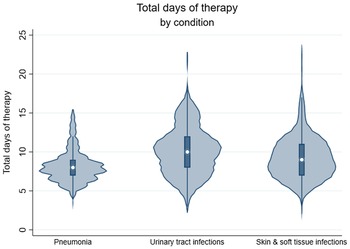
DOT was optimal in 19% of CAP encounters, 30% of UTI, and 25% of SSTI. Overall DOT was optimal for only 26% of encounters, ranging from 13% to 31% across the 4 hospitals (Figure 2). The median DOT across all indications was 9 days: 8 days (IQR: 7–9) for CAP, 10 days (IQR 8–10) for UTI, and 9 days (IQR 7–11) for SSTI (Figure 3).
Optimal antibiotic prescribing at discharge for community-acquired pneumonia, urinary tract infection, or skin and soft tissue infection at 4 children’s hospitals. Optimal antibiotic duration, choice, and choice and duration are mutually exclusive categories. CAP, community-acquired pneumonia; UTI, urinary tract infection; SSTI, skin and soft tissue infection.

Median duration of antibiotic therapy prescribed for children with community-acquired pneumonia urinary tract infection and skin and soft tissue infection at 4 children’s hospitals. The box and whiskers within each plot depict the median (white dot), interquartile range (box), and 5th/95th percentiles (whiskers); the width of each plot represents the number of courses that received that value for the overall antibiotic duration.

Overall, only 20% of encounters were prescribed both optimal choice and optimal DOT, ranging from 10% to 28% across hospitals (Figure 2). Both choice and DOT were optimal in 14% of CAP encounters, 28% of UTI, and 16% of SSTI.
In unadjusted analysis, Black patients were more likely to receive optimal DOT than white patients (31% vs 26%, P = .050) (Supplemental Table 5). There were no other differences in prescribing by race or ethnicity for choice, duration, or choice and duration combined. In a multivariate logistic regression, only UTI and hospital were associated with increased odds of receipt of optimal choice and DOT (Table 3).
Sociodemographic and clinical factors associated with optimal discharge antibiotic prescribing, defined as optimal for both choice and duration of therapy, for community-acquired pneumonia, urinary tract infections, and urinary tract infections at 4 children’s hospitals in 2021

Multivariate logistic regression was performed to evaluate associations between sociodemographic factors and optimal prescribing. All analyses were performed using Stata 18 (StataCorp). Odds ratios were reported with 95% confidence intervals. A 2-sided P-value <.05 was considered statistically significant.
Discussion
At 4 children’s hospitals with established antimicrobial stewardship programs, only 20% of discharge antibiotic courses for CAP, UTI, and SSTI were optimal by both choice and duration of antibiotic therapy. A far higher percentage of prescriptions included optimal choice of antibiotic (77%) than optimal DOT (26%). Although there was considerable variation in prescribing across hospitals, overall optimal prescribing (both duration and choice) was low in all 4 centers, ranging from 10% to 28%. Discharge antibiotic prescribing represents a significant opportunity to improve antibiotic use in children.
Discharge prescribing patterns at children’s hospitals are not well described. Single center studies have found that 20%–27% of discharge antibiotic prescriptions were suboptimal. Reference Hersh, Newland and Gerber7–Reference Zhang, Paturi, Puckett, Scheinker, Schwenk and Joerger9 In our cohort, the proportion of suboptimal antibiotic prescribing was much higher (80%), which might reflect our focus on CAP, UTI, and SSTI instead of all discharge prescriptions, variable definitions of optimal prescribing, and institutional variations in antibiotic prescribing culture and stewardship. A point prevalence survey of antibiotic prescribing at 32 children’s hospitals also identified a high prevalence of suboptimal prescribing and variability across centers, with the proportion of children receiving antibiotics in the hospital who were prescribed at least 1 antibiotic that was suboptimal ranging from 7% to 47% across hospitals. Reference Tribble, Lee and Flett11
The choice of antibiotic was more commonly optimal than duration in our study. This was likely driven by a combination of factors, including a pre-existing focus on optimal choice of antibiotics by established ASPs and our permissive definition of optimal choice for UTI and SSTI necessitated by lack of access to microbiology data (which may not be available by hospital discharge when length of stay is very short, as it was here) coupled with variable local epidemiology and resistance patterns. Patients may also be more likely to receive an optimal choice of therapy because national guidelines are clearer regarding antibiotic choice than they are about DOT. For example, the Pediatric Infectious Diseases Society/Infectious Diseases Society of America guideline for the management of CAP clearly identifies amoxicillin as the preferred choice of therapy, which led to rapid adoption. Reference Newman, Hedican, Herigon, Williams, Williams and Newland12,Reference Williams, Edwards and Self13 The CAP guideline is less clear about duration, suggesting “Treatment courses of 10 days have been best studied, although shorter courses may be just as effective.” Reference Bradley, Byington and Shah14 Recent evidence points to shorter courses of antibiotics for pneumonia as safe and effective, but these data have not yet been incorporated into national guidelines. Reference Same, Amoah and Hsu15–Reference Pernica, Harman and Kam17 Similarly, for UTI, the 2011 American Academy of Pediatrics guideline gives a wide range of 7–14 days for treatment duration, Reference Roberts18 with mounting evidence that shorter courses are warranted. Reference Fox, Amoah, Hsu, Herzke, Gerber and Tamma19,Reference Montini, Tessitore and Console20 A national multicenter quality improvement study also found that adherence to optimal choice of therapy was higher than adherence to optimal DOT in hospitalized children. Reference McCulloh, Kerns and Flores21 Other evaluations of discharge prescribing have also found that suboptimal prescriptions were most commonly due to errors in DOT. Reference Olson, Thorell and Hersh8,Reference Zhang, Paturi, Puckett, Scheinker, Schwenk and Joerger9 Because optimal antibiotic prescribing requires both the right drug and the right DOT, there remains significant room for improvement for children at discharge. In the outpatient setting, changing default durations in EHR orders is a highly effective intervention to decrease excess antibiotic prescribing, Reference Sun, Jones and Fricchione22 but this has been more challenging to translate into discharge ordering due to the need to account for inpatient DOT, which is an important target for future efforts to improve discharge prescribing.
Because prior research has shown differences in antibiotic prescribing by race and ethnicity Reference Kim, Kabbani and Dube23–Reference Nedved, Lee and Wirtz25 but has largely been limited to outpatient settings, we conducted a secondary analysis to explore the association between optimal prescribing and race and ethnicity in this inpatient cohort. Although Black patients were more likely to receive optimal DOT than white patients in unadjusted analyses, multivariate adjustment for age, sex, race, ethnicity, hospital, and antibiotic allergy revealed no association between race or ethnicity and optimal prescribing, suggesting the unadjusted association between race and optimal prescribing was likely related to differences in racial and ethnic distribution across hospitals. For example, the 2 hospitals with the highest percentages of optimal DOT were also those with the largest proportion of Black patients. At least 1 prior study reported differences in prescribing by patient race at the level of the individual prescriber within a primary care network. Reference Gerber, Prasad and Localio24 While discharge prescribing occurs at the threshold between the inpatient and outpatient setting, the decision-making occurs while children are in the hospital and reflects inpatient prescribing dynamics, which might be driven more by team dynamics and clinical pathways than prescribing in the outpatient setting. One other group evaluated differences in antibiotic prescribing for children with acute respiratory infections in the inpatient setting at a single center. Reference Tan, McGrath and Brothers26 They found that non-Hispanic White children were more likely to receive broad-spectrum antibiotics than children of other races, but that this relationship may be mediated or confounded by ICU admission and insurance status. This emphasizes that prescribing in hospitalized children may result not just from individual provider practices but also from underlying disparities in resources related to systemic racism that impact the pre-hospital course, including the likelihood of seeing a primary care provider and receiving antibiotics prior to hospitalization or of presenting later in the course of illness with more severe disease. Further research is needed to evaluate disparities in antibiotic prescribing in the inpatient setting and at discharge.
Our study has multiple strengths, including the evaluation of a large cohort of patients across 4 children’s hospitals and the use of standard, objective criteria to define optimal antibiotic prescribing based on national guidelines and available evidence. There were also several limitations to our analysis. Some of the prescribing that was considered suboptimal by our prespecified criteria may have been appropriate according to institutional guidelines at the time, which may not have incorporated newer data published during the study period. Nevertheless, this reveals opportunities for improvement in discharge prescribing. We also did not have access to microbiologic data, which, when available prior to discharge, can guide the selection of antibiotics for UTI and often for SSTI. To account for this, we conservatively allowed multiple antibiotics as appropriate for both. Although this could have resulted in inaccurate categorization of optimal choice for some patients, most suboptimal prescribing was due to DOT, which would not be impacted by culture results.
We identified high rates of suboptimal prescribing at discharge for CAP, UTI, and SSTI at 4 large children’s hospitals with well-established stewardship programs. This highlights the importance of interventions to improve discharge prescribing, which constitutes a significant proportion of overall antibiotic prescribing and is often overlooked by ASPs. Additional research is needed to identify the best approaches to improve antibiotic prescribing at hospital discharge.
Supplementary material
The supplementary material for this article can be found at https://doi.org/10.1017/ice.2025.59
Financial support
This work was supported by Agency for Healthcare Research and Quality (AHRQ) R01HS027428-01.
Competing interests
JGN reports receiving grant support from AHRQ for an unrelated study of surgical stewardship; all other authors report no potential conflicts.




 Open access

