

1. Introduction: Between rule and prerogative
To call something “modern” typically involves distinguishing it from what came before, and very often it ascribes a lack or a failure in that which preceded modernity. Instead, this article seeks to follow Chakrabarty’s call to think of modernity, not through the negative, but through productive attention to the multiplicity of contemporary discourses (Chakrabarty, Reference Chakrabarty2002). In this article, I seek to show how contemporary Indian law is animated by two imaginings of legality: as a rational, rule-bound process and as a form of power that is dispensed through an act of sovereign prerogative. These dual imaginings of modern legality are exemplified in forms of writing—in particular, letters of petition—composed by people accused of terrorist offences in Delhi.
Through my fieldwork in Delhi’s terrorism courts, I became interested in writing undertaken by people accused of terror offences: they wrote diaries; petitions to high government officials (such as the president and prime minister), to courts, to national, and to international human rights bodies; and letters to friends and families. In 2019, I met a lawyer who practised at the appellate levels in the Supreme Court of India and discussed with him the writings of terror-accused individuals. In response, he told me about an appeals case that he was involved with.
The appeal was by six defendants against their conviction for several terror-related offences. According to the prosecution, in 2006, these six men (plus another, who had been acquitted) were part of a conspiracy that planned several bomb explosions in a large city in southern India. The trial court and the first appellate court convicted the men of several offences, including conspiracy to wage war against the state and the illegal possession of arms and explosives. In 2011, the trial court sentenced them to life imprisonment. The convictions and sentences were mostly upheld by the first appellate court in 2018. The Supreme Court would later affirm the convictions and sentences in 2022. It took a total of 16 years for the case to be heard before the trial court and the eventual judgment in the Supreme Court.
The lawyer involved with this case told me of a minor story arising out of the proceedings. He represented one man, whom I will call Mohammed Zubair, who was in his 30s at the time of the appeal. Zubair was about 18 years old when he was first arrested, according to the lawyer. Zubair ran a tea stall in a city in a neighbouring state, where his family continued to live. During the investigation and the trial of his case, he had been refused bail, as bail is nearly impossible to obtain when undergoing a trial under the anti-terror law. Because of his family’s poverty, they could not visit him, and he had not seen them for most of the time since his first arrest.
While his appeal was pending before the Supreme Court, he filed a petition in the Supreme Court asking the court to grant him parole for a month to see his ailing mother, “who was on her deathbed.” Parole is not a right in India (Supreme Court of India, 2000), and can be granted at the discretion of authorities in cases of family illness, death, or other family events. According to the lawyer, just because Zubair had been convicted did not mean that he lost his rights: he still ought to have a right to see his family under India’s expansive “right to life” jurisprudence. The petition, according to the lawyer, relied upon the argument that seeing his family, especially his mother for one last time, was part of his right to life. Additionally, the lawyer said that parole ought to be granted because “illness of a family member” was a reason for “granting parole under the rules framed under the Prisoners Act, 1894 and the Prisons Act, 1900.” Further, a report from the jail stated that Zubair was a “prisoner who had good behaviour,” something that was required under the parole rules. A psychiatric evaluation conducted on Zubair, stated that there “was no evidence of a psychiatric disorder” (medical report, on file). The lawyer said that this showed Zubair’s rationality in that Zubair was not a “crazy person” who could do any harm to anyone. Ultimately, the lawyer hoped the petition’s narrative of Zubair—a poor man, spending more than a decade in prison, away from home, who wanted to visit his sick mother one last time—might move the Supreme Court to “show mercy towards” Zubair. The lawyer did not show me the petition for parole, but from the lawyer’s description, the petition he drafted on behalf of Zubair was framed around three themes: the constitutional right to life, procedural grounds for parole, and an appeal to the mercy of the judges.
In response, the judges asked the lawyer to tell Zubair to write them a letter. The lawyer was a bit taken aback by this very unusual request. According to the lawyer, “the petition was too professionally crafted” and the judges wanted to see “something more directly from Zubair himself.” The judges wanted to make sure, said the lawyer, that if Zubair was released on parole, he would not commit any terror-related crimes. And to do so, the judges needed to understand Zubair’s character. What the lawyer appeared to be reading into the judges’ request was that the lawyer’s words put a distance between Zubair and the judges. The formality of the petition and the legal language used therein made Zubair’s claim less intimate and hence less authentic—the judges could not judge the veracity of what was written and they could not get an insight into Zubair’s character. In response, the lawyer drafted an affidavit for Zubair to sign and submit to the judges. In the lawyer’s mind, the affidavit—a statement written in the first person and sworn to on oath—would provide the judges an idea of Zubair’s personal story. The lawyer said that the fact that the affidavit was written in the form of “I, Mohammed Zubair, am from here, this is my background, this is my family” ought to have given the judges a sense of Zubair’s character. The lawyer said it focused on two things: his life story, his poverty, and his closeness to his mother; and that the conviction was without factual basis as “he was an innocent person who had been implicated by the police force for no reason.” The lawyer removed references to the Constitution and to the parole rules, that were included in the original petition. He retained the reference to the official report citing Zubair’s good behaviour, as it would show the court “that [Zubair] was a good man.” The fact that it was a sworn affidavit, according to the lawyer, would add to the claim that Zubair’s account was a truthful one.
At the next hearing, the judges seemed irritated by the affidavit. According to the lawyer:
I really didn’t understand what they wanted. They went on saying “we want to know the real applicant.” How am I supposed to get them to know the real [Zubair]? Do they want me to bring him to court? If so, then why not just summon him? But then they won’t do that—they are an appellate court and they should not examine evidence. But they are the Supreme Court, they can do what they want. So why not just do that?
During the hearing, one of the judges suggested that Zubair compose a handwritten letter to the judges. According to the lawyer, the judge said that “this would permit them to hear from Zubair directly.” The lawyer, frustrated with this process, quickly accepted this and arranged for Zubair to handwrite a letter “writing the same things written in the affidavit in simpler language.” The lawyer wondered how handwriting made a difference, but went along with it. He told Zubair to format his submission as a letter: the lawyer said the letter began with “Respected Judges of the Supreme Court”; it then told the judges of his life story; and then asked for parole to see his ailing mother; and ended with “I humbly pray that you please accept my request.” And then Zubair signed the letter. According to the lawyer, the letter was shorn of any mention of rules or rights, placing Zubair solely in the position of a supplicant.
At the next hearing, seemingly satisfied with what they had read, the judges issued a short order stating “Considering the fact that [the] accused has already been in jail for 14 years and that he wishes to visit his ailing mother […] and family members, we grant parole to the accused.” (Supreme Court order, on file).
There are two intertwined aspects of this narrative that I seek to expand upon in this article: first, the ideologies of modern Indian law; and second, the significations of the letter. This narrative is reflective of two intertwined ideologies of modern Indian law: on the one hand, the law provides justice through the “universality and rationality of an impersonal law” (Mukherjee, Reference Mukherjee2009, xx) evidenced by objective, rigorous, formal procedures. For example, the original petition for parole contained assertions of the right to life, and a meeting of the parole rules under the relevant statutes. On the other hand, there is the idea of law that is similar to sovereign prerogative, as in the narrative above in which parole could be granted as an act of mercy by the court. Expanding on the idea that modern Indian law is drawn from the colonial-era imaginings of justice as a gift from the British monarch (Mukherjee, Reference Mukherjee2009, xxii; Raman, Reference Raman2019), we can see in the narrative above how modern Indian law also takes the form of a prerogative. By using the term prerogative here, I mean to suggest that the law is seen as if it is a sovereign power that can be exercised without regard to rules. Those who administer the law can be seen to have absolute discretion, to be used in ways that they deem proper. As we will see later on, this imagination of power is encoded into law, and specifically anti-terror laws. But for the moment, let us keep with the imagination of law as sovereign grace, where justice and its denial are dispensed regardless of rules.
These are the two images of law that I want to focus on here: as that which either provides or denies justice through its rules and procedures, or that which provides or denies justice through an idea of prerogative. These intertwined conceptualizations of law also produce images of the subjectivity of people who encounter the law. The imagination of law as objective rule conceives of a rational individual who dispassionately asserts their rights in accordance with substantive and procedural laws.Footnote 1 On the other hand, the law as a prerogative imagines a poor, helpless supplicant appealing to the benevolence of a higher entity.Footnote 2 Taking cue from Asad’s understanding of modernity as project that is neither coherent nor bounded, and that generates sometimes conflicting aesthetics and sensibilities, this article argues that modern Indian law is characterized by the intertwining of ideologies of the law as objective rule and law as prerogative. Further, I argue these ideologies of law are accompanied by shifts between the imagined subjectivity of people, between a rational, rights-bearing citizen and a helpless supplicant.
This brings me to the second point I would like to draw from the narrative of Zubair’s petition for parole. These intertwined imaginings of law and subjectivity are also in law as materialized in letters. Looking at the law through the form of the letter allows us to see an elaboration of these twin ideologies. Observe, for example, the varieties of the affective repertoires in Zubair’s missives to the court: in the first petition, Zubair appears both as a rights-bearing rational individual and as a humble petitioner praying for mercy; while in the final letter, his narration of himself is supposed to convey the idea of a helpless supplicant praying for the grace of the Supreme Court. These ideas are not just conveyed through the content of the petitions and letters, but also their form: the typed-out petition bearing the aesthetics of a bureaucratic filing is seen as distant and even confected, but the imagined intimacy of a handwritten letter would give the judges an authentic insight into Zubair’s character. The first petition can be seen as emblematic of an ideology of law as rule where a rational individual appeals to the law’s objectivity; the second can be seen as signalling the idea of law as prerogative where a supplicant prays for the law’s mercy.
In this article, I seek to highlight these twin ideologies of Indian law by tracking the various significations in letters of petition that I encountered during my fieldwork. Leaving the lofty heights of the Supreme Court, the petitions I discuss in this article are far humbler, yet as urgent. In this article, I look at three sets of petitions.Footnote 3 One defendant gave me copies of several letters he wrote to the trial judge and prison authorities, in which he told the authorities about the verbal abuse and threats that he faced from other jail inmates for “being a terrorist”; the second comprises a set of handwritten letters by several defendants to the National Human Rights Commission (NHRC) which provided graphic descriptions of the torture that their authors faced at the hands of the Mumbai police and medical officials; the third is a petition in which the author—the erstwhile president of a banned “terrorist” organization—tells a judge that he has been betrayed by the law and no longer has faith in it.
In discussing these petitions, I track three of their aspects: the narratives provided by the authors about their petitions, the form of the petitions, and their content. I show how the law is imagined both as a rule and as prerogative, and simultaneously I show how the authors construct themselves through both the form and content of the petition.
Before doing so, I would like to discuss how scholars have understood petitions, and official letters more generally, to argue that we need to look at both the form and content of petitions to understand how the law is imagined.
1.1. Petitions and epistolarity
Historians of early modern Europe (Zaret, Reference Zaret2000; Schneider, Reference Schneider2005), of pre-colonial early modern India (Mohiuddin, Reference Mohiuddin1971), and of colonial India (Bayly, Reference Bayly2000; Siddiqui, Reference Siddiqui2005) have shown how the letter and letter writing practices were a mode of operation of state power and epistolography a key form of writing by and to the state. Importantly, the emergence of letter writing was mediated by an ethics of letter writing where relations between officials inter se and between the state and its subjects were governed by modes of address and proper forms of epistolary behaviour. The official letter is not just a mode of communication. Through its form and content, the official seeks to convey certain affective experiences while communicating with the state (Mathur, Reference Mathur2015).
In this article, I focus on one form of the official letter—the letter of petition. The petitions I encountered in Delhi’s courts were commonly referred to as arjis. The word arji is a form of the word arzdasht, which is a combination of two words: arz, Arabic for “submission”; dasht, Farsi for “to have” or to “possess” (Zaidi, Reference Zaidi and Siddiqi2005, p. 9). The word arzdasht designated a type of petition that was extant from the founding of the Delhi Sultanate in the 13th century.
Crucial to the arzdasht or petition was the idea that it was a letter addressed by a social inferior to a superior. They were framed in deferential, supplicatory tones to encapsulate a relationship of lordship and dependence (Zaidi, Reference Zaidi and Siddiqi2005, p. 13). They were written to create an affective relationship of intimacy across hierarchy and were aimed at moving the addressee to do or to refrain from doing something.Footnote 4 Examples of arzdashts, Raman argues, “suggest that they were written texts of praise and/or fealty that simultaneously and reciprocally… sought the grace of superiors” (Raman, Reference Raman2012, pp. 165–6) and tapped into the “polyvalent hierarchical intimacy that associated petitioning with divine address”Footnote 5 (Raman, Reference Raman2012, p. 166).
If the pre-colonial arzdasht was premised upon the idea of intimacy across hierarchy, the colonial petition was built around a different affective move: a dispassionate narrative of the self and an objective appeal based on rules. While petitioners viewed petitioning to access a semi-divine sovereign power, the colonial state’s view of petitions was grounded in Protestant ideologies of conscience and toleration (Raman, Reference Raman2012). Petitioners were expected to be sincere and to frame their objective claims in terms of universal, normative rules. As a mode of bureaucratic writing, petitions were to be stripped of any social context and weighed in terms of their own rational contents. As a result, petitions during the colonial period spoke in multiple voices that could appeal both to the semi-divine nature of the colonial state and to the liberal ideology of rules and regulations.
The arjis I encountered in Delhi’s trial courts were written in these “polyvocal” terms (Dirks, Reference Dirks2015, p. 152) in multiple ethical and affective registers. The petitions reflected a legal “voice system” (Hill, Reference Hill, Tedlock and Mannheim1995) that invoked both the graciousness and mercy of their addressees, as well as an appeal to the rules, with authors’ identities alternating between citizen and supplicant. While they take on several different formal features, these arjis also contained the characteristics that marked petitions more generally: they were written by an “inferior” to a “superior”; they contained a narrative of facts that necessitated the writing of the petition; and they stated a list of requests or demands from the addressee.
Petitions have been a fertile source of scholarly inquiry. Scholars have analysed the role of petitions in state formation and bureaucratization (Nubola, Reference Nubola2001; Travers, Reference Travers2019); in how the state is imagined (Stephens, Reference Stephens2019); in the creation of new publics (Swarnalatha, Reference Swarnalatha2001; Bukhovets, Reference Bukhovets2001; Kaicker, Reference Kaicker2019; O’Hanlon, Reference O’Hanlon2019; Cody, Reference Cody2009); as creating new subjectivities (Blaine, Reference Blaine2001); as located in a broader repertoire of political action (Balachandran, Reference Balachandran2019; Kidambi, Reference Kidambi2019). Some scholarship highlights performative and affective dimensions of petitions—how they are communally drafted and presented to authorities—to conceptualize state power (Cody, Reference Cody2009; Mathur, Reference Mathur2019).
These modes of analysing petitions are helpful as they reveal forms of political mobilization and conceptions of state power. I seek to build on this scholarship about petitions to show how the law is conceptualized both as rule and prerogative. This scholarship, however, has tended to pass over the fact that the petition is a form of a letter, and has understated the significations of the letter form.
In order to understand the range of meanings that the letter’s formal and social properties create, scholars have worked with and around the idea of epistolarity, where “the creation of meaning derives from the structures and potential specific to the letter form” (Altman, Reference Altman1982, p. 4). The significations emerge both out of a dyadic, dynamic, and specific relationship between the letter’s author and addressee, and also through the various social practices that emerged around the letter (Schneider, Reference Schneider2005).
Let me expand on these two points in turn. First, on the dyadic relationship between the author and the addressee. The letter is a way to transcend the boundaries of space, where the letter stands in for the author of the letter, in the presence of the addressee. A letter therefore involves constructing a narrative of oneself and also imagining the addressee. As the letter is written to a specific addressee, the letter also demands a reply and places an obligation upon that particular addressee. The narrative structure of a letter—that begins in the past, and concludes in the present—also conceives of a certain future, and therefore asks the addressee to act towards that imagined future. Further, the form of the letter or the manner of its arrival also conveys meaning: a letter written in one’s own hand may convey a feeling of intimacy that one written by a clerk’s hand would not; a delayed letter may convey a sense of frustration or distancing, whereas an immediate response may indicate a desire to maintain epistolary exchange.
Second, letter reading and writing are shot through with various cultural and social practices. Scholars have shown that letter writing and reading are essentially social practices, since letters are both written and read within certain communities (Schneider, Reference Schneider2005; Ahearn, Reference Ahearn, Barton and Hall2000; Barton and Hall, Reference Barton, Hall, Barton and Hall2000). The ability to write a letter was variously seen as an entry into middle-class social refinement in late 18th-century America (Dierks, Reference Dierks, Barton and Hall2000), an important introduction in producing the proper citizen (Schultz, Reference Schultz, Barton and Hall2000), and an act that marked entry into the public sphere (Zaret, Reference Zaret2000).
The letters that I discuss in this article bring together these two aspects of epistolarity. They are written from an “inferior” position—by people in jails—to state institutions. Most of the letters ask the officials to intercede on behalf of the authors. They have an ethical dimension as they provide, through their narrative, a sense of the author’s character and simultaneously an imagination of their addressees. They are written in different emotional registers—at times pleading, at times accusatory, at times relying on a dispassionate reading of rules. Apart from their content, their writing is imbued with significance: as in the narrative above, handwriting suggests intimacy and a transparent insight into the character of the author.
In Section 1 of this article, we will see how a “good” handwriting may suggest a “good character”; and it also provides a way for the author to gain respectability from other prison inmates. In this section, we will also see how the writing in a formal style enables a reader to imagine the state as a rule-bound entity. Section 2 discusses a set of petitions to the NHRC. Here, we can see how writing petitions is a collective practice, even when the petition is about one’s torture. In appealing to both universal human rights and the mercy of the Commission, these petitions provide us with an image of both the author and the addressee. In Section 3, we will see how writing petitions gives the author a certain moral authority. This moral authority, backed by the petition form, enables the author to take on an accusatory tone, providing an image of the law that has broken its promise to uphold the rule of law and the rights of minorities. Paying attention to the letter form of petitions enables us to see how the law is imagined both as rule and prerogative.
These intertwined imaginings are all the more emphasized in the context of India’s anti-terror laws. Scholarship and popular narratives of the discursive environment of anti-terror laws tell us how these laws are used to justify severe forms of violence—from torture to extra-judicial killings. Further, the deviations that anti-terror laws make from the ordinary procedural and evidentiary laws mean that the experience of the trial itself is one of violence. Anti-terror laws in India have been used to target minority communities and civil society groups that an increasingly authoritarian government sees as disloyal to the Indian state. In this context, the petitions—and the images of law and subjectivity they create—take on an urgent tone. Before discussing the petitions themselves, I briefly discuss scholarship on India’s anti-terror laws.
1.2. Anti-terror laws: Between rule and prerogative
Criticism of India’s current anti-terror law—the Unlawful Activities Prevention Act, 1967 (UAPA)—and its predecessor legislations, has proceeded on three simultaneous tracks: the substance, procedure, and impact of anti-terror legislation. Substantively, literature on India’s anti-terror laws points out that the laws effectively criminalize fundamental rights by making mere speech and mere association criminal offences. The definition of various offences—including “terrorism,” “unlawful activity”—has been criticized as being vague and overbroad (Human Rights Watch, 2011). This allows all manner of acts to be prosecuted as “terrorism”: celebrating a historic military victory of an army comprising Dalits over an army comprising upper caste Hindus (Shah, Reference Shah2024), or posting a news story on social media (Aafaq, Reference Aafaq2021). Second, they deviate from ordinarily applicable procedural and evidentiary laws in different ways: UAPA enables the police to keep terrorism suspects in custody for up to 180 days before charges are brought, whereas the normal law allows only up to 90 days of pre-charge detention (for charges of equivalent severity, such as murder). While under ordinary criminal procedure an accused person may be let out on bail during the trial, bail is virtually impossible under anti-terror laws. Unlike “ordinary” criminal law, the identity of witnesses may be kept secret under anti-terror laws. Current and past anti-terror laws have allowed certain types of evidence to be introduced in trials that are not allowed under ordinary evidentiary laws, such as confessions made to police officers and interceptions of electronic communication. In the logic of the state, these “exceptional” procedural rules are necessary to ensure that terrorists are “speedily tried and punished” (Malimath et al., Reference Malimath, Varadachary, Gupta, Menon, Rao and Gupta2003, p. 226).
Third, the impact of anti-terror laws has also been highlighted, as effectively legitimizing violence by the police by granting the police and executive authorities wide powers. Narratives of anti-terror laws are populated with acts of violence such as torture, arbitrary detention, kidnapping, and extortion by the police acting under the cover of legality (Krishnan, Reference Krishnan2004; Kalhan et al., Reference Kalhan, Conroy, Kaushal, Miller and Rakoff2006; Human Rights Watch, 2011). In bringing this to light, scholars and activists see these laws as fundamentally anti-democratic and as an assault upon constitutionally enshrined fundamental rights and the separation of powers (Singh, Reference Singh2006; Singh, Reference Singh2007; Coordination of Democratic Rights Organisations, 2012; Suresh, Reference Suresh2019). Further, scholars and activists have shown that institutional prejudice towards Muslims and lower caste and tribal communities and accompanying discourses that produce the idea that these communities are prone to terrorism mean that anti-terror laws have been used to target religious and caste minorities in India (Singh, Reference Singh2007).
My aim here is not to repeat the criticisms of the UAPA, which I agree with. Rather, it is to highlight how a wide latitude and immunity granted to the police and state officials exists simultaneously with a surfeit of rules and procedures. In other words, how ideas of prerogative are entwined with ideas about rules. Indeed, as Nasser Hussain has pointed out, contemporary anti-terror legislations are drawn from colonial-era ideas about how to marry the ideologies of the rule of law with the necessity of the use of violence to maintain imperial domination (Hussain, Reference Hussain2003; Hussain, Reference Hussain2007a; Hussain, Reference Hussain2007b). This has resulted in laws that simultaneously grant wide powers to state officials (resulting in horrific violence, false imprisonments and the creation of suspect communities) and also prescribe elaborate rules for the exercise of this power. In this way, the idea of prerogative is encoded into legal texts. This is not the idea of prerogative that exists outside the law (Schmitt, Reference Schmitt1985; Schmitt, Reference Schmitt2014) but rather is very much within it.
The petitions that I detail later in this article reflect this imagination, not just of law in general but of anti-terror laws in particular. In the petitions, we can see how the authors draw attention to the violence perpetrated or enabled by state officials. In the first petitions, we are told how the prosecution’s designation of a person as a terrorist left him open to violence at the hands of other prisoners, violence that jail and judicial officials seemed to ignore; in the second, we are told of horrific violence by police officials and torture under the guise of a “scientific techniques,” such as narcoanalysis; in the third, we hear accusations of institutional anti-Muslim prejudice. In different ways, these petitions tell the addressees that the law is an avenue for violence. At the same time, the petitioners invoke the idea of law as a set of rules that ought to intervene to protect them from this violence: in the first set of petitions, we will see how the author believes that the ability to write a petition shows him to be a law-abiding citizen; the second and third invoke universal legal terminologies to signify to their addressees that they too are entitled to the law’s protection. In different ways, these petitions imagine law as both rule and prerogative. As a result, we can also see the shifting subjectivities of the petitioners themselves—from rights-bearing rational citizens to humble supplicants praying for justice.
2. Finding a footing during the trial
One of the ways in which the law emerges as both rule and prerogative is in how defendants themselves speak about their petitions. Defendants talk about their petitions as enabling them to find a way to participate in their own trials. Writing petitions enabled them to believe that they could communicate in legal discourse and hence gave them the belief that they ought to be heard by the officials and courts that they addressed. In this section, we will see how different significations of the petition—in particular, the format and the handwriting—enabled a petition’s author to feel that he could claim a space both in the courtroom and in the prison. In speaking about his petitions, we will see how he imagines the law both as rule-bound and as an act of prerogative.
In this section, I follow the narrative of one terror-defendant—whom I call Kumar—to understand why he wrote petitions and what meanings he attached to them. I show that learning the form of petitions, the language to be used, and how to send them enabled him to feel that he had a say in his own trial. He believed that he was able to give the addressees a sense that he understood the law and therefore ought to be heard. He believed that the ability to write petitions gave him licence to enter law’s linguistic ideology that prizes the objectivity of rules at the cost of social contexts. At the same time, the epistolary logic of petitions—that it is a form of intimate address that overcomes the limitations of space—enabled Kumar to imagine his addressees as individuals who may be moved by the plight of his situation. Writing petitions, as we will see, also enabled him to gain respectability in the eyes of other prison inmates, a respectability that was linked, in his mind, to his knowing how to address the state. In this way, I describe Kumar’s learning how to write a petition as connected to his demonstrating a learning of the law—an imagination of the law that moves between rule and prerogative.
Kumar and his co-defendant—whom I call Bharucha—were accused by the police of being members of a banned communist party. The police alleged that Bharucha was a member of the organization’s highest decision-making body, and Kumar was Bharucha’s “helper” and was a member of the organization’s lowest ranks.
As the police alleged that Bharucha was one of the top members of the party, they escorted Bharucha from the jail to the court complex in a special armoured van that was followed by another vehicle which carried armed guards. Once he reached the court complex, he was brought to the courtroom surrounded by armed police officials. By contrast, though he was also accused of the same terrorist crimes, Kumar was treated differently. He was brought to the court complex in an ordinary prison bus along with other defendants who had court hearings on that day, and he was accompanied to the courtroom by a lone policeman. This meant that I could not speak with Bharucha, but I could speak with Kumar quite easily while we sat at the back of the courtroom.
Kumar seemed to resent the differences between him and Bharucha. Kumar had graduated from high school and grew up in a village in the hills of northern India. Bharucha, on the other hand, grew up in extremely privileged settings, having gone to elite schools and universities both in India and abroad. While Kumar was employed in the jail to deliver newspapers to different parts of the jail, Bharucha gave talks on sociology and economics to jail inmates and even wrote an academic conference paper while in jail. To get to “Bharucha’s level” (as Kumar put it), Kumar was taking a bachelor’s degree in Human Rights through an open university that conducted classes in jail. Kumar told me that Bharucha made extensive notes about the charges against them and regularly wrote to his lawyers pointing out what he saw as defects in the prosecution’s case. Kumar’s attitude towards Bharucha was a mixture of gratefulness and respect, mixed with jealousy that he was treated with so little respect when compared to Bharucha.
For Kumar, this sense of disrespect came, partially, from how he was treated by other prison inmates. He told me that he felt threatened and humiliated by other people on the bus, while being transported between the jail and the court complex. He claimed that other men, who were being transported in the bus for their own trials, often pointed at him and called him a “terrorist” to humiliate him. They slighted his masculinity by, he said, loudly asking whether such a thin and weak-looking person could have committed violent crimes. He claimed that some others on the bus had threatened to slash his face with a blade.
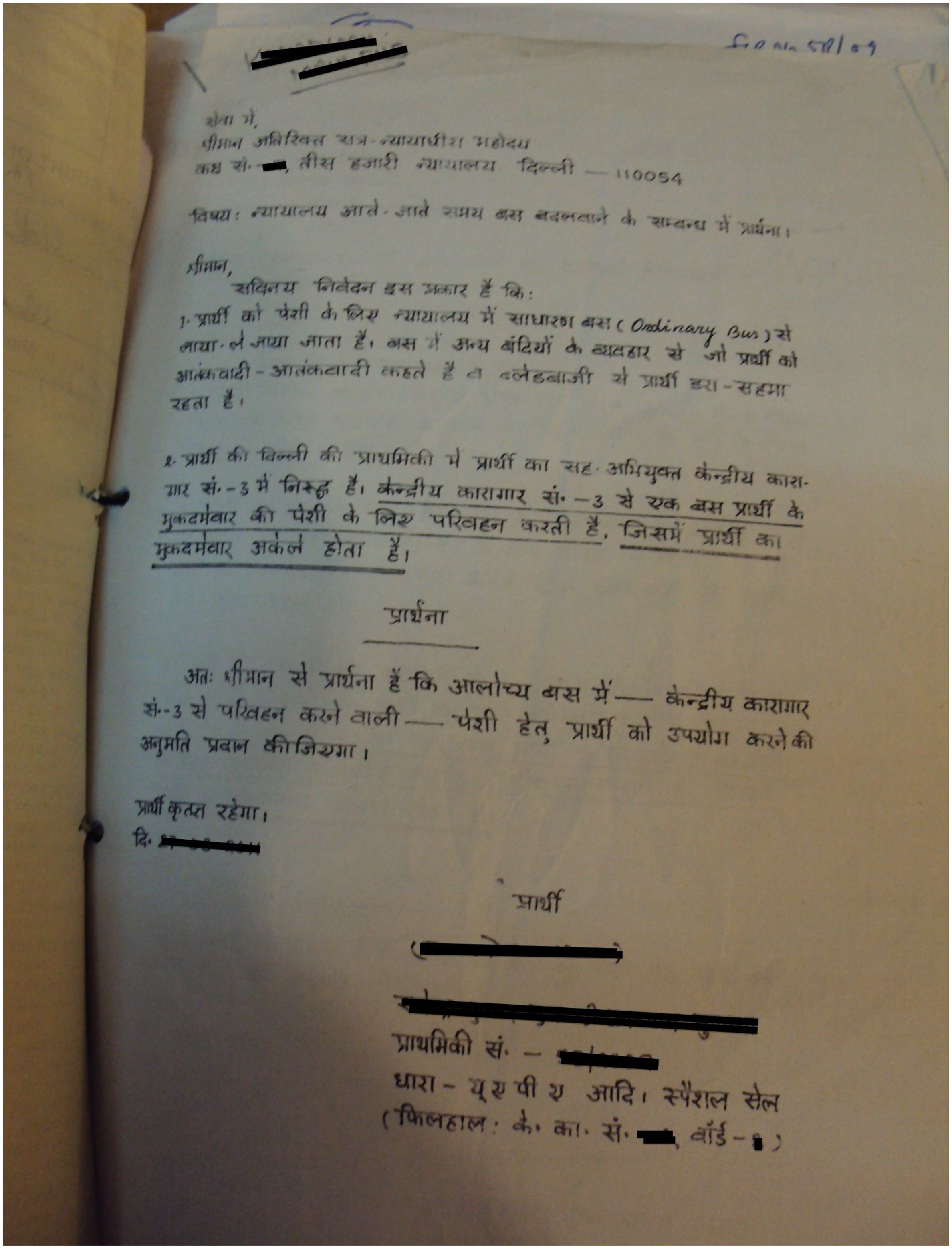
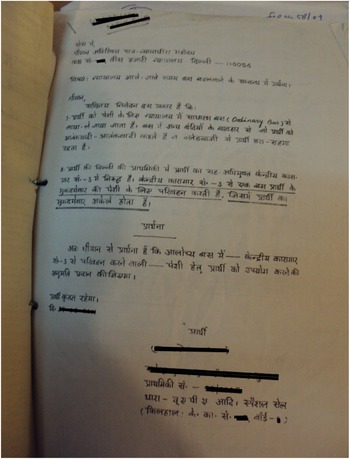
He wrote the letter in Figure 1 to the judge presiding over his case, asking to be transported in the same bus as Bharucha. It was written in Hindi and has been translated by me.
Letter from Kumar to the trial court judge
The letter reads:
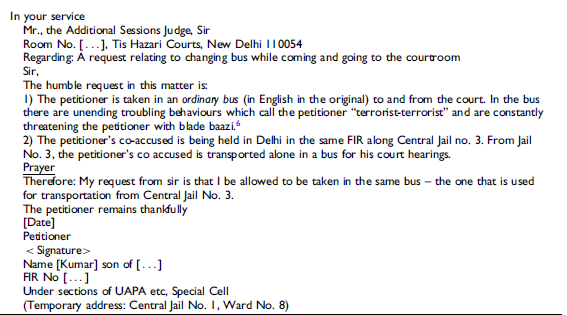
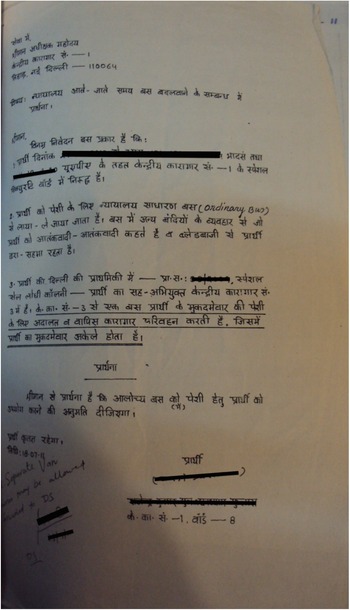
This is the first of three letters Kumar had given me pertaining to his issues on the bus. The first letter was merely placed on the judge’s file and nothing ever came of it. He again wrote out a similar letter and submitted it to the judge, and again, there was no reply. Kumar then sent another letter (Figure 2), this time to an administrator in Tihar Jail.
Letter from Kumar to the jail administrator
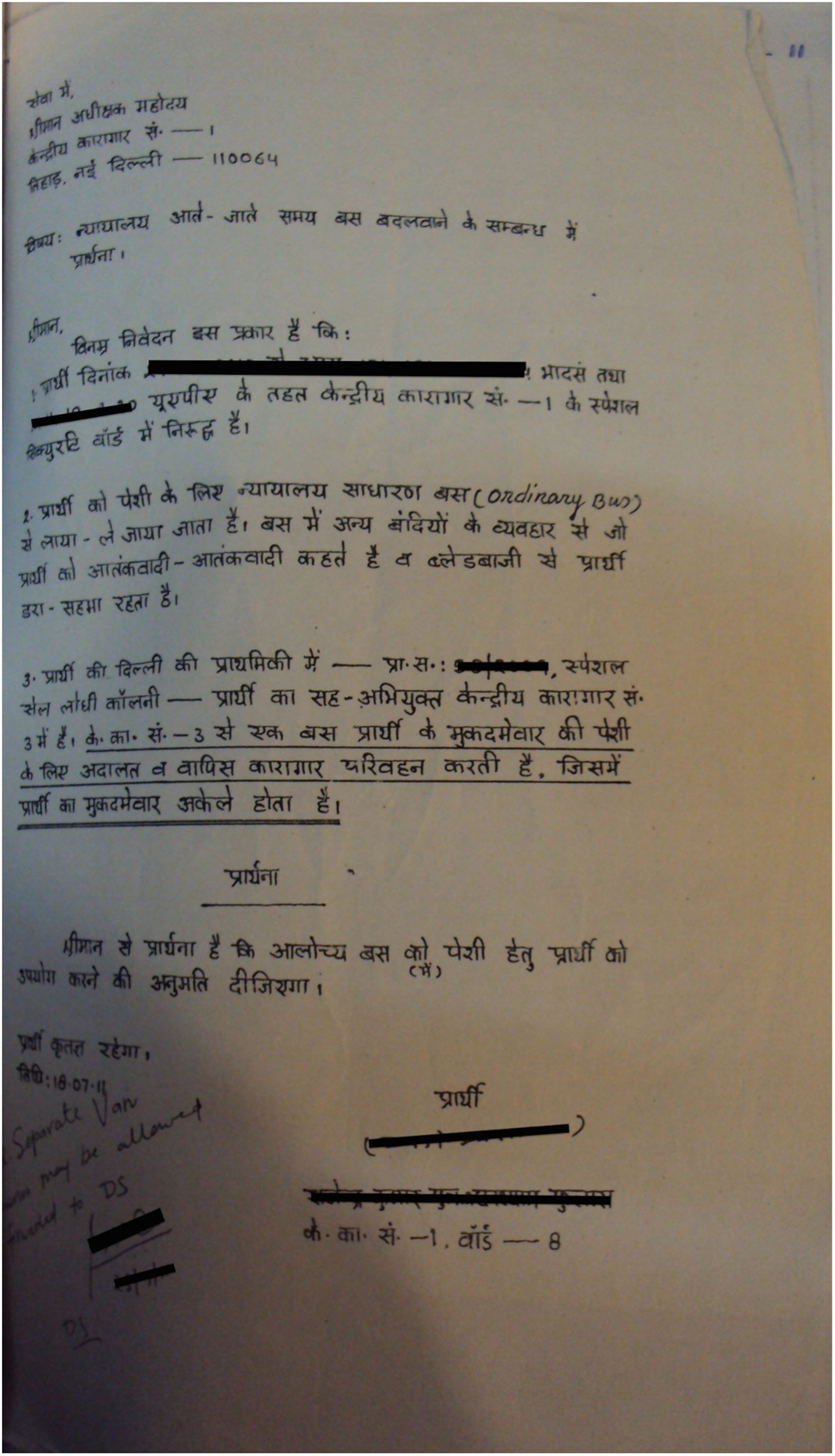
Kumar signs off his letters with the word Prārthī, meaning “one who makes a prayer.” In doing so, he writes himself into the position of a supplicant who is polite, moral, humble before a benevolent court. This is not a letter that is framed in the language of rights. Through these letters, invoking the language of submission, he writes himself into being a moral person who is suffering and deserving of the court’s mercy.
Despite his resort to the language of supplication, I also got the sense from Kumar that he wanted to be transported along with Bharucha because it would be a marker of respect. One word he used to describe his experiences on the bus was “dabaana” or to be put down. I got the sense that he felt, by being allowed to travel on the same bus with Bharucha, he would not only escape the weekly bullying, but he would also be elevated to “Bharucha’s level.” While they are written in supplicatory language, these applications gave voice to Kumar’s sense of himself—that he should be treated on par with Bharucha.
These arjis filed by Kumar were just several of the many that he sent. He sent petitions on a variety of topics, not just regarding his request to be transported by a special van. He told me that he had written letters to the Prime Minister of India and the Chief Minister of his home state. In these letters, he told the addressees that he was innocent and was being tangled up in a fabricated case. He also wrote letters to the judges who presided over other cases against him, asking them to start those trials and not to wait for this one in Delhi to conclude.
I asked him when he started writing these petitions. He told me that his first weeks in prison were marked by confusion: “I did not know what was happening,” he told me.
“They [the police] would take me from the police station to some place, ask some questions. They would take me to court and tell me that I was to stay quiet in front of the judge. I would not know anything – I did not understand what they [the police, lawyers, and judges] were saying to each other.”
He told me that he started writing applications and petitions to court officials and government officers after he was transferred out of police custody and into the jail, where he was held during his trial. There, he saw other defendants write applications and petitions to different judicial and governmental offices. He also approached the legal aid centre in the jail, where he saw how legal aid lawyers wrote out petitions. He learned from other jail inmates how to read his case papers and how to intervene in his case by filing petitions. He told me, “I realised that this is how people would work on their cases […] I saw people writing arjis and I thought I should also write to help my case.” He told me, “likhte likthe, confidence bad jaata hai” [confidence grows by writing]. He told me, “now if there is something that I want or need, I immediately write out an arji.” In other words, it was the writing of the petitions, not their success, that enabled Kumar to feel that he could participate in his own trial.
During our conversations, I asked him if he thought the addressees would actually do anything as a result. His petitions about being taken on a different bus, after all, had proved fruitless. His responses proceeded along different lines. First, he drew attention to the form of his writing. He said that the fact that he wrote them out as arjis—and not as he had seen by some inmates, as postcards to courtsFootnote 7 —meant that the courts and officials ought to take them seriously. While speaking of the letter to the court (Figure 1), he drew attention to the fact that the judge’s address was there, that he numbered his paragraphs as he saw in legal documents, that it specifically mentioned a “Prayer” as he had seen in petitions drafted by lawyers. While speaking to him, I got the sense that he believed the courts and officials should take him seriously because he had cultivated the ability to write in a legal form.
He told me that, as his handwriting is neat and his written Hindi is good, they demonstrated “his education.” His handwriting was so good that other prison inmates would sometimes ask him to write out petitions for them. Implicit in his description of his handwriting is the idea that his neat handwriting would give the addressees a sense of his character, and would buttress the truthfulness of his petitions. Even though he expressed some pride in being able to write out petitions for other inmates, he felt that if he could write petitions in English, his applications would be taken more seriously “as they show good education” and “the quality of a person.”
He also wrote out and sent his own petitions so he could make sure that they had been sent. While commenting on legal aid lawyers, he believed that they were all incompetent and corrupt. “If they were good and honest, then they would not be in legal aid,” he said. Even though they get paid by the government, he had heard that they force inmates to pay them and even then, “the work doesn’t get done.” So rather than bribing the legal aid lawyer to do work that might not get done, he would rather do it himself. He went to the post office in jail, and made sure that his petitions were sent by registered post. Sending it by registered post, he said, “would make them know that I know it has been delivered.” He told me, drawing upon a legal metaphor of being present in court, “that I was before them.” Here, Kumar draws upon the epistolary logic of the petition: the petitioner singles out an addressee to write to, the petition is seen as being able to transport the petitioner in person into the presence of that particular addressee, and by that presence, the addressee should be moved to respond.
While the applications about the bus concern a relatively simple (albeit dangerous) matter, they show us the significance of his ability to write in a legal form. At one level, they are an attempt by Kumar to get the respect he feels he deserves and to get out of humiliating and dangerous circumstances. At a more fundamental level, the ability to write petitions gives Kumar, in his own eyes, the standing to participate in his own trial. In his narration of his experience of the trial, he was first confused by what was going on, and then he learned how to read case files and taught himself how to write applications. The applications reflected the learning that he had cultivated during the trial. Although at the start of the trial he felt stupefied by the legal process, filing the arjis eventually allowed him to claim that he was making important interventions in his own case. And in doing so, the petition form allowed him to draw upon two imaginings of the law: as someone knowledgeable about the petition form, he can speak in the linguistic ideology that appeals to an objective set of rules; and, by drawing attention to the petition’s letter form, he also shows that the law can be imagined as a rhetorical form aimed to move another emotionally. His ability to write petitions, drawing upon these two aspects of the law, enabled him to find a footing during the trial.
3. Petitions as demands for a specific future
In most instances, the terror-accused individuals I came to know during my fieldwork wrote petitions when they wanted something to happen: as we saw in the last section, to be taken in a different bus, or in this section, a plea that action should be taken against police and medical officials who tortured the authors. Petitions do not just document what has happened. They are demands for a specific future. As we will see in this section, in making a demand for a specific future, they invoke the dual imagination of the law as rule and prerogative, and write into existence a shifting subjectivity of the author.
I came across the following petition and two similar ones while going through the files of the case against the Students Islamic Movement of India (SIMI). According to the Indian government, SIMI is a terrorist organization responsible for numerous terrorist attacks across India. Former members of SIMI have told me that they were a student organization, which believed in university education and an adherence to Islamic principles. According to these former members, the only reason SIMI was banned in September 2001 was because it was one of the few organizations opposing the then-Hindu right-wing government’s expansion of power in the wake of the war on terror. After it was banned, SIMI had been blamed for several terrorist attacks in India in the 2000s. Most of the investigations and trials against SIMI members for terrorist offences have ended in acquittals, and some journalists have shown that SIMI became a convenient scapegoat for police forces to blame for terrorist acts (Sahi, Reference Sahi2008).
The following letter was written by a person alleged to have been a SIMI member and to have been part of a conspiracy that resulted in the bombing of Mumbai’s suburban trains. Several members of this alleged conspiracy were arrested by Mumbai’s Anti-Terrorism Squad (ATS) and some eventually were convicted. One of those accused, who was later acquitted in the trial, has written about his violent experiences of going through the investigation and trial (Shaikh, Reference Shaikh2021).
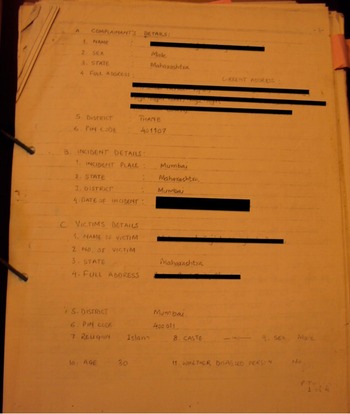
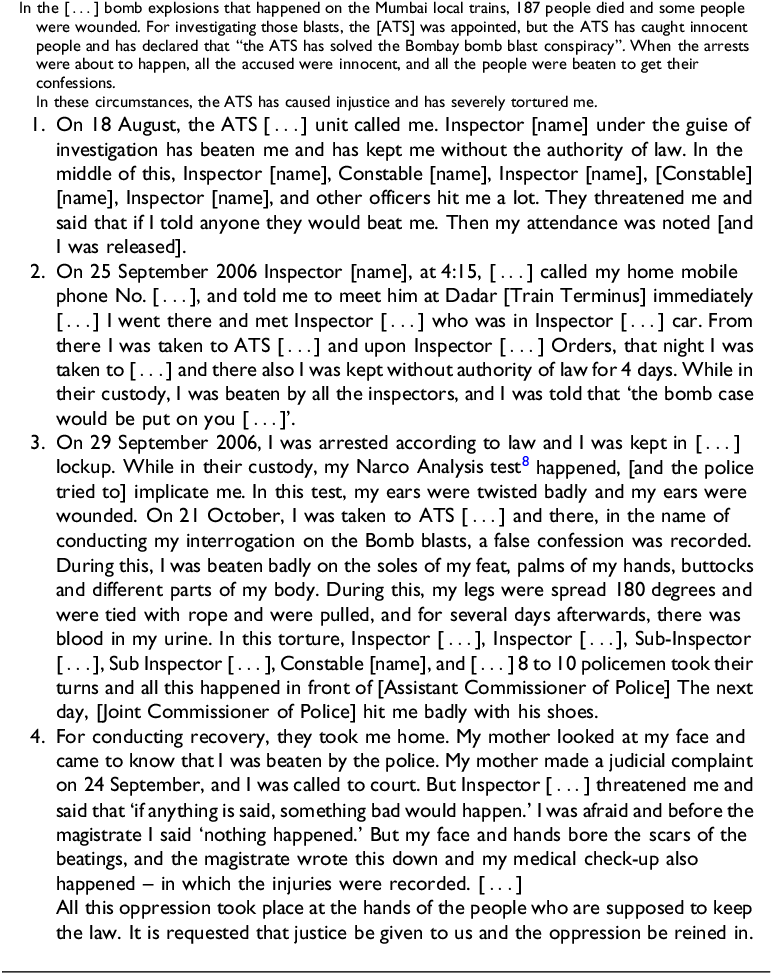
The following letters contain graphic descriptions of the torture their authors were subjected to by the Mumbai police. It is written by one of those accused in the case, to the NHRC. Figure 3 is the first page of this petition.
First page of a petition from a defendant to the National Human Rights Commission
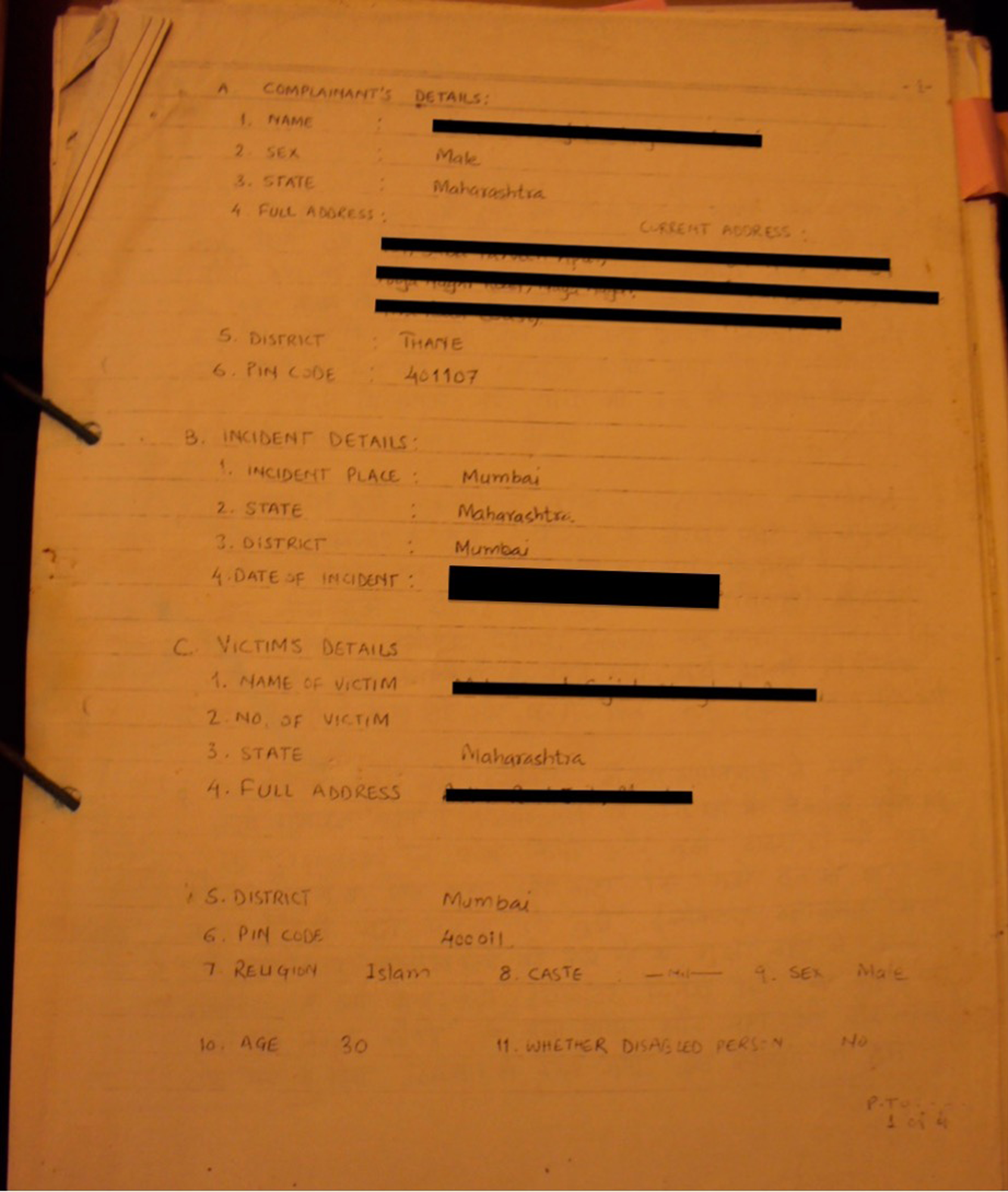
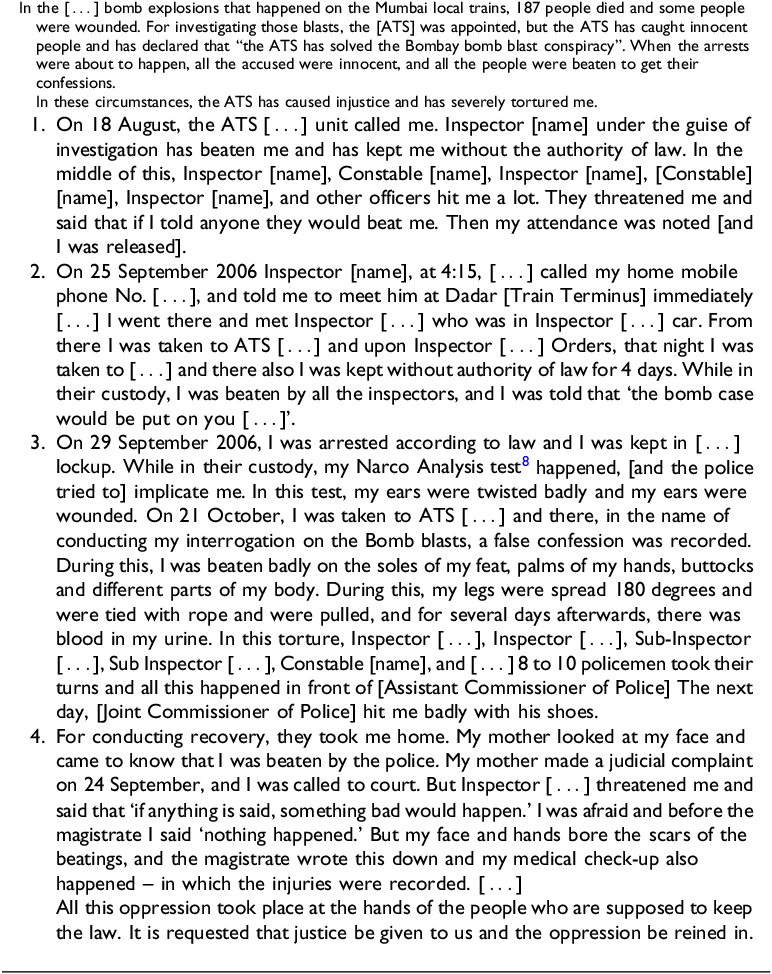
The next two pages contained text written in Hindi that detailed the tortures suffered by the letter writer. The bottom right-hand corner of each page states the total number of pages of the letter, and the page that the reader is currently on, indicating the effort of the letter’s author to ensure that no part of the letter goes missing and that the NHRC has the full account as contained in the petition. What follows is my translation of an excerpt of the body of letter.
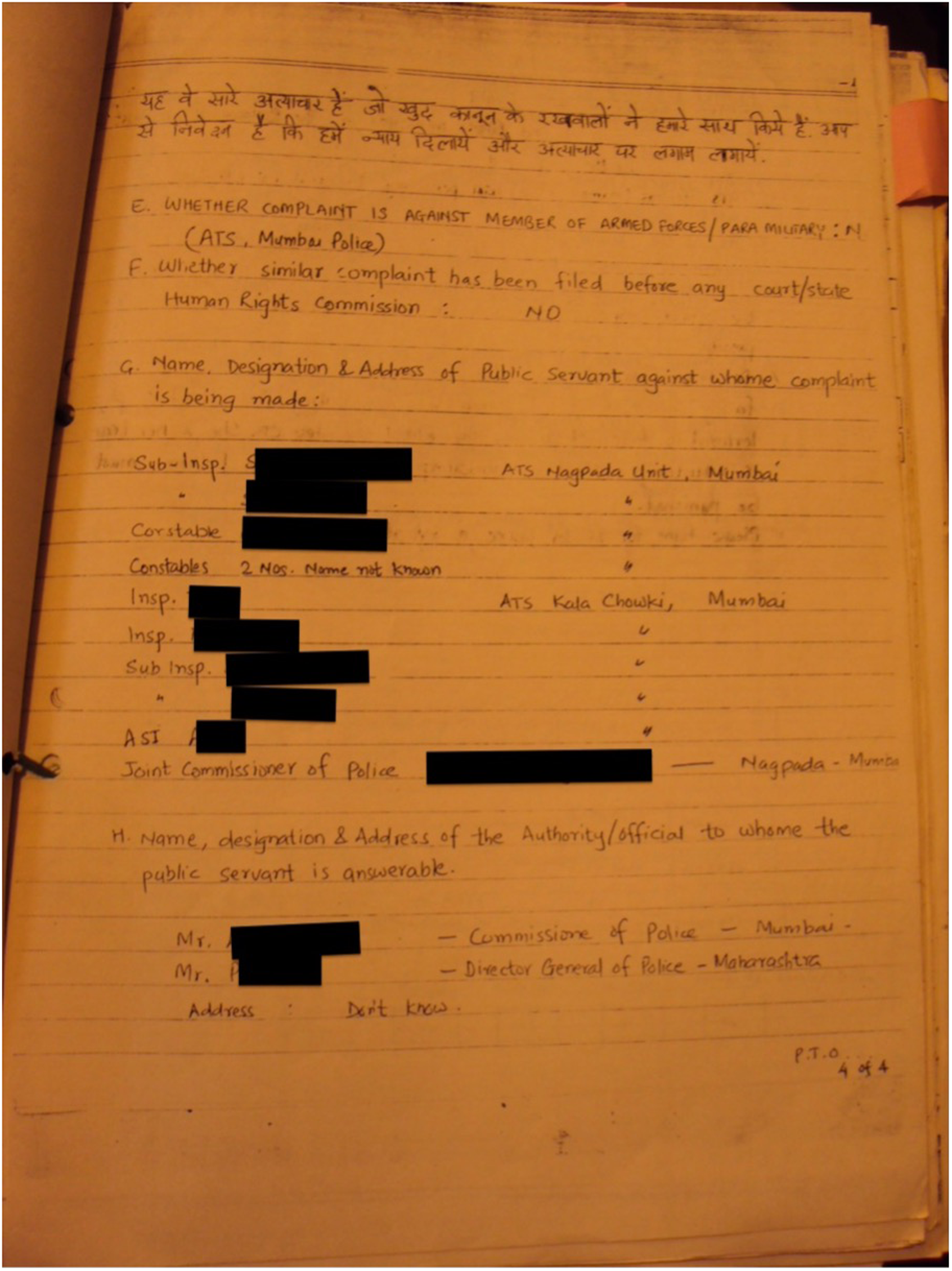
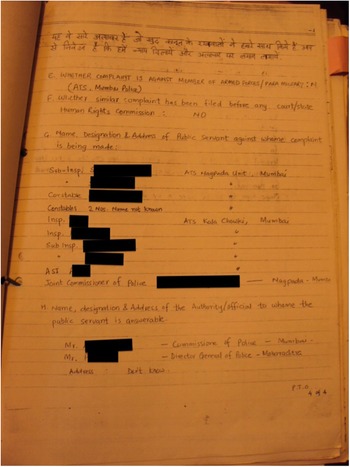
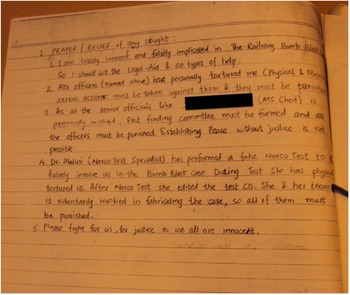
The last two pages (Figures 4 and 5) of the letter detail the names of the people against whom the complaint is being made and what actions the petitioner wants: action to be taken against the police officers, the medical professional who administered the truth-serum test and to be released from this case.
Page of petition to National Human Rights Commission stating the names and designations of officers who committed acts of torture
Final page of the petition to the National Human Rights Commission
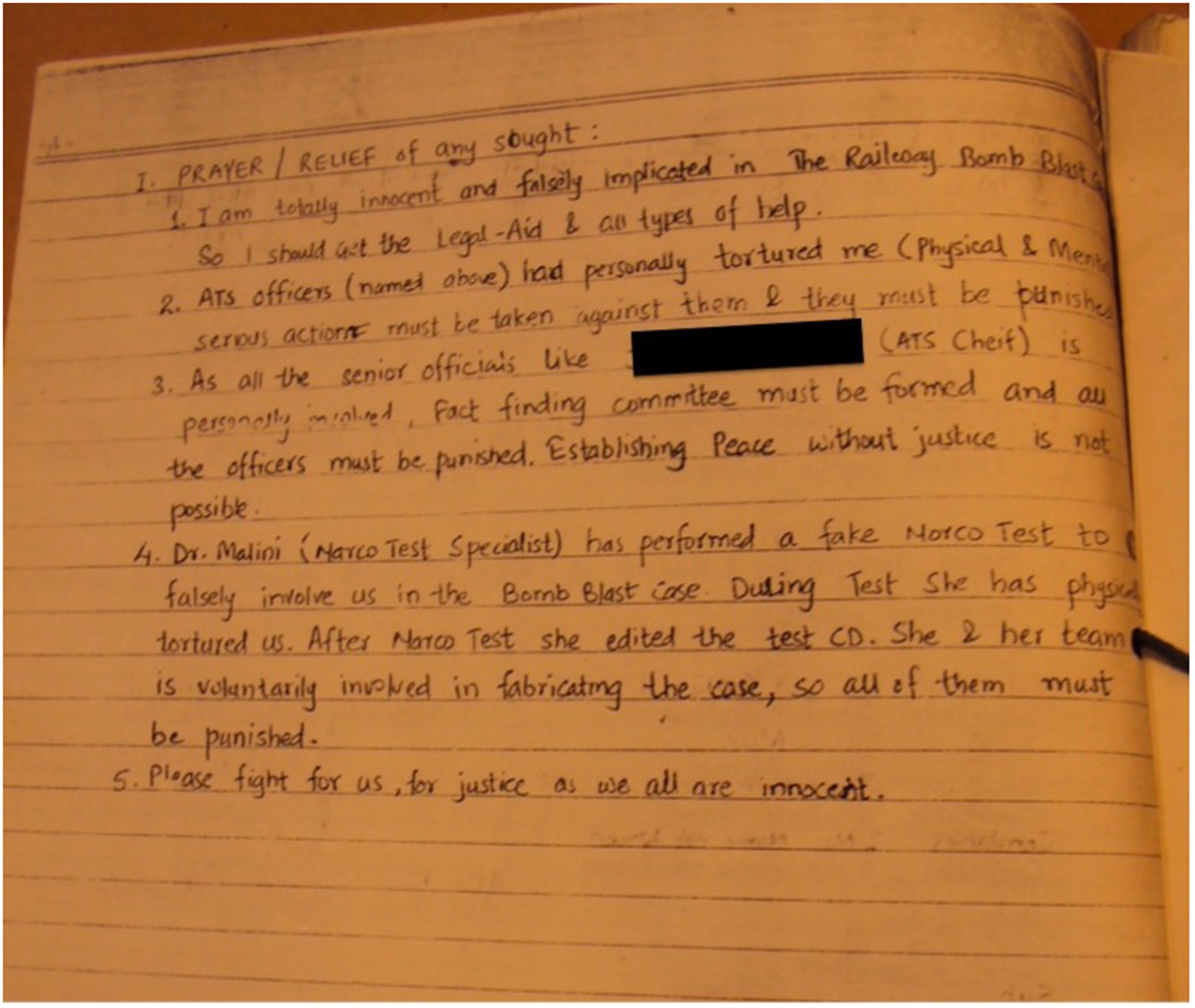
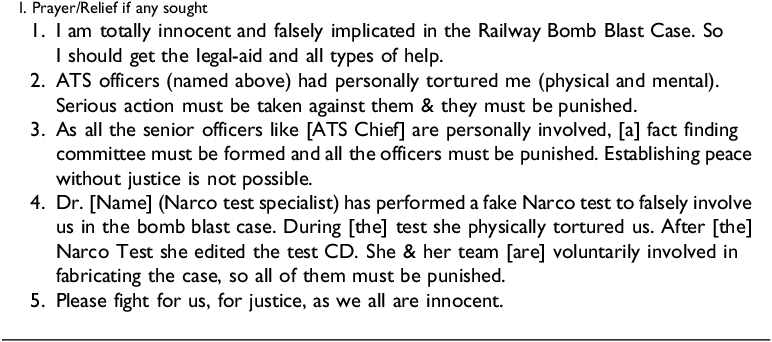
The last page of the petition reads

The other two letters also spoke of such horrors. All of them were written by people who were accused in the same case. To my untrained eye, they all also appear to have been written in the same handwriting, indicating that one person wrote them on behalf of the three “official” authors. Regardless of whether they were written by the same person, the fact that there were three of these letters written and sent together gestures towards an understanding of legal letter writing not as a solitary pursuit, but rather as a collaborative and communal activity (Ahearn, Reference Ahearn, Barton and Hall2000; Barton and Hall, Reference Barton, Hall, Barton and Hall2000).
Several aspects of this petition stand out. First is its form. By copying it by hand, the authors are seeking to place the petition within the formal requirements set by the NHRC. By writing to the commission, and adhering to its recommended form, the authors are singling out the Commission as addressee. This is not a strategy to send the same petition to multiple addressees. Rather, the author’s decision to send it only to the NHRC implies that he had a sense of what the NHRC, in particular, can and should do. Also, the formality of the petition—numbering the paragraphs and using sub-headings—indicates that the author wrote the petition while imagining an official addressee. The author could have sent a postcard, or a letter containing fewer formalities. Instead, they wrote out a petition bearing the hallmarks of a legal document, indicating that they imagined the NHRC as a rule-bound body that works through official procedures.
The second noteworthy aspect of the petition is the affective moves the petitioner makes. Of particular interest are the forms of the self that the author writes into existence (Foucault, Reference Foucault and Rabinow1994). The letter invokes universal legal terms—it names the physical violence as “torture” and says that any “evidence” collected in these circumstances is fabricated; that he was kept “without the authority of law” for four days; and that his “attendance” at a police station was “noted.” The author also narrates himself as an innocent person who has suffered brutal torture and humiliation at the hands of the police. The author seeks to move the addressee to act by narrating the author’s specific circumstances. It narrates the torture the author faced, the look of concern of his mother’s face, and finally ends on a plaintive note. It also adopts a confrontational tone by reminding the addressee that “Establishing peace without justice is not possible.”
By invoking universal legal categories as well as attempting to move the addressees through the force of emotion, these petitions make claims and demands upon their addressees. They provide a narrative of the self and attempt to place the narrative in the domain of the institutions that are being addressed. By appealing to both the specific circumstances of the author and by an appeal to “objective” rules, they aim to persuade the Human Rights Commission to act against the police officials. Weaving together rule and prerogative, the petition enables us to see law as an affective field of confrontation based on rules. The petition is an attempt to move another and also a demand for a reply.
These two aspects of law—as rule and prerogative—also emerge through the idea of time implicit in these petitions. By listing the dates, the narratives presented in this letter form a chronological ordering of the past. The sequential ordering imposes an order on the events (Ochs and Capps, Reference Ochs and Capps1996). The letter opens with a progressive description of “what happened,” narrates a series of events in order of their occurrence, with the sending of the letter itself marking the temporal conclusion of the narrative. The events that are relevant are determined by the request that the letter contains. The letter is hence both a container for that narrative and part of the narrative.
More importantly, as a part of the narrative, the letter also serves as a link between the past and the present, and importantly as a link to future life worlds (Ochs and Capps, Reference Ochs and Capps1996). Even as the narrator is positioned in the present—and hence tells the narrative from the temporal perspective of the present—the petition also provides an opening into the future. The letters end with a prayer, a wish, a desire. This is what the author of the letter hopes for in the future, what he thinks ought to pass. Thus, these letters implicitly anticipate a world that could be and specify what the law could do to bring that world about. They weave a story of the self and communicate it to the addressee, employing multiple ethical and emotional registers, to demand a future that the petitioner wants.
4. Turning away from the law
To write a letter is to place oneself in a position of vulnerability: a letter may not be replied to; one’s wish conveyed through the letter may be disregarded. We single out another person, expecting to receive a reply and to have our requests considered. A letter may end in failure to create a desired future. To write a letter of petition runs similar risks: legal institutions may not respond, or claims for justice may be met with disdain. The ethical work of narrating oneself through rules and making emotional appeals may be for nothing. The law is revealed to be hypocritical as not following its own rules; and callous and uncaring for failing to be moved to action by the cries of the author.
Most of the petitions that I encountered during my fieldwork were not replied to. As we saw in Section 2, Kumar’s appeals to be taken on a different bus largely fell on deaf ears. Petitions to the NHRC went unanswered. Rather than think about efficacious petitions (Mathur, Reference Mathur2019), I want to understand what imaginings of the law created, even in this failure to receive a reply.
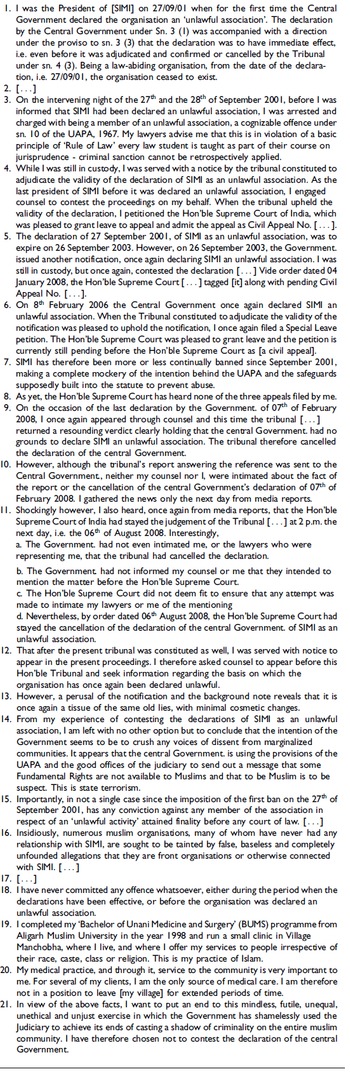
I want to explore this by looking at a petition filed by the last president of SIMI, Dr. Shahid Badar, in 2010. After the 2001 ban on SIMI, the ban on the organization was adjudicated by a tribunal, which was specially constituted by the government under a power granted to it under the UAPA. The ban was upheld by the tribunal and remained in effect for two years. Under the UAPA, if the government wants to ban an organization again, it has to present its case, afresh, to a tribunal. The government issued fresh bans every two years which were upheld by tribunals in 2003 and 2005. After each tribunal decision, Dr. Badar filed an appeal to the Supreme Court. Each time, the court admitted the appeal and did not schedule a hearing of the cases. The ban was renewed again in 2008, except this time, the tribunal found that the government did not have sufficient cause to ban the organization and cancelled the organization’s proscription. The Government of India immediately filed an appeal against the order of the tribunal in the Supreme Court, and the court issued an interim stay on the tribunal’s decision. The Supreme Court, after passing the interim stay, has not scheduled a hearing on this case either.
The ban on SIMI was renewed for a fifth time in 2010, but this time, Dr. Badar refused to challenge the ban. Dr. Badar wanted to tell the tribunal, in writing, that he refused to participate in the proceedings for a fifth time. He sent the text of a petition to his lawyer, who then edited it and filed it before the tribunal. During a conversation with Dr. Badar and his lawyer, I asked them why they felt it necessary to file a petition to make the point. They could have simply not appeared before the tribunal, or the lawyer could have just appeared before the tribunal and orally informed it that Dr. Badar was refusing to take part. This was Dr. Badar’s reply:
Because I want to put things on file. I want my statement to be part of the record. If [the lawyer] just made a statement, then the judge may or may not record it. I want them to know that I have followed the law. I am a citizen of this country and they violate all ideas of rule of law and the constitution, just because we are Muslim.
Here Dr. Badar infuses his petition with several ideas. First, the idea of law as a record, the idea that it will remain on the archive of the case. By referring to the image of a file, Dr. Badar seems to be imagining the courts as Weber might—as dispassionate, rule-bound bureaucracies that produce files. Second, in framing himself as a victim, he invokes the idea that petitioning symbolizes his status as an equal citizen, an equality that he has been denied on account of him being Muslim. Third, in pointing to the hypocrisy of the law, he seems to say that the petition is emblematic of the rule of law and constitutionalism, two things that the state has refused to follow.
These ideas are elaborated in the text of his petition, an excerpt of which is below.
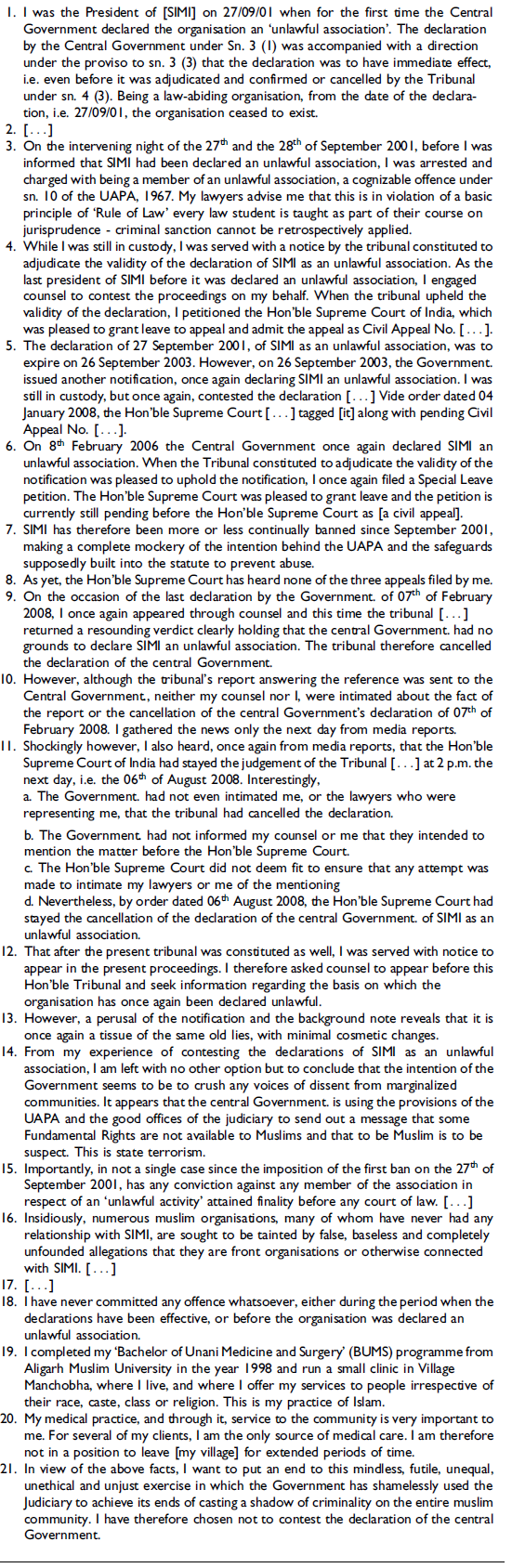
The tone in this petition to the tribunal is scathing. Through its sequential narrative, the petition constructs a sense of the author on the one hand, and of the government and the courts on the other. Through its narrative, Dr Badar constructs himself in two different ways: first as a person who has respected the law and who knows its fundamental principles. Note again, the formality of the petition—its numbered paragraphs, and its sequential setting out of the facts. He refers to texts of the relevant statutes, notification dates, civil appeals—indicating that he knows the bureaucratic forms of legal processes. He also refers to certain fundamental legal principles—the rule against non-retroactivity of criminal law and the rule of fair hearing. He also narrates himself as a victim of the court’s callousness and the government’s hatred towards Muslims, and he presents himself as a doctor whose practice of Islam and medicine is rooted in an ethic of care.
By contrast, both the courts and the government are painted as uncaring and as institutions that do not actually venerate the law. His repeated invocation of the dates of his appeals to the Supreme Court, and his detailing of the procedural violations when the court stayed the final declaration cancelling the ban, does two things: it paints a picture of an institution that both does not follow its own rules, and it highlights the court’s lack of care for the plight of Muslim citizens and their associations. The petition describes the government in the same way: as an institution that does not follow the rules under the UAPA, has no regard to due process and is institutionally prejudiced towards Muslims. He tells us how he and the organization for which he was a president had been victims of the government’s use of anti-terror laws. He demonstrates that he was subject to the retrospective application of criminal sanctions and was left to contest the bans while he was imprisoned on spurious charges. The petition points to the government’s cynical use of anti-terror laws to ban legitimate organizations. It draws out the underhanded tactics used by the government—such as not informing him of the tribunal’s decision or of filing an overnight appeal without due notice. It points to the fact that the government is using anti-terror laws to “cast a shadow of criminality on the entire [M]uslim community.” In pointing out how the government has used anti-terror laws to crush dissent, the application names the government’s actions as “state terrorism.” It also criticizes the Supreme Court, first for never hearing any of the appeals that he had filed, and second, for acting with embarrassing haste on the government’s appeal, and third for never giving him adequate notice of the appeal.
Here, the imagination of law as rule is overwhelmed by the idea of law as a prerogative: where institutions can do what they want, regardless of what legal texts say. The petitioner insists on recording his refusal to be part of the empty rituals of mercy and supplication and the feigning of rule of law. This letter aims to effect a turning away from the law. In doing so, it makes the case that the law has not lived up to his expectations. It makes no demands, and does not even expect an acknowledgement of what has happened, for the law has fallen to such depths in Dr. Badar’s eyes. The mood here is one of anger and disappointment that the government and even the judiciary, which should uphold constitutional ideas of equality and liberty, have failed to do so. A call to be treated fairly has not only gone unheard but has been met with a profound rejection. The feeling is one of betrayal, of being let down, of a law that had promised so much, delivered so little and responded to cries for justice with more injustice.
5. Conclusion
In this article, I have sought to show how an imagination of law is entwined with the significations of the petition. By exploring the narrative within the petitions, as well as their form and content, I have suggested that the law is imagined as a power that takes the form of both a rational, rule-bound process, and as a form of prerogative. In the first imagining, the legal institutions and officials provide justice through the law’s objective and rational processes, and in the second, justice is dispensed only if these legal institutions and officials are moved by hearing the plight of the petitioner. In invoking both these imaginings of the law, the petitioners narrate their own subjectivity in different ways—as law-abiding, rational individuals who appeal to rules and as humble supplicants appealing to the law to exercise its prerogative to bring about justice.
While this argument is made through the media of petitions written by terror-accused individuals, these intertwined imaginings of the law and the people who encounter it are not limited to petitions. In fact, we can see how these conceptions of law are produced by legal institutions themselves.
Take, for example, the Indian judiciary’s innovation of the Public Interest Litigation (PIL). Broadly speaking, these are cases brought by a “public spirited individual or institution” who have petitioned the higher courts—the High Court and the Supreme Court—on behalf of people who have suffered “legal injury” and are unable to approach the courts “by reason of poverty, disability or socially or economically disadvantaged position are unable to approach the court” (Supreme Court of India, 1978). One of the hallmarks of PILs has been the relaxation of technical rules of procedure: the petitioners themselves do not need to have a strict locus standi to bring the case; the petition need not demonstrate a distinct cause of action; evidentiary standards are lowered; and courts are allowed to fashion flexible and creative remedies. Further, in what the Supreme Court refers to as its “epistolary jurisdiction,” the “petition” need not even take the form of a petition. Instead, a letter or a postcard sent to the court may be treated as a petition for the enforcement of fundamental rights (Supreme Court of India, 1982; Supreme Court of India, 1986). The creation of PILs was lauded as a form of “juridical democratisation” (Baxi, Reference Baxi1985, p. 108) in which the courts, unencumbered by procedural and technical constraints, could hear petitions on behalf of the suffering, “teeming millions” (Baxi, Reference Baxi1985, p. 111) of Indians. PIL procedures provide another dramatic example of the imagining of poor supplicants to justify allowing law as rule to give way to law as prerogative. The letter here is imagined as a device through which the courts can hear directly from these poor supplicants.
The ostensible abjuring of rules has, however, been a source of anxiety. Scholars have argued that the disregard for procedure has enabled the courts to become vehicles for dominant economic and social interests, even as they speak in the name of the people and employ discourses of populism to rhetorically justify their ability to issue orders without reference to rules (Suresh and Narrain, Reference Suresh and Narrain2014; Bhuwania, Reference Bhuwania2017). Even the courts themselves have periodically bemoaned the fact that PILs have become a vehicle for narrow interests and have been used to further private interests, and have issued guidelines to verify the bona fides of petitioners, evidentiary standards, and other procedures regarding PILs. They have oscillated between extolling the virtues of the expansive nature of PILs, and laying down rules for PILs because of this same normlessness (Parliament of India: Official Debates of Rajya Sabha, 1997, p. 276; Spandana, Reference Spandana2023a; Spandana, Reference Spandana2023b; Khergamker, Reference Khergamker2024).
It is perhaps in this context that the Supreme Court’s demands for a handwritten letter from Zubair—in the opening sequence—become understandable. In the judges’ view, the formal petition was not enough. The handwritten letter could assure the court that the petitioner had “given his word” (to think of the literal meaning of parole) that he was deserving of the court’s grace. The courts’ desire to know the real applicant through a handwritten letter could help to determine whether the prisoner was “deserving” of parole. In this sense, the handwritten letter is imagined as providing an emotional and moral legibility of Zubair’s character. It could enable the court to imagine Zubair as a deserving prisoner. Against this possible reading into the court’s thinking behind asking for a handwritten letter, we can recall the lawyer’s frustration with the process. The lawyer seemed to be taken aback by the court’s disregard for the rules. What was the point of submitting evidence of good behaviour, the psychiatric reports, and sworn statements, if the court could claim to comprehend a person’s character just by reading a handwritten letter? What was the point of the lawyerly drafting of a petition, which appealed to rules and readings of precedent, if the court had no regard to them?
My aim here is not to cast judgment on courts, but rather to suggest how intertwined imaginings of the law are illustrated by competing ideas about the petition. In one, the petition is an avenue to hear from the people themselves. Unmediated by the filters of formality, the petition is imagined as a way to hear about the plight of the poor supplicants who seek the court’s justice. On the other hand, in a different imagining, a petition is emblematic of the rule of law. In this imagining, the petition ought to describe a cause of action, the standing to bring a case, evidence for its claims, and an appeal to objective principles of law. These two competing visions of the petitions reveal fundamental anxieties about the law. On the one hand, the legal process—with its complicated rules and forms—is known to remain out of reach for most Indians. As Baxi asked many years ago, could the legal system maintain any legitimacy in the eyes of ordinary Indians, if the law could not respond to the needs and demands of their needs and claims (Baxi, Reference Baxi1982)? On the other hand, there is an equally pressing concern about what the “rule of law” means if justice can be dispensed as an act of grace. What is the point of rules of procedure and evidence, if the courts can just do what they want? The point here is not to resolve these tensions, but to observe them as an animating feature of contemporary Indian law.

 Open access

