

1. Introduction
The International Convention on the Elimination of All Forms of Racial Discrimination (ICERD) is a central instrument that drives the universal ambition of eliminating racial discrimination. Its adoption on 21 December 1965 was regarded as a signal moment in international lawFootnote 1 and since then it has been ratified by almost all states.Footnote 2 While the idea of having a centralized instrument with a unitary aim to eliminate racial discrimination was nothing short of revolutionary, it is worth noting – as indicated by Patrick Thornberry – that ‘the Convention did not emerge ex nihilo but carried with it a weight of political, ideological, and institutional baggage’.Footnote 3 Its inception was characterized by disagreements which are consistently found in its travaux préparatoires. Among those disagreements, one of the most prominent revolved around the criteria for defining racial discrimination.
This article examines this disagreement through Article 1 of ICERD, which lays down the basis of defining racial discrimination. It argues that, irrespective of the disagreements on the definition of racial discrimination,Footnote 4 the wording of Article 1 in its current form creates a tripartite classification of semantics. At the first level, race is given an equal footing to colour, descent, or national or ethnic origin, and hence all of these protected grounds constitute racial discrimination (Paragraph 1). On the second level, race is differentiated from citizenship and therefore distinctions based on it are not considered racial discrimination (Paragraph 2). Between these two levels, the term nationality is introduced, the meaning of which fluctuates from national origin and ethnic origin to citizenship, which is regarded as racial discrimination only if it is targeted against a particular nationality (Paragraph 3). ICERD thus creates a semantic conundrum, in which these terms and the meaning generated through them construct a particular conception of racial discrimination which is often difficult to discern and apply.
The framing of racial discrimination in Article 1 has not gone unnoticed. Michelle Foster and Timnah Rachel Baker have recently explored it as a ‘Doctrinal Blind Spot of International Law’,Footnote 5 James A Goldston as ‘Holes in the Rights Framework’,Footnote 6 while other scholars have also remained sceptical about it.Footnote 7 Due to the confines Article 1 introduces in conceptualizing racial discrimination, there have been calls that the Committee on the Elimination of all Forms of Racial Discrimination (Committee) needs to shift towards a harm-based approach,Footnote 8 or interpret the exception of Article 1 as narrowly as possible.Footnote 9 The Committee itself has given various general recommendations and concluding observations on state reports to mitigate the impact of Article 1. However, examining Article 1 through the lens of semantics differs significantly from the existing literature on this issue. This examination demonstrates that the wording of Article 1 of ICERD creates a linguistic conundrum that invites multiple interpretations, as each ground conveys its own specific meaning. An analysis driven from the meaning of grounds arranged in a tripartite structure, therefore, allows a different and deeper examination into the functionality and limitations of Article 1.
Through identifying Article 1 of ICERD as a semantic conundrum, this article proceeds to explore the jurisprudence of different forms of discrimination such as direct, indirect, and positive discrimination within its framework and examining three key cases/communications decided by the Committee, namely Diop v. France, A.M.M. v. Switzerland, and B.M.S. v. Australia. Since discrimination is essentially a ground-oriented concept in law, the analysis of forms of discrimination through the tripartite distribution of grounds in Article 1 gives a vantage point from which direct, indirect, and positive forms of racial discrimination could be understood. The examination of the chosen cases thereafter shows how the contention in those cases was essentially of a ground and the meaning it generated. In all three cases, the authors relied on the ground of ‘national origin’, while the state parties justified the exclusions on the ground of ‘citizenship’.Footnote 10 The contention thus revolved around the meaning each ground conveyed and their relevance in defining racial discrimination.
The Committee eventually decided that these cases were not of racial discrimination. This article contends otherwise. It argues that, while the relevance of grounds and their meaning was a central issue in all these cases, the authors were racialized non-citizens since their factual association with other racial grounds, such as colour, descent etc., was clear. This means that, even though they were non-citizens, they were easily identifiable through other racial characteristics, such as differences in colour, descent, and, most notably, national origin. Using the language of forms of discrimination, this article shows that the Committee was mostly concerned with direct discrimination in all these cases – on the basis of grounds that were enumerated in Article 1. If it had examined the cases through the jurisprudence of indirect and positive discrimination, it could have reached a different outcome. The semantic conundrum of Article 1 could have been avoided by the Committee if racial discrimination was understood through its forms.
The article thus examines two questions, how the semantic conundrum of Article 1 leads to the misconstruction of racial discrimination, and how the Committee could have avoided it by using forms of discrimination. While the focus of this article is on three cases, which certainly do not reflect the entire jurisprudence of the Committee, the argument it makes through analysing these questions has broader implications. By examining Article 1 as a semantic conundrum and realising the constraints it introduces to extend protection against racial discrimination, the Committee could utilize the jurisprudential possibilities offered by diverse forms of discrimination to see beyond it. It is now fairly established that ICERD is a living instrument.Footnote 11 Since it has been regarded as such, there seems no reason why strategic means are not used to extend protection against discrimination through it.
2. The semantic conundrum and racial discrimination
The preamble of ICERD states that the aim of the Convention is to eliminate ‘racial discrimination in all its forms and manifestations, and to prevent and combat racist doctrine’.Footnote 12 However, it does not give a clear definition of the term ‘racial discrimination’. Instead, it creates a tripartite classification that introduces a semantic conundrum in the definition of racial discrimination. Article 1 of ICERD lays down the basis of this semantic conundrum. Paragraph 1 of Article 1 states that the term racial discrimination shall mean any distinction, exclusion, restriction or preference based on ‘race, colour, descent, or national or ethnic origin’.Footnote 13 These grounds have been mentioned in the preamble of ICERD as well and therefore the Committee has clarified that ‘the words “based on” do not bear any meaning different from “on the grounds of” in preambular paragraph 7’.Footnote 14 However, to define a concept as important as racial discrimination, this conceptualization through certain protected grounds, with race as one of those grounds, does not appear to be particularly useful. The grounds protected against racial discrimination in ICERD, namely race, colour, descent, or national or ethnic origin, are independently recognized and, therefore, need to be proven separately to make a claim of discrimination.Footnote 15 For instance, a person who is discriminated against due to their ethnic origin cannot claim discrimination on the ground of colour unless they prove it independently. In the given situation, if each ground connotes an independent meaning, which then feeds into the definition of racial discrimination, the function of the term race seems puzzling in it.
It is arguable that race is meant to include what other categories (colour, descent, or national or ethnic origin) do not, or perhaps it acts as a general category with colour or other categories’ further subclassifications of it.Footnote 16 This is not clearly mentioned in the draft of the ICERD. The travaux préparatoires of ICERD, nevertheless, reflect that inclusion of race in this manner is influenced by the work of UNESCO.Footnote 17 In particular, in one of its statements, UNESCO states that there is ‘no such thing as “race” … the words “race”, “colour” and “ethnic origin” all meant much the same thing’.Footnote 18 This statement made by UNESCO fits well within the context of Article 1. Race seems to stand here as an anonymous term. Its inclusion as a term seems to play a symbolic function which, seemingly, could not be divorced from the conceptualization of racial discrimination.Footnote 19
This positioning of race in the meaning of racial discrimination in ICERD is, however, problematic. In the given construction, racial discrimination ends up being interpreted as a distorted concept which is distilled to ‘race, colour, descent, or national or ethnic origin’ only, wherein these words and race seem to mean the same thing. However, this distortion and distillation is problematic not necessarily because of what it entails but what it excludes. By enumerating that racial discrimination corresponds to five grounds, all of which appear to function independently but share a similar meaning with race, ICERD removes other intersectional characteristics connected with race. It generates a semantic conundrum in which the term ‘race’ functions mystically in designating who does and who does not need to be protected.
This semantic conundrum becomes prominent through Articles 1(2) and 1(3) of the ICERD. Article 1(2) of ICERD states that the prohibition against racial discrimination (guaranteed in Article 1(1)) does not apply to ‘distinctions, exclusions, restrictions or preferences between citizens and non-citizens’.Footnote 20 On the face of it, these clauses appear to be totally exclusionary. In this context, Ion Diaconu rightly criticizes Article 1(2) of ICERD by observing that if taken literally it ‘would have compelled the Committee to avoid any discussion on the situation of stateless populations or those of a foreign citizenship living on the territories of the States Parties’.Footnote 21 James A. Goldston also writes that Article 1 of ICERD ‘grants states discretion in applying race-based distinctions when it comes to citizenship rules’.Footnote 22 Peter Spiro similarly observes that Article 1 ‘brackets the use of race as a criterion for citizenship’.Footnote 23
Article 1(3) adds further complexity in defining racial discrimination. It states that ‘nothing in this convention may be interpreted as affecting in any way the legal provisions of States Parties concerning nationality, citizenship or naturalization, provided that such provisions do not discriminate against any particular nationality’.Footnote 24 The use of the term ‘nationality’ twice in Article 1(3) seems to be confusing. Schwelb, for instance, writes that the first word nationality is used in an ethnic sense, whereas the second in a politico-legal sense.Footnote 25 Diaconu, on the other hand, writes that nationality in the first sense means citizenship, whereas he and Lerner agree that the second reference to nationality is equivalent to national origin.Footnote 26
Articles 1(2) and 1(3) of the ICERD thus make defining racial discrimination quite complex. A collective reading of these articles, against the background discussion on the distortion and distillation of racial discrimination in Article 1(1), conveys that ICERD disintegrates the meaning of racial discrimination at three levels. At the first level, race stands on a similar footing to colour, descent, or national or ethnic origin, and hence all of them constitute racial discrimination. On the second level, racial discrimination does not mean citizenship and therefore distinctions based on it are not considered racial. In between these two levels, nationality fluctuates from national and ethnic origin to citizenship, which is only classified as racial if it is targeted against a particular nationality. The ICERD, thus, ends up in a bizarre play with racial epistemology, designating and retracting from what may or may not constitute racial discrimination. The semantic conundrum it generates in terms of defining racial discrimination can be visualised through Figure 1 below.
A visual representation of the semantic conundrum in Article 1 of the Race Convention
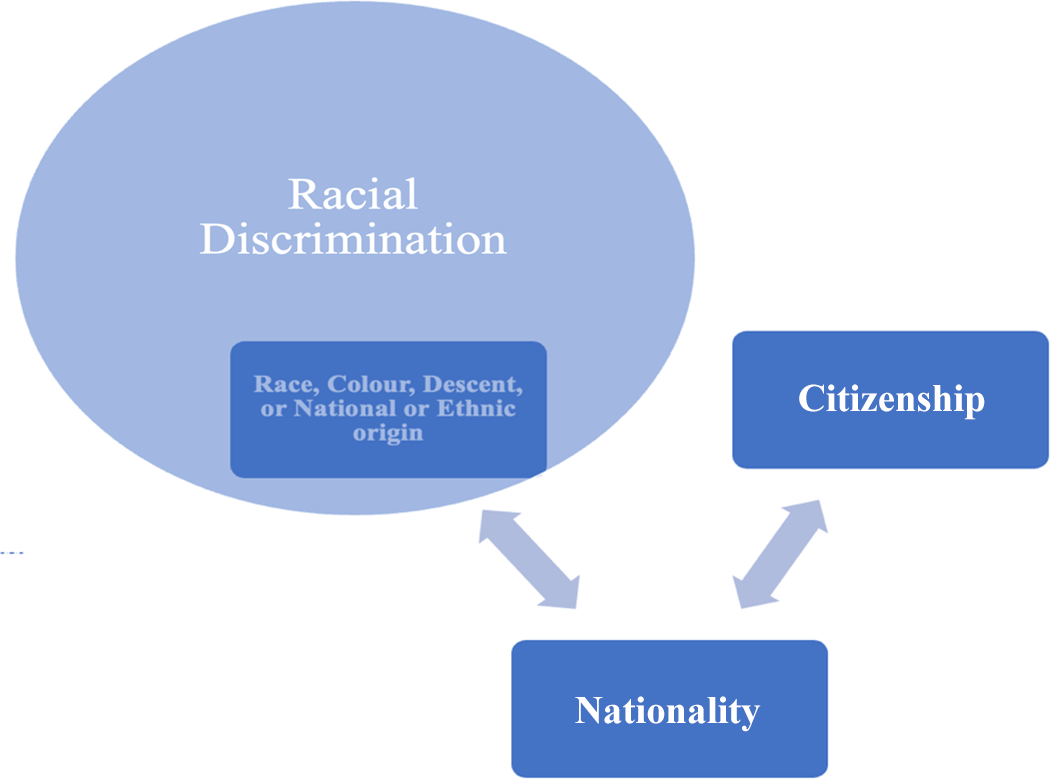
Figure 1 Long description
The image is a diagram that visually represents the relationship between racial discrimination, citizenship, and nationality. It features a large blue oval labeled 'Racial Discrimination' with a smaller blue rectangle inside it that reads 'Race, Colour, Descent, or National or Ethnic origin.' Two arrows point from this oval to two separate blue rectangles labeled 'Citizenship' and 'Nationality,' indicating a connection between these concepts. The diagram aims to clarify the semantic conundrum in Article 1 of the Race Convention by showing how racial discrimination intersects with citizenship and nationality.
Since Article 32 of the Vienna Convention on the Law of Treaties (VCLT) allows recourse to be made to the preparatory work of the treaty in case of obscure or ambiguous meaning, the travaux préparatoires of ICERD become a useful reference point to illuminate this conundrum.Footnote 27 However, it is worth noting that the travaux préparatoires of Article 1 only provide context as to why these terms became a part of the Convention in the current form rather than clarifying what they mean. The discussions indicate that the main concern in drafting the paragraphs of Article 1 in their current form was to maintain a clear separation between the state apparatus and the individuals who were not citizens.
The term ‘national origin’ in Article 1(1) appears to be the main point of contention.Footnote 28 There was a concern that the term national origin will overlap with nationality in a legal sense and for that reason Capotorti took a consistent stance against its inclusion,Footnote 29 while other experts struggled with the term.Footnote 30 In the Commission on Human Rights, the inclusion of the term ‘national’ was challenged on the basis that while it was suitable for the Universal Declaration of Human Rights as a more general non-discrimination instrument, it was not a form of racial discrimination and therefore not even included in the 1963 Declaration on the Elimination of Racial Discrimination, which preceded the adoption of the Convention. The word ‘national’ was retained in Paragraph 1 but by a bare margin of votes, i.e., ten to nine with one abstention.Footnote 31
Against this background, Paragraph 2 was introduced, the earlier version of which stated that ‘national origin’ did not mean nationality or citizenship, so that the Convention would therefore ‘not be applicable to distinctions, exclusions, restrictions or preferences based on differences of nationality or citizenship’.Footnote 32 This was withdrawn in favour of the text which ultimately became the definitive version of Article 1, encompassing Paragraphs 1, 2, and 3. In this revised version, the term ‘national origin’ was retained as one of the prohibited grounds for discrimination, and additional limitations were introduced concerning non-citizens.Footnote 33
The concerns of the states for not extending the meaning of national origin to non-citizens also varied. The representative from Uganda expressed the concern that newly independent countries might want to preserve certain rights exclusively for their own nationals, particularly those nations recently liberated from colonial rule.Footnote 34 The representative from India argued that the Convention’s purpose was to combat racial discrimination within a country, and no delegation had ever suggested that these obligations should be extended to aliens.Footnote 35 Meanwhile, the representative of the USSR contended that the term ‘national origin’ did not encompass nationality, and since it was not addressed in the text of Paragraph 1, there was no need for a reservation regarding it.Footnote 36 However, they also expressed the opinion that it was widely accepted that distinctions in status should exist between a country’s citizens and non-citizens.Footnote 37 Hence, while the semantic conundrum of Article 1 existed at three different levels, the travaux préparatoires reveal that the main reason for it being such was the reluctance to extend the protection of racial discrimination to non-citizens sui generis.
The Committee has to, therefore, resort to General Recommendations to avoid the textual vigour of Article 1. It demonstrated through various recommendations that the linguistic parochiality of ICERD should not act as a bar to extending protection against discrimination to racialized non-citizens. In Paragraph 2 of the General Recommendation 11, the Committee stated that Articles 1(2) and 1(3) did not exempt states parties from reporting on non-citizens: on the contrary, they were to ‘report fully upon legislation on foreigners and its implementation’.Footnote 38 In Paragraph 3 of the same recommendation the Committee stated that Article 1, Paragraph 2, should not be interpreted to ‘detract in any way from the rights and freedoms recognised and enunciated in other instruments, especially the Universal Declaration of Human Rights, the International Covenant on Economic, Social and Cultural Rights and the International Covenant on Civil and Political Rights’.Footnote 39 The General Recommendation 30 follows this interpretive approach as it states that Article 1(2) ‘must be construed so as to avoid undermining the basic prohibition of discrimination…’.Footnote 40
The recommendations indicate that the Committee aimed to rectify the rigidness introduced by Article 1 in the draft of ICERD. The optimism it generates is visible in the comments of some scholars as well. Theodor Meron, for instance, writes that while distinctions according to citizenship/nationality may be drawn by states parties, the recommendations show that they will be tested for being used as a ‘pretext for racial discrimination’.Footnote 41 Patrick Thornberry also writes that ‘the recommendation underpins the understanding of the grounds of racial discrimination that includes their extension to gender, religion, and other instances by the operation of “intersectionality,” or “multiple discrimination”’.Footnote 42 In a recent inter-state case, Qatar v. United Arab Emirates, the Committee hinged on the meaning of ‘national…origin’ and whether it included ‘nationality’ or not. It observed that a ‘reading of 1(2) that rules out from the Convention any concern with non-citizens could be classified in (VCLT) terms as a “manifestly absurd or unreasonable” reading of ICERD, and as not corresponding to its object and purpose’.Footnote 43
Against this background, it seems that the Committee has multiple choices when it is faced with cases of racial discrimination. It can either decide cases in accordance with the semantic conundrum of Article 1, taking into account the travaux préparatoires, which would exclude non-citizens from its protective scope. Alternatively, it can refer to its own recommendations and consider the broader context in which other international human rights instruments operate, thereby extending protection to such individuals. While it might be expected that the Committee would follow its own recommendations, it is noteworthy that in numerous instances the Committee has chosen to adhere to the semantic conundrum. This has resulted in the denial of protection against racial discrimination to various racialized non-citizens. Three case examples of this will be discussed later in this paper. However, before examining these cases, the following section elaborates the jurisprudence of various forms of discrimination through the semantic conundrum of ICERD. This is shown to illustrate how the Committee could have employed, and still has the potential to utilize, this jurisprudence to reach a positive outcome – even while remaining within the confines of the semantic conundrum.
3. Forms of discrimination and the semantic conundrum
Discrimination, whether racial or not, is fundamentally a ground-oriented concept in law. This means that law enumerates certain grounds and then regulates the protection it gives against discrimination through them. There are other terms used in a similar meaning to grounds, such as protected characteristic,Footnote 44 protected category,Footnote 45 particular trait,Footnote 46 etc. but the focus through these terms is primarily on criteria that is used to decide cases of discrimination. A concise expression of this is articulated by Lawrence Blum, as he writes that the wrongfulness of discrimination in law is expressed ‘on the basis of X, where X is a protected category’.Footnote 47 Since discrimination is understood and regulated in law through certain grounds, its forms – namely direct, indirect, and positive discrimination – are linked to these grounds as well. The tripartite classification of the grounds of racial discrimination, examined through the semantic conundrum of ICERD in the previous section, introduces a unique form of complexity in these forms. However, before illustrating such in the context of semantic conundrum, these forms are briefly examined below.
The concept of direct discrimination is derived from explicit reference to a protected category. For instance, the Equality Act 2010 in the UK defines direct discrimination as ‘a person (A) discriminates against another (B) if, because of a protected characteristic, A treats B less favourably than A treats or would treat other’.Footnote 48 The protected ground herein is a primary focus to see when discrimination is direct or not. Since direct discrimination involves an actionFootnote 49 or omission to that effect, it is also referred to as disparate treatment.Footnote 50 Indirect discrimination, on the other hand, emanates from a reference to a protected ground as well – though it is not explicit in this instance.Footnote 51 It involves a practice or a policy which is neutral on its face but puts a person belonging to a protected category at a particular disadvantage.Footnote 52 Due to its ability to impact persons belonging to a protected category disadvantageously, it is also known as disparate impact.Footnote 53 The connection of this form of discrimination with a protected ground is of particular significance here – since without the latter, the former cannot exist. For this reason, Michael Foran writes the ‘concept of indirect discrimination arises as a result of a grounds-oriented account of discrimination, where the ground in question is essential to determining whether the act of discrimination is legally impermissible’.Footnote 54
Positive discrimination is considerably more contentious than the previous two forms of discrimination and is taxonomically similar to affirmative action, reasonable accommodation, quotas, positive action, etc.Footnote 55 Its main purpose is to benefit a group that is disadvantaged.Footnote 56 For that reason, it imposes more onerous obligations than direct or indirect discrimination.Footnote 57 In any case, for defining who gets to be positively discriminated, the protected grounds remain relevant. Since positive discrimination aims to benefit a category which has been historically disadvantaged, it is unlikely for it not to be included in the list of protected grounds which prima facie prohibits disadvantaging an enumerated category.Footnote 58 For instance, Section 158(1a) of the UK Equality Act 2010 states that positive action applies to persons who share a protected characteristic and suffer a disadvantage connected to the characteristic.Footnote 59
Hence, these three wings of discrimination impose negative and positive obligations through which enumerated grounds are protected from the direct or indirect accumulation of disadvantages against them. Herein, the connection of these forms with a protected ground is significant. They operate only through a reference to the grounds protected by law, and not otherwise, and therefore any error at the level of conceptualizing these grounds regenerates and transforms into the operation of these forms. The tripartite distribution of grounds will automatically mean that the application of these forms will vary as well.
In the context of the language of ICERD, Article 1 Paragraph 1 uses the words ‘which has purpose or effect’ for prohibiting racial discrimination.Footnote 60 Normally, the term ‘purpose’ generates a requirement in the form of intention that must exist to prove a case of racial discrimination, whereas the term ‘effect’ is focused on the impact of such discrimination. The terms, therefore, seem to provide a parallel terminology to direct and indirect forms of discrimination. This terminological shift can be seen in the decisions of the Committee as well. For instance, the Committee stated in L.R. et al. v. Slovakia that ‘the definition of racial discrimination…expressly extends beyond measures which are explicitly discriminatory to encompass measures that are not discriminatory at face value but are discriminatory in fact and effect, that is, if they amount to indirect discrimination’.Footnote 61 In the given context, the term purpose or effect seems to provide a replica for direct and indirect discrimination.
However, Frostell and De Schutter have indicated that these terms might convey a different meaning. Frostell, for instance, writes that ‘direct and indirect discrimination…might occur both in the presence and in the absence of a discriminatory purpose’.Footnote 62 Hence, they are not necessarily identical to the difference between purpose or effect, as enumerated in Article 1. De Schutter also demonstrates that indirect discrimination can occur with or without purpose. He writes that indirect discrimination could include the ‘instances of conscious discrimination which hide behind the use of apparently neutral criteria’,Footnote 63 and disparate effect discrimination, rules/practices which ‘although not calculated to produce such effect, impose a specific disadvantage on certain groups, or have a disproportionate impact’Footnote 64 on them.
The Committee has not given a clear definition of direct, indirect, and positive form of discrimination. The terms direct and indirect discrimination appear as a heading in General Recommendation 32 but they are not sufficiently elaborated.Footnote 65 Especially for positive discrimination, the Committee has stated that the term is a contradictio in terminis (combination of words which are in conflict with one another) and therefore should be avoided.Footnote 66 It has, instead, used the terms ‘affirmative action’ or ‘positive action’ to describe positive discrimination.Footnote 67
This terminological variance may be relevant in the way various forms of discrimination are understood and applied by the Committee. However, the underlying criterion in these discussions remain the grounds of discrimination in law. Whether the term purpose or effect may constitute direct or indirect discrimination is only a secondary concern to ‘on what basis’ they constitute such at the first place. This is where the forms of discrimination, their connection with grounds, and the semantic conundrum of Article 1 become useful. Since the ICERD relies on certain grounds to conceptualize racial discrimination, the jurisprudential potential emanating from those grounds can be utilized to extend its protection as well.Footnote 68
Returning to the semantic conundrum, since racial discrimination is conceptualized in ICERD as distinction, exclusion, restriction, or preference based on ‘race, colour, descent, or national or ethnic origin’, direct discrimination would result if an expressive reference to these grounds is made.Footnote 69 Indirect discrimination, on the other hand, would be triggered if a practice, even if neutral, disproportionately impacts members of the group who are protected through the enumerated grounds. The possibility of positive discrimination would rely on the same enumerated grounds; however, it will be focused on giving a benefit to someone who has suffered disadvantage due to their connection with those grounds.
Paragraphs 2 and 3 of Article 1 would, nevertheless, create difficulty in classification of these forms of discrimination. Given that Paragraph 2 explicitly excludes the ground of citizenship from protection against discrimination, whereas Paragraph 3 allows nationality and national origin to be placed either among protected grounds or the ones excluded from it, direct, indirect and positive forms of discrimination will allow the Committee to choose a focal point of its analysis. A single case of racial discrimination that involves two grounds, one protected such as colour, while the other excluded such as citizenship, may create different scenarios. It could potentially be a direct reference to the protected ground or the one excluded from it. While the Committee would presumably extend protection against discrimination on the protected ground, for the ground excluded checking for indirect discrimination would allow the linguistic rigour of semantic conundrum to be avoided. A similar approach can be employed by using the jurisprudence of positive discrimination, through which the Committee could focus on giving advantage to the disadvantaged category.
In the following section, three key cases adjudicated under the ICERD are examined, each illustrating how the Committee misinterpreted or inadequately addressed the concept of racial discrimination. These misinterpretations, it is argued, stem from the semantic conundrum embedded in Article 1 of the Convention. Building upon the insights presented in both this and the preceding section, it is contended that while the Committee has overlooked the jurisprudential possibilities offered by diverse forms of discrimination in the past, it can still utilize them to rectify the outcomes. It has the potential to broaden its interpretation by engaging with a more nuanced understanding of discrimination as experienced in diverse socio-political contexts. Doing so would allow for a more inclusive and dynamic application of Article 1 – one that recognizes the evolving forms and impacts of racial discrimination in the modern world. Such an approach would not only enhance the Convention’s relevance and legitimacy but would also provide meaningful redress for victims whose experiences do not fit neatly into rigid or traditional definitions.
4. Decisions of the Committee
The semantic conundrum of ICERD has a direct impact on the way the Committee reaches its decisions. The narrow construction of racial discrimination through Article 1 of the ICERD, in which racial discrimination is distorted and distilled to certain characteristics only, is not rectified by the recommendations of the Committee. The conundrum compels the Committee to not only misconstrue the concept of racial discrimination but allows direct, indirect, and positive forms of discrimination to escape its scrutiny as well. The outcome of this formulation is that in various cases, particularly the ones involving citizenship, the Committee ends up permitting various forms of racial discrimination. This section initially examines three key cases of the Committee and then shows how using the jurisprudence of various forms of discrimination could have resulted in a different outcome.
4.1. Diop v. France
Diop v. France is one of the cases in which the author, Mr. Diop, was denied the license from practising law in the Bar of Nice.Footnote 70 He was of Senegalese national origin and had residential status in France. He was married to a French citizen and had a child who was domiciled in Monaco (France) as well. Regarding his application to the Court of Cassation, the Court found that ‘the author met all the statutory requirements for the exercise of the lawyers’ profession except one: the French nationality’.Footnote 71 Mr. Diop took the case to the Committee and argued that ‘he was denied the right to work on the ground of national origin’,Footnote 72 and that the state party violated his right to family life.Footnote 73 He also contended that the Bar of Paris has already given six non-citizen lawyers the license to practice law.Footnote 74 The state party rebutted his claim by arguing that ‘the governing Body of the Bar of Paris erroneously interpreted applicable regulations by admitting these Senegalese citizens’.Footnote 75 It further contended that the rejection of his application by the Bar Council of Nice was ‘exclusively based on his nationality, not because he was Senegalese but because he was not French within the meaning of article 1 paragraph 2’.Footnote 76
On the question of whether the admission of other non-citizens to the Bar of Paris was erroneous or legitimate, the Committee decided that it was ‘not within its mandate to interpret or monitor the application of bilateral conventions concluded between States parties to the Convention’.Footnote 77 The contention by Mr. Diop that the state party violated his right to family life was also refused by stating ‘it is not within the Committee’s mandate to see to it that these rights are established; rather, it is the Committee’s task to monitor the implementation of these rights, once they have been granted on equal terms’.Footnote 78 Finally, the Committee also decided that ‘the refusal to admit Mr. Diop to the Bar was based on the fact that he was not of French nationality, not on any of the grounds enumerated in article 1, paragraph 1’.Footnote 79
This case reflects the semantic conundrum generated by ICERD in its jurisprudence. Mr. Diop contended that he was discriminated against on the ground of ‘national origin’. The state party argued, to the contrary, that the differential treatment given to Mr. Diop was ‘exclusively based on his nationality’. However, in doing so it also relied on Article 1(2) which allowed differentiations on the basis of citizenship. Hence, the crux of the argument in determining whether the given case was of racial discrimination or not, related to which protected ground it was based on.
4.2. A.M.M. v. Switzerland
In A.M.M. v. Switzerland, a person with a Somali national origin started to reside in Switzerland under the F category (giving him temporary admission status) Visa in 1999. He applied for jobs, did well in interviews,Footnote 80 applied to receive a university education,Footnote 81 and to renew his maritime navigation certificate,Footnote 82 but was refused on the grounds that a person with an F permit could not be hired for that position. In 2006, the petitioner lodged a complaint with the Federal Commission against Racism and the discriminatory effects of the F permit on the petitioner. However, it was rejected on technical grounds, such as competence of the relevant authority in matters relating to residential status.Footnote 83 He also lodged a complaint of damage to property, after his letterbox was broken into, against the Migrant Reception Office. He claimed that ‘these actions and abuse of authority were the result of racial discrimination’ but the complaint was refused on the grounds that it was time-barred.Footnote 84
He filed a complaint to the Committee alleging that ‘the State party authorities categorize persons seeking refugee status with reference to their background, their political and religious beliefs, their intellectual ability and any future plans they may have’.Footnote 85 He further argued that ‘the decisions and attitudes of the authorities with power to control his access to the labour market, medical treatment and training, to interfere in his private life … are directly related to his origins, his integrity, his background and his personality’.Footnote 86 In strong words, he deplored that ‘his treatment is not the same as the treatment given to the rest of the population, and also that, notwithstanding his many complaints to various institutions, there has been no enquiry into the action taken against him by the authorities’.Footnote 87
The state party responded by citing Article 1(2) of the Convention, stating that its ‘authorities may treat their own nationals and non-nationals differently, provided that this distinction is not discriminatory in purpose, on grounds of race, colour, descent or national or ethnic origin, and does not entail such consequences’.Footnote 88 It further emphasized that the ‘petitioner’s claims are based solely on his status under the law on foreign nationals and not on his origin or his Somali nationality’.Footnote 89 In other words, it argued that the regulations challenged by the petitioner ‘do not apply only to Somali nationals or a specific group of persons within the meaning of article 1 of the Convention’.Footnote 90
The state party further asserted that the ‘petitioner’s status does not depend on his national origin’.Footnote 91 It was argued that ‘his status…can be changed if he meets the personal criteria for obtaining a residence permit … the fact that he has not obtained a residence permit derives from his personal situation and not his national origin or his race’.Footnote 92
Similar to Diop v. France, this case had a connection with several grounds of racial discrimination as well. The petitioner contended that the differential treatment he faced was based on his national origin and race. The fact that he was of Somali national origin and therefore not treated equally demonstrated that his race was the root cause of this difference. The state responded by arguing that the ground on which he received this treatment was his citizenship and not national origin, the former being excluded from protection even though the latter is protected. Hence, the central argument in determining whether this case constituted racial discrimination or not revolved around identifying whether it was based on the ground of national origin, as Mr. Diop contended, or citizenship, as the state responded. Both parties, in the given context, were relying on the semantics of Article 1 to argue for or against the case of racial discrimination.
4.3. B.M.S. v. Australia
The third case, B.M.S. v. Australia, concerned a person of Indian national origin. He worked for ten years as a medical practitioner under temporary registration in Australian public hospitals.Footnote 93 However, since he was trained overseas, he had to medically register in Australia and pass two examinations, a multiple-choice examination (MCQ) and a clinical examination – conducted by Australian Medical Council (AMC).Footnote 94 In 1992, he became a naturalized Australian citizen, and in the same year the Australian Minister of Health (AMH) introduced a quota which limited the number of doctors who were trained overseas and passed the first stage of this examination. The author passed the MCQ examinations on three occasions but was prevented by the quota system to reach the next stage.Footnote 95
He filed a complaint of discrimination with the Australian Human Rights and Equal Opportunity Commission (HREOC). In 1995, under the Australian Racial Discrimination Act, the Commission found the quota policy ‘grossly unfair, resulting in unnecessary trauma, frustration and a deep sense of injustice’.Footnote 96 However, it found the examination system by the AMC as legitimate since it was ‘not based on his national origin or on the consideration that he was a person not of Australian or New Zealand origin’.Footnote 97 The Australian Government appealed the decision in the Federal Court of Australia, which found the quota system and AMC examination to be reasonable,Footnote 98 but did not proceed with this practice afterwards since it was discontinued after the HREOC’s decision.
Before the Committee, the petitioner challenged the quota system and AMC examination as racially discriminatory – arguing that although the quota system was discontinued it may be reintroduced at any time in the light of the Federal Court of Australia’s ruling which overturned the HREOC’s decision.Footnote 99 Apropos the quota system, he argued that it ‘was a quantitative control designed to shut out a number of overseas-trained doctors not because they were trained overseas but because they were from overseas’.Footnote 100 He further stated there is a clear link between a person’s place of birth and where they receive their education, as most individuals tend to be educated in their country of origin. Hence, he argued that ‘a restriction purportedly based on place of training is effectively a restriction based on national origin, particularly if that restriction is in no way connected to the issue of training’.Footnote 101
For the AMC examination, it was argued that pass rate for people from Inda, Middle East, and Asia was much lower than those who were born in the US, Canada, Western Europe, and Southern Africa, which showed a perception of the racial ‘compatibility’ and allowed prejudices on the basis of race and colour to find a neutral platform through which they can be expressed.Footnote 102
In its response, the state party refuted the differentiation to be based on ‘national origin’. It argued that the system of examination did not differentiate the petitioner ‘because of his (Indian) national origin, but because he has trained at an overseas institution’,Footnote 103 and the distinction was therefore not based on national origin but on the basis of the identity of the medical school.Footnote 104 The state party further argued that even if it was established that the system disadvantaged ‘doctors trained outside Australia and New Zealand … such an effect would not constitute discrimination on the basis of “national origin”’.Footnote 105 It argued that the groups ‘who are privileged under this scenario are those trained in Australian and New Zealand medical schools, rather than persons of particular national origin’.Footnote 106 For the quota, the state argued that even if it can be considered to benefit those ‘who have attended Australian and New Zealand medical schools, such persons are not characterized by a national origin. Instead, they would be likely to share citizenship, a factor outside the realm of the Convention’,Footnote 107 and ‘under Article 1(2) of the Convention States parties are not prohibited from discriminating on the basis of citizenship’.Footnote 108
In this case, the contention of the petitioner was similar to previous cases as he alleged racial discrimination on the ground of national origin. The state party responded by arguing that the treatment he received was based on the ground of citizenship and the identity of the medical school he attended instead of his national origin. The complexity, thus, revolved around the semantic conundrum that existed in Article 1 of the ICERD in which, depending on the ground of discrimination in question, a case was regarded as racial or not.
5. Beyond semantic conundrum: Exploring an alternative
The cases examined in the preceding section share a common theme. In all three cases, the petitioners were racialized non-citizens. They argued that the racial discrimination they experienced was linked to their national origin, which had a clear and direct association with race. Mr. Diop was of Senegalese national origin, A.M.M. was from Somalia, while B.M.S. was from India. They had a strong connection with one of the characteristics that conceptualized racial discrimination in ICERD, namely ‘national origin’. They were, therefore, racialized non-citizens according to the definition of racial discrimination. They did not, however, possess the citizenship of the respective state. Using citizenship as a ground, instead of any other, allowed the discrimination they faced to escape from being qualified as racial. Even the General Recommendations adopted by the Committee did not help in reaching a better outcome.Footnote 109 Hence, the cases portrayed how the rigidness in the semantic conundrum of Article 1 impacted the outcome in practice and influenced the working of the Committee. However, since the main contention in these cases was essentially based on the grounds, and the way they were enumerated in the semantic conundrum, an alternative way could have been to use the language of direct, indirect, and positive forms of discrimination to reach a different outcome. The following analysis shares some insights into it.
In the case of Diop v. France, various grounds could have been invoked to examine the issue of racial discrimination. Since citizenship was not only not recognized as a protected ground but also excluded from the definition of racial discrimination, a reference to it would automatically refute a case of direct discrimination. This is what the Committee found. A reference to nationality, however, would have re-invoked what racial discrimination meant in the context of Article 1(3) of ICERD. If it meant national or ethnic origin it may have constituted direct discrimination, whereas if it meant nationality in a politico-legal sense it would have constituted indirect discrimination only if it was against a particular nationality. Finally, if the ground under discussion had been colour, the case of direct discrimination would not arise since there was no explicit reference to it. If, however, Mr. Diop had evidenced the indirect impact of the refusal on the members of the coloured community, the Committee could have found indirect discrimination.
The latter two arguments were not raised in that case, especially as indirect discrimination, and that is probably why the Committee considered it appropriate to deny the application using Article 1(2) as a reference point. However, if the indirect accumulation of disadvantage would have been observed by the Committee, it could have decided this case differently. This element was more prominent in A.M.M. v. Switzerland, where the petitioner showed the indirect impact on the members of different national origins and colour due to the policies based on citizenship.
The petitioner in A.M.M. v. Switzerland argued that ‘the temporary admission is a system designed to deter foreigners from remaining on Swiss territory’.Footnote 110 He highlighted that the persons admitted on a temporary basis are subject to a distinct set of rules and conditions due to their temporal status, ‘which applies in every area of daily life, and by their physical appearance, their language and their national and cultural origin’.Footnote 111 He further stated that according to his view ‘the notion of origin and nationality cannot be separated from the status of temporary admission’.Footnote 112 He emphasized that ‘Switzerland has three distinct groups, based on nationality: (1) Swiss; (2) Europeans and American, Canadian, Australian and New Zealand citizens; and (3) nationals of third countries. A person with temporary admission status can only belong to the third category’.Footnote 113 Against this background, he asked the Committee ‘not to concentrate on specific claims but rather to make an overall analysis to what extent the social, economic, and cultural context in Switzerland is a factor in discrimination against particular groups of the foreign population’.Footnote 114
The Committee’s response to these allegations was surprisingly precise. The Committee primarily noted that ‘the petitioner’s claims have been abundantly supported by specific examples of decisions the author considers to be discriminatory against him … in particular the petitioner’s claims regarding obstacles to access to work, to vocational and university training and to health’.Footnote 115 It also noted ‘the complexity of the issue raised by this case, which highlights the negative effects of the Swiss “temporary admission” status (“F” permit for foreigners) on some groups of foreigners who can also be distinguished by ethnic or national origin’.Footnote 116 However, the Committee decided that the petitioner has ‘not unequivocally established that the discriminatory acts … were based on his ethnic origin or Somali nationality and not on his status as a foreigner admitted on a temporary basis as provided by Swiss law’.Footnote 117 The Committee further concluded that it ‘is not convinced that the facts before it constituted discrimination based “on race, colour, descent, or national or ethnic origin” within the meaning of article 1 of the Convention’.Footnote 118 By stating this, the Committee decided that ‘it will not consider the petitioner’s claims under the other provisions of the Convention’.Footnote 119
Unlike in Diop v. France, in this case, the petitioner contended that in addition to being directly discriminated due to the F category visa, he was indirectly discriminated due to his national origin and colour as well. First, he argued that as a non-citizen of Switzerland his residency status enabled the state to regulate his access to the labour market, which constituted direct discrimination against him. Second, he contended that the F category residential status had adverse impacts on ‘nationals of third countries’ – most of whom are coloured – and therefore was indirectly discriminatory due to his national origin.
In the given context, the Committee had more margin to see the connection between citizenship and other categories of race. Even within the confines of the semantic conundrum that existed in ICERD, the Committee explicitly recognized the negative effects of the F permit on some foreigners who were distinguishable by ethnic or national origin. The Committee also noted that ‘the petitioner’s claims have been abundantly supported by specific examples of decisions the author considers to be discriminatory against him’.Footnote 120 In this context, deciding that the petitioner’s case was not directly based on race, colour, descent, or national or ethnic origin, and therefore denying a consideration of the petitioner’s other claims, demonstrated how the semantic conundrum became a barrier to access protection against racial discrimination.
In light of the facts and circumstances of the case, while the Committee was concerned with examining direct discrimination only, it could have used the jurisprudential potential of indirect discrimination. The indirect impact of these policies on the members of the third-world nations, specifically those who were living in Switzerland, could have been recognized. If the evidence was there, the Committee could have used the grounds of ‘national origin’ to demonstrate the disproportionate impact and the disadvantages of the F category visa on members belonging to this category. It could have referred to its General Recommendations while demonstrating this indirect connection. Hence, in both cases, there was significant potential to explore the jurisprudence of indirect discrimination. This approach could have afforded the Committee greater flexibility to navigate around the constraints of Article 1(2) of ICERD and recognize the racial impacts of these practices.
In B.M.S. v. Australia, there was an opportunity to explore the jurisprudence of positive discrimination. The Committee did not engage with the facts and issues of the case as robustly as it should have. In short, it decided that even if the system favoured doctors trained in Australian and New Zealand medical schools ‘such an effect would not necessarily constitute discrimination on the basis of race or national origin since, according to the information provided, medical students in Australia do not share a single national origin’,Footnote 121 and ‘the fact that the system could disadvantage overseas trained doctors did not necessarily render it incompatible with the CERD’.Footnote 122
In this specific case, the main contention of the petitioner was that the quota system gave preferential treatment to those who were trained in Australia and New Zealand in comparison to the rest of the world. This, as he argued, was effectively a preference on the basis of national origin and therefore racially discriminatory. His objection to the AMC examination system was similar, whereby he argued that the neutrality of the test was actually a platform through which racial prejudices were expressed.
Being caught up in the semantic conundrum of ICERD, the Committee decided the outcome of the case in the favour of the state. Notwithstanding the fact that, in this particular case, the Committee could have used the concept of indirect discrimination to examine how the policies were adversely impactful against the members who had a different national origin, it could have explored the jurisprudence of positive discrimination to see the functioning of the quota systems as well. As previously noted, quota systems are intended to benefit disadvantaged groups, which is why they carry more onerous obligations than the other forms of discrimination. The Committee’s assertion that, despite disadvantaging doctors of overseas origin, the quota system was not necessarily incompatible with ICERD, inverted the logic that underpins positive discrimination. The Committee could have looked beyond the semantic conundrum and applied the principles of positive discrimination to effectively address the issue of racial discrimination in this case.
Using this approach would have given teeth to the Committee’s concluding observations on state reports as well. Especially in the case of France and Switzerland, the Committee showed several concerns and made relevant recommendations for the protection of racialized non-citizens. In particular, it encouraged the state party ‘to ensure the full participation of the populations concerned … persons of African descent, persons of Arab origin and non-citizens, in the implementation of the plan’.Footnote 123 It further outlined several steps to safeguard the rights of non-citizens.Footnote 124 Given that decisions in these cases were rendered before the reports, they could have influenced the state practices.
The potential to explore the jurisprudence of various forms of discrimination in these cases was, therefore, significant. In particular, while examining the indirect impacts of discrimination on the categories protected by ICERD, the Committee could have diverted the focus of its analysis from Article 1(2) to racialized non-citizens. The jurisprudential potential of indirect and positive discrimination would have helped the Committee avoid the semantic conundrum and extend its protection to various racialized groups. While these decisions made by the Committee cannot be revisited, understanding the constraints of the semantic conundrum that exits in ICERD and grasping the jurisprudential potential of various forms of discrimination could allow the Committee to see beyond it.
6. Conclusion
This article demonstrates that Article 1 of ICERD is entangled in a complex semantic conundrum through which racial discrimination is distorted and distilled to certain grounds that generate a meaning which is often difficult to discern. The paragraphs of Article 1 create a tripartite classification of semantics to define racial discrimination. At the first level, it places race on the same level as colour, descent, or national or ethnic origin, treating them as equally relevant grounds. At the second level, it clearly separates race from citizenship, suggesting that the two are not interrelated. In between these two levels, the term nationality appears, but its meaning is unclear as it shifts between national origin, ethnic origin, and citizenship. The constitution of racial discrimination in this structure is dependent not only on the grounds but the meaning that is conveyed through them as well.
The article then explores the jurisprudence of direct, indirect, and positive discrimination through this semantic conundrum and examines three key cases decided by the Committee, namely Diop v. France, A.M.M. v. Switzerland, and B.M.S. v. Australia. By arguing that the core issue in these cases revolved around the interpretation of grounds to define racial discrimination, it shows how the semantic conundrum of Article 1 leads to the misconstruction of racial discrimination. This misconstruction, as the paper further argues, can be avoided by the Committee if the jurisprudence offered by various forms of discrimination is utilized.
The argument presented in this article, nevertheless, extends beyond this point. While the language of Article 1 might have been politically or ideologically influenced, leading to the development of the semantic conundrum as it exists in its current form, the aims of the Convention are broader. If the Convention aims to prohibit all forms of racial discrimination, the Committee must look beyond the semantic conundrum. It must adhere to the principle of making ICERD a living instrument and therefore employ various strategies to circumvent the linguistic rigor of Article 1. Using the jurisprudence of various forms of discrimination offers a means to expand protection against racial discrimination, particularly for racialized non-citizens. This approach can serve as a useful means to advance the core objectives of ICERD.

 Open access

