

Introduction
In his classic text on The Ghetto, the sociologist Louis Wirth compared the pattern and history of Jewish settlement that emerged in Frankfurt between the 15th and 19th centuries with the modern ghetto that he witnessed in Chicago during the early 20th century. According to Wirth [1956 (1928): 41], Frankfurt was typical “of ghettos everywhere in Western Europe”, constituting a walled enclave on a narrow street (or Judengasse), organized around the communal life of the local Jewish population. Although the Jewish district was located near Frankfurt’s marketplace, residents were restricted in their movements outside the ghetto, particularly at night and on Christian holidays. In Chicago, the spatial delineation of the Jewish community was voluntary rather than compulsory, with a concentration of German-speaking Jews near the city’s business district already evident before the Great Fire of 1871. Following that disaster and the arrival of large numbers of Eastern European and Russian immigrants, the community was joined by the “greater Ghetto” on Chicago’s West Side, encompassing a population that included roughly 20,000 Jewish residents [Zeublin Reference Zeublin2007 (1895)]. Despite differences in the scale and character of settlement, Wirth argued that the concept of the “ghetto” was sufficiently malleable as to encompass the institutional features of Jewish communities in both cities.
The history of urban centres has continued to rely on the flexibility of this conceptualization. From its origins in 1516, with the application of the label “il Ghetto Nuevo” to the enclosed Jewish quarter in Venice, the idea of the ghetto has been adapted to the forced relocation of German Jews to Nazi-controlled towns across Eastern Europe, as well as to the racial segregation of African Americans in impoverished inner-city neighbourhoods [Duneier Reference Duneier2016; Freeman Reference Freeman2019; Haynes and Hutchison Reference Haynes and Hutchison2008]. Social scientists have considered the use of the term for contexts as diverse as Dutch achterstandswijk, French banlieues, Brazilian favelas, Muslim neighbourhoods in Mumbai, and the Delta enclave of ancient Alexandria [Blokland Reference Blokland2008; Ferreira Nunes and Veloso Reference Ferreira Nunes, Veloso, Hutchison and Haynes2012; Gupta Reference Gupta2015; Nightingale 2012]. Like Wirth, most scholars have been careful not to draw simplistic analogies between such urban settings. Still, given the high level of variance among them, the theoretical, empirical, and ethical implications of a strong conceptualization of the ghetto have increasingly come into question [e.g., Small Reference Small2008, Reference Small2015].
In this study, we interrogate the utility of the ghetto concept when it is applied to the archetype that inspired Wirth’s [1927, (Reference Wirth1928) 1956] work, the Jewish communities of Western Europe predating the 20th century. Theoretically, we disentangle two forms of subordination of a minority community through spatial and institutional mechanisms. One follows Wirth’s emphasis on the isolation of an ethnic minority through ghettoization. We argue that this process relies on low levels of interaction with the majority group, weak or absent property rights, rigid policing of boundaries, and the spatial concentration of the minority on a reasonably large scale. The other form of minority-group subordination occurs through micro-segregation, based on an ideology of paternalism and/or exploitation. This process relies on higher levels of interaction with the majority group, complex property rights, porous boundaries that offer sites of opportunity, and minority spatial concentration on a smaller scale. In both instances, there is a process of minority-community formation under duress, creating what some scholars have termed a “community of fate” [Baehr Reference Baehr2005].
Our article focuses on four case studies of early German Jewish communities—Cologne, Frankfurt, Worms, and Mecklenburg-Schwerin—and considers how well they map onto the ideal types of ghettoization and micro-segregation. Drawing on historical censuses, maps, legal documents, property and tax records, and secondary literature, we find that conceptions of micro-segregation are better suited to explain the spatial arrangement and economic outcomes observed in these Jewish quarters prior to the 20th century. Operating near marketplaces or arteries of commerce, the communities were an essential interface of exchange between Jewish and Christian worlds, often featuring the interspersal of households of different faiths during crucial periods in their history. Under the auspices of the medieval institution of Servi camerae regis, German rulers and clergy issued privileges to Jewish residents, offering a heterogeneous array of residential and property rights while extorting the payment of special taxes. The aristocratic “protection” provided to the communities was tenuous—in the two centuries after the Black Death, 40% of the Jewish communities in the German states suffered massacres or other major incidents of persecution [Maimon, Breuer and Guggenheim Reference Maimon, Breuer and Guggenheim2003]. But the central mechanisms of paternalism and exploitation that created these communities were different from the mechanisms of isolation that came to circumscribe the 20th- and 21st-century ghetto.
The Process of Ghettoization
Wirth defined the ghetto as an urban institution “through which a minority has effectually been subordinated to a dominant group” [Reference Wirth1927: 58]. Although the ghetto developed historically in the absence of conscious design, it evolved to become a mechanism that isolated its residents, both socially and spatially, from the surrounding society. Wirth argued that the ghetto, in a narrow sense, was a distinctively Jewish institution; nevertheless, there were “forms of ghettos” for a variety of ethno-racial groups, including “Little Sicilies, Little Polands, Chinatowns, and Black Belts” [ibid.]. Subsequently, Wirth’s critics suggested that his view of the ghetto was too quick to highlight the accommodation and eventual assimilation of minority groups, as well as the centrality of ecological processes [e.g., Etzioni Reference Etzioni1959]. The darkest hour of ghettoization would come only a few years after Wirth published his book, as the National Socialist regime set up segregated districts in Eastern Europe as part of a policy of the expulsion of Jewish people from Germany. Wirth himself suggested there was a continuity between the early modern and Nazi ghettos, even though the latter were a new and horrific invention [Duneier Reference Duneier2016; Finkel Reference Finkel2017].
Recent sociological scholarship has extended several of the themes in Wirth’s early work. One is that the ghetto is not simply a place but a set of interrelated processes, combining aspects of spatial segregation, racial domination, and economic disadvantage (Table 1) [Chaddha and Wilson Reference Chaddha and Wilson2008; Wacquant Reference Wacquant, Hutchison and Haynes2012]. In discussing ghettoization, analysts acknowledge that the distinction between “ghetto” and “non-ghetto” areas is a continuum, varying over time and according to the type of social or economic separation. The ghettoization of the Jewish people reached its apex in the Nazi era; the Nazis’ initial plan was to expel Jewish residents from cities where they numbered fewer than 500 and to set up zones of forced Jewish concentration [Friedman Reference Friedman1954; Lehnstaedt Reference Lehnstaedt2016]. In the United States, antisemitism pushed Jewish residents from select neighbourhoods through the application of far less extreme measures. Nevertheless, until the 1950s, the restrictive covenants that were used to prevent African Americans from buying or renting real estate in desirable areas often also included means of segregation for persons of the “Semitic race”. Distinctive Jewish neighbourhoods, sometimes called “gilded ghettos,” emerged in cities such as Los Angeles, Minneapolis, and New York, spatially marking their residents as non-white [Phillips Reference Phillips2016].
Comparison of Ghettoization and Micro-Segregation Processes

Conceptions of ghettoization vary not only according to their social mechanisms, but also in their spatial scale and morphology. Operational definitions of ghettoization cover a variety of spatial units, subsuming contiguous zones of minority concentration across urban districts, census tracts, postal codes, and, more generically, neighbourhoods [Logan et al. Reference Logan, Zhang, Turner and Shertzer2015; Small Reference Small2008]. Outside of urban areas, indigenous and migrant populations are subject to social exclusion, leading analysts to consider whether rural reservations or camps also represent a spatial unit that is ghettoized. Some of the ghettos identified by Wirth extended over large expanses and minority populations. By the turn of the century, Chicago’s greater ghetto included parts of the seventh, eighth, and nineteenth wards, an area of about 2.5 km2. Nearly 30 per cent of the population of 70,000 residents were Jewish [Zeublin Reference Zeublin2007]. The coercive process of Nazi ghettoization produced densely populated Jewish districts, with the infamous Warsaw ghetto reaching half a million residents in an area of less than 3.5 km2 [Israel 1994]. The ghetto’s original namesake in Venice was considerably smaller, but it too came to encompass the Ghetto Nuevo, Ghetto Vecchio, and Ghetto Nuovissimo [Haynes and Hutchison Reference Haynes and Hutchison2008], with a population of nearly 5,000 Jewish residents by the middle of the 17th century.
The scale of a ghetto is not incidental to its role in isolating and stigmatizing minority residents. Even in the absence of physical barriers to pedestrian entry and exit, large-scale ghettoization adds physical distance to the social distance between inhabitants and the outside world. If a key component of the inequality experienced in the ghetto is its spatial opportunity structure [Galster and Sharkey Reference Galster and Sharkey2017], then the existence of massive ghettos often means that their residents have to travel longer distances to employment, social services, schools, and public amenities. Moreover, outsiders find it easier to locate large ghettoized areas or populations on a map and label them as dangerous. In Mumbai, for instance, the stigma attached to Muslim ghettos arises partly from the practice of referring to them by the generic designation of “mini-Pakistan”, thereby lumping residents from diverse Muslim sects and backgrounds together [Gupta Reference Gupta2015]. The construction of large Eastern European ghettos by the National Socialists was designed to erase, rather than recognize, Jewish culture in these places [Lehnstaedt Reference Lehnstaedt2016]. Stigmatization may be less pronounced when minority populations are recognized as being diverse and areas of minority residence are scattered.
Other features of ghettoization are still actively debated. Some conceptions of ghettos emphasize their low organizational density [Wacquant Reference Wacquant2008], while others find an abundance of small establishments and community institutions [Small Reference Small2008]. Wirth himself noted the centrality of synagogues, Talmudic schools, kosher shops, and other organizations to Jewish quarters. “In the close life within ghetto walls, almost nothing was left to the devices of individuals”, he wrote; “life was well organized” [Wirth [1928] 1956: 61]. Organizational density aside, property ownership is often limited among ghetto residents. In France and other Francophone countries, the delineation of banlieues has become synonymous with low-income rental housing (habitations à loyer modéré). Around the world, shops in the ghetto are often owned by ethnic merchants who do not look like other minority residents and may not live in the area, leading to recurrent conflicts between customers and business owners [Gold Reference Gold2010]. In the most severe instances of ghettoization, such as those found under the Nazis, expulsion to segregated districts was preceded by the registration, confiscation, and/or destruction of the minority group’s property [Israel 1994].
For Wirth, the old European ghettos and their residents were distinguished from the areas and people outside by means of clear boundaries, “outward manifestations of separateness” that included “the ghetto wall, the gates, the Jewish badge” [(1928) Reference Wirth1956: 38]. Even the newer Chicago ghettos had their distinct lines of demarcation. For instance, the contours of the Jewish community in 1870 were bounded by Van Buren, Polk, and Clark Streets, as well as the Chicago River, with synagogues marking “the outposts of Jewish settlements before the great fire” [ibid.: 169]. More recent writings on ghettoization have continued to emphasize the role of physical and social boundaries. Thus, Wacquant [2012] writes that “the ghetto sharpens the boundary between the outcast category and the surrounding population” and develops “impermeable boundaries”. In addition to physical barriers (e.g., walls, railway lines, motorways) and administrative boundaries, the intensive supervision of the ghetto has been an instrument of control over minority residents. Policing has often substituted for other barriers in both American and European instances of ghettoization, creating a “figurative ghetto with invisible walls and an occupying army” [Freeman Reference Freeman2019: 132]. Under the Nazis, nearly half of the Jewish ghettos in occupied Poland and the Soviet Union were initially open (i.e., not physically enclosed), but entry and exit were nonetheless restricted and boundaries were harshly policed [Finkel Reference Finkel2017].
The Process of Micro-Segregation
Although Wirth’s work influenced a number of subsequent accounts of ghettoization, it also reveals another view of minority group subordination that contrasts with the elements shown in the middle column of Table 1. This tension suggests the need for an alternative conception of subordination in urban locales, operating at a smaller scale and under distinct institutional conditions. For medieval and early modern Jewish quarters, particularly those outside the Venetian Ghetto Nuevo, the alternative conception dovetails with the growing recognition among scholars and journalists that many of these historical districts did not readily match the modern archetype of the ghetto [Ravid Reference Ravid2008; Aderet Reference Aderet2020].
The concept of micro-segregation builds on Wirth’s insight that the precarious position of Jewish communities in the Middle Ages led them to live under the protection of emperors, popes, and local rulers, who in turn saw the minority group as a source of revenue. As a religious minority, Jews were regularly threatened with antisemitic attacks, scapegoating, and removal from the cities and towns where they lived.Footnote 1 Under these circumstances, it made little sense for paternalistic elites to focus simply on the isolation of Jewish minorities—rather, Jews “became the servants of the chamber (servi camerae) and acquired formal and impersonal rights” in return for their economic exploitation, which rendered them a form of “taxable property” [Wirth (Reference Wirth1928) 1956: 15–17]. The institution of servi camerae regis traced its origins to the reign of Holy Roman Emperor Frederick I (1122–1190) and had become widespread in Western Europe by the 13th century. In the process, the relationships of Jewish residents with their Christian neighbours became increasingly fixed “to a formal, legalistic abstract form of intercourse” [ibid.: 18]. Local rulers bolstered their autonomy by drawing on the resources and services of the dependent minority. By the early modern period, court agents were selected from Jewish communities to fulfil a variety of functions for aristocrats: e.g., as confidents and advisers, as financial managers and providers of capital, as war commissaries, or as sources of collectable toys for princes or jewellery for princesses [Coser Reference Coser1972].
The legal position of Jewish minorities translated into an obligation for them to reside in spatially separated quarters centred around the community synagogue. Before the 16th century, the term “getto” or “ghetto” did not exist, and these areas went by labels that varied by language and region: e.g., Judenviertel (Jewish quarter), Yiddishe gas (Jewish alley), Rue Juiverie (Jewish street), or Judería (Jewish neighbourhood) [Schwartz Reference Schwartz2019].Footnote 2 As these names suggest, the Jewish community was typically concentrated in one street, city block, or neighbourhood. By the spatial and demographic standards of 20th-century ghettos, these areas were relatively small. Wirth recognized the Frankfurt community as being one of the largest and most famous in central Europe, yet it only occupied a stretch of 200 buildings along the 300-metre-long Judengasse, with roughly 3,000 official residents in the early 18th century [Dietz Reference Dietz1907]. Scholars have identified over 1,000 European cities that had a permanent Jewish population during the Middle Ages and early modern era [Johnson and Koyama Reference Johnson and Koyama2017], with most of these communities composed of a cluster of buildings and several hundred residents each [Berenbaum and Skolnik Reference Berenbaum and Skolnik2007].Footnote 3 After Jewish emancipation and the lifting of residential restrictions in the 19th century, the scale of separation operated at a more fine-grained level. Some public amenities and facilities were effectively segregated for Jewish use—such as separate park benches and hotels [Duneier Reference Duneier2016]—while Jewish–Gentile contacts navigated homophily in associational life and micro-boundaries between neighbours [e.g., Kaplan Reference Kaplan2001].
Among historical Jewish communities, the nature of minority property rights and ownership was also distinct from what we observe in 20th century ghettoization. Under the label of extraterrioriality, Wirth [1956] describes the ability of the Jewish community to regulate the affairs of its own residents, particularly in regard to tax burden and tenant rights. In the Roman ghetto, these rights originated in the jus gazzaga, a law that prescribed perpetual leases to Jewish residents under fixed rents and somewhat equitable conditions. In particular, “the jus gazzaga made it unlawful for a Jew to oust another Jew from property which he rented or had leased” [1956: 58], but it also required that disputes over property and other civil matters be settled within the community rather than through external authorities or courts. Throughout the Middle Ages and early modern period, this contributed to the development of a complex patchwork of property rights in Jewish communities across Europe, including private-property ownership, communal property, perpetual leases, and hereditary tenure [e.g., Kober Reference Kober1940]. Although Christian mobs all-too-frequently threatened the real estate of Jewish residents, extraterritoriality provided a legal basis for autonomous policing, residential stability, and Jewish self-rule within a segregated enclave.
The feature of historical Jewish communities that has received the most sociological attention is their interstitial role in commerce between local majority groups and the wider world. Despite the physical boundaries that often separated the communities (via walls, gates, and the like), their economic and social boundaries were necessarily porous in order to support the extraction of rents by majority elites. In his famous essay on “The Stranger,” Simmel characterized the outsider role as being “fixed within a particular spatial group, or within a group whose boundaries are similar to spatial boundaries” but that nevertheless allow its residents to “produce a pattern of coordination and consistent interaction” with others [Simmel Reference Wolff1950: 402–403]. The outsider thus has the opportunity to become a middleman entrepreneur, finding value in the boundaries between social groups. For both Wirth and Simmel, the status of the Jewish resident as a stranger in his or her own city, along with a set of wide and varied commercial contacts, equipped the Jew “to be a successful undertaker, organizer, trader, and negotiator” [Wirth Reference Wirth1956: 78; see also Coser Reference Coser1972]. The interstitial role of Jewish enclaves had implications for the economic and demographic development of urban centres. European cities with permanent Jewish communities experienced faster population growth than those without, particularly with improvements in access to trade networks after 1600 [Johnson and Koyama Reference Johnson and Koyama2017].
As a function of micro-segregation, the interstitial role did not simply apply to ethnic communities as a whole (e.g., in groups’ capacity to act as “middlemen minorities” [Zenner Reference Zenner1991]), but also produced inequality within those communities. Locations near the boundaries became privileged sites of commerce and interaction with paternalistic majorities who did not want to venture too far into the enclaves. Traders and entrepreneurs at the boundaries were well positioned to move goods into marketplaces outside the ethnic community during the day and retreat to their homes at night. The mutual fear that majority- and minority-group members had of each other, alongside their mutual dependence, meant that the spatial boundaries of minority enclaves became sites of economic opportunity and value. Meanwhile, majority elites permitted, even encouraged, internal stratification within the Jewish communities [see also Baehr Reference Baehr2005].
When viewed along these dimensions, the process of micro-segregation appears distinctive from ghettoization with respect to its central mechanisms, scale, and boundaries (see Table 1). Moreover, when micro-segregation occurs in a locality, it can be inimical to subsequent ghettoization. The Netherlands, for instance, had a long history of religious pluralism that led to the existence of Protestant-minority enclaves in majority-Catholic territory, Catholic-minority enclaves in majority-Protestant territory, and scattered Jewish communities in all parts of the country. In the 1940s, when Jewish residents faced the grim prospect of deportation to Nazi ghettos or concentration camps, those living near other religious minorities were more likely to be aided through clandestine collective action [Braun Reference Braun2019]. The spatial contours of micro-segregation allowed rescue efforts to occur within walking distance, while the porous boundaries between religious minorities encouraged a sense of shared vulnerability. Hubs of religious commitment were most likely to be observed where non-Jewish minorities had relatively few church buildings in an area relative to their number of congregants.
The distinction between ghettoization and micro-segregation is one of ideal types, and many cases of minority-group subordination will fall on a continuum in between. The features of ghettoization and micro-segregation are also not necessarily mutually exclusive, especially when viewed over time. For instance, in his study of the Budapest ghetto during the Holocaust, Cole [Reference Cole2003] suggests that the permeability of the walls for Jewish smugglers was part of the reason that these boundaries became so heavily policed. Similarly, the assignment of a minority group to a devalued legal status under micro-segregation can contribute to subsequent ethno-racial stigmatization. In early modern Europe, the legally mandated separation of Jewish communities contributed to the widespread perception among Gentiles that Jews were physiologically “different” in body and mind [Gilman Reference Gilman1991]. To evaluate the conceptual utility of micro-segregation amid such historical complexity, we now turn to an empirical examination of four case studies of German-Jewish communities during the late Middle Ages and early modern period. We focus in particular on the scale of the communities, the property rights of residents, the potential for residential contact between Jews and Christians, and the role of boundaries in dictating economic value and entrepreneurial opportunity.
Case Studies
To ensure that our analyses are reasonably robust to community variation, we chose case studies across a range of historical, geographic, and political contexts. The cases are differentiated broadly between those that focus on three Rhenish enclaves (i.e., located on or near the River Rhine), which were among the oldest and largest Jewish communities in central Europe, and enclaves in the Grand Duchy of Mecklenburg-Schwerin, which were smaller and only developed in the 18th or early 19th centuries. The Rhenish sites include the Jewish community in Cologne, which was first mentioned in Roman times; the community in Frankfurt, which came into being in the 12th century; and the community in Worms (also known as “Warmaisa”), which first established a synagogue in 1034 [Kober Reference Kober1940; Wirth Reference Wirth1956; Reuter Reference Reuter2009]. For the purposes of studying processes of micro-segregation, each of these communities offers distinct analytical advantages. Cologne has the most extensive documentary and archaeological evidence on Jewish residents during the late Middle Ages. Frankfurt was the site of Wirth’s original study of the ghetto, though he devoted limited attention to the physical, demographic, and economic distribution of its residents. Worms is known for the longevity of its Jewish community, covering a period of roughly a millennium of existence [Reuter Reference Reuter2009].Footnote 4
In order to evaluate the generalizability of the findings, we also examine Jewish communities in the eastern German state of Mecklenburg-Schwerin. While scattered Jewish enclaves could be found in that region before the 14th century, all Jewish residents had been expelled by 1493 [Kober Reference Kober1947]. In cities such as Parchim and Schwerin, the communities only re-emerged during the 18th century, when residential and trade privileges were again extended to Jews. The case of Mecklenburg-Schwerin thus provides insight into the process of micro-segregation for Jewish communities that developed under conditions of delayed modernization and gradual emancipation [Donath Reference Donath1874].
Data, Measures, and Analytic Approach
Data
We collected information on residential patterns in Jewish communities and surrounding neighbourhoods from census, tax, and property records linked with historical maps. Depending on the historical archives used, the basic unit of analysis for the Rhenish communities was either the house or the household. In Cologne, the archives consist of property records for each house dating from 1135 until 1349, the year a pogrom triggered by the Black Death destroyed the city’s Jewish quarter [Kober Reference Kober1920, Reference Kober1940]. Our analysis focuses on two cross-sections of the property records: (1) in 1235, the year before Frederick II formalized Jewish servitude and privileges within the Holy Roman Empire; and (2) the 1340s, when Cologne’s Jewish district had reached its maximum size and degree of segregation from the surrounding Saint Laurence parish. In Worms, we examine taxation and visitation (i.e., Jewish census) records for each household in the early modern era [Reuter Reference Reuter and Heinemann1983, Reference Reuter2009], as Jewish communities were increasingly tied to the mercantile interests of Germany’s numerous petty states and the economic needs of the Holy Roman Emperor. Here again, we emphasize two cross-sections for the purposes of our analysis: (1) in 1495, when the Diet of Worms called for imperial reforms that imposed new tax regulations on the Jewish population; and (2) in the mid-18th century, when the segregation of the Warmaisa community was showing initial signs of dissolution. For Frankfurt, we examine a combination of visitation and taxation records for each house [Dietz Reference Dietz1907], applying a cross-sectional analysis to the Jewish community at a time when it had reached its maximum population density (just before all the houses were destroyed by fire in 1711).
The records for Mecklenburg-Schwerin’s Jewish communities are distinctive insofar as they are based on a general population census carried out in 1819 and cover Jewish and Christian households alike [Minnesota Population Center 2019]. The census took place immediately prior to the formal end of serfdom in the Grand Duchy, though the emancipation of Jews would not be complete for another fifty years. Aside from the religion of each resident, the census collected information on characteristics such as age, gender, marital status, name, occupation, and geographic district. In contrast to the Rhenish communities, we do not have historical maps of the five enclaves in Mecklenburg-Schwerin (Grevesmühlen, Güstrow, Kröpelin, Parchim, and Schwerin) where the Jewish population were concentrated. However, the sequential listing of residents in a process of direct enumeration preserved information on the spatial contiguity of households. As we discuss in the next section, this allows us to estimate the level of micro-segregation between Jewish and Christian neighbours.
Measure of Micro-Segregation
A basic measure of micro-segregation is the extent to which minority- and majority-group members are interspersed in residential areas or conveyances. Micro-segregation occurs when minorities tend to have minority-group neighbours rather than majority-group neighbours along street fronts, city blocks, tenement hallways, or transit seating. Assuming that an enumerator has followed a linear path through a spatial unit, one can calculate the measure in terms of the number of runs R of minority members, where a run is a continuous sequence that is not interrupted by the appearance of an individual or household from the majority group. The sequence index of segregation (SIS) is then calculated as R relative to how many runs would be expected under random mixing [Grigoryeva and Ruef Reference Grigoryeva and Ruef2015]:
 $$ \mathrm{SIS}=1-\frac{\mathrm{R}-2}{\mathrm{E}\left(\mathrm{R}\right)-2} $$
SIS is zero under conditions of random mixing and one under conditions of complete micro-segregation within a spatial unit (e.g., when all Jewish households are concentrated along one street in a city). For the simple two-group case, the expected number of runs E(R) can then be derived from the number of majority- (N 1 ) and minority- (N 2 ) group members within each spatial unit:
 $$ \mathrm{E}\left(\mathrm{R}\right)=\frac{2\mathrm{N}1\mathrm{N}2}{\mathrm{N}1+\mathrm{N}2}+1. $$
With respect to the data on Jewish communities, we derived the SIS directly from the sequential listing of Jewish and Christian households in the population census for Mecklenburg-Schwerin. For Cologne and Worms, we simulated 1,000 sequences of streets based on spatial contiguity in historical maps, calculating the mean and variance of SIS across these enumeration scenarios (see Appendix). Frankfurt was a fully segregated Jewish enclave throughout the period of our analysis. By definition, therefore, it has an SIS = 1.
Other Key Variables
To address the scale of segregation, we used historical maps and censuses to document the area (in m2) and population (number of residents) for each Jewish community. Property ownership was tracked at the level of buildings or households, differentiating between three general types of ownership for real estate: private ownership, public/community ownership, and perpetual leases (typically administered by the Jewish council). Alongside ownership, the valuation of property is an important indicator of the economic opportunities and prestige associated with different sites within Jewish communities. Property values were measured in terms of either tax assessments that were levelled by the Jewish council (Frankfurt and Worms) or the sales value of real estate (Cologne). In Mecklenburg-Schwerin, we were able to identify buildings that served as sites of entrepreneurial activity. Given the vocations open to the Jewish population in the early modern period, we define entrepreneurs as individuals or families running a business in any retail or wholesale trade, as well as businesses in banking or financial exchange.
Analytic Approach
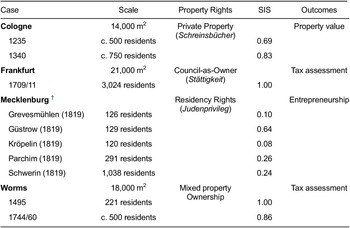
Table 2 provides an overview of our historical cases and the measures available for each. The outcomes in the right-hand column are analysed using multivariate models. In particular, we want to evaluate the claim that the boundaries of communities formed under conditions of micro-segregation are sites of economic value and entrepreneurship. To this end, we estimate the effect of a Jewish property or household’s distance to the boundaries. In the gated communities of Cologne, Frankfurt, and Worms, the distance is the number of other houses between the property and the nearest gate. In the less segregated communities of Mecklenburg-Schwerin, we consider whether a Jewish resident has a next-door neighbour of a different religion. These neighbours are identified within households immediately preceding or following a Jewish household in the census listing.
Summary of Historical Cases
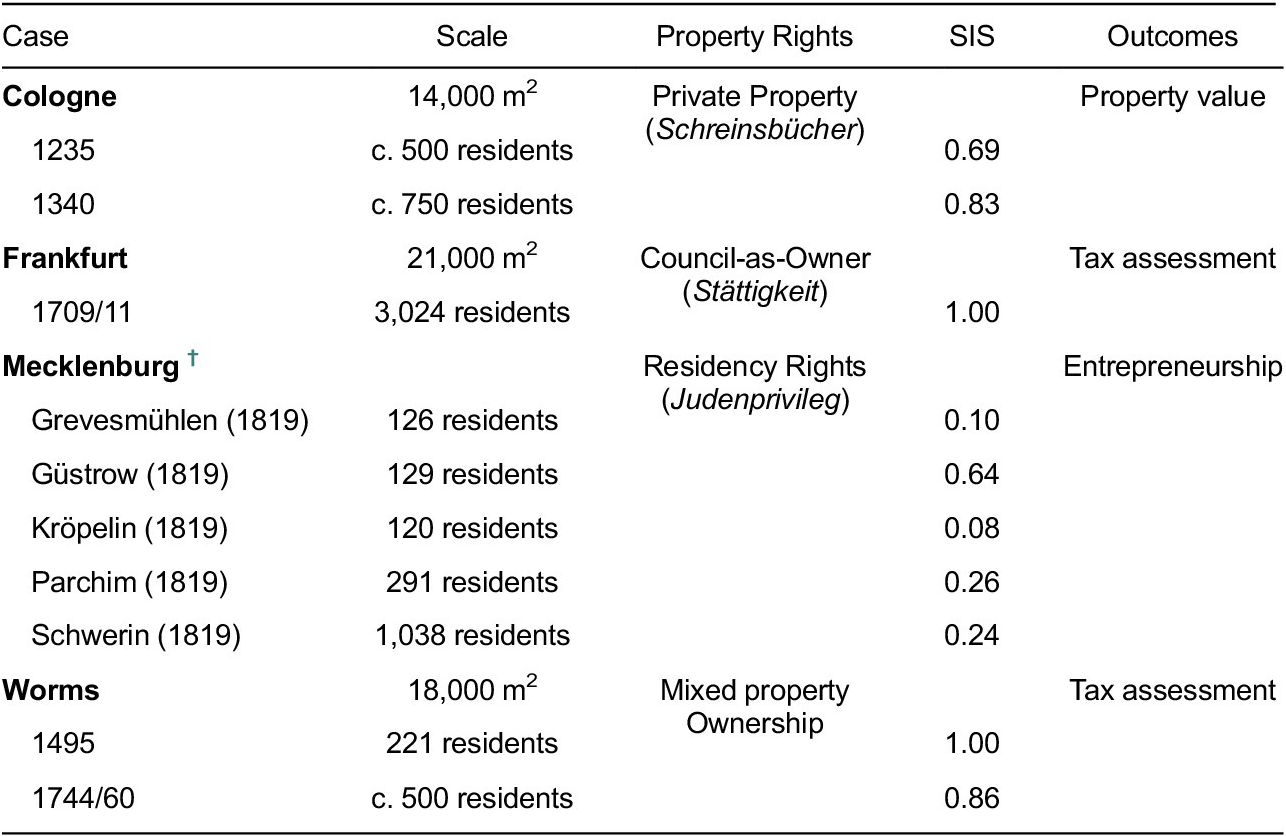
† Estimate of the Jewish population for each district in Mecklenburg-Schwerin based on Integrated Public Use Microdata Series (IPUMS) sample.
The OLS models of property valuation control for a number of other variables, including the physical size of a building, the size of a resident household, the age of the building, and its location vis-à-vis the community’s main street (Judengasse), distinguishing properties on front lots, back lots, and those that occupy both.Footnote 5 We estimated the models of entrepreneurial activity in Mecklenburg as logistic regressions for individual residents, controlling for age, gender, marital status, and fixed effects by community.
Data Coverage and Standardization
Given that the records on Jewish communities are centuries old, they present a number of challenges for modern social-scientific analysis. Historians have already addressed some of these challenges, such as the identification and translation of property records from Latin, Hebrew, and archaic German [e.g., Kober Reference Kober1920]. Remaining issues pertain to the completeness of the data for each community, as well as the standardization of physical measurements and currencies from the late medieval and early modern periods.
Property records in Cologne, Frankfurt, and Worms are complete with respect to the presence of Jewish or Christian residents, but occasionally have no information for assessed property value or size. Data are missing for 4% of the buildings occupied by Jewish households in Cologne, 8% in Frankfurt, and 16% in Worms. Missing values were imputed for the sites with incomplete information, using joint multiple imputation with 20 replications based on building valuation, size, age, building lot type (back lot, front lot, or both), form of ownership, and location [McNeish Reference McNeish2017]. This procedure yielded a sample of 81 Jewish-occupied properties in Cologne, 196 properties in Frankfurt, and 49 properties in Worms.
In Mecklenburg-Schwerin, the digitized version of the census samples portions of territories, encompassing 6% of the entire population of the Grand Duchy in 1819 [Minnesota Population Center 2019]. The sampling rate for residents across the five communities in this study is much higher, including exactly one third of the population in each district (N = 574 Jewish residents total). Sampling is clustered spatially, so that sequences of households preserve information on next-door neighbours in and around Jewish neighbourhoods.
Physical measurements and currencies for the historical Jewish communities are often denominated in archaic units that are unfamiliar to social scientists today. For instance, Frankfurt used a local variant of the “foot” to measure the width of buildings, corresponding to 285 mm in length (the modern foot is 305 mm). The price of real estate in late medieval Cologne was most often listed in Cologne marks (marca), but sometimes in other forms of currency. We follow Kober’s [1920] currency conversions for Cologne, such that 1 “heavy” gulden = 7/4 marks = 1 florin graves and 1 “light” gulden = 5/3 marks = 1 florin liberi. In late 15th-century Worms, 1 florin was equal to 26 albus. To simplify interpretation, building sizes and values are converted to standardized measures (Z-scores) in the multivariate analyses.
Case Analyses
Cologne
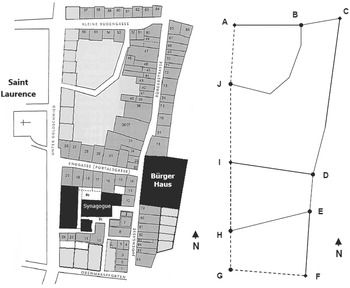
Although there is evidence of Jewish settlement in Cologne dating back to Roman times, reliable archival sources on community dimensions and ownership date to the period for which property registers are preserved, between 1135 and 1349. Recent archaeological excavations have also uncovered the physical remains of this quarter in the Saint Laurence district [Schütte and Gechter Reference Schütte and Gechter2012]. The Jewish community was originally concentrated on the west side of the Judengasse, the south side of the Portalsgasse, and a proximate street segment of Unter Goldschmied, close to the guildhall (“Bürger Haus”) and market immediately to the east (see Figure 1). By the 1340s, it had grown to encompass a considerable area to the north, bounded by the Bürgerstrasse and “Little” Budengasse.Footnote 6 At its peak, the Jewish community occupied an area of roughly 14,000 m2, 81 residential structures, 150 households, and 750 residents [Kober Reference Kober1920].
Map and Street Network for Jewish Quarter in Cologne (c. 1340)

The steady presence of the Jewish quarter over a period of two centuries was anchored in servi camerae regis and the property rights extended to its residents. While Cologne’s Jews were restricted to a particular district, most acquired their houses as private property, with a smaller number of residents leasing properties by paying a ground rent (Hofzins). The private property in the district subsumed residential homes, courtyards (which might include small gardens, orchards, and wells), and occasionally shops [Kober Reference Kober1940]. Church parishes carefully documented ownership in property books (Schreinsbücher), along with the details of any real estate transactions. In return for property and residency rights, Cologne’s Jewish population were obliged to pay a bewildering array of hereditary taxes, tithes, and annuities. As a correlate of their economic exploitation, however, the residents of Saint Laurence enjoyed a high level of residential stability prior to the Black Death.Footnote 7
For much of its medieval history, a notable feature of the Jewish quarter was that it was not a fully enclosed and separate district. On the eastern side of the community, along the Bürgerstrasse, walls separating Christians and Jews were not erected until the years between 1295 and 1310, while doors and open windows directly facing houses of different faiths were only prohibited in 1289 [Kober Reference Kober1940]. Some Christians owned homes in the district and others rented from Jewish landlords, leading to a “natural community” with respect to certain interests, such as those involving shared amenities and building upkeep [ibid: 85]. In 1235, the district around the street network shown in Figure 1 included 48 buildings with Christian owners and 43 with Jewish owners, excluding communal Jewish property (e.g., the synagogue). Based on simulations of 1,000 walking paths, the SIS through the quarter had a mean of 0.69 and standard deviation of 0.03, indicating a moderate level of micro-segregation (Table 3). By 1340, the number of houses occupied by Jewish owners had increased to 81, while the number occupied by Christian owners had declined to 13. Again relying on simulations of walking paths, the residential pattern yields a mean SIS of 0.83 (standard deviation of 0.06), suggesting a statistically significant rise in micro-segregation over the course of a century (t = 70.1, p<.001).
Distribution of Sequence Index of Segregation (SIS) for Walking Paths in Cologne †

† Based on 1,000 simulated walking paths, using the algorithm discussed in the Appendix.
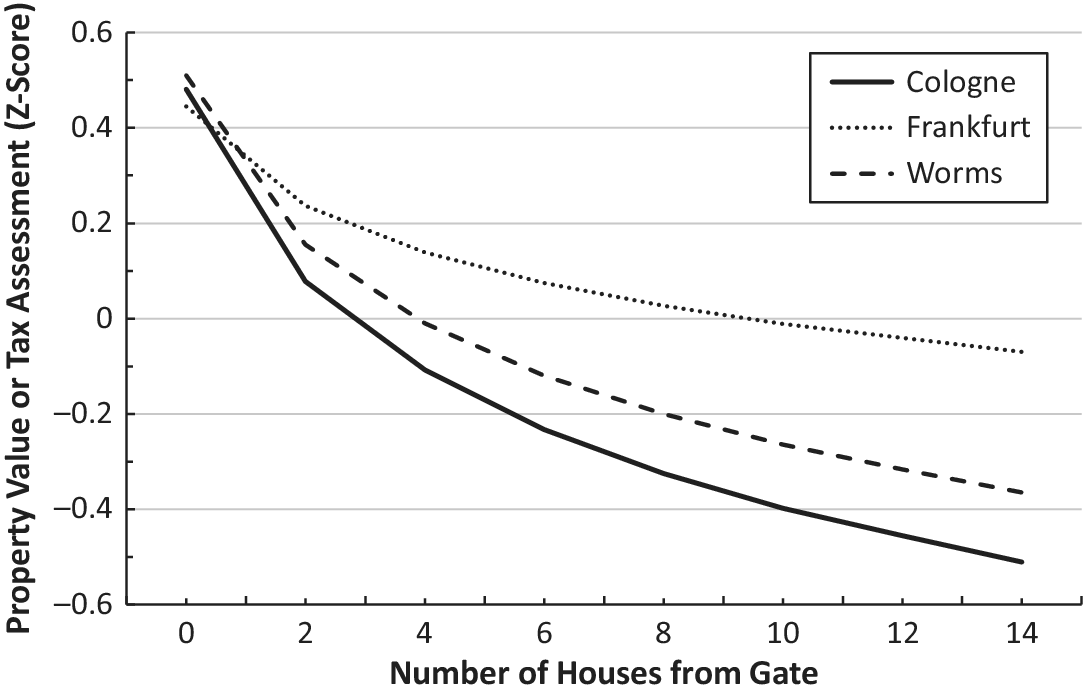
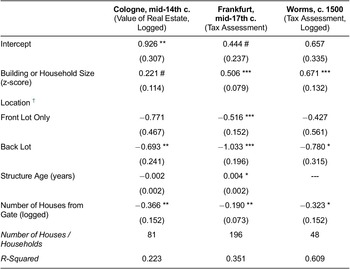
Proximity to commerce played an important role in structuring the value of real estate in Cologne’s Jewish quarter. During the 10th century, the city’s marketplace was established between the River Rhine and a Roman wall that came to define the eastern side of the district. In the succeeding centuries, Jewish merchants “were among the most active participants in the fairs of Cologne”, trading in gold, pearls, sheepskin, and rare textiles, among other goods [Kober Reference Kober1940: 105]. Archaeological evidence also suggests that residents ran mundane businesses, such as bakeries and grocery shops, within the Jewish district [Aderet Reference Aderet2020]. In the mid-14th century, properties near Cologne’s marketplace, along the Judengasse, were more expensive (by 0.7 standard deviations) than those on more peripheral streets (Table 4). In addition, valuation reflected distance to the gates marking entrances to the district (e.g., the Budengasse gate in the north-east or the Unter Taschenmacher gate in the north-west). As plotted in Figure 2, properties declined in value when there were several other houses between the property and the gate. Those properties located at one of the boundaries of Cologne’s Jewish quarter were valued at 0.5 standard deviations above the average, net of other factors, while those located eight houses away were valued at 0.3 standard deviations below the average.Footnote 8
Standardized Regression Estimates of Property Valuation in Jewish Communities

† Reference category for location is a house on the main street (Judengasse), occupying both front and back lots. Houses on peripheral streets in Cologne are coded as being on back lots.
# p < .10; * p < .05; ** p < .01; *** p < .001 (two-tailed tests for controls, one-tailed for number of houses from gate)
Property Valuation in Jewish Communities By Position Away from Boundaries
Frankfurt
The Jewish settlement in Frankfurt dates to the late 11th century and was initially concentrated near the cathedral, interspersed among the dwellings of Christian residents. In 1462, Friedrich III and the city council ordered the relocation of all Jewish residents to the edge of town, under pressure from church leaders who had argued that the Jewish population posed a disruption to Christian worship services [Kracauer Reference Kracauer1906]. The newly created segregated district covered an area that was 330 m long and roughly 60 m wide, with a row of buildings on either side of the central Judengasse. Initially, the area was a sparsely populated “interstitial area” on a dried-up section of Frankfurt’s old moat [Wirth (1928) 1956: 42], encompassing roughly a dozen residential houses and a few communal structures. By the early 18th century, however, population growth and in-migration had rendered it one of the most crowded urban zones in all of Europe. Prior to the Great Fire of 1711, for instance, visitation statistics indicate that Frankfurt’s Jewish district included 203 houses, 505 households, and 3,024 residents [Kracauer Reference Kracauer1906]. Each household averaged six residents and each resident had just a few square metres of living space.
The properties in Frankfurt’s segregated Jewish district were not privately owned but belonged to the city council. However, the area’s population had a durable set of residential and tenancy rights (Stättigkeit) that allowed households to live in the district across generations. Residential stability was especially apparent among the city’s Jewish business owners. Between the mid-16th century and the dissolution of the district, the typical firm was founded by a family that had lived in the district for an average of 157 years.Footnote 9 As was the case in Cologne, tenancy rights were rooted in the economic exploitation of Jewish residents, who were expected to pay property taxes for their perpetual leases and to finance the construction or expansion of all buildings. The tenancy rights were also coupled with restrictions on the movement of Jewish residents outside the district and the lines of trade they could pursue. Even towards the end of the district’s existence, Gentile business owners feared competition and opposed the licensing of merchants or other Jews who wanted to live and do business outside the Judengasse [Ferguson Reference Ferguson1998].
In terms of physical appearance and residential demography, the Jewish district approached the ideal type of later ghettos, although it never bore that label prior to its dissolution. Visitors characterized the Judengasse as a long, gloomy street surrounded by five- to six-storey structures that threatened to block out all daylight [Wirth (Reference Wirth1928) 1956]. Frankfurt’s Jews were legally compelled to live in the district and it was “physically cordoned off via gates and walls” [Schwartz Reference Schwartz2019: 13]. In contrast to Cologne and pre-1460s Frankfurt, the district did not have any Christian households, but some well-to-do Jewish families employed Christian domestic servants. Consequently, the SIS is 1.00 at the household level.
The conceptualization of the Judengasse as an isolated ghetto is nonetheless challenged by the profound economic and political relationships between its residents and the surrounding Christian populace. This was most evident in late-18th-century exemplars such as Mayer Amschel Rothschild, whose private banking empire got its start through his connections to members of the local aristocracy, for example Prince William of Hesse-Kassel [Ferguson Reference Ferguson1998]. Rothschild was hardly alone in his role as a court agent who served as a broker between Jewish and Christian worlds. Prior to the 19th century, at least 35 Jewish court agents lived in the city of Frankfurt, serving the nobility in various German states [Dietz Reference Dietz1907: 396–397]. For the vast majority of Jewish residents, who could not hope to rise to this elite status, brokerage occurred in more mundane forms at the boundaries of the Judengasse. Tax valuations reflected economic opportunities near the three gates of the district (Table 4). Controlling for building size, building age, and lot characteristics, valuations were 0.4 standard deviations above the mean for properties located at the gates of the district, but roughly at the mean valuation for properties when they were located eight houses away (Figure 2).
Worms
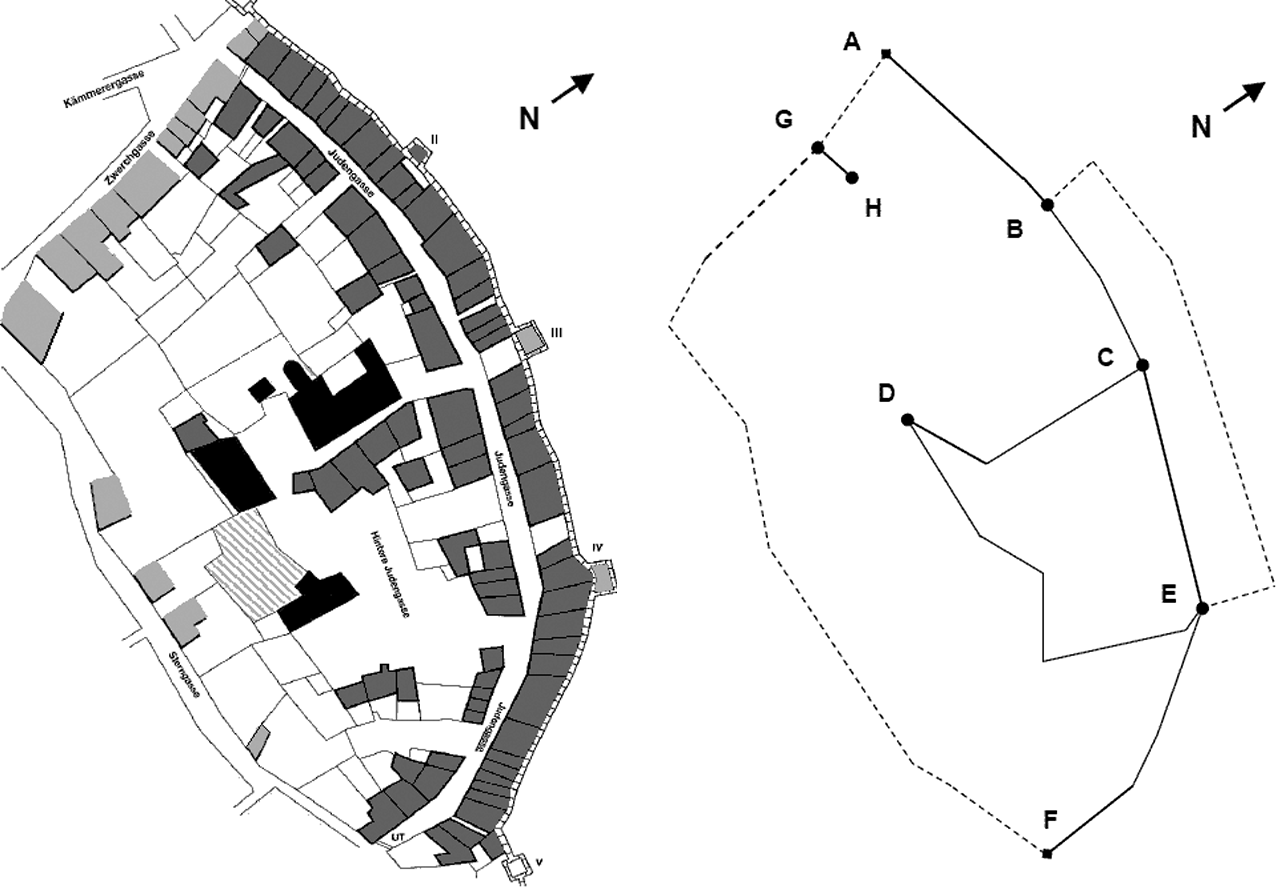
The Jewish community in Worms (also known as “Warmaisa”) is one of the oldest in central Europe, dating back to the decades before the construction of the city’s first synagogue in 1034. Like other medieval districts with Jewish residents, its early existence was precarious—the Judengasse was ransacked during the First Crusade and the quarter was destroyed again at the time of the Black Death [Reuter Reference Reuter2009]. A period of greater stability followed, as Jewish residents sought the protection of the city, its bishop, and the Holy Roman Emperor, retreating to a segregated district delineated by walls and two gates. The spatial contours of the district were well established by the end of the 15th century, encompassing 41 residential houses, roughly 50 households, and 200–250 residents at that time [Reuter Reference Reuter and Heinemann1983]. The basic boundaries of the district remained intact until its dissolution in 1801, although residential density would increase considerably. By the mid-18th century, visitation lists revealed 88 residential houses, 146 households, and roughly 500 residents in an area covering approximately 18,000 m2 (see Figure 3).
Map and Street Network for Jewish Quarter in Worms (c. 1760)
Resource extraction was integral to the protections that were extended to Warmaisa’s Jewish population. For instance, in the set of Jewish rights (Judenordnung) issued in 1524, the community was ordered to pay 800 gulden to the city of Worms and 400 gulden to support Frankfurt’s trade fair on an annual basis [Reuter Reference Reuter2009]. Jewish residents were also subject to the imperial taxes that were levied on the Christian populace, albeit under a distinctive payment scheme. While the population at large paid household taxes in proportion to self-reported assets, the Jewish community was taxed as a whole in proportion to aggregate population size. The Jewish council then reapportioned this tax to each household in light of its perceived wealth and opportunities [Reuter Reference Reuter and Heinemann1983].Footnote 10
With respect to property ownership and commerce, Warmaisa displayed a mixture of the patterns observed in medieval Cologne and early modern Frankfurt. Around 1500, 20% of residential buildings were privately owned and 68% were the property of the city council. The remainder fell under the communal ownership of the Jewish community [ibid.]. As in the case of Frankfurt, physical movement and business activity outside the Jewish quarter was restricted. According to the 16th-century Judenordnung, residents who wanted to move out of the city had to give three months’ notice to local authorities, who would then ensure that their legal and business obligations had been fulfilled prior to their departure. Direct competition with Christian merchants and craftsmen was prohibited, as was loitering in the Wormser marketplace or setting up stalls outside the boundaries of the Judengasse [Reuter Reference Reuter2009: 71–73].
In contrast to Cologne and Frankfurt, the level of residential segregation in Worms displayed a slight decrease over time. Between the 14th and 16th centuries, the area was fully segregated from Christian quarters, albeit with substantial amounts of open space on its southern side devoted to gardens and wine cultivation (SIS = 1.00).Footnote 11 By the mid-18th century, there is evidence that the physical and social boundaries of the district had become more porous. Driven by population growth, some Jewish residents began to extend their quarters into the towers of the old city wall on the north side, leading to increased contact with the guards who patrolled and slept in these fortifications [Reuter Reference Reuter2009]. On the south side of the district, the crumbling walls were increasingly criss-crossed by back alleys or yards connecting Christian and Jewish homes. Based on 1,000 simulated walks through the quarter’s street networks in 1760 (Figure 3), we computed an average SIS of roughly 0.86 with a standard deviation of 0.04, representing a significant decline from the full segregation observed historically (t = –100.6, p<.001).
Warmaisa is often remembered as a centre of Jewish scholarship and learning, as signalled by its appellation of “Little Jerusalem-on-the-Rhine” [Roemer Reference Roemer2005]. In comparison to Cologne and Frankfurt, commercial activity was historically not as important to community life. Still, the provisions of the city’s Judenordnung suggest that crucial economic ties existed between the city’s Christian and Jewish populations during the early modern era. Several articles of the Judenordnung regulated the moneylending and pawnbroking business with regard to Christian clients. Another article specified that Christian residents could freely choose which Jewish merchants they patronized in the Judengasse [Reuter Reference Reuter2009]. Given the spatial arrangement of the neighbourhood and the reluctance of Gentiles to venture too far inside it, this favoured entrepreneurs who were located near the gates. The tax assessments placed on households also reflected the familiar pattern seen in Jewish enclaves in other German cities. Based on perceived economic opportunity, the Jewish council levied high taxes on households located near one of the two entry points (nodes A and F) into Warmaisa and lower taxes on houses located further away from the boundaries of the district (Table 4 and Figures 2–3).
Mecklenburg-Schwerin
While Jewish enclaves were mentioned in the Duchy of Mecklenburg as far back as the 13th century, they never developed in size and prominence to the same extent as the Rhenish communities. As elsewhere, the Black Death contributed to deadly pogroms against Jews, and it was followed by the removal of all Jewish residents in 1492. The Jewish populace would only begin to return after the extension of residential and trade privileges in the late 17th and 18th centuries [Donath Reference Donath1874]. Between 1760 and the early 1800s, small Jewish communities formed in the cities of Grevesmühlen, Güstrow, Kröpelin, Parchim, and Schwerin. This late development meant that Mecklenburg-Schwerin’s Jews were on the periphery of Jewish intellectual and economic life in the German states. In 1830, the Duchy’s entire Jewish population numbered 3,126 residents, soon to be served by a single Schul (Or-Nagah), founded in 1833 [Kober Reference Kober1954]. A little over a decade earlier, the census of 1819 had enumerated fewer than 2,000 Jewish residents in Mecklenburg-Schwerin (Table 2).
During the early 19th century, the Jews of Mecklenburg-Schwerin were at a turning point. Their historical existence in the Duchy had been a liminal one, operating under the “protection” of local aristocrats while they were restricted economically by a 1755 ban on landholding [Donath Reference Donath1874]. But the wave of emancipation that began with the French occupation of the Rhineland also reached Mecklenburg. In 1811, Jewish leaders drafted a petition for emancipation, which was approved in 1813 by the edict of a progressive Duke, Frederick Francis I. Census data indicate some private landownership in Jewish communities in the succeeding years. Nevertheless, the privileges of emancipation were not to last. The edict was revoked in 1817, owing to pressure from the conservative Junker estates; in 1819 the Hep-Hep riots spread antisemitism and violence across the German states. The Jewish residents of Mecklenburg would not be fully emancipated until 1869.
From a demographic perspective, the Jewish population of Mecklenburg-Schwerin was relatively small yet spatially concentrated. Out of more than 400,000 residents in 1819, Jews represented fewer than 0.5% of the populace, while the Lutheran majority constituted 99% (the remainder were affiliated with Catholic or other Protestant congregations). Based on our census sample, Jewish residents were located in only five enumeration districts out of 180 within the Grand Duchy. A closer examination of residential patterns, however, reveals that Jews were not subject to the levels of segregation observed in the Rhenish communities during the medieval and early modern eras. With the exception of Güstrow, Jewish households tended to be interspersed with Christian households, as indicated by low measures of micro-segregation (SIS = 0.08 to 0.26). Moreover, 42% of residences with a Jewish household head had live-in domestic servants or other residents who were Christians, contributing to interpersonal contact across faiths. Unfortunately, where micro-segregation was more pronounced, as in Güstrow, the Jewish community became the target of mobs during the Hep-Hep riots [Donath Reference Donath1874: 193–195].
The Jewish residents of Mecklenburg-Schwerin had an active entrepreneurial culture. Despite the short history of the Duchy’s Jewish enclaves, distinctive centres of trade had emerged devoted to particular commodities, such as silver in Schwerin and wool in Parchim. Among Jewish men with occupations listed in the 1819 census, nearly two thirds (63.5%) worked as traders or merchants. Among Jewish women, labour-force participants tended towards service occupations, yet a fair percentage (11.4%) also worked in mercantile trades. By comparison, Mecklenburg’s Christian residents were far less likely to pursue these occupations, with only 2.3 and 0.3% of men and women, respectively, listed as merchants or traders.
By the 19th century, the Jewish households in Mecklenburg-Schwerin were not walled or gated, but proximity to Christian neighbours continued to influence opportunities for trade. Table 5 displays estimates from a logistic regression of occupation (in particular, whether a resident worked as a merchant or trader) on demographic and ecological characteristics. Controlling for age, gender, and marital status, the odds ratio for Jewish involvement in entrepreneurial occupations was 19 times that of Christian involvement (Model 1). Moreover, any resident with a neighbour of a different religion had an odds ratio that was one-and-a-half times that of a resident with co-religionists as neighbours. Proximity to households of different faiths did not favour all Jewish residents equally. It did favour Jewish men, who had fewer proscriptions on interfaith contact than were applied to Jewish women [Kaplan Reference Kaplan, Carlebach and Schacter2012]. These effects can be visualized more clearly as predicted probabilities. They indicate a significant difference in the probability that a Jewish man with neighbours of a different faith would be involved in trade (0.67) compared to a Jewish man surrounded by other Jewish households (0.44), but no significant difference between Jewish women with neighbours of a different or the same faith (Figure 4).
Logistic Regression Estimates of Entrepreneurship in Jewish Communities Within Mecklenburg-Schwerin (1819)
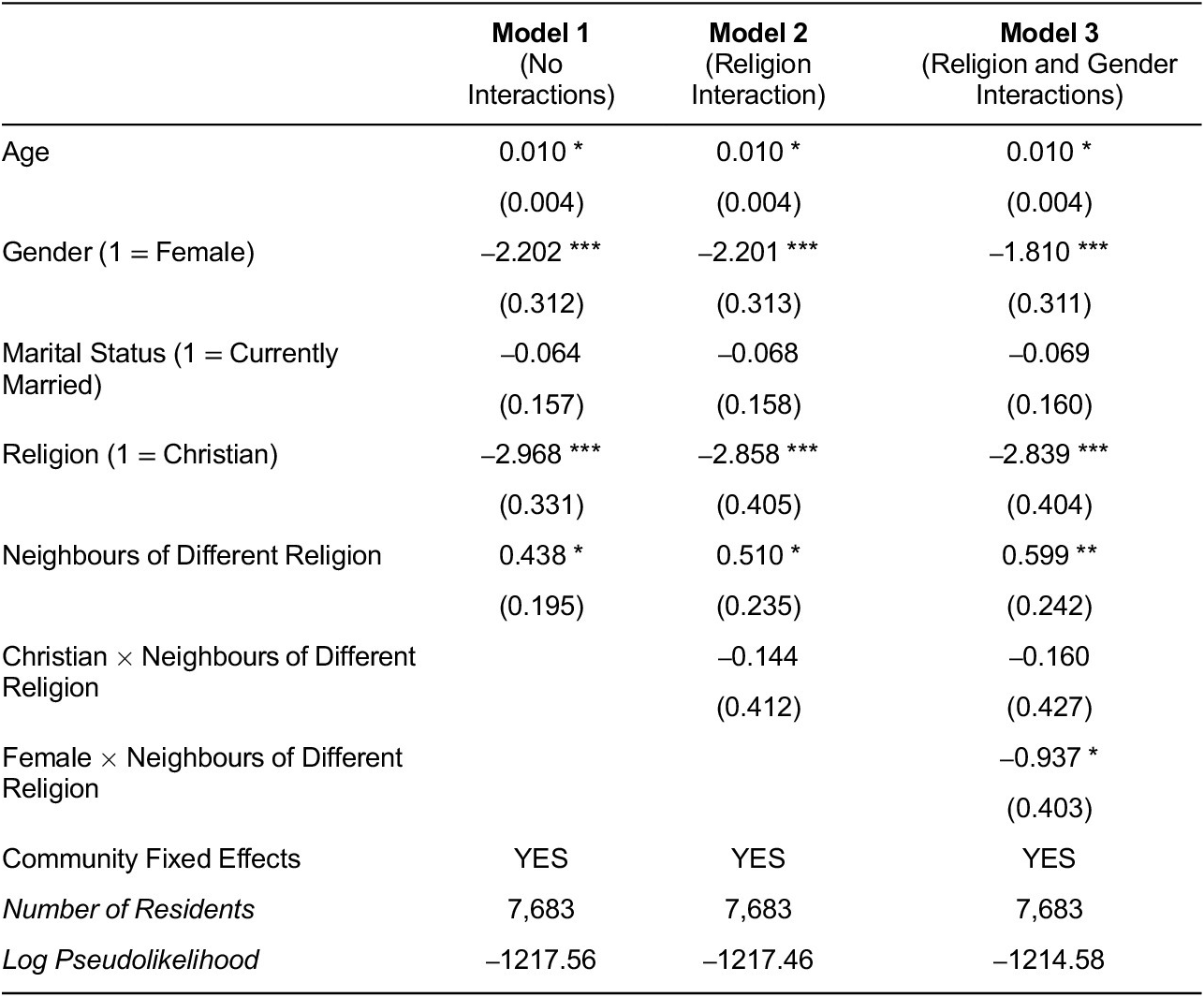
Note: Entrepreneurship is defined as involvement in trading or mercantile activity. Sample is limited to adolescent and adult residents (age 12+) who were in the labour force. Robust standard errors account for clustering of residents within households.
* p < .05; ** p < .01; *** p < .001 (two-tailed tests for controls, one-tailed for neighbours of a different religion)
Entrepreneurship in Jewish Communities Based on Types of Neighbours

Discussion
Although some social historians, following Wirth [(Reference Wirth1928) 1956], have traced the concept of ghettoization to Germany’s Jewish communities during the late medieval and early modern eras, the concept is largely anachronistic in these historical settings. The communities were not identified as ghettos in their own time [Schwartz Reference Schwartz2019; Fuchs and Krobb Reference Fuchs, Krobb, Fuchs and Krobb1999]. Moreover, the theoretical parameters of 20th-century conceptions of the ghetto are inadequate to describe the communities’ spatial layouts and institutional conditions. Akin to modern ghettos, the segregated enclaves were a social device whereby Jewish minorities in urban areas were subordinated to the Christian majority. But they were constituted on a smaller geographic scale, featured more robust (and complex) systems of property rights, and varied considerably in their degree of residential segregation. Whereas the modern ghetto is depicted as a place of residential isolation or expulsion for racialized, wealth-deprived minorities [Duneier Reference Duneier2016], the early Jewish enclaves were segregated on the basis of religious prejudice and operated under the aegis of the German nobility and clergy, while also serving as an important source of revenue for Christian elites. For Jewish community members, the interface with Christian residents was often threatening, owing to deep-seated antisemitism and scapegoating. At the same time, it also offered a site of economic value and entrepreneurial opportunity [Simmel Reference Wolff1950].
Our study develops the concept of micro-segregation as a theoretical alternative to ghettoization in order to explain these residential patterns and economic outcomes. Drawing on a comparative analysis of five cross-sectional data points from well-known Rhenish Jewish communities and five data points from more peripheral communities in eastern Germany, its findings suggest that these minority enclaves lie on a continuum between micro-segregation and ghettoization, depending on their spatial contours and institutional features. For instance, the Jewish community of 13th-century Cologne (with its modest scale, extensive private-property rights, and interspersal with Christian neighbours) more closely matches the ideal type of micro-segregation than early 18th-century Frankfurt (with its larger scale, reliance on perpetual leases, and full residential segregation). Nevertheless, there is a consistent qualitative difference between these historical urban enclaves and more recent forms of ghettoization. Under servi camerae regis, elites recognized that the Jewish population played an essential role in their political economy [Coser Reference Coser1972] and the boundaries of segregated Judengassen were proximate to centres of trade. In the “jobless ghettos” that emerged in the 20th century, minorities were isolated from sites of employment and commerce [Wilson Reference Wilson William1996] and authorities drew stark boundaries around these districts through harsh policing tactics [Freeman Reference Freeman2019]. Further research is needed to establish whether other forms of early modern Jewish communities, including the iconic Italian cases of Rome and Venice, more closely map onto processes of micro-segregation or processes of ghettoization.
Beyond these Jewish communities, the concept of micro-segregation may have considerable utility in accounting for other forms of residential minority enclaves. Addressing the Jewish diaspora, Wirth [1956: 3] argued that the shtetl that emerged within the Pale of Settlement (i.e., the western region of Imperial Russia that allowed Jewish settlement) represented “a ghetto within a ghetto”. More recent scholarship has placed the characterization of the shtetl as a decaying, provincial instance of ghettoization into question. Between the 1790s and 1840s, roughly two thirds of the world’s Jewish population lived in shtetls located in the partition between Poland and Russia. Petrovsky-Shtern [Reference Petrovsky-Shtern2014] notes that despite their circumscribed legal status, Jewish residents in these small towns had residential proximity to marketplaces, limited separation from the local Christian population, and a complex system of lease holding under the protection of Polish magnates. As a result of these conditions, the shtetl formed an essential economic interface in the region, particularly in moving commodities across the “poorly controlled borders” of Russia [ibid.: 71]. A more apt description of this pattern of settlement might thus be micro-segregation within a ghetto. While Russian state policy confined Jews to the Pale of Settlement into the 20th century, their distribution in that zone tended to be a result of “idiosyncratic historical circumstances” that ensured minority-group dispersion across hundreds of towns in Belarus, Moldova, Ukraine, and western Russia [Acemoglu, Hassan and Robinson Reference Acemoglu, Hassan and Robinson2011: 903].
In the United States, early African-American enclaves that formed under Jim Crow also exhibited features of micro-segregation. Jim Crow statutes drew pernicious legal distinctions between whites and people of colour at a fine-grained spatial scale, covering seating arrangements in public conveyances, public toilet facilities, racially separate sections of parks and hospitals, and the segregation of Black schools and universities. During the era of the Great Migration, African Americans were not yet isolated in all-Black neighbourhoods [Freeman Reference Freeman2019]. In 1917, the racial zoning of entire parts of cities was struck down by the US Supreme Court in Buchanan v. Warley, based on the argument that residential segregation on the part of municipalities was a violation of private-property rights. The resulting Black Belts in northern and border cities initially existed in proximity to industry and commerce, attracting African Americans who sought “economic mobility, political enfranchisement, and cultural expression” [ibid.]. Over time, however, Jim Crow segregation of public transit and businesses contributed to problems of spatial mismatch, whereby Black residents faced substantial barriers to employment in urban areas [Ruef and Grigoryeva Reference Ruef and Grigoryeva2020].
Aside from historical exemplars, the concept of micro-segregation offers promise as a lens through which to understand conditions of minority residence and mobility in modern urban centres. In Europe and America, “white spaces” in public amenities, businesses, workplaces, and schools continue to be seen as off-limits to immigrants, religious minorities, and people of colour, a situation that is often rooted in small-scale distinctions of place and property within gentrifying neighbourhoods [e.g., Anderson Reference Anderson2015]. These places of exclusion coexist with more cosmopolitan spaces that offer opportunities for interaction and exchange. Communities defined by religious exclusivity (such as Orthodox Jews) are also found in the midst of modern cities, where many adherents interact with non-coreligionists during the working day yet are pulled into segregated spaces for worship and communal experiences [Tavory Reference Tavory2016]. The term micro-segregation aptly describes the process whereby most residents in an urban area are not members of a minority group and the minority group is neither fully assimilated nor fully isolated. In contrast to earlier forms of micro-segregation, the status of these minority groups is not narrowly circumscribed by civil or criminal law. Yet constraints emerge for minority residents as a function of religious law or the fact that their physical appearance (e.g., black or brown skin tone, wearing a hijab) “supersedes their identities as ordinary law-abiding citizens” [Anderson Reference Anderson2015: 12].
Extensions to our theory can engage further with the central mechanisms of micro-segregation, as well as applying the concept to different minority groups and urban settings. We have argued that under micro-segregation the boundaries of enclaves are sites of exchange and entrepreneurship for minority residents. A corollary to this hypothesis is that economic benefits at the boundaries will vary as a function of enclave scale and institutional conditions, perhaps disappearing entirely if the area becomes “ghettoized”. Our comparative analysis of property valuation supports this intuition, with stronger boundary effects in medieval Cologne, for instance, than in early modern Frankfurt. Nevertheless, a larger sample of ethnic economies would be needed to test this implication thoroughly. Our study also uses residential location as a proxy for interactions between Jewish and Christian neighbours. More direct indicators of intergroup contact and exchange are required to tap into underlying social relationships, as well as to address the extent to which a majority group’s paternalism or economic exploitation drives the rise of micro-segregation. These extensions offer the promise of a more complete account of the origins, features, and effects of micro-segregation among minority groups.
Appendix
Simulated Patterns of Micro-Segregation
To generate a sample of enumeration sequences, we build on the classic Hierholzer algorithm from graph theory. The algorithm proceeds as follows. First, to ensure that a street network could hypothetically be traversed without a break, the algorithm begins with a node of odd degree, defined as an intersection of an odd number of street edges (i.e., street sides). For Cologne, this means that the algorithm begins with either node A or F, chosen randomly (Figure 1). These are also logical starting points since they are located at major gateways into the Jewish district. After choosing a starting node, the algorithm sequentially enumerates houses on a randomly chosen street edge originating from the starting node. Then, the sequence proceeds to a randomly chosen, spatially adjoining street edge that has not already been traversed (including going back down the other side of the same street for two-sided streets). For instance, if the sequence starts from node A and traverses the north side of AB, it can then proceed to either side of BC (north or south) or go back along the south side of AB (from node B to node A). As the sequence moves from one street edge to another, it considers the spatial adjacency of houses, so that the last house enumerated on one street edge is spatially adjacent to the first house on the next street edge in the sequence. Thus, moving from the Kleine Budengasse (BC) to Bürgerstrasse (CD), the enumeration begins with either house 50 or house 65. Finally, if all of the adjoining street edges have already been traversed, then the sequence randomly proceeds to any remaining street edge. The sequence is complete when all the street edges have been enumerated.
Using this algorithm, we simulated 1,000 unique enumeration sequences. Additional analyses show that the simulation results remain the same when the sample is increased to 10,000 sequences. Also, sensitivity analyses (not presented) indicate that the distribution of the SIS is robust to the boundaries of Jewish districts—e.g., when the sequence for Cologne in 1340 includes five additional Christian houses on the eastern border edge located immediately south of the Bürgerhaus (town hall). A sample Stata program of the algorithm is available on request.




 Open access

