




INTRODUCTION
Agricultural research and development structures and strategies (hereafter ‘ARD’) are failing to adequately support hundreds of millions of smallholder farmers with agricultural technologies that meet their urgent needs and that suit their diverse contexts. Agricultural research systems across the globe typically seek to serve resource-limited farmers with simple, one-size-fits-all solutions for increasing agricultural production. Blanket recommendations, for example, for varieties or fertilizer levels, are often made for entire countries or regions. This approach – of trying to match very few options to smallholders’ heterogeneous and often marginal socio-ecological conditions – has performed poorly and has doubtful economic and environmental sustainability (Herrmann et al., Reference Herrmann, Haussmann, van Mourik, Traore, Oumarou, Traore, Ouedraogo and Naab2013).
Meanwhile, in well-resourced settings, the fields of commerce, medicine and agriculture are moving towards more context-responsive approaches. Mass-market products are still the norm, but segmentation, personalization and localization are increasingly celebrated and realized with the aid of Big Data (Bryant et al., Reference Bryant, Katz and Lazowska2008; Hood and Auffray, Reference Hood and Auffray2013; Rivers et al., Reference Rivers, Warthmann, Pogson and Borevitz2015). The larger seed companies that serve industrialized agriculture are matching the DNA sequences of their crop varieties with the environmental conditions of their customers through genomic selection (Heslot et al., Reference Heslot, Jannink and Sorrells2015). In precision farming, farmers are tailoring crop management decisions to field-scale heterogeneity in soil conditions (Gebbers and Adamchuk, Reference Gebbers and Adamchuk2010; Oliver et al., Reference Oliver, Bishop and Marchant2013). Crop varieties, soil nutrients and seed density are increasingly adjusted to match local environmental variations through the use of sophisticated technologies (Brauer et al., Reference Brauer, Singh and Popescu2014; Monsanto Company, 2015).
Input-oriented agriculture is relatively simple. At its extreme, it relies on monocultures of broadly adapted varieties of relatively few crops and livestock species. Environments are homogenized through the use of irrigation, fertilizer and pesticide. In contrast, agricultural production systems based on agroecological principles (both traditional or pre-modern systems and post-modern ones) are considerably more complex in terms of the numbers of components, their interactions and the diversity of these systems over time and space. Whilst energy-intensified agriculture is based on optimized simplicity, agroecological intensification (AEI) involves optimized complexity. Shifting towards a more sustainable agriculture will require the matching of more complex options with the enormous heterogeneity of contexts faced by smallholder farmers, rather than homogenizing these contexts through the use of a few energy-intensive options. Whatever the development trajectories followed in sub-Saharan Africa, there will be millions of smallholders for several generations and they need the support of relevant and effective ARD systems.
The authors are associated with The McKnight Foundation's Collaborative Crop Research Program (CCRP, ccrp.org). The CCRP funds research to support smallholder farmers who live in some of the most food-insecure parts of the world. Through engaging with ARD projects for over two decades, the CCRP became aware of the critical limitations noted above. Seeking to promote AEI for smallholders, the programme recognized the need to link social and technical innovation processes, and local knowledge bases with global ones. The programme's team is developing a vision for a new approach to ARD, based on the idea of farmer research networks (FRNs). We are exploring ways in which FRNs, building on existing ideas and components, could transform ARD systems to more effectively support the matching of agricultural or AEI options with farmers’ diverse contexts. In this paper, we attempt to address the question of how smallholder farmers can benefit from the wider trend towards better targeting and tailoring of solutions based on the data revolution.
To achieve this, we envisage FRNs. The FRN concept has much in common with established participatory research endeavours, but aspires to integrating the functions of research and extension at a larger scale, exploiting the potential of emerging data tools to gain insights of value to individual participants as well as to the global knowledge system. The aim would be to link problem-solving research with action that can provide a context-specific evidence base for AEI, and facilitate positive changes for farmers at scale. In the case of CCRP, the aspirations for FRN include adherence to social values such as mutuality, reciprocity, beneficiary ownership and local agency. Options for investigation and adaptation would include germplasm; management alternatives for crops, farms and landscapes; methods for post-harvest storage and transformation; and social innovations. Whilst any of these topics could be suitable entry points for smallholder-based investigation, a growing FRN could be designed to allow its members to tackle an increasing variety of opportunities and problems over time and space. The capacity to answer questions, adapt technologies and solve problems could serve as valuable social infrastructure, enabling rural people to meet dynamic market opportunities and to cope with challenges like climate variability and change.
Large-scale engagement of farmers in the research process offers two complementary opportunities: Farmers can be exposed to targeted options that respond to their interests, and farmers can provide data on the performance of those options for the benefit of others in similar socio-ecological contexts. At the same time, it can provide data for the global research knowledge-base on how options interact with contexts, through effectively doing experiments that are much larger than researchers alone could ever contemplate. A lot of useful methodology has been developed and practiced on limited scales through the last 30 years of development of participatory research concepts and practices (e.g., Ceccarelli and Grando, Reference Ceccarelli and Grando2007; Ceccarelli et al., Reference Ceccarelli, Guimaraes and Weltzien2009; Christinck et al., Reference Christinck, Weltzien and Hoffmann2005; Martin and Sherington, Reference Martin and Sherington1997; Veldhuizen et al., Reference Veldhuizen, van Waters-Bayer and de Zeeuw1997; Weltzien et al., Reference Weltzien, Whitaker, Rattunde, Dhamotharan, Anders, Witcombe and Farrington1997; Weltzien et al., Reference Weltzien, Christinck, Touré, Rattunde, Diarra, Sangare, Coulibaly, Almekinders and Hardon2007). These aim to meet not only research objectives but also satisfy value-based empowerment requirements of farmers being able to influence research done for them. Developments in ICTs now bring within reach the prospect of large-scale participatory research, which would enable the integration and up-scaling of improved crop genetics and management, as well as other types of agricultural technologies and options.
In this paper, we use the option-by-context interaction framework (OxC; Nelson and Coe, Reference Nelson and Coe2014 and papers in this volume) for conceptualizing complexity, give OxC interaction examples and outline the challenges of dealing with this complexity. We then describe the FRN approach and consider the elements and principles that could be brought together to support a potentially more powerful approach to ARD serving the diversity of smallholder farmers. We close with issues related to data management and incentives to take part in an FRN. Whilst the diagnosis and cure are potentially of broader relevance, our focus will be primarily on smallholder agriculture in sub-Saharan Africa.
OPTIONS, CONTEXTS, INTERACTIONS AND COMPLEXITY
Agricultural research aims to improve system performance by developing new options and matching appropriate options with contexts. By ‘options’, we simply mean things that farmers and farm communities can do differently. Options include technical choices or innovations like those pertaining to crop species and varieties; the use of other inputs or the use of inventions like novel irrigation technologies. Options would also include social and financial innovations, like ways of organizing or approaches to managing risk. Agroecological approaches would extend the range of options in a number of ways, including the use of biological inputs (e.g., microbial ones), functional diversification at various scales and strategies to enhance soil organic matter and nutrient cycling. ‘Contexts’ are the ecological, economic and social situations in which options are used.
Options can be conceptualized as points in an n-dimensional space, with dimensions including the type of change sought (e.g., optimization; diversification; invention; integration); the body of knowledge and practice involved (genetic improvement of crops or livestock; crop or system management; etc.), and the scale at which a given issue is considered. For issues related to genetic improvement, the scale of interest could be the nucleotide, gene, genotype or population. For soil, the issues could include the chemistry, biology or physics of soil at any spatial scale from molecular to microscopic to landscape to planetary.
Smallholders farm under extremely diverse socio-ecological conditions, many of which are characterized by extreme resource limitations. These contexts, too, can be conceptualized as an n-dimensional space, in this case defined by axes that capture the heterogeneity in ecological, social, cultural and economic factors. In addition, the temporal dimension must be considered, since many context factors are notably dynamic. The dynamic challenges include climate change, resource degradation, rising energy costs, varying access to inputs and changing markets. Ojiem et al. (Reference Ojiem, de Ridder, Vanlauwe and Giller2006) considered the multiple contextual dimensions hierarchically and defined the socio-ecological niche for an option as the subspace to which it is adapted.
We consider options as interacting with contexts to determine performance. This is simply a generalization of the concept of genotype and environment interaction that has long been considered by breeders, with genotype being replaced by any option and environment by the full set of social, economic and ecological contexts. Specifically, we use the conceptual model:
 $$\begin{equation}
{O_i} + {C_j} + {\rm{OxC}}ij = {P_{ij}},
\end{equation}$$
$$\begin{equation}
{O_i} + {C_j} + {\rm{OxC}}ij = {P_{ij}},
\end{equation}$$
where Oi is the average effect of option i, Cj the average effect of context j, OxCij the interaction and Pij the performance of option i in context j. Then, the relative performance, or advantage of option 2 over option 1 is
 $$\begin{equation}
{P_{2j}}-{P_{1j}} = \left( {{O_2} - {O_1}} \right)\ + \ \left( {{\rm{Ox}}{{\rm{C}}_{2j}} - {\rm{Ox}}{{\rm{C}}_{1j}}} \right).
\end{equation}$$
$$\begin{equation}
{P_{2j}}-{P_{1j}} = \left( {{O_2} - {O_1}} \right)\ + \ \left( {{\rm{Ox}}{{\rm{C}}_{2j}} - {\rm{Ox}}{{\rm{C}}_{1j}}} \right).
\end{equation}$$
If the first term is large compared to the second, then the relative performance does not depend (much) on context and wide-scale recommendations can be made. If the second term is large, then the relative performance, and value to farmers of 2 rather than 1, depends on context. Thus, recommendations have to be context specific. Hence, it is necessary to understand the nature of OxC interactions.
The interactions amongst options and contexts result in performance characteristics that must be assessed according to the specific objectives of the farmers and other stakeholders. Performance criteria can be complex for smallholders, and include aspects of food security, nutrition, markets, risk management, livelihoods and sustainability (e.g., provision of ecosystem services). Some can only be usefully measured as preferences. A systematic analysis and understanding of OxC interactions can generate insights into complexity. Context space cannot be fully characterized to allow all OxC interactions to be understood. But without an understanding of the principle OxC interactions, predictions that allow effective targeting cannot be made and recommendations for farmers will be uncertain and hence risky. Insights into the most important OxC interactions would mean that simple, broad and weak messages and recommendations for smallholders can be replaced by a set of more nuanced and context-specific suggestions that are more likely to be more useful to more people and to have larger impact.
EXAMPLES OF OPTION-BY-CONTEXT INTERACTION
As noted above, a classic type of OxC interaction is genotype by environment interaction (GxE) that is recognized as a fundamental concern for crop improvement (plant breeding). GxE interactions mean that different varieties are best adapted or best performing in different environments. Distinct environments include those that differ in soil type, rainfall or abiotic or biotic stress pressure, or environments that differ in farmers’ resource endowment, use of inputs (e.g., fertilizers, pesticides), cropping system (e.g., sole cropping, intercropping, rotation; Brummer, Reference Brummer, Lamkey and Lee2006) or market access. There is a considerable literature on GxE interactions (Annicchiarico, Reference Annicchiarico2002; Crossa, Reference Crossa2012; Des Marais et al., Reference Des Marais, Hernandez and Juenger2013). GxE interactions are often large and can account for more variance in yield than is attributed to genotypes alone. Sometimes the basis of the GxE interaction is understood, as when it is based on phenology (e.g., Berger et al., Reference Berger, Ali, Basu, Chaudhary, Chaturvedi, Deshmukh, Dharmaraj, Dwivedi, Gangadhar, Gaur, Kumar, Pannu, Siddique, Singh, Singh, Singh, Turner, Yadava and Yadav2006) or resistance to biotic or abiotic stresses that vary across environments (e.g., Chapman, Reference Chapman2008). The performance of crop varieties typically varies by landscape position, reflecting adaption to differences in temperatures, soils or water conditions (Douxchamps et al., Reference Douxchamps, Frossard, Uehlinger, Rao, Van Der Hoek, Mena, Schmidt and Oberson2012; Ebanyat et al., Reference Ebanyat, de Ridder, de Jager, Delve, Bekunda and Giller2010). The interactions between and amongst specific genetic loci and environmental variables can be analysed with the use of molecular markers, revealing environment-specific effects of different genes or gene clusters (Boer et al., Reference Boer, Wright, Feng, Podlich, Luo, Cooper and van Eeuwijk2007; Heslot et al., Reference Heslot, Akdemir, Sorrells and Jannink2014).
Researchers often seek ‘optimum’ management practices, such as fertilizer levels that maximize yield in experimental trials, but it is clear that management options interact with farmers’ biophysical, social and economic contexts in a variety of ways (Giller et al., Reference Giller, Tittonell, Rufino, van Wijk, Zingore, Mapfumo, Adjei-Nsiah, Herrero, Chikowo, Corbeels, Rowe, Baijukya, Mwijage, Smith, Yeboah, van der Burg, Sanogo, Misiko, de Ridder, Karanja, Kaizzi, K'ungu, Mwale, Nwaga, Pacini and Vanlauwe2011; Herrmann et al., Reference Herrmann, Haussmann, van Mourik, Traore, Oumarou, Traore, Ouedraogo and Naab2013; Zingore et al. 2007a). Adoption of options that require cash investment will be affected by farmers’ market context and wealth. The success of management options that require time and knowledge will depend on labour availability and access to information. Farmers’ use of soil amendments vary based on farm resource endowments and livelihood strategies (Tittonell et al., Reference Tittonell, Muriuki, Shepherd, Mugendi, Kaizzi, Okeyo, Verchot, Coe and Vanlauwe2010; Zingore et al., Reference Zingore, Murwira, Delve and Giller2007b). Even within a farm, decisions are made on each plot in a context-dependent manner; for example, farmers use more fertilizer (including human waste) on fields that are closer to the homestead than on those that are more remote (Rowe et al., Reference Rowe, Van Wijk, de Ridder and Giller2006; Tittonell et al., Reference Tittonell, Muriuki, Klapwijk, Shepherd, Coe and Vanlauwe2013). Whilst research and extension systems have traditionally provided blanket fertilizer recommendations and continue to do so in many countries, there is increasing evidence that context-based recommendations can dramatically increase the efficiency of fertilizer use (Biradar et al., Reference Biradar, Aladakatti, Rao and Tiwari2006; Pampolino et al., Reference Pampolino, Manguiat, Ramanathan, Gines, Tan, Chi, Rajendran and Buresh2007; Pasuquin et al., Reference Pasuquin, Witt and Pampolino2010). Use of fertilizers (including organic amendments) can be guided by leaf colour charts (Singh et al., Reference Singh, Singh, Ladha, Bronson, Balasubramanian, Singh and Khind2002) or sensors (Ortiz-Monasterio and Raun, Reference Ortiz-Monasterio and Raun2007) on a plot basis, resulting in reduced fertilizer applications, better timing of nutrient availability for the crop and increased yields. The emerging implication that management options must be tailored to local contexts has broad relevance to the management of agricultural systems.
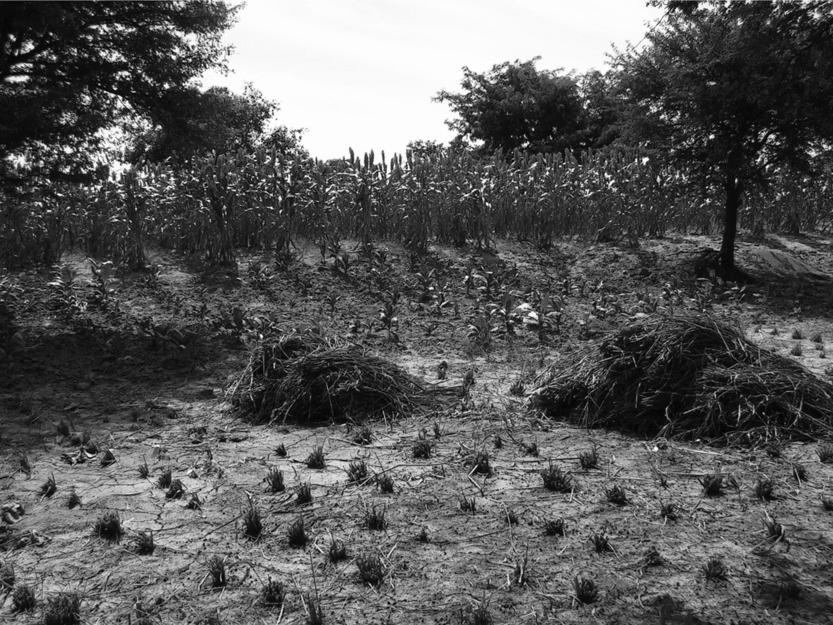
Diversification has many potential roles in agriculture, but its effective use is considerably more complex than fertilizer management. The roles of diversity include risk management, food and nutritional security, pest management (see below) and maximizing systems performance by matching crops to local differences in soil type or landscape position (Figure 1). There are many options for diversification in time and space (Malezieux et al., Reference Malezieux, Crozat, Dupraz, Laurans, Makowski, Ozier-Lafontaine, Rapidel, De Tourdonnet and Valantin-Morison2009). Implementation of diversification options interacts with farmers’ objectives, constraints and incentives. Farmers that are most concerned about stable minimum yields will be more inclined to grow heterogeneous cultivar types or diversified systems, whilst those most interested in market income will be more likely to grow the varieties that can most readily be sold. Families confronting a ‘hungry period’ will be more inclined to produce short-duration varieties (Haussmann et al., Reference Haussmann, Traoré, Rattunde, Weltzien-Rattunde, vom Brocke and Parzies2012; Herrmann et al., Reference Herrmann, Haussmann, van Mourik, Traore, Oumarou, Traore, Ouedraogo and Naab2013), whilst those seeking to maximize yield may prefer varieties with longer maturity periods. Those most concerned with nutritional security may wish to grow specific crops or varieties for consumption; this can lead to gendered crop choices even within a household. Diversification at small scales interacts with mechanization; less-mechanized systems or households are likely to find it easier to manage intercrops and/or diverse, small plots.
Example of farmers’ management of crop diversity within a heterogeneous field in the Maradi region, Niger. Sorghum, tobacco, rice and trees are planted to exploit different niches within one field.
The effectiveness of pest management principles and practices interact with the diverse biology and life history strategies of different pest species, with crop and environmental differences, and with social and economic variation amongst farmers who implement pest management strategies and tactics, and the market and institutional contexts in which they operate. Whilst integrated pest management (IPM) has been widely espoused for decades and has been successful in some favourable contexts, its implementation has been disappointing overall. Various explanations for this underperformance have been advanced, some pertaining to inadequate options and some pertaining to contextual constraints (Parsa et al., Reference Parsa, Morse, Bonifacio, Chancellor, Condori, Crespo-Pérez and Dangles2014). IPM can be successful when the management of a single pest is an important driver of success or failure for a dominant or high-value crop and effective management options are available. For instance, where rice is the dominant crop and rice blast is a potentially devastating disease, farmers are enthusiastic about integrated disease management; the same goes for potato and late blight disease (Nelson et al., Reference Nelson, Orrego and Ortiz2001). In farming systems featuring a diversity of crops, each of which is affected by a number of minor pests, farmers are less likely to focus on the individual pests and more likely to benefit from system management approaches that reduce overall pest pressure (Nelson, Reference Nelson and Pinstrup-Andersen2010). The push–pull system for management of the maize stress complex has been widely adopted in Kenya, largely because the companion crops used to control maize pests are useful as fodder in the associated dairy industry. Likelihood of adoption of the push–pull system was affected by farmer's age, household headship by female farmers, technology attributes and exposure to a variety of extension methods (Khan et al. Reference Khan, Amudavi, Midega, Wanyama and Pickett2008).
THE CHALLENGE OF DEALING WITH COMPLEXITY: EFFICIENTLY MATCHING VAST OPTION SPACE WITH VAST CONTEXT SPACE
It is intimidating to contemplate the infrastructure needed to facilitate the understanding of OxC interactions of relevance to smallholder farmers under a ‘business as usual’ approach. The existing ARD system simply does not have the capacity or intention to support a transition to complex AEI-based agricultural production systems. Governments and donors seeking positive impacts of ARD promote work ‘at scale’ but efforts to reach large numbers of people tend to involve replication of simplicity rather than local adaptation and investigation of complexity. The norms of most national agricultural research programmes bear little resemblance to the systems needed to support any options that show large OxC interactions for smallholders. This may be because of conceptual gaps, because policies are not intended to support smallholder development, or because AEI is neither a value nor an aim of most systems. Conceptual gaps may include a lack of systems thinking and the assumption that simple economic theory predicts the behaviour of farmers and the uptake and impacts of technology. Structural issues in the way that research is organized do not support systems-oriented analysis. These characteristics are problematic for almost any agricultural research targeting smallholders, whether or not it is based on AEI.
The way that research is conducted and recommendations are released suggests an implicit assumption that farm conditions are uniform and favourable. Research is conducted on research stations under conditions that do not resemble those of smallholder farmers, then perhaps repeated on a few farms. The results of a few trials are averaged, and recommendations are made on that basis. The conventional answer to farmers’ needs for access to relevant options is the agricultural extension service. In current practice, such services are often weak and unable to provide this access. In many countries, government extension agencies have been replaced by non-governmental organizations (NGOs) that tend to have the same weaknesses. When they are able to provide support to farmers, it is on the basis of a critically limited option set – the blanket recommendations.
Taking better account of OxC interactions would require a significant change in the way that ARD is conducted. A greater number of options would need to be assessed across a wider range of contexts than can be contemplated by the under-resourced ARD systems that bear responsibility for ensuring food security in most resource-poor countries. Alternative approaches that engage smallholders themselves would open a new range of possibilities. Such approaches could build on the decades of innovation in participatory ARD (Biggs and Farrington, Reference Biggs and Farrington1991; Lilja and Bellon, Reference Lilja and Bellon2008). It has long been recognized by those promoting and using participatory ARD that involving smallholder farmers in the research process can make it possible to better match options and contexts for AEI. But participatory research has rarely been implemented on a wide scale. It is not simply a question of reaching large numbers with information and technology; the information and technology can and should be iteratively refined as it is tested. The ubiquity of OxC interactions means that the relevant research generating understanding and messages has to be done in the diverse contexts in which results and messages are needed, so the requirement is to do research at scale, not simply reach larger numbers of people with information.
OPPORTUNITIES FOR DOING THINGS DIFFERENTLY: THE FARMER RESEARCH NETWORK APPROACH
We propose that these ARD challenges will be more effectively addressed by systematically bringing together social, technical and methodological innovations that enable farmers to collectively conduct large-scale research. This will require substantial support from institutions that currently embrace research and/or extension mandates. Specifically, we propose that FRNs can be designed to take advantage of OxC interactions in a wide range of areas. An FRN is an association of farmer groups, working together with research and development organizations to facilitate access to technical, institutional and financial support, which engages in research and is networked so as to share information and data.
The concept of FRNs builds on a number of elements that have been developed and implemented at various scales. A fundamental ambition of the approach is to enhance farmers’ access to new and old options in a scalable manner, whilst supporting a systematic learning process that allows insights on the interactions of options and contexts to be derived. Whilst the components are all recognizable and an FRN in its early stages of development would probably resemble other participatory research efforts, the implementation of FRNs at scale would be both novel and transformative. In the context of smallholder agriculture, FRNs could enable AEI options to be adapted in diverse ways across a wide range of contexts.
ELEMENTS OF FRN: SOCIAL, TECHNICAL AND METHODOLOGICAL CAPITAL, AND USE OF LOCAL AND GLOBAL KNOWLEDGE
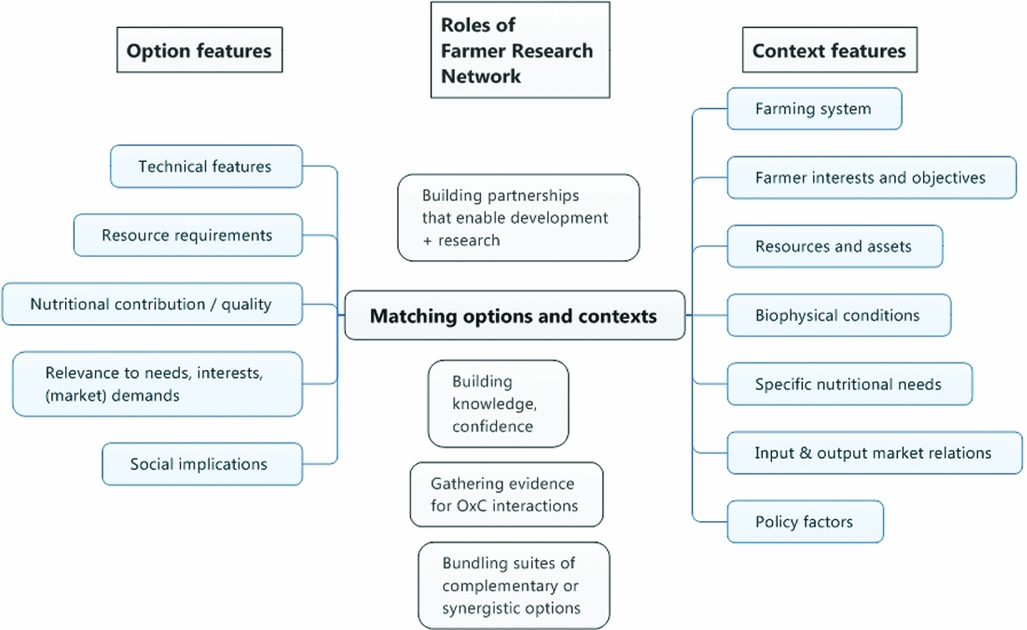
The functions of an FRN are illustrated schematically in Figure 2. A significant social innovation process is needed to support large-scale participatory ARD that fulfils these functions, enabling farmers to identify options of interest and match them systematically to their contexts. The roles of farmers, extensionists and researchers would need to change significantly, and their relationships would have to adjust accordingly. To collectively conduct research, farmers need the organizational capacity to decide on priorities, identify opportunities and options, select topics for investigation, test options in a meaningful way and share results. To support this, the research and extension systems would need to reorient their efforts towards providing the principles, information and methodology that FRNs can use to develop locally relevant practices. The FRN, with its diverse partners working together, would then identify local priorities, select the principles that are relevant to their opportunities and challenges and conduct the experiments needed to adapt the general principles to their specific circumstances. Organizational innovation should thus be recognized as a critical component of realizing the potential of FRNs. Transdisciplinary methodological frameworks, which acknowledge the need to engage actors from outside the formal research establishment in the research process, can contribute to facilitating and implementing FRNs (Lang et al., Reference Lang, Wiek, Bergmann, Stauffacher, Martens, Moll, Swilling and Thomas2012).
Functions of a farmer research network (FRN). An FRN should be built on partnerships that effectively match the features of social and technical innovations (types and characteristics of “options” as indicated at left) with the features of farmers’ contexts (types and characteristics of farms and farmers and their environment as indicated at right).
We argue for the potential merits of large-scale farmer experimentation, but recognize that FRNs could be practiced at any scale and that they will necessarily start small. FRNs will vary in many ways: in the extent and nature of farmer participation in design and data collection; in the scope and focus of the topics investigated; in the extent to which a learning agenda is associated with the research agenda; in the size and leadership structure of the network. In the simplest case, a network of farmers engages in on-farm experimentation, supported by researcher(s) and/or a development organization. In practice, this type of network typically focusses on a single topic or set of topics that is determined by the researcher(s) or the development organization that provides financial and technical support to the network. Various other arrangements can be envisaged or found in practice. A regional FRN platform supporting multiple researcher teams, development organizations and farmer organizations would be a scalable approach and has the potential to offer a wider range of options to participating farmers. A data platform that could provide information on the research process, on options, on contexts and on OxC (integrating global information with local) would enhance the power of the FRN to draw upon and contribute to both global and local knowledge to enhance farm and system performance.
In some regions, including West Africa, strong farmer organizations exist and can provide a platform for research efforts of their members. Local groups of farmers are organized into unions, and several unions into larger farmer federations. For example, in 2014, the FUMA Gaskiya Federation in Niger consisted of 17 unions with 325 subgroups and a total of 12,742 members, of whom 52% were women. Such organizations can coordinate access to technology and can facilitate collective action. With CCRP support, they have recently started coordinating experiments done by members of farmer organizations and have the capacity to involve thousands of farmers in the same trial. In eastern and southern Africa, such unions or federations are not (yet) as powerful but there are many governmental and NGOs, some of which serve large numbers of farmers. Farmer organizations and local development organizations form a collective infrastructure that could support FRN research activities. Currently, there are many examples of productive collaboration between researchers and farmers, but these typically address relatively narrow sets of issues defined by researchers’ interests. The brokerage role played by development organizations and farmer organizations could be important in facilitating the research process, including the initial matching of candidate options (including ‘value propositions’ brought forward by researchers) to farmers’ contexts.
The role of formal ARD professionals in an FRN approach differs from their role in a conventional research system. Researchers and extension personnel in an FRN would aim to expand the global option set through analysis of the published literature; to contribute to narrowing the local options set through spatial analysis and the use of systems tools such as models (e.g., Giller et al., Reference Giller, Tittonell, Rufino, van Wijk, Zingore, Mapfumo, Adjei-Nsiah, Herrero, Chikowo, Corbeels, Rowe, Baijukya, Mwijage, Smith, Yeboah, van der Burg, Sanogo, Misiko, de Ridder, Karanja, Kaizzi, K'ungu, Mwale, Nwaga, Pacini and Vanlauwe2011); to support the design of large-scale experimentation; and to assist in the analysis, visualization and sharing of the results. Farmers would play complementary roles in the process, negotiating and contributing to the range of options considered; selecting the options for testing in their own contexts; testing options locally; gathering and reporting the results, and placing the results into the actual context (e.g., fit of the option to production objective, climate factors and soil fertility in the field). The understanding of options, contexts and their interactions would be enriched by bringing local and global information together. Options should be carefully targeted to avoid testing technologies that are not suited to the local context, such as crop species or varieties that are poorly adapted to an environment or that do not fit the socio-cultural setting. Options that are well enough matched to contexts to merit experimental testing can be identified by discussion and preliminary testing. Farming systems modelling can sometimes enhance targeting of options (Giller et al., Reference Giller, Rowe, de Ridder and van Keulen2006; van Wijk et al., Reference Van Wijk, Tittonell, Rufino, Herrero, Pacini, de Ridder and Giller2009).
As noted above, the notion of an FRN is intended to build on the existing body of participatory ARD in a way that has the potential to allow large-scale matching of options and contexts. Well-documented participatory approaches include local agricultural research committees (CIALs, for the Spanish acronym; Ashby et al., Reference Ashby, Braun, Garcia, Guerrero, Hernandez, Quiro´s and Roa2000; Braun et al., Reference Braun, Thiele and Fernandez2000), participatory plant breeding (e.g., Ceccarelli and Grando, Reference Ceccarelli and Grando2007; Ceccarelli et al., Reference Ceccarelli, Guimaraes and Weltzien2009; Christinck et al., Reference Christinck, Weltzien and Hoffmann2005; Sperling et al., Reference Sperling, Ashby, Smith, Weltzien and Mcguire2001; Weltzien et al., Reference Weltzien, Whitaker, Rattunde, Dhamotharan, Anders, Witcombe and Farrington1997; Weltzien et al., Reference Weltzien, Christinck, Touré, Rattunde, Diarra, Sangare, Coulibaly, Almekinders and Hardon2007), farmer field schools (FFS; e.g., Onduru et al., Reference Onduru, du Preez, Muchena, Gachimbi, de Jager and Gachini2008; van de Fliert,Reference Van de Fliert1993) and many others (Douthwaite et al., Reference Douthwaite, Beaulieu, Lundy and Peters2009). As of 2005, ~250 CIALs were active in Latin America (Rivera, Reference Rivera2011). Whilst these farmer research groups have presumably identified local solutions to local issues (with a general focus on participatory varietal selection), we could find little evidence in the literature of networking or production of global public goods. Participatory breeding efforts have, in some cases, involved large numbers of farmers in organized networks that have produced and managed crop germplasm. The MASIPAG network has conducted farmer-based rice breeding in the Philippines since the 1980s. As of 2010, the network included 635 farmer groups with ~35,000 farmer members that has produced over 1,000 rice varieties and maintained a similar number of traditional local varieties (Bachmann, Reference Bachmann, Goldringer, Dawson, Rey, Vettoretti, Chable, Lammerts van Bueren, Finckh and Barot2010).
Tens of thousands of FFS have been conducted in Asia, Latin America and Africa. These have been used primarily as a participatory extension approach, though some variants have entailed participatory technology development (e.g., Nelson et al., Reference Nelson, Orrego and Ortiz2001). Because farmer groups have been supported to conduct experiments primarily with the aim of learning about established agroecological principles and practices, the findings of the many FFS experiments conducted have not been considered to add to the global knowledge base and data has not been systematically captured and interpreted.
The FRN concept would aim to implement FFS-type learning and experimentation approaches but with greater emphasis on negotiation of the research agenda and on the sharing and analysis of research results. Analysis would be at different scales, matching the interests of the organizations involved, perhaps with farmer groups taking interest in results for their community, NGOs for a wider geographical extent and researchers to inform the global knowledge base. With the increasing availability of sensor and communications technologies, it should now be possible for farmer researchers to gather and share data on the performance of agricultural options in their particular context. Exploration of the possibilities will require investments in social innovation processes to fully engage and inspire rural communities (especially rural youth), as well as in the relevant technical processes, including those that allow the collective management, interpretation and sharing of large, participatory datasets.
GENERATING AND USING DATA
Research depends on systematically observed and interpreted data, both qualitative and quantitative. Any research network will need to generate, manage and use data. FRNs working at scale have the potential to generate datasets that are larger than those often coming from current agricultural research (though these datasets are likely to be small by ‘Big Data’ standards). This potential explosion of farmer-generated data will present new opportunities and challenges.
The two basic empirical study types used in all agricultural research – observational and experimental – have relevance to research conducted by FRNs. Initial surveys by farmers of their own circumstances could allow them to identify similarities and differences that inform their experimental designs and the targeting of options to contexts. FRNs provide a practical framework for large-scale monitoring by farmers. This is needed, for instance, for understanding and managing pest and disease problems that are likely to shift with changes in climate. Data on the dispersal of tropical crop diseases apparently lags behind that of temperate crop diseases, and the biases associated with non-systematic observations are troublesome in both cases (Bebber et al., Reference Bebber, Holmes, Smith and Gurr2014; Garrett, Reference Garrett2013). FRN efforts could enhance surveillance and management options by linking disease outcomes with observations on practice and context. Farmers are generally time-constrained and focussed on production so we do not advocate collecting routine data in the hope that something will emerge; there is simply too much that could be observed. Farmers are more likely to be willing to engage and participate if the work of the FRN is prioritized based on specific hypotheses aimed at solving identified problems. The ‘Big Data’ model used in some industries, which finds research value in information collected routinely for other purposes, has limited relevance to smallholder agriculture as there is no wide-scale routine data collection.
Trials or experiments are likely to the be the main study type that generates data for FRNs. Experiments can be done by farmers in their own fields, using methods developed through years of experience with participatory plant breeding and participatory technology development. The difference with FRNs is the scale at which they can be done – hundreds or thousands of farmers can be involved, rather than the tens typical in earlier participatory experimentation. Such ‘large-N’ trials mean that a wide range of contexts can be sampled. The scale involved also means that experimental design and data collection must be simple, with much done by farmers themselves rather than by technicians. This imposes some new requirements, including the need for farmers to understand the basic concepts of experimentation. Their experiments need to be logical and interpretable at multiple levels. First, a trial should engage the interest and attention of the participating farmers, and the results obtained by an individual must make sense to that person. This means that the treatment set must answer that individual farmer's questions, and that the measurements taken are informative for that farmer's decision-making. Second, the trial should make sense to the farmer group or community, so that everyone learns more by comparing results across neighbouring farms. Third, the trial should be coherent across the network, so that there is added value from networked information (otherwise we do not need an FRN). Finally, it should make a contribution to the global knowledge base, in order to engage researchers and meet their objectives.
Since the aim of any FRN study includes understanding OxC interactions, it will be necessary to collect not only response data (performance) but also data that characterizes relevant dimensions of context. The objectives of the trial and the hypotheses of OxC interaction would determine the relevant factors. An FRN could build a database that contains information on members (farmers), farms and fields that can be used and re-used in different experiments. There is considerable scope for using secondary data on context through geo-referencing, particularly for environmental descriptors derived from remote sensing, such as climate and soil. Whilst it is not possible to measure everything about the context (there are too many variables that might be relevant), networks of farmer-managed sensors could contribute to local and global understanding of local variation in climate and soil characteristics. Data on farms and farmers will be useful in interpreting FRN data, but also in subsequent targeting options to socio-ecological niches.
Using geo-referencing to link to secondary data is an example of the way current ICTs can help make research done through FRNs more feasible (see Hyman et al., Reference Hyman, Hodson and Jones2013, for an overview of publicly available spatial data sets). There are other ways in which ICTs can support FRNs. For example, new sensors are becoming available that allow inexpensive measurements to be made in the field of things that were previously measured at high cost in the lab (e.g., soil carbon; plant, soil and grain respiration; see photosynq.org for details). Inexpensive microscopes can allow farmers to observe things that are normally invisible to them (e.g., pathogenic fungi). Photos, audio and video can easily be recorded as part of an experimental protocol. Many smartphones include GPS receivers so that much data can be geo-referenced. Apps such as Open Data Kit (ODK, which is free and open-source; odk.org) allow all this to be done very simply on a low-cost device, reducing the burden of data entry (Hartung et al., Reference Hartung, Lerer, Anokwa, Tseng, Brunette and Borriello2010). Enhancements becoming available for ODK allow it to link to existing databases.
As in any sort of participatory research undertaking, data and information need to flow to farmers in an FRN, not only to be collected from or by them. There is wealth of experience in using ICTs to convey existing knowledge to farmers (Aker, Reference Aker2011; Torero, Reference Torero, Marble and Fritschel2014). However, not much has been done to help communicate research results back to farmers. Results from an FRN trial, perhaps combined with secondary data, need to be interpreted and presented at the farmer, community and network levels in ways that are intelligible and useful. The tools to do this remain to be developed.
All this suggests the need for a comprehensive data system to support an FRN, something that will allow integrated data collection, aggregation, analysis, interpretation and communication. To be useful, any such data management system would need to be easy to use by farmers, extension people and other ICT non-specialists. A system that relies on researchers and their technicians as the sole custodians and controllers of anything to do with data is unlikely to win the confidence and support of farmers and their organizations. We are not aware of any system that currently allows farmers and extension personnel to visualize their data in near real-time and are endeavouring to support the development of such capability.
In addition to technical challenges relating to participatory data visualization and interpretation, there are sensitive questions around data ownership, access and confidentiality. Access to large, contextualized data sets created by FRNs would have tremendous benefits from a global science perspective, but it is essential to balance the benefits of open data with farmers’ control of their own information. There are clear reasons for routine geo-referencing of data, but this means that information about individuals, including possibly sensitive social information, can be linked to identifiable people and households. Since standard practice in such cases is to severely limit who has access to the data and what they can do with it, approaches will need to be taken to protect participants’ anonymity whilst allowing individuals to identify themselves. Strategies will need to be developed for observing ethical norms whilst fulfilling the proper spirit and intent of FRNs. This will require the negotiation of working rules for data ownership, access, use and privacy as FRNs evolve.
MOTIVATIONS FOR TAKING PART
Scientific research is powerful as a way of learning, solving problems and creating novel possibilities. It can also be a demanding and slow process that leads to frustration more often than it leads to bonanzas. A successful FRN might be seen as a way in which farmers more effectively share the costs and benefits of agricultural research, and ideally guide it in directions that serve their interests. To realize a scenario in which farmers, researchers and extension/development organizations share and negotiate the research process, it will be important to carefully manage the incentives and disincentives for all concerned. Researchers, extension workers and farmers must see what is in it for themselves, in the short, medium and longer terms. The incentives and disincentives for participation in FRN likely resemble those involved in other forms of participatory research, with distinctive possibilities developing as FRNs are scaled. Recognized incentives include access to information and knowledge; access to technology and strengthening of social capital (Ortiz et al., Reference Ortiz, Orrego, Pradel, Gildemacher, Castillo, Otiniano and Kahiu2011). Other potential incentives might include prestige, pleasure and better market integration. The subtleties that influence costs (time, travel; extra work; cognitive challenges) and benefits (access to interesting and potentially profitable insights and technologies; self-esteem, stronger groups and collective action) will strongly influence the success of a given effort.
Researchers are assessed on the basis of research outputs: typically products and publications. Engagement with an FRN would provide opportunities to enhance relevance of applied research at spatial scale and to uncover complexity that would not be feasible with other models. There is a perception that research done with and by farmers is of low quality and there is a persistent view amongst many agricultural scientists that research done with farmers is not publishable. For the scientific potential of FRNs to be realized, new research methods will have to be developed and used, and attention will need to be paid to new details. Large-scale participatory trials will be novel and eminently publishable if researchers keep an eye on what defines applied research quality: building upon the known; approaching issues in new ways; using valid methods; analysing results in insightful ways; and deriving utility from the findings. Since new concepts of experimental design and methods of data collection and analysis will be needed, researchers will also need to update their toolbox and be prepared to describe and defend methods used.
For many extension workers, it will take a considerable change of approach to facilitate a research process rather than to provide answers. Supporting a research process will still require the facilitator to give farmers access to information, but the aim will be to identify the high-priority unknowns that the group will be willing to investigate. The motivations for extension workers to adopt an FRN approach would include opportunities to develop their own skills and knowledge (including ICT tools); being associated with something novel and successful; and the eventual enhanced impact. An FRN could be run by an NGO or a farmers’ organization, with members of those organizations serving the ‘extension’ role. If the FRN is effective in enhancing members’ access to beneficial social processes and technical options, engagement could increase the status of the organization. The social benefit to members could be an important part of their keenness to participate.
The question of incentives for farmers is critical. Previous experiences with participatory research suggest that improved social capital (group membership and action), human capital (knowledge, capability) and access to technology are compelling incentives (Ortiz et al., Reference Ortiz, Orrego, Pradel, Gildemacher, Castillo, Otiniano and Kahiu2011). Both material and intangible benefits are important, and any FRN will need some quick wins to convince resource-limited smallholders that participation is worthwhile. The approach must be designed to provide benefit in the short run, with immediate demonstrations of the utility of gathering quantitative and qualitative information. Initial baseline exercises that identify shared and distinct priorities amongst members of the community, as well as presentation of high-priority, attractive options like new, stress-resistant crop genotypes, are likely to generate enthusiasm for participation. It will be interesting to see how farmers respond to technology options, but there is obvious potential for multifaceted benefits from the use of smart-phone technologies. The learning and prioritization process must be designed to enhance farmers’ knowledge and confidence. In the longer run, FRNs would need to increase their productivity and/or resilience, as well as to contribute in less tangible but also important ways like community cohesion, empowerment, recognition/prestige and intellectual engagement.
CONCLUSIONS
We are in the early stages of designing FRNs, building on decades of participatory research and on developments in ICTs. Transformation is possible and urgently needed to address the pressing challenges faced by hundreds of millions of smallholder farmers who are served by critically weak ARD systems, but will be a tall order to achieve systematic and large-scale implementation of FRNs. This will be a slow process that will require concerted effort and investment. Social and technical innovation will be required to implement a distributed research system, perhaps paralleling the changes needed for distributed energy and irrigation systems. Successful FRNs will build upon and expand the existing social capital of farmer organizations and other rural institutions and movements. If farmer organizations can support research capability by and for their members, participation in these organizations will enable rural people to solve local problems and improve their farm performance. The aim of enhancing access to options could progressively develop, starting with a narrow research focus on selecting better-adapted crop varieties to addressing an increasingly wide scope of issues. Different processes will be required to support the transformation of the research and extension system to support FRNs. The parallel with the earlier history of participatory research is useful. The ‘Participatory Research and Gender Analysis’ programme of the Consultative Group on International Agricultural Research provided a community of practice that allowed practitioners to swap ideas, tools and experience and facilitated the advancement of concepts and practice. A similar platform for FRNs would facilitate learning how to make FRNs work through collecting and synthesizing experiences and organizing research on critical questions of FRN process. Investment in social and communications innovation and infrastructure, technology and methods will be needed to capitalize on the potential of a more inclusive and broad-scale approach to agricultural research.
Acknowledgements
We thank colleagues working with the Collaborative Crop Research Program for numerous discussions and debates that have led to the ideas in this paper. We also thank Jacqueline Maasch for assistance in finding literature.


 Open access

