





1. Introduction
We begin with an example that motivated our investigations.
Example 1.1. Consider the exact symplectic manifold $T^*S^2$
with its canonical symplectic structure, which we can identify with the affine variety
$T^*S^2$
with its canonical symplectic structure, which we can identify with the affine variety
 \begin{equation*}X = (xy+z^2=1)\subset \mathbb{C}^3\end{equation*}
with a symplectic form restricted from $\mathbb{C}^3$
. Projecting onto the
$\mathbb{C}^3$
. Projecting onto the $z$
direction exhibits
$z$
direction exhibits $X$
as
$X$
as $\mathbb{C}^*$
-fibration over
$\mathbb{C}^*$
-fibration over $\mathbb{C}$
, with two degenerate fibres over
$\mathbb{C}$
, with two degenerate fibres over $\{\pm 1\}$
. Write
$\{\pm 1\}$
. Write $S$
for the zero section in
$S$
for the zero section in $T^*S^2$
, which is also the Lagrangian matching sphere over an arc
$T^*S^2$
, which is also the Lagrangian matching sphere over an arc $\Lambda \subset \mathbb{C}$
connecting the two critical values.
$\Lambda \subset \mathbb{C}$
connecting the two critical values.
There is a Hamiltonian $S^1$
action on
$S^1$
action on $T^*S^2$
given by rotating the fibres, that is, rotating the phases of
$T^*S^2$
given by rotating the fibres, that is, rotating the phases of $x$
and
$x$
and $y$
in opposite directions. We are interested in the
$y$
in opposite directions. We are interested in the $S^1$
-equivariant wrapped Fukaya category of
$S^1$
-equivariant wrapped Fukaya category of $T^*S^2$
, which we denote by
$T^*S^2$
, which we denote by $\mathcal{W}_{S^1}\!(T^*S^2)$
.
$\mathcal{W}_{S^1}\!(T^*S^2)$
.
The construction of equivariant Fukaya categories with respect to an action of a Lie group $G$
is explained by Daemi and Fukaya in [Reference Daemi and Fukaya5, Theorem 8.3]Footnote 1. For this preliminary discussion, we only need to know that an exact compact
$G$
is explained by Daemi and Fukaya in [Reference Daemi and Fukaya5, Theorem 8.3]Footnote 1. For this preliminary discussion, we only need to know that an exact compact $S^1$
-invariant Lagrangian is an object of this category, with endomorphisms given by
$S^1$
-invariant Lagrangian is an object of this category, with endomorphisms given by $S^1$
-equivariant Floer cohomology
$S^1$
-equivariant Floer cohomology $HF^*_{S^1} (L,L)$
, which we can identify with the usual
$HF^*_{S^1} (L,L)$
, which we can identify with the usual $S^1$
-equivariant cohomology
$S^1$
-equivariant cohomology $H^*_{S^1}(L)$
(just as the Floer cohomology of an exact compact Lagrangian
$H^*_{S^1}(L)$
(just as the Floer cohomology of an exact compact Lagrangian $HF^*(L,L)$
is isomorphic to
$HF^*(L,L)$
is isomorphic to $H^*(L)$
).
$H^*(L)$
).
The exact Lagrangian sphere $S\subset X$
is preserved by the
$S\subset X$
is preserved by the $S^1$
-action, and indeed, it defines an object of this category. The
$S^1$
-action, and indeed, it defines an object of this category. The $S^1$
-action on
$S^1$
-action on $S$
is the usual
$S$
is the usual $S^1$
-action on
$S^1$
-action on $S^2$
with two fixed points, so we can calculate that:
$S^2$
with two fixed points, so we can calculate that:
 \begin{equation*}HF^*_{S^1}(S, S) = H^*_{S^1}(S) = \mathbb{C}[x,y]/xy\end{equation*}
where $\deg x = \deg y =2$
. Note that here we’re using the (unique) grading structure on
$\deg x = \deg y =2$
. Note that here we’re using the (unique) grading structure on $T^*S^2$
.
$T^*S^2$
.
Now consider the set of regular values of our projection:
 \begin{equation*}\mathcal{P} = \mathbb{C}\setminus \{\pm 1\}\end{equation*}
This is the pair-of-pants. The wrapped Fukaya category $\mathcal{W}(\mathcal{P})$
can easily be calculated; in particular, the endomorphisms of the arc
$\mathcal{W}(\mathcal{P})$
can easily be calculated; in particular, the endomorphisms of the arc $\Lambda$
– which is a non-compact Lagrangian in
$\Lambda$
– which is a non-compact Lagrangian in $\mathcal{P}$
– is:
$\mathcal{P}$
– is:
 \begin{equation*}HW^*(\Lambda , \Lambda ) = \mathbb{C}[x, y]/xy \end{equation*}
Moreover, for an appropriate (and unique) grading structure on $\mathcal{P}$
, we can arrange that
$\mathcal{P}$
, we can arrange that $\deg x= \deg y=2$
.
$\deg x= \deg y=2$
.
So we have observed that:
 \begin{equation*} HW^*(\Lambda , \Lambda ) = \mathbb{C}[x,y]/xy = HF^*_{S^1}(S, S) \end{equation*}
This strongly suggests that there is quasi-equivalence of $\mathbb{Z}$
-graded pre-triangulated categories:
$\mathbb{Z}$
-graded pre-triangulated categories:
 \begin{equation} \mathcal{W}(\mathcal{P}) \simeq \mathcal{W}_{S^1}(T^*S^2) \end{equation}
We claim that this equivalence does indeed hold, but we will not give a proof in this paper (although we will provide a heuristic mirror symmetry justification). Instead, our focus will be on extrapolating from this example to some general conjectures (Figure 1).
Cotangent bundle of two-sphere.

1.1. Algebraic torus fibrations
As a first generalisation, consider the following set-up. Let $Y= \mathbb{C}^n$
, or a more general Liouville manifold, and
$Y= \mathbb{C}^n$
, or a more general Liouville manifold, and $f \;:\; Y \to \mathbb{C}$
be a holomorphic map with
$f \;:\; Y \to \mathbb{C}$
be a holomorphic map with $0$
as a regular value. Then we can construct a fibration
$0$
as a regular value. Then we can construct a fibration $\pi \;:\; X \to Y$
by setting
$\pi \;:\; X \to Y$
by setting $X$
to be the smooth hypersurface:
$X$
to be the smooth hypersurface:
 \begin{equation*} X = \{ (x,y,\textbf{w}) ;\, xy = f(\textbf{w}) \} \; \subset \mathbb{C}^2\times Y \end{equation*}
The generic fibre of $\pi \;:\; X \to Y$
is isomorphic to
$\pi \;:\; X \to Y$
is isomorphic to $\mathbb{C}^*$
, and it degenerates to a node along the smooth hypersurface
$\mathbb{C}^*$
, and it degenerates to a node along the smooth hypersurface $D = \{ f(\textbf{w}) =0 \}$
. The space
$D = \{ f(\textbf{w}) =0 \}$
. The space $X$
admits a Hamiltonian
$X$
admits a Hamiltonian $S^1$
action given by rotating the fibres:
$S^1$
action given by rotating the fibres: $ (x,y, \textbf{w}) \mapsto (e^{i\theta }x,e^{-i\theta }y, \textbf{w})$
for
$ (x,y, \textbf{w}) \mapsto (e^{i\theta }x,e^{-i\theta }y, \textbf{w})$
for $e^{i\theta } \in S^1$
.
$e^{i\theta } \in S^1$
.
More generally, suppose we have holomorphic line bundles $L_1,\ldots , L_r$
on
$L_1,\ldots , L_r$
on $Y$
and sections
$Y$
and sections $f_i\in \Gamma (L_i^{\otimes 2})$
. Assume that each hypersurface
$f_i\in \Gamma (L_i^{\otimes 2})$
. Assume that each hypersurface $D_i = \{ f_i=0 \}$
is smooth and that together they form a simple normal crossing divisor
$D_i = \{ f_i=0 \}$
is smooth and that together they form a simple normal crossing divisor $D=\cup _{i=1}^r D_i$
. Then we can form the smooth space:
$D=\cup _{i=1}^r D_i$
. Then we can form the smooth space:
 \begin{equation*} X = \{ (x_1,y_1,\ldots , x_r,y_r, \textbf{w}) \,|\, x_iy_i = f_i(\textbf{w}), \text{for all } i \}\;\;\subset \textrm {Tot}\left (\oplus _{i=1}^r L_i^{\oplus 2} \right ) \end{equation*}
The projection to $\textbf{w}$
defines a fibration
$\textbf{w}$
defines a fibration $\pi \;:\; X \to Y$
whose generic fibre is isomorphic to
$\pi \;:\; X \to Y$
whose generic fibre is isomorphic to $(\mathbb{C}^*)^r$
, with singular fibres appearing over the divisor
$(\mathbb{C}^*)^r$
, with singular fibres appearing over the divisor $D$
. We also have a Hamiltonian action of an
$D$
. We also have a Hamiltonian action of an $r$
-dimensional torus
$r$
-dimensional torus $T$
on
$T$
on $X$
by rotating the fibres.
$X$
by rotating the fibres.
If $r\gt \dim Y$
, then the intersection of all the
$r\gt \dim Y$
, then the intersection of all the $D_i$
is empty, and it follows that the diagonal
$D_i$
is empty, and it follows that the diagonal $U(1)\subset T$
acts freely. Then the quotient
$U(1)\subset T$
acts freely. Then the quotient $X' = X/\mathbb{C}^*$
is again a manifold fibering over
$X' = X/\mathbb{C}^*$
is again a manifold fibering over $Y$
, with generic fibre an algebraic torus, and singular fibres appearing over the same divisor
$Y$
, with generic fibre an algebraic torus, and singular fibres appearing over the same divisor $D$
. It carries a Hamiltonian action of the rank
$D$
. It carries a Hamiltonian action of the rank $r-1$
torus
$r-1$
torus $T/U(1)$
. In fact, if
$T/U(1)$
. In fact, if $r=\dim + k$
, then there is a rank
$r=\dim + k$
, then there is a rank $k$
subtorus of
$k$
subtorus of $T$
, which acts freely, and we can quotient by any subtorus of it.
$T$
, which acts freely, and we can quotient by any subtorus of it.
We’ll refer to these $X\to Y$
or
$X\to Y$
or $X'\to Y$
, with their Hamiltonian torus actions, as algebraic torus fibrations.
$X'\to Y$
, with their Hamiltonian torus actions, as algebraic torus fibrations.
Conjecture A. Given an algebraic torus fibration $X\to Y$
, we have a quasi-equivalence:
$X\to Y$
, we have a quasi-equivalence:
 \begin{equation*} \mathcal{W}_{T}(X)_{-\textbf{1}} \simeq \mathcal{W}(Y\setminus D) \end{equation*}
Here if we work with $\mathbb{Z}$
-graded categories, the grading on
$\mathbb{Z}$
-graded categories, the grading on $Y \setminus D$
should be chosen so that it extends over
$Y \setminus D$
should be chosen so that it extends over $D$
. The meaning of the suffix
$D$
. The meaning of the suffix $-\textbf{1}$
will be explained in the next section; for the moment, we ignore it.
$-\textbf{1}$
will be explained in the next section; for the moment, we ignore it.
If we delete the divisor $\pi ^{-1}D$
from
$\pi ^{-1}D$
from $X$
, then what remains is just a principal
$X$
, then what remains is just a principal $(\mathbb{C}^*)^r$
bundle over
$(\mathbb{C}^*)^r$
bundle over $Y\setminus D$
. So it is not too surprising that there should be a quasi-equivalence:
$Y\setminus D$
. So it is not too surprising that there should be a quasi-equivalence:
 \begin{equation*}\mathcal{W}_T(X\setminus \pi ^{-1}D) \simeq \mathcal{W}(Y\setminus D)\end{equation*}
and indeed, this fits with a more general story about Hamiltonian reduction that we will discuss in the next section. However, $\mathcal{W}_T(X)$
should be a deformation of
$\mathcal{W}_T(X)$
should be a deformation of $\mathcal{W}_T(X\setminus \pi ^{-1}D)$
, since including the extra divisor will add terms to the
$\mathcal{W}_T(X\setminus \pi ^{-1}D)$
, since including the extra divisor will add terms to the $A_\infty$
structure. ConjectureA is the claim that this deformation is in fact trivial.
$A_\infty$
structure. ConjectureA is the claim that this deformation is in fact trivial.
In Section 2, we will provide evidence for the conjecture using toric mirror symmetry; in some examples, this amounts to an (excessively indirect!) proof.
Remark 1.3. There is also some evidence for our conjecture in the existing literature, not using mirror symmetry, when $X$
is a hypertoric variety associated to a special kind of hyperplane arrangement in
$X$
is a hypertoric variety associated to a special kind of hyperplane arrangement in $Y= \mathbb{C}^n$
.
$Y= \mathbb{C}^n$
.
Fix a collection of points $p_1,\ldots , p_k\in \mathbb{C}$
. Taking the
$p_1,\ldots , p_k\in \mathbb{C}$
. Taking the $n$
th symmetric product produces a hyperplane arrangement
$n$
th symmetric product produces a hyperplane arrangement $Y \setminus D = \operatorname{Sym}^{n}(\mathbb{C} \setminus \{ p_1,\ldots , p_k\})$
. In [Reference Lekili and Polishchuk18], the category
$Y \setminus D = \operatorname{Sym}^{n}(\mathbb{C} \setminus \{ p_1,\ldots , p_k\})$
. In [Reference Lekili and Polishchuk18], the category $\mathcal{W}(Y\setminus D)$
was described explicitly by computing the endomorphism algebra of a particular generator.
$\mathcal{W}(Y\setminus D)$
was described explicitly by computing the endomorphism algebra of a particular generator.
There is also a hypertoric variety $X$
, which can be constructed as an algebraic torus fibration
$X$
, which can be constructed as an algebraic torus fibration $\pi :X \to Y$
degenerating over
$\pi :X \to Y$
degenerating over $D$
, as in Conjecture A. The paper [Reference Braden, Licata, Proudfoot and Webster3] studies certain algebras associated to
$D$
, as in Conjecture A. The paper [Reference Braden, Licata, Proudfoot and Webster3] studies certain algebras associated to $T$
-invariant Lagrangians in
$T$
-invariant Lagrangians in $X$
, which are expected to agree with their endomorphism algebras in
$X$
, which are expected to agree with their endomorphism algebras in $\mathcal{W}_T(X)$
. And, as was noted in [Reference Lauda, Licata and Manion13], they are the same algebras as were found in [Reference Lekili and Polishchuk18].
$\mathcal{W}_T(X)$
. And, as was noted in [Reference Lauda, Licata and Manion13], they are the same algebras as were found in [Reference Lekili and Polishchuk18].
1.2. Hamiltonian reduction
Suppose we have a Hamiltonian $S^1$
action on a symplectic manifold
$S^1$
action on a symplectic manifold $X$
. The information of the
$X$
. The information of the $S^1$
action appears in the Fukaya category as an invertible element:
$S^1$
action appears in the Fukaya category as an invertible element:
 \begin{equation*}s \in SH^*(X)\end{equation*}
This gives rise to a natural automorphism of the identity functor, so for each object $L\in \mathcal{W}(X)$
, it provides an automorphism
$L\in \mathcal{W}(X)$
, it provides an automorphism $s_{L}\;:\; L\stackrel {\sim }{\longrightarrow } L$
. Precisely,
$s_{L}\;:\; L\stackrel {\sim }{\longrightarrow } L$
. Precisely, $s_{L} = \mathcal{CO}^0(s) \in HF^0(L,L)$
where
$s_{L} = \mathcal{CO}^0(s) \in HF^0(L,L)$
where $\mathcal{C}\mathcal{O}^0$
is the zeroth order part of the unital algebra map
$\mathcal{C}\mathcal{O}^0$
is the zeroth order part of the unital algebra map $\mathcal{CO}\;:\; SH^*(X) \to HH^*(CF^*(L,L))$
called the closed-open string map.
$\mathcal{CO}\;:\; SH^*(X) \to HH^*(CF^*(L,L))$
called the closed-open string map.
This $s$
was originally constructed by Seidel [Reference Seidel25] for compact
$s$
was originally constructed by Seidel [Reference Seidel25] for compact $X$
and as an invertible element in the quantum cohomology
$X$
and as an invertible element in the quantum cohomology $QH^*(X)$
. When
$QH^*(X)$
. When $X$
is exact, Seidel’s construction yields an element in symplectic cohomology
$X$
is exact, Seidel’s construction yields an element in symplectic cohomology $SH^*(X)$
instead [Reference Ritter24], but in either case, we can map it to Hochschild cohomology using the closed-open map.Footnote 2
$SH^*(X)$
instead [Reference Ritter24], but in either case, we can map it to Hochschild cohomology using the closed-open map.Footnote 2
In the previous section, we discussed the equivariant wrapped category $\mathcal{W}_{S^1}\!(X)$
as though it was a single category. In fact, for any given
$\mathcal{W}_{S^1}\!(X)$
as though it was a single category. In fact, for any given $\lambda \in \mathbb{C}^*$
, one can construct a version of the equivariant category
$\lambda \in \mathbb{C}^*$
, one can construct a version of the equivariant category
 \begin{equation*}\mathcal{W}_{S^1}\!(X)_\lambda \end{equation*}
starting from those objects of $\mathcal{W}(X)$
such that
$\mathcal{W}(X)$
such that $s_L= \lambda 1_{L}$
. Teleman [Reference Teleman30] refers to these categories as the ‘spectral components’ of the equivariant Fukaya category, and they will be the main focus of this paper.Footnote 3
$s_L= \lambda 1_{L}$
. Teleman [Reference Teleman30] refers to these categories as the ‘spectral components’ of the equivariant Fukaya category, and they will be the main focus of this paper.Footnote 3
For example, an $S^1$
-invariant Lagrangian
$S^1$
-invariant Lagrangian $L$
(which is monotone, has minimal Maslov at least 2 and is equipped with a spin structure) provides an object of
$L$
(which is monotone, has minimal Maslov at least 2 and is equipped with a spin structure) provides an object of $\mathcal{W}_{S^1}\!(X)_{\pm 1}$
. But if we give
$\mathcal{W}_{S^1}\!(X)_{\pm 1}$
. But if we give $L$
a non-trivial local system, whose monodromy along
$L$
a non-trivial local system, whose monodromy along $S^1$
orbits is
$S^1$
orbits is $\lambda$
, then we have an object of
$\lambda$
, then we have an object of $\mathcal{W}_{S^1}\!(X)_{\pm \lambda }$
.
$\mathcal{W}_{S^1}\!(X)_{\pm \lambda }$
.
Remark 1.4. The sign ambiguity above comes from the choice of spin structure on $L$
. Namely, along the
$L$
. Namely, along the $S^1$
-orbit of a point on
$S^1$
-orbit of a point on $L$
, we have two trivialisation of the tangent bundle
$L$
, we have two trivialisation of the tangent bundle $TL$
: one induced from the
$TL$
: one induced from the $S^1$
action and the other coming from the spin structure, and a negative sign appears if these do not agree (see [Reference Tonkonog31, p.10]). In particular, modifying the local system by multiplying the monodromy by
$S^1$
action and the other coming from the spin structure, and a negative sign appears if these do not agree (see [Reference Tonkonog31, p.10]). In particular, modifying the local system by multiplying the monodromy by $-1$
is equivalent to changing the spin structure.
$-1$
is equivalent to changing the spin structure.
In Example 1.1, our Lagrangian $S$
was a 2-sphere; hence, it carries a unique spin structure, which induces the bounding spin structure on each
$S$
was a 2-sphere; hence, it carries a unique spin structure, which induces the bounding spin structure on each $S^1$
orbit, whereas the spin structure induced by the trivialisation via the
$S^1$
orbit, whereas the spin structure induced by the trivialisation via the $S^1$
action is the non-bounding one. This makes it an object of
$S^1$
action is the non-bounding one. This makes it an object of $\mathcal{W}_{S^1}\!(T^*S^2)_{-1}$
.
$\mathcal{W}_{S^1}\!(T^*S^2)_{-1}$
.
Now consider the Hamiltonian reduction $ X {/\!/}_{a} \,S^1$
at some regular value
$ X {/\!/}_{a} \,S^1$
at some regular value $a\in \mathbb{R}$
of the moment map
$a\in \mathbb{R}$
of the moment map $\mu$
. There is a Lagrangian correspondence
$\mu$
. There is a Lagrangian correspondence
 \begin{align} \Gamma = \{ (x, [x] ), \; \mu (x)=a \} \; \subset X^{-}\times (X{/\!/}_{a} \,S^1) \end{align}
which induces a functor
 \begin{align} \mathcal{W}(X) \to \mathcal{W}(X{/\!/}_{a} \,S^1) \end{align}
via the theory of holomorphic quilts [Reference Fukaya6,Reference Lekili and Lipyanskiy14,Reference Ma’u, Wehrheim and Woodward19]. Moreover, since $\Gamma$
is
$\Gamma$
is $S^1$
-invariant, we can use it to define a functor in the equivariant setting. Teleman conjectures that this gives an equivalence
$S^1$
-invariant, we can use it to define a functor in the equivariant setting. Teleman conjectures that this gives an equivalence
 \begin{equation} \mathcal{W}_{S^1}\!(X)_{\pm e^{a}} \cong \mathcal{W}(X{/\!/}_{a} \,S^1) \end{equation}
between the Fukaya category of the Hamiltonian reduction and the corresponding spectral component of the equivariant category. More generally, we can consider the spectral component at $\lambda = \pm e^{a+ ib}$
, and this will give the wrapped category of the quotient equipped with a B-field (or perhaps a more general bulk deformation). A theorem along these lines, for compact
$\lambda = \pm e^{a+ ib}$
, and this will give the wrapped category of the quotient equipped with a B-field (or perhaps a more general bulk deformation). A theorem along these lines, for compact $X$
, has been announced by Fukaya [Reference Fukaya7].
$X$
, has been announced by Fukaya [Reference Fukaya7].
Remark 1.8. In general, one has to worry about whether $\Gamma$
is unobstructed. If
$\Gamma$
is unobstructed. If $X$
is compact, it can occur that
$X$
is compact, it can occur that $\Gamma$
is only weakly unobstructed, which then necessitates choosing a bounding cochain on
$\Gamma$
is only weakly unobstructed, which then necessitates choosing a bounding cochain on $\Gamma$
to make the functor (1.6) defined, in which case, its target category may also get bulk deformed (as forced by the existence of the functor (1.6) [Reference Fukaya6]).
$\Gamma$
to make the functor (1.6) defined, in which case, its target category may also get bulk deformed (as forced by the existence of the functor (1.6) [Reference Fukaya6]).
Remark 1.9. The sign ambiguity in (1.7) is not present in Teleman’s paper; we discovered it from examples, but it can be explained as follows. Before we can use $\Gamma$
to define a functor, we must first equip it with a spin structure, and then it becomes an element of
$\Gamma$
to define a functor, we must first equip it with a spin structure, and then it becomes an element of $\mathcal{W}_{S^1}\!\big (X\times (X{/\!/}_a\, S^1)\big )_{\pm 1}$
with the sign determined as in Remark 1.4. If
$\mathcal{W}_{S^1}\!\big (X\times (X{/\!/}_a\, S^1)\big )_{\pm 1}$
with the sign determined as in Remark 1.4. If $\Gamma$
is not simply connected, then we may be able to produce two equivalences
$\Gamma$
is not simply connected, then we may be able to produce two equivalences $\mathcal{W}_{S^1}\!(X)_{e^a} \stackrel {\sim }{\longrightarrow } \mathcal{W}(X{/\!/}_{\mathfrak{a}}\,S^1)$
and
$\mathcal{W}_{S^1}\!(X)_{e^a} \stackrel {\sim }{\longrightarrow } \mathcal{W}(X{/\!/}_{\mathfrak{a}}\,S^1)$
and $\mathcal{W}_{S^1}\!(X)_{-e^{a}} \stackrel {\sim }{\longrightarrow } \mathcal{W}(X{/\!/}_a\,S^1)$
using different spin structures. In other examples, there is no choice, and one must just compute the sign.
$\mathcal{W}_{S^1}\!(X)_{-e^{a}} \stackrel {\sim }{\longrightarrow } \mathcal{W}(X{/\!/}_a\,S^1)$
using different spin structures. In other examples, there is no choice, and one must just compute the sign.
Let us see what this point of view brings to our Example1.1. The moment map there is $\mu = |x|^2 - |y|^2$
. Any non-zero
$\mu = |x|^2 - |y|^2$
. Any non-zero $a\in \mathbb{R}$
is a regular value of
$a\in \mathbb{R}$
is a regular value of $\mu$
and produces the quotient
$\mu$
and produces the quotient $X{/\!/}_{a} \,S^1 \cong \mathbb{C}$
. Since
$X{/\!/}_{a} \,S^1 \cong \mathbb{C}$
. Since $\mathcal{W}(\mathbb{C})\cong 0$
, the corresponding spectral component should be zero.
$\mathcal{W}(\mathbb{C})\cong 0$
, the corresponding spectral component should be zero.
Given Remark1.4, our observation (1.2) should really be the claim that:
 \begin{equation*}\mathcal{W}_{S^1}(X)_{-1} \cong \mathcal{W}(P) \end{equation*}
So the spectral component at $\lambda =-1$
is non-zero. This must correspond to the singular value
$\lambda =-1$
is non-zero. This must correspond to the singular value $a=0$
of the moment map, where we cannot do symplectic reduction. Instead, we are simply deleting the singularities of the moment map fibre
$a=0$
of the moment map, where we cannot do symplectic reduction. Instead, we are simply deleting the singularities of the moment map fibre $\mu ^{-1}(0)$
and forming the quotient:
$\mu ^{-1}(0)$
and forming the quotient:
 \begin{equation*}\mathcal{P} = \big (\mu ^{-1}(0) - (0,0,\pm 1)\big ) / S^1\end{equation*}
With this prescription, we are extending the equivalences
 \begin{equation*}\mathcal{W}_{S^1}(X)_{-e^a} \cong \mathcal{W}(X{/\!/}_{a} \,S^1)\end{equation*}
from (1.7) to the singular value $a=0$
.
$a=0$
.
From this example, we draw the following general conclusion:
Conjecture B. Let $X$
be a Liouville manifold with a Hamiltonian
$X$
be a Liouville manifold with a Hamiltonian $S^1$
-manifold such that the fixed locus
$S^1$
-manifold such that the fixed locus $X^{S^1}$
has codimension four, and assume there are no finite non-trivial stabiliser groups. Let
$X^{S^1}$
has codimension four, and assume there are no finite non-trivial stabiliser groups. Let $\mu \;:\; X \to \mathbb{R}$
be the moment map, and let
$\mu \;:\; X \to \mathbb{R}$
be the moment map, and let $a\in \mathbb{R}$
be a singular value in the interior of
$a\in \mathbb{R}$
be a singular value in the interior of $\operatorname{Im}\mu$
. Then there is a quasi-equivalence
$\operatorname{Im}\mu$
. Then there is a quasi-equivalence
 \begin{equation*}\mathcal{W}_{S^1}\!(X)_{- e^{a}} \cong \mathcal{W}(U/S^1) \end{equation*}
where $U$
is the smooth locus in
$U$
is the smooth locus in $\mu ^{-1}(a)$
.
$\mu ^{-1}(a)$
.
As stated, our conjecture may be too optimistic, as in general $\mathcal{W}(U/S^1)$
may have to be bulk deformed.Footnote 4 However, we will see many examples below where such a bulk deformation is absent.
$\mathcal{W}(U/S^1)$
may have to be bulk deformed.Footnote 4 However, we will see many examples below where such a bulk deformation is absent.
Remark 1.10. Following Remark 1.9, we should justify why we have written $-e^a$
instead of
$-e^a$
instead of $e^a$
. The smooth locus
$e^a$
. The smooth locus $U$
is an
$U$
is an $S^1$
bundle, but in
$S^1$
bundle, but in $\mu ^{-1}(a)$
, some of the
$\mu ^{-1}(a)$
, some of the $S^1$
fibres collapse to points. So the Lagrangian correspondence
$S^1$
fibres collapse to points. So the Lagrangian correspondence $\Gamma$
should be given a spin structure, which is the bounding spin structure on the orbits – hence the minus sign. This is essentially the same argument that we used for the
$\Gamma$
should be given a spin structure, which is the bounding spin structure on the orbits – hence the minus sign. This is essentially the same argument that we used for the $T^*S^2$
example in Remark 1.4.
$T^*S^2$
example in Remark 1.4.
Remark 1.11. The spectral components that are not covered either by Teleman–Fukaya’s ideas or our Conjecture B are the components at $\lambda = - e^{a+ ib}$
where
$\lambda = - e^{a+ ib}$
where $a$
is a singular value and
$a$
is a singular value and $b\neq 0$
. The best we can say about these is that (i) they should be bulk deformations of
$b\neq 0$
. The best we can say about these is that (i) they should be bulk deformations of $\mathcal{W}(U/S^1)$
, and (ii) they should be more similar to the components at generic values than they are to
$\mathcal{W}(U/S^1)$
, and (ii) they should be more similar to the components at generic values than they are to $\mathcal{W}(U/S^1)$
. From mirror symmetry, we should expect to see special behaviour in complex codimension one.
$\mathcal{W}(U/S^1)$
. From mirror symmetry, we should expect to see special behaviour in complex codimension one.
Most of the discussion above generalises easily to Hamiltonian actions of a higher-rank torus $T=(S^1)^r$
. Such an action produces
$T=(S^1)^r$
. Such an action produces $r$
Seidel elements
$r$
Seidel elements $s_1,\ldots , s_r$
, and hence a category
$s_1,\ldots , s_r$
, and hence a category $\mathcal{W}_T(X)_\lambda$
for each
$\mathcal{W}_T(X)_\lambda$
for each $\lambda \in (\mathbb{C}^*)^r$
.
$\lambda \in (\mathbb{C}^*)^r$
.
For regular values of the moment map, the corresponding component $\mathcal{W}_T(X)_\lambda$
will be the Fukaya category of the corresponding symplectic quotient of
$\mathcal{W}_T(X)_\lambda$
will be the Fukaya category of the corresponding symplectic quotient of $X$
, possibly with a bulk deformation. At singular values, our conjecture is that we should instead – at least in some situations – take the quotient of the smooth part of the moment map fibre.
$X$
, possibly with a bulk deformation. At singular values, our conjecture is that we should instead – at least in some situations – take the quotient of the smooth part of the moment map fibre.
The set-up considered in ConjectureA is a specialcase of this story. A moment map value $(a_1,\ldots ,a_r)$
is regular if every
$(a_1,\ldots ,a_r)$
is regular if every $a_i$
is non-zero, and then the corresponding Hamiltonian reduction is the base
$a_i$
is non-zero, and then the corresponding Hamiltonian reduction is the base $Y$
. So taking the spectral component at the value
$Y$
. So taking the spectral component at the value $\lambda = (-\!e^{a_1},\ldots , -e^{a_r})$
will produce
$\lambda = (-\!e^{a_1},\ldots , -e^{a_r})$
will produce $\mathcal{W}_{S^1}\!(X)_\lambda \cong \mathcal{W}(Y)$
. At a more general
$\mathcal{W}_{S^1}\!(X)_\lambda \cong \mathcal{W}(Y)$
. At a more general $\lambda$
, provided each
$\lambda$
, provided each $\lambda _i$
lies off the unit circle, we will get
$\lambda _i$
lies off the unit circle, we will get $\mathcal{W}(Y)$
, possibly with a bulk deformation.
$\mathcal{W}(Y)$
, possibly with a bulk deformation.
But suppose $\lambda _1=-1$
. Then the fibre of the moment map has singularities over the divisor
$\lambda _1=-1$
. Then the fibre of the moment map has singularities over the divisor $D_1$
, and our conjecture is that the spectral component is
$D_1$
, and our conjecture is that the spectral component is
 \begin{equation*}\mathcal{W}_{S^1}\!(X)_\lambda \cong \mathcal{W}(Y\setminus D_1)\end{equation*}
bulk deformed by $(b_2,\ldots , b_r)$
. If several
$(b_2,\ldots , b_r)$
. If several $\lambda _i$
are equal to
$\lambda _i$
are equal to $-1$
, then we must delete several divisors, and at the most special value
$-1$
, then we must delete several divisors, and at the most special value
 \begin{equation*} -\textbf{1} = (\!-\!1,\ldots , -1)\end{equation*}
we get the statement of Conjecture A.
Example 1.12. The simplest possible example of Conjectures A and B is to set $X=\mathbb{C}^2$
with the
$X=\mathbb{C}^2$
with the $S^1$
action
$S^1$
action $\theta \;:\; (x,y) \to (e^{i\theta }x, e^{-i\theta }y)$
. We can view it as an algebraic torus bundle
$\theta \;:\; (x,y) \to (e^{i\theta }x, e^{-i\theta }y)$
. We can view it as an algebraic torus bundle $\pi \,:\,X \to Y=\mathbb{C}$
with
$\pi \,:\,X \to Y=\mathbb{C}$
with $\pi (x,y)=xy$
, having a single singular fibre over
$\pi (x,y)=xy$
, having a single singular fibre over $D=\{0\}$
. The Hamiltonian reduction at generic values of
$D=\{0\}$
. The Hamiltonian reduction at generic values of $\mu$
is
$\mu$
is $\mathbb{C}$
, and at the singular value
$\mathbb{C}$
, and at the singular value $a=0$
, the quotient of the smooth locus is
$a=0$
, the quotient of the smooth locus is $\mathbb{C}^*$
. So we expect that
$\mathbb{C}^*$
. So we expect that
 \begin{equation*}\mathcal{W}_{S^1}(X)_{-e^a}\cong \mathcal{W}(\mathbb{C})\cong 0 \end{equation*}
if $a\neq 0$
, but that
$a\neq 0$
, but that $\mathcal{W}_{S^1}\!(X)_{-1}\cong \mathcal{W}(\mathbb{C}^*)$
, which is not zero.
$\mathcal{W}_{S^1}\!(X)_{-1}\cong \mathcal{W}(\mathbb{C}^*)$
, which is not zero.
Consider the invariant Lagrangian torus $L=\{|x|=|y|=1\}$
, and equip it with the canonical spin structure and some choice of
$L=\{|x|=|y|=1\}$
, and equip it with the canonical spin structure and some choice of $\mathbb{C}^*$
local system. Then we have an object of
$\mathbb{C}^*$
local system. Then we have an object of $\mathcal{W}_{S^1}\!(X)_\lambda$
where
$\mathcal{W}_{S^1}\!(X)_\lambda$
where $\lambda$
is the monodromy along
$\lambda$
is the monodromy along $S^1$
orbits in
$S^1$
orbits in $L$
. Following the discussion after Conjecture A, we could delete
$L$
. Following the discussion after Conjecture A, we could delete $\pi ^{-1}D$
and consider just the
$\pi ^{-1}D$
and consider just the $\mathbb{C}^*$
bundle
$\mathbb{C}^*$
bundle $\pi \;:\; (\mathbb{C}^*)^2\to \mathbb{C}^*$
. In this space,
$\pi \;:\; (\mathbb{C}^*)^2\to \mathbb{C}^*$
. In this space, $L$
is exact, and since the
$L$
is exact, and since the $S^1$
action is free, we can compute
$S^1$
action is free, we can compute
 \begin{equation*}HF_{S^1}(L,L) = HF(L/S^1, L/S^1) = H^*(S^1)\end{equation*}
regardless of the local system. This is consistent with the equivalence (1.7) that says
 \begin{equation*}\mathcal{W}_{S^1}\!(X\setminus \pi ^{-1}D)_{-e^a} \cong \mathcal{W}(\mathbb{C}^*)\end{equation*}
for all values of $a$
. But if we do the computation in
$a$
. But if we do the computation in $X$
instead, this answer gets deformed by holomorphic discs. Indeed, the moduli space of discs bounded by
$X$
instead, this answer gets deformed by holomorphic discs. Indeed, the moduli space of discs bounded by $L$
is diffeomorphic to
$L$
is diffeomorphic to $S^1 \sqcup S^1$
, and the
$S^1 \sqcup S^1$
, and the $S^1$
action is free on each component [Reference Seidel26, Lem. 2.16]. Moreover, the boundary classes of the two
$S^1$
action is free on each component [Reference Seidel26, Lem. 2.16]. Moreover, the boundary classes of the two $S^1$
-families of discs differ by an orbit of a point in
$S^1$
-families of discs differ by an orbit of a point in $L$
,Footnote 5 and their contributions cancel each other exactly when
$L$
,Footnote 5 and their contributions cancel each other exactly when $\lambda = -1$
.
$\lambda = -1$
.
So if $\lambda \neq -1$
, then this object is isomorphic to zero in
$\lambda \neq -1$
, then this object is isomorphic to zero in $\mathcal{W}_{S^1}\!(X)_\lambda$
, but if
$\mathcal{W}_{S^1}\!(X)_\lambda$
, but if $\lambda =-1$
, we have a whole family of non-zero objects parameterised by the remaining monodromy
$\lambda =-1$
, we have a whole family of non-zero objects parameterised by the remaining monodromy $\nu \in \mathbb{C}^*$
of the local system.Footnote 6 This supports the claim that
$\nu \in \mathbb{C}^*$
of the local system.Footnote 6 This supports the claim that $\mathcal{W}_{S^1}\!(X)_{-1}\cong \mathcal{W}(\mathbb{C}^*)$
but that
$\mathcal{W}_{S^1}\!(X)_{-1}\cong \mathcal{W}(\mathbb{C}^*)$
but that $\mathcal{W}_{S^1}\!(X)_\lambda \cong 0$
for all other values of
$\mathcal{W}_{S^1}\!(X)_\lambda \cong 0$
for all other values of $\lambda$
. It seems that the deformation
$\lambda$
. It seems that the deformation
 \begin{equation*}\mathcal{W}_{S^1}\!(X\setminus \pi ^{-1}D)_\lambda \leadsto \mathcal{W}_{S^1}\!(X)_\lambda \end{equation*}
is trivial exactly for the special value $\lambda =-1$
.
$\lambda =-1$
.
Following Remark 1.11, we can look in particular at the components $\mathcal{W}_{S^1}\!(X)_{-e^{ib}}$
for
$\mathcal{W}_{S^1}\!(X)_{-e^{ib}}$
for $b\neq 0$
. These all appear to be zero and hence non-trivial bulk deformations of
$b\neq 0$
. These all appear to be zero and hence non-trivial bulk deformations of $\mathcal{W}_{S^1}\!(X)_{-1}$
.
$\mathcal{W}_{S^1}\!(X)_{-1}$
.
In Example 2.3, we will show that all these claims are consistent with mirror symmetry.
In fact, we haven’t found any examples for Conjecture B, as stated, that go beyond the set-up of Conjecture A. But we do have a couple of rather speculative examples where we drop the condition that $X$
is Liouville – see Section 2.5.
$X$
is Liouville – see Section 2.5.
1.3. Mirror symmetry
Given a Hamiltonian action $S^1\curvearrowright X$
, the Seidel element makes the wrapped Fukaya category
$S^1\curvearrowright X$
, the Seidel element makes the wrapped Fukaya category $\mathcal{W}(X)$
– at least at the level of homology – linear over the ring
$\mathcal{W}(X)$
– at least at the level of homology – linear over the ring $\mathbb{C}[s, s^{-1}]$
. This can be understood as part of a more general story of ‘topological group actions’ on categories envisaged by Teleman [Reference Teleman30] (see Section 1.6).
$\mathbb{C}[s, s^{-1}]$
. This can be understood as part of a more general story of ‘topological group actions’ on categories envisaged by Teleman [Reference Teleman30] (see Section 1.6).
Now suppose that $X$
is a mirror to an algebraic variety
$X$
is a mirror to an algebraic variety $\breve {X}$
. Then, since
$\breve {X}$
. Then, since $\mathcal{W}(X)=D^b(\breve {X})$
, the mirror to
$\mathcal{W}(X)=D^b(\breve {X})$
, the mirror to $s$
must be an invertible element
$s$
must be an invertible element $\sigma$
in:
$\sigma$
in:
 \begin{equation} HH^0(D^b(\breve {X})) = \Gamma (\mathcal{O}_{\breve {X}}) \end{equation}
If we have an $S^1$
action on the symplectic side, then on the mirror, we have a function
$S^1$
action on the symplectic side, then on the mirror, we have a function $\sigma \,:\,\breve {X}\to \mathbb{C}^*$
.
$\sigma \,:\,\breve {X}\to \mathbb{C}^*$
.
Example 1.14. Take the cylinder $X=T^*S^1$
with the obvious
$X=T^*S^1$
with the obvious $S^1$
action. The mirror is
$S^1$
action. The mirror is $\breve {X}=\mathbb{C}^*$
, which we can view as the space of
$\breve {X}=\mathbb{C}^*$
, which we can view as the space of $\mathbb{C}^*$
-local systems on the zero section
$\mathbb{C}^*$
-local systems on the zero section $S^1\subset X$
. If we equip this
$S^1\subset X$
. If we equip this $S^1$
with the non-bounding spin structure, then it follows that the mirror to the
$S^1$
with the non-bounding spin structure, then it follows that the mirror to the $S^1$
action is the identity function
$S^1$
action is the identity function $\sigma \;:\; \breve {X} \to \mathbb{C}^*$
.
$\sigma \;:\; \breve {X} \to \mathbb{C}^*$
.
More generally, $X$
might be mirror to a Landau-Ginzburg model
$X$
might be mirror to a Landau-Ginzburg model $(\breve {X}, \breve {W})$
. Then
$(\breve {X}, \breve {W})$
. Then $\mathcal{W}(X)$
is equivalent to the category of matrix factorizations
$\mathcal{W}(X)$
is equivalent to the category of matrix factorizations $\textrm {MF}(\breve {X}, \breve {W})$
, but still a function
$\textrm {MF}(\breve {X}, \breve {W})$
, but still a function $\sigma \,:\,\breve {X}\to \mathbb{C}^*$
does provide a natural automorphism of this category, so a possible mirror to the
$\sigma \,:\,\breve {X}\to \mathbb{C}^*$
does provide a natural automorphism of this category, so a possible mirror to the $S^1$
action on
$S^1$
action on $X$
.
$X$
.
‘Conjecture’ C. Suppose we have a Hamiltonian $S^1$
action on a Liouville manifold
$S^1$
action on a Liouville manifold $X$
. Suppose
$X$
. Suppose $X$
has a mirror Landau-Ginzburg model
$X$
has a mirror Landau-Ginzburg model $(\breve {X}, \breve {W})$
, and that the
$(\breve {X}, \breve {W})$
, and that the $S^1$
action is mirror to a function
$S^1$
action is mirror to a function $\sigma \;:\; \breve {X}\to \mathbb{C}^*$
. Then for every
$\sigma \;:\; \breve {X}\to \mathbb{C}^*$
. Then for every $\lambda \in \mathbb{C}^*$
, we have an equivalence
$\lambda \in \mathbb{C}^*$
, we have an equivalence
 \begin{equation*}\mathcal{W}_{S^1}\!(X)_\lambda \;\cong \; \textrm {MF}\!\big (\breve {Z}_\lambda , \breve {W}|_{\breve {Z}_\lambda } \big ) \end{equation*}
where $\breve {Z}_\lambda \subset \breve {X}$
denotes the hypersurface
$\breve {Z}_\lambda \subset \breve {X}$
denotes the hypersurface $\sigma ^{-1}(\lambda )$
.
$\sigma ^{-1}(\lambda )$
.
The generalisation to higher-rank torus actions is obvious.
This claim will be central to all the mirror symmetry evidence that we provide for our other conjectures. However, it is not really a precise conjecture because we have not specified what we mean by ‘mirror’. In particular, it’s not enough to just assume that $\mathcal{W}(X)\cong \textrm {MF}(\breve {X}, \breve {W})$
, as we shall see in Section 1.6.
$\mathcal{W}(X)\cong \textrm {MF}(\breve {X}, \breve {W})$
, as we shall see in Section 1.6.
Example 1.15. Consider
 \begin{equation*}X = \mathbb{C}^2 \setminus \{ xy=1 \}\end{equation*}
equipped with the restriction of the standard symplectic form on $\mathbb{C}^2$
. This is a log-Calabi Yau surface, which is known to be self-mirror ([Reference Pascaleff22]). It is an important example because it is the simplest example of a symplectic manifold admitting a Lagrangian torus fibration that has a singular fibre. We write
$\mathbb{C}^2$
. This is a log-Calabi Yau surface, which is known to be self-mirror ([Reference Pascaleff22]). It is an important example because it is the simplest example of a symplectic manifold admitting a Lagrangian torus fibration that has a singular fibre. We write
 \begin{equation*} \breve {X} = \mathbb{C}^2 \setminus \{ \breve {x}\breve {y}=1 \} \end{equation*}
for the mirror.
Now add a Hamiltonian $S^1$
action on
$S^1$
action on $X$
by
$X$
by $e^{i\theta }(x,y) = (e^{i\theta }x, e^{-i\theta }y)$
. Using some toric mirror symmetry (see Example 2.5), one can argue that on
$e^{i\theta }(x,y) = (e^{i\theta }x, e^{-i\theta }y)$
. Using some toric mirror symmetry (see Example 2.5), one can argue that on $\breve {X}$
, this becomes the non-vanishing function:
$\breve {X}$
, this becomes the non-vanishing function:
 \begin{equation*} \sigma = -1-\breve {x}\breve {y} \end{equation*}
If $\lambda \in \mathbb{C}^*$
with
$\lambda \in \mathbb{C}^*$
with $\lambda \neq -1$
, then
$\lambda \neq -1$
, then $\sigma ^{-1}(\lambda )\cong \mathbb{C}^*$
. So the claim is that
$\sigma ^{-1}(\lambda )\cong \mathbb{C}^*$
. So the claim is that $\mathcal{W}_{S^1}\!(X)_\lambda \cong D^b(\mathbb{C}^*)$
. But for
$\mathcal{W}_{S^1}\!(X)_\lambda \cong D^b(\mathbb{C}^*)$
. But for $\lambda =-1$
, we are claiming that
$\lambda =-1$
, we are claiming that $\mathcal{W}_{S^1}\!(X)_{-1}$
should be equivalent to the derived category of the node
$\mathcal{W}_{S^1}\!(X)_{-1}$
should be equivalent to the derived category of the node $\breve {Z}_{-1}= \{\breve {x}\breve {y}=0\}$
.
$\breve {Z}_{-1}= \{\breve {x}\breve {y}=0\}$
.
We can also relate these spectral components to symplectic reduction as we discussed in the previous section. For a regular moment map value $a\in \mathbb{R} \setminus 0$
, Fukaya-Teleman tell us (1.7) that
$a\in \mathbb{R} \setminus 0$
, Fukaya-Teleman tell us (1.7) that
 \begin{equation*}\mathcal{W}_{S^1}\!(X)_{-e^a}\cong \mathcal{W}(X{/\!/}_{a}\, S^1) = \mathcal{W}(\mathbb{C} \setminus 1)\end{equation*}
which is consistent with our mirror symmetry claims since $\mathbb{C}\setminus 1$
is indeed mirror to
$\mathbb{C}\setminus 1$
is indeed mirror to $\mathbb{C}^*$
. At the singular value
$\mathbb{C}^*$
. At the singular value $a=0$
, we can apply our Conjectures A or B, which tell us to delete the singularity from
$a=0$
, we can apply our Conjectures A or B, which tell us to delete the singularity from $\mu ^{-1}(0)$
before we take the quotient. The result is
$\mu ^{-1}(0)$
before we take the quotient. The result is $\mathbb{C} \setminus \{0, 1\}$
, which is the pair-of-pants,Footnote 7 and this is indeed a mirror to the node
$\mathbb{C} \setminus \{0, 1\}$
, which is the pair-of-pants,Footnote 7 and this is indeed a mirror to the node $\breve {Z}_{-1}$
.
$\breve {Z}_{-1}$
.
We can also move off the real line and set $\lambda = -e^{a+ib}$
. If
$\lambda = -e^{a+ib}$
. If $a\neq 0$
, this has no effect; all bulk deformations of
$a\neq 0$
, this has no effect; all bulk deformations of $\mathbb{C}\setminus \{1\}$
are trivial (there are no
$\mathbb{C}\setminus \{1\}$
are trivial (there are no $SH^2$
classes to deform with) and
$SH^2$
classes to deform with) and $\mathcal{W}(\mathbb{C}\setminus \{ 1 \}) \cong D^b(\mathbb{C}^*)$
, consistent with the mirror. But this is not true for
$\mathcal{W}(\mathbb{C}\setminus \{ 1 \}) \cong D^b(\mathbb{C}^*)$
, consistent with the mirror. But this is not true for $a=0$
, and we can see from the mirror that
$a=0$
, and we can see from the mirror that $\mathcal{W}_{S^1}\!(X)_{-e^{ib}}$
should be a non-trivial deformation of
$\mathcal{W}_{S^1}\!(X)_{-e^{ib}}$
should be a non-trivial deformation of $\mathcal{W}_{S^1}\!(X)_{-1}$
(c.f. Remark 1.11 again).
$\mathcal{W}_{S^1}\!(X)_{-1}$
(c.f. Remark 1.11 again).
Remark 1.16. It is tempting to understand ‘Conjecture’ C in the following way. Both $\mathcal{W}(X)$
and
$\mathcal{W}(X)$
and $\textrm {MF}(\breve {X}, \breve {W})$
are categories linear over
$\textrm {MF}(\breve {X}, \breve {W})$
are categories linear over $\mathbb{C}[s, s^{-1}]$
, and they are equivalent over this base. For any fixed value
$\mathbb{C}[s, s^{-1}]$
, and they are equivalent over this base. For any fixed value $s=\lambda \in \mathbb{C}$
, we should be able to take the fibres on both sides and get equivalent categories.
$s=\lambda \in \mathbb{C}$
, we should be able to take the fibres on both sides and get equivalent categories.
This interpretation is a useful first approximation, but it suffers from the following two defects:
-
(1) The Seidel element is only central in $\mathcal{W}(X)$
at the homology level, so one should be careful with the definition of ‘linear over
$\mathbb{C}[s, s^{-1}]$
’. To be able to base-change
$\mathcal{W}(X)$
to individual values
$s=\lambda$
presumably would require some
$E_2$
structure. There is recent progress on constructing such
$E_2$
structure in [Reference Oh and Tanaka21].
$\mathcal{W}(X)$
at the homology level, so one should be careful with the definition of ‘linear over
$\mathbb{C}[s, s^{-1}]$
’. To be able to base-change
$\mathcal{W}(X)$
to individual values
$s=\lambda$
presumably would require some
$E_2$
structure. There is recent progress on constructing such
$E_2$
structure in [Reference Oh and Tanaka21].


More seriously:
-
(2) It is not true in general that the fibre of
$\textrm {MF}(\breve {X}, \breve {W})$
at
$s=\lambda$
is equal to the category of matrix factorizations on the hypersurface
$\breve {Z}_\lambda$
. See Section 1.6.


Note that the two functions $\breve {W}$
and
$\breve {W}$
and $\sigma$
on the mirror
$\sigma$
on the mirror $\breve {X}$
are playing very different roles, and this becomes clearer when we discuss grading. To give
$\breve {X}$
are playing very different roles, and this becomes clearer when we discuss grading. To give $\mathcal{W}(X)$
a
$\mathcal{W}(X)$
a $\mathbb{Z}$
-grading, we must choose a grading structure, which is a homotopy class of sections of
$\mathbb{Z}$
-grading, we must choose a grading structure, which is a homotopy class of sections of $LGr(TX)$
. On the mirror, this usuallyFootnote 8 corresponds to a choice of ‘R-charge’, that is, a
$LGr(TX)$
. On the mirror, this usuallyFootnote 8 corresponds to a choice of ‘R-charge’, that is, a $\mathbb{C}^*$
action on
$\mathbb{C}^*$
action on $\breve {X}$
for which
$\breve {X}$
for which $\breve {W}$
has weight 2. The function
$\breve {W}$
has weight 2. The function $\sigma$
on the other hand must have weight zero.
$\sigma$
on the other hand must have weight zero.
The presence of R-charge alters the grading on Hochschild cohomology, thereby destroying the equality (1.13), even in the case $\breve {W}=0$
. So in principle, the mirror to
$\breve {W}=0$
. So in principle, the mirror to $S^1\curvearrowright X$
might be a
$S^1\curvearrowright X$
might be a $\sigma$
with some higher-order terms given by polyvector fields. But we will not encounter any such examples in this paper.
$\sigma$
with some higher-order terms given by polyvector fields. But we will not encounter any such examples in this paper.
Remark 1.17. We shall see in Section 1.6 that the spectral components $\mathcal{W}_{S^1}\!(X)_\lambda$
are only a part of a richer categorical structure. However, in the
$\mathcal{W}_{S^1}\!(X)_\lambda$
are only a part of a richer categorical structure. However, in the $\mathbb{Z}$
-graded situation, we believe that the spectral components, together with the non-equivariant category
$\mathbb{Z}$
-graded situation, we believe that the spectral components, together with the non-equivariant category $\mathcal{W}(X)$
, determine this structure completely. So in the
$\mathcal{W}(X)$
, determine this structure completely. So in the $\mathbb{Z}$
-graded world, we should perhaps read “Conjecture” C as a definition of an ‘
$\mathbb{Z}$
-graded world, we should perhaps read “Conjecture” C as a definition of an ‘ $S^1$
-equivariant mirror’. See the recent paper of Aganagic [Reference Aganagic2] for some related ideas.
$S^1$
-equivariant mirror’. See the recent paper of Aganagic [Reference Aganagic2] for some related ideas.
1.4. Recovering the non-equivariant category
Given $S^1\curvearrowright X$
, we have for each
$S^1\curvearrowright X$
, we have for each $\lambda \in \mathbb{C}^*$
a spectral component
$\lambda \in \mathbb{C}^*$
a spectral component $\mathcal{W}_{S^1}\!(X)_\lambda$
of the equivariant Fukaya category. These categories have some important extra structure; they are linear over the ground ring of
$\mathcal{W}_{S^1}\!(X)_\lambda$
of the equivariant Fukaya category. These categories have some important extra structure; they are linear over the ground ring of $S^1$
-equivariant cohomology:
$S^1$
-equivariant cohomology:
 \begin{equation*}H^\bullet _{S^1}(pt) = \mathbb{C}[t], \quad \deg t =2 \end{equation*}
This structure is built into the construction, and all $A_\infty$
structure maps respect it. It is therefore possible to take the fibre of
$A_\infty$
structure maps respect it. It is therefore possible to take the fibre of $\mathcal{W}_{S^1}\!(X)_\lambda$
at
$\mathcal{W}_{S^1}\!(X)_\lambda$
at $t=0$
. The result is a subcategory
$t=0$
. The result is a subcategory
 \begin{equation*}\mathcal{W}_{S^1}\!(X)_\lambda |_{t=0} \subset \mathcal{W}(X) \end{equation*}
of the ordinary wrapped Fukaya category of $X$
; it is the full subcategory of objects
$X$
; it is the full subcategory of objects $L$
with
$L$
with $s_{L}=\lambda 1_{L}$
.
$s_{L}=\lambda 1_{L}$
.
Example 1.18. In Example 1.1, the endomorphism algebra of $S$
in
$S$
in $\mathcal{W}_{S^1}\!(X)_{-1}$
is the equivariant cohomology
$\mathcal{W}_{S^1}\!(X)_{-1}$
is the equivariant cohomology $H^\bullet _{S^1}(S^2) = \mathbb{C}[x,y]/xy$
, and the equivariant parameter
$H^\bullet _{S^1}(S^2) = \mathbb{C}[x,y]/xy$
, and the equivariant parameter $t$
maps to
$t$
maps to $x+y$
. Setting
$x+y$
. Setting $t=0$
, we recover the ordinary cohomology
$t=0$
, we recover the ordinary cohomology $H^\bullet (S^2)$
, which is the endomorphism algebra of
$H^\bullet (S^2)$
, which is the endomorphism algebra of $S$
in
$S$
in $\mathcal{W}(X)$
.
$\mathcal{W}(X)$
.
Of course, this observation is not limited to this example; it applies in general to $S^1$
-invariant exact compact Lagrangians.
$S^1$
-invariant exact compact Lagrangians.
It seems reasonable to expect that $\mathcal{W}_{S^1}\!(X)_\lambda$
is generated by invariant Lagrangians, provided that we include the non-compact ones. Moreover, in some examples
$\mathcal{W}_{S^1}\!(X)_\lambda$
is generated by invariant Lagrangians, provided that we include the non-compact ones. Moreover, in some examples $\mathcal{W}(X)$
itself can be generated by invariant Lagrangians; this happens, for instance, in Example 1.1 since the cotangent fibre at one of the two fixed points is invariant and generates
$\mathcal{W}(X)$
itself can be generated by invariant Lagrangians; this happens, for instance, in Example 1.1 since the cotangent fibre at one of the two fixed points is invariant and generates $\mathcal{W}(T^*S^2)$
. In this situation, it may be possible to recover the non-equivariant category
$\mathcal{W}(T^*S^2)$
. In this situation, it may be possible to recover the non-equivariant category $\mathcal{W}(X)$
from a single spectral component
$\mathcal{W}(X)$
from a single spectral component $\mathcal{W}_{S^1}\!(X)_\lambda$
of the equivariant category.
$\mathcal{W}_{S^1}\!(X)_\lambda$
of the equivariant category.
Now suppose we have the set-up of Conjecture A, with (for simplicity) $r=1$
. So we have a rank 1 algebraic torus fibration
$r=1$
. So we have a rank 1 algebraic torus fibration $\pi \;:\; X \to Y$
degenerating over a divisor
$\pi \;:\; X \to Y$
degenerating over a divisor $D\subset Y$
. The conjecture is that:
$D\subset Y$
. The conjecture is that:
 \begin{equation*} \mathcal{W}_{S^1}\!(X)_{-1} \cong \mathcal{W}(Y\setminus D)\end{equation*}
Since the category on the left is linear over $\mathbb{C}[t]$
, the category on the right should be too.
$\mathbb{C}[t]$
, the category on the right should be too.
There is an obvious guess for what this extra structure on $\mathcal{W}(Y\setminus D)$
is. Indeed, there is a class
$\mathcal{W}(Y\setminus D)$
is. Indeed, there is a class
 \begin{equation*}\tau \in SH^2(Y \setminus D)\end{equation*}
corresponding to a simple Reeb orbit going around the divisor $D$
once. It is sometimes called the Borman-Sheridan class [Reference Tonkonog32]. With this choice of
$D$
once. It is sometimes called the Borman-Sheridan class [Reference Tonkonog32]. With this choice of $\tau$
, the category
$\tau$
, the category $\mathcal{W}(Y\setminus D)$
becomes linear over
$\mathcal{W}(Y\setminus D)$
becomes linear over $\mathbb{C}[t]$
.Footnote 9
$\mathbb{C}[t]$
.Footnote 9
Conjecture D. In the situation of Conjecture A, with $r=1$
, the action of
$r=1$
, the action of $t$
on
$t$
on $\mathcal{W}_{S^1}\!(X)_{-1}$
coincides with the action of
$\mathcal{W}_{S^1}\!(X)_{-1}$
coincides with the action of $\tau$
on
$\tau$
on $\mathcal{W}(Y \setminus D)$
.
$\mathcal{W}(Y \setminus D)$
.
If correct, this implies that the fibre $\mathcal{W}(Y\setminus D)|_{t=0}$
agrees with the subcategory of
$\mathcal{W}(Y\setminus D)|_{t=0}$
agrees with the subcategory of $\mathcal{W}(X)$
generated by objects
$\mathcal{W}(X)$
generated by objects $L$
such that
$L$
such that $s_L = -\!\operatorname{1}_L$
. If this is the whole of
$s_L = -\!\operatorname{1}_L$
. If this is the whole of $\mathcal{W}(X)$
– which looks roughly equivalent to asking that
$\mathcal{W}(X)$
– which looks roughly equivalent to asking that $\mathcal{W}(X)$
is generated by invariant Lagrangians – then it follows that:
$\mathcal{W}(X)$
is generated by invariant Lagrangians – then it follows that:
 \begin{equation} \mathcal{W}(Y\setminus D)|_{t=0}\;\cong \; \mathcal{W}(X) \end{equation}
We expect this to hold whenever the wrapped category of $Y$
is zero, which will be true if
$Y$
is zero, which will be true if $Y$
is a subcritical Weinstein manifold such as
$Y$
is a subcritical Weinstein manifold such as $\mathbb{C}^n$
. In particular, it should work for Example 1.1. In the next section, we’ll discuss this in more detail, including the mirror picture.
$\mathbb{C}^n$
. In particular, it should work for Example 1.1. In the next section, we’ll discuss this in more detail, including the mirror picture.
When it holds, the equivalence (1.19) opens a route to proving some new instances of homological mirror symmetry, by bootstrapping up from a theorem about $Y$
to a theorem about
$Y$
to a theorem about $X$
.
$X$
.
Remark 1.20. In our discussion after Conjecture A, we noted that the deformation
 \begin{equation*} \mathcal{W}_{S^1}\!(X\setminus \pi ^{-1} D)_{-1} \;\leadsto \; \mathcal{W}_{S^1}\!(X)_{-1} \end{equation*}
must be trivial. But now we can refine this: the $A_\infty$
-structure is not deforming, but the
$A_\infty$
-structure is not deforming, but the $\mathbb{C}[t]$
structure is. On the quotient, we are starting with the trivial
$\mathbb{C}[t]$
structure is. On the quotient, we are starting with the trivial $\mathbb{C}[t]$
structure on
$\mathbb{C}[t]$
structure on $\mathcal{W}(Y \setminus D)$
and deforming it to the non-trivial one where
$\mathcal{W}(Y \setminus D)$
and deforming it to the non-trivial one where $t$
acts as
$t$
acts as $\tau$
. The class
$\tau$
. The class $\tau$
itself relates to the formal deformation of
$\tau$
itself relates to the formal deformation of $\mathcal{W}(Y \setminus D)$
to the relative category
$\mathcal{W}(Y \setminus D)$
to the relative category $\mathcal{W}(Y,D)$
, which is the subject of our next section.
$\mathcal{W}(Y,D)$
, which is the subject of our next section.
Remark 1.21. A more precise version of “Conjecture” C would also include $\mathbb{C}[t]$
structures. If the mirror to
$\mathbb{C}[t]$
structures. If the mirror to $S^1\curvearrowright X$
is
$S^1\curvearrowright X$
is $\sigma \;:\; \breve {X} \to \mathbb{C}^*$
, then each category
$\sigma \;:\; \breve {X} \to \mathbb{C}^*$
, then each category $D^b(\breve {Z}_\lambda )$
is automatically linear over
$D^b(\breve {Z}_\lambda )$
is automatically linear over $\mathbb{C}[t]$
, because the presentation of
$\mathbb{C}[t]$
, because the presentation of $\breve {Z}_\lambda$
as a hypersurface provides a choice of
$\breve {Z}_\lambda$
as a hypersurface provides a choice of $t\in HH^2(\breve {Z}_\lambda )$
(it’s the class of the deformation of
$t\in HH^2(\breve {Z}_\lambda )$
(it’s the class of the deformation of $\breve {Z}_{\lambda }$
that we get by varying
$\breve {Z}_{\lambda }$
that we get by varying $\lambda$
to first order). This should agree with the
$\lambda$
to first order). This should agree with the $\mathbb{C}[t]$
structure on
$\mathbb{C}[t]$
structure on $\mathcal{W}_{S^1}\!(X)_\lambda$
.
$\mathcal{W}_{S^1}\!(X)_\lambda$
.
If the mirror is an LG model, then we again have an automatic choice of
 \begin{equation*}t\in HH^2\big (\textrm {MF}(\breve {Z}_\lambda , \breve {W}|_{\breve {Z}_\lambda })\big )\end{equation*}
but now $t$
might be recording that the superpotential
$t$
might be recording that the superpotential $\breve {W}|_{\breve {Z}_\lambda }$
is varying with
$\breve {W}|_{\breve {Z}_\lambda }$
is varying with $\lambda$
, rather than the hypersurface itself. Or they might both be deforming.
$\lambda$
, rather than the hypersurface itself. Or they might both be deforming.
1.5. Relative Fukaya categories
Suppose again we have the set-up of Conjecture A with $r=1$
. On the base space
$r=1$
. On the base space $Y$
, we can consider the relative wrapped Fukaya category:
$Y$
, we can consider the relative wrapped Fukaya category:
 \begin{equation*}\mathcal{W}(Y, D)\end{equation*}
This category is, by construction, linear over a power series ring $\mathbb{C}[[h]]$
where
$\mathbb{C}[[h]]$
where $\deg h = 0$
. The relative Fukaya category was first considered by Seidel in [Reference Seidel27]. The objects are exact Lagrangians in
$\deg h = 0$
. The relative Fukaya category was first considered by Seidel in [Reference Seidel27]. The objects are exact Lagrangians in $Y \setminus D$
, which may be non-compact but must stay away from
$Y \setminus D$
, which may be non-compact but must stay away from $D$
; that is, they should not asymptotically approach to
$D$
; that is, they should not asymptotically approach to $D$
.
$D$
.
Setting $h=0$
in the relative category recovers the full subcategory of
$h=0$
in the relative category recovers the full subcategory of $\mathcal{W}(Y\setminus D)$
spanned by these same Lagrangians. If instead we invert
$\mathcal{W}(Y\setminus D)$
spanned by these same Lagrangians. If instead we invert $h$
, we get the ordinary wrapped Fukaya category
$h$
, we get the ordinary wrapped Fukaya category $\mathcal{W}(Y)$
, with
$\mathcal{W}(Y)$
, with $h$
essentially becoming the Novikov parameter (c.f. [Reference Lekili and Perutz16, Lemma 1.2]). So the relative category captures the ‘total space’ of the formal deformation with central fibre
$h$
essentially becoming the Novikov parameter (c.f. [Reference Lekili and Perutz16, Lemma 1.2]). So the relative category captures the ‘total space’ of the formal deformation with central fibre $\mathcal{W}(Y\setminus D)$
and generic fibres
$\mathcal{W}(Y\setminus D)$
and generic fibres $\mathcal{W}(Y)$
.
$\mathcal{W}(Y)$
.
Now consider the space $X$
. The
$X$
. The $S^1$
action makes
$S^1$
action makes $\mathcal{W}(X)$
linear over the ring
$\mathcal{W}(X)$
linear over the ring $\mathbb{C}[s^{\pm 1}]$
. At a generic value
$\mathbb{C}[s^{\pm 1}]$
. At a generic value $\lambda$
of
$\lambda$
of $s$
, one expects that
$s$
, one expects that $\mathcal{W}_{S^1}\!(X)_\lambda$
is equivalent to
$\mathcal{W}_{S^1}\!(X)_\lambda$
is equivalent to $\mathcal{W}(Y)$
, possibly with a bulk deformation. At
$\mathcal{W}(Y)$
, possibly with a bulk deformation. At $\lambda =-1$
, our Conjecture A is that
$\lambda =-1$
, our Conjecture A is that $\mathcal{W}_{S^1}\!(X)_{-1} \cong \mathcal{W}(Y\setminus D)$
.
$\mathcal{W}_{S^1}\!(X)_{-1} \cong \mathcal{W}(Y\setminus D)$
.
Comparing the previous two paragraphs, we reach the following conclusion:
Conjecture E. Suppose we have the set-up of Conjecture A with $r=1$
. Then the relative wrapped Fukaya category
$r=1$
. Then the relative wrapped Fukaya category $\mathcal{W}(Y,D)$
is equivalent to the completion of
$\mathcal{W}(Y,D)$
is equivalent to the completion of $\mathcal{W}(X)$
at
$\mathcal{W}(X)$
at $s=-1$
.
$s=-1$
.
If we express this in terms of mirror symmetry as in Section 1.3, then we are claiming the following. Suppose $X$
is mirror to
$X$
is mirror to $(\breve {X}, \breve {W})$
and the
$(\breve {X}, \breve {W})$
and the $S^1$
action is mirror to a function
$S^1$
action is mirror to a function $\sigma :\breve {X} \to \mathbb{C}^*$
. Then
$\sigma :\breve {X} \to \mathbb{C}^*$
. Then $\mathcal{W}(Y, D)$
will be equivalent to the category of matrix factorizations on the formal scheme obtained by completing
$\mathcal{W}(Y, D)$
will be equivalent to the category of matrix factorizations on the formal scheme obtained by completing $\breve {X}$
along the divisor
$\breve {X}$
along the divisor $\breve {Z}_{-1}= \sigma ^{-1}(\!-\!1)$
.
$\breve {Z}_{-1}= \sigma ^{-1}(\!-\!1)$
.
Remark 1.22. Conjecture E suffers from the same technical defect (1) discussed in Remark 1.16: we probably need some $E_2$
structure to be able to complete
$E_2$
structure to be able to complete $\mathcal{W}(X)$
over
$\mathcal{W}(X)$
over $\mathbb{C}[s,s^{-1}]$
. But the more fundamental problem (2) does not apply here, because (unlike when we take fibres) completing the category
$\mathbb{C}[s,s^{-1}]$
. But the more fundamental problem (2) does not apply here, because (unlike when we take fibres) completing the category $\textrm {MF}(\breve {X}, \breve {W})$
should give the same result as completing the space
$\textrm {MF}(\breve {X}, \breve {W})$
should give the same result as completing the space $\breve {X}$
.
$\breve {X}$
.
Remark 1.23. The relative category $\mathcal{W}(Y, \mathcal{D})$
is linear over
$\mathcal{W}(Y, \mathcal{D})$
is linear over $\mathbb{C}[[h]]$
, and the completion of
$\mathbb{C}[[h]]$
, and the completion of $\mathcal{W}(X)$
is also linear over a power series ring. We’re implicitly claiming that these structures agree, and for this to be compatible with Conjecture D, we need that
$\mathcal{W}(X)$
is also linear over a power series ring. We’re implicitly claiming that these structures agree, and for this to be compatible with Conjecture D, we need that $h=s+1$
to first order. But, in general, there might be higher-order corrections. We expect this to be controlled by the quantum Kirwan map (c.f. [Reference Woodward and Xu33]).
$h=s+1$
to first order. But, in general, there might be higher-order corrections. We expect this to be controlled by the quantum Kirwan map (c.f. [Reference Woodward and Xu33]).
Remark 1.24. One could formulate Conjecture E more generally in the set-up of Conjecture B. If there are multiple singular fibres, then there will be a relative Fukaya category for each singular value, and the claim is that each is equivalent to the completion of $\mathcal{W}(X)$
at some corresponding value of
$\mathcal{W}(X)$
at some corresponding value of $s$
.
$s$
.
Perhaps the most interesting situation for this conjecture is the case when $\mathcal{W}(Y)\cong 0$
, as we discussed in the previous section. In this case, we expect from (1.7) that
$\mathcal{W}(Y)\cong 0$
, as we discussed in the previous section. In this case, we expect from (1.7) that $\lambda =-1$
is the only non-zero spectral component of
$\lambda =-1$
is the only non-zero spectral component of $\mathcal{W}_{S^1}\!(X)$
.
$\mathcal{W}_{S^1}\!(X)$
.
On the mirror side, this is the statement that
 \begin{equation*}\textrm {MF}\!\big (\breve {Z}_{\lambda }, \breve {W}|_{\breve {Z}_{\lambda }}\big )\cong 0 \quad \quad \mbox{for all } \lambda \neq -1\end{equation*}
which says that the restriction of $\breve {W}$
to
$\breve {W}$
to $\breve {Z}_\lambda$
has no critical points if
$\breve {Z}_\lambda$
has no critical points if $\lambda \neq -1$
. It follows that
$\lambda \neq -1$
. It follows that $\textrm {Crit}(\breve {W})$
is contained (set-theoretically) in
$\textrm {Crit}(\breve {W})$
is contained (set-theoretically) in $\breve {Z}_{-1}$
, and hence completing
$\breve {Z}_{-1}$
, and hence completing $\breve {X}$
at
$\breve {X}$
at $\breve {Z}_{-1}$
has no effect on the category of matrix factorizations.Footnote 10 Equivalently, the subcategory
$\breve {Z}_{-1}$
has no effect on the category of matrix factorizations.Footnote 10 Equivalently, the subcategory $\textrm {MF}_{\breve {Z}_{-1}}(\breve {X}, \breve {W})$
of matrix factorizations supported on
$\textrm {MF}_{\breve {Z}_{-1}}(\breve {X}, \breve {W})$
of matrix factorizations supported on $\breve {Z}_{-1}$
is in fact the whole of
$\breve {Z}_{-1}$
is in fact the whole of $\textrm {MF}(\breve {X}, \breve {W})$
.
$\textrm {MF}(\breve {X}, \breve {W})$
.
Returning to the A-side, we conclude that if $\mathcal{W}(Y)\cong 0$
, then completing
$\mathcal{W}(Y)\cong 0$
, then completing $\mathcal{W}(X)$
at
$\mathcal{W}(X)$
at $s=-1$
has no effect. Equivalently,
$s=-1$
has no effect. Equivalently, $\mathcal{W}(X)$
is generated by objects
$\mathcal{W}(X)$
is generated by objects $L$
such that
$L$
such that $s_L= -\operatorname{1}_L$
. So (1.19) holds, and Conjecture E becomes the claim that
$s_L= -\operatorname{1}_L$
. So (1.19) holds, and Conjecture E becomes the claim that $\mathcal{W}(Y,D)$
and
$\mathcal{W}(Y,D)$
and $\mathcal{W}(X)$
are equivalent.
$\mathcal{W}(X)$
are equivalent.
To understand this claim in more detail, we draw the following diagram:

Here the categories along the top row are all supposed to be equivalent, as are the three categories along the bottom. The vertical arrows are an adjunction.
On the B-side, the adjunction is obvious; it’s given by pushing forward or pulling back along the inclusion $i\;:\; \breve {Z}_{-1}\hookrightarrow \breve {X}$
. On the symplectic manifold
$i\;:\; \breve {Z}_{-1}\hookrightarrow \breve {X}$
. On the symplectic manifold $X$
, only the upward functor is obvious – it’s the functor from Section 1.4, which takes an invariant Lagrangian in
$X$
, only the upward functor is obvious – it’s the functor from Section 1.4, which takes an invariant Lagrangian in $\mathcal{W}_{S^1}(X)_{-1}$
and regards it as an object of
$\mathcal{W}_{S^1}(X)_{-1}$
and regards it as an object of $\mathcal{W}(X)$
instead. The adjoint to this functor is less clear.
$\mathcal{W}(X)$
instead. The adjoint to this functor is less clear.
Curiously, on the base $Y$
, it is the downward functor, which is obvious – just set the deformation parameter
$Y$
, it is the downward functor, which is obvious – just set the deformation parameter $h$
to zero – and the upward functor, which is a little more surprising.
$h$
to zero – and the upward functor, which is a little more surprising.
Our conjectured equivalence $G\;:\; \mathcal{W}(Y\setminus D) \stackrel {\sim }{\longrightarrow } \mathcal{W}_{S^1}\!(X)_{-1}$
should roughly be given by the Lagrangian correspondence
$G\;:\; \mathcal{W}(Y\setminus D) \stackrel {\sim }{\longrightarrow } \mathcal{W}_{S^1}\!(X)_{-1}$
should roughly be given by the Lagrangian correspondence $\Gamma$
associated to
$\Gamma$
associated to $\mu ^{-1}(0)$
; see (1.5). So, at least approximately, it sends a Lagrangian
$\mu ^{-1}(0)$
; see (1.5). So, at least approximately, it sends a Lagrangian $\Lambda$
to the invariant Lagrangian
$\Lambda$
to the invariant Lagrangian $\pi ^{-1}(\Lambda )\cap \mu ^{-1}(0)$
.
$\pi ^{-1}(\Lambda )\cap \mu ^{-1}(0)$
.
On the top line, the functor $F\;:\; \mathcal{W}(X) \stackrel {\sim }{\longrightarrow } \mathcal{W}(Y, D)$
needs to be adjoint to
$F\;:\; \mathcal{W}(X) \stackrel {\sim }{\longrightarrow } \mathcal{W}(Y, D)$
needs to be adjoint to $G$
, so it’s given by the same correspondence
$G$
, so it’s given by the same correspondence $\Gamma$
but viewed as a functor in the opposite direction. To apply this functor to a Lagrangian
$\Gamma$
but viewed as a functor in the opposite direction. To apply this functor to a Lagrangian $L\subset X$
, we must perturb until
$L\subset X$
, we must perturb until $L$
intersects
$L$
intersects $\mu ^{-1}(0)$
transversely, and then we project
$\mu ^{-1}(0)$
transversely, and then we project $L\cap \mu ^{-1}(0)$
down to
$L\cap \mu ^{-1}(0)$
down to $Y$
.
$Y$
.
Remark 1.26. If we drop the condition that $s=-1$
is the only non-zero component, then we can still draw this diagram, and the only change is that
$s=-1$
is the only non-zero component, then we can still draw this diagram, and the only change is that $F$
is no longer an equivalence. It is mirror to the restriction from
$F$
is no longer an equivalence. It is mirror to the restriction from $\breve {X}$
to the formal completion of
$\breve {X}$
to the formal completion of $\breve {X}$
along
$\breve {X}$
along $\breve {Z}_{-1}$
.
$\breve {Z}_{-1}$
.
Example 1.27. Revisiting Example 1.1, Conjecture E claims that we have an equivalence:
 \begin{equation} \mathcal{W}(T^*S^2) \cong \mathcal{W}(\mathbb{C}, \{\pm 1\}) \end{equation}
In this example, we can compute the effects of all functors in (1.25) quite explicitly.
Take a straight arc in $\mathbb{C}$
from either puncture to infinity, that is, either
$\mathbb{C}$
from either puncture to infinity, that is, either $\Lambda _2$
or
$\Lambda _2$
or $\Lambda _3$
in Figure 2. Under
$\Lambda _3$
in Figure 2. Under $G$
, they lift to the cotangent fibres at the two fixed points. These objects are not isomorphic in
$G$
, they lift to the cotangent fibres at the two fixed points. These objects are not isomorphic in $\mathcal{W}_{S^1}\!(X)_{-1}$
, but they become isomorphic when we pass to
$\mathcal{W}_{S^1}\!(X)_{-1}$
, but they become isomorphic when we pass to $\mathcal{W}(X)$
since all cotangent fibres are isomorphic in that category. If we want to now apply the functor
$\mathcal{W}(X)$
since all cotangent fibres are isomorphic in that category. If we want to now apply the functor $F$
, we must take a cotangent fibre at a generic point so that it intersects
$F$
, we must take a cotangent fibre at a generic point so that it intersects $\mu ^{-1}(0)$
transversely, and the result is the arc
$\mu ^{-1}(0)$
transversely, and the result is the arc $\Lambda _4$
. So the ‘surprising’ functor
$\Lambda _4$
. So the ‘surprising’ functor $\mathcal{W}(Y\setminus D)\to \mathcal{W}(Y, D)$
appearing in the third column of (1.25) sends both
$\mathcal{W}(Y\setminus D)\to \mathcal{W}(Y, D)$
appearing in the third column of (1.25) sends both $\Lambda _2$
and
$\Lambda _2$
and $\Lambda _3$
to
$\Lambda _3$
to $\Lambda _4$
.
$\Lambda _4$
.
As a test of our claimed equivalence (1.28), we can compute $\textrm {Hom}_{\mathcal{W}(Y,D)}(\Lambda _4,\Lambda _4)$
directly using the wrapped Floer complex. The result is
$\textrm {Hom}_{\mathcal{W}(Y,D)}(\Lambda _4,\Lambda _4)$
directly using the wrapped Floer complex. The result is
 \begin{equation*} \frac {\mathbb{C}\langle u,v\rangle [h]}{(u^2,v^2)}, \ \ \ du = h\cdot 1, dv = h \cdot 1, \ \ |u|=|v|=-1 \end{equation*}
and it is easy to see that this is quasi-isomorphic to $\mathbb{C}[x]$
with
$\mathbb{C}[x]$
with $|x|=-1$
, which is indeed the endomorphism algebra of a cotangent fibre in
$|x|=-1$
, which is indeed the endomorphism algebra of a cotangent fibre in $\mathcal{W}(T^*S^2)$
.
$\mathcal{W}(T^*S^2)$
.
If we apply $G$
to the arc
$G$
to the arc $\Lambda$
from Example 1.1, then we get
$\Lambda$
from Example 1.1, then we get $S^2$
, as an object of
$S^2$
, as an object of $\mathcal{W}_{S^1}\!(X)_{-1}$
. But applying
$\mathcal{W}_{S^1}\!(X)_{-1}$
. But applying $F$
to
$F$
to $S^2 \in \mathcal{W}(X)$
does not produce
$S^2 \in \mathcal{W}(X)$
does not produce $\Lambda$
; no arc ending at
$\Lambda$
; no arc ending at $1$
or
$1$
or $-1$
can be in the image of
$-1$
can be in the image of $F$
. In fact,
$F$
. In fact, $F(S^2)$
is a figure-0eight encircling both punctures.
$F(S^2)$
is a figure-0eight encircling both punctures.
Lagrangians in $\mathbb{C} \setminus \{\pm 1\}$
.
$\mathbb{C} \setminus \{\pm 1\}$
.

Remark 1.29. The ‘surprising’ functor $\mathcal{W}(Y\setminus D) \to \mathcal{W}(Y, D)$
formally is given by setting the Borman-Sheridan class
$\mathcal{W}(Y\setminus D) \to \mathcal{W}(Y, D)$
formally is given by setting the Borman-Sheridan class $\tau$
to zero. We can get a more explicit understanding by passing through the mirror.
$\tau$
to zero. We can get a more explicit understanding by passing through the mirror.
On the B-side, the composition $i_*i_*$
acts on objects as
$i_*i_*$
acts on objects as
 \begin{equation*}i^*i_*\!:\; \mathcal{E} \;\mapsto \; \big [ \mathcal{E} \stackrel {t_{\mathcal{E}}}{\longrightarrow } \mathcal{E}[2] \big ]\end{equation*}
where $t_{\mathcal{E}}$
is the
$t_{\mathcal{E}}$
is the $HH^2$
class from Remark 1.21 evaluated on the object
$HH^2$
class from Remark 1.21 evaluated on the object $\mathcal{E}$
. On the A-side, this corresponds to taking a Lagrangian
$\mathcal{E}$
. On the A-side, this corresponds to taking a Lagrangian $L \subset Y\setminus D$
and forming the twisted complex
$L \subset Y\setminus D$
and forming the twisted complex
 \begin{equation*} \big [ L \stackrel {\tau _L}{\longrightarrow } L[2] \big ] \end{equation*}
where $\tau _L$
is the image of
$\tau _L$
is the image of $\tau$
under the closed-open map
$\tau$
under the closed-open map $\mathcal{CO}^0 \;:\; SH^*(\mathcal{W}(Y \setminus D)) \to HF(L,L)$
. But we claim that this twisted complex can be represented by an object
$\mathcal{CO}^0 \;:\; SH^*(\mathcal{W}(Y \setminus D)) \to HF(L,L)$
. But we claim that this twisted complex can be represented by an object $\tilde {L}$
, which does not asymptote to
$\tilde {L}$
, which does not asymptote to $D$
, so it can be viewed as object of the relative category
$D$
, so it can be viewed as object of the relative category $\mathcal{W}(Y, D)$
. On the level of objects, we believe this is our functor. It’s easy to see that this consistent with our discussion of the objects
$\mathcal{W}(Y, D)$
. On the level of objects, we believe this is our functor. It’s easy to see that this consistent with our discussion of the objects $\Lambda , \Lambda _2$
and
$\Lambda , \Lambda _2$
and $\Lambda _3$
in the example above.
$\Lambda _3$
in the example above.
Note that if $L$
does not have an end converging to
$L$
does not have an end converging to $D$
, then we should have
$D$
, then we should have $\tau _L=0$
, and so the result of applying the functor should be just
$\tau _L=0$
, and so the result of applying the functor should be just $L \oplus L[1]$
. On the mirror, this is what happens when
$L \oplus L[1]$
. On the mirror, this is what happens when $\mathcal{E}=i^*\mathcal F$
for some
$\mathcal{E}=i^*\mathcal F$
for some $\mathcal F\in \textrm {MF}(\breve {X}, \breve {W})$
.
$\mathcal F\in \textrm {MF}(\breve {X}, \breve {W})$
.
Remark 1.30. We could also consider the relative category:
 \begin{equation*}\mathcal{W}(X, \pi ^{-1} D)\end{equation*}
This will be linear over $\mathbb{C}[[h]]$
, and it should also have a
$\mathbb{C}[[h]]$
, and it should also have a $\mathbb{C}[s, s^{-1}]$
structure coming from the
$\mathbb{C}[s, s^{-1}]$
structure coming from the $S^1$
action. We believe that these two structures are essentially the same, and this encapsulates many of our claims. See Example 2.3 for an example (on the mirror side) of what we mean by this.
$S^1$
action. We believe that these two structures are essentially the same, and this encapsulates many of our claims. See Example 2.3 for an example (on the mirror side) of what we mean by this.
1.6. Topological
$S^1$
actions on categories and the KRS 2-category

The structures that we have encountered can be understood more clearly using the framework of ‘topological group actions’ on categories sketched by Teleman in [Reference Teleman30]. In this section, we’ll give a brief explanation of these ideas, restricting only to the case of topological $S^1$
actions. The generalisation to actions of higher-rank tori is easy; the non-abelian case is considerably deeper, but we won’t need it.
$S^1$
actions. The generalisation to actions of higher-rank tori is easy; the non-abelian case is considerably deeper, but we won’t need it.
To first approximation, a topological $S^1$
action on a category
$S^1$
action on a category $\mathcal{C}$
is a choice of natural automorphism
$\mathcal{C}$
is a choice of natural automorphism $s\;:\; \operatorname{1}_{\mathcal{C}} \to \operatorname{1}_{\mathcal{C}}$
of the identity functor, or equivalently a
$s\;:\; \operatorname{1}_{\mathcal{C}} \to \operatorname{1}_{\mathcal{C}}$
of the identity functor, or equivalently a $\mathbb{C}[s, s^{-1}]$
structure on
$\mathbb{C}[s, s^{-1}]$
structure on $\mathcal{C}$
. We saw in Section 1.3 that the Seidel element provides this structure on
$\mathcal{C}$
. We saw in Section 1.3 that the Seidel element provides this structure on $\mathcal{C}=\mathcal{W}(X)$
when
$\mathcal{C}=\mathcal{W}(X)$
when $X$
is a Hamiltonian
$X$
is a Hamiltonian $S^1$
-manifold. On the mirror side, a non-vanishing function on
$S^1$
-manifold. On the mirror side, a non-vanishing function on $\breve {X}$
provides this structure on
$\breve {X}$
provides this structure on $\mathcal{C}=D^b(\breve {X})$
.
$\mathcal{C}=D^b(\breve {X})$
.
A heuristic general explanation for this definition goes as follows. Imagine that $\mathcal{C}$
is a topological category (or
$\mathcal{C}$
is a topological category (or $\infty$
-category) with a space of objects
$\infty$
-category) with a space of objects $Ob_{\mathcal{C}}$
. Then the space of automorphisms of any object
$Ob_{\mathcal{C}}$
. Then the space of automorphisms of any object $x\in Ob_{\mathcal{C}}$
is, by definition, the based loop space
$x\in Ob_{\mathcal{C}}$
is, by definition, the based loop space $\Omega _xOb_{\mathcal{C}}$
. A ‘topological
$\Omega _xOb_{\mathcal{C}}$
. A ‘topological $S^1$
action’ means an action
$S^1$
action’ means an action $S^1 \curvearrowright Ob_{\mathcal{C}}$
, and then for any object
$S^1 \curvearrowright Ob_{\mathcal{C}}$
, and then for any object $x$
, we have an automorphism
$x$
, we have an automorphism $s_x:x\stackrel {\sim }{\longrightarrow } x$
given by the orbit of
$s_x:x\stackrel {\sim }{\longrightarrow } x$
given by the orbit of $x$
under the
$x$
under the $S^1$
action.
$S^1$
action.
If we have a topological $S^1$
action on
$S^1$
action on $\mathcal{C}$
, we can then ask about the equivariant category. A natural definition of an ‘equivariant structure’ on an object
$\mathcal{C}$
, we can then ask about the equivariant category. A natural definition of an ‘equivariant structure’ on an object $x$
is a choice of contracting homotopy
$x$
is a choice of contracting homotopy $h$
of the loop
$h$
of the loop $s_x$
(this is analogous to the definition of an equivariant sheaf). Such an
$s_x$
(this is analogous to the definition of an equivariant sheaf). Such an $h$
induces – up to homotopy – an
$h$
induces – up to homotopy – an $S^1$
action on
$S^1$
action on $\Omega _xOb_{\mathcal{C}}$
, and then the automorphism space of
$\Omega _xOb_{\mathcal{C}}$
, and then the automorphism space of $(x,h)$
in the equivariant category will be something like the homotopy quotient
$(x,h)$
in the equivariant category will be something like the homotopy quotient $\Omega _xOb_{\mathcal{C}}\times _{S^1} ES^1$
. Hence, if we linearise by replacing spaces with their cohomology, we expect the equivariant category to be linear over
$\Omega _xOb_{\mathcal{C}}\times _{S^1} ES^1$
. Hence, if we linearise by replacing spaces with their cohomology, we expect the equivariant category to be linear over $H^\bullet (BS^1)=\mathbb{C}[t]$
.
$H^\bullet (BS^1)=\mathbb{C}[t]$
.
More algebraically, this discussion suggests that the equivariant category should be the fibre of $\mathcal{C}$
at the point
$\mathcal{C}$
at the point $s=1$
. And indeed, the fibre category is always linear over
$s=1$
. And indeed, the fibre category is always linear over $\mathbb{C}[t]$
.Footnote 11 More generally, we could take the fibre at some value
$\mathbb{C}[t]$
.Footnote 11 More generally, we could take the fibre at some value $s=\lambda$
and interpret this as a ‘twisted equivariant category’. This looks like it could be the correct framework for the equivariant Fukaya categories
$s=\lambda$
and interpret this as a ‘twisted equivariant category’. This looks like it could be the correct framework for the equivariant Fukaya categories $\mathcal{W}_{S^1}\!(X)_\lambda$
and the mirror symmetry picture from Section 1.3.
$\mathcal{W}_{S^1}\!(X)_\lambda$
and the mirror symmetry picture from Section 1.3.
Unfortunately (as we warned in Remark 1.16), this story is too simplistic.
Example 1.31 (Reference Teleman30, Example 4.5.). Let $S^1$
act on
$S^1$
act on $\mathbb{C}^n$
with the standard diagonal action, so the non-empty symplectic quotient is
$\mathbb{C}^n$
with the standard diagonal action, so the non-empty symplectic quotient is $\mathbb{P}^{n-1}$
. Then
$\mathbb{P}^{n-1}$
. Then $\mathcal{F}(\mathbb{P}^{n-1})$
is a spectral component of
$\mathcal{F}(\mathbb{P}^{n-1})$
is a spectral component of $\mathcal{W}(\mathbb{C}^n)$
. But
$\mathcal{W}(\mathbb{C}^n)$
. But $\mathcal{W}(\mathbb{C}^n)\cong 0$
and
$\mathcal{W}(\mathbb{C}^n)\cong 0$
and $\mathcal{F}(\mathbb{P}^{n-1})\ncong 0$
, so the latter cannot possibly be a fibre of the former.
$\mathcal{F}(\mathbb{P}^{n-1})\ncong 0$
, so the latter cannot possibly be a fibre of the former.
That example cannot be $\mathbb{Z}$
-graded, but the next one can.
$\mathbb{Z}$
-graded, but the next one can.
Example 1.32. The simplest example for Conjecture A is $X=\mathbb{C}^2$
mapping to
$X=\mathbb{C}^2$
mapping to $Y=\mathbb{C}$
via the map
$Y=\mathbb{C}$
via the map $\pi =xy$
, as we considered in Example 1.12. Our conjecture is that
$\pi =xy$
, as we considered in Example 1.12. Our conjecture is that $\mathcal{W}_{S^1}\!(X)_{-1} \cong \mathcal{W}(\mathbb{C}^*)$
. Since this is non-zero, it cannot be a fibre of
$\mathcal{W}_{S^1}\!(X)_{-1} \cong \mathcal{W}(\mathbb{C}^*)$
. Since this is non-zero, it cannot be a fibre of $\mathcal{W}(X)$
.
$\mathcal{W}(X)$
.
On the mirror side, these two examples are quite similar: the mirror superpotential $\breve {W}$
has no critical points, but the restriction of
$\breve {W}$
has no critical points, but the restriction of $\breve {W}$
to a hypersurface
$\breve {W}$
to a hypersurface $\breve {Z}_\lambda$
does have critical points.Footnote 12 So
$\breve {Z}_\lambda$
does have critical points.Footnote 12 So $\textrm {MF}(\breve {W})\cong 0$
but
$\textrm {MF}(\breve {W})\cong 0$
but $\textrm {MF}(\breve {W}|_{\breve {Z}_\lambda })\ncong 0$
. This is obviously a general phenomenon and illustrates sharply why
$\textrm {MF}(\breve {W}|_{\breve {Z}_\lambda })\ncong 0$
. This is obviously a general phenomenon and illustrates sharply why $\textrm {MF}(\breve {W}|_{\breve {Z}_\lambda })$
cannot be a fibre of
$\textrm {MF}(\breve {W}|_{\breve {Z}_\lambda })$
cannot be a fibre of $\textrm {MF}(\breve {W})$
.
$\textrm {MF}(\breve {W})$
.
Teleman’s solution to this puzzle uses the Kapustin-Rozansky-Saulina 2-category. This is a conjectural construction from 3D topological field theory (Rozansky-Witten theory) that associates a 2-category to a holomorphic symplectic manifold $M$
.
$M$
.
An object of this 2-category ${K\!RS}(M)$
is a choice of holomorphic Lagrangian
${K\!RS}(M)$
is a choice of holomorphic Lagrangian $L\subset M$
, together with a category
$L\subset M$
, together with a category $\mathcal{C}_L$
, which is linear over
$\mathcal{C}_L$
, which is linear over $L$
, that is, which carries an action of the tensor category
$L$
, that is, which carries an action of the tensor category $Coh(L)$
. In particular, each
$Coh(L)$
. In particular, each $L$
defines an object by setting
$L$
defines an object by setting $\mathcal{C}_L = Coh(L)$
. These special objects should generate
$\mathcal{C}_L = Coh(L)$
. These special objects should generate ${K\!RS}(M)$
, so using the Yoneda embedding, we can view a general object
${K\!RS}(M)$
, so using the Yoneda embedding, we can view a general object $\mathfrak{X}$
as an operation
$\mathfrak{X}$
as an operation
 \begin{equation*}L \mapsto \textrm {Hom}_{{K\!RS}(M)}(L, \mathfrak{X})\end{equation*}
which associates a (1-)category to each Lagrangian. We need this perspective for our version of equivariant mirror symmetry (see below). It also has the advantage that we can immediately handle objects $\mathfrak{X}$
supported on singular Lagrangians, by viewing them as an operation on smooth Lagrangians.
$\mathfrak{X}$
supported on singular Lagrangians, by viewing them as an operation on smooth Lagrangians.
For topological $S^1$
actions, the relevant holomorphic symplectic manifold is the shifted cotangent bundle:
$S^1$
actions, the relevant holomorphic symplectic manifold is the shifted cotangent bundle:
 \begin{equation*}M = T^\vee [\!-\!2]\mathbb{G}_m = \textrm {Spec} \mathbb{C}[s^{\pm 1}, t] \end{equation*}
In the $\mathbb{Z}_2$
-graded world, this is symplectic. In the
$\mathbb{Z}_2$
-graded world, this is symplectic. In the $\mathbb{Z}$
-graded world, it is shifted-symplectic; the variable
$\mathbb{Z}$
-graded world, it is shifted-symplectic; the variable $t$
has degree 2.
$t$
has degree 2.
The latter is much easier because there are very few (smooth) holomorphic Lagrangians. Indeed, we can interpret the grading as a $\mathbb{C}^*$
action on
$\mathbb{C}^*$
action on $T^\vee \mathbb{G}_m$
, which scales the fibres, and then the only
$T^\vee \mathbb{G}_m$
, which scales the fibres, and then the only $L$
’s that are invariant under this action are the zero section and the cotangent fibres themselves. Moreover, these Lagrangians intersect each other in a very simple way. So in the
$L$
’s that are invariant under this action are the zero section and the cotangent fibres themselves. Moreover, these Lagrangians intersect each other in a very simple way. So in the $\mathbb{Z}$
-graded world, an object of
$\mathbb{Z}$
-graded world, an object of ${K\!RS}(T^\vee [\!-\!2]\mathbb{G}_m)$
should be the following data:
${K\!RS}(T^\vee [\!-\!2]\mathbb{G}_m)$
should be the following data:
-
(i) A
$\mathbb{C}[s^{\pm 1}]$
-linear category
$\mathcal{C}$
(this is the category associated to the zero section). -
(ii) A
$\mathbb{C}[t]$
-linear category
$\mathcal{D}_\lambda$
for each
$\lambda \in \mathbb{C}^*$
(this is the category associated to the cotangent fibre at
$\lambda$
). -
(iii) For each
$\lambda$
, an embeddingwhere the source is the fibre of
\begin{equation*}\mathcal{C}|_\lambda \;\hookrightarrow \; \mathcal{D}_\lambda \end{equation*}
$\mathcal{C}$
at
$s=\lambda$
, and the image is the subcategory of
$\mathcal{D}_\lambda$
consisting of objects supported at
$t=0$
.
-
(iv) For each
$\lambda$
, an embeddingwhere the source is the fibre of
\begin{equation*}(\mathcal{D}_\lambda )|_0 \;\hookrightarrow \; \mathcal{C}\end{equation*}
$\mathcal{D}_\lambda$
at
$t=0$
and the image is the subcategory of
$\mathcal{C}$
consisting of objects supported at
$s=\lambda$
.


Remark 1.33. (iii) and (iv) might be equivalent. They arise from considering the morphisms between the zero section and the cotangent fibres in ${K\!RS}(T^\vee [\!-\!2]\mathbb{G}_m)$
, which we have not discussed.
${K\!RS}(T^\vee [\!-\!2]\mathbb{G}_m)$
, which we have not discussed.
One of Teleman’s insights is that a ‘category with a topological $S^1$
-action’ is really an object of
$S^1$
-action’ is really an object of ${K\!RS}(T^\vee [\!-\!2]\mathbb{G}_m)$
. In the
${K\!RS}(T^\vee [\!-\!2]\mathbb{G}_m)$
. In the $\mathbb{Z}$
-graded world, we can view it as a system of categories as described above.
$\mathbb{Z}$
-graded world, we can view it as a system of categories as described above.
On the B-side, we get an example by taking a smooth variety $X$
with a function
$X$
with a function $\sigma \;:\; X \to \mathbb{C}^*$
and setting
$\sigma \;:\; X \to \mathbb{C}^*$
and setting
 \begin{equation*}\mathcal{C}=D^b(X) \quad \quad \mbox{and}\quad \quad \mathcal{D}_\lambda = D^b(Z_\lambda )\end{equation*}
where $Z_\lambda = \sigma ^{-1}(\lambda )$
. Here (iii) becomes the fact that the fibre of
$Z_\lambda = \sigma ^{-1}(\lambda )$
. Here (iii) becomes the fact that the fibre of $D^b(X)$
at
$D^b(X)$
at $s=\lambda$
is
$s=\lambda$
is $\textrm {Perf}(Z_\lambda )$
, which is also the subcategory of
$\textrm {Perf}(Z_\lambda )$
, which is also the subcategory of $D^b(Z_{\lambda })$
on which
$D^b(Z_{\lambda })$
on which $t$
acts nilpotently. And (iv) is the fact that setting
$t$
acts nilpotently. And (iv) is the fact that setting $t=0$
in
$t=0$
in $D^b(Z_\lambda )$
recovers the subcategory
$D^b(Z_\lambda )$
recovers the subcategory $D^b_{Z_\lambda }\!(X)\subset D^b(X)$
of objects supported on
$D^b_{Z_\lambda }\!(X)\subset D^b(X)$
of objects supported on $Z_\lambda$
.
$Z_\lambda$
.
More generally, we can take an LG model $(X, W)$
, with R-charge, equipped with a function
$(X, W)$
, with R-charge, equipped with a function $\sigma \;:\; X \to \mathbb{C}^*$
. Then we set
$\sigma \;:\; X \to \mathbb{C}^*$
. Then we set $\mathcal{C}=\textrm {MF}(X, W)$
and
$\mathcal{C}=\textrm {MF}(X, W)$
and $\mathcal{D}_\lambda = \textrm {MF}(Z_\lambda , W|_{Z_\lambda })$
.
$\mathcal{D}_\lambda = \textrm {MF}(Z_\lambda , W|_{Z_\lambda })$
.
On the A-side, we should get an example by taking a graded Hamiltonian $S^1$
-manifold
$S^1$
-manifold $X$
and setting:
$X$
and setting:
 \begin{equation*}\mathcal{C} = \mathcal{W}(X)\quad \quad \mbox{and}\quad \quad \mathcal{D}_\lambda =\mathcal{W}_{S^1}\!(X)_\lambda \end{equation*}
If all fibres of the moment map are regular, we should be able to replace each $\mathcal{W}_{S^1}\!(X)_\lambda$
by
$\mathcal{W}_{S^1}\!(X)_\lambda$
by
 \begin{equation*}\mathcal{W}(X{/\!/}_{\log |\lambda |} S^1, \,\arg (\pm \lambda ))\end{equation*}
as discussed in Section 1.2. In the situation of Conjecture A, we should get an example if we set $\mathcal{C}= \mathcal{W}(X)$
, set
$\mathcal{C}= \mathcal{W}(X)$
, set $\mathcal{D}_\lambda = \mathcal{W}(Y)$
for
$\mathcal{D}_\lambda = \mathcal{W}(Y)$
for $\lambda \neq -1$
, and set
$\lambda \neq -1$
, and set $\mathcal{D}_{-1}= \mathcal{W}(Y\setminus D)$
.
$\mathcal{D}_{-1}= \mathcal{W}(Y\setminus D)$
.
Remark 1.34. If we are $\mathbb{Z}$
-graded, and each category
$\mathbb{Z}$
-graded, and each category $\mathcal{D}_\lambda$
is smooth and proper, then
$\mathcal{D}_\lambda$
is smooth and proper, then $t$
must be torsion (since
$t$
must be torsion (since $\deg (t)=2$
). It follows that (iii) must be an equivalence
$\deg (t)=2$
). It follows that (iii) must be an equivalence $\mathcal{C}|_\lambda \stackrel {\sim }{\longrightarrow } \mathcal{D}_\lambda$
. In this situation, the category
$\mathcal{C}|_\lambda \stackrel {\sim }{\longrightarrow } \mathcal{D}_\lambda$
. In this situation, the category $\mathcal{C}$
determines everything, and the simpler story described earlier in this section is enough (c.f. [Reference Teleman30, Remark 3.2]). In the KRS 2-category, we just have the category
$\mathcal{C}$
determines everything, and the simpler story described earlier in this section is enough (c.f. [Reference Teleman30, Remark 3.2]). In the KRS 2-category, we just have the category $\mathcal{C}$
, supported on the Lagrangian
$\mathcal{C}$
, supported on the Lagrangian $\{t=0\}$
.
$\{t=0\}$
.
But Example 1.32 demonstrates that the simpler story fails under just the assumption of $\mathbb{Z}$
-grading alone. In that example, we have
$\mathbb{Z}$
-grading alone. In that example, we have $\mathcal{D}_{-1} = \mathcal{W}(\mathbb{C}^*)$
, and we claim that the
$\mathcal{D}_{-1} = \mathcal{W}(\mathbb{C}^*)$
, and we claim that the $\mathbb{C}[t]$
structure is just the co-ordinate function, that is,
$\mathbb{C}[t]$
structure is just the co-ordinate function, that is,
 \begin{equation*}\mathcal{D}_{-1} \cong \textrm {Spec} \mathbb{C}[t^{\pm 1}]\end{equation*}
(see Example 2.3). So $\mathcal{D}_{-1}\ncong 0$
, but it contains no objects supported at
$\mathcal{D}_{-1}\ncong 0$
, but it contains no objects supported at $t=0$
. This object of
$t=0$
. This object of ${K\!RS}(T^\vee [\!-\!2]\mathbb{G}_m)$
is supported on the incomplete Lagrangian
${K\!RS}(T^\vee [\!-\!2]\mathbb{G}_m)$
is supported on the incomplete Lagrangian $\{s=-1, t\neq 0\}$
.
$\{s=-1, t\neq 0\}$
.
If we leave the $\mathbb{Z}$
-graded world, we see that the “the equivariant Fukaya category” should really be a construction that associates a category to any Lagrangian
$\mathbb{Z}$
-graded world, we see that the “the equivariant Fukaya category” should really be a construction that associates a category to any Lagrangian $L\subset T^\vee \mathbb{G}_m$
(with the spectral components just being the special case when
$L\subset T^\vee \mathbb{G}_m$
(with the spectral components just being the special case when $L$
is the cotangent fibre). It would be very interesting to understand this construction.
$L$
is the cotangent fibre). It would be very interesting to understand this construction.
2. Toric mirror symmetry
In this section, we first review some heuristics in mirror symmetry, which are well-known and possibly all established.Footnote 13 We then discuss a series of examples giving evidence for the conjectures of Section 1.
2.1. General heuristics
The starting point is a torus $T\cong (\mathbb{C}^*)^n$
. The mirror to
$T\cong (\mathbb{C}^*)^n$
. The mirror to $T$
is just the dual torus
$T$
is just the dual torus $T^\vee$
. From here, we get to more complex examples by applying the following two constructions:
$T^\vee$
. From here, we get to more complex examples by applying the following two constructions:
-
(1) We can partially compactify
$T$
to a toric variety
$X$
. On the mirror side, this corresponds to adding a superpotential
$\breve {W} \in \Gamma (\mathcal{O}_{T^\vee })$
, so the mirror to
$X$
is a Landau-Ginzburg model
$(T^\vee , \breve {W})$
. More precisely, the rays of the toric fan for
$X$
give a finite set of points in the latticeand
\begin{equation*} L = \textrm {Hom}(\mathbb{C}^*, T) = \textrm {Hom}(T^\vee , \mathbb{C}^*) \end{equation*}
$\breve {W}$
is the corresponding Laurent polynomial.Footnote 14 If we start on the A-side with the wrapped Fukaya category
$\mathcal{W}(T)$
, then adding in the toric boundary
$\partial X$
deforms the category, and this corresponds on the mirror to deforming
$D^b(T^\vee )$
to the category of matrix factorizations
$\textrm {MF}(T^\vee , \breve {W})$
. In the other direction, adding
$\breve {W}$
to
$T^\vee$
changes
$\mathcal{W}(T^\vee )$
by introducing stops at infinity. This means that certain non-compact Lagrangians become non-zero objects, and these correspond to complexes in
$D^b(X)$
supported on
$\partial X$
. One can of course swap the roles of
$T$
and
$T^\vee$
here, and we can also do both operations to both sides, so the mirror to a toric LG model
$(X, W)$
is another toric LG model
$(\breve {X}, \breve {W})$
.
-
(2) Suppose
$X$
is the total space of a line bundle
$L$
over a base
$B$
. Given a section
$f\in \Gamma (B, L^\vee )$
of the dual line bundle, we have an induced superpotential
$W = pf$
on
$X$
, where
$p$
is the fibre co-ordinate. Then the LG model
$(X,W)$
is equivalent to the variety:More generally, one can introduce a function
\begin{equation*} H = \{f=0\}\subset B \end{equation*}
$g\in \Gamma (\mathcal{O}_B)$
and set
$W'=pf + g$
, then the LG models
$(X, W')$
and
$(H, g|_H)$
are equivalent. On the B-side, this phenomenon is called Knörrer periodicity, and it’s been proven by many people ( [Reference Orlov20],…) that
$\textrm {MF}(X, W')\cong \textrm {MF}(H, g|_H)$
. On the A-side, the analogous result has also been established recently [Reference Jeffs11, Thm. 1].


To these two well-established heuristics, we add a third, following Section 1.3.
-
(3) Suppose we have a mirror pair of toric LG models
$(X, W), (\breve {X}, \breve {W})$
as in (1). A choice of 1-parameter subgroup
$l\in L$
determines an
$S^1$
action on
$X$
and also a monomial function
$l\in \Gamma (\mathcal{O}_{\breve {X}})$
. The mirror to the
$S^1$
action is the function:We require that
\begin{equation*}\sigma = l \end{equation*}
$W$
is invariant under the
$S^1$
action, meaning that every monomial in
$W$
lies in the sublattice
$\langle l\rangle ^\perp \subset L^\vee$
. It follows that
$\sigma$
is a non-vanishing function on
$\breve {X}$
.


Remark 2.1. These heuristics only work as stated under the assumption that $X$
is exact or monotone or, more generally, satisfies Assumption 1.4 of [Reference Abouzaid, Auroux and Katzarkov1], which guarantees that
$X$
is exact or monotone or, more generally, satisfies Assumption 1.4 of [Reference Abouzaid, Auroux and Katzarkov1], which guarantees that $\breve {W}$
and
$\breve {W}$
and $\sigma$
don’t receive any higher-order corrections involving Novikov parameters.
$\sigma$
don’t receive any higher-order corrections involving Novikov parameters.
Remark 2.2. Arguably our presentation here is backwards. Since a toric variety is a symplectic reduction of a vector space, you can derive heuristic (1) from (1.7), “Conjecture” C, heuristic (1), and the knowledge that the mirror of $\mathbb{C}^N$
is
$\mathbb{C}^N$
is $((\mathbb{C}^*)^N\!,\, \breve {x}_1+\ldots +\breve {x}_N)$
. And this seems closer to the original physical derivation of toric mirror symmetry.
$((\mathbb{C}^*)^N\!,\, \breve {x}_1+\ldots +\breve {x}_N)$
. And this seems closer to the original physical derivation of toric mirror symmetry.
Example 2.3. Recall the very simple Example 1.12 where $X=\mathbb{C}^2$
. We view it as fibred over
$X=\mathbb{C}^2$
. We view it as fibred over $Y=\mathbb{C}$
via the map
$Y=\mathbb{C}$
via the map $\pi =xy$
, which has a single singular fibre over
$\pi =xy$
, which has a single singular fibre over $D=\{0\}$
. The fibration is preserved by the
$D=\{0\}$
. The fibration is preserved by the $S^1$
action on
$S^1$
action on $X$
with weights
$X$
with weights $(1,-1)$
.
$(1,-1)$
.
Following heuristic (1) above, the mirror to $X$
is the LG model
$X$
is the LG model $\breve {X}=(\mathbb{C}^*)^2$
with
$\breve {X}=(\mathbb{C}^*)^2$
with $\breve {W} = \breve {x} + \breve {y}$
. And heuristic (1) says that the mirror to the
$\breve {W} = \breve {x} + \breve {y}$
. And heuristic (1) says that the mirror to the $S^1$
action is the function
$S^1$
action is the function $\sigma = \breve {x}/\breve {y}$
. If we want to have a
$\sigma = \breve {x}/\breve {y}$
. If we want to have a $\mathbb{Z}$
-grading, the only option is that
$\mathbb{Z}$
-grading, the only option is that $\deg (\breve {x})=\deg (\breve {y})=2$
, and then
$\deg (\breve {x})=\deg (\breve {y})=2$
, and then $\deg (\breve {W})=2$
but
$\deg (\breve {W})=2$
but $\deg (\sigma )=0$
, as required.
$\deg (\sigma )=0$
, as required.
If we want to make the $\mathbb{C}[s^{\pm 1}]$
structure completely explicit, we can change co-ordinates and declare that the mirror to
$\mathbb{C}[s^{\pm 1}]$
structure completely explicit, we can change co-ordinates and declare that the mirror to $X$
is
$X$
is
 \begin{equation} (\mathbb{C}^*_{\breve {y}} \times \mathbb{C}^*_s, \, (1+s)\breve {y}) \end{equation}
If we slice at $s=-1$
, we just get
$s=-1$
, we just get $\mathbb{C}^*_{\breve {y}}$
with no superpotential. So our “Conjecture” C predicts:
$\mathbb{C}^*_{\breve {y}}$
with no superpotential. So our “Conjecture” C predicts:
 \begin{equation*}\mathcal{W}_{\mathcal{S}^1}\!(X)_{-1} \cong D^b(\mathbb{C}^*)\end{equation*}
This fits Conjecture A since $Y\setminus D = \mathbb{C}^*$
is self-mirror. If we slice at value
$Y\setminus D = \mathbb{C}^*$
is self-mirror. If we slice at value $s\neq -1$
, we get the mirror to
$s\neq -1$
, we get the mirror to $Y=\mathbb{C}$
, and indeed, the category is zero on either side of the mirror. This supports the claims we made in Example 1.12.
$Y=\mathbb{C}$
, and indeed, the category is zero on either side of the mirror. This supports the claims we made in Example 1.12.
The $\mathbb{C}[t]$
structure on
$\mathbb{C}[t]$
structure on $D^b(\mathbb{C}^*_{\breve {y}})$
is evidently just the co-ordinate function,
$D^b(\mathbb{C}^*_{\breve {y}})$
is evidently just the co-ordinate function, $t=\breve {y}$
(see Remark 1.21). Note that this is consistent with the grading since
$t=\breve {y}$
(see Remark 1.21). Note that this is consistent with the grading since $\deg (\breve {y})=2$
. It also matches the Borman-Sheridan class on
$\deg (\breve {y})=2$
. It also matches the Borman-Sheridan class on $\mathcal{W}(\mathbb{C}^*)$
, which counts the additional holomorphic disc that appears once we fill in the puncture. From the same picture, we can see that the relative Fukaya category on the base must be
$\mathcal{W}(\mathbb{C}^*)$
, which counts the additional holomorphic disc that appears once we fill in the puncture. From the same picture, we can see that the relative Fukaya category on the base must be
 \begin{equation*}\mathcal{W}(Y, D) \cong \textrm {MF}\!\big (\textrm {Spec} \mathbb{C}[\breve {y}^{\pm 1}][[h]], \; h\breve {y}\big ) \end{equation*}
which is indeed the completion of (2.4) at $s=-1$
, matching Conjecture E. But this last observation is vacuous, since both categories are zero.
$s=-1$
, matching Conjecture E. But this last observation is vacuous, since both categories are zero.
We can look more carefully at our proposed equivalence $\mathcal{W}(\mathbb{C}^*) \stackrel {\sim }{\longrightarrow } \mathcal{W}_{S^1}\!(X)_{-1}$
, that is, the functor
$\mathcal{W}(\mathbb{C}^*) \stackrel {\sim }{\longrightarrow } \mathcal{W}_{S^1}\!(X)_{-1}$
, that is, the functor $G$
from (1.25). If
$G$
from (1.25). If $\Lambda \subset \mathbb{C}^*$
is an arc from 0 to
$\Lambda \subset \mathbb{C}^*$
is an arc from 0 to $\infty$
, then it’s clear that
$\infty$
, then it’s clear that $G(\Lambda )$
will be an
$G(\Lambda )$
will be an $S^1$
-invariant Lagrangian thimble
$S^1$
-invariant Lagrangian thimble $L$
. The claim is that such an
$L$
. The claim is that such an $L$
is a generator of
$L$
is a generator of $\mathcal{W}_{S^1}\!(X)_{-1}$
and has endomorphism algebra
$\mathcal{W}_{S^1}\!(X)_{-1}$
and has endomorphism algebra $\mathbb{C}[t^{\pm 1}]$
. Presumably, one could check this claim directly.
$\mathbb{C}[t^{\pm 1}]$
. Presumably, one could check this claim directly.
Finally, let us fulfil our promise in Remark 1.30 and discuss the relative category $\mathcal{W}(X, \pi ^{-1}D)$
. Since
$\mathcal{W}(X, \pi ^{-1}D)$
. Since $\pi ^{-1}(D)$
here is just the toric boundary
$\pi ^{-1}(D)$
here is just the toric boundary $\{\breve {x}\breve {y}=0\}$
, it’s clear that the relative category is mirror to:
$\{\breve {x}\breve {y}=0\}$
, it’s clear that the relative category is mirror to:
 \begin{equation*} \textrm {MF}\!\Big (\mathbb{C}[\breve {x}^{\pm 1}, \breve {y}^{\pm 1}][[h]], \,h(\breve {x} + \breve {y})\Big ) \; \; \cong \; \; \textrm {MF}\!\Big (\mathbb{C}[\breve {y}^{\pm 1}, s^{\pm 1}][[h]], \,h(1+s)\breve {y}\Big )\end{equation*}
Here we have applied the same co-ordinate change as above. We see that the $\mathbb{C}[s^{\pm 1}]$
structure and the
$\mathbb{C}[s^{\pm 1}]$
structure and the $\mathbb{C}[[h]]$
structure are tied together in that they act through the product
$\mathbb{C}[[h]]$
structure are tied together in that they act through the product $h(s+1)$
. It follows that once we slice at
$h(s+1)$
. It follows that once we slice at $s=-1$
, the deformation in the
$s=-1$
, the deformation in the $h$
direction is trivial; this is our claim that adding in
$h$
direction is trivial; this is our claim that adding in $\pi ^{-1}(D)$
does not deform the equivariant Fukaya category of
$\pi ^{-1}(D)$
does not deform the equivariant Fukaya category of $X\setminus D$
. But the
$X\setminus D$
. But the $\mathbb{C}[t]$
structure on the slice does deform, because
$\mathbb{C}[t]$
structure on the slice does deform, because $t=h\breve {y}$
. This should be a general phenomenon.
$t=h\breve {y}$
. This should be a general phenomenon.
2.2. Torus fibrations over a torus
Example 2.5. For a variation on Example 2.3, set $X$
to be the open variety
$X$
to be the open variety $X= \mathbb{C}^2\setminus \{ xy=1\}$
and consider the projection:
$X= \mathbb{C}^2\setminus \{ xy=1\}$
and consider the projection:
 \begin{equation*}\pi =xy-1\, :\; X \to Y=\mathbb{C}^*\end{equation*}
We considered exactly this $X$
in Example 1.15. It’s an algebraic torus fibration with a single singular fibre over
$X$
in Example 1.15. It’s an algebraic torus fibration with a single singular fibre over $D=\{1\}$
, and it’s again preserved by the
$D=\{1\}$
, and it’s again preserved by the $S^1$
action with weight
$S^1$
action with weight $(1,-1)$
. The difference with Example 2.3 is that now,
$(1,-1)$
. The difference with Example 2.3 is that now, $Y=\mathbb{C}^*$
is log-Calabi-Yau and
$Y=\mathbb{C}^*$
is log-Calabi-Yau and $\mathcal{W}(Y)\neq 0$
. So we expect that
$\mathcal{W}(Y)\neq 0$
. So we expect that $\mathcal{W}(X)$
will be supported over the whole of
$\mathcal{W}(X)$
will be supported over the whole of $\mathbb{C}^*_s$
and not just at
$\mathbb{C}^*_s$
and not just at $s=-1$
.
$s=-1$
.
To apply our mirror symmetry heuristics, we view $X$
as the hypersurface:
$X$
as the hypersurface:
 \begin{equation*}X = (z-xy+1)\;\subset \mathbb{C}^2_{x,y}\times \mathbb{C}^*_z\end{equation*}
Then by heuristic (2), it is equivalent to the LG model:
 \begin{equation*} \mathbb{C}^3_{x,y,p} \times \mathbb{C}^*_z, \quad W = p(z-xy + 1) \end{equation*}
Without $W$
, the mirror would be
$W$
, the mirror would be $(\mathbb{C}^*)^4$
with superpotential
$(\mathbb{C}^*)^4$
with superpotential $\breve {W} = \breve {x} + \breve {y} + \breve {p}$
, and
$\breve {W} = \breve {x} + \breve {y} + \breve {p}$
, and $\sigma = \breve {x}/\breve {y}$
. The presence of
$\sigma = \breve {x}/\breve {y}$
. The presence of $W$
induces a partial compactification of the mirror. To see what this is, we perform the co-ordinate change
$W$
induces a partial compactification of the mirror. To see what this is, we perform the co-ordinate change
 \begin{equation*} z \mapsto pz, \quad y \mapsto pxy \end{equation*}
so now $W = z - y + p$
. On the mirror, we have to perform the dual co-ordinate change:
$W = z - y + p$
. On the mirror, we have to perform the dual co-ordinate change:
 \begin{equation*} \breve {p} \mapsto \breve {p}\breve {z}\breve {y}, \quad \breve {x} \mapsto \breve {x}\breve {y}\end{equation*}
So the mirror is
 \begin{equation} \mathbb{C}^3_{\breve {y}, \breve {z}, \breve {p}}\times \mathbb{C}^*_{\breve {x}}, \quad \breve {W} = (1+\breve {x})\breve {y} + \breve {y}\breve {z}\breve {p} \end{equation}
with $\sigma = \breve {x}$
.
$\sigma = \breve {x}$
.
Using heuristic (1), we can remove the $\breve {y}$
direction and get that the mirror is the hypersurface
$\breve {y}$
direction and get that the mirror is the hypersurface
 \begin{equation*} \breve {H} = (1+\breve {x}+\breve {z}\breve {p})\; \subset \mathbb{C}^2_{\breve {z},\breve {p}}\times \mathbb{C}^*_{\breve {x}} \end{equation*}
which is in fact isomorphic to $X$
. If we view
$X$
. If we view $\breve {H}$
as an open subset of
$\breve {H}$
as an open subset of $\mathbb{C}^2_{\breve {z}, \breve {p}}$
, then
$\mathbb{C}^2_{\breve {z}, \breve {p}}$
, then $\sigma = -1 -\breve {z}\breve {p}$
, as claimed in Example 1.15. We saw there how slicing at different values of
$\sigma = -1 -\breve {z}\breve {p}$
, as claimed in Example 1.15. We saw there how slicing at different values of $\sigma$
supports our conjectures.
$\sigma$
supports our conjectures.
Completing $\breve {H}$
at
$\breve {H}$
at $\lambda =-1$
produces the formal smoothing of the node, and this agrees with the relative Fukaya category
$\lambda =-1$
produces the formal smoothing of the node, and this agrees with the relative Fukaya category $\mathcal{W}(Y, D)$
as in Conjecture E. But it is not the same as
$\mathcal{W}(Y, D)$
as in Conjecture E. But it is not the same as $\breve {H}$
, reflecting the mirror fact that
$\breve {H}$
, reflecting the mirror fact that $\mathcal{W}(X)$
is not generated by invariant Lagrangians. The subcategory generated by invariant Lagrangians, which is the fibre of
$\mathcal{W}(X)$
is not generated by invariant Lagrangians. The subcategory generated by invariant Lagrangians, which is the fibre of $\mathcal{W}_{S^1}\!(X)_1\cong D^b(\breve {z}\breve {p}=0)$
at
$\mathcal{W}_{S^1}\!(X)_1\cong D^b(\breve {z}\breve {p}=0)$
at $t=0$
, should be equivalent to the subcategory
$t=0$
, should be equivalent to the subcategory
 \begin{equation*}D^b_{\breve {z}\breve {p}=0}(\breve {H}) \subset D^b(\breve {H})\end{equation*}
of objects supported on the node.
The previous example generalises immediately to rank 1 algebraic torus fibrations over a torus $Y= (\mathbb{C}^*)^n$
. Given a divisor
$Y= (\mathbb{C}^*)^n$
. Given a divisor $D=(f)\subset Y$
, we have an algebraic torus bundle
$D=(f)\subset Y$
, we have an algebraic torus bundle
 \begin{equation*}X = (xy - f) \subset \mathbb{C}^2_{x,y}\times Y \end{equation*}
with an $S^1$
action having weights
$S^1$
action having weights $(1,-1)$
on
$(1,-1)$
on $(x,y)$
and fixing
$(x,y)$
and fixing $Y$
.
$Y$
.
First, we construct the mirror to $D$
. Since
$D$
. Since $D$
is a hypersurface in the torus
$D$
is a hypersurface in the torus $Y$
, we can use heuristic (2) to replace it with the LG model
$Y$
, we can use heuristic (2) to replace it with the LG model $(Y\times \mathbb{C}_p, pf)$
. If we consider instead
$(Y\times \mathbb{C}_p, pf)$
. If we consider instead $(Y\times \mathbb{C}^*_p, pf)$
, then the mirror would be a toric Calabi-Yau
$(Y\times \mathbb{C}^*_p, pf)$
, then the mirror would be a toric Calabi-Yau $\breve {D}$
of dimension
$\breve {D}$
of dimension $n+1$
, determined by the Newton polytope of
$n+1$
, determined by the Newton polytope of $f$
. Adding the divisor
$f$
. Adding the divisor $p=0$
induces a superpotential
$p=0$
induces a superpotential $\breve {W}$
on the mirror, and
$\breve {W}$
on the mirror, and $\breve {W}$
is the monomial cutting out the toric boundary
$\breve {W}$
is the monomial cutting out the toric boundary $\partial \breve {D}$
.
$\partial \breve {D}$
.
Next, we consider the mirror to $Y\setminus D$
. This is the hypersurface
$Y\setminus D$
. This is the hypersurface $(z-f)\subset \mathbb{C}^*_z\times Y$
, so it’s equivalent to the LG model
$(z-f)\subset \mathbb{C}^*_z\times Y$
, so it’s equivalent to the LG model $W = p(z-f)$
on
$W = p(z-f)$
on $\mathbb{C}_p\times \mathbb{C}^*_z\times Y$
. Then the mirror is
$\mathbb{C}_p\times \mathbb{C}^*_z\times Y$
. Then the mirror is $\breve {D} \times \mathbb{A}^1_{\breve {z}}$
with the superpotential
$\breve {D} \times \mathbb{A}^1_{\breve {z}}$
with the superpotential $\breve {W}\breve {z}$
. By heuristic (2), we deduce that the mirror to
$\breve {W}\breve {z}$
. By heuristic (2), we deduce that the mirror to $Y\setminus D$
is the toric boundary of
$Y\setminus D$
is the toric boundary of $\breve {D}$
.
$\breve {D}$
.
Finally, we can discuss the mirror for $X$
. Once again, we replace
$X$
. Once again, we replace $X$
with an LG model
$X$
with an LG model $\mathbb{C}^3_{x,y,p}\times Y$
with
$\mathbb{C}^3_{x,y,p}\times Y$
with $W = (xy-f)p$
. The mirror is
$W = (xy-f)p$
. The mirror is $\breve {D} \times \mathbb{C}_{\breve {y}}\times \mathbb{C}^*_{\breve {x}}$
with superpotential
$\breve {D} \times \mathbb{C}_{\breve {y}}\times \mathbb{C}^*_{\breve {x}}$
with superpotential
 \begin{equation*} \breve {x}\breve {y} + \breve {y} + \breve {y}\breve {W} \end{equation*}
and the mirror to the $S^1$
action is
$S^1$
action is $\sigma = \breve {x}$
. Using heuristic (2) and writing
$\sigma = \breve {x}$
. Using heuristic (2) and writing $s=\breve {x}$
, we get that the mirror to
$s=\breve {x}$
, we get that the mirror to $X$
is the hypersurface:
$X$
is the hypersurface:
 \begin{equation*}\breve {X} = (\breve {W} + 1 + s ) \; \subset \breve {D} \times \mathbb{C}^*_s \end{equation*}
This is isomorphic to $\breve {D}\setminus \{\breve {W}=-1\}$
. Projecting onto
$\breve {D}\setminus \{\breve {W}=-1\}$
. Projecting onto $s$
exhibits it as a family of tori, degenerating at
$s$
exhibits it as a family of tori, degenerating at $s=-1$
to the toric boundary
$s=-1$
to the toric boundary $\partial \breve {D}$
. This matches our conjectures that a generic fibre of
$\partial \breve {D}$
. This matches our conjectures that a generic fibre of $\mathcal{F}(X)$
should be
$\mathcal{F}(X)$
should be $\mathcal{F}(Y)$
and the fibre at
$\mathcal{F}(Y)$
and the fibre at $s=-1$
should be
$s=-1$
should be $\mathcal{W}(Y\setminus D)$
.
$\mathcal{W}(Y\setminus D)$
.
If we want the relative Fukaya category $\mathcal{F}(Y,D)$
, we identify
$\mathcal{F}(Y,D)$
, we identify $Y\setminus D$
with the hypersurface
$Y\setminus D$
with the hypersurface $(z-f)$
as above, and note that
$(z-f)$
as above, and note that $D$
is now the divisor
$D$
is now the divisor $z=0$
. So the mirror to
$z=0$
. So the mirror to $\mathcal{F}(Y,D)$
is
$\mathcal{F}(Y,D)$
is
 \begin{equation*}\breve {D} \times \mathbb{A}^1_{\breve {z}} \times \textrm {Spf} \mathbb{C}[[h]], \quad \breve {W}\breve {z} + h\breve {z} \end{equation*}
which is equivalent to the completion of $\breve {X}$
at
$\breve {X}$
at $s=-1$
.
$s=-1$
.
2.3. Torus fibrations over affine space
The construction of the previous section can be adapted to rank 1 algebraic torus fibrations over affine space by partially compactifying $Y=(\mathbb{C}^*)^n$
to
$Y=(\mathbb{C}^*)^n$
to $\overline {Y}=\mathbb{C}^n$
. On the mirror side, this introduces
$\overline {Y}=\mathbb{C}^n$
. On the mirror side, this introduces $n$
extra monomials in the superpotential.
$n$
extra monomials in the superpotential.
Example 2.7. In Example 2.5, we can extend $Y$
to
$Y$
to $\overline {Y}=\mathbb{C}$
and
$\overline {Y}=\mathbb{C}$
and $X$
to
$X$
to $\overline {X}=\mathbb{C}^2$
. Obviously, this is just a translation of Example 2.3, but in our mirror description, this is slightly less obvious. Adding in the divisor
$\overline {X}=\mathbb{C}^2$
. Obviously, this is just a translation of Example 2.3, but in our mirror description, this is slightly less obvious. Adding in the divisor $\{z=0\}$
adds a monomial to
$\{z=0\}$
adds a monomial to $\breve {W}$
, and the mirror becomes:
$\breve {W}$
, and the mirror becomes:
 \begin{equation*}\mathbb{C}^3_{\breve {y}, \breve {z}, \breve {p}}\times \mathbb{C}^*_{\breve {x}}, \quad W = \breve {x}\breve {y} + \breve {y} + \breve {y}\breve {z}\breve {p} + \breve {z} \end{equation*}
Using heuristic (2), this is equivalent to the hypersurface
 \begin{equation*}(\breve {y}\breve {p} + 1) \subset \mathbb{C}^2_{\breve {y},\breve {p}}\times \mathbb{C}^*_{\breve {x}}\end{equation*}
equipped with the superpotential $\breve {x}\breve {y} + \breve {y}$
. This is the mirror from Example 2.3.
$\breve {x}\breve {y} + \breve {y}$
. This is the mirror from Example 2.3.
Example 2.8. We started this paper with Example 1.1, the symplectic manifold $X=T^*S^2$
obtained as the hypersurface
$X=T^*S^2$
obtained as the hypersurface $(xy -z^2 + 1) \subset \mathbb{C}^3$
. This is an algebraic torus fibration over
$(xy -z^2 + 1) \subset \mathbb{C}^3$
. This is an algebraic torus fibration over $Y=\mathbb{C}$
degenerating over the two points
$Y=\mathbb{C}$
degenerating over the two points $D=(z^2-1)$
. Now let’s find the toric mirror.
$D=(z^2-1)$
. Now let’s find the toric mirror.
We start with the mirror to $D$
, viewed as a divisor inside
$D$
, viewed as a divisor inside $\mathbb{C}^*$
. Following the previous section, the mirror is the LG model
$\mathbb{C}^*$
. Following the previous section, the mirror is the LG model
 \begin{equation*}\breve {D} = \textrm {Tot}\big \{ \mathcal{O}(-2) \to \mathbb{P}^1_{\breve {u}:\breve {v}}\big \},\; \; \breve {W} = \breve {u}\breve {v}\breve {p} \end{equation*}
where $\breve {p}$
is the fibre co-ordinate. Note that
$\breve {p}$
is the fibre co-ordinate. Note that $\breve {W}$
has two isolated non-degenerate critical points, which is consistent with it being mirror to
$\breve {W}$
has two isolated non-degenerate critical points, which is consistent with it being mirror to $\breve {D}$
.
$\breve {D}$
.
The mirror to $\mathbb{C}^*\setminus D$
is the toric boundary
$\mathbb{C}^*\setminus D$
is the toric boundary $\partial \breve {D}$
. The mirrors to punctured surfaces are well-studied, and
$\partial \breve {D}$
. The mirrors to punctured surfaces are well-studied, and $\partial \breve {D}$
is the ‘balloon-chain’ mirror (see, e.g. [Reference Lekili and Polishchuk17]).
$\partial \breve {D}$
is the ‘balloon-chain’ mirror (see, e.g. [Reference Lekili and Polishchuk17]).
Let $X^o$
be the intersection of
$X^o$
be the intersection of $X$
with the torus, so it’s an algebraic torus fibration over
$X$
with the torus, so it’s an algebraic torus fibration over $\mathbb{C}^*$
, and it’s
$\mathbb{C}^*$
, and it’s $X$
with one smooth fibre cut out. The mirror to
$X$
with one smooth fibre cut out. The mirror to $X^o$
, still following the previous section, is:
$X^o$
, still following the previous section, is:
 \begin{equation} \breve {X}^o =\breve {D} \setminus \{\breve {u}\breve {v}\breve {p} = -1\} \end{equation}
So $X^o$
is self-mirror.
$X^o$
is self-mirror.
To get the mirror to $X$
itself, we take the LG model mirror to
$X$
itself, we take the LG model mirror to $X^o$
and add one extra term to the superpotential, dual to
$X^o$
and add one extra term to the superpotential, dual to $\{z=0\}$
. The result is:
$\{z=0\}$
. The result is:
 \begin{equation*}\breve {D} \times \mathbb{C}_{\breve {y}}\times \mathbb{C}^*_{s}, \quad \breve {y}(1+s) + \breve {y}\breve {u}\breve {v}\breve {p} + \breve {p}\breve {u}^2\end{equation*}
It’s a little harder to interpret this model geometrically, but we can make some observations:
-
• If we fix the value of
$s$
to any value except
$s=-1$
, then the superpotential on that divisor has no critical points, so the category of matrix factorizations is zero. This fits our conjectures since
$\mathcal{F}(Y)\cong 0$
. -
• On the divisor
$\{s=-1\}$
, we can use heuristic (2) to remove the
$\breve {p}$
direction, and we get the hypersurfacewhich is an affine variety isomorphic to the node. This fits our conjectures, since
\begin{equation*} \breve {H} = (\breve {y}\breve {u}\breve {v} + \breve {u}^2) \subset \mathbb{P}^1_{\breve {u}:\breve {v}}\times \mathbb{C}_{\breve {y}} \end{equation*}
$Y\setminus D$
is the pair-of-pants.
-
• On any slice
$\{s=\lambda \}$
, the critical points of the superpotential of are contained in the affine chart where
$\breve {v}\neq 0$
. Therefore, we can delete the locus
$\{\breve {v}=0\}$
and get an equivalent model. After an obvious co-ordinate change, the result is:(2.10)
\begin{equation} \mathbb{C}^3_{\breve {u}, \breve {p}, \breve {y}}\times \mathbb{C}^*_s, \quad (\breve {y}-\breve {p})(1+s) + \breve {y}\breve {u}\breve {p} \end{equation}
-
• It’s instructive to compare this with Example 2.5, specifically the LG model (2.6). There we saw the derived category of the node appearing at
$s=-1$
, and the generic fibre was a smoothing of the node. Here we have a more abstract deformation of the node where the generic fibre is zero.On the A-side, one can deform the wrapped category of the pair-of-pants either by capping off one puncture or by capping off two punctures simultaneously. Example 2.5 was the former; this is the latter.


In all such examples, we have $Y= \mathbb{C}^n$
and hence
$Y= \mathbb{C}^n$
and hence $\mathcal{W}(Y)\cong 0$
. As we explained in Section 1.5, it should follow that
$\mathcal{W}(Y)\cong 0$
. As we explained in Section 1.5, it should follow that
 \begin{equation*}\textrm {Crit}(\breve {W})\subset \{s=-1\}\end{equation*}
and it easy is to check that this is indeed true in the two examples above.
2.4. Hypertoric quotients
Example 2.11. The manifold $T^* S^2$
is not just symplectic but actually hyperkähler and can be obtained as a hyperkähler quotient of
$T^* S^2$
is not just symplectic but actually hyperkähler and can be obtained as a hyperkähler quotient of $\mathbb{C}^4$
. This gives another perspective on Example 2.8.
$\mathbb{C}^4$
. This gives another perspective on Example 2.8.
Take the hypersurface
 \begin{equation*}X= (xy + zw - 1) \subset \mathbb{C}^4 \end{equation*}
which symplectically is $T^*S^3$
. If we let
$T^*S^3$
. If we let $U(1)$
act on
$U(1)$
act on $\mathbb{C}^4$
with weights
$\mathbb{C}^4$
with weights $(1,-1,1,-1)$
, then
$(1,-1,1,-1)$
, then $X$
is preserved, and the action on it is free. Taking the symplectic quotient at the moment map value
$X$
is preserved, and the action on it is free. Taking the symplectic quotient at the moment map value $a=0$
gives
$a=0$
gives $T^*S^2$
. At other values of
$T^*S^2$
. At other values of $a$
, we get a non-exact symplectic manifold, which is diffeomorphic to
$a$
, we get a non-exact symplectic manifold, which is diffeomorphic to $T^*S^2$
, and it is known that the wrapped category of all these non-exact quotients is zero [Reference Ritter24].
$T^*S^2$
, and it is known that the wrapped category of all these non-exact quotients is zero [Reference Ritter24].
So from (1.7), we expect the spectral component $\mathcal{W}_{S^1}\!(X)_\lambda$
to be equivalent to
$\mathcal{W}_{S^1}\!(X)_\lambda$
to be equivalent to $\mathcal{W}(T^*S^2)$
for one value of
$\mathcal{W}(T^*S^2)$
for one value of $\lambda$
, either
$\lambda$
, either $\lambda =1$
or
$\lambda =1$
or $\lambda =-1$
, and zero for all other values of
$\lambda =-1$
, and zero for all other values of $\lambda$
. To nail down the sign, one can compute that the Lagrangian
$\lambda$
. To nail down the sign, one can compute that the Lagrangian $S^3$
in
$S^3$
in $X$
, with its unique spin structure, defines an object of
$X$
, with its unique spin structure, defines an object of $\mathcal{W}_{S^1}\!(X)_1$
(see Remark 2.17 below). So we expect that:
$\mathcal{W}_{S^1}\!(X)_1$
(see Remark 2.17 below). So we expect that:
 \begin{equation*}\mathcal{W}_{S^1}\!(X)_1 \cong \mathcal{W}(T^*S^2) \quad \quad \mbox{and}\quad \quad \quad \quad \mathcal{W}_{S^1}\!(X)_\lambda \cong 0 \;\;\mbox{for}\; \lambda \neq 1\end{equation*}
But we can upgrade this, because $X$
is actually preserved by a rank 2 torus
$X$
is actually preserved by a rank 2 torus $T$
, acting on
$T$
, acting on $(x,y)$
and
$(x,y)$
and $(z,w)$
separately. This induces a residual
$(z,w)$
separately. This induces a residual $S^1$
action on the quotient
$S^1$
action on the quotient $T^*S^2$
, which is the same action we considered previously. The obvious prediction is that:
$T^*S^2$
, which is the same action we considered previously. The obvious prediction is that:
 \begin{equation} \mathcal{W}_T(X)_{(\lambda ,\lambda ^{-1})} \cong \mathcal{W}_{S^1}\!(T^*S^2)_\lambda \quad \quad \mbox{and}\quad \quad \quad \quad \mathcal{W}_T(X)_{(\lambda , \mu )} \cong 0 \;\;\mbox{for}\; \lambda \mu \neq 1 \end{equation}
Projecting $X$
to
$X$
to $\mathbb{C}$
via
$\mathbb{C}$
via $xy$
exhibits it as a rank 2 algebraic torus fibration degenerating over the two points
$xy$
exhibits it as a rank 2 algebraic torus fibration degenerating over the two points $D_0=\{0\}, D_1=\{1\}$
, as in Conjecture A. Taking the
$D_0=\{0\}, D_1=\{1\}$
, as in Conjecture A. Taking the $S^1$
quotient, we recover our previous picture of
$S^1$
quotient, we recover our previous picture of $T^*S^2$
as a rank 1 torus fibration degenerating over the divisor
$T^*S^2$
as a rank 1 torus fibration degenerating over the divisor $D=D_0\cup D_1$
.
$D=D_0\cup D_1$
.
Now we can construct the toric mirror, and since we have a rank 2 torus action here, the mirror should be defined over $\textrm {Spec} \mathbb{C}[s_1^{\pm }, s_2^{\pm }]$
. Following the prescriptions of the previous section, the result is the Landau-Ginzburg model
$\textrm {Spec} \mathbb{C}[s_1^{\pm }, s_2^{\pm }]$
. Following the prescriptions of the previous section, the result is the Landau-Ginzburg model $\mathbb{C}^3_{\breve {y}, \breve {w}, \breve {p}} \times (\mathbb{C}^*)^2_{s_1, s_2}$
with:
$\mathbb{C}^3_{\breve {y}, \breve {w}, \breve {p}} \times (\mathbb{C}^*)^2_{s_1, s_2}$
with:
 \begin{equation} \breve {W} = \breve {y}\breve {w}\breve {p} + (1+s_1)\breve {y} + (1+s_2) \breve {w} \end{equation}
To get the mirror to $T^*S^2$
, we restrict to a divisor
$T^*S^2$
, we restrict to a divisor $s_1s_2=1$
, which recovers (2.10) after an obvious co-ordinate change. It’s also easy to check that setting
$s_1s_2=1$
, which recovers (2.10) after an obvious co-ordinate change. It’s also easy to check that setting $s_1s_2=\lambda$
for any value
$s_1s_2=\lambda$
for any value $\lambda \neq 1$
results in a superpotential with no critical points. So our prediction (2.12) is consistent with the mirror.
$\lambda \neq 1$
results in a superpotential with no critical points. So our prediction (2.12) is consistent with the mirror.
If we set $s_1=-1$
and
$s_1=-1$
and $s_2=-1$
, we get the mirror to the pair-of-pants again. But with this approach, we get a
$s_2=-1$
, we get the mirror to the pair-of-pants again. But with this approach, we get a $\mathbb{C}[t_1, t_2]$
structure on
$\mathbb{C}[t_1, t_2]$
structure on $MF(\breve {y}\breve {w}\breve {p})$
, the two
$MF(\breve {y}\breve {w}\breve {p})$
, the two $HH^2$
classes being
$HH^2$
classes being $t_1=\breve {y}$
and
$t_1=\breve {y}$
and $t_2=\breve {w}$
. They are mirror to capping off two punctures separately.
$t_2=\breve {w}$
. They are mirror to capping off two punctures separately.
Also note that $\textrm {Crit}(\breve {W})$
is contained in
$\textrm {Crit}(\breve {W})$
is contained in $\{s_1=s_2=-1\}$
, which is mirror to the fact that
$\{s_1=s_2=-1\}$
, which is mirror to the fact that $\mathcal{W}_T(X)_{(-1,-1)}$
is the only non-zero spectral component.
$\mathcal{W}_T(X)_{(-1,-1)}$
is the only non-zero spectral component.
The previous example has an immediate higher-dimensional generalisation.
Example 2.14. We can get the symplectic manifold $T^*\mathbb{C}\mathbb{P}^n$
as a hyperkähler quotient of
$T^*\mathbb{C}\mathbb{P}^n$
as a hyperkähler quotient of $\mathbb{C}^{2n +2}$
. We take the hypersurface
$\mathbb{C}^{2n +2}$
. We take the hypersurface
 \begin{equation*}X = (x_0y_0 + \ldots + x_n y_n - 1) \;\; \cong \; T^*S^{2n+1} \end{equation*}
and then take the symplectic quotient of $X$
by the
$X$
by the $S^1$
action having weights
$S^1$
action having weights $(1,-1,,\ldots , 1,-1)$
. At
$(1,-1,,\ldots , 1,-1)$
. At $a=0$
, we get
$a=0$
, we get $T^*\mathbb{C}\mathbb{P}^n$
, and at other values of
$T^*\mathbb{C}\mathbb{P}^n$
, and at other values of $a$
, we get something diffeomorphic but non-exact. So we expect to see a single non-zero spectral component, and a computation with spin structures (Remark 2.17) tells us to expect it at
$a$
, we get something diffeomorphic but non-exact. So we expect to see a single non-zero spectral component, and a computation with spin structures (Remark 2.17) tells us to expect it at $\lambda =(\!-\!1)^{n+1}$
. All other spectral components should be zero.
$\lambda =(\!-\!1)^{n+1}$
. All other spectral components should be zero.
Moreover, since this $S^1$
is just a 1-parameter subgroup of a rank
$S^1$
is just a 1-parameter subgroup of a rank $n+1$
torus
$n+1$
torus $T$
acting on
$T$
acting on $X$
, we expect that:
$X$
, we expect that:
 \begin{equation} \mathcal{W}_T(X)_{(\lambda _0,\ldots , \lambda _n)} \cong \begin{cases} \mathcal{W}_{T/S^1}\!(T^*\mathbb{C}\mathbb{P}^n)_{(\lambda _1,\ldots , \lambda _n)} & \mbox{for}\; \lambda _0\lambda _n = (-1)^{n+1} \\ 0 & \mbox{for}\; \lambda _0\lambda _n \neq (-1)^{n+1} \end{cases} \end{equation}
We have a projection
 \begin{equation*} \pi = (x_1y_1,\, \ldots ,\, x_ny_n): \; X \to \mathbb{A}^n\end{equation*}
which exhibits $X$
as an algebraic torus fibration as in Conjecture A, degenerating over a ‘simplex’ of hyperplanes:
$X$
as an algebraic torus fibration as in Conjecture A, degenerating over a ‘simplex’ of hyperplanes:
 \begin{equation*}D = \bigcup _{i=1}^n \{z_i=0\} \cup \{z_1+\ldots +z_n = 1\}\end{equation*}
After quotienting by $S^1$
, we get a similar picture for
$S^1$
, we get a similar picture for $T^*\mathbb{C}\mathbb{P}^n$
(but now this is a slight generalisation of the construction in Conjecture A). The complement
$T^*\mathbb{C}\mathbb{P}^n$
(but now this is a slight generalisation of the construction in Conjecture A). The complement $\mathbb{A}^n\setminus D$
of this hyperplane arrangement can be viewed as a higher-dimensional analogue of the pair-of-pants.
$\mathbb{A}^n\setminus D$
of this hyperplane arrangement can be viewed as a higher-dimensional analogue of the pair-of-pants.
The toric mirror to $X$
is
$X$
is $\mathbb{C}^{n+2}_{\breve {p},\breve {y}_0,\ldots , \breve {y}_n}\times (\mathbb{C}^*)^{n+1}_{s_0,\ldots , s_1}$
with
$\mathbb{C}^{n+2}_{\breve {p},\breve {y}_0,\ldots , \breve {y}_n}\times (\mathbb{C}^*)^{n+1}_{s_0,\ldots , s_1}$
with
 \begin{equation} \breve {W} = \breve {p}\breve {y}_0\ldots \breve {y}_n + \sum _{i=0}^n (1+s_i)\breve {y}_i \end{equation}
where the $(S^1)^n$
action on
$(S^1)^n$
action on $X$
is mirror to the given
$X$
is mirror to the given $\mathbb{C}[s_0^{\pm 1}, \ldots ., s_n^{\pm 1}]$
structure. If we set all
$\mathbb{C}[s_0^{\pm 1}, \ldots ., s_n^{\pm 1}]$
structure. If we set all $s_i=-1$
, this reduces to
$s_i=-1$
, this reduces to $\textrm {MF}(\breve {p}\breve {y}_0\ldots \breve {y}_n)$
, which was proven by [Reference Lekili and Polishchuk18] to be the mirror to
$\textrm {MF}(\breve {p}\breve {y}_0\ldots \breve {y}_n)$
, which was proven by [Reference Lekili and Polishchuk18] to be the mirror to $\mathbb{A}^n\setminus D$
. So this agrees with our Conjecture A.
$\mathbb{A}^n\setminus D$
. So this agrees with our Conjecture A.
To get the mirror to $T^*\mathbb{C}\mathbb{P}^n$
, we should restrict to the divisor
$T^*\mathbb{C}\mathbb{P}^n$
, we should restrict to the divisor $\{s_0\ldots s_n = (\!-\!1)^{n+1}\}$
; this gives:
$\{s_0\ldots s_n = (\!-\!1)^{n+1}\}$
; this gives:
 \begin{equation*}\breve {W}' = \breve {p}\breve {y}_0\ldots \breve {y}_n + \left (1+\frac {(\!-\!1)^{n+1}}{s_1\ldots s_n}\right )\breve {y}_0 + \sum _{i=1}^n (1+s_i)\breve {y}_i \end{equation*}
If we’re prepared to forget the information of the torus action, then we can simplify this considerably. The critical locus of $\breve {W}'$
is contained in
$\breve {W}'$
is contained in $\{s_i=-1, \forall i\}$
, so by completing at that locus and repeated applications of (2), we can reduce this to the model:
$\{s_i=-1, \forall i\}$
, so by completing at that locus and repeated applications of (2), we can reduce this to the model:
 \begin{equation*}\mathbb{C}^2_{\breve {p},\breve {y}}, \quad \breve {p}\breve {y}^{n+1} \end{equation*}
So the claim is that
 \begin{equation*}\mathcal{W}(T^*\mathbb{C}\mathbb{P}^n) \cong \textrm {MF}(\breve {p}\breve {y}^{n+1})\end{equation*}
and it would not be very hard to verify this directly.Footnote 15 But this description obscures the $\mathbb{C}[s_1^{\pm 1},\ldots , s_n^{\pm 1}]$
structure.
$\mathbb{C}[s_1^{\pm 1},\ldots , s_n^{\pm 1}]$
structure.
Remark 2.17. An $S^1$
action on
$S^1$
action on $S^k$
induces a Hamiltonian
$S^k$
induces a Hamiltonian $S^1$
action on
$S^1$
action on $X=T^*S^k$
, and then the invariant Lagrangian sphere in
$X=T^*S^k$
, and then the invariant Lagrangian sphere in $X$
defines an object of either
$X$
defines an object of either $\mathcal{W}_{S^1}\!(X)_1$
or
$\mathcal{W}_{S^1}\!(X)_1$
or $\mathcal{W}_{S^1}\!(X)_{-1}$
as explained in Remark 1.4. To see if it’s
$\mathcal{W}_{S^1}\!(X)_{-1}$
as explained in Remark 1.4. To see if it’s $+1$
or
$+1$
or $-1$
, we need a simple computation with spin structures, generalising the one we did for
$-1$
, we need a simple computation with spin structures, generalising the one we did for $T^*S^2$
.
$T^*S^2$
.
Alternatively, following Remark 1.9, we can ask whether the Lagrangian correspondence $\Gamma$
gives us an object of
$\Gamma$
gives us an object of $\mathcal{W}_{S^1}\!(X \times X{/\!/} S^1)_1$
or
$\mathcal{W}_{S^1}\!(X \times X{/\!/} S^1)_1$
or $\mathcal{W}_{S^1}\!(X \times X{/\!/} S^1)_{-1}$
. But this is the same computation.
$\mathcal{W}_{S^1}\!(X \times X{/\!/} S^1)_{-1}$
. But this is the same computation.
The frame bundle of $S^k$
is (up to homotopy) just
$S^k$
is (up to homotopy) just $SO(k+1)$
, and the unique spin structure on
$SO(k+1)$
, and the unique spin structure on $S^k$
is the double cover
$S^k$
is the double cover $\textrm {Spin}(k+1)\to SO(k+1)$
. Suppose our
$\textrm {Spin}(k+1)\to SO(k+1)$
. Suppose our $S^1$
action on
$S^1$
action on $S^k$
is a subgroup of
$S^k$
is a subgroup of $SO(k+1)$
, which rotates a plane and fixes the orthogonal
$SO(k+1)$
, which rotates a plane and fixes the orthogonal $k-1$
subspace. The induced action on the frame bundle is the obvious one, and orbits are non-trivial elements of
$k-1$
subspace. The induced action on the frame bundle is the obvious one, and orbits are non-trivial elements of $\pi _1(SO(k+1))$
. It follows that for this
$\pi _1(SO(k+1))$
. It follows that for this $S^1$
action, the Lagrangian sphere gives an object of
$S^1$
action, the Lagrangian sphere gives an object of $\mathcal{W}_{S^1}\!(X)_{-1}$
.
$\mathcal{W}_{S^1}\!(X)_{-1}$
.
But now suppose that $k=2n+1$
is odd and we take the free
$k=2n+1$
is odd and we take the free $S^1$
action on
$S^1$
action on $S^k$
. Since this rotates
$S^k$
. Since this rotates $n+1$
orthogonal planes, the resulting orbits in the frame bundle are contractible if and only if
$n+1$
orthogonal planes, the resulting orbits in the frame bundle are contractible if and only if $n+1$
is even, and it follows that the Lagrangian sphere gives an object of
$n+1$
is even, and it follows that the Lagrangian sphere gives an object of $\mathcal{W}_{S^1}\!(X)_{(-1)^{n+1}}$
.
$\mathcal{W}_{S^1}\!(X)_{(-1)^{n+1}}$
.
We should be able to handle any hyperkähler quotient of a vector space by a torus using the methods of the previous two examples.
Example 2.18. Let $Y$
be the cotangent bundle to the blow-up of
$Y$
be the cotangent bundle to the blow-up of $\mathbb{C}\mathbb{P}^2$
in a point. We can construct
$\mathbb{C}\mathbb{P}^2$
in a point. We can construct $Y$
as a hyperkähler quotient of
$Y$
as a hyperkähler quotient of $\mathbb{C}^8$
by
$\mathbb{C}^8$
by $(U(1))^2$
acting with weights:
$(U(1))^2$
acting with weights:
 \begin{equation*}\begin{pmatrix} 1 &\quad 1 &\quad 1 &\quad 0 &\quad -1 &\quad -1 &\quad -1 &\quad 0 \\ 0 &\quad 0 &\quad 1 &\quad 1 &\quad 0 &\quad 0 &\quad -1 &\quad -1 \end{pmatrix} \end{equation*}
So it’s the symplectic quotient of the 6-dimensional affine variety
 \begin{equation*}X = \{x_1y_1 + x_2y_2 + x_3y_3 = \alpha , \;x_3y_3 + x_4y_4 = \beta \} \subset \mathbb{C}^8 \end{equation*}
(for generic $\alpha , \beta$
) by a rank 2 torus. Projecting to
$\alpha , \beta$
) by a rank 2 torus. Projecting to $\mathbb{A}^2$
with
$\mathbb{A}^2$
with $(x_1y_1, x_2y_2)$
exhibits
$(x_1y_1, x_2y_2)$
exhibits $X$
as an algebraic torus fibration, degenerating over a divisor, which is the union of four hyperplanes:
$X$
as an algebraic torus fibration, degenerating over a divisor, which is the union of four hyperplanes:
 \begin{equation*}D = \big \{z_1z_2(z_1+z_2 - \alpha )(z_1 + z_2 + \beta -\alpha ) = 0 \big \}\end{equation*}
The toric mirror to $X$
can be constructed using the heuristics of Section 2.1; the first step is to pass to an LG model on
$X$
can be constructed using the heuristics of Section 2.1; the first step is to pass to an LG model on $\mathbb{C}^{10}$
. The result is the toric variety
$\mathbb{C}^{10}$
. The result is the toric variety
 \begin{equation} \textrm {Tot}\big \{\mathcal{O}(-1)^{\oplus 2}_{\breve {p},\breve {q}} \to \mathbb{P}^1_{\breve {u}:\breve {v}}\big \}\times \mathbb{C}^3_{\breve {y}_1,\breve {y}_2,\breve {y}_3}\times (\mathbb{C}^*)^4_{s_, s_2, s_3, s_4} \end{equation}
with the superpotential:
 \begin{equation*}\breve {W} = \breve {q}\breve {u}\breve {y}_1\breve {y}_2 + \breve {p}\breve {v}\breve {y}_3 + (1+s_1)\breve {y}_1 + (1+s_2)\breve {y}_2 + (1+s_3)\breve {y}_3 + (1+s_4)\breve {q}\breve {v} \end{equation*}
Now suppose that $\alpha$
and
$\alpha$
and $\beta$
are both real, so that
$\beta$
are both real, so that $D$
is the complexification of a real hyperplane arrangement, and suppose further that
$D$
is the complexification of a real hyperplane arrangement, and suppose further that $\beta \gt \alpha \gt 0$
. Then we can cut
$\beta \gt \alpha \gt 0$
. Then we can cut $\mathbb{A}^2\setminus D$
into two open sets: one the complement of a triangle of hyperplanes and the other the complement of a square of hyperplanes (c.f. [Reference Proudfoot23, Example 2.1.5]). The first open set is topologically a ‘4d pair-of-pants’; this is the hyperplane arrangement that arises from
$\mathbb{A}^2\setminus D$
into two open sets: one the complement of a triangle of hyperplanes and the other the complement of a square of hyperplanes (c.f. [Reference Proudfoot23, Example 2.1.5]). The first open set is topologically a ‘4d pair-of-pants’; this is the hyperplane arrangement that arises from $T^*\mathbb{C}\mathbb{P}^2$
as we saw in the previous example. The second open set is the cross-product of two copies of the 2d pair-of-pants; this would arise from
$T^*\mathbb{C}\mathbb{P}^2$
as we saw in the previous example. The second open set is the cross-product of two copies of the 2d pair-of-pants; this would arise from $T^*\mathbb{C}\mathbb{P}^1\times T^*\mathbb{C}\mathbb{P}^1$
.
$T^*\mathbb{C}\mathbb{P}^1\times T^*\mathbb{C}\mathbb{P}^1$
.
On the B-side, the variety (2.19) can be covered by two open charts. Let’s set $s_1=s_2=s_3=s_4=-1$
, leaving only the terms
$s_1=s_2=s_3=s_4=-1$
, leaving only the terms $\breve {q}\breve {u}\breve {y}_1\breve {y}_2 + \breve {p}\breve {v}\breve {y}_3$
in
$\breve {q}\breve {u}\breve {y}_1\breve {y}_2 + \breve {p}\breve {v}\breve {y}_3$
in $\breve {W}$
. Then on the chart
$\breve {W}$
. Then on the chart $\{\breve {v}\neq 0\}$
, we can remove the variables
$\{\breve {v}\neq 0\}$
, we can remove the variables $\breve {p}$
and
$\breve {p}$
and $\breve {y}_3$
by heuristic (2), and what remains is exactly the mirror to the 4d pair-of-pants. On the chart
$\breve {y}_3$
by heuristic (2), and what remains is exactly the mirror to the 4d pair-of-pants. On the chart $\{\breve {u}\neq 0\}$
, we get the cross-product of two copies of the mirror to the 2d pair-of-pants. So at this level, the decomposition into two open sets can be done on either side of the mirror with the same results.
$\{\breve {u}\neq 0\}$
, we get the cross-product of two copies of the mirror to the 2d pair-of-pants. So at this level, the decomposition into two open sets can be done on either side of the mirror with the same results.
However, if we repeat the B-side discussion without setting the $s_i$
’s to -1, then the second chart is not a cross-product, reflecting the fact that
$s_i$
’s to -1, then the second chart is not a cross-product, reflecting the fact that $Y$
is not actually the union of
$Y$
is not actually the union of $T^*\mathbb{C}\mathbb{P}^2$
and
$T^*\mathbb{C}\mathbb{P}^2$
and $T^*\mathbb{C}\mathbb{P}^1\times T^*\mathbb{C}\mathbb{P}^1$
.
$T^*\mathbb{C}\mathbb{P}^1\times T^*\mathbb{C}\mathbb{P}^1$
.
The procedure of ‘cutting into open subsets and regluing’ has been used previously to understand mirror symmetry in various situations. The preceding example suggests that mirror symmetry for hypertoric varieties could also be approached this way, and it would be interesting to develop this into a general story.
2.5. Beyond torus fibrations
We conclude with two examples, which are not algebraic torus fibrations but do fit into the more general framework of Section 1.2, although the manifolds involved are not Liouville.
Example 2.20. Let $X=\mathbb{C}\mathbb{P}^1\times \mathbb{C}\mathbb{P}^1$
with the diagonal
$X=\mathbb{C}\mathbb{P}^1\times \mathbb{C}\mathbb{P}^1$
with the diagonal $S^1$
action:
$S^1$
action:
 \begin{equation*}(x:y,\, z:w) \mapsto (\lambda x\;:\; y,\, \lambda z: w)\end{equation*}
The moment polytope is an interval, and for a generic value in the interval, the symplectic quotient is $\mathbb{C}\mathbb{P}^1$
. But there is one singular value in the interior of the interval. The smooth locus of the singular fibre is
$\mathbb{C}\mathbb{P}^1$
. But there is one singular value in the interior of the interval. The smooth locus of the singular fibre is $U=S^1\times \mathbb{C}^*$
, so
$U=S^1\times \mathbb{C}^*$
, so $U/S^1=\mathbb{C}^*$
.
$U/S^1=\mathbb{C}^*$
.
If we want to think of this as a torus fibration, the best we can do is to take the rational map:
 \begin{equation*}\pi = xw\!:\!yz \; : \;\mathbb{C}\mathbb{P}^1\times \mathbb{C}\mathbb{P}^1 \dashrightarrow \mathbb{C}\mathbb{P}^1\end{equation*}
Away from the two base points, this is a rank 1 algebraic torus fibration with two singular fibres.
The mirror to $X$
is the LG model
$X$
is the LG model $(\mathbb{C}^*)^2_{\breve {x}, \breve {z}}$
with
$(\mathbb{C}^*)^2_{\breve {x}, \breve {z}}$
with $\breve {W}= \breve {x}+ 1/\breve {x} + \breve {z} +1/\breve {z}$
, and the mirror to the
$\breve {W}= \breve {x}+ 1/\breve {x} + \breve {z} +1/\breve {z}$
, and the mirror to the $S^1$
action is
$S^1$
action is $\sigma = \breve {x}\breve {z}$
. Changing co-ordinates gives:
$\sigma = \breve {x}\breve {z}$
. Changing co-ordinates gives:
 \begin{equation*}(\mathbb{C}^*)^2_{\breve {x}, s}, \; \; \breve {W} = (1+s^{-1})\breve {x} + (1+s)/\breve {x}\end{equation*}
If we restrict to a generic value of $s$
, we get the mirror to
$s$
, we get the mirror to $\mathbb{C}\mathbb{P}^1$
(with some particular coefficients). But at
$\mathbb{C}\mathbb{P}^1$
(with some particular coefficients). But at $s=-1$
, we get
$s=-1$
, we get $\mathbb{C}^*$
with a zero superpotential, as predicted by Conjecture B.
$\mathbb{C}^*$
with a zero superpotential, as predicted by Conjecture B.
This example is obviously a compactification of Example 2.3, and this mirror is obviously a deformation of that mirror. A slightly more interesting observation is that we can delete the locus $\{xw=yz\}$
and get an honest rank 1 algebraic torus fibration over
$\{xw=yz\}$
and get an honest rank 1 algebraic torus fibration over $\mathbb{C}$
with two critical points, and this is symplectomorphic to
$\mathbb{C}$
with two critical points, and this is symplectomorphic to $T^*S^2$
. So we expect this example to also be a compactification/deformation of Example 2.8. On the mirror, this is certainly true: we can deform (2.10) to
$T^*S^2$
. So we expect this example to also be a compactification/deformation of Example 2.8. On the mirror, this is certainly true: we can deform (2.10) to
 \begin{equation*} \breve {W} = \breve {y}\breve {p}(\breve {u} - h) + (1-s)(\breve {y} - \breve {p}) \end{equation*}
and then for a generic value of $h$
this is equivalent to
$h$
this is equivalent to $(\mathbb{C}^*)^2$
with a superpotential
$(\mathbb{C}^*)^2$
with a superpotential $(1+s)(\breve {y} - h/\breve {y})$
.
$(1+s)(\breve {y} - h/\breve {y})$
.
Example 2.21. Consider the variety $X=K_{\mathbb{C}\mathbb{P}^1}$
, which we can get as a symplectic quotient of
$X=K_{\mathbb{C}\mathbb{P}^1}$
, which we can get as a symplectic quotient of $\mathbb{C}^3_{x,y,p}$
by
$\mathbb{C}^3_{x,y,p}$
by $S^1$
acting with weights
$S^1$
acting with weights $(1,1,-2)$
. It is diffeomorphic, but not symplectomorphic, to
$(1,1,-2)$
. It is diffeomorphic, but not symplectomorphic, to $T^*S^2$
.
$T^*S^2$
.
Now consider the $S^1$
action on
$S^1$
action on $X$
induced from the action with weights
$X$
induced from the action with weights $(\!-\!1,0,1)$
on
$(\!-\!1,0,1)$
on $\mathbb{C}^3$
. This preserves the projection:
$\mathbb{C}^3$
. This preserves the projection:
 \begin{equation*}\pi =xyp\;:\; X \to \mathbb{C}\end{equation*}
This is not quite the set-up of Conjecture A because a generic fibre of $\pi$
is
$\pi$
is $\mathbb{C}^*$
, but the fibre over
$\mathbb{C}^*$
, but the fibre over $0$
is the toric boundary of
$0$
is the toric boundary of $X$
, and this has two nodes. For a generic value of the moment map, the symplectic quotient is
$X$
, and this has two nodes. For a generic value of the moment map, the symplectic quotient is $\mathbb{C}$
, but there are two singular values, each singular fibre containing one of the nodes.
$\mathbb{C}$
, but there are two singular values, each singular fibre containing one of the nodes.
The mirror to $X$
is
$X$
is $(\mathbb{C}^*)^2$
with
$(\mathbb{C}^*)^2$
with
 \begin{equation*}\breve {W} = \breve {x} + \breve {p} + \frac {\breve {p}^2}{\breve {x}}\end{equation*}
and the mirror to the $S^1$
action is
$S^1$
action is $\sigma = \breve {p}/\breve {x}$
. Changing co-ordinates gives
$\sigma = \breve {p}/\breve {x}$
. Changing co-ordinates gives $\breve {W} = (1+s+s^2)\breve {x}$
.
$\breve {W} = (1+s+s^2)\breve {x}$
.
So at a generic value of $s$
, we get the mirror to
$s$
, we get the mirror to $\mathbb{C}$
, and at the two roots of the quadratic
$\mathbb{C}$
, and at the two roots of the quadratic $1+s+s^2$
, we get
$1+s+s^2$
, we get $\mathbb{C}^*$
. This is as predicted by (1.7) and Conjecture B. If we complete
$\mathbb{C}^*$
. This is as predicted by (1.7) and Conjecture B. If we complete $\textrm {MF}((\mathbb{C}^*)^2, \breve {W})$
at either of the two special values of
$\textrm {MF}((\mathbb{C}^*)^2, \breve {W})$
at either of the two special values of $s$
, we get a copy of the relative Fukaya category
$s$
, we get a copy of the relative Fukaya category $\mathcal{W}(\mathbb{C}, \{0\})$
, which fits with Remark 1.24.
$\mathcal{W}(\mathbb{C}, \{0\})$
, which fits with Remark 1.24.
This example is really a degeneration of $T^*S^2$
; the two critical points of the fibration have collided. The hyperkähler perspective of Example 2.11 makes this explicit – to get
$T^*S^2$
; the two critical points of the fibration have collided. The hyperkähler perspective of Example 2.11 makes this explicit – to get $K_{\mathbb{C}\mathbb{P}^1}$
instead of
$K_{\mathbb{C}\mathbb{P}^1}$
instead of $T^*S^2$
, we set the complex moment map to zero and take the symplectic quotient of the singular hypersurface:
$T^*S^2$
, we set the complex moment map to zero and take the symplectic quotient of the singular hypersurface:
 \begin{equation*}Y = (xy + zw) \subset \mathbb{C}^4\end{equation*}
On the mirror side, the fact that $Y$
is singular is not a problem. Removing the constant term from the equation just causes us to delete the divisor
$Y$
is singular is not a problem. Removing the constant term from the equation just causes us to delete the divisor $\breve {p}=0$
, so the mirror to
$\breve {p}=0$
, so the mirror to $Y$
is
$Y$
is $\mathbb{C}^2_{\breve {y},\breve {w}}\times (\mathbb{C}^*)^3_{\breve {p}, s_1,s_2}$
with the superpotential (2.13). To get the mirror to
$\mathbb{C}^2_{\breve {y},\breve {w}}\times (\mathbb{C}^*)^3_{\breve {p}, s_1,s_2}$
with the superpotential (2.13). To get the mirror to $X$
, we set
$X$
, we set $s_1s_2=1$
, and after using heuristic (2) to remove two variables, we recover the mirror we just found.
$s_1s_2=1$
, and after using heuristic (2) to remove two variables, we recover the mirror we just found.
The previous example suggests that, when studying mirror symmetry for hypertoric varieties, there should be no problem handling degenerate hyperplane arrangements where multiple hyperplanes coincide.
For our final example, we consider a case where the symplectic side is not just a manifold $X$
but rather a Landau-Ginzburg model
$X$
but rather a Landau-Ginzburg model $(X,W)$
. It suggests that we can apply all of the ideas of Section 1 to this more general situation.
$(X,W)$
. It suggests that we can apply all of the ideas of Section 1 to this more general situation.
Example 2.22. As in Example 1.12, we take $X=\mathbb{C}^2$
with the
$X=\mathbb{C}^2$
with the $S^1$
action having weights
$S^1$
action having weights $(1,-1)$
. Now add the
$(1,-1)$
. Now add the $S^1$
-invariant superpotential
$S^1$
-invariant superpotential $W=xy$
.
$W=xy$
.
The presence of $W$
induces a partial compactification of the mirror (2.4) that we found in Example 2.3. It’s easy to compute that the result is:
$W$
induces a partial compactification of the mirror (2.4) that we found in Example 2.3. It’s easy to compute that the result is:
 \begin{equation*}\big (\mathbb{C}_{\breve {y}} \times \mathbb{C}^*_s, \; (1+s)\breve {y}\big ) \end{equation*}
Indeed, this has one non-degenerate critical point, so the category of matrix factorizations is equivalent to $D^b(pt)$
, which matches the Fukaya-Seidel category of
$D^b(pt)$
, which matches the Fukaya-Seidel category of $W$
.
$W$
.
If we set $s$
to any value
$s$
to any value $\lambda \neq -1$
, we get
$\lambda \neq -1$
, we get $\mathbb{C}_{\breve {y}}$
with superpotential
$\mathbb{C}_{\breve {y}}$
with superpotential $(1+\lambda )\breve {y}$
, and the category of matrix factorizations of this is zero, but for
$(1+\lambda )\breve {y}$
, and the category of matrix factorizations of this is zero, but for $\lambda =-1$
, we get
$\lambda =-1$
, we get $D^b(\mathbb{C})$
. So mirror symmetry suggests that the
$D^b(\mathbb{C})$
. So mirror symmetry suggests that the $S^1$
-equivariant Fukaya-Seidel categories of
$S^1$
-equivariant Fukaya-Seidel categories of $W$
(assuming such things can be defined) will be zero except for the component at
$W$
(assuming such things can be defined) will be zero except for the component at $\lambda =-1$
.
$\lambda =-1$
.
The symplectic quotient of $X$
at a regular value is
$X$
at a regular value is $\mathbb{C}$
, and
$\mathbb{C}$
, and $W$
descends to give the co-ordinate function. At the singular value, our conjectures tell us to replace
$W$
descends to give the co-ordinate function. At the singular value, our conjectures tell us to replace $\mathbb{C}$
with
$\mathbb{C}$
with $\mathbb{C}^*$
. The Fukaya-Seidel category of
$\mathbb{C}^*$
. The Fukaya-Seidel category of $(\mathbb{C}, z)$
is zero, but the Fukaya-Seidel category of
$(\mathbb{C}, z)$
is zero, but the Fukaya-Seidel category of $(\mathbb{C}^*, z)$
is equivalent to
$(\mathbb{C}^*, z)$
is equivalent to $D^b(\mathbb{C})$
(its toric mirror). So the pictures from mirror symmetry and from symplectic reduction match each other.
$D^b(\mathbb{C})$
(its toric mirror). So the pictures from mirror symmetry and from symplectic reduction match each other.
Acknowledgements
We have benefited from conversations, suggestions and correspondence from Denis Auroux, Kenji Fukaya, Dan Pomerleano, Ivan Smith and Jack Smith. YL is partially supported by the Royal Society URF $\setminus$
R
$\setminus$
R $\setminus$
180024 and EPSRC grant EP/W015889/1.
$\setminus$
180024 and EPSRC grant EP/W015889/1.




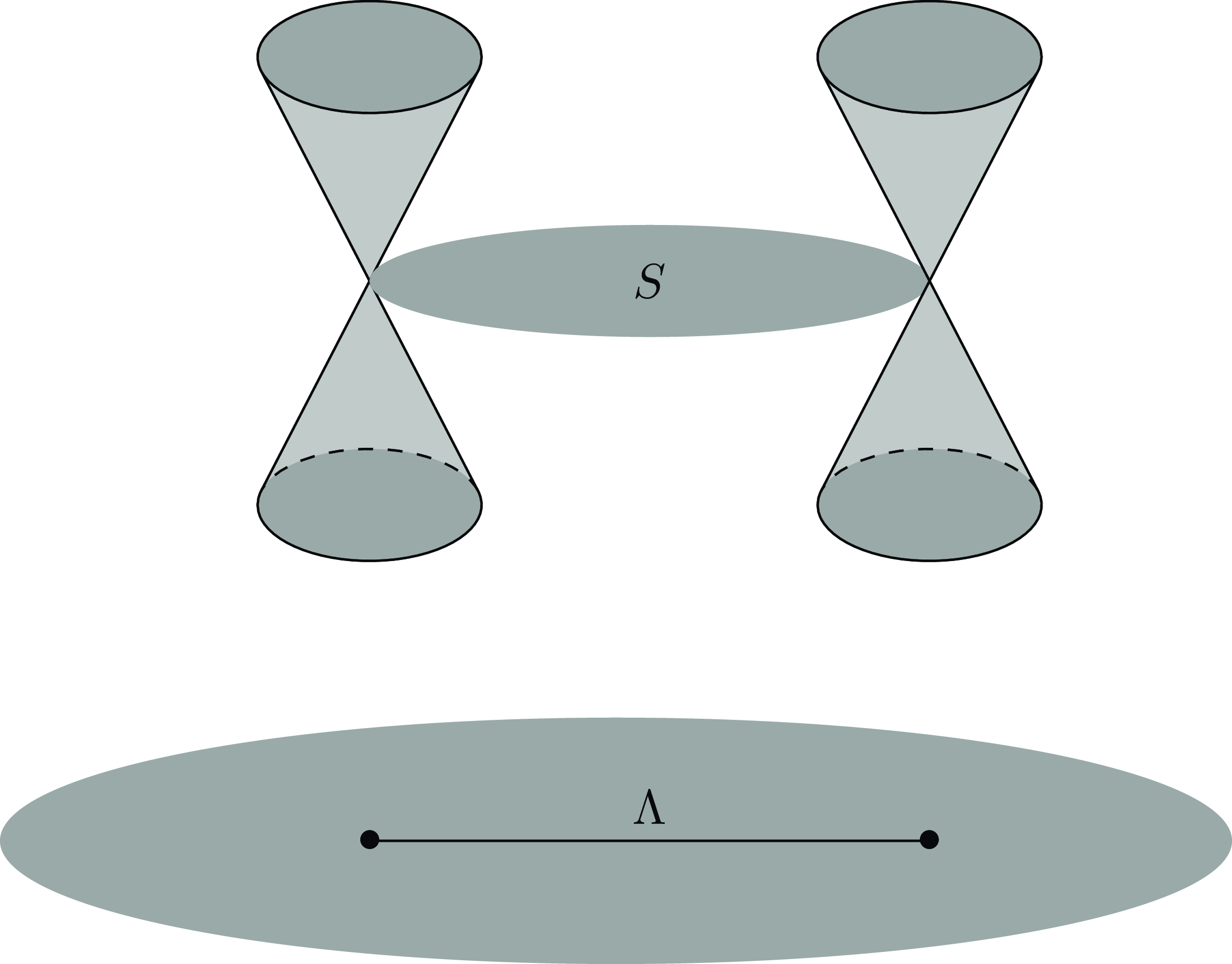
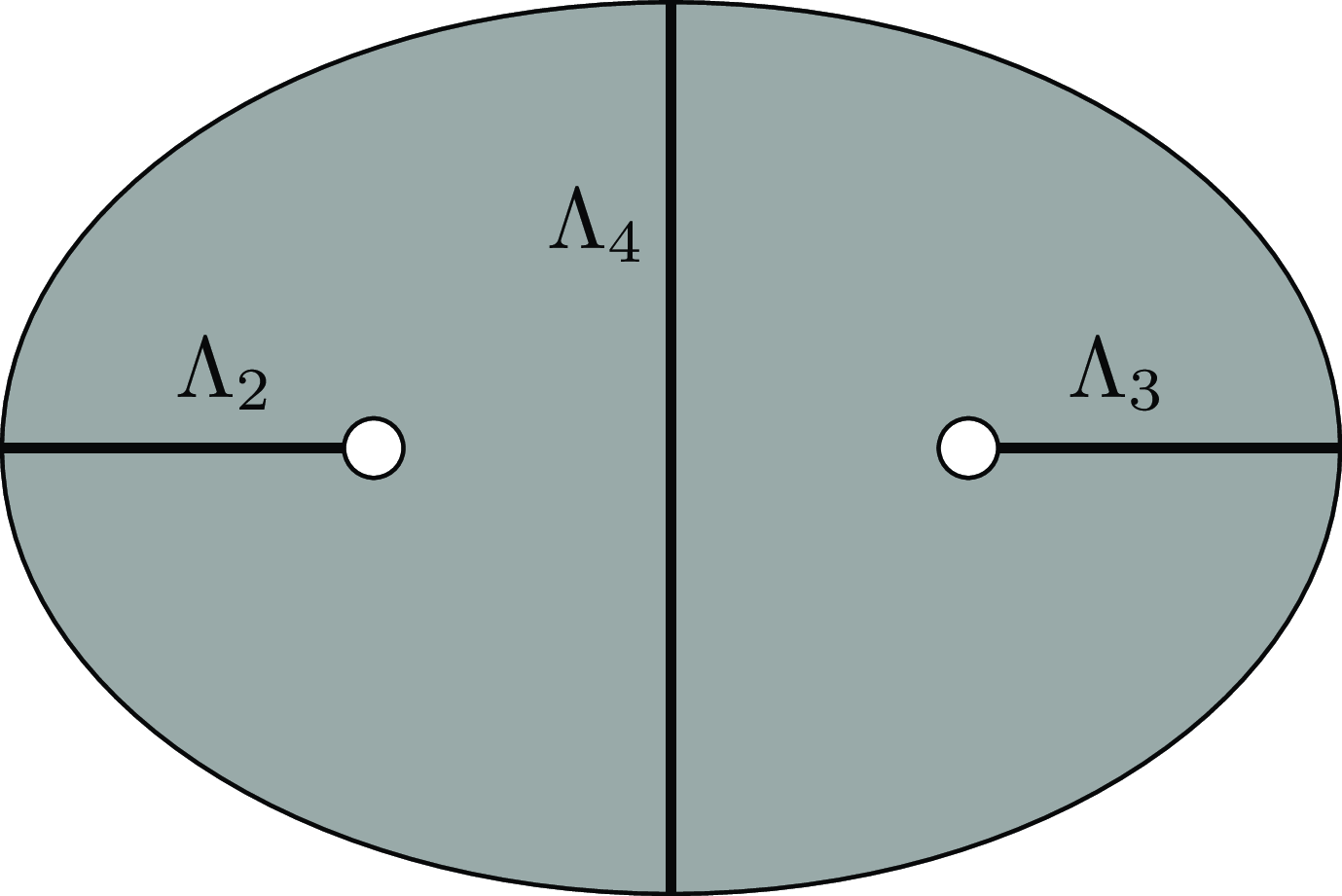


 Open access

