


1. Introduction and problem clarification
Smart Product-Service Systems (smart PSS) integrate physical products with digital services, connected through Information and Communication Technologies (ICT). This convergence of products and services enhances customer engagement, enables personalized experiences, and offers long-term value by enabling adaptation to meet users’ evolving needs. The shift toward smart PSS is driven by advancements in sensors, computing power, data communication, and digitalization, allowing companies to meet customer demands for customized and adaptive products and services (Reference Wang, Zheng, Chen and KhooWang et al., 2019; Reference Wiesner, Marilungo and ThobenWiesner et al., 2017a). Unlike traditional products or services, smart PSS require holistic approaches that consider interconnected product-service ecosystems extending beyond the initial purchase with the aim of building lasting customer relationships through continuous engagement throughout the lifecycle (Reference Paliyenko, Heinz, Schiller, Tüzün, Roth and KreimeyerPaliyenko et al., 2023; Reference SchweitzerSchweitzer, 2010).
As smart PSS become more prevalent, traditional product or service development methodologies reveal inherent limitations in handling their unique requirements (Paliyenko et al., Reference Paliyenko, Kreimeyer and Roth2024a). These systems involve dynamic interactions between multiple disciplines, such as mechanical engineering, software development, and service design, all of which have distinct terminologies, goals, and approaches. The interplay of these disciplines complicates requirements management (RM), increasing the risk of misalignment and inefficiency (Reference Paliyenko, Heinz, Schiller, Tüzün, Roth and KreimeyerPaliyenko et al., 2023). Additionally, smart PSS development demands a robust RM approach that incorporates data-driven insights and feedback from later lifecycle stages (e.g., use, maintenance) back into early development phases to ensure adaptability and responsiveness to customer needs (Reference Paliyenko, Heinz, Schiller, Tüzün, Roth and KreimeyerPaliyenko et al., 2023; Reference Aurich, Koch, Kölsch and HerderAurich et al., 2019). Consequently, there is an evident need for suitable methods in smart PSS RM that capture the dynamic, interconnected nature of these systems and address the multidisciplinary demands inherent to their development. As current RM methods fall short when applied to smart PSS, they often lack the flexibility to adapt to continuous, lifecycle-driven data input and do not integrate feedback loops from commissioning and operations back into the development phases (Reference Paliyenko, Langner, Muller, Dausch, Roth, Guertler and KreimeyerPaliyenko et al., 2024b). As smart PSS increasingly provide real-time data on user behaviors and environmental factors, traditional RM methods are insufficient for capturing and leveraging this data effectively (Reference Aurich, Koch, Kölsch and HerderAurich et al., 2019; Reference Zhou, Ming, Han, Bao, Liao, Tong, Liu, Guan and ChenZhou et al., 2023).
Furthermore, the transition from human-centric to data-driven RM introduces challenges in defining and prioritizing stakeholder needs. Existing methods often consider product and service requirements in isolation, overlooking their interdependencies (Reference Paliyenko, Kreimeyer and RothPaliyenko et al., 2024a). In smart PSS, this fragmented approach results in disconnected development efforts, reducing potential synergies between the product and service components and hindering alignment with customer expectations. Consequently, methods for RM must be capable of capturing and processing evolving, interlinked requirements that span various stakeholders and disciplines to foster smart PSS development (Reference Wiesner, Marilungo and ThobenWiesner et al., 2017a). Therefore, this research aims to investigate and propose data-driven methodologies for RM that are suitable for smart PSS development. By examining existing approaches and identifying gaps in current methodologies, this paper seeks to propose principles for data-driven RM, ensuring that requirements are dynamically aligned with real-world usage patterns and customer feedback. This paper therefore aims to answer the following research questions: What approaches exist for requirements management in smart PSS development, and what characteristic principles should be addressed to leverage data in smart PSS?
2. Approach to research
This research employs a structured methodology, that includes comprehensive background research, which helps identify key gaps in existing approaches and supports the formulation of the problem statement. After gathering insights from the preliminary research, the study refines the problem statement, pinpointing specific deficiencies in current RM for smart PSS, especially in relation to the integration of data-driven feedback and adaptive lifecycle considerations. A rigorous systematic literature review (SLR) is performed to systematically investigate the identified research gaps. After gathering the relevant literature, the research proceeds with an assessment of the findings with an emphasis on data processing. Each study is examined for insights into how it addresses RM for smart PSS design, particularly with regard to the challenges of data-driven feedback loops and cross-disciplinary collaboration.
The SLR was conducted in May 2024 to respond to the following research question: What methodologies exist for RM in the context of smart PSS development? Following a contextual literature review, a search protocol was devised (see Figure 1) and a search string was constructed for scientific databases. This search provides a comprehensive range of data, but it should be noted that it may also exclude other methods that are not included in these sources.
Search parameters used for the SLR

To gain a comprehensive understanding of RM in smart PSS development, adjacent areas such as service design and CPS were also included in the search. A search for approaches that are purely data-driven would be an ineffective use of resources in this context, as the existing literature assumes the presence of data-based methods in these areas. The utilized key-words and their synonyms were documented and constituted the foundation for the search string, which was then refined in an iterative process. The results were ultimately subjected to a three-stage review process. Stage one addressed the title, abstract, and keywords, stage two comprised a content review of relevant sections, and stage three featured a detailed analysis intended to ascertain whether the articles addressed specific RM methods. During the screening of the articles, the focus was on distinguishing between those that merely proposed a theoretical model and those that had already been applied to a real-life scenario. For the methodologies to be included in the final selection, they had to demonstrate a certain degree of fulfilment, allowing for their implementation in the development process.
3. Findings
This chapter begins by presenting the identified methods. It then evaluates the suitability of RM methods for smart PSS development. Subsequently, the methods are analyzed within the context of data-driven design. Finally, principles for data-driven RM tailored to smart PSS development are proposed.
3.1. Description of identified methods for RM
The search identifies 16 distinct methods from different domains, such as PSS, CPS, or smart service design. Table 1 provides a brief description of their key elements for requirements management.
Methods for requirements management

3.2. Depiction of suitability of RM for smart PSS development
The success of a product, system, or service is fundamentally influenced by the quality of RM. Effective RM hinges on understanding user problems, translating them into precise requirements and product attributes, and generating viable solutions based on these insights. This process is shaped by various external factors and the interactions between stakeholders, which must be seamlessly integrated into the development workflows (Reference Paliyenko, Heinz, Schiller, Tüzün, Roth and KreimeyerPaliyenko et al., 2023). For smart PSS, this issue is further magnified by the need to define an increasing number of requirements for products, services, and interconnected systems within a multidisciplinary environment involving diverse stakeholders.
Traditional development approaches are often insufficient due to the dynamic, data-driven, and interdisciplinary nature of these systems (Paliyenko et al., Reference Paliyenko, Kreimeyer and Roth2024a). As such, RM for smart PSS must ensure that requirements remain relevant and adaptable across all lifecycle stages, from initial design to long-term operation and maintenance (Reference Aurich, Koch, Kölsch and HerderAurich et al., 2019). The ability to integrate lifecycle feedback into RM is a critical aspect of smart PSS development. These systems thrive on iterative improvement, where insights from later lifecycle stages, such as operational performance and user behavior, must feed back into the design and development phases. Traditional static methods often fail to accommodate this feedback, resulting in outdated or misaligned requirements (Reference Paliyenko, Langner, Muller, Dausch, Roth, Guertler and KreimeyerPaliyenko et al., 2024b; Reference Zhou, Chen, Cao, Miao and MingZhou et al., 2022).
Customer-centricity lies at the heart of smart PSS development, emphasizing the need to tailor solutions to individual user contexts. RM must account for the inherent context dependency of smart PSS, where the usage environment influences system behavior and value delivery. Continuous monitoring and adaptation to these contextual factors are essential for maintaining alignment with customer needs. Equally essential to smart PSS RM is the utilization of data as a core asset (Paliyenko et al., Reference Paliyenko, Langner, Muller, Dausch, Roth, Guertler and Kreimeyer2024b). Smart PSS generate vast amounts of data throughout their lifecycle, including usage logs, performance metrics, and maintenance records. Effective methods must not only capture this data but also translate it into actionable insights for refining requirements (Reference Liu, Ming, Qiu, Qu and ZhangLiu et al., 2020).
The integration of product and service requirements represents another unique challenge in smart PSS development. Traditional methods often treat these domains separately, leading to inefficiencies and misalignments (Reference Paliyenko, Kreimeyer and RothPaliyenko et al., 2024a). In this context, managing the complexity of smart PSS is another critical consideration. As these systems grow in scale, they involve a broader range of stakeholders. RM must address the increasing volume of data and interdependencies. Hierarchical decomposition of requirements and modular design principles can simplify this complexity by breaking down requirements into manageable units and visualizing their relationships across the system. Traceability is particularly important in this context, enabling developers to track requirements from their initial high-level definitions through mid-level system specifications and low-level technical details. High-level requirements must be established prior to the development of the product or system. These requirements focus on the overarching business case and involve stakeholders from the value creation network. Mid-level requirements encompass system requirements and solution-specific requirements, addressing the smart PSS as a whole as well as its associated value creation processes. Low-level requirements pertain to more detailed aspects, including component-specific requirements, technical specifications, and service-related requirements.
In addition to addressing these core challenges, methods for smart PSS RM must align with data-driven design principles to support decision-making through evidence-based insights (Reference Zhou, Ming, Han, Bao, Liao, Tong, Liu, Guan and ChenZhou et al., 2023). These methods should facilitate the identification of emerging trends and future user demands while employing data visualization to present clear and actionable insights to stakeholders. Additionally, project monitoring and control mechanisms should ensure that requirements consistently align with development goals, allowing for progress tracking and the early detection of potential deviations during the initial stages of the development process.
3.3. Assessment of methods for data-driven RM
The analysis of methods for RM reveals a wide range of approaches, each targeting specific aspects of the process. To gain a deeper understanding of how these frameworks integrate into data-driven engineering, they examined along four dimensions: data planning, data acquisition, data preparation, and application. These dimensions, derived from established frameworks like the CRISP-DM data cycle (Reference ShearerShearer, 2000) and ISO/IEC 8183 (2023) for AI system data processing, provide a structured lens for assessing the strengths and limitations of each approach. Notably, the dimension application was used in this paper instead of evaluation to emphasize the practical implementation of methods in case studies or use cases, rather than a formal evaluation based on predefined criteria. This distinction was made because the reviewed literature rarely conducted comprehensive evaluations along specific metrics. By focusing on applicability, this paper aims to provide a clearer understanding of the practical relevance and feasibility of the examined methods.
The analysis of the methods was conducted iteratively, initially by the authors, who specialize in systematic product and PSS development. In this process, each paper was examined for elements explicitly addressing data collection, analysis, preparation, and application within the context of RM. Particular attention was paid to the depth and clarity of the guiding methodologies presented, as the goal was to identify not just the presence of relevant elements but also the robustness and practicality of their implementation. This focus on methodological depth was essential to distinguish between superficial references to data-driven practices and genuinely actionable methods.
Following this initial analysis, the findings were reviewed and discussed with two additional academic researchers specializing in data-driven design and systems engineering. Their expertise provided valuable external perspectives, helping to refine the classification and interpretation of the methods. Insights gained from these discussions were incorporated into the paper.
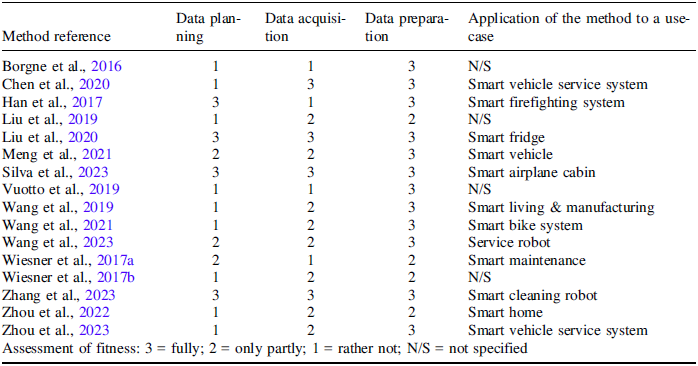
The assessment of existing frameworks (see Table 2) shows that many focus predominantly on data collection and preparation, often to support the derivation of actionable requirements. However, the integration of these stages into a cohesive, lifecycle-oriented approach remains a key challenge for many methods. For instance, data planning is foundational for aligning the requirements management process with overarching project objectives and the broader system context. Despite its importance, detailed methodologies for executing data planning are often underdeveloped. Frameworks like Zhou et al. (Reference Zhou, Chen, Cao, Miao and Ming2022) acknowledge the need for careful planning but lack concrete methods to achieve it, highlighting a significant gap in practical applicability.
Data acquisition, the systematic collection of information from various sources, is addressed with varying levels of detail. Some methods, such as those by Zhou et al. (Reference Zhou, Ming, Han, Bao, Liao, Tong, Liu, Guan and Chen2023), emphasize capturing customer emotions and experiences. While valuable for understanding user preferences, this focus often neglects other critical factors, such as environmental and system variables, which are essential for a holistic view of smart PSS requirements. On the other hand, frameworks like Wang et al. (Reference Wang, Chen, Zheng, Li and Khoo2021) adopt innovative approaches, such as graph-based modeling, to contextualize requirements and explore the relationships between product and service components. This approach proves effective for mapping dependencies and supporting system-wide integration, although it may lack the granularity needed for certain technical requirements.
Data preparation, which involves cleaning, organizing, and transforming collected data for analysis, is consistently one of the strongest areas across most frameworks. Advanced methods leverage mathematical models to process complex datasets, enabling engineers to interpret and utilize data effectively. Frameworks such as those by Silva et al. (Reference Silva, Moraes and Ciaccia2023) and Zhang et al. (Reference Zhang, Lin, Wang, Ma, Li, Zhang, Liu and Feng2023) excel in this dimension, integrating diverse data sources to inform decision-making processes. Silva et al. (Reference Silva, Moraes and Ciaccia2023), in particular, combine elements from existing development approaches to create a comprehensive framework validated through practical use cases, demonstrating its applicability in real-world scenarios. These efforts highlight the value of robust data preparation mechanisms in enhancing the effectiveness of requirements management.
Application, the final dimension, ensures that requirements align with stakeholder goals and system constraints throughout the lifecycle. This stage is crucial for validating the relevance and feasibility of requirements as they evolve. Frameworks like Zhou et al. (Reference Zhou, Chen, Cao, Miao and Ming2022) and Wang et al. (Reference Wang, Chen, Zheng, Li and Khoo2021) incorporate lifecycle-oriented evaluation strategies, enabling continuous adaptation of requirements in response to changing conditions. However, other approaches, such as those by Liu et al. (Reference Liu, Ming and Zhang2019) and Wiesner et al. (Reference Wiesner, Marilungo and Thoben2017a), remain limited to early-stage requirements elicitation and lack mechanisms for iterative validation, reducing their utility in dynamic smart PSS environments.
Classification and assessment of identified RM methods

A deeper exploration of the frameworks reveals that their focus on requirements types varies significantly. Some, like Liu et al. (Reference Liu, Ming, Qiu, Qu and Zhang2020) and Zhou et al. (Reference Zhou, Chen, Cao, Miao and Ming2022), prioritize customer-centric requirements, emphasizing emotional and activity-based factors. These approaches align well with user-focused design principles but often underrepresent system-generated requirements derived from sensors or operational data. Conversely, frameworks by Meng et al. (Reference Meng, Chen, Sun and Ming2021) and Han et al. (Reference Han, Xing, Yang, Li, Zhang and Chen2017) emphasize sensor-driven requirements, effectively capturing real-time insights from the product’s operation. While both approaches offer valuable contributions, few frameworks successfully integrate customer-centric and system-centric requirements into a unified methodology.
Lifecycle integration is another critical factor influencing the suitability of these methods for smart PSS. Frameworks like Wang et al. (Reference Wang, Chen, Zheng, Li and Khoo2021) and Zhou et al. (Reference Zhou, Chen, Cao, Miao and Ming2022) stand out for their ability to support continuous requirements elicitation and adaptation across the product lifecycle. Their methods ensure that requirements remain responsive to evolving user needs and environmental conditions. In contrast, some frameworks, such as those by Wiesner et al. (Reference Wiesner, Marilungo and Thoben2017a) and Borgne et al. (Reference Borgne, Belloir, Bruel and Nguyen2016), focus heavily on specific development phases, limiting their applicability to iterative and adaptive lifecycle management.
Overall, the analysis highlights that while many frameworks address specific aspects of requirements management effectively, significant gaps remain in their holistic applicability to smart PSS development. Data preparation is consistently well-addressed, with many methods providing robust tools for processing and interpreting data. However, data planning and acquisition require further development to ensure alignment with project goals and stakeholder needs. Similarly, while some methods excel in lifecycle integration, others remain limited to static or phase-specific approaches, reducing their effectiveness for dynamic smart PSS environments.
3.4. Principles for data-driven RM in smart PSS development
Drawing from the literature review and the analysis of existing methods in the context of data-driven design and lifecycle considerations, numerous valuable insights have been identified. This work derives essential principles to support the development of smart PSS and guide effective RM. To validate these proposed principles, they are carefully compared with the existing body of literature, which is referenced throughout this section.
The development of smart PSS requires advanced principles for data-driven RM to address the complexities of multidisciplinary collaboration, lifecycle integration, and the dynamic nature of user and environmental needs. These principles are essential to ensure that RM processes remain adaptive, effective, and capable of leveraging data as a strategic asset. By building on established theories in systems engineering, data management, and requirements elicitation, a comprehensive approach can be defined to guide RM practices in smart PSS contexts.
Data-driven RM must also leverage the wealth of information generated by smart PSS to inform decision-making and foster innovation. Systematic collection, analysis, and application of data throughout the requirements lifecycle allow RM processes to transition from reactive to proactive. Predictive analytics, natural language processing, and other advanced techniques can uncover latent requirements and anticipate future challenges and opportunities, enabling smart PSS to remain competitive and responsive. (Reference Meng, Chen, Sun and MingMeng et al., 2021; Reference Han, Xing, Yang, Li, Zhang and ChenHan et al., 2017)
A key principle of data-driven RM is its alignment with the entire lifecycle of smart PSS. Requirements must not only address the initial development phases but also evolve continuously during deployment, operation, and maintenance. This lifecycle-oriented approach ensures that insights gained from later stages, such as user behavior and system performance, feed back into early-phase decision-making. Adaptive RM processes enable smart PSS to respond to dynamic market conditions and evolving customer needs, ensuring their long-term relevance and effectiveness. Feedback loops, integrated into RM frameworks, capture data from usage monitoring and predictive maintenance to validate and refine requirements in real time, maintaining their applicability throughout the lifecycle. (Reference SchweitzerSchweitzer, 2010)
The quality and traceability of data are critical to the success of data-driven RM. High-quality data that is accurate, complete, and representative of the system’s operational context forms the foundation of effective decision-making. Traceability ensures that stakeholders can track the evolution of requirements from their initial definition to their implementation and eventual impact on system performance. (Reference Paliyenko, Tüzün, Roth and KreimeyerPaliyenko et al., 2022; Reference ShearerShearer, 2000)
Multidisciplinary collaboration is another essential principle, as smart PSS development involves diverse fields such as mechanical engineering, software development, and service design. Each discipline brings its own perspectives, goals, and terminologies, which can lead to misalignments if not managed effectively. RM methods must facilitate seamless communication and alignment among stakeholders. Tools like Model-Based Systems Engineering (MBSE) and smart platforms that provide tailored access to requirements can enable stakeholders to engage meaningfully with the RM process while preserving the integrity of interdisciplinary workflows. (Reference Wang, Zheng, Chen and KhooWang et al., 2019; Reference Borgne, Belloir, Bruel and NguyenBorgne et al., 2016)
Transparency in the RM process builds trust among stakeholders, fostering collaboration and reducing conflicts. Clear communication, accessible documentation, and accountability throughout the requirements lifecycle are key to maintaining this transparency. Practical implementations include version-controlled requirements repositories and stakeholder dashboards that provide real-time updates on the status and progress of requirements. By enhancing trust and decision-making, transparency strengthens stakeholder relationships and improves overall project outcomes.
Customer-centricity is a key objective of smart PSS, making it a central principle of data-driven RM. Requirements must be derived from a deep understanding of user needs, preferences, and pain points, ensuring the system delivers value throughout its lifecycle. Co-creation, usability testing, and customer feedback systems are viable techniques for achieving this. Such principles ensure that smart PSS remain aligned with user expectations, even as those expectations evolve over time. (Reference Liu, Ming, Qiu, Qu and ZhangLiu et al., 2020)
The context-dependent nature of smart PSS introduces additional complexity, requiring RM processes to be highly adaptable and responsive to external variables. Factors such as user preferences, geographical conditions, and regulatory requirements can significantly influence system behavior. Context-aware RM leverages data-based monitoring and contextual data analytics to capture and interpret these factors. Machine learning algorithms, for example, can identify patterns and trends in usage data, enabling the dynamic adjustment of requirements to reflect contextual realities. (Reference Paliyenko, Langner, Muller, Dausch, Roth, Guertler and KreimeyerPaliyenko et al., 2024b; Reference Zhou, Ming, Han, Bao, Liao, Tong, Liu, Guan and ChenZhou et al., 2023)
The inherent complexity of smart PSS necessitates approaches that simplify and manage this complexity effectively. Modular RM frameworks, which break down complex systems into manageable components, can address subsystem-specific challenges without compromising the overall system. Modeling methods that map interdependencies between modules further enhance decision-making and system optimization, allowing stakeholders to manage the complexity of smart PSS with greater efficiency and clarity.
Scalability is another critical factor, particularly for large-scale smart PSS with extensive stakeholder networks and interconnected systems. Scalable RM methods ensure that processes remain effective as the system grows in size and complexity. Digital tools and cloud-based platforms provide the necessary infrastructure for managing large datasets, diverse requirements, and geographically distributed teams. This scalability ensures that RM practices can adapt to the dynamic demands of smart PSS development.
Continuous validation and verification are essential to ensure that requirements remain feasible and aligned with stakeholder goals. Integrated testing and validation processes, extending from initial requirements elicitation to post-deployment monitoring, are vital for maintaining alignment with real-world user expectation. Testing frameworks and simulation environments enable rapid validation, reducing the risk of misalignment or infeasibility. Such continuous validation processes ensure that smart PSS development stays on track and deliver systems that meet stakeholder expectations.
4. Discussion and outlook
The SLR reveals that there are already methods designed specifically for the RM of smart PSS. These methods effectively address isolated problems within RM and enable a more efficient development process. One important aspect to be highlighted is the integration into the development process of the vast amounts of data generated by smart PSS during their lifecycle: This is done to create value for both customers and companies. Many identified models address this issue using mathematical methods capable of processing large datasets. These methods support decision-making and help developers manage uncertainties. However, a persistent challenge in data and information processing lies in the lack of a unified descriptive logic that facilitates information exchange across the interdisciplinary domains of service, product, and software development.
The integration of lifecycle feedback into RM processes is another major focus area. Smart PSS operate across extended lifecycles, with requirements evolving in response to user interactions, environmental changes, and technological advancements. While the existing methods often target requirements elicitation and validation in the early stages, they fail to provide comprehensive approaches for managing the entire RM process. This is particularly the case when it comes to documenting and dynamically integrating new requirements throughout the lifecycle. Only two identified methods explicitly consider dynamic requirements and their integration into the smart PSS lifecycle. This limitation underlines the need for a holistic management approach that spans from requirements elicitation and validation to their dynamic integration and governance throughout the lifecycle. While many approaches excel in specific areas, such as data preparation or stakeholder involvement, few adequately address the holistic integration of lifecycle data, dynamic requirements evolution, and interdisciplinary alignment. For example, data planning, a foundational component of effective RM, is often underdeveloped, leaving practitioners without actionable strategies for aligning data collection with system objectives.
Leveraging lifecycle data enables RM processes to transition from reactive to proactive, allowing teams to anticipate and address emerging challenges before they escalate. Advanced analytics tools, such as predictive modeling and machine learning, play a critical role in this transformation by providing actionable insights that enhance decision-making and support innovation. Moreover, the principles emphasize data quality and traceability, ensuring decisions are based on reliable, transparent, and contextually relevant information. These principles address the growing complexity of smart PSS by enabling stakeholders to trace requirements across the system lifecycle, maintaining alignment with evolving objectives and performance metrics.
The multidisciplinary nature of smart PSS development introduces additional challenges to RM. Effective collaboration among mechanical engineers, software developers, and service designers requires RM methods that facilitate communication, alignment, and shared understanding. However, the lack of unified documentation practices in many existing approaches limits their effectiveness. The proposed principles advocate for MBSE techniques and collaborative platforms to bridge disciplinary divides and ensure a comprehensive, accessible documentation and communication process.
Context-awareness is another critical consideration, as smart PSS operate in dynamic and diverse environments. Requirements must not only reflect user preferences but also adapt to external factors such as regulatory constraints, environmental conditions, and market trends. The principles proposed in this paper emphasize the need for real-time monitoring and contextual data analytics to dynamically adapt requirements, ensuring alignment with the system’s operational environment. However, while some methods support requirement elicitation during the lifecycle, they lack systematic approaches for integrating these requirements into the existing RM framework. Future work should explore strategies to address this gap, ensuring that dynamic requirements are incorporated into the broader RM process.
This paper provides a comprehensive investigation into existing frameworks and proposes principles for data-driven RM, addressing critical gaps in data planning, lifecycle integration, system-level requirement handling, and interdisciplinary collaboration. While this paper provides a robust foundation for data-driven RM in smart PSS, it is not without limitations. The proposed principles are derived from a synthesis of existing literature and theoretical insights, which may not fully capture the nuances of specific industrial applications. Practical validation of these principles through case studies or pilot projects is necessary to assess their real-world applicability and impact. Furthermore, the rapid pace of technological change poses an ongoing challenge for RM processes. As new tools, methods, and data sources emerge, RM frameworks must continuously evolve to remain relevant. This underscores the need for adaptive, iterative approaches that can incorporate advancements in data analytics, artificial intelligence, and other enabling technologies.



 Open access

