

1. Introduction
This paper focuses on farmland disputes in Myanmar triggered by the 2012 land law reform as a result of legal assistance by the donor agencies, to identify the nature of customary rights asserted in such disputes and the attitudes of mediators in realizing a normative modification to the formal law. The method of analysis includes the interview surveys targeting ordinary farmers and the government officials in charge of land administration, as well as the mediators in grassroots dispute resolution, combined with the case analysis.
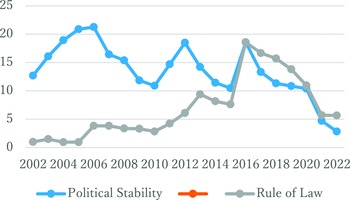
Myanmar’s land law sphere is worthy of investigation because of the intensity of social objections triggered by the donor-supported land law reform in 2012, which clashed with the people’s belief in their absolute rights to ancestral land, as detailed in the following of this study. Figure 1 shows a trend of inverse proportion in the recent two decades’ relation between the “Rule of Law” and the “Political Stability” indicators of Myanmar provided by the World Bank’s Governance Indicators (Kaufmann et al., Reference Kaufmann, Kraay and Mastruzzi1996–Reference Kaufmann, Kraay and Mastruzzi2022, implying a dilemma that the social instability raises as the legal transplant proceeds. Myanmar has committed to the liberal economic policy under the 2008 Constitution, as declared in the Framework for Economic and Social Reforms (FESR) 2012–2015. In response to thousands of farmers’ roaring claims nationwide, Aung San Suu Kyi’s government that took the reign after the triumph in the 2015 general election basically succeeded the implementation of FESR while making it a public promise to bring about an ultimate settlement for land disputes by declaring the 2016 National Land Use Policy, and establishing the Standing Committee for Scrutinizing of Confiscated Farmland which is said to settle nearly 4,000 cases nationwide between 2016 and 2020.
Rule of law and social stability in Myanmar (unit: worldwide worst ranking).
Source: World Bank’s Governance Indicators for Myanmar during 2002–2022.

In the following, the authors first provide a quick overview of historical changes of land law regime in Myanmar since the pre-colonial time upward in Section 2, which has been a path of great altitudes of changing “Positivitat” in the sense of Niklas Luhmann (Luhmann, Reference Luhmann1975, p. 231); then, in Section 3, the results of the structured interviews with a total of 120 farmers in 4 target areas, semi-structured interviews with a total of 8 land administrators, as well as the semi-structured interviews with a total of 8 mediators of village level will be provided; Section 4 is the analysis of typical land disputes handled by the Kayin State-level Standing Committee for Scrutinizing of Confiscated Farmland. Section 5 is the conclusion.
2. Historical overview of farmer’s right to land in Myanmar
2.1 Dynasty era: Bobwapaingmyae as the basis of household livelihood
Even though the legal system of pre-colonial Burma had a positive regime consisting of the written code Dhammathat, king’s ordinances Yazathat as well as the compilations of case law Hpyathon, the law is considered to have originated from the justice beyond such positive law.Footnote 1 Land law was a typical such area which natural law dominated: Bobwapaingmyae was a right that secured the basis of subsistent livelihood of a household which had made living on the land for several generations, which was secured even against the kings’ confiscation.Footnote 2 Chapter 8 of Manugye Dhammathat,Footnote 3 compiled in 1782 under the King Alaungphapaya during the Konbaung Dynasty, clarifies the absolute nature of Bobwapaingmyae by differentiating varieties of private rights to land into either of two large groups: the absolute land Myaethay or the contestable land Myaeshin. Bobwapaingmyae is categorized into Myaethay, while other types of rights which should be well enough bases for claiming ownership in the modern capitalist law, such as the succeeded land, purchased land, occupied land for more than ten years, cleared forests by one’s own labour (damaucha), are all categorized into contestable Myaeshin, requiring a few more generations of continuous use until they amount to the absolute status of Bobwapaingmyae (Article 1, Chapter 8 of Manugye Dhammathat). One remarkable characteristic of Bobwapaingmyae was incapability of being targeted for sales: the term sales (Maeyoungchachin) appearing in Manugye Dhammathat (e.g., articles 15, 16, 36 of Chapter 7) was in fact a mortgage in which the heirs of such Bobwapaingmyae maintained the right of redemption by paying back the debt of their forefathers (Aung, Reference Aung2008, p. 81). This absoluteness of Bobwapaingmyae as the basis of family livelihood is, together with the protection of Myaeshin in a way of development into a matured Bobwapaingmyae, bound the king’s administration, constituted the Burmese “rule of law” if we put it in our contemporary expression.
2.2 British colonial land law: Land liquidation
As Burma was added to the Bengal Province of the British Raj following the third Anglo–Burmese War in 1885–1886, the “Indian Code,” which is believed to be a codification of British common law, took over the Burmese sui generis law. The first Judicial Commissioner of Burma, John Jardine, applied a unification policy by suspending the initial chief commissioners’ attempt to apply Burmese Dhammathat as a legal source, and the 1898 Burma Laws Act (art. 13) confirmed this Jardine’s line by allowing the application of local law at the court only for inheritance, marriage, or religious matters (Maung, Reference Maung1963). This change of Positivität made the traditional land regime taken over by a series of colonial land law: namely, 1863 Waste Land Claims Act, 1876 Lower Burma Land and Revenue Act, 1889 Upper Burma Land Revenue Regulations and Manual, as well as the laws brought by the Indian Code, including 1882 Transfer of Property Act, 1894 Land Acquisition Act, 1908 Registration Act, etc. In Lower Burma, such new land regime denied the continuation of Bobwapaingmyae as family property, or the chances of any Myaeshin rights to be developed into Bobwapaingmyae, by newly conceptualizing an individual permanent and transferable right to use and occupancy on land, namely “Landholder’s Right.”Footnote 4 In Upper Burma, unfairly strict proof for Bobwapaingmyae was required,Footnote 5 until letting historian John S. Furnivall lament the tragic outcomes of the 1889 Upper Burma Land Revenue Regulations and Manual (art. 23) that invited a tremendous loss of agricultural communities in Upper Burma due to the nationalization of fallow land in the name of wasteland management following the failure of proving Bobwapaingmyae especially during the traditional recess for fertilization purpose as well as the land for communal use (Furnivall, Reference Furnivall1948, pp. 105–8, 135). The judicial system was a state apparatus for literal implementation of colonial law, as a part of the hierarchical system of review at the privy council in Britain as final, without any room for the assertion of Bobwapaingmyae lacking formal evidence.
Thus, the change of formal law resulted in the deprivation of Burmese households of their ancestral land, their sole basis of livelihood, causing a tremendous increase in landless population during a few decades of colonial rule (Furnivall, Reference Furnivall1956, p. 92).Footnote 6
2.3 Post-independence era: Household’s right to land under tightened state control
As the goal of post-independence sui generis law to restore the Burmese legal tradition, legal historian Hla Aung emphasizes the need to overcome the evils of colonial law, which replaced the household’s livelihood basis by individualized property rights, introduced the concept of sales having the effect of immediate loss of ancestral property, abolished the limitation for loan sharking, denied the first-rank preference right of cultivators on their products, etc. (Aung, Reference Aung2008, p. 96). 1953 Land Nationalization Act was dedicated to this goal, by restoring the right of farming household to land (art. 6, sec. 1; art. 7, sec. 1), and controlling the sales, lease, and mortgages of farmland (art. 11, sec. 1). Such a restoration, however, required not only the re-establishment of household’s right to land, but also an active redistribution of land to landless population who had lost a status of landed farmer during the colonial era. As the re-distribution policy retarded due to the technical difficulties, such as the seizure of land held in excess of the ceiling by absentee landlords for nationalization,Footnote 7 General Ne Win’s socialism in 1970s suspended the active implementation of redistribution policy, and instead, strengthened the state control of land use regardless of the difference of land tenure categories, either owner or tenant.Footnote 8 Such tightening of state control made the legal nature of the farmer’s right to land as weak as a tenancy of the state land, which is almost similar to the colonial concept of “landholder’s right” (except for its freedom of sales) rather than the restoration of traditional absolute right of Bobwapaingmyae.
2.4 Donor-sponsored 2012 land law reform: Land liquidation policy in revival
The military regime after the 1988 coup d’état by the State Law and Order Restoration Council (SLORC 1988–1997, later the State Peace and Development Council: SDPC during 1997–2011) turned to the economic liberalization policy, while featuring the revival of British economic laws in the colonial time as well as the judicial system as an apparatus for literal implementation of such laws. In the particular area of land law, the military reactivated the wasteland management method of the British by the 1991 Waste Land Instruction, and nationalized and granted vast areas of fallow land or common land that lacked land records.Footnote 9
This military’s land policy was formalized in the 2012 land law reform under the 2008 Constitution, which featured the freedom of farmland sales by both farmers and non-farmers by vesting a cultivation right loat paing kwin to individuals or institutions under the Farmland Law (arts. 4, 8) which enjoys freedom of sales, lease, and mortgages (art. 9(b)), as well as the 2012 Law on Vacant, Fallow and Virgin Land Management that legalized the wasteland nationalization and grants.
Here, the legal nature of loat paing kwin is far from that of Bobwapaingmyae as a security of household livelihood, but instead, reveals almost equal characteristic to the British “landholder’s right” in its transferable nature of individual right, and also its vulnerability subject to a permit given, and revoked, by the discretion of the State as the ultimate owner of the entire nation’s land (Farmland Law, art. 3 (d)), provided such administrative decision is final and non-contestable at the judicial procedure (art. 25 (c)).Footnote 10
3. Farmers vs. government perception gap: Survey results
Given this large amplitude in the historical changes of Positivität, Myanmar’s land law regime has faced frictions with society. To understand the origin of land disputes, during April through June 2023, the authors conducted a structured interview survey on a total of 120 farmers, and in-depth interviews with township administrators, officers in charge of land records, and experienced farmers working as village-level mediators for land disputes, with follow-up interviews conducted during August 2024. As a permit for onsite visits was not available due to the political instability following the 1 February 2020 coup, the authors obtained a permit for online interviews.Footnote 11
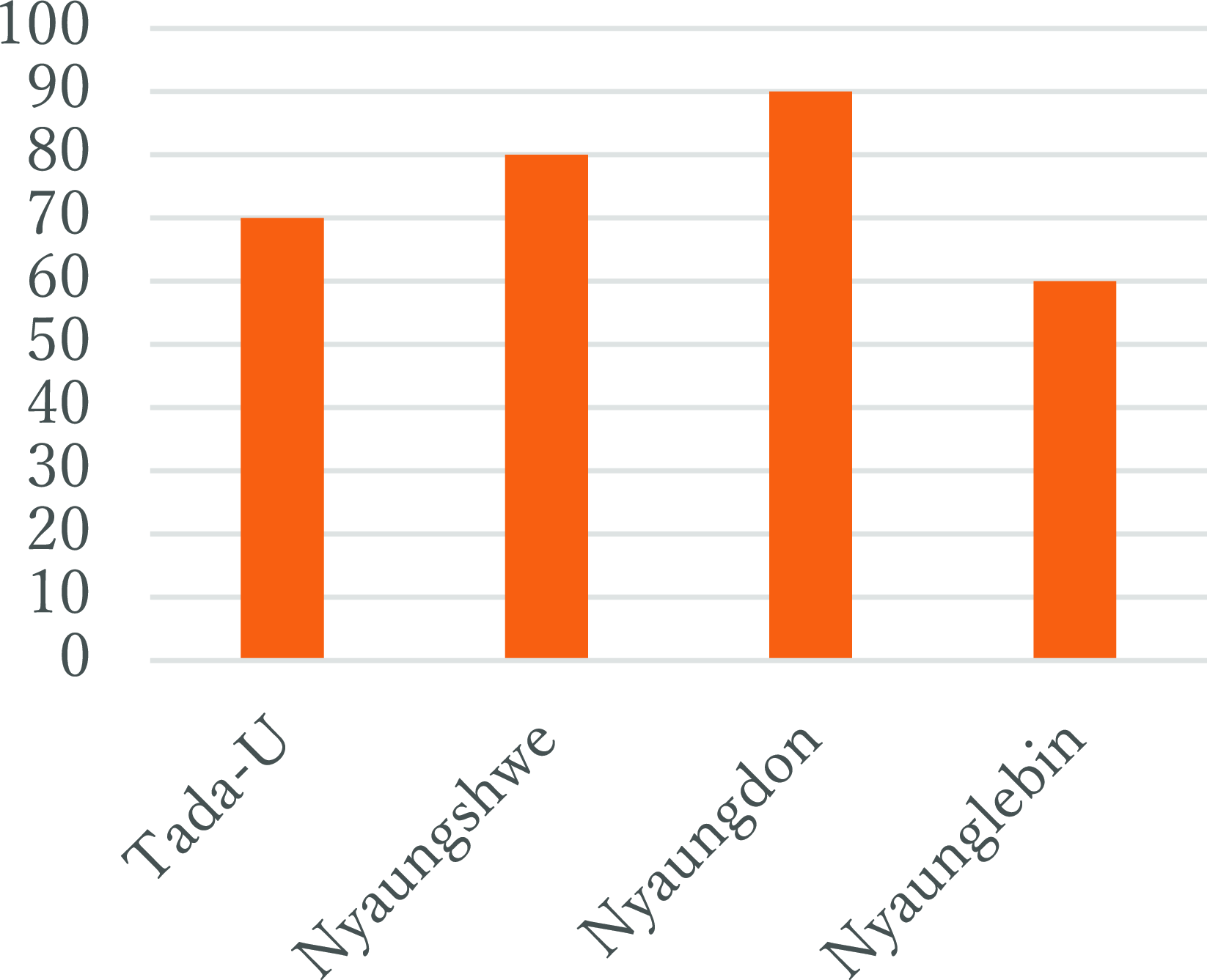
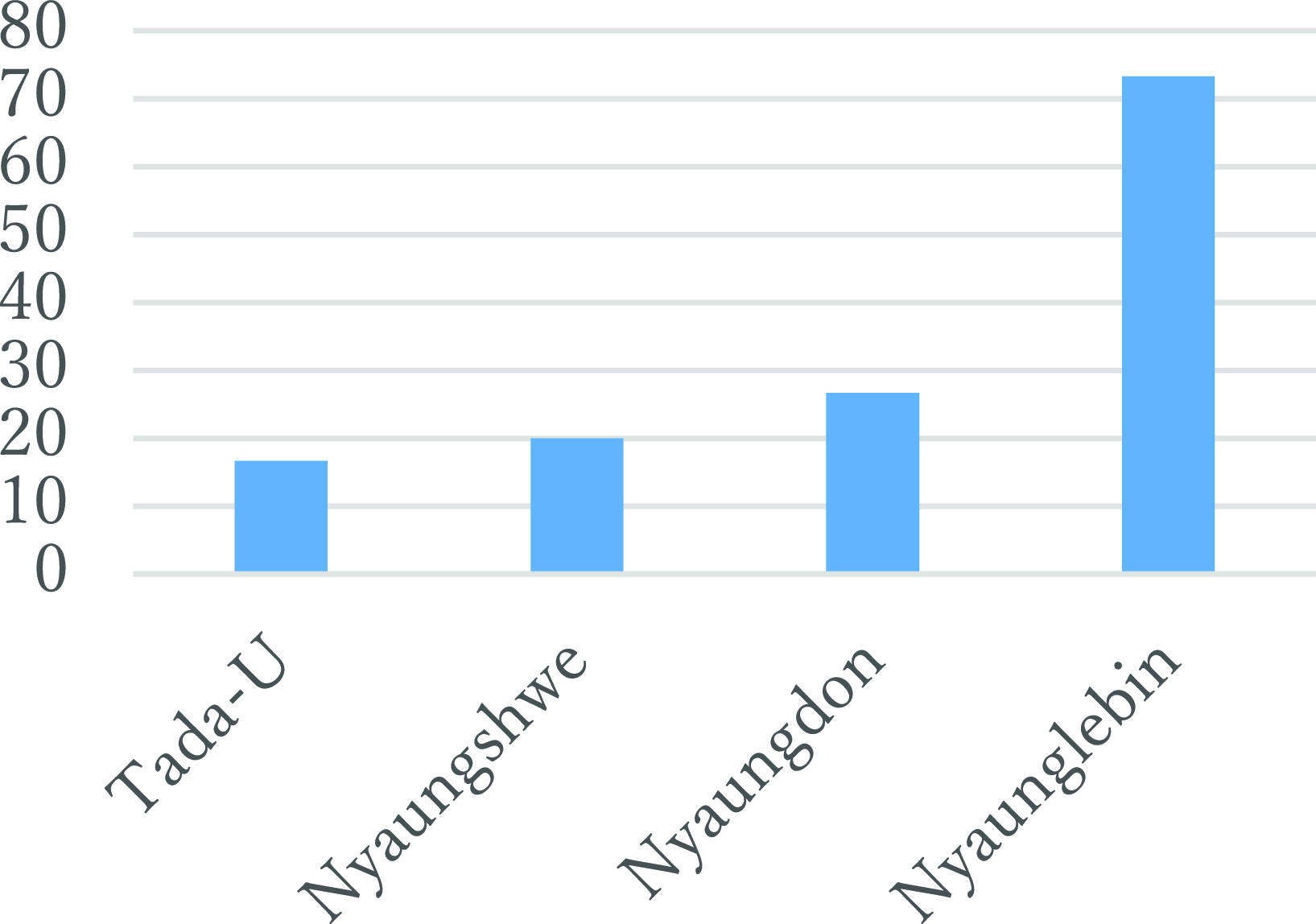
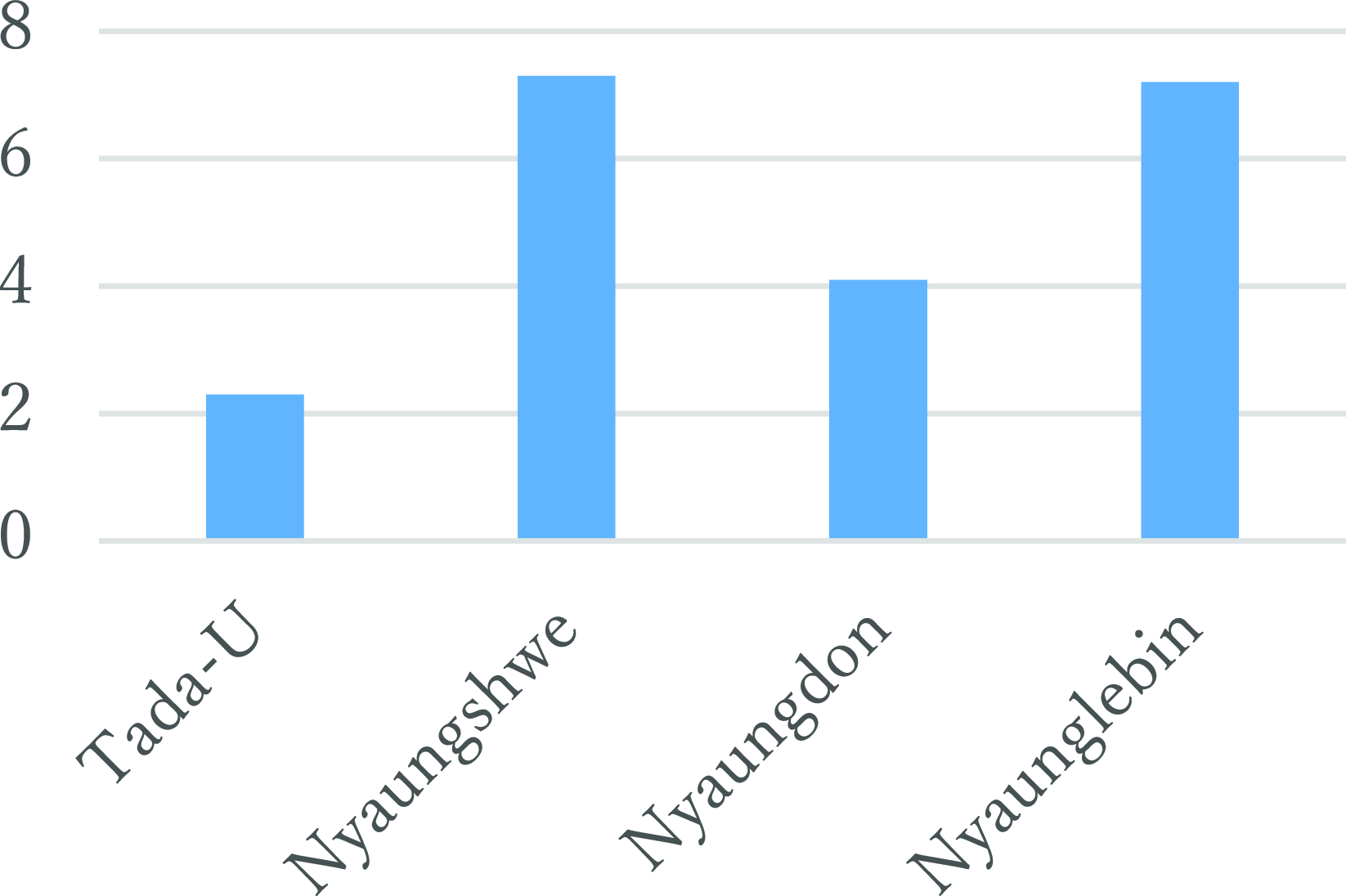
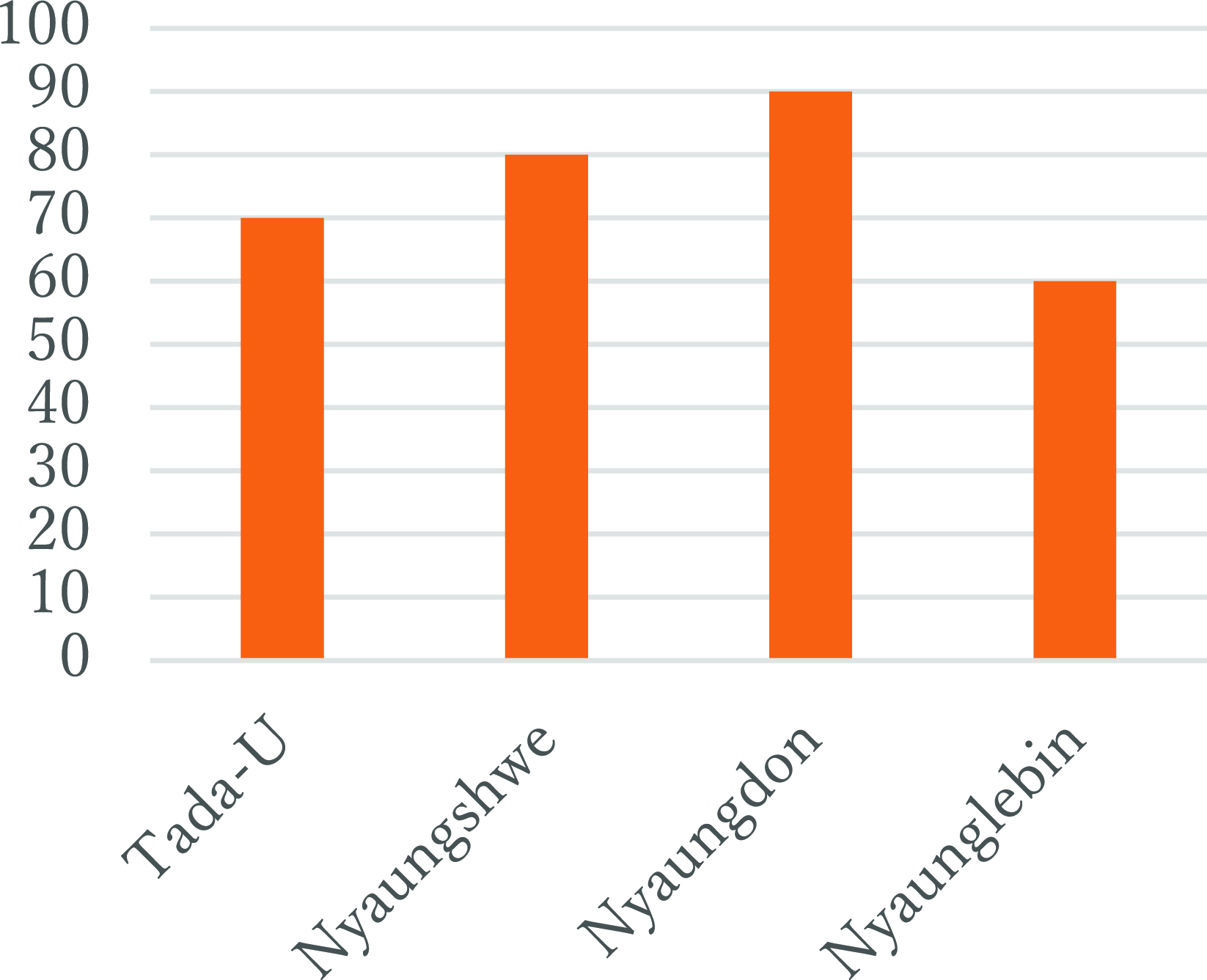
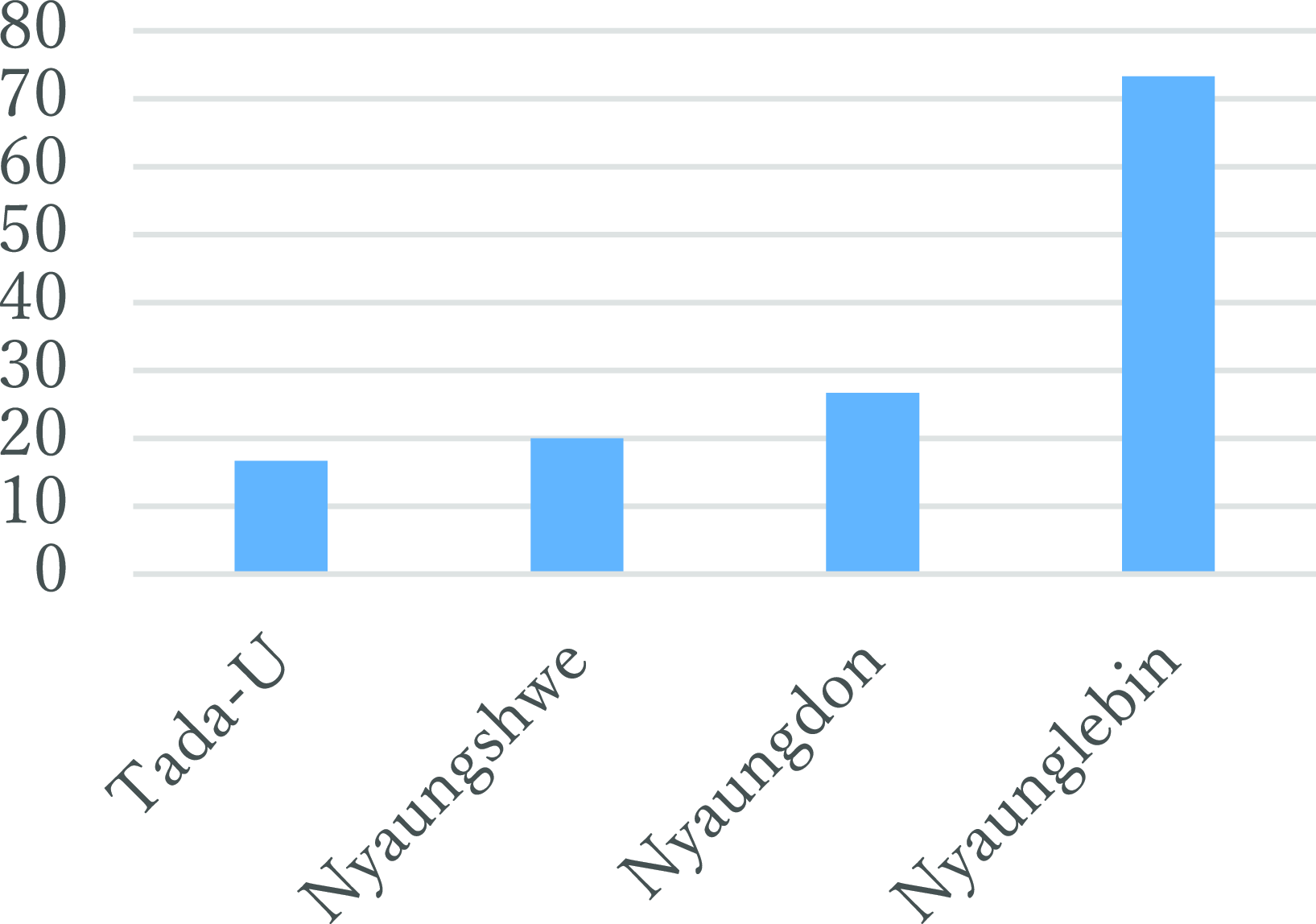
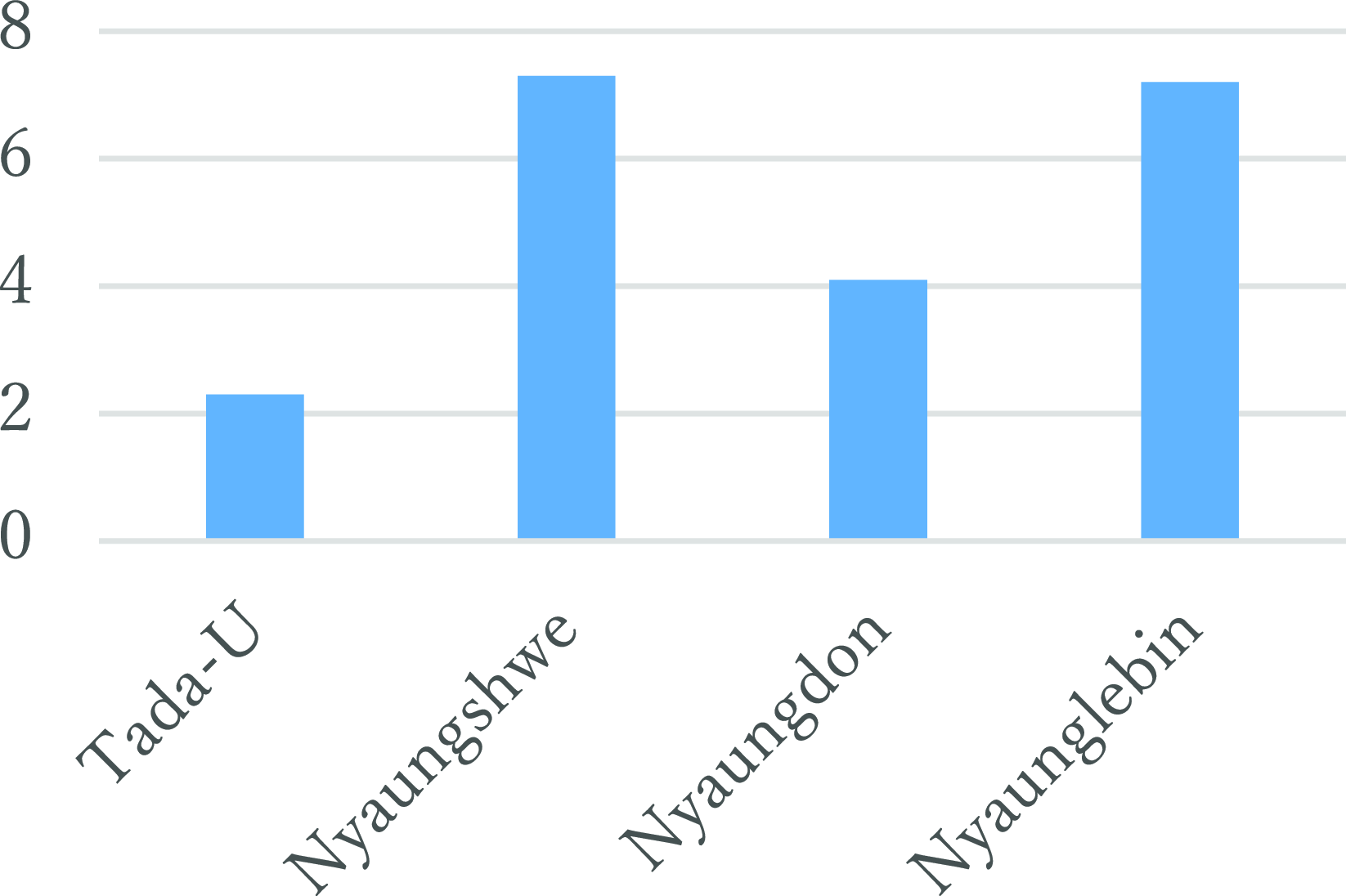
Four townships were targeted for the survey as typical rural areas based on subsistent agriculture, but increasingly coming under the influence of urbanization and industrialization: from Upper Burma, Tada-U Township in Kyaukse District of Mandalay Region, which has the population of 152,077, mostly belonging to the Burmese ethnic, 90% of which are farmers, affected by the construction of the Mandalay International Airport and Yangon-Manual Highways which took 20% of the land areas of the township in 1995;Footnote 12 and also Nyaungshwe Township in Taunggyi District of Shan State, which has the population of 173,642, with the majority belonging to the Shan ethnic, of which 92% are farmers, and also known for the tourism;Footnote 13 from Lower Burma, Nyaungdon Township in Maubin District of Ayeyarwady Region, which has the population of 199,227, mostly belonging to the ethnics of Kyain and Burma, and almost all are farmers, known for the rice production for export, and becoming affected by the urbanization in the outskirt of Yangon;Footnote 14 and Nyaunglebin Township in Bago Division of Bago Region, with the population of 219,755, mostly belonging to the ethnics of Kyain and Burma, of which 80% are farmers, affected by the construction of Hantharwaddy International Airport.Footnote 15 Despite the similarity of population size, their economic structure of agricultural community slightly differs each other, as shown in the ratio of landed farmers (as shown in Figure 2) from the findings of the authors’ interview,Footnote 16 as well as the ratio of farming households involved in another business (as shown in Figure 3), which reveals a high ratio of 70% in Nyaunglebin Township in Bago, representing the degree of urbanization and industrialization penetrating into the rural economy.
Ratio of landed farmers (%).
Source: Q.1-d of Township Administrators’ Interview
Ratio of farmers with side business (%).
Source: Q.1-11 of Farmers’ Interview.
3.1 Perception of farmers: Results of structured interview survey
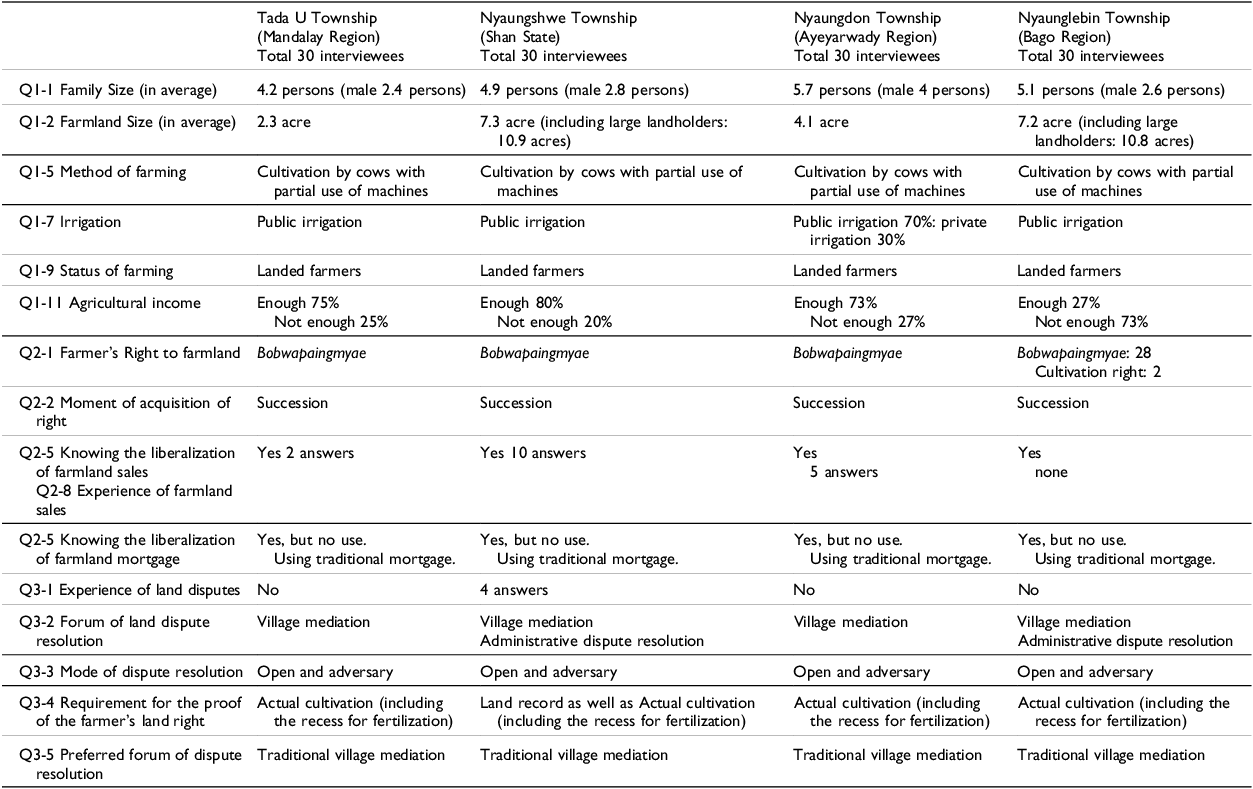
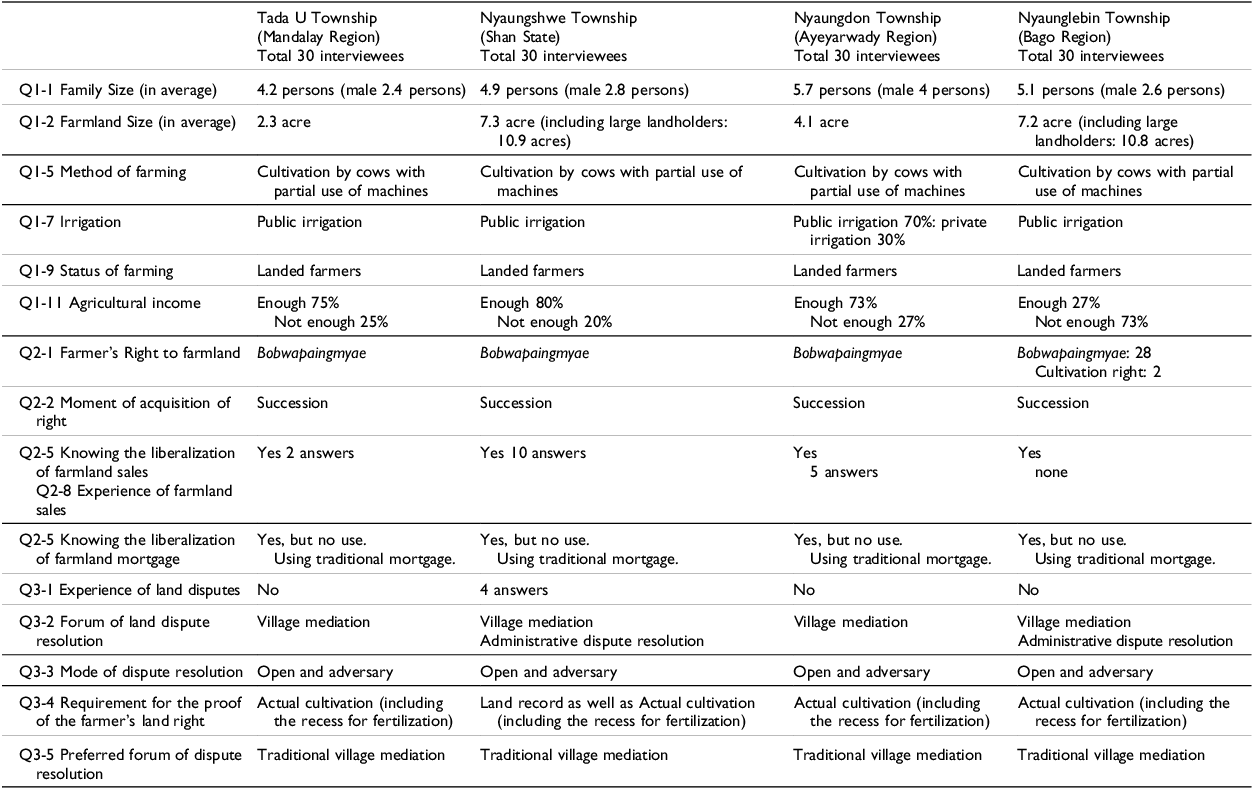
The authors conducted a structured interview survey in the 4 target townships from April to June 2023 with a total of 120 households (30 households in each of the 4 target townships accessed) with the support of the village tract leaders and community volunteer groups in the target townships. The selection of interviewees was randomly made by the discretion of the support team through a snowballing method so as to reflect the typical status of local farmers.Footnote 17 The result is summarized in Table 1. As for the demography of interviewed households, the household size (Question 1-1) is mostly a nuclear family consisting of four to six persons, except for Nyaungdon Township in Ayeyarwady Region, where the majority is a larger family having a few male adults as cultivators. The area size of farmland (Question 1-2) shows a slight difference as indicated in Figure 4, such that the most of answers in Tada U Township in Mandalay Region and NyaunglebinTownship in Ayeyarwady Regions are in the range of 2–4 acres (1–2 ha) while the average answers in Nyaungshwe Township in Shan State and Nyaunglebin Township in Bago Region are as big as 7 acres (3 ha).Footnote 18 As for the farming status (Question 1-9), all answered that they are landed, while the government statistic shared in the interviews with Township administrations (Gov. Question 1-d, also shown in Figure 2) revealed a different ratio of landed farmers: 70% for Tada U Township in Mandalay Region, 80% for Nyaungshwe Township in Shan State, 90% for Nyaungdon Township in Ayeyarwady Region, and 60% for Nyaunglebin Township in Bago Region. The style of farming (Question 1-5) is basically dependent on cultivation by cows, with a merely partial use of machines. Irrigation system mostly depends on the government, except for Nyaungdon Township in Ayeyarwady Region, where one-third of the answers indicate they utilize the community-owned irrigation systems (Question 1-7). Income structure also revealed a difference (Question 1-11): in particular, 70% of the answers in Nyaunglebin Township in Bago Region depend on a side business.
Results of farmers’ structured interview in four target townships
Source: Compilation by the authors.
Average farm size of interviewees (unit: acres).
Source: Farmers’ Interview Question 1-2.
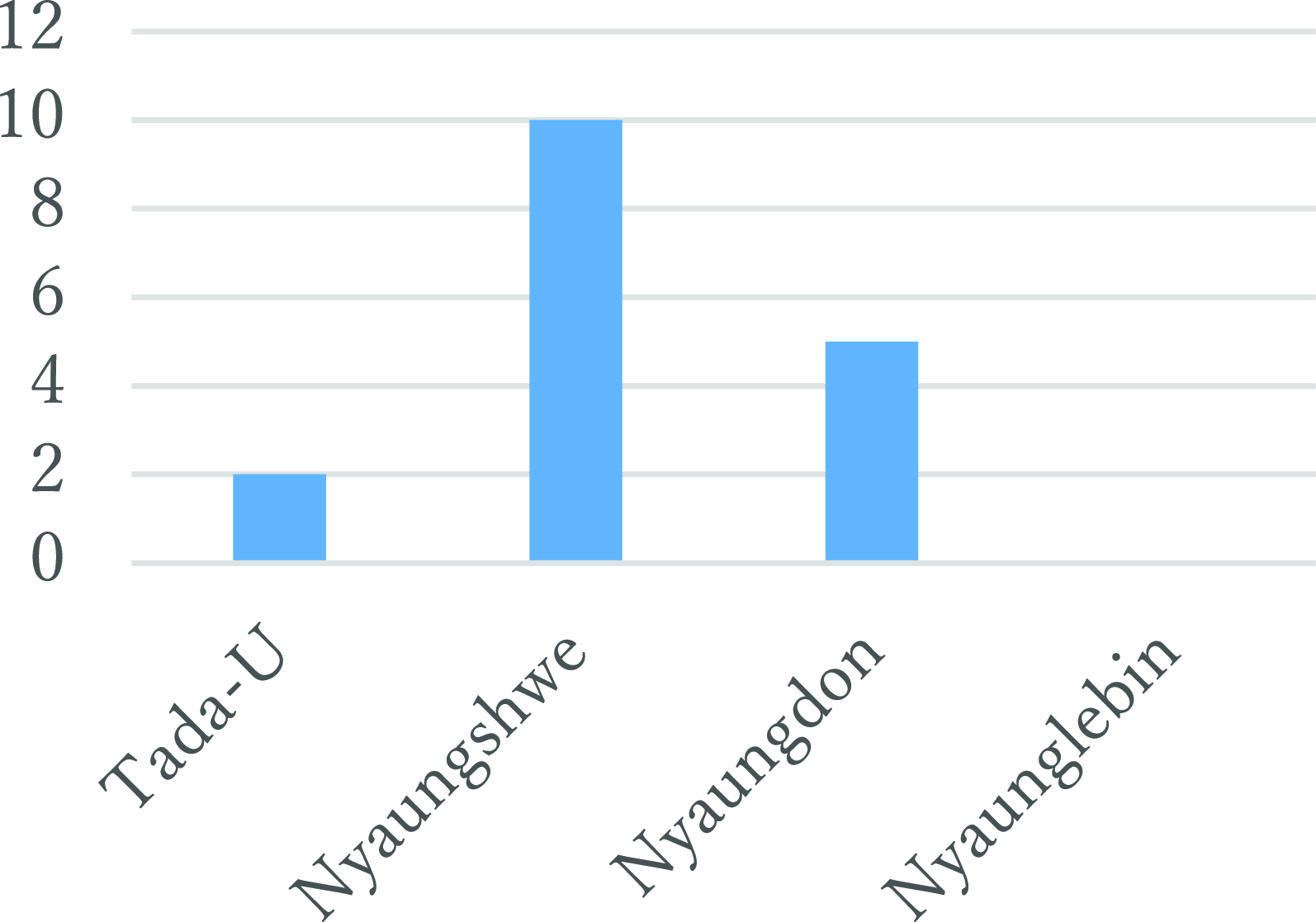
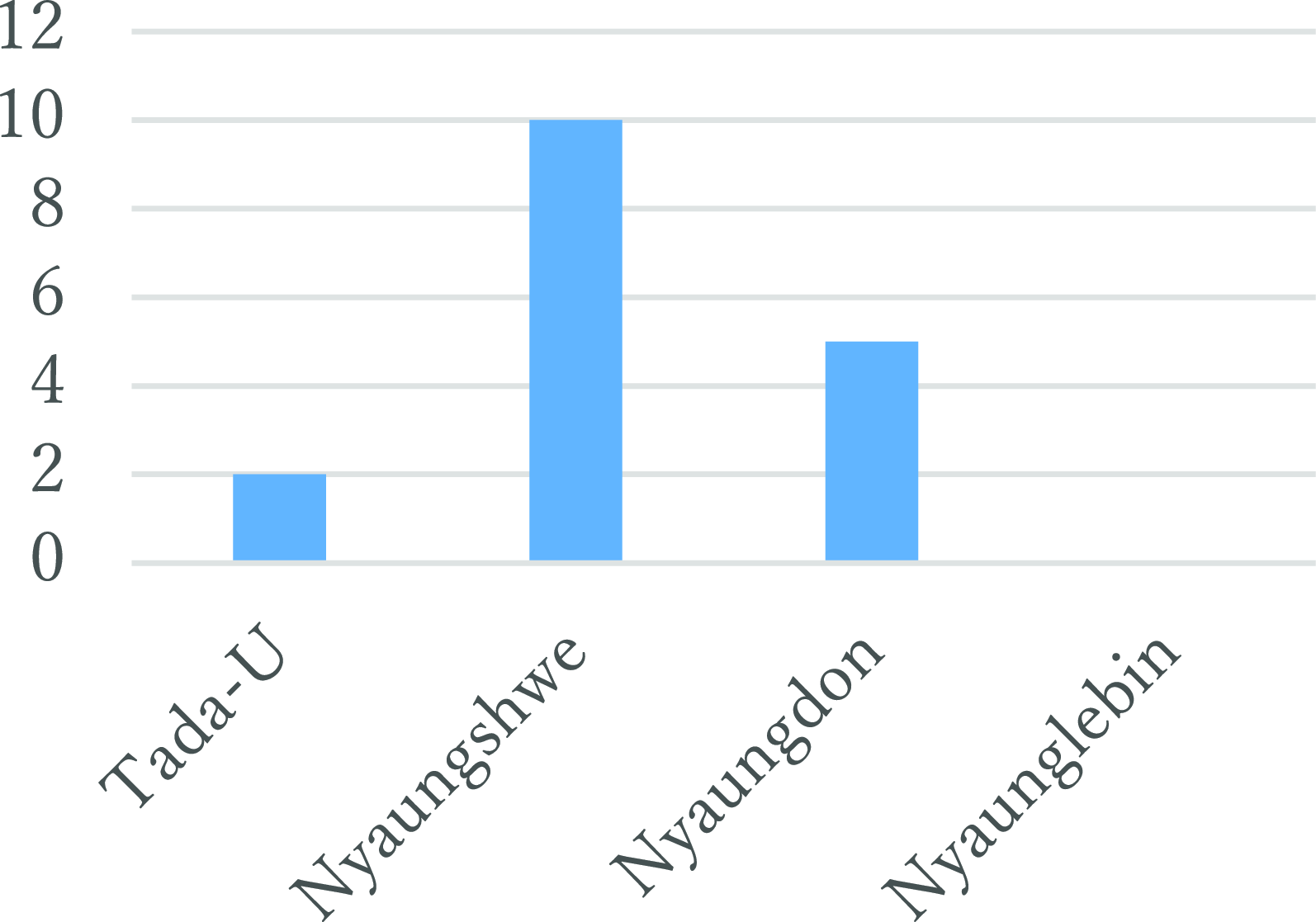
As for the farmer’s right to the land (Question 2-1), all answers except merely two answers in Nyaunglebin Township in Bago, who referred to “cultivation right,” stated that the farmers have the right of Bobwapaingmyae.Footnote 19 The moment of acquisition of such right is the succession (Question 2-2). But all answered that they also have obtained the registration of “cultivation right” under the 2012 Farmland Law (Question 2-3). All of them answered that they know the 2012 Farmland Law liberalized the farmland transactions (Question 2-5), but the degree of actual experience of land sales differs (Question 2-8): two answers in Tada U Township in Mandalay Region, ten answers in Nyaungshwe Township in Shan State, and five answers in Nyaungdon Township in Ayeyarwady Region, while none in Nyaunglebin Township in Bago Region as shown in Figure 5. As for the mortgage of farmland (Question 2-7), none has had the actual experience of formal mortgage with registration at land record office, while all have experienced non-registered rural finance.
Experience of land sales (unit: case).
Source: Farmers’ Interview Question 1-11.
Asked about the land disputes (Question 3-1), except for four answers in Nyaungshwe Township in Shan State, all others had no experience. As for the choice of forums for land dispute resolution (Question 3-2), all answers in Tada U Township of Mandalay Region and Nyaungdon Township of Ayeyarwady Region chose the traditional village mediation, while 20% answers in Nyaungshwe Township of Shan State and also in Nyaunglebin Township of Bago Region chose the formal dispute resolution by the land administration, which may reflect an increase of the cases beyond the capacity of traditional village mediation according to the gradual penetration of urbanization and industrialization. But it is impressive that all of the answers prefer the traditional village mediation to other forums for the saving of time and cost for effective dispute resolution (Question 3-5). In fact, asked about the mode of land dispute resolution (Question 3-3), all favoured the adversarial style of traditional village mediation where the disputing parties make the oral argumentation in front of the public, while those who experienced land disputes in Nyaungshwe Township of Shan State as shown in Question 3-2 described the lengthy procedure of formal dispute resolution at the government which requires more than several months, in contrast to a quick resolution by the village mediation within a week. As for the method of proof in the dispute resolution of the farmer’s right (Question 3-4), the majority of the answers in Nyaungshwe Township of Shan State referred to the land record, while all answers in three other townships referred to the testimony on the fact of “actual cultivation.”
From the above, it is a remarkable finding of this survey that almost all farmers in all targeted areas have a firm belief that the right of farmers to the farmland is the traditional Bobwapaingmyae. Even though the impact of liberalization of farmland transaction by the 2012 Farmland Law is known to them, the majority still holds a trust in the traditional village mediation as a basis of dispute resolution to secure their right to the subsistent livelihood through a fair and upright fact-finding before the public.
3.2 Perception of land administrators
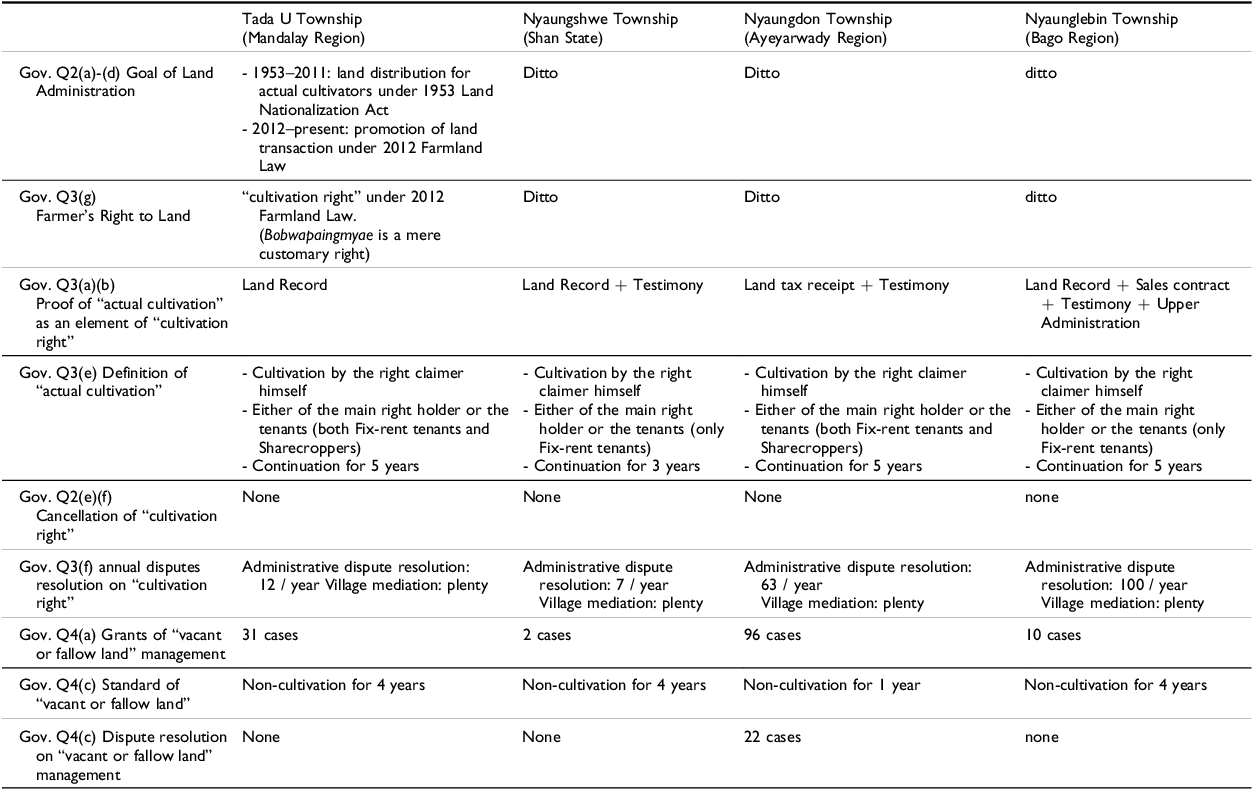
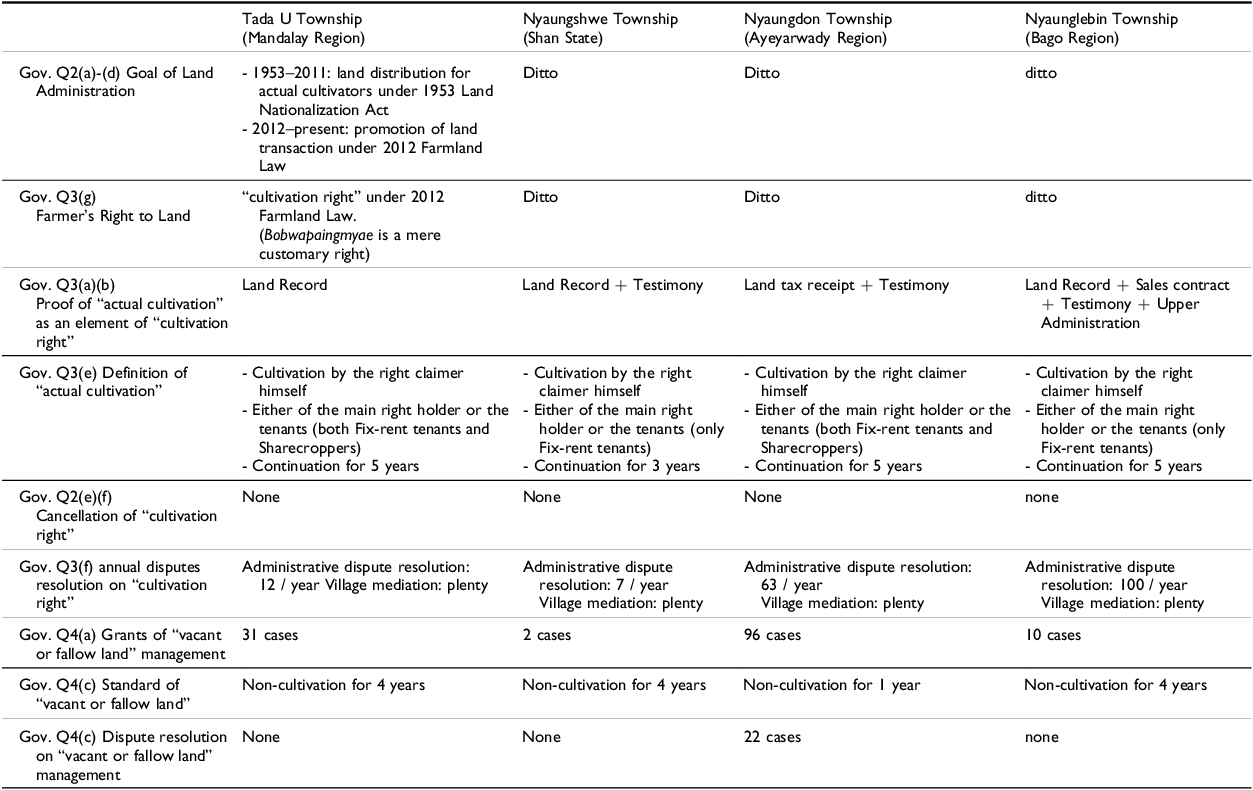
Table 2 summarizes the results of online interviews which the authors conducted with the Township Administrators,Footnote 20 as well as the staff officers in charge of land record management, of each of the four target townships.Footnote 21
Results of interviews with township administrators and land record staff officers in target four townships
Source: Compilation by the authors.
Asked about the periodical goals of land administration (Gov. Question 3 (a)–(d)), all interviewees answered almost similarly that the goal of land policy from the independence up to the year 2011 was the land-to-tillers policy which allocates the farmland to the “actual cultivators” as defined under the 1953 Land Nationalization Act, but the policy has totally changed to the liberalization of land transactions and wasteland management since the 2012 land law reform.
Asked about the nature of farmers’ right to land (Gov. Question 3(g)), all interviewees answered that what the farmers have on their farmland is the “cultivation right” under the 2012 Farmland Law. All answers consider the traditional Bobwapaingmyae as a mere customary right which should be absorbed into the registered “cultivation right” and cannot be asserted against it.
But the answers were divided on the method of proof of the “cultivation right”(Gov. Question 3(a) (b)), such that the practice of Tada U Township in Mandalay Region is based solely on the land record, while the practice of Nyaungshwe Township in Shan State pays attention to the testimonies of village chief and neighbours on the fact of “actual cultivation” as well as the land record, and the practice of Nyaungdon Township in Ayeyarwady Region is based on the land tax receipts and testimonies on “actual cultivation,” and the practice of Nyaunglebin Township in Bago Region incorporates all of the land records, land sales contracts, testimonies on “actual cultivation,” and the opinion of upper administration.
Asked about the definition of “actual cultivation” (Ahman Take Sight Pyo Chin) as one of the core elements in the assertion of the “cultivation right” (Gov. Question 3(e)), all interviewees answered that “actual cultivation” must be the physical working on land by the right holder himself. Here, the meaning of the right holder himself is either the main right holder or the tenant, who currently performs continuous cultivation. As for the length of such continuous cultivation (Gov. Question 3 (g)), except for Nyaungshwe Township of Shan State which answered three years, all others answered five years. The answers were divided for the range of the tenant eligible for this claim of “cultivation right” (Gov. Question 3 (e)): while the answers of Tada U Township in Mandalay Region and Nyaunglebin Township in Bago Region included both the fixed rate tenancy and the share-croppers, the answers of Nyaungshwe Township in Shan State and Nyaungdon Township in Ayeyarwady Region excluded the sharecroppers.
As for the administrative dispute resolution involving the decision on the “cultivation right” (Gov. Question 3 (h)), all target townships see numbers of disputed cases, in which Nyaunglebin Township in Bago Region has resolved such cases at the rate of 100 per year. Although the statistics of the cases resolved by the traditional village mediation were not available, all answered that such resolution cases are plentiful.
As for the implementation of the administrative discretion on the revocation of once vested “cultivation right” (Gov. Question 2 (e)(f)), all interviewees lacked any experience of such a revocation.
On the other hand, asked about the implementation of the 2012 Law on Vacant, Fallow and Virgin Land Management (Gov. Question 4(a)), all target townships have experienced many nationalization cases of vacant or fallow land, among which Nyaungdon Township in Ayeyarwady Region has performed 96 cases since the introduction of the Law. As for the standard of “vacant or fallow land” (Gov. Question 4(c)), except for Nyaungdon Township in Ayeyarwady Region which requires proof of non-cultivation for merely one year, all other townships required the non-cultivation for four years. Nyaungdon Township in Ayeyarwady Region has experienced 22 disputes related to the vacant or fallow land management,Footnote 22 while other townships lack any experience (Gov. Question 4(d)).
Thus, the land administration seems to be in the turning phase from the remaining influence of the land-to-tiller policy under the 1953 Land Nationalization Act to the land liquidation policy under the 2012 Farmland Law, but the degree of such a shift differs between the townships. In particular, the practice of evidence-taking for the decision of “actual cultivator” as the basis of the titling of “cultivation right” varies from the pro-cultivator stance depending on the oral testimony of village communities to the pro-transaction stance making much of the objective information appearing in the land record. The implementation of the 2012 Law on Vacant, Fallow and Virgin Land Management is similarly in a process of shift, as seen in the degree of loosening of the definition of “vacant or fallow land” which decides the range of grants for land development. In either case, our survey has found little room for the land administration to give a consideration to the farmers’ strong belief in their ancestral right of Bobwapaingmyae.
3.3 Perception of village mediators
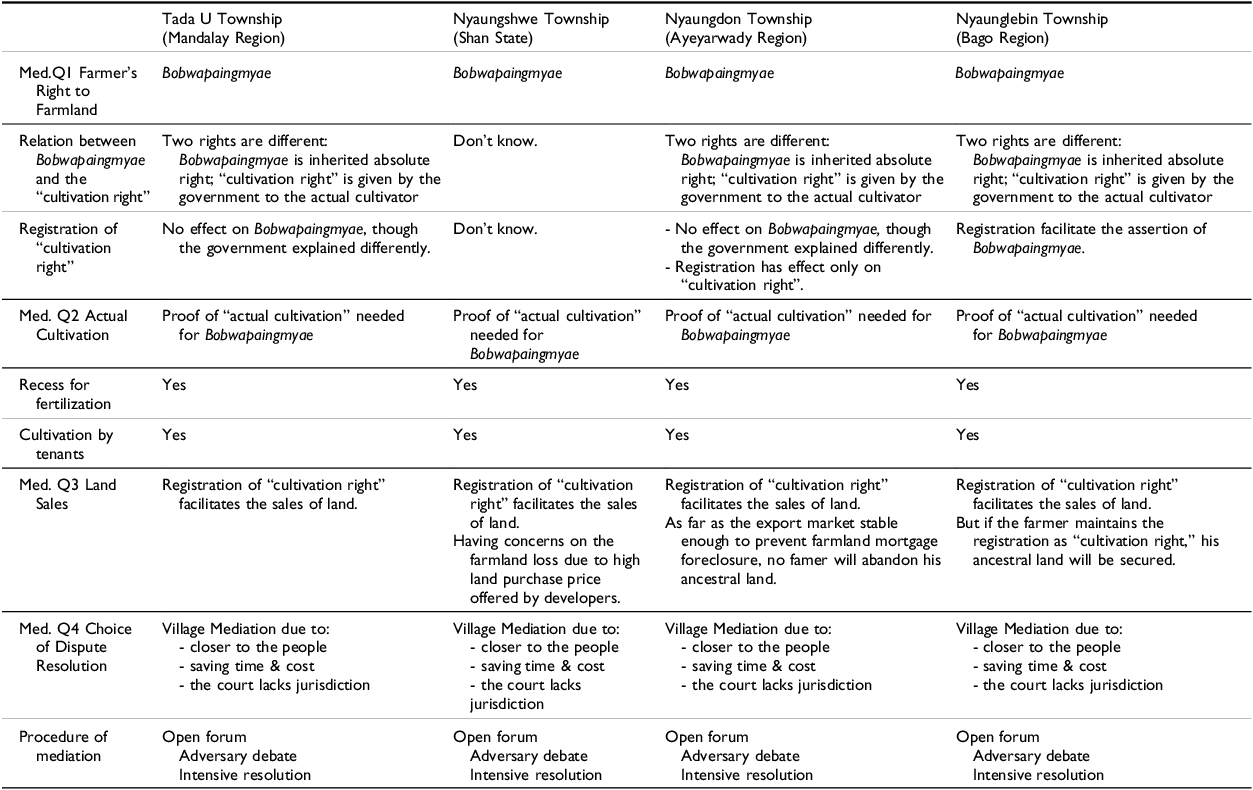
From the aforementioned surveys in Sections 3.1 and 3.2, a certain gap in the perception of land regime between the farmers and the land administration is identified, with an implication as a possible source of land disputes. Then, what are the stances of the mediators who are expected to bring about a resolution across such a gap? The following is the results of the authors’ interviews with a total of eight mediators (two from each of four target townships) who are the leading class farmers in each community, having a long career sitting as a mediator of land disputes raised at the traditional village mediation, which is identified as the most entrusted forum for local farmers by the authors’ survey (see question 3-5 in Table 1).Footnote 23
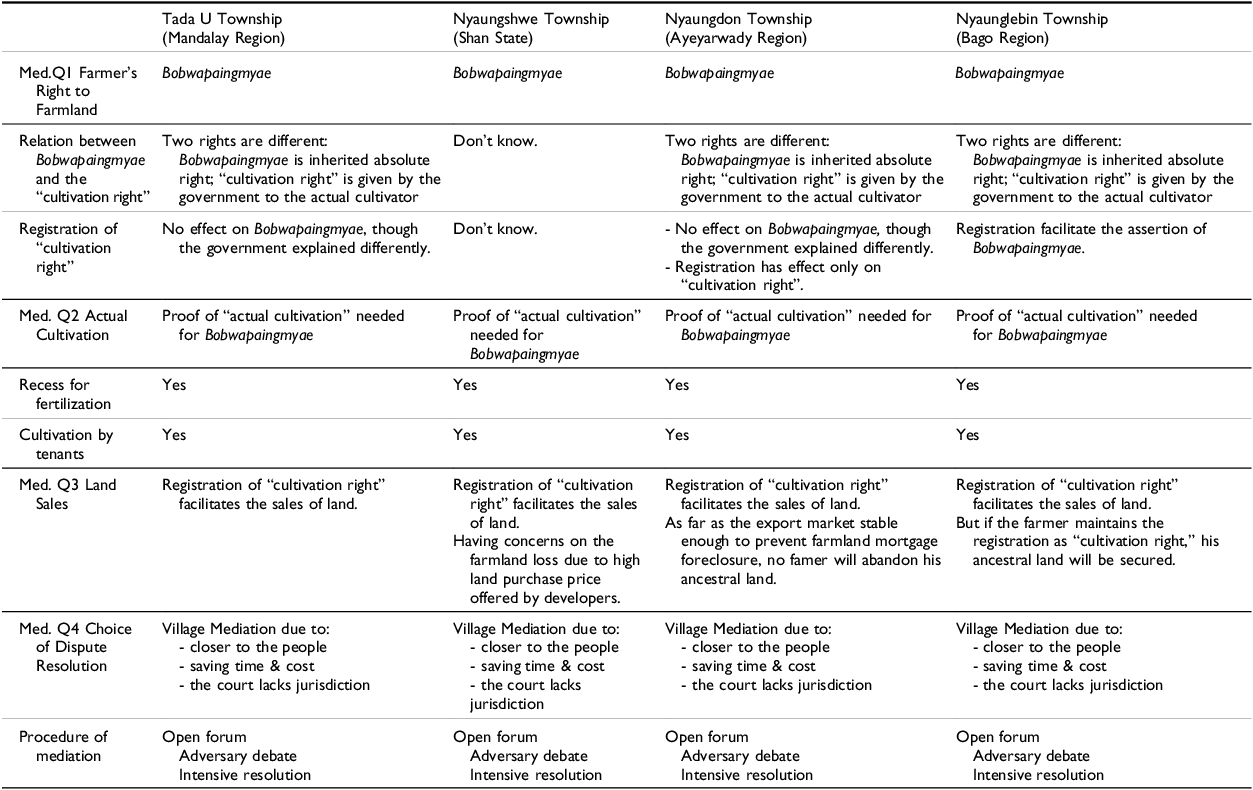
The most evident gap is revealed as for the nature of farmer’s right to their farmland: while the land administrators in one voice answered that the farmer’s right is the “cultivation right” granted by the title registration, which is a literally accurate understanding of the Farmland Law, almost all in the farmers’ interview answered that they succeed the traditional absolute right Bobwapaingmyae. Then, what is the stance of the mediators in this contest? As summarized in Table 3 (Med. Question 1), all of the interviewed mediators unanimously answered that the farmers succeed the ancestral right of Bobwapaingmyae.
Results of interviews with village mediators in target four townships
Source: Compilation by the authors.
Further asked about the relation between such Bobwapaingmyae and the “cultivation right” under the Farmland Law, while the mediators from Nyaungshwe Township in Shan State frankly admitted that they lack accurate knowledge to answer this question, all other mediators answered that these two rights are different to each other: Bobwapaingmyae is an absolute incontestable right inherited from the ancestors while the “cultivation right” is a creation by the government and offered to the actual cultivator of the same land. The holders of Bobwapaingmyae went through the title registration procedure for “cultivation right” to receive the Form-7 title certificate on their farmland only because the government instructed them to do so, but they never considered such a registration could affect their ancestral right of Bobwapaingmyae.
Asked about the effect of such title registration, the mediators’ answers were similar even though there was a slight difference in nuance: the mediators from Tada U Township in Mandalay Region and one mediator from Nyaungdon Township in Ayeyarwady Region stated an opinion that, even though the government officers explained that the registration made their former right Bobwapaingmyae into a new “cultivation right,” their ancestral right of Bobwapaingmyae would never be affected by any registration; while another mediator from the same Nyaungdon Township in Ayeyarwady Region commented that the registration only has an effect to secure the “cultivation right” while it cannot logically stand that the absolute right of Bobwapaingmyae is substituted by a weaker “cultivation right” without any compensation; the mediators from Nyaunglebin Township in Bago Region also commented that the registration of “cultivation right” was what they did based on the suggestion by the government that it would realize a better security of their ancestral land from the pressure of economic transactions.
On the other hand, all mediators knew that the land sales had been liberalized since the introduction of “cultivation right” and shared a concern of farmland loss by increasing sales (Med. Question 3). The mediators of Nyaungshwe Township in Shan State stated a deep concern on the loss of farmland due to the recent rising land purchase price offered by land developers, while the mediators of Nyaungdon Township in Ayeyarwady Region stated that they won’t be afraid of the farmland loss as far as the rice price in the export market is stable because there is no farmer who intentionally abandon his ancestral land as far as he can repay the debt to avoid farmland mortgage foreclosure. The mediators from Nyaunglebin Township in Bago Region stated a more optimistic view that their farmland is secured as long as the Bobwapaingmyae holder has registered as “cultivation” right, and keeps it firmly to block the land fluidization, according to the explanation given by the local government.
Thus, it is demonstrated that village mediators from different regions in Myanmar share a similar stance that the traditional ancestral right prevails in the contest between the written law and such traditional norms. In order to find a logic to justify this priority, they tend to imagine a pluralistic land regime such that the government-sponsored “cultivation right” is granted on the same parcel of land, as a means to increase the security of Bobwapaingmyae from the penetration of capitalist land developers. Such a notion of pluralistic land regime can work as a strategic compromise of legal postulate bridging the formal written law and social norms.
Another interesting fact in this regard is that all mediators require the proof of “actual cultivation” for the assertion of Bobwapaingmyae (Med. Question 2), which implies that their notion of Bobwapaingmyae is not automatically permanent, but it can cease when its raison d’être as a basis of family livelihood is lost. It is noted, however, that the mediators’ definition of “actual cultivation” is broader than that of the land administrators on “cultivation right”: including a recess of cultivation for the fertilizing purpose, and also the cultivation by tenants for the main right holder’s benefit, which seem to reflect the traditional norms in the society, different from the land-to-tillers policy of the land administrators.
Lastly, asked about the dispute resolution (Question 4), all mediators definitely confirmed the superiority of village mediation, in terms of the closeness to the people and the facts, the efficiency for saving time and costs, and the knowledge compared to the court which lacks jurisdiction due to the finality of the land administration’s decisions. Even though the mediators did not explicitly refer to the normative issues, their emphasis on the closeness to people implies the closeness to the people’s norms. It is also noteworthy that the style of mediation is similar in all answers, which is an adversary debate in an open forum where all villagers can join, where the debate is held intensively day and night for a week or so until the resolution is reached. As shown in the farmers’ survey in Section 3.1 above (Question 3-1), a great majority of farmers choose the village mediation where they can expect their familiar norms to be applied in their familiar procedure.
Once a dispute fails to be resolved in this closer forum, however, the case is to be brought to the formal forum of administrative dispute resolution, where the gap between written law and social norms is intensified. Especially when a Bobwapaingmyae holder dares to put his land on the market through sales or mortgages, such a separate “cultivation right” held by a third party will start to negate the original Bobwapaingmyae. The legal positivism will increasingly decide the outcomes of the resolution as the case goes up the ladder of appeal system.
4. Legal postulate of scrutinizing committee of confiscated farmland: Case analysis
4.1 Substantive standard for dispute resolution
Even though the normative gap between the farmers’ belief in their ancestral land right and the legal positivism of the land administration seems temporarily filled by village mediators’ compromised approach to constitute a formal “cultivation right” as a means of securing the traditional Bobwapaingmyae, once a “cultivation right” is separated from the family household and placed on the market, a dispute goes beyond the legal postulate of village mediation. Then, how does the formal forum respond to the gap between the written law and social norms?
The 2012 Farmland Law (arts. 22–25) provides for a layer of dispute resolution system under the Farmland Management Council which starts from the village-tract level and can be appealed through the township and the district levels to the region/state level headed by the governor as final, whose decision is conclusive and incontestable at the court (art. 25 (c)). Due to the criticisms against this government-led dispute resolution, Aung San Suu Kyi’s administration launched the 2016 Presidential Decree No. 14 to set up a new resolution forum, the Standing Committee for Scrutinizing Confiscated Farmland. But this forum was another government-led dispute resolution system basically managed by the land administrators of each level, with a participation of a limited number of public representatives. The following in this section is an analysis of actual cases resolved by the Standing Committee of Kayin State-level from 2019 to 2021, which are typical land disputes chosen among over 200 cases handled by the first author of this paper during his service in the Standing Committees of all levels from 2016 through 2020.
Before entering into each case, we should first confirm the substantive basis applied by the Standing Committees. The “National Land Use Policy” introduced by the Central Committee for National Land and Resources Management in January 2016 provided a series of general principles to guide the dispute resolution. It declares the ideals of sustainable land use for the future (Preamble sec. 1, sec. 6 (a), sec. 8(a), etc.), separation of state land from private land (Preamble sec. 3), security of land ownership and tenancy as livelihood basis (Preamble sec. 4, 6(b)), respect for customary rights (6(c)) etc., but, on the other hand, it emphasizes the economic development through the application of international best practice, utilization of market mechanism, promotion of land registration system, and deduction of land tax (sec. 8(a)(b)). There is no concrete provision to elaborate on the substantive legal designs for mitigating the gap between these two goals of livelihood protection and economic promotion, but instead, references are only made to the new procedures for dispute resolution (sec. 6 (d)) and community participation (sec. 6 (e)). The silence is remarkable on to the existing legal rights of farmers, either Bobwapaingmyae or “cultivation right,” while a general expression of “legal land title of individual, household, collective group and community in disregard of the registration” (sec. 16 (e)) is used, there is no concrete provision for the method of such titling except for a merely general reference to the “community consultation and participation” (sec. 17(f)).Footnote 24 Even for the notorious problem of wasteland management known as “land-grabbing,” the detailed substantial legal design is entrusted to the “future research” (sec. 80(n)).
Given this abstract nature of “National Land Use Policy” in short of giving exact guidance to the forefront of dispute resolution, the Central Standing Committee launched in 2018 (as periodically amended) an internal guideline for the lower committees (hereinafter referred to as the “Guideline”), which consists of a total of 52 provisions, including a certain flexible stance going beyond the literal reading of written law.
For instance, as a method of proof of farmer’s original right eligible for the titling of “cultivation right” under the 2012 Farmland Law, the Guideline explicitly provides that the oral testimony or other means of proof are acceptable without depending on the land record (secs. 1(b)(d), 3(a)). This is not only a procedural flexibility facilitating a proof, but in fact is a decisive substantive choice to prioritize what the farmers assert as their ancestral right of Bobwapaingmyae over other claims such as land purchase contracts, without any further requirement of documentary evidence. This may result in the farmer prevailing in the contest for land title against other parties.
Also, the Guideline (sec. 1(f)(j)) provides that the once issued title certificate can be cancelled and reissued according to the true fact, which is a substantive alteration to the formal law, since it prioritizes the protection of true cultivator at the sacrifice of the inherent conclusiveness of the Torrens-style titling registration.
A certificate of temporary land lease (sec. 6(a)) is also an example of government’s creation of property law, which gives an endorsement of administrative practice to secure extra time until the deliberation for final titling.
Farmers failing to obtain the “cultivation right” title even under these eased procedural and substantive standards will eventually be deemed as illegal trespassers who are targeted for eviction (sec. 6(i)).
Also for the issue of “land grabbing” or uncompensated land nationalization, the Guideline (sec. 1(c), 3(c), 4(e) for the government cases, and 2(a)(b) for the military cases) sets a realistic line for settlement that the unregistered traditional right is to be compensated by borrowing the international practice of public taking, which calls for compensation if the public use continues, while the restoration of farmland to the original farmer is necessary if the public use has ceased. Here again, the Guideline treats the traditional ancestral right of Bobwapaingmyae as legal under the formal law regime, allowing them an access to compensation, by separating it from the status of the squatters who lack legal basis for land occupancy.
Thus, the Guideline draws a realistic line extending support to the unregistered traditional rights. This flexibility can be a double-edged sword, however, as the dispute settlement may require complicated balancing of interests. A typical setting of unregistered traditional right is a contest between a family holding Bobwapaingmyae and the mortgagee or his purchaser who received the title certificate of “cultivation right” as a result of mortgage foreclosure, but if this family continues cultivation, the Guideline, if literally applied, will let this unregistered family with Bobwapaingmyae prevail in this contest, by issuing a new title certificate of “cultivation right” thereto. This conclusion reminds us of the redemption right of heirs in the land mortgage under the dynasty era’s Dhammathat. This seems to be an evidence of continued legal tradition of prioritizing the protection of subsistent livelihood, but such a result must meet the criticism of the financiers whose predictability is largely harmed. How, then, the forefront of dispute resolution implements such a farmer-friendly policy line of the Guidelines?
4.2 Case analysis: Dispute involving Bobwapaingmyae lacking registration as a cultivation right
The following is an analysis of typical cases handled by the Standing Committee of Kayin State-level from 2019 to 2021 involving the farmer’s claim of Bobwapaingmyae lacking the registration as “cultivation right.”
4.2.1 Case 1 on “Cultivation Right” title offered to the tenant
After the simultaneous registration for the titling of “cultivation right” under the 2012 Farmland Law, Farmer A raised a claim against the “cultivation right” title certificate given to Farmer B, which was heard by the Standing Committee for Scrutinizing Confiscated Farmland of the Kayin State during 2019–2020. According to the assertion of Farmer A, he succeeded the ancestral farmland from his father in 1976 and continued cultivation until 1989 when he decided to work in the capital city Yangon and entrusted this land to his sister C, who continued her cultivation until 1999, but then entrusted this land to Farmer B who promised her to provide 90 tins of rice harvest per year, which was equivalent to the land tax that C was obliged to pay to the land administration. B continued his cultivation by the simultaneous registration in 2012 and obtained the “cultivation right” title certificate. Farmer A insisted that this contract between C and B is a lease with a fixed rent in its substance, and therefore, it is A as the main right holder to receive the “cultivation right” title certificate.
To this claim, the conclusion of the village tract-level Farmland Management Council was that Farmer A lost his right to the farmland as of 1989 when he ceased his cultivation, according to the obligation to continue cultivation under the 1953 Land Nationalization Act (art. 6) which was the law at that time. The Council also confirmed the fact that Farmer B acquired a formal registration for the tenancy as of 2000, to which Farmer A made no objection. Accordingly, it is lawful that the “cultivation right” title certificate was given to this certified tenant who actually continues cultivation.
Farmer A raised this case to the Standing Committee for Scrutinizing Confiscated Farmland of the Kayin State, which sustained the decision by the Farmland Management Council and dismissed the case.
4.2.2 Case 2 on “Cultivation Right” title offered to the purchaser
Farmer A raised an objection to the “cultivation right” title certificate given to Farmer B by the simultaneous registration for “cultivation right” title under the 2012 Farmland Law. This case was heard by the Standing Committee for Scrutinizing Confiscated Farmland of the Kayin State during 2020–2021.
According to the assertion of Farmer A, he succeeded the ancestral farmland from his father and continued his cultivation until 2010, when Mr. C, a prominent person in his village, illegally sold the land to a third party, who further sold it to the succeeding purchasers, until Farmer B finally purchased it and obtained the “cultivation right” title certificate.
The Kayin State-level Standing Committee entrusted the fact-finding to the township-level, which found that the target farmland was in fact the one that was succeeded by Farmer D from his forefathers, and was lawfully transferred by Farmer D to Farmer B in 2009, and therefore Farmer A lacked the ground for his claim. The Kayin State-level Standing Committee affirmed the result of this fact-finding and dismissed the claim of Farmer A.
4.2.3 Case 3 on “Cultivation Right” offered to an evacuee during the ethnic conflict
This is another case of objection to the simultaneous titling for “cultivation right” under the 2012 Farmland Law, but has a complicated background because the target farmland was located in the area affected by the armed ethnic conflict. Farmer A succeeded the target farmland from her forefathers but got evacuated to Thailand in 1997 due to the serious armed conflict near the border. During her absence, according to her assertion, the target land was illegally occupied by a group of activists inside the village and used for the local development, which prevented her intention to restore her farming by applying for the registration of “cultivation right.”
This case was heard from 2016 to 2019 at the Kayin State-level Standing Committee, during which, the fact-finding was mandated to the township-level, which further entrusted it to the village-level due to the serious influence of the armed conflict. The report said that Farmer A’s continuous cultivation was confirmed until 1997 but negative after that, whereas the activists group has been on a project to utilize the abandoned land lots within the village for the purpose of local development under the guidance of a famous Buddhist monk, which has been accepted by the remaining villagers in exchange for the provision of alternative land. It was also confirmed that this group applied for a formal permit of land use change (LaNa 39) under the Land Nationalization Act, but the land administration refused it, which has made the legal status of this land parcel uncertain up to the present.
The Kayin State-level Standing Committee refrained from rendering a decision on this contest, with a reason that this case is after all a private dispute which is outside of the jurisdiction of the Standing Committee, and instead recommended the parties to try a special forum for mediation presided over by the Township Administrator before going to the court.
4.2.4 Case 4 on farmers lacking documents against wasteland nationalization by public cooperation
A group of farmers raised a claim calling for the restoration of their land as they asserted illegally taken by the government-owned Public Cooperation for Teak Development in 1982 without compensation. This case was heard during 2018–2021 at the Kayin State-level Standing Committee. The Committee entrusted the fact-finding to the township-level, which reported that each of claimant farmers had succeeded the ancestral land and also fulfilled the requirements of “actual cultivation” as of 1982, as well as the fact that the target land parcels are no longer used for the public purpose of timber development. Based on such facts, the Kayin State-level Standing Committee sent a letter of recommendation to the relevant ministry in 2018 requesting the return of target land parcels to farmers, but the minister responded with a letter of objection in 2019 contending that the claimant farmers were illegal occupants lacking any documentary evidence of their right to land (Paing Sai Hmu Htauk Ahtar) as of 1982, and that this understanding was further confirmed by the issuance of the LaNa39 (certificate of permit for land use change) by the land administration as of 1987.
The Kayin State-level Standing Committee refrained from offering a decision on this contest, due to the lack of jurisdiction according to the Presidential Decree No.14 which entrusted the Committee to settle only disputes that occurred after the year 1988, and instead, closed the case by issuing a final recommendation to the minister to pay attention to the livelihood of farmers.
4.2.5 Case 5 on farmers lacking documents against wasteland nationalization by military
A group of farmers raised a claim calling for the restoration of their land in a total of 330 acres (133 ha) as they asserted was illegally taken by the military in 1997 without compensation. This case was heard during 2018–2020 at the Kayin State-level Standing Committee. The Committee assigned the fact-finding to the township level, which further entrusted this task of investigation to the village-tract level. Upon the confirmation that all claimants meet the status of “actual cultivators,” the Kayin State-level Standing Committee sent a letter of recommendation to the military in 2019. To which, the military first responded negatively, because of the reason that the target land areas were currently in military use. To this, the Kayin State-level Standing Committee further asked for a clarification. The military responded with more details such that a part of the target land areas used to be a wasteland, which were lawfully considered as national land under the wasteland management scheme without compensation, while the rest of the land areas were farmland under cultivation, to which the military provided a lawful compensation at that time, except for 70 acres of land area for which the farmers refused to receive the compensation. The military proposed a compromise for this 70 acres by offering the option of either compensation at the current price or returning the land, which was amicably accepted by the farmers.
4.3 The essence of legal postulate of standing committee
A common feature across the above five cases of Kayin State-level Standing Committee is that the claim was based on the traditional right to ancestral land, Bobwapaingmyae. In all cases, due to some different background reasons, the claimants lacked the registration of “cultivation right” under the 2012 Farmland Law, and therefore their counterparts of disputes, either a minister or the military headquarter, initially showed a negative attitude to treat them as a formal claim. The stance of Kayin State-level Standing Committee on the disputes looks obscure at a glance, basically takes a line of legal positivism abided by the written law, but occasionally borrows the traditional norms according to the realistic needs of dispute resolution. The question is if there is a single logic across these flexible resolutions.
Case 1 above was a typical case of such a flexible resolution, in which the Committee affirmed the government’s positivist logic that the claimant-farmer A had lost his right since his infringement of the obligation to continue cultivation under the 1953 Land Nationalization Act, but, on the other hand, confirmed the title of the farmer B by recognizing the lawfulness of his status as a traditional mortgagee under the disguise of tenancy, despite that such a traditional mortgage is a circumvention of the legal prohibition of land transfer under the 1953 Act. A possible logic to mend this contradiction might be an understanding that an absentee party who has been away from the “actual cultivation” for a long time cannot be allowed to assert the traditional right Bobwapaingmyae. Even though we saw an opposite conclusion in Case 3, where the claim of absentee party Ms. A to her ancestral land was affirmed, it was an extraordinary case raised by a refugee from the armed ethnic conflict, who implied her will to return to the “actual cultivation” as of the peace restored. In this connection, in Case 4 on the wasteland nationalization for timber industry development, it was remarkable that the standing of the claimant-farmers was decided based on both facts of “actual cultivation” and of the succession of ancestral land, Bobwapaingmyae, which means that a single assertion of Bobwapaingmyae is not sufficient for the protection of a party lacking the registered “cultivation right” unless he successfully proves his “actual cultivation.” In other words, an absentee party cannot make his assertion of Bobwapaingmyae.
A concern in this regard of Case 4 is a different conclusion between the holder of Bobwapaingmyae lacking the registration and the tenants lacking the registration: the former is eligible for the title of “cultivation right” but the latter is not, even when both fulfil the requirement of “actual cultivation.” We can recognize another logic of the Committee drawing a line of protection according to the degree of stability of the legal status (myaethay in the traditional term). Though the claimant-farmers in Case 5 were only required to prove their “actual cultivation” without showing their Bobwapaingmyae, which implied that tenant farmers in addition to Bobwapaingmyae holders were eligible for remedies, we suppose a special consideration might have been applied by Aung San Suu Kyi’s government in this case involving the military use.
The legal postulate of such administrative dispute resolution is not easily visible, in reflection of plural policy considerations, but one attitude held across the cases is the respect of ancestral right of Bobwapaingmyae to the extent it is under “actual cultivation” (provided that the question remains on its interpretation). A claim of Bobwapaingmyae by an absentee party is basically not acceptable, which reminds us of the same conclusion under the traditional legal code Dhammathat in the pre-colonial time.Footnote 25 It is remarkable that the same requirement of “actual cultivation” has been succeeded from the pre-colonial era up to the present as a foothold for social norm of Bobwapaingmyae to survive under the changing formal law, perhaps as a result of rare fortunes, including the colonial land law kept the requirement of “actual cultivation” for the purpose of putting the “landholder’s right” in a legal status as vulnerable as the state land’s tenant, the post-independence 1953 Land Nationalization Act succeeded such requirement for the purpose of land-to-tiller policy, and the current 2012 Farmland Law succeeded the basic structure of the 1953 Act except for the liberalization of land transactions.
5. Summary of findings
In spite of the large amplitude of changing Positivität in Myanmar’s land law sphere, it was a remarkable finding of this study that the ordinary farmers, regardless of the regions, hold a firm perception of their traditional right Bobwapaingmyae. As reviewed in Section 2 above, the written code Dhammathat used to provide for such a regime of Bobwapaingmyae as the basis of household livelihood, but it was denied by the colonial land regime; and then, the post-independence 1953 Land Nationalization Act attempted the restoration of traditional livelihood basis, but caught up in the strict state control in the era of Burmese socialism; and currently, the donor-oriented land liquidation policy is prominent under the 2012 land law reform, by newly introducing a transferable “cultivation right” to facilitate land market. A remarkable finding of this study through the interview with 120 farmers in 4 targeted areas was that an overwhelming majority of interviewed farmers confirmed their strong belief that they succeeded the traditional absolute right to ancestral land, Bobwapaingmyae, as described in the pre-colonial written code Dhammathat (Section 3.1 above).
The interview with the officers in charge of land administration in four targeted areas, on the other hand, identified a legal positivism in their law application, with an emphasis on their common understanding that Bobwapaingmyae is a mere customary right which is absorbed into the registered “cultivation right” (Section 3.2 above). Such a perception gap between the farmers and the administration must be intensified in the land disputes such as the objections to the simultaneous titling and the wasteland nationalization, and entrusted to the dispute resolution forums. This study conducted the interviews with a total of eight mediators in charge of village mediation, which was the most favourite choice of forum in all answers of the aforementioned farmers’ interviews, and found that most of the interviewed mediators have an understanding that the traditional land right Bobwapaingmyae and the “cultivation right” under the written law separately exist in parallel, and that many Bobwapaingmyae holders go through with the registration of “cultivation right” for the purpose of keeping it in their hand as a means of securing their Bobwapaingmyae (Section 3.3 above). Thus, village mediators are wisely coordinating the gap between the farmers’ belief in Bobwapaingmyae and the government’s legal positivism on “cultivation right” by this pluralist approach, with a tactic of letting the farmers intentionally hold both rights to prevent the land fluidization.
While this legal postulate of village mediators is workable for the internal disputes within the village sphere where all parties share the understanding of Bobwapaingmyae, once any Bobwapaingmyae holder dares to separate his “cultivation right” from Bobwapaingmyae and places it in the market through the sales or mortgage foreclosure, the disputes start to involve outsiders (purchasers or mortgagees) and must be handled in the formal dispute resolution systems where the legal positivism may govern and the pluralist logic of village mediation would no more be acceptable. Then, for the purpose of ascertaining the legal postulate of administrative dispute resolution, we studied several typical cases heard at the Kayin State-level Standing Committee for Scrutinizing Confiscated Farmland during 2016–2020, and identified a tendency that the resolution by the Committee is based on the fact of “actual cultivation” which is both one of the core requirements of the titling of “cultivation right” under the written law and also an indispensable requirement of the traditional Bobwapaingmyae (Section 4 above). Based on this common requirement of “actual cultivation” as a nodal point, the Committee shows a flexible tendency to affirm the claims of Bobwapaingmyae holders even when they lack the registration of formal “cultivation right” due to various backgrounds, as far as the “actual cultivation” is proven to show the household’s livelihood at concern. To the contrary, the claims of absentee parties are not acceptable even though they appeal to their ancestral right of Bobwapaingmyae, with an implication that the absoluteness of Bobwapaingmyae is affirmed only because of the social norm that prioritizes the basis of actual livelihood on land, which is fundamentally different from the modern ownership traded for its abstract value. In this sense, we understand the legal postulate of this administrative dispute resolution forum is the protection of livelihood of farming households, which corresponds to the fundamental norms rooted in the society beyond the generations.
A reason for this openness of Myanmar’s land dispute resolution to unwritten social norms must relate to its bottom-up institutional structure connected to the base society. Village mediation has been given a position as the first instance trial in the formal administrative dispute resolution (1953 Land Nationalization Act, arts. 16, 23; 2012 Farmland Law, art. 25), while the upper levels have maintained a custom to pay attention to the facts found by the basic level. It is also an ironic fortune that the court in Myanmar, which is known for its strict legal positivism, has been isolated from the land disputes resolution due to the “finality” clause in the written law which declares the administrative decisions are final and incontestable by the judiciary (Land Nationalization Act, art. 36; Farmland Law, art. 25 (c)).
Then, what about the future of dispute resolution? As the urbanization and industrialization are inevitable trends, to what extent can mediators maintain their legal postulate of pluralists who bring in the social norm of livelihood protection into the realm of land fluidization through the term “actual cultivation” as a foothold. It is a logic applicable to the disputes having nexus to agricultural society (e.g., conflict between absentee landlord and tenants) but it is questionable to what extent the same logic can be applicable to the disputes involving non-agricultural entities increasingly receiving the “cultivation rights” to immediately turn it into commercial or industrial use.
The tendency of administrative dispute resolution in the cases we analysed in Section 4 implies a stance that is open to the land transactions within the agricultural sector but restrictive to the land fluidization by other uses, such as commercial, industrial, or speculative purposes. The “cultivation right” title in Case 1 was given to the farmer B, who was in fact a purchaser of land from C in the disguise of traditional mortgage in a tenancy form (as a tactic to evade the prohibition of land transaction under the 1953 Land Nationalization Act), but the Kayin State-level Standing Committee affirmed this titling to B. Also in Case 2, the administrative decision supported the argument of farmer B, who purchased land from D despite the prohibition of land transaction under the 1953 Land Nationalization Act. But such an openness to land transaction suddenly turns negative in Case 3, where the local group requested the land use change permit for town development. Though such a land use change was admissible under LaNa36 permit under the 1953 Act, and the current 2012 Farmland Law (arts. 8, 30) further promotes farmland transfer to non-agricultural investors, the Kayin State-level Standing Committee cautiously abstained from rendering a decision, implying its basic stance in favour of the assertion of Bobwapaingmyae.
While the changing Positivität of the regime of written law in Myanmar, following the worldwide mainstream of “legal transplant,” increasingly prioritizes a higher value-added land use to the traditional agricultural livelihood, Bobwapaingmyae is maintained through the legal postulate of dispute resolution forums. Behind this, we recognize a pride that it used to be the central value of the formal law since the pre-colonial Myanmar. Perhaps, the strong comment we obtained from one of the interviewed mediators from Nyaungdon Townshi of Ayeyarwady Region gives us a hint: “Farmland is only single treasure we farming households succeed from the past. We just simply intend to hand this over to our descendants, till the end of this world.” As long as this impressive enthusiasm lasts, they will continue to find a way to keep the social norm effective within the changing regime of formal law. The authors estimate that the “actual cultivation” as a historically developed tactic for compromise since the colonial time between plural legal regimes by requiring the objective appearance of a right to the world, as a formalistic reasonableness in Weber’s sense, as a basis of enabling a compromise between the commercial actors and the traditional agricultural livelihood, provided the definition of “actual cultivation” will continue to be a focus of debate in articulating what is the substantive justice in a changing society.

 Open access

