





1 Introduction
In recent years, the Datalog language (Ceri et al. Reference Ceri, Gottlob and Tanca1989) has been experiencing renewed interest, thanks to the growing adoption for Knowledge Representation and Reasoning applications (Gottlob Reference Gottlob2022). The additional requirements introduced by reasoning spawned prolific research towards new extensions of the language to support advanced features such as existential quantification and aggregation. These extensions are frequently shared under the common name of Datalog $^\pm$
(Calì et al. Reference Calì, Gottlob and Lukasiewicz2012) and include languages, technically, “fragments," that exhibit a very good tradeoff between computational complexity and expressive power, such as Warded and Shy Datalog
$^\pm$
(Calì et al. Reference Calì, Gottlob and Lukasiewicz2012) and include languages, technically, “fragments," that exhibit a very good tradeoff between computational complexity and expressive power, such as Warded and Shy Datalog $^\pm$
(Baldazzi et al. Reference Baldazzi, Bellomarini, Favorito and Sallinger2022).
$^\pm$
(Baldazzi et al. Reference Baldazzi, Bellomarini, Favorito and Sallinger2022).
As the new logical languages flourish, the expectations for declarative, explainable expressivity of complex domains, jointly with feasible computation, are rekindling the idea of using deductive languages in practical applications, with modern systems (Leone et al. Reference Leone, Allocca, Alviano, Calimeri, Civili, Costabile, Fiorentino, Fuscà, Germano, Laboccetta, Cuteri, Manna, Perri, Reale, Ricca, Veltri and Zangari2019) based on Datalog in production settings, often in combination with knowledge-based AI models, such as knowledge graphs (Bellomarini et al. Reference Bellomarini, Fakhoury, Gottlob and Sallinger2019).
With so many real-world adoptions, the temporal perspective is increasingly becoming a first-class requirement of Datalog. In fact, with the pervasive constant and voluminous streams of data, we are witnessing that temporal reasoning – the ability to reason about events and intervals in time – is becoming of the essence in many fields, from healthcare to finance, robotics to transportation. We can look at a plethora of use cases: the longitudinal studies of anticancer treatments to explain and prevent adverse events (Ma et al. Reference Ma, Lee, Mai, Gilman, Liu, Zhang, Li, Redfern, Mullaney, Prentice, Mcdonagh, Pan, Chen, Schadt and Wang2021), the analysis and prediction of stock market time series (Walega et al. Reference Walega, Cuenca grau, Kaminski and Kostylev2019), the tracking of objects for unmanned vehicles (Lin et al. Reference Lin, Fu, He, Xiong and Li2022), the processing of IoT devices interactions (Walega et al. Reference Walega, Cuenca grau, Kaminski and Kostylev2019), and the exploitation of log data (Brandt et al. Reference Brandt, Kalayci, Ryzhikov, Xiao and Zakharyaschev2018).
The proposal for an extension of Datalog with Metric Temporal Logic operators, or DatalogMTL (Brandt et al. Reference Brandt, Kalayci, Ryzhikov, Xiao and Zakharyaschev2018), shows an extremely promising impulse towards a declarative language with sufficient expressive power to handle reasoning settings, such as recursion, while offering time awareness within a computationally effective framework.
Positioning of the paper
This paper studies the theoretical and practical underpinnings at the foundation of modern implementations of DatalogMTL. We illustrate the functional and architectural desiderata of such systems and present the Temporal Vadalog system, a fully-engineered reasoning DatalogMTL tool. This work is a substantially extended version of a RuleML+RR ’22 paper (Bellomarini et al. Reference Bellomarini, Benedetto, Gottlob and Sallinger2022) introducing the system. Besides proposing a broader and completely reformulated presentation of the content, the contribution is here enriched with (i) an in-depth discussion about the logical optimization of the temporal operators; (ii) the implementation of new temporal operators (namely, since and until); (iii) an entirely new part dedicated to the implementation of time series in Temporal Vadalog; (iv) a corpus of new experiments.
To present the ideas at the foundation of Temporal Vadalog, let us start introducing DatalogMTL with a financial use case example from our work with the Bank of Italy.
Example 1.1.
Changes in strategically important companies may face government scrutiny to uphold regulatory standards, focusing on both the companies and their new shareholders. We describe the scenario by a database $\mathcal {D}$
of facts about company shares and the following set
$\mathcal {D}$
of facts about company shares and the following set $\Pi$
of DatalogMTL rules.
$\Pi$
of DatalogMTL rules.

 \begin{align} \!\!\!\!\!\!\!\!\!\!\!\!\!\!\!\!\!\!\!\!\!\!\!\!\!\!\!\!\!\!\!\!\!\!\!\!\!\!\!\!\!\!\! \mathit {watchCompany}(Y), \mathit {significantOwner}&(X,Y), \nonumber\\ \mathit {connected}&(X,Z) \to \mathit {watchCompany}(Z) \end{align}
We assume the reader is familiar with Datalog rule syntax: the left-hand side of the rule (the body) is the implication premise and is composed of a logical conjunction of predicates over terms, that is constants or variables; the right-hand side (the head) is the implication conclusion. In the rules, we find predicates from the relational schema of $\mathcal {D}$
. In particular, significantShare holds whenever
$\mathcal {D}$
. In particular, significantShare holds whenever $X$
retains a high number of shares of
$X$
retains a high number of shares of $Y$
; significantOwner is then a derived, namely, “intensional” predicate, obtained by Rule 1. Then, by Rule 2, whenever
$Y$
; significantOwner is then a derived, namely, “intensional” predicate, obtained by Rule 1. Then, by Rule 2, whenever $Y$
is interested in a watchCompany fact to indicate that the authority deems that company of some strategic relevance, given that
$Y$
is interested in a watchCompany fact to indicate that the authority deems that company of some strategic relevance, given that $X$
is a significant owner of
$X$
is a significant owner of $Y$
, then all companies
$Y$
, then all companies $Z$
connected to
$Z$
connected to $X$
will be watched over as well. Neglecting for a moment the temporal angle of
$X$
will be watched over as well. Neglecting for a moment the temporal angle of $\Pi$
, its semantics is straightforward: whenever the premise of one rule holds with respect to
$\Pi$
, its semantics is straightforward: whenever the premise of one rule holds with respect to $\mathcal {D}$
, then
$\mathcal {D}$
, then $\mathcal {D}$
is augmented with new facts to satisfy the implication if it does not already hold. For instance, if
$\mathcal {D}$
is augmented with new facts to satisfy the implication if it does not already hold. For instance, if $\mathcal {D}$
contains the facts
$\mathcal {D}$
contains the facts $\mathit {watchCompany}(\mathit {ACME})$
,
$\mathit {watchCompany}(\mathit {ACME})$
, $\textit {significantOwner}(A,\mathit {ACME})$
,
$\textit {significantOwner}(A,\mathit {ACME})$
, $\mathit {connected}(A,\mathit {EMCA})$
, then the new fact
$\mathit {connected}(A,\mathit {EMCA})$
, then the new fact $\textit {watchCompany}(\mathit {EMCA})$
will be added to
$\textit {watchCompany}(\mathit {EMCA})$
will be added to $\mathcal {D}$
. Here, the temporal perspective is introduced by the
$\mathcal {D}$
. Here, the temporal perspective is introduced by the $\boxplus$
and
$\boxplus$
and
 operators. When prefixed with $\boxplus$
, a predicate holds, only if the predicate itself continuously holds in the interval (
$\boxplus$
, a predicate holds, only if the predicate itself continuously holds in the interval ( $[t,t+1]$
, if Rule 1 is evaluated at
$[t,t+1]$
, if Rule 1 is evaluated at $t$
) in the future, as indicated by the operator internal in the index. The
$t$
) in the future, as indicated by the operator internal in the index. The
 operator modifies a predicate’s semantics so that it holds if the predicate itself holds at least once in the past interval ( $[t-1,t]$
, if Rule 1 is evaluated at
$[t-1,t]$
, if Rule 1 is evaluated at $t$
). Clearly, in a temporal interpretation of Datalog, all facts, including the “extensional” ones of
$t$
). Clearly, in a temporal interpretation of Datalog, all facts, including the “extensional” ones of $\mathcal {D}$
, are time-annotated. In the example, Rule 1 fires only if
$\mathcal {D}$
, are time-annotated. In the example, Rule 1 fires only if $X$
, who has never been a significant shareholder for
$X$
, who has never been a significant shareholder for $Y$
in the past, becomes such in the future.
$Y$
in the past, becomes such in the future.
More formally speaking, the semantics of a set of Datalog rules $\Pi$
is defined via the chase procedure (Maier et al. Reference Maier, Mendelzon and Sagiv1979), which modifies
$\Pi$
is defined via the chase procedure (Maier et al. Reference Maier, Mendelzon and Sagiv1979), which modifies $\mathcal {D}$
as long as all the rules of
$\mathcal {D}$
as long as all the rules of $\Pi$
are satisfied. Multiple variants of the chase arose, including many supporting DatalogMTL. At the same time, several DatalogMTL fragments were also introduced, to carefully balance expressive power and computational complexity: DatalogMTL
$\Pi$
are satisfied. Multiple variants of the chase arose, including many supporting DatalogMTL. At the same time, several DatalogMTL fragments were also introduced, to carefully balance expressive power and computational complexity: DatalogMTL $^{\text {FP}}$
(Walega et al. Reference Walega, Cuenca grau, Kaminski and Kostylev2019) and its core and linear eponymous
$^{\text {FP}}$
(Walega et al. Reference Walega, Cuenca grau, Kaminski and Kostylev2019) and its core and linear eponymous and
and  (Walega et al. Reference Walega, Cuenca grau, Kaminski and Kostylev2020b), or Integer DatalogMTL (Walega et al. Reference Walega, Cuenca grau, Kaminski and Kostylev2020a) offer a good prospect for reasoning over time, with some of them being tractable, that is query answering can be evaluated in polynomial time with respect to the database size. Moreover, the system should support operations over numeric values and aggregations, as well as negation.
To get to the core of our discussion, let us lay out the characteristics that a reasoning system should support to deal with time as a first-class system, via DatalogMTL.
Functional desiderata
A temporal reasoning system is a “reasoner” in the first place. A good yardstick for the features it should incorporate then comes from the experience with knowledge graph management systems: such tools should adopt a simple, modular, low-complexity, and highly expressive language. DatalogMTL fragments like the ones mentioned above should then be supported. To cope with real-world applications, monotonic aggregations should be supported as well (Bellomarini et al. Reference Bellomarini, Nissl and Sallinger2021a).
Architectural desiderata
The existing systems implementing DatalogMTL adopt time-aware extensions of the chase. Yet, the vast experience from the database community suggests that a direct implementation of the chase can be a suboptimal choice, affected by multiple limitations. For efficiency and memory footprint, the extensional database and all intermediate facts must be in memory. We wish for reasoning systems to be memory-bound, using a modern data processing pipeline architecture. As for desiderata specific to temporal reasoners, temporal programs can produce facts that periodically hold over time, with repeating patterns potentially generating infinite facts, which practically can be represented compactly depending on the DatalogMTL fragment. A temporal reasoner should recognize these fragments, identify the patterns at runtime, and guarantee termination. Architecturally, it should have a configurable toolbox of strategies for different fragments. Time intervals should be carefully handled, with a selection of algorithms to merge and compress them for a space-efficient representation.
The development of temporal reasoners is in its infancy, with the only proposals for practical implementation of DatalogMTL being either not engineered for production use or not supporting essential features such as recursion, like in the system by Brandt et al. (Reference Brandt, Kalayci, Kontchakov, Ryzhikov, Xiao and Zakharyaschev2017). Conversely, MeTeoR (Wang et al. Reference Wang, Hu, Walega and Grau2022) supports recursion; still, it does not offer operations over numeric values or aggregations.
Contribution
In this paper, we present the Temporal Vadalog system, a fully-engineered reasoning system that addresses the above desiderata. Functionally, it offers:
-
• support for multiple DatalogMTL fragments, including DatalogMTL $^{FP}$
(i.e. forward-propagating; resp. BP, i.e. backward-propagating) over the real timeline, and DatalogMTL
$^{FP}$
(resp. BP) over the integer timeline
$^{FP}$
(i.e. forward-propagating; resp. BP, i.e. backward-propagating) over the real timeline, and DatalogMTL
$^{FP}$
(resp. BP) over the integer timeline -
• native support of the DatalogMTL operators (box, diamond, since and until)
-
• operations over numeric values
-
• recursion, aggregations, and stratified negation
-
• time series and time series operators.


Its architecture is based on a modern data pipeline style, where programs are evaluated in a pull-based and query-driven manner, sustaining limited memory footprint and high scalability for medium- to high-size settings. More in particular:
-
• rewriting-based optimization
-
• fragment-aware termination control strategies
-
• seamless integration of temporal and non-temporal reasoning.
Overview
Section 2 presents DatalogMTL and an overview of time series operators. Section 3 covers the main contribution of the paper, detailing the Temporal Vadalog pipeline and its components; Section 4 shows how the system can be used to reason over time series. Section 5 presents the empirical evaluation of the system with a discussion of the experiments. In Section 6 we discuss the related work; finally, we conclude the paper in Section 7. Additional material can be found in the supplementary material.
2 Preliminaries
2.1 DatalogMTL
DatalogMTL is Datalog extended with operators from the metric temporal logic. This section is a summary of DatalogMTL with stratified negation under continuous semantics.
DatalogMTL is defined over the rational timeline, that is an ordered set of rational numbers $\mathbb {Q}$
. An interval
$\mathbb {Q}$
. An interval $\varrho = \langle \varrho ^-, \varrho ^+ \rangle$
is a non-empty subset of
$\varrho = \langle \varrho ^-, \varrho ^+ \rangle$
is a non-empty subset of $\mathbb {Q}$
such that for each
$\mathbb {Q}$
such that for each $t \in \mathbb {Q}$
where
$t \in \mathbb {Q}$
where $\varrho ^- \lt t \lt \varrho ^+$
,
$\varrho ^- \lt t \lt \varrho ^+$
, $t \in \varrho$
, and the endpoints
$t \in \varrho$
, and the endpoints $\varrho ^-, \varrho ^+ \in \mathbb {Q} \cup \{-\infty, \infty \}$
. The brackets denote whether the interval is closed (“
$\varrho ^-, \varrho ^+ \in \mathbb {Q} \cup \{-\infty, \infty \}$
. The brackets denote whether the interval is closed (“ $[]$
”), half-open (“
$[]$
”), half-open (“ $[)$
”,“
$[)$
”,“ $(]$
”) or open (“
$(]$
”) or open (“ $()$
”), whereas angle brackets (“
$()$
”), whereas angle brackets (“ $\langle \rangle$
”) are used when unspecified. An interval is punctual if it is of the form
$\langle \rangle$
”) are used when unspecified. An interval is punctual if it is of the form $[t,t]$
, positive if
$[t,t]$
, positive if $\varrho ^- \geq 0$
, and bounded if
$\varrho ^- \geq 0$
, and bounded if $\varrho ^-, \varrho ^+ \in \mathbb {Q}$
.
$\varrho ^-, \varrho ^+ \in \mathbb {Q}$
.
DatalogMTL extends the syntax of Datalog with negation with temporal operators (Tena Cucala et al. Reference Tena cucala, Walega, Cuenca grau and Kostylev2021). For the following definitions, we consider a function-free first-order signature. An atom is of the form $P(\boldsymbol {\tau })$
, where
$P(\boldsymbol {\tau })$
, where $P$
is a
$P$
is a $n$
-ary predicate and
$n$
-ary predicate and $\boldsymbol {\tau }$
is a
$\boldsymbol {\tau }$
is a $n$
-ary tuple of terms, where a term is either a constant or a variable. An atom is ground if it contains no variables. A fact is an expression
$n$
-ary tuple of terms, where a term is either a constant or a variable. An atom is ground if it contains no variables. A fact is an expression $P(\boldsymbol {\tau })@\varrho$
, where
$P(\boldsymbol {\tau })@\varrho$
, where $\varrho$
is an interval and
$\varrho$
is an interval and $P(\boldsymbol {\tau })$
a ground atom and a database is a set of facts. A literal is an expression given by the following grammar, where
$P(\boldsymbol {\tau })$
a ground atom and a database is a set of facts. A literal is an expression given by the following grammar, where $\varrho$
is a positive interval:
$\varrho$
is a positive interval:
 . A rule is an expression given by the following grammar, where $i,j \geq 0$
, each
$i,j \geq 0$
, each $A_k$
(
$A_k$
( $k \geq 0$
) is a literal and
$k \geq 0$
) is a literal and $B$
is an atom:
$B$
is an atom: $A_1 \land \dots \land A_i \land \mathrm {not}\; A_{i+1} \land \dots \land \mathrm {not}\; A_{i+j} \to B$
. The conjunction of literals
$A_1 \land \dots \land A_i \land \mathrm {not}\; A_{i+1} \land \dots \land \mathrm {not}\; A_{i+j} \to B$
. The conjunction of literals $A_k$
is the rule body, where
$A_k$
is the rule body, where $A_1 \land \dots \land A_i$
denote positive literals and
$A_1 \land \dots \land A_i$
denote positive literals and $A_{i+1} \land \dots \land A_{i+j}$
denote negated (i.e. prefixed with not) literals. The atom
$A_{i+1} \land \dots \land A_{i+j}$
denote negated (i.e. prefixed with not) literals. The atom $B$
is the rule head. A rule is safe if each variable occurs in at least one positive body literal, positive if it has no negated body literals (i.e.
$B$
is the rule head. A rule is safe if each variable occurs in at least one positive body literal, positive if it has no negated body literals (i.e. $j=0$
), and ground if it contains no variables. A program
$j=0$
), and ground if it contains no variables. A program $\Pi$
is a set of safe rules and is stratifiable if there exists a stratification of a program
$\Pi$
is a set of safe rules and is stratifiable if there exists a stratification of a program $\Pi$
. A stratification of
$\Pi$
. A stratification of $\Pi$
is defined as a function
$\Pi$
is defined as a function $\sigma$
that maps each predicate
$\sigma$
that maps each predicate $P$
in
$P$
in $\Pi$
to a positive integer (stratum) s.t. for each rule, where
$\Pi$
to a positive integer (stratum) s.t. for each rule, where $P^{h}$
denotes a predicate of the head, and
$P^{h}$
denotes a predicate of the head, and $P^{+}$
(resp.
$P^{+}$
(resp. $P^{-}$
) a positive (negative) body predicate,
$P^{-}$
) a positive (negative) body predicate, $\sigma (P^{h}) \geq \sigma (P^+)$
and
$\sigma (P^{h}) \geq \sigma (P^+)$
and $\sigma (P^{h}) \gt \sigma (P^-)$
.
$\sigma (P^{h}) \gt \sigma (P^-)$
.
The semantics of DatalogMTL is given by an interpretation $\mathfrak {M}$
that specifies for each time point
$\mathfrak {M}$
that specifies for each time point $t \in \mathbb {Q}$
and each ground atom
$t \in \mathbb {Q}$
and each ground atom $P(\boldsymbol {\tau })$
, whether
$P(\boldsymbol {\tau })$
, whether $P(\boldsymbol {\tau })$
is satisfied at
$P(\boldsymbol {\tau })$
is satisfied at $t$
, in which case we write
$t$
, in which case we write $\mathfrak {M}, t \models P(\boldsymbol {\tau })$
. This satisfiability notion extends to ground literals as follows:
$\mathfrak {M}, t \models P(\boldsymbol {\tau })$
. This satisfiability notion extends to ground literals as follows:
An interpretation $\mathfrak {M}$
satisfies
$\mathfrak {M}$
satisfies $\mathrm {not}\,A$
(
$\mathrm {not}\,A$
( $\mathfrak {M}, t \models \mathrm {not}\,A$
), if
$\mathfrak {M}, t \models \mathrm {not}\,A$
), if $\mathfrak {M},t \not \models A$
, a fact
$\mathfrak {M},t \not \models A$
, a fact $P(\boldsymbol {\tau })@\varrho$
, if
$P(\boldsymbol {\tau })@\varrho$
, if $\mathfrak {M}, t \models P(\boldsymbol {\tau })$
for all
$\mathfrak {M}, t \models P(\boldsymbol {\tau })$
for all $t \in \varrho$
, and a set of facts
$t \in \varrho$
, and a set of facts $\mathcal {D}$
if it is a model of each fact in
$\mathcal {D}$
if it is a model of each fact in $\mathcal {D}$
. Furthermore,
$\mathcal {D}$
. Furthermore, $\mathfrak {M}$
satisfies a ground rule
$\mathfrak {M}$
satisfies a ground rule $r$
if
$r$
if $\mathfrak {M},t \models A_k$
for
$\mathfrak {M},t \models A_k$
for $0 \leq k \leq i$
and
$0 \leq k \leq i$
and $\mathfrak {M},t \models \mathrm {not}\,A_k$
for
$\mathfrak {M},t \models \mathrm {not}\,A_k$
for $i+1 \leq k \leq i+j$
for every
$i+1 \leq k \leq i+j$
for every $t$
; for every
$t$
; for every $t$
, if the literals in the body are satisfied, so is the head
$t$
, if the literals in the body are satisfied, so is the head $\mathfrak {M},t \models B$
;
$\mathfrak {M},t \models B$
; $\mathfrak {M}$
satisfies a rule when it satisfies every possible grounding of the rule. Moreover,
$\mathfrak {M}$
satisfies a rule when it satisfies every possible grounding of the rule. Moreover, $\mathfrak {M}$
is a model of a program if it satisfies every rule in the program and the program has a stratification, i.e. it is stratifiable. Given a stratifiable program
$\mathfrak {M}$
is a model of a program if it satisfies every rule in the program and the program has a stratification, i.e. it is stratifiable. Given a stratifiable program $\Pi$
and a set of facts
$\Pi$
and a set of facts $\mathcal {D}$
, we call
$\mathcal {D}$
, we call $\mathfrak {C}_{\Pi, \mathcal {D}}$
the canonical model of
$\mathfrak {C}_{\Pi, \mathcal {D}}$
the canonical model of $\Pi$
and
$\Pi$
and $\mathcal {D}$
(Brandt et al. Reference Brandt, Kalayci, Ryzhikov, Xiao and Zakharyaschev2018), and define it as the minimum model of
$\mathcal {D}$
(Brandt et al. Reference Brandt, Kalayci, Ryzhikov, Xiao and Zakharyaschev2018), and define it as the minimum model of $\Pi$
and
$\Pi$
and $\mathcal {D}$
, i.e.
$\mathcal {D}$
, i.e. $\mathfrak {C}_{\Pi, \mathcal {D}}$
is the minimum model for all the facts of
$\mathfrak {C}_{\Pi, \mathcal {D}}$
is the minimum model for all the facts of $\mathcal {D}$
and the rules of
$\mathcal {D}$
and the rules of $\Pi$
. In this context, “minimum” means that the set of positive literals in
$\Pi$
. In this context, “minimum” means that the set of positive literals in $\mathfrak {M}$
is minimized or, equivalently, that the positive literals of this model are contained in every other model. Since
$\mathfrak {M}$
is minimized or, equivalently, that the positive literals of this model are contained in every other model. Since $\Pi$
is stratifiable, this minimum model exists and is unique (Gelder et al. Reference Gelder, Ross and Schlipf1991). According to Tena Cucala’s notation (Tena Cucala et al. Reference Tena cucala, Walega, Cuenca grau and Kostylev2021), we say that a stratifiable program
$\Pi$
is stratifiable, this minimum model exists and is unique (Gelder et al. Reference Gelder, Ross and Schlipf1991). According to Tena Cucala’s notation (Tena Cucala et al. Reference Tena cucala, Walega, Cuenca grau and Kostylev2021), we say that a stratifiable program $\Pi$
and a set of facts
$\Pi$
and a set of facts $\mathcal {D}$
entail a fact
$\mathcal {D}$
entail a fact $P(\boldsymbol {\tau })@\varrho$
, written as
$P(\boldsymbol {\tau })@\varrho$
, written as $(\Pi, \mathcal {D}) \models P(\boldsymbol {\tau })@\varrho$
, if
$(\Pi, \mathcal {D}) \models P(\boldsymbol {\tau })@\varrho$
, if $\mathfrak {C}_{\Pi, \mathcal {D}} \models P(\boldsymbol {\tau })@\varrho$
. In the remainder of the paper, we will assume the stratification of programs (or set of rules) as implicit.
$\mathfrak {C}_{\Pi, \mathcal {D}} \models P(\boldsymbol {\tau })@\varrho$
. In the remainder of the paper, we will assume the stratification of programs (or set of rules) as implicit.
In this context, the query answering or reasoning task is defined as follows: given the pair $Q = (\Pi, \mathit {Ans})$
, where
$Q = (\Pi, \mathit {Ans})$
, where $\Pi$
is a set of rules,
$\Pi$
is a set of rules, $\mathit {Ans}$
is an
$\mathit {Ans}$
is an $n$
-ary predicate, and the query
$n$
-ary predicate, and the query $Q$
is evaluated over
$Q$
is evaluated over $\mathcal {D}$
, then
$\mathcal {D}$
, then $Q(\mathcal {D})$
is defined as
$Q(\mathcal {D})$
is defined as $Q(\mathcal {D}) = \{(\bar {t}, \varrho ) \in \mathit {dom}(\mathcal {D})^{n} \times \mathit {time}(\mathcal {D}) \mid (\Pi, \mathcal {D}) \models \mathit {Ans}(\bar {t})@\varrho \}$
, where
$Q(\mathcal {D}) = \{(\bar {t}, \varrho ) \in \mathit {dom}(\mathcal {D})^{n} \times \mathit {time}(\mathcal {D}) \mid (\Pi, \mathcal {D}) \models \mathit {Ans}(\bar {t})@\varrho \}$
, where $\bar {t}$
is a tuple of terms, the domain of
$\bar {t}$
is a tuple of terms, the domain of $\mathcal {D}$
, denoted
$\mathcal {D}$
, denoted $\mathit {dom}(\mathcal {D})$
, is the set of all constants that appear in the facts of
$\mathit {dom}(\mathcal {D})$
, is the set of all constants that appear in the facts of $\mathcal {D}$
, and the set of all the time intervals in
$\mathcal {D}$
, and the set of all the time intervals in $\mathcal {D}$
is denoted as
$\mathcal {D}$
is denoted as $\mathit {time}(\mathcal {D})$
. As we shall see in practical cases, the
$\mathit {time}(\mathcal {D})$
. As we shall see in practical cases, the $\mathit {Ans}$
predicate of
$\mathit {Ans}$
predicate of $\Pi$
will be sometimes called “query predicate” and provided to the reasoning system with specific conventions, which we omit for space reasons, but will render in textual explanations.
$\Pi$
will be sometimes called “query predicate” and provided to the reasoning system with specific conventions, which we omit for space reasons, but will render in textual explanations.
Fragments of DatalogMTL
We define DatalogMTL $^{\text {FP}}$
(Walega et al. Reference Walega, Cuenca grau, Kaminski and Kostylev2019) as the DatalogMTL language restricted to only make use of forward-propagating operators, that is the operators that only examine the past, as in
$^{\text {FP}}$
(Walega et al. Reference Walega, Cuenca grau, Kaminski and Kostylev2019) as the DatalogMTL language restricted to only make use of forward-propagating operators, that is the operators that only examine the past, as in ,
, $\boxminus$
and
$\boxminus$
and $\mathbin {\mathcal {S}}$
. DatalogMTL
$\mathbin {\mathcal {S}}$
. DatalogMTL $^{\text {BP}}$
is symmetrical to DatalogMTL
$^{\text {BP}}$
is symmetrical to DatalogMTL $^{\text {FP}}$
using backward-propagating operators, for example
$^{\text {FP}}$
using backward-propagating operators, for example ,
, $\boxplus$
and
$\boxplus$
and $\mathbin {\mathcal {U}}$
. A linear language has at most one intensional atom in the body of the rules, while in a core language, in addition, rules without
$\mathbin {\mathcal {U}}$
. A linear language has at most one intensional atom in the body of the rules, while in a core language, in addition, rules without $\bot$
in the head contain only one body atom.
$\bot$
in the head contain only one body atom.  ,
,  (Walega et al. Reference Walega, Cuenca grau, Kaminski and Kostylev2020b) are thus defined as the core and linear fragments using only the
  operator. Finally, Integer DatalogMTL (Walega et al. Reference Walega, Cuenca grau, Kaminski and Kostylev2020a) is DatalogMTL operating exclusively on an integer (discrete) timeline.
2.2 Time series
Time series data is a sequence of data points, collected over time, that measure the performance of a particular variable. For example, we may have time series for stock prices or inflation expectations in finance and economics, humidity readings in domotics, and all the relevant vital measurements for healthcare.
Time series are typically made of sequences of evenly-spaced punctual temporal intervals, in which case they are considered regular; otherwise, they are called irregular time series. The distance between intervals defines the frequency (or time resolution).
To understand how to work with time series, we need a clear overview of the operators that can be applied and how they manipulate and transform data to detect and measure patterns and trends. Let us go through an introduction to the common time series operators, and we will later explore their implementation in Temporal Vadalog.
Shifting
The shifting operator moves the time index of the data, allowing to compare data points from different periods (e.g., the same month in different years).
Rolling
The rolling operator calculates a moving time window (rolling window), typically to apply statistical metrics to smooth out short-term data fluctuations.
Resampling
The resampling operator transforms the time series by changing its frequency, by lowering it (downsampling) or by increasing it (upsampling).
Moving averages
Moving averages use rolling windows to smooth data and filter noise and fluctuations. Types depend on the different weight over data points, and include: a) Simple Moving Average, where all points have equal weight, and the Centered Moving Average variant; b) Exponential Moving Average, where recent points have more weight.
Stock and flow
Measurements in time series can be stocks, quantities existing at a specific time, or flows, variables measured over an interval of time, comparable to the rate or speed, and can be derived from stocks (and vice versa). For instance, in real estate, the stock could refer to the available housing units, while the flow represents the rate of new units entering it. For the conversion between measurement units, we use the following operators: a) Stock to flow, the difference between stocks over consecutive time points; b) Flow to stock, the cumulative sum of a series of flows over time.
Seasonal decomposition
The seasonal decomposition operator splits a time series into its trend, seasonal, and residual components, which helps identify patterns and trends.
3 The Temporal Vadalog Architecture
The architecture aims to support query answering with DatalogMTL: given a database of time-annotated facts and a set of rules with one or more query predicates, we produce an execution plan for that query. Our approach is inspired by our extensive experience in constructing database and knowledge graph management systems. Our architecture builds on that of the Vadalog system (Bellomarini et al. Reference Bellomarini, Sallinger and Gottlob2018), which in its current version does not support temporal reasoning. Vadalog adopts the volcano iterator model (Graefe and McKenna Reference Graefe and Mckenna1993), thus employing consolidated query evaluation techniques from a reasoning perspective. In this work, we go beyond and extend the approach in such a way that the query plans include temporal operators (i.e. they are time-aware). Rather than providing a comprehensive taxonomy of all the components in the architecture, we will take a thematic walk-through, with a focus on addressing the challenges of temporal reasoning. In the next section, we will introduce our time-aware execution pipeline.
3.1 A time-aware execution pipeline
Similar to the pipe and filters architecture (Buschmann et al. Reference Buschmann, Henney and Schmidt2007), a DatalogMTL program $\Pi$
is transformed into an execution pipeline that takes data from the input sources, applies necessary modifications, including relational algebra operations (e.g., projection, selection) or time-based ones, and generates the intended output as a result.
$\Pi$
is transformed into an execution pipeline that takes data from the input sources, applies necessary modifications, including relational algebra operations (e.g., projection, selection) or time-based ones, and generates the intended output as a result.
Building the pipeline
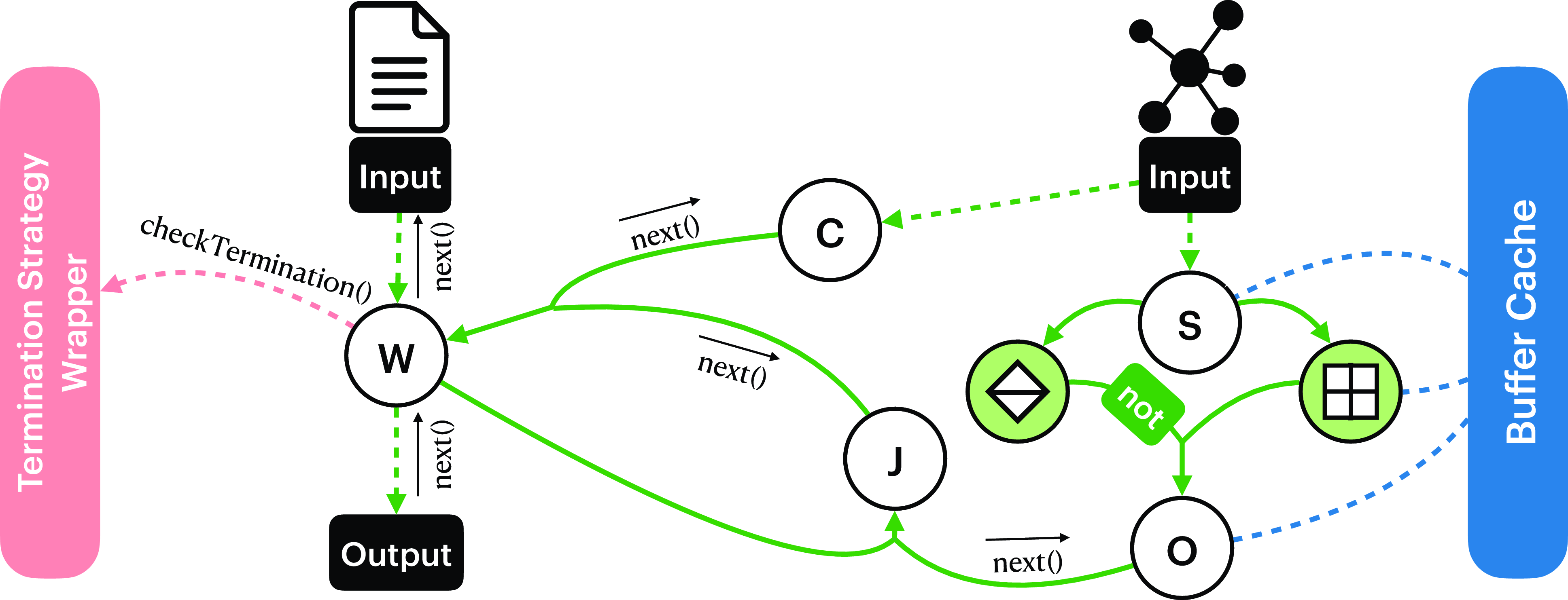
Building the pipeline involves four main steps: (i) A logic optimizer rewriting tasks to simplify programs and ensure that only combined individual operators are allowed in the canonical form. (ii) A logic compiler transforming the rules into in-memory placeholder objects, each assigned the “task of knowing” the transformation to be performed. (iii) A heuristic optimizer producing variations of the generated pipeline to improve performance by introducing perturbations and ad-hoc simplifications. (iv) Finally, a query compiler translating the logical graph structure into a reasoning query plan. Each placeholder generates a filter responsible for performing the transformations; each read-write dependency between rules induces a pipe. Figure 1 shows the Example1.1 pipeline.
The reasoning pipeline for Example1.1. The atom significantShare is denoted by the filter S, significantOwner by O, watchCompany by W, connected by C, and J is an artificial filter to decompose, for simplicity, the ternary join of Rule 2 into binary joins.
At runtime
At runtime, a pull-based approach is used: sinks iteratively pull data using next() and get(), propagating calls through a filter chain to source filters. Source filters read from the initial data source via data adapters. Each filter applies transformations based on rule types (linear, joins, temporal operators, aggregations, etc.). In particular, a linear filter handles Vadalog linear rules, defined as rules having a single atom in the body.Footnote 1 As long as data is available in the cascade of invoked filters, next() succeeds. In Figure 1, for example, facts for the output filter W are generated both with the input data C and S and recursively through the filter J since the watchCompany rule is recursive.
Temporal challenges
We will now give a full overview of the system, pointing out how Temporal Vadalog provides support for tackling a number of time-relevant challenges.
-
• Applying Temporal Operators. Section 3.2 covers how the temporal operators (e.g., the
operator in Figure 1) are implemented in the pipeline. -
• Merging strategies. The semantics for
$\boxminus$
requires the merging of adjacent and overlapping intervals to function correctly. How merging strategies work and are designed in Temporal Vadalog is covered in Section 3.3. -
• Temporal Joins and Stratified Negation. Section 3.4 explains the implementation of joins in temporal reasoning (e.g. in the W filter), where time awareness, as well as support for stratified negation, is required.
-
• Termination Strategies. DatalogMTL can formulate programs with infinite models (Bellomarini et al. Reference Bellomarini, Nissl and Sallinger2021b), by capturing domain events that repeat infinitely, such as weekdays. Section 3.5 outlines our strategy for program termination.
-
• Aggregate functions and numeric operations. The Temporal Vadalog System provides standard scalar and temporal arithmetic operations, as well as support for aggregate functions in the form of time point or cross-time monotonic aggregations. This unique feature allows for a non-blocking implementation that works seamlessly with recursion. As far as we know, the Temporal Vadalog System is the only DatalogMTL reasoner capable of implementing aggregations. Their syntax and semantics are explained in our recent publication (Bellomarini et al. Reference Bellomarini, Nissl and Sallinger2021a).
-
• Temporal and non-Temporal Reasoning. Since many existential extensions are undecidable (Lanzinger and Walega Reference Lanzinger and Walega2022), we consider temporal reasoning and existential reasoning as orthogonal fragments: in Datalog with existentials (Bellomarini et al. Reference Bellomarini, Benedetto, Gottlob and Sallinger2022) we forbid temporal operators and in DatalogMTL we forbid existentials. To support both modes within one program we added support for temporal wrapping and unwrapping of rules by allowing to switch between intervals as metadata and as atoms.
-
• Time Series. The handling of time series and the most common operators in this kind of analysis will be presented in Section 4.
 operator in Figure
3.2 Temporal operators
The implementation of the temporal operators introduced by DatalogMTL is designed in a two-phase procedure, first by applying logical optimization to reduce the number of required rules, and then by introducing multiple filter nodes in the reasoning pipeline.
Logical optimization
The application of linear temporal operators, that is, the operators for Vadalog linear rules, box and diamond, results in intervals computed through mathematical expressions between the interval of a fact, $\langle t_1, t_2 \rangle$
, and that of the operator itself,
$\langle t_1, t_2 \rangle$
, and that of the operator itself, $\varrho = \langle o_1, o_2 \rangle$
, as schematized by Walega et al. (Reference Walega, Cuenca grau, Kaminski and Kostylev2019):
$\varrho = \langle o_1, o_2 \rangle$
, as schematized by Walega et al. (Reference Walega, Cuenca grau, Kaminski and Kostylev2019):
with corresponding rules for determining the interval boundaries.Footnote 2
Among these,  offers one of the most accessible intuitions for understanding how an interval is derived: let us say that a shop has recentlyOpened if it had its inauguration in the past 12 days: $inauguration(X)\,{\rightarrow}\,recentlyOpened(X)$
. Assume that shop A has had its inauguration on the 5th and 6th days of the month:
$inauguration(X)\,{\rightarrow}\,recentlyOpened(X)$
. Assume that shop A has had its inauguration on the 5th and 6th days of the month: $D = \{\mathit {inauguration}(A)@[5,6]\}$
. Then, A can be considered to have recentlyOpened between the 5th and the 18th:
$D = \{\mathit {inauguration}(A)@[5,6]\}$
. Then, A can be considered to have recentlyOpened between the 5th and the 18th: $\mathit {recentlyOpened}(A)@[5,18]$
, that is
$\mathit {recentlyOpened}(A)@[5,18]$
, that is $[t_1 + o_1, t_2+o_2]$
.
$[t_1 + o_1, t_2+o_2]$
.
As these expressions can be composed, one can rewrite a chain of Vadalog linear rules containing temporal operatorsFootnote 3 into a single rule with an equivalent temporal operator, as long as every intermediate step of the chain yields a valid (i.e. non-empty) interval.
Since the derived interval can include both positive and negative endpoints, an equivalent operator cannot be chosen among the linear operators ,
, ,
, $\boxminus$
,
$\boxminus$
, $\boxplus$
, and instead is implemented as a generic operator
$\boxplus$
, and instead is implemented as a generic operator $T\langle e_1,e_2 \rangle$
where
$T\langle e_1,e_2 \rangle$
where $\langle e_1,e_2 \rangle$
is the desired interval transformation. That is,
$\langle e_1,e_2 \rangle$
is the desired interval transformation. That is, $T\langle e_1,e_2 \rangle$
applied to the interval
$T\langle e_1,e_2 \rangle$
applied to the interval $\langle t_1, t_2 \rangle$
of a fact gives
$\langle t_1, t_2 \rangle$
of a fact gives $\langle t_1 + e_1, t_2 + e_2 \rangle$
. Note that
$\langle t_1 + e_1, t_2 + e_2 \rangle$
. Note that $T$
is not constrained by the usual restrictions for intervals in linear operators, that is
$T$
is not constrained by the usual restrictions for intervals in linear operators, that is $e_1$
and
$e_1$
and $e_2$
are arbitrary for
$e_2$
are arbitrary for $T$
. The linear operators
$T$
. The linear operators ,
, ,
, $\boxminus$
,
$\boxminus$
, $\boxplus$
can easily be seen as instances of the generic
$\boxplus$
can easily be seen as instances of the generic $T$
operator: we have that
$T$
operator: we have that $T\langle e_1,e_2 \rangle$
expresses any of the following:
$T\langle e_1,e_2 \rangle$
expresses any of the following: , or
, or $\boxplus _{\langle -e_1,-e_2 \rangle }$
.
$\boxplus _{\langle -e_1,-e_2 \rangle }$
.
Algorithm
Given a chain of Vadalog linear rules, we apply the mathematical expressions of each operator in order, starting from $[0,0]$
, the smallest valid interval for facts. If the resulting interval is empty – that is, the left endpoint is larger than the right endpoint, or, in case it is equal, the interval is open – or if we reach the end of the chain, we stop and merge the rules to an equivalent temporal operator applying the derived interval. This process is applied exhaustively until all rules are merged.
$[0,0]$
, the smallest valid interval for facts. If the resulting interval is empty – that is, the left endpoint is larger than the right endpoint, or, in case it is equal, the interval is open – or if we reach the end of the chain, we stop and merge the rules to an equivalent temporal operator applying the derived interval. This process is applied exhaustively until all rules are merged.
Example 3.1.
Consider the following combination of three temporal operators, where (Expression 3) can be reduced to $T[9,9]$
, while (Expression 4) can be reduced only partially.
$T[9,9]$
, while (Expression 4) can be reduced only partially.


For Expression 3, we first apply
 Footnote
4
to
Footnote
4
to $[0,0]$
, resulting in
$[0,0]$
, resulting in $[-3,-1]$
, then apply
$[-3,-1]$
, then apply
 , resulting in the interval $[-1,4]$
. Then, we combine this interval with the remaining operator
$[-1,4]$
. Then, we combine this interval with the remaining operator $\boxminus _{[5,10]}$
, resulting in
$\boxminus _{[5,10]}$
, resulting in $[9,9]$
and in the final expression
$[9,9]$
and in the final expression $T[9,9] A$
. For Expression 4, we again apply
$T[9,9] A$
. For Expression 4, we again apply
 to
to $[0,0]$
, resulting in
$[0,0]$
, resulting in $[-3,-1]$
, but then apply
$[-3,-1]$
, but then apply $\boxminus _{[5,10]}$
resulting in the interval
$\boxminus _{[5,10]}$
resulting in the interval $[7,4]$
. As no further optimization is possible, the final expression is
$[7,4]$
. As no further optimization is possible, the final expression is
 .
.
Reasoning pipeline
A filter node is introduced for each operation executed in the pipeline. For the operators introduced by DatalogMTL, we consider the following:
-
• TemporalNode. This node computes the resulting interval of a fact at the application of a linear temporal operator (
,,
$\boxminus$
,
$\boxplus$
, or the generic
$T$
operator introduced in Logical Optimization, following the DatalogMTL semantics as shown above). -
• MergeNode. This node merges overlapping and adjacent intervals, required for the application of the box operator. Its functioning is addressed in Section 3.3.
-
• ClosingNode. This node computes the closure of the interval of a fact. It is required before the application of
$\mathbin {\mathcal {S}}$
and
$\mathbin {\mathcal {U}}$
, as defined in (Walega et al. Reference Walega, Cuenca grau, Kaminski and Kostylev2019):
$\varrho _{\mathbin {\mathcal {S}}} = ((\varrho _1^c \cap \varrho _2) + \varrho _3) \cap \varrho _1^c$
, resp.
$\varrho _{\mathbin {\mathcal {U}}} = ((\varrho _1^c \cap \varrho _2) - \varrho _3) \cap \varrho _1^c$
where
$c$
denotes the closing operator and
$+$
(resp.
$-$
) is the addition (subtraction) of intervals as defined for (). -
• TemporalJoinNode. An extension of the join node in Vadalog incorporating restrictions on intervals of facts, required for
$\mathbin {\mathcal {S}}$
and
$\mathbin {\mathcal {U}}$
to take the semantics of the special join behavior of intervals into account. We discuss this node in detail in Section 3.4.
 ,
, ,
, 


 (
( ).
).

3.3 Merging strategies
This section discusses the implementation of the MergeNode, which provides us with two orthogonal optimization choices: (i) the placement strategy and (ii) the merge strategy.
Example 3.2.
A person $X$
that owns an amount
$X$
that owns an amount $Z$
of shares of a company
$Z$
of shares of a company $Y$
is an investor of the company (Rule 5), and a long-time investor of the company if it is an investor for at least 3 years with gaps of at most half a year (Rule 6).
$Y$
is an investor of the company (Rule 5), and a long-time investor of the company if it is an investor for at least 3 years with gaps of at most half a year (Rule 6).
 \begin{align} \mathit {shares}(X,Y,Z) & \to \mathit {investor}(X,Y) \end{align}

with the following database:
 \begin{align*} \mathcal {D} = \{\mathit {shares}(A,B,0.2)@[0.1,0.5), \mathit {shares}(A,B,0.2)@[0.4,1.1), \\ \mathit {shares}(A,B,0.3)@[1.5,3.7), \mathit {shares}(A,B,0.4)@[3.7,4.2)\} \end{align*}
Placement strategy
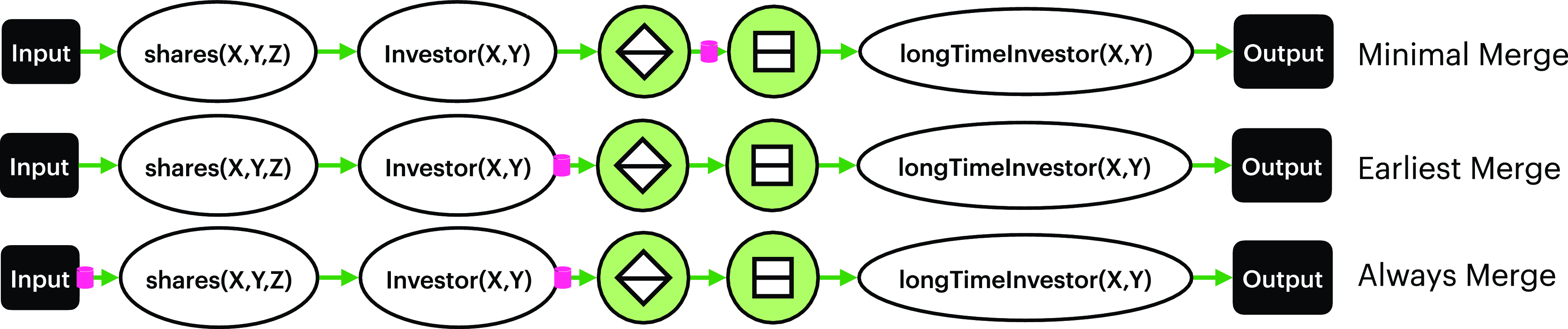
The system maintains an ordered data structure of intervals for each fact. Depending on the program, there are multiple ways to merge facts to uphold correctness. Consider Example3.2, where one can merge directly before the box operator (minimal merge), before the diamond operator (earliest merge), or continuously, that is always guaranteeing that all intervals per fact are merged (always merge) throughout the reasoning process. The placement options are described as follows:
-
• Minimal Merge. The planner inserts a merge operation before every box operator. This ensures correctness but does not provide further performance optimization.
-
• Earliest Merge. The planner inserts the merge in the earliest position it can be processed in the pipeline, so that the intervals of each fact are already merged when it reaches the box operator, while the operators coming before the latter also benefit from the reduced number of facts. If no merge operation is required (i.e. there is no box operator) the planner avoids merging.
-
• Always Merge. Merge operations are placed after the input filters and all filters that can generate facts with unmerged intervals. This can reduce the number of intermediary facts, providing a memory usage improvement, yet has a tradeoff with the time required for merging all existing facts.
In addition, for the Minimal and Earliest Merge, further optimization is obtained by providing the planner hints on where to place additional merge nodes, such as: after rules that share the same head; after a diamond operator produces many overlapping intervals; after the input or before the output to eliminate duplicates.
Figure 2 shows the merging strategies for Example3.2. Temporal operators transform any set of intervals into a merged set: coalescing is always applied before the output.
Overview of interleaving strategies; merging positions are marked in fuchsia.
Merge strategy
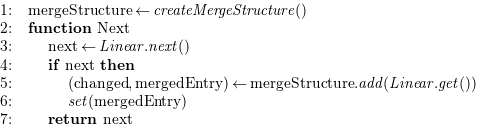
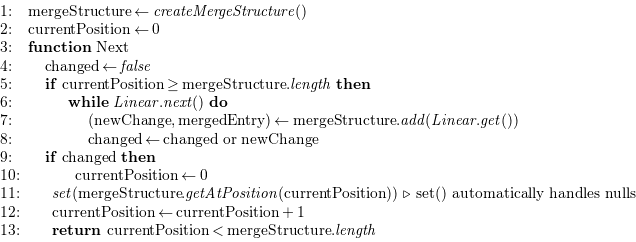
In software development, we face a typical tradeoff between streaming and blocking-based processing operations: the former typically aims for system responsiveness, limited memory footprint, and in-memory computation, while the latter aims for improving overall performance but requires more memory or materialization of intermediate results (Sciore Reference Sciore2020). In the case of the merging operator, we recognize a similar behavior. The merging operator is partially blocking: it can return a partial merge, but has to wait for all facts to be processed to return the final merged intervals. Two implementation options, Streaming and Blocking, were integrated into the system. Algorithms 1-2 present these strategies through the function next(), which returns a Boolean denoting whether a new fact has been retrieved (the caller will later retrieve the fact itself through a separate getter function get()). It makes use of Linear.next(), inherited from the linear filter scan, to check for new facts in the pipeline; thus it retrieves the facts, merges their intervals, and saves them into a mergeStructure, a hash map with the ground atoms as keys and the collections of intervals as values.Footnote 5 Every node (and hence, every MergeNode) handles only one atom. Updating mergeStructure via add also returns a Boolean newChange to note whether mergeStructure has been updated (i.e. it added new facts or new intervals not subsumed by already-present intervals.)
Streaming Strategy in the MergeNode
Blocking Strategy in the MergeNode
Streaming. (Algorithm1) This operator pulls a fact from the previous node, merges the fact on-the-fly with the intermediate merging result, and forwards the merged fact without waiting until all incoming data has been processed.
Blocking. (Algorithm2) This operator receives and merges all available facts before forwarding them: currentPosition keeps track of the facts already served downstream. Newly received factsFootnote 6 are only retrieved if the facts in mergeStructure have already been handled (Line 5); currentPosition is reset to 0 if mergeStructure is changed: as we do not know which facts have been changed,Footnote 7 all of them will have to be served again downstream (Lines 9-10). With set() (Line 11) we specify which fact will be retrieved with get() by the next() call from the filter below (an incremental value as long as the next() is called and no new facts are retrieved, 0 in case we have to start again because the structure changed). The calls are performed as long as there are new facts to pull from the filter above. By construction, as shown in Section 3.1, our termination strategies ensure termination also in the presence of cyclicity. Note that the possible merges of the facts have already been performed during the execution of the pipeline and no outstanding merges are left after termination.
Example 3.3.
Example
3.2
(continued) with the merge operator placed directly before the box. The Streaming Merge reads the first three entries, sufficient to apply $\boxminus _{[0,3]}$
to derive the intermediate result longTimeInvestor(A,B)@[3.1,4.2], before the final longTimeInvestor(A,B)@[3.1,4.7] is derived; the Blocking Merge strategy waits for all facts to be read then applies the box operator, deriving only fact longTimeInvestor(A,B)@[3.1,4.7].
$\boxminus _{[0,3]}$
to derive the intermediate result longTimeInvestor(A,B)@[3.1,4.2], before the final longTimeInvestor(A,B)@[3.1,4.7] is derived; the Blocking Merge strategy waits for all facts to be read then applies the box operator, deriving only fact longTimeInvestor(A,B)@[3.1,4.7].
3.4 Temporal joins
Example 3.4.
A person $X$
that goes to a movie matinee
$X$
that goes to a movie matinee $M$
(between
$M$
(between $[14,16)$
) gets a discounted ticket (Rule 7 and database). In the example, only person
$[14,16)$
) gets a discounted ticket (Rule 7 and database). In the example, only person $A$
will get a discount.
$A$
will get a discount.
 \begin{align} \mathit {goesToTheMovies}(X,M), \mathit {matineeDiscount}(M) \to \mathit {discountedTicket}(X) \end{align}
 \begin{align*} \mathcal {D} = \{\mathit {goesToTheMovies}(A,C)@[15,17), \mathit {goesToTheMovies}(B,C)@[21,23), \\ \mathit {matineeDiscount}(C)@[14,16)\} \end{align*}
When joining two or more temporal predicates, we are interested in joining them not only based on their terms, but also on the temporal interval of each fact. We call this particular join a “temporal join."
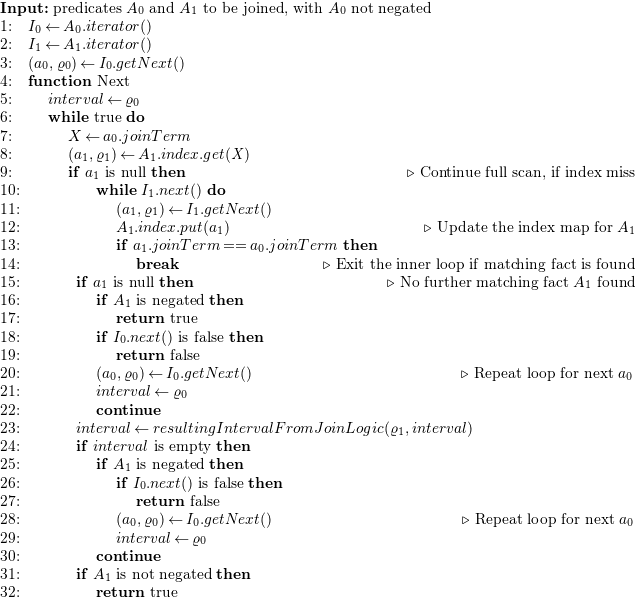
The temporal join in Temporal Vadalog is an extension with intervals of the Vadalog slot machine join (Bellomarini et al. Reference Bellomarini, Benedetto, Gottlob and Sallinger2022), an enhanced version of the index nested loop join (Garcia-Molina et al. Reference Garcia-molina, Ullman and Widom2009) with the support of dynamic in-memory indexing: instead of having a pre-calculated index, it builds the index in-memory during the first full scan. Algorithm3 shows the operation for joining two predicates ( $n=2$
). For each predicate
$n=2$
). For each predicate $A_{k}$
with
$A_{k}$
with $0 \leq k \lt n$
to be joined, we first use the index to get the next scanned fact that matches the known terms used in the join, that is the joinTerm from the previous
$0 \leq k \lt n$
to be joined, we first use the index to get the next scanned fact that matches the known terms used in the join, that is the joinTerm from the previous $A_j$
with
$A_j$
with $0 \leq j \lt k$
(Line 8). If no further fact is found in the index, we do the full scan (Lines 10-14) until either a matching fact is found or the number of facts is exhausted. If no further fact is found (Line 15-22), we continue the scan with the next
$0 \leq j \lt k$
(Line 8). If no further fact is found in the index, we do the full scan (Lines 10-14) until either a matching fact is found or the number of facts is exhausted. If no further fact is found (Line 15-22), we continue the scan with the next $A_{j}$
if it exists and the current
$A_{j}$
if it exists and the current $A_k$
is not negated. In case a fact has been found (whether from the index or the full scan), we update the valid interval of the joined fact depending on the join logic (Line 23): the difference for a negated literal, the intersection for a positive interval, or a mixture of interval operations and set operations for
$A_k$
is not negated. In case a fact has been found (whether from the index or the full scan), we update the valid interval of the joined fact depending on the join logic (Line 23): the difference for a negated literal, the intersection for a positive interval, or a mixture of interval operations and set operations for $\mathbin {\mathcal {U}}$
and
$\mathbin {\mathcal {U}}$
and $\mathbin {\mathcal {S}}$
. Finally, we check whether the resulting interval is valid and if not, if
$\mathbin {\mathcal {S}}$
. Finally, we check whether the resulting interval is valid and if not, if $A_{k}$
is negated, we continue the scan with the next
$A_{k}$
is negated, we continue the scan with the next $A_{j}$
if it exists (Line 25-29), otherwise we continue with the loop; in case the interval is not empty and
$A_{j}$
if it exists (Line 25-29), otherwise we continue with the loop; in case the interval is not empty and $A_{k}$
is not negated, we return true as we have found a valid joined fact (Line 31-32); otherwise, we continue to retrieve the next “negated” fact.
$A_{k}$
is not negated, we return true as we have found a valid joined fact (Line 31-32); otherwise, we continue to retrieve the next “negated” fact.
As the temporal join supports negated atoms, it follows that Temporal Vadalog supports stratified negation in safe rules.
3.5 Termination strategy for the infinite chase of intervals
In previous work (Bellomarini et al. Reference Bellomarini, Nissl and Sallinger2021b), we discussed the fragments of DatalogMTL that can generate infinite models that have finite representations in DatalogMTL $^{\mathit {FP}}$
. In the following example, we depict one such case. This section explains how Temporal Vadalog handles these cases to guarantee termination.
$^{\mathit {FP}}$
. In the following example, we depict one such case. This section explains how Temporal Vadalog handles these cases to guarantee termination.
Example 3.5.
A 30-day Job Report is an economic indicator, released once every 30 days, whose content can impact stock prices. Stock market analysts want to be aware of this indicator’s releases to mark them as possible causes of stock price change over a certain threshold ( $K$
below).
$K$
below).
Temporal Join between two predicates

 \begin{align} \mathit {StockPriceChange}(X,V), V\gt K &\to \mathit {PriceEvent}(X) \end{align}

A DatalogMTL $^{\mathit {FP}}$
(resp. BP) program can fall into one of three categories (Bellomarini et al. Reference Bellomarini, Nissl and Sallinger2021b): (i) it is harmless, that is it satisfies the sufficient conditions for a finite model; (ii) it is either
$^{\mathit {FP}}$
(resp. BP) program can fall into one of three categories (Bellomarini et al. Reference Bellomarini, Nissl and Sallinger2021b): (i) it is harmless, that is it satisfies the sufficient conditions for a finite model; (ii) it is either temporal linear or DatalogMTL $^{\mathit {FP}}_{\boxminus }$
union-free, that is it satisfies the sufficient condition for a constant model under certain constraints; (iii) otherwise, it belongs to the DatalogMTL
$^{\mathit {FP}}_{\boxminus }$
union-free, that is it satisfies the sufficient condition for a constant model under certain constraints; (iii) otherwise, it belongs to the DatalogMTL $^{\mathit {FP}}$
category, a sufficient condition for a periodic model.
$^{\mathit {FP}}$
category, a sufficient condition for a periodic model.
The Temporal Vadalog system guarantees termination by employing a two-phase approach, one at compile time and one at runtime.
Compile time
In this phase, the planner detects the fragment of DatalogMTL $^{\mathit {FP}}$
:
$^{\mathit {FP}}$
:
-
(i) The planner checks if the program has “harmful” temporal cycles using (Bellomarini et al., Reference Bellomarini, Nissl and Sallinger2021b, Algorithm 1). If the program is harmless, it marks
$\textit {modelKind}=\textit {Finite}$
. -
(ii) In presence of harmful temporal cycles, the algorithm checks if the program is temporal linear, that is, each rule has at most one body predicate mutually temporal recursive with the head in the dependency graph of
$\Pi$
. If the program is temporal linear and the operators allowed in temporal linear, defined over
$[t1,t2]$
are such that
$t1 \neq t2$
, then the algorithm sets the
$\textit {modelKind}=\textit {Constant}$
. -
(iii) If the program is not temporal linear, the algorithm checks if the program is union-free. A program is union-free if there are no rules of
$\Pi$
sharing the same head predicate. If the program is union-free and the box operators
$\boxminus _{[t1,t2]}$
are such that
$t1 \neq t2$
, then the algorithm sets the
$\textit {modelKind}=\textit {Constant}$
. -
(iv) If the program does not meet the conditions to be temporal linear or union-free, we assume it is in DatalogMTL
$^{\mathit {FP}}$
and set
$\textit {modelKind}=\textit {Periodic}$
.


At this time, the system computes the repeating pattern length pLength in all non-finite cases, based on the pattern lengths combination of the different Strongly Connected Components of $\Pi$
. The resulting facts are of the form
$\Pi$
. The resulting facts are of the form $P(\tau )@\varrho$
and
$P(\tau )@\varrho$
and $\{P(\tau )@\langle o_1, o_2 \rangle, \mathit {n}\}$
, while the intervals are given by
$\{P(\tau )@\langle o_1, o_2 \rangle, \mathit {n}\}$
, while the intervals are given by $\langle o_1 + \mathit {x} * \mathit {pLength}, o_2 + \mathit {x} * \mathit {pLength} \rangle$
for all
$\langle o_1 + \mathit {x} * \mathit {pLength}, o_2 + \mathit {x} * \mathit {pLength} \rangle$
for all $x \in \mathbb {N}$
, where
$x \in \mathbb {N}$
, where $x \geq \mathit {n}$
, in the case of periodic, or
$x \geq \mathit {n}$
, in the case of periodic, or $\langle o_1 + \mathit {x} * \mathit {pLength}, \infty \rangle$
, in the case of constant. Functional components called termination strategies wrap all filters in the pipeline, to prevent the generation at runtime of facts leading to non-termination.
$\langle o_1 + \mathit {x} * \mathit {pLength}, \infty \rangle$
, in the case of constant. Functional components called termination strategies wrap all filters in the pipeline, to prevent the generation at runtime of facts leading to non-termination.
Runtime
In this phase, the system behavior depends on the detected fragment (the one associated with the set modelKind), denoting fragment awareness. If modelKind is finite, non-termination can only be caused by Datalog recursion, and standard termination strategies are employed. The reasoning produces facts of the form $P(\tau )@\varrho$
. If the model is constant or periodic, the termination strategies recognize facts generated by the “non-finite” filters and mark the matching repeating patterns. In the case of a constant model, the base interval of ground atoms is converted into
$P(\tau )@\varrho$
. If the model is constant or periodic, the termination strategies recognize facts generated by the “non-finite” filters and mark the matching repeating patterns. In the case of a constant model, the base interval of ground atoms is converted into $\langle o_1 + \mathit {x} * \mathit {pLength}, \infty \rangle$
, and the generation stops. If the model is periodic, the termination strategies related to the “non-finite” filters represent the numeric intervals with the equivalent of their pattern-based symbol, so that repeating sub-intervals are not generated, and termination is guaranteed.
$\langle o_1 + \mathit {x} * \mathit {pLength}, \infty \rangle$
, and the generation stops. If the model is periodic, the termination strategies related to the “non-finite” filters represent the numeric intervals with the equivalent of their pattern-based symbol, so that repeating sub-intervals are not generated, and termination is guaranteed.
Looking back at Example3.5, at compile time the planner determines that $\textit {modelKind}=\textit {Periodic}$
, and, from Rule 10, that
$\textit {modelKind}=\textit {Periodic}$
, and, from Rule 10, that $pLength=1$
. At runtime, after fact
$pLength=1$
. At runtime, after fact $\mathit {30DayJobReport}@[60,60]$
is generated, the termination strategy for PossibleCause infers that
$\mathit {30DayJobReport}@[60,60]$
is generated, the termination strategy for PossibleCause infers that $n=0$
and so that all facts generated from Rule 8 have form
$n=0$
and so that all facts generated from Rule 8 have form $\mathit {30DayJobReport}@[x\times 30,x\times 30 + 1]$
for
$\mathit {30DayJobReport}@[x\times 30,x\times 30 + 1]$
for $x \ge 0$
, and their generation is put on hold. Applying the join for
$x \ge 0$
, and their generation is put on hold. Applying the join for $\mathit {PriceEvent}@[121,121]$
and the pattern generated from Rule 8-Rule 10,
$\mathit {PriceEvent}@[121,121]$
and the pattern generated from Rule 8-Rule 10, $x \in \mathbb {N}$
such that
$x \in \mathbb {N}$
such that $[x\times 30,x\times 30 + 1] \cap [121,121]$
is not an empty interval and corresponds to
$[x\times 30,x\times 30 + 1] \cap [121,121]$
is not an empty interval and corresponds to $x=4$
. We can conclude that
$x=4$
. We can conclude that $\textit {PossibleCause}$
(A,“JR”)@[121,121].
$\textit {PossibleCause}$
(A,“JR”)@[121,121].
4 Time Series in Temporal Vadalog
Time series analysis is vital across many sectors, using historical data to identify trends, detect anomalies, predict events, and inform decisions to improve efficiency, reduce costs, and allocate resources. While many Time Series Database systems exist, considering time series analysis relevance in data science, we want to explore how to handle it with a more general-purpose system like Temporal Vadalog. allowing us to use common operators for time series in the broader scope of reasoning applied, for instance, to KGs, specifically exploiting its characteristics of explainability and context-awareness, especially important for domains dealing with sensitive data and particular needs.
In this section, we will present how the Temporal Vadalog System can be used to reason over time series, by showing how many of the core functions of time series databases are easily and immediately available by using DatalogMTL operators, monotonic temporal aggregations and arithmetic operations. Since we focus on regular time series, the examples in the following sections are intended to be used in discrete time (e.g. timestamps).
4.1 Basic operations
Temporal Vadalog natively handles the sum and other arithmetical operations over the same time intervals. This section covers other basic operations that deal with time series: shifting, rolling, and resampling. We will proceed informally by example, as the temporal operators’ semantics has already been introduced.
Basic time series operators in Temporal Vadalog: a) Shifting by 1; b) Rolling operator with $n=3$
; c) Join of the extended intervals with the original ones.
$n=3$
; c) Join of the extended intervals with the original ones.

Shifting
Shifting re-positions the time points of a time series by adding a delay, achieved through the box or diamond operator by stating a fact holds at $t$
if it held at some past time point. The example adds a lag of one unit of time to the stock facts, where
$t$
if it held at some past time point. The example adds a lag of one unit of time to the stock facts, where $\mathit {stock}(X,\mathit {Value})$
represents any time series
$\mathit {stock}(X,\mathit {Value})$
represents any time series $X$
with value
$X$
with value $\mathit {Value}$
. Figure 3a shows the shifting operation over a discrete timeline.
$\mathit {Value}$
. Figure 3a shows the shifting operation over a discrete timeline.

Rolling
Rolling defines a fixed-size window that slides through a time series one data point at a time, allowing for the computation of statistics over the data points within the window. A rolling window of size $n$
is achieved by extending each data point’s interval by
$n$
is achieved by extending each data point’s interval by $[0,n)$
with the diamond operator (Figure 3b). The time series is later joined with the original one, applying the full window’s data points to each specific interval for further operations (Figure 3c where at
$[0,n)$
with the diamond operator (Figure 3b). The time series is later joined with the original one, applying the full window’s data points to each specific interval for further operations (Figure 3c where at $t=3,4$
we have the
$t=3,4$
we have the $n=3$
rolling windows.)
$n=3$
rolling windows.)

 \begin{align} \mathit {stock}(X, \mathit {Value}), \mathit {extended}(X,Roll) & \to \mathit {rolling}(X,\mathit {Roll}) \end{align}
Resampling
The resampling of a time series changes its time resolution. Working with different time resolutions (e.g. one monthly series and one daily) may require this change in both directions: downsampling, lowering the frequency of the data (e.g. daily to monthly), and upsampling, increasing the frequency (e.g. monthly to daily).
Downsampling. In Temporal Vadalog we can achieve downsampling by using the aggregation operator $\triangle _{\mathit {unit}}$
, where unit is the frequency we want to transform our time series into. This operator was introduced in a previous work (Bellomarini et al. Reference Bellomarini, Nissl and Sallinger2021a).
$\triangle _{\mathit {unit}}$
, where unit is the frequency we want to transform our time series into. This operator was introduced in a previous work (Bellomarini et al. Reference Bellomarini, Nissl and Sallinger2021a).
 \begin{align} \triangle _{\mathit {month}} \mathit {dailyStock}(X,\mathit {Value}) &\to \mathit {monthlyStocks}(X,\mathit {Value}) \end{align}
The set of facts that were valid daily will be now valid over the entire month. To obtain the final value for the monthly data point, we can use arbitrary aggregations, depending on the domain (e.g. arithmetic mean, minimum, maximum, etc.)
Upsampling. We can convert a time series to a higher frequency by using the temporal join with a series with a higher frequency that we can create on the spot with a diamond operator. In the following example, we will convert a weeklyStock(Company,Value,WeekStart), where $\mathit {WeekStart}$
is expressed in a day unit, into a daily time series.
$\mathit {WeekStart}$
is expressed in a day unit, into a daily time series.


 \begin{gather} \mathit {dailySeries}(Z), \mathit {weeklyStock}(C,V_1,W_1), \nonumber\\ \mathit {nextWeek}(C,V_2,W_2), W=W_1 + \tfrac {(V-V_1)(W_2-W_1)}{(V_2-V_1)} \to \mathit {upsampling}(C,W) \end{gather}
Note that Rule 15 generates an infinite chase of intervals, which requires us to employ a mechanism for terminating the generations like the strategies discussed in Section 3.5.
4.2 Moving averages
Moving averages use the rolling window described above to calculate different types of averages, typically to smooth out fluctuations and noise.
Simple moving average (SMA)
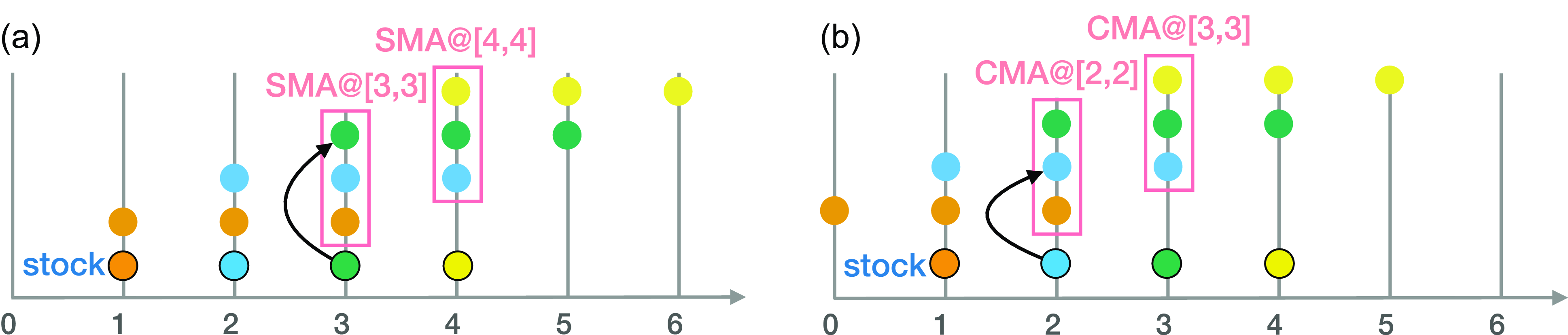
In this moving average, each data point contained in the window has the same weight in the calculation of the average. Hence, we compute first the rolling window and then derive the arithmetic mean of the data points (Figure 4a).
 \begin{align} \mathit {rolling}(X,Y), \mathit {Avg}=avg(Y) & \to \mathit {sma}(X,\mathit {Avg}) \end{align}
From simple moving average (a) to centered moving average (b), with $n=3$
.
$n=3$
.
Exponential moving average (EMA)
With the EMA operator we give more importance to the more recent data points. The first value is calculated through the simple moving average. We omit this from the example for conciseness. The following values are calculated as a sum (Rule 21) of the current data point multiplied by the parameter $k$
(where
$k$
(where $k=2/(1+n)$
,
$k=2/(1+n)$
, $n$
being the size of the window) (Rule 20) and, using recursion, the previous moving average multiplied by
$n$
being the size of the window) (Rule 20) and, using recursion, the previous moving average multiplied by $1-k$
(Rule 19).
$1-k$
(Rule 19).

 \begin{align} \mathit {stock}(X, V), Y= X * k & \to \mathit {emaInput}(Y) \end{align}
 \begin{align} \mathit {emaInput}(X), Y = sum(X) & \to \mathit {ema}(Y) \end{align}
Centered moving average (CMA)
In the SMA operator, a window of $n$
data points will yield a value at the right extremity of that window; in the Centered Moving Average (CMA), instead, the data point of reference for the moving average is the data point at the center of the window. For any odd
$n$
data points will yield a value at the right extremity of that window; in the Centered Moving Average (CMA), instead, the data point of reference for the moving average is the data point at the center of the window. For any odd $n$
window, this is obtained by calculating the SMA and then shifting it by
$n$
window, this is obtained by calculating the SMA and then shifting it by $n/2$
, as shown by Figure 4a-b.
$n/2$
, as shown by Figure 4a-b.

4.3 Stock and flow
Performing mutual conversion between stock and flow is a helpful feature in multiple contexts. Transformation operators, in continuous time, can be computed through derivatives and integrals, while in discrete time one usually considers the difference between two time points. We focus on the discrete version, as the discrete (integer) timelines are the usual implementation choice in time series databases (Dyreson Reference Dyreson2018).
Stock to flow (discrete)
This operator calculates the flow as the difference between the stock at $t$
and
$t$
and $t-1$
. To do so in Temporal Vadalog, we shift the time series by
$t-1$
. To do so in Temporal Vadalog, we shift the time series by $[1,1]$
and compute the difference between the values from the original and shifted time series.
$[1,1]$
and compute the difference between the values from the original and shifted time series.

 \begin{align} \mathit {stock}(X, V1), \mathit {shiftedStock}(X, V2), V = V1-V2 & \to \mathit {stockToFlow}(X, V) \end{align}
Flow to stock (discrete)
This operator, on the other hand, calculates the stock as the cumulative sum of flows from the beginning of the time series up to the current data point. To do so in Temporal Vadalog, we extend the flow time series to the interval $[0,T]$
, where
$[0,T]$
, where $T$
is the last interval, and then we compute the sum over each data point.
$T$
is the last interval, and then we compute the sum over each data point.

 \begin{align} \mathit {rolledFlow}(X, V1), V = sum(V1) & \to \mathit {stock}(X, V) \end{align}
4.4 Seasonal decomposition
Seasonal decomposition separates a time series into three different components: trend, seasonality, and residual. Regular, repeating events such as holidays and seasonal shifts impact variables similarly from one period (e.g. a year) to the next. For this reason, extracting the seasonality from the time series allows having a better understanding of the data. In this section, we compute seasonal decomposition with the additive model.
Trend
The trend component is calculated as the Centered Moving Average (CMA) of the time series, as explained in Section 4.2, abbreviated in the following as a call to $\mathit {cma}$
with
$\mathit {cma}$
with $T$
the length of the period (e.g. 12 months).
$T$
the length of the period (e.g. 12 months).
 \begin{align} \mathit {stock}(X, \mathit {Stock}), \mathit {Value} = \mathit {cma}(\mathit {Stock}, \mathit {T}) \to \mathit {trend}(X, \mathit {Value}) \end{align}
Seasonal component
The seasonal component is extracted by calculating the per-period averages over the difference between the time series and the trend component, which we call detrend. In the following example, we calculate the seasonal component over the period $N$
(e.g. 10 years), with
$N$
(e.g. 10 years), with $T$
representing the length of the period.
$T$
representing the length of the period.

Residual
Finally, the residual is the time series when the seasonal component and the trend are taken out.
 \begin{align} \mathit {detrend}(X, D), \mathit {seasonal}(X, S), \mathit {Value} = D - S \to \mathit {residual}(X, \mathit {Value}) \end{align}
This concludes our section on time series operations in Temporal Vadalog.
5 Experiments
For the experimental evaluation of our system, we conducted several performance tests. Previously (Bellomarini et al. Reference Bellomarini, Benedetto, Gottlob and Sallinger2022), we presented the Company Ownership experiments, a set of five scenarios about ownership changes in companies, whose historical information was stored in Knowledge Graphs of increasing sizes. In this paper, we present new results of the same scenarios, with the optimized reasoning capability of the current Temporal Vadalog and more dynamic datasets (Section 5.1), as well as new results from the experiments created with iTemporal (Bellomarini et al. Reference Bellomarini, Benedetto, Gottlob and Sallinger2022), an extensible generator of temporal benchmarks, in Section 5.4. We also show the results of new experiments: We replicated the experiments from the MeTeoR paper (Wang et al. Reference Wang, Hu, Walega and Grau2022), the Lehigh University Benchmark ones in Section 5.2 and the Meteorological ones in Section 5.3. We also evaluate the performance of reasoning over time series in Section 5.5.
Setup
We run the experiments in a memory-optimized virtual machine with 16 cores and 256 GB RAM on an Intel Xeon architecture. Each experiment was run 3 times, and the results shown are the arithmetic mean of the elapsed time of each set of runs. The time out is set at 4,000 s ( $\sim$
1 hour and 7 minutes).
$\sim$
1 hour and 7 minutes).
Datasets
Our datasets comprise real-world, realistic and synthetic data. Our Company ownership experiments have been run over a real-world dataset (RW1721) extracted from the Italian Companies KG (Bellomarini et al. Reference Bellomarini, Benedetti, Ceri, Gentili, Laurendi, Magnanimi, Nissl and Sallinger2020), in a slice comprising the (continuous) ownership edges from 2017-21. The realistic datasets (MN7-MN28) represent company ownership graphs from 700 thousand to 2.8 million nodes generated in the likeness of a real-world dynamic structure, with their ownership changes over 5 intervals and a high change rate, to test performance. The datasets for the Lehigh University Benchmark are as described in the MeTeoR paper (Wang et al. Reference Wang, Hu, Walega and Grau2022); the Meteorological experiments employ 3 datasets extracted from the Maurer et al. (Reference Maurer, Wood, Adam, Lettenmaier and Nijssen2002) dataset at 5/50/500 stations. For the iTemporal experiments, the synthetic datasets (S1-S10M) are generated with a random distribution over a given domain and include from 1K to 10 M facts. The Time Series experiments were run over the NASDAQ Composite Index (NASDAQ OMX Group 2023), a daily time series from February 1971 to March 2023 comprising 13596 records. From this dataset, we extracted the last 1% (NQ1), 10% (NQ10), and 50% (NQ50) so to have 4 total data sizes. Details about the datasets employed in the experiments can be found in the supplementary material.
5.1 Company ownership experiments
Similarly to Example1.1, we ran experiments on company ownership changes over time.
Scenarios
The experiment scenarios contain different elements: 1) Temporal: diamond operator, recursion, and constraints on variables; 2) Negation: recursion and stratified negation; 3) Aggregation, temporal aggregations; 4) Diamond: diamond operator and recursion; 5) Box: box operator and recursion. We ran each scenario on MN7-28 and RW1721; Box and Diamond were also run on MeTeoR 1.0.15 for comparison, as they do not include features not supported by MeTeoR.Footnote 8 All scenarios were run with the always merge strategy; Box was tested also in the minimal and earliest merge.
Discussion
The performance of Temporal, Negation and Aggregation are shown in Figure 5a. They all show good scalability, with the elapsed time increasing linearly over the dataset sizes. Temporal, the most complex scenario, is the most expensive as well but with just over 182 secs for the biggest datasets, while Aggregation and Negation perform two times faster at 24-99 secs. Figure 5b shows the results for Box and Diamond in both Vadalog and MeTeoR.Footnote 9 Vadalog performs in a similar linear-increase fashion to the other scenarios, about 100 times faster than MeTeoR, which exceeds the 4,000 secs threshold in the MN20-28 datasets in both scenarios. Merge strategy-wise, we see that the always merge (am) Box is the most expensive, running at 180 secs for MN28, while earliest merge (em) Box is on average 8% faster, and similar to those of Diamond at around 41-170 secs. The nature of the datasets, having many adjacent facts, explains it: by merging strategically, fewer facts are sent down the pipeline, and fewer operations are needed while merging all the facts at one time may be superfluous. Figure 5c shows the performance on the real-world dataset. MeTeoR results are not shown as they all exceed the timeout. In Vadalog, Negation and Temporal are the fastest at 102 secs, while Aggregation is the most expensive at 183 secs. In MN7-28, Aggregation performed well compared to Temporal and Negation, but in RW1721, it is the worst due to having 12 times more intervals, decreasing performance. As for the merge strategies, RW1721 shows similar performance to MN7-28, with Box em the best performer at 131 secs and Box am the worst at 145 secs. The full result tables and larger versions of all graphs can be found in the supplementary material.
(a) Temporal, Aggregation and Negation on MN7-MN28 over time; (b) Box and Diamond in Temporal Vadalog and MeTeoR; (c) RW dataset in all scenarios; (d) LUBM Non-Recursive experiment; (e) LUBM Recursive experiment; (f) Meteorological experiments; (g) iTemporal Box and Diamond; (h) iTemporal Union and Intersection; (i) Time Series.
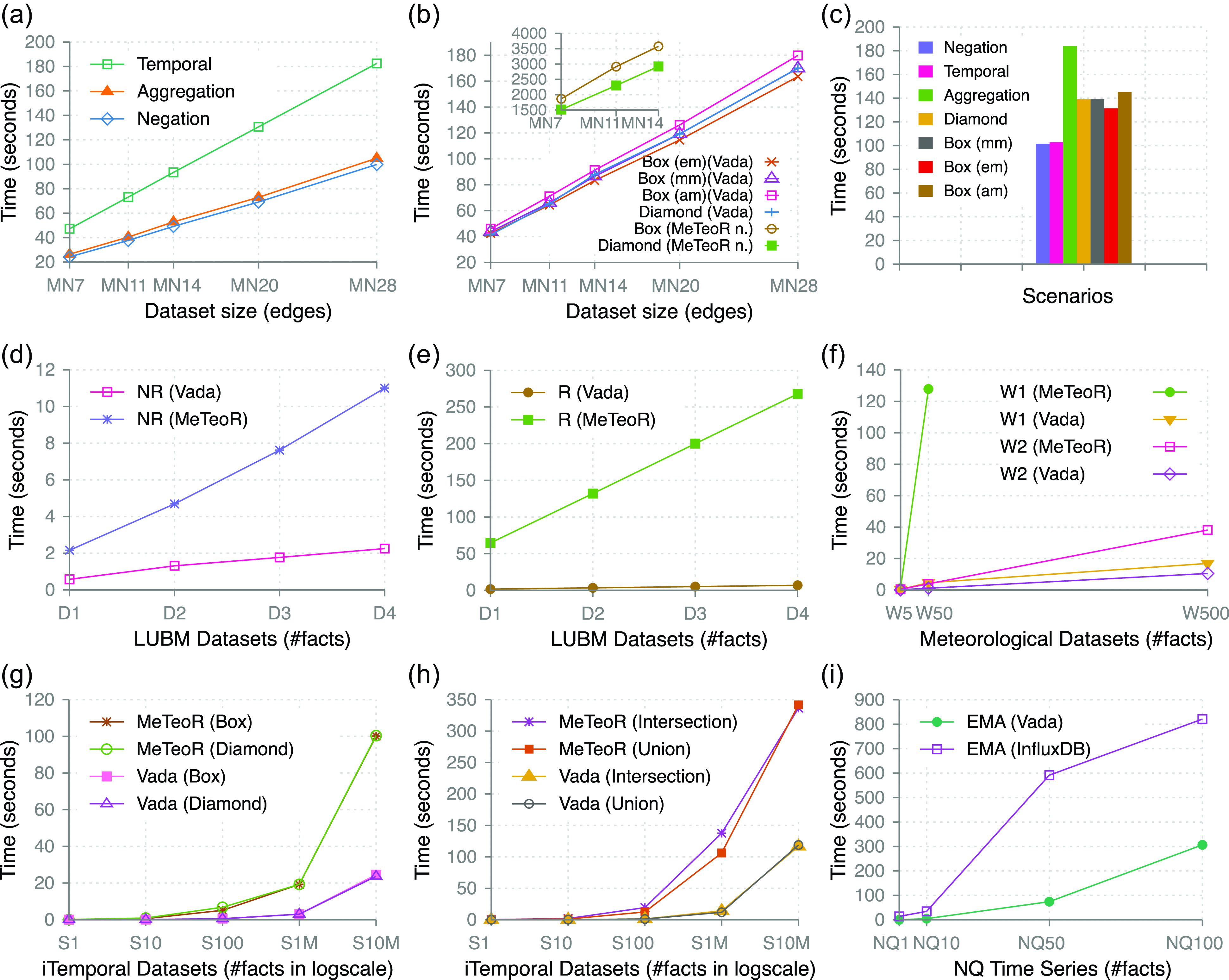
5.2 Lehigh university benchmark experiments (LUBM)
The LUBM benchmark for DatalogMTL (Wang et al. Reference Wang, Hu, Walega and Grau2022) in a modified form Walega et al. (Reference Walega, Kaminski, Wang and Grau2023) measures the efficiency of forward-propagating rules in MeTeoR in the interval $[0,300]$
for four different dataset sizes (5, 10, 15, and 20 million facts) and two different programs (one recursive and one non-recursive program).
$[0,300]$
for four different dataset sizes (5, 10, 15, and 20 million facts) and two different programs (one recursive and one non-recursive program).
Discussion
We used the published program and dataset from Walega et al. (Reference Walega, Kaminski, Wang and Grau2023) and repeated the experiments for MeTeoR (seminaive mode) and our system. The results are presented in Figures 5d-e and show an overhead for MeTeoR of a factor of at least 3 for the non-recursive program and of a factor of at least 30 for the recursive ones (R). The main factor for better performance in Vadalog is the join, which in recursive programs especially shows the benefit of indexing already-seen atoms.
5.3 Meteorological experiments
We adapted the rules of the experiments on meteorological data (Maurer et al. Reference Maurer, Wood, Adam, Lettenmaier and Nijssen2002) in Wang et al. (Reference Wang, Hu, Walega and Grau2022). The programs W1 and W2 are run over a filtered version of this dataset: W1 regarding high temperatures, and W2 regarding heavy winds. For this reason, we have to consider that while the original dataset is the same, W1 works with approximately 10 times the facts of W2. MeTeoR runs in seminaive mode.
Discussion
The results are shown in Figure 5f. Both W1 and W2 perform well in Vadalog, with Vadalog being 28 times faster than MeTeoR for W1 at the W50 size (MeTeoR exceeds the time out for W500), and around 4 times faster for W2.
5.4 iTemporal experiments
Considering the previous experiments, we observe a substantial speedup of the Temporal Vadalog System with respect to MeTeoR (seminaive mode). To confirm these measurements, we used iTemporal (Bellomarini et al. Reference Bellomarini, Benedetto, Gottlob and Sallinger2022), a generator for DatalogMTL, to generate specific experiments with different data sizes targeting the main temporal operations (i.e., the application of temporal operators, joins, and unions).
Discussion
In Figures 5g-h we present the results, which show that our system outperforms MeTeoR with a factor of 3 to 4 (depending on the benchmark) for $10M$
facts and reinforces the observations of the previous benchmarks (e.g. it scales linearly).
$10M$
facts and reinforces the observations of the previous benchmarks (e.g. it scales linearly).
5.5 Time series experiments
We executed the computation of the exponential moving average (EMA) on Vadalog and the Time Series Database InfluxDB (Version 2.6.1) over the NASDAQ Composite Index (NASDAQ OMX Group 2023). InfluxDB is a NoSQL time series database with a distinct data model optimized for time series operations. (InfluxDB 2023) For a fair comparison with the streaming-based approach of Vadalog, we compare the total time of loading and querying the data (end-to-end process).
Discussion
Results are shown in Figure 5i. Our system outperforms InfluxDB by 2.5x for the largest dataset, considering the end-to-end measurement. We note that the experiment’s aim is not to compare against the performance of InfluxDB, but to show that our system can achieve reasonable reasoning times in an end-to-end manner.
6 Related Work
The 1980s see the first proposals for a temporal version of Datalog with $\textrm {Datalog}_{1S}$
(Chomicki Reference Chomicki1990; Chomicki and Imielinski Reference Chomicki and Imielinski1988, Reference Chomicki and Imielinski1989), using successor functions, and Datalog extensions with temporal logic operators from Linear Temporal Logic with Templog (Abadi and Manna Reference Abadi and Manna1989), both with further work from Baudinet (Reference Baudinet1992, Reference Baudinet, Chomicki and Wolper1993, Reference Baudinet1995) and Computation Tree Logic with Datalog LITE (Gottlob et al. Reference Gottlob, Grädel and Veith2002). Further work on constraint databases include: Brodsky et al. (Reference Brodsky, Jaffar and Maher1997); Maher and Srivastava (Reference Maher, Srivastava and Hull1996); Revesz (Reference Revesz2002). Interest in the application of logic programming over the dense timeline focused on Metric Temporal Logic (Alur and Henzinger Reference Alur and Henzinger1993; Koymans Reference Koymans1990) in the work of Brzoska (Reference Brzoska and Lloyd1995, Reference Brzoska1998). More recently, MTL has been considered as a formalism that can provide an expressive temporal extension to Datalog with DatalogMTL in the work of Brandt et al. (Reference Brandt, Kalayci, Kontchakov, Ryzhikov, Xiao and Zakharyaschev2017, Reference Brandt, Kalayci, Ryzhikov, Xiao and Zakharyaschev2018), who also presented a practical implementation through SQL rewriting, although non-recursive. Theory for continuous semantics DatalogMTL (Tena Cucala et al. Reference Tena cucala, Walega, Cuenca grau and Kostylev2021; Walega et al. Reference Walega, Cuenca grau, Kaminski and Kostylev2019; Walega et al. Reference Walega, Cuenca grau, Kaminski and Kostylev2020a; Walega et al. Reference Walega, Cuenca grau, Kaminski and Kostylev2020b) as well as for pointwise (Kikot et al. Reference Kikot, Ryzhikov, Walega and Zakharyaschev2018) has been studied extensively in recent years, and most recently with MeTeoR (Wang et al. Reference Wang, Hu, Walega and Grau2022; Walega Reference Walega2023), a reasoner employing a combination of materialization and automata-based reasoning, and that we have referred for our comparative experiments.
$\textrm {Datalog}_{1S}$
(Chomicki Reference Chomicki1990; Chomicki and Imielinski Reference Chomicki and Imielinski1988, Reference Chomicki and Imielinski1989), using successor functions, and Datalog extensions with temporal logic operators from Linear Temporal Logic with Templog (Abadi and Manna Reference Abadi and Manna1989), both with further work from Baudinet (Reference Baudinet1992, Reference Baudinet, Chomicki and Wolper1993, Reference Baudinet1995) and Computation Tree Logic with Datalog LITE (Gottlob et al. Reference Gottlob, Grädel and Veith2002). Further work on constraint databases include: Brodsky et al. (Reference Brodsky, Jaffar and Maher1997); Maher and Srivastava (Reference Maher, Srivastava and Hull1996); Revesz (Reference Revesz2002). Interest in the application of logic programming over the dense timeline focused on Metric Temporal Logic (Alur and Henzinger Reference Alur and Henzinger1993; Koymans Reference Koymans1990) in the work of Brzoska (Reference Brzoska and Lloyd1995, Reference Brzoska1998). More recently, MTL has been considered as a formalism that can provide an expressive temporal extension to Datalog with DatalogMTL in the work of Brandt et al. (Reference Brandt, Kalayci, Kontchakov, Ryzhikov, Xiao and Zakharyaschev2017, Reference Brandt, Kalayci, Ryzhikov, Xiao and Zakharyaschev2018), who also presented a practical implementation through SQL rewriting, although non-recursive. Theory for continuous semantics DatalogMTL (Tena Cucala et al. Reference Tena cucala, Walega, Cuenca grau and Kostylev2021; Walega et al. Reference Walega, Cuenca grau, Kaminski and Kostylev2019; Walega et al. Reference Walega, Cuenca grau, Kaminski and Kostylev2020a; Walega et al. Reference Walega, Cuenca grau, Kaminski and Kostylev2020b) as well as for pointwise (Kikot et al. Reference Kikot, Ryzhikov, Walega and Zakharyaschev2018) has been studied extensively in recent years, and most recently with MeTeoR (Wang et al. Reference Wang, Hu, Walega and Grau2022; Walega Reference Walega2023), a reasoner employing a combination of materialization and automata-based reasoning, and that we have referred for our comparative experiments.
Another comparable system, the Dyna language solver, proposed by Vieira et al. (Reference Vieira, Francis-landau, Filardo, Khorasani and Eisner2017) employs fixed point evaluation but computation may fail to terminate, while Vadalog employs the isomorphic chase with termination strategies, hence a program will always terminate; the Dyna solver uses forward or backward chaining depending on the strategy chosen by its reinforcement learning optimizer, whereas Vadalog uses a pull-based approach for evaluation, more efficient in resource usage for query answering.
The non-temporal version of the Vadalog System (Bellomarini et al. Reference Bellomarini, Benedetto, Gottlob and Sallinger2022) has been proposed as a system to reason over KGs (Bellomarini et al. Reference Bellomarini, Benedetti, Ceri, Gentili, Laurendi, Magnanimi, Nissl and Sallinger2020) with rules expressed in Warded Datalog $^\pm$
(Bellomarini et al. Reference Bellomarini, Sallinger and Gottlob2018). Other reasoners of similar expressive power include PDQ (Benedikt et al. Reference Benedikt, Leblay and Tsamoura2015), Llunatic (Geerts et al. Reference Geerts, Mecca, Papotti and Santoro2013), Graal (Baget et al. Reference Baget, Leclère, Mugnier, Rocher and Sipieter2015), DLV (Leone et al. Reference Leone, Pfeifer, Faber, Eiter, Gottlob, Perri and Scarcello2006), and RDFox (Nenov et al. Reference Nenov, Piro, Motik, Horrocks, Wu and Banerjee2015).
$^\pm$
(Bellomarini et al. Reference Bellomarini, Sallinger and Gottlob2018). Other reasoners of similar expressive power include PDQ (Benedikt et al. Reference Benedikt, Leblay and Tsamoura2015), Llunatic (Geerts et al. Reference Geerts, Mecca, Papotti and Santoro2013), Graal (Baget et al. Reference Baget, Leclère, Mugnier, Rocher and Sipieter2015), DLV (Leone et al. Reference Leone, Pfeifer, Faber, Eiter, Gottlob, Perri and Scarcello2006), and RDFox (Nenov et al. Reference Nenov, Piro, Motik, Horrocks, Wu and Banerjee2015).
7 Conclusion
In this paper, we introduced a new framework and architecture for reasoning with DatalogMTL, highlighting its efficiency and ability to handle complex tasks, like the reasoning over time series, through multiple performance evaluations. We exceeded the capabilities of existing DatalogMTL reasoning tools. Moving forward, we aim to enhance the reasoner and explore other fragments of DatalogMTL.
Acknowledgements
The work on this chapter was supported by the Vienna Science and Technology Fund [10.47379/VRG18013, 10.47379/NXT22018, 10.47379/ ICT2201]. This research was funded in whole or in part by the Austrian Science Fund 10.55776/COE12. The authors acknowledge TU Wien Bibliothek for financial support through its Open Access Funding Programme.
Supplementary material
To view supplementary material for this article, please visit https://doi.org/10.1017/S1471068425000018.


 Open access

