


Introduction
Simulation games are an established teaching tool in civic education and political science classes. Scholars have described several positive expectations, such as enhancing participants’ political interest and conveying transferable knowledge and skills. Furthermore, they have been described as a promising teaching approach to convey deeper insights into the political process and thus to help students ‘to understand parliaments from the inside’ (Schöne). Empirical studies have underlined positive effects of simulation games on learners’ political dispositions. However, many studies either use purely qualitative approaches or very small-N quantitative approaches. Recently, systematic intervention studies have provided further insights into the effects of political simulation games. But these studies didn’t focus on causes of the measured effects and have lacked depth regarding the learning effects due to a closed items design. There still is a lack of understanding how students’ conceptual changes brought about by participating in the game are related to their changes in political attitudes.
The study presented here addresses this research deficit by using a mixed-method approach, analysing the effects of simulations of European Parliamentarian decision-making conducted with secondary school classes in Germany on students’ political knowledge, motivations and attitudes. This paper focuses on the following research questions: What kinds of political knowledge do the participants gain during the simulation game? How is the students’ knowledge gain—or in other words, their conceptual change—related to changes in their attitudes towards the EU, specifically their perception of EU responsiveness? In addition to a standardised written questionnaire with pre- and post-tests (N = 308), qualitative interviews were conducted with selected participants (n = 12). The interviewees’ answers can be linked to their written answers in the questionnaire, thus allowing for exemplary in-depth insights into certain types of participants as detected in the questionnaire study. The results can help to identify relevant learning effects participants experience in EU simulation games that are not yet captured appropriately by quantitative empirical studies, and thus to stimulate the development of new measurement tools for assessing the learning outcomes of political simulation games more adequately.
The paper is structured as follows: first, drawing on existing literature, an overview of the expected learning outcomes of simulation games and their special potential for teaching about the European Union is given. Here, the relevance of promoting citizens’ political knowledge as well as their political motivations and attitudes, such as their sense of political efficacy and perceived responsiveness of the political system, will be given special attention and discussed in more detail. In the next step, the aim and design of the empirical study are presented, also introducing the simulation game conducted, the sample composition, and the measurement tools and methods of data analysis implemented. Finally, the results of the quantitative and qualitative study are presented and connected to each other. The article concludes with a summary of its core results and an outline of recommendations for future research.
Simulation games as a tool for teaching about the European Union
Simulation games in civic education as well as in teaching politics at University are an action-, learner-, experience- and process-oriented pedagogical method, usually simulating a political decision-making procedure with clearly opposed political interests and a certain time pressure. They reduce reality to a simplified model, allowing participants to experiment with politics and try out their political skills—including their abilities to argue and negotiate—in a safe learning environment. Furthermore, they are expected to disseminate knowledge in an experience-based and hence sustainable fashion. Finally, it is assumed that due to the dynamics of the game and the self-direction of the players, simulation games motivate learners to engage with the subject matter, awakening or deepening their interest in politics (c.f., Clark et al. Reference Clark, Van Dyke, Loedel, Scherpereel and Sobisch2017; Donche et al. Reference Donche, Gijbels, Spooren, Bursens, Bursens, Gijbels, Donche and Spooren2018; Fink Reference Fink2015; Jones and Bursens Reference Jones and Bursens2015; Knogler and Lewalter Reference Knogler, Lewalter and Kriz2014; Krain and Lantis Reference Krain and Lantis2006; Raiser et al. Reference Raiser, Schneider and Warkalla2015; Usherwood Reference Usherwood2014). Simulation games thus seem an appropriate method to simultaneously enhance different dimensions of students’ political competency, such as content knowledge, abilities to make political judgments and take political action as well as political motivations and attitudes (Detjen et al. Reference Detjen, Massing, Richter and Weißeno2012).
With regard to teaching about the European Union (EU), particular challenges require creative pedagogical approaches. The complexity of its multi-level political system has been identified as a central problem for teaching about the EU (Oberle and Forstmann Reference Oberle and Forstmann2015a; Schöne and Immerfall Reference Schöne, Immerfall and Oberle2015). In addition to the perceived hyper-complexity, the strong dynamics of European integration can create an obstacle for teaching and learning, since knowledge about the EU tends to quickly become outdated. Further challenges identified are a perceived distance between the EU and its citizens as well as insufficient (perceived) importance to their everyday life, a lack of prior knowledge, a lack of interest in the EU and prejudices on the part of learners. Given their above-mentioned potential, simulation games are a promising tool for facing these challenges and for successfully promoting students’ EU-related political competencies (c.f. Brunazzo and Settembri Reference Brunazzo and Settembri2012). In the following, the relevance of young citizens’ political knowledge and their political motivations and attitudes will be depicted in more detail.
Knowledge is generally considered to be a vital component of competency. Without content knowledge, subject-specific skills can neither be acquired nor used (Weinert Reference Weinert1999). Citizens’ political knowledge matters, as does that of ‘citizens-to-be’ in the young generation. This can be argued not only when referring to theories of democracy and theories of civic education, but also when looking at empirical research into the effects of having political knowledge (c.f., delli Carpini and Keeter Reference Delli Carpini and Keeter1996; Oberle Reference Oberle2012). Studies show that having political knowledge is positively related to attitudes relevant for a sound functioning of democracy, such as tolerance, trust and the readiness to change one’s perspective (see e.g. Popkin and Dimock Reference Popkin, Dimock, Lupia, McCubbins and Popkin2000; Hall Reference Hall2018). Political knowledge leads to greater political participation and to people participating in ways that allow them to advocate for their own interests and values (e.g. Lau and Redlawsk Reference Lau, Redlawsk and Kuklinski2001; Popkin and Dimock Reference Popkin, Dimock, Elkin and Soltan1999). Furthermore, it enhances competencies regarding the identification and processing of new information on political issues, which is of utmost importance in times of thriving alternative facts and fake news (Sängerlaub Reference Sängerlaub2017; Porter et al. Reference Porter, Wood and Kirby2018). As to the European Union (EU), Eurobarometer data show a significant correlation between EU knowledge and voting in European Parliamentary elections (Westle Reference Westle and Oberle2015; Westle and Johann Reference Westle, Johann, Faas, Arzheimer and Roßteutscher2010), underlining the relevance of political knowledge for political action in the context of the European Union. Also recent studies of Hogh and Larsen (Reference Hogh and Larsen2016) as well as Braun and Tausendpfund (Reference Braun, Tausendpfund, Westle and Tausendpfund2019) point out that knowledge about the EU has a crucial impact on voting in the European elections, as it increases participation in the elections.
Motivations and attitudes are also decisive elements of citizens’ political competency (Weinert Reference Weinert1999; Detjen et al. Reference Detjen, Massing, Richter and Weißeno2012). Political motivations include the perception of political self-efficacy which is a central prerequisite for political participation (Dalton and Klingemann Reference Dalton, Klingemann, Dalton and Klingemann2007; Reichert Reference Reichert2016). One can distinguish between internal and external efficacy (Vetter Reference Vetter1997; Oberle Reference Oberle, Manzel and Oberle2018): While internal political efficacy refers to perceptions of one’s own politics-related skills, external political efficacy is one’s subjective perception of the system’s responsiveness to citizens’ interests, that is, one’s assessment of whether ‘the political system is open to and reacts to the influence of its citizens’ (Vetter and Maier Reference Vetter, Maier and Gabriel2005: 57). Perceptions of responsiveness are closely related to trust in the political system (van der Meer and Zmerli Reference Van der Meer, Zmerli, van der Meer and Zmerli2017) or diffuse political support (Easton Reference Easton1965). Of course, adequate perceptions of responsiveness depend to a large extent on the actual reactions of a political system, its institutions and actors, to citizens’ interests. At the same time, it must be emphasised that without a modicum of citizens’ trust in their political institutions, representative democracy cannot survive (cf. Fuchs et al. Reference Fuchs, Gabriel and Völkl2002). It is unclear just how much trust is required to maintain a democratic political system (Schöne Reference Schöne, Oberle and Weißeno2017). But as Wilhelm Knelangen (Reference Knelangen and Oberle2015) has argued before the BREXIT referendum, a current crisis of trust among EU citizens could pose a serious threat to the existence of the EU.
Building on earlier studies by Patzelt (Reference Patzelt1998, Reference Patzelt2003) and others, Schöne (Reference Schöne, Oberle and Weißeno2017; Reference Schöne2011) assumes that certain misconceptions contribute to a loss of citizens’ trust in their political institutions, especially party-state institutions like parliament and government. Analysing group discussions, he demonstrates that it is quite common even for students in teacher training for being civics teachers to be fed up with political processes (prozessverdrossen). Schöne identifies a lack of ‘appreciation for the interplay between political dispute and the search for compromise’. In order to increase understanding of how politics is done, he draws on micro-politics in recommending that civic education should focus more on political actors’ perspectives as well as processes of political conflict and consensus. For this, he considers simulation games and field trips to be promising pedagogical approaches. With regard to teaching about the EU, Usherwood (Reference Usherwood2014) and Rappenglück (Reference Rappenglück2004) have also pointed out the particular potential of simulation games for enhancing the understanding of the complex procedures of political decision-making in the European multi-level system.
However, there is a profound lack of systematic empirical research on the effects of simulation games. Studies have underlined the potential of simulation games for enhancing learners’ knowledge, skills, motivations and attitudes, but most of these studies either use purely qualitative approaches or very small-N quantitative approaches (c.f. Gosen and Washbush Reference Gosen and Washbush2004; Krain and Lantis Reference Krain and Lantis2006; Schnurr et al. Reference Schnurr, De Santo and Green2014; Baranowski and Weir Reference Baranowski and Weir2015). Recently, systematic intervention studies with several points of measurement have provided further insights into the effects of simulation games on learners’ political dispositions (e.g. Lohmann Reference Lohmann2019; Oberle et al. Reference Oberle, Ivens, Leunig, Bursens, Gijbels, Donche and Spooren2018a, Reference Oberle, Ivens, Leunig, Schöne and Detterbeckb). But these papers didn’t focus on causes of the measured effects, and the results presented have lacked depth regarding the learning effects due to a closed items design. Also, these studies did not explain how participants’ conceptual changes are related to their changes in political attitudes. The study presented in this paper wants to address this research deficit by means of a mixed-method approach, analysing the effects of short simulations of European Parliamentarian decision-making conducted with secondary school students at German schools on participants’ political knowledge, motivations and attitudes. The paper puts a special focus on the results regarding students’ game-induced knowledge gain and how this is related to changes in their perception of responsiveness of the EU.
Learning effects of EU simulation games: a mixed-method study
The aim of the study is to shed light on the effects of EU simulation games on students’ political knowledge, sense of political efficacy and attitudes towards the EU with a special focus on the kind of knowledge gained during the game and its relation to the change of students’ EU-related external political efficacy—thus their feelings about the responsiveness of the EU. By using both quantitative and qualitative empirical methods and linking their results to each other, the study analyses on the one hand the development in learners’ political dispositions captured both before and after their participation in the simulation games, and on the other hand students’ subjective assessment of the game and its learning impact.
Thus, the research questions can be specified as follows: (How) does participation in a short simulation game affect students’ knowledge about the EU, attitudes towards the EU and EU-related political efficacy? How do the students themselves rate the simulation games and its effects? Can the game-induced knowledge gain explain students’ pronounced change in perception of the EU’s responsiveness—and does the written, closed-item survey capture the kind of knowledge the students themselves identify as a relevant learning experience during the interviews?
The EU simulation game
As in regular school lessons there is rarely time to spend on extensive interventions, the EU simulation games chosen for this study are rather short with a duration of three hours including an introduction of the content (policy area and EU’s political system), the game structure and, of course, a debriefing session. The game focuses on the European Parliament’s decision-making within the co-decision procedure of the European Union in three different policy areas, either (a) asylum policy, (b) data protection or (c) CO2 regulations in relation to passenger cars. The relevance of these topics for participants’ lives is assumed to be relatively apparent to today’s adolescents. Instead of taking on the roles of certain personalities, students in this simulation take on those of political actors with predefined, differing interests—thus, they each play a member of a certain Parliamentarian committee allied to a political faction represented in parliament and of a particular nationality. Each simulation game has different phases such as parliamentary meetings, negotiations in specialist committees and a plenary session with a final vote. The company planpolitik (www.planpolitik.de) developed and conducted the simulation games at the participating schools.
Design of the study
The empirical study accompanying the simulation games follows a mixed-method approach. In addition to a partially standardised written questionnaire with pre- and post-tests (N = 308), qualitative interviews with participants in different games were conducted (n = 12). The interviews focus on the learning effects of the simulation as perceived by participants themselves. The students’ answers are evaluated by means of a computer-assisted categorical content analysis (software Maxqda). The interviewees’ oral answers can be linked to their written answers in the questionnaire, thus allowing for exemplary in-depth insights into certain types of participants detected in the quantitative study by means of a latent class analysis (software MPlus).
Sample and data collection
For the quantitative intervention study, fifteen EU simulation games conducted in twelve different schools in the German states of Lower Saxony and North Rhine-Westphalia were examined. All in all, 308 students (48.8% boys; average age 16.75 years, SD = 1.98; 57.8% grammar schools, 30.5% vocational schools, 11.7% comprehensive schools) participated in one of the simulation games and both the pre- and post-collection surveys. Care was taken that between the pre- and post-collection there was no other school teaching on the European Union except the simulation game. The pre-survey was conducted either a few days or directly before the simulation, the post-survey a few days or directly after the simulation game. The students’ parents were informed and asked for their written consent beforehand.
In addition to the written questionnaire, guided face-to-face interviews were conducted with twelve participants (seven girls, five boys; average age 15.58 years, SD = 0.67) at three different schools (75% at grammar schools, 25% at vocational schools). In the selection of interviewees, care was taken that both female and male students as well as both more active and more passive participants (as observed during the game) were questioned. Just as with the written surveys of the post-test, the interviews took place directly after the simulation game or in the next civics lesson and were conducted by trained personnel. All interviews were conducted on a voluntary basis. The teachers were not present during the interviews and did not receive a copy of their students’ answers. All interviews were anonymised; their transcripts can be linked to the written questionnaires by a code that only the students themselves are able to decipher.
Survey instruments of questionnaire study
The questionnaires do contain some semi-open and open questions but mainly consist of closed questions. Objective EU knowledge was measured by means of 24 multiple-choice questions, most frequently with four answer options. Participants’ political motivations and attitudes as well as their assessment of the simulation game were measured by four-point Likert scaled items, mostly asking for agreement or disagreement with the given statements (scores have been reversed in a coherent manner to aid interpretation in the present article: 1, disagree entirely, to 4, agree entirely). For the assessment of students’ EU-related dispositions and the changes brought about by participating in the game, the same scales were used in the pre- and post-surveys. Some scales had been used and validated by earlier studies, while other items were newly developed for this research.
EU-related political attitudes were gathered in a five-factor construct that consists of general attitudes on the EU, on the significance of European elections, on the EU’s performance (focusing on democratic legitimacy), on perceptions of the EU’s responsiveness and on perceptions of the EU’s relevance to everyday life. A two-factor model was constructed estimating EU-related internal political efficacy containing the two dimensions: (a) subjective knowledge and (b) discourse-related self-efficacy. (Items drawn from Deutsche Shell Reference Shell2010; Gille et al. Reference Gille, Sardei-Biermann, Gaiser and de Rijke2006; Kerr et al. Reference Kerr, Sturman, Schulz and Burge2010; Oberle and Forstmann Reference Oberle, Forstmann and Oberle2015b; Vetter Reference Vetter, van Deth and Tausendpfund2013; Westle Reference Westle and Roller2006.)
Objective knowledge about the European Union is captured by twenty-four multiple-choice items (developed building on Oberle Reference Oberle2012; Oberle and Forstmann Reference Oberle, Forstmann and Oberle2015b) with one correct answer and mainly three distractors to decrease the guessing probability. The items focus on general EU knowledge (e.g. the EU’s goals, its number of member states, its dynamics), as well as EU institutions and law-making processes (especially the co-decision procedure as ordinary legislative procedure), especially the role of the European Parliament. Although the items do consider the European Parliament, e.g. the European elections, and the basic roles of the institutions in the EU legislative procedures, they do not comprise the inner institutional processes in detail, such as work in committees, the role of political factions or the actions of single parliamentarians. A one-dimensional Rasch model was applied in ConQuest showing a good model fit to the data (WLE/EAP = 0.73/0.74, variance = 0.66, discrimination = 0.20–0.48).
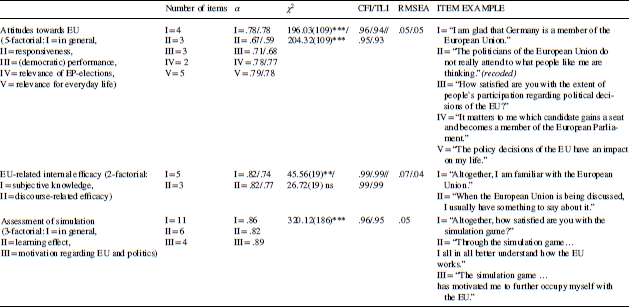
In addition, the pre-survey collected socio-demographic background variables like age, gender, cultural capital (proxy indicator number of books at home, single item with six-point Likert scale, see Kerr et al. Reference Kerr, Sturman, Schulz and Burge2010) and the type of school. The post-test included 21 items giving students the opportunity to rate the simulation game and its effects. Here, a three-factor model was constructed with the dimensions (a) general satisfaction with the simulation game, (b) experienced learning effect and (c) perceived increase in interest in EU, in politics in general and in motivation to engage oneself politically. This model provides a good data fit and was newly developed in this study. For calculating measurement models and advanced analyses like latent regressions, structural equation models and latent class analyses, the software Mplus 7.4 was used. Here, Likert scale items were treated as categorical variables and the hierarchical structure of the data was taken into account. (For measurement models of the latent constructs as well as sample items, see Table 1.)
Fit values of measurement models (pre-/post-test) and item examples—questionnaire study
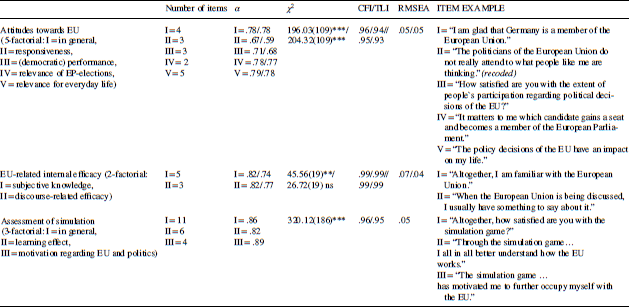
***P < .001; **P < .01
Content analysis and coding system of interview study
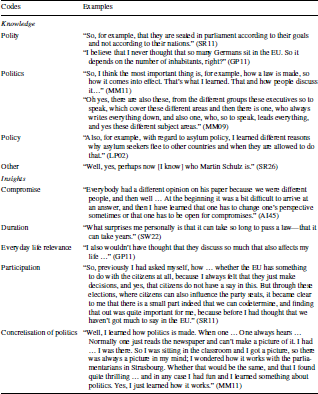
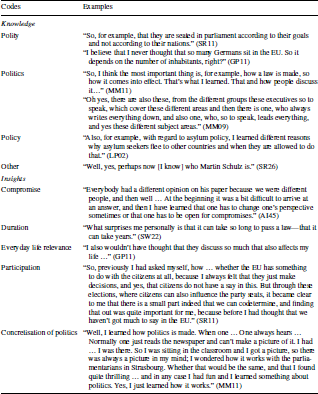
The interviews were fully transcribed and then coded according to the qualitative content analysis after Mayring (Reference Mayring, Mey and Mruck2010). The analysis focuses on the kind of learning the interviewees report having experienced during the simulation game. Their responses regarding the knowledge gain were assigned to the four categories polity-, politics- and policy-knowledge as well as other knowledge. Apart from the knowledge gain, different “insights” or “realisations” regarding the political domain were detected and assigned to four different categories, coded as importance of compromises, duration of the political process, concretisation of the political as well as relevance of politics for one’s everyday life. A coding scheme with examples for each category is displayed in Table 2. Finally, the interviewees were classified into three groups according to the change of their perception of EU responsiveness between the pre- and post-survey in the questionnaire study, with a first group showing an increase, a second group undergoing no change and a third group showing a decrease in perceived EU responsiveness.
Students’ reported learning effects—subcodes and anchor examples
Results of the study
In the following, the results of both the quantitative and qualitative parts of the empirical study are reported and linked to each other. First, the questionnaire study’s results will be described, with a special focus on changes in students’ EU knowledge and perceived EU responsiveness before and after participating in the simulation game. Second, the results of the qualitative content analysis of interviews with participants will be reported, also taking into account the questionnaire data of the interviewees.
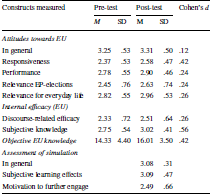
Overall, 94.8% of the 308 consulted participants were satisfied and 35.3% of them were even very satisfied with the EU simulation game. Other indicators of the students’ positive assessment of the game are that 90.6% of them would recommend it to others and 77.1% would play it again. Participants rated their simulation game experience as interesting, informative, varied and exciting and did not find it too easy, too difficult or too long (for further details of the students’ evaluation of the simulation game itself, see Oberle et al. Reference Oberle, Ivens, Leunig, Bursens, Gijbels, Donche and Spooren2018a). Also, the mean values of latently measured in Table 3 underline that the students rated the simulation game positively (M = 3.08; SD = 0.31) and generally considered it to have rather large learning effects (M = 3.09; SD = 0.47). When it comes to the questions of whether the game had increased their interest in politics and the EU and whether it had motivated them to further engage with the topic of EU and to participate in politics (third dimension of game evaluation), there was a medium level of agreement (M = 2.49) which varied more strongly across interviewees (SD = 0.66).
Comparison of pre- and post-test constructs: means (M), standard deviations (SD), effect size of changes (Cohen’s d) (N = 308)
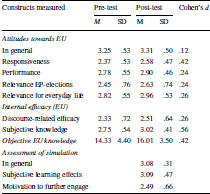
The mean value comparison displayed in Table 3 indicates the change in political dispositions of the students before and after participating in the game. Except for the general attitudes towards the EU, which were already fairly positive before the game (M = 3.25; SD = 0.53), all latent constructs display a significant change towards more positive values between pre- and post-test. Two features are especially noteworthy: first, the short simulation game has a rather strong effect on both subjective and objective EU knowledge. Second, there is a conspicuous effect of participation in the short simulation game on the assessment of the EU’s responsiveness to its citizens.
Given that the students did not meet any real political actors during the intervention, but only simulated a process of European politics, the relatively strong change in perceived EU responsiveness comes as rather unexpected. The games did not intend to produce an illusion of reality or an uncritical EU euphoria, so this pronounced effect on the assessment of the representative multi-level system of the EU also raises crucial questions. Therefore, the change of responsiveness perception within the sample was analysed in further detail in order to find out which participants underwent changes and whether there are clues to explain this development.
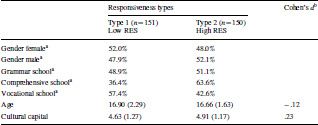
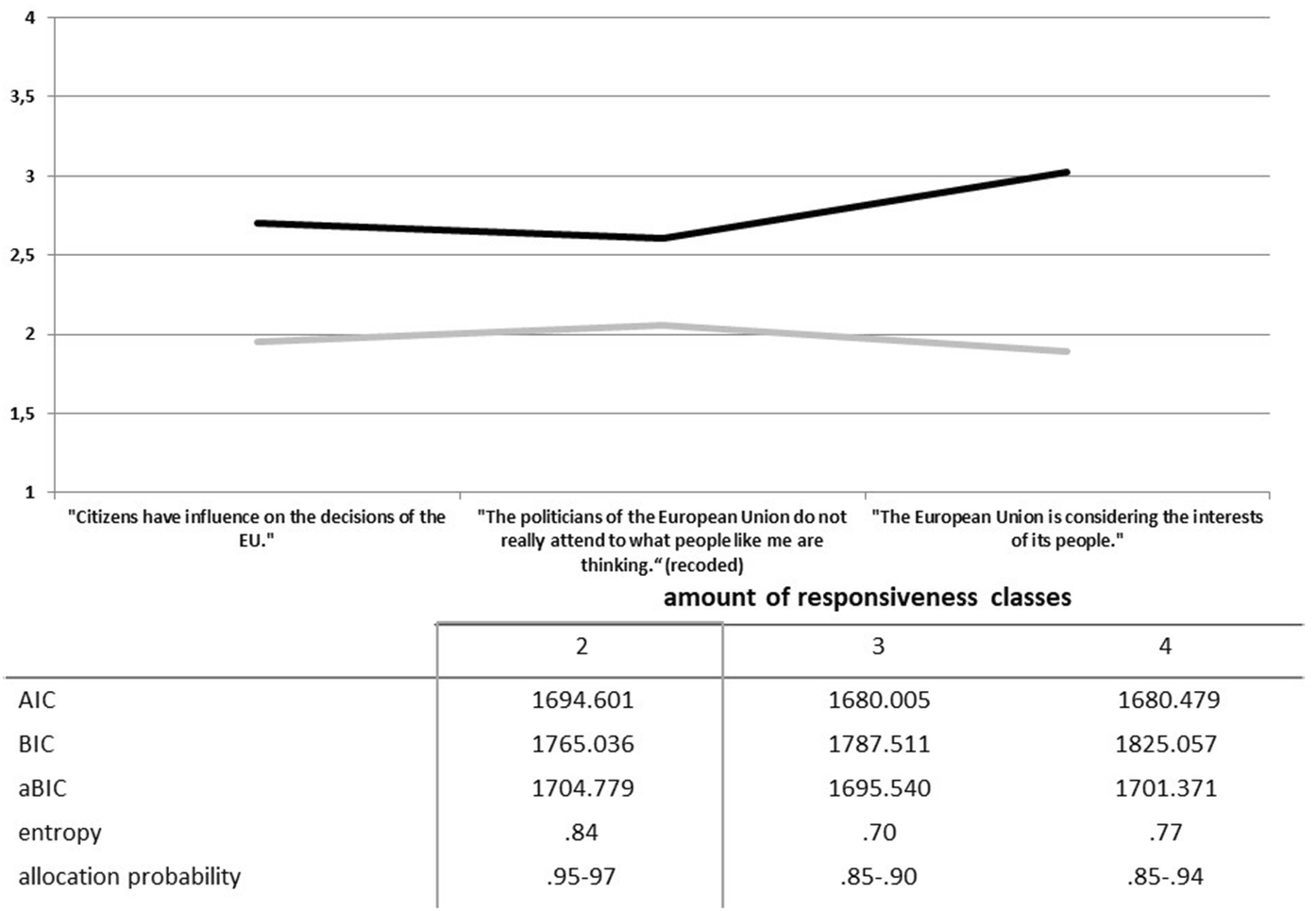
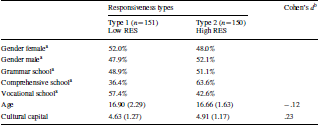
In order to ascertain how the views of pupils with different perceptions of EU responsiveness develop between the pre- and the post-test, “responsiveness types” were generated. Based on the pre-test data of the intervention group, latent class analyses were conducted in Mplus 7.4 which suggest a two-class solution (lowest BIC, entropy = 0.84, allocation probability between 0.95 und 0.97; see Fig. 1). The two types differ in terms of their level of perceived EU responsiveness. While students belonging to type 1 (n = 151) perceive the EU as rather unresponsive (M = 1.96; SD = 0.36), those belonging to type 2 (n = 150) tend towards a rather positive estimation (M = 2.77; SD = 0.52). As to the composition of the two groups (see Table 4), type 1, with a negative perception of responsiveness, contains a higher number of vocational school students and has less cultural capital than the group with a more positive perception of responsiveness.
Latent class analysis: responsiveness types (pre-test data, N = 308)
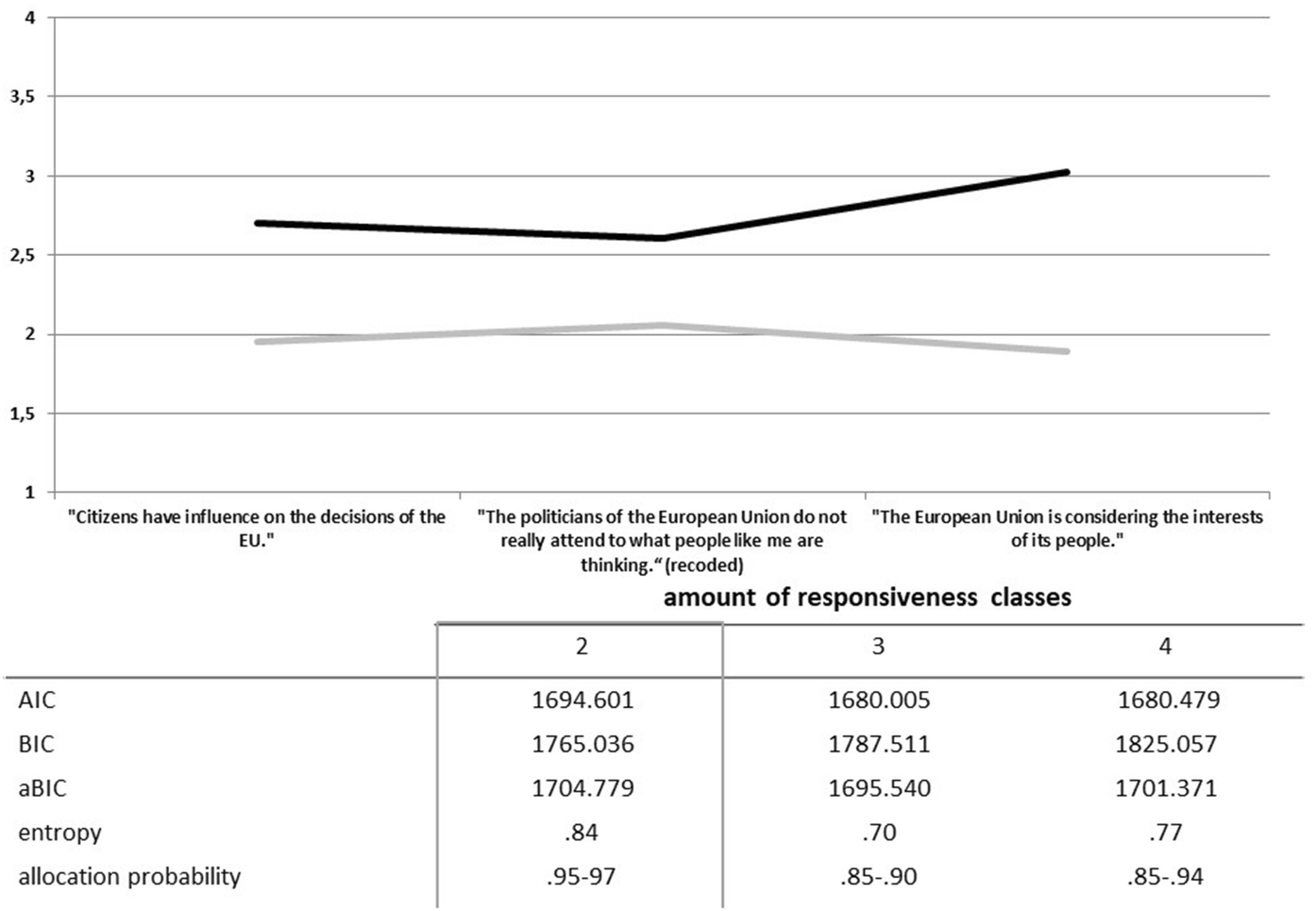
Responsiveness Types: description/ composition (N = 308)
aAll percentages in one line sum up to 100%
bClassification according to Cohen’s d: d ≥ .20 = weak effect; d ≥ .50 = medium effect; d ≥ .80 = strong effect
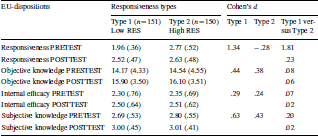
The change in perception of responsiveness brought about by participating in the simulation game is very different for the two responsiveness types (see Table 5). The change is extraordinarily strong for type 1 (Cohen’s d = 1.34), tending towards a medium value. By contrast, type 2 even displays a slight decline in perception of EU responsiveness. Thus, the simulation game did not contribute to an increase in a prior positive assessment of responsiveness or indeed to the students having euphoric feelings about the EU’s responsiveness, but mainly led to a less negative attitude in those students with a prior sceptical view.
Comparison of pre- and post-test values for responsiveness types (N = 308)
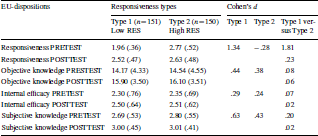
Both groups show a significant gain in objective EU knowledge (see Table 5). What is striking is that although the two groups obviously differ strongly in their perception of EU responsiveness, there was no significant difference in their levels of objective EU knowledge, neither before nor after the game. The same holds true for discourse-related internal efficacy. However, some difference in subjectively perceived EU knowledge can be seen before the game (Cohen’s d = 0.20), which after the game is levelled out by a stronger increase in subjective EU knowledge in the first group with the more sceptical view of EU responsiveness before the game.
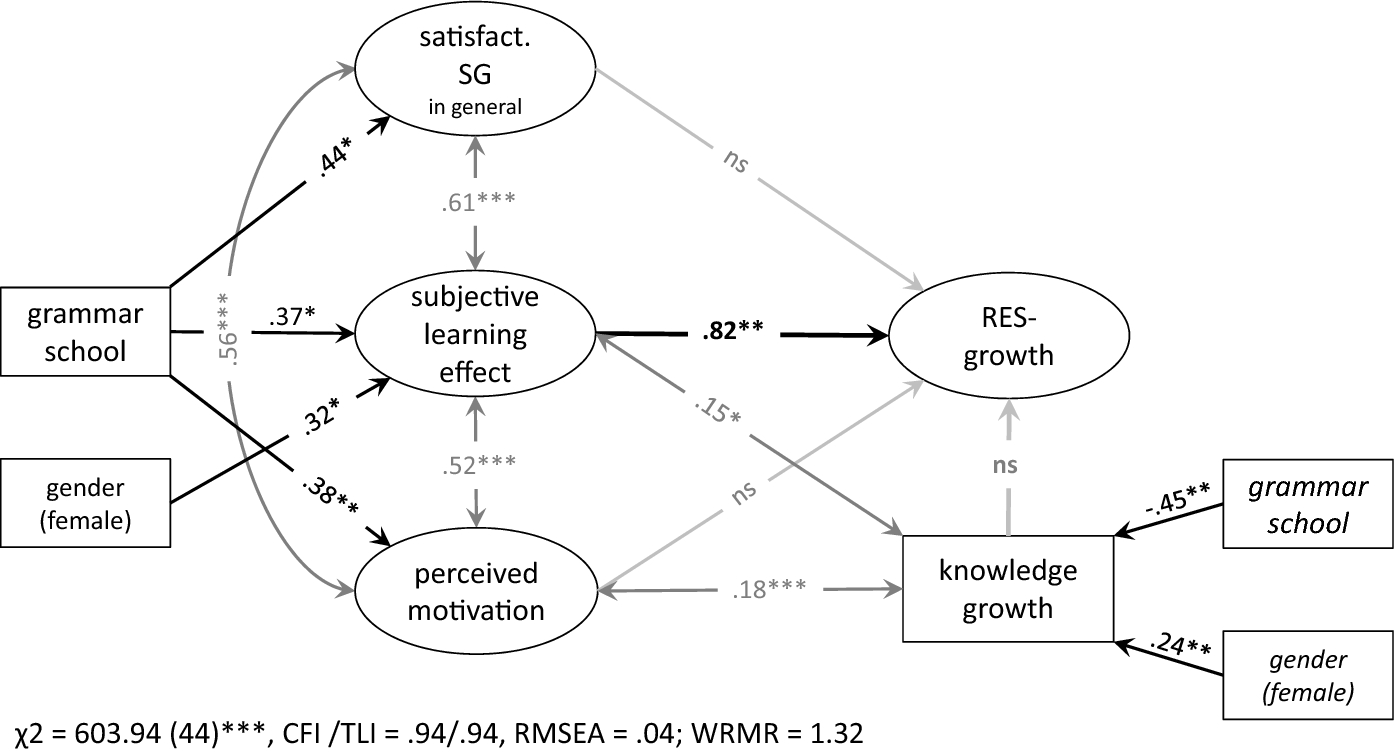
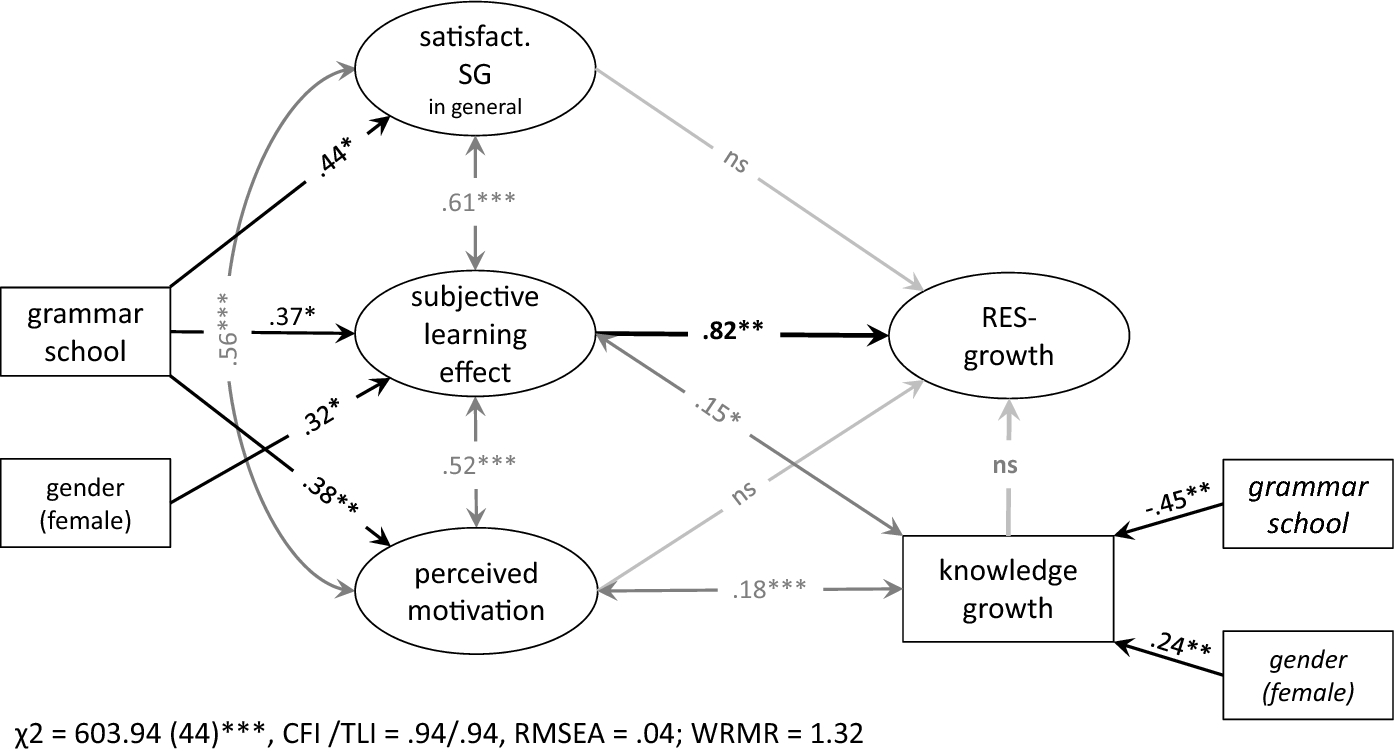
The likely conclusion that the change in perceived responsiveness was not brought about by the change in objective EU knowledge, as measured by means of the 24 multiple choice item battery used in the questionnaire, is underlined by the structural equation model displayed in Fig. 2. Here, a latent growth model was calculated for the change in perceived EU responsiveness between pre- and post-test, using this growth variable as a dependent variable and students’ assessment of the game as well as their knowledge growth as independent variables, while controlling for the effects of socio-demographic background variables. The model shows that the change in students’ EU knowledge has no effect at all on the change in their perceived responsiveness, whereas students’ assessment of the learning effect experienced through the game strongly predicts the change in perceived EU responsiveness (r = 0.82**). Thus, what the participants believe themselves to have learned during the game obviously is relevant for their evaluation of the EU’s responsiveness, mostly resulting in a more positive evaluation. At the same time, the growth in objective EU knowledge is only weakly correlated with students’ subjectively perceived learning effect (r = 0.18***).
Structural equation model: latent change in responsiveness, knowledge gain, perceived learning effect and background variables
Looking only at the results of the quantitative study, it thus remains unclear what kind of knowledge students gain when participating in a simulation game apart from the declarative political knowledge as measured in the questionnaire. There seem to be learning effects of high relevance from the students’ perspective that also have repercussions on their perception of the responsiveness of the EU political system. In order to find out more about these learning effects, we can turn to the qualitative interviews that were conducted with participants in addition to the questionnaire study.
Overall, twelve students of three schools took part in the guided interviews and were asked about the kind of learning effects they had experienced during the simulation game. All of them also took part in the questionnaire study. By means of a qualitative content analysis of the interviews, different aspects of knowledge as well as different aspects of “insights” and “realisations” were categorised following a coding approach that is both deductive and inductive (see Table 2). The analysis reveals that students’ subjective knowledge gain mainly refers to the process dimension of EU politics (and politics in general), but also the polity of the EU. It is interesting that policy-knowledge is hardly ever mentioned, even though the simulations focused on certain policy areas like asylum policy or data protection. Apart from knowledge, participants report having gained “insights” or “realisations” about the EU and the political in general. Here, they underline the relevance of compromises for political decision-making, also stressing that these compromises sometimes need to go far and are often difficult to reach, and point out the duration of political decision-making in the EU, citing these as new realisations gained through the simulation game.
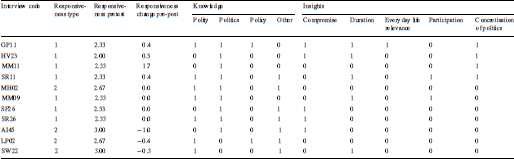
On the basis of the questionnaire study, the interviewees can be grouped according to the change of perception of EU responsiveness brought about by the simulation game (see Table 6). Four of the students show an increase in perceived responsiveness, three show a decline, and four display no change at all (one of the interviewees lacked relevant questionnaire data and was not considered in the following analysis). There is no difference in objective knowledge gain when comparing the three groups of students.
Interviewees’ perception of EU responsiveness (based on the questionnaire data), knowledge and insights acquired during the simulation game (interview coding)
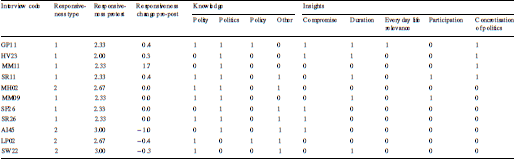
As one can see in Table 6, students with a “responsiveness gain” through the simulation game mention more types of realisations about politics than the other groups. All four students report learning experiences in the sense of a concretisation of politics. They describe having gained a clearer, more vivid “picture” and deeper, less superficial understanding of politics. The other interviewees don’t mention such a concretisation of the political as a relevant learning experience. Students of all groups, however, attest to having gained an understanding of the necessity as well as the difficulties of compromises in politics and thus the duration of democratic political decision-making. For the latter, the frequency is higher in the “responsiveness gain” group.
The coding of polity-, politics- or policy-knowledge in the interviewee statements did not lead to a sound explanation of changes in perceived responsiveness. Politics knowledge gain is mentioned by all students of the “responsiveness gain” and “unchanging responsiveness” groups. However, when it comes to the realisations about the political, the study suggests a connection between reporting such “insights” as one’s learning experience and a more positive evaluation of the EU’s responsiveness. Furthermore, especially in the “responsiveness gain” group, the reported politics knowledge gain was often directly connected to insights such as the relevance of compromises, the duration of democratic decision-making and the concretisation of politics in the students’ answers.
Conclusion
Even though the simulation games evaluated in this study were quite short with only three hours including preparation and debriefing, the intervention study was able to highlight significant learning effects both on political knowledge and on political motivations and attitudes. What is especially striking is the strong change in perceived responsiveness of the EU that the intervention caused in students with a prior rather sceptical, negative perception. In our study, this development could not be explained by the given growth in EU knowledge as measured by a 24 multiple-choice item battery (Rasch scaling). However, using data from qualitative interviews accompanying the questionnaire study, the results presented here suggest that the simulation game provided participants with other fundamental insights into democratic politics which may have caused them to evaluate the EU’s responsiveness more positively. Participating in the game changed students’ understanding of political processes (politics dimension) in the EU, both with regard to their declarative knowledge on EU politics and with regard to something we labelled “insights” or “realisations”. These insights can neither purely be defined as political knowledge nor as political attitudes.
Through the simulation games, students understood the relevance of compromises in democratic politics and realised the often unavoidably time-consuming process of democratic political decision-making when negotiating many different, opposing interests and struggling for political compromises. Furthermore, the simulation game provided a concretisation of politics, helping students to picture political processes more vividly and to thereby gain a deeper understanding of the political. These learning effects seem to have had repercussions on students’ perception of the EU’s responsiveness to its citizens, which was rated much more moderately after the simulation game experience by students who had been rather sceptical and critical about the EU’s responsiveness beforehand. Adopting the roles of parliamentarians seems to have elevated students’ identification with politicians in the EU and their perceived concreteness and graphicness of (EU) politics. The increased understanding of the difficulties and duration of finding solutions to political problems and reaching political compromises may have caused the students to question their prior assumptions regarding the incompetence or aloofness of political actors and the distance of the EU to its citizens. In this way, the insights gained through the simulation experience helped to reduce a diffuse but profoundly sceptical view on procedures of political decision-making (Prozessverdrossenheit, Schöne) that some students held prior to participating in the simulation game, improving their negative evaluation of the through-put legitimacy (Schmidt Reference Schmidt2013) of EU politics, resulting in a more moderate (while still not unrealistically optimistic) view.
Such fundamental realisations regarding democratic politics in the pluralistic society, which go beyond declarative political knowledge, should be researched in greater depth by future studies about the effects of simulation games. Departing from qualitative studies, tools should be developed to systematically measure process-oriented political knowledge (politics-knowledge), process-oriented political attitudes (here, responsiveness is a central, but certainly not the only relevant feature) and process-oriented “insights” also in quantitative studies. This could help to better understand people’s scepticism towards the EU and their alienation from politics in general and how these can be constructively counteracted by educational approaches such as simulation games.

 Open access

