




INTRODUCTION
This study examines craft production among the Middle Preclassic Maya (1000–350 b.c.) through the analysis of worked faunal remains and lithic usewear patterns. The study builds from previous research examining crafting and meat-processing activities during the Classic period (Aoyama Reference Aoyama1995, Reference Aoyama2007; Emery Reference Emery2009, Reference Emery2010; Emery and Aoyama Reference Emery and Aoyama2007; McKillop and Aoyama Reference McKillop and Aoyama2018), when Maya society had already developed full-fledged states in which crafting specialists held definitive roles in the political economy. Yet what was the role of craft specialists following the transition to a sedentary lifestyle, during the development of increasing social complexity and early states? How did such specializations exist? Can we identify them and the locations where these activities took place? We examine these questions at the site of Ceibal, Guatemala (Figures 1 and 2), where excavations have recovered tens of thousands of lithic and animal bone remains dating to the Middle Preclassic occupation.
Map of the Maya area, including sites mentioned in the text. Map by Sharpe.

The Middle Preclassic period (Table 1) was a critical time in the development of lowland Maya civilization during which significant social changes took place (Barlett and McAnany Reference Barlett, A. McAnany, Canuto and Yaeger2000; Estrada-Belli Reference Estrada-Belli2006, Reference Estrada-Belli2011; Powis Reference Powis2005). There is evidence for increased sedentism and growing dependence on agricultural products during the earlier part of this period (1000–700 b.c.; Fedick and Ford Reference Fedick and Ford1990; Lohse Reference Lohse2010; Pohl et al. Reference Pohl, Pope, Jones, Jacob, Piperno, deFrance, Lentz, Gifford, Danforth and Josserand1996), along with the spread of early monumental construction projects that would have necessitated a degree of organized collaboration (Doyle Reference Doyle2012; Inomata et al. Reference Inomata, Triadan, Pinzón, Burham, Ranchos, Aoyama and Haraguchi2018, Reference Inomata, Triadan, Pinzón and Aoyama2019, Reference Inomata, Triadan, Vázquez López, Fernandez-Diaz, Omori, Méndez Bauer, Hernández, Beach, Cagnato, Aoyama and Nasu2020; Powis et al. Reference Powis, Micheletti, Crow, Skaggs, Stanchly, Cartagena and Powis2019; Rice and Pugh Reference Rice and Pugh2021). The onset of the late Middle Preclassic period (700–350 b.c.) witnessed substantial social changes as well, marked by widely shared cultural practices across the Maya lowlands (including art and monumental architecture), an increasing institutionalization of social inequality, and political centralization (Estrada-Belli Reference Estrada-Belli2006, Reference Estrada-Belli2011; Hammond Reference Hammond, Grove and Joyce1999; Hendon Reference Hendon, Grove and Joyce1999; Houston and Inomata Reference Houston and Inomata2009:77; Pugh Reference Pugh2021). These trends led to the emergence of divine rulership and early urban centers during the Late and Terminal Preclassic periods (350 b.c.–a.d. 175).
Chronological phases at Ceibal, Guatemala.

Although scholars have learned a great deal about Classic Maya social organization (a.d. 175–950), our understanding of the Preclassic period in general, and of empirical studies examining craft production during the Middle Preclassic period in particular, are still limited. A principal reason for this lack of information is due to the ancient Maya practice of building repeatedly on the same location, including over preexisting structures (Sabloff Reference Sabloff1994:113). Centuries of rebuilding over the same location not only altered or destroyed the earlier occupation levels, but in many cases built up the terrain over time so that the underlying Middle Preclassic levels are now several meters underground. Traditional horizontal excavations are both difficult and dangerous at such depths. Furthermore, the reuse of terrain from other parts of a site for these later construction projects, which included repurposed middens and their associated artifacts, makes it difficult to distinguish primary and secondary (and tertiary) depositional material from buried earlier periods.
Since 2005, the Ceibal-Petexbatun Archaeological Project (CPAP) has uncovered substantial construction and ritual activities that took place during the early stages of human settlement at the lowland center of Ceibal, and have provided detailed diachronic data from the Middle Preclassic through the Terminal Classic period (Table 1). These data have been used to address essential questions pertaining to the origins, development, adaptations, and endurance of lowland Maya civilization (Inomata Reference Inomata, Freidel, Chase, Dowd and Murdock2017; Inomata et al. Reference Inomata, Triadan, Aoyama, Castillo and Yonenobu2013, Reference Inomata, MacLellan, Triadan, Burham, Aoyama, Nasu, Munson, Pinzón and Yonenobu2015, Reference Inomata, Triadan, MacLellan, Burham, Aoyama, Palomo, Yonenobu, Pinzón and Nasu2017a, Reference Inomata, Triadan and Aoyama2017b, Reference Inomata, Pinzón, Palomo, Sharpe, Ortíz, Méndez and Román2017c; Munson and Pinzón Reference Munson and Pinzón2017; Palomo et al. Reference Palomo, Inomata and Triadan2017; Sharpe et al. Reference Sharpe, Inomata, Triadan, Burham, MacLellan, Munson and Pinzón2020; Triadan et al. Reference Triadan, Castillo, Inomata, Palomo, Méndez, Cortave, MacLellan, Burham and Ponciano2017). These discoveries were achieved with deep vertical excavations, extensive horizontal excavations where possible, and tunnels into and below Middle Preclassic structures. The results of the Ceibal excavations offer a rare opportunity to examine the faunal and lithic remains from a large Middle Preclassic settlement.
Here we examine the lithic and faunal assemblages to better understand the emergence of crafting specialists and their role in Middle Preclassic Maya society. Our research objectives included: (1) improving our understanding of the manufacturing process of different materials during the Middle Preclassic period, (2) examining the association between lithic production and bone/shell processing for meat (i.e., butchery) or artifact production at various locations around the settlement, (3) identifying locations of craft production within the Middle Preclassic community, and (4) comparing these activities with those of later Classic-period society.
CLASSIC-PERIOD CRAFT SPECIALISTS
It is unclear how the role of specialized artisans, such as the producers of stone, bone, and shell ornaments and tools, developed during the Middle Preclassic period. In this study, we use Costin's (Reference Costin1991:4) definition of craft specialization: “a differentiated, regularized, permanent, and perhaps institutionalized production system in which producers depend on extra-household exchange relationships at least in part for their livelihood, and consumers depend on them for acquisition of goods they do not produce themselves.” Specialists are not only defined by their skill, but how the items they produce interplay with economics beyond the household level. Obsidian and marine shells were commodities not equally distributed across the Maya region, and their acquisition would have required negotiation with those who had access to these resources.
By the Classic period, craft specialists included individuals contracted by members of the elite class to produce specialized wares, as well as members of the elite class themselves (Emery and Aoyama Reference Emery and Aoyama2007; Inomata Reference Inomata2001, Reference Inomata2007; Kovacevich Reference Kovacevich2013; Widmer Reference Widmer2009). Non-elite artisans existed, especially for producing general-use wares made from local materials, but the elites appear to have maintained their societal position in part by restricting access to certain materials and specialized knowledge of how to carve, paint, inscribe, or otherwise modify objects into finished products.
Multicrafting debitage from bone/shell processing by stone tools is readily identifiable from Classic-period contexts in the Maya region. Excavations at the hastily abandoned site of Aguateca, not far from Ceibal, recovered the largest corpus to date of undisturbed bone, shell, and lithic crafting debitage in the Maya area. The remarkable quantity of material allowed Emery and Aoyama (Reference Emery and Aoyama2007) to determine that elite specialists engaged in the majority of these activities. Virtually no evidence of shell or bone carving has been found outside of the epicenter of Aguateca (Aoyama Reference Aoyama2009a:129; Emery and Aoyama Reference Emery and Aoyama2007), suggesting high-status individuals had control of these resources. These specialists manufactured objects of high symbolic value, including royal regalia, within a courtly setting. As Inomata (Reference Inomata2001:324) asserts, such objects made by a skilled elite craftsperson were probably highly valued; furthermore, craft production itself was an ideologically loaded political act, closely related to the elites’ power and prestige.
Evidence for intensive bone and shell crafting has been documented at other Classic sites. Emery (Reference Emery2009, Reference Emery2010) identified a Terminal Classic bone crafting workshop at Dos Pilas, where a non-elite specialist likely working full time modified thousands of animal bones, mostly mammals, following repeated techniques. Moholy-Nagy's (Reference Moholy-Nagy1994, Reference Moholy-Nagy1997) work at Tikal has identified locations where elite crafting using various materials took place around the monumental center of the site. Most of this activity occurred within elite households, and she speculates that production may have been driven, in part, by competition among artisans (Moholy-Nagy Reference Moholy-Nagy1997:308).
Excavators at an elite residence at Copan identified ornamental bone and shell crafting areas in several Late Classic chambers, as well as evidence of processing fine stone and possibly feather-working for costumes (Widmer Reference Widmer2009). The results of microwear analysis of chipped stone artifacts associated with numerous marine shell ornaments representing at least four species, collected in front of Temple 10L-16 of the Acropolis at Copan, show that marine shell craft production may have been carried out by members of the royal family or attached specialists serving the ruler at the end of the Late Classic period (Aoyama Reference Aoyama1995). Attached specialists would have been those individuals contracted, sponsored, and/or directed by elites or those with governmental (including possibly religious) power to produce artifacts that required specialized skills (Costin Reference Costin1991:7, 11). The sponsoring individual(s) may have helped acquire the raw materials for the specialists to produce these items, as may have been the case at Copan.
Whereas the Dos Pilas example was an unusual case of a utilitarian workshop where the specialist worked at his/her own initiative, the Copan and Tikal households were managed by elites to produce items for elite consumption. Elites were both artisans themselves and may have employed specialists with particular skills (likely including other elites) to produce specific objects. The manner in which a governing elite class developed during the Middle Preclassic period is still largely unknown, but evidence of complex ceremonial activities requiring rare and non-local materials (e.g., jade, obsidian, and marine shells) in the southern Maya lowlands suggests that certain individuals directed the production and use of these objects for specific purposes (Aoyama Reference Aoyama2017a; Aoyama et al. Reference Aoyama, Inomata, Triadan, Pinzón, Palomo, MacLellan and Sharpe2017a, Reference Aoyama, Inomata, Pinzón and Palomo2017b; Hohmann Reference Hohmann, Healy and Emery2014; Shafer and Hester Reference Shafer and Hester1991). Many of these finished objects had an association with ceremonial activities, including as cached offerings and feasting deposits under monuments and plazas (Estrada-Belli Reference Estrada-Belli2006; Hammond and Gerhardt Reference Hammond, Gerhardt and Hammond1991; Inomata et al. Reference Inomata, Pinzón, Palomo, Sharpe, Ortíz, Méndez and Román2017c; MacLellan Reference MacLellan2019b; Rice and Pugh Reference Rice and Pugh2017). Identifying who modified these materials, where the work was performed, and how the final products were used and discarded is the objective of the present study.
THE SITE OF CEIBAL AND ITS EXCAVATIONS
Ceibal (also known as Seibal) was a large pre-Hispanic Maya settlement along the Pasión River in the southern Peten, Guatemala. There is evidence for human occupation at the site from 1100 b.c. to a.d. 950, with intermittent occupation of outlying residential groups lasting through a.d. 1200. Harvard University conducted the first excavations in the 1960s, focusing on the later Classic-period phases that were near the surface, and which included the most accessible stone monumental features (Tourtellot Reference Tourtellot1988; Willey Reference Willey1978, Reference Willey1990; Willey et al. Reference Willey, Ledyard Smith, Tourtellot and Graham1975). Material remains collected from these excavations largely consisted of ceramic and some lithic material, which were not included in the present study. The project collected a significantly smaller number of chipped stone artifacts (N = 2,394) than the CPAP team (N = 83,330), primarily because they did not screen the excavated soil (Willey Reference Willey1978:124). Most chipped stone artifacts pertained to the Classic period, but a few were recovered from unmixed Middle Preclassic contexts. Unlike many projects from this time, animal bone was also collected and examined, revealing a preponderance of deer in the diet during the Late and Terminal Classic periods that came from dense middens deposited by elites living near the site's center (Pohl Reference Pohl1976, Reference Pohl and Pohl1985, Reference Pohl, Willey and Graham1990). While marine shell and some ornamental freshwater shell artifacts were recovered, unmodified freshwater shell was usually not (Willey Reference Willey1978:162–167).
More recent excavations (2005 onward) by the CPAP team have determined that Ceibal's Preclassic history was just as extensive, if not more so, than its Classic-period occupation (Inomata et al. Reference Inomata, MacLellan, Triadan, Burham, Aoyama, Nasu, Munson, Pinzón and Yonenobu2015, Reference Inomata, Triadan and Aoyama2017b, Reference Inomata, Pinzón, Palomo, Sharpe, Ortíz, Méndez and Román2017c). These recent excavations went much deeper than Harvard had excavated and implemented techniques such as LiDAR to examine the site's physical features and layout (Inomata et al. Reference Inomata, Triadan, Pinzón, Burham, Ranchos, Aoyama and Haraguchi2018, Reference Inomata, Triadan, Pinzón and Aoyama2019), as well as flotation and fine-screen recovery methods to obtain information about subsistence and crafting activities around the site (Sharpe et al. Reference Sharpe, Inomata, Triadan, Burham, MacLellan, Munson and Pinzón2020). Furthermore, the project examined both the monumental center as well as the outlying residential and smaller ceremonial groups to gain a broad understanding of activities and occupational sequences around the settlement over time (Burham and MacLellan Reference Burham and MacLellan2014; Inomata et al. Reference Inomata, MacLellan, Triadan, Burham, Aoyama, Nasu, Munson, Pinzón and Yonenobu2015, Reference Inomata, Pinzón, Palomo, Sharpe, Ortíz, Méndez and Román2017c; Triadan et al. Reference Triadan, Castillo, Inomata, Palomo, Méndez, Cortave, MacLellan, Burham and Ponciano2017).
Excavations found evidence for human occupation at the site beginning slightly before 1000 b.c., around the time ceramic production spread throughout the region and the transition to permanent settlements took place. Shortly thereafter, large-scale monumental construction projects began at what would become the center of the settlement, Group A (Figure 2; Inomata et al. Reference Inomata, Pinzón, Palomo, Sharpe, Ortíz, Méndez and Román2017c). These consisted of extensive earthen platforms, likely necessitating the participation of a large number of individuals over several years to move thousands of cubic meters of material (Inomata et al. Reference Inomata, Triadan, Pinzón and Aoyama2019). The platforms supported ceremonial structures such as E-Groups, which were oriented to the cardinal directions and likely used for ritual activities with astronomical associations (Inomata Reference Inomata, Triadan, Pinzón, Burham, Ranchos, Aoyama and Haraguchi2018, Reference Inomata, Triadan, Pinzón and Aoyama2019). The presence and prevalence of large-scale monumental construction during this early period, which was expanded by centuries of later generations, suggests Ceibal was an important lowland center during the Middle Preclassic. While our knowledge of lowland society during this period is still limited, these monumental works indicate that a degree of centralized organization existed to plan and manage such large-scale projects.
Map of Ceibal, Guatemala. Numbers indicate the locations of primary Middle Preclassic midden deposits. (1) Real 2 midden in A-24 Platform. (2) Real 3 midden in Structure Pemech-3rd. (3) Escoba 2 middens in the A-24 Platform. (4) Escoba 2 midden behind Structure A-15. (5) Escoba 2 midden in the Group A Central Plaza. (6) Escoba 2 trash pit in the Jul Group. Map courtesy of the Ceibal-Petexbatun Archaeological Project.
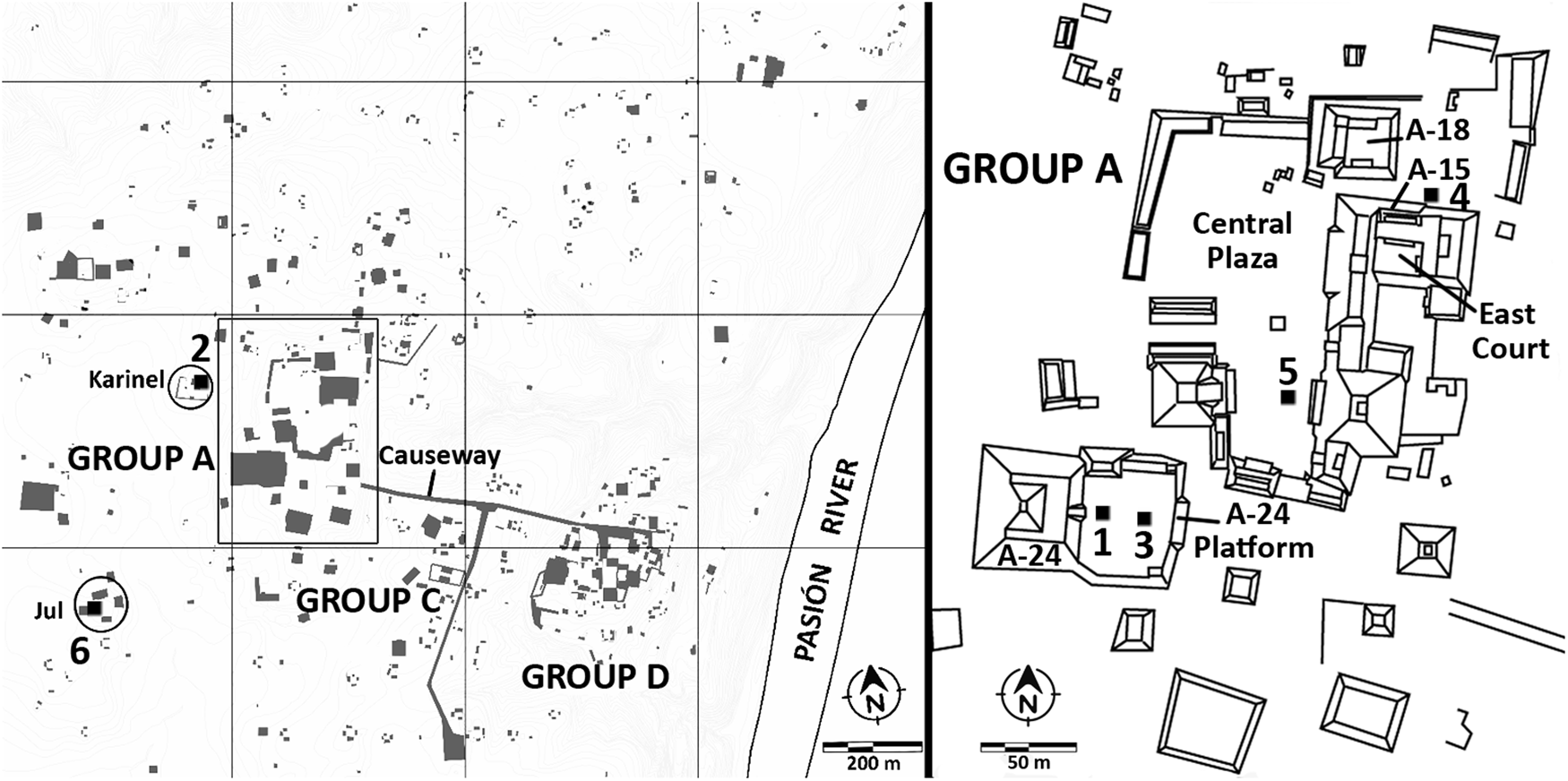
Excavations in the residential areas revealed evidence for domestic activities in both the outlying groups, as well as near the central core of the site. Excavations underneath the Terminal Classic royal palace complex in Group A's East Court and Platform A-24 (Figure 2) recovered what may be early residential structures belonging to Ceibal's emerging Middle Preclassic elite (Triadan et al. Reference Triadan, Castillo, Inomata, Palomo, Méndez, Cortave, MacLellan, Burham and Ponciano2017). Evidence for platforms with stone foundations and drainage canals, charcoal deposits, and ceramic and other material refuse in dense middens attest to living spaces that were likely occupied by individuals involved with the ceremonial activities at the center of the site. These individuals appear to have had access to certain prestigious objects, including jade and marine shell, indicating they had the ability to obtain these materials from afar. Excavations beyond Group A at other residences, including the Karinel and Jul groups, identified other Middle Preclassic patio groups with middens and living spaces, although likely constructed with perishable materials due to the lack of stonework (Burham Reference Burham2019; MacLellan Reference MacLellan2019a). The lithic and faunal material from both the Group A monumental center and the residences, particularly the middens recovered from the early residential groups, forms the basis for the present study.
OVERVIEW OF THE MATERIAL ASSEMBLAGES
Lithic Sample
Aoyama studied 86,624 lithic artifacts (1,802,882.3 g) recovered from different parts of Ceibal, including the central part of the settlement around Group A, outlying residential groups, and the nearby minor centers (Aoyama Reference Aoyama2017a, Reference Aoyama2017b; Aoyama et al. Reference Aoyama, Inomata, Triadan, Pinzón, Palomo, MacLellan and Sharpe2017a, Reference Aoyama, Inomata, Pinzón and Palomo2017b). Of these lithic artifacts, the CPAP has collected 37,116 chipped stone artifacts from unmixed Preclassic contexts, including 30,500 artifacts from the Middle Preclassic contexts. In fact, the Middle Preclassic lithic artifacts from Ceibal make up the largest sample of this critical period in the Maya lowlands to date.
Faunal Sample
A total of 37,549 faunal specimens have been identified from the CPAP excavations at Ceibal, using a conservative quantification method for invertebrates. Of these, 5,848 vertebrate specimens date to Middle Preclassic contexts (a minimum of 227 individuals), as well as 10,016 mollusk specimens (a minimum of 9,224 individuals), representing a total of 42.2 percent of the total Ceibal faunal assemblage. An overview of the entire corpus of faunal remains revealed changes in both ecological and subsistence patterns through the Middle Preclassic to Postclassic occupations (Sharpe Reference Sharpe2019; Sharpe et al. Reference Sharpe, Emery, Inomata, Triadan, Kamenov and Krigbaum2018, Reference Sharpe, Inomata, Triadan, Burham, MacLellan, Munson and Pinzón2020). Dogs were the most common mammal in the Middle Preclassic period (about twice as abundant as the Classic-period phases based on number of individuals), and the fine-screen and flotation analyses revealed thousands of fish bones attesting to the significance of riverine resources to the site's inhabitants. Furthermore, faunal analyses revealed a significant decline in the proportion and variety of freshwater mollusks during the Preclassic/Classic transition (ca. a.d. 175). This indicated that the role of mollusks in the Ceibaleño diet was marginal throughout the Classic period, although it constituted a significant part of the Middle Preclassic subsistence base.
STUDY METHODS
The Ceibal faunal and lithic assemblages examined here include those recovered from primary and secondary (construction fill) contexts dating to the Middle Preclassic period. Each of us reviewed our materials separately and according to the best practices in our fields. We then correlated the remains in each archaeological context to provide a view of shell and bone artifact production across the site. To ensure temporal control, we eliminated faunal and lithic collections that seemed to represent mixed time periods based on the presence of substantial mixed ceramic, and with consultation with the original excavating archaeologists.
Lithic Analysis
Aoyama selected 1,300 chipped stone artifacts made of obsidian (N = 619) and chert (N = 681) from different structures and contexts in Ceibal for high-power microwear analysis, which was developed by Keeley (Reference Keeley1980) to study stone tool use. Aoyama (Reference Aoyama1995, Reference Aoyama1999, Reference Aoyama2007, Reference Aoyama2009a, Reference Aoyama, Inomata, Triadan, Ponciano and Aoyama2009b; Aoyama et al. Reference Aoyama, Inomata, Triadan, Pinzón, Palomo, MacLellan and Sharpe2017a, Reference Aoyama, Inomata, Pinzón and Palomo2017b) has conducted microwear analysis on a total of 8,516 stone artifacts from Ceibal and other Maya sites. In 1987, he conducted an intensive experimental study of usewear on obsidian and chert in Honduras to establish a framework for the interpretation of Maya stone tool use (Aoyama Reference Aoyama1989, Reference Aoyama1999:33–47). The results of 267 replication experiments conducted in a range of worked materials (including silica-rich grass, wood, meat, hide, leather, bone, antler, shell, soil, and stone), permitted identification of usewear patterns. Aoyama independently controlled three variables: (1) direction of use, (2) worked material, and (3) number of strokes. Motions parallel to the working edge were sawing, cutting, and grooving, while transverse actions included scraping, whittling, and chopping, based on contact angle differences (Aoyama Reference Aoyama1999:Figure 2.4). Moreover, boring was done with a semi-rotary, two-way action using an experimental tool held perpendicular to the worked surface.
Previous microwear studies indicate that the correlation between polish type on chert and worked material is not absolute; that is, both the type of action and the number of strokes, as well as the contact material, can influence polish (Kajiwara and Akoshima Reference Kajiwara and Akoshima1981; Vaughan Reference Vaughan1985). Hence it is not appropriate to classify polish types with a particular worked material (e.g., bone polish, hide polish, meat polish). In the face of such difficulties, following the Tohoku University Microwear Research Team in Japan (Serizawa et al. Reference Serizawa, Kajiwara and Akoshima1982), Aoyama identified 11 basic polish types on chert artifacts (Figure 3) that are principally (but not absolutely) the result of the worked material (Table 2). Obsidian is a volcanic natural glass, and striations form more readily on its surface than on chert. Furthermore, not all types of obsidian polish are similar to those on chert. Consequently, he classified usewear on the obsidian tools into 11 patterns, based on combined observation of surface striations, polish, and tiny pits (Figure 4 and Table 3). (For a detailed description of the usewear experiments and more examples of microphotos, see Aoyama [Reference Aoyama1989, Reference Aoyama1995, Reference Aoyama1999:39–47, Reference Aoyama2009a:11–14]).
D1 type polish and parallel striations on a chert flake which was used to cut bone from Real 3 Phase Midden above Structure Pemech-3rd in the Karinel Group, Ceibal, early Middle Preclassic period (200× magnification). The polish surface is smooth and flat, but its area is limited to near the edge of the artifact. Photograph by Aoyama.

Usewear Pattern C and parallel striations on an obsidian prismatic blade used to cut shell from Real 2 Phase Midden in the A-24 Platform of Group A, Ceibal, early Middle Preclassic period (200× magnification). The polish surface is bright and flat but rough and pitted and marked by clear striations. Photograph by Aoyama.

Usewear types on chert artifacts. Modified from Emery and Aoyama (Reference Aoyama2007:Table 2).

Usewear patterns on obsidian artifacts. Modified from Emery and Aoyama (Reference Aoyama2007:Table 3).

The instrument used in the present study was a metallurgical microscope (Olympus BX60M) with 50–500× magnification and an incident-light attachment. Usewear patterns were documented with an Olympus photomicrographic system PD-27 attached to a digital camera. Magnification of 200× was the most frequently used; 50× and 100× served primarily to permit identification of usewear locations, whereas observation of usewear details in specific areas of artifacts required 500×. Following Vaughan (Reference Vaughan1985:56–57), each portion of a lithic artifact with interpretable usewear was counted as an “independent use zone” (IUZ).
Faunal Analysis
Sharpe conducted the analysis of the faunal assemblage, focusing on material excavated from 2005–2017. Preliminary sorting and identifications were conducted in the CPAP Guatemala City laboratory. Subsets of the assemblage were temporarily exported for further analysis with comparative zoological collections containing relevant species, namely the Florida Museum of Natural History (Gainesville, Florida, USA) and Smithsonian Tropical Research Institute (Panama City, Panama). Identifications used the most valid scientific names to date, following the International Code of Zoological Nomenclature (https://www.iczn.org/).
Quantification followed standard methods, including Number of Identified Specimens (NISP; Reitz and Wing Reference Reitz and Wing2008:202) and Minimum Number of Individuals (MNI; Reitz and Wing Reference Reitz and Wing2008:205). A detailed overview of these methods as they were used at Ceibal can be found in Sharpe et al. (Reference Sharpe, Inomata, Triadan, Burham, MacLellan, Munson and Pinzón2020). For vertebrates, NISP included all specimens, although bones that could be refitted were counted as a single specimen.
Snails (gastropods) and bivalves were calculated differently. Snail NISP was calculated similarly to MNI, with the only exception being modified specimens (e.g., beads), which were calculated individually. Bivalves were calculated by the minimum number of valves for NISP, and the minimum number of whole individuals for MNI. Mollusk counts likely underrepresent the true number of individuals in the assemblage, but they provide a systematic means of quantifying trends that can be repeated by other analysts, as well as a more realistic estimate than would be provided by counting individual shell fragments.
Analysis of faunal modifications used the type names and descriptions proposed by Emery from previous studies of fauna from Petexbatun sites near Ceibal, including Aguateca and Dos Pilas (Emery Reference Emery2009, Reference Emery2010; Emery and Aoyama Reference Emery and Aoyama2007). In these studies, Emery examined large assemblages of animal bone and shell from Late and Terminal Classic-period contexts to distinguish patterns in the production routine used for crafting certain artifacts (e.g., bone tubes, beads, and shell tinklers). She also distinguished cut marks resulting from meat and marrow processing and skinning. She recognized that there are occasions when the distinction between meat-processing cuts and artifact manufacture cuts are ambiguous, particularly if a bone was first cut for meat processing and later reused for craft production, or if weathering on the surface of a bone or shell obscures the type of modification.
In general, single or repeated cut marks around the joints of limb bones of a vertebrate are considered butchery or meat processing for dismemberment in this study, whereas many fine cut marks along a surface could be related to skinning, especially on the distal elements (metapodials, carpals/tarsals, and phalanges; Emery Reference Emery2010:126–127). Cut marks resulting from the crafting process are usually distinguishable from those resulting from butchery processing because they are frequently smoother and follow similar trajectories on long bones, such as circumferential cuts around the proximal and distal ends of the shaft to remove the epiphyses, and long straight incisions or cuts vertically along the shaft (see Emery and Aoyama Reference Emery and Aoyama2007:74–75). For vertebrates, removal of the epiphysial ends of long bones is a common first step in the production of bone artifacts. Long bone shafts can then be modified into a number of finished products, such as bone tubes, flutes, or rasps. Dividing the long bone into multiple small cylindrical segments can produce beads. Also, long bones can be cut vertically into strips and smaller flat segments, which Emery identifies as “blanks” that can be used for modelling into other objects in a secondary reduction stage, such as perforators/awls, decorative pins or buttons, and other objects (see Emery [Reference Emery2010:Figure 7.6] for a detailed diagram of the reduction sequence). The final “finishing” stage occurs when the craftsperson smooths out the edges of the object, polishes the surface, and adds incisions, drill holes, or other finishing features.
Modifications on mollusks varied depending on the shell type. Marine shells were likely imported to Ceibal for ornaments (most commonly beads or adornos), for musical instruments in the form of large gastropod trumpets, and even perhaps as curiosities or gifts, symbolic in part because they came from the sea at a great distance. Freshwater shells included gastropods (most commonly jute, Pachychilus sp., and apple snails, Pomacea flagellata), as well as mussels (Unionidae). Modifications on jute typically involved removal of the spire, as well as puncturing along the spire or body to remove the meat (Halperin Reference Halperin, Garza, Prufer and Brady2003; Keller Reference Keller and Robin2012:257–260). From Sharpe's observation of modern jute along the Pasión River, however, spire tips sometimes break naturally and might not be an accurate assessment of modification. People living along the Pasión River today open freshwater mussels by hand or by prying open with a sharp object, two methods that do not leave discernable marks. Some dense shells at Ceibal, however, exhibit repeated chipping along the edges, which would be unlikely to occur naturally and might suggest the shell was used as a tool or had been chipped to open the mussel (for similar examples using experimental techniques on a related species from Australia, see Weston et al. [Reference Weston, Szabó and Stern2017]).
STUDY RESULTS
The following sections review the overall results of the lithic and faunal analyses. We first review the results of the lithic assemblage, focusing on the usewear patterns observed on obsidian artifacts, followed by those of chert. We next review the results of the modified fauna, examining both evidence of crafting and butchery/skinning. Finally, we examine specific primary contexts at Ceibal where Middle Preclassic artifact production took place.
The Lithic Assemblage
Aoyama randomly selected 823 chipped stone artifacts from the Middle Preclassic primary contexts for the usewear analysis and observed a total of 937 IUZ on them, including 572 IUZ on the 428 analyzed obsidian artifacts. At least 308 analyzed obsidian artifacts (72 percent) were used. In terms of the 347 analyzed obsidian artifacts, excluding those from an obsidian blade workshop dump, 307 artifacts (88.5 percent) were utilized. The analyzed obsidian lithic artifacts were used primarily for cutting, whittling, and grooving unidentified material (61.2 percent); wood carving (22 percent), including cutting (14.5 percent) and whittling (6.5 percent); meat or hide processing (13.3 percent), including cutting meat or hide (11.9 percent), scraping hide (1.2 percent), and boring hide (0.2 percent); and, to a much smaller degree, carving shell or bone (3.5 percent), including cutting shell or bone (2.8 percent) and whittling shell or bone (0.7 percent). In sum, the distribution of usewear on the obsidian tools indicates that shell and bone working is not the primary activity for any obsidian artifact type, and that not only initial and prismatic blades but also large and small percussion flakes were only occasionally used for this method of crafting (Table 4). Large percussion flakes were used more frequently for shell or bone carving than pressure blades.
Independent use zones (IUZ) associated with shell or bone working in the creation of artifacts on different types of obsidian artifacts from the Middle Preclassic period, Ceibal. IUZ, independent use zones.

Of the 395 chert chipped stone artifacts, 229 (58 percent) showed identifiable microwear. Comparison of the results of microwear analysis of obsidian and chert artifacts exhibits clear differences between the assemblages (Figure 5). Chert chipped stone artifacts were employed for an even heavier and wider range of activities (IUZ = 367) than obsidian artifacts. Shell or bone carving (62.1 percent), such as whittling (30.2 percent), cutting (25.1 percent), boring (6.5 percent), and grooving (0.3 percent) shell or bone, was the most common activity, followed by meat or hide processing (26.7 percent), and to a much smaller degree, wood carving (3.8 percent), stone working (2.2 percent), and working unidentified material (5.2 percent). Thicker chert artifacts appear to be capable of heavier tasks, including shell and bone carving.
Worked materials on chert and obsidian chipped stone artifacts from the Middle Preclassic period at Ceibal. Figure by Aoyama.

Table 5 summarizes IUZ associated with shell or bone working in the creation of artifacts on different types of chert artifacts. Small percussion blades (IUZ = 13) mainly served for whittling and cutting shell or bone (84.6 percent) but also for cutting meat or hide (15.4 percent). Similarly, chert prismatic blades (IUZ = 39) were used mainly for cutting and whittling shell or bone (84.6 percent) but also for other tasks, such as cutting meat or hide (5.3 percent) and scraping hide (5.3 percent). In contrast, as stated above, obsidian prismatic blades served only occasionally for cutting shell or bone (2.9 percent). Aoyama identified evidence of use on 37.1 percent of the chert primary flakes, 45 percent of the secondary flakes, and 50 percent of the tertiary flakes. In total, at least 122 of 264 chert unretouched flakes were used (46.2 percent). They were “informal tools” used frequently for multiple functions (Figure 6). More than half of the identified activities performed with these chert flakes (IUZ = 160) were shell or bone carving (51.3 percent), such as whittling (31.9 percent), cutting (18.1 percent), and boring (1.3 percent), followed by meat or hide processing (38.8 percent). Similarly, 75 percent of the analyzed bifacial thinning flakes (IUZ = 6) were used for cutting and whittling shell or bone (83.3 percent) and scraping hide (16.7 percent). Thus, a higher percentage of shell or bone carving was noted for bifacial thinning flakes than for thicker percussion flakes. It is interesting to note that two out of five chunks (40 percent) were used for scraping hide. Moreover, four of 12 exhausted flake cores were used for whittling shell or bone (80 percent) and scraping hide (20 percent).
Worked materials on chert flakes, denticulates, bifacial points, and oval bifaces from the Middle Preclassic period at Ceibal. Figure by Aoyama.

Independent use zones (IUZ) associated with shell or bone working in the creation of artifacts on different types of chert artifacts from the Middle Preclassic period, Ceibal. IUZ, independent use zones.

Most of the unifacially retouched flake tools made of chert show evidence of use. Two scrapers (IUZ = 5) were used for cutting and whittling shell or bone (60 percent) and scraping hide (20 percent). A total of 28 out of 35 denticulates (80 percent, IUZ = 43) show usewear. Like unretouched flakes, denticulates were used mainly for carving shell or bone (65.1 percent), followed by cutting meat or hide (16.3 percent) and scraping hide (11.6 percent; Figure 6). All 36 analyzed drills were used (IUZ = 79). While distal tips were employed for boring shell or bone (27.8 percent) and hide (6.3 percent), lateral and other edges were used for cutting and whittling shell or bone (45.6 percent) as well as cutting meat or hide (10.1 percent). Finally, chert oval bifaces (IUZ = 6) were applied mainly for cutting and chopping wood (66.7 percent) but also for chiseling stone (33.3 percent; Figure 6).
Aoyama analyzed microwear on 127 chipped stone artifacts recovered from the early Middle Preclassic Real phase contexts in Ceibal. The majority of the analyzed obsidian artifacts (13/15, 86.7 percent) were used, while interpretable microwear was observed on 45 out of 112 chert artifacts (40.2 percent). A total of 85 IUZ were identified on the artifacts dating to the early Middle Preclassic Real phase. Meat or hide processing (44.7 percent) were the most common activities, followed by shell or bone carving (34.1 percent), working unidentified material (12.9 percent), wood carving (5.9 percent), and chiseling stone (2.4 percent).
A total of 852 IUZ were identified on 687 chipped stone artifacts (410 obsidian and 277 chert artifacts) collected from the unmixed late Middle Preclassic Escoba phase deposits. Working unidentified material (42 percent) were the most common activities, followed by shell or bone carving (25.7 percent), wood carving (15.8 percent), meat or hide processing (15.7 percent), and chiseling stone (0.7 percent).
The Faunal Assemblage
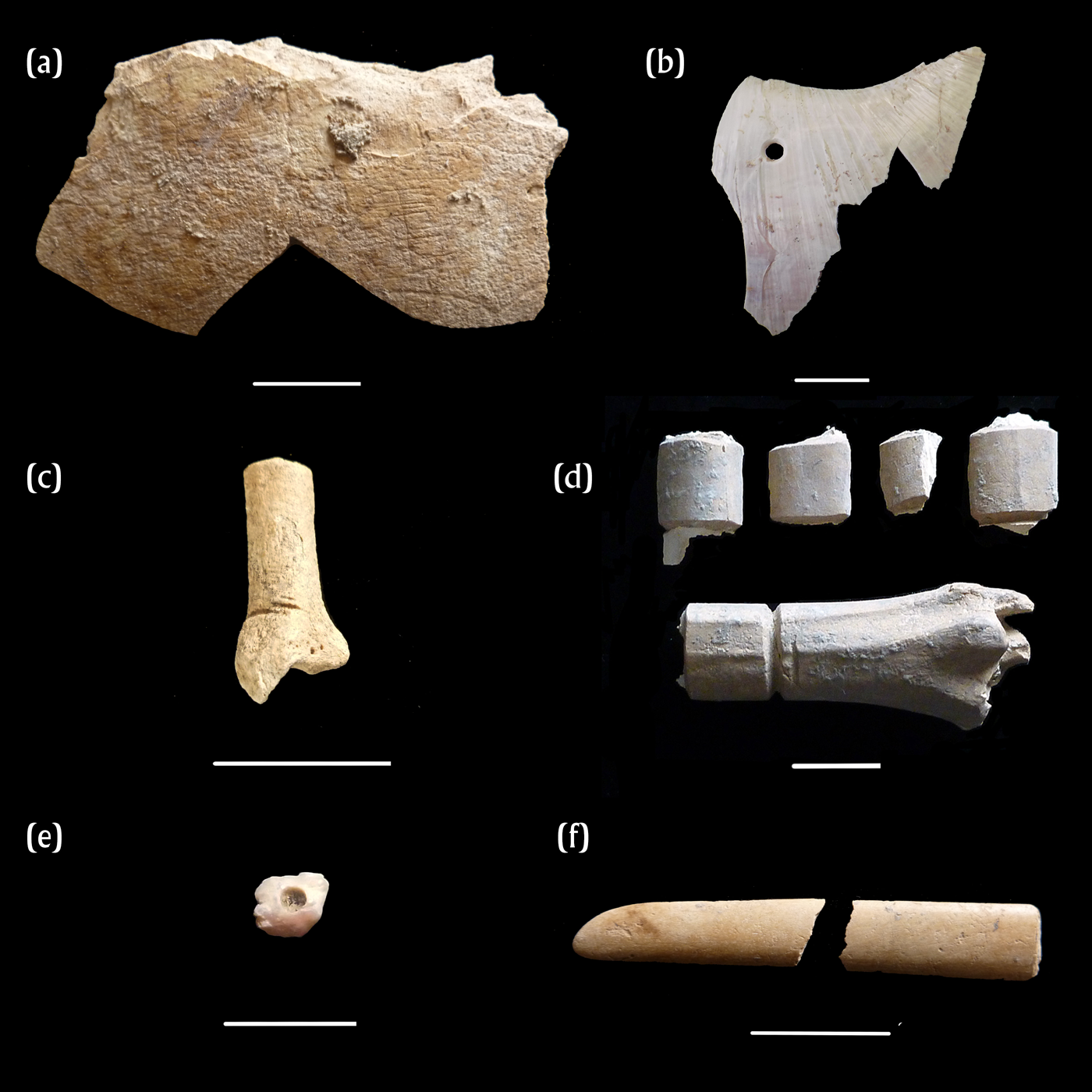
A total of 444 faunal specimens exhibited modifications (Table 6), representing 2.9 percent of the total number of Middle Preclassic specimens (NISP = 15,216, not counting unmodified land snails). Of these, the majority (76.4 percent) were bones and shells exhibiting modifications associated with crafting, mainly carving or piercing (Figure 7). The rest could be attributed to butchery activities, including eight specimens (seven mammal and one fish) with cut marks likely due to dismemberment or, in the case of one large jaguar (Panthera onca) metacarpal, possible skinning. Jute snails made up the largest proportion of modified fauna for the purposes of consumption, including 85 individuals (19.1 percent of modified specimens) with pierce marks or missing spires. Of the specimens modified for crafting, about a third (36.6 percent) were in an early state of production or the remains of debitage, while the remaining portion were near-finished or completed artifacts.
Examples of bone and shell modifications at Middle Preclassic Ceibal. (a) Carved river turtle (Dermatemys mawii) carapace from the Group A East Court, Real 3 phase (CB201F-3-12-7). (b) Drilled apple snail from Karinel Group, Escoba 2 phase (CB211B-4-5-4). (c) Possible butchery marks on a dog tibia from the A-24 Platform, Escoba 2 phase (CB200B-16-8-1). (d) Deer tibia in the process of crafting beads or “blanks” for ornaments, Structure A-18, Escoba 3 phase (CB205A-1-7-15). (e) Tiny river mussel bead from the Group A Central Plaza, Escoba 2 phase (CB203B-18-6-4). (f) Carved bone awl or flat pin, Structure A-15 midden, Escoba 2 phase (CB201G-1-6-1). Bar denotes 2 cm in all photos except (e), which is 0.5 cm. Photographs by Sharpe.
Subsistence-based processing (butchery and skinning) and bone/shell artifact production at Middle Preclassic Ceibal. Early-stage processing includes debitage and primary/secondary production stages. Late-stage processing includes finished or nearly finished artifacts. NISP, number of identified specimens.

Tables 7 and 8 show the types of modifications exhibited among the fauna during the Real and Escoba phases. Modified specimens from the Real phase represent a third (135 specimens, 30.4 percent) of the modified material, of which half are pierced jute from a single Real 3 deposit in the Karinel Group. The nature of this deposit is unclear since no other artifacts or distinguishing features were located nearby. Almost all jute in the deposit were pierced in a similar fashion, on the side of the spire. There were far less modified jutes in the Escoba phase (2.9 percent). Modified freshwater mussels were proportionally similar between both periods (14.8 percent and 12.3 percent) and were located in all operations. The Escoba phase had a much higher number and proportion of worked marine shell (140 specimens, 45.3 percent of worked Escoba fauna) than the Real phase (six specimens, 4.4 percent of worked Real fauna), and the latter constituted only finished products. Marine shell crafting was therefore more common in the Escoba phase than the Real phase at Ceibal and included a larger diversity of species (Sharpe Reference Sharpe2019).
Real-phase bone and shell artifacts by area from Ceibal.

*Possibly includes marks from processing shell for meat
Escoba-phase bone and shell artifacts by area from Ceibal.
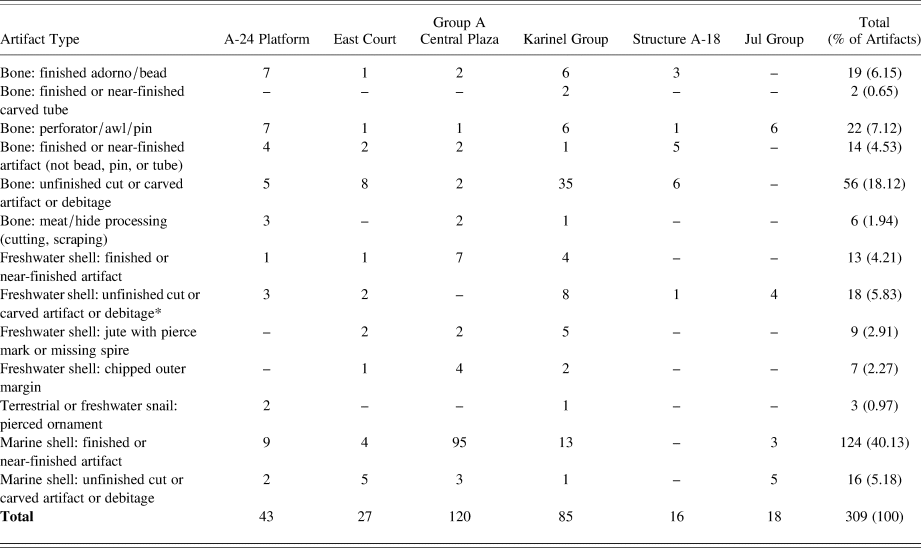
*Possibly includes marks from processing shell for meat
Interestingly, the only modified apple and terrestrial snails found at Ceibal were identified in the Escoba phase. These included a fragment of a large apple snail with a carefully drilled, round hole in the Karinel Group (Figure 7b), and two cone snails (Bulimulus sp.) with identical round drill holes found together in the A-24 Platform. These were likely ornamental objects, based on the care that was taken to drill these small perforations. By contrast, the jute snails were likely pierced forcefully with a sharp stone implement, leaving behind large, jagged holes.
Worked bone made up 24.4 percent of the Real modified remains, of which 17.0 percent was in an early state of manufacture or debitage. Worked bone was more common in the Escoba phase (38.5 percent), but the number of remains in the early production or debitage phase was proportionally similar to the Real phase (18.1 percent). Finished bone objects in the Real phase primarily consisted of adornos and beads (5.2 percent of worked Real specimens), and one pin found in Platform A-24. The Escoba phase had a greater variety of finished bone artifacts, including 22 pins/awls found across several parts of the site (7.1 percent of worked Escoba specimens), as well as several adornos/beads (6.2 percent). Additionally, two long-bone tubes were found in the Karinel Group, and 14 other bone objects (mainly carved and polished flat objects with incisions, often broken) were found in different deposits. Bone working for the purpose of artifact production was apparently more common across the site during the Escoba phase than the Real phase.
In general, primary contexts containing the remains of discarded faunal material resulting from consumption and artifact manufacture are largely absent in the Middle Preclassic phases at Ceibal. Concentrated middens of unmodified freshwater mollusks, particularly Pomacea, are occasionally present, but vertebrate middens are distinctly absent (Sharpe et al. Reference Sharpe, Inomata, Triadan, Burham, MacLellan, Munson and Pinzón2020). This stands in stark contrast to the Late and Terminal Classic periods, where dense deposits of vertebrates, mainly deer, have been found in both the central ceremonial core and outlying residential groups (Pohl Reference Pohl, Willey and Graham1990; Sharpe et al. Reference Sharpe, Inomata, Triadan, Burham, MacLellan, Munson and Pinzón2020). Evidence of deer butchery is absent in the Middle Preclassic, but present in the Classic phases (15 specimens from Late/Terminal Classic deposits recovered by the CPAP; see also Pohl Reference Pohl, Willey and Graham1990:157–158). This absence does not mean that deer were not hunted in the Middle Preclassic. Rather, the lack of butchery marks and primary vertebrate middens indicates that the Middle Preclassic inhabitants had a different disposal method of bones than in the Classic period. The following section explores this trend further by examining primary contexts of discarded lithic and faunal material at Middle Preclassic Ceibal.
Examining Bone, Shell, and Lithic Remains in Primary Contexts
In the following section, we present the lithic and faunal data from primary archaeological contexts to address the question of where craft production took place during the early Middle Preclassic Real-Xe and the late Middle Preclassic Escoba-Mamom phases. Since primary contexts containing faunal material are scarce in the Middle Preclassic phases at Ceibal, we focus on lithic material; however, the few faunal remains found in these deposits provide what might be considered direct evidence of modified bones and shells made by the very stone tools identified in these deposits. This section also discusses the nature of each deposit, and what the combined lithic and faunal data reveal about the human individuals who were responsible for their creation.
Real 2-Phase Midden in the A-24 Platform of Group A
The A-24 Platform is a large ceremonial structure on the western side of Group A. Excavations recovered a Real 2 phase midden at the western side of this platform, at the base of Structure A-24 (CB200A1-20-1, Figure 8 and Table 9; Triadan et al. Reference Triadan, Castillo, Inomata, Palomo, Méndez, Cortave, MacLellan, Burham and Ponciano2017:235). The midden contained a total of 63 chipped stone artifacts, including three obsidian and 60 chert artifacts. Three natural tools of quartzite (two hammerstones and pebble smoothers) were deposited in the midden, but neither metates nor manos were found. Aoyama selected 36 chipped stone artifacts made of obsidian (N = 3) and chert (N = 33) for high-power microwear analysis. All obsidian artifacts were used, while interpretable microwear was observed on 10 out of 33 chert flakes (30.3 percent), indicating that nearly one third of the chert flakes were not manufacturing debris but used tools. A total of 17 IUZ were identified on the analyzed chipped stone artifacts, including cutting meat or hide (35.3 percent), working unidentified material (29.4 percent), scraping hide (17.6 percent), carving wood (11.8 percent), and whittling shell or bone (5.9 percent). Obsidian prismatic blade segments were used for cutting meat or hide, whereas chert unretouched flakes were used for scraping hide, cutting meat or hide, and whittling bone or shell. In sum, hide working, wood working, and shell or bone carving appear to have been activities undertaken with these chipped stone artifacts from the midden deposit.
Materials worked with the chipped stone artifacts from the two Real phase midden deposits in Ceibal. Figure by Aoyama.

Lithic evidence for shell and bone, and meat and hide working at Ceibal during the early Middle Preclassic Real phase. IUZ, independent use zones.

The majority of the faunal remains in this context (Table 10) were unmodified (see Supplementary Material for specimen identifications). The context included 15 scattered dog bones from at least two individuals (20.8 percent of the context's NISP), and several unidentified small carnivore bones that may have been dogs. The modified remains included one clear cut through the center of a carnivore's metapodial (likely a small dog); it was unclear if this was bone working or butchery, due to the smooth nature of the break. The other vertebrate specimens in the deposit (e.g., deer, raccoon, a barn owl, turtle, and catfish) were unmodified. A fragment of a small bone pin and a broken, but possibly finished, shell disk carved from a freshwater mussel were also found in the deposit. Since these few modified remains were a small portion of the overall number of specimens, it seems craftworking took place near this area and included the discard of other miscellaneous fauna that were likely consumed. Small carnivores (likely dogs) and freshwater mussels appear to be the materials carved with the chipped stone tools.
Worked bone and shell material from select primary midden contexts containing lithic debitage from Ceibal. Note the Structure B'ab’ay midden did not contain any modified fauna.

Real 3-Phase Midden above Structure Pemech-3rd in the Karinel Group
A total of 45 chipped stone artifacts, including six obsidian and 39 chert artifacts, were recovered from a Real 3 phase midden (CB211C14-7-1; Figure 8 and Table 9) above Structure Pemech-3rd in the residential Karinel Group, located only 160 m west the Central Plaza of Group A (MacLellan Reference MacLellan2019a:169). A polished hemisphere made of calcite and a quartzite sphere were collected but neither metates nor manos were recovered. Aoyama selected 35 chipped stone artifacts made of obsidian (N = 6) and chert (N = 29) for microwear analysis. Four El Chayal obsidian artifacts were used. These included a medial segment of prismatic blade, two initial pressure blades, and a large secondary flake served for cutting meat or hide. Interpretable microwear was observed on 14 out of 29 chipped chert artifacts (48.3 percent), indicating that more than half of them were manufacturing debris. A total of 27 IUZ were identified on the analyzed chipped stone artifacts, including carving shell or bone (44.4 percent), cutting meat or hide (22.2 percent), and scraping hide (14.8 percent). Chert secondary and tertiary flakes were used for carving shell or bone and scraping hide, whereas chert denticulates and a small percussion blade served for cutting and whittling shell or bone.
The tools from the midden in the Karinel Group were more intensively used than those from the midden in the A-24 Platform. Moreover, a significantly higher percentage of the chipped stone artifacts recovered from the midden in the Karinel Group were used for carving shell or bone (44.4 percent) as compared to those from the midden in the A-24 Platform (5.9 percent). In sum, the results of microwear analysis indicate that this midden deposit in the Karinel Group was a mixture of chert flake production and other non-subsistence production debris, including from shell or bone carving and hide processing.
The faunal remains from this context (Table 10) support the findings of the microwear analysis. The only modified fauna were four mammal long bone fragments: two carved and polished beads, and two shaft pieces with smooth horizontal cuts. The identified mammals in the deposit included deer and dogs, which may have been the source of the beads, although the carved bones were not diagnostic to species. There were no carved or cut shells in the deposit, indicating that bone was likely the primary crafting material in this area.
Escoba 2-Phase Midden Associated with the Kaaxkuut Structure in the A-24 Platform of Group A
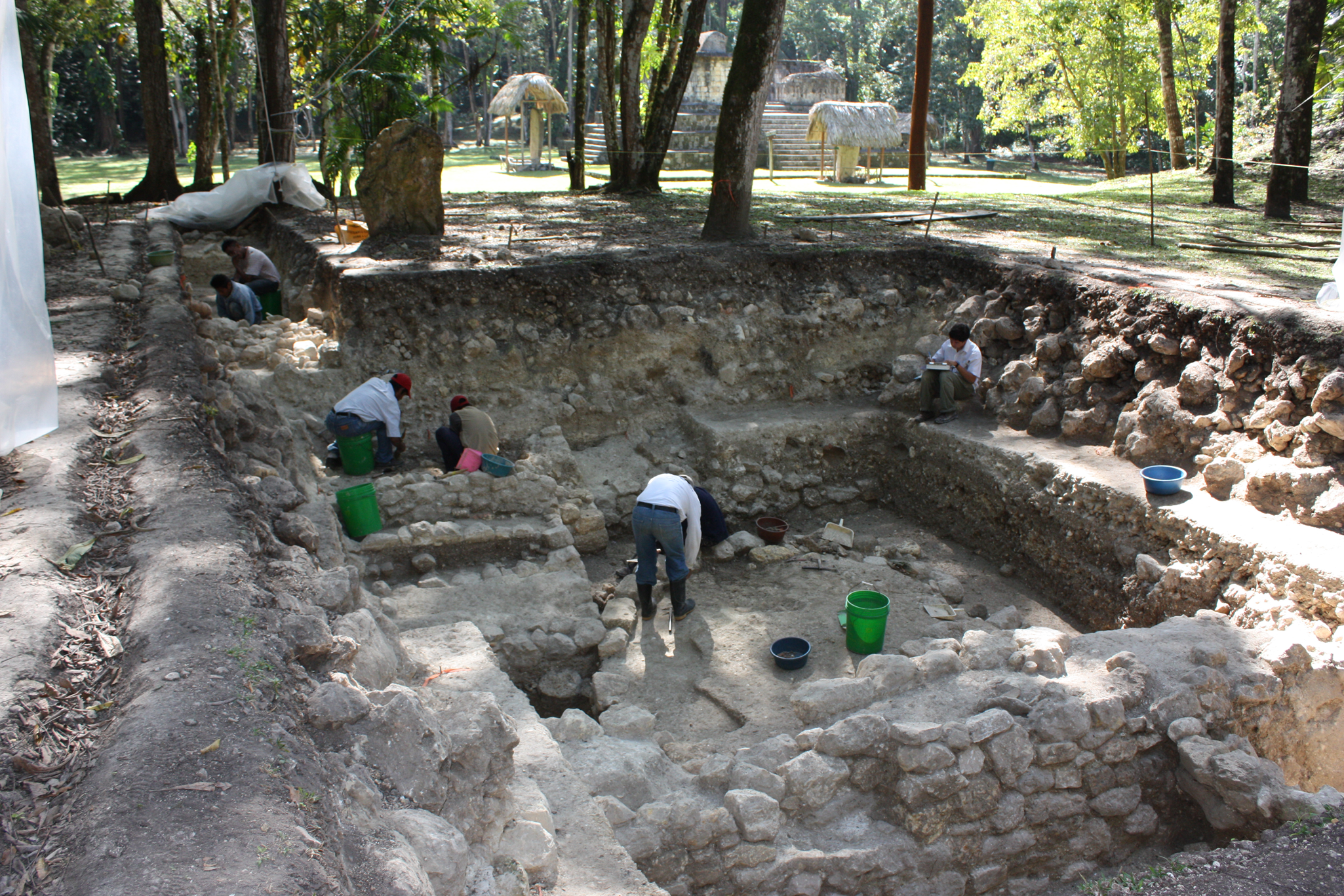
There was a continuation of platform and temple building and refurbishing during the late Middle Preclassic Escoba-Mamom phase at Ceibal (Inomata et al. Reference Inomata, MacLellan, Triadan, Burham, Aoyama, Nasu, Munson, Pinzón and Yonenobu2015:4269). Extensive excavations in the A-24 Platform (Figure 9) uncovered a series of middens dating to the Escoba 2 phase (Figure 10 and Table 11). A considerably larger number of obsidian artifacts (N = 161) were recovered than chert chipped stone artifacts (N = 62) from the late Middle Preclassic Escoba 2 phase midden on Floor 5b2, associated with the Kaaxkuut Structure under the large terrace east of Structure A-24 (CB200B1-7-3 and 16-7-5; Triadan et al. Reference Triadan, Castillo, Inomata, Palomo, Méndez, Cortave, MacLellan, Burham and Ponciano2017:241). Moreover, two ground stone artifacts (a jade tabular bead and a limestone mano) and four natural tools (chert and quartzite hammerstones as well as two quartzite notched pebbles) were found in the midden.
Extensive excavations of the A-24 Platform in Group A of Ceibal that revealed Structures Kelko, Ba'ba’y, Kotko, and Kaaxkuut and Platform Saq’, dating to the Escoba phase. Photograph by Aoyama.
Materials worked with the chipped stone artifacts from the Escoba phase middens and on-floor deposits in Ceibal. Figure by Aoyama.

Lithic evidence for shell and bone, and meat and hide working at Ceibal during the late Middle Preclassic Escoba phase. IUZ, independent use zones.

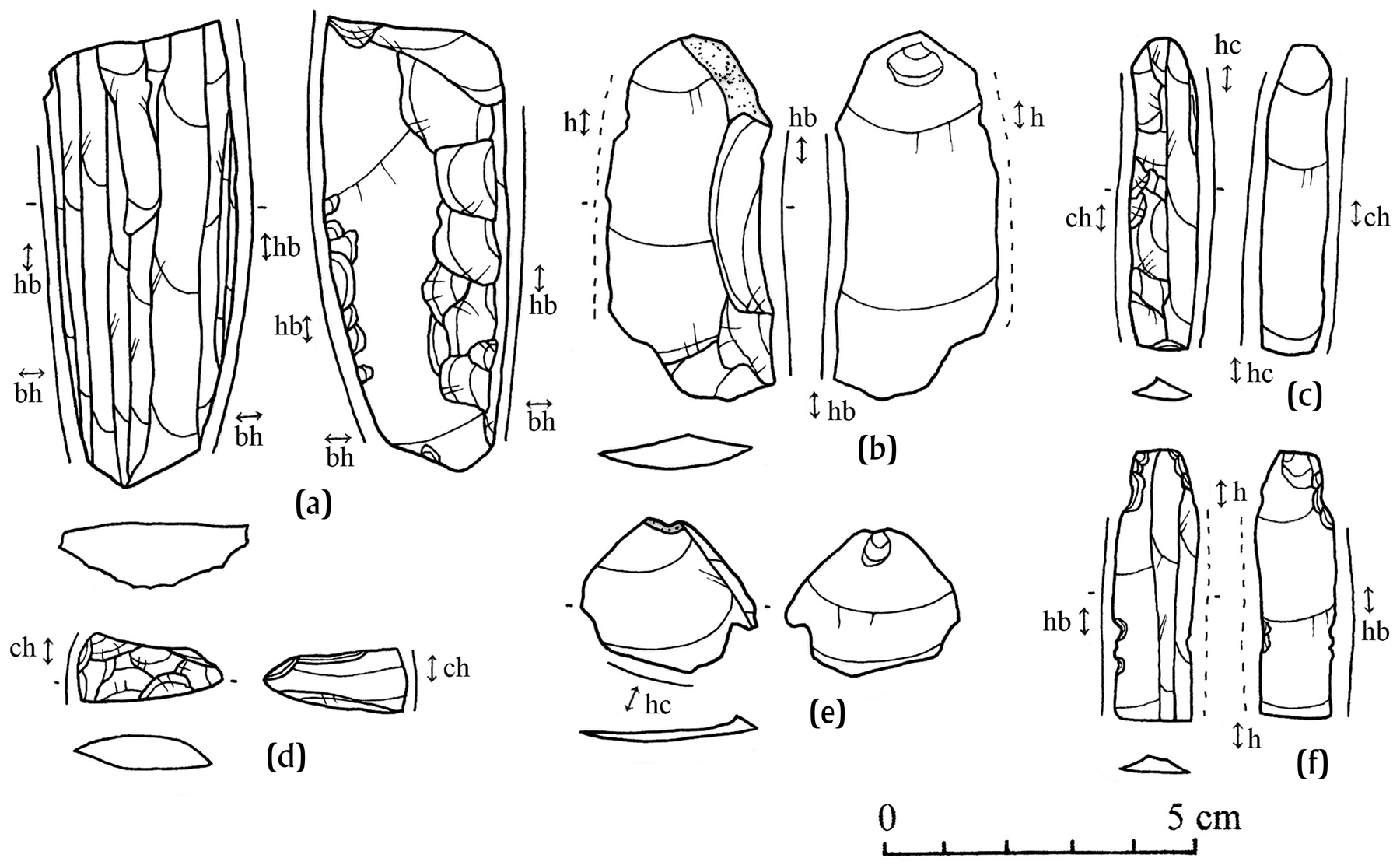
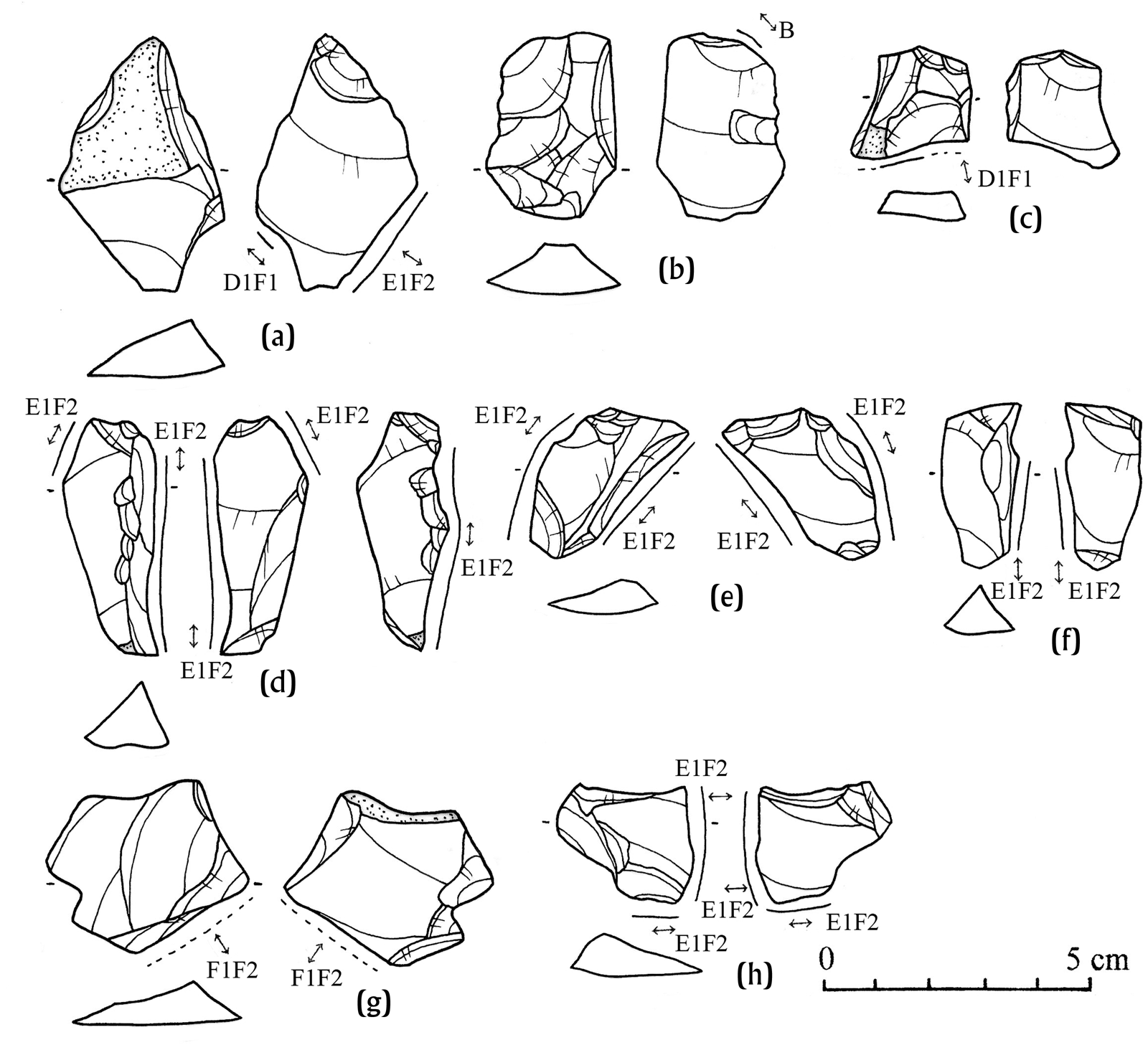
A total of 296 IUZ were identified on the 194 selected chipped stone artifacts (147 obsidian and 47 chert). Microwear was identifiable on 88.4 percent of obsidian artifacts (Figure 11), while at least 66 percent of chert artifacts were used (Figure 12), indicating that most of the obsidian and chert artifacts were used tools rather than manufacturing debris. Working of unidentified material (56.4 percent) was the most common activity, followed by cutting, whittling, and grooving wood (23 percent), carving bone or shell (9.1 percent), cutting meat or hide (7.1 percent), scraping hide (4.1 percent), and working stone (0.3 percent). Among them, obsidian prismatic blades, small percussion flakes and a scraper, and chert flakes, denticulates, and a scraper were used for meat or hide processing. Materials used for carving shell or bone objects included thicker chert flakes, denticulates, flake cores and a scraper, as well as obsidian prismatic and initial blades, and small and large percussion flakes. Consequently, in addition to cooking activities, several kinds of craft production, such as wood carving and, to a much smaller degree, shell or bone carving and hide processing were executed with the chipped stone artifacts.
San Martín Jilotepeque obsidian artifacts recovered from the Escoba 2 phase midden (CB200B1-7-3) associated with the Kaaxkuut Structure in the A-24 Platform of Group A, Ceibal, showing the distribution of usewear on them. Because different polish types are frequently observable on the same edge, a complex of different polish types is described by a combination of a principal type and a secondary type, such as bh, ch, hb, and hc. Artifacts (c–e) were used for shell or bone carving. (a) Polyhedral core fragment, Cat. 196-1. (b) Large secondary flake, Cat. 196-2. (c) Proximal segment of crested blade, Cat. 196-3. (d) Small tertiary flake, Cat. 196-4. (e) Small secondary flake, Cat. 196-5. (f) Proximal segment of prismatic blade, Cat. 196-6. Lithic illustrations in Japanese technical style by Aoyama.
Chert artifacts recovered from the Late Middle Preclassic Escoba 2 phase midden (CB200B1-7-3) associated with the Kaaxkuut Structure in the A-24 Platform of Group A, Ceibal, showing the distribution of usewear on them. Because different polish types are frequently observable on the same edge, a complex of different polish types is described by a combination of a principal type and a secondary type, such as BF1, E1F2, and F1F2. Artifact (a) was used for both cutting shell or bone and scraping hide, artifact (c) served for whittling shell or bone, and artifacts (d-f) and (h) were utilized for meat or hide processing. (a and d) Denticulates: (a) Cat. 194-1; (d) Cat. 194-2. (b, e, f, and h) Tertiary flakes: (b) Cat. 194-3; (e) Cat. 194-4; (f) Cat. 194-5; (h) Cat. 194-6. (c and g) Secondary flakes: (c) Cat. 194-7; (g) Cat. 194-8. Lithic illustrations in Japanese technical style by Aoyama.
The majority of the fauna in the Kaaxkut Structure midden were unmodified dog bones (7.4 percent) and fish (48.8 percent), including catfish (Siluriformes), gar (Atractosteus tropicus), and cichlids (Cichlidae; Supplementary Information). Only three bones and three shells were modified, and all appeared to be the products of ornamental craft production (Table 10). Of the bones, one dog ulna had been cut horizontally midway through the shaft and carefully smoothed around the edges afterward, indicating it was likely not the result of butchery or skinning. Two other, unidentified, vertebrate bone fragments exhibited carving and polishing along the edges. One of these had been carved into a thin pin but was broken at the two ends. One freshwater mussel had been cut near the umbo. Since stray cut marks are rare on mussels at Ceibal, it was either an unusual occurrence of a mussel pried open with a sharp tool that left a mark or was the result of someone beginning to modify the shell for a specific purpose. Finally, two small Atlantic marginella (Prunum apicinum) shells also exhibited puncture marks on the sides, potentially made with the point of a sharp tool. Considering the quantity of lithic tools and debitage in this assemblage compared to the small number of modified remains, it would appear that the faunal results support the microwear data in that many of the tools in this context were used for food processing, particularly of meat (perhaps the dogs and fish), but that bone and shell crafting were not as common.
Escoba 2-Phase Midden Associated with Structure Kotko in the A-24 Platform of Group A
Under Floor 5b2 and Structure Kaaxkuut, excavators found a dense ceramic and lithic midden deposited during the late Middle Preclassic Escoba 2 phase on the exterior floor (Floor 5c2) to the east of Structure Kotko in the A-24 Platform of Group A (Triadan et al. Reference Triadan, Castillo, Inomata, Palomo, Méndez, Cortave, MacLellan, Burham and Ponciano2017:241). A total of 106 chipped stone artifacts, including 58 obsidian and 48 chert artifacts, were recovered from the midden associated with Structure Kotko (CB200B16-7-9, 19-8-2, and 19-8-4). Furthermore, two ground stone artifacts (a circular grooved hemisphere made of calcite and a limestone mano) and 15 natural tools (seven quartzite pebble smoothers, a basalt pebble smoother, a chert pebble smoother, two sandstone faceted smoothers, a schist faceted smoother, a basalt faceted smoother, and two quartzite hammerstones) were collected.
The deposit contained very few faunal remains (NISP = 30), of which two (a pierced Atlantic marginella bead and a cut dog radius, which may have been debitage from bone working due to the smooth nature of the cut) were the only representatives of fauna modification (Table 10). Almost half of the fauna (46.7 percent) were unmodified freshwater shells. The number and types of faunal specimens in these lots resembled the fragments in the surrounding fill matrix, indicating that they were likely not primary midden debris associated with the lithic material in this midden.
Aoyama selected 101 chipped stone artifacts made of obsidian (N = 57) and chert (N = 44) for microwear analysis (Figure 10). Usewear was observed on 46 out of 57 obsidian artifacts (80.7 percent), indicating that some obsidian artifacts were not used tools but manufacturing debris. Interpretable microwear was observed on 18 out of 44 chert artifacts (40.9 percent). A total of 106 IUZ were identified on the analyzed chipped stone artifacts, including cutting meat or hide (28.3 percent), cutting and whittling unidentified material (26.4 percent), carving wood (24.5 percent), carving shell or bone (17 percent), scraping hide (2.8 percent), and stone working (0.9 percent). Obsidian artifacts (IUZ = 80) were used principally for cutting meat or hide (36.3 percent), cutting and whittling unidentified material (35 percent), and wood carving (27.5 percent); and, to a much smaller degree, for carving shell or bone (1.3 percent). In terms of activities performed with chert artifacts (IUZ = 26), shell or bone carving were the most common activities (65.4 percent), followed by wood carving (15.4 percent), scraping hide (11.5 percent), cutting meat or hide processing (3.8 percent), and stone working (3.8 percent).
Obsidian prismatic and initial pressure blades and flakes, as well as chert flakes served for meat or hide processing. Thicker chert artifacts, such as flakes, scrapers, denticulates, and drills, as well as an obsidian large flake served for shell or bone carving. In sum, the lithic assemblage and the results of microwear analysis point out that this midden deposit was a mixture of obsidian and chert flake production debitage and other non-subsistence production debris, including shell or bone carving and hide processing, as well as cooking activities. The fauna that were the subject of these processing activities appear to have been deposited elsewhere.
Escoba 2-Phase Midden Associated with Structure B'ab’ay in the A-24 Platform of Group A
Structure Kotko was a rounded horizontal expansion of an earlier rectangular low platform, Structure B'ab’ay (Triadan et al. Reference Triadan, Castillo, Inomata, Palomo, Méndez, Cortave, MacLellan, Burham and Ponciano2017:241). On the eastern side was another area of a late Middle Preclassic Escoba 2 phase midden placed on the associated Floor 5d (CB200B16-8-2 and 19-8-6). A considerably smaller number of obsidian (N = 8) and chert (N = 6) chipped stone artifacts were collected from this midden than the other two middens described above. Furthermore, the midden was almost entirely devoid of animal remains, containing only six fragments (five unidentified vertebrates, mostly from small shafts, and one mammal shaft fragment). These lacked modifications, indicating that this midden, like the Kotko Structure midden above it, did not contain primary animal discard.
Aoyama conducted high-power microwear analysis on all chipped stone artifacts except a chert small primary flake (Figure 10). All obsidian artifacts except an initial pressure blade and a small secondary flake were used (75 percent) for cutting and whittling unidentified material and wood, while interpretable microwear was observed on two out of five chipped chert artifacts (40 percent). A total of 13 IUZ were identified on the analyzed chipped stone artifacts, including cutting and whittling unidentified material (61.5 percent), carving wood (23.1 percent), and carving shell or bone (15.4 percent). Chert artifacts were used exclusively for carving shell or bone, that is, a chert denticulate was used for cutting shell or bone and a chert small primary flake served for whittling shell or bone. In sum, the results of microwear analysis indicate that this midden deposit was a mixture of chert flake production debitage and other non-subsistence production debris, including wood and shell or bone carving.
Escoba 2-Phase Midden on the Foot of the North Side of the Platform Behind Structure A-15 on the East Court of Group A
Sharpe uncovered a late Middle Preclassic Escoba 2 phase midden (CB201G1-6-1) on the foot of the north side of the platform behind Structure A-15 on the East Court of Group A (Triadan et al. Reference Triadan, Castillo, Inomata, Palomo, Méndez, Cortave, MacLellan, Burham and Ponciano2017:243). A considerably larger number of chert artifacts (N = 69) were recovered than obsidian chipped stone artifacts (N = 13) from the midden. A complete thick-ovate-rectangular mano of limestone (31.7 × 8.3 × 5.6 cm, 2,055.4 g) was also collected. The mano in question is the longest specimen uncovered so far by the CPAP. The diversity of animal species in the deposit (at least 14 different taxa; Supplementary Information), particularly dogs and a variety of freshwater fish, indicate it was likely also a primary midden for animal discard. Among these specimens included two modified remains, one a carved and polished mammal shaft that may have been an awl (Figure 7f) and the other a large marginella shell (Prunum sp.) with cut spire, likely used as a bead or tinkler.
A total of 67 IUZ were identified on the 81 selected chipped stone artifacts (13 obsidian and 68 chert). Microwear was identifiable on all obsidian artifacts except a small secondary flake and a small tertiary flake (84.6 percent), while at least 45.6 percent of chert artifacts were used (Figure 10). In total, shell or bone carving (44.8 percent) were the most common activities, followed by meat or hide processing (35.8 percent), working of unidentified material (14.9 percent), and carving wood (4.5 percent). The analyzed obsidian artifacts (IUZ = 22) were principally used for cutting and whittling unidentified material (45.5 percent) and cutting meat or hide (40.9 percent); and, to a much smaller degree, for cutting wood (9.1 percent) and scraping hide (4.5 percent). Chert artifacts were more intensively utilized than obsidian artifacts: Aoyama was able to determine all worked material categories on them (IUZ = 45). Shell or bone carving (66.7 percent) were the most common activities performed with chert artifacts, followed by scraping and boring hide (24.4 percent); and, to a much smaller degree, for cutting meat or hide (6.7 percent) and whittling wood (2.2 percent). Obsidian prismatic blades served for meat or hide processing, whereas chert flakes, denticulates, and flake cores were used mainly for shell or bone carving and to a smaller degree for meat or hide processing. Consequently, in addition to cooking activities, several kinds of craft production, including shell or bone carving and hide processing, were executed with the chipped stone artifacts. These likely included the animals in the deposit, particularly dogs and fish.
Escoba 2-Phase Burned Floor 10b in the E-Group Plaza of Group A
The inhabitants of Ceibal expanded the E-Group in the Central Plaza of Group A throughout the Middle Preclassic period. Under the burned Floor 9 within the E-Group's plaza, excavators found the burned Floor 10b (CB203B18-6-4) that appears to have resulted from the ritual termination of another construction phase (Inomata et al. Reference Inomata, Pinzón, Palomo, Sharpe, Ortíz, Méndez and Román2017c:Figure 16). A total of 53 chipped stone artifacts, including 32 obsidian and 21 chert artifacts, and a complete plano-convex variety short mano of limestone (11.8 × 7.8 × 6.8 cm, 1,041.9 g), were recovered on the burned Floor 10b.
Aoyama selected 24 chipped stone artifacts made of obsidian (N = 18) and chert (N = 6) for microwear analysis (Figure 10). Usewear was observed on 15 out of 18 obsidian artifacts (83.3 percent), indicating that a large tertiary flake, a small primary flake, and a small tertiary flake were not used tools but manufacturing debris. Interpretable microwear was observed on four out of six chert artifacts (66.7 percent). A total of 32 IUZ were identified on the analyzed chipped stone artifacts, including working unidentified material (75 percent), carving wood (12.5 percent), chiseling stone (6.3 percent), cutting meat or hide (3.1 percent), and whittling shell or bone (3.1 percent).
Among the obsidian artifacts, apart from whittling wood (IUZ = 1), the materials could not be identified on 24 out of 25 IUZ (96 percent), suggesting that the obsidian tools found on the burned Floor 10b were not intensively used. In terms of activities performed with chert artifacts (IUZ = 7), cutting wood (42.9 percent) was the most common activity, followed by chiseling stone (28.6 percent), cutting meat or hide (14.3 percent), and whittling shell or bone (14.3 percent). Chert flakes served for whittling shell or bone and cutting meat or hide.
Only a few faunal specimens were recovered in the deposit (NISP = 24), the majority of which were freshwater shells and possibly part of the surrounding secondary fill matrix. Four modified ornamental shells, however, are noteworthy because they do not resemble anything in the surrounding excavation lots. Two of these were marine gastropods with holes drilled in the sides for use as beads or tinklers, including an Atlantic marginella and an olive shell (Olivinae). The other two were freshwater mussel fragments with tiny holes pierced carefully in the nacre. One of these was a tiny (2.5 × 2 mm) nacre bead (Figure 7e), recovered in the soil flotation. No other shell bead this small has been recovered at Ceibal. These carefully drilled ornamental shell objects match the microwear patterns from the lithics found in the deposit, which indicate shell whittling.
Escoba 2-Phase Trash Pit at the Jul Group in the Periphery Area of Ceibal
The Jul Group, a minor temple and residential complex, is located approximately 600 m southeast of the Group A Central Plaza. Burham (Reference Burham2019) excavated the plaza in front of Structure 6E-6, a six-meter tall pyramid in the Jul Group. She uncovered a large intrusion, i.e., the late Middle Preclassic Escoba 2 phase trash pit, approximately two meters in diameter and one meter deep, carved out of the bedrock (CB210A). It was completely filled with rich midden materials that appeared to be a single dumping event (Figure 13). In addition to several partial ceramic vessels and large pieces of broken pottery (Burham Reference Burham2019:149), the midden materials included hundreds of apple snail shells, worked marine shell, multiple deer antlers, a partial rabbit (Sylvilagus sp.), and fish bones, representing one of the largest Middle Preclassic primary middens containing fauna at the site (NISP = 1,397). Only one percent of the material was modified (Table 10). In addition, Aoyama identified 2,139 chipped stone artifacts, four ground stone artifacts, including manos of quartzite (N = 1) and basalt (N = 1), a sherd of K-feldspar rock vessel, an unclassified ornament of dacite, five natural tools (including pebble smoothers of basalt [N = 1] and dacite [N = 1]), three faceted smoothers of basalt, and seven manuports of quartzite (N = 4), pumice (N = 1), goethite (N = 1), and K-feldspar rock (N = 1).
Late Middle Preclassic Escoba 2 phase trash pit carved out of the bedrock (CB210A) at the Jul Group in the periphery area of Ceibal. Note green containers with apple snails (Pomacea flagellata). Photograph by Aoyama.

A considerably larger number of chert chipped stone artifacts (N = 1,938) were recovered than obsidian artifacts (N = 201) from the trash pit. The percentage of obsidian artifacts among all chipped stone artifacts from this midden (9.4 percent) is considerably lower than the same percentage for the Escoba phase contexts at the central part of Ceibal (32.7 percent). Chert artifacts are characterized by the prominent presence of prismatic blades (N = 103) and drills (N = 51). In fact, more than half (52.9 percent) of the chert prismatic blades included in the present study were found at the Jul Group.
A total of 178 IUZ were identified on the 82 selected chipped stone artifacts (11 obsidian and 71 chert). Microwear was identifiable on all obsidian artifacts, while at least 98.6 percent of chert artifacts were used, indicating that the great majority of the obsidian and chert artifacts were used tools rather than manufacturing debris. The analyzed obsidian lithic artifacts (IUZ = 24) were used for processing unidentified material (41.7 percent), meat or hide processing (25 percent), wood carving (20.8 percent), and carving shell or bone (12.5 percent). In terms of activities performed with chert artifacts (IUZ = 154), shell or bone carving (82.5 percent) were the predominant activities, followed by meat or hide processing (11 percent), working of unidentified material (5.2 percent), and wood carving (1.3 percent). In total, shell or bone carving (73 percent) were the most common activities, followed by working of unidentified material (10.1 percent), cutting meat or hide (9 percent), scraping hide (3.9 percent), and cutting and whittling wood (3.9 percent). Tools used for carving shell or bone include chert drills, prismatic blades, flakes, small percussion blades, denticulates, bifacial thinning flakes, as well as obsidian prismatic blades. Moreover, obsidian prismatic blades as well as chert flakes and drills served for meat or hide processing. In sum, in addition to cooking activities, several kinds of craft production, in particular shell or bone carving, were executed with the chipped stone artifacts.
The context contained evidence of both finished bone and shell artifacts, as well as debitage from crafting. Significantly, it was one of the few locations at Ceibal where marine shell debitage was identified, specifically the cut fragments of a large gastropod (Sharpe Reference Sharpe2019). Marine shell debitage is interestingly absent in the Late Preclassic and Classic periods at Ceibal, since many shell artifacts likely arrived at Ceibal as finished products. Yet marine shell crafting took place during the Escoba 2 phase of the Jul Group, along with crafting of both mammal long bones into narrow, polished pins and/or awls (of which five were found, scattered throughout the deposit). Three freshwater mussels also exhibited marks indicative of cutting, carving, and intentional smoothing of edges; all of these appear to be debitage from shell working, rather than finished products. It would therefore appear that this part of the Jul Group contained an individual or individuals who were actively involved with crafting bone and shell artifacts with the chipped stone tools in the deposit.
DISCUSSION
We began this study with four objectives: (1) to better understand the manufacturing process of certain raw materials during the Middle Preclassic period; (2) to examine the association between lithic production and bone/shell processing for meat or artifact production at various locations around Ceibal; (3) to identify locations of craft production; and (4) to compare crafting activities with those of later Classic-period society. In general, primary evidence for crafting is exceedingly rare, with lithic production easier to identify than that of bone or shell artifacts. Evidence of the latter is more readily apparent from microwear analysis on stone tools. It would appear that these activities occurred in the vicinity of early ceremonial features at the site's core, suggesting that those who conducted the ceremonies, among them the developing elite class, were involved with craft production. Here we examine what the evidence at Ceibal can tell us regarding the identities of the craft specialists, including what this informs us regarding Middle Preclassic craft production in the Maya region.
Middle Preclassic Crafting and Emerging Elite Identities
Of the eight primary middens reviewed in this analysis, all but two (that of the Pemech-3rd structure and the Jul group) were found in and around Group A's monumental architecture at the core of the site. Like Classic-period artisans, there is evidence that Middle Preclassic individuals engaged in multicrafting of different materials near the site-core, due to the presence of different artifact types in the middens and based on the evidence of multiple usewear patterns on individual stone tools. The individuals involved with these crafting activities apparently conducted their operations within the ceremonial center. Much like evidence for elite crafting in the Late and Terminal Classic periods, it would appear that those involved with the ceremonies had a hand in directing the production of specialized items used in performances, and may have even been the crafters themselves.
Evidence for the production of stone tools, including obsidian blades, is most prevalent at these locations. Artisans specializing in blade production would have needed to acquire the raw obsidian to produce these items, and it appears the Ceibal crafters had a steady supply of these materials based on the quantity of lithic items found across the site during the Middle Preclassic period (Aoyama Reference Aoyama2017a, Reference Aoyama2017b). The microwear analysis indicates that the tools themselves were used primarily for shell, bone, and meat/hide processing, based on the preponderance of marks pertaining to these activities at the majority of the middens. Only in the two Platform A-24 middens, in the Kaaxkuut and B'ab’ay Structures, did woodworking make up the majority of identified wear patterns. We do not know what type of wood was modified at these locations, but they may have been for objects related to activities conducted on the large central platform.
There is more evidence for modified shell at the site than bone. It is possible that some modified marine shells were imported to Ceibal during the Middle Preclassic as finished products. These may have included the Atlantic marginella beads and olive shell tinklers. Although it is difficult to prove or disprove when marginella beads were modified (they are small, barely a centimeter long, with irregular punctured holes in the sides), olive tinklers required the careful removal of the spire. All Preclassic olives at Ceibal were missing spires, and no stray spires have ever been found at the site; by contrast, olives with worked spires, as well as stray modified spires, have been found at Preclassic sites in Central Belize and eastern Guatemala, including Pacbitun (Hohmann Reference Hohmann2002:138–139) and Holmul (Sharpe Reference Sharpe2016:399). Likewise, marine shell ornaments in the form of perforated shell disks (usually gastropods) and pierced conch fragments (usually Strombus pugilis), have been commonly found as either finished or modified products at many Middle Preclassic sites, including Pacbitun (Hohmann Reference Hohmann2002, Reference Hohmann, Healy and Emery2014), Colha (Buttles Reference Buttles2002:160–161), Cuello (Hammond Reference Hammond and Hammond1991), K'axob (Isaza Aizpurúa and McAnany Reference Isaza Aizpurúa and McAnany1999), Chan (Keller Reference Keller and Robin2012), Blackman Eddy (Cochran Reference Cochran2010), Cahal Pech (Ebert et al. Reference Ebert, McGee, Dudash, Porter, Ebert, Walden, Hoggarth and Awe2019), Nakbe (Hansen Reference Hansen and Grube2001:52, 54), Cival and Holmul (Sharpe Reference Sharpe2016), and Tikal (Moholy-Nagy Reference Moholy-Nagy and Pohl1985, Reference Moholy-Nagy, Haynes, Ceci and Bodner1989:152).
Of these, the largest assemblage was recovered by the Pacbitun excavations near the site's epicenter, where nearly 5,000 specimens have been recovered from shell ornament production (Hohmann Reference Hohmann2002, Reference Hohmann, Healy and Emery2014). These items were primarily made from conch species (Lobatus and Strombus genera) and were crafted in domestic settings in part for export as exchange goods. Gastropod shell disks and pierced conch, however, have not been found at Middle Preclassic Ceibal, likely due in part to Ceibal's distance from the Belizean shell exchange network into northeastern Guatemala. At least some marine shell was modified at Ceibal, however, since the Jul trash deposit contained several fragments of a large modified marine gastropod with cut marks, some unfinished, which resembled debitage from shell working; however, this is a small amount compared to that found in the eastern Guatemalan and Belizean sites from the same period. Finished and unfinished freshwater shell were the primary modified mollusks at Ceibal, with the thick river mussels serving the purpose for bead and disk production rather than conch.
Evidence for bone crafting in the middens indicates that, even by the Middle Preclassic, there were standardized methods for cutting and carving certain objects. The sequence of bone reduction for preparing and modifying finished products like awls, tubes, and beads, as outlined by Emery (Reference Emery2009, 2010:207), is evident from the worked and finished bones in the middens analyzed in this study. Evidence for a standardized process of manufacture indicates these crafters were skilled specialists, with products destined for activities that were conducted in and around the ceremonial center. The bone and shell beads and pins found in the Central Plaza and its peripheral structures were worn by individuals engaged in activities in this area of the site.
A Crafting Conundrum: Preservation of Stones versus Bones
Our investigation began with the objective to improve our understanding of Middle Preclassic crafting and butchery activities, including identifying activity areas where these projects took place. Through extensive excavations and careful fine-screen recovery techniques, the CPAP was able to recover a large quantity of lithic material. Furthermore, excavations recovered several middens containing the primary production materials from lithic-related activities, including both lithic tool production and the discarded tools used for butchery, skinning, and bone/shell carving. The actual bones modified during these crafting activities were scarce, however, and direct evidence for butchery was almost non-existent.
The results of high-power microwear analysis on chipped stone artifacts indicate that obsidian tools were used primarily for working unidentified material, wood carving, and meat or hide processing. Shell and bone working was not the primary activity for any obsidian artifact type. Obsidian initial and prismatic blades, as well as large and small percussion flakes, were used only occasionally for this method of crafting. In contrast, chert chipped stone artifacts were employed for an even heavier and wider range of activities than obsidian artifacts. Shell or bone carving was the most common activity, followed by meat or hide processing, and to a much smaller degree wood carving, stone working, and working unidentified material. Because chert is stiffer and less brittle than obsidian, chert artifacts, including chert small percussion blades, prismatic blades, drills, denticulates, scrapers, bifacial thinning flake, informal unretouched flakes, and exhausted flake cores were capable of heavier tasks, including shell and bone carving. Chert oval bifaces, however, were used mainly for cutting and chopping wood but also for chiseling stone.
There are few Middle Preclassic sites with direct evidence for artifact production activity areas. Most of these are for the manufacture of chert tools in Northern Belize, such as Colha (Hester and Shafer Reference Hester and Shafer1984; Shafer and Hester Reference Shafer and Hester1991), Cuello (McSwain Reference McSwain1989), and San Estevan (Paris Reference Paris2012), where a number of tools including blades, adzes, and burin spalls were crafted in far greater abundance than would be used by the residents at the site. Burin spall microdrills, in particular, would have been used for perforating bone and shell, and have been found in association with the unfinished products of the latter at Colha (Buttles Reference Buttles2002:74–75), Pacbitun (Hohmann Reference Hohmann2002:81), and Cahal Pech (Ebert et al. Reference Ebert, McGee, Dudash, Porter, Ebert, Walden, Hoggarth and Awe2019:10). Chert drills at Ceibal were not burin spall microdrills but were made from flakes shaped by marginal retouching. Generally, both sides were retouched to have a prominent, elongated projection. Excavations at Cahal Pech have found that microdrills, including retouched tools, were most commonly found at the site's core and higher status peripheral groups. Like Ceibal, this suggests specialized artisans were members of the early elite class.
By contrast, very few Middle Preclassic sites have primary evidence for bone crafting. Boileau and Stanchly (Reference Boileau, Stanchly, Powis, Skaggs and Micheletti2020) noted that of the thousands of worked specimens recovered at Pacbitun, the vast majority were marine and freshwater shells, with bones making up only a small proportion. Moholy-Nagy (Reference Moholy-Nagy, Ciudad Ruz, Marquinez, Garcia Campillo and Iglesias Ponce de León1998:126) noted that, while Middle Preclassic worked bone was rarely recovered at Tikal, the few tubes and awls that were found resembled later forms, much like the similarity between Middle Preclassic and Classic productions stages identified at Ceibal. Carved awls, hooks, and tubes, likely from deer, were found in Middle Preclassic Cuello deposits (Hammond Reference Hammond and Hammond1991:180–183); four of the latter exhibited an incised mat design much like the Classic pop symbol for rulership. An undefined number of bone artifacts have been recovered from Middle Preclassic middens at Uaxactun (Hendon Reference Hendon, Grove and Joyce1999), including awl-like objects that may have been used in textile production by individuals living near the center of the site where the middens were found. Yet, overall, there is remarkably little evidence for bone crafting, and even butchery, in the Middle Preclassic.
It is possible that the lack of Preclassic modified bones is due to the manner in which the ancient Maya discarded vertebrates. In some areas of the Maya lowlands today, including the Yucatan, animal mandibles are placed in special locations in the forest as a means of repaying the Lord of the Animals and regenerating hunted individuals (Santos-Fita et al. Reference Santos-Fita, Naranjo, Estrada, Mariaca and Bello2015); a similar practice has been documented with both cranial and postcranial skeletons among highland hunting communities in Guatemala (Brown and Emery Reference Brown and Emery2008; Emery and Brown Reference Emery, Brown, Chacon and Mendoza2012). The bone debris may also have been discarded some distance from the living areas for sanitation purposes.
The Late and Terminal Classic layers at Ceibal, however, contain a number of dense vertebrate middens, and similar Classic and Postclassic middens have been reported at other sites. Pohl (Reference Pohl, Willey and Graham1990:157–158) remarked on the extensive middens around Groups A and D, where deer were the primary food among elites in these areas. Many of these deer bones exhibited cut marks, whereas no Middle Preclassic deer have been found with butchery marks at the site to date. Hamblin (Reference Hamblin1984:184)'s extensive analysis of over 20,000 bones at the Classic-period site of Cozumel also noted a remarkably low number (15 specimens) of what she would consider “clear” butcher marks, suggesting that even well-preserved Classic assemblages lack discernable meat-processing evidence. Our best opportunity for identifying where and how meat processing/skinning and production activities took place in the Middle Preclassic is, therefore, the microwear observations from stone tools.
CONCLUSIONS
A review of the usewear patterns observed on the lithic artifacts across the site, particularly from the primary midden deposits, indicates that the Middle Preclassic inhabitants of Ceibal engaged in various kinds of craft production near the site center. We agree with Hirth (Reference Hirth2009) who suggested that multicrafting described the way that domestic craft activity was structured in pre-Columbian Mesoamerica. Obsidian flakes and initial pressure blades as well as chert flakes, scrapers, denticulates, and even exhausted flake cores were used for shell and bone carving at Ceibal. Craft specialists at Ceibal used standardized techniques to chip, cut, carve, and whittle material. Many materials, including obsidian and marine shells, were not local to the Ceibal area and would have required some effort to obtain, likely through negotiations with trade contacts who could supply these resources. Many of the modified marine shell artifacts commonly found along the eastern Guatemala/Belize exchange network were not found at Middle Preclassic Ceibal, and so the Ceibal crafters instead used thick river mussels and even freshwater snails for crafting ornaments. The fact that both the finished products as well as the debitage from stone and bone/shell crafting were found in middens located in and around the center of the site suggests that Ceibal's early elite class were the ones in charge of these activities, much like the later Classic period. Intriguingly, specialized methods for carving bone and shell ornaments resembled those performed by later Classic artisans.
Generations of repeated activities over the same location at long-lived sites like Ceibal make it difficult to identify primary bone and shell food processing and crafting activities in the Middle Preclassic period. To put this in perspective, the temporal difference between the Late Classic and today is less than that between the Late Classic and Middle Preclassic periods. In many ways we are fortunate to recover any modified bone and shell from Middle Preclassic occupations.
Our best evidence to address the questions regarding who conducted bone and shell crafting and where it was done in the Middle Preclassic comes from microwear analyses on lithics. As such, we believe it is imperative that future studies concerning resource processing and artifact production include microwear analysis on stone tools as a means of gauging activities that leave behind little to no trace in the archaeological record. The combined data from faunal and lithic analysis at Ceibal improve our understanding of the manufacturing process of different materials among the ancient Maya. Some of the products of these crafting endeavors could be found near the production sites, revealing the skill with which these specialists operated. The fact that finalized products did not move far from the production centers, and that lithic concentrations were confined to key ceremonial areas around the site-core and outlying minor temple and residential areas (the Jul and Karinel groups), indicates that the crafters and recipients of the final products were likely associated. Artistic and craft production of shell or bone objects using chipped stone tools by emerging elites was therefore important in establishing elite identity among the Preclassic Maya.
RESUMEN
Este estudio examina la producción de artefactos de los materiales de lítica, hueso animal, y concha, en el sitio maya de Ceibal, Guatemala, para los propósitos de entender la emergencia y papel societal de los especialistas en artesanía. Durante el período preclásico medio (1000–350 a.C.), la sociedad de los mayas antiguos experimentaba una transición critica a los asentimientos sedentarios. Esta transformación resultó en varios cambios significativos, incluyendo el desarrollo de proyectos de construcción para grandes monumentos para las actividades ceremoniales, un cambio a patrones de asentamiento nucleado, y un aumento del control diferencial de objetos especiales y prestigiosos. Las excavaciones verticales y horizontales en Ceibal han recuperado uno de los conjuntos más extensos de materiales de lítica, hueso, y concha del período preclásico medio hasta la fecha. Este estudio examina estos materiales para entender los procesos de fabricación, y la asociación entre la producción de artefactos de lítica y hueso/concha. Además, el estudio compara estas actividades con las actividades del período clásico en el área maya. Mientras que los centros de producción para los artefactos en el período clásico pueden ser identificados con relativa facilidad en unos sitios, encontramos que los basureros del preclásico medio fueron desordenados e incorporados en los proyectos de construcción de las generaciones posteriores. Por lo tanto, la identificación de las actividades de artesanía del preclásico medio es difícil, pero no imposible, de realizar en los contextos arqueológicos. La evidencia de la artesanía se encuentra cerca de estructuras ceremoniales donde la élite temprana habría estado presente sugiere que estaban estrechamente involucrados en el proceso de producción de artefactos.
SUPPLEMENTARY MATERIAL
To view supplementary material for this article, please visit https://doi.org/10.1017/S0956536122000049
ACKNOWLEDGMENTS
The authors wish to thank the many members of the Ceibal-Petexbatun Archaeological Project, particularly Takeshi Inomata and Daniela Triadan, for the many years of intensive research they have performed at the site. We thank Mary Pohl and Kitty Emery for their advice concerning fauna from the Petexbatun region, in particular bone and shell crafting. Additionally, we thank the reviewers for providing important critiques and insights regarding Maya crafting. Archaeological excavations and material analyses were performed with permission from the Instituto de Antropología e Historia de Guatemala. Funding for lithic analysis since 2005 was provided by the Ministry of Education, Culture, Sports, Science, and Technology–Japan (Grants-in-Aid for Scientific Research No. 21101001, No. 21101003, No. 26101001, and No. 26101003) and the Japan Society for the Promotion of Science (Grants-in-Aid for Scientific Research No. 17401024, No. 21402008, No. 26300025, No. 20H01343, No. 20H05124, and No. 20K20712). Funding for faunal research was provided by the National Science Foundation (BCS-1433043), Sigma Xi Scientific Research Society (G20141015712606), and the Smithsonian Tropical Research Institute.


 Open access

