





Introduction
Once considered a smoker's paradise because of the lack of restrictions on where one could smoke, Japan has introduced various regulations on smoking in public places. Tolerance of smoking is also waning. More than three-quarters of Japanese reported “displeasure/discomfort” (fukai) due to “the smoke of others,” mainly in restaurants and bars, according to a Cabinet Office survey in 2019.Footnote 2 Women felt discomfort at higher rates than men (86.4% versus 69.5%). Attitudes have changed gradually but significantly. Until recently, smoking was socially accepted; Japan had one of the highest male smoking rates among OECD countries and largest gender disparities in smoking rates at the turn of the millennium.Footnote 3 While opinions in Japan vary on smoking's deviancy today, the once-accepted behavior now faces increasing regulation.
In summer 2018, Japan adopted its most significant restrictions to date on indoor smoking with revisions to the Health Promotion Law (HPL) at the national level and a new ordinance from the Tokyo Metropolitan Government.Footnote 4 Both reforms aimed to reduce secondhand or passive smoke (judō kitsuen). Enforcement began by 2020, in time for the Tokyo Olympics and Paralympics, which were postponed a year due to the pandemic. Many localities had already banned smoking on crowded sidewalks. Decreasing cigarette consumption also had feedback effects with changing societal perceptions of smoking (Feldman Reference Feldman2006; Levin Reference Levin2013). But the 2018 regulations adopted a notably more legalistic approach by banning smoking in more spaces, detailing rules about signage and ventilation standards for designated smoking rooms, and imposing fines for noncompliance. Legalistic modes of governance involve more detailed and formal rules, legal obligations, and sanctions (Barnes and Burke Reference Barnes and Burke2020). Jarman (Reference Jarman2018) documented a similar legalistic turn in European tobacco control measures. While European and British tobacco control reforms were stricter and more comprehensive than in Japan (Cairney and Yamazaki Reference Cairney and Yamazaki2018), the reforms nonetheless mark a noteworthy change for Japan. The changes beg the question: how did smoking, which was long socially accepted or at least tolerated, become considered an action that should be regulated?
What accounts for this shift toward legalistic smoking regulations? More than two decades ago, Eric Feldman predicted that “the move toward a formal legal regime in the area of tobacco policy is likely to be symbolic in Japan. It will signal that individuals and institutions will have already altered their smoking-related behavior, and that the changed climate of tobacco consumption can now be officially enunciated. At the same time, formalized tobacco control policies will reinforce newly created social norms about smoking, and ensure that the norms will be strengthened” (Feldman Reference Feldman2001, p. 706). The 2018 reforms give us an opportunity to assess Feldman's predictions, which were partly right.
I argue that the legalistic turn in governance is real and significant, but also that the dichotomy between the prior informal modes of social control and newer legalistic ones is more complex than often assumed. Laws and regulations may delineate in writing acceptable or unacceptable behavior – in this case where one can smoke – and control said behavior with sanctions. But, as Feldman predicted, legal rules sometimes also formalize emerging societal norms and provide citizens with information to update their expectations about accepted behavior (McAdams Reference McAdams2015). Though some social norms shape individual behavior even in the absence of legal rules, formal rules can facilitate a norm's enforcement. At the same time, even weak or unenforceable laws can have “expressive power” that catalyzes social change and reshapes social norms (Htun and Jensenius Reference Htun and Jensenius2022; Sunstein Reference Sunstein1996). In this sense, the relationship between regulations and changing social practices is more recursive than unidirectional. Shifts in social norms, as well as in regulatory style, occur through repeated interactions between state and societal actors over time. This article uses the case of Japanese smoking regulations to analyze how civil society groups contributed in such recursive interactions to making a behavior seem deviant and in need of regulating.
Societal actors often play important roles as change agents by reshaping conceptions of issues and appropriate modes of social control through their interactions with state actors. The main theories of policy change include civil society actors when analyzing the catalytic role of learning and shifting beliefs for building reform coalitions or the processes of coupling novel definitions of a problem with appropriate solutions and utilizing events to create policy windows (Baumgartner and Jones Reference Baumgartner and Jones1993; Kingdon Reference Kingdon1984; Sabatier and Jenkins-Smith Reference Sabatier and Jenkins-Smith1993). This article draws insights from considering the “multiple lenses” of the main policy theories and associated “narratives of policy change” to help clarify what changed and what factors explain the change (Cairney Reference Cairney2007). However, as one review noted, these main theories have paid insufficient attention to the causal mechanisms and micro-level processes behind policy change (John Reference John2003). I therefore contribute by elaborating three mechanisms that societal groups activate related to issue redefinition, coalition-building, and lobbying.
This article traces how Japanese tobacco control advocates combined litigation that framed smoking as a rights violation, local and voluntary initiatives that denormalized smoking, and information subsidies that showed lawmakers how regulations could tackle the problem of secondhand smoke. These strategies leveraged the 2005 WHO Framework Convention on Tobacco Control, annual World No Tobacco Day events, and the International Olympics Committee's campaign for smoke-free games to seek more legalistic regulations. In so doing, they cultivated receptive audiences and elite allies and obtained national and subnational reforms that incrementally curtailed where one could smoke. Such multipronged advocacy recursively interacted with changing smoking patterns and societal perceptions of smoking to render smoking regulatable.
This article contributes to scholarship about social control, regulatory style, and the role of law in Japanese policy processes. Japan historically opted for “soft law” methods of social control that discouraged rather than banned undesirable behaviors (Löschke Reference Löschke2021; Pharr Reference Pharr1990; Upham Reference Upham1987). But smoking regulations are one of several issue areas in which the Japanese government is adopting more legalistic modes of governance, suggesting a shift in regulatory style toward more formal rules and proceduralized enforcement. Whereas most explanations of regulatory style and the broader judicialization of politics tend to be top-down, emphasizing politicians and judges as change agents, this article traces how societal actors are overlooked drivers behind the legalistic turn in governance (Ginsburg Reference Ginsburg2001; Hirschl Reference Hirschl2004; Kelemen Reference Kelemen2011). In so doing, this article theorizes mechanisms that connect legal reform with evolving social practices and attitudes toward smoking. This analysis adds precision to theories of policy change by specifying the micro-processes through which activists influence agenda setting, coalition building, and policy paradigms (John Reference John2003). Also, it contributes to new research about social movements' role in the construction of public knowledge – in this case about the health risks of secondhand smoke (Choudry Reference Choudry and Trifonas2019; Kim and Arrington Reference Kim and Arrington2023; Mather Reference Mather1998; McCann, Haltom, and Fisher Reference McCann, Haltom and Fisher2013; Setzer and Vanhala Reference Setzer and Vanhala2019).
The article first contrasts recent smoking regulations with what came before. Then, after describing changing patterns of smoking in Japan, the article outlines the politically influential voices opposed to smoking regulations, such as the LDP's pro-tobacco caucus, the Ministry of Finance, the tobacco industry, and representatives from the restaurant and bar industry. The article then analyzes how tobacco control advocates used mutually reinforcing strategies – legal mobilization, local activities, and information subsidies – to reshape societal understandings of smoking and obtain new regulations.
A legalistic turn: what has changed in policy processes in Japan
I selected the case of smoking regulations because it exemplifies debates about modes of governance, such as non-binding “soft law” approaches versus more formal and enforceable legalistic approaches. Previously, Japan had few rules about where adults could smoke and instead promoted smoking etiquette and toleration toward smoking. Japan's tobacco industry pioneered portable ashtrays to prevent cigarette butt litter and created “kitsuen manā” (smoking manners) ads urging smokers to be considerate of others. Emphasizing manners obviated the need for regulations and downplayed health concerns. The government's twenty-first Century Tobacco Countermeasures Deliberation Council decided against recommending enforceable restrictions on smoking in 1998 because “tobacco is an item of individual preference having a long history as well as certain cultural facets; therefore, it would not be proper for the government to interfere without following legal procedures” (Mochizuki-Kobayashi, Yamaguchi, and Samet Reference Mochizuki-Kobayashi, Yamaguchi and Samet2004, p. 347). Tobacco control advocates countered that “social rules – in other words laws – are needed to protect the health of nonsmokers.”Footnote 5 Although Japan's new Health Promotion Law in 2002 articulated the country's first legal clause about secondhand smoke (Art. 25), it only imposed an obligation for facilities managers to endeavor to prevent exposure in public places (doryoku gimu).Footnote 6 Despite the law's toothlessness, as Mark Levin noted, Article 25 acted as a “catalyst giving legitimacy and authority to clean air advocates in Japan” (Levin Reference Levin2005, pp. 61–62). It expressed a principle that advocates cited in championing voluntary and subnational restrictions on smoking.
Gradually, family restaurant chains and public buildings curtailed smoking voluntarily, and localities began limiting smoking. Rules against smoking on sidewalks (rojō kitsuen) proliferated, starting with Chiyoda Ward in Tokyo in 1999. The ward, which added small fines in 2002, had just 40,000 residents but many office buildings, where over a million employees worked (and smoked) with apparent disregard for the ward's cleanliness (Matsubara Reference Matsubara2002). While technically legalistic, such rules against outdoor smoking generally entail tiny ($10 to $20) fines (karyō) that can be difficult to collect (Tanaka Reference Tanaka2014, pp. 165, 257). Wealthy wards like Chiyoda issue several thousand fines per year by employing retired policemen for enforcement.Footnote 7 In 2022, Osaka similarly collected more than 4,000 fines, but 40% were from confused foreigners (Ide and Takagi Reference Ide and Takagi2023). Most localities lack the capacity to enforce the rules. For instance, Kyoto and Nara reported issuing no fines in 2019. Still, as of 2022, hundreds of municipalities have banned smoking on sidewalks, and signs, especially in urban areas, make the rules visible (see Fig. 1).Footnote 8
Signs about rules against smoking in the street, Tokyo area (author's photos 2023).

Meanwhile, Kanagawa and Hyōgo Prefectures passed secondhand smoke prevention ordinances in 2010 and 2013, respectively. Yet they exempted smaller restaurants and had weak enforcement (Kashiwabara, Armada, and Yoshimi Reference Kashiwabara, Armada and Yoshimi2011; Yamada et al. Reference Yamada, Mori, Kashiwabara, Yasuda, Horie, Yamato, Garçon and Armada2015).
With the 2018 reforms, Japan opted for more legalistic policy instruments to regulate smoking. Revisions to the Health Promotion Law required most facilities, including restaurants and bars over 100 square meters, to become nonsmoking except in designated rooms. More enforceable rules, which were implemented in stages, replaced aspirational clauses.Footnote 9 First, smokers had to start considering (hairyo gimu) their surroundings when smoking from January 2019.Footnote 10 Second, schools, childcare facilities, universities, medical facilities, and government buildings had to fully ban indoor smoking starting in July 2019. Finally, smoking in private businesses, including bars and restaurants, transportation facilities, and offices, was prohibited outside designated smoking rooms from April 2020. Due to resistance from the hospitality and tobacco industries, as well as their influential allies in the LDP, the national reforms permitted designated smoking rooms in office buildings – including in the Diet buildings, but not in government ministries and agencies – and eateries. They also exempted existing small restaurants and bars from the new rules. However, reform advocates “obtained an important concession”: the legal requirement that all new establishments, regardless of size, segregate smoking (Tanaka Reference Tanaka2015, pp. 37–45).Footnote 11 They also succeeded in barring minors from smoking rooms.
Rather than base the rules off businesses' floorspace, the Tokyo Metropolitan Government's contemporaneous ordinance was stricter. It required designated smoking rooms in any establishments with employees to protect their health. Small bars (izakaya) where only the owner works typify the exempted establishments. Due to their distinctive policy paradigms (Arrington Reference Arrington2021), the national law curbed smoking in just 45% of the capital's bars and restaurants, whereas the metropolitan ordinance covered 84% of them (Osaki Reference Osaki2018). Although the reforms fell short of comprehensively banning smoking, the Japan Society for Tobacco Control celebrated: “The Reiwa era [from 2020 onward] can be remembered as the start of thorough passive smoking regulations… . Japanese citizens can now breathe cleaner air” (JSTC 2019b). Both national and metropolitan reforms entailed markedly more legalistic approach to controlling smoking, a practice that was once socially accepted in Japan.
This legalistic turn in smoking regulations in Japan exemplifies a broader phenomenon. In the past two decades, governance in many parts of the world has increasingly involved more detailed rules, codified rights, proceduralized enforcement mechanisms including via the courts, and wider participation in decision-making (Cichowski Reference Cichowski2007; Dressel Reference Dressel2012; Hirschl Reference Hirschl2004; Stone Sweet Reference Stone Sweet2000). Scholars have documented “Eurolegalism” and “cooperative legalism” amid European integration, “deregulation and re-regulation” during Japan's economic liberalization, and even “authoritarian legality” in China (Bignami Reference Bignami2011; Gallagher Reference Gallagher2017; Kelemen Reference Kelemen2011; Vogel Reference Vogel1996). Robert Kagan's conceptualization of regulatory style is helpful for capturing what is changing (Barnes and Burke Reference Barnes and Burke2020, p. 473). Kagan (Reference Kagan2001) emphasized two dimensions on which governance varied: (1) the level of formality or the degree to which policy decisions and implementation follow written-down rules and procedures, and (2) the extent of participation in decision-making and policy implementation. Smoking regulations in Japan exhibit more legalistic characteristics, as a wider array of stakeholders deliberate policy and as policy instruments become increasingly detailed and enforceable.
Legalistic governance is a change for Japan. Indeed, Kagan (Reference Kagan2000) used Japan as a foil when describing U.S.-style adversarial legalism. Historically, Japanese governance was characterized by informality and bureaucratic discretion wherein officials used “soft-law” measures, such as administrative guidance with non-binding recommendations or warnings (Upham Reference Upham1987). Decision-making (often in smoke-filled rooms) by opaque networks of bureaucrats, politicians, and regulated interests – famously called the “developmental state” in the realm of industrial policy – underpinned economic growth and single-party dominance (Johnson Reference Johnson1982). Institutional hurdles and the courts' pro-state reputation also discouraged litigation as a means of policy enforcement (Haley Reference Haley1978). The non-legalistic approach extended to public policy, which involved negotiating with societal groups to achieve policy objectives and maintain social order (Araki Reference Araki1999; Garon Reference Garon1997; Pharr Reference Pharr1990). Dan Foote identified in Japan a “classic pattern of seeking to achieve change not through the coercive force of law, but by using law, and governmental persuasion, to change attitudes” (Foote Reference Foote and Baum1997, n. 191). Japan is thus a “hard case” for legalistic governance.
Since the 1990s, however, formal procedures and rules have proliferated even in Japan. Rules and regulations have become more detailed and enforceable amid efforts to constrain state actors, rein in corruption, and enhance accountability and oversight of government officials after scandals sapped public trust (Akio Reference Akio and Berman2010; Pharr Reference Pharr, Nye, Zelikow and Kang1997). Civil society organizations promoted accountability and partnered with the government to tackle increasingly complex social issues (Haddad Reference Haddad2007; Pekkanen Reference Pekkanen2004). One activist observed that “it is true that the law [was] marginalized in Japan. But a major change has occurred since the late 1980s. As the bureaucracy has become more and more criticized, there has been an increasing reliance on and control by the law” (Chan Reference Chan2004, p. 147). While shared norms of behavior once maintained social order, formal regulations emerged to clarify expectations and rules. Yet such signs of a “legal turn” (hōka in Japanese) in social policy domains have received less attention than the contemporaneous judicial reforms and changes to legal education, though it also contributes to the judicialization of politics (but see Vanoverbeke et al. Reference Vanoverbeke, Maesschalck, Nelken and Parmentier2014).
Researchers have proposed diverse top-down explanations for increasing legalism. Extant scholarship emphasizes politicians' strategies to cope with political fragmentation and weak administrative capacity (Kagan and Nelson Reference Kagan, Nelson, Rabin and Sugarman2001; Kelemen Reference Kelemen2011), expected electoral turnover (Ginsburg Reference Ginsburg2001; Hirschl Reference Hirschl2004), globalization and the demands of multinational firms with U.S.-trained lawyers (Ginsburg Reference Ginsburg, Ginsburg and Chen2008; Kelemen and Sibbitt Reference Kelemen and Sibbitt2002), and policy diffusion and convergence (Burke Reference Burke, Levin and Shapiro2004; Vanhala Reference Vanhala2015). Another catalyst for greater legalism is the empowerment of the political left, which often seeks to improve “the quality of the process” (Kage Reference Kage2017; Kitschelt Reference Kitschelt1994, p. 10). Some governments are also sensitive to foreign pressure (gaitatsu) and their country's international reputation (Reimann Reference Reimann and Karan2010, p. 50; Schoppa Reference Schoppa1997). While such top-down explanations are not wrong, they have overlooked the role of societal actors in promoting legalistic policy solutions.
Civil society actors, I argue, are under-appreciated societal drivers behind the legalistic turn in governance. To disaggregate societal actors' influence, I identify three interacting strategies (see Table 1). First, tobacco control advocates filed lawsuits regarding secondhand smoke to frame the issue as a rights violation in need of legal protections. Second, alongside medical professionals, they engaged in local initiatives that sought to de-normalize smoking and spur voluntary changes in private businesses' smoking policies. Third, they provided information subsidies to policymakers, demonstrating how other countries were adopting legalistic policy instruments for public health reasons and how the Japanese public supported nonsmoking rules. They thereby pushed for national and subnational policy changes that create the legal categories, concepts, and frameworks for regulating behaviors that were increasingly considered socially unacceptable.
Summary of activists’ strategies for making a behavior more regulatable

This research draws on 28 interviews I conducted with tobacco control activists, lawyers, officials, researchers, and journalists in 2018 and 2023 in Japanese.Footnote 12 I also qualitatively analyzed the content of policy deliberations, tobacco control advocates' publications, news coverage, and secondary scholarship in Japanese. These diverse sources illuminate the strategies through which tobacco control advocates reshaped public knowledge and obtained stricter regulations, amid changing smoking habits and societal perceptions of the practice.
Smoking in Japan: from socially accepted to a public health concern
Japan had some of the highest male smoking rates in the world and few restrictions on where one could smoke. Nearly half of men smoked at the turn of the millennium, whereas only about ten percent of women smoked (see Fig. 2). Smoking was an accepted – or at least tolerated – part of social and work gatherings. The term “tabakomyunikēshon” blends “tobacco” and “communication” to describe valued information exchanges among colleagues while smoking.Footnote 13 Aienka (literally “people who love to smoke”) still argue that adults make free and informed choices when smoking and are thus exercising their right to self-determination.Footnote 14
Smoking rates in Japan.
Source: MHLW, Kenkō Eiyō Chōsa (Citizens’ Health and Wellness Survey), https://www.mhlw.go.jp/bunya/kenkou/kenkou_eiyou_chousa.html.

Yet cigarette consumption has been declining since the late 1990s (see Fig. 3) due in part to growing awareness of the associated health risks. Women's smoking rates have changed less than men's, but gender disparities in smoking rates remain among the greatest in the OECD (OECD 2005, p. 29). The proportion of Japanese men who reported smoking fell below 40 percent in 2005 and stands at 27 percent today, which is triple the rate among women.
Cigarette sales over time in Japan (billions).
Source: Tobacco Institute of Japan, https://www.tioj.or.jp/data/pdf/230529-cigarette-sales-change.pdf.

These smoking patterns meant that secondhand smoke particularly impacted wives and children. Dr. Hirayama's study (Reference Hirayama1981) was one of the first in the world to demonstrate the health consequences of secondhand smoke; he found that smokers' wives had double the risk of lung cancer.Footnote 15 More recently, Tokyo's 2017 Ordinance Protecting Children from Passive Smoking raised awareness by equating secondhand smoke to “child abuse” (jidō gyakutai), though the ordinance was unenforceable (Okamoto Reference Okamoto2018, p. 57). Tobacco control advocates also note that women and high schoolers disproportionately work in restaurants and bars, where Japan had almost no smoking regulations until 2020 (ASH 2020).
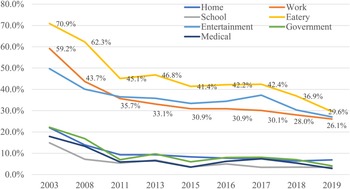
Indeed, workplaces and restaurants or bars were common sites of secondhand smoke exposure. Around 2000, smoking was far from deviant; two thirds of Japanese respondents reported being exposed to others' smoke at work and over 70 percent experienced secondhand smoke in restaurants or bars (see Fig. 4). People with lower educational attainment were and still are more likely to be exposed in the home and workplace (Matsuyama et al. Reference Matsuyama, Aida, Tsuboya, Koyama, Sato, Hozawa and Osaka2018).
Secondhand smoke exposure, by facility type.
Source: MHLW, Kenkō Eiyō Chōsa (Citizens’ Health and Wellness Survey), p. 27, https://www.mhlw.go.jp/bunya/kenkou/kenkou_eiyou_chousa.html.

However, the likelihood of being exposed to secondhand smoke has declined in the past two decades. It is important to note that the decline predates the recent tightening of smoking regulations (Feldman Reference Feldman2006; Levin Reference Levin2013). Indeed, the decline probably facilitated stricter regulations. As detailed below, tobacco control advocates contributed to and benefited from changing social attitudes and practices.
Opponents of smoking regulations: the tobacco industry's political clout
Despite these changing social realities, tobacco companies, the Ministry of Finance, LDP politicians, and hospitality industry groups resisted regulating where one could smoke. They used several strategies. First, whenever policymakers considered regulating smoking, tobacco interests leveraged economic or fiscal arguments and influential allies to seek exemptions. Strong political connections and a revolving door between the Ministry of Finance and industry had developed. Despite privatizing the state-owned monopoly as Japan Tobacco (JT) and opening the Japanese market to tobacco imports in the mid-1980s, the Ministry of Finance is still legally obligated to promote the tobacco industry as a key part of the national economy and to be JT's largest shareholder.Footnote 16 JT adapted well to privatization, becoming one of the world's top five tobacco companies; it also still controls about 60% of the sizeable Japanese market (MacKenzie, Eckhardt, and Prastyani Reference MacKenzie, Eckhardt and Prastyani2017). Ministry of Finance officials regularly retire to JT's senior ranks, and approval from the Minister of Finance is legally required for JT's top personnel decisions and business plans (Asukai, Torii, and Chikamoto Reference Asukai, Torii and Chikamoto2005, p. 262). In addition, the Japanese government collects stable and sizeable tax revenues from tobacco sales (Oshio Reference Oshio2021). JT's economic importance and these interlinkages sustain tobacco interests' political clout.
The industry's connections extend into the long-dominant LDP. The pro-tobacco Diet members' league (Jimintō Tabako Giin Renmei, hereafter Tobacco Giren) was formed within the LDP and included nearly 300 lawmakers in 2018, which is about three-quarters of the party (“Faction Promoting Regulations” 2018). By 2023, their number had shrunk to 221, partly because their charismatic longtime leader, Noda Takeshi, lost his seat in October 2021.Footnote 17 But the Tobacco Giren remains influential and “is a source of money and votes for members.”Footnote 18 Moreover, many members of the Tobacco Giren, including Noda, had experience in or ties to the Ministry of Finance. Like tobacco companies, the Tobacco Giren favors an accommodationist approach: both smokers and nonsmokers “should be protected under the constitutional right to pursue happiness” (Mizuho Reference Mizuho2017).
Another strategy of tobacco industry groups has been to undermine scientific evidence about smoking and secondhand smoke's health consequences. JT and foreign tobacco companies founded the Tobacco Institute of Japan (TIOJ) in 1987 to promote “common industry positions on smoking and health” and “delay” smoking regulations (Iida and Proctor Reference Iida and Proctor2018, p. 6). JT also established the Smoking Research Foundation in 1986 to fund industry-friendly research with substantial grants (Ishida Reference Ishida2018). Globally, the tobacco industry embraced Japanese research about air ventilation because it supported policy instruments accommodating smokers and non-smokers in shared spaces (Sebrié and Glantz Reference Sebrié and Glantz2007). Being entwined with knowledge production as funders of research gave industry influence over policy. To cast doubt on the need for regulations, for example, an industry representative on Japan's 1998 Tobacco Countermeasures Deliberation Council asserted that secondhand smoke “undoubtedly irritates the eyes and nose, but its relation to cancer is an issue for the future” (Mochizuki-Kobayashi, Yamaguchi, and Samet Reference Mochizuki-Kobayashi, Yamaguchi and Samet2004, p. 347).
In the past decade, new heated tobacco products created new opportunities for accommodationist arguments to leverage science. Japan is the largest market for IQOS, Philip Morris' flagship heated tobacco product (Nakagawa Reference Nakagawa2020). Philip Morris lobbied for different rules for heated tobacco products, which it argued were more socially acceptable because they are “harm reducing” and “smokeless” (Nakagawa Reference Nakagawa2021). For now, the argument has traction. A health ministry official defended different rules for conventional cigarettes and heated tobacco products by saying that “[for] heated tobacco products, …there is still little clear scientific evidence of ill health effects” (Sakai Reference Sakai2019). Researcher and tobacco control advocate Yamato Hiroshi criticized this approach to regulating new e-cigarettes, saying that the norm in “public health [is] to regulate something when in doubt, unless there is proof that it is harmless” (“National, Tokyo Gov'ts Split,” 2017). The health consequences of heated tobacco products are still being studied, but the WHO notes that nicotine is highly addictive and e-cigarettes expose smokers and bystanders to harmful chemicals.Footnote 19
Meanwhile, foreign companies and JT have also defused pressure for nonsmoking rules by partnering with local governments to build and maintain designated smoking zones and rooms as an infrastructure for “smoking manners.” They tapped into Japan's cultures of courtesy and created state-society networks that could be reactivated later to oppose indoor smoking restrictions (Kashiwabara and Armada Reference Kashiwabara and Armada2013, p. E138). Localities reportedly appreciated that industry players footed the bill for constructing designated smoking areas (Nakagawa Reference Nakagawa2021). JT also offered free sessions with a “separate-smoking (bun'en) consultant” for establishments preparing for the revised Health Promotion Law's full implementation in order to keep smoking possible, albeit in designated spaces.Footnote 20 Pro-tobacco decision-makers and interests continue to impede stronger regulations, contending that smoking is neither deviant nor dangerous to public health, but an item of personal preference (shikōhin) based on adults' informed choices.
How: tobacco control advocates' strategies
Tobacco control advocates worked to shift public perceptions of smoking, spread knowledge about its health effects, and promote smoking regulations in public places via three interacting strategies. Across the next three subsections, I highlight how legal mobilization helped frame secondhand smoke as a violation of nonsmokers' rights to health and clean air; how local activities and voluntary changes de-normalized smoking and cultivated elite allies; and how ideas about legalistic policy instruments tried abroad and about where Japan falls short of peer countries provided information subsidies to decision-makers. These three micro-level processes add precision to some of the main theories of policy change, which highlight actors, the networks or relationships among them, and their ideas and beliefs, as well as institutions, policy context, and events (Heikkila and Cairney Reference Heikkila, Cairney, Weible and Sabatier2017, pp. 303–4). For example, my analysis of societal groups' framing, research, and informational work echoes the Advocacy Coalition Framework's attention to how changes in beliefs and learning spur coalition building for policy change (Sabatier and Jenkins-Smith Reference Sabatier and Jenkins-Smith1993). The three mechanisms also elaborate how interactions among diverse actors, including policy entrepreneurs in civil society, create windows of opportunity. They couple redefined problems with policy solutions and leveraging events to generate the political will for policy change, as emphasized by the Multiple Streams Framework (Kingdon Reference Kingdon1984). I analyze an extended historical timeframe focusing on activists' strategies and their cumulative effects, which clarify micro-processes identified in the main theories of policy change. Considering these recursive processes helps us understand the legalistic turn in smoking regulations.
Legal mobilization: rights-based framing catalyzes incremental changes
First, tobacco control advocates framed secondhand smoke as a rights violation to promote formal, enforceable protections of those rights. Framing describes the contested processes through which people try to define what the problem is and thereby link it with potential policy solutions (Benford and Snow Reference Benford and Snow2000; Goffman Reference Goffman1974). Frame articulators spur collective action by awakening individuals to the injustice of their situations and the possibilities that it is “legally grievable” via litigation (Taylor Reference Taylor2020, p. 1331). They thereby challenge behavior that was previously tolerated, such as sexual harassment at work (Marshall Reference Marshall2005). U.S. tobacco lawsuits and the insider documents they disclosed also turned public opinion against the tobacco industry (Mather Reference Mather1998, pp. 923–24; McCann, Haltom, and Fisher Reference McCann, Haltom and Fisher2013). Japan's legal system lacks U.S.-style discovery procedures, but Japanese litigation articulated a rights-based rationale for regulating smoking. Though regulations remained elusive, litigation spurred private businesses to voluntarily enact nonsmoking policies that later proved conducive to stronger regulations.
From the beginning of Japan's tobacco control movement in the late 1970s, when groups emerged in several regions, creating nonsmoking spaces was a main objective. In Sapporo, a lawyer founded the Association to Protect Nonsmokers (Hikitsuensha wo mamorukai) in 1977 with the slogan “clean air belongs to everyone.” Feminists in Nagoya established the Women's Association to Abolish Tobacco Damage (Tabakonogaiwo tsuihōsuru onnatachi no kai), partly because women bore the brunt of secondhand smoke (Bianco et al. Reference Bianco, Haglund, Matsui, Nakano, Samet and Yoon2001, p. 210). Most famously, about sixty people gathered for the 1978 founding of the National Federation of Anti-Smoking Movement Groups (Zenkoku kin'en ken'en undō renraku kyōgikai) in Tokyo.Footnote 21 The concept of ken'enken offered a potent framing for the movement. The kanji denote a “right to hate smoke/smoking” but the term connotes nonsmokers' rights more broadly. With it, the movement sought to develop a new, specific right to justify regulating smoking in public places (Nottage Reference Nottage2004, p. 55).
Proposed legislation containing spatial restrictions on smoking in 1978 failed, though the movement did catalyze some early changes. The Tokyo-based group and a dozen likeminded lawyers successfully petitioned the Ministry of Health and Welfare to start prohibiting smoking (except in designated rooms) in national hospitals and residential institutions. Meanwhile, Japan's airlines responded to the lawyers' letters formally requesting more nonsmoking seats, but the rail company did not. This led in 1980 to Japan's first tobacco-related lawsuit, wherein four plaintiffs sought more nonsmoking cars on Japan's bullet trains (shinkansen).
This early legal mobilization for nonsmokers' rights argued that the Ministry of Health and Welfare had a duty to protect public health, including by regulating smoking (Feldman Reference Feldman2001, p. 691). The defendants countered that secondhand smoke does “not cause intolerable harm,” smoking is an individual choice, and consumer protection laws only regulate artificial products, not natural ones like tobacco (Isayama Reference Isayama1983, p. 110). Nevertheless, Japan Rail voluntarily increased the number of nonsmoking cars within a year of the lawsuit's filing, a step that the plaintiffs' lead lawyer interpreted as “probably aimed at increasing the defendants’ chances of winning.”Footnote 22 Indeed, the court ruled in 1987 that the plaintiffs had failed to show that smoking on shinkansen was “beyond the limits of toleration” and noted that smoking was widely accepted in Japan (Feldman Reference Feldman2001, pp. 679, 692; Levin Reference Levin2016).Footnote 23 This “logic of tolerable limits” (junin gendoron) and the challenges of proving health damage from secondhand smoke stymied the several dozen subsequent lawsuits related to secondhand smoke. Still, some public places, such as train stations, voluntarily became nonsmoking in response to media coverage and activism associated with the lawsuit.
Lawsuits over secondhand smoke in workplaces followed. In the late 1980s, women tobacco control advocates running a hotline in Tokyo were “surprised by the number of people who called in to say they had been fired for opening the office's window or other awful stories about nonsmokers’ rights not being protected.”Footnote 24 Several lawsuits over secondhand smoke at work resulted in settlements that required workplaces to separate smoking and nonsmoking areas in the early 1990s.Footnote 25 The plaintiff in one case and his supporter group researched existing regulations and made what they labeled “a big discovery” (daihakken) – the Ministry of Labor's Guidelines for Creating Comfortable Workplaces (Kaiteki shokuba shishin) and the 1992 revisions of the Industrial Health and Safety Law. They decided “why not take advantage of this law and guidelines” to argue that the employer was violating labor standards by taking no measures against smoking.Footnote 26 Conciliation accepted this logic, and the Labor Standards Inspection Office subsequently issued guidance explicitly encouraging smoking separation (bun'en). Accommodating smoking at work via segregation reflected tobacco industry opposition to legalistic smoking bans, which it claimed violated smokers' rights (Tanaka Reference Tanaka2016, pp. 51–57). But officials incrementally clarified and bolstered even nonbinding policies. The MHW published Japan's first Guidelines to Prevent Smoking in Workplaces in 1996, recommending but not requiring designated smoking areas and better ventilation. Within five years, the proportion of workplaces taking measures to contain tobacco smoke rose from 37.3% to 67.6%. The Guidelines added details and technical standards to prevent smoke from leaking out of smoking rooms after the Health Promotion Law was passed in 2002.Footnote 27
Some lawsuits related to nonsmokers' rights made headway in the shadow of the new Health Promotion Law, even though the law was more aspirational than legalistic. For instance, a ruling in 2004 found that Nagoya's failure to enforce the smoking ban in schools violated the plaintiff's right to education and awarded damages; the court also ordered the city to enforce the smoking ban.Footnote 28 In the same year, the Tokyo District Court issued a landmark ruling ordering the Edogawa Ward Office to pay compensation to an employee who had suffered health problems due to secondhand smoke at work.Footnote 29 Although the court agreed with the defendant that there was insufficient evidence to prove that secondhand smoke had caused the plaintiff's lung disease, it did rule that the employer had violated its legal obligation to provide a safe work environment. This ruling inspired some additional lawsuits but also “reduced the need for litigation by making employers more responsive to lawyers' letters” requesting nonsmoking measures in their clients' workplaces (Okamoto Reference Okamoto2020, p. 127).
The mixed implications of the 2002 Health Promotion Law's non-binding Article 25 were further evident in lawsuits related to secondhand smoke in taxis. After three taxi drivers and 23 passengers sued the ministries of health and of transportation, the court ruled in 2005 that the HPL did not legally oblige the government to enforce secondhand smoke countermeasures but nonetheless recognized the health risks of secondhand smoke.Footnote 30 Also, the ruling stated that taxi companies have a duty to protect the health of drivers and passengers (Ito Reference Ito2005; “Tokyo Taxis,” 2008). In a 2008 lawsuit filed by Yasui Koichi, a nonsmoking taxi driver, the court again found that the HPL did not mandate nonsmoking measures in taxis.Footnote 31 However, the cases drew attention to the issue, and most taxis barred smoking by the end of the decade (Levin Reference Levin2013, p. 485). Like the local initiatives described in the next section, such nonsmoking rules by private companies made smoking seem less normal.
The newest area of legal mobilization concerns secondhand smoke from neighbors' apartments, which has proven controversial due to the belief that private spaces should not be regulated. Usually, victims contact the building's management, which can ask the smoking neighbor to change his behavior. Next steps include contacting local government offices, but, as one official told a woman in Hyōgo, “we've received many similar consultations. We're sorry …but we have no legal grounds [for taking further action]” (Miyagi Reference Miyagi2023b). A few such disputes have gone to court. As of this writing, only three rulings have been handed down, and only one awarded compensation to the victim. A lawyer speculated that the one case was probably won in December 2012 because “the defendant denied that smoking caused harm and admitted that he had refused to change his behavior following the plaintiff's request.”Footnote 32 Unusually, the court recognized the psychological damages associated with secondhand smoke (Okamoto Reference Okamoto2020, p. 126). However, in 2019 and 2020, two additional courts dismissed claims by denying causal linkages between the victim's disease and the neighbor's smoking. They also ruled that people “are free to smoke in their homes.” Anecdotally, residents are generally more accepting of limits on pets and noise than on smoking, even though pet and noise rules also regulate private spaces.Footnote 33 Despite the dim prospects for future litigation, some condominium managers are restricting smoking.Footnote 34 In some cases, such as the woman in Hyōgo, residents mobilized to alter the condo rules (Miyagi Reference Miyagi2023b).
Local activities to de-normalize smoking and catalyze voluntary changes
Second, and sometimes in conjunction with legal mobilization, tobacco control advocates pursued diverse local initiatives to de-normalize smoking and encourage voluntary changes that gradually made conditions more favorable for regulations. Rising interest in tobacco control among medical professionals turned doctors into individual change agents in their localities and professional networks. The Health Promotion Law's passage in 2002 and Japan's ratification of the 2005 Framework Convention on Tobacco Control also legitimized their calls for nonsmoking rules. More recently, tobacco control groups have mobilized customers to praise businesses that go smoke-free or criticize businesses that retain designated smoking rooms. Such local and voluntary initiatives facilitated legalistic regulations in 2018 and have also benefited from these strengthened regulations.
Japanese medical professionals helped reshape public knowledge about smoking's health risks, though many were slow to mobilize due to doctors' high rates of smoking and dependency on industry funding for research.Footnote 35 The first advocacy group, Japan Medical-Dental Association for Tobacco Control, was founded in 1992.Footnote 36 It had 500 members by 1994 and more than 1,200 members by 2000. Today, the group pursues relatively “mild” policy objectives and is still led by one of its founders, the pediatrician Saito Reiko.Footnote 37 Members foreswore smoking and tobacco industry funding, and they pushed their own professional associations to publicly support nonsmoking rules. To enable professionals to supply information subsidies more effectively to policy debates, nine associations also founded the Tobacco Control Medical-Dental Research Network in 2005.Footnote 38 More than thirty academic societies had joined the Network by 2020, including the influential Japan Medical Association (Nihon ishikai). Such organizing encouraged anti-smoking declarations from professional associations.Footnote 39 Also, medical professionals' advocacy “carried considerable weight among policymakers, as did advocacy by patient groups,” as well as in local communities.Footnote 40
Today, one of the most active organizations of professionals from the medical, dental, and legal fields is the Japan Society for Tobacco Control (JSTC).Footnote 41 It was formed in 2006 and has published a journal with policy-relevant research since 2009. Its leaders and 3,500 members write articles, hold seminars, issue press releases, and raise awareness about tobacco control among doctors around the country. Many local tobacco control groups around Japan cooperate with the JSTC, but “some prefer a more forceful stance.”Footnote 42 One group with maximalist objectives is Tobacco-Free Advocacy Japan, which two doctors in Hyōgo prefecture founded in 2012.Footnote 43 It “opposes even allowing designated smoking rooms.”Footnote 44 Whether in groups with moderate or maximalist goals, medical professionals are credible sources of information that has gradually reshaped citizens' and politicians' perceptions of smoking.
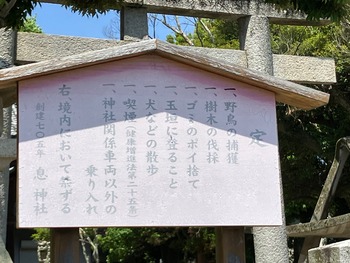
The 2002 enactment of the Health Promotion Law, which required managers of public facilities to “endeavor” (tsutomeru) to prevent secondhand smoke exposure (Art. 25), created many new opportunities for local initiatives by doctors and other tobacco control advocates. For instance, one pediatrician wrote letters urging smoking bans in the ski and golf facilities she frequented and personally printed no-smoking signs to hang in local playgrounds.Footnote 45 In Hamamatsu, a local doctor persuaded the historic Oki Shrine to ban smoking on the grounds and “asked that it specifically cite Art. 25 of the law, albeit without mentioning that it only imposes an obligation to endeavor (doryoku gimu)” (see Fig. 5) (Katoh Reference Katoh2020). He also organized a seminar for regional taxi drivers to explain the health risks of customers and drivers smoking; “surprisingly” more than five hundred drivers attended. He described his strategy for grassroots change as “making the social environment nonsmoking” (shakai kankyō no kin'enka).Footnote 46 As signs of his local efficacy, Hamamatsu smoking rates have fallen to 9.7% overall (well below the national average), and about three-quarters of restaurants are fully nonsmoking.
Oki Shrine rules (line 6 from right cites the 2002 Health Promotion Law to ban smoking) (author's photo).

Nationwide, nonsmoking spaces gradually spread. Several hospitals and school districts declared their entire facilities smoke-free (Ogawa Reference Ogawa2002). Various restaurant chains voluntarily banned smoking.Footnote 47 Train lines removed smoking cars, some local governments banned indoor smoking in their buildings, and some universities prohibited smoking on campus. Not all the changes were health-motivated; one journalist recalled editorial meetings becoming nonsmoking “because someone realized that all the smoke was bad for the machine that connected editors in Tokyo and Osaka.”Footnote 48
Tobacco control advocates have also mobilized the power of customers. One organization printed business card-sized notices that people could hand to restaurants to signal their pleasure or displeasure with the establishment's smoking policy, encouraging a form of crowdsourced enforcement.Footnote 49 Japanese overwhelmingly supported stronger regulations. In a survey conducted just after the HPL revisions passed, two-thirds of respondents said they would avoid eateries that allowed smoking, and a quarter said they would still do so even if designated smoking rooms were built (Mainichi 2018). An online survey of Tokyoites in 2020 similarly found that 73% of respondents reported that the restaurant's smoking policy impacted their choice about whether to eat there or not.Footnote 50 That said, hospitality industry groups worried about losing customers and about the cost or space challenges of installing smoking rooms. Two hundred restaurant and bar owners protested in 2018, urging the metropolitan government “not to steal customers’ pleasure [tanoshimi]” (Asahi Shimbun 2018). As a result, national and subnational nonsmoking reforms ultimately included subsidies for designated smoking rooms, contra WHO implementation guidelines for the FCTC. Yet public support for regulating smoking has inspired tobacco control advocates to launch local campaigns criticizing the use of taxpayer money to build smoking spaces (Ishida Reference Ishida2020; Yamada et al. Reference Yamada, Mori, Kashiwabara, Yasuda, Horie, Yamato, Garçon and Armada2015, p. 498).
In the wake of revisions to the Health Promotion Law, companies have again restricted smoking more than legally required due to tobacco control advocacy and societal attitudes against smoking. For instance, Japan's largest brokerage firm, Nomura Holdings Inc., began prohibiting smoking entirely during work hours in 2021, including for those teleworking, and abolished all smoking rooms (Nishio Reference Nishio2021). Though the firm will not monitor or punish rule-breakers, it offered to cover all smoking cessation programs and give points to employees who quit. Retail giant Aeon and food manufacturer Ajinomoto have likewise banned smoking during work hours. Such voluntary changes make smoking seem more deviant and regulatable.
Information subsidies for policymakers: models from abroad and quality research
Third, tobacco control advocates contributed to smoking regulations by providing information subsidies. The concept of “information subsidies” describes how activists shoulder the costs of collecting, evaluating, and packaging policy-relevant information for decision-makers (Gandy Reference Gandy1982). Such informative lobbying from interest groups and NGOs, like tobacco control groups, can save policymakers time and resources by supplying quality data that redefines a problem and couples it with potential policy solutions, such as legalistic ones (Hall and Deardorff Reference Hall and Deardorff2006; Kingdon Reference Kingdon1984). Useful information includes policy instruments tried abroad, analyses of lawsuits, data about gaps in implementation, surveys, and even regulatory language. This strategy resembles what Keck and Sikkink (Reference Keck and Sikkink1998, p. 16) called “information politics,” which they define as “the ability to quickly and credibly generate politically usable information and move it to where it will have the most impact.” By reporting facts and interpreting them – whether by repackaging existing data or gathering new information – tobacco control advocates promoted legalistic policy solutions.
Proponents of regulating smoking in Japan supplied two main forms of information subsidies. One built off the spread of indoor smoking regulations worldwide, spurred by the 2005 Framework Convention on Tobacco Control (FCTC). Among the Convention's 182 Parties, 67 countries have fully banned smoking in public spaces, and another 72 require some spaces to be completely smoke-free (WHO 2021, pp. 64–67). Japanese proponents of regulations frequently noted that, for years, Japan had received the worst score possible on the “Protect people from tobacco smoke” portion of the World Health Organization's “MPOWER” tool for assessing compliance with the FCTC.Footnote 51 Other reform advocates pointed out Japanese respondents to the early-2018 International Tobacco Control (ITC) survey reported higher rates of secondhand smoke exposure in bars (83%), restaurants (55%), and workplaces (49%) than Chinese respondents. Even Beijing, they noted, had enacted smoking regulations ahead of hosting the Olympics and Paralympics in 2008; the United Kingdom and Brazil (also Games hosts) similarly enacted strict nonsmoking rules with penalties (Ishida Reference Ishida2017). Beijing even disallowed designated smoking rooms in restaurants and bars in 2014. Such comparisons aimed to shame Japan into adopting stronger regulations.
In addition, the FCTC's implementation guidelines for Art. 8 provided tobacco control advocates with specific models of legalistic regulations. They recommend that “effective [domestic] legislation should impose legal responsibilities for compliance on both affected business establishments and individual smokers, …provide penalties for violations, …[and] include a system for both monitoring and prosecuting violators” (Uang, Hiilamo, and Glantz Reference Uang, Hiilamo and Glantz2015; WHO 2007, pp. 25–26). Advocates used these “best practices” when calling for stronger regulations.
The WHO and International Olympic Committee also actively promoted legalistic reforms, amplifying domestic activists' demands. For instance, in April 2017, the WHO's Dr. Douglas Bettcher visited Japan carrying a letter from WHO Director-General Dr. Margaret Chan. She reminded the Health Minister of Japan's commitment under Article 8 of the FCTC and wrote, “I urge you to ensure that the 2020 Tokyo Olympics maintain the longstanding tradition [since 1998] of adopting tobacco free policies and, specifically, I urge Japan to adopt a complete ban on smoking in indoor public places at the national level,” referencing the implementation guidelines (Chan Reference Chan2017). At events organized by the Japan Society for Tobacco Control and allies in the Diet, Bettcher also called Japan's secondhand smoke policies “outdated” (jidaiokure) (NTV 2017). From such international comparisons and models, Japanese reform advocates crafted information subsidies for decisionmakers that highlighted how Japan lagged behind and how legalistic policy instruments are best suited for addressing the problem of secondhand smoke.
Second, Japanese tobacco control advocates supplied information subsidies by interpreting and sometimes producing quality research about secondhand smoke, regulations' effects, and public opinions on smoking.Footnote 52 For instance, to counter hospitality industry groups' worries about loss of revenue, members of the Japan Medical-Dental Association Against Smoking publicized foreign studies showing that nonsmoking measures instead speed up table turnover, draw more women customers and foreigners, reduce cleaning costs, and enhance food flavor.Footnote 53 The Japan Society for Tobacco Control similarly urged fully smoke-free environments by citing Japan's falling smoking rates and a 2017 study, which found that 81 percent of Japanese restaurants that went fully smoke-free reported customers' numbers not changing or actually increasing (JSTC 2019a). The JSTC pamphlet ends with encouragement: “If we all go smoke-free together, it won't be scary.” The Tobacco Control Research Network, a coalition of several dozen medical and dental associations, likewise cited scientific studies demonstrating that designated smoking rooms are not effective at preventing secondhand smoke harm.Footnote 54 They argued instead “the clear need for laws and ordinances that have fines and are comprehensive.” In fact, exemptions based on floorspace “had no scientific basis since secondhand smoke becomes more concentrated in small spaces” (Iwanaga Reference Iwanaga2019). Although the 2018 reforms ultimately exempted small eateries, these arguments contributed to the rule that new establishments must be nonsmoking and to Tokyo's stricter regulations.
Additionally, evidence of public support for smoking regulations provided information subsidies. In 2017, the Japan Medical Association, Japan Society for Tobacco Control, and other health groups underscored the need for stronger regulations by collecting 2.74 million signatures on petitions (Sakuta Reference Sakuta2019). Healthcare professionals also administered the International Tobacco Control (ITC) survey in early 2018, finding that over three-quarters of Japanese respondents – including smokers – supported smoking bans in workplaces (81%) and restaurants (78%), and 65% supported bans in bars (Sansone et al. Reference Sansone, Fong, Meng, Craig, Xu, Quah, Ouimet, Mochizuki, Yoshimi and Tabuchi2020).
Implementation data is an emerging form of information subsidy. For example, tobacco control advocates have capitalized on the challenges of enforcing even the watered-down rules in Diet buildings. Diet members obtained carveouts for themselves by changing the MHLW's proposal for a fully ban smoking indoors in all government buildings, which are not allowed to have indoor smoking rooms, to allowing them in Diet buildings. Activists tallied 83 smoking rooms in Diet-related buildings. Still, a ruling party member commented, “I sometimes find it too much of a bother to go all the way to the smoking room because so many people visit my office each day” (Kuroda Reference Kuroda2020). Opposition leader Edano Yukio also had to apologize for smoking in his office after the law went into force. From April 2020, when the more legalistic revisions to the HPL went into force, anyone smoking outside designated rooms could be fined up to 300,000 yen ($2,800), which is a significantly heftier fine than sidewalk smoking bans have. Reform advocates have publicized Diet members' rule-breaking and contrasted it with data about how many local assemblies fully banned smoking indoors.Footnote 55 Such information subsidies shame officials and reinforce new rules, including by raising public awareness about them.
Conclusion
Japan's expansion of nonsmoking rules offers us the chance to analyze how norms and legal rules interact in the social construction of what behavior should be regulated. It also enables us to unpack how societal groups can influence those interactions. Through issue framing, litigation, local initiatives to de-normalize smoking, and the production and dissemination of credible information, they reshaped societal perceptions of smoking to make it seem in need of regulation and persuaded decision-makers to adopt more detailed and enforceable rules. Unpacking these recursive processes contributes to policy theories, especially those that posit incremental change (Streeck and Thelen Reference Streeck and Thelen2005; Studlar and Cairney Reference Studlar and Cairney2014). This article traced the interaction of changing societal attitudes toward smoking and policies that cumulated to mark a more legalistic regulatory approach. Continuing to permit – and subsidize – designated smoking rooms suggests regulatory concessions to tobacco interests, who favored continuing to accommodate smoking. On balance, however, the reforms passed in 2018 both reflected and will continue to deepen societal support for regulating smoking.
Yet challenges remain. The coronavirus pandemic hampered implementation and enforcement. Financial pressures due to curfews and closures deterred businesses from investing in nonsmoking renovations. Pandemic-related duties also swamped public health officials, preventing them from enforcing nonsmoking rules.Footnote 56 Now that the pandemic has abated, local officials are taking innovative approaches to enforcing rules. Chiba and Tokyo officials are gradually visiting establishments to monitor compliance; citizens can also report violations via the app Line but no fines have been levied yet (“90% of Children Exposed,” 2020). Many communities, though, lack a system for reporting establishments that break nonsmoking rules.Footnote 57 Additionally, in the name of reducing covid transmission, numerous municipalities temporarily closed outdoor smoking areas in 2020, fueling a social discourse about “smoking-area refugees” (kitsuenjo nanmin) (Ishida Reference Ishida2020). Alongside new restrictions on indoor smoking, people increasingly resorted to smoking outside, despite rules against it. When surveyed by the National Cancer Center Japan in April 2023, Japanese respondents indicated that “on streets” was the most common place they “experience discomfort due to passive smoking” (73.4%) and the next most common was in restaurants and other eateries (47.8%) (Miyagi Reference Miyagi2023a). Also, perceptions of the new regulations differed between nonsmokers and smokers. While 49% of nonsmokers felt that the number of places where people can smoke “had decreased,” more than two-thirds of smokers felt that way (Miyagi Reference Miyagi2023a). Thus, social norms and perceptions continue to adapt to the stronger regulations.
Smoking-related rules are also spreading around Japan, as in other developed democracies. Prior to the Health Promotion Law's revision, just ten prefectures (including Kanagawa and Hyōgo) and municipalities had enacted secondhand smoke prevention measures, but this figure had grown to nearly fifty prefectures and municipalities by 2023.Footnote 58 In September 2018, for instance, Chiba City followed Tokyo's lead in enacting an ordinance that was stricter than the national reforms; it required restaurants with employees to become nonsmoking or install designated smoking rooms. Osaka's 2018 ordinance emphasized the health consequences for children and urged parents to try to keep their children out of smoking areas, but it contained few enforceable clauses.Footnote 59 The prefecture enacted a broader and more formalized Secondhand Smoke Prevention Ordinance the following year, adding details to regulations and fines for noncompliance.Footnote 60 Examples from other policy areas indicate a common pattern of subnational ordinances that are stronger (uwanose) or go beyond (yokodashi) national statutes cumulating toward national reforms (Adachi, Hosono, and Iio Reference Adachi, Hosono and Iio2015, p. 76).Footnote 61 Taking advantage of subnational institutional openness, tobacco control advocates explain that they are “pushing reform on two fronts – the national and the local.”Footnote 62 They are continuing to leverage the recursive interactions between norms and regulations through multilevel advocacy, contributing to the legalistic turn in the governance of smoking.
Acknowledgements
I would like to thank Gabriele Vogt, David Chiavacci, colleagues at the LMU's Japan Zentrum in Munich, and the panelists and participants at the VSJF Conference “Deviance and Norms in Times of Change in Japan” in Zürich in November 2022. Funding for this research came from the Core University Program for Korean Studies of the Ministry of Education of the Republic of Korea; Korean Studies Promotion Service at the Academy of Korean Studies, Grant/Award Number: AKS-2021-OLU-2250001; the Social Science Research Council; and a Research Fellowship from the Alexander von Humboldt Foundation in 2022-2023.
Competing interests
None.



 Open access

