

Introduction
Time has long been a foundational theme in management research (Ancona, Okhuysen, & Perlow, Reference Ancona, Okhuysen and Perlow2001). It dates back to Taylor’s (Reference Taylor1911) pioneering time and motion studies that helped establish management as a scientific discipline. As a critical dimension of managerial activities, time provides a powerful lens for understanding organizational phenomena. In recent decades, research on temporal dynamics in management has expanded rapidly, giving rise to at least two notable streams. One stream examines how activities are structured in relation to time, focusing on temporal patterns, pacing, and rhythms of action (e.g., Blagoev, Hernes, Kunisch, & Schultz, Reference Blagoev, Hernes, Kunisch and Schultz2024; Jiang, Yin, & Liu, Reference Jiang, Yin and Liu2019; Pérez-Nordtvedt, Payne, Short, & Kedia, Reference Pérez-Nordtvedt, Payne, Short and Kedia2008; Zhang, Priem, Wang, & Li, Reference Zhang, Priem, Wang and Li2023). The other stream explores how actors perceive and interpret time, such as how individuals’ orientation toward the past, present, or future shapes decision-making (e.g., Bansal, Kim, & Wood, Reference Bansal, Kim and Wood2018; Chen & Nadkarni, Reference Chen and Nadkarni2017; Gamache & McNamara, Reference Gamache and McNamara2019). Together, these lines of inquiry highlight how both the temporal organization of activities and the temporal orientation of actors matter for understanding managerial and organizational processes.
While the momentum of temporal research has greatly influenced Chinese management studies, most studies are developed based on the same set of temporal assumptions as those originated from Western traditions and phenomena. This is not surprising as some assumptions, such as a linear, clock view of time, have strong roots in market-based economies (Reinecke & Ansari, Reference Reinecke and Ansari2015). Applying theories consistent with the Western view of time also indicates relatively fewer challenges when submitting to other top-tier management journals. However, the failure to account for the unique time perception and value in China may prevent us from advancing the understanding of time in the Chinese management context.
China offers an especially fertile ground for advancing temporal research (Chan & Du, Reference Chan and Du2021). On one hand, ‘China speed’ has become synonymous with rapid market entry, fast-paced growth, and accelerated technology adoption. On the other hand, traditional culture emphasizes long horizons and cyclical rhythms, reflected in the lunar calendar, annual festivals, and enduring practices. Language further encodes time differently: Chinese speakers often perceive the future as temporally closer than English speakers, shaping more future-focused decisions (Chen, Reference Chen2013). Combined with policy-driven rhythms such as the central government’s Five-Year Plans, these dynamics foster a temporal orientation that oscillates between speed and patience, urgency and endurance (Zheng, Shen, Zhong, & Lu, Reference Zheng, Shen, Zhong and Lu2020).
Against this backdrop, a call for papers was launched at Management and Organization Review (MOR) entitled ‘Advancing Temporal Research on Chinese Management’. The response was highly encouraging, attracting wide interest from scholars across multiple disciplines, resulting in 46 proposals. Of these, eight were ultimately developed into full papers and were accepted. Collectively, these articles explore time-related variables important or unique to the context of Chinese management.
This introductory article develops and presents a 3C framework of Chinese conceptions of time – compressing, cyclic, and continuing – that not only synthesizes insights from the accepted articles but points out future research directions. Under compressing, firms and individuals respond to accelerated development and time scarcity; under cyclic, they adapt through recurring rhythms and iterative learning; and under continuing, they prioritize long-term orientation and persistence. The framework highlights how China’s hybrid temporal orientations, which reflect both the accelerated transformation during recent decades and the long-standing traditions rooted in millennia of history, shape organizational behaviors and performance.
Importantly, these 3C conceptions of time (i.e., compressing, cyclic, and continuing) not only connect to the two broad streams of temporal research but also extend them in meaningful ways. For the stream on how activities are structured in relation to time, the compressing and cyclic orientations offer insights into how accelerated growth pressures and institutionalized rhythms alter the sequencing and pacing of routines in ways that earlier studies have overlooked. For the stream examining how actors perceive time, the continuing orientation highlights the role of enduring commitments, cultural traditions, and persistent future focus, all of which remain underdeveloped in prior work. In this sense, the 3C framework not only builds on but also redirects these streams, opening avenues to study temporal dynamics that have so far remained at the margins of management research. Applying this framework, we show how the papers in this special issue extend temporal research in important ways.
Overall, this special issue demonstrates the importance of theorizing time in context. By grounding the temporal lens in Chinese management, the collected articles move beyond Western linear assumptions and open new pathways for comparative temporal research. The remainder of this introduction elaborates the 3C framework, summarizes the contributions of the eight articles through this lens, and outlines a future research agenda that positions time as a central construct in understanding Chinese organizations and their global significance.
A Foundational Framework of Extant Temporal Research
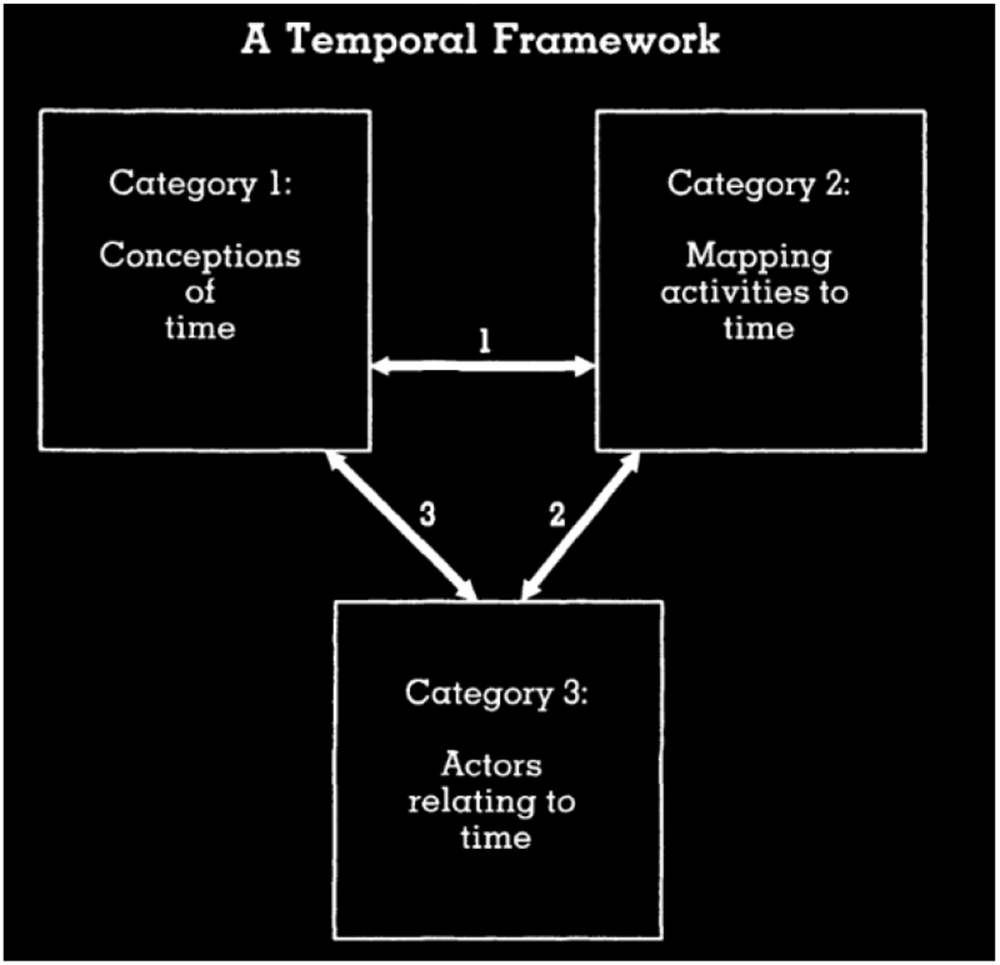
Temporal research has advanced markedly, since Ancona et al.’s (Reference Ancona, Okhuysen and Perlow2001) foundational framework (see Fig. 1), which synthesized disparate studies on time. They identified three categories: conceptions of time (underlying assumptions like clock time vs. event time, shaped by cultural and social factors; Bluedorn & Denhardt, Reference Bluedorn and Denhardt1988); mapping activities to time (scheduling, pacing, and sequencing activities with constructs like rhythms and entrainment; Zerubavel, Reference Zerubavel1985); and actors relating to time (how the temporal orientation of individuals and groups shape their decision-making and behaviors; Barley, Reference Barley and Dubinskas1988). Conceptions of time mostly serve as the foundational pillar, influencing how activities are mapped onto temporal dimensions and how actors perceive, interpret, and engage with those mappings. This tripartite model clusters temporal variables for a unified view, bridging fragmented research to inform management literature.
A foundational temporal framework excerpted from Ancona et al. (Reference Ancona, Okhuysen and Perlow2001)

Since Ancona et al.’s (Reference Ancona, Okhuysen and Perlow2001) framework, scholars have systematically extended temporal research by conceptualizing time as a resource, structure, and process (Blagoev et al., Reference Blagoev, Hernes, Kunisch and Schultz2024), revealing how assumptions about time can expose blind spots in areas like strategy (Kunisch, Bartunek, Mueller, & Huy, Reference Kunisch, Bartunek, Mueller and Huy2017). Work on mapping activities to time has shown how rhythms and sequencing of actions (Zhang et al., Reference Zhang, Priem, Wang and Li2023), whether in acquisitions, innovation, or alignment with environmental change, can sustain competitive advantage. Additionally, research on actors relating to time has demonstrated how temporal orientation shapes cognition and behavior, from individuals’ subjective experiences (Shipp & Jansen, Reference Shipp and Jansen2021) to executives’ strategic choices (Chen & Nadkarni, Reference Chen and Nadkarni2017). Taken together, these developments advance Ancona et al.’s tripartite model by enriching both the study of how activities are coordinated in time and how actors interpret and respond to temporal cues.
Despite these advances, most of the development in temporal research has been grounded in a widely shared but rarely questioned assumption in management research, what many refer to as the Western view of time. This view has deep historical roots in Judeo–Christian traditions, which imagine time as a linear path with a clear beginning (creation) and a definitive end (apocalypse). As a result, Western thought tends to divide past, present, and future into separate blocks and treats progress as a steady movement from one stage to the next (Adam, Reference Adam1994; Gupta, Reference Gupta1992). Over centuries, this worldview encouraged scholars and practitioners to see organizations as sets of stable entities moving through discrete phases, rather than as continuously unfolding processes (George & Jones, Reference George2000; Schultz & Hernes, Reference Schultz and Hernes2013). Even before management became a formal discipline, this linear and segmented way of thinking shaped how people conceptualized change, decision-making, and organizational outcomes.
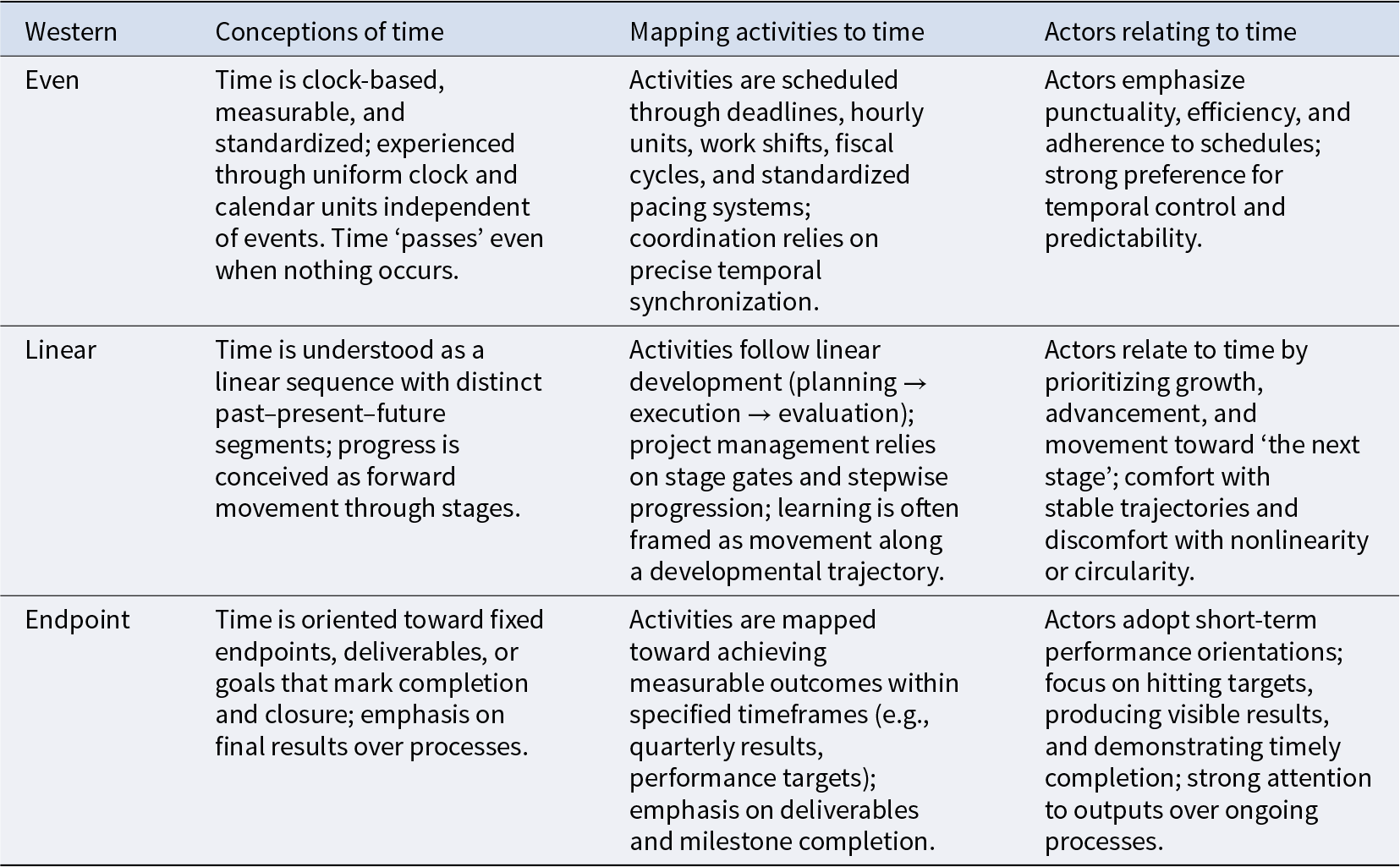
With industrialization, these cultural assumptions merged with the rise of clock time – a view of time as standardized, measurable, and independent of social context. Clock time makes it possible to coordinate activities through schedules, deadlines, fiscal quarters, and performance cycles, and it heavily influenced tools ranging from Taylor’s time–motion studies to modern project management systems (Taylor, Reference Taylor1911; Thompson, Reference Thompson1967; Zerubavel, Reference Zerubavel1985). While these tools support efficiency, they also encourage organizations and researchers to focus on short-term results, fixed deliverables, and observable endpoints (Bluedorn, Reference Bluedorn2002; Reinecke & Ansari, Reference Reinecke and Ansari2015). As a consequence, many temporal assumptions in Western management research privilege what can be measured in linear, clock-based units. This makes it harder to notice alternative temporal experiences – such as the sense of urgency created by rapid societal change, the importance of recurring cycles in social and institutional life, or the centrality of long-term continuity across generations – that often shape Chinese management practice.
However, the Western temporal lens (see Table 1 for details), with its emphasis on clock-time, linear progression, and fixed stages, does not fully capture how time is experienced and acted upon in Chinese organizational contexts. Many of its underlying assumptions encourage scholars to focus on short-term results, discrete temporal events, and clearly defined endpoints. This orientation obscures forms of temporality that are more accelerated, more rhythmic, or more enduring than standard Western temporal logics typically acknowledge. Recent work in the AMR special issue on ‘Theorizing Time in Management and Organizations’ similarly argues for diversifying temporal assumptions in management research (Bansal, Shipp, Crilly, Jansen, & Okhuysen, Reference Bansal, Shipp, Crilly, Jansen, Okhuysen and Langley2025). Parallel efforts to articulate alternative temporal ontologies, such as Blagoev and Schreyögg’s (Reference Blagoev and Schreyögg2025) notion of Eigenzeit, further underscore the value of expanding beyond linear, clock-based models. In China, for example, traditions of cyclical rhythms, long horizons, and culturally embedded practices suggest alternative ways of perceiving and valuing time. Without incorporating these perspectives, the current framework remains incomplete and its global relevance limited. To fully advance temporal research, we need deeper insight into how a Chinese temporal lens reshapes the existing understanding of temporal frameworks – a gap this special issue seeks to address.
The Western view

A Chinese Temporal Lens: The 3C Framework
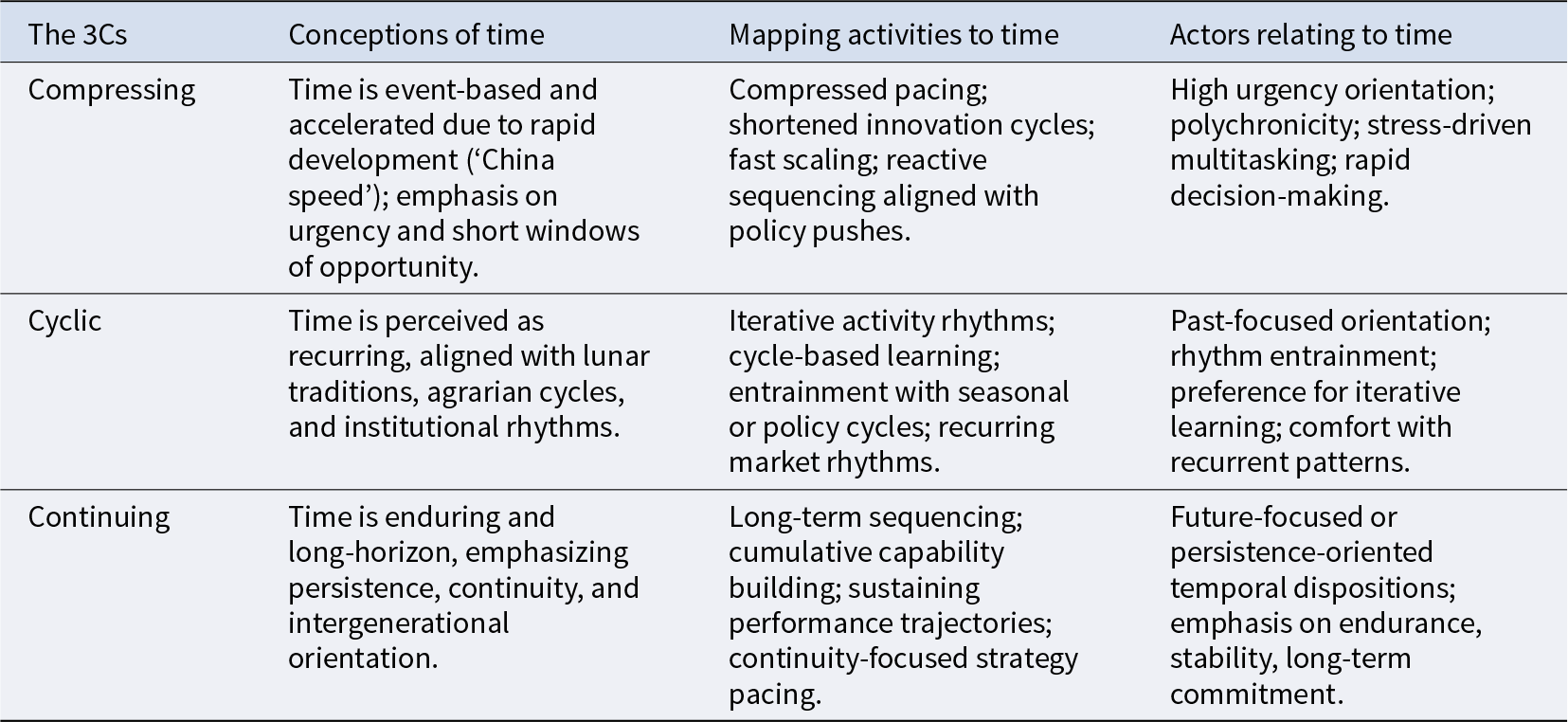
To advance the temporal lens in Chinese management, we introduce a culturally grounded framework that enriches all three temporal categories identified by Ancona et al. (Reference Ancona, Okhuysen and Perlow2001), conceptions of time, mapping activities to time, and actors’ temporal orientations. We propose that a Chinese temporal lens constitutes three interrelated dimensions, compressing, cyclic, and continuing (see Table 2), which draw simultaneously from ancient cultural traditions and contemporary economic transformations. While these 3Cs reflect culturally embedded assumptions about time, their theoretical relevance extends far beyond temporal conceptions. Each C systematically influences how organizations structure and pace activities, as well as how actors perceive, interpret, and respond to temporal cues. Accordingly, the 3C framework should be viewed as a holistic, culturally informed extension of the full temporal model, rather than a set of constructs confined to the first category of conceptions of time.
The 3C framework

Each of the three dimensions emerges from distinct historical and cultural conditions and can be understood as a response to the limitations of the Western temporal lens (see Table 3). Whereas the Western view emphasizes clock time, linear progression, and fixed endpoints, Chinese temporality places greater weight on events, rhythms, and long arcs of continuity. First, the compressing dimension reflects the extraordinary acceleration of China’s economic development over the past several decades, during which industrialization and urbanization unfolded at unprecedented speed, compressing processes that took centuries in Western economies into mere decades (Sturgeon & Whittaker, Reference Sturgeon and Whittaker2019). Because time is experienced less as an abstract chronological flow and more as a sequence of events that must be completed, the rapid accumulation of such events creates a pervasive sense that time is scarce and opportunities are fleeting. This results in managerial practices oriented toward fast decision-making and rapid execution. Rather than the steady, clock-driven pacing assumed in Western models, compressing temporality highlights contexts where speed is not simply a choice but a cultural and institutional expectation tied to event-driven urgency.
Comparing the 3C framework with the Western view of time

The cyclic dimension, by contrast, offers a parallel alternative to Western linear progression. Rooted in China’s agrarian heritage and philosophical traditions, it emphasizes patterned recurrence rather than forward movement toward a fixed end-state. Time is understood through recurring rhythms – seasons, festivals, agricultural cycles, and dynastic patterns – that have historically guided social and economic life (Needham, Reference Needham1977). Confucian thought reinforces the importance of aligning action with natural and social cycles rather than with standardized clock units (Bodde, Reference Bodde1991). In place of the Western assumption that processes unfold through discrete stages toward predetermined outcomes, cyclic temporality recognizes that many Chinese organizational practices evolve through iterative rounds of adjustment, that relationships deepen through repeated exchanges, and that institutional change follows recognizable waves rather than linear trajectories.
The continuing dimension contrasts most directly with the Western emphasis on fixed endpoints and short performance cycles. Drawing from China’s long civilizational horizon, where historical continuity stretches across millennia, continuing temporality valorizes endurance and long-term development over short-term results. This perspective manifests in persistent commitment, long-range planning, and an inclination to evaluate success across extended periods, aligning with Hofstede’s characterization of Confucian long-term orientation (Fang, Reference Fang2003; Hofstede, Reference Hofstede1991). Rather than prioritizing immediate outcomes or quarter-by-quarter metrics, continuing temporality foregrounds patience, accumulation, and transgenerational continuity – temporal qualities that Western, end-state–oriented models often overlook or undervalue.
Rooted in China’s rapid growth and Confucian traditions, these temporal dimensions highlight alternatives to the Western view. At the same time, they are not unique to China: compressing is common in emerging economies, cyclic views in agrarian societies, and continuing in Confucian-influenced cultures. Thus, the 3C framework both advances research on Chinese management and provides a lens with broader relevance for understanding temporal dynamics across contexts.
Applying the 3C Framework to Papers from the Special Issue
To clarify how the special issue papers align with the 3C framework, we classify each study according to the dominant temporal emphasis reflected in its core mechanism (see Table 4). Papers are grouped under compressing when they examine phenomena driven by urgency, time scarcity, or accelerated pacing (e.g., Liu et al. on identity reconstruction under rapid environmental change; Ye et al. on polychronicity as a response to compressed time). Papers are categorized as cyclic when they focus on iterative, recurring, or rhythm-based temporal processes (e.g., Li et al. on past-focused learning signals; Yu et al. on entrepreneurial reentry rhythms; Yi et al. on innovation patterns entrained with institutional cycles). Finally, papers are placed under continuing when they highlight long-term persistence, endurance, or future-oriented temporal horizons (e.g., Zhao et al. on sustained ESG commitments; Ding et al. on long-horizon responses shaped by future-time reference [FTR]; Yang et al. on persistent performance trajectories). These concise explanations reflect the dominant temporal construct driving each study, rather than methodological or topical similarities, thereby clarifying how the 3C framework meaningfully differentiates and integrates the empirical contributions in this special issue. Because the contributions in this special issue are predominantly empirical rather than purely theoretical, we also report their empirical setting and main findings in Table 4.
Summary of Special Issue papers using the 3C framework

Compressing
The compressing dimension advances research by highlighting how time scarcity in China’s rapid development trajectory drives accelerated activity mappings and urgent actor orientations, prioritizing speed and efficiency amid change. This lens reveals opportunities to study phenomena like organizational transformations and polychronic behaviors in high-pressure contexts.
For instance, due to the rapid growth of Chinese companies, they often face the challenge of transforming their organizational identity from followers to leaders, making this a valuable exploration at the intersection of identity and temporal studies. Liu, Lin, and Huo (Reference Liu, Lin and Huo2025) conduct a comparative case study of two Chinese firms transitioning from follower to leader positions in emerging markets. Through the compressing lens, the study reveals how unstable environments impose temporal rigidities, prompting activity mapping via single activity transformations – such as radical ‘break and (re)build’ logic or progressive layer-by-layer evolution in identity structures. Actors relate to time through past-oriented urgency, enabling high-position leaps and enriching insights into temporal dynamics for organizational identity construction in compressed growth contexts. In so doing, this paper extends the compression dimension by showing how rapid market and organizational shifts produce temporal rigidities that force abrupt identity transformations.
Because of compressed time where entrepreneurs do not have enough time resources, particularly for women who also need to manage family life, this makes the temporal orientation of polychronicity important to study. Ye, Song, Li, and Qiao (Reference Ye, Song, Li and Qiao2025), grounded in role accumulation theory, surveyed 129 Chinese women entrepreneurs to explore polychronicity amid gender-specific challenges. The compressing dimension frames role conflicts and interruptions as environmental challenges, fostering actors relating to time through polychronic orientations – favoring simultaneous task management to handle venture capital barriers, work-life conflicts, and caregiving demands. Moderators like emotional intelligence and experience amplify polychronic orientations’ resilience-building effects. As such, this study highlights how compressed temporal preferences enable women entrepreneurs to navigate adversity and offers practical strategies for multitasking in China’s fast-paced entrepreneurial landscape. These compressing assumptions not only define the conception of time in contemporary Chinese management but also shape activity mapping – through accelerated pacing and shortened sequencing – and influence actor orientations such as urgency, polychronicity, and rapid decision-making.
Cyclic
The cyclic dimension advances research by emphasizing iterative processes and repeated learning episodes rooted in traditional recurring patterns. Within this dynamic context, temporal constructs like past-focused orientations and adaptive rhythms may be important to study (Blagoev et al., Reference Blagoev, Hernes, Kunisch and Schultz2024).
Because of the importance of continuous learning from past events in iterative innovation cycles, past-focused temporal orientation can be a credible signal of learning capacity, influencing funding decisions under uncertainty. Consistent with this point, Li, Xi, Yi, Li, and Liu (Reference Li, Xi, Yi, Li and Liu2025) draw on signaling theory and gender expectations to examine how past-focused temporal orientation affects innovation evaluations. They argue that narratives emphasizing prior events signal stronger learning among innovators. Gender further moderates the relationship such that female-dominated teams gain more credibility from past-focused signals, and female evaluators respond to the past-focused signals more positively. This result indicates that past-focused signals can reduce funding gaps between genders, advancing innovation research on temporal rhetorics and genders. We find it also extending the cyclic dimension of a Chinese temporal lens by showing how past-oriented temporal cues signal iterative learning capabilities in innovation evaluation.
Because entrepreneurial journey may feature failure and reentry as part of a cyclical trajectory for serial entrepreneurs, Yu, Liu, Cao, Zhou, and Li (Reference Yu, Liu, Cao, Zhou and Li2025) examine entrepreneurs’ reentry rhythms. By analyzing 368 Chinese entrepreneurs, this paper explores how firms’ lifespan affects post-failure reentries. Particularly, they find that longer lifespans hinder the follow-up reentry of the entrepreneur, revealing a temporal driver of serial entrepreneurs. They further show that past-focused temporal orientation amplifies this negative effect, providing insights into time’s objective (lifespan) and subjective (focus) roles in entrepreneurial recovery and resilience. This study illustrates the cyclic dimension through the repeated rhythm of entrepreneurial reentry, revealing how previous cycles of experience shape future attempts.
Fast-changing digital innovation allows for iterative adaptations to recurring and unpredictable institutional shifts. Within this context, Shaheer, Yi, and He (Reference Shaheer, Yi and He2026) examine how innovation rhythms adapt to institutional rhythms via design iteration, using data from 4,619 firms across 50 countries in the mobile app industry. Viewed through a temporal lens, regulatory changes function as environmental rhythms that shape firms’ innovation rhythms. Their results reveal a U-shaped pattern: low uncertainty suppresses innovation, moderate uncertainty enables innovation, but high uncertainty again overwhelms innovative activity. Design iteration serves as a temporally distributed mechanism for resilient synchronization, offering a time-sensitive view on innovation in nascent industries like China’s emerging markets. These cyclic assumptions not only characterize a culturally rooted conception of recurring time but also shape activity mapping, through iterative rhythms, recurring learning cycles, and entrainment with institutional or seasonal patterns, and influence actor orientations, such as past-focused sensemaking, comfort with repetition, and alignment with collective temporal rhythms. Therefore, this paper highlights how the cyclic dimension of a Chinese temporal lens structures strategic adaptation.
Continuing
The continuing dimension advances research by prioritizing long-term orientations and persistence drawn from China’s historical endurance, leading to temporal constructs like future-focused biases and sustained performance rhythms that favor ongoing stability over short-term gains. This facilitates studies on strategic decisions that have long-horizon outcomes, such as environmental protection and social equity, both of which are important topics in China. Accordingly, Zhao, Wang, and Yao (Reference Zhao, Wang and Yao2025) examine CEOs’ temporal focus and firm ESG using data from Chinese listed firms between 2009 and 2021. They show that past- or present-focused CEOs suppress environmental and social investments but enhance governance; future-focused CEOs boost sustainability initiatives, moderated by green experience and wealth sensitivity, illuminating executive perceptions’ role in long-term corporate heterogeneity.
Because the topic of continuing organizational performance is important, not only in China but globally, where we often sacrifice long-term returns for short-run gains, Ding, Noorderhaven, and Guo (Reference Ding, Noorderhaven and Guo2025) examine how the way languages encode FTR shapes firms’ strategic responses to performance feedback. Grounded in the behavioral theory of the firm, it argues that managers’ interpretations of performance shortfalls are not neutral but are filtered through temporal orientations. By analyzing 12,309 firms from 12 countries between 2007 and 2019, this paper finds that firms in strong-FTR language contexts (where the future is linguistically marked) are less likely to engage in acquisitions in response to sustained underperformance. Slack resources strengthen this relationship, while political stability weakens it. As such, this study offers insights into how temporal biases shape long-term strategic adjustments amid persistent shortfalls. This paper extends our understanding of the continuing dimension by shedding light on linguistic structures that encode future orientation.
Further, Yang, Chen, Wei, and Liu (Reference Yang, Chen, Wei and Liu2026) focus on performance persistence of platform companies from the lens of continuance. They investigate why some social platforms are able to sustain superior performance in international markets. Instead of emphasizing imitation barriers, it highlights network effects as the key mechanism behind performance persistence. The study argues that persistence varies across countries depending on contextual factors: intellectual property rights protection can dampen network effects by restricting information flows, while demand heterogeneity amplifies the value of large networks for information consumption. As such, this paper contributes to strategy research on geographic variations in sustaining long-term performance superiority. These continuing assumptions not only reflect a conception of time grounded in endurance and long-term horizons but also shape activity mapping – through extended sequencing, cumulative capability building, and sustained strategic pacing – and influence actor orientations such as persistence, future-focused commitment, and an emphasis on stability across temporal spans.
Discussion and Future Research Directions
Collectively, the papers in this special issue illustrate the richness of applying a temporal lens to Chinese management, revealing how culturally infused temporality influences organizational behaviors and strategies. By grounding our analysis in the 3C framework – compressing, cyclic, and continuing – we uncover patterns that extend beyond Western linear views, offering nuanced insights into phenomena like innovation funding, entrepreneurial reentry, and ESG investments. These studies not only affirm the foundational role of time in management but also highlight the interplay between temporal rigidities – such as institutional uncertainty or gender biases – and adaptive mechanisms that enable firms to thrive in China’s dynamic landscape. Overall, this special issue advances the temporal perspective by demonstrating its applicability to real-world challenges, encouraging scholars to consider time not as a neutral backdrop but as a strategic resource shaped by cultural and economic forces.
Exploring More Chinese Conceptions of Time
One avenue for future research involves exploring more complex Chinese conceptions of time, particularly as multiple generations coexist with divergent temporal views in this unique setting. China serves as a compelling context where ancient cyclical traditions intersect with modern compressing urgencies and continuing endurance, fostering hybrid conceptions that may be ambivalent or multifaceted. For instance, younger generations influenced by global digital cultures might blend polychronic multitasking with traditional rhythms, requiring new temporal orientations that accommodate ambiguity, such as being comfortable with overlapping time frames. This complexity could shape activity mapping in innovative ways, like meshing rhythms from diverse activities – e.g., integrating state-driven policy cycles with entrepreneurial innovation sequences – or actor relations that involve negotiating conflicting temporal priorities in teams. Digging deeper into Chinese-specific phenomena, such as the temporal implications of the ‘996’ work culture or the rhythmic patterns in e-commerce platforms like Taobao, could reveal how these blended conceptions affect phenomena like work-life integration or supply chain agility, extending the 3C framework to capture intergenerational dynamics.
Bridging Activity Mapping and Actors Relating to Time
Another critical direction is bridging activity mapping with actors relating to time, as these streams, while robust individually, rarely engage with each other, representing a significant opportunity for integration. Temporal orientations of actors often determine how activities are mapped, sequenced, or paced, and conversely, the same orientation might yield varying effects under different activity patterns. For example, a past-focused orientation could enhance learning in cyclic rhythms but hinder adaptation in compressed mappings. In this special issue, only one paper, Yu et al. (Reference Yu, Liu, Cao, Zhou and Li2025), touches upon this linkage by showing how temporal focus moderates the impact of firm lifespan on reentry sequencing. We encourage much more research in this vein, such as examining how CEO future orientation influences the pacing of ESG initiatives or how polychronic actor traits interact with institutional rhythms in digital innovation, potentially using mixed-methods to unpack these interdependencies and enrich theoretical models.
Influence of 3C on Multiple Activity Rhythms
Future studies should investigate how the 3C framework influences multiple activity rhythms, such as the meshing or entrainment between organizational and environmental rhythms, to better understand synchronization in complex systems. For example, the compressing dimension might accelerate meshing in fast-paced industries like tech, while cyclic elements could facilitate entrainment with seasonal policy cycles, and the continuing orientation ensures long-term alignment with institutional evolutions. In the Chinese context, this could manifest in state-owned enterprises harmonizing internal innovation rhythms with 5-year plans or private firms entraining supply chain activities with global market fluctuations. While the papers by Shaheer et al. (Reference Shaheer, Yi and He2026) and Liu et al. (Reference Liu, Lin and Huo2025) illustrate how organizations in China adjust their single activity rhythms, important opportunities reside in studying multiple activity rhythms. Empirical work using longitudinal data could test these interactions, revealing how misalignments lead to inefficiencies or how successful entrainment enhances resilience, extending theoretical models to capture multi-level temporal interdependencies.
Addressing Overlooked Temporal Perceptions
Temporal perceptions in the Chinese context are mostly overlooked in current research, and we do not fully know how individuals really feel about time compression, polychronicity, or long-term horizons in high-pressure environments like China. Across the special issue, several papers, such as Ye et al.’s (Reference Ye, Song, Li and Qiao2025) work on polychronicity, Li et al.’s (Reference Li, Xi, Yi, Li and Liu2025) study on past-focused signaling, and Ding et al.’s (Reference Ding, Noorderhaven and Guo2025) analysis of FTR, indicate that subjective temporal perceptions meaningfully shape evaluations and decision-making in China. This distinction aligns with Shipp and Cole’s (Reference Shipp and Cole2015) call for more explicit theorization of how individuals experience, interpret, and act on time, as well as with Shipp and Jansen’s (Reference Shipp and Jansen2021) review highlighting the centrality of subjective temporal experience in organizational life. Future directions should directly focus on subjective experiences, such as employees’ emotional responses to ‘China speed’ in compressing contexts, or how generational differences in cyclic perceptions affect team cohesion. Qualitative studies, like ethnographies in e-commerce firms, might uncover feelings of exhaustion from constant urgency or fulfillment from enduring commitments, informing interventions for well-being. Integrating surveys with neuroscientific tools could measure perceptual variances, linking them to outcomes like creativity or turnover, thus bridging micro-level feelings with macro-level temporal strategies in the 3C framework.
A Dynamic 3C Framework
A promising direction for future research lies in examining the dynamic interplay among the 3Cs. Although the 3Cs are analytically distinct, organizations may shift their temporal emphases as they move through different strategic or environmental phases. For instance, firms often operate under time compression during periods of rapid growth or intense competition, when event-driven urgency dominates decision-making. As organizations stabilize, they may transition toward a continuing trajectory, emphasizing endurance, long-horizon investments, and process accumulation. Understanding how organizations oscillate among these temporal logics, what triggers these transitions, and how conflicting temporal demands are reconciled represents a rich opportunity for advancing temporal theory. Such work could illuminate how firms navigate temporal complexity and how shifts in temporal orientation shape organizational adaptation, innovation, and strategic behavior.
Methodological and Interdisciplinary Innovations
Broader calls for future research include methodological innovations and interdisciplinary integrations to deepen the temporal lens. For instance, fusing insights from psychology could map individual bias dynamics, such as cognitive reframing of temporal foci, while sociology might analyze cultural cycle influences on organizational inertia, adopting multi-method approaches to temporal conflicts. This agenda encourages addressing grand challenges like climate adaptation in China, where reshaping environmental rigidities, such as policy volatility, supports sustainable continuing orientations, perhaps through mixed-methods studies combining network analysis with qualitative narratives. Additionally, exploring how activity mapping and actors’ temporal orientations shape the conceptions of time fundamentally could reveal feedback loops, such as how polychronic orientations in teams redefine the cyclic dimension in multicultural firms. This would enrich the 3C framework by examining reverse causality in temporal dynamics.
Acknowledgements
We thank Editor-in-Chief Xiao-Ping Chen and two anonymous reviewers for their insightful and constructive comments on this paper. We are also grateful to the participants of the MOR workshop in Beijing, 2023, and to the dedicated reviewers who contributed to this special issue. We acknowledge the financial support from the Key Special Project of the National Key Research and Development Program of China (Grant No. 2022YFF0903202) and the National Natural Science Foundation of China (Grant No. 72202004, 72091314).
Pengxiang Zhang (zhangpx@gsm.pku.edu.cn) is an Assistant Professor at Guanghua School of Management, Peking University. He received a PhD from University of South Carolina. His primary research interests include digital innovation, strategic rhythms, platform ecosystems, and global strategy. His research has appeared in journals such as the Journal of International Business Studies, Journal of Management, Journal of Management Studies, and Strategic Management Journal.
Weiguo Zhong (zwg@gsm.pku.edu.cn) graduated from City University of Hong Kong and is a Professor of Strategy at Guanghua School of Management, Peking University. His research focuses on the areas of innovation ecosystem, corporate innovation strategy, digitalization strategy, and internationalization. He has published more than 50 pieces of work in a variety of prestigious academic journals, including Academy of Management Journal, Journal of Management, Journal of International Business Studies, and Management World (in Chinese) among others.
Sali Li (sali.li@moore.sc.edu) is a Moore Professor in the Sonoco International Business Department at the Darla Moore School of Business, University of South Carolina, and was selected for the Thinkers50 Radar in 2026. His research explores how digital platform ecosystems innovate, iterate, and internationalize.
Lin Jiang (linjiang@usf.edu) is an Associate Professor at the University of South Florida’s Muma College of Business. She received a PhD from Georgia Institute of Technology’s Scheller College of Business. Her primary research examines emotional and informational communication in contexts such as entrepreneurial pitching and social media. Her research has appeared in journals such as the Academy of Management Journal, Journal of Business Venturing, Entrepreneurship Theory and Practice, Strategic Management Journal, Research Policy, and Technovation.
Christine M. Chan (christine.chan1@unsw.edu.au) is a Professor at the University of New South Wales. Her research analyzes the influences of institutions on multinational enterprises’ foreign market entry strategies and performance in developed and emerging economies. She has published in the Strategic Management Journal, Journal of International Business Studies, Journal of Management, and Journal of Business Research.