


Introduction
Devolving authority to the sub-national and local levels enables governments to respond to public demands with greater precision, optimize the allocation of public resources, and strengthen administrative accountability (Manor Reference Manor1999; Martinez-Vazquez and McNab Reference Martinez-Vazquez and McNab2003). As the administrative units closest to citizens, local governments are directly responsible for delivering essential public services such as waste management, street lighting, and potable water supply. To enhance governance effectiveness and stimulate economic growth, a wide range of decentralization reforms has been implemented worldwide (Cifuentes-Faura et al. Reference Cifuentes-Faura, Benito, Guillamón and Faura-Martínez2023; Escobar Lemmon and Ross Reference Escobar Lemmon and Ross2014). This trend has markedly expanded sub-national governments’ fiscal, political, and administrative responsibilities in both developed and developing countries (Sanogo Reference Sanogo2019). Nevertheless, local governments may leverage their informational advantages to pursue decisions that maximize their own political careers, thereby neglecting efforts in the public domain and deviating from the original objective of achieving better and more efficient governance (Benaine and Kroll Reference Benaine and Kroll2021; Chen et al. Reference Chen, Yuan, Wang and Gong2024). In authoritarian regimes, where sub-national officials are typically appointed rather than locally elected and therefore face limited bottom-up accountability, decentralization reforms can attenuate the center’s hierarchical control. This erosion of central oversight increases the likelihood that local officials will engage in strategic distortion – prioritizing parochial or careerist objectives over centrally defined governance goals – thereby posing a direct challenge to both political stability and the authority of the central government (Koelble and Siddle Reference Koelble and Siddle2013; Montinola et al. Reference Montinola, Qian and Weingast1995). Therefore, in an authoritarian political system, the central government need to rely on a series of institutions to collect and analyze information regarding local government activities in order to effectively constrain their behavior (Piña and Avellaneda Reference Piña and Avellaneda2019).
However, existing studies have predominantly examined electoral democracies when addressing challenges stemming from decentralization. Within such contexts, attention is given to political parties, public approval ratings, and interactions between local governments and citizens. Strengthening accountability and deepening democracy are perceived as means to better realize the positive effects of decentralization (Eaton and Connerley Reference Eaton, Connerley, Connerley, Eaton and Smoke2010;Zagrapan and Spáč Reference Zagrapan and Spáč2022). Consequently, promoting information disclosure is often regarded as an effective mechanism to address related challenges. This paper contends that, in authoritarian states, promoting local government information disclosure also represents an effective strategy for mitigating problems associated with decentralization. Moreover, recent years have witnessed growing initiatives in some authoritarian states to promote local government information disclosure. Yet existing studies have focused predominantly on environmental governance (Anderson et al. Reference Anderson, Buntaine, Liu and Zhang2019; Liu and Kong Reference Liu and Kong2021; Van der Kamp et al. Reference Van der Kamp, Lorentzen and Mattingly2017),leaving its effects on social governance areas – such as social welfare and urban-rural development – largely underexplored.
Therefore, to examine whether broader local government information disclosure can serve as an effective approach to addressing governance challenges under decentralization in authoritarian states, we select a policy experiment in China focused on information disclosure in social governance as a case study. As an authoritarian state, China In recent years, the central government has placed growing emphasis on routine and broad-based disclosure of local government information to the general public, while also highlighting the importance of responsiveness to daily citizen oversight and inquiries (Wang and Bai Reference Wang and Bai2024). At the same time, the underdevelopment of China’s county seats exemplifies the governance challenges stemming from decentralization. As the administrative cores of counties, many county seats (i.e., the towns or subdistricts hosting county governments) suffer from inadequate public service provision and signs of decline – issues that the central government currently prioritizes in urging local governments to address (Pan et al. Reference Pan, Huang, Qin, Li and Lang2022; Wu Reference Wu2024).
We utilize the Standardization and Normalization Pilot Program for Local Government Disclosure, completed in China in 2018, as a quasi-natural experiment. Employing county-level data from 2015 to 2022, we apply a difference-in-differences (DID) approach to identify the impact of local information disclosure on the development of county seats. The empirical results show that, after passing parallel trend tests and other robustness checks, county-level governments information disclosure significantly enhances the development of county seats. Specifically, it increases the proportion of both economic-use land and administration and public service land in urban construction, thereby breaking the vicious cycle whereby insufficient public services and lagging industrial development reinforce each other. Furthermore, heterogeneity analysis reveals distinct variations in the effects of local government information disclosure policies. The policy impact is more substantial in counties with higher levels of citizen responsiveness, as well as in those with relatively limited fiscal capacity.
This study contributes to the existing literature in the following significant ways. First, it empirically demonstrates that in authoritarian systems, the central government’s efforts to promote local government information disclosure to the public can effectively alleviate governance challenges resulting from decentralization. This finding offers valuable insights for other countries with similar political systems. Although local officials in authoritarian regimes are not directly accountable to the electorate, the central government can still leverage information disclosure mechanisms to influence local government behavior. Second, this paper reveals that the effectiveness of information disclosure is shaped by the degree of citizen responsiveness at the local level. Therefore, implementing information disclosure policies need be accompanied by efforts to enhance public attention and participatory capacity. Finally, this research also shows that information disclosure can help narrow regional development disparities in the context of decentralization, thereby promoting more balanced interregional development.
Literature review and hypotheses
Decentralization and governance dilemma
Decentralization is widely regarded as a mechanism to improve governmental responsiveness to citizen needs, enhance the efficiency of public goods allocation, and strengthen political accountability (Manor Reference Manor1999; Martinez-Vazquez and McNab Reference Martinez-Vazquez and McNab2003). It can also mobilize citizens to engage in local politics through innovative approaches, ultimately fostering bottom-up improvements in democratic governance (Blair Reference Blair2000; Sanogo Reference Sanogo2019). Local governments across both developed and developing regions have seen a substantial expansion in their fiscal, political, and administrative obligations (Escobar Lemmon and Ross Reference Escobar Lemmon and Ross2014). In democratic states, politicians rely on electoral support to sustain their tenure in office.
Theoretically, decentralization may promote development by enhancing the provision of public services – as reflected in the Tiebout model – or by incentivizing competition among local governments, exemplified by the framework of “market-preserving federalism” (Jacqmin and Lefebvre Reference Jacqmin and Lefebvre2020; Singh et al. Reference Singh, Bhattacharjee and Nandy2024; Tiebout Reference Tiebout1956; Weingast Reference Weingast1995). In authoritarian settings, it manifests as the central government’s delegation of revenue-raising and spending authority to subnational units or as the permission granted to subnational leaders to adapt national policies to local conditions, thereby fostering more efficient economic institutions aligned with regional comparative advantages (Chen et al. Reference Chen, Yuan, Wang and Gong2024; Faguet Reference Faguet2014).
The decentralization of fiscal power is of paramount importance in the overall process of decentralization. The first-generation theory of fiscal federalism posits that allocating expenditure responsibilities for matters closely related to the public to local governments enhances the efficiency of resource allocation. This is because local governments possess superior information advantages in the distribution of fiscal resources. Consequently, entrusting expenditure decisions to local governments is more conducive to improving the efficiency of providing local public goods or services (Oates Reference Oates2005). Therefore, many countries have, to varying degrees, granted greater fiscal authority to local governments. However, this approach often overlooks the self-interested nature of governments as “economic agents,” leading to a series of strategic interactions and gaming behaviors between central and local governments (Maskin Reference Maskin1999). As highlighted by the second-generation theory of fiscal decentralization, local governments tend to leverage their informational advantages to maximize their budgetary scale rather than social welfare. This is particularly evident in systems where local officials are appointed by higher levels of government. In such contexts, officials are accountable to higher authorities rather than to local residents, leading them to exploit information asymmetry to make decisions that best serve their own political careers (Qian and Weingast Reference Qian and Weingast1997; Weingast Reference Weingast2014). Gaming, as a common yet detrimental coping strategy, refers to the various tactics employed to meet performance targets. These include data manipulation, reduction of effort, or shifting efforts from non-evaluated dimensions to evaluated ones. By leveraging such strategies, local governments – often confronted with multiple competing objectives – may selectively allocate resources to improve performance in specific areas or create a superficial appearance of improvement. In doing so, they fail to genuinely advance the policy goals that the performance indicators are intended to reflect (Benaine and Kroll Reference Benaine and Kroll2021; Han and Wang Reference Han and Wang2023).
These problems appear more pronounced in authoritarian regimes, where sub-national officials are appointed rather than locally elected, rendering them less accountable to constituents. Consequently, bottom-up accountability is weak, which increases the likelihood of decisions that primarily serve the interests of local governments rather than the public (Moynihan and Pandey Reference Moynihan and Pandey2010). Within a multilevel administrative structure, decentralization reforms weaken the center’s leverage over subnational governments, thereby increasing local officials’ incentives to engage in distortive behavior. The central government traditionally relies on administrative regulations and locally reported information to control subnational authorities and curb strategic behavior. Decentralization reforms, however, release local governments from these regulatory constraints that once safeguarded the integrity and transparency of public service delivery. Consequently, local governments acquire a pronounced informational advantage, and information asymmetries in the reform process are further intensified (Benaine and Kroll Reference Benaine and Kroll2020). Public choice theory asserts that, driven by self-interest, bureaucrats may exploit their informational and discretionary advantages to manipulate institutions for private gain (Moe Reference Moe1984). In multilevel administrative systems, some local officials may leverage their newly acquired autonomy and informational advantages to selectively fulfill the policy objectives set by the central government. Moreover, some inexperienced and institutionally weak local governments often make poorly justified decisions after gaining autonomy, leading to a decline in governance performance under high-pressure evaluation systems (Han and Wang Reference Han and Wang2023; Wang and Kim Reference Wang and Kim2023). For example, in highway construction projects, local governments may prioritize widening the surface of rural roads while reducing the width of the roadbed (Chen et al. Reference Chen, Yuan, Wang and Gong2024). They may also selectively neglect investments in local public management and service infrastructure (Fu and Zhang Reference Fu and Zhang2007; Ma and Yang Reference Ma and Yang2010). This issue is particularly acute in less developed regions, where fiscal decentralization has led to increased fund misappropriation and selective spending, thereby worsening the welfare of local residents (Jia et al. Reference Jia, Guo and Zhang2014). In the long run, such practices may impair national development and even threaten political stability. Thus, central governments in authoritarian states often rely on a set of institutional mechanisms to collect and analyze information on local governments, which helps constrain local behavior.
Information disclosure and local government behavior
We believe that promoting the transparency of local government information is an effective way to address issues arising from decentralization. The extant literature has extensively examined the effects of information disclosure. For instance, Matheus and Janssen (Reference Matheus and Janssen2020), through a systematic literature review, demonstrate that its effects encompass enhancing accountability, fostering citizen participation, improving efficiency and cost reduction, strengthening governance and political voter turnout, as well as advancing anti-corruption efforts. Particularly, the proliferation of modern information and communication technologies (ICT) has provided more cost-effective and efficient channels for governmental information disclosure, leading to increasingly extensive impacts (Meijer Reference Meijer2009, Reference Meijer2013). The effects arising from the disclosure of local government information can be categorized into two primary dimensions.
First, information disclosure attenuates problematic practices within local governments. The disclosure of government information enables citizens and the media to monitor governmental conduct with relative ease. Local governments characterized by severe corruption, arbitrary fiscal expenditures, or irrational budgetary structures will be compelled by this oversight pressure to curtail such malpractices (Guillamon and Cuadrado-Ballesteros Reference Guillamon and Cuadrado-Ballesteros2021). In electoral democracies, this proposition rests on the premise that elected officials are accountable to their local constituents. As Cifuentes-Faura et al. (Reference Cifuentes-Faura, Benito, Guillamón and Faura-Martínez2023) observe, citizens – by paying taxes and casting votes – select the political representatives who design and enact public policy; therefore, sub-national governments should disclose information as fully as possible so that the public can better understand and oversee governmental conduct. Citizens should be entitled to access information that enables them to effectively monitor and evaluate the conduct of elected representatives, thereby ensuring governmental accountability (Tejedo-Romero and Araujo Reference Tejedo-Romero and Araujo2020). Greater transparency reduces information asymmetry, enhances trust in political figures, and mitigates conflicts between citizens and policymakers (Birskyte Reference Birskyte2018). In authoritarian states, some literature points out that local information disclosure can create potential instabilities (such as collective actions or public dissatisfaction) for local governments engaged in unreasonable practices. Even though local officials in authoritarian regimes are not accountable to the electorate, they may still reduce problematic behaviors due to fear of being held responsible by higher authorities for local political instability. As Anderson et al. (Reference Anderson, Buntaine, Liu and Zhang2019) demonstrates through a field experiment approach, local governments in China increase their compliance with central government requirements when non-governmental organizations disclose local information to the public and media.
Second, the disclosure of local government information is considered to improve fiscal efficiency, which serves as a critical factor influencing local government behavior. This practice requires local governments to standardize and regulate administrative procedures within their jurisdictions, thereby enhancing the scientific rigor of fiscal decision-making. As noted by Cifuentes-Faura et al. (Reference Cifuentes-Faura, Benito, Guillamón and Faura-Martínez2023) based on a survey of 449 local governments in Spain, higher transparency regarding public service contracts, urban planning, and public projects correlates with greater efficiency in municipal administrations, leading to more optimal resource management. Through a quantitative analysis of empirical data from Guangdong Province, China between 2001 and 2017, Zhang and Wang (Reference Zhang and Wang2020) demonstrate that fiscal transparency exerts a significant positive impact on the efficiency of local environmental governance. Li et al.(Reference Li, Ouyang, Du and Zhao2017), through an empirical analysis of 262 Chinese cities from 2005 to 2012, find that greater government transparency facilitates improvements in eco-efficiency performance. Simultaneously, the disclosure of government service information enhances internal governance efficacy by clarifying powers and responsibilities, standardizing institutions, and streamlining procedures – thereby improving organizational efficiency. It also strengthens external governance effectiveness by reducing institutional costs for enterprises and optimizing the development environment for the private sector. As a result, the fiscal conditions of local governments are likely to improve (Fan et al. Reference Fan, Huang, Zhang, Xie and Yin2025). Particularly in recent years, the advancement of e-government has provided robust technological support and platform infrastructure for government information disclosure. This has enabled more efficient and accessible administrative services for businesses within jurisdictions, significantly improving the business environment and enhancing regional economic efficiency. Consequently, these developments contribute to reducing local government fiscal deficits and alleviating financial pressures (Yan and Lyu Reference Yan and Lyu2023).
Existing research limitations and research hypotheses
In summary, we argue that enhancing local government information disclosure can effectively address the governance challenges arising from decentralization. Although existing studies provide some theoretical support, certain limitations remain.
First, existing studies predominantly focus on electoral democracies when discussing how to mitigate local governments’ strategic behaviors resulting from decentralization. Existing studies, when discussing how to address the strategic behaviors of local governments resulting from decentralization, predominantly focus on electoral democracies. This emphasis arises because research within electoral democracies tends to prioritize issues such as political parties, local autonomy, and voter support. Consequently, effective citizen participation, institutional accountability, and electoral responsiveness are considered crucial conditions for decentralization to realize its theoretical benefits (Bohlken, 2016). This framework naturally positions information disclosure as an effective instrument in such context (Cucciniello et al. Reference Cucciniello, Porumbescu and Grimmelikhuijsen2017). In contrast, discussions in authoritarian contexts more frequently approach the challenges of decentralization through the lens of resolving information asymmetry between different levels of government (Chen et al. Reference Chen, Yuan, Wang and Gong2024). Nevertheless, whether local government information disclosure can serve as an effective tool to address decentralization issues in authoritarian states still lacks systematic empirical evidence. Some studies have also pointed out the institutional rationale behind the increasing promotion of grassroots government information disclosure in authoritarian states. In authoritarian systems, the central government requires mechanisms to collect and analyze information on local governments in order to constrain their behavior. This heightened transparency does not necessarily imply a reduction in state power; on the contrary, institutions or practices seemingly characteristic of democratic societies can in fact be utilized to reinforce authoritarian rule (Lorentzen Reference Lorentzen2014; Lorentzen et al. Reference Lorentzen, Landry and Yasuda2014). Examples include citizen petition systems (Dimitrov, Reference Dimitrov2015), non-competitive elections (Gandhi and Lust-Okar Reference Gandhi and Lust-Okar2009), restricted press freedom (Egorov et al., Reference Egorov, Guriev and Sonin2009), investigative reporting (Lorentzen Reference Lorentzen2014), collective activities as well as the disclosure of local government information to the public (Lorentzen Reference Lorentzen2013).
Second, while some studies have also explored the impact of local government information disclosure to the public in authoritarian contexts, they have primarily focused on the domain of environmental governance, particularly in developing countries (Anderson et al. Reference Anderson, Buntaine, Liu and Zhang2019; Lorentzen et al. Reference Lorentzen, Landry and Yasuda2014; Van der Kamp et al. Reference Van der Kamp, Lorentzen and Mattingly2017). This emphasis stems from the rapid environmental degradation following accelerated industrialization in these nations in the past few years. And environmental pollution is often linked to large local industrial enterprises, which play a significant role in regional economic development. Consequently, conflicts between central government objectives and local priorities tend to be more pronounced in this domain. However, while information disclosure practices have expanded in recent years to encompass various dimensions of social governance, and academic research remains predominantly concentrated on environmental issues. The role of local government transparency in social domains such as public welfare and urban-rural development still requires further systematic investigation.
As an authoritarian state, China serves as a representative case for studying how information disclosure affects governance challenges under decentralization. First, in recent years, the central government has placed growing emphasis on routine and broad disclosure of local government information to the general public, while also stressing responsiveness to daily citizen oversight and inquiries (Wang and Bai Reference Wang and Bai2024). On May 1, 2007, the Regulations of the People’s Republic of China on Government Information Disclosure came into effect, establishing clear provisions regarding the scope, procedures, conditions, and methods of information disclosure. This regulatory framework was further strengthened with the passage of the Revised Regulations on Government Information Disclosure in April 2019, which heightened requirements for governmental transparency. It mandates administrative agencies to proactively disclose 15 categories of information, including planning statistics, fiscal budgets, and administrative enforcement results. Among these, annual reports – such as budget execution, final accounts, and government information disclosure work reports – must be published yearly, while monthly statistical reports and penalty outcomes shall be disclosed within 20 working days after their issuance or modification. Data are typically presented in the form of aggregated tables or policy documents. With the exception of state secrets, commercial confidentiality, personal privacy, and internal administrative matters, citizens may request access to other government information. Administrative organs are required to respond within 20 working days and may provide the information free of charge or in electronic format through government websites, official gazettes, archives, and other channels. The revised regulations particularly emphasize that “governments at the county level shall take the initiative to disclose government information closely related to the daily lives of grassroots communities.”
Second, the issue of county-level urban construction in China epitomizes the governance challenges arising from decentralization and has become a key priority for the central government in guiding local governance practices (Wu Reference Wu2024). Chinese county-level governments have long grappled with fiscal insufficiency and a structural mismatch wherein expenditure responsibilities exceed revenue capacities (Pan et al. Reference Pan, Huang, Qin, Li and Lang2022; Wang and Sun Reference Wang and Sun2023; Wu Reference Wu2024). Following the 1994 tax-sharing reform, China’s fiscal system simultaneously underwent expenditure decentralization and revenue centralization. County governments are tasked with funding critical areas such as agricultural support, compulsory education, public health services, and social welfare programs – yet their corresponding revenue authority remains inadequate (Gong and Lu Reference Gong and Lu2009, Reference Gong and Lu2013). This disparity has resulted in persistent fiscal imbalances at the county level (Yin and Zhu Reference Yin and Zhu2011). As the administrative core of the county, the county seat (i.e., the town or subdistrict where the county government is located) serves as the political, economic, and cultural center of the region and represents the most urbanized area with the greatest potential for accelerated urbanization. However, against the backdrop of the central government’s sustained push for urbanization at the county level, some county governments have become preoccupied with indiscriminate spatial expansion – prioritizing quantitative growth in land area while neglecting industrial development and public service provision, resulting in large-scale idle and inefficient land use (Wu Reference Wu2024). Those grappling with fiscal constraints have shifted their focus back to rural development, leaving behind unfinished urban projects. In more radical cases, large tracts of land have been allocated overwhelmingly to real estate development, often at the expense of balanced and sustainable growth (Lei Reference Lei2025; Qian Reference Qian2022). Fiscal constraints and extensive expenditure responsibilities have dampened county-level governments’ willingness to invest in public management and services within county seat development. In turn, inadequate provision of public services has hindered population agglomeration and industrial growth, thereby impeding both the pace of urbanization and economic expansion – a vicious cycle has taken hold. Consequently, in recent years, many county seats have seen limited development in recent years, with some even experiencing varying degrees of decline (Han Reference Han2022; Wang and Zhu Reference Wang and Zhu2023). China’s 14th Five-Year Plan and 2022 No. 1 Central Document explicitly prioritize county-seat urbanization as a national strategy (Zhang Reference Zhang2022). In sum, this paper takes China as its empirical setting and advances the following hypothesis:
H1: Local government information disclosure improves the development of county seats.
Furthermore, citizen participation and the responsiveness to government information are critical factors that influence how information disclosure affects local government behavior. A review of research on the effects of information disclosure by Cucciniello et al. (Reference Cucciniello, Porumbescu and Grimmelikhuijsen2017) notes that some studies have identified citizen accountability as an intermediary mechanism through which information disclosure affects specific aspects of government performance and conduct. Kosack and Fung (Reference Kosack and Fung2014) argue that public responsiveness is key to transparency effectively improving social governance. A successful information disclosure policy generally involves four essential steps: the information itself must be salient; it should influence the decisions of recipients and motivate them to act; these actions must produce a notable and substantial impact on the information providers; and the providers must be capable of responding constructively. However, many information disclosure initiatives simplistically assume that inadequate public services will inevitably trigger citizen dissatisfaction and action, often overlooking the conditional nature of citizen responsiveness. Empirical studies also highlight the importance of internet-based citizen responsiveness in developing authoritarian states. For example, Jiang et al. (Reference Jiang, Meng and Zhang2019) note that, compared to traditional mechanisms, this platform offers citizens a lower-cost and more transparent channel for expressing demands, particularly attracting disadvantaged groups – who often face discrimination in conventional political participation and are more sensitive to costs. Their research finds that such online engagement has increased government attention to social welfare policies and expanded the coverage of key low-income assistance programs. Furthermore, a nationwide field experiment conducted in China by Buntaine et al. (Reference Buntaine, Greenstone, He, Liu, Wang and Zhang2024) demonstrates that public complaints submitted via social media to regulatory authorities have significantly reduced violations and pollution emissions.
Moreover, given China’s vast territory and pronounced regional disparities, examining how information disclosure policies affect local governments with divergent development baselines will yield more practically relevant findings. According to the China Statistical Yearbook (2024), China has 34 provincial-level administrative units, 333 prefecture-level units, and 1,867 county-level units. Due to factors such as history, geographical conditions, and institutional changes, significant developmental disparities exist among counties. Those in the eastern coastal region generally exhibit higher economic development levels, enjoy more abundant fiscal resources, and possess more advanced industrial structures and public services. They also demonstrate stronger capacity for funding urban construction and greater citizen participation in local governance (Su and Wang Reference Su and Wang2010; Su and Zhu Reference Su and Zhu2009). In contrast, counties in central and western regions lag economically, rely more heavily on central government fiscal transfers, and depend predominantly on central and provincial funding for their county-seat development budgets (Zhuang and Zhang Reference Zhuang and Zhang2015). Based on these observations, the following heterogeneity hypotheses are proposed:
H2a: The effect of local government information disclosure on the development of county seats varies across counties with differing levels of citizen responsiveness.
H2b: The effect of local government information disclosure on the development of county seats varies across counties with different fiscal capacity.
Research design, methods, and data
We examine the impact of local government information disclosure on county seat development using a sample of nearly 1,400 Chinese countiesFootnote 1 , after excluding those with extensive missing values. To evaluate the effects of an information disclosure pilot program, we employ a DID design to establish causal inference.
Empirical strategy
We employ a difference-in-differences approach for model estimation. The sample is divided into a treatment group, consisting of counties implementing the local government information disclosure pilot program, and a control group, comprising counties without such initiatives. The DID method compares changes in outcomes between these two groups before and after the policy implementation, thereby capturing the relative differential effect attributable to the policy intervention. The empirical model is specified as follows: ${Y_{it}}={\beta _0} + {\beta _1}LI{D_{it}}{\rm{ }} + {\beta _2}{X_{it}}{\rm{ }} + {\gamma _i}{\rm{ }} + {\lambda _t}{\rm{ }} + {\varepsilon _{it}}$
The information disclosure pilot program examined in this study was completed by the end of 2018. The dataset covers county-level observations from 2015 to 2022. Let ${Y_{it}}$
denote the level of county-seat development in county i and year t. The control variables,
${Y_{it}}$
denote the level of county-seat development in county i and year t. The control variables, ${X_{it}}$
, include county seat area, county seat population, value-added of the primary industry at the county level, value-added of the secondary industry at the county level, and gross regional product at the county level.
${X_{it}}$
, include county seat area, county seat population, value-added of the primary industry at the county level, value-added of the secondary industry at the county level, and gross regional product at the county level. $LI{D_{it}}$
indicates the implementation of the local information disclosure policy, taking the value of 1 if county i was included in the pilot program in year t, and 0 otherwise. The coefficient
$LI{D_{it}}$
indicates the implementation of the local information disclosure policy, taking the value of 1 if county i was included in the pilot program in year t, and 0 otherwise. The coefficient ${\beta _1}$
captures the average treatment effect of the information disclosure policy and is the key parameter of interest.
${\beta _1}$
captures the average treatment effect of the information disclosure policy and is the key parameter of interest. ${\gamma _i}$
and
${\gamma _i}$
and ${\lambda _t}$
represent county and year fixed effects, respectively, and
${\lambda _t}$
represent county and year fixed effects, respectively, and ${\varepsilon _{it}}$
is the idiosyncratic error term.
${\varepsilon _{it}}$
is the idiosyncratic error term.
Treatment variable
We utilize the Standardization and Normalization Pilot Program for Local Government Information Disclosure, launched in 2017, to define the treatment and control groups. And we construct the policy variable $LI{D_{it}}$
to examine the differential effects on county seat development between pilot and non-pilot counties following the implementation of the information disclosure policy.
$LI{D_{it}}$
to examine the differential effects on county seat development between pilot and non-pilot counties following the implementation of the information disclosure policy.
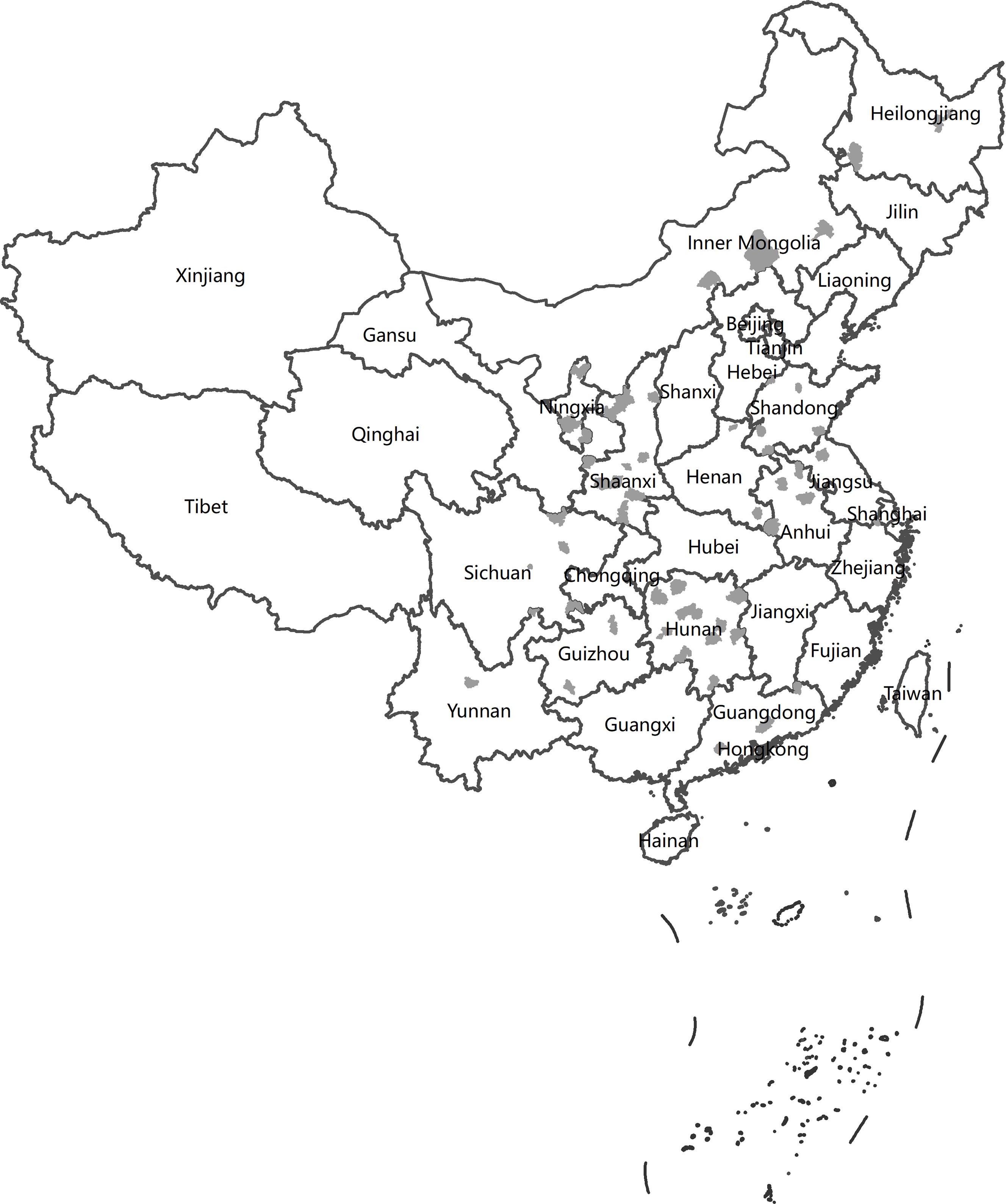
In May 2017, the State Council General Office of China issued the Work Plan for Implementing the Standardization and Normalization Pilot Program for Local Government Information Disclosure, designating 100 counties and districts within 16 provincial-level divisions to conduct pilot reforms. The selection of pilot counties followed the principle of “stratified categorization while ensuring representativeness.” The choice of pilot provinces covered China’s three major economic zones: eastern, central, and western regions, with 6 from the eastern region, 4 from the central region, and 6 from the western regionFootnote 2 . Based on their respective development conditions, each pilot province selected five to eight county-level units, ensuring representation across regions with different levels of economic development, geographical characteristics, and governance foundations. This approach aims to explore replicable experiences for subsequent nationwide implementation. It should be noted that the program allowed provincial-level units not included in the initial pilot to organize local implementation in accordance with the plan. Additionally, provincial governments were permitted to independently expand the scope of the pilot by designating additional counties or districts to carry out information disclosure following the prescribed guidelines (State Council General Office 2017). As a result, a total of 163 counties and municipal districts were ultimately designated as pilot units, among which 62 were counties containing distinct county seats (Figure 1). This study treats these 62 counties as the treatment group, with all other counties serving as the control group.
Pilot counties.
Note: Dark colors represent pilot counties.
The pilot policy mandated county-level governments to disclose the entire process of government information – covering decision-making, implementation, management, services, and outcomes – across 25 domains directly relevant to citizens’ daily lives. These areas encompassed key fields such as urban and rural planning, fiscal budgeting, environmental protection, healthcare, and social servicesFootnote 3 . Specifically, the disclosed information comprised raw data from multiple sources and formats, including departmental profiles (e.g., organizational structures and responsibilities), leadership details (e.g., names, positions, photos, and duties), and domain-specific materials (e.g., policies, annual plans, project notices, and internal work documents).
The central government stated that the key tasks for pilot county governments comprised the following: (1) Systematize disclosure items: Pilot units were to comprehensively catalog all government disclosure matters within the pilot scope based on power and responsibility lists and public service items. Each entry was to be broken down into detailed sub-items to ensure scientific categorization, standardized naming, and clear definition. (2) Develop disclosure standards: Based on this catalog, specific disclosure criteria were to be established for each item. A standardized directory was to be compiled and dynamically updated. (3) Standardizing disclosure procedures: Pilot units were required to enhance working mechanisms to ensure coordinated information release, interpretation, and response. Full-process disclosure – spanning decision-making, implementation, management, service delivery, and outcomes – was to be implemented. (4) Diversifying disclosure channels: Government websites were to be upgraded in content and management to serve as the primary information platform. Depending on local conditions, diverse channels – such as government social media, radio, television, newspapers, bulletin boards, service centers, and public service counters – were to be utilized to facilitate public access to government information (State Council General Office 2017). It can be observed that the pilot program not only required local governments to disclose relevant information but also involved streamlining the catalog of disclosure items, optimizing administrative functions, adjusting operational approaches, and diversifying channels for citizens to access information – all with the aim of establishing a routine and institutionalized disclosure mechanism.
Meanwhile, the central government employed a multi-pronged strategy to ensure that pilot counties executed the program effectively. First, the central government required provincial authorities to conduct periodic inspections of their pilot counties, promptly address emerging issues, and ensure smooth implementation and measurable results. Upon completion of the pilot phase, provincial authorities are required to undertake a preliminary inspection and acceptance assessment of each pilot county. Second, provincial governments were instructed to create dedicated sections on their official websites to centrally present the progress of the pilot programs across counties within their jurisdictions. Concurrently, pilot county governments were required to actively engage with public oversight and accountability by providing timely responses to citizens’ inquiries. Public evaluations and third-party assessments were further employed to gather comprehensive feedback on the implementation and outcomes of the pilot initiatives. Thirdly, an incentive mechanism was established by integrating the pilot tasks into the performance appraisal system for county governments conducted by provincial-level authorities. Regions demonstrating outstanding results in the pilot work received official commendation (State Council General Office 2017).
In China’s multi-tiered and extensive governance system, decentralization has exacerbated information asymmetry between the central and local governments. Through the aforementioned measures, the information disclosed by local governments and their conduct in the process can be effectively monitored by the public. Since much of the disclosed content is closely related to citizens’ daily lives, it facilitates public verification and helps identify three types of information in local government disclosures: distorted information that is not factually accurate, genuine information that is problematic or misleading, and information that is unclear or subject to public questioning. Additionally, public feedback and citizen evaluations are incorporated into the performance assessment systems of local governments, thereby ensuring that the information disclosure policy achieves its intended governance outcomes.
In July 2018, after assessing the implementation of the pilot initiative across local governments, the Chinese central government announced that all pilot units had fulfilled four key requirements: compiling a comprehensive inventory of government disclosure items, establishing standardized disclosure criteria, regulating disclosure procedures, and enhancing disclosure methods. As a result, previously common issues such as ambiguous disclosure standards and inconsistent presentation formats – particularly prevalent at the county level – were initially addressed. Many pilot units proactively adopted technological solutions to offer intelligent and diversified channels, significantly improving residents’ access to government information. A central government official highlighted that standardizing disclosure entails streamlining administrative functions and adjusting operational methods. Systematically organizing disclosure and public service items facilitates better categorization of approval processes and helps eliminate redundant or irrational certificates that have long troubled businesses and the public (People’s, Daily Reference People’S2018).
Dependent variable
The dependent variable, county seat development level, is proxied by two indicators: the proportion of economic-use land within the built-up area and the proportion of land used for administration and public services within the built-up area. As noted earlier, county seat development has been actively promoted in recent years by the central government as a key policy priority. For some time, county-level governments have prioritized expanding the built-up area while neglecting industrial development and public service provision. This has led to large-scale idle land, unfinished projects, and an overemphasis on visible infrastructure such as road construction. Consequently, land has not been effectively allocated for industrial use or public services, resulting in a continued decline in the proportion of economic-use land and land for administration and public services in recent years. Consequently, both the public welfare function and economic vitality of county seats have been declining, creating a vicious cycle of mutual constraint. Inadequate public services hinder local economic development, while fiscal shortages – exacerbated by local fiscal decentralization – reduce the government’s willingness to maintain public spending. This ultimately leads to stagnated county seat development and constrains the overall urbanization process. Therefore, using these two variables to represent the county seat development is justified. The specific meaning of the dependent variable ${Y_{it}}$
is as follows:
${Y_{it}}$
is as follows: $\small{\eqalign{& {\rm{Economic {\hbox{-}} use}}\;{\mkern 1mu} {\mkern 1mu} {\rm{land}} \;{\mkern 1mu} {\mkern 1mu} {\rm{ratio}}= {\rm{Proportion\; of}}\;{\rm{economic}} {\hbox{-}} {\rm{use}}\,{\mkern 1mu} {\mkern 1mu} {\rm{land\; within\; the\; built}} {\hbox{-}} {\rm{up}}\;{\rm{area}} =\cr & {{Area\;of\;Land\;for\;( {Commercial\;and\;Business\;Facilities + \;Industrial + Logistics\;and\;Warehouse} )} \over {Area\;of\;built - up\;area}}}}$

Moderator variable
For our analysis of the two heterogeneity hypotheses, we use the volume of messages on the Leaders’ Message Board and the construction budgetary fund for county seat as observed variables to proxy the degree of citizen responsiveness and fiscal capacity, respectively.
The Message Board for Leaders was launched in 2008 by People’s Daily Online, a key central news website in China, with the aim of serving as a unified platform for direct communication between the public and Party or government leaders at the county level and above. After more than a decade of operation, it has become one of the most widely used public‒government interaction platforms in China. By November 2019, the total number of messages left by netizens had exceeded 2 million (Huanqiu 2019). The platform provides two dedicated message sections for each county-level and higher administrative unit: one for the principal Party committee leader and another for the government administrative leader. This structure allows citizens to direct messages to specific officials to express petitions, opinions, inquiries, or oversight requests. Users may submit messages either anonymously or under real-name registration, which requires only a mobile phone number or an email address. In this study, the total number of messages addressed to both Party and government leaders is aggregated to represent the annual message volume for each corresponding county-level government. The volume of messages on the platform can serve as an indicator of citizens’ responsiveness to information disclosure (Jiang et al. Reference Jiang, Meng and Zhang2019; Su and Meng Reference Su and Meng2016). A higher level of message activity generally reflects greater public sensitivity to information, stronger willingness to participate, and better expressive ability among local residents, suggesting that disclosed information is more likely to be seen and acknowledged. Conversely, a low volume of messages may indicate a weaker culture of civic engagement and less effective dissemination of information in the region.
In this study, the construction budgetary fund for county seat is employed as a proxy for fiscal capacity at the county level. The construction budgetary fund for county seat comprises resources from the state budgetary fund, domestic loans, securities, foreign investment, and self-raised funds, with the state budgetary fund and self-raised funds being the primary sources. Counties with ample construction funding typically possess a stronger fiscal base and a higher level of economic development, with self-raised funds constituting a significant portion of their resources (Liu et al. Reference Liu, Jia and Ding2019). In contrast, counties with limited construction funding rely more heavily on the state budgetary fund. Under fiscal decentralization, county governments often face budgetary constraints, and those in less funded areas may also exhibit weaker infrastructure development and a limited capacity for making scientifically sound and efficient fiscal decisions (Su and Wang Reference Su and Wang2010). Therefore, conducting heterogeneity analysis based on counties’ varying fiscal capacities facilitates the derivation of more practical and contextually grounded conclusions.
Other variables and data sources
China’s counties vary considerably in size and economic structure, which may confound the estimated causal relationship in this study. Therefore, with reference to existing literature and considering data availability and completeness, the following control variables are included to mitigate potential biases: county seat area, county seat population, value-added of the primary industry, value-added of the secondary industry, and county-level gross domestic product (GDP) (Liu et al. Reference Liu, Jia and Ding2019; Xu Reference Xu2021). Additionally, this study selects a set of alternative dependent variables for robustness checks.
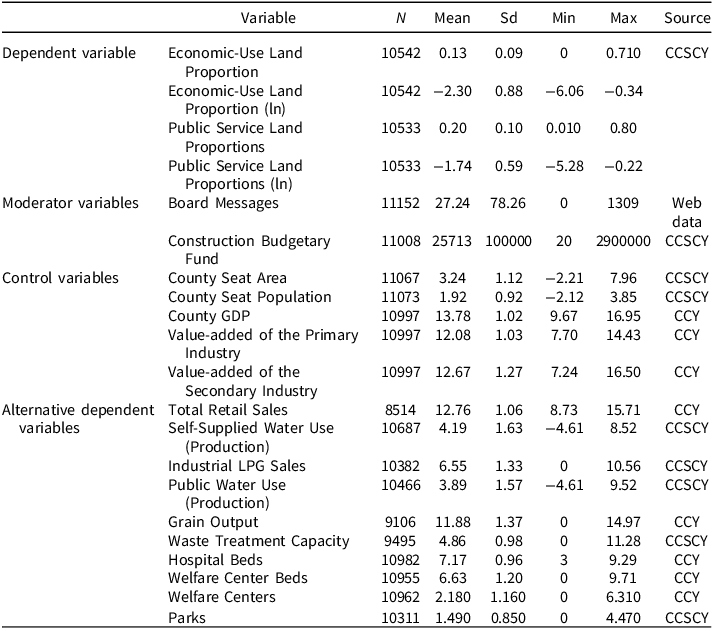
The dataset we utilized encompasses 10,542 observations from 1,366 counties with county towns in China between 2015 and 2022 (Yan and Lyu Reference Yan and Lyu2026). The data were sourced from the China County Statistical Yearbook (CCY) and the China County Seat Construction Statistical Yearbook (CCSCY), which are the most authoritative and comprehensive county-level statistical publications in China. Compiled respectively by the Rural Socioeconomic Survey Department of the National Bureau of Statistics and the Ministry of Housing and Urban-Rural Development, and published by China Statistics Press, these yearbooks operate under China’s centralized statistical management systemFootnote 4 . Data collection for the yearbooks employs a comprehensive, multi-channel approach that integrates statistical reports, administrative records, archival documents, digital information, remote sensing, and field surveys to conduct cross-verification. Strict data quality control procedures are rigorously implemented to ensure the breadth and reliability of data sources. The Board Messages data were collected via Python-based web scraping from People’s Daily OnlineFootnote 5 , and the annual count for each county was calculated using Python. Descriptive statistics and sources for each variable are presented in Table 1. Following common practice in the literature, logarithmic transformations were applied to a subset of variables (Malesky et al. Reference Malesky, Nguyen and Tran2014; Shi and Li Reference Shi and Li2020).
Descriptive statistics of variables

Note: Both the control variables and the alternative dependent variables have been logarithmically transformed.
Abbreviations: GDP, Gross Domestic Product; LPG, Liquefied Petroleum Gas; CCY= China County Statistical Yearbook; CCSCY= China County Seat Construction Statistical Yearbook.
Results
Time trend
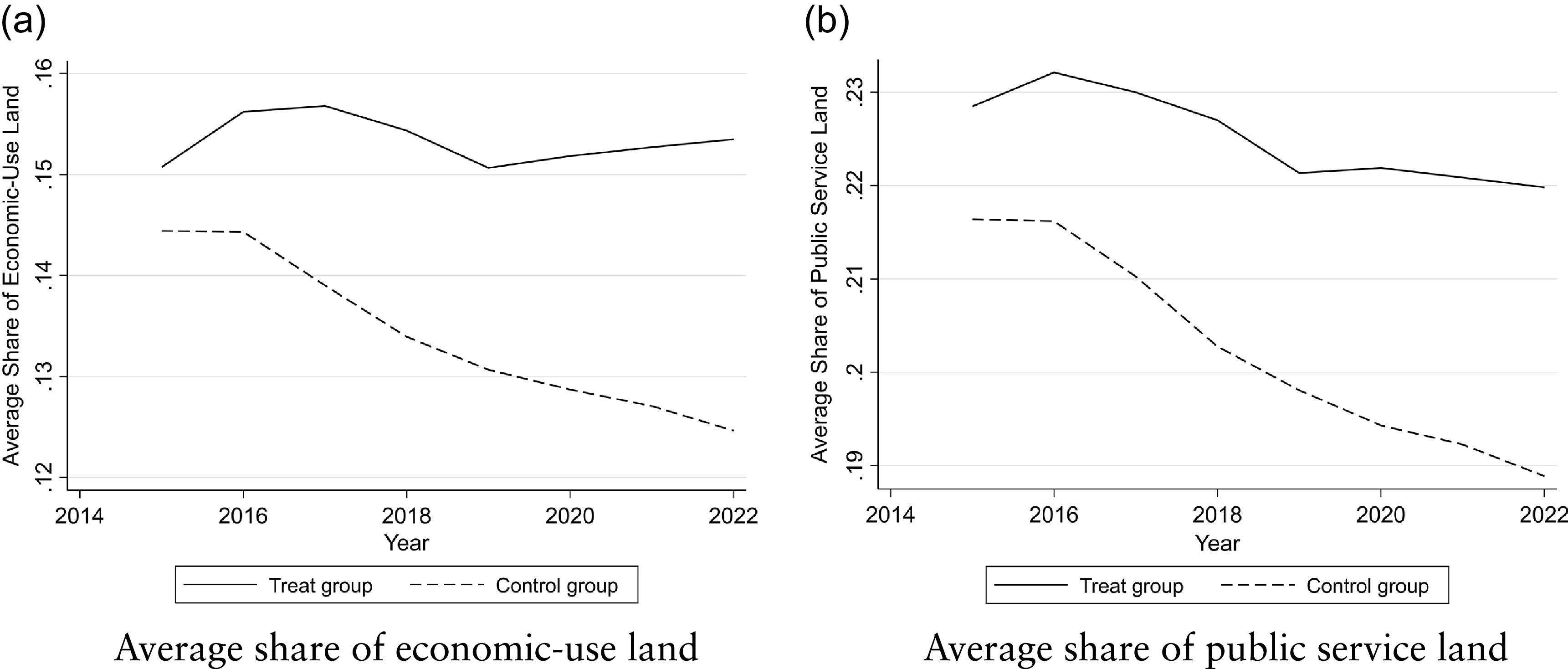
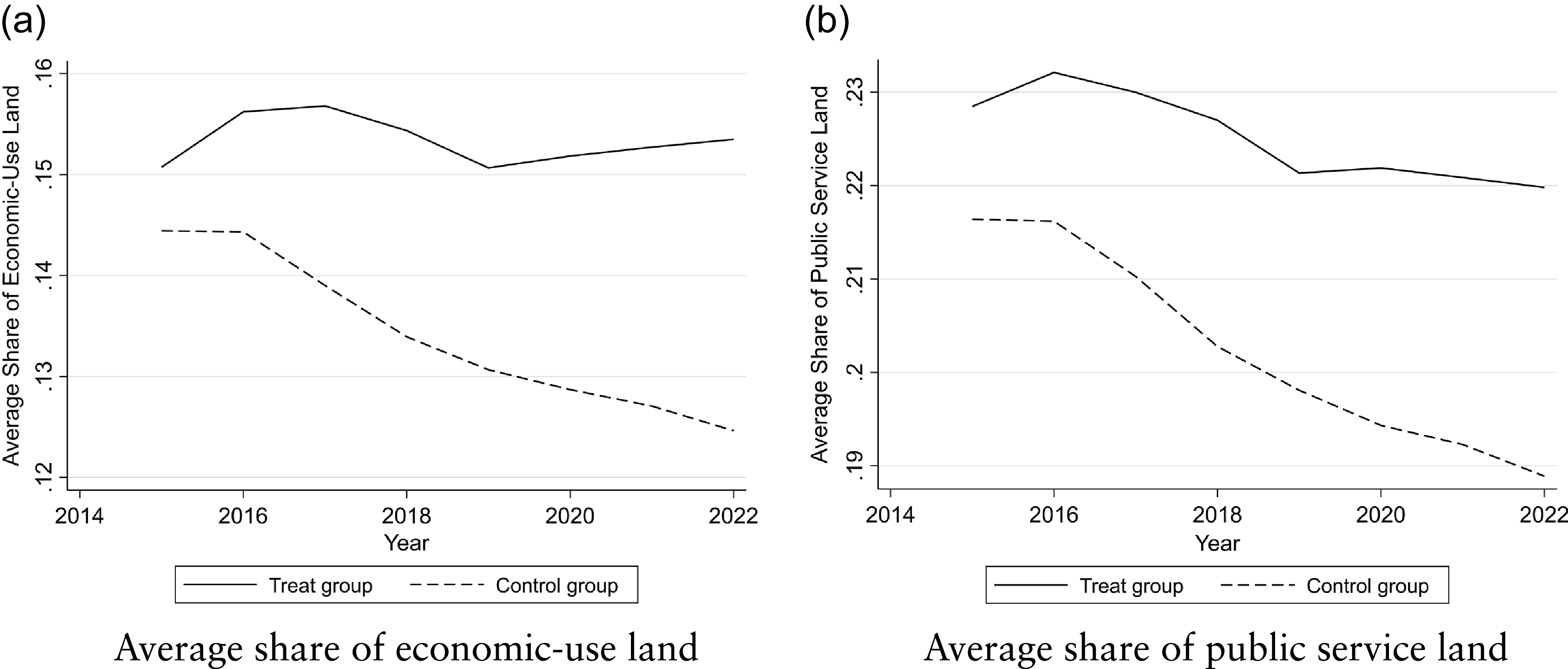
We utilize the local government information disclosure pilot program to categorize the sample counties into treatment and control groups. We analyzed the average proportions of economic-use land and administration & public service land within the built-up area across different groups from 2015 to 2022, with the results illustrated in Figure 2. As shown, non-pilot counties experienced a continuous decline in the share of both economic-use land and public management land over time. This trend aligns with existing research on the development challenges of Chinese counties, which highlights the ongoing reduction in industrial development and supporting public services. Following the implementation of the information disclosure policy in 2018, the treated group exhibited a growing divergence from the control group in both the proportion of economic-use land and public management land. Prior to the policy intervention, both groups followed similar trends; however, the decline in these proportions slowed significantly in pilot counties that implemented information disclosure. Based on this, it can be preliminarily concluded that the improvements in industrial development and public service levels in the county seats of pilot counties resulted from the information disclosure policy. However, a more rigorous analysis will be provided in the subsequent regression analysis.
Time trends. (a) Average share of economic-use land (b) Average share of public service land.
Regression model estimates
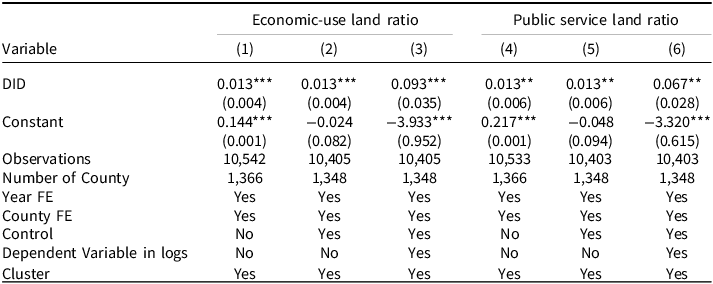
Table 2 presents the results of a DID analysis examining the impact of county-level government information disclosure policies on county seat development. Columns (1) to (3) report the effects of the local government information disclosure pilot program on the proportion of economic-use land in county seats. All specifications control for year and county fixed effects, with standard errors clustered at the county level. As shown, whether control variables are included or the dependent variable is adjusted, pilot counties exhibit a statistically significant increase in the share of economic-use land compared to non-pilot counties. The results demonstrate that disclosing local government information can facilitate the allocation of land for economic development during the urbanization of county seats, thereby emphasizing and promoting local industrial growth. Columns (4) to (6) examine the impact of the local government information disclosure pilot program on the proportion of land allocated for administration and public services. These specifications also include year and county fixed effects, with standard errors clustered at the county level. The results show that, following the implementation of the policy, pilot counties allocated more land resources to public services and management, reflecting an increased emphasis on enhancing public administration and service capabilities during urban development. The balanced development between economic industries and public services has consistently been a key challenge in the urbanization of county seats. Information disclosure by county-level governments has helped mitigate both the insufficient development and poor coordination between these areas – an outcome that aligns with the central government’s policy objectives for urbanization in recent years.
Regression results

Robust standard errors in parentheses.
***p < 0.01, **p < 0.05, *p < 0.1.
Parallel trends assumption
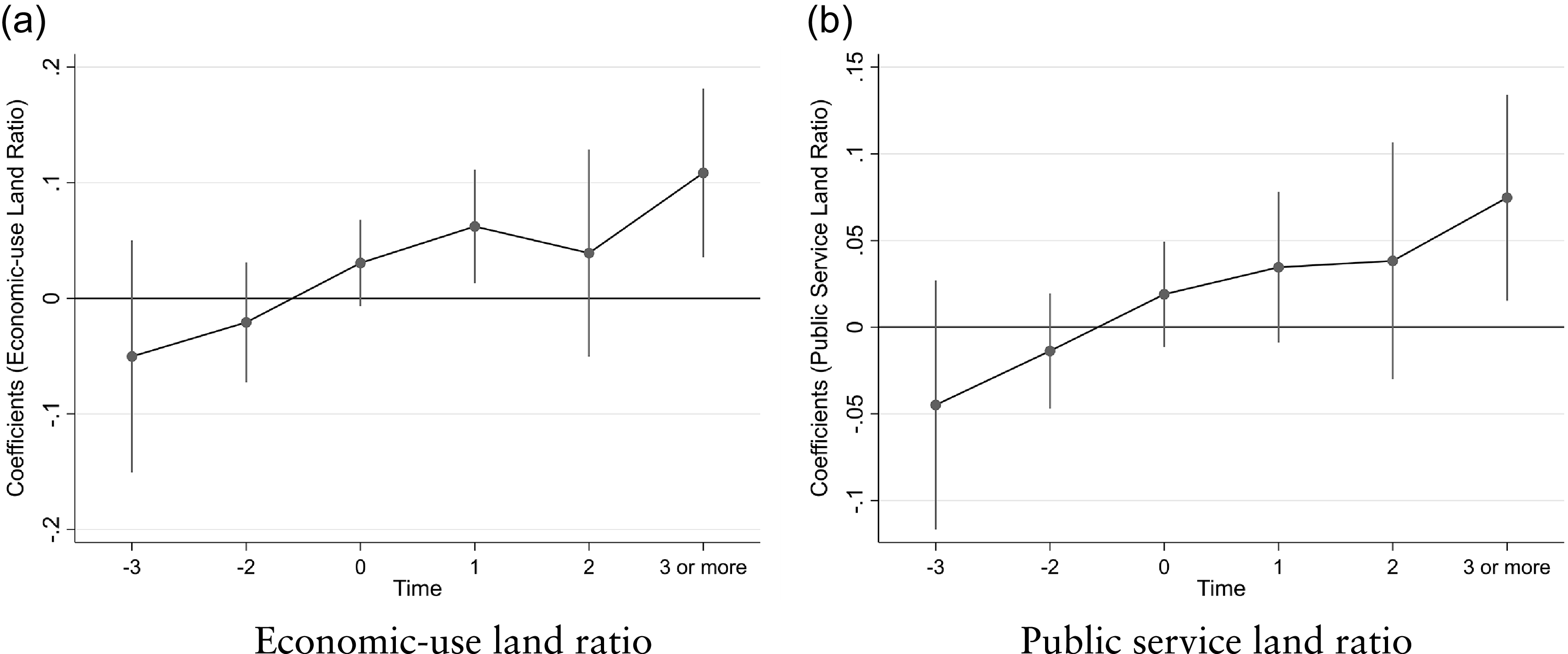
This section employs a parallel trends analysis to further examine the regression results. Figure 3 graphically presents the estimated policy coefficients across different time periods. The pre-treatment coefficients for before3 (time = −3) and before2 (time = −2) are statistically indistinguishable from zero, indicating parallel trends between the treatment and control groups prior to the policy intervention and confirming the suitability of the control group. This result satisfies the parallel trends assumption. Simultaneously, at the time of the information disclosure policy implementation (time=0), the regression coefficients for both the economic-use land share and the public service land share began to shift in a positive direction. This suggests that pilot counties increased their efforts toward industrial development and public services within their respective county seats following the policy introduction. In the three years following the policy implementation (time = 1, 2, 3), the positive treatment effects grew consistently stronger. This indicates that, as the policy continued to be enforced, the disparity in both economic-use land and public-service land proportions between treatment and control counties widened over timeFootnote 6 . It should be noted, however, that the estimated effects were not immediately significant or monotonic in the initial year of implementation, indicating a certain time lag in the policy’s influence. This lag is likely attributable to the time required for the policy to take full effect and for the corresponding adjustments in land-use planning to materialize.
Parallel trends test of the policy effect. (a) Economic-use land ratio (b) Public service land ratio.

Robustness checks
To further rule out potential confounding factors and ensure that the findings are indeed driven by local information disclosure, a series of robustness checks were conducted.
Alternative dependent variables
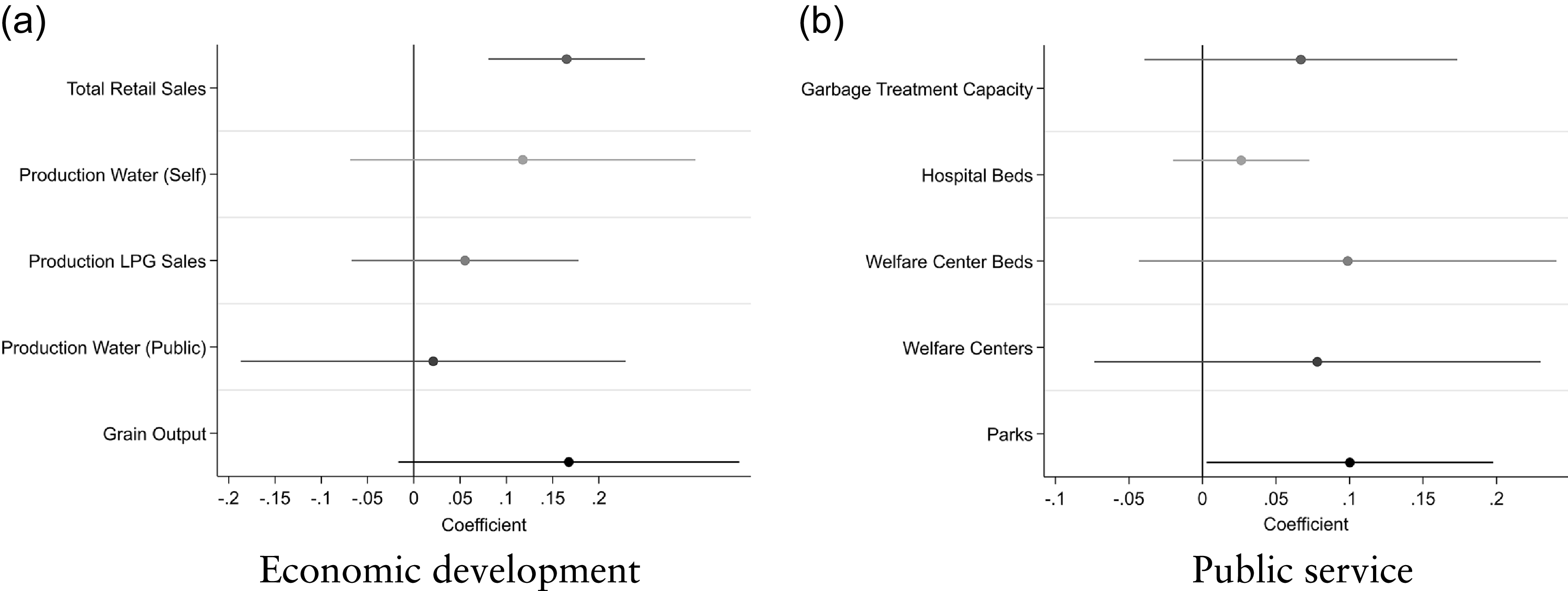
To verify the robustness of the findings, this study extends the dependent variables to include additional measures of economic development and public service provision. Production and operational water use from public supply, production and operational water use from self-supplied sources, sales of liquefied petroleum gas (LPG) for production and operation, total retail sales of consumer goods, and county-level grain output are used to gauge the level of economic and production activity. Meanwhile, domestic garbage harmless treatment capacity, number of hospital beds, number of beds in social welfare centers, number of social welfare centers, and number of parks are employed to assess the level of public services. The regression results are presented in Figure 4. After incorporating these extended dependent variables, the regression coefficients show a consistently positive direction across all indicators, though some are not statistically significant at the 5% level. This may reflect differences in the measurement sensitivity of various indicators to policy effects, indicating that the impact of information disclosure on certain aspects of county-level development – particularly in comparison to land-related indicators – is relatively moderate. Nevertheless, the uniformly positive trend observed across all ten indicators – spanning both economic and public service dimensions – still provides valuable empirical support for the argument that local government information disclosure contributes to advancing economic and public service development in counties.
Estimated effects using alternative dependent variables. (a) Economic development (b) Public service.

Placebo test
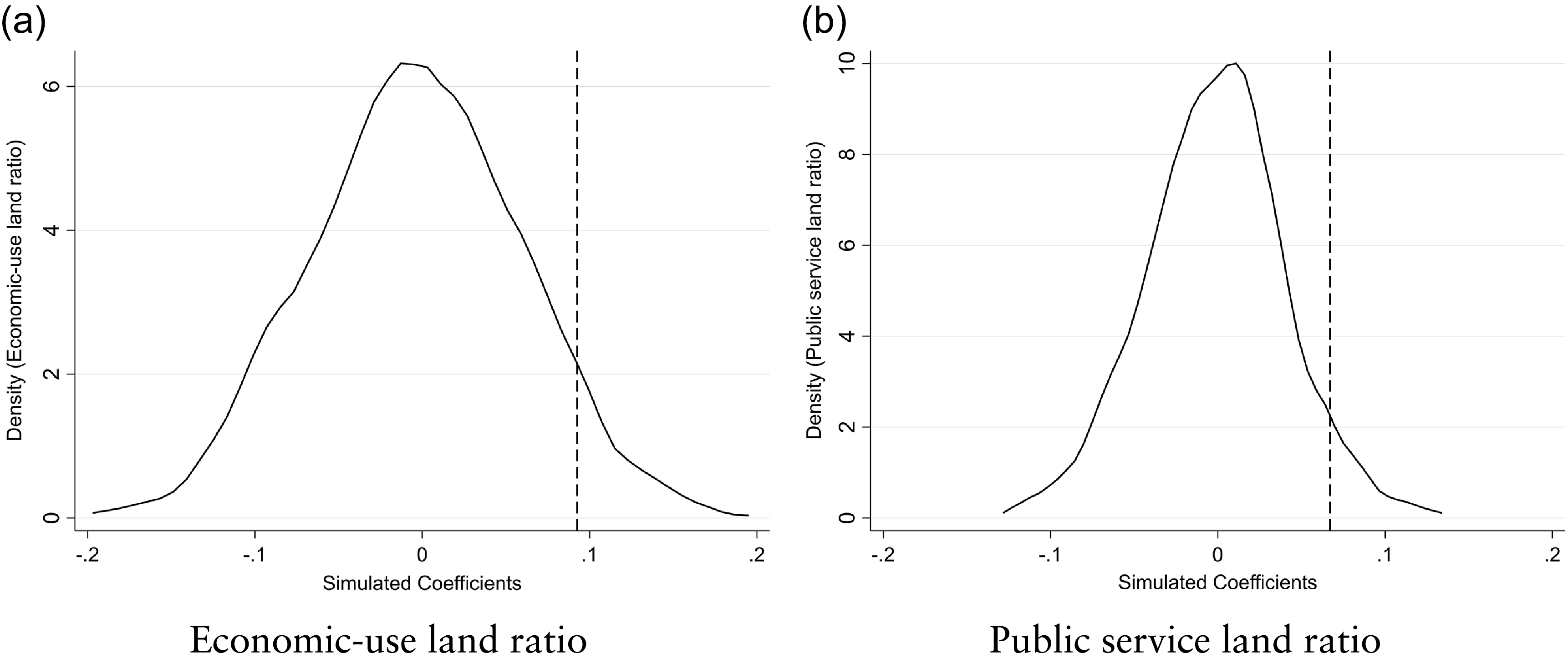
This study employs a methodology involving random selection of a “pseudo-treatment group.” Specifically, 100 counties were randomly drawn from the original sample to form the pseudo-treatment group, with the remaining counties serving as the control group. This process of random assignment and difference-in-differences estimation was repeated 500 times to construct the distribution of the pseudo-treatment effects. The results are presented in Figure 5. For both dependent variables, the estimated pseudo-treatment effects are concentrated around zero and follow an approximately normal distribution. This pattern is consistent with the theoretical expectation that no systematic effect should be observed when the treatment group is randomly assigned. As shown in Figure 5, the actual estimated treatment effects are 0.093 and 0.067 (indicated by the dashed lines), both of which lie well beyond the range of the placebo-generated distribution, suggesting that our main results are not driven by random factors. This indicates that the baseline results are statistically significant and unlikely to have occurred by chance. The outcome of this test effectively rules out model misspecification or data randomness as alternative explanations, thereby enhancing the credibility of the findings and confirming that the observed treatment effects indeed stem from the actual policy intervention rather than random fluctuations.
Distribution of pseudo-treatment effects. (a) Economic-use land ratio (b) Public service land ratio.
Note: The dashed line represents the true coefficient.

Propensity score matching (PSM)
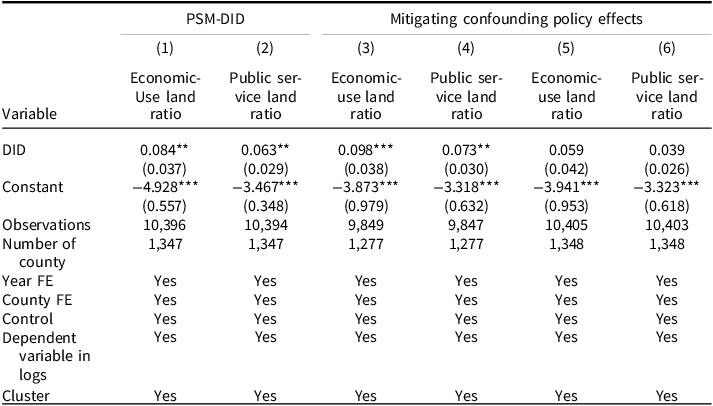
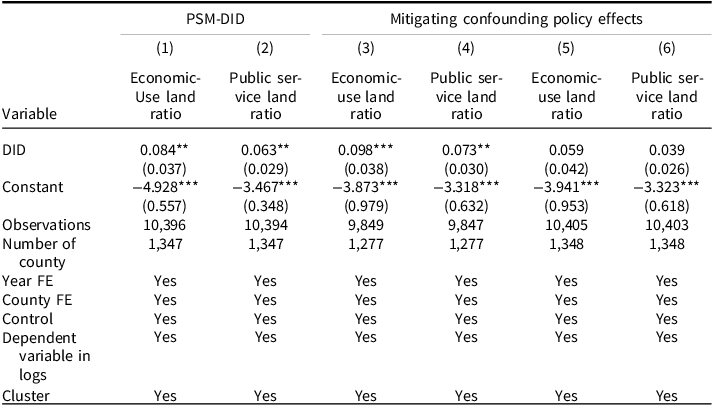
The difference-in-differences approach is potentially susceptible to selection bias, as it may not ensure that the treatment and control groups possess identical pre-policy characteristics – a concern particularly relevant in large-sample settings. Given the substantial regional and economic heterogeneity across counties in our sample, significant individual differences exist. To address this, we employed Propensity Score Matching (PSM) using the observed control variables as matching features to identify comparable counties between the treatment and control groups. The matched samples were then re-analyzed using the DID model. The results from the PSM-DID estimation, presented in columns (1) and (2) of Table 3, consistently demonstrate that local information disclosure significantly promotes the development of county seats in pilot areas, further confirming the robustness of the main findings.
Robustness checks
Robust standard errors in parentheses.
***p < 0.01, **p < 0.05, *p < 0.1.
Mitigating confounding policy effects
Given that other pilot policies more directly targeted at county seat development were implemented during the study period, it is possible that the estimated effects in the baseline regression could be confounded by these concurrent initiatives. In 2020, China’s National Development and Reform Commission (NDRC) issued the Notice on Accelerating the Strengthening of Weak Links in County Seat Urbanization, which designated 78 counties and 42 county-level cities as demonstration zones for new urbanization initiatives at the county level. The policy aims to enhance public services, municipal facilities, and industrial economic development. As another national-level pilot policy, the estimated effects of the information disclosure pilot project may be confounded by the influence of this concurrent urbanization policy. To address this concern, this study provides two main responses. First, the overlap between the urbanization pilot counties and the information disclosure pilot counties is limited to only 8 counties. This minimal overlap indicates that the estimated policy effects of information disclosure are unlikely to be substantially confounded by the urbanization initiative. Additionally, after excluding all urbanization pilot counties from the sample, the regression results – reported in columns (3) and (4) of Table 3 – remain statistically significant. Secondly, the effect of the urbanization pilot policy was also analyzed using the same DID specification as in the main regression. The results are reported in columns (5) and (6) of Table 3. The results indicate that the urbanization pilot policy did not exert a statistically significant effect on the proportions of public service land and economic-use land within the built-up area. This suggests that although thematically related to the dependent variables used in this study, the policy does not constitute a major confounding factor, thereby reinforcing the robustness of the primary findings.
Further analysis
Heterogeneous effects of information disclosure policy by citizen response
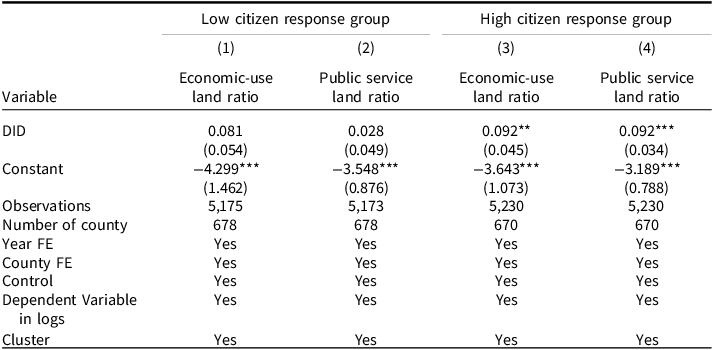
We measure citizen responsiveness to information disclosure by analyzing messages from the public to county-level government officials on the Local Leaders’ Message Board. Civic awareness and attentiveness to government information vary significantly across county seats in China. Although the information disclosure policy has enhanced the volume of information communicated by local governments to the public, variations in the degree of citizen responsiveness have also shaped the effectiveness of its implementation. Kosack and Fung (Reference Kosack and Fung2014) argue that successful information disclosure requires not only that the information provided be accessible but also that it influences the decisions and actions of its recipients. Many transparency initiatives simplistically assume that substandard public services will inevitably lead to user dissatisfaction and subsequent action – an assumption that may not hold in reality. Based on the 2018 message volume, we bifurcated the sample into “low’ and “high’ citizen response groups using the median value (7) as the threshold. Specifically, counties with up to 7 messages were categorized as low-response, while those exceeding 7 were classified as high-response. We performed regression analyses for each subgroup using the same specification as in the main model. The results are reported in Table 4.
The effects of information disclosure by level of citizen response

Robust standard errors in parentheses.
***p < 0.01, **p < 0.05, *p < 0.1.
The estimated policy effects of information disclosure in counties with low levels of citizen responsiveness are shown in columns (1) and (2). In contrast, the effects for counties with high citizen responsiveness are presented in columns (3) and (4). The results indicate that where citizen responsiveness is low, the policy effects of information disclosure are statistically insignificant, providing no support for Hypothesis 1 regarding improvements in public services and industrial development. In contrast, a significant policy effect emerges only in contexts with stronger citizen responsiveness, suggesting that active citizen engagement is a crucial condition for information disclosure to yield the intended outcomes. This also indicates that the effectiveness of local government information disclosure requires public attention and response to such information in order to create pressure from societal oversight and, consequently, prompt changes in their behavior. On the one hand, this finding further confirms the effectiveness of local government information disclosure as a crucial policy instrument for the central government to regulate local behavior. On the other hand, the results also suggest that merely increasing the quantity of information released is insufficient; it is equally essential to enhance citizens’ information literacy and participatory capacity to strengthen their attentiveness and responsiveness to government information.
Heterogeneous effects of information disclosure policy by fiscal capacity
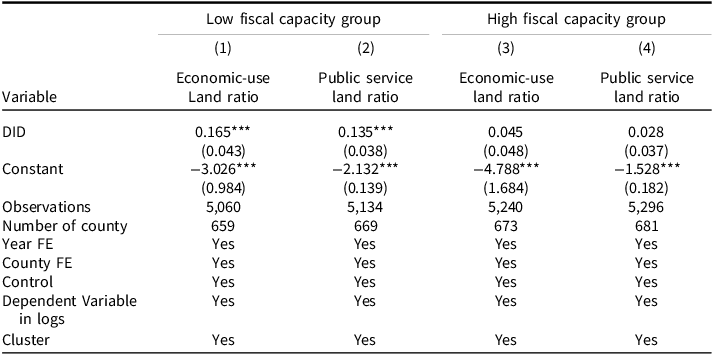
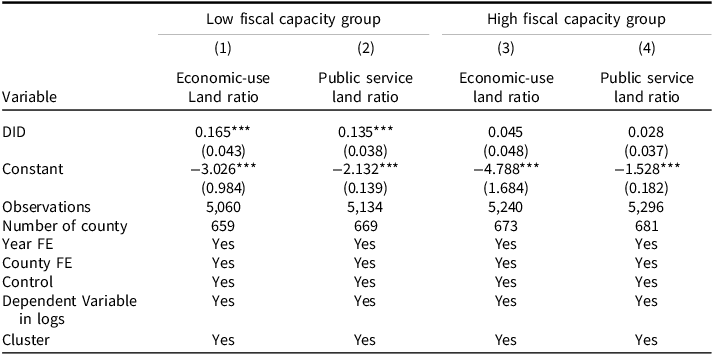
Due to historical, geographical, and other factors, development remains uneven across county-level governments in China, particularly in terms of fiscal capacity. Counties with weaker public finances tend to lag behind their well-funded counterparts in overall development. This disparity is reflected in their limited ability to self-fund construction projects, greater reliance on central budgetary transfers, lower levels of economic development, and poorer public services. Such areas are also more susceptible to inefficient spending, misallocation of funds, and corruption. Does the implementation of information disclosure policies yield differentiated effects in counties with varying levels of fiscal capacity? To examine this, counties are categorized into “low fiscal capacity” and “high fiscal capacity” groups based on whether their 2018 construction budgetary fund for county seat development falls below or above the median value (10,405.5). This results in two subgroups of roughly equal sample size. Subgroup regression analyses are then performed using the same specification as the main model. The results are presented in Table 5.
The effects of information disclosure by level of fiscal capacity
Robust standard errors in parentheses.
***p < 0.01, **p < 0.05, *p < 0.1.
In the low fiscal capacity group, information disclosure significantly increases both the proportion of economic-use land and the share of public service land in county seat development. In contrast, no significant effect is observed in the high fiscal capacity group. This conclusion differs from existing research on local environmental information disclosure. Previous studies often indicate that disclosure is more effective in governments with stronger fiscal capacity, as their diverse revenue sources reduce the need to protect heavily polluting industries for economic stability. Additionally, proactive disclosure efforts can help these governments attract greater attention and support from higher-level authorities. However, the mechanism operates differently in the domain of social governance. Disclosing information in areas closely related to public daily life – such as urban and rural planning, construction projects, social security, and municipal services – does not necessarily lead to a reduction in local tax revenue or other fiscal resources. On the contrary, enhancing the standardization and accessibility of such information can attract higher-quality enterprises, thereby helping to alleviate local fiscal constraints. Therefore, information disclosure policies tend to yield more substantial effects in counties with lower fiscal capacity.
Moreover, counties with a weaker fiscal foundation often exhibit initially low levels of government transparency, resulting in poor visibility into fiscal spending, irregular use of public funds, and a higher incidence of corruption. Promoting government information disclosure can help restrain arbitrary fiscal spending by local governments in these regions. When government information is fully disclosed to the public, the resulting surge in oversight pressure leads these counties to exercise greater prudence in fiscal planning during urbanization. They place stronger emphasis on compliance and efficiency in fund usage, while prioritizing the enhancement of public welfare in urban development and improvements in public management and service delivery. Thus, information disclosure serves as an effective tool to rectify local government behavior and helps narrow regional development disparities while promoting more balanced growth across regions.
Conclusions
This study conducts a detailed analysis of county-level data from 2015 to 2022 using a DID approach, leveraging the Standardization and Normalization Pilot Program for Local Government Information Disclosure as a quasi-natural experiment. The main findings are as follows: ① After passing parallel trend tests and additional robustness checks, the results show that local government information disclosure significantly promotes the development of county seats, as specifically reflected in the rising proportion of both economic-use land and public service land. ② This study further reveals the heterogeneous effects of local government information disclosure policies through heterogeneity analysis. The policy impact is more pronounced in counties with higher levels of citizen responsiveness, as well as in those with relatively limited construction budgets, where the policy achieves particularly notable outcomes.
The following implications can be drawn from the findings of this study: First, in authoritarian states, the central government’s promotion of local information disclosure to the public can help mitigate challenges arising from decentralization. The decline of county seats represents a significant manifestation of the challenges associated with decentralization. The findings of this study demonstrate that in the realm of social governance, local government information disclosure policies can serve as an effective tool to constrain and correct governmental behavior. These policies enhance both the public welfare and economic efficiency of county seat development, thereby breaking the vicious cycle in which inadequate public services and sluggish industrial development mutually reinforce each other. This study further confirms that information disclosure by local governments serves as an effective mechanism of social governance and a direction that authoritarian states ought to embrace. It provides a significant reference for other authoritarian regimes: the central government may utilize transparency at the local level to mitigate challenges – such as shortages in public goods provision and deficiencies in public management and services – resulting from fiscal inadequacies under decentralization.
Second, the effectiveness of information disclosure is influenced by the degree of citizen responsiveness. A high level of citizen responsiveness indicates strong participatory capacity and sustained attention to government information. In such contexts, more comprehensive disclosure can stimulate active feedback, which not only strengthens oversight of local governments but also supplies more valid suggestions for scientific and rational fiscal decision-making. This study contributes to the existing literature on government information disclosure and offers insights for improving policy implementation. When advancing information disclosure policies, it is essential not only to institutionalize standards for the content, frequency, and methods of disclosure by local governments but also to emphasize the cultivation and enhancement of citizens’ responsiveness to government information. Particularly in non-electoral countries, citizen attention to political or government activities is generally low. Beyond professionals and academics, ordinary members of the public exhibit relatively limited active demand for government information and data. Failure to enhance citizens’ sensitivity to government information and encourage active expression of their needs may reduce information disclosure to a mere formalistic exercise – serving only as a tool for local governments to demonstrate compliance to higher authorities rather than as a genuine mechanism for public oversight and participation.
Third, information disclosure can help mitigate regional development disparities in the context of decentralization. Regions with lower budgets typically possess weaker economic foundations and face greater expenditure responsibilities under ongoing decentralization trends. Consequently, fiscal constraints in these areas often lead to reduced willingness to invest in public management and services. These regions often suffer from lower fiscal efficiency and a weaker capacity for scientific budgetary decision-making. Even when granted greater autonomy, they frequently struggle to allocate resources effectively, which can lead to a range of issues such as irrational spending, misallocation of funds, and corruption – ultimately undermining local governance performance. However, this study demonstrates that the policy effects of information disclosure are more substantial in regions with insufficient construction budgets. This suggests that enhancing transparency can help narrow regional development disparities under decentralization, promote more balanced growth across areas, and ultimately improve overall national governance performance. In particular, recent years have witnessed continuous improvements in online service delivery, further openness of government data, and optimized mobile service provision – key trends characterizing global digital governance. For less developed countries and regions, fully leveraging the latecomer advantage in technology to enhance governance efficiency represents a strategic development pathway worthy of focused attention.
This study also has several limitations. First, it is constrained by the availability of local government data. County-level government data are vast in volume, making collection and organization challenging, and the variables included in publicly published statistical yearbooks are limited. As a result, the selection of proxy variables in this paper is somewhat restricted, and it is difficult to identify suitable instrumental variables for more rigorous robustness tests. Secondly, detailed information regarding the implementation process of the pilot initiatives on information disclosure remains scarce. Although the pilot policy was uniformly designed by the central government, the specific measures and implementation approaches adopted by various provinces and counties can only be gleaned from fragmented news reports and promotional materials. As a result, the concrete process of their execution and advancement has been, to some extent, overlooked. Should conditions permit, future research could conduct a case study of a representative pilot county, employing in-depth interviews and field investigations to analyze the mechanisms and effectiveness of information dissemination between local governments and the public. Such an approach would not only help mitigate the limitations of this study but also yield more practical insights for policy implementation.
Data availability statement
Replication materials are available in the Journal of Public Policy Dataverse at https://doi.org/10.7910/DVN/RVKD4B.
Acknowledgements
This research was funded by the National Natural Science Foundation of China (No. 72434003).



 Open access

