


Regional variation in mental health may result from preventable environmental causes and inform public health interventions. Many studies have been conducted comparing the rates of psychiatric disorders between urban, and rural environments, with inconsistent findings. Evidence for the more prevalent mood, anxiety and substance use disorders, reviewed by Peen et al, Reference Peen, Schoevers, Beekman and Dekker1 indicates increased rates in residents of urban in comparison with rural environments and a link between higher social problems and environmental stressors in cities and increased psychiatric morbidity has been hypothesised. The evidence for the effect of urbanicity on other common mental health disorders, including personality disorders, eating disorders and attention–deficit hyperactivity disorder (ADHD), is limited and inconclusive. Reference van Son, van Hoeken, Bartelds, van Furth and Hoek2,Reference Knopf, Holling, Huss and Schlack3 However, no causal inferences can be based on studies of prevalent cases examining urbanicity at the time of enrolment, because of methodological limitations; most importantly the increased mortality and emigration in people with a mental illness but also the hypothesised drift towards cities of individuals with mental illness. Reference Freeman4 The most systematically examined psychiatric disorder for the effect of urbanicity on incidence is schizophrenia, with consistent evidence that urban environment is associated with a higher risk for the disorder. Reference Mortensen, Pedersen, Westergaard, Wohlfahrt, Ewald and Mors5,Reference Vassos, Pedersen, Murray, Collier and Lewis6 Although not known, the underlying cause(s) responsible for these differences have been hypothesised to include toxic exposures, diet, infections, stress or an artefact because of selective migration or treatment-seeking behaviour. Although confounding may explain part of the effect, as for example high rates of schizophrenia in cities can be secondary to higher rates of substance misuse or ethnic minority status in comparison with rural places, studies accounting for a variety of confounders have confirmed the association. Reference van Os, Kenis and Rutten7 Only a few studies have considered urban–rural differences in the incidence of bipolar affective disorder, Reference Pedersen and Mortensen8–Reference Laursen, Munk-Olsen, Nordentoft and Bo Mortensen10 depression Reference Laursen, Munk-Olsen, Nordentoft and Bo Mortensen10,Reference Sundquist, Frank and Sundquist11 and autism. Reference Chen, Liu, Su, Huang and Lin12,Reference Lauritsen, Astrup, Pedersen, Obel, Schendel and Schieve13 It remains unknown whether urbanicity influences the incidence of other mental disorders. Examining the effect of urbanicity in a broad range of mental disorders would be useful in order to explore similarities and differences of categorical mental diagnoses as identified through the current classification systems and to direct further research aiming to identify the underlying causal effects of urbanicity (i.e. looking at aetiological factors that have been associated specifically with psychosis or with a broader risk for mental illness). Based on a large nation-wide population, we aimed to investigate whether urban–rural differences at place of birth influence the full spectrum of mental disorders including, among others, substance misuse, schizophrenia, mood disorders, neurotic and stress-related disorders, eating disorders, intellectual disability (ICD-10 ‘mental retardation’), pervasive developmental disorders and hyperkinetic disorder.
Method
Study population
The Danish Civil Registration System (CRS) was established in 1968, where all people living in Denmark were registered. Among other variables, it includes information on personal identification number, gender, date and place of birth, continuously updated information on vital status and also the parent's personal identifiers. The personal identification number is used in all national registers enabling accurate linkage between registers. Our study population included all individuals born in Denmark between January 1955 and 31 December 2006 and with both parents also born in Denmark.
Assessment of mental illness
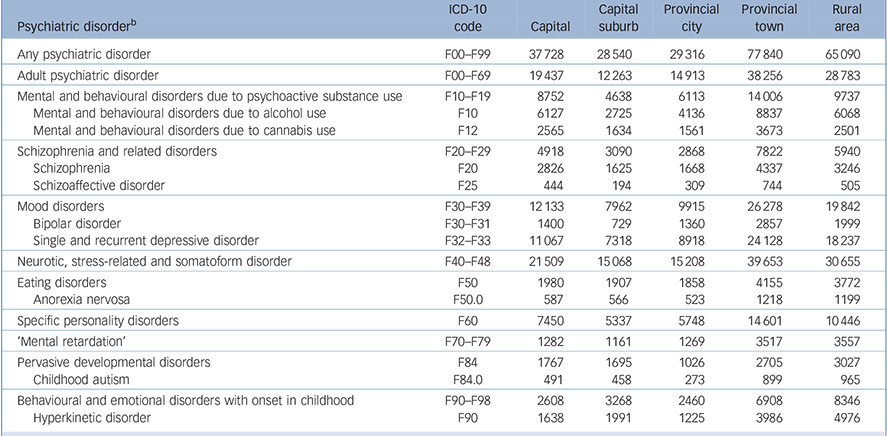
People within the study cohort and their parents and siblings were linked via their personal identifier to the Danish Psychiatric Central Research Register Reference Mors, Perto and Mortensen14 to obtain information about mental illness. This register was computerised in 1969 and contains data on all admissions to Danish psychiatric in-patient facilities and, from 1995, information on out-patient visits to psychiatric departments. From 1969 to 1993 the diagnostic system used was the Danish modification of ICD-8 15 and from 1994 the ICD-10. 16 Cohort members were classified with a mental disorder if they had been admitted to a psychiatric hospital or had received out-patient care. The spectrum of mental disorders considered is shown in Table 1. We examined the main categories of ICD-10 and the most common and characteristic disorders within these categories. For each mental disorder, the date of onset was defined as the first day of the first contact (in-patient or out-patient) with the diagnosis of interest. Multiple disorders were recorded if developed by the individual. Parents and siblings were classified as having a history of mental disorder if they had been admitted to a psychiatric hospital or had been in out-patient treatment for any reason.
Number of new cases according to degree of urbanisation of place of birth in Denmark a
| Psychiatric disorder b |
ICD-10 code |
Capital | Capital suburb |
Provincial city |
Provincial town |
Rural area |
|---|---|---|---|---|---|---|
| Any psychiatric disorder | F00–F99 | 37 728 | 28 540 | 29 316 | 77 840 | 65 090 |
| Adult psychiatric disorder | F00–F69 | 19 437 | 12 263 | 14 913 | 38 256 | 28 783 |
| Mental and behavioural disorders due to psychoactive substance use | F10–F19 | 8752 | 4638 | 6113 | 14 006 | 9737 |
| Mental and behavioural disorders due to alcohol use | F10 | 6127 | 2725 | 4136 | 8837 | 6068 |
| Mental and behavioural disorders due to cannabis use | F12 | 2565 | 1634 | 1561 | 3673 | 2501 |
| Schizophrenia and related disorders | F20–F29 | 4918 | 3090 | 2868 | 7822 | 5940 |
| Schizophrenia | F20 | 2826 | 1625 | 1668 | 4337 | 3246 |
| Schizoaffective disorder | F25 | 444 | 194 | 309 | 744 | 505 |
| Mood disorders | F30–F39 | 12 133 | 7962 | 9915 | 26 278 | 19 842 |
| Bipolar disorder | F30–F31 | 1400 | 729 | 1360 | 2857 | 1999 |
| Single and recurrent depressive disorder | F32–F33 | 11 067 | 7318 | 8918 | 24 128 | 18 237 |
| Neurotic, stress-related and somatoform disorder | F40–F48 | 21 509 | 15 068 | 15 208 | 39 653 | 30 655 |
| Eating disorders | F50 | 1980 | 1907 | 1858 | 4155 | 3772 |
| Anorexia nervosa | F50.0 | 587 | 566 | 523 | 1218 | 1199 |
| Specific personality disorders | F60 | 7450 | 5337 | 5748 | 14 601 | 10 446 |
| ‘Mental retardation’ | F70–F79 | 1282 | 1161 | 1269 | 3517 | 3557 |
| Pervasive developmental disorders | F84 | 1767 | 1695 | 1026 | 2705 | 3027 |
| Childhood autism | F84.0 | 491 | 458 | 273 | 899 | 965 |
| Behavioural and emotional disorders with onset in childhood | F90–F98 | 2608 | 3268 | 2460 | 6908 | 8346 |
| Hyperkinetic disorder | F90 | 1638 | 1991 | 1225 | 3986 | 4976 |
a. People born in Denmark 1955-2006 were followed for a mental disorder 1995–2012.
b. For psychiatric disorders the main categories of ICD-10 excluding dementia and organic disorders are shown; the indented entries are the most common and characteristic disorders within that category.
Assessment of urbanisation at birth
Municipalities in Denmark were classified according to degree of urbanisation 17 as follows: capital, capital suburb, provincial cities, provincial towns or rural areas. Denmark is a small homogeneous country with a population of 5.3 million people and a total area of 43 000 km2. The population densities for the capital, capital suburb, provincial cities, provincial towns and rural areas, respectively, are 5220, 845, 470, 180 and 55 people per km2. 17 Distances are small in Denmark – most people live within 25 km of a city with more than 30 000 inhabitants and even closer to a psychiatric hospital.
Study design and statistical analyses
For each psychiatric disorder, individuals were followed up from the earliest age at which they may possibly develop the specific disorder or 1 January 1995, whichever came last, until onset of the outcome in question, death, emigration from Denmark or 31 December 2012, whichever came first. Note that since individuals were followed from 1995 onwards only, those with diagnoses prior to 1995 were excluded. The findings were therefore based entirely on incident cases diagnosed according to the more operational ICD-10 diagnostic classification system and during a period when both in-patient and out-patient information was used, except that the ICD-8 classification was used to censor people with a diagnosis prior to 1995 and to establish family history. Since many of the child psychiatric disorders were only registered in out-patient settings, the study cohort for the child psychiatric disorders included only individuals born in 1993 or later.
The incidence rate ratios (IRRs) associated with urbanicity at birth for each mental disorder outcome were estimated by log linear Poisson regression. All IRRs were adjusted for calendar period, age and gender, as well as the interaction between age and gender. Age and calendar period were treated as time-dependent variables, whereas all other variables were treated as variables independent of time. Potential confounders included maternal and paternal age at time of child's birth and history of mental illness in a parent or sibling. P-values and 95% confidence intervals were based on likelihood ratio tests. The adjusted-score test suggested that the regression models were not subject to overdispersion.
In addition to the categorical model (IRR for five levels of urbanisation) we used a continuous model that estimates trends to summarise the risk associated with urbanicity at birth. Specifically, the level of urbanisation was entered into the model as a trend variable with scores proportional to the logarithm of the relative population density (0 for rural areas, 0.26 for provincial towns, 0.47 for provincial cities, 0.60 for capital suburbs and 1 for the capital). Using this scoring, the estimated relative risk corresponds to the risk of birth in the capital compared with birth in the rural area using data from all degrees of urbanisation. As a result of the many tests performed, in this article we will denote estimates as statistically significant if the P-value is <0.0025, using a Bonferroni correction for multiple testing across the 20 psychiatric disorders we examined. This study was approved by the Danish Data Protection Agency.
Results
A total of 2 894 640 people born in Denmark 1955–2006 were followed from 1995 to 2012, using the ICD-10 classification. Overall, the cohort was followed for 45 325 531 person-years, during which period 238 514 members of the cohort had their first psychiatric contact with any psychiatric disorder. The list of psychiatric disorders examined with corresponding ICD-10 codes and the number of new cases during the follow-up period according to degree of urbanisation are presented in Table 1.
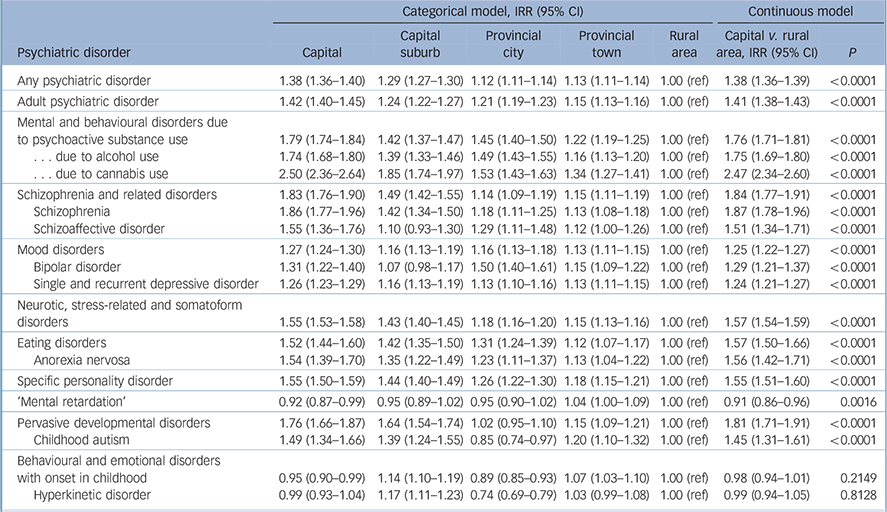
Table 2 shows IRRs under the categorical model for each of the psychiatric outcomes across the five categories of degrees of urbanisation of place of birth in Denmark, compared with people born in rural areas and summary estimates of the effect of birth in the capital compared with birth in rural areas (trend estimate). For all psychiatric disorders, except intellectual disability and behavioural and emotional disorders with onset in childhood, individuals born in the capital had a higher incidence rate than those born in rural areas. There was evidence of a dose–response association between the degree of urbanisation and the IRR of the disorder in question.
Relative risk of psychiatric disorders by degree of urbanisation of place of birth in Denmark a
| Categorical model, IRR (95% CI) | Continuous model | ||||||
|---|---|---|---|---|---|---|---|
| Psychiatric disorder | Capital | Capital suburb |
Provincial city |
Provincial town |
Rural area |
Capital
v. rural area, IRR (95% CI) |
P |
| Any psychiatric disorder | 1.38 (1.36–1.40) | 1.29 (1.27–1.30) | 1.12 (1.11–1.14) | 1.13 (1.11–1.14) | 1.00 (ref) | 1.38 (1.36–1.39) | <0.0001 |
| Adult psychiatric disorder | 1.42 (1.40–1.45) | 1.24 (1.22–1.27) | 1.21 (1.19–1.23) | 1.15 (1.13–1.16) | 1.00 (ref) | 1.41 (1.38–1.43) | <0.0001 |
| Mental and behavioural
disorders due to psychoactive substance use |
1.79 1.74–1.84) | 1.42 (1.37–1.47) | 1.45 (1.40–1.50) | 1.22 (1.19–1.25) | 1.00 (ref) | 1.76 (1.71–1.81) | <0.0001 |
| … due to alcohol use | 1.74 (1.68–1.80) | 1.39 (1.33–1.46) | 1.49 (1.43–1.55) | 1.16 (1.13–1.20) | 1.00 (ref) | 1.75 (1.69–1.80) | <0.0001 |
| … due to cannabis use | 2.50 (2.36–2.64) | 1.85 (1.74–1.97) | 1.53 (1.43–1.63) | 1.34 (1.27–1.41) | 1.00 (ref) | 2.47 (2.34–2.60) | <0.0001 |
| Schizophrenia and related disorders | 1.83 (1.76–1.90) | 1.49 (1.42–1.55) | 1.14 (1.09–1.19) | 1.15 (1.11–1.19) | 1.00 (ref) | 1.84 (1.77–1.91) | <0.0001 |
| Schizophrenia | 1.86 (1.77–1.96) | 1.42 (1.34–1.50) | 1.18 (1.11–1.25) | 1.13 (1.08–1.18) | 1.00 (ref) | 1.87 (1.78–1.96) | <0.0001 |
| Schizoaffective disorder | 1.55 (1.36–1.76) | 1.10 (0.93–1.30) | 1.29 (1.11–1.48) | 1.12 (1.00–1.26) | 1.00 (ref) | 1.51 (1.34–1.71) | <0.0001 |
| Mood disorders | 1.27 (1.24–1.30) | 1.16 (1.13–1.19) | 1.16 (1.13–1.18) | 1.13 (1.11–1.15) | 1.00 (ref) | 1.25 (1.22–1.27) | <0.0001 |
| Bipolar disorder | 1.31 (1.22–1.40) | 1.07 (0.98–1.17) | 1.50 (1.40–1.61) | 1.15 (1.09–1.22) | 1.00 (ref) | 1.29 (1.21–1.37) | <0.0001 |
| Single and recurrent depressive disorder | 1.26 (1.23–1.29) | 1.16 (1.13–1.19) | 1.13 (1.10–1.16) | 1.13 (1.11–1.15) | 1.00 (ref) | 1.24 (1.21–1.27) | <0.0001 |
| Neurotic,
stress-related and somatoform disorders |
1.55 (1.53–1.58) | 1.43 (1.40–1.45) | 1.18 (1.16–1.20) | 1.15 (1.13–1.16) | 1.00 (ref) | 1.57 (1.54–1.59) | <0.0001 |
| Eating disorders | 1.52 (1.44–1.60) | 1.42 (1.35–1.50) | 1.31 (1.24–1.39) | 1.12 (1.07–1.17) | 1.00 (ref) | 1.57 (1.50–1.66) | <0.0001 |
| Anorexia nervosa | 1.54 (1.39–1.70) | 1.35 (1.22–1.49) | 1.23 (1.11–1.37) | 1.13 (1.04–1.22) | 1.00 (ref) | 1.56 (1.42–1.71) | <0.0001 |
| Specific personality disorder | 1.55 (1.50–1.59) | 1.44 (1.40–1.49) | 1.26 (1.22–1.30) | 1.18 (1.15–1.21) | 1.00 (ref) | 1.55 (1.51–1.60) | <0.0001 |
| ‘Mental retardation’ | 0.92 (0.87–0.99) | 0.95 (0.89–1.02) | 0.95 (0.90–1.02) | 1.04 (1.00–1.09) | 1.00 (ref) | 0.91 (0.86–0.96) | 0.0016 |
| Pervasive developmental disorders | 1.76 (1.66–1.87) | 1.64 (1.54–1.74) | 1.02 (0.95–1.10) | 1.15 (1.09–1.21) | 1.00 (ref) | 1.81 (1.71–1.91) | <0.0001 |
| Childhood autism | 1.49 (1.34–1.66) | 1.39 (1.24–1.55) | 0.85 (0.74–0.97) | 1.20 (1.10–1.32) | 1.00 (ref) | 1.45 (1.31–1.61) | <0.0001 |
| Behavioural and
emotional disorders with onset in childhood |
0.95 (0.90–0.99) | 1.14 (1.10–1.19) | 0.89 (0.85–0.93) | 1.07 (1.03–1.10) | 1.00 (ref) | 0.98 (0.94–1.01) | 0.2149 |
| Hyperkinetic disorder | 0.99 (0.93–1.04) | 1.17 (1.11–1.23) | 0.74 (0.69–0.79) | 1.03 (0.99–1.08) | 1.00 (ref) | 0.99 (0.94–1.05) | 0.8128 |
a. In the categorical model we present Incidence rate ratios (IRR, with 95% confidence intervals) and in the continuous model a summary estimate measuring the IRR of birth in the capital compared with birth in a rural area for each psychiatric disorder. All estimates were adjusted for calendar year, gender, age and its interaction with gender. The P-value for the likelihood ratio tests that birth in the capital v. birth in the rural area influences the risk for the psychiatric disorder.
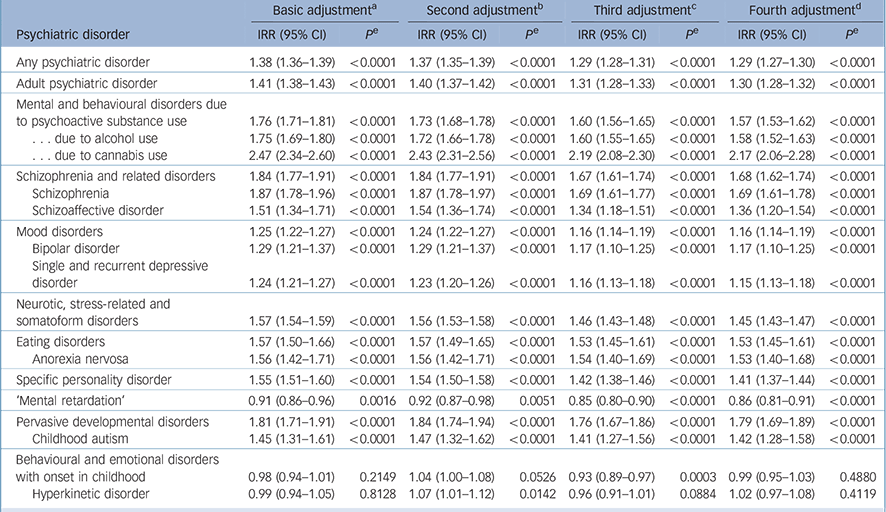
Table 3 presents trend estimates for each psychiatric outcome adjusting for potential confounders. Adjusting for parental age did not substantially alter the trend estimates, whereas the inclusion of family history of mental illness in the model resulted in a reduction of trend estimates for most disorders. In the full model and in the majority of specific categories of mental disorders examined, the risk in individuals born in more urbanised areas is significantly increased. From this point onwards we refer to the fully adjusted estimates. For behavioural and emotional disorders with onset in childhood, including hyperkinetic disorder, the place of birth does not influence the risk of the disorder and for intellectual disability we found a significant reduction of the incidence in more urbanised areas (trend 0.86, P<0.0001).
Summary estimates measuring the incidence rate ratio (IRR) of birth in the capital compared with birth in a rural area
| Basic adjustment a | Second adjustment b | Third adjustment c | Fourth adjustment d | |||||
|---|---|---|---|---|---|---|---|---|
| Psychiatric disorder | IRR (95% CI) | P e | IRR (95% CI) | P e | IRR (95% CI) | P e | IRR (95% CI) | P e |
| Any psychiatric disorder | 1.38 (1.36–1.39) | <0.0001 | 1.37 (1.35–1.39) | <0.0001 | 1.29 (1.28–1.31) | <0.0001 | 1.29 (1.27–1.30) | <0.0001 |
| Adult psychiatric disorder | 1.41 (1.38–1.43) | <0.0001 | 1.40 (1.37–1.42) | <0.0001 | 1.31 (1.28–1.33) | <0.0001 | 1.30 (1.28–1.32) | <0.0001 |
| Mental and behavioural
disorders due to psychoactive substance use |
1.76 (1.71–1.81) | <0.0001 | 1.73 (1.68–1.78) | <0.0001 | 1.60 (1.56–1.65) | <0.0001 | 1.57 (1.53–1.62) | <0.0001 |
| … due to alcohol use | 1.75 (1.69–1.80) | <0.0001 | 1.72 (1.66–1.78) | <0.0001 | 1.60 (1.55–1.65) | <0.0001 | 1.58 (1.52–1.63) | <0.0001 |
| … due to cannabis use | 2.47 (2.34–2.60) | <0.0001 | 2.43 (2.31–2.56) | <0.0001 | 2.19 (2.08–2.30) | <0.0001 | 2.17 (2.06–2.28) | <0.0001 |
| Schizophrenia and related disorders | 1.84 (1.77–1.91) | <0.0001 | 1.84 (1.77–1.91) | <0.0001 | 1.67 (1.61–1.74) | <0.0001 | 1.68 (1.62–1.74) | <0.0001 |
| Schizophrenia | 1.87 (1.78–1.96) | <0.0001 | 1.87 (1.78–1.97) | <0.0001 | 1.69 (1.61–1.77) | <0.0001 | 1.69 (1.61–1.78) | <0.0001 |
| Schizoaffective disorder | 1.51 (1.34–1.71) | <0.0001 | 1.54 (1.36–1.74) | <0.0001 | 1.34 (1.18–1.51) | <0.0001 | 1.36 (1.20–1.54) | <0.0001 |
| Mood disorders | 1.25 (1.22–1.27) | <0.0001 | 1.24 (1.22–1.27) | <0.0001 | 1.16 (1.14–1.19) | <0.0001 | 1.16 (1.14–1.19) | <0.0001 |
| Bipolar disorder | 1.29 (1.21–1.37) | <0.0001 | 1.29 (1.21–1.37) | <0.0001 | 1.17 (1.10–1.25) | <0.0001 | 1.17 (1.10–1.25) | <0.0001 |
| Single and
recurrent depressive disorder |
1.24 (1.21–1.27) | <0.0001 | 1.23 (1.20–1.26) | <0.0001 | 1.16 (1.13–1.18) | <0.0001 | 1.15 (1.13–1.18) | <0.0001 |
| Neurotic,
stress-related and somatoform disorders |
1.57 (1.54–1.59) | <0.0001 | 1.56 (1.53–1.58) | <0.0001 | 1.46 (1.43–1.48) | <0.0001 | 1.45 (1.43–1.47) | <0.0001 |
| Eating disorders | 1.57 (1.50–1.66) | <0.0001 | 1.57 (1.49–1.65) | <0.0001 | 1.53 (1.45–1.61) | <0.0001 | 1.53 (1.45–1.61) | <0.0001 |
| Anorexia nervosa | 1.56 (1.42–1.71) | <0.0001 | 1.56 (1.42–1.71) | <0.0001 | 1.54 (1.40–1.69) | <0.0001 | 1.53 (1.40–1.68) | <0.0001 |
| Specific personality disorder | 1.55 (1.51–1.60) | <0.0001 | 1.54 (1.50–1.58) | <0.0001 | 1.42 (1.38–1.46) | <0.0001 | 1.41 (1.37–1.44) | <0.0001 |
| ‘Mental retardation’ | 0.91 (0.86–0.96) | 0.0016 | 0.92 (0.87–0.98) | 0.0051 | 0.85 (0.80–0.90) | <0.0001 | 0.86 (0.81–0.91) | <0.0001 |
| Pervasive developmental disorders | 1.81 (1.71–1.91) | <0.0001 | 1.84 (1.74–1.94) | <0.0001 | 1.76 (1.67–1.86) | <0.0001 | 1.79 (1.69–1.89) | <0.0001 |
| Childhood autism | 1.45 (1.31–1.61) | <0.0001 | 1.47 (1.32–1.62) | <0.0001 | 1.41 (1.27–1.56) | <0.0001 | 1.42 (1.28–1.58) | <0.0001 |
| Behavioural and
emotional disorders with onset in childhood |
0.98 (0.94–1.01) | 0.2149 | 1.04 (1.00–1.08) | 0.0526 | 0.93 (0.89–0.97) | 0.0003 | 0.99 (0.95–1.03) | 0.4880 |
| Hyperkinetic disorder | 0.99 (0.94–1.05) | 0.8128 | 1.07 (1.01–1.12) | 0.0142 | 0.96 (0.91–1.01) | 0.0884 | 1.02 (0.97–1.08) | 0.4119 |
a. Basic adjustment: summary estimates of IRRs were adjusted for calendar year, gender, age and its interaction with gender. Identical estimates are presented in Table 2.
b. Second adjustment: summary estimates of IRRs were adjusted for parental age at time of child's birth, calendar year, gender, age and its interaction with gender.
c. Third adjustment: summary estimates of IRRs were adjusted for parental history of mental illness, calendar year, gender, age and its interaction with gender.
d. Fourth adjustment: summary estimates of IRRs were adjusted for parental age at time of child's birth, parental history of mental illness, calendar year, gender, age and its interaction with gender.
e. The P-value for the likelihood ratio test that birth in the capital v. birth in the rural area influences the risk for the psychiatric disorder.
Examination of the IRR of any psychiatric disorder for individuals born in the capital compared with individuals born in rural areas by age at diagnosis showed a high effect of urbanicity in young children, a decline to minimal effect around the ages of 5–10 (reflecting the lack of effect of urbanicity in behavioural and emotional disorders with onset in childhood), an increase during adolescence and a steady elevated IRR around 1.5 throughout adulthood.
Discussion
Main findings
In this study we found that birth in the capital or large cities was associated with elevated risk for developing mental illness in general. When the main categories of psychiatric diagnoses were examined separately, this association applied to most disorders with the exception of intellectual disability and emotional disorders with onset in childhood, including hyperkinetic disorder. For the remaining diagnostic categories the association was highly significant with the IRRs of birth in the capital v. birth in rural areas taking into account all levels of urbanicity (trend estimates) ranging from 2.17 to 1.15.
Comparison with previous findings
The effect of urbanicity at birth on the incidence of any psychiatric disorder (trend 1.29, 95% CI 1.27–1.30) was marginally higher than the estimate of a recent meta-analysis of total prevalence rates for psychiatric disorders (pooled adjusted odds ratio (OR) = 1.21); Reference Peen, Schoevers, Beekman and Dekker1 although the two methods are not directly comparable. When examining specific psychiatric outcomes, the stronger effect of urban birth was found for pervasive developmental disorders, schizophrenia and substance use disorders (trend 1.79, 1.68 and 1.57, respectively). It has been suggested that the urban–rural differences in the risk of schizophrenia is not just an epiphenomenon of selective migration or differential service utilisation. Reference Vassos, Pedersen, Murray, Collier and Lewis6,Reference van Os, Kenis and Rutten7 For example, Pedersen & Mortensen showed that the more years lived in a high degree of urbanisation the higher the risk of schizophrenia and, for fixed urbanicity at 15th birthday, the IRR increased with increasing degree of urbanisation at place of birth. Reference Pedersen and Mortensen18
Contrary to prevalence studies of urban–rural differences in alcohol consumption or misuse, Reference Donath, Grassel, Baier, Pfeiffer, Karagülle and Bleich19 we found that urban birth increases significantly the risk of developing alcohol-related disorders (trend 1.58) and we noticed an even stronger effect for cannabis use (trend 2.17). The latter could be partially explained by the easier access, greater peer pressure and more tolerant attitude towards substance use in people growing up in cities. 20
The strong association with pervasive developmental disorders is consistent with a recent meta-analysis of the prevalence of autism spectrum disorders that showed an over twofold increase in typical autism and autism spectrum disorders in studies conducted in urban environments in comparison with studies in rural/mixed environments. Reference Williams, Higgins and Brayne21 The variation in prevalence rates of pervasive developmental disorders between studies is remarkable Reference Fombonne22 and the recent increase in the incidence of these disorders may reflect a broadening of the concept of pervasive developmental disorders or improved detection and recognition of the disorder. Reference Chakrabarti and Fombonne23 Hence, urban–rural differences in autism may partially reflect differences in service availability, recognition rates and awareness of autism spectrum disorders among both the lay public and professionals.
The effect of urban birth on the incidence of neurotic and stress-related disorders, eating disorders and personality disorders were similar (trend 1.41–1.53). These findings contrast with a recent systematic review of the global prevalence of anxiety disorders that found a higher rate of anxiety in rural populations. Reference Baxter, Scott, Vos and Whiteford24 However, this review presents comparisons of urban/rural prevalence rates estimated from different studies; hence, these previous results should be interpreted with caution.
Unlike most prevalence studies, which find a stronger effect for mood disorders in comparison with anxiety disorders, Reference Peen, Schoevers, Beekman and Dekker1,Reference Romans, Cohen and Forte25 our estimate of the effect of urbanicity on the incidence of mood disorders was much lower (trend 1.16), but still significant. Similar effect sizes were estimated for depression and bipolar disorder (trend 1.15 and 1.17, respectively), underlining the similarity of bipolar with other mood disorders. A recent population-based cohort study found that the incidence of bipolar disorder was not different in urban compared with non-urban areas. However, this study was probably underpowered and the crude IRR estimated from the data presented (1.14) was very similar to our findings. Reference Kroon, Wohlfarth, Dieleman, Sutterland, Storosum and Denys9 This is much lower than the effect of urbanicity on schizophrenia – possibly a point of difference between bipolar disorder and schizophrenia. The effect of urbanicity on schizoaffective disorder (trend 1.36) lies between the two conditions.
One interesting finding was that urban birth appears to be slightly protective for intellectual disability. This is similar to studies that found higher prevalence of intellectual disability in rural areas. Reference Lai, Tseng, Hou and Guo26,Reference Sondenaa, Rasmussen, Nottestad and Lauvrud27 Reasons suggested include inbreeding and selective migration, with more competentpeople moving to the cities. Evidence from recent studies indicates that increased administrative prevalence of autism (as measured using educational and other administrative data) is accompanied by concurrent decline in the prevalence of intellectual disability and other developmental disabilities. Reference Coo, Ouellette-Kuntz, Lloyd, Kasmara, Holden and Lewis28 One possibility that could account for some of the converse effect of urban environment on intellectual disability (reduced incidence) and pervasive developmental disorders (increased incidence) could be differential diagnostic substitution Reference King and Bearman29 between urban and rural areas.
The only other diagnostic category that did not show increased incidence in urban environments was behavioural and emotional disorders with onset in childhood and hyperkinetic disorder specifically, unlike a recent study from Germany that found that the prevalence of ADHD increased with a higher degree of urbanisation Reference Knopf, Holling, Huss and Schlack3 and a recent population-based study from Taiwan that identified increased incidence of all neurodevelopmental disorders (intellectual disability, autism and ADHD) in urban environments. Reference Chen, Liu, Su, Huang and Lin12 Despite some evidence of aetiological and clinical overlap between autism and ADHD, Reference Taurines, Schwenck, Westerwald, Sachse, Siniatchkin and Freitag30 our study suggests that risk factors associated with urbanicity differentiate the two disorders.
The results of this study, with urbanicity acting as a common risk factor for most mental disorders, can be interpreted in the context of a continuum model for mental illness, not restricted by current diagnostic boundaries, with psychiatric syndromes having quantitative differences apart from qualitative differences in causal mechanisms. Reference Laursen, Munk-Olsen, Nordentoft and Bo Mortensen10 This adds to previous evidence that the risk of schizophrenia is associated with a family history of a wide range of mental disorders, not confined to psychosis. Reference Mortensen, Pedersen and Pedersen31 Alongside recent molecular evidence of shared genetic aetiology for psychiatric disorders, Reference Lee, Ripke, Neale, Faraone and Purcell32 our findings provide insights into the shared causation of psychiatric disorders from an epidemiological perspective. Therefore, we argue that discussions about the validity of the Kraepelinian dichotomy and continuum models that include only psychotic disorders are an oversimplification of the full picture of mental illness.
Epidemiological studies measuring differences in incidence are not equipped to examine specific aetiopathogenic mechanisms. Urbanicity is a ‘proxy’ for underlying risk factors and a number of potential causes have been proposed in the schizophrenia literature. These include individual or area characteristics such as differences in diet, exposure to infections, pollutants or toxins, household crowding, obstetric complications, ethnic density, deprivation and social fragmentation or reduced social cohesion. Reference Allardyce and Boydell33 Evidence from a Danish sibling design suggests that whatever the causes responsible for these urban–rural differences in schizophrenia risk they are mainly operating at a family rather than an individual level. Reference Pedersen and Mortensen34 However, we cannot extrapolate these theories to the totality of mental illness and the new evidence that urbanicity acts as a risk factor for most mental disorders indicates the need to reconsider or broaden the search for causal factors.
It has been suggested that control over the internal housing environment, quality of housing, presence of valued ‘escape facilities’ (such as parks, public spaces, leisure and recreation), crime and fear of crime, and social participation underlie the interface between the urban and physical environment and mental well-being. Reference Chu, Thorne and Guite35 Type of dwelling, noise, pollution, crowding and density, accessibility, exposure and access to nature have also been associated with psychological symptoms Reference Cooper, Boyko and Codinhoto36 and previous evidence exists that improvement in the social environment is associated with improved mental health of the population. Reference Dalgard and Tambs37 All these factors and other differences between rural and urban birth and upbringing need to be considered as potential causes for the differences in the incidence of mental disorders.
Strengths and limitations
This is the first study that investigates the effect of urban birth on the incidence of the full spectrum of psychiatric disorders. Strengths of the study include the large sample size that includes the entire population of Denmark, with complete ascertainment of the patients treated in psychiatric departments during the follow-up period, and exposure to the risk factor before the illness onset, which eliminates the possibility of selective migration. In addition, the adjustment for potential confounders such as parental age and family history reduces the possibility that the observed differences in the incidence of mental disorders reflect only differential exposure to other known risk factors. Since we only include people born in Denmark with both parents also born in Denmark, our findings are not influenced by foreign immigration patterns.
A limitation of the study is that individuals with mental illness were identified through the psychiatric case register, as opposed to clinical examination with structured interviews. Although the use of register-based diagnoses has several strengths, they may lack the reliability that can be obtained by well-trained interviewers using operationalised diagnostic interviews. Reference Eaton, Hall, Macdonald and McKibben38 Although systematic studies validating all clinical diagnoses presented in this study do not exist, validation of some diagnoses (schizophrenia, single depressive episode, affective disorder, dementia, autism) has been carried out with good results. Reference Lauritsen, Jorgensen, Madsen, Lemcke, Toft and Grove39,Reference Uggerby, Ostergaard, Roge, Correll and Nielsen40 Furthermore, the use of the psychiatric case register for the identification of family history may provide more reliable confounder adjustment than using family history information collected retrospectively usually by examining patients and controls, a potential source for selection and recall bias.
Another limitation is that the individuals with mental illness included in our analyses were identified through in- or outpatient treatment in psychiatric settings. Psychological problems are among the most common reasons for presentation in primary care in Denmark (9.3% of all encounters), with only a small proportion (less than 5% across all diagnoses) being referred to out-patient clinics or for hospital admission. Reference Moth, Olesen and Vedsted41 We therefore cannot draw conclusions about the effect of urbanicity at birth on less severe disorders that do not require specialist treatment. Since urbanicity is a ‘proxy’ for unknown risk factors, epidemiological studies in developed, highly urbanised countries, like Denmark alone, may not be sufficient to reveal the mechanisms underlying the urban effect and the findings cannot be generalised in low- and middle-income countries. However, two recent studies from low-income countries Reference Lundberg, Cantor-Graae, Rukundo, Ashaba and Ostergren42,Reference Prina, Ferri, Guerra, Brayne and Prince43 offer evidence that the association of urbanicity with mental illness is not limited to high-income countries.
Although examination of urbanicity at birth and adjustment for family history eliminates the possibility of selective migration to urban centres of individuals or families after the development of mental illness, there is still a possibility of selective migration towards urban areas of families with traits or subtle symptoms below the threshold for treatment by psychiatric services. In addition, we cannot exclude the possibility of urban–rural differences in service utilisation, as a proportion of people do not change environment during their lives; hence, the place of residence at diagnosis is correlated with the place of birth.
Implications
In conclusion, we found a dose–response association between the degree of urbanisation at birth and the incidence of the full spectrum of mental disorders. We confirmed previous associations of urbanicity with risk for schizophrenia, bipolar disorder and autism and expanded the findings to substance use, mood, neurotic, eating and personality disorders. Potential explanations include urban–rural differences in service utilisation, diet, stress, lifestyle, family-level factors, infections, complications during pregnancy, quality of housing, fear of crime and social participation. The only disorder where birth in an urban environment appeared to be protective was intellectual disability. Our findings that urban birth increases the risk for most mental disorders, combined with current evidence on their global burden to individuals and society Reference Murray, Vos and Lozano44 urge the research community to develop testable hypotheses of risk factors underpinning the effect of urbanicity on mental health. Replication of the findings in a different population is crucial before definite conclusions can be drawn. Furthermore, identification of specific factors that underlie the association between early life exposure to urban environment and mental illness would be relevant for public policies, including public health and town planning policies.
Funding
This study was funded by the Stanley Medical Research Institute, Bethesda, Maryland and by grants from The Lundbeck Foundation, Denmark. E.V. was supported by a Guy's and St Thomas Charity Grant and the NIHR Biomedical Research Centre at the South London and Maudsley NHS Foundation Trust and King's College London. The funders had no involvement in any aspect of the study.




eLetters
No eLetters have been published for this article.