





Introduction
Affective polarization constitutes a significant challenge to Western democracies (Fiorina and Abrams Reference Fiorina and Abrams2008; Levitsky and Ziblatt Reference Levitsky and Ziblatt2018; Reiljan Reference Reiljan2020). While some degree of polarization may motivate democratic participation and help citizens differentiate between parties (Pierce and Lau Reference Pierce and Lau2019; Bettarelli, Close, and van Haute Reference Bettarelli, Close and van Haute2022), high levels of affective polarization seem to have a number of negative effects. Affective polarization may threaten social coherence and national unity (Levitsky and Ziblatt Reference Levitsky and Ziblatt2018), hinder effective policy-making (Hetherington and Rudolph Reference Hetherington and Rudolph2015), and increase social distancing (Ahler and Sood Reference Ahler and Sood2018). Some studies even suggest that it may increase political violence (Kalmoe and Mason Reference Kalmoe and Mason2019; Piazza Reference Piazza2023). Whereas numerous important insights have already been offered into the causes, extent, and consequences of affective polarization (Hetherington and Rudolph Reference Hetherington and Rudolph2015; Iyengar et al. Reference Iyengar2019), recent studies have also provided insights into how to counter affective polarization (Huddy, Bankert, and Davies Reference Huddy, Bankert and Davies2018; Druckman et al. Reference Druckman2022).
In this research note, we investigate whether politicians can counter affective polarization by altering their rhetoric about political opponents. Our study builds on intergroup threat theory (Stephan and Stephan Reference Stephan, Stephan and Oskamp2000; Riek et al. Reference Riek, Mania and Gaertner2006; Renström et al. Reference Renström, Bäck and Carroll2021) and intergroup leadership theory, which points to how the behavior and rhetoric of group leaders can reduce hostility and improve collaboration between competing social groups (Hogg and van Knippenberg Reference Hogg and van Knippenberg2003; Hogg, van Knippenberg, and Rast Reference Hogg, van Knippenberg and Rast2012). This also aligns with existing studies on affective polarization, which indicate that political elites can affect polarization through their rhetoric and behavior. For instance, when politicians engage in harsh, uncivil attacks on each other, voters react by becoming more affectively polarized in their evaluations of political parties and candidates (Mutz Reference Mutz2007; Skytte Reference Skytte2021). In contrast, politicians may also play a depolarizing role. For example, warm cross-partisan interactions between leading Democrats and Republicans seem to reduce levels of affective polarization (Huddy and Yair Reference Huddy and Yair2021; Voelkel et al. Reference Voelkel2023).
Building on existing evidence regarding the polarizing and depolarizing role of politicians, our investigation extends this evidence in three important ways. First, while some studies suggest politicians can influence affective polarization, these studies have generally relied on hypothetical scenarios, such as fictional news stories (Huddy and Yair Reference Huddy and Yair2021) or staged debates between actors (Mutz Reference Mutz2007), although for a valuable, recent exception, see Voelkel et al. (Reference Voelkel2023). In an effort to increase ecological validity, our study assesses the impact of actual rhetoric in the form of real statements in which politicians speak positively about a political opponent. Second, our study contributes important nuances to the existing knowledge by investigating previously untested hypotheses about the extent to which the effects of politicians’ rhetoric vary depending on factors at the citizen level. We hypothesize that the effects of politicians’ rhetoric will be moderated by citizens’ party affiliation (relative to that of the politicians) and by citizens’ trust in politicians. Third and finally, while prior studies have cast light on affective polarization outside the United States (see, eg Gidron et al. Reference Gidron, Adams and Horne2020; Reiljan Reference Reiljan2020; Harteveld Reference Harteveld2021; Knudsen Reference Knudsen2021; Renström et al. Reference Renström, Bäck and Carroll2021; Wagner Reference Wagner2021; Ryan Reference Ryan2023; Wagner Reference Wagner2024), the literature is limited when it comes to the role of politicians’ rhetoric outside the United States (for a notable exception, see Bäck et al. Reference Bäck, Carroll, Renström and Ryan2023). Our study is situated in Denmark, which, unlike the United States, has a multiparty system and moderate levels of affective polarization in the population (Reiljan Reference Reiljan2020). As such, our study contributes important insights into the generalizability of existing findings on politicians’ ability to reduce political hostility among the general public.
Using a preregistered experiment among a sample of 2,000 citizens, we find that exposure to congenial politician rhetoric about political opponents does indeed reduce citizens’ levels of affective polarization. Specifically, the experimental treatments reduce citizens’ negative emotions toward outpartisans, as well as their desire to socially distance themselves from such outpartisans. We do not find evidence of a moderating effect of party affiliation, and our evidence is mixed when it comes to the moderating effects of political trust.
Theory: depolarizing the public through congenial rhetoric
Given the potentially harmful consequences of affective polarization, a burgeoning literature has begun searching for depolarizing strategies. For instance, scholars have found depolarizing effects of correcting misperceptions about the attitudes and demographics of outpartisans (Ahler and Sood, Reference Ahler and Sood2018; Druckman et al., Reference Druckman2022), of correcting people’s meta-perceptions regarding outpartisans’ level of hostility toward themselves (Lees and Cikara Reference Lees and Cikara2020; Voelkel et al. Reference Voelkel2023), and of reducing the saliency of people’s partisan identity (Levendusky Reference Levendusky2018). Moreover, some evidence suggests that the rhetoric and behavior of political elites may have an impact as well. While some research indicates that politicians’ communication may generally have polarizing effects (Bäck et al. Reference Bäck, Carroll, Renström and Ryan2023), others have focused on how political elites may either polarize or depolarize through their messages, depending on how they communicate about their political opponents (Huddy and Yair Reference Huddy and Yair2021; Mutz Reference Mutz2007; Skytte Reference Skytte2021). Most notably, Voelkel et al. (Reference Voelkel2023) find that when US citizens are presented with a video showing the friendship between Joe Biden (Democrat) and John McCain (Republican), this reduces participants’ level of affective polarization. However, the evidence in Voelkel et al. (Reference Voelkel2023) is mixed when it comes to the effects of the intervention on participants’ support for anti-democratic values, undemocratic candidates, and political violence, as some tests suggest an increase in these anti-democratic attitudes while other tests suggest no effects.
In this article, we contribute to this line of research by investigating politicians’ ability to depolarize the public through their rhetoric about political opponents. Our investigation is based on Intergroup Threat Theory (Stephan and Stephan Reference Stephan, Stephan and Oskamp2000) and Intergroup Leadership Theory Renström et al. Reference Renström, Bäck and Carroll2021), both of which draw on insights from social psychology to inform predictions regarding intergroup conflict and intergroup dynamics more broadly. Intergroup Threat Theory posits that individuals’ behaviors and attitudes toward ingroup and outgroup members are shaped by intergroup threat perceptions, that is, perceptions regarding the extent to which outgroup members constitute a threat to the ingroup (Stephan and Stephan Reference Stephan, Stephan and Oskamp2000). When outgroup members are perceived as threatening (either to the physical and material wellbeing of the ingroup or to the ingroup’s morals, values, or worldview), people are expected to react with increased levels of intergroup differentiation, that is, increased levels of identification with the ingroup and increased levels of hostility toward the outgroup (Stephan and Stephan Reference Stephan, Stephan and Oskamp2000, Riek et al. Reference Riek, Mania and Gaertner2006). Intergroup Threat Theory has been used to inform research on various kinds of group dynamics, including affective polarization among voters. For example, Renström et al. (Reference Renström, Bäck and Carroll2021) find intergroup threat perceptions to be associated with higher levels of affective polarization among Swedish voters. Moreover, using survey experiments in Sweden and Germany, Renström et al. (Reference Renström, Bäck and Carroll2023) find that people become more affectively polarized in response to messages (social media posts) designed to increase intergroup threat perceptions. These findings and insights suggest that politicians may be able to play a depolarizing role by conveying to citizens that political group differences do not imply intergroup threat.
This expectation also aligns with Intergroup Leadership Theory, according to which group leaders can shape intergroup relations by inspiring group members to become more or less constructive in their approach to outgroups (Hogg, van Knippenberg, and Rast Reference Hogg, van Knippenberg and Rast2012; Kershaw et al. Reference Kershaw, Rast, Hogg and van Knippenberg2021; Rast, Hogg, and van Knippenberg Reference Rast, Hogg and van Knippenberg2018). According to the theory, constructive group relations do not imply blurring or erasing intergroup identity boundaries – in fact, attempts to do so may even backfire due to people’s desire to maintain distinct group identities (Turner, Brown, and Tajfel Reference Turner, Brown and Tajfel1979; Abrams and Hogg Reference Abrams, Hogg, Dovidio, Hewstone, Glick and Esses2010). Instead, the key to successfully countering intergroup hostility will often, according to Intergroup Leadership Theory, be to acknowledge existing group differences (e.g., political disagreements or differences in partisan identities) while at the same time – through verbal and non-verbal communication – signaling a valued, positive relationship across these differences (Kershaw et al. Reference Kershaw, Rast, Hogg and van Knippenberg2021).
Combining these insights with the existing evidence suggesting an impact of political elites’ rhetoric on affective polarization among the public (Huddy and Yair Reference Huddy and Yair2021; Mutz Reference Mutz2007; Skytte Reference Skytte2021; Voelkel et al. Reference Voelkel2023), we hypothesize that exposing citizens to politicians’ congenial rhetoric about political opponents (e.g., expressions of respect and appreciation of personal traits among political opponents) will reduce affective polarization among citizens.Footnote 1 Specifically, we test the following hypothesis:
H1: Exposing citizens to congenial messages from politicians decreases polarization among citizens.
Ingroup bias and trust in politicians
The effects of congenial messages may be contingent on whether the citizen shares a political affiliation with the politician providing the congenial message. According to social identity theory, people tend to exhibit ingroup favoritism and outgroup prejudices (Turner et al. Reference Turner, Brown and Tajfel1979). For many, political identity constitutes a key part of their social identity (Kirkland and Coppock Reference Kirkland and Coppock2018). In effect, research on citizens’ reactions to political communication has shown that citizens are not equally receptive to messaging from all politicians. When evaluating communication from politicians, people are often biased by party cues, causing them to become more receptive to political proposals and messages if they are from ingroup politicians, that is, politicians they already support (Bartels Reference Bartels2002; Bisgaard and Slothuus Reference Bisgaard and Slothuus2018). In contrast, people will often take a more critical stance toward messages from outgroup politicians, that is, politicians they do not support (Bullock Reference Bullock, Suhay, Grofman and Trechsel2020; Cohen Reference Cohen2003; Slothuus and Bisgaard Reference Slothuus and Bisgaard2021). Based on this research, we hypothesize that:
H2: Exposure to congenial messages from ingroup politicians decreases polarization more than congenial messages from outgroup politicians.
When testing hypothesis 2, we focus on party blocs rather than individual parties. Prior research on affective polarization in Denmark (Hansen and Kosiara-Pedersen Reference Hansen and Kosiara-Pedersen2017) and other multiparty systems has indicated a bloc-based pattern in affective polarization (Huddy et al., Reference Huddy, Bankert and Davies2018; Kekkonen and Ylä-Anttila Reference Kekkonen and Ylä-Anttila2021; Knudsen, Reference Knudsen2021; Bantel Reference Bantel2023; Ryan Reference Ryan2023; Comellas and Torcal Reference Comellas and Torcal2023; Wagner and Praprotnik Reference Wagner and Praprotnik2024). Left-leaning voters tend to be more sympathetic toward left-leaning parties and hostile toward right-leaning parties, and vice versa for right-leaning voters, which can create two opposing, affectively polarized, left-right blocs (Comellas and Torcal Reference Comellas and Torcal2023). Consequently, recent work on affective polarization in multiparty systems indicates that, rather than parties, political blocs are the most relevant unit of analysis (Gidron et al. Reference Gidron, Sheffer and Mor2022; Kekkonen et al. Reference Kekkonen, Suuronen, Kawecki and Strandberg2022). As noted by Wagner (Reference Wagner2021, p. 2):
affective polarization in multiparty settings should be defined and assessed as the extent to which politics is seen as divided into two distinct camps […] In the US context, research on affective polarization generally assumed the existence of positive in-group towards a single party, but this is not appropriate for multiparty contexts.
Finally, some citizens may be more receptive to political messages than others. Specifically, research on persuasion has found that trust is a prerequisite for persuasion (Lupia and McCubbins Reference Lupia, McCubbins, Lupia, McCubbins and Popkin2000). When people perceive certain sources of information (e.g., politicians) as being trustworthy, they will be more likely to alter their beliefs based on information from those sources. Conversely, people will be more likely to ignore or even reject information if they do not trust the sources of the information (Hovland and Weiss, Reference Hovland and Weiss1952; Petty and Wegener, Reference Petty, Wegener, Gilbert, Fiske and Lindzey1998; Druckman, Reference Druckman2001). This is, for example, evident in several pieces of research within political science, which have consistently found that high-trusting citizens are more compliant with government regulations and more receptive to government communications compared to less trusting citizens (Levi and Stoker, Reference Levi and Stoker2000; Charron et al. Reference Charron, Lapuente and Rodríguez-Pose2023). Building on this, in the context of our investigation, we therefore also expect political trust to moderate the effects of politicians’ messages. Specifically, we expect that high-trusting citizens will be more affected by the politicians’ messages than those who exert less trust in politicians.
H3: Exposure to congenial messages from politicians decreases polarization more among citizens with high levels of political trust than among citizens with low levels of trust.
Methods and data
We test our hypotheses using a survey experiment conducted within the context of Danish politics. Prior to data collection, all hypotheses were preregistered along with an analysis plan at the Open Science Framework. Footnote 2 Compared to the United States, where most previous research on this topic has been conducted, Denmark constitutes an interesting case as it has moderate levels of affective polarization and a high level of social and political trust (Rothstein and Stolle Reference Rothstein and Stolle2003; Andersen and Dinesen Reference Andersen, Dinesen, Møller and Dinesen2017). Importantly, unlike the two-party system in the United States, Denmark has a multiparty system where the political parties have, however, traditionally been organized into two main blocs (Hansen and Kosiara-Pedersen Reference Hansen and Kosiara-Pedersen2017).Footnote 3
The experiment was conducted using a commercial web panel (Voxmeter). A total of 2,274 persons started the survey, and 2,034 completed it (completion rate: 89.4%). Importantly, virtually all the attrition occurred prior to exposure to the experimental stimuli, with an attrition rate of just 1.1% among participants exposed to the experimental stimuli. While our sample is not a probability sample, our final sample is demographically diverse: 51.6% were women, and ages varied from 18 to 91 (M = 50.8 SD = 18.0). Further, the sample resembles the population fairly well on party choice and education, although citizens with a lower secondary education were somewhat underrepresented and citizens with a vocational upper secondary education were somewhat overrepresented in our sample. Overall, we therefore consider our sample to approximate the Danish population fairly well (for a detailed comparison of sample and population characteristics, see online Appendix A). Finally, we note that treatment effects in survey experiments are generally highly consistent across probability and nonprobability samples (Coppock, Leeper, and Mullinix Reference Coppock, Leeper and Mullinix2018).
Pretreatment covariates
Prior to the experiment, participants were surveyed on basic demographics, vote choice, political interest, and policy attitudes. In addition, we included six pretreatment items on perceived traits of people voting for the party the participant disliked the most, four items on desire to socially distance oneself from people voting for the party most disliked by the participant, and five pretreatment items on participants’ support for democratic norms. These items were used to form three indices (Cronbach’s alpha = 0.87 for trait perceptions, 0.84 for social distancing, and 0.74 for democratic norms). As these indices were expected to have substantial explanatory power on the dependent variables in our experiment, in accordance with our preregistration, we included the indices as covariates in the analyses of the experiments to increase the precision of our experimental effect estimates (Mutz Reference Mutz2011, pp. 123–126). The entire survey questionnaire, including the experiment, can be found in online Appendix B.
Experiment
Following the measurement of our pretreatment variables, our survey participants were randomly assigned to the experimental conditions. In the control condition, the participants were not exposed to any statements from politicians. The remaining participants were randomly assigned to one of six versions of the treatment and were presented with one of six brief statements from a politician regarding a political opponent. To heighten the ecological validity of our study, all statements used in the treatment material were real statements from the politicians that had been published in newspaper articles or posted on social media (Stampe Reference Stampe2015; Greve-Poulsen Reference Greve-Poulsen2019; Geil Reference Geil2021).
We included six different statements from politicians representing six different political parties. We did this in order to heighten the generalizability of our findings and minimize the risk of effects being attributable to any particular statement or party characteristic. Specifically, the six statements were from politicians from the two main parties on the left and on the right in Danish politics (Social Democrats and The Liberals), two parties at the extremes of the left-right divide on the economic policy dimension (The Red-Green Alliance and Liberal Alliance) and two parties at the extremes of the divide on immigration policy, which is the most salient new politics issue in Danish politics (Social Liberals and Danish People’s Party). In all six statements, the politicians expressed respect for and praised the personal traits of a political opponent (highlighting positive traits like warmth and/or competence). For example, one of them said: ‘I can hardly find a politician with whom I disagree more than Pelle Dragsted. However, I have great respect for him as a politician and consider him a good colleague […]’ (for full wording of all versions of the experimental material, see online Appendix B).
On the same survey page as the experimental treatment material, the participants were asked how surprised they were by the statement. This question was included to increase the likelihood of them reading the statement carefully. On the following pages, participants were then asked to answer the dependent variable items of the study.
Dependent variables
In prior research, a wide range of survey measures have been employed to measure affective polarization, including feeling thermometers (Iyengar et al. Reference Iyengar, Sood and Lelkes2012; Gidron et al. Reference Gidron, Sheffer and Mor2022), measures of negative emotions toward outpartisans (Mason Reference Mason2016; Bruter and Harrison Reference Bruter and Harrison2020; Osmundsen et al. Reference Osmundsen, Bor, Vahlstrup, Bechmann and Petersen2021), stereotype measures, and trait-ratings of outpartisans (Iyengar et al. Reference Iyengar, Sood and Lelkes2012; Druckman et al. Reference Druckman2022; Bäck et al. Reference Bäck, Carroll, Renström and Ryan2023), as well as social distancing measures asking people about their (un)willingness to have outpartisan friends, neighbors, colleagues, etc. (Ahler and Sood Reference Ahler and Sood2018; Iyengar et al. Reference Iyengar2019; Druckman et al. Reference Druckman2022). Instead of relying on just one measure, we chose to include two different posttreatment measures of affective polarization, the first being an index measuring negative emotions toward political opponents and the second being a social distancing index. Specifically, to measure negative emotions, participants were asked if thinking of political opponents made them feel anger, fear, disgust, frustration, and pity (alpha = 0.83).Footnote 4 Moreover, to measure social distancing, participants were asked about their willingness to a) be a friend with and b) be a neighbor to a political opponent (alpha = 0.73).
Finally, as an attention check, participants were asked about the name of the politician who was cited in the experimental treatment material. Choosing from six options, 88.1% of the participants chose the correct name, indicating that the vast majority of them had paid attention to the stimuli.Footnote 5
Results
In accordance with our preregistration, all hypotheses are tested using regression models (Ordinary least squares). For all hypotheses, the dependent variables are the two indices of negative emotions and social distancing. To test hypothesis 1 about the effects of the congenial politician messages on these dependent variables, we compare the responses of the control group with those of the treatment group who read one of the six congenial politician messages from the politicians. Here, we do not distinguish between the six politician messages.
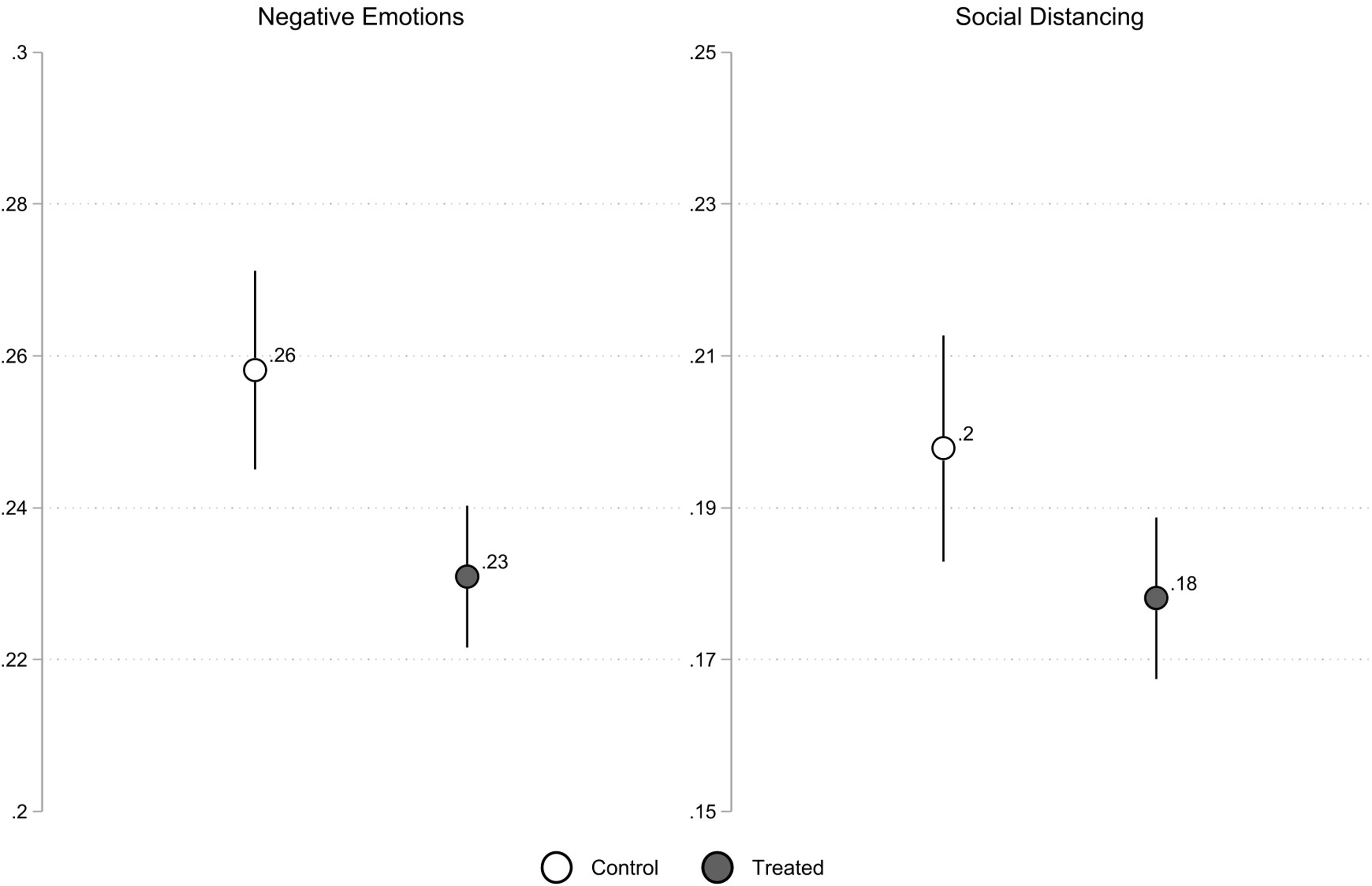
As illustrated in the left side panel of Figure 1, the congenial messages from the politicians had a statistically significant effect on participants’ negative emotions toward their political opponents (p = 0.001). Among the participants who read one of the six congenial messages, the average level of negative emotions was 0.23, while the level in the control group was 0.26 (on a scale from 0–1, with higher values indicating more negative emotions). The congenial messages from the politicians also had a statistically significant effect on participants’ desire to socially distance themselves from political opponents (p = 0.035). This is illustrated in the right-side panel of Figure 1. Among participants who had read one of the six congenial messages, the average value on the social distancing index was 0.18, while the level in the control group was 0.20 (on a scale from 0–1).Footnote 6
Main effects (hypothesis 1).

While statistically significant, the effects on participants’ negative emotions and social distancing were substantively modest. The effect on negative emotions corresponds to a change of 0.13 standard deviations on the emotions index, while the effect on social distancing corresponds to a change of 0.09 standard deviations on the social distancing index. Thus, politicians’ congenial messages did not lead to fundamentally different levels of polarization among participants. It is, however, at the same time important to remember that the experimental stimuli consisted of just one quote from one politician speaking about another politician. Given the low intensity of the treatment, it is noteworthy that it is possible to influence citizens’ polarization levels at all.
Next, to test hypothesis 2, we grouped our experimental results based on whether participants read a message from an ingroup politician or an outgroup politician. As previously noted, research on affective polarization in multiparty systems has indicated a bloc-based pattern in polarization (Huddy et al., Reference Huddy, Bankert and Davies2018; Knudsen, Reference Knudsen2021), and, in accordance with our preregistration, we coded in- and outgroup membership at the political party bloc level. Specifically, in the treatment groups where the source of the congenial message was a left-leaning politician (i.e., a politician from The Red-Green Alliance, Social Liberals, or Social Democrats), left-leaning participants were coded as belonging to the ingroup of the politician, while right-leaning participants were coded as belonging to the outgroup. Conversely, in the treatment groups where the source was a right-leaning politician (i.e., a politician from The Liberals, Danish People’s Party, or Liberal Alliance), right-leaning participants were coded as belonging to the ingroup, whereas left-leaning participants were coded as belonging to the outgroup. One could potentially also have analyzed specific parties, but this would require a much larger number of participants in the experiment. Consequently, in accordance with our preregistration, we focus on the two traditional party blocs in Danish politics. The results divided by ingroup and outgroup can be seen in Figure 2.
Effects of ingroup and outgroup treatments (hypothesis 2).

Looking at Figure 2, it is clear that our results do not support hypothesis 2. Starting with negative emotions, the congenial messages have significant depolarizing effects, regardless of whether the source is an ingroup politician (p = 0.045) or an outgroup politician (p = 0.002). These two effects are not significantly different from each other (p = 0.30). We see a similar pattern for social distancing: here, congenial messages have a significant depolarizing effect when the source is an outgroup politician (p = 0.014), and although the effect of a message from an ingroup politician is not statistically significant (p = 0.20), the two effects are not significantly different from each other (p = 0.26).
One might ask whether this lack of support for hypothesis 2 could be due to the analyses being based on political blocs. Gidron et al. (Reference Gidron, Adams and Horne2023) have, for example, shown that mainstream right-wing partisans are often more hostile toward populist right-wing parties than one would expect, based on policy differences. To address this, we report a series of explorative analyses in online Appendix F, where we utilize that for half of our respondents, we have access to (pretreatment) feeling thermometer ratings of each individual party. As we show in the Appendix, bloc membership is a strong predictor of sympathy toward each of the six parties in our experiment (including the Danish People’s Party, which can be classified as a populist, right-wing party). Within the context of our experiment, it does thus seem reasonable to group the parties together according to their bloc membership.
Moving on to hypothesis 3, the evidence is mixed when it comes to the moderating effect of political trust. Thus, as we illustrate in Figure 3, our analyses show no evidence of political trust moderating the effect of congenial messages on respondents’ negative emotions (p = 0.44). One potential explanation for the lack of an effect here may be that our effect sizes are relatively small, making it less likely that we can identify an effect. When it comes to social distancing, we do, however, find the effect of politicians’ congenial messages to be moderated by recipients’ political trust (p = 0.03). As expected, politicians’ congenial messages have a larger depolarizing effect among citizens with a high level of political trust than among citizens who are less trusting.
Effects conditional on political trust (hypothesis 3).

In addition to the preregistered analyses above, our survey’s pretreatment measures of affective polarization allow us to make an explorative test (reported in online Appendix C) of the extent to which reactions to politicians’ messages differ depending on respondents’ prior levels of affective polarization. For example, it is plausible that among individuals with low initial levels of affective polarization, floor effects might leave limited room for a depolarization effect. Moreover, some existing research suggests that, especially among individuals with high initial levels of affective polarization, political elite messages may have polarizing effects due to party cues, leading these individuals to be biased in their interpretations of the messages (Bäck et al. Reference Bäck, Carroll, Renström and Ryan2023). To account for the possibility of non-linear interaction effects (e.g., stronger effects among participants with moderate levels of polarization), we therefore categorize our respondents into three groups of low, medium, and high levels of affective polarization based on our pretreatment measures. As can be seen in online Appendix C, our effects do not differ depending on the respondents’ initial level of affective polarization. Interestingly, this indicates that our results affect respondents with both low, moderate, and high levels of affective polarization equally. We return to this point in the discussion below.
Conclusion and discussion
Our experiment shows that politicians can reduce affective polarization among citizens. When citizens are exposed to politicians who express personal respect and sympathy for their political opponents, the citizens’ negative emotions toward persons with whom they themselves disagree politically decrease as does the desire for social distancing from such persons. The experiment also shows that the positive effects of politicians’ rhetoric do not depend on the political affiliation of the politician or the citizen who receives the message. Thus, we found no statistically significant differences in whether the congenial messages came from the citizen’s own political party bloc or from the other side of the political spectrum. Finally, while we did not identify any moderating effect of political trust when using citizens’ negative emotions as our dependent variable, we did find that political trust moderated the effect of politicians’ congenial messages on citizens’ desire for social distancing. Specifically, higher levels of political trust were associated with a stronger depolarizing effect of congenial messages, meaning that the largest effects of the congenial messages were found among citizens with a high level of trust in politicians.
It is worth considering to what extent our findings are generalizable to other countries. As noted earlier, Denmark is an interesting case due to the country’s multiparty system, relatively moderate levels of affective polarization, and high levels of political trust. Here, it is perhaps worth noting that our main hypothesis on congenial messages from politicians reducing affective polarization is based on evidence of politicians’ rhetoric having an impact among citizens in the highly polarized United States (Mutz Reference Mutz2007; Huddy and Yair Reference Huddy and Yair2021; Skytte Reference Skytte2021; Voelkel et al. Reference Voelkel2023). In addition, some of our results may indicate that the findings will generalize to other countries, although not unequivocally so. First, contrary to our expectations, the effects of the congenial messages on negative emotions were not moderated by political trust. At the same time, however, the effects on social distancing were primarily driven by respondents with moderate to high levels of political trust. Some caution may therefore be warranted when generalizing to countries with low political trust. Second, our exploratory analyses indicate that the effect of congenial messages does not depend on citizens’ initial levels of affective polarization. Thus, we find similar effect sizes of congenial messages for citizens with low, moderate, and high levels of pretreatment affective polarization. This – at least tentatively – suggests that our findings could be replicated in other countries, including countries with higher or lower levels of affective polarization than Denmark. However, here it should also be noted that even though a substantial subset of our participants had relatively high levels of affective polarization, the results may not necessarily generalize to countries or individuals with markedly higher levels of affective polarization than those found among Danish citizens.
There is therefore clearly still value in empirical investigations and replications of our study in other countries. There would also be value in further exploring the interplay between political blocs and specific parties. While we have focused on political blocs, rather than individual parties, future studies conducted in multiparty settings might want to further investigate heterogeneous partisan effects both within and between blocs. Depending on the exact nature of the multiparty system, this will of course require quite large sample sizes.
Even with these caveats in mind, our findings generally suggest that congenial messages from politicians do have a relatively general effect. The depolarizing effect of politicians’ congenial messages does not seem to presuppose any specific level of affective polarization, is similar across in- and outgroup audiences, and is less contingent on citizens’ trust in politicians than expected. These results indicate that if politicians seek to reduce affective polarization among citizens, doing so is indeed possible. Politicians’ rhetoric toward their opponents influences affective polarization, making it a simple, effective, and viable tool for reducing polarization among the public. However, it is also relevant to emphasize the importance of another central actor: the mass media. Just as participants in our experiment received politicians’ congenial messages through quotes from news stories, a significant portion of the political information that citizens encounter is mediated by news outlets. Thus, whether citizens are exposed to politicians speaking respectfully about their opponents depends not only on how frequently politicians convey such messages but also on whether the mass media choose to cover and emphasize them.
Supplementary material
The supplementary material for this article can be found at https://doi.org/10.1017/S1475676525100030.
Data availability statement
Materials needed to replicate the results in this manuscript are deposited at Harvard Dataverse (https://doi.org/10.7910/DVN/T3MM1F).
Acknowledgments
An earlier version of this research note was presented at the Department of Governance and Management at the Danish Center for Social Science Research. We thank the participants for their excellent suggestions.
Funding statement
This research received no external funding.
Competing interests
The authors declare no conflicts of interest in this research.
Ethical statement
This study was performed in line with the principles of the Declaration of Helsinki. Informed consent was obtained from all individual participants included in the study.


 Open access

