Background
In Britain, it was estimated that in 2016, 2.8 million adults used e-cigarettes; mainly current and ex-smokers (ASH, 2016a). The top reasons for using e-cigarettes are to help stop smoking and reduce harm (McNeill et al., Reference McNeill, Brose, Calder, Hitchman, Hajek and McRobbie2015). Some evidence shows that e-cigarettes can help smokers to quit smoking and reduce cigarette consumption (McRobbie et al., Reference McRobbie, Bullen, Hartmann-Boyce and Hajek2014; McNeill et al., Reference McNeill, Brose, Calder, Hitchman, Hajek and McRobbie2015). Although existing research does not provide a definitive conclusion about their safety in absolute terms, there is an indication that they are less harmful than tobacco cigarettes and comparable in toxicity to approved Nicotine Replacement Therapies (NRTs) (NCSCT, 2016). However, their position within tobacco control is still controversial (RCP, 2016). Many consider e-cigarettes a breakthrough in public health and harm reduction history (Hajek et al., Reference Hajek, Etter, Benowitz, Eissenberg and McRobbie2014; McNeill et al., Reference McNeill, Brose, Calder, Hitchman, Hajek and McRobbie2015). Others warn that their safety, quality and long-term use have not been established fully and therefore oppose their promotion (Chapman, Reference Chapman2014).
Stop Smoking Services (SSSs) in England train stop smoking advisors (SSAs) to support smokers who want to quit through providing accessible, evidence-based and cost-effective services (DOH, 2011). Their current practice includes offering treatments such as NRTs aiming at stopping smoking with the view of ending nicotine use (NICE, 2008). Some evidence indicates that NRTs are an effective intervention (Kamerow, Reference Kamerow2012), other questions their effectiveness (Alpert et al., Reference Alpert, Connolly and Biener2013).
Tobacco harm reduction approach implies that ‘it is safer to use licensed nicotine-containing products than to smoke’ and that their ‘lifetime use […] will be considerably less harmful than smoking’ (NICE, 2013: 10). However, many smokers find NRTs unsatisfactory as long-term substitutes for smoking (RCP, 2016: 7). In contrast, e-cigarettes have the potential to permanently replace cigarettes (Bell and Keane, Reference Bell and Keane2012) because they imitate features of smoking and this is making them a popular and effective substitute to smoking (RCP, 2016: 70). However, some mainstream tobacco control opinions consider e-cigarettes a threat to their efforts to denormalise smoking through eliminating the visibility of the smoking behaviour (Bell and Keane, Reference Bell and Keane2012; De et al., Reference de Andrade and Hastings2013). Concerns were raised that e-cigarettes might glamorise smoking, provide an entryway for people to become addicted or deter smokers from using existing cessation aids (De and Hastings, Reference de Andrade, Hastings and Angus2013).
This study was part of a self-funded Doctoral degree in Social Sciences. Ethical approvals were gained from the Social Care NREC, Public Health Directorate in two counties in South East (SE) England and the University Ethical Committee. At the time, SSSs were not prescribing or recommending e-cigarettes but were seeing an increase in service users asking about and using e-cigarettes. SSAs were advised to tell people that these products are not regulated and ‘therefore, their effectiveness, safety and quality cannot be assured’, but to advise ‘that these products are likely to be less harmful than cigarettes’ (NICE, 2013: 15).
Other studies highlighted the concerns and perceptions that health practitioners hold for e-cigarettes at UK SSSs (Beard et al., Reference Beard, Brose, Brown, West and McEwen2014; Hiscock et al., Reference Hiscock, Goniewicz, McEwen, Murray, Arnott, Dockrell and Bauld2014). This study explores the knowledge, attitudes and beliefs towards e-cigarettes (without particular focus on smoking cessation) among a group of e-cigarette users and a group of SSAs in SE England. It aims to answer three questions: (1) how are e-cigarettes perceived by the e-cigarette users and SSAs? (2) what are the risks and benefits associated with e-cigarettes, as perceived by both groups? (3) how do these understandings shape participants’ attitude towards e-cigarettes?
Method
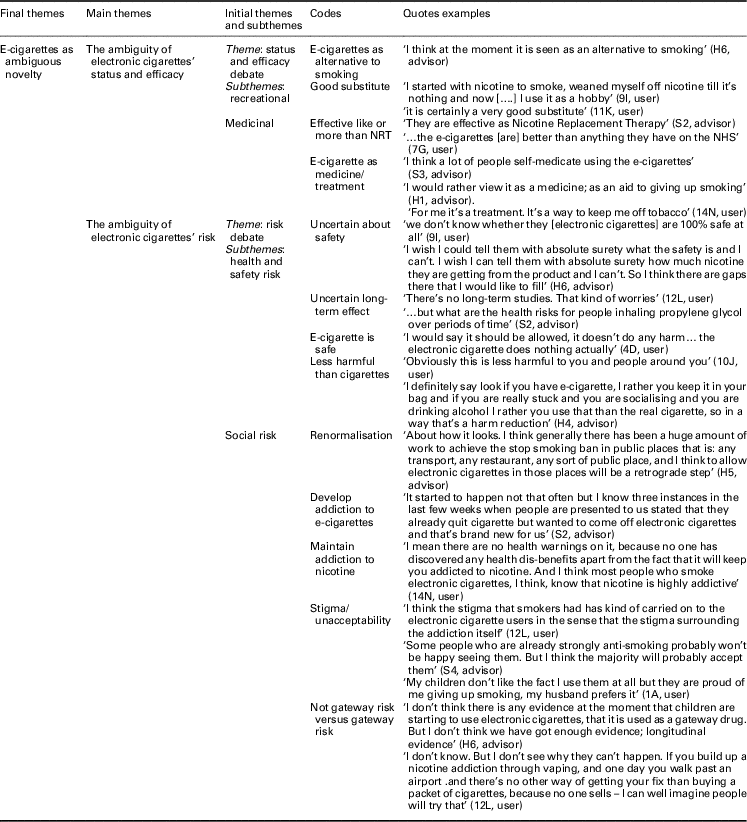
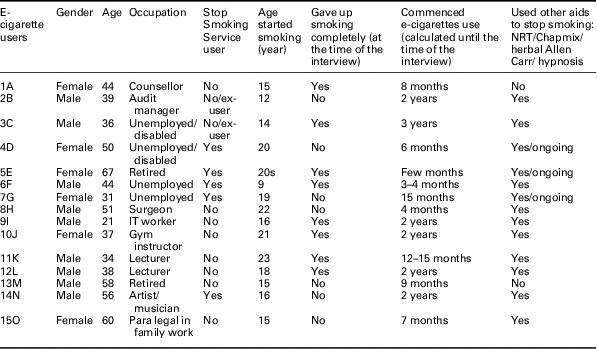
The study was conducted between 2014 and 2015 and used a convenience sampling. SSAs were invited to participate in the research and invite their clients who use e-cigarettes to participate. Leaflets and posters were distributed at some local shops and e-cigarette stores and an advert was put on some social media platforms and on the University website; inviting e-cigarette users to participate. Face to face and phone semi-structured interviews were used. Based on the literature review, a draft interview topic guide was designed to explore reasons of and attitudes towards e-cigarette use; perceptions of their status, efficacy, risk and/or benefit. Phone interviews were offered to participants if found more convenient to them than face to face interview. The sample consisted of 13 SSAs from two SSSs in two counties in SE England (seven from one county and six from the other; nine females and four males) and 15 current e-cigarette users (median age 44 years (range 21–67); 60% (n=9) males; 33% (n=5) were SSSs users; duration of e-cigarette use ranged between 4 and 36 months (average 14.6 months); 53% (n=8) were ex-smokers (the rest still smoked either occasionally or regularly). Appendix 1 shows relevant demographic characteristics of e-cigarette users. An inductive approach of thematic analysis was used using QSR NVivo10 and applying the six phases framework proposed by Braun and Clarke (Reference Braun and Clarke2006). Appendix 2 shows the process of coding.
Findings
Two main themes were identified from the analysis.
Theme 1: the reasons for using e-cigarettes
E-cigarettes were used as a therapeutic aid to stop or cut down smoking and as a smoking substitute. Their efficacy was attributed to: replicating the habitual and rituals of smoking; offering comfort and pleasure; delivering nicotine effectively; relieving withdrawal symptoms and helping in avoiding relapse to smoking. Both groups mentioned e-cigarettes’ innovative modernistic features; flavours; reduced cost compared with cigarettes; tobacco-free smell; social acceptability and the possibility of customising them according to individual’s needs and desires. Some users used e-cigarettes as a hobby and a social activity. Nearly all e-cigarette users opted to use e-cigarettes to improve their health. Two users mentioned they used them to save money without referring to health concerns. Some users reported being encouraged to use e-cigarettes instead of smoking by friends, family or health personnel.
Theme 2: the ambiguity of e-cigarettes
Both groups were heterogeneous in their attitudes, values and beliefs. The diverse perceptions that e-cigarettes have generated and the uncertainty associated with them were evident and can be classified into three subthemes:
-
(i) The ambiguity of e-cigarettes’ status and efficacy. E-cigarettes were perceived and used as therapeutic products, recreational products, a smoking substitute and an addition for NRTs.
‘I would rather view it as a medicine; as an aid to giving up smoking’.(H1, advisor)
‘For me it’s a treatment. It’s a way to keep me off tobacco’.(14N, user)
‘It is not a medicine and is certainly not a treatment’. (2B, user)
Nearly all users and most of the advisors perceived e-cigarettes to be as effective as or more effective than NRTs. Their effectiveness in helping particular types of smokers to quit or reduce smoking was highlighted.
‘I don’t know, I am not certain. I think for people who are very addicted to the nicotine and very addicted to the habits surrounding the smoking, it could be the e-cigarette is the thing that help them to stop or at least the thing to taking nicotine at a relatively safe level without all the chemicals from tobacco and all the harm from Carbon monoxide.’(H5, advisor)
-
(ii) The ambiguity of e-cigarettes’ physical risks. E-cigarettes were perceived as safe products; safer alternative to smoking; an innovation with potential long-term threats; ‘dangerous’ and risky objects.
‘I wish I could tell them with absolute surety what the safety is and I can’t. I wish I can tell them with absolute surety how much nicotine they are getting from the product and I can’t’. (H6, advisor)
‘My sense is that there’s a lot of risk aversion around it because nobody can say it’s safe, therefore it must be dangerous’.(11K, user)
Some users described the health benefits of using e-cigarettes, like improving their lung function. All participants believed e-cigarettes to be less harmful than smoking. However, the advisors expressed more concerns than users, especially of the long-term effect.
-
(iii) The ambiguity of e-cigarettes’ social risks. E-cigarettes were perceived as devices that might create addiction, maintain nicotine addiction, a gateway to smoking, a gateway from smoking, a smoking renormalisation threat and an approved habit with a possibility of developing stigma.
‘The danger [it] may open up a door for an addiction they did not have to begin with…it’s a double-edge sword’.(H1, advisor)
‘I think the stigma that smokers had has kind of carried on to the e-cigarette users in the sense that the stigma surrounding the addiction itself. People see you as weak because you give in to the addiction because you obviously don’t have willpower enough to stop, so it’s kind of the moral judgement…’ (12L, user).
In the face of e-cigarettes’ ambiguity and potential risks, nearly all the advisors favoured a medicinal regulation for e-cigarettes to ensure safety and to add them to their prescription list, aiming at eliminating nicotine use. They disapproved e-cigarettes’ resemblance to conventional cigarettes and favoured their ban in public places to avoid any potential risk. Conversely, nearly all e-cigarette users disapproved e-cigarettes’ ban in public places. The users placed e-cigarettes in a smoking quitting continuum where boundaries are blurry and where they can tailor their use according to their lifestyle, needs and desires.
Discussion and conclusion
Similar to other qualitative studies, this study is subject to criticisms (Diefenbach, Reference Diefenbach2009; Bryman, Reference Bryman2012). The lack of generalisability of findings could be construed as a weakness. However, this was purposely a small qualitative study and was not designed to fulfil the generalisability requirement, rather it focused on garnering individual accounts of e-cigarette perceptions. A potential limitation is using two different interview methods; however, there was a high degree of thematic commonality provided via both approaches. To address validity, interviews were recorded and transcribed. Participants’ direct quotes were used and themes were continuously revised and verified with two PhD supervisors.
The findings on the reasons of e-cigarette use conform to results from other studies (Dawkins et al., Reference Dawkins, Turner, Roberts and Soar2013; Dockrell et al., Reference Dockrell, Morrison, Bauld and McNeill2013; ASH, 2016b). Although other studies found that some e-cigarette users reported stopping using e-cigarettes based on advice they had received from a health professional (ASH, 2016b), in this study, some users reported health personnel’s approval to use e-cigarettes instead of smoking. Similar to other studies, e-cigarettes’ relative safety compared with traditional cigarettes was emphasised (Dawkins et al., Reference Dawkins, Turner, Roberts and Soar2013; Pepper and Brewer, Reference Pepper and Brewer2014; Pepper et al., Reference Pepper, Emery, Ribisl, Rini and Brewer2015; Baweja et al., Reference Baweja, Curci, Yingst, Veldheer, Hrabovsky, Wilson, Nichols, Eissenberg and Foulds2016). Although participants in one study viewed e-cigarettes differently to NRTs (Rooke et al., Reference Rooke, Cunningham-Burley and Amos2016), e-cigarettes, in this study, were perceived to be as effective as or more than NRTs.
The findings have provided new insights into SSAs’ attitudes towards e-cigarettes. SSAs envisaged e-cigarettes’ potential benefits to some cohorts. However, their aim at stopping nicotine use does not reflect harm reduction approaches in nicotine addiction which aim at minimising the effect of consuming nicotine rather than eliminating its use, as recommended by leading health organisations (NICE, 2013).
Both groups demonstrated uncertainty with regards to the status, efficacy and risks associated with e-cigarettes. Some of these concerns lack empirical evidence such as the gateway and smoking renormalisation concerns (NCSCT, 2016). Similar uncertainty, concerns and disagreement were found in other studies (Pepper and Brewer, Reference Pepper and Brewer2014; Beard et al., Reference Beard, Brose, Brown, West and McEwen2014; Hiscock et al., Reference Hiscock, Goniewicz, McEwen, Murray, Arnott, Dockrell and Bauld2014; Rooke et al., Reference Rooke, Cunningham-Burley and Amos2016; Sherratt et al., Reference Sherratt, Marcus, Robinson, Newson and Field2015, Reference Sherratt, Newson, Marcus, Field and Robinson2016). These expressed demonstrations of uncertainty may possibly reflect the circulated controversy in the media. Ambiguity and fear played a major part in stigmatising other biotechnological innovations, health conditions and behaviours (Gregory et al., Reference Gregory, Slovic and Flynn1996; Stuber et al., Reference Stuber, Galea and Link2008). Stigma has multiple forms and severities including negative stereotyping and experiences of discrimination (Stuber et al., Reference Stuber, Galea and Link2009). If ambiguity of e-cigarettes persisted, some forms of stigma might develop.
To avoid stigma and amplification of risk, public health messages should address the uncertainty and different perceptions of e-cigarettes and highlight the difference between stop the use of nicotine and stop smoking. E-cigarettes’ benefits and risks should be continuously evaluated, put into perspective in comparison with harms inflicted by tobacco use, and circulated among media channels and health services to minimise ambiguity and non-evidence-based concerns. Stop smoking services need to recognise the potential benefits gained by using e-cigarettes as a harm reduction tool and focus on stopping smoking rather than stopping nicotine. Indeed, the latest guidelines by The National Centre for Smoking Cessation and Training have incorporated similar recommendations to SSAs (NCSCT, 2016). Further research could reveal the changes of attitudes towards e-cigarettes among SSAs following these new recommendations.
Acknowledgements
I am grateful to all of the study participants and the various gatekeepers. I thank my supervisors for supporting my PhD work, especially Dr Hauke Riesch for reading this article before sending to the journal.
Financial Support
Self-funded.
Conflicts of Interest
None.
Appendix
The demographic characteristics of e-cigarette users
An illustration of the process of coding from the two data sets inductively