

Introduction
How does the context of prior policy influence the outcomes of new policies? In the summer of 2012, President Obama signed an executive order requiring the Department of Homeland Security to temporarily cease apprehending and deporting unauthorized immigrants who had entered the United States as children, provided they met certain criteria, including having no criminal record and completing high school or entering the armed forces. In the decade since, Deferred Action for Childhood Arrivals (DACA) has offered relief to nearly one million individuals and, perhaps, signaled that the US government values childhood arrivals despite their legal status. Although DACA recipients often express both relief and frustration at their political limbo, questions remain for scholars about what impact DACA has made on immigrant communities. In this paper, we ask how has the broad policy environment – understood here as the overall intensity of immigration enforcement – moderated the effect of policy experiences with accommodationist programs like DACA?
Policy feedback theory and related arguments, such as social construction theory, teach us that government policy affects individuals’ political orientation and engagement (Béland et al. Reference Béland, Campbell and Weaver2022; Mettler and SoRelle Reference Mettler, SoRelle, Paul and Weible2014). When the government offers benefits to a broad class of people, such as senior citizens receiving social security, members of that group are more efficacious and participate in more political activities. Even when they do not participate directly in programs, individuals who are strongly tied to those with policy experience are also subject to feedback effects. By virtue of its design, DACA is the type of policy that should produce such effects among immigrants and those who know them. Although this project attempts to explore the dynamics of these effects, we also consider context as a moderating factor and theorize how it complicates an otherwise straightforward application of policy feedback theory. We hope to build upon Michener’s (Reference Michener2019) two-tiered racialized feedback framework (RFF). RFF bridges the fields of racial politics and policy theory by identifying the conditions under which race and ethnicity should be centered in feedback studies. Michener argues that policies administrated in a decentralized or discretionary manner constitute one such circumstance. We expand on this idea by studying universalistic protection against discretionary actions.
Using data from the 2016 Cooperative Congressional Election Study (Table 1), we found that experience with DACA is positively associated with external efficacy and political participation, which confirms feedback theory. However, these effects are moderated by the intensity of enforcement in an immigrant’s county of residence, suggesting that scholars studying the feedback effects need to be attentive to the broader policy environment, even when studying seemingly universalistic programs. This suggests that to understand the full effects of a policy, scholars must also consider the prior contexts and policy exposures in which the policies are implemented.
Descriptive statistics
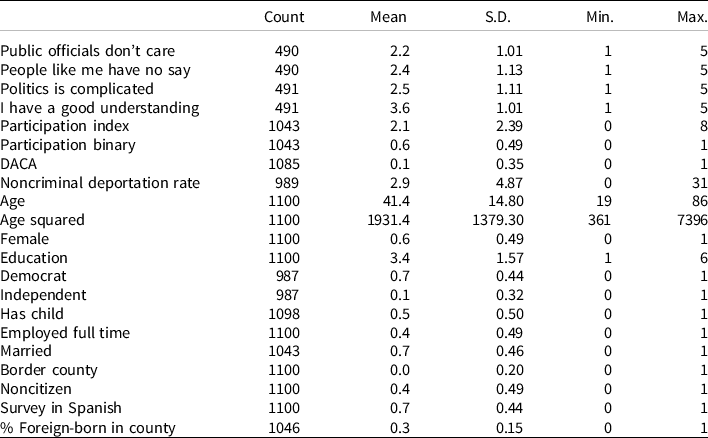
Note: The table shows descriptive statistics only of foreign-born Latinos used in the analysis.
Policy feedback and context
Policy feedback theory argues that policies shape mass political behavior by distributing resources to some groups and doling out punishments to others (Campbell Reference Campbell2012). Policies send a message to the public and individual policy recipients about which groups are worthy of government help and which are not. The type of feedback effects from policy depends on whether policy recipients are framed in a positive or negative light. Interactions with positive policies, such as the GI Bill’s educational provisions or Social Security, teach individuals that they are valued in society and that the government is likely to be responsive to their needs. As a result, individuals receiving these messages have more positive political orientations and increased civic engagement than those who don’t (Campbell Reference Campbell2003; Mettler Reference Mettler2002).
Conversely, experience with negative or burdensome policies, such as certain welfare programs or the criminal justice system, tells individuals that the government is there to regulate or punish their behavior, leading to reduced feelings of efficacy and trust as well as lower rates of participation (Kumlin et al. Reference Kumlin, Stadelmann-Steffen and Haugsgjerd2018; Lerman and Weaver Reference Lerman and Weaver2014a, Reference Lerman and Weaver2014b; Soss Reference Soss1999). Furthermore, these effects can spill over to community members, who gain proximal policy experience (Walker Reference Walker2020). However, few scholars account for the fact that individuals do not experience any policy in isolation. Instead, individuals’ experiences with various policies simultaneously exist within the context of their policy environment.
Policy environments, such as rates of deportation or incarceration in an individual’s county or city, refer to the degree to which a policy is enforced in an individual’s context of residence. When policy environments reinforce the messages from policy experience, the feedback effects from direct policy experience are likely to be amplified. An example of this reinforcement mechanism is when experiences with policy and the policy environment are restrictionist, such as when an individual is arrested and resides in an area with high incarceration rates. Punitive policy environments affect political orientation (Maltby Reference Maltby2017; Rocha et al. Reference Rocha, Knoll and Wrinkle2015), group attachment (Maltby et al. Reference Maltby, Rocha, Jones and Vannette2020), and participation (Burch Reference Burch2013; Maltby Reference Maltby2017; Pedraza et al. Reference Pedraza, Nichols and LeBrón2017; Sanchez et al. Reference Sanchez, Vargas, Juarez, Gomez-Aguinaga and Pedraza2017; Garcia-Rios et al. Reference Garcia-Rios, Lajevardi, Oskooii and Walker2021).Footnote 1 Similarly, when individuals interact with beneficial policies, they learn that society views them positively and that the government is likely to be responsive to their needs. When this policy interaction occurs in areas with accommodative or, at least, neutral policy environments, the messages from policy contact are reinforced by their environment. In these scenarios, the messages individuals receive about their worth in society from interacting directly with a policy are mirrored by those from the broader policy environment, meaning we should expect behavior to change in ways that match traditional policy feedback theory: beneficial policies positively affect orientations and behavior while burdensome laws produce negative effects.
At times, however, individuals may receive different messages from personal policy experience and their overall policy environment. For instance, for those who have experience with a beneficial policy but reside in a hostile policy environment, the messages from the policy are mixed. In these situations, individuals’ personal experiences with policy and the resulting positive feedback effects may be mitigated by their context. Although contact with policy teaches individuals that the government cares, the surrounding policy environment reminds them of the limitations of governmental acceptance. As a result, the policy environment may reduce the potential benefits of positive policy contact.
Policy contact occurs in pre-existing policy environments. These policy environments can either reinforce or contradict the messages from direct policy experience, meaning environments will moderate the effect of direct policy feedback. Although experience and environment work in tandem, the feedback effects from policy work as traditionally expected. But when policies clash, the feedback from direct policy contact will be, at best, mitigated and, at worst, reversed. By deporting unauthorized immigrants, immigration policy sends the message that immigrants are unworthy of governmental help and deserve to be punished. However, accommodationist policies, such as providing legal status for undocumented youth, signal to the public that this group merits government protection and is worthy of beneficial policies. As individuals experience policy, the signals and resources provided (or threatened) by policy influence how individuals relate to the government (Mettler and SoRelle Reference Mettler, SoRelle, Paul and Weible2014). This prompts us to ask: how does context influence the outcomes of new policies? When individuals are exposed to beneficial policy interactions in hostile policy environments, what is the effect on political orientations and behaviors?
Secure communities
From 2008 to 2014, Immigration and Customs Enforcement (ICE) implemented the Secure Communities program. Developed internally by the Department of Homeland Security, Secure Communities relies on partnerships between federal, state, and local law enforcement agencies, with the expressed goal of prioritizing the increased deportation of immigrants deemed “dangerous.” Whenever an individual is arrested and booked in a state or local jailing facility, they are fingerprinted. Under the Secure Communities program, authorities run each set of fingerprints against federal immigration databases. If someone is found without authorization, ICE can request that the individual be detained to begin deportation proceedings.
Although originally created under the Bush administration in 2008, the program was drastically expanded under Obama, resulting in the highest rate of interior removals (over 200,000 per year) to date (Capps et al. Reference Capps, Gelatt, Van Hook and Fix2018). Although briefly replaced with Obama’s Priority Enforcement Program (a change, in many ways, in name only), Secure Communities was reintroduced and strengthened by the Trump administration. Unlike prior administrations, the Trump administration expanded enforcement priorities to include all noncitizens. Unsurprisingly, most individuals identified and deported under Secure Communities have never been convicted of a crime (Kohli et al. Reference Kohli, Markowitz and Chavez2011). Although the Biden administration has halted Secure Communities, ICE claims the program is “not reflective of current practice,” and the data infrastructure of Secure Communities remains untouched and active (Immigration and Customs Enforcement n.d.).
Secure Communities has overwhelmingly targeted immigrants from Latin America. Over 90% of program deportees are Latino, and arrest rates for Latinos, even those who are documented or citizens, have increased in localities that participate in local immigration enforcement (Capps et al. Reference Capps, Gelatt, Van Hook and Fix2018). In such hostile enforcement contexts, Latino immigrants and citizens learn that the government does not care about them, leading to reduced efficacy and political engagement. Rocha et al. (Reference Rocha, Knoll and Wrinkle2015) found that feelings of trust among both native- and foreign-born Latinos are decreased in areas with intense immigration enforcement (Cruz Nichols et al. Reference Cruz Nichols, LeBrón and Pedraza2018). The criminal justice literature has similarly found that hostile enforcement contexts lead to negative political orientations and reduced participation (Burch Reference Burch2013; Maltby Reference Maltby2017).Footnote 2
When any new immigration legislation is signed into law, Secure Communities is the policy context it must contend with. This is critical because existing rates of immigration enforcement shape political orientation and behavior. However, ICE activity is not consistent across the US. ICE agents have historically high levels of discretion and, thus, can make strategic choices about where and how they operate because the responsibility for making arrests has devolved to line officers (Cortez Reference Cortez2021; Stumpf Reference Stumpf2015). The variation in enforcement holds consequences for the communities targeted. Scholars have found that Latinos struggle to maintain a cohesive and unified sense of group identity because of the disparate immigration histories that have affected groups over time (Beltrán Reference Beltrán2010). That said, the negative effects of enforcement affect more than simply those directly targeted.
Many Latinos exist in what is defined as “mixed-status families,” families where one or more family member is undocumented, and Latinos who share a close relationship with the foreign-born population generally express more support for the undocumented than non-Latinos (Leighley and Nagler Reference Leighley and Nagler2013; Masuoka and Junn Reference Masuoka and Junn2013; Vargas Reference Vargas2015). Similarly, Maltby et al. (Reference Maltby, Rocha, Jones and Vannette2020) found that threatening immigration policy environments lead to close ethnic ties, particularly for native-born Latinos, possibly because environments highlight the ways native-born Latinos are treated like their foreign-born counterparts. However, this presents a critical question: if the negative effects of enforcement within one’s context spill over to populations with linked fate, do the effects of accommodative programs, like DACA, operate in the same way?
DACA
DACA was never created with the intention of providing legal status for all unauthorized immigrants. This was made clear by the program’s strict eligibility requirements. Recipients must prove a continuous presence in the US since 2007, be younger than 31 as of June 2012, meet specific educational requirements, and show evidence of “good moral character” by having few to no interactions with law enforcement (Alulema Reference Alulema2019). Even with these requirements, the US Citizenship and Immigration Services (USCIS) reported as of June 30, 2020, that DACA covers over 650,000 recipients living in all US states and territories. DACA allows Dreamers to defer deportation on a renewable two-year basis and increases recipients’ access to education and employment. By allowing undocumented individuals to live openly, DACA helps “deepen [the recipients’] social ties in the US” (Alulema Reference Alulema2019, 2). DACA promotes a positive image of its recipients, signaling to the public that Dreamers are valued in society and deserve governmental protection (Terriquez Reference Terriquez2017).
Consistent with seminal policy feedback theory (Pierson Reference Pierson1993), DACA shapes the attitudes and behaviors of beneficiaries through interpretive and resource effects. Because DACA positively constructs its recipients, DACA also signals to recipients that they are deserving members of society whose voices and participation are important. DACA also provides resources by deferring deportation and increasing access to education and employment. DACA recipients report increased educational attainment and higher wages (Kuka et al. Reference Kuka, Shenhav and Shih2020), and better mental and physical health (Giuntella and Lonsky Reference Giuntella and Lonsky2020; Hainmueller et al. Reference Hainmueller, Lawrence, Martén, Black, Figueroa, Hotard, Jiménez, Mendoza, Rodriguez, Swartz and Laitin2017; Patler et al. Reference Patler, Hamilton, Meagher and Savinar2019). DACA recipients also incur costs associated with political opposition or threats to take those benefits away from them. The positive interpretive effects combined with both accommodating and restrictive resource effects incentivize recipients to become politically active (Williamson Reference Williamson2020).
Overlooked, however, is the effect of DACA across the full range of political contexts. Although previous studies have examined DACA recipients’ control over where they live, scholars often do not account for factors related to immigration enforcement within those localities (Wong and García Reference Wong and García2016). To ascertain the exact influence of DACA on political orientations and behavior, it is necessary to examine the various enforcement realities that applicants live with.
Given that public attitudes toward documented and undocumented immigration depend on moralistic rather than attribute-based consideration, DACA recipients are perceived by most of the public as deserving of protection (Wright et al. Reference Wright, Levy and Citrin2016). Public officials also find it advantageous to support and advocate for immigration reforms like DACA and defend Dreamers (Barreto and Collingwood Reference Barreto and Collingwood2015). Traditional policy feedback theory would therefore suggest that individuals who have experience with DACA, either personally or proximally, would have a more positive political orientation and be more likely to get involved in politics than those who don’t have experience with DACA. For example, Hipsman et al. (Reference Hipsman, Gómez-Aguñiaga and Capps2016) found that DACA recipients feel a greater sense of belonging in the US and are less afraid of deportation. Both feelings are likely linked to increased political involvement and efficacy. However, we contend that the story is more complex. DACA may provide protection, but it is relevant to account for the level of threat in one’s context. These studies are missing a critical piece of the puzzle.
Theory
We contend that policy feedback theory must be revised to explicitly explain how pre-existing policy context influences policy outcomes experienced by targeted communities through the RFF proposed by Michener (Reference Michener2019). The RFF asserts that race is an essential component of policy design, implementation, and outcomes, often leading to differences in how racial and ethnic minorities are treated compared to Whites (Wallace and Zepeda-Millán Reference Wallace and Zepeda-Millán2020). Michener (Reference Michener2019) argued that race is important when policies are implemented in a decentralized manner and lead to disparities across groups.
To test this theory, we examined DACA and Secure Communities, policies that fit at least part of the RFF classification. Both disproportionately target Latinos, who comprise the majority of Secure Communities removals and DACA recipients, and, in many cases, the bulk of local immigrant communities (Albarracín Reference Albarracín2016; Capps et al. Reference Capps, Gelatt, Van Hook and Fix2018; USCIS 2022). Although it is a federal policy, Secure Communities is decentralized because it is enforced by local law enforcement, who control initial processing and choose whether to detain unauthorized individuals (Maggio Reference Maggio2021; Juárez et al. Reference Juárez, Gómez-Aguiñaga and Bettez2018). Many communities explicitly decide not to enforce this policy, often after declaring sanctuary status. As with other policies that target one or more racial groups and that are enforced at local levels, this has led to inequality both across Latinos and non-Latinos and between Latinos in different policy environments. Conversely, DACA is a more centralized policy. State and local governments cannot accept or reject applicants, nor do they have the discretion to create standards for DACA recipients. DACA applicants must meet the same qualifications and can expect a standardized process regardless of where they reside. With these explicitly racialized policies, we compare the effects of universal and decentralized policies on Latinos’ political behavior, a step few scholars have taken. We argue that it is essential to understand how the effects of a universal and beneficial policy differ based on the ways that localities implement a burdensome and decentralized policy.
Typically, when scholars examine feedback from a nationalized policy, such as the GI Bill (Mettler Reference Mettler2002) or Social Security (Campbell Reference Campbell2003), they focus on the overall benefits for groups without considering how more localized policy environments can uphold or contradict a policy’s messages. This may be because, unlike DACA, many centralized and beneficial policies are aimed at Whites who do not have to contend with disproportionately burdensome policies from their local governments. However, racial and ethnic minority populations’ experiences with policy and government vary considerably depending on local context. Therefore, it is especially important to understand the interaction between new policies and pre-existing policy environments for these groups. Thus, when scholars study the impact of a centralized policy on a targeted minority group, they observe the effect of that specific policy within the context of the group’s pre-existing policy environment.
When new, centralized policies do not contradict the political status quo, they reinforce the positive or negative signaling effect on the group’s political behavior. These can be considered non-conflictual policies, which work in the same direction, target the same population, and follow standard social construction and policy feedback expectations. In contrast, conflictual policies send opposite or contradictory signals to the pre-existing political environment of the targeted population, leading to outcomes unanticipated by traditional theories. This suggests that mixed findings regarding how policies influence group behavior within the literature are not conflictual. They are instead incomplete snapshots of how targeted groups react to contrasting policy signals across time and space.
Depending on how policy environments and personal policy experiences stereotype targeted communities, policy environments can either reinforce or moderate the feedback effects from universal policies and direct policy experience. Because racial and ethnic minority populations face more significant variation in how punitive local policy environments can be compared to Whites, it is essential to understand whether the benefits of centralized policies can break through the negative feedback from the local policy context. An important test of this is through the interaction of DACA, a centralized and beneficial policy, and Secure Communities, a decentralized and burdensome policy, on Latinos’ beliefs and behaviors.
We argue that pre-existing policy environments determine the direction and size of direct feedback effects. Depending on how local policy environments and personal experience with a nationalized policy affect individuals, policy environments can either reinforce or moderate the feedback effects from direct experience. We contend that DACA has had substantial positive effects on foreign-born Latinos’ political efficacy and behavior but that these effects have not been studied within the context of existing immigration enforcement policies in their communities. In Figure 1, we give a visualization of our expected outcomes in this theoretical framework.
Visualization of theory.
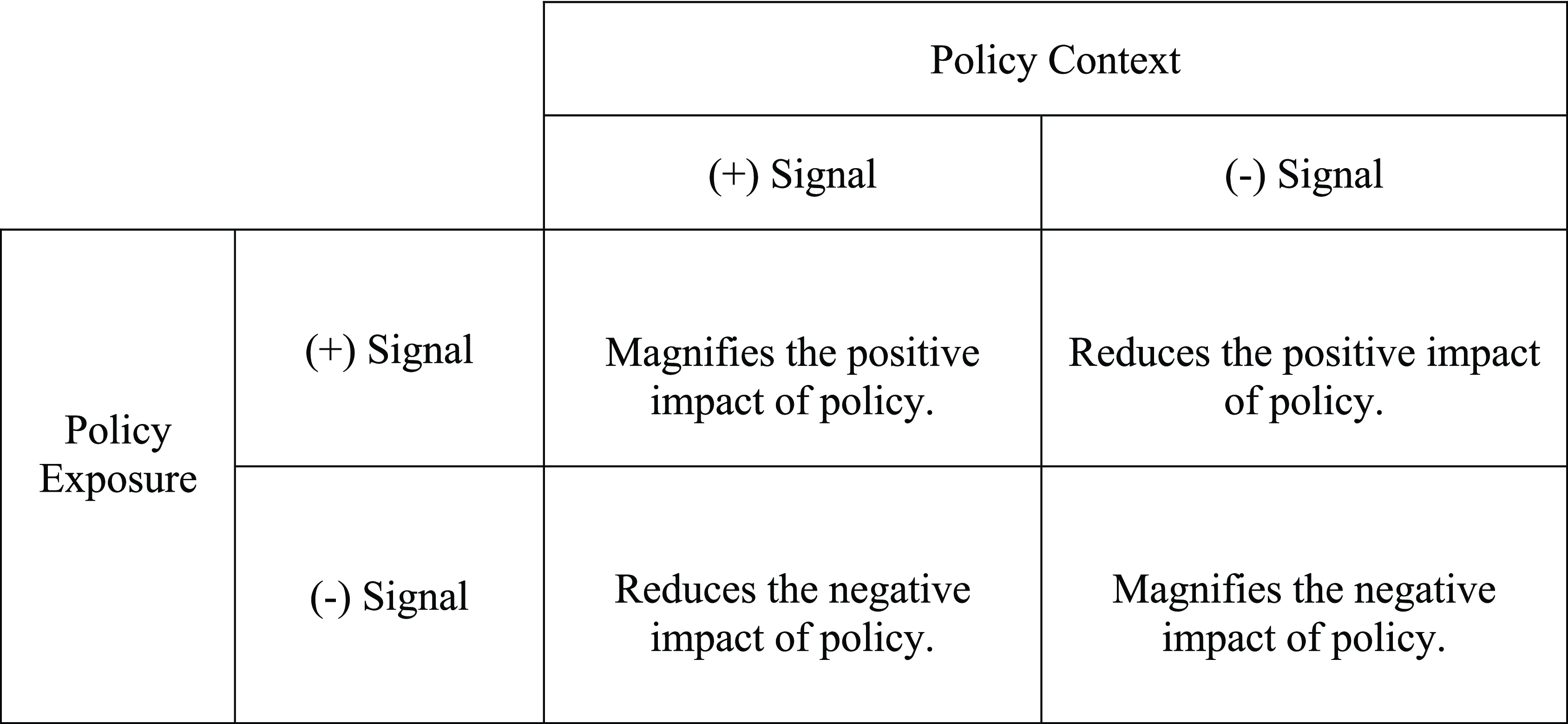
We should note that exploring the interaction of DACA and Secure Communities only tests half of our proposed theory because DACA is a positive policy exposure and Secure Communities is a negative policy context. Given that previous scholars have studied the effect of restrictionist policies on marginalized communities, exploring DACA from this theoretical perspective provides a novel and difficult test of our theory. However, more work needs to be done to clarify the effect of restrictionist policies across the spectrum of contexts.
Hypotheses
Hypothesis 1 (H1a): Enrollment in DACA is positively associated with external efficacy, but this effect is negatively moderated by communities with high levels of immigration enforcement. The association between DACA and external efficacy will lessen in areas where immigration enforcement is high.
(H1b): Enrollment in DACA is positively associated with internal efficacy, but this effect is negatively moderated by communities with high levels of immigration enforcement. The association between DACA and internal efficacy will lessen in areas where immigration enforcement is high.
Hypothesis 2 (H2): Enrollment in DACA is positively associated with political participation, but this effect is negatively moderated by communities with high levels of immigration enforcement. The association between DACA and participation will lessen in areas where immigration enforcement is high.
Data and methods
We tested our hypotheses using a Latino-only module from the 2016 Cooperative Congressional Election Study. This survey was conducted online by YouGov in both pre- (September 28–November 7, 2016) and post-election (November 9–December 14, 2016) waves. The survey contains 2,023 adult Latino respondents. However, we restricted our sample to the 54% of respondents identifying as foreign-born. We did this because this survey offers a unique opportunity to understand the political orientations and participation of Latinos who have first- or second-hand experience with DACA. Our theory predicts that the interaction between decentralized policy environments and experience with centralized accommodation programs, such as DACA, affects political efficacy and participation. Our first four dependent variables capture respondents’ feelings of efficacy. We relied on the following two survey statements to measure respondents’ external political efficacy:
Public officials don’t care much what people like me think. (Agree strongly; Somewhat agree; Neither agree nor disagree; Somewhat disagree; Disagree strongly).
People like me don’t have any say about what the government does. (Agree strongly; Somewhat agree; Neither agree nor disagree; Somewhat disagree; Disagree strongly).
From these questions, we generated two five-category ordinal variables ranging from 1 (Agree strongly) to 5 (Disagree strongly), with higher values indicating greater efficacy. External efficacy was not high among our respondents, with only 10% disagreeing with “Public officials don’t care much about what people like me think” and only 16% disagreeing with the statement “People like me don’t have any say about what the government does.”Footnote 3
To measure internal efficacy, we used the following two statements:
I feel that I have a pretty good understanding of the important political issues facing our country. (Disagree strongly; Somewhat disagree; Neither agree nor disagree; Somewhat agree; Agree strongly).
Sometimes, politics and government seem so complicated that a person like me can’t really understand what’s going on. (Disagree strongly; Somewhat disagree; Neither agree nor disagree; Somewhat agree; Agree strongly).
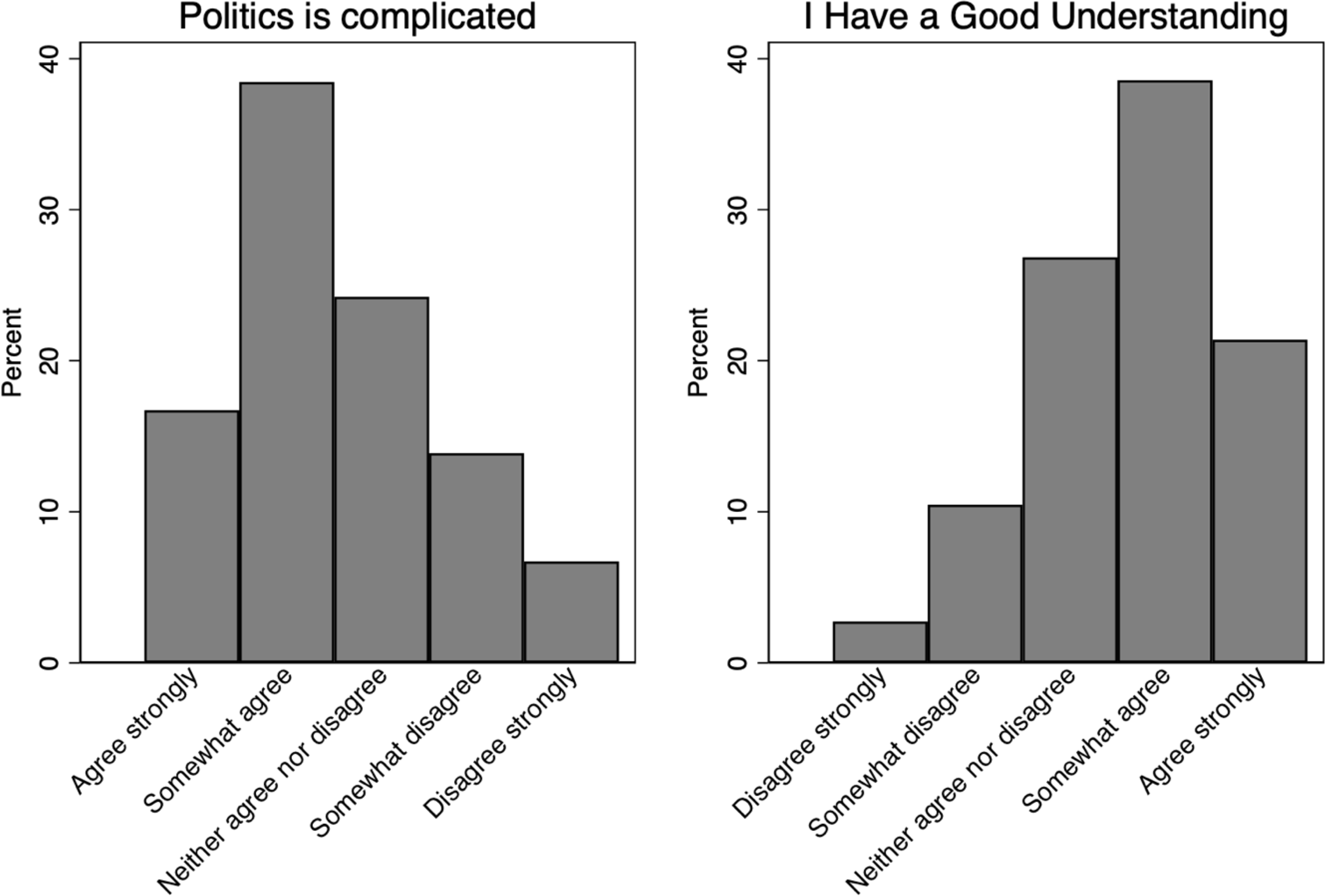
As with external efficacy, we used these to make two five-category ordinal variables with higher values indicating higher levels of internal political efficacy (For understanding, Agree strongly = 5; for complicated, Disagree strongly = 5). Our sample showed much higher levels of internal efficacy. Roughly 20% of respondents strongly or somewhat disagreed with the statement that politics is too complicated. Over half of our sample (56%) agreed with the statement that they had a good understanding of politics.
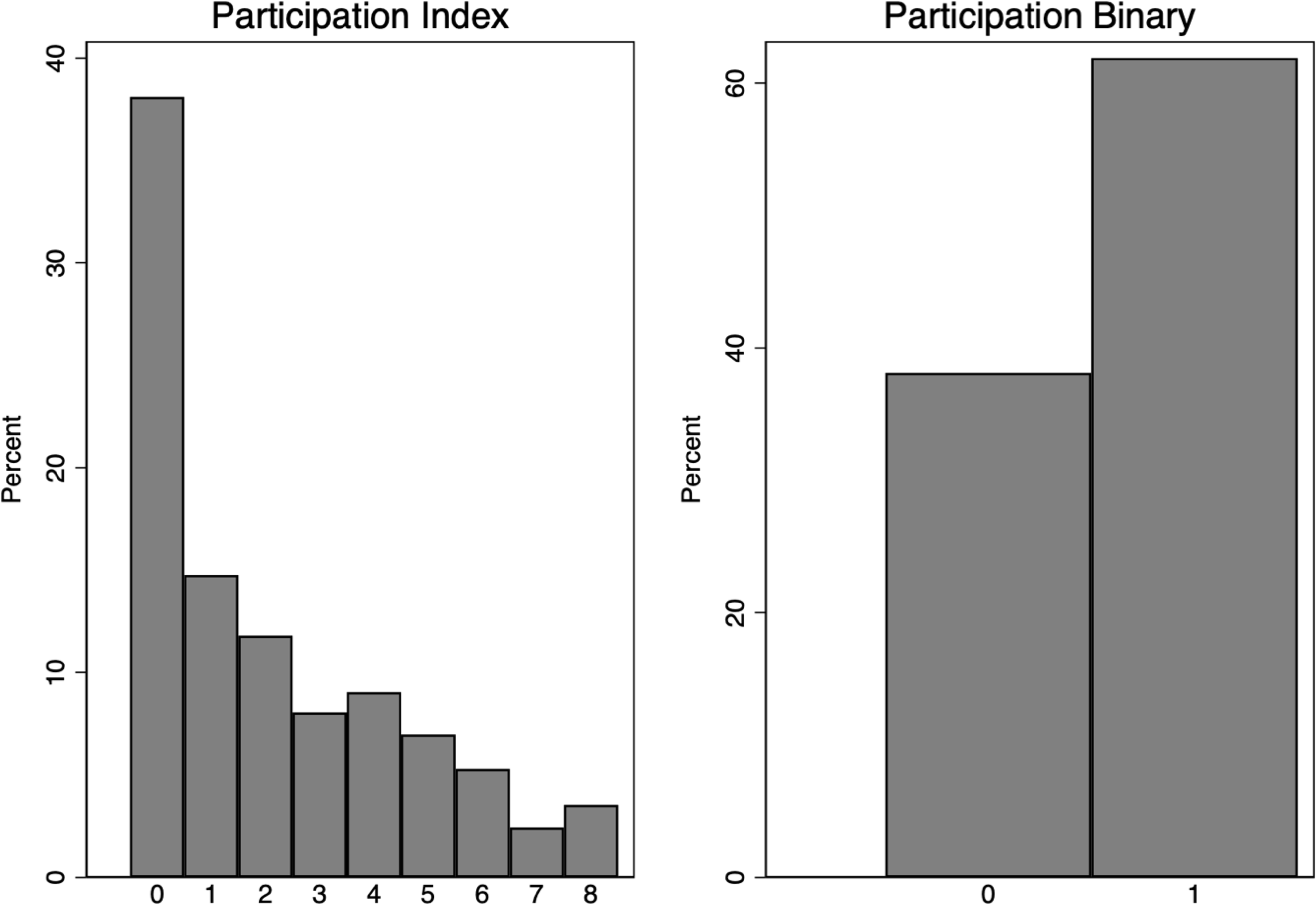
We also hypothesized that policy environment and experience will affect political participation. To test this, we created two measures of participation. First, we created a participation index that counts the total number of participatory acts that a respondent performed. Included in this index are whether or not respondents joined in a protest march, rally, or demonstration; attended a meeting of a town or city government or school board; signed a paper petition about a political or social issue; signed an Internet petition about a political or social issue; worked with other people to deal with some issue facing their community; telephoned, wrote a letter to, or visited a government official to express views on a public issue facing their community or schools; attended a meeting about an issue facing their community or schools; or devoted time to volunteer work. This variable ranges from 0 to 8. Cronbach’s alpha (Cronbach Reference Cronbach1951) suggests that our summative participation scale is reliable because the estimated correlation between it and the underlying factor it measures was 0.91. In addition, the correlation between a participatory act and the overall scale suggests that all participatory acts fit well in the scale.
On average, foreign-born Latinos participated in two acts. However, participation in politics in any form was relatively rare. Thus, we also created a binary measure of participation that captures whether respondents participated in any way, with a 1 indicating they performed at least one political act and a 0 otherwise. Nearly 60% of our sample participated in at least one activity.
To capture the relevant existing policy environment, we supplemented our survey data with information on immigration enforcement intensity from ICE. We collected county-level statistics on the number of individuals deported as well as their criminal statuses under the Secure Communities programs from their internal 2015 report. From this, we focused on the number of individuals deported for low-level and noncriminal offenses. This includes individuals convicted of offenses punishable by less than one year, such as overstaying visas. In doing so, we followed previous scholars who found that the effect of immigration enforcement on attitudes and behavior depends on who is deported (Cruz Nichols et al. Reference Cruz Nichols, LeBrón and Pedraza2018; Maltby et al. Reference Maltby, Rocha, Jones and Vannette2020; Rocha et al. Reference Rocha, Knoll and Wrinkle2015). We measured contextual immigration enforcement by taking the number of low-level and noncriminal immigrants per one thousand foreign-born residents in a county. The noncriminal deportation rate varied widely across the country, ranging from no deportations to 31 deportations per 1,000 foreign-born residents. On average, counties in our sample had a noncriminal deportation rate of 3.
To measure contact with accommodating social programs, we used a question that asks individuals whether they have had experience with DACA. This is a binary variable that equals 1 if the respondent had experience with DACA and 0 otherwise. Roughly 14% of our respondents either knew someone with DACA or were DACA recipients themselves. With this data, we cannot distinguish whether individuals were personal recipients of DACA or whether they knew someone with DACA. Thus, we believe that our models likely underestimated the true effect of DACA on political behavior because the effect of policy on attitudes is likely stronger for those with personal rather than second-hand experience. We argue that the effect of DACA on efficacy and participation depends on the level of immigration enforcement in one’s county. To test this, we interacted DACA experience with the deportation rate in the respondent’s county.
We controlled for individual-level factors known to affect feelings of efficacy and participation, including age, gender, and partisan affiliation. We measured socioeconomic status by education level, an ordinal variable ranging from 1 (less than a high school education) to 6 (post-graduate education), and by whether the respondent had full-time employment. We also included measures for whether respondents had a child living at home and whether a respondent was married (domestic partnerships are counted as married). We controlled for several characteristics specific to foreign-born Latinos, including Spanish language use (a binary variable that measures whether they took the survey in English [0] or Spanish [1]) and whether the respondent was a citizen.
Our models also controlled for several contextual factors that may have affected feelings of efficacy and participation. Immigration is more salient in some parts of the country than others, which likely affects an individual’s willingness to engage in politics. To account for this, we included the proportion of the respondent’s county that is foreign-born and whether the respondent lived in a county bordering Mexico.
Analysis
First, we examined whether policy feedback effects from DACA varied with existing enforcement environments. Table 2 presents a series of models that test how first- or second-hand DACA experience, moderated by the enforcement intensity within a county, shapes respondents’ external efficacy. Because our four dependent variables are measured on an ordinal scale, we used ordinal logistic regression models. We clustered our standard errors by county.Footnote 4
Political efficacy – External
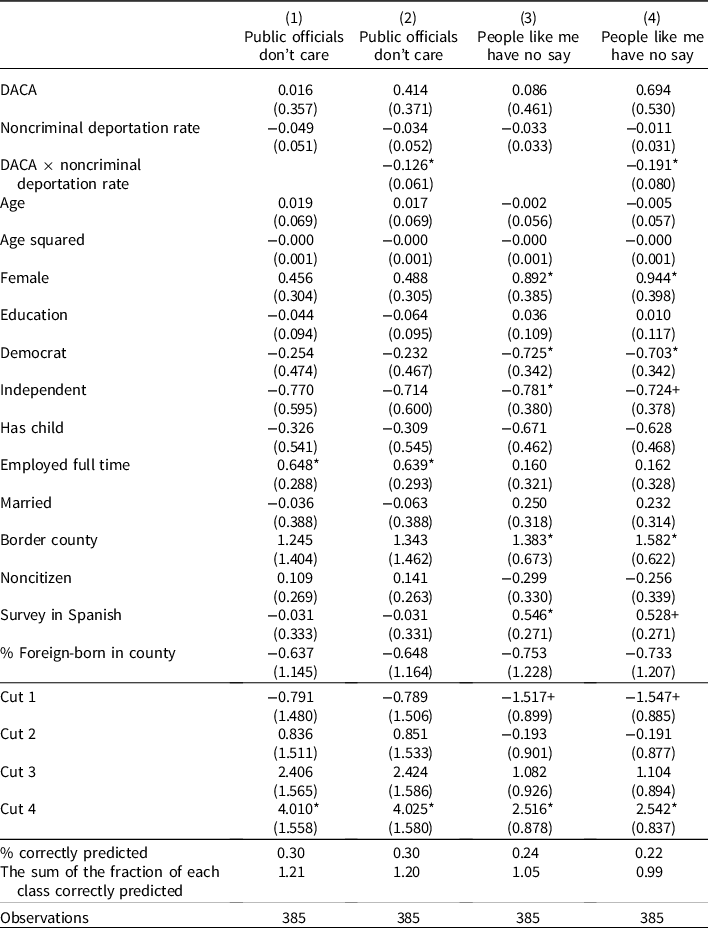
Note: (1) Models estimated using ordered logit. Efficacy questions were asked of only half the sample.
(2) Standard errors are in parentheses. +p < 0.10, *p < 0.05.
(3) All dependent variables in this table have 5 categories. When calculating % correctly predicted, we made the predicted category to be the category with the highest predicted probability.
Models (1) and (3) in Table 2 examine the impacts of DACA experience on external efficacy without including the interaction term. Neither experience with DACA nor immigration enforcement significantly affected feelings of external efficacy. Models (2) and (4) examine how the effects of DACA experience on external efficacy varied with the existing enforcement environment. The results suggest that restrictionist policy environments significantly reduced DACA’s positive impact on external efficacy measured by the two survey questions, which provides evidence for H1a.
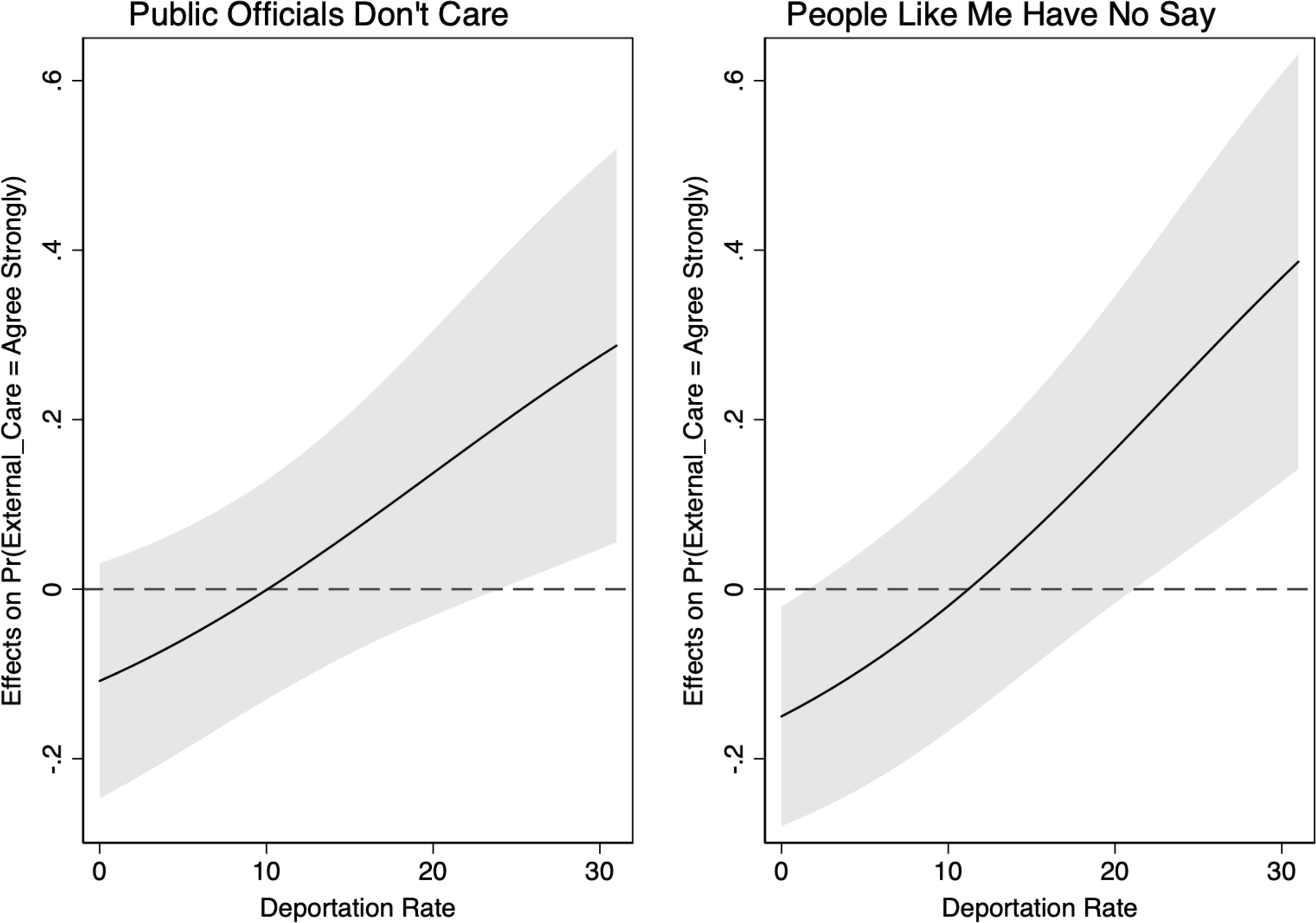
Figure 2 shows the marginal effects of direct or indirect experience with DACA on respondents strongly agreeing that public officials don’t care or people like me have no say across a range of enforcement environments, setting all other variables to their means. Footnote 5 For both measures, we found that the effect of DACA experience was negative, indicating greater external efficacy when immigration enforcement is low (deportation rate = 0).Footnote 6 However, this does not reach statistical significance at standard levels, indicating that we cannot be certain that experience with a more accommodating policy produces beneficial feedback effects. Although this does not support our assumption that DACA has, on average, a positive effect on political orientations, this does suggest that interactions with DACA do not reverse our expectations. As immigration enforcement in one’s county becomes more punitive, experience with DACA makes it more likely that individuals will strongly agree that the government does not care about them and that people like them have no say in politics. Particularly, when the noncriminal deportation rate was at the highest level, the predicted probability of respondents with DACA experience strongly agreeing that people like them have no say in politics was 0.65 times higher than those without DACA experience. This supports our argument that any positive effects of DACA on efficacy are, at best, limited by a restrictionist pre-existing policy environment and, at worst, reversed.Footnote 7
Marginal effects of DACA on external efficacy with 95% CIs.

The four models in Table 3 test our second hypothesis (H1b) that the positive effect of DACA on internal efficacy is negatively affected when existing enforcement environments are more intense.Footnote 8 Again, we use Models (1) and (3) as baseline models and add the interaction term in Models (2) and (4). Neither DACA experience nor the interaction between it and the policy environment affected respondents’ beliefs that government is too complicated. However, levels of immigration enforcement in one’s environment did influence feelings that government is too complicated, at least for those without direct or indirect DACA experience. For foreign-born Latinos with no DACA experience, high rates of deportation in one’s county negatively affected internal efficacy, as measured by the politics-is-complicated question. But this effect was not consistent across measures of internal efficacy.
Political efficacy – Internal
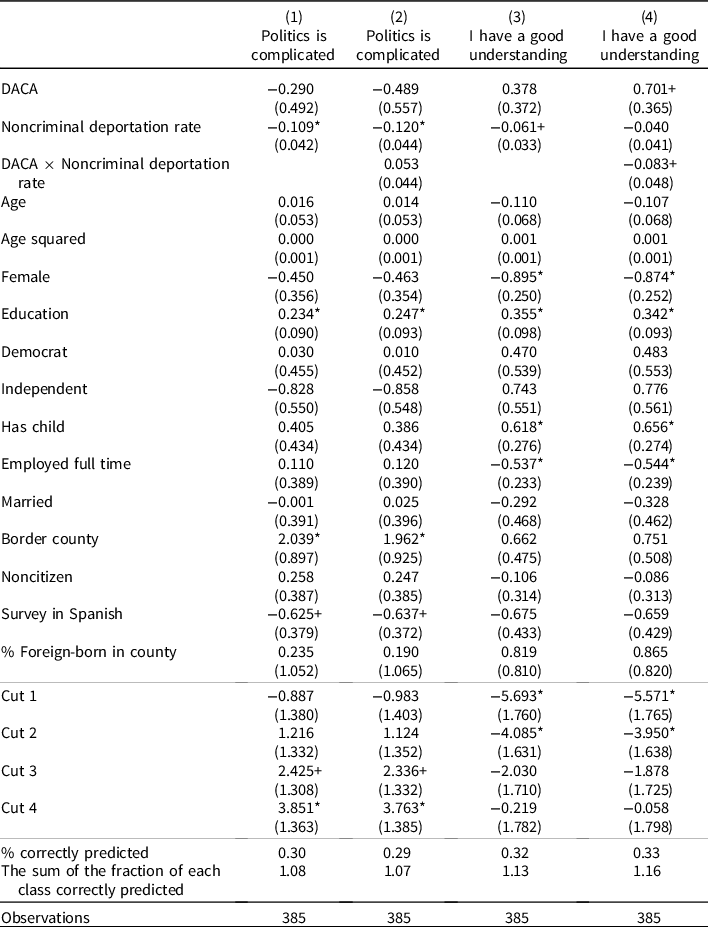
Note: (1) Models estimated using ordered logit. Efficacy questions were asked of only half of the sample.
(2) Standard errors in parentheses. +p < 0.10, *p < 0.05.
(3) All the dependent variables in this table have 5 categories. When calculating % correctly predicted, we made the predicted category to be the category with the highest predicted probability.
Model (4) in Table 3 suggests that direct or indirect experience with DACA positively affected respondents’ beliefs that they have a good understanding of politics when enforcement is low, but this reached statistical significance at only the 0.10 level. The level of immigration enforcement in one’s county significantly decreased the internal efficacy of respondents with DACA experience. In this model, we also found some support for our second hypothesis. Here, the interaction between DACA experience and policy environment was negative and statistically significant at the 0.10 level, indicating that the positive effect of DACA was reduced in areas where many were deported. However, because this effect does not meet traditional standards of significance and does not hold across measures of internal efficacy, we do not find this evidence compelling.
Only a few other factors influence foreign-born Latinos’ sense of efficacy. Those with full-time employment were more likely to believe that public officials “care about what people like me think” compared to those who were unemployed or only employed part-time. Latinas were more likely than men to report that “people like me have a say in what the government does.” However, Democrats and Independents were less likely to feel this way than their Republican counterparts. Those who took the survey in Spanish were more likely to feel a sense of external efficacy, but this reached statistical significance at only the 0.10 level for one model.
Additionally, respondents who lived in a county bordering Mexico were more likely to believe that they “have a say in what the government does.” Turning to Models (2) and (4) in Table 3, we find that education was positively linked with internal efficacy. Those in counties bordering Mexico were also likely to disagree that “politics is too complicated.” Those who took the survey in Spanish were more likely to say that “politics is too complicated” compared to those who took the survey in English. Although Latinas and those with full-time employment were more likely to have external efficacy, they were less likely to report that they had “a good understanding of politics.” Finally, respondents who had a child were more likely to say that they had “a good understanding of politics” than those without children.
When it comes to political participation, are the feedback effects from DACA also moderated by existing enforcement environments? In Table 4, we test how experience with DACA, moderated by the enforcement intensity, shapes foreign-born Latinos’ participation. We used ordinary least squares regression to analyze the participation index and logistic regression to analyze the binary participation measure. Both models cluster standard errors by county. We also report our models’ goodness of fit in the table.
Political participation
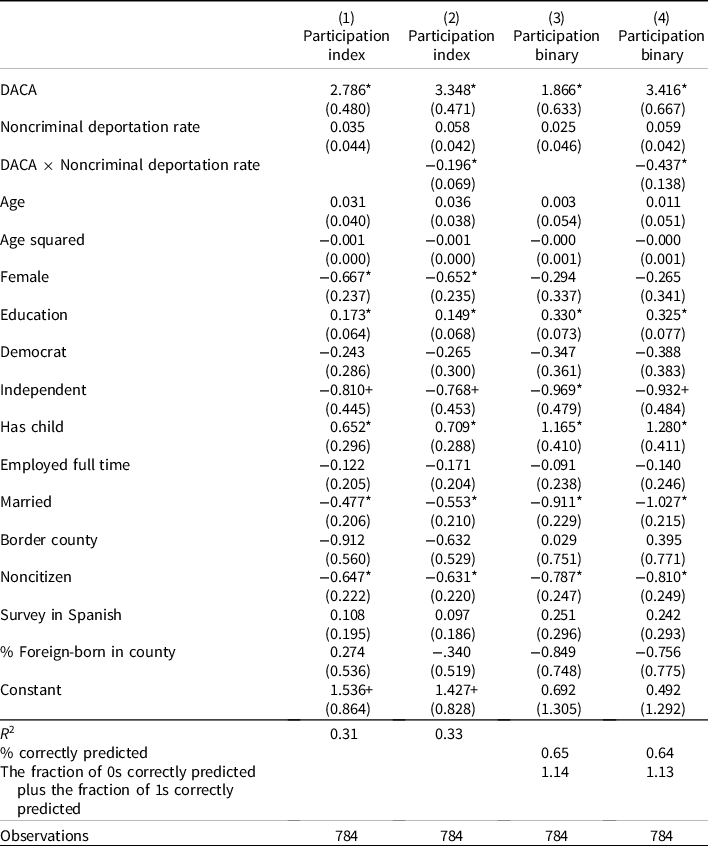
Note: (1) Participation index estimated using ordinary least squares regression.
(2) Binary participation estimated using logit. Standard errors in parentheses. +p < 0.10, *p < 0.05.
(3) When calculating % correctly predicted, we use a cutoff of 0.5.
Table 4 examines our third hypothesis (H2): the positive effects of direct or indirect experience with DACA on participation are negatively moderated by the existing enforcement environment intensity. Again, we used Models (1) and (3) as a baseline and included the interaction term in Models (2) and (4). Our results showed that experience with DACA had a positive and statistically significant effect on participation, measured as either the number of participatory acts or the likelihood of engaging in any form of participation when immigration enforcement is low. This indicates that, absent existing enforcement environments, experience with an accommodationist policy will increase political engagement. Although DACA continues to face political and legal scrutiny, finding it has a positive and significant effect on participation indicates that it is at least partially functioning as it was intended. Furthermore, the noncriminal deportation rate in a county does not directly affect participation for those without DACA experience, but immigration enforcement does moderate the effect of DACA experience on behavior, as indicated by the negative and statistically significant interaction term.
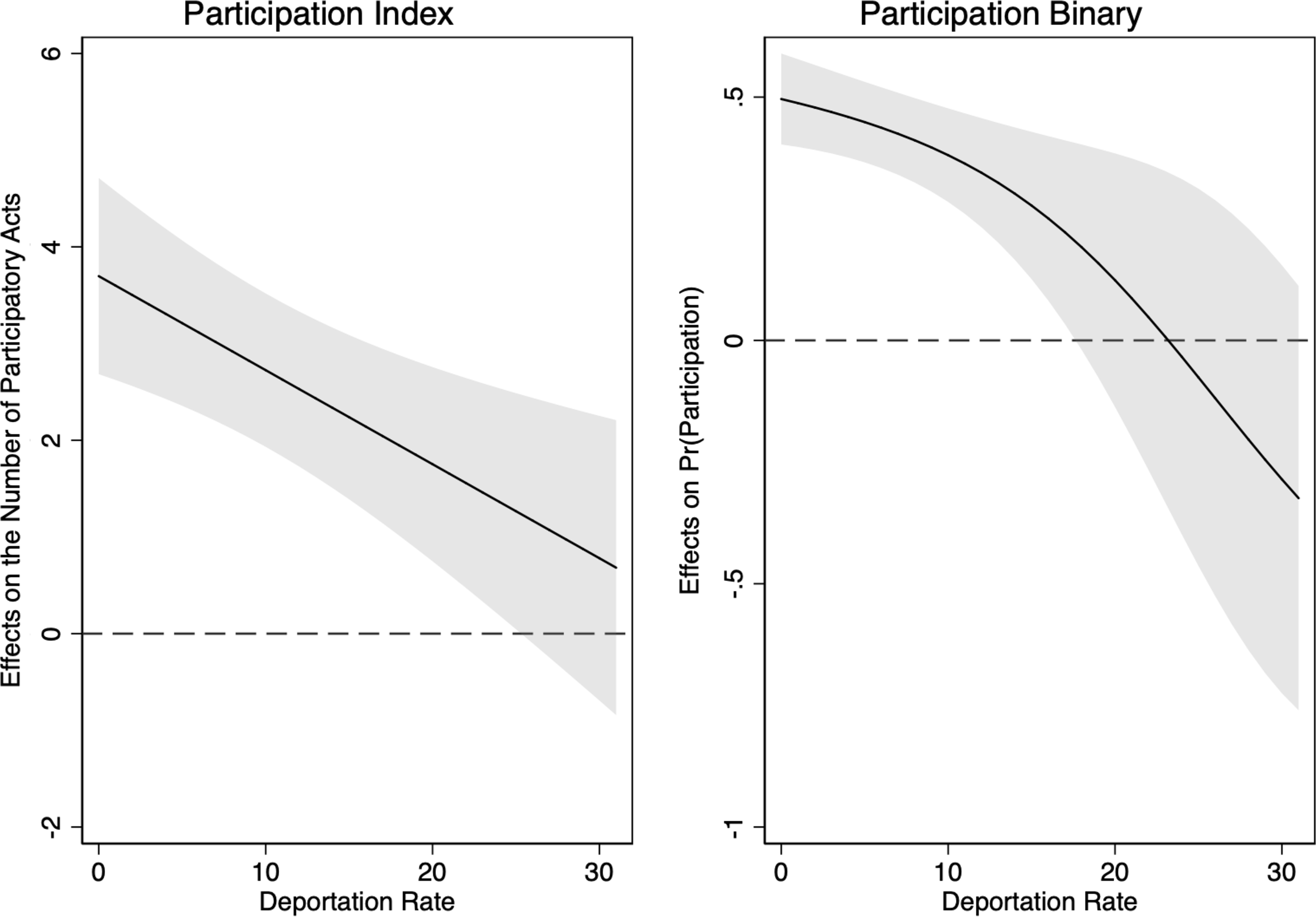
Figure 3 shows the average marginal effect of DACA experience on the number of participatory acts and the likelihood of participation across a range of immigration enforcement contexts. Looking first at the binary measure of participation, we find that in areas where immigration enforcement was more lenient, experience with DACA had a positive and statistically significant effect on one’s likelihood of participating. But the benefits of DACA disappeared as the policy environment became more intense. In areas with a higher-than-average rate of deportation, having experience with DACA had either no effect on participation or a negative effect on one’s likelihood of participating.
Marginal effects of DACA on political participation.

Turning to the participation index, we see a similar effect. In areas where immigration enforcement was low, DACA experience led to participation in more acts. As the pre-existing policy environment became more intense, the positive effect of DACA on participation disappeared. This finding is consistent with other studies that showed that DACA recipients, particularly women, reported higher levels of anxiety about DACA’s uncertain future than non-DACA undocumented students (Flores Morales and Garcia Reference Flores Morales and Garcia2021). Given that our survey was administered during the 2016 election when Trump gave clear signals about his intent to rescind DACA, our results suggest that DACA recipients may have been afraid to be too political because of the uncertainty surrounding the program’s future. Because immigration enforcement is more intense in some areas of the US than others, our argument that experience with DACA should not be studied in isolation received further support. Instead, we need to understand how DACA affects individuals’ attitudes and behavior in relation to immigration enforcement in their area more broadly.Footnote 9
Other factors also affected foreign-born Latinos’ political engagement. Education had a positive effect on how many acts individuals participated in as well as their likelihood of participating. Similarly, those with children were more likely to participate and at greater rates than those without children. Given that some of the participatory acts dealt with concerns about local schools, this effect is unsurprising. However, married respondents and noncitizens participated at lower rates compared to their single and citizen counterparts. Those who identified as political Independents were less likely to get involved in politics than Democrats or Republicans, but this reached statistical significance at only the 0.10 level. Lastly, women reported participating at lower rates than men, but men and women were equally likely to participate in at least one act.
Conclusion
The current literature suggests that enrollment in DACA, a positive policy with little to no local discretion, should have a strong positive effect on political orientation and behavior. This study finds little evidence of a direct relationship. However, it is important to note that we do find that enrollment in DACA is a significant predictor of non-electoral participation and that experience with DACA influences the attendance of political protests or signing of petitions. Accommodationist policies have the potential to influence political behavior, even when targeted communities are denied the full spectrum of political participation opportunities. This also suggests that the hotly debated repeal of DACA carries potential negative effects for the political engagement of foreign-born immigrants and members of the Latina/o/x community who are shut out of the ballot box. We also found that the effects of enrollment in DACA were significantly moderated by the intensity of immigration enforcement within the immigrant’s county of residence. This suggests that local policies and protections do matter – federal immigration policy does not “trump” all.
These findings also highlight how critical it is for future studies of immigration incorporation to understand how the effects of specific programs, whether positive or negative, are moderated by existing policy environments. New policies, however accommodating, cannot erase or eclipse local policy experience. We also offer this insight as a theoretical extension of Michener’s (Reference Michener2019) RFF framework to encourage policy feedback scholars to be more attentive to historical contexts going forward. Otherwise, scholars will continue to miss the complete picture of how policy functions. The full effects of an individual’s policy experience, both behavioral and psychological, prove difficult to untangle. Many immigrants within the United States find themselves trapped within that web.
Data availability statement
Replication materials are available in the Journal of Public Policy Dataverse at https://doi.org/10.7910/DVN/MJWKVO.
Acknowledgements
We are grateful to the reviewers and editors of Journal of Public Policy, the discussants and audience members of the Western Political Science Association, and Benjamin Farrer.
Competing interests
The authors declare none.
Appendix. Histograms of Political Efficacy and Participation
External efficacy.

Internal efficacy.
Participation.
Marginal effects of DACA on external efficacy with 95% CIs (Deportation rates).
Effects of DACA on political participation with 95% CIs (Deportation rates).
Regression of combined external efficacy

Note: (1) External efficacy scale (sum of the other two measures) is an OLS model.
(2) Care and Say are ordered logit models. Efficacy questions were asked of only half of the sample. Standard errors in parentheses. +p < 0.10, *p < 0.05.
(3) The dependent variables in Model (2) and (3) have 5 categories. When calculating % correctly predicted, we made the predicted category to be the category with the highest predicted probability.
Regression of combined internal efficacy

Note: (1) Internal efficacy scale (sum of the other two measures) is an OLS model.
(2) Complicated and understanding are ordered logit models. Efficacy questions were asked of only half of the sample. Standard errors in parentheses; +p < 0.10, *p < 0.05.
(3) The dependent variables in Models (2) and (3) have 5 categories. When calculating % correctly predicted, we made the predicted category to be the category with the highest probability.
Regressions of external efficacy on deportation rate
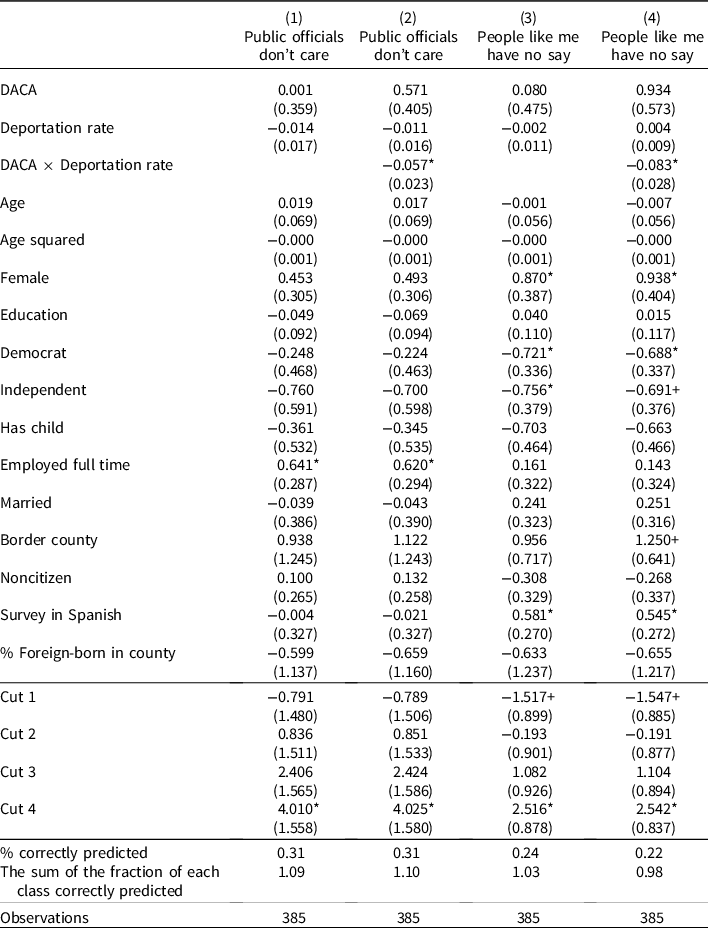
Note: (1) Models estimated using ordered logit. Efficacy questions were asked of only half the sample.
(2) Standard errors in parentheses. +p < 0.10, *p < 0.05.
(3) All the dependent variables in this table have 5 categories. When calculating % correctly predicted, we made the predicted category to be the category with the highest predicted probability.
Regressions of internal efficacy (Deportation rate)

Note: (1) Models estimated using ordered logit. Efficacy questions were asked of only half of the sample.
(2) Standard errors in parentheses. + p < 0.10, * p < 0.05.
(3) All the dependent variables in this table have 5 categories. When calculating % correctly predicted, we made the predicted category to be the category with the highest predicted probability.
Regressions of political participation (Deportation rate)

Note: (1) Participation Index estimated using ordinary least squares regression.
(2) Binary participation estimated using logit. Standard errors in parentheses. +p < 0.10, *p < 0.05.
(3) When calculating % correctly predicted, we use a cutoff of 0.5.


 Open access

