


The period between the two world wars was, perhaps, the most prosperous time for Yugoslavia. Entering the twentieth century independent from the centuries-old rule of the Ottoman Empire,Footnote 1 gaining territory lost in the First (1912–1913) and Second (1913) Balkan Wars,Footnote 2 and emerging victorious after the First World WarFootnote 3 – no longer under the rule of the Austro-Hungarian EmpireFootnote 4 – brought a period of unusual stability and opulence. The Kingdom of Serbia united with the Kingdom of Montenegro and the newly formed State of Slovenes, Croats, and Serbs to form the Kingdom of Serbs, Croats, and Slovenes in 1918. In 1929, the alliance was renamed the Kingdom of Yugoslavia, establishing Belgrade as its capital.Footnote 5
The new, strong coalition within the kingdom, now with a larger territory and free from external imperialistic forces, was eager to shed its past under Ottoman rule. Ready to modernize, the kingdom turned toward Western European culture. At the beginning of the century, Belgrade introduced telephones, electric lights, and electric trams, which were among the first electric streetcars in Europe.Footnote 6 In 1921, Yugoslavia announced an international competition for a plan to urbanize Belgrade. In 1923, the plan, under the leadership of architect Đorđe Kovaljevski, was finalized,Footnote 7 and Belgrade, on par with other European centers, was growing into a metropolis during the interwar period.
The Kingdom of Yugoslavia was also blossoming culturally with the founding of cultural institutions (theaters, concert halls, and opera houses), the formation of professional orchestras and ensembles, and the establishment of music schools. The National Theater in Belgrade, home of the opera, was established in 1868, and the first philharmonic orchestra in the kingdom was founded in Subotica (present-day Vojvodina, Serbia) in 1908. Soon after, by the early 1920s, the first philharmonic, ballet, and opera ensembles were created in Belgrade. Music schools in the region had already been established in the nineteenth century: the Music School of the Slovene Philharmonic Society, a descendant of the Ljubljana Philharmonic Academy of Johann Berthold von Höffer (which was founded in 1701), opened in 1821, and Glazbena matica of Ljubljana in 1872; in 1827, the Croatian Music Institute, then called Musikverein, became a significant concert hall, and two years later the Academy of Music in Zagreb, Croatia’s oldest music school, was instituted; the music school in Subotica (Vojvodina), then part of the Austro-Hungarian Empire, opened in 1868; and the first music school in Serbia, the Serbian Music School, opened in Belgrade on September 21, 1899. The Music Academy in Belgrade, renamed the Faculty of Music of the University of Arts in 1973, was founded in 1937, and it became the first higher music education institution in the Kingdom of Yugoslavia.Footnote 8 Although all these activities across the kingdom ceased during the First World War, musical life continued to thrive during the interwar period, with young artists and intellectuals traveling to study abroad.
Yugoslav music history is relatively young. The first professional composers emerged in the nineteenth century, and throughout the first decades of the twentieth century, they continued to compose in the Romantic tradition. Musicologist Sonja Marinković suggests that the development of Yugoslav music can be examined through three stages of Romanticism: pre-Romantic (1830s–1880s), Romantic (1880s–1914), and late Romantic (until the 1950s), which slowly paved the way for modernism.Footnote 9 Thus, while one group of composers – the first generation of Yugoslav composers, including Josif Marinković (1851–1931) and Stevan Mokranjac (1856–1914), as well as the second generation, including Stanislav Binički (1872–1942), Petar Krstić (1877–1957), and Kosta Manojlović (1890–1949) – rigorously maintained the course of the Romantic tradition, a new generation of composers, those who traveled and were educated abroad during the interwar period, followed modernist tendencies, especially expressionism, quarter-tone systems (i.e., microtonality), and twelve-tone composition.
Since the first music institution of higher education in the Kingdom of Yugoslavia was not established until 1937, composers who wished to pursue a formal study of composition during the interwar period traveled to other European centers. This was not an uncommon trend – the most educated parts of the new Kingdom of Yugoslavia were regions under the rule of the Austro-Hungarian Empire. Living in an urban and modern kingdom that was seeking to adapt Western cultural models following its emancipation from the Ottoman and Austro-Hungarian empires, Yugoslav composers, mostly from Serbia and Slovenia, traveled across Western and Central Europe to study. For example, even before the First World War, Binički, Krstić, Milenko Paunović (1889–1924), and Vladimir Đorđević (1869–1938) honed their compositional skills at the leading music centers in Europe at the time – Munich, Prague, and Vienna. Right before the First World War, Petar Konjović (1883–1970), Stevan Hristić (1885–1958), and Miloje Milojević (1884–1946) – the “three giants” of Serbian music – studied in Prague, Leipzig, and Munich, respectively.Footnote 10 Slovene composer Marij Kogoj (1892–1956) studied in Vienna, while Slavko Osterc (1892–1956) went to Prague and Danilo Švara (1902–1981) to Frankfurt. A Croatian composer, Josip Štolcer-Slavenski (1896–1955), began his studies before the war in Budapest with Zoltán Kodály, Albert Siklós, and Béla Bartók and, like many others, continued at the Prague Conservatory during the interwar period. Most of these composers’ music, still written in the late Romantic style, was now enriched with elements of impressionism and expressionism, a musical aesthetic they brought back and taught in Yugoslavia (first at the Music Academy in Belgrade) upon their return. Among them, Slavenski’s music of the 1920s and 1930s stands out as more experimental, featuring a synthesis of folk, vernacular, and the avant-garde.Footnote 11
Prague became a prime destination during the interwar period for most Yugoslav composers, who flocked there to study with Alois Hába (1893–1973). A Czech composer known for his experimentation with microtonal music, Hába defended his approach to composition as an “anti-Germanic phenomenon” and an “embodiment of the modern pan-Slavic idea.”Footnote 12 In his work on the reception of microtonal music in Slovenia, musicologist Leon Stefanija notes how Hába justified his work within this system: “The Romans have musically taken joy in diatonics, the Germans have devised great musical works in chromaticism. To us Slavs belongs the future and the task of quarter-tone music.”Footnote 13 It is not surprising that Yugoslav composers found Hába’s method practical and appealing. Seeking to free classical music from the constraints of Western tonality, Hába’s microtonal approach, which the composer derived from folk tunes of his native Moravia, offered an alternative modernist thinking to the Austrian/Germanic teachings of Arnold Schoenberg and his new twelve-tone system. Thus, for Slavs, an approach that drew on microtones – a tuning system inherent in their traditional folk musicFootnote 14 – and stood in contrast to yet another Germanic system following the region’s emancipation from Austro-Hungarian rule, Hába’s teachings were the answer. His theories were translated into Serbo-Croatian and published in the prominent music journal Zvuk in 1933,Footnote 15 allowing even those who could not afford to travel abroad to become familiar with the newest musical trends.
Composers from Yugoslavia rushed in droves to the Prague Conservatory, earning them the moniker “Prague students” [Praški đaci]. Most notably, young composers from Slovenia (Osterc, Franc Šturm [1912–1943], Demetrij Žebre [1912–1970], and Ivan Pučnik [1915–1991]) and Serbia (Vojislav Vučković [1910–1942], Ljubica Marić [1909–2003], Dragutin Čolić [1907–1987], Milan Ristić [1908–1982], and Stanojlo Rajičić [1910–2000]), among others, went to study with Hába, whose courses on microtonality were one of the very few higher education courses on the subject in Europe before the Second World War. Such experience allowed them to be in step with the newest avant-garde methods and teachings, a rare circumstance in Yugoslav history. These young “Prague” composers studied, learned, and assimilated the latest compositional techniques of that time in their works – atonality, expressionism, and microtonality. For instance, compositions by Osterc and other “hypermodernists” from Slovenia (including Matija Bravničar [1897–1977], Šturm, and Švara), featured polytonality, atonality, and athematicism. They often combined these techniques with dodecaphonic and quarter-tone procedures, as evident in Osterc’s ballet Maska rdeče smrti [Mask of the red death] (1930) or his piano piece Aforizmi [Aphorisms] (1936). The achievements of these interwar composers illustrate their use of both German expressionism and the avant-garde methods that were taught in Prague during this period.
However, with the looming Second World War, they all returned home, where the war, once again, obliterated cultural life in the country. After the war, these once avant-garde composers either fully abandoned or greatly softened their modernist tendencies, as the once vibrant, energetic, and growing kingdom was now a very different place. Postwar Yugoslavia was now a communist state that had adopted socialist realism, an ideology that directly resisted modernization and progress.
Postwar Yugoslavia: Communism and Socialist Realism
After more than twenty years of growth and relative political stability in the Kingdom of Yugoslavia, the country was once again at war following the swift attack and occupation by the Axis forces on April 6, 1941. Surrounded on all sides by the Axis powers – Italy, Germany, Hungary, Romania, and Bulgaria – Yugoslavia was once again partitioned. Germany annexed northern Slovenia, formed a puppet state of Nazi Germany in the Independent State of Croatia (present-day Croatia and Bosnia and Herzegovina), and occupied most of Serbia. Italy claimed the rest of Slovenia, most of the Adriatic Coast (Croatia and Montenegro), and Kosovo. Bulgaria occupied Macedonia and eastern Serbia, while Hungary took hold of Vojvodina (the northern province of Serbia). The Yugoslav Partisans, the communist-led antifascist resistance headed by Josip Broz Tito (1892–1980), fought not only the Axis forces but also guerillas and fascists inside the country: Chetniks, the Serbian nationalists, Yugoslav royalists, and guerilla forces, who also collaborated with the Axis forces in their mission to form an ethnically pure Greater Serbia, and Ustashe, the Croatian fascists and Roman Catholic ultranationalists whose ideology was framed on the premise of creating an ethnically pure Greater Croatia.Footnote 16 The Partisan resistance ultimately prevailed, and Yugoslavia was once again liberated from the Axis powers, internally and externally, on May 25, 1945.Footnote 17
In the immediate aftermath of the Second World War, Yugoslavia, now under the leadership of Tito – their communist Partisan hero – emerged as a newly formed socialist state with a communist regime: the Federal People’s Republic of Yugoslavia.Footnote 18 In postwar Europe, politically divided into Eastern and Western Blocs, Yugoslavia aligned with the Soviet Union – its ally and joint liberator in the Second World War – in 1946. Already by 1948, however, Yugoslavia had severed its alliance with the Soviet Union and the Eastern Bloc following the Tito–Stalin split – a major geopolitical rift between the two leadersFootnote 19 – and established a new social and economic model of self-management socialism. This model, instituted in 1950, aimed to “eliminate any domination of nonproducers in the economy and society (the liberation of labor) through a decision-making structure that is neither a compromise nor a mixture of Western-type and Soviet-type industrial relations.”Footnote 20 It would prove to be a powerful tool in promoting and strengthening socialist and communist values in Yugoslavia.Footnote 21
In 1963, Yugoslavia was renamed the Socialist Federal Republic of Yugoslavia – a self-managed, one-party socialist federation governed by the League of Communists of Yugoslavia – comprising six constituent republics: Bosnia and Herzegovina, Croatia, Macedonia, Montenegro, Serbia (including two autonomous provinces, Kosovo and Metohija, and Vojvodina), and Slovenia. Tito, who had already led Yugoslavia since 1945 as prime minister, was now appointed president for life (de facto, a dictator). Tito held the fragile country together and initiated a series of new constitutions and economic reforms that steadily shifted power from the federal level down to economic enterprises, municipalities, and republic-level apparatuses of the Communist Party.Footnote 22 This socioeconomic and political model resulted in Yugoslavia’s remarkable growth between 1953 and 1965, followed by a substantial slowdown thereafter.Footnote 23 Yet the strong and still-prevalent ethnic and religious divisions, now swept under the rug and kept “in check” during Tito’s presidency, would continue to show cracks, penetrating the surface and coming on full display in the 1990s.
These ethnic and religious (i.e., nationalist) tensions played a pivotal role in the politics of national identity in Yugoslavia. The notion of identity implies the existence of some individual or collective characteristic by which a certain person or social group is recognizable. For a continuously unstable multiethnic and multireligious country that had changed its borders, names, and political systems several times since the beginning of the twentieth century, such volatility has inevitably affected all aspects of life in Yugoslavia, including its cultural production.Footnote 24 For composers, these incessant changes have posed challenges in seeking to define, position, and identify themselves musically as Yugoslavs but also according to their distinct ethnicity. The latter had to be subdued and revealed in moderation, so as not to stoke any notions of nationalism.Footnote 25
Yugoslavia’s initial political reordering with the Soviet Union had a profound effect on the country’s relationship and communication with the West. However, its defection from the Soviet Bloc in 1948 strained its relations with all countries of the communist Eastern Bloc, which even threatened to invade.Footnote 26 Yugoslavia was beginning to open communication channels with the West, particularly with the United States, which was cautiously warming up to the only country to defect from the Eastern Bloc (and even provided financial support),Footnote 27 and to repair its relations with the Soviet Union in 1955 (following Stalin’s death in 1953). Nonetheless, Yugoslavia endured a period of deep political, economic, and cultural isolation during the first decade of the Cold War, which lasted until about 1960.Footnote 28 This grave isolation resulted in a significant stifling of cultural creativity and progress.
These first fifteen postwar years were particularly challenging for composers in the politically unstable new state. Left economically destitute and cut off from alliances on both sides of the Iron Curtain, composers had to fend for themselves at a pivotal time of new musical and technological innovations. Travel was difficult, if not impossible. Needing to control all political, economic, social, and cultural processes in the country, the authorities of the newly formed communist states imposed harsh conditions on their citizens traveling to the West, fearing massive migration.Footnote 29 Acquiring any cultural goods, such as books, music scores, articles, and recordings, was likewise difficult.Footnote 30 Not only was it challenging to obtain musical scores of contemporary works, but new music was neither performed in concerts nor played on the radio.Footnote 31
Such simplification of the lack of modern music in Yugoslavia during this period makes a sound argument. That is, the indisputable Yugoslav narrative illustrates an environment in which Yugoslav composers, who just a few years earlier were studying the newest musical techniques in the finest institutions across Europe, were now cut off from any happenings outside of Yugoslavia. The little information that allowed them to learn about new music came mostly from secondhand reports provided by those who attended musical festivals abroad. However, the exchange of information still existed during the 1950s, albeit scarcely. A number of composers attended notable music festivals across Europe and the US at the time, such as the Eleventh International Summer Course for New Music at Darmstadt (1957), Warsaw Autumn (in 1956), International Society for Contemporary Music (ISCM) festivals in Brussels (1950) and Rome (1959), and several other festivals in Paris, London, Salzburg, Edinburgh, and even the US.Footnote 32 Further, composers from abroad were occasionally invited to present their works in Yugoslavia. For instance, in 1958, the Union of Composers of Serbia invited Zbigniew Wiszniewski to give a talk in Belgrade about his electronic music.Footnote 33
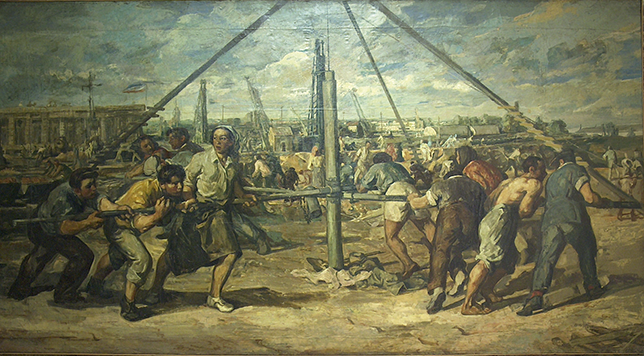
In addition to the burdens arising from Yugoslavia’s global cultural isolation, Yugoslav composers had to confront challenges from within. In the immediate years after the war, Yugoslavia’s newly established Communist Party, along with prominent members of the arts establishments, adopted socialist realism as a dominant feature of the country’s cultural policy. Socialist realism originated in the Soviet Union in the 1930s, constraining artists to present a “faithful image of reality, firmly rooted in history, in the course of revolutionary transformations,”Footnote 34 so that they could be used in propaganda campaigns, spreading an ideology that was in line with the ideals of the communist regime (Figure 1.1). After 1945, its principles were imposed on artists in all domains and across the Eastern Bloc. According to the doctrine, “art had to actively participate in building a socialist society, and … to that end it should be easily understood by the masses.”Footnote 35 For composers, this meant that their works were expected to cultivate the national character of society, optimism, and comprehensibility and to avoid experimentation.Footnote 36 Thus, at the time when expressionism and avant-garde were practiced by composers in Serbia and Slovenia, other music communities in Yugoslavia, including in Croatia, were more concerned with the “revival and appreciation of the national image.”Footnote 37
Boža Ilić, Сондирање терена на Новом Београду [Drilling of the terrain in New Belgrade] (1948). Oil on canvas, 4.5 m x 2.5 m. This work is a prime example of socialist realism in Yugoslavia, depicting the rebuilding of the nation after the war. Such images conveyed a collective sense of pride, patriotism, brotherhood, and unity, showing men and women taking part in such voluntary youth actions.
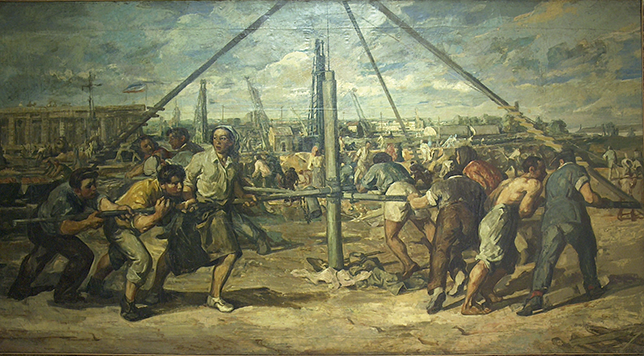
Figure 1.1 Long description
The artwork celebrates young workers and their hardworking activities in rebuilding the postwar nation. The painting depicts a scene in the building of the new neighborhood, New Belgrade, in the capital city of Belgrade. Specifically, the painting depicts the drilling of the terrain. The background is an industrial building site that spreads far into the horizon. A group of young workers in the foreground, both male and female, are turning the handles of the drilling probe. The composition is closed, with the drilling probe in the middle and two groups of workers to the left and right. The painting’s background is busy depicting more workers, cranes, drills, and other heavy equipment. A sense of movement is achieved by arranging the two main groups of workers. The workers are young, healthy-looking, and serious. Each person is pictured pushing the drill, pensive, and seemingly without acknowledging the presence of the others. The three workers on the left facing the viewer lead us into the action. Their large, round bodies are pushing against the wooden handle of the drill. The young woman close to the center is the focal point of the group. Her tall, powerful body creates a strong vertical movement, making her the symbolic core of the painting: an ideal worker full of health and energy. Although the workers’ backs are bent into their task, there are no signs of physical strain on their faces as they do this backbreaking work.
In music, populist mass songs that celebrate communism, socialism, brotherhood, unity, and state-building are the definitive examples of socialist realism. Originating from Soviet-style mass culture (when the USSR first implemented the doctrine), the phenomenon spilled over to the West and East in the 1930s and 1940s. In the US, Clement Greenberg and Dwight Macdonald wrote critical essays about mass culture, which they saw as a threat to “high” culture – namely, elitism and academicism of modernist aesthetics. Greenberg referred to mass songs as “kitsch” art,Footnote 38 while Macdonald described mass culture as a “dynamic, revolutionary force, breaking down the old barriers of class tradition, taste, dissolving all cultural distinctions,” and in the process producing a “homogenized culture.”Footnote 39 Thus, while the West sought to foster modernism, a marker of cultural scientism that distinguished art from socialist realism,Footnote 40 postwar Yugoslavia aimed to connect musical arts to the working class.Footnote 41
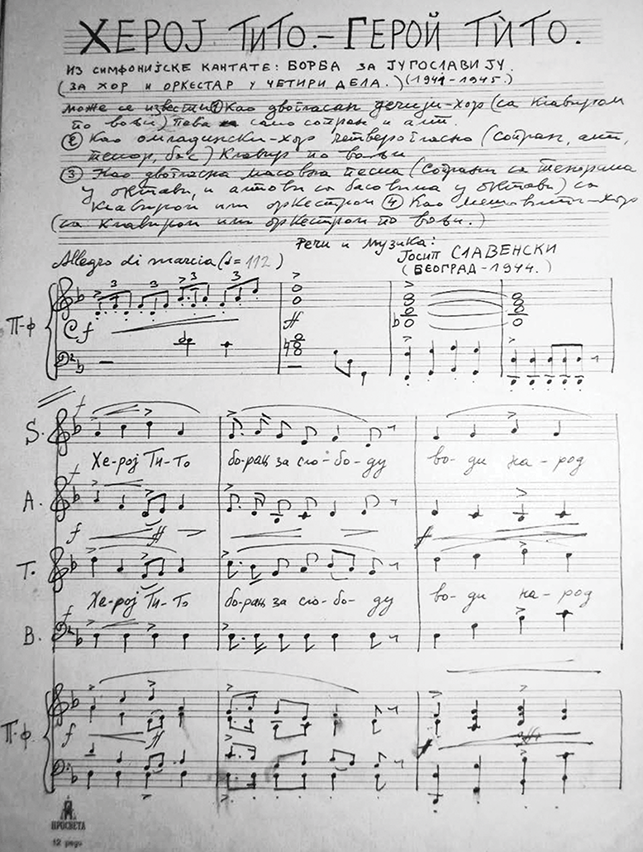
Slavenski notably stands out as a composer who – presumably willingly – embraced the populist mass song genre in Yugoslavia, signaling a drastic shift in style from his former experimental works. Even though he was not a member of the Communist Party, Slavenski wrote around thirty mass songs between 1944 and 1950, about half of them harmonizations of traditional Partisan songs and the other half originals.Footnote 42 These songs celebrate Tito, the Partisans, the Red Army, Stalin, the USSR, the youth, and the work ethic of nation-building. They bear titles such as Drug Tito [Comrade Tito], Heroj Tito [Hero Tito], Pesma o Lenjinu [Song about Lenin], Pesma o Staljinu [Song about Stalin], Staljin–Tito [Stalin–Tito], Da nam živi rad [Long Live Work], and Narodne partizanke pesme [Traditional Partisan songs] (Figure 1.2). Submitting his entry in 1947, Slavenski entered a competition for the national anthem of the new Federal People’s Republic of Yugoslavia, perhaps the ultimate feat of mass song genre and socialist realism. Even though his song did not win, it nonetheless signified the composer’s dedication to the socialist and communist cause.
Josip Štolcer-Slavenski, Херој Тито [Hero Tito] (1944), autograph score, SATB and piano, from a symphonic cantata, A Battle for Yugoslavia. Slavenski composed music and text. The text reads: Hero Tito / a freedom fighter / leads the nation/ […]. Original text in Serbian: Херој Тито / борац за слободу / води народ […] (The Faculty of Music Archive.
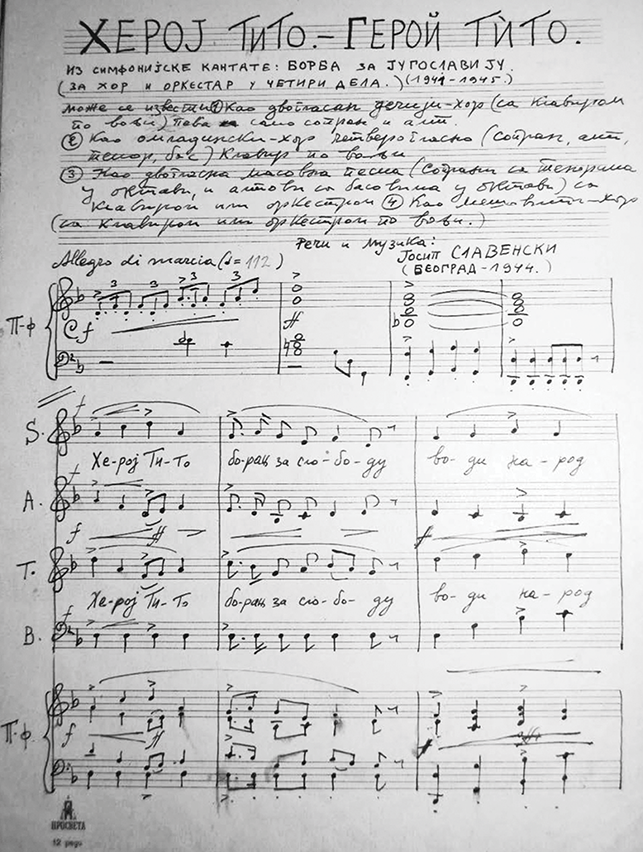
Figure 1.2 Long description
The text reads: Hero Tito, a freedom fighter, leads the nation. The song is in 4/4 meter with a march-like tempo, Allegro con marcia, and bombastic chords and octaves in forte dynamics.
For Slavenski, mass songs were a continuation of folk art, a characteristic trait of the composer’s oeuvre. The Croatian composer embraced the notion of pan-Yugoslavia immediately after the creation of the Kingdom of Yugoslavia following the First World War and imbued his music with folk motives from all parts of the region. Such folklorism is evident in his works like Jugoslovenska svita [Yugoslav suite] (1921) and Балканофонија [Balkanophonia] (1927), a work that comprises seven movements featuring dances and songs from all regions of Yugoslavia – Serbian Dance, Albanian Song, Turkish Dance, Greek Dance, Romanian Dance, My Song [Croatia],Footnote 43 and Bulgarian Dance. Many of Slavenski’s mass songs incorporate folk elements from around the country, illustrating that the composer truly saw himself not as a Croatian but as a Yugoslav composer and a faithful representative of socialist realism.
Socialist realism was not applied in Yugoslavia as extensively as in other communist states in the Eastern Bloc and was technically abandoned following the country’s split from the Soviet Union in 1948. However, its ramifications were overwhelmingly present in all cultural and artistic spheres throughout the 1950s. As composers whose works displayed modern techniques and technologies were scrutinized, shunned, and sometimes blacklisted, Yugoslav composers continued to practice and favor traditional (i.e., “neoclassical”) aesthetics. Thus, even those composers who had previously studied abroad the newest approaches to composition, such as microtonality, serialism, and expressionism, now either fully rejected avant-garde techniques or succumbed to the pressure of composing in a more subdued modernism. Musicologist Ivana Medić describes this phenomenon as “moderated modernism” – a style situated between the avant-garde and tradition, denoting a “politically neutral, socially acceptable, non-avant-garde, non-challenging form of modernism, whose most obvious feature was the artists’ desire to make peace between modern and traditional and between regional and international.”Footnote 44 Croatian writer Miroslav Krleža positioned this need for a moderated approach to modernist art to make it fit within the communist, specifically Marxist, ideology. Such art was both “localized,” given its particular formulation in Yugoslav history, and “international,” since the Marxist scope was international.Footnote 45 Thus, “moderated modernism” stood in direct opposition to both modernist aesthetic and socialist realism, situating Yugoslavia “on the ‘margins’ of Europe.”Footnote 46
Clearly, in postwar Yugoslavia, aesthetics and politics were inseparable, even though the Communist Party generally sought to avoid “direct meddling” in the theory and criticism of art.Footnote 47 Since “moderated modernists” held prominent positions as professors, music critics, concert organizers, and heads of cultural institutions, which, de facto, implied their association and standing within the Communist Party, they were in a strong position to push forth the Party’s agenda. Thus, the postwar generation of composers, including the once-progressive “Prague students,” abandoned nearly all avant-garde styles and ensured that the new generations of composers did not veer too much outside tradition. The common justification for this reasoning points to pressures from the Communist Party. While true to a certain degree, another factor also played a significant role: Many Yugoslav composers simply did not like the modernist aesthetic, and in order to maintain their powerful positions and not have to subject themselves to any change or challenge, or risk losing their grip on control and power, they ensured that their view was the dominant one.
The Postwar “Avant-Garde”: Moderated Modernism
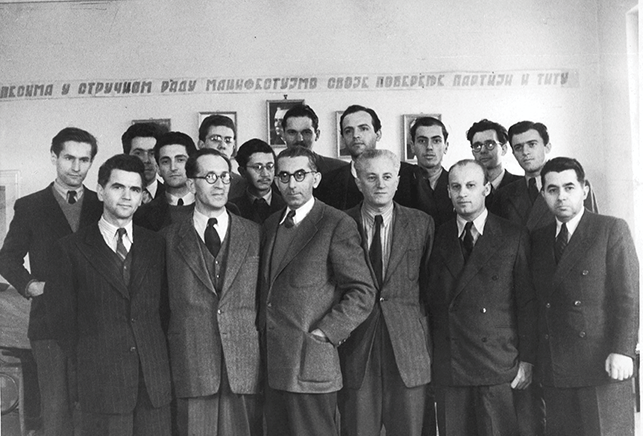
During the Second World War, once again, all music activity in Yugoslavia almost came to a stop. While the Music Academy in Belgrade, the only higher institution for music studies in the country at the time, did not officially close during the war, activity was minimal, at best. Most of its faculty and students were drafted to fight in the war, captured as prisoners of war, or killed. Regular studies resumed in 1945, with Petar Konjović appointed as the Rector of the Academy and Stevan Hristić as the first composer on the faculty.Footnote 48 Other composers joined soon after – Milenko Živković, Stanojlo Rajičić, Predrag Milošević, Mihovil Logar, and Miloje Milojević (Figure 1.3). They all abandoned their prewar expressionism in favor of neoclassicism (except for Logar, who occasionally shifted between tonal and atonal language in his music) upon their return from Prague. Rajičić, notoriously, became the firmest critic of modernism and staunchest supporter of socialist realism, holding back the progress of musical development in Serbia (and by extension, Yugoslavia) until his retirement in 1977.
Music Academy in Belgrade, Composition Department faculty and students during the 1950s: (top row, left to right) Mihovil Logar, Marko Tajčević, Mihajlo Vukdragović, Milenko Živković, Stanojlo Rajičić, Predrag Milošević; (bottom row, from left to right) Zlatan Vauda, Borivoje Simić, Aleksandar Obradović, Dejan Despić, Dušan Radić, Vasilije Mokranjac, Dragutin Gostuški, Vlastimir Peričić, Dušan Trbojević, Lambra Dimitrijević. The banner above them reads: “With success in our professional work, we manifest our trust in the Party and Tito” [Успесима у стручном раду манифестујемо своје поверење Партији и Титу]. The Faculty of Music Archive.
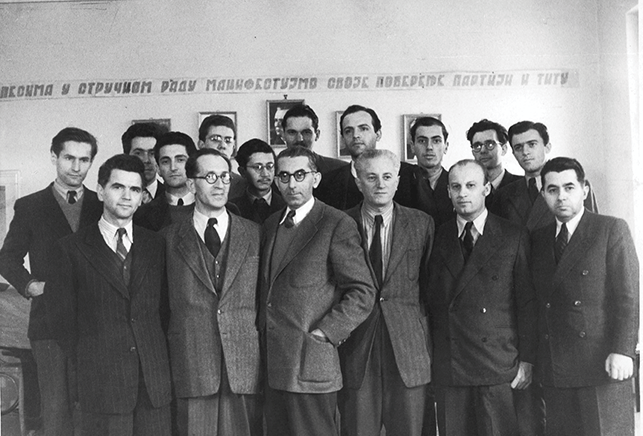
Figure 1.3 Long description
The photograph is telling as it only shows sixteen men, even though women were employed at the Academy at this time, most notably, Ljubica Marić. They are clad in formal suits and ties, looking straight at the camera. In the front row, pictured from left to right are Mihovil Logar, Marko Tajčević, Mihajlo Vukdragović, Milenko Živković, Stanojlo Rajičić, Predrag Milošević. In the top row, from left to right are Zlatan Vauda, Borivoje Simić, Aleksandar Obradović, Dejan Despić, Dušan Radić, Vasilije Mokranjac, Dragutin Gostuški, Vlastimir Peričić, Dušan Trbojević, Lambra Dimitrijević. They are standing in the hallway of the building. The banner above them on the wall reads, With success in our professional work, we manifest our trust in the Party and Tito.
Several other composers, who served as prominent music critics or repositioned themselves as musicologists, significantly contributed to the spread of socialist realism in Yugoslav cultural life. Viewing music as needing to be easily accessible and digestible by the masses, composers and critics largely favored Romantic/neoclassical aesthetics and thus advocated for moderated modernism, at best. Even during the interwar period, there was certain resistance toward avant-garde techniques. For instance, Stefanija notes that in Slovenia, the attitude concerning microtonal music changed only during the 1960s with the growing popularity of electronic music.Footnote 49 Before then, microtonal music was associated with Hába’s teachings. While many of those who studied with Hába during the interwar period, such as Osterc, regarded microtonality as “pragmatic and vital,” others were far more critical of the method.Footnote 50 For instance, in Slovenia, Srečko Koporc remarked that Hába’s theory, presented in his Neue Harmonielehre (1927),Footnote 51 was “primitive,” as it was based on the principle of “multiplication of the intervals from the current tonal system.”Footnote 52 Even those who publicly defended the new aesthetic were skeptical in private. Bravničar confessed that even though Hába’s students respected him and appreciated the consistency of his method, “no one would swear with both hands on quarter-tones.”Footnote 53
In Serbia, Miloje Milojević was a prominent critic for the respected journal Srpski književni glasnik [Serbian literary courier]. While the journal played a pivotal role in introducing European modernist tendencies to its readership, critics clearly voiced their preference for tonality and moderated modernism.Footnote 54 More specifically, as musicologist Aleksandar Vasić reveals, critics stepped into the realm of twentieth-century modernism with “only one foot” – very selectively, favoring Romanticism above all and also impressionism, with expressionism and other modernist aesthetics only in moderation and in specific cases.Footnote 55 For instance, Milojević understood Schoenberg’s music as valuable in terms of its “sensationalism” and devised purely for its “effect,” while his views on Stravinsky changed drastically from “genius” to “bizarre and incomprehensible.”Footnote 56 Regarding Yugoslav composers, Milojević showed mild support for the protagonists of modernism: Slavenski, Oskar Jozefović (1890–1941), Božidar Širola (1889–1956), and a few others. But as Vasić points out, Milojević’s writings about Slavenski, one of the most notable Yugoslav composers, can be characterized as largely neglected, lacking any clear support, and at times even questioning his aesthetic.Footnote 57
Dragutin Gostuški, who started his career as a composer but, after graduating from the Music Academy, joined the Musicology Institute of the Serbian Academy of Sciences and Arts in 1952, enjoyed a reputation as an esteemed critic and scholar. Gostuški held a particular disdain toward avant-garde music. In his 1959 critical essay, he noted that twelve-tone music was merely a “glitch” in music history, devised as a “forced attempt toward solving inner creative crisis.”Footnote 58 As for Yugoslav composers who still pursued avant-garde approaches in the face of socialist realism, Gostuški was even less sympathetic, describing them as “reactionaries.”
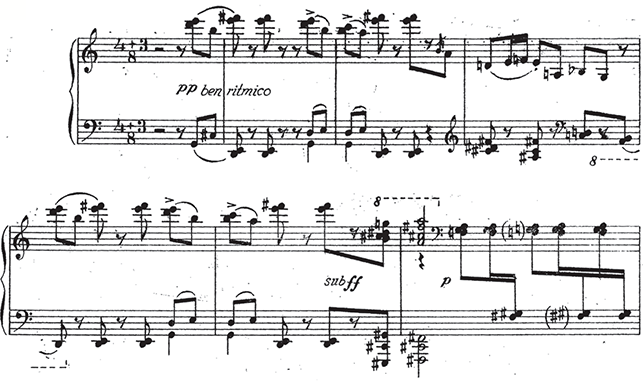
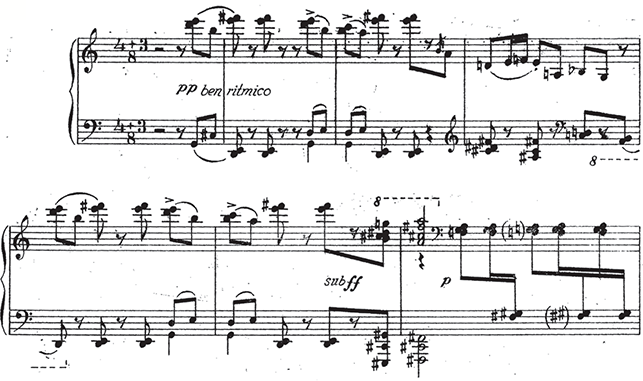
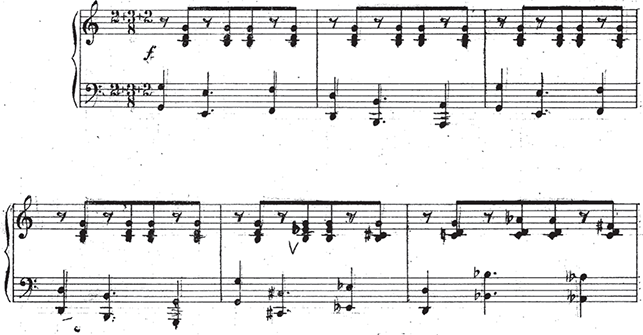
Predictably, Gostuški’s music, representative of Yugoslav modernism during the 1950s, displayed a toned-down modernist aesthetic, with (modal) folk melodies and occasional dissonant/cluster chords, as illustrated in his Two Dances for piano from 1954 (Example 1.1). The musical element in which Gostuški departed from classical tradition the most is rhythm, although not in an innovative way. As seen in the Two Dances, Gostuški notates both pieces in additive meter, which is one prominent characteristic of Yugoslav folk music, Dance No. 1 in (4+3)/8 and Dance No. 2 in (2+3+2)/8. The second dance is rhythmically less ambitious – Gostuški adheres to a regular grouping of 2+3+2 in both hands throughout the piece. In technique, style, and aesthetics, this work evokes Bartók’s dances from decades earlier. The first dance employs some more complex ideas. For instance, the perception of the 4+3 temporal organization is distorted from the very start with an awkward anacrusis, as well as irregular grouping patterns, placement of rests, and phenomenological accents that are constantly at odds with the metrical organization of the dance.Footnote 59 Nonetheless, both works feature folk motives and mostly chordal harmonies with some mild dissonances, characteristic of his entire oeuvre.
Dragutin Gostuški, Dve Igre za klavir (1954) [Two dances for piano] (Savez kompozitora Jugoslavije, Edicija udruženja kompozitora Srbije [Composers’ Association of Serbia]).
Igra Br. 1 [Dance No. 1], mm. 1–6.
Example 1.1a Long description
Written in an additive meter of 4+3 eighth notes, it shows some modernist rhythmic characteristics and also some dissonance with tritones and seconds. The piece is evocative of Bartók’s expression.
Igra Br. 2 [Dance No. 2], mm. 1–6.
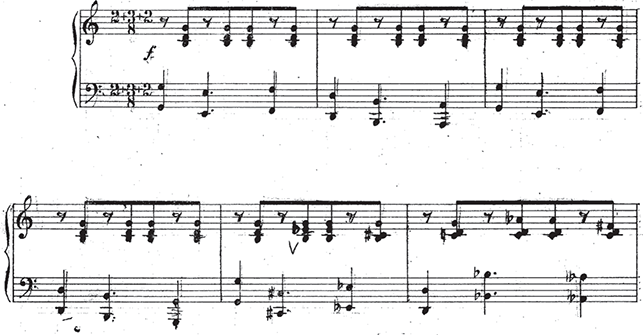
Example 1.1b Long description
Written in an additive meter of 2+3+2 eighth notes, this grouping is maintained throughout the piece, with the left hand playing octaves on the downbeat of each grouping and the right hand playing trichords on each grouping off-beat; hence, the two hands do not coincide.
With well-positioned guardians of socialist realism in all spheres of cultural life, well after Yugoslavia’s official abandonment of the doctrine in 1948, the new generation of students, those born in the interwar period, for the most part, followed the trajectories of their professors. The most radical ones – Vinko Globokar (b. 1934), Ivo Malec (1925–2019), and Milko Kelemen (1924–2018) – left Yugoslavia by the mid 1950s. The few exceptions among those who remained included Dušan Radić (1929–2010), Enriko Josif (1924–2003), and Ljubica Marić, all of whose music of the late 1950s was perceived as “avant-garde” and “unconventional” at the time,Footnote 60 especially Marić’s quarter-tone compositions. Vladan Radovanović (1932–2023) – foremost Yugoslav avant-gardist and innovator – succinctly summarized the “moderated” modernism of the 1950s as a “mixture of European music romanticism and our folklore plus occasional and moderate dissonance.”Footnote 61
But even Radovanović experimented with a moderated style during this decade. His Sonata for two pianos, celesta, and percussion (1953) is evocative of Bartók with tritone leaps, octaves with added dissonance, pitch-centric passages that shift between modal and nontonal motives, changing meters, and instrumentation.
Toward the late 1950s, Radovanović started developing his distinct, intricate style of dissonant polyphony, which he first worked out in Devetoglas [Nine-part] (1958–1959), a piece written in nine-part dissonant counterpoint. Soon after, he formulated this approach into a technique he called “hyperpolyphony” (or polyphony of polyphonies) – a texturally dense style in which individual lines and also groups of instruments are polyphonically related, with controlled aleatory. He debuted this style in 1964 with his radically avant-garde radiophonic work Sferoön (1960–1964).Footnote 62
By 1960, Yugoslav composers had reestablished a regular conversation with the West. Already by 1961, Yugoslavia was home to the Music Biennale Zagreb international festival of contemporary music, which gathered some of the most recognizable and prominent names from both sides of the Iron Curtain – from Stockhausen, Lutosławski, Kagel, Pierre Schaeffer, and David Tudor at its inaugural event in 1961, to Stravinsky, Hába, Nono, and Cage in 1963. By 1965, the avant-garde was again becoming the dominant mode of musical expression for many young Yugoslav composers of the new generations, a reaction to the restrictions and rigidity of moderated modernism and folklorism that were regarded as offshoots of the dogmatic socialist realism of the postwar decade.
Conclusion
Postwar Yugoslavia underwent a crucial political (and geographical) reordering, with the abolition of the monarchy and the implementation of a socialist structure, governed by the Communist Party and based on the economic premise of self-management. The drastic change caused cultural shock for the artists who saw their country suddenly shift from a growing, modern, urban nation, on par with major European centers at the time, to a rigid communist state with socialist realism, a dogma that directly opposed modernism. The avant-garde was now associated with elitism, which stood at odds with the principal aims of socialist realism, seeking to erase (at least superficially) the difference between social and economic classes and any prejudices based on value. While a handful of composers stayed the course and continued to experiment with new musical trends, even if in a subdued (“moderated”) format, most Yugoslav composers succumbed to the pressures of socialist realism, defending and insisting on the continuation of the neoclassical and neo-Romantic aesthetic. The avant-garde was seen as an incomprehensible style with a diminished capacity for communication. As Mirjana Veselinović-Hofman observes, the avant-garde represented a “social surplus”Footnote 63 that had no place in a country celebrating the working class.
Even though Yugoslavia officially abandoned socialist realism in 1948, the doctrine continued to be willfully implemented and guarded by composers throughout the 1950s, with its remnants visible until the 1980s. However, the opening of communication with the West in the early 1960s, the founding of the incredibly significant and renowned international festival of new music in 1961 – Music Biennale Zagreb – and the establishment of the Third Program of Radio Belgrade in 1965, a radio program dedicated to the promotion of experimental and avant-garde music, created room for avant-garde trends in Yugoslavia, which had not been experienced in the country since the interwar period.

 Open access