

A Radical Pearl Merchant’s Demand
On April 22, 1834, the exact day that the new charter of 1833 took effect, one unnamed editor of a magazine wrote to the directors of the East India Company and demanded that they throw open access to the library and museum at India House:
To H. St. George Tucker Esq., Chairman of the East India Company;–
Sir, as that abominable monopoly expires this day, I request that the subordinate Government Board, called the Court of Directors of the East India Company, will direct that you and the other servants of the Crown, service in Leadenhall, facilitate my access to the public papers and books, the property of the nation, which have been so long buried in Leadenhall. If I do not receive immediate admission I shall apply to the superior authorities of the nation. Remember! Licenses and passports are out of date. Don’t harden your hearts about what power is left.
With sincere sorrow that House and all is not already at the hammer, your most obedient servant,
The charter of 1833 dealt another blow to the Company’s corporate sovereignty and monopoly privileges. Under the conditions set out in 1833, the remaining monopoly on the China trade was lifted, the Company was to cease all trading activities and all Company property was formally transferred to the Crown, to be held in trust by the Company.Footnote 2 This last directive meant that the Company’s entire imperial infrastructure, from the presidencies to the Company ports to India House itself and everything within it, was now, on paper at least, a part of the British government. In practice, however, the Company retained control over much of that property, and in many ways operations at India House remained unchanged after 1833. But, for the author of the above letter, the new ownership arrangement made all the difference: the Company’s library and museum was now, so the author claimed, a “public” resource.
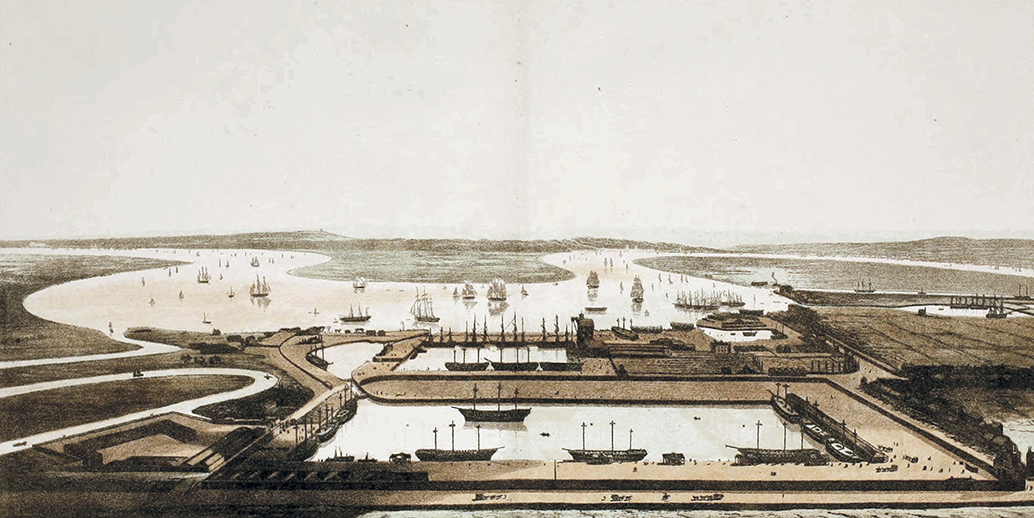
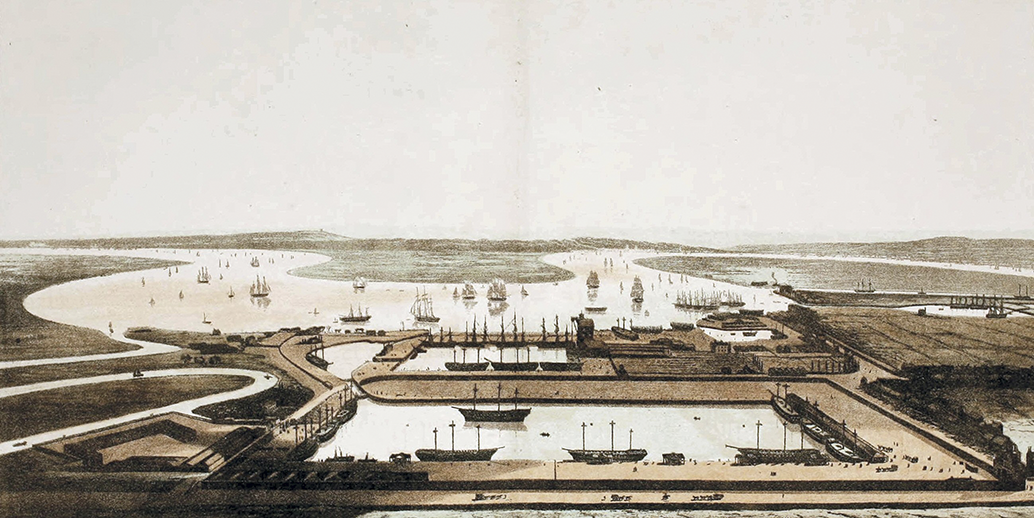
The East India Docks in 1806. The Company’s control over shipping, and the associated dominance of the London docks, was a key target of the free-trade reformers. From Wikimedia Commons. Also see Green, Henry and Robert Wigram. Chronicles of Blackwall Yard. Whitehead, Morris and Lowe, 1881.
The author is very likely Peter Gordon a writer, adventurer and one-time pearl fishery manager in Madura, who had been in conflict with the Company for years over alleged mistreatment.Footnote 3 Gordon had been back in London since around 1830, and among other things was working on a set of volumes, coauthored with John Crawfurd, on the history of China.Footnote 4 Presumably it was this research that took him into the India House library in the first place. Alexander’s East India and Colonial Magazine, which ran from 1831 to 1843, was relatively prominent, one of very few periodicals devoted to Britain’s empire in Asia.Footnote 5 According to one periodical survey from 1838, its politics were “ultra Radical” and its circulation numbers small in comparison to the other principal journal on Indian topics, the Asiatic Journal and Monthly Register (which was “conservative, but not violently so”).Footnote 6 In the years after the end of the Company’s monopoly in 1833, in the pages of Alexander’s Gordon would use the museum and library as a pressure point to expose all that was wrong, in the editors’ views, with the remaining subcontracted and corporate-shareholder structured form of British rule in India. Gordon and other critics would use the issue of access to the Company’s collections as a litmus test for the relationship between the British state and the Company. As the editors argued, if the Company had now truly relinquished its monopoly, and set aside any sovereignty claims with respect to the Crown, then the Company’s library and museum should now be run exactly as a public resource; that is, like “the other National Museum,” the British Museum and its library.Footnote 7
This chapter turns to the changing relationship between the Company and its publics – in Britain and British India – and focuses on debates and practices related to ownership of, and access to, the Company’s library and museum after 1833. As we saw in the last chapter, for one sector of the British public – naturalists, orientalists and other members of the scientific community – access to the Company’s collections was growing ever wider during this period. But in terms of visitors to the brick-and-mortar spaces of Company science, access was much more restrictive than, for example, the British Museum. As we will see, while the legal ownership of the Company’s knowledge resources could be transferred to the Crown with the passage of a new charter, just what it meant to be a “public” knowledge resource was up for debate. In this period, just as natural philosophy was resolving into separate disciplines with separate institutional structures (more on that in Chapter 7), the cultural space of knowledge production was separating into new and separate spheres: public versus private, national versus imperial, professional versus amateur. The Company’s piecemeal absorption into the British state was not so much the erasure of a historical anomaly as it was part of the very process by which “states” and “publics” came to be more clearly defined against corporations and “private” interests.
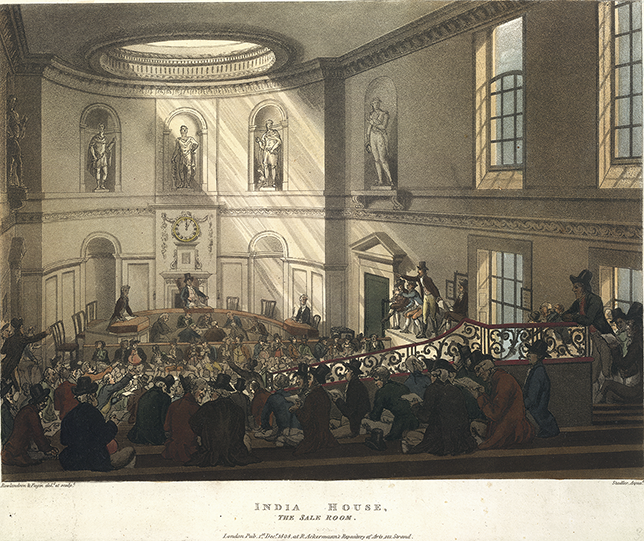
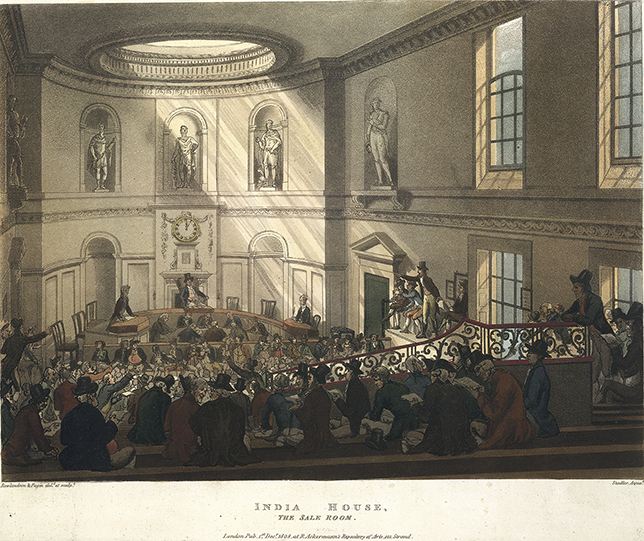
The Sale Room at India House, where until 1813 all goods from Asia (and until 1833 all goods from China) would be auctioned by the Company. By Joseph Stadler, 1808.
Historians such as Phil Stern and David Ciepley have charted the changing history of the corporate–state relationship at the level of politics and economics.Footnote 8 In what follows, I consider how the public–private status of the Company was also debated and constructed in relation to science, education and access to knowledge resources. At a time when a coherent British imperial identity was only just beginning to crystalize, the extremely convoluted property relations for the library-museum (held in trust by the Company for the Crown, which in turn held it in trust for the people of British India) raised awkward questions about the very idea of an imperial public.
The Charter of 1833: The Library-Museum in the Era of Reform
Received … 1000 cards of admission to library. Printed to order.
The 1830s were a transformative period in British culture, and these changes would bring new pressures to bear on the practices of Company science at India House. The reformist Whig party had come into power in 1830. The Reform Act of 1832 significantly expanded voting rights. By the Slave Emancipation Act of 1833, slavery became illegal throughout the British Empire. Agitation to repeal import laws (Corn Laws) that favored agricultural landholders was growing, and the working-class Chartist movement was gaining momentum. Discourses and practices of knowledge production were also reshaped during the so-called Age of Reform. With liberal utilitarianism came a push for increasing access to, and state support of, science and education. Cheap periodicals such as those produced by the Society for the Diffusion of Useful Knowledge (SDUK) were aimed at facilitating the self-improvement and self-determination of the “middle ranks” at the center of Jeremy Bentham and James Mill’s utilitarian social philosophy. The incorporation of the secular University of London in 1836 sought to break the hold of the Anglican Oxbridge colleges. Radical newspapers attacked “taxes on knowledge.”Footnote 9 Scientific societies were also swept up in the vanguard. The British Association for the Advancement of Science (f. 1831) was established as an antidote to the perceived aristocratic elitism of the Royal Society. Subsequently the Royal Society, too, changed its rules of membership and governance in the late 1830s. Attention also turned to exhibitions, museums and galleries, and to the British Museum in particular, when in 1832 and 1835 a Parliamentary inquiry scrutinized the public utility of that institution.
It is in this context that, as the next charter renewal season approached, some shareholders began questioning whether the Company had done enough to make the library and museum accessible to the public. The India House library-museum had always been described by Wilkins and the Court of Directors as a “public” repository. Although free, access was restricted through a variety of different measures. Visitors were required to have a ticket of admission, and generally only directors had tickets to disburse. Wilkins also could admit visitors without tickets, but these were supposed to only be people “distinguished by rank or science.”Footnote 10 Special arrangements would always be made for “persons of extraordinary high rank or status.”Footnote 11 It was also rumored that anyone could bribe their way in with a small gift to one of the porters.Footnote 12 Descriptions of India House and its repository appear in London guidebooks in this period, and the wider reading public also came into contact with Company science through books that drew on the collections. Edward Moor’s popular Hindu Pantheon (1810), for example, used illustrations of sculptures and drawings from the Company’s museum (and Wilkins provided the Sanskrit labels).Footnote 13
But India House was far less of a draw, and far less spectacular, than the many other cheap shows and rotating exhibitions for which London was becoming famous.Footnote 14 In the streets of London in this period, museum displays of foreign curiosities were of a piece with commercial displays of foreign commodities, and the experience of each shaped the experience of the other.Footnote 15 Across London, shows and exhibitions were integral to the booming city’s new shopping arcades and other innovations in consumer culture. For instance, at the Baker Street Bazaar, from the mid 1820s onwards, a gallery of shops sat adjacent to special exhibitions ranging from new carriage styles to livestock shows to, most famous of all, Madame Tussaud’s waxworks.Footnote 16 Some popular shows about India or China could be found outside India House, such as the spectacular panorama of the battle of Seringapatam that was installed in 1800 at the Lyceum in the Strand, and could be experienced any day of the week for one shilling.Footnote 17
Within India House in this period, consumer culture and new forms of exhibition were juxtaposed in a different way. The library-museum sat not alongside shops but the auction rooms where merchants would bid. The foot traffic that might lead to a side-trip into the displays was made up of Company employees and associates of all ranks, from sailors and warehouse workers to tea traders, shareholders and nabobs. The numbers of Company shareholders, pensioners, widows and current employees who might come to India House for business of some kind or another was by this time into the tens of thousands. Still, since no records of visitor numbers from this period survive (the earliest is the chairman telling a meeting of shareholders that about 4,000 visited in 1833), it is unclear how many people were actually wandering through the library and museum rooms when Wilkins began complaining in 1817 of the “immense crowds of all classes who have by various means obtained leave to visit the Library and Museum.”Footnote 18 At that point, ticket-bearers were admitted any day of the week except Sunday. In the custom of the public museum before 1830, visitors would be accompanied by a guide, sometimes Wilkins or (later) Horsfield, other times an assistant. Although restricted to the guide’s tour, visitors were allowed to handle objects, such as turning the crank that set Tipu’s tiger growling, leaf through some of the manuscripts and even play some of the Malayan instruments on display from Raffles’s collections. Wilkins and Horsfield also themselves fetched and returned books and manuscripts for library visitors, so the number of users is likely to have been relatively small. Peter Gordon, the radical anti-monopolist, gives one of the most detailed descriptions of the library visitor experience in 1835:
Our first object naturally was to ascertain the contents of the library; the library is not sufficiently catalogued, therefore, an actual inspection of many books was the only means of ascertaining their contents. At the British Museum, the reading-rooms are furnished with such books as the readers are most likely to have occasion to refer to, and they are placed so that each reader can help himself to them; but, at the India House, all the books are taabooed; Dr. Horsfield alone can take a book from its shelf; hence, every reader is a constant source of trouble to the assistant; so much so, that, each reader cannot but feel a great degree of repugnance to go into the Doctor’s room, and to disturb the studies of a man of science, for each book he requires, and to be quite embarrassed with the over strained politeness of the Doctor or the miserable economy of the Company which constrains Dr. Horsfield himself to perform the laborious and dirty work of a common porter, in taking down the books and bringing them to the reading desk. … The Doctor simpers and says that nothing can be a trouble to a librarian.Footnote 19
Back in 1817, Wilkins had requested that the directors cut the opening times, such that “the curiosity of the public may be liberally satisfied” without so much inconvenience for himself and the users of the library. The directors agreed to put new restrictions on visiting days, so that it was only open on Mondays, Thursdays and Saturdays between 10am and 3pm.Footnote 20 Although crowds were apparently unwanted by the librarian and visitors working in the library (who sometimes complained of the frequent growling and squealing of Tipu’s tiger coming from the display galleries), both Wilkins and Horsfield also steadily expanded and changed the displays throughout the late 1810s and 1820s.Footnote 21 Such improvements were usually presented to the directors as being required by growing visitor numbers, such as when, in March 1818, Wilkins requested
greater accommodation for the depositing of works which have greatly accumulated, and also for displaying certain works of natural history which have not been arranged for want of sufficient space … which will contribute to make the Library and Museum more worthy of the attention of the numerous visitors, among whom are to be numbered Persons of rank and science of all nations.Footnote 22
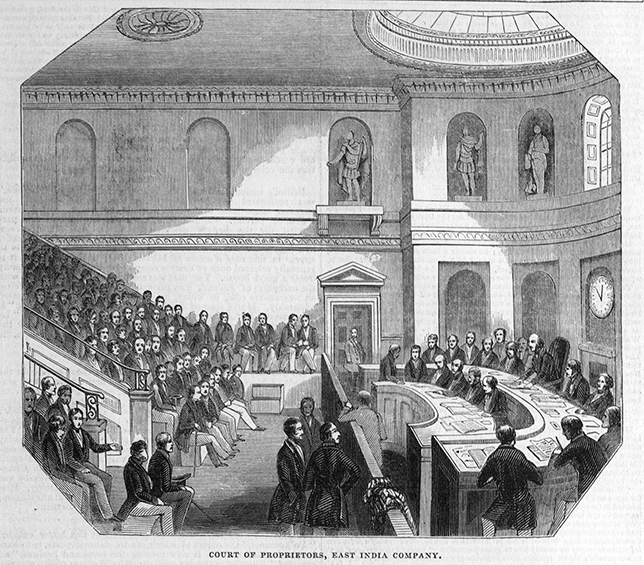
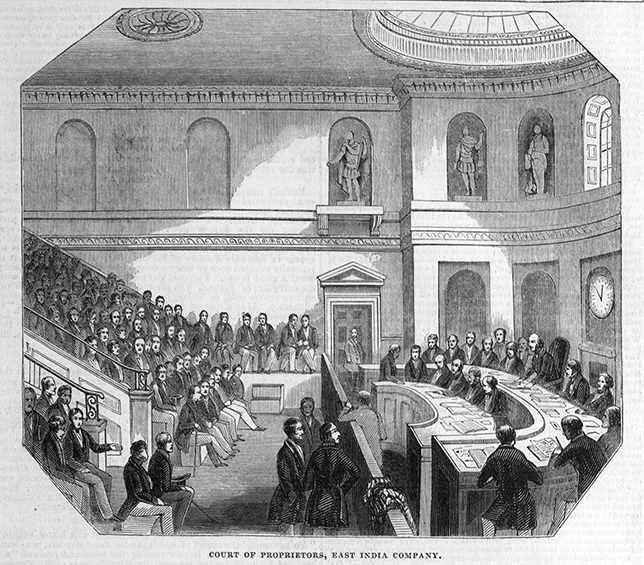
A little over a decade later, the issue of public access would re-emerge as part of the debates surrounding the charter renewal of 1833. In the Court of Proprietors (see Figure 6.3), shareholders raised questions about the running of the library and museum. The lack of museum guides or catalogs was brought up several times in the Court of Proprietors in 1832.Footnote 23 Catalogs and guides were two things that the Parliamentary Commission discovered the British Museum was doing very well, and which visitors voraciously consumed. Cheaply available, these publications were regarded by the Commission as key to making the collections as widely accessible as possible. The Penny Magazine of the SDUK, a cheap periodical aimed at working- and middle-class “improvement,” published guides to the British Museum, and the museum itself sold an affordable guide as well. The print representation of the collections was also seen by curators such as John Edward Gray, keeper of the British Museum zoological collections, as critical to the accessibility of the museum.Footnote 24
Engraving of a regular meeting of the Court of Proprietors at India House.
The Company, meanwhile, still had no catalogs for any of its collections.Footnote 25 One proprietor, Captain Gowan, repeatedly compared the running of the Company’s museum to that of the British Museum. Noting that the British Museum was now open to visitors six days a week, he proposed that India House should “meet them halfway” and open its museum to general admission three days per week. He and other proprietors also asked about the lack of labels on displays and the system of needing a card of introduction for admittance. Having heard that it was under consideration to transfer the whole collection to the British Museum (a rumor that seems to frequently crop up after 1833), Gowan seems to have been keen to make the case that the collection would be better cared for and more accessible in the hands of that institution.Footnote 26 Gowan also sometimes forcefully questioned the necessity and value of the Company running its own college, noting that even Oxford now had a Sanskrit Chair.Footnote 27 Reporting on these debates in the Court of Proprietors, Alexander’s East India Magazine took the proprietors’ complaints as evidence of the extremity of the Company’s “despotic power of expulsion” and “corrupt patronage”: “the Court of Directors persist in excluding the British Public from the Museum and Library at the India House; they also persist in refusing free access to their own constituents, and in resisting the expressed wish of the Superior Court for a descriptive catalogue.”Footnote 28
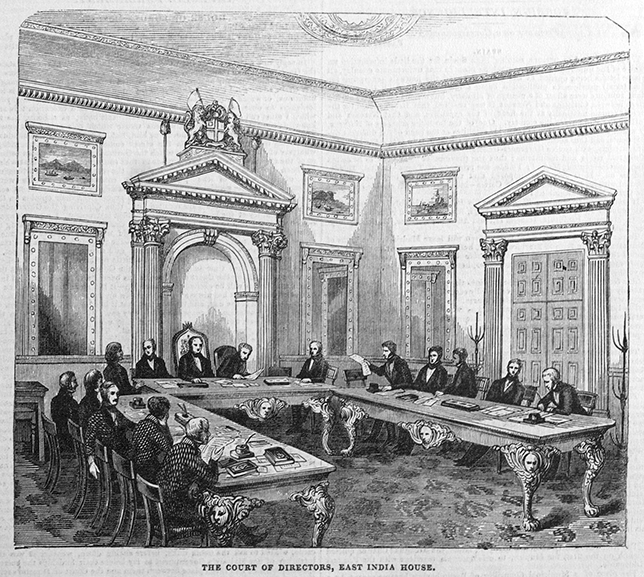
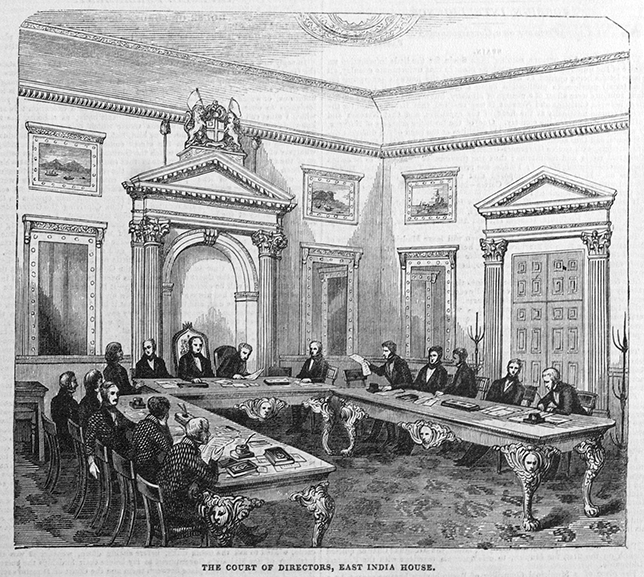
Somewhat surprisingly, the chairman and the Court of Directors (see Figure 6.4) did not reply to the shareholders by agreeing that the museum needed to improve access to the general British public. Instead, he defended the relatively closed nature of its collections as a necessity. The reason was that this was a specialized collection to be used for “serious study,” and that if the museum were “thrown open,” not only would things most likely go missing through “sleight of hand” (periodicals at the time often commented that the British public was uniquely untrustworthy when it came to acting properly in a museum) but it would also be much too disruptive to the “really useful” aspect of the collections, which was to serve the true orientalist, the scholar working on any and all topics to do with Asia.Footnote 29 In short, and not surprisingly, the directors regarded the knowledge produced by “scholarly” orientalist work as coextensive with the useful knowledge required in governance: history, languages, literature, natural history and so on. After all, this very unique scholarly culture of British orientalism had, since its early days in the late eighteenth century, been totally intertwined with the Company and its shifting position within India. In this way, no matter its ownership status, the India House library and museum was not like the British Museum because it remained very closely tied to the actual work of state. The collections sat somewhere on a continuum between state archives (which themselves were only just then beginning to become organized into standalone institutions, let alone with conventions of public access) and public museums.
Engraving of a meeting of the Court of Directors at India House.
From the first plans for the India House library and museum back in 1798, it had always been discussed as a set of institutions intended to serve the interests of the people of British India, and it was also the British Indian taxpayer who funded the administration at India House. In these debates, however, the interests of the Indian taxpayer seem to have never been brought up directly. Serving the interests of the people of India had, in this case, always been understood as having nothing to do with providing the Indian public physical access (or even virtually in the form of catalogs or guides) to what was in effect their national museum and library. The assumption seems to have been that resources were to be put to use for the good of the Indian public, without being able to be used by them. This assumption is especially striking given that, during the Parliamentary inquiry into the British Museum in 1832, reformers were greatly worried about the inaccessibility of those resources to the typical taxpayer living outside London.
Liberal reforms bubbled their way into the Company administration through many of the changes made in the Charter Act of 1833. The starkest realignment of Company politics with the growth of liberalism came with the formal end of all Company trading, and the beginning of “free trade” (though still heavily mediated by laws and tariffs) between Britain and Asia. But radicals and reformers in Britain took up the cause of “improving” British India in many different ways during the charter renewal season. The proposed instruments of improvement were often not directly political or economic (though reformers worried greatly about the economic and political status of India) but fundamentally about education. Thus, promoting the growth of science and education in India became a key focus of the 1833 charter debates. For example, the remaining restrictions on “free” colonization – British travel to and settlement in India – were increasingly under attack by those who argued they also severely limited the free movement of ideas between Britain and India. The industrialist Dwarkanath Tagore and the writer and reformer Rammohun Roy were among a group of Calcutta businessmen and reformers who made a formal petition in 1829 for the end of such restrictions on free movement as well as free trade.Footnote 30 Both saw the opening up of India to more European business and enterprise as a prerequisite for widespread educational transformation through informal interaction and communication. William Bentinck, governor-general of India during this period (1828–1835), echoed these views repeatedly. Bentinck’s governorship is often taken as the beginning of a period in which liberal utilitarian views were particularly influential within British Indian politics, and he did push for similar kinds of education-driven reforms for India as Bentham and his allies were building in Britain. He avoided wars and sought financial reform in order to create a surplus for investment in education and improvement schemes. He promoted (in anticipation of Macaulay) English-language education over native-language education, started planning for a Ganges canal system and experimented with steam navigation to improve communication.Footnote 31
Bentinck saw greater interpersonal mixing between Britons and Indians as key to raising the “mind” of India, which had been so he believed with a now-typical dogmatism, “buried for ages in universal darkness.”Footnote 32 Although praising the “superior aptitude” and “thirst after knowledge” among Indians, he believed that it was only through anglicizing Indian culture that “improvement” in India could be effected. He argued that the “rigid preclusion of the free admission of Europeans to India” had “dammed up … the main channel of improvement to India.”Footnote 33 Already by 1830 the size of the British communities in India had grown significantly, along with the scale of the Company’s government. By 1830, the Company had nearly 40,000 individuals on its India payroll: 875 civil servants, 745 medical officers and over 36,000 “European” (mostly British) troops in its Indian army.Footnote 34 Bentinck also believed that the movement must go both ways, with more encouragement for Indian men “to go to Europe; [and] there to study in the best schools of all the sciences” and, above all, to see “what India may become by [seeing] what Europe, and especially England, is.”Footnote 35
During the charter debates of 1833, the directors therefore attempted to show that the Company was deeply invested in the growth of education, specifically in “European science” and literature, in British India. Noting that they had kept up the promise made in 1813 to give substantial annual support to native education, the directors cited one report from 1826 that listed over sixty Company-supported schools, madrassas, colleges, book societies and presses. The majority of these institutions were, at that time, conducted in local languages and separate from Christian missionary schools. And, according to the directors, this investment was already opening up more pathways for natives to access skilled civil service careers. Through the disbursement of Company funding to smaller independent schools and colleges, “a considerable number of learned natives are retained, in their capacities as moulavees, moonshees, pundits and professors of the art of writing in native characters.” Similarly, medical schools were “instructing native doctors in the science of medicine with a particular view of more effectively discharging their duties as vaccinators.”Footnote 36 At the same time, with the charter of 1833 formally ending the ban of non-Christians and non-British employees in the Company’s civil service, the Company’s British-based colleges were now an obstacle to Asian subjects gaining some key civil service positions.
The subject of the Company’s patronage of education and science in Britain came under scrutiny as well, and the record of the Company’s education regime in the home country was shakier and harder to defend against the move for reform. Some close to the Company were highly critical of the financial and moral benefit of Haileybury for British India. The Member of Parliament and former chairman Richard Jenkins, for example, advocated for a revival of Wellesley’s grand plan for Calcutta College, suggesting that this was in the best interests of the people of India. In the end, the Company just barely succeeded in keeping the Company’s British colleges open. Any civil servants or military officers bound for India still had to obtain degrees from Haileybury or Hertford.
How to Break a Knowledge Monopoly
The Charter Act of 1833 transformed the nature of the Company. In the broadest terms, the Act significantly reshaped British colonialism into a now more familiar form of nation-based imperialism. In the process, both Britain and “India” resolved into more nation-like bodies. In the case of Britain, the arguably separate sovereignty of the Company was nearly entirely eroded: the Act explicitly designated India as a colony possessed by the Crown. And in the case of “India” – which at this time stretched northeast around the Bay of Bengal to include the Straits Settlements (i.e. parts of present-day Myanmar, Malaysia, Singapore) – it was for the first time united as a single administrative and legislative entity, with the creation of the governor-general of India position, and the raising of the Bengal government to the Supreme government of India, and the removal of the independent legislative powers of the Bombay and Madras presidencies. And as Tagore and Bentinck and other liberals had hoped, the Act also enabled, for the first time, the free movement of Europeans, and thus encouraged “colonization” in large parts of the new nation-like territorial entity as well as removing one of the Company’s means of monopolizing knowledge of Asia.
Eventually, the Company’s library and museum would also become more state-like and would merge with Britain’s state collections. But the process itself was not at all smooth, would take many decades to complete and wouldn’t really begin until after the abolition of the Company in 1858. One interesting immediate effect was the first disciplinary splintering of the museum collection, in this case “war trophies” being separated out from the rest of the collection and relocated. Standards and flags of vanquished powers such as those of Tipu Sultan were soon transferred over to a new naval museum at Haslar Hospital.Footnote 37 In another change, in 1838, public opening hours were eventually extended, with no tickets required on Saturdays between 11am and 3pm. At the same time, however, the directors continued to assert that the India House museum was not a public collection and that the business of empire came first. As the chairman wrote to a Member of Parliament enquiring about the museum opening times: “although the Museum in this house does not come under the denomination of a Public Institution, the Court feel happy in consenting to its being opened to the inspection of the public so far as may be practicable with reference to the business transacted under its roof.”Footnote 38
Another attempt at accommodating the public view within the necessities of the “business transacted under its roof” was a new policy explicitly barring visitors from copying or extracting “official documents” or other designated materials from the library, with the interesting exception of “documents of a literary or scientific character.”Footnote 39 It seems to have been Peter Gordon, the anti-monopolist, who prompted the Committee to clarify what visitors were and were not allowed to transcribe.Footnote 40
The effects of the charter can also be seen in some changes to the collecting and patronage patterns for the library and museum. For example, after the rules for British travel to India became less restricted in the 1830s, the Company’s control over exploration and travel writing would weaken, although expeditions into most inland areas still needed approval from the Company. For example, the well-known traveler and writer Emma Roberts, author of Scenes and Characteristics of Hindustan of 1836, made her career with the financial support of the periodical press (and only the tacit support of the directors). In 1839, she arranged a sponsored trip sponsored by the Asiatic Journal and Monthly Register who serialized her “Notes of an Overland Journey through France and Egypt to Bombay in 1839,” and the directors supported her expedition with a substantial subscription.Footnote 41
By far the biggest challenge the new charter created for the library and museum had to do with the new ownership status of the India House collections. Now that all Company property had been transferred to the Crown, the formal ownership status was clear, but the future physical location seems to have been in doubt. We have seen that some shareholders were now bringing up the possibility of merging the Company’s collections with the British Museum. In the week that the new charter took effect, a London newspaper reported on the “important alterations” now taking place at India House since the new “arrangement” between the Company and government: some clerks and officers had been dismissed; others were now planning to retire; Haileybury College was (to the paper’s surprise) not going to be broken up; “a great portion of the premises of the East-India House will become useless to the Company, in consequence of the loss of the exclusive trade with China and other commercial arrangements”; and “we have not heard whether the museum is still to remain in the East India-House, or the Library, which consists of a great number of scarce books and valuable manuscripts [will be moved].”Footnote 42
Ultimately any decision on the location of the library and museum depended upon whether or not the British government agreed that the library and museum constituted part of the material necessary for the governance of India. This was an issue emerging from the state-like nature of the Company. However, there was also another set of issues emerging from the corporate nature of the Company: how the Company’s privileged possession of two centuries’ worth of commercial knowledge might impact the opening up of the India trade to other British firms. Were critical trade secrets being kept locked up at India House? Was the Company doing enough to support the interests of British merchants and traders? Was the ability of British manufacturers to increase sales in India, or export raw materials for their factories, being hindered by the natural monopoly now maintained by the library and museum?
The potential commercial value of the knowledge resources held within the Company’s library and museum would frame one attempt by another institution to take over management of the Company’s collections. After 1833, amidst the discussion about the future of the India House library and museum, one possibility being considered was to transfer the whole of the collections to the Royal Asiatic Society.Footnote 43 Could the apparent or possible conflicts of interest over the Company keeping control of its library and museum be resolved by transferring it to a specialized third party such as the Royal Asiatic Society? With the prospect on the horizon, the members invited the writer William Cooke Taylor to remark on the “Present State and Future Prospects of Oriental Literature in 1835” to essentially make the case for the Royal Asiatic Society as the proper future home for the India House collections. Taylor opens his remarks with a nod to the utilitarian fashion of the moment:
It may seem strange to connect Oriental commerce with Oriental literature, and many may deem the association unnatural; but no country in the world is more thoroughly utilitarian than England; in no other nation is it so difficult to introduce a new object of study … without demonstrating its immediate pecuniary advantages.Footnote 44
Taylor goes on to press the real economic utility of orientalist study to the nation. Essentially he takes the Company’s still semi-sovereign defense of keeping the library and museum for reasons of (Indian) state and turns it back around to a properly (to him) imperial alignment: yes, the library and museum is essential to the work of the government of India, but as the Indian state is now formally subsumed under the Crown, its success and improvement, its relationship to the mother country, is now a matter of concern to all of the people of Britain, and – most importantly – a possible source of commercial gain for all.
Taylor also argues that the Royal Asiatic Society is deserving of the patronage and support of not merely scholars of the orient but also “all engaged in the commerce of the East, all who derive advantage from general traffic.”
The RAS [Royal Asiatic Society] is designed to be the great storehouse of intelligence for all who desire information respecting the present state of trade and capabilities of all the countries between the Eastern Mediterranean and the Chinese seas. … Were its advantages as clearly understood as they ought to be, it would have a branch in every port and a member in every counting house. In nothing more than in trade, and in no branches of trade than in those between England and eastern countries, has the truth of the aphorism been demonstrated, that “KNOWLEDGE IS POWER.” … But there are too many in the world … who desire much to see the power increased and perpetuated, but neglect the knowledge which is its first element.
The Royal Asiatic Society was far from alone in gravitating toward work that was considered to be useful to British trade and industry, or in presenting collections as central to the development of commerce and trade. The spectacular expansion of industrial production in the first decades of the nineteenth century also coincided with a growing chorus of doubt and worry about the effects of such growth on the quality of design and the scope of industrial innovation. The potential for museums to support manufacturing and improve craft and industrial design was just then beginning to be promoted; similar claims were made, for example, in the House of Commons Select Committee Report on Arts and Manufacture of 1835.Footnote 45
It is in this wider context that those who were really pushing the Company and the British state on this question of access to commercial knowledge at India House were often reformers and traders invested (either economically or ideologically) in the growth and expansion of trade with Asia. Peter Gordon was among the most vocal critics. It is unclear how invested Gordon really was in the future of the India trade (or of the Company’s library-museum), but the Company’s repository was especially useful to Gordon’s crusade precisely because of the apparent contradiction of access to a publicly owned collection being managed by a corporation of shareholders (“publicly owned but kept very private”).Footnote 46 For Gordon, it perfectly encapsulated how out-of-synch was the very existence of the Company with the era of free-trade reform; the library-museum is the one incongruously uncorrupted “object” hidden within the otherwise degenerate body of the Company, and as Gordon dramatically suggests, it will be the undoing of the whole thing:
The library at the India House has been hid from the notice of the Crown, the Parliament and the People in the immense mass of corruption which has hitherto filled every apartment of the India House, but now that the Company of merchants has been compelled to give up its commerce, its museum stands forth as a conspicuous object; indeed it is so conspicuous that the Directors, who were merchant kings, seem likely to dwindle into puppet show men.Footnote 47
Gordon’s attention was also drawn to the Company’s library and museum in the context of a records crisis at the level of the British government. In October 1834, the old Houses of Parliament burned to the ground. The fire was caused by an attempt to clear out some of the old archives. Bundles of wooden tally sticks used in accounting were added to the basement furnaces, causing them to overheat, and burning all the rest of the archives along with the entire building. In the wake of that fiasco, Parliament set up a Commission to investigate the state of public record-keeping in Britain, a move that would eventually lead to the establishment of Britain’s first Public Records Office. Gordon, however, was focused on the differential treatment being given to colonial public records versus British public records by the Commission. Why, he asks, isn’t government treating the Company’s library and museum as the “national” collection that it is? Shouldn’t the Public Records Commission survey include the India House archives and records, and, in fact, all of the libraries and archives in British colonies? Shouldn’t the Commission reports be sent throughout the empire, and not given only, as the Commission had done, to libraries and archives in the UK? Gordon is essentially telling the government to act like the empire it now is and take more direct control of the records of its vast territories. (The Commission is called the “Public Records Commission of the United Kingdom” but Gordon refers to it as the “Public Records Commission of the Empire.”)Footnote 48 Worst of all, he argues, is the situation at India House: “The libraries of Benares, Arcot, Tanjore, Seringapatam and Poonah have been plundered of their contents, which now lie rotting in the cellars of Leadenhall, corroded by damp and covered with dirt. The state of the archives, libraries, colleges, and schools of every portion of the British empire is constitutionally a proper subject for a grand jury to investigate.”Footnote 49
According to Gordon, Government, by its inaction, is allowing the Company to continue to hoard and neglect materials that the public now has a right to access. The “public” of the “Public Records Commission” is being (provocatively) understood as a trans-imperial entity, an imperial public, which has equal rights to knowledge of the records of its government:
In India, from time-to-time, severe threats are promulgated against officers, copyists &c who presume to reveal the secrets of the offices in which they are employed. We hope that every literary society in each colony will immediately apply to the British government for a copy of the publications of the Commission on the Public Records of the kingdom; the library at Arbroath [a royal residence in Scotland] has received a copy of the Board’s publications, and surely the libraries at Colombo, Sydney, and Hobart Town have as good a claim as those at Arbroath and Lubeck, unless every British colony is to be branded as a Lubberland [i.e. lazy, unproductive].Footnote 50
Government is here, by excluding colonial archives and libraries from the remit of “Public Records,” failing to embrace the reality of the newly unified imperial sovereign and the new geography of the “public” under British law.
The Company, according to Gordon, is, in its turn, further exploiting this government inaction by actively mismanaging the collections. Gordon essentially claims that the Company is maintaining its knowledge monopoly through criminal neglect and mistreatment of the library resources, which amounts to a passive way of blocking public access. Gordon argues, for example, that the Company uses the library and museum as a personal treasury, selling and gifting items for profit. As proof of “the extreme impropriety of continuing to employ the India directors as the curators and conservators of a National Museum,” Gordon relays a story about the directors misusing the ”invaluable collection of Indian coins” and melting down ancient “Dariecs” (Daric coins) found buried near Benares.Footnote 51 Although no record of coin melting has been found, the library day books record numerous occasions where items were brought into the warehouse and then sent out as presents, or (less often) where precious items were taken out of display and made into gifts. Some of these gifts were very publicly made, such as the gold tiger’s head and other precious items captured from Tipu Sultan that were presented to the royal family in 1832 just before the charter renewal debates began.
Even more, the pages of Alexander’s detail the criticisms familiar from other visitor guides and the shareholder debates: lack of opening hours, few guides, no catalogs, unsystematic and unhelpful labels on objects, and the system of needing a card of admission provided by a director or curator. Gordon remains particularly focused on the lack of catalogs for the Company’s library and museum. Gordon suggests that the lack of good documentation and access is willful and favors the ongoing corrupt rule of the Company. Of the chairman, “his grand secret is to keep [Indians] in a state of profound ignorance … naturally enough this monster seizes upon all records, and locks up those which he does not destroy.”Footnote 52 Noting that the Company has long experience in producing catalogs for its auction sales, Gordon argues that the Company’s “Manuscripts, Books, Antiquities, Maps and Medals certainly deserve some degree of the care which is bestowed on compiling Catalogues of the Company’s ‘old musty’ ‘tarry flavoured’ teas.”Footnote 53 But as the Company refuses to make the collections accessible through proper documentation, Gordon sets out, as he tells his readers, to produce a catalog and guide to the library himself.
The first installments of his guide to “The National Library at India House” were published in Alexander’s between 1834 and 1835.Footnote 54 Gordon begins by again reminding the readers that they should think of the Company’s resources as a public asset.Footnote 55 The “guide” then goes on to detail the shoddy functioning of the library as a research institution, purposely underfunded, with the curators woefully overworked. But then, about two issues into the guide, in a dramatic turn, which Gordon relays in real time (“This article has been cut off, abruptly, by the receipt of the following letter”) after the directors receive a copy of Gordon’s Guide, they revoke his permission to access the library and museum. This “censorship” gives Gordon and the Alexander’s editors much more fire, and they continue probing and attacking the Company library and museum from afar.
In Gordon’s attacks on the Company’s library and museum, there is always a lack of clarity in which people, he believed, rightfully own the India House collections. At one point, he argues that the right thing would be to “force” the “tyrants of Leadenhall” to restore the “records of India” to India. But at other points it is also argued that the Company (and thus the government of India) is so in debt to the British government that its records should stay in British hands.Footnote 56 Gordon’s more common suggestion is that “The [India House] museum and library should immediately be removed to the British Museum where they would be accessible to every person.”Footnote 57 The corrupt management of the Company is certainly seen as detrimental to the interests of India, but, to be clear, that is the case only because it stands in the way of liberal improvement that would anglicize the whole system and, ultimately, increase British trade with India. The Company is therefore (as is a common trope in the Anglicist literature) painted as an old Asian despot itself, having adopted the old “corrupt rule of the ancient rulers of India”:Footnote 58
Look at the rights of the cultivators of India – ask about the pergunnah rates – the tenure of land – the nature of slavery – the laws of caste – the rights of heads of families – the modes of trial – or any other important subject; and instead of finding it defined as by an English record, we find it uncertain as a Mahratta chieftain would desire, so that whenever occasion offered, he might intermeddle, and raise a dispute with his weaker neighbour.
In the end, Gordon’s attacks seem to have had little effect on the question of whether the Company’s collections should be moved out of India House and merged with the British Museum. The Royal Asiatic Society (which Gordon had claimed was almost as corrupt as the Company itself – it was “Philip sober” whereas the Company was “Philip drunk”) was also unsuccessful in its bid to take control of the collections. However, in a move likely intended to appease such criticism, the directors did introduce one major change to the running of Company science at India House. In 1838, a new position was created: the reporter on the products of India. The first post-holder was John Forbes Royle. Royle was born in Cawnpore, India, was sent back to Britain for his education at Edinburgh High School and then Addiscombe, and returned to India in 1819. For nearly a decade he was the director of the Company’s botanical garden at the former Dutch factory town of Saharanpur. He had arrived back in London in 1831 – yet another Company surgeon-naturalist with a rare collection in tow. Royle had wide-ranging interests, but he became known as a “pioneer of economic botany,” as the distinct branch of botany focused on economically useful plants came to be called.Footnote 59
The Office of the Reporter on the Products of India represented a new articulation of how the India House repository served not only British interests but also, so it was argued, the interests of the Indian taxpayer. Royle’s office was meant to aid the “improvement” of India by, very specifically, increasing commercial trade between Britain and India. By 1850 this commerce-based economic route to India’s improvement had, within the world of Company science in London anyway, begun to eclipse the earlier discursive focus on creating consilience on the grounds of artistic and literary exchange and translation. The market was to be the new meeting place and site of mutual benefit. And, as we shall see in Chapter 7, the Great Exhibition would allow Royle and his contemporaries to push this vision of the economic utility of museums to entirely new heights – with unexpected results.
Fossils in the Old Pay Office
Although possibly through no influence of Gordon and the radical anti-monopolists, the India House library and museum did, in the 1830s and 1840s, slowly open up access to the public, increase gallery spaces and finally begin publishing catalogs. Change came to the running of the museum and library in 1836, when Charles Wilkins, at eighty-six still in charge of the library, became ill and died soon after. Instead of succeeding Wilkins, Horsfield was given a separate position as naturalist and curator of the Company’s museum, and an orientalist was sought to head the library. The Company succeeded in hiring one of the most prominent orientalists in Britain, Horace Hayman Wilson, who had recently been hired to the first chair in Sanskrit studies at Oxford. Wilson, the son of an accountant of the Company, went out to India as a surgeon in 1809. He had been trained at St. Thomas’s Hospital, London and, as he explains it, turned to the study of languages on his outward voyage when a fellow passenger from India began teaching him Hindustani.Footnote 60 Once in India, he was hired by Dr. John Leyden, assay master at the Calcutta mint, as his assistant. Wilson took over from Leyden in 1816, and remained assay master until he returned to Britain in 1833. By 1811 Wilson had joined and (with Colebrooke’s aid) become secretary of the Asiatic Society of Bengal. In 1813 he published his first translation, The Cloud Messenger (a translation of Kalidasa’s Meghadhuta), and in 1819 he published a Sanskrit–English Dictionary. Wilson was also involved in the education debates of the 1820s, was on the board of the School Book Society and the Hindu College, and was secretary for public instruction in Calcutta.Footnote 61 While in Calcutta, Wilson had already delved into Company collections, publishing the first catalog of the vast (and controversial) Mackenzie Collection. The massive catalog was printed at great expense at the Asiatic Society’s press in 1828.Footnote 62 He was known for his opposition to the requirements of Christian instruction, evangelization and attempts to regulate Indian religious practices (he even opposed Bentinck’s very public and popular measure to abolish suttee), all of which put him in favor with many of the Indian scholarly and political elite in Calcutta but made him less popular among some circles in London. All of this makes it even more surprising that Wilson would in 1832 be elected as the first Boden professor of Sanskrit at Oxford – a new position intended formally to support the spread of Christianity in India. When Wilkins died, the directors offered him the post of Company librarian, which he took on in addition to his professorship, cementing a new link between Oxford and the Company.
The hiring of Wilson and Forbes Royle and other expenditures on the museum and collections at India House are especially notable in this period after 1833, during which time internal “reform” was slashing the number of clerks, which sunk from around 200 in 1828 to 56 in 1844 (the smallest administration since 1765).Footnote 63 These were also years of financial strain, as Company profits declined and its expenditure, especially on border wars, continued to grow. But the positions devoted to information management continued to multiply. By at least 1847, India House also had a “statistical office” with eight clerks.Footnote 64 There are other signs that the charter of 1833 stimulated an expansion of investment in the sciences at India House. The astronomer and natural philosopher John Herschel was asked to be a general scientific advisor to the Company in 1838.Footnote 65 Although Herschel declined, from the late 1830s onward the directors were much more often seeking advice from the Royal Society, and the exchange of publications and reports (especially astronomical, magnetic and meteorological records) between the India House library and the library of the Royal Society was increasingly frequent.
The increase in curator positions after Wilkins’s death would have been a welcome addition given the growing scope of the Company’s collections. Throughout the 1830s and 1840s, the India House collections expanded much faster than in the previous decades. With so much material coming in, much of the curators’ work involved managing the inflows. Wilson was dealing with a steadily increasing amount of library material, particularly printed matter sent from India. By 1830, four daily English newspapers and multiple weeklies in both Bengali and English were being printed in Calcutta alone, and the India House library was meant to receive and retain copies of all of metropolitan newspapers and journals published in India. Printing technology was now in the hands of not only the presidency and missionary presses but also book publishers and state-civic associations such as the Calcutta School Book Society and the Bibliotheca Indica series published by the Asiatic Society of Bengal. And even in Britain, the number of books coming out on topics related to Asia or to the Company was higher than ever (though nowhere near the number of Asia-printed works being gathered at India House).
Separately from the imports received and the purchases made by the librarian, the Court of Directors exercised one form of cultural patronage by way of subscription for publications. The directors were approached by hopeful authors who wrote to them and usually included a prospectus or a printed copy of their work. The most successful applications for support would result in the Company purchasing 100 copies, although this was quite rare. More often a large subscription would be forty copies of a work; less fortunate authors would be granted only six, or often just one subscription. As the century progressed, the number of authors who approached the Company slowly increased. Some of the successful authors were well-known, successful writers; others were Company servants or were connected to the Company in some way.
In 1844, the first year exact visitor numbers are available, 16,003 persons are recorded in the visitor books, and the numbers would grow slightly until the Great Exhibition of 1851, when the numbers would jump significantly (from 18,623 in 1850 to 37,490 in 1851).Footnote 66 Despite the criticisms of reformers and anti-monopolists, the Company’s collections were still largely considered private property; the now formally national character of the Company’s collections seems not to have made a very wide impression. The Saturday Journal reports on the extended opening times with a brief review:
A SMALL museum at the East India House is now open freely to the public on Saturdays. The day is rather an awkward one for the majority of London sight-seers; but as the museum is, of course, private property, that is, the property of the East India Company, it is a privilege to be admitted to see it on any day that the directors may choose. It would add considerably to the privilege if the objects in the museum were labelled with a few descriptive particulars, which might inform the visitors, not merely of names, but of history, meaning, or use.Footnote 67
The Penny Magazine also published a guide to the India Museum in 1841 after learning that the India House collections were now open to the public without an admission card from 10am to 3 pm on Saturdays.Footnote 68
In 1851, Henry Greene Clarke, who also published pamphlet guides to other national collections (including the British Museum, the National Gallery and the Naval Gallery at Greenwich Hospital), published a short guide to the museum at India House, which depicted the galleries as needing more English-language labels, difficult to access, poorly lit and sometimes small, cramped and “subterranean.”Footnote 69 Guidebooks from the 1840s and 1850s usually stressed two things about the Company’s library and museum. First, it was one of very few London museums that could be accessed free of charge, especially in East London.Footnote 70 Second, generally India House was still in 1850 the only place where one could see a large amount of material from India, Southeast Asia and China on permanent display.
One material effect of the charter of 1833 was that some of the most spectacular spaces inside India House – including the auction rooms and pay offices – were now redundant. By the mid 1840s, the museum was expanding into new rooms in India House. From the time Horsfield took over as curator, a steady stream of museum construction, expansion and improvements were presented to the Court of Directors, which almost always approved the expenditures. In 1837, Horsfield had five large glazed cases constructed for specimens of birds and other specimens from Assam and Madras.Footnote 71 The floor space of both the library and the museum continued to expand and, while Wilson kept building bookshelves, Horsfield kept building cases.Footnote 72 The old pay office, one of the largest rooms on the ground floor, was now refitted on the model of the British Museum but “of course to a much more limited extent” to house large archaeological finds (“various articles of ancient Hindoo Sculpture”) and natural history specimens. Additional rooms above the original library and museum rooms were given over to an expanded natural history display, particularly focused on Horsfield’s collection of birds and insects.Footnote 73
In these ways, within India House, by 1850 the everyday work of imperial administration ran alongside the everyday work of museum management. Every September the library and museum would close to the public and extra hands would be brought in, cleaning the rooms and all the cases, doing repairs, and preparing and mounting specimens.Footnote 74 Such maintenance continued on a smaller scale all year long. Printed matter had to be sent to the binders. Specimens also had to be stuffed, pinned or otherwise prepared. Some of this – likely the insect preparations – Horsfield did on his own; in addition to paper, ink and candles, the library and museum also regularly purchased large quantities of pins. By the early 1850s, the Company’s entomological collection was, according to some entomologists, beginning to rival that of the British Museum.Footnote 75 Throughout 1830–1 several hundred specimens were sent to taxidermists, for example the ornithologist and preparer John Gould. Gould (whose Birds of Asia of 1850 would be dedicated to the Company) would sometimes be paid for his taxidermy work with bird specimens selected from the Company’s collections.Footnote 76
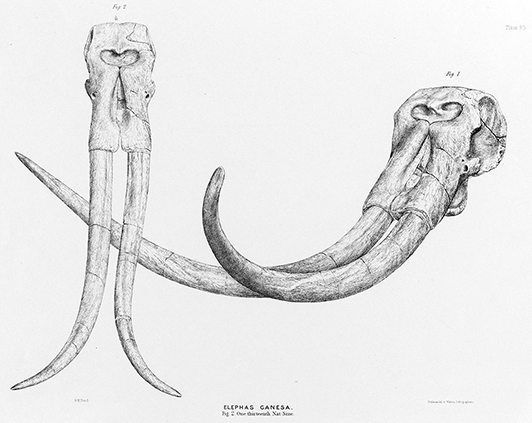
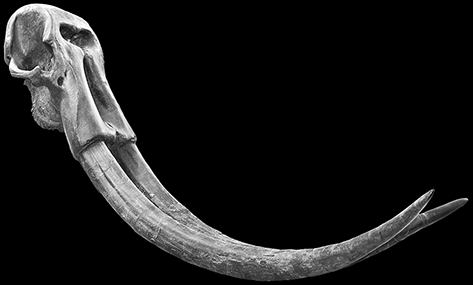
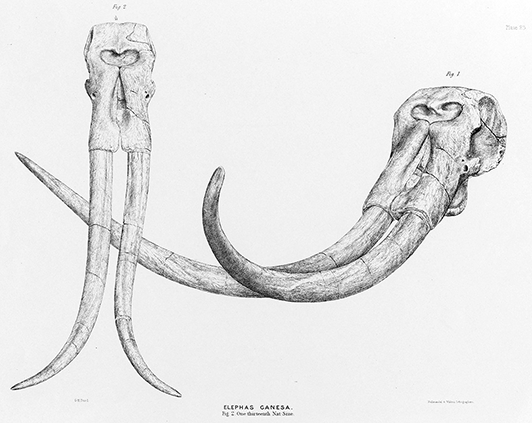
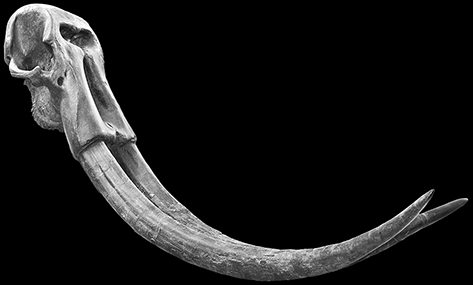
Perhaps the most elaborate new natural history preparation and display at India House involved the Siwalik Hills fossils from northern India (see Figures 6.5 and 6.6). The fossil collection made by the naturalist Hugh Falconer (1808–1865) and engineer Proby Cautley arrived during the 1840s. Soon after graduating from the University of Edinburgh in 1829, Falconer went to London to assist Nathaniel Wallich on his cataloging of the herbaria from Calcutta. At the same time, he also assisted in the cataloging of John Crawfurd’s fossil collections that had been extracted from the banks of the Irrawaddy during a diplomatic trading mission to Ava (Myanmar), which Crawfurd had donated to the recently established Geological Society. Falconer succeeded Royle at the Saharanpur Gardens (see Figure 7.2) in 1832, and would take up a professorship of materia medica at the Calcutta College, and superintendence of the Calcutta Botanic Gardens, when Wallich retired in 1848. Some fossils had been uncovered by the Bengal engineers during work clearing riverbeds for the construction of the Doab canal. Between 1834 and 1839, and relying on local sources – Falconer mentions in particular scrutinizing Ferishta’s History of Dekkan (a Company-sponsored English translation of an influential seventeenth-century Persian work) and tracking down a rumored gift to a raja of a giant elephant tooth – Falconer and Cautley, an engineer, surveyed the Siwalik Hills at the base of the Himalayas for fossil remains.Footnote 77 Their discoveries would be by far the largest yet found by Europeans in Asia; huge deposits of fossil remains of many reptiles and mammals.Footnote 78 From Calcutta, the Nautilus shipped on July 1, 1841 with 187 crates of fossils.Footnote 79 Falconer arrived back in London in 1841 with eighty more crates, and Cautley sent along another twenty-two cases, which arrived in August 1844. The shipments were so heavy that special arrangements had to be made with HM Treasury in order to allow the arrival to be duty free.Footnote 80
In agreement with the directors, the British Museum was given a large set of Falconer and Cautley’s collection, and Falconer’s work on his collection in the British Museum is well known.Footnote 81 But Falconer (with the aid of Horsfield and Wilson) was at the same time supervising the preparation and display of an extensive and only partially duplicate set of fossils at India House. The directors had seen to it that “a room will be appointed in this house for the reception of the collection of fossils made from the Himalayan Range and for its use in the suitable arrangement of the Collections during his furlough.” (The same letter also informed Falconer that his botanical collection from Saharanpur was in transit “for the court and will be taken charge of by Dr Royle and Dr Horsfield.”)Footnote 82 With the aid of Falconer, Wilson convinced the Court to hire the same assistants Falconer had employed in the British Museum, to continue the delicate and laborious process of “freeing similar specimens from the earthy matter by which their true forms are, in a great measure, concealed.” The stonecutter Frederick Pullman and two assistants spent at least a year at India House working on extracting the fossils.Footnote 83 And once this was done, he was retained for another few years in order to make plaster-casts of the fossils for distribution to other museums and universities.Footnote 84 Pullman was recommended to the directors as highly experienced, having, for example, “cleared the mastodon’s head” (the large mastodon skull was one of the most famous of the British Museum collections), and at the same time cheaper than either “artists” or “lapidaries.” Still, when the directors questioned the need for India House to enter into fossil cast production, Horsfield stepped in to explain that such casts would be a kind of currency with which the Company could purchase missing specimens for its own collections:
[Pullman’s] labors have produced a series of specimens which the geologists of Europe will appreciate and be compelled to refer to, from their absence from the cabinets of the Continent or the British Museum. Nevertheless, the series is not complete, and gaps can only be filled up by Casts of Specimens from Continental collections or from the British Museum, but these casts can most readily be obtained by an interchange of Casts from the Company’s rare specimens.Footnote 85
By 1850 sets of casts were regularly being requested by different institutions and sent out to them; for example, the University Museum Stockholm and the naval museum at Haslar Hospital received “a complete series of Casts of the Himalayan Fossils, in five cases,” while the Ludlow Museum of Natural History received “a Cast from the Head of the Rhinoceros … from the Siwalik Hills.”
All of this growth, together with the greater opening to the public, presented by Wilson as “the improved condition of the library,” as he put it, suggested it was time for a catalog of the printed books.Footnote 86 Printed in a run of 1,000, this was the first catalog for the Company’s library or museum. It would soon be followed by numerous other partial catalogs of the museum. The first major published museum catalog, Horsfield’s catalog of mammals, was printed in 1851, just in time for the opening of the Great Exhibition. A catalog of the Company’s collection of birds followed in 1854, and an insect catalog was published in 1857.Footnote 87 Meanwhile, in 1841, Wilson had produced a descriptive catalog of the coins and antiquities from Afghanistan in the Company’s collections. Many of these had been plundered and purchased before the first Anglo-Afghan war by the agent Charles Masson.Footnote 88 Wilson had also continued to publish Sanskrit translations, as well as, in 1840, two books on Hindu history and religion.Footnote 89 Catalogs, books and expanding exhibits were just a few of the ways in which the knowledge resources of the Company were increasingly on the move.
*
After the end of the Company’s monopoly and the transfer of the library and museum to Crown ownership in 1833, the Company’s scientific and educational institutions in London could not easily be resolved into a British “public” institution. The 1833 charter was just the beginning of a long and convoluted process that would remake the Company’s knowledge monopoly into a public knowledge resource in Britain. In this way, in the first decades of the Age of Reform, the brick-and-mortar library-museum at India House was not only a mediator between visitors and the idea of “India” in Britain but also a mediator between reformers and the idea of “empire.” Historians have argued that, in the eighteenth century, the Company’s expanding empire was significant in forging a sense of “Britishness.”Footnote 90 Now, as the monopoly was unwound, the question of how the Company’s knowledge resources should be managed became one of the many issues through which the sense of “British imperialness” and in particular the idea of an imperial public would be established.
The Company’s piecemeal absorption into the British state was not so much the erasure of a historical anomaly as part of the very process by which “states” and “publics” came to be more clearly defined against corporations and “private” interests.Footnote 91 While these issues stemmed from the old state-sovereign elements of the Company, other issues stemmed from the corporate-shareholder structure of the Company. As British manufacturers and merchants sought to increase the India trade, the Company remained a target of criticism, and in this context the directors were accused of hoarding knowledge essential to the development of free trade between Britain and India. The new position of the reporter on the products of India was likely intended to address some of this criticism by actively focusing on disseminating commercially useful information. But in practice, as we will see, Royle’s position at India House was equally tied to a “commercial public” as well as a “scientific public,” two categories that very often overlapped. To be sure, from the radical perspective of Alexander’s, the shared club culture of the monopolists and the scientists was nothing to celebrate. Its pages ridiculed the tight connection between the Company (“Philip drunk”) and the Royal Asiatic Society (“Philip sober”): the former were “men incorporated for the wicked and corrupt purpose of plundering India”; the latter were “the self-same men meeting in their better moments to make some return for the evils they inflict upon the people of India.”Footnote 92 Clubs and societies were also the point where scientists in Britain increasingly were able to plug directly into the Company’s knowledge resources and build upon the resources provided by the Company’s former monopoly and still paid for by British Indian taxpayers. In the contemporary discourse on the utility of these rapidly expanding venues for self-improvement and rational entertainment, the incongruity of British India’s “national museum” being located thousands of miles away at India House could not have been more acute.
Illustration of a reconstruction of a Stegodon skull, which Falconer classified as “Elephanta Gansea,” plate 23, in Falconer, Hugh and Proby T. Cautley. Fauna Antiqua Sivalensis, Being the Fossil Zoology of the Sewalik Hills, in the North of India. Smith, Elder and Co., 1846. Also see Falconer, Hugh and Charles Murchison. Description of the Plates of the Fauna Antiqua Sivalensis. R. Hardwicke, 1845.
Reconstructed fossil skull of a Stegodon, an extinct genus of proboscidean, collected by Proby Cautley and Hugh Falconer in the Siwalik Hills in the late 1830s.

 Open access