

Introduction
The number of people migrating has increased globally. International Organization for Migration (2024) reported an increase of approximately 87% between 2020 and 2024, from 150 million to 281 million. Migration is a natural and perennial phenomenon, but it is becoming increasingly complex and political, with major host countries in the West tightening their migration policies (Berberich Reference Berberich2024). Despite these happenings, Nigerians are increasingly emigrating to the West, with many more expressing intentions to do so (Alabi and Olajide, Reference Alabi and Olajide2023). For many young people in present-day Nigeria, leaving the country is a priority, a matter of urgency, and the only solution to escape perennial socio-economic and political uncertainties in the country (Ikuteyijo Reference Ikuteyijo and McLean2020; Liu Reference Liu2024). This is to the extent that young Nigerians take loans and sell their assets to fund the cost of migration (Aina Reference Aina2023). Some educated Nigerian professionals resign from ‘well-befitting’ jobs to migrate on student visas and to engage in jobs that are less professional and require little or no education (Alabi Reference Alabi2024a). Migration is not a problem, but the current wave, the desperation, and the circumstances surrounding emigration in Nigeria are concerning.
Two issues arise with the increasing (semi)permanent emigration in Nigeria. First, the impact of desperate emigration on identity shifts becomes salient. Therefore, it becomes crucial to consider what Nigerians who left the country—because they lost hope in Nigeria—would say about their identities. This is particularly critical given that the governments of receiving countries prefer that migrants be ingrained in the norms and traditions of the host country (Bartram Reference Bartram2018, Reference Bartram2021). Second, “immigrant integration” is commonly used in migration debates. In migration studies, the concept is controversial, political, and understood differently (see Favell Reference Favell2019; Meissner Reference Meissner2019; Penninx Reference Penninx2019; Schinkel Reference Schinkel2018; Wieviorka Reference Wieviorka2014). However, little is known about what the subjects (migrants) understand by the concept of integration. This study investigates (1) how Nigerian migrants self-identify, that is, whether they identify with Nigeria more than the host country or otherwise, and (2) how Nigerian migrants understand the notion of “immigrant integration.”
Aside from migrants’ understanding of integration, there is a paucity of studies linking migrants’ identification with their understanding of integration. Earlier studies in this regard defined integration positively and investigated the association between migrants’ identification and their labour market outcomes (Cai and Zimmermann, Reference Cai and Zimmermann2024; Islam and Raschky, Reference Islam and Raschky2013; Piracha et al., Reference Piracha, Tani, Cheng and Wang2023). This study contributes to the literature by showing the possible (dis)connection between migrants’ self-identification and their conception of immigrant integration. Importantly, migration studies have focused on explaining the concept of integration and how it should be used (Favell Reference Favell2019; Meissner Reference Meissner2019; Penninx Reference Penninx2019; Schinkel Reference Schinkel2018; Wieviorka Reference Wieviorka2014), while paying little attention to what it means to migrants themselves.
The study analyzed interviews with thirty Nigerians in the United States and United Kingdom. The study utilizes the concept of “double consciousness,” credited to W. E. B. Du Bois (Reference Du Bois2008) who used the term to demonstrate how African Americans juggle between being Black people and embracing the lifestyles and identities of the dominant White society. This idea of “twoness” in migration studies has been used to show how migrants (re)imagine the idea of home (Şenay Reference Şenay2009); how economic survival in the host countries pushes migrants to succumb to some cultural elements of the host country (Scott Reference Scott2023); how migrant communities switch between the languages of the origin and host countries (Layne and Miles, Reference Layne and Miles2024); and the effect on migrants’ subjectivity and attitude toward perceived outgroup members (Lobban Reference Lobban2013). In this study, double consciousness is employed to explain the changing self-identification of migrants and the inconsistency between how migrants self-identify and how they perceive immigrant integration.
This work is organized into sections. The next section, in line with the first study objective, engages with the literature on migrants’ identification patterns and argues that identification is not static. It is impractical for a migrant to fall strictly into one identification category. In line with the second research objective, the section that follows presents relevant literature on immigrant integration. It engages with debates surrounding integration, focusing on both progressive and culturalist perspectives. The literature review is followed by the methods section, results, and discussion of findings.
The Fluidity of Migrants’ Patterns of Identification
Identity is important to both migrants and the host country. There is an assumption that migrants disturb the national identity and cultural makeup of the host country by creating multiple cultures that may displace the original culture of the host country (Scheffler Reference Scheffler2007). According to Scheffler (Reference Scheffler2007), “A country that experiences a large influx of immigrants will find it more difficult to sustain its national traditions and the practices in which they are enshrined” (p. 93). Some have argued that when migrants retain their homeland language and traditions, they are likely to replace the traditions and language of the host country (Kobzeva et al., Reference Kobzeva, Kolomoets, Lukyanets and Korotaeva2021). Such views might have informed the recent nationalist protests against migrants in Europe. However, other scholars have refuted the assumptions that migrants displace or distort the culture and traditions of the host country (see Mesoudi Reference Mesoudi2021; Rapoport et al., Reference Rapoport, Sardoschau and Silve2021). Some scholars argue that host governments implement checks and policies to facilitate and ensure that migrants adopt the host culture (Bartram Reference Bartram2021; Schinkel Reference Schinkel2013), especially before they are granted citizenship in the host country (Bartram Reference Bartram2021).
Some studies suggest that the more migrants identify with their host culture and traditions, the more positive their labour market outcomes will be (Cai and Zimmermann, Reference Cai and Zimmermann2024; Islam and Raschky, Reference Islam and Raschky2013; Piracha et al., Reference Piracha, Tani, Cheng and Wang2023). However, Carillo and colleagues (Reference Carillo, Lombardo and Venittelli2023) submitted that the positive effect of identifying with the host country is unclear, but the effect is large for women and low-skilled workers. It is reasonable to infer that the effect of identifying with one’s home country on labour market outcomes and migration experiences, broadly speaking, may be negative and significant for African migrants in the West, and low or non-existent for European and American migrants in the same location.
An important point is that African migrants’ identification in the West may affect their well-being in the host country. Consequently, migrants have a choice to make. Some attempts have been made to classify migrants’ identification patterns, and at least two outcomes are commonly identified (Berry Reference Berry2001; Cai and Zimmermann, Reference Cai and Zimmermann2024; Carillo et al., Reference Carillo, Lombardo and Venittelli2023; Imoagene Reference Imoagene2012; Patel Reference Patel2012). First, the category of those who imbibe the culture of the home country at the expense of the host culture is regarded as ‘separation’ according to John W. Berry (Reference Berry2001). It is regarded as ‘unbelonging’ according to Onoso Imoagene (Reference Imoagene2012) and ‘true consciousness’ in Du Bois’ conception. The lesson from the framing of these concepts is that tenacity to the home culture is perceived in a negative light by some and in positive terms by others. The second is the embracement of the host country’s culture and lifestyles to the detriment of the homeland culture. This practice is often called different names, including acculturation, assimilation, and adaptation (Berry Reference Berry2001; Cai and Zimmermann, Reference Cai and Zimmermann2024; Carillo et al., Reference Carillo, Lombardo and Venittelli2023; Patel Reference Patel2012).
It is important to state that, in strict terms, it is difficult for a migrant (especially a first-generation migrant) to embrace separation or assimilation in totality. No matter how much a migrant chooses to imbibe the culture of the home country, their daily activities revolve around the material and non-material components of the host culture. The host culture influences the money they spend, the national anthem they sing consciously or unconsciously, and how their day is organized. Similarly, in strict terms, a first-generation migrant cannot completely displace the homeland culture. Even if they deliberately intend to dissociate from their origin, the homeland is imagined and reflected in migrants’ existentialities (Alabi Reference Alabi2024a).
Consequently, homeland and host cultures are not mutually exclusive; they can co-exist, and migrants can identify with both simultaneously (Berry Reference Berry2001; Boland Reference Boland2020; Rapoport et al., Reference Rapoport, Sardoschau and Silve2021). While in Du Bois’ theorizing, this may be termed double consciousness, contemporary scholars, due possibly to the perceived critical undertone of the concept, are shifting and calling it differently, including ‘integration’ (Berry Reference Berry2001), ‘cultural hybridity’ (Boland Reference Boland2020), ‘bi-cultural identity’ (Safa et al., Reference Safa, Long and Umaña-Taylor2023), or Hillel Rapoport and colleagues’ (Reference Rapoport, Sardoschau and Silve2021) term, ‘a new hybrid culture.’ While some scholars argue that cultural hybridity is an offshoot of Du Bois’ idea of double consciousness (Wazzan and Ibrahim, Reference Wazzan and Ibrahim2016; Young Reference Young and Robert2020), the framing in the literature suggests that the former is perceived in a positive light and desirable, while the latter indicates a betrayal of the original identity and the incompatibility of two competing cultural identities or ideals (see Lobban Reference Lobban2013; Wazzan and Ibrahim, Reference Wazzan and Ibrahim2016; Young Reference Young and Robert2020).
An important lesson is that migrants’ self-identification is not static, at least from the instrumental point of view (Imoagene Reference Imoagene2012; Scott Reference Scott2023). Migrants may switch allegiance and identification depending on events in the homeland and host country, and what each country offers at a specific time. In other words, migrants’ identification is ongoing and ever-changing (Jin and Wang, Reference Jin and Wang2022; Kehinde and Ibrahim, Reference Kehinde and Ibrahim2022). With the increasing rate of international migration, nationalist protests, and consequent changes in migration policies in major receiving countries, the way migrants self-identify and their lifestyles are bound to change.
The Idea of Immigrant Integration: A Note on the Cultural and Progress Perspectives
Immigrant integration is controversial both in academic writing and political discourse. There are at least two perspectives in the former: cultural and progress. The culturalist or nationalist perspective of integration assumes that migrants are pollutants and their culture and traditions are not in line with those in the host country; hence, they need to be integrated. A typical definition of immigrant integration in this regard was provided in a 2006 Dutch Parliamentary report where integration was defined thus as quoted by Willem Schinkel (Reference Schinkel2013): “Integration means participation and that requires that all migrants learn the Dutch language and adopt the norms, values and forms of social conduct prevailing in our country” (p. 1149). This definition requires that migrants embrace in totality the language and other cultural practices of the host country and must be in contact with the “autochtones,” which means natives or indigenes. By implication, traditionally, migrants were imagined as people from the filthy, polluted, and criminal “outside society” while nationals of the host country were in the clean, peaceful “inside society” (Schinkel Reference Schinkel2017). Hence, integration was seen as the extent to which migrants have embraced and submitted to the ways of life in the host society (see Dodevska Reference Dodevska2023; Schinkel Reference Schinkel2013, Reference Schinkel2017). To this end, integration was synonymous with migrants’ socialization (Wieviorka Reference Wieviorka2014) or migrants’ submission (Schneider and Crul, Reference Schneider and Crul2010).
The traditional culturalist view, therefore, equates assimilation (in Berry’s terms) with integration and sees both as a one-way process. Alternative culturalist perspectives appear less coercive and recognize the accommodation of some aspects of migrants’ culture (see Favell Reference Favell, Zapata-Barrero, Jacobs and Kastoryano2021) and admit to the two-way process (i.e., as a mutual adjustment of both migrants and receiving countries) of immigrant integration (Klarenbeek Reference Klarenbeek2021). Blanca Garcés-Mascareñas and Rinus Penninx (Reference Garcés-Mascareñas and Penninx2016) argued for an understanding of integration as a three-way process comprising migrants, the host country, and the country of origin.
To Berry (Reference Berry2001), “When there is an interest in both maintaining one’s original culture and engaging in daily interactions with other groups, integration is the option; here, some degree of cultural integrity is maintained” (p. 619). Integration is still commonly understood as assimilation by some contemporary scholars, such as Adrian Favell (Reference Favell2019), especially in the United States, where both concepts are often used synonymously to refer to the gradual disappearance of ethnic distinctions (see Alba Reference Alba2024; Lee and Sheng, Reference Lee and Sheng2024). To those who regard assimilation and integration as the same, culture (change) is central to their understanding.
Perhaps the assimilationist or nationalist view of integration led Schinkel (Reference Schinkel2018) to advocate abandoning the concept. Schinkel perceived that the concept was inherently neocolonial. Hence, he called for social science research against the idea of immigrant integration. Schinkel’s idea generated a heated debate, with some scholars suggesting alternative approaches to understanding and researching the concept instead of discarding it (see Favell Reference Favell2019, Reference Favell, Zapata-Barrero, Jacobs and Kastoryano2021; Garcés-Mascareñas and Penninx, Reference Garcés-Mascareñas and Penninx2016; Hadj Abdou Reference Hadj Abdou2019; Klarenbeek Reference Klarenbeek2019, Reference Klarenbeek2021; Kutor et al., Reference Kutor, Arku and Bandauko2023; Meissner Reference Meissner2019; Meissner and Heil, Reference Meissner and Heil2021; Penninx Reference Penninx2019).
On the other hand, the progressive perspective on integration recognizes the limitations of cultural notions and sees integration as the extent to which migrants experience improvement in several dimensions, including the labour market, education, polity, health, etc. (Bartram Reference Bartram2016; Di Bartolomeo et al., Reference Di Bartolomeo, Kalantaryan and Bonfanti2015; Dollmann Reference Dollmann2022; Dustmann and Frattini, Reference Dustmann and Frattini2011; Kutor et al., Reference Kutor, Arku and Bandauko2023; Masinda et al., Reference Masinda, Jacquet and Moore2014; Penninx Reference Penninx2005; Schneeweis Reference Schneeweis2011). This view sees cultural integration as one of the many dimensions of immigrant integration. The progressive perspective is largely quantitative and defines integration in measurable terms.
To some scholars, integration is defined as the extent to which migrants are exposed to the same work conditions, wages, and benefits as those of host country nationals (Dustmann and Frattini, Reference Dustmann and Frattini2011). To David Bartram (Reference Bartram2016) and Jörg Dollmann (Reference Dollmann2022), participation in politics and voting during elections are indicators of migrants’ political integration. To other scholars, integration relates to the migrants’ employment rate, their level of school enrolment, their ease of acquiring citizenship, their cultural recognition, their rights to work, and their access to the criminal justice system, etc. (Di Bartolomeo et al., Reference Di Bartolomeo, Kalantaryan and Bonfanti2015; Masinda et al., Reference Masinda, Jacquet and Moore2014; Penninx Reference Penninx2005).
The Migrant Indication Policy Index (MIPEX), which measures immigrant integration along eight dimensions (ease of becoming citizens, ease of becoming permanent residents, the extent of protection from social discrimination, extent of responsiveness to the needs of immigrant children, ease of family re-union, labour market mobility, access to health and equal rights and opportunities in the labour market),Footnote 1 is an example of a progressive perspective and quantitative understanding of immigrant integration. However, Lea M. Klarenbeek (Reference Klarenbeek2019), resting on the notion of “relational integration,” noted that immigrant integration should not be conceived in quantitative and objective terms alone; rather, it should be understood as migrants’ subjective assessment of their wellbeing and (in)equalities. In the author’s words, “Relational integration does not primarily concern the decrease of objective difference, but rather the meaning of perceived difference” (Klarenbeek Reference Klarenbeek2019, p. 4).
While the progressive perspective on integration is interesting and less controversial, it sees migrants’ positive experiences in the host country as steady and continuous without giving room for the opposite, that is, disintegration- a situation where migrants’ progress is rolled back due to new unfriendly migration policies, such as those of Donald Trump in the United States, or natural phenomena such as COVID-19 (See Alabi Reference Alabi2024a). An important gap in the literature is that scholars have been the ones trying to define what immigrant integration means or should mean; there is little understanding of how migrants themselves understand the concept. In addition, not much is known about the possible connections between how migrants self-identify and how they understand integration. For example, if a migrant identifies as African and with their original ways of life, will they understand integration in a cultural or progressive sense? Do migrants see integration as a positive concept?
Methods
This paper is part of a mixed-methods study on the integration and experiences of Nigerian migrants in the West, focusing on the United States and United Kingdom. The current study reports findings from the qualitative methods. The two destination countries are important for several reasons. First, according to the African Polling Institute (2020), major destination countries for Nigerian migrants include the US and the UK. Second, Nigeria has a long history of emigration to the US and the UK. However, the motivation for emigrating has changed over time from temporary to (semi) permanent migration. During colonialism, young Nigerians emigrated to different countries, including the US and UK, to receive formal education. The political rulers who struggled for Nigeria’s independence were educated in the US and UK. Nnamdi Azikiwe (US), Obafemi Awolowo (UK), Tafawa Balewa (UK), Eyo Ita (US), and Funmilayo Ransome-Kuti (UK) were educated abroad. By the mid-twentieth century, more than 100 Africans (including more than ten Nigerians) had graduated from Lincoln University in the US (Adebakin Reference Adebakin2020) and several others had graduated from the UK. The mid-twentieth century coincided with the period of agitation for political independence across different African countries. Several Nigerians returned after their education to form political parties through which they channeled their dissatisfaction against British colonial rule. However, in contemporary Nigeria, hopelessness reigns, and many young people see (semi) permanent migration as the only hope (Alabi Reference Alabi2024b; Liu Reference Liu2024).
The qualitative methods comprised doing online interviews with Nigerian migrants in the US and UK. Online interviewing is becoming a popular means of gathering data among migrants, especially because it is a convenient way to sample migrants who are always on the move (Gruber et al., Reference Gruber, Eberl, Lind and Boomgaarden2021; Segal Reference Segal2024). The study population included Nigerian migrants living in the US or UK for at least six months, regardless of their visa type or occupational status. All the participants were documented migrants at the time of data collection. A primary inclusion criterion was that participants must have been born in Nigeria or have lived in the home country for a significant period and identified as Nigerians. The interviews were conducted between May and August 2022.
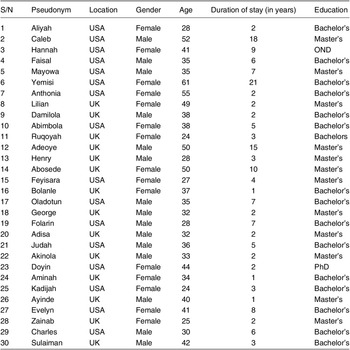
Thirty migrants (sixteen from the US and fourteen from the UK) participated in the study. A summary is presented in Table 1. Twenty-eight participants were born in Nigeria. One participant was born in Germany, and another was born in the UK. The participants were recruited using a mix of different sampling strategies, including snowballing, online sampling (Nigerian migrants in the US and UK were contacted on LinkedIn, migrant groups on Facebook, Instagram, etc.). Given that social media is becoming a reliable method of sampling migrants (Pszczółkowska Reference Pszczółkowska2020), one key advantage of sampling migrants online is the possibility of reaching a wider audience across several locations in the host country. The thirty participants came from thirteen counties in the UK and ten states in the US. Twenty-nine interviews took place via Zoom, while one was done via Microsoft Teams. All the interviews were recorded with the participants’ permission.
Basic Demographic Characteristics of Participants

Table 1. Long description
The header row contains S forward slash N, Pseudonym, Location, Gender, Age, Duration of stay in years, and Education. Each subsequent row presents a participant’s pseudonym, location (USA or UK), gender (Male or Female), age (ranging from 24 to 61), duration of stay (from 1 to 21 years), and education level (Bachelor’s, Master’s, OND, or PhD). For example, the first row lists Aliyah, USA, Female, age 28, 2 years, Bachelor’s. The table includes 30 participants, with 16 from the UK and 14 from the USA. Education levels are distributed as follows: Bachelor’s (majority), Master’s, OND, and PhD. Ages are distributed across young adult to senior, with durations of stay varying widely. Gender distribution is nearly balanced. The table provides a comprehensive overview of participant demographics for further analysis.
An interview guide was used to guide the discussion, but the process was flexible, and the ordering of the questions was not the same for participants. The ordering of the questions was determined by the flow of the discussion and participants’ responses. To understand migrants’ identification, participants were asked in a series of ways about their attachment or belongingness to Nigeria and the host countries. A typical question was, “How much Nigerian or American are you now?” This was followed by a series of questions to probe into participants’ patterns of self-identification and the reasons they identified the way they did. Participants were asked to rate their belongingness on a scale of 100 where necessary. Later, in a different set of questions, participants were asked to describe what “immigrant integration” meant to them—this was followed by probing questions. The average duration of the interviews was 67 minutes. The language of the interview was English.
All interviews were transcribed verbatim in Microsoft Office Word. Pseudonyms were carefully adopted to replace the participants’ real names. English names were replaced with other English names, and ethnic and religious names were replaced similarly. The data were managed using NVivo (version 14).
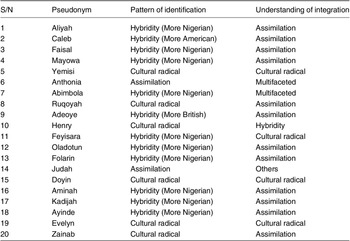
The study adopted a thematic analysis approach. An inductive thematic approach was primarily adopted in the coding process to explore patterns in migrants’ self-identification and perception of immigrant integration. This initially led to the generation of several codes under the two broad themes: “patterns of identification” and “meaning of integration.” To situate the sub-themes within existing studies and concepts, the codes under “patterns of identification” were recoded and categorized into three: assimilation, true consciousness or cultural radicals, and hybridity, in line with earlier studies (Berry Reference Berry2001; Imoagene Reference Imoagene2012). Cultural radicals are participants who exhibited an extraordinary affinity to their home culture and were wary of migrants who assimilate to the host country’s culture at the expense of their own. In Du Bois’s conception, these are the people with “true consciousness.” Berry (Reference Berry2001) described them as “separation,” while Imoagene (Reference Imoagene2012) conceptualized them as “unbelonging.” Hybridity had two sub-codes- “More Nigerian” and “More British or American.” Similarly, the codes under the theme “understanding of immigrant integration” were recoded and categorized into two in line with the earlier studies: “cultural understanding” and “socio-economic progress” (Masinda et al., Reference Masinda, Jacquet and Moore2014; Schinkel Reference Schinkel2017; Di Bartolomeo et al., Reference Di Bartolomeo, Kalantaryan and Bonfanti2015). Other codes include “multifaceted” and “others.” The first node (cultural understanding) had three sub-codes, namely, “integration as assimilation process,” “integration as hybridity,” and “cultural radicalism.” A word cloud was generated to visualize the keywords participants used to describe integration. Later, each participant’s self-identification and description of integration were placed side by side and presented in Table 2 to visualize double consciousness or (in)consistency between the two.
Summary of Participants’ Identification and Understanding of Integration
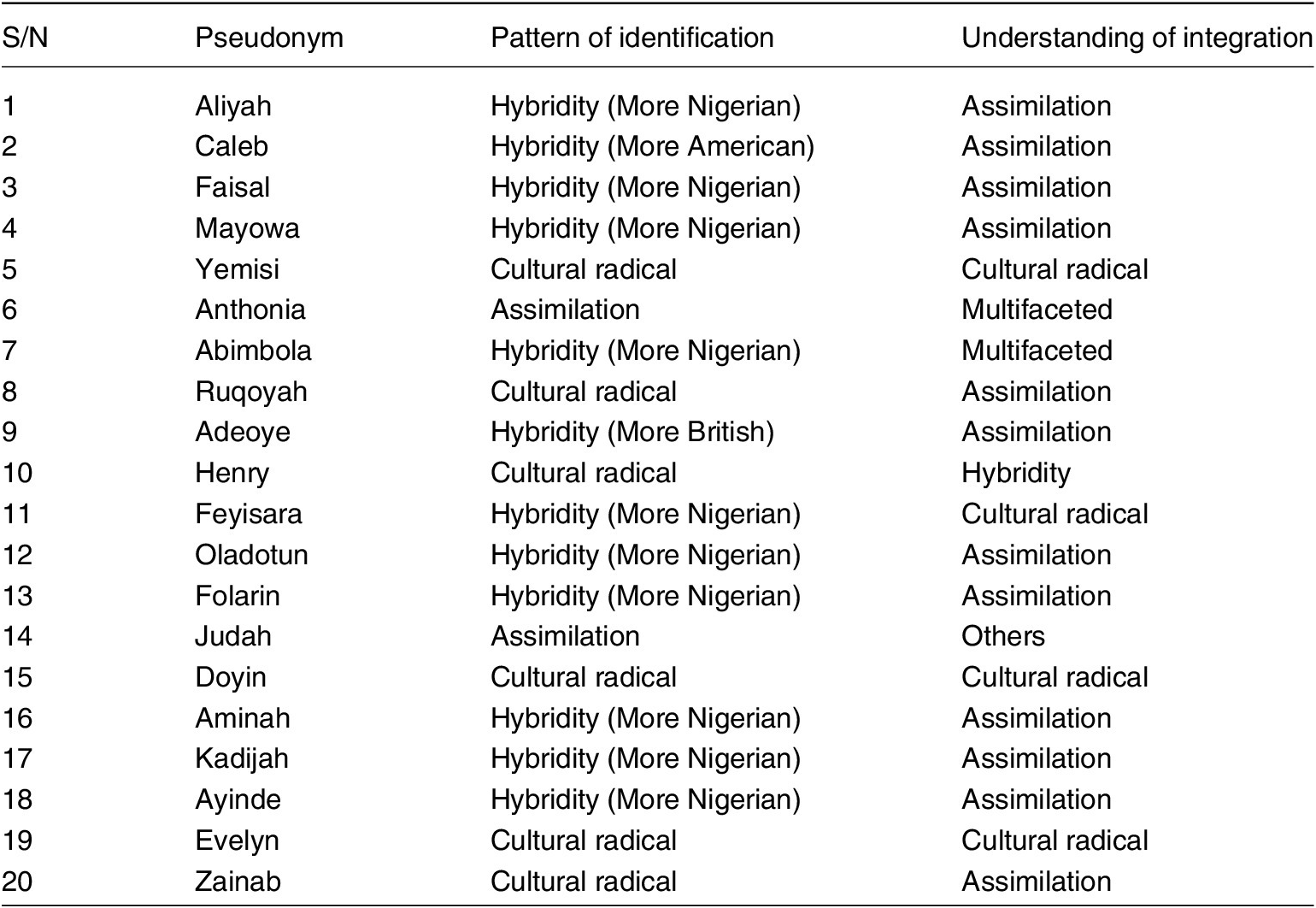
Table 2. Long description
The header row contains four columns: S forward slash N, Pseudonym, Pattern of identification, and Understanding of integration. Each subsequent row presents a participant's pseudonym and their responses. From the top, Aliyah, Caleb, Faisal, Mayowa, Abimbola, Feyisara, Oladotun, Folarin, Aminah, Kadijah, and Ayinde are identified with hybridity, mostly as ‘More Nigerian,’ except Caleb as ‘More American’ and Adeoye as ‘More British.’ Their understanding of integration is predominantly assimilation, except Abimbola and Feyisara who are multifaceted and cultural radical respectively. Anthonia and Judah are identified with assimilation, with Anthonia's understanding as multifaceted and Judah's as others. Yemisi, Ruqoyah, Henry, Doyin, Evelyn, and Zainab are identified as cultural radicals, with their understanding varying between cultural radical, assimilation, and hybridity. The table shows that assimilation is the most common understanding, followed by cultural radical and multifaceted. Patterns of identification are mainly hybridity, with cultural radical and assimilation also represented.
The research abided by the principles of research ethics. The study was approved by the ethics committee of the sociology department, University of Cape Town, with approval number SOC2022/1. All participants were informed about the objectives of the study prior to their participation. No participant was incentivized. To respect privacy, no potential participant was reminded more than twice to participate in the study.
Results and Discussion
Demographic Characteristics and Brief Migration Trajectory of the Participants
Table 1 shows the basic information of the participants. During data collection, a gender balance was maintained, with half of the study population consisting of females and the other half comprising males. The average age is 37.5, ranging from twenty-four to sixty-one years. The duration of stay in the current host country ranges from one to twenty-one years, with an average of 5.4. All the participants had at least a bachelor’s degree, except Hannah, who had an OND (Ordinary National Diploma)— a two-year post-secondary education degree offered by polytechnics in Nigeria. One participant held a PhD, while three participants were pursuing theirs.
Most participants were first-generation migrants. Several participants migrated on visiting and study visas. A few examples may suffice. Akinola, Aminah, Ayinde, and Zainab migrated to the UK through the master’s study visa route. Aliyah migrated to the US to pursue a master’s degree, having completed her bachelor’s degree in Nigeria. Henry and Feyisara had their first and second degree in Nigeria and were pursuing their PhD in the UK and the US, respectively.
Two participants (Doyin and Abosede) were born outside of Nigeria. Abosede was born in the UK, and she is a British citizen. She completed her primary and secondary education and earned her first degree in Nigeria. She had been shuttling between Nigeria and the UK. She moved (semi) permanently to the UK in 2012. Doyin was born in Germany to Nigerian parents. She got her first degree from Germany. She had lived in Ireland for twenty years and migrated to the US in 2020 for work purposes.
Some participants’ migration was facilitated by their parents and spouses. Caleb was a stockbroker in Nigeria and first visited his wife in the US in 2003. He later changed his immigration status from visitor to student after enrolling in an MBA program. Abimbola’s father was a renowned table tennis player in Nigeria and had lived in the US for over two decades. Her mother is an American citizen. She completed her first degree in Nigeria and migrated to the US in 2017 after her father filed for her. Adisa is a Nigerian-born British citizen. His mother was born in the UK. Sulaiman’s wife was a British citizen. She was born in Nigeria but raised in the UK. The couple moved to the UK in 2019 after their marriage in Nigeria in 2018.
Some participants migrated from other countries to their current host nation. Ruqoyah left Nigeria in 2016 to pursue an undergraduate degree in Sweden. She migrated to the UK in 2019 to pursue her PhD. Yemisi was an accountant and left Nigeria for the UK in 1995. Her husband won the US visa lottery in 1999. Yemisi and her son joined him in 2001. Mayowa was a banker in Nigeria who migrated to the UK for a master’s program. He went for a holiday in the US after his master’s program and decided to stay back after realizing the plethora of opportunities in the US. In his words, “when I came to the US, it was a different ball game entirely. It is better than the UK in terms of opportunities like work, development, and a lot of things that make life easy for people. I got to the US and had a lot of friends, so I was like, ‘what am I going back to do in Nigeria when all I need is here?’” (Mayowa, Male, US).
Some participants stated that they married a national of the host country to regularize their stay. Oladotun migrated to the US with a study visa to pursue his master’s, but he deferred his admission for some time due to financial constraints. He married an American woman to regularize his stay. Evelyn migrated to the US on a visiting visa with her boyfriend from Nigeria. According to her, they both reached a mutual understanding to go their separate ways and marry Americans to regularize her stay in the US.
Migrants’ Identification Patterns
Two of the thirty participants (Charles and Sulaiman) believed that the question of identification is difficult to answer. Hence, they did not clearly explain which country they identified with. Twenty-eight participants provided detailed responses to the questions related to self-identification. Four of them fell in the category of assimilation (they solely identified with the host country’s culture and lifestyles), eight identified solely with Nigeria, and the remaining sixteen participants identified with both countries at varying degrees.
Lilian, a participant in the assimilation category, stated, “I associate with the UK at all times. I don’t even remember that I came from Nigeria…I’m telling you this because I’m at peace. So, I don’t even remember home” (Lilian, Female, UK). Similarly, Judah reported: “I’d say I am 100% American” (Judah, Male, US). Based on their self-identification with the host country, one may be reluctant to refer to their identification as double consciousness, as the term, in Du Bois’s (Reference Du Bois2008) conception, refers to a dual perception of self. However, the fact that they identify as Nigerians made them eligible to participate in this study, and their identification with the US or UK suggests twoness. The implication is that migrants may unconsciously identify with a nationality or culture through their actions and lifestyles.
Three of the four participants in the assimilation category identified as such because “Nigeria happened to them,” which means they were victims of the volatile and corrupt Nigerian system before they migrated. Lilian experienced traffic robbery four times while driving in Nigeria—this made her feel unsafe and triggered her decision to resign from her senior managerial job and emigrate to the UK to pursue a second master’s degree. Judah had wanted to join the Nigerian military but experienced corruption firsthand in the recruitment process. After migration, he joined the US military after meeting the requirements without knowing or paying anyone. He stated thus: “if you don’t know someone in Nigeria, you can’t be someone… But here, all I needed was to apply… and I was so happy I got the opportunity. Moreover, wherever I go, I am proud to be a US Army Officer” (Judah, Male, US). In addition, Judah has acquired American citizenship. This can be regarded as an instrumental point of view (Imoagene Reference Imoagene2012) or the economy of identification (Scott Reference Scott2023) because the participants’ identification is based on the opportunities the host countries are believed to offer. The third participant lamented corruption in the health sector, envy, and lack of privacy caused by informal relationships in Nigeria.
Five of the eight participants who reported total identification with Nigeria were from the UK. This reinforces Imoagene’s (Reference Imoagene2012) findings that “More of the UK second generation identify as Nigerian compared to the US second generation” (p. 2168). In this study, participants used specific words and phrases (such as “100%,” “to the core,” etc.) to demonstrate their total allegiance to Nigeria. Yemisi, who has been in the US for over two decades, stated, “I’m a Nigerian to the core. Even my kids feel insulted when you tell them they are Americans” (Yemisi, Female, US). Henry averred, “The idea of belonging in the UK still doesn’t exist. I am a visitor in many ways; I’m 100% Nigerian and 0% British” (Henry, Male, UK). George and Evelyn also used “100%,” while Ruqoyah used “99.99%” to describe their attachment to Nigeria. Three of the eight participants (Henry, George, and Sandra) have English names, while the rest have ethnic and religious names.
Some interesting justifications for the total identification with Nigeria include food, citizenship, culture, accent, etc. Food was mentioned by five of the eight participants (Yemisi, Henry, George, Doyin, and Evelyn). For example, a participant said, “I still maintain my Nigerian identity 100%. I don’t eat American food…They only have snacks and leaves they eat. Their only food is bread and pasta. That’s not food to me. I eat my Nigerian food” (Evelyn, Female, US). Similarly, George stated, “I’m very rigid about food. I have been eating Nigerian food since I have been here. I go to African shops, and I get to buy food from Lagos. I buy raw food and get it when it is brought in here through cargo” (Henry, Male, UK). This reinforces the findings of Henriette M. Nyamnjoh (Reference Nyamnjoh2018) on the role of food in how migrants (re)imagine the home country.
Regarding citizenship, two participants (especially Doyin) reported some interesting points. Both participants reported having a Nigerian passport, which makes them Nigerian by default. However, Doyin—who was born outside of Nigeria (Germany), had multiple citizenships and lived in many countries, including Ireland, the US, and the UK—travelled to Nigeria to register and obtain a voter’s card. She travelled to Nigeria to vote and was livid that many Nigerians are not doing the same. The participant compared Irish migrants to Nigerian migrants thus:
I don’t know what to do with the Nigeria situation because I think the problem of Nigeria are Nigerians themselves. […] they (Nigerians) are shouting that we should get diaspora voting. But look, the Irish people did not have diaspora voting; every time there was a referendum, everybody travelled from wherever they were and came home and voted. This was how we were able to change the divorce laws with the referendum, change the abortion laws with the referendum, change gay marriages with the referendum. […] Nigerians should be able to organize themselves to get on the flipping plane and land in Nigeria to vote. (Doyin, Female, US).
Of the sixteen participants who demonstrated hybridity or twoness, fourteen identified more with Nigeria than the US or UK, and most put numbers to their identification. For example, Oladotun, who worked in the prison service, stated, “I’m 70% Nigerian, 30% American. What made it 30% is because of where I stay, the people I work with, my day-to-day experience, the kind of music I listen to” (Oladotun, Male, US). Two other participants from the US (Aliyah and Hannah) reported a ratio of 70:30 for Nigeria and the host country, respectively. Other participants, including those with dual citizenship in both countries, mostly reported ratios of 90:10, 80:20, and 60:40 in favour of Nigeria. Their reasons revolved around the following: (1) life in the host country is too formal and lonely, which is similar to the findings from the study of Yolanda Covington-Ward (Reference Covington-Ward2017), (2) perceived lack of morality in the host country, including the legalization of same-sex marriage, (3) preference for Nigerian food and music, (4) holding a Nigerian passport, (5) “owanbe”—an indigenous term that explains the essence of sociality and how young Nigerians merry with one another at social events that often include the wearing of the same colour of fabric, eating, drinking, and dancing. However, some participants identify with the host countries in the areas of work ethics, merit-based approach as opposed to personal connections, and effective governance. Consequently, most participants who demonstrated twoness in their identification adopted an instrumental point of view (Imoagene Reference Imoagene2012) by combining the strengths and benefits of both home and host countries. The implication is that identity and self-identification are fluid and ever-changing (Jin and Wang, Reference Jin and Wang2022; Kehinde and Ibrahim, Reference Kehinde and Ibrahim2022) and may be shaped by inequalities between home and host countries and changes in a series of events in both countries.
Migrants’ Understanding of Integration
Figure 1 presents the word cloud showing the keywords participants used when describing what immigrant integration meant. An important word is “culture,” which suggests that Nigerian migrants understood immigrant integration in cultural terms. Participants used other keywords (such as adopt, trying, learn, familiarize, assimilate, adapt, imbibing) to suggest the process of assimilation, that is, the process of learning the culture and environment of the host country.
Word cloud showing keywords used to describe immigrant integration.

Because of the flexibility of the interview process and the challenges associated with online interviews, responses regarding the understanding of integration were not adequately provided by six participants (Lilian, Abosede, Bolanle, George, Adisa, and Akinola). Hence, only responses from twenty-four participants are narrated in this section. Two of the twenty-four participants whose responses were coded said they had no idea what immigrant integration meant. One of the remaining twenty-two participants said integration means “You just moving from one country to another, and starting afresh” (Judah, Male, US). Two participants described immigrant integration from a multifaceted perspective, which resonates with earlier studies that argue that immigration is broad and multidimensional (Di Bartolomeo et al., Reference Di Bartolomeo, Kalantaryan and Bonfanti2015; Dustmann and Frattini, Reference Dustmann and Frattini2011; Masinda et al., Reference Masinda, Jacquet and Moore2014; Penninx Reference Penninx2005). One of the two participants in the multifaceted category referred to different issues, including work culture, family, crime, and finance, among others. However, the participant sees integration as adapting to the different phenomena, including the rapidity of activities, crime, and work culture, in the new environment. The participant stated, “In New York when I’ve looked at the whole thing, and I have seen that I cannot integrate properly in that New York, it is too fast-paced for me” (Abimbola, Female, US). Anthonia defined integration as “the whole package; the whole wellbeing” (Anthonia, Female, US), which includes several components, such as education, employment, finance, and culture. However, Anthonia’s view of integration is the migrants’ ability to learn about the lifestyles and culture of the host country in each of the different components. The participant explained thus:
… in layman’s terms, integration means being present, being mixed with the crowd that you’re blurring your differences…it means imbibing a culture in terms of how they speak, and their general outlook in public… So, there are a whole lot of cultural differences that you have to integrate into. The accent is at the top of the list; because the US is such a great country where you have all sorts of people. One thing that will set you apart is your accent. You have to work on that; you have to integrate when it comes to that (Anthonia, Female, US).
Surprisingly, no participant described immigrant integration in terms of socio-economic progress. Two participants described integration as hybridity, while four participants were sceptical of the concept, refused to accept its popular usage, and frowned at Nigerian migrants who exhibit double consciousness.
The majority (nineteen out of twenty-four) described integration in cultural terms. Of the nineteen participants, thirteen described integration as the process of assimilation, that is, the process of learning the culture of the host country, which reinforces the assertion of Favell (Reference Favell2019) that “The move from assimilation to integration is retrogressive… Most seriously operationalized integration measures are, in fact, assimilation measures…The terms are interchangeable” (p. 2). In this regard, one participant stated, “Integration means absorbing the culture of the country you’re in…learning the language, eating their food, trying to be like them in a way” (Zainab, Female, UK). Using the word “learning,” another participant averred, “To me, there are times you can learn the integration process. That is if you want to. Integration is trying to blend into a particular setting or a particular lifestyle. It means you try to blend into the lifestyle you find yourself in” (Oladotun, Male, US). For many participants, an important aim of the learning process is to reduce culture shock. Folarin described integration as “the ability of someone to move from one place to the other to assimilate their culture, have less cultural shock, and be able to feel among others” (Folarin, Male, US). An important point in the definition from people in this category is that integration is the sole responsibility of the migrants, which contradicts the two-way understanding (Klarenbeek Reference Klarenbeek2021) and the three-way approaches to integration (Garcés-Mascareñas and Penninx Reference Garcés-Mascareñas and Penninx2016).
The two participants who described integration as hybridity mentioned that integration involves combining many things. While Sulaiman sees integration as the responsibility of the receiving country, Henry criticized the UK’s policy for making integration the sole responsibility of migrants. Although Imoagene (Reference Imoagene2012) stated that multiculturalism is an official policy in the UK, even though it is not effective, Henry seems not to be aware of such a policy. As he noted:
The UK is a very funny country…The way I see it, you are trying to integrate people from different backgrounds, different people from different places and you need to integrate them into one, and make them feel that belonging…that doesn’t exist in the UK. Once you are here, it is up to you to find your way to integrate with the population, or if you choose not to integrate. So, there’s no official policy on this (Henry, Male, UK).
Although Henry recognized hybridity in his understanding, he noted that the UK system is structured such that migrants must assimilate. He noted, “So, there’s already a pattern; there is already a British way of doing things. And so, you can’t come in to upset that pattern; you just simply have to fit in” (Henry, Male, UK).
However, the four participants in the cultural radicalism or true consciousness category were dissatisfied that migrants must fit into the existing pattern. All the four participants were from the US. They advocated that Nigerian migrants should be tenacious and maintain their Nigerian identity. In addition, some participants asserted that the Nigerian culture is rich and justified by how African cultural artefacts are showcased and commercialized in Museums in Western countries. Hence, they suggested that Nigerians carry the Nigerian culture with pride. Yemisi described her refusal to imbibe the American accent:
When you speak, they will tell you they don’t understand what you are saying…I went to somewhere in the US to train with most Americans who aren’t used to standing in front of someone like me, and I said, ‘let’s get something straight here! I have an accent, and so do you. I speak a second language, and don’t know if you do. So, if there is anything I say that you don’t understand, just tell me. I’d happily repeat myself’ (Yemisi, Female, US).
Another participant in this category argued that although integration means to “ease in,” new entrants should join ethnic enclaves and live with people from their country to maintain their original identity and maintain connections with home. The most radical of the four participants was Doyin (a heritage architect). Despite being born in the West, Doyin criticized Nigerian migrants who try to assimilate the culture of the host country at the expense of the original culture when some countries, such as Brazil and Cuba, are practising the Ifa traditional religion and learning to speak the Yoruba language, both common in Nigeria.
Double Consciousness: Differences Between Self-identification and the Meaning of Integration
Table 2 shows codes for the two variables side-by-side to show the (dis)connection between migrants’ self-identification and their understanding of integration. The table summarizes the findings from twenty participants who adequately responded to both issues. Three of the twenty participants (Yemisi, Doyin, and Evelyn) maintained cultural radicalism or true consciousness across the two variables.
The three participants expressed 100% tenacity to the Nigerian lifestyles and perceived integration in a negative light—as culturism and as a betrayal of the origin, which resonates with the work of Schinkel (Reference Schinkel2017, Reference Schinkel2018). The participants were critical of the idea of equating integration to assimilation. They chose not to be integrated. As Doyin mentioned, “I will rather prefer to integrate in Nigeria than integrating somewhere else” (Doyin, Female, US). Another participant reported, “I will say some immigrants are integrated because they have jettisoned the way we use our hands to eat some food. Some people have fully integrated already, but not all of us; some of us have a conscience” (Evelyn, Female, US). Evelyn conceived of integration as culturism, which she believed should be rejected by Nigerian migrants. She sees assimilation as a betrayal and denial of the original identity. Two participants (Caleb and Adeoye) were somewhat consistent because they identified more with the host country and defined integration as assimilation.
However, eleven participants (55%) exhibited what Du Bois (Reference Du Bois2008) would term double consciousness because they identified either more or in totality with Nigeria but defined integration as the process of assimilation. In addition, despite claiming more affinity to Nigeria, they see integration in a positive light and as the process of learning and imbibing the host country’s culture. Most of them see submission to the host’s culture as a requirement for socioeconomic progress in the host country, which reinforces the view of earlier studies that reported a connection between assimilation and labour market outcomes (Cai & Zimmermann, Reference Cai and Zimmermann2024; Islam & Raschky, Reference Islam and Raschky2013; Piracha et al., Reference Piracha, Tani, Cheng and Wang2023). A few of the cases are discussed.
Faisal, a male participant from the US, reported a 60% affiliation with Nigeria and 40% with the US. To him, integration “means you are trying to change your habit, lifestyle, culture and all those things.” Ruqoyah from the US said she is Nigerian 99.99% and always has the home country at heart, but she sees integration as the process of sinking into the norms and culture of the host country to feel among and have a sense of belonging. Oladotun identified as 70% Nigerian and understood integration as the process of blending in and learning the ways of life in the new country, primarily for socio-economic or instrumental reasons reported in earlier studies (Imoagene Reference Imoagene2012; Scott Reference Scott2023). The participant said, “The concept of integration is me trying to learn the things around me so I won’t be the odd one out” (Oladotun, Male, US). This reinforces Schinkel’s (Reference Schinkel2017) view that migrants are primarily perceived as outsiders who can potentially upset the balance in the host country. Hence, the host country’s government puts policies in place to ensure migrants embrace the host culture. An example is the Life in the UK Test, which must be taken and passed as a requirement for UK citizenship (Bartram Reference Bartram2018, Reference Bartram2021). In preparation for the test, many migrants imbibe and learn the British ways of life and identify with the host country, which is the aim of the test (Bartram Reference Bartram2018). Bartram (Reference Bartram2021) shows that although the test increases migrants’ attachment to the UK, it does not necessarily make them feel British—a typical case of double consciousness. Supporting the social and economic reasons for double consciousness, Ayinde, who identified more as a Nigerian, stated thus when explaining his understanding of integration: “…Because you want to pay bills, you don’t want to get messed up… so, generally, I’m integrating as much as I think I should” (Ayinde, Male, UK). Similarly, Anthonia added, “… you have to assimilate and adopt the culture and be part of the culture; that’s the only way and time you will enjoy being here” (Anthonia, Female, US).
Folarin, who held dual citizenship, described himself as “a Nigerian to the core” but used the word “assimilate” in his description of integration in order to reduce culture shock. However, he reported that some aspects of his Nigerianness can never change. He said that contrary to what some migrants do to feel American, he would never change his name. It is important to add that some participants who changed their first names or added an English name reported a slight improvement in their job application outcomes—they were called for interviews but did not get the job. This resonates with the findings of earlier studies, where migrants were asked to change their names (Rynderman and Flynn, Reference Rynderman and Flynn2016; Udah et al., Reference Udah, Singh and Chamberlain2019), but it only increased their chances of being called for interviews (Booth et al., Reference Booth, Leigh and Varganova2012).
Conclusion
Evidence from this study suggests that migrants’ identities can change with time and circumstances in both countries of origin and destination. Identification patterns are temporal and can fluctuate depending on circumstances in the home country, receiving country and migrants’ personal experiences. With increasing migration, twoness or double consciousness—and multiple ways of identification—is becoming normalized as a way of life. Many migrants and scholars do not view multiple identities as double consciousness in Du Bois’s conception. They see it in a positive light and as cultural hybridity, which is the new trend. Many migrants are managing cultural differences to improve their migration experiences. They retain what they think is necessary from the Nigerian culture and embrace what they think will improve their well-being in the host country. In hybridity, the home and host cultures are not necessarily competing; they are rather complementary. While a few participants frowned upon double consciousness and saw it as a betrayal of origin, several participants suggested that it is a realistic trend, a requirement for survival, and a positive factor in a world with an increasing migrant population. Nigerian migrants moderate between the original and host cultures, holding to some cultural elements of both the original and host countries. However, most Nigerian migrants maintained a stronger affinity to the Nigerian way of life than to the host country.
An important question is, how did migrants conceive of integration as assimilation? Words and narratives are powerful. As shown from the works of Schinkel, host governments frame policy documents to suggest integration as the submission to the host culture. In addition, the narratives from scholarly works and the media are ingrained in the subconscious of many migrants. For many Nigerians, the home country is unpredictable and uninhabitable (Alabi Reference Alabi2024b; Liu Reference Liu2024), so living abroad, especially in the West, is necessary. Consequently, everything must be done—including submission to the host culture—to improve migration experiences.
Although Nigerian migrants did not conceive of integration as socioeconomic progress, their understanding of the concept, as assimilation, is because they need to improve their migration experiences in the host country. Although the views of Nigerian migrants resonate with the proposition of Favell (Reference Favell2019), this article states that assimilation and integration are different and should not mean the same thing. While assimilation is the movement toward the host country’s culture, integration should be defined in socio-economic terms, that is, the extent or the process by which migrants experience progress in several aspects of their lives, including health, polity, employment, and other indicators identified by MIPEX. However, the quantitative indicators are not enough. Migrants’ progress should also be understood through the lens of relational integration (Klarenbeek Reference Klarenbeek2019). At the relational level, integration should be the outcome of migrants’ subjective comparison of their pre-migration and post-migration well-being, as well as the perceived inequalities between them and nationals of the host country.
Western governments are pleased when migrants adapt to the culture of the host country. Thus, it is the responsibility of the governments of sending countries to create policies that will prevent them from losing their citizens to receiving countries that provide a preferable environment.


 Open access

