

Introduction
Pig husbandry is practised across the world and often identified in the archaeological record from bones, sometimes also supported by insect and parasite egg studies (e.g. on the Anglo-Scandinavian occupation deposits at Coppergate, York; Kenward & Hall 1995: 759, 778) as well as by coprostanol analysis. Where bones, insects or parasite eggs are not preserved, pig management is less easy to recognise. Nevertheless, soil features and faecal residues may provide micromorphological and chemical indicators of the former presence of pigs and their impact on archaeological stratigraphy.
Previous investigations
Thin section methods can been used to characterise faecal remains of wild boar, herbivores, dogs and humans (including mineralised cess). Boar dung is more organic and less phosphate-rich compared to that of dogs and humans and is not autofluorescent under blue light; it contains more amorphous organic matter and fewer plant remains than herbivore dung (Macphail & Goldberg 2010). An experimental 'pig pasture' at the Lann-Gouh 'medieval' farm in the Moribhan in north-western France was studied by Reference Gebhardt, Barham and MacphailGebhardt (1995). This study showed that pigs rapidly disturbed the soil surface, uprooting some small trees. No faecal material or phosphate features were reported in an analysis of the soil studied in thin section. Suspected pig churning and defecation have been tentatively recognised in deposits associated with prehistoric middening, in the secondary use of Roman buildings (at Leicester) or in medieval cities (e.g. Canterbury and London). The character of these anthropogenic deposits is apparently much more phosphate-rich than reported by Reference Gebhardt, Barham and MacphailGebhardt (1995). Thus, a follow-up experimental study of where pig activities are more concentrated was required to help identify ancient pig pens.
The pig experiment and pilot sampling programme at West Stow Anglo-Saxon Village
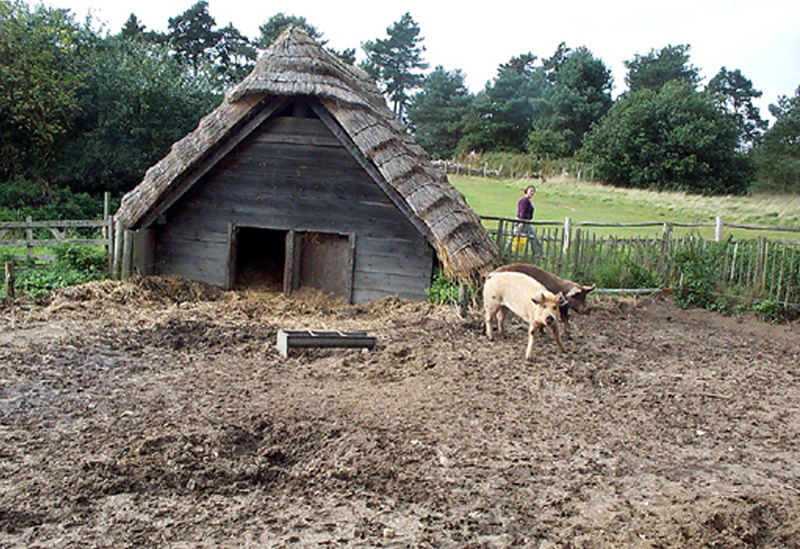
West Stow, on the Breckland sands of Suffolk, UK, is the site of an excavated fifth–seventh century AD Anglo-Saxon settlement, where the 'village' was recreated during the 1970s. In 2008, two pigs (cross-bred Tamworths) occupied a small enclosure where their pathways to drinking water showed concentrations of faecal remains (Figure 1); they also had access to their own 'pig pasture'. Micromorphology and bulk soil sampling, which focused upon these two locations, was facilitated by Mary-Ellen Crothers, who also supplied information on the background to the 'village', as well as pig management and diet.
West Stow Anglo-Saxon Village, Suffolk, UK; showing pig compacted pathways in their small enclosure; faecal deposits are visible in the surface crust.

Soil results
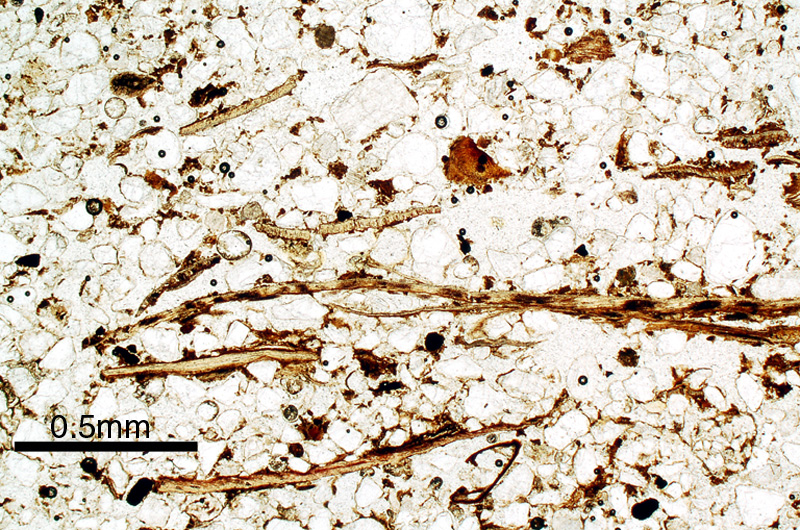
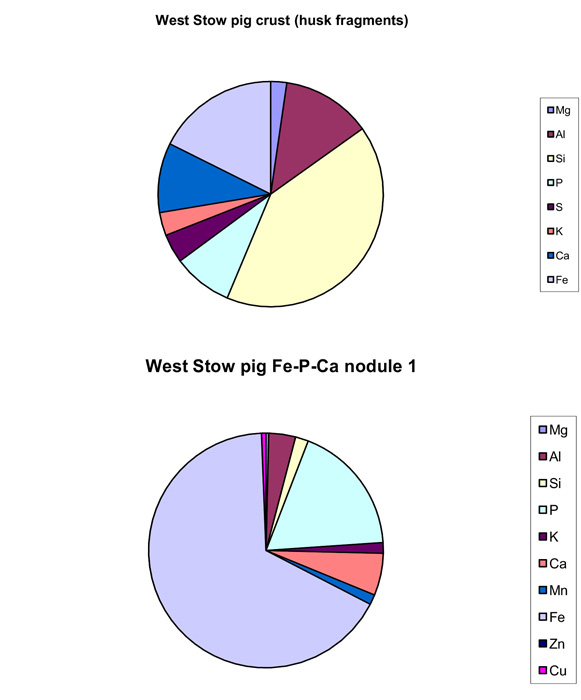
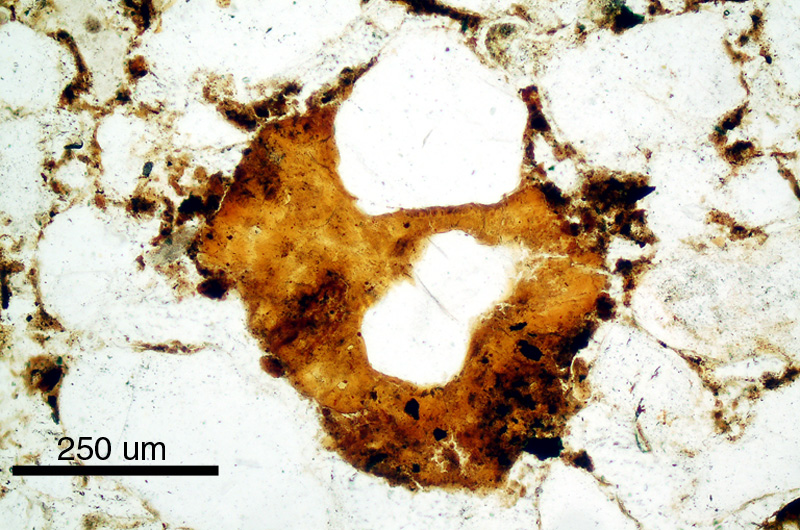
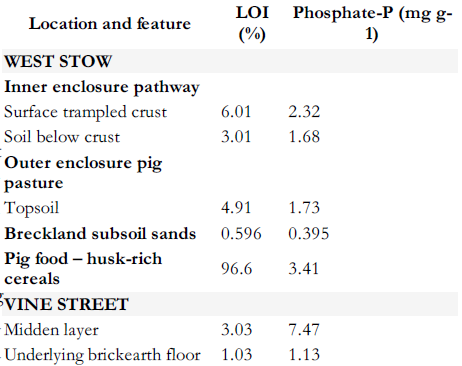
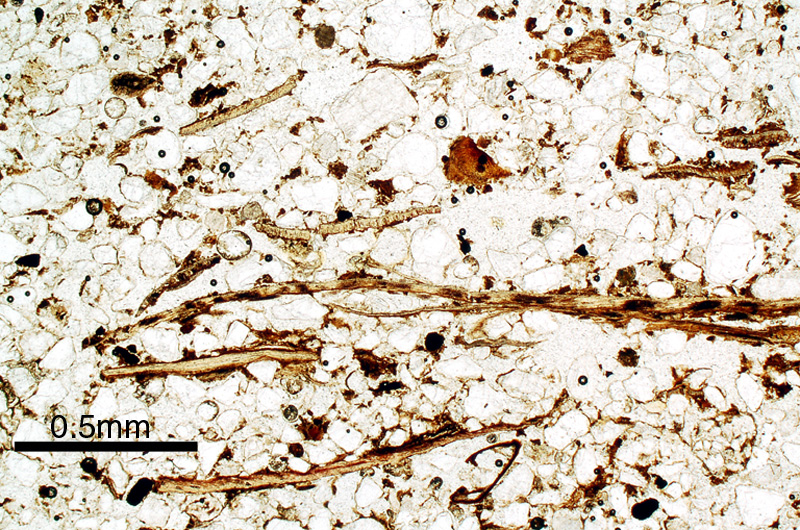
As expected, analysis of the chemistry in bulk samples found the highest concentrations of organic matter (estimated by loss-on-ignition, LOI) and phosphate in an example of the pig-trampled and dung-enriched crust of the pathway surface (Table 1). In thin section, the pathway sample showed features likely to be the result of pig activity. The surface crust was compact, and composed of a concentration of sub-horizontally layered, partially digested, cereal husk remains and amorphous organic matter (pig faecal waste) (Figure 2). This is consistent with the chemistry in bulk samples. Scanning Electron Microscope/Energy Dispersive Spectrometer (SEM/EDS) analyses found the phosphate to be concentrated in these faecal remains, alongside iron, calcium and sulphur (Figure 3). Below this crust, nodules of amorphous iron, phosphorus and calcium were present (Figures 3 & 4). These are believed to be neo-formed features of pig slurry origin. However, such nodules, which often occur in ancient settlement soils, may have other origins: road drainage, cess pit contamination, general weathering of occupation deposits, including animal dung, ashes and bones. At Roman Vine Street, Leicester (Macphail & Crowther 2009), however, 'midden' deposits had been churned into an underlying brickearth floor within a first century timber structure. Here also, mineralised faecal material was mixed with coprolitic bone remains, suggesting the possible re-use of this house space as a pig pen. Phosphate levels were very high and presumed secondary phosphate nodules also occurred (Table 1).
Photomicrograph of 15mm-thick trampled pathway surface crust. Note amorphous staining of horizontally-oriented cereal husk fragments (faecal remains). The highest LOI and P are recorded in this horizon (Table 1). SEM/EDS also analysed this staining (4.33%P, 2.10% S, 5.05% Ca, 8.91% Fe, n=8) (see Figure 3). Plane polarised light (PPL).

Detailed photomicrograph of a Fe-P-Ca nodule in sandy soil approximately 50mm below pathway crust. It has a typical yellow brown colour under PPL.


Discussion and conclusions
The small experimental investigation at West Stow, along with observations from Lann-Gouh, shows that pigs produce churned pig pastures. In addition, their concentrated activity enriches the soil both in organic matter and in phosphate (West Stow pig pathway). However, in this experiment pigs were not scavenging meat or bone waste, unlike what we know of pig husbandry in the past; hence phosphate features and concentrations do not replicate some suggested archaeological examples of pig management (e.g. Vine Street in Leicester). Ethno-archaeological examples of traditional pig husbandry should be sought to provide this kind of analogue data.
Acknowledgments
The Leverhulme Trust is thanked for supporting Macphail's reference studies. Mary-Ellen Crothers (West Stow Anglo-Saxon Village) and University of Leicester Archaeology Services are gratefully acknowledged.