Here is how the story has long been told: The history of theatre begins with its birth in Dionysian ritual and the literary brilliance of ancient Athens and Rome. It resumes, long after the fall of the Roman Empire, with theatre’s rebirth in Christian ritual, from where it spills out into the streets of Western Europe and becomes the popular medieval theatre. It continues with Europe’s national theatre traditions from the Renaissance onward, up through spoken theatre’s intellectually challenging realism and avant-garde formulations. And it culminates with modern Western theatre flowing out into the broader world, where it readily displaces primitive and Eastern theatrical traditions that for centuries had failed to show meaningful progress.
Thus runs, in brief, the confection of false assumptions, unjustifiable exclusions, and cultural self-aggrandizements that for more than a century has been understood as the arc of theatre history. It is the theatre-history version (as historically minded readers might recognize) of what has been called the “Whig” (or “whiggish”) interpretation of history, in which world history is seen as the story of freedom’s progress that finds its ultimate expression in modern Western democracies. That interpretation has been discredited by generations of historians, but its counterpart in theatre history lingers on, zombie-like, in many classrooms, textbooks, and scholarly works. This book presents a different way to look at theatre history. Above all, it refuses to accept that theatre history consists of little more than the history of theatre in Europe and its cultural descendants. Instead, it views theatre as a global phenomenon and offers a new understanding of the arc of theatre history – one that integrates the world’s great diversity of theatrical traditions without making any presumptions about progress.
While the global perspective presented here is intended to replace what I will call the Standard Western Approach to theatre history, it in no way discounts more tightly focused historical studies, whether of theatre regions (e.g., South Asia and Europe), states (Kerala and France), theatre forms (kathakali and opera), or specific locales, troupes, theatre artists, or theatrical events. The global perspective can in fact offer fresh insights on each of these levels by showing how they fit into a larger picture. But this book presents a global overview of theatre across what the historian Fernand Braudel has famously called the longue durée – a scale of time that can span centuries, even millennia. It identifies theatre history’s most important inflection points, explains why those inflection points came about, and examines how they found expression in the world’s various theatre traditions. My hope is to offer the overarching context for world theatre history that the Standard Western Approach so manifestly fails to provide.
The Fallacies of the Standard Western Approach
What, specifically, is wrong with the Standard Western Approach? The approach is, of course, a metanarrative (or, as some say, a master narrative), and metanarratives are now often viewed with suspicion. The theorist Jean-François Lyotard suggests that the defining characteristic of postmodernism is an “incredulity toward metanarratives”; along the same lines, the philosopher Michel Foucault argues that “the traditional devices for constructing a comprehensive view of history and for retracing the past as a patient and continuous development must be systematically dismantled.”1 Lyotard and Foucault (along with many others) have sought primarily to dismantle the Eurocentric “Whig” interpretation of history – along with other such metanarratives that assume some teleological necessity drives historical development – although their rhetoric extends far beyond that reasonable goal.
The fundamental problem with the metanarrative of the Standard Western Approach is not that it is a metanarrative, per se, but that it is a grossly misleading one that glorifies “Western” theatre as the standard for and inevitable endpoint of theatre history. As with any historical narrative, a metanarrative must be judged on the soundness of its historical reasoning and its adherence to the available evidence. The Standard Western Approach patently fails on both counts, and so its endurance as the default metanarrative in theatre studies – especially in the United States – is disturbing. I am willing to assume, for the sake of argument, that it endures largely as a matter of unreflective habit, although its glorification of “Western” theatre has no doubt made it a comfortable habit for “Westerners.” But whatever ethical or political objections can be raised against it, the Standard Western Approach is most immediately objectionable because it is bad history.
Three fallacies of historical reasoning undermine the Standard Western Approach.2 The first is its profound ethnocentrism, which allows its proponents to contend that the mainstream of world theatre history runs through Europe. A prime support for this mainstreaming of European theatre is the second fallacy: a dichotomy drawn between “East” and “West” that divides the world into a pair of ostensibly equivalent units and allows for the “othering” of all “Eastern” theatre as a single alien entity. The third fallacy is the approach’s progressivist thesis, which holds that the “West” alone has shown true historical progress as its theatre has evolved from ritual to realism and beyond, thereby allowing proponents of the Standard Western Approach to spuriously justify mainstreaming European theatre while offering minimal attention to all other theatres.
Ethnocentrism is by no means unique to Europe, but European ethnocentrism (or, more succinctly, Eurocentrism) has been especially pernicious for the past few centuries because of its globalist aspirations. Not only does it seek to subsume all the world into the history of Europe, its proponents also insist that the rest of the world accept it as the only valid historical account.3 But as the cultural critic Edward W. Said has noted, it is no longer tenable to believe that “European culture could be viewed coherently and importantly as unquestionably central to human history.” Instead, “new cultures, new societies, and emerging visions of social, political, and aesthetic order now lay claim to the humanist’s attention, with an insistence that cannot long be denied.”4 To be clear, the idea that Europe (or any other place) might be (or might have been) the center of the theatrical world is not necessarily fallacious. China was, after all, for centuries the incontestable center of the porcelain trade throughout Eurasia – by which term I mean not only the Eurasian landmass itself but also the islands that flank that landmass, along with North Africa. If one place or another is to be recognized as the center of the theatrical world, it must be shown that the theatre of other regions has in some way been dependent on or derived from it. But this cannot be shown of the relationship between European theatre and theatre anywhere else in the world (aside from a few European colonies in the Americas) before the eighteenth century.
No matter, though, because proponents of the Standard Western Approach have employed the simple expedient of minimizing or outright ignoring the evidence of theatrical traditions unrelated to that of Europe. Consider the textbook Living Theatre: A History of Theatre, by Edwin Wilson and Alvin Goldfarb. After a short introductory section and a detailed examination of theatre in ancient Greece and Rome, these authors confront an obvious problem: the disconnection between the collapse of ancient Mediterranean theatre and the theatre that emerged in Europe some 500 years later. To plug this gap, Wilson and Goldfarb shift their attention to Asia, jamming a perfunctory account of almost the entire theatre history of the various Asian regions into fewer than thirty pages. With that chore accomplished, they can return exclusively to the European mainstream until they reach the twentieth century. Only then do they expand their focus, but their interest remains entirely on the spread of European-style theatre.5
The dichotomy between East and West is a critical prop for the mainstreaming of European theatre. Identifying an actual boundary between East and West has always been a problem for European geographers because the Eurasian landmass runs without meaningful interruption all the way from the Atlantic to the Pacific. But logical geography was never the point of the East–West dichotomy. Of more importance was the desire to distinguish Europe from everything to its east while also putting it on an equal footing with the entirety of that geographically vast and culturally varied expanse. Europeans were not willing to accept that (as the historian Marshall G. S. Hodgson points out) Europe is “historically simply one among several regions of the Eastern Hemisphere, each of the same order as itself in size, populousness, and cultural wealth.”6 And the “cultural wealth” of those regions includes theatrical traditions at least as long-lived and complex as that of Europe. Moreover, “Eastern” theatrical traditions are as different from one another as they are from European theatre. James R. Brandon writes, “There is no single Asian-Oceanic aesthetic of theatre nor is there a single structural pattern, but rather numerous, even opposing, aesthetics and structures.”7 And Leonard C. Pronko observes, “The abyss that separates Kathakali, for example, from Noh, or Peking opera from Kabuki, is as deep as that which distinguishes a Balinese dance from Oedipus.”8 There is, in brief, no single thing as “Eastern” theatre, just as there is no single thing as the “East.”
But again, no matter. Viewed from a distance, and with sufficient disregard for the evidence, one could deploy familiar stereotypes to convince oneself that all “Eastern” theatre is the alien other to “Western” theatre. Brander Matthews, the first American exponent of the Standard Western Approach, wrote that “the orientals have no vital drama because they are fatalists, because they do not believe in the free will without which drama cannot exist.”9 But this is demonstrably false. Orphan of Zhao, written by Ji Junxiang, shares a central characteristic with many other plays of China’s Yuan-era zaju theatre: According to the scholar Wang Guowei, “Courageous actions are … performed through the heroes’ assertion of will.”10 Similarly, Kalidasa’s Sakuntala and the Ring of Recognition, written for ancient India’s Sanskrit theatre, conforms to the Natyasastra, which holds (in Farley P. Richmond’s gloss) that “the principle objective of the plot is to show the hero struggling for and finally attaining his object of desire.”11 I mention these particular plays because both were available to Matthews in English translation,12 but he apparently preferred to make up his mind about “oriental” theatre on the basis of a crude stereotype.
The progressivist thesis is similarly predicated on a long-standing European conceit, this time about historical teleology. According to the historian Peter Burke, “That ‘history’ is going somewhere, that it is guided by destiny or Providence … is an old [and] widespread assumption in the West,” being “deeply embedded in the Jewish and the Christian traditions”; more “modern concepts of historical development may be viewed as secular forms of these religious ideas.”13 These “modern concepts” were most famously enunciated first by the philosophes of the French Enlightenment and then in the 1820s by the German philosopher G. W. F. Hegel. “The history of the world,” Hegel famously proclaimed, “is none other than the progress of the consciousness of freedom”; whatever is not, or has ceased to be, part of that progress is therefore irrelevant to history.
The Whig historians of Great Britain were equally progressivist. The historian William H. McNeill notes that they were the first to see “British, American, and Continental European history as a common whole” (i.e., as a unified “West”); they argued “that all mankind has been toiling onward and upward through time toward the pinnacle of English (and/or American) constitutional liberty.”14 In the United States, the whiggish version of the progressivist thesis was promulgated in surveys of “Western Civilization” that became popular in academia around the start of the twentieth century. Their progressivist story, writes the historian Lawrence W. Levine, “pictured ‘Western Civilization’ as the end product of all world history, or at least the world history that mattered, since entire continents, whole peoples, and complete historical epochs were ignored as if they had not existed.”15 Not coincidentally, it was just as “Western Civ” surveys were becoming widespread that the earliest academic theatre programs were created in the United States. Shannon Jackson points out that these programs bore the stigma of academic illegitimacy: “Dramatic literature, especially drama performed, risked association with the feminine, the primitive, and the commercial.” To erase (or at least obscure) this stigma, Jackson suggests, theatre scholars introduced modes of discourse that were broadly accepted in academia for their “manifest rigor.”16
The progressivist thesis was one of those modes: Theatre scholars sought to “reproduce turn-of-the-century conventions of historical singularity and progressive continuity.” A hallmark of this thesis was “the evolutionary paradigm of ‘from ritual to theatre.’”17 Sheldon Cheney, author of an influential theatre history textbook first published in 1929, stated: “From being a [ritualistic] convention, [theatre] had progressed through all the stages of part-artificial-part-imitational portrayal until it had arrived at photographic representation of familiar men and women.”18 As late as the 1990s, Glynne Wickham could offer a related version of the thesis: “As society achieves greater stability and coherence … it turns increasingly away from [ritualistic] dance and toward [natural] language as a more flexible medium through which to formulate and express its views of itself in action.”19 I will withhold further comment on the ritual-to-theatre paradigm until Part I of this book, when discussing the origins of theatre. It is notable, however, that a significant realm of twentieth-century European and American theatre belies the notion that theatre’s progress culminated in the realism of spoken theatre. But once more, no matter, for the century’s parade of avant-garde movements could itself be construed as a progressive development. Alan Woods observes, “The very term ‘avant-garde’ … defines the process of progress,”20 although what the avant-garde might be progressing toward remains very much an open question.
Another hallmark of the Standard Western Approach is its willingness to ignore entire realms of evidence from around the world – a propensity it shares with the progressivism of Hegel, the Whig historians, and the World Civ surveys. But even for the supposedly progressive “West,” it turns out that demonstrating progress requires ad hoc justifications and the exclusion of contrary evidence. An obvious problem is the aforementioned discontinuity between the end of ancient Mediterranean theatre and the tenth-century emergence of European theatre, which needs to be rationalized away with the notion that theatre was reborn in the Church. But if this is the case, it undercuts Cheney’s claim that “from Greek times to [the] twentieth century, there has been a wider and wider deviation from conventional methods toward naturalism.” Cheney’s modest proviso that “the progression has not been direct” can scarcely account for a complete reset after a lapse of some 500 years.21
To gain at least a superficial plausibility, the progressivist thesis would need to be confined to the post-tenth-century “West” – but even that cannot salvage it. Consider that just after Shakespeare’s Macbeth (1606) hit the boards, Monteverdi’s Orfeo (1607) signaled the emergence of European opera. This presents a problem for the progressivist thesis, for opera is obviously based in song and has long included highly conventionalized dance. So where is the inevitable progress “toward naturalism”? One widely adopted solution is simply to ignore opera, implicitly denying that it even is dramatic theatre. But this is surely a case of special pleading. After all, Greek tragedy also included ample amounts of song and dance, and no one in their right mind would argue that it is not dramatic theatre. Another solution is to claim, with Wickham, that opera (and presumably the Broadway musical as well) is a “reversion” to “the primacy of song and dance within primitive dramatic ritual.”22 But if such “reversions” are possible as late as the seventeenth and twentieth centuries – and for theatre forms that might be considered among the greatest or most popular of Euro-American theatre arts – how can one retain the claim of continuous progress? In light of all this, it is understandable that explicit restatements of the progressivist thesis have become more rare in recent years. It is far less understandable why that thesis continues to provide the underlying rationale of most theatre history classrooms and textbooks.
Two additional problems with the Standard Western Approach deserve mention. First is its reliance on nationhood as its basic unit of geographic analysis. Studies of theatre in Europe invariably track national theatres as if they have not been intimately connected since the emergence of liturgical theatre a millennium ago and as if, over the past four centuries, opera, ballet, and spoken theatre have not become virtually pan-European. But the emphasis on nationhood should come as no surprise. The historian Pamela Crossley writes, “Well into the twentieth century the structure of all [European] historical narrative was dominated by the archetypical story of each nation’s cultural evolution and political emancipation, sometimes followed by its ability to expand and dominate other peoples.”23 But what is a “nation”? The word is often used in reference to nation-states, which can be defined as “a single people [i.e., an ethnos] in a single territory constituting itself as a unique political community.”24 The existence of such states, however, is usually a polite fiction, for the large majority of self-proclaimed nation-states plainly fail to conform to this definition.25 Moreover, the very existence of nation-states is a historical novelty in most of the world, with other kinds of polities (ranging from tribal formations to multiethnic empires) having long been far more common.
“Nationhood” might alternatively be construed simply in terms of an ethnos. But any stable sense of ethnicity is also little more than fiction. The geneticist David Reich observes that with the advent of DNA analysis “we know now that nearly every group living today is the product of repeated population mixtures that have occurred over thousands and tens of thousands of years.”26 A further difficulty is presented by the fact that people claiming one or another ethnicity have migrated (willingly or unwillingly) to lands near and far and often live together cheek by jowl. Another alternative is to construe “nationhood” in terms of a shared language. Indeed, an excellent book on German theatre takes this approach, stating that its subject is “all of German-speaking Europe and the German-language theatre that was performed in this large area.”27 Perhaps this linguistic focus is useful for German theatre (given the absence of a unified German nation-state before the mid nineteenth century), but its general lack of utility becomes obvious when one contemplates the prospect of identifying most theatre in North America and Australasia, as well as a fair amount of theatre in Africa and South Asia, as English theatre.28 However useful it might sometimes be to define nations in terms of ethnicity or language, such definitions fail to function as units of geographical analysis.
The second additional problem is the Standard Western Approach’s inability to identify its periods – that is, its units of temporal analysis – with any taxonomic clarity. Thomas Postlewait has compiled a list of twenty-two different taxonomic categories on which theatre periods have been based, noting that although “these categorical riches are no doubt a measure of the complexity of the field of theatre history,” they are also “a measure of its confusion.”29 The most frequently encountered period designations are in the category Postlewait calls “traditional eras”: ancient, medieval, and modern. But Marshall G. S. Hodgson observes that this familiar tripartite division of history “has been attacked by innumerable historians as inadequate for a fair long-run view even of European history” while being “still more distortive of the world scene.”30
Also commonly used for identifying theatre’s periods are Postlewait’s overlapping categories of “art and literary movements” and “styles of visual art and architecture.” Period designations in these categories, however, are notoriously vague as temporal units. It is disconcerting that multiple period designations can be applied to the same historical moment, even if limited to a single theatre form in a single place. Spoken theatre in seventeenth-century France, for example, can plausibly be characterized as Renaissance or Neoclassical or Baroque. But if one is to use such terms as period designations, one needs to be able to distinguish between them temporally. Also (and no small matter), while period designations based on European arts might have at least a modest utility for European theatre, they are useless for making sense of theatre periods globally: Can the concept of, say, the Baroque period possibly have meaning for theatre in South Asia?
The Standard Western Approach, in brief, is intellectually bankrupt. Supplementing its account with tokenistic forays into theatre from beyond the European tradition might salve one’s conscience but offers little challenge to the false shape that the approach gives to theatre history. Nor is a challenge offered by refusing any sort of integrated perspective, taking recourse instead to a semirandom variety of localized theatre studies. However satisfying each of these studies might individually be, their cumulative incoherence can scarcely overcome the deeply entrenched Eurocentric metanarrative.
World History and World Theatre History
Can the field of world history help us to make sense of how to study world theatre history?31 We can begin by noting, with the historian Jerry H. Bentley, that “the term world history has never been a clear signifier with a stable referent.” Indeed, “it shares a semantic and analytic terrain with several alternative approaches … includ[ing] universal history, comparative history, global history, big history, transnational history, connected history, entangled history, shared history, and others.”32 Historians debate the differences between these terms, defining them in various and sometimes contradictory ways, but the two most oft-used terms are “world” and “global” history, which many historians employ interchangeably.33 I will generally refer to “world” theatre history because it is less likely to imply that this history is necessarily connected to colonial and postcolonial processes of globalization. But given the awkwardness of using “world” as an adjective – with “worldly” having its own distinct connotations – I will not hesitate to refer to a “global” approach to theatre history.
As one might gather from the multiplicity of names associated with it, this approach “is no unitary and monolithic discourse.” The historian Jürgen Osterhammel comments that “practicing Global Historians are likely to find it difficult to agree on a definition that goes beyond the claim that Global History is an approach to the past that is non-Eurocentric and focussed on long-distance connectivity across national and cultural boundaries. Under such a spacious roof, several different historiographical styles live in peaceful coexistence.”34 The two claims on which these historians agree, however, are sufficient markers for a global approach to theatre history, which similarly need not be restricted to any single manner of analysis. I therefore hold that world theatre history strives for an integrated view of theatre history in two or more regions of the world, or in a single region within the context of the world itself.35
By emphasizing an “integrated view,” I mean to suggest that an account of, say, Chinese theatre history (whether of that whole tradition or some aspect thereof) is no more world theatre history than a similarly focused account of European theatre; to argue otherwise would be to accept the odious premise that somehow Europe stands apart from the “world.” Indeed, even if one were to place accounts of Chinese and European theatre within the covers of a single book, that would still not quite be what I mean. To speak of this pairing as world theatre history, one would need to focus on some points of connection between the two traditions, even if only to show how they were impacted by a shared larger context. But when taking a global approach, according to the historians James Belich, John Darwin, and Chris Wickham, attempts to identify connections need to be done “reciprocally”; that is, “one side should not be considered the ‘norm’ and the other the ‘deviation,’”36 as has been a recurring practice of the Standard Western Approach when it has deigned to acknowledge theatre beyond Europe.
The connections with which world theatre histories might be concerned are quite various. They might arise from direct contact between theatre forms of two or more regions, whether brought about by the transference of whole theatre forms or of specific theatrical traits thereof. In such cases the connection is homological. The transfer of European spoken theatre to many other world regions in the past two centuries, whence it has been domesticated in various ways, is an obvious example of homology; a far more limited homology is the transfer of the particular trait of blackface performance from American minstrel shows to the Ghanian Concert Party theatre.37
Conversely, connections between theatre forms of different regions might reside in similarities that have arisen in the absence of any direct theatrical contact. These analogical connections might be either similar theatrical responses to similar societal contexts (i.e., convergent analogies) or pure happenstance (coincidental analogies). Stock characters of the wily servant/slave type, for example, are a convergent analogical trait in many theatre forms, including ancient Roman comedy and Indonesia’s wayang kulit purwa. There has been no direct contact between these two forms (nor between forms that are homological with them), but such characters are common in the theatre of societies with well-developed systems of servitude. Coincidental analogies arise with even greater frequency. Masked actors, for example, can be found in theatre forms ranging from Greek tragedy to Japan’s nō to the various masquerade traditions of sub-Saharan Africa. These forms have not directly interacted, nor do they share a common ancestor, and so the similarity is analogical rather than homological. But neither does there seem to be any shared societal context that would have led these theatre forms to converge on this trait, so the analogy is simply coincidental.
One can examine world theatre history on a variety of temporal and spatial scales, from a fully global view of the longue durée right down to matters that are purely local in time and space. While it might seem counterintuitive, there is no inherent contradiction between world history and what is often called microhistory. Giovanni Levi (a microhistorian) writes, “Even the apparently minutest action of, say, somebody going to buy a loaf of bread, actually encompasses the far wider system of the whole world’s grain markets.”38 There is, to be sure, “a radicalized form” of microhistory that “essentializes the uniqueness of each place to the extent that it denies the very possibility of any historical narrative of exchanges and connections.”39 But microhistory need not be so extreme. John Darwin (a world historian) comments that for many historians “the appeal of global history will lie in its capacity to enhance our knowledge of the ‘local’. … To an extent that would astonish historians of a generation or two ago, the global and the local have converged – to the intellectual benefit of both.”40
Given the many temporal and spatial scales on which world history – and likewise, world theatre history – can be written, a key asset is the ability to move between those scales. According to the historian Douglas Northrop, “World historians do not see the simple expansion of scale – including to the globe as a whole – as the only story worth telling.” History exists simultaneously on multiple temporal and spatial scales, and all scales “work together, [with] each lend[ing] structure and composition to the others.”41 It is axiomatic, for example, that every theatrical event is unique and, as such, is susceptible to microhistorical study. But there are connections between these unique events that can be illuminated by a shift of scale. While shifting to a larger scale necessitates the loss of detail about individual events, it also allows for consideration of different sorts of detail that are impossible to see on a microhistorical scale. William H. McNeill therefore argues that no historical scale is more “true” than any other; instead, each has its own “appropriate conceptualization and amount of detail, just as each scale of a map has an appropriate projection and amount of detail.”42
Although this book will not hesitate to dive into localized scales, its basic perspective is large scale. To the historian Janet L. Abu-Lughod, the chief value of such a perspective “lies in its search for explanations beyond the narrow confines of historical specialization in a given time and place,” providing “a vision that gives depth of perspective to historical (re)construction.”43 Such a “search for explanations” benefits studies on more localized scales as well. Northrop argues, “Grand perspectives give new meaning to national (and local) developments, and cross-regional or global developments shape local-to-national stories. The basic idea is that none of these histories, at whatever level, exist in isolation.”44
I seek, in sum, to offer a panoramic view of world theatre history that avoids Eurocentrism and emphasizes the various connections that bind together the world’s theatres. I reject any sense of an East–West dichotomy (or of the more recent and extreme formulation of a dichotomy between “the West” and “the Rest”) because I see Europe as a part of the world, not apart from the world; I also reject the teleology of the progressivist thesis because historical evidence does not support the claim that all the world’s theatre is moving in a single and inevitable direction. The Standard Western Approach that continues to dominate the field cannot provide even the facsimile of a creditable account of theatre history. Theatre is, and always has been, a global phenomenon, and that fact must be at the basis of any work that claims to treat the general history of theatre.
Dramatic Theatre as the Enactment of Make-Believe Narratives
What do I mean when I refer to theatre? Beyond its root meaning of a place to see performance, the word has accrued multiple (and often contradictory) meanings.45 Without rehearsing those meanings, let me say that my concern is specifically with dramatic theatre, although for the sake of convenience I will usually refer to this as theatre. But I recognize that, strictly speaking, dramatic theatre is a subset of the broader field of theatre, per se, which also includes performances of music, dance, circus, and variety acts and at least some nondramatic rituals. The folklorist Richard Bauman notes that all theatrical performance is offered in the presence of a live audience and is “aesthetically marked and heightened.”46 Further, in all such performance there is a “frame,” as the sociologist Erving Goffman puts it, that “transforms an individual into a stage performer who may be ‘looked at’ and ‘looked to’ by persons in the ‘audience’ role.”47 All theatrical performance, in other words, is an intentional artistic communication between performers and their audiences.
Dramatic theatre adds to this its own defining pair of traits. First, its performers enact characters in a narrative that is not really occurring at the time and place of the performance; second, its audience willingly assents to engage imaginatively in the performers’ enactment. As P. E. Easterling observes, dramatic theatre “depends on the paradox that everything presented to an audience is both real, in the sense that flesh-and-blood people are taking part in the enacting and witnessing of the event, and make-believe, in that the characters and situations presented to the audience are feigned,” adding that “audiences are generally capable of dealing with this paradox.”48
This understanding of dramatic theatre does not privilege dramatic literature, as has long been common in European and American scholarship. It recognizes instead that a given theatrical event might employ a verbal text that is written, orally transmitted, or improvised (either from a scenario or as a whole) or that it might eschew a verbal text altogether in presenting its narrative. It also recognizes the variety of means available to the performers of that event, including spoken dialogue and monologue, music, song, chant, gesture, movement, dance, acrobatics, martial arts, and more. This understanding of dramatic theatre also accepts that performers can carry their own individual roles, or carry multiple roles, or share roles between them, or perform their roles through puppets, or even be meta-dramatic figures. They might wear any manner of makeup and costume, and their performance might involve any manner of prop, scenography, and staging.
One consequence of this understanding is that it effaces the line between dramatic theatre and storytelling. Some performances might readily be identifiable as one or the other, but the enactment of characters typical of dramatic theatre is actually quite common in storytelling. Eli Rozik points out that “the moment oral storytellers perform dialogue ‘in character’ there is acting.”49 In the words of Yellowman, a Navajo storyteller, “Tales should not be viewed as narratives but as dramatic presentations performed within certain cultural contexts for moral and philosophical reasons.”50 Conversely, the oral narration typical of storytelling is often an important element in dramatic theatre. Most notable, perhaps, is Japan’s bunraku puppet theatre, in which the narrator sits to one side of the stage and visibly delivers third-person narration as well as the play’s dialogue, while puppets embody the characters “speaking” that dialogue. It is best to say that rather than there being a clear boundary between dramatic theatre and storytelling, the two exist on a continuum of performed make-believe narrative.
Despite the breadth of this understanding of dramatic theatre, it is possible that some might see in it a lurking Eurocentrism, which I would like to forestall. Bharata (the early theorist of Sanskrit theatre) had the god Brahma say, “The drama I have devised, is a mimicry of actions and conducts of people, which is rich in various emotions, and which depicts different situations.”51 According to Zeami (the cofounder and theorist of nō), “Role playing … forms the fundamental basis of our art”; it involves “an imitation, in every particular, with nothing left out,” though “depending on the circumstances, one must know how to vary the degree of imitation involved.”52 Chinese theatre has no theorist of quite the stature of Bharata or Zeami, but the great sixteenth-century playwright Tang Xianzu commented that “theater creates heaven and earth, ghosts and deities. Theater can exhaust ten thousand possibilities of human characters and present a thousand changes in human history. Several actors on a stage … may show spectators the illusion of a people a thousand years from now or scenes from any dream.”53
We can also look beyond these Eurasian testimonies. Amerindians not only have storytelling that is distinctly dramatic, as already noted, but also performance that is more obviously toward the dramatic theatre end of the continuum. Among the Maya, traditional practices included “dialogues [that] were sung or chanted by choruses while the actors danced [the roles] silently.”54 Farther north, the Aztecs created “a deeply theatrical” culture that included “mock combats, masked dancing, puppetry, and other dramas.”55 Yet farther north, we find the “Wolf Ritual” of the Makah, which includes a special evening known as the “Night of Dancing” that combines music, dance, and pantomime – of which an early European observer wrote that he “never saw acting more to the life; the performers would be the making of a minor theatre in London.”56 In Australia, according to Maryrose Casey, “formal Aboriginal performance practices historically include the alternating of a number of elements within the framework of the performance; these elements include story telling through narrative, poetry, dance, mime, song, music and visual art. The interaction and integration of art forms is commonplace; the story has many ways of being told.”57
Sub-Saharan Africa, meanwhile, has been something of an intellectual wrestling match over the existence of indigenous dramatic theatre. But Osita Okagbue notes that in forms such as the kote-tlon of the Bamana people, the Ekong comic plays of the Ibibio, and various sketches in other masquerade traditions, “drama is well developed, and there is nothing ‘quasi’ or ‘pre-drama’ about them.”58 And of course there are numerous sub-Saharan African storytelling traditions as well, many of which involve “impersonation and masking and comic costuming.”59 Such traditions also have a long history in North Africa and Southwest Asia, where Arab storytellers present their tales “with a strong theatrical element including improvised dramatic action, impersonation of a variety of characters, singing and dancing, usually accompanied by a tambourine and a flute.”60 And despite the common presumption that Islam forbids dramatic theatre, such theatre has nonetheless been a constant presence in Islamic lands for at least a thousand years, as we will see.
All of this suggests that the enactment of make-believe narratives is a virtually universal human activity. This book will focus on it because despite its familiarity it is a remarkably strange activity. One can readily understand why people like to perform and to watch feats of talent and artistry, as in dance, music, circus acts, and so on. But while dramatic theatre certainly avails itself of that attraction by incorporating such feats into its performances, it also asks its audience to participate in what everyone involved recognizes to be, in effect, falsehoods. As the philosopher Ludwig Wittgenstein wisely cautions: “Don’t take it as a matter of course, but as a remarkable fact, that pictures and fictitious narratives [such as dramatic theatre] give us pleasure [and] occupy our minds.”61 This book seeks to make sense of the history of this “remarkable fact.”
The Inflection Points of World Theatre History
Does world theatre history have a discernable shape?62 I contend that there are a handful of moments – extended though they might be – during which theatre in multiple regions of the world saw unusual and impressive degrees of change in rough synchronicity, thereby shaping theatre’s course through time. Identifying these inflection points, as I will call them, makes it possible to comprehend the general development of world theatre by identifying its broadest historical periods.
One might reasonably object that any such set of periods reimposes a metanarrative onto theatre history. But as I have suggested, the real problem is not with metanarratives; it is with teleological metanarratives such as theatre’s Standard Western Approach. Without some sort of metanarrative, we would be left with what John Russell Brown fears would be nothing more than a nightmarish “compendium of local reports” and “disparate narratives.”63 Humans create metanarratives for a simple reason: “Coherence,” writes the historian David Carr, “seems to be imposed on us whether we seek it or not. Things need to make sense.”64 The lack of a well-considered metanarrative is an invitation to default to the Standard Western Approach. That said, there can be no doubt that “all periodizations are in some measure biased, arbitrary, and illusory”; nevertheless, the historian Ross E. Dunn continues, they “are also absolutely essential tools for making sense of the constructable past.”65 The historian Adam McKeown refers to these tools as “heuristic” and suggests that the “frameworks” they provide are created precisely so that others might “elaborate, modify, rethink, challenge, and even undermine” them.66 Such is certainly the case with this book.
But how is one to identify the moments of widespread theatrical change on which a scheme of periods must depend? Theatrical events are, quite literally, not only beyond counting but beyond even approximating. We need to simplify matters by categorizing the events in a way that can, at least in theory, be universally applicable, even absent specific knowledge about the overwhelming majority of them. The categories should group together theatrical events whose interactions have bred demonstrable similarities, even if those events are separated by hundreds of years or thousands of miles; conversely, they should avoid grouping together events that exhibit substantial differences, even if those events are offered in close proximity of time and/or space. Any sort of categorization for theatrical events will necessarily be blurry around the edges, with some events being outliers and others arguably fitting into multiple categories at once – but such is the case, writes the cognitive psychologist Steven Pinker, with categories “in any realm in which history plays a role,” such as biology or linguistics. Despite this blurriness, Pinker argues, categorization “works because things come in clusters.”67
One kind of categorization that accords with these criteria, and which is regularly used in Asian theatre scholarship, is the theatre form.68 When writing of Japanese theatre, for example, one does not hesitate to distinguish between forms such as nō, kabuki, and bunraku, among yet others, despite these forms having coexisted in the same society for some four hundred years. But because spoken theatre has been so dominant in Euro-American theatre studies, it can be difficult to see that it too is merely a single theatre form among many. This difficulty is apparent in a comment by the director Ariane Mnouchkine: “We Westerners have only created realistic forms. That is to say, we haven’t created a form at all, in the true sense.” But as M. Cody Poulton responds, “Standing inside the tradition of realism, it may be difficult to see the form that the mimetic takes”; nonetheless, “all artistic expression, even the realistic kind, takes some form or other.”69 I might add that Mnouchkine is plainly incorrect in saying that “Westerners have only created realistic forms,” as the existence of opera and ballet (as well of avant-garde works such as her own) clearly demonstrates.
I define a theatre form as a population of associated theatrical events with a distinctive system of performance and reception. The theatrical events that make up a form are, to return to Steven Pinker’s term, a “cluster” of events whose palpable similarities are the result of a web of associations among the people and institutions that have created them. There will always be variation within a theatre form, and when a distinctive cluster of events within the form becomes especially evident, we can speak of it as a subform. Subforms can eventually become forms in their own right if they become sufficiently distinctive, so it can sometimes be difficult to decide whether one is looking at a form or a subform – but this is usually an issue for specialists to hash out. If all of this seems abstract, consider someone in, say, Paris, Berlin, or New York who decides to attend a theatrical event. She likely has some idea of what sort of event she wants to see, and an even clearer idea of what she does not want to see, because she has learned to distinguish between the theatre forms available to her. Pity the person who fancies attending a play with lots of music but does not know the difference between a musical and an opera.
The concept of the theatre form provides a way to identify when theatre history has seen its most widespread change – that is, the inflection points that have given it its shape. Most importantly, using theatre forms to categorize events allows us to avoid basing theatrical periods on matters that are external to theatre itself. The historian David Hackett Fischer states, “The logic of any narrative scheme must conform to the logic of the problem at hand and not to some extraneous structure.”70 The “problem at hand” in theatre history is theatre – and so theatre itself must be the basis for determining its periods. This is not to suggest that theatre history is autonomous from the world around it, but to avoid forcing theatre history into one or another Procrustean bed, we need to look first to theatre itself for clues about its historical shape and only then expand our view.
I will focus on the emergence of theatre forms to identify the most significant moments of theatrical change. New forms have, of course, come into being throughout theatre history, and each introduces change. One might imagine that these forms have emerged more or less independently and sporadically over the centuries. But what if the emergence of multiple theatre forms occurs at a few specific moments – and not just in one region, but across multiple regions of the world, all at once? It would then be plausible to see those moments of widespread change as the major inflection points in theatre history and therefore as the start of new historical periods.
There are obvious methodological problems with using the emergence of theatre forms as the basis for periodization. The most immediate is the gross unevenness of the available evidence. Little is known about the history (or even the existence) of many theatre forms in sub-Saharan Africa, the pre-Columbian Americas, and the South Pacific, while historical information about the history of at least some Eurasian forms is frustratingly slight. And even when substantial information is available, emergence can be difficult to date, for fifty years or more might pass between the first evidence of a form and its full establishment as an ongoing way of creating theatre. These problems are serious but not fatal. We cannot hope to offer a truly global periodicity for any time before the nineteenth century, but we can hope for a pan-Eurasian scheme of periods going back about a thousand years from now. And given the temporal scale on which we are working, the fifty or so years it might take for a form to emerge is little more than a rounding error that should have limited impact on delineating the inflection points in the longue durée of theatre history.
The basic method for identifying interregional or global inflection points is what the historian Joseph Fletcher calls “integrative history.” Fletcher comments that this method “is conceptually simple,” if not easy to put into practice: “First one searches for historical parallels (roughly contemporaneous similar developments in the world’s various societies), and then one determines whether they are causally interrelated.”71 I propose that we can track the emergence of a sufficient number of theatre forms to allow for a tentative periodization of theatre history over the past 1,000 years. Further, upon discovering when theatre forms in multiple regions emerged in rough synchronicity, we can then seek to understand why and how each theatrical efflorescence has occurred.
To those ends, I compiled a roster of theatre forms from as many regions as possible, listing the forms in the chronological order of their emergence. My main sources were standard reference works such as The Cambridge Guide to Theatre, The Oxford Encyclopedia of Theatre & Performance, The Cambridge Guide to Asian Theatre, The Encyclopedia of Asian Theatre, and The Dictionary of Southeast Asia Theatre, supplemented by more locally focused histories. The full roster is available on the webpage associated with this book.72 It includes more than 150 theatre forms for which some period of emergence is given in the sources.
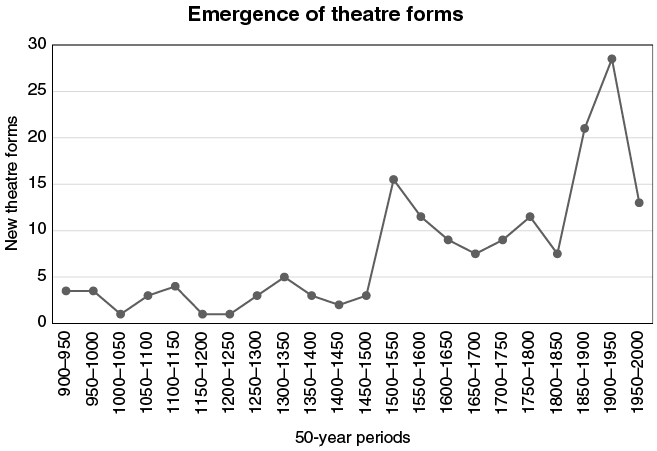
Let me be clear about the limitations of this roster. First, it is not comprehensive. It does not include forms for which no date of emergence is suggested by my sources, even as it also excludes the countless forms for which virtually no historical information is available. Second, it is not authoritative in its dating. The sources themselves sometimes disagree; where they do, I have used what seem the more likely dates but claim only that these dates are defensible. Third, the roster is not chronologically precise. It dates the emergence of theatre forms in fifty-year increments, but no doubt a form might have emerged in the previous fifty-year period than the one in which I have included it or become fully established only in the subsequent period. My goal with this roster, however, is to be neither comprehensive, authoritative, nor precise. It is merely to discover if, indeed, theatre forms have tended to emerge at identifiable moments across multiple regions, thereby giving theatre history a discernable shape. And indeed, when the data from the roster is presented in graph form, a shape most certainly presents itself (Figure I.1).
The emergence of theatre forms since 900 ce. Note that for forms whose emergence is identified by a century (e.g., “dates from the fourteenth century”) or a period spanning two half-centuries (e.g., “dates from mid fourteenth century”), I have given half-value to each half-century.
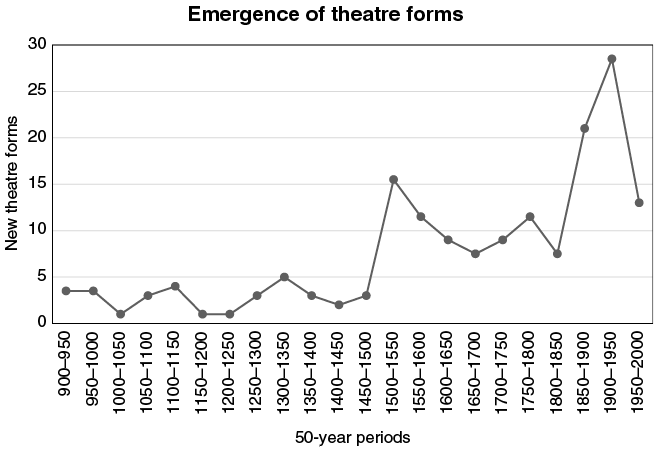
The graph begins in the year 900 ce because information about theatre in earlier centuries is far too spotty for historical analysis, with the obvious exceptions of the breakthroughs to literary theatre in ancient Greece (and its follow-up in Rome) and India. Through the centuries before and after those breakthroughs, the emergence of new forms seems to show no pattern – perhaps owing to the paucity of information or perhaps because the forms emerged for purely local reasons. As best one can tell, though, there is no interregional shape to theatre history before the tenth century.
But in the centuries immediately after 900 ce, the roster shows something unprecedented: There is now not a single fifty-year span without at least one new form, and the few fifty-year periods without multiple new forms might well be statistical artifacts. For a region such as Europe, one might suspect that increasing literacy starting in the tenth century is responsible for the emergence of new forms (or at least for the recording of their emergence), but the new forms are not limited to Europe; they are emerging all across Eurasia. The strong impression one gets is that theatre has entered a new period of creativity and that we are seeing a pan-Eurasian rising tide of theatrical change. And as the graph clearly shows, a true wave of theatrical change arose suddenly in the sixteenth century, extending across Eurasia and now touching the Americas and the South Pacific as well. Again, one might suspect that Europe’s new print technology played a role in this change, but the efflorescence of new theatre forms takes place both in regions to which print had not yet been introduced (e.g., South Asia) and in regions where it had long existed (e.g., East Asia). Moreover, while the sixteenth-century wave seems to come out of nowhere, the late seventeenth and eighteenth centuries show a relatively steady state of emergence at a significantly lower level than the sixteenth century, which suggests a waning in the impetus behind the wave. In the mid nineteenth century, however, comes another wave of theatrical change, which grows into a virtual tsunami by the early twentieth century, washing over the entire world before it drains away in the aftermath of the Second World War.
The upshot of all this is that theatre forms over the past millennium do tend to emerge in rough synchronicity, rather than being random and independent occurrences. Although the forms in each efflorescence were shaped by their local theatrical and societal contexts, the global perspective allows us to see that each efflorescence was interregional, with the first two extending across Eurasia and the third encompassing the globe.
But it is not sufficient merely to identify these inflection points in theatre history. There remain the critical issues of considering why these inflections took place when they did and how they did. The historian William A. Green observes, “Ideally, all periodizations should be rooted in disciplined concepts of continuity and change …. We must identify how powerful historical forces interacted to generate particular forms of change at particular velocities.”73 The “historical forces” that might stimulate interregional moments of theatrical change can of course be quite various, and the same forces might impact the theatre of different societies (and also the various theatre forms of a given society) in differing ways. Still, the most powerful of these forces are not entirely unknowable.
The inflection points I have identified are based on nothing more than the emergence of theatre forms, but as it happens, these same points are widely recognized by world historians as moments of significant change in general history.74 Most striking, perhaps, is an account of Eurasian history by Victor Lieberman. His “central thesis,” argued through two volumes totaling more than 1,300 pages, “is that over at least a thousand years, vast stretches of Eurasia, including Southeast Asia, Europe, Japan, China, and South Asia, responded in broadly comparable ways to coordinated economic, climatic, and military stimuli. Most regions, for example, saw a great upsurge in economic and political vitality in the late first and early second millennia, and again for much of the 16th and 17th centuries.”75 I need to add that Lieberman’s volumes cover only until 1830, at which point European empires were gaining temporary mastery over much of Eurasia, bringing about yet another moment of synchronized sociopolitical change.
The congruence of our theatrical inflection points with the period-markers identified by Lieberman and many other world historians explains why the moments of theatrical efflorescence took place in multiple regions: The relevant historical forces came from beyond theatre and were interregional in their impact. Societies undergoing certain kinds of change create opportunities for the emergence of new forms of theatre. This is not to say that theatre is a “mirror” that “reflects” the world, as the now-hackneyed metaphor has it, but it does suggest that theatre exists in the world and that its history is not separable from it. This should not be surprising, because theatre is both created and attended by people of that world. And so, over the past 1,000 years, as societies across Eurasia have changed in rough synchronicity, the theatres of those societies give the impression of having danced in their own various ways to a common historical rhythm.
But all of this takes us back “only” a thousand years. The centuries immediately before that are (as I have noted) difficult to parse, but the earlier emergence of literary forms of theatre in Greece and India is undoubtedly another inflection point needing examination. And even that fails to take us back far enough, for it is evident that Greece’s tragedy and comedy and India’s Sanskrit theatre were preceded by nonliterary forms of theatre. And so to begin examining the shape of theatre history, we need to go back to the earliest inflection point in theatre history: the emergence of dramatic theatre itself.
The inflection points I will discuss set off new periods of world theatre history – but they do not necessarily mark the end of the previous periods. As I conceive them, the periods of theatre history are open-ended, for with the onset of a new period, the theatre of previous periods does not suddenly cease. Continuity, after all, is as much a part of history as is change. Established theatre forms often remain in performance well into subsequent periods, and even if the forms might cease being performed, their plays and performance practices will often be taken up by the artists of successor theatre forms, modified as necessary to fit their needs. And so rather than see each period as a discrete entity, I see the periods as a set of layers, with each new period being, in effect, placed atop the existing ones. In this way, one can recognize the theatrical efflorescence that marks the start of a new period while still acknowledging the ongoing vitality of at least some aspects of previous periods.
I use theatre history’s major inflection points to structure this book. Part I delves into the “deep history” of dramatic theatre: Chapter 1 offers a Darwinian explanation for the development of theatrical behavior, and Chapter 2 contemplates what we can say about early forms of theatre for which there is virtually no evidence. Part II explores the theatrical breakthroughs that took place in ancient Greece and India: Chapter 3 analyzes the societal conditions that allowed for the invention of those lands’ literary theatres, and Chapter 4 considers why other ancient societies did not then invent their own literary theatre forms, while also showing how the Greek and Indian breakthroughs created the legacies of long-enduring theatre regions.
Part III of this book takes up the rising tide of theatrical change that began in the tenth century, when the various parts of Eurasia grew increasingly interconnected even as they crystalized their own societal identities. Chapter 5 explains how China served as the engine of the Eurasian convergence while developing a pair of theatre forms that would influence the East Asian theatre region for centuries to come. Chapter 6 follows the most important sea route outward from China, making stops in Southeast Asia, South Asia, and North Africa to show how each of these regions was stimulated to create its own new forms of theatre. Chapter 7 then turns to the lands on the margins of Eurasia – Europe to the west, Japan to the east – to see how each developed its own distinctive societal identity and theatre forms.
Part IV of the book considers the sixteenth-century resurgence of Eurasia in the wake of the bubonic plague and the post-Mongol collapse of commerce, noting how each region was reconfigured in ways that opened numerous opportunities for theatrical innovation. Chapter 8 examines the emergence of urban-based theatre forms in Japan after it suffered from its own profound internal disruptions. Chapter 9 looks to the Islamic empires of the Ottomans, the Safavids, and the Mughals, alike in sharing a common tradition of improvisatory comic theatre but otherwise notably different in their theatrical directions. Chapter 10 takes on the lands bordering the South China Sea and charts the disparate theatrical courses of East Asia, Southeast Asia, and the Philippines. Chapter 11 focuses on Europe, noting how humanistic studies and the growing importance of the Atlantic Ocean spurred theatrical change.
Part V surveys the global transformation that began in the nineteenth century with the onset of industrialization and the challenge, virtually everywhere in the world, of confronting the modernity that ensued. Chapter 12 tells of Europe, with its new working- and middle-class audiences and its new ideologies of romanticism and realism. Chapter 13 discusses the “Neo-Europes” of the Americas and Australasia that had been created by European colonization and that continued to be influenced by European theatre even as they went their own ways. Chapter 14 turns to three regions directly subjected to European imperialism – sub-Saharan Africa, South Asia, and Southeast Asia – and to the diversity of theatrical paths taken in each region. Chapter 15 considers Japan, Korea, and East Asia, which were less directly subjected to European imperialism but nonetheless compelled to create their own versions of modernity.
Finally, the Conclusion will take a closer look at three aspects of world theatre history that are recurring themes in this book. First is the immense impact of nontheatrical historical forces, especially at theatre history’s major inflection points; second is the frequency with which theatre forms have been influenced by syncretism, whether intracultural or intercultural; and third is the depth of attraction that dramatic theatre has exerted upon people everywhere. World theatre history, one might say, has been shaped by general history, but it has also been shaped by the transmission of theatrical ideas as well as by the intrinsically human desire to participate in dramatic theatre.
A Personal Note
Allow me to conclude this Introduction on a personal note. Who am I to write about world theatre history? Everyone comes from somewhere or (for some people) a set of somewheres. I come from the United States, a fact that has undoubtedly influenced my thinking, sometimes in ways I will have failed to recognize. But the same is true, mutatis mutandis, of everyone. All claims about history come from one or another person (or group of people) hailing from one or another place (or set of places). Because we are all inescapably positioned in the world, no one automatically has a greater or lesser authority to write about the world. But as the historian David Hackett Fischer notes, “The fact that historical knowledge is itself historically caused by the situation of the historian does not in any degree imply that it is false.”76 The validity of a historical claim is conditional not on who or where it comes from but on the quality of its historical reasoning and on its adherence to the available evidence.
I am aware, though, that I bring a set of presuppositions to this book. I presuppose that the world matters, for we all share a common humanity, however much our individual lives might be embedded in one or another society. I also presuppose that historical evidence allows for the making of meaningful historical claims, even if those claims cannot be granted absolute certainty. Regarding theatre history, I have already suggested that I reject the view that it should focus on dramatic literature. But I also reject A. M. Nagler’s view that theatre historians should focus on “styles of performance and their more or less plausible reconstructions,” while engaging “neither in historical philology nor in the study of literature, neither in folklore nor in sociology.”77 My presupposition, rather, is that everything associated with theatrical events is legitimate territory for theatre historians. Further, while I reject the view that theatre exists in an aesthetic universe of its own, I also reject the contrary view that it merely reflects or expresses the society in which it is performed. My presupposition, instead, is that dramatic theatre is a constituent part of society, at once affecting and being affected by it – but that societal forces do not compel theatre to develop in any particular direction. I believe that theatre artists, while working within specific theatrical and societal contexts, are the primary agents of theatrical continuity and change.
But I am only one person. A strong argument can be made that a book on world theatre history should be written by a team of scholars, each an expert on the place of which they write. The offsetting advantage that can be offered by a single author (whoever he or she might be) is a unity of vision that provides a clear thesis and a coherent argument in support of that thesis. Works by teams of experts present multiple perspectives and differing points of emphasis, sometimes leading to contradictions, repetitions, and/or gaps in the overall discussion; they also tend to be quite unwieldy.78 No single author can claim anything like the depth of knowledge that a team of experts will have, but such an author can hope to offer a cogent and concise line of thought.
I make no claim to expertise in the theatre (or general) history of any particular time and/or place. Because this book is based on the expertise of others, it should be understood as a work of synthesis. But it is a fundamentally different synthesis than can be found elsewhere, for its discussion of the longue durée of theatre history is based on the premise that all the places of the world are in the world, together, and that none is intrinsically more or less worthy of consideration than any other place. Starting from this premise, the following pages seek to make sense of the enduring continuities and the most important moments of change that have given world theatre history its shape.