

1. Introduction
Continent formation and its stabilization are key factors for understanding tectonic processes and histories across geologic time (Nelson, Reference Nelson1991; Holm et al. Reference Holm, Darrah and Lux1998, Reference Holm, Medaris, McDannell, Schneider, Schulz, Singer and Jicha2020;). The Neoproterozoic crustal block of Sri Lanka is well suited for investigating how volcanic arcs are transformed tectonically via accretion/collisions, high-T metamorphism, intense deformation and ultimately stabilized into continental crust. Late Neoproterozoic continental reconstructions place the continental fragment of Sri Lanka at the nexus of Africa, Madagascar, India and East Antarctica in the heart of the Gondwana supercontinent (Fig. 1; Yoshida et al. Reference Yoshida, Funaki and Vitanage1992; Lawver et al. Reference Lawver, Gahagan and Dalziel1998). Geological correlations of Sri Lanka with adjacent Gondwana fragments (the Lützow-Holm Complex (LHC) in East Antarctica (Yoshida et al. Reference Yoshida, Funaki and Vitanage1992; Shiraishi et al. Reference Shiraishi, Ellis, Hiroi, Fanning, Motoyoshi and Nakai1994), the Kerala Khondalite Belt (KKB) in southern India (Plavsa et al. Reference Plavsa, Collins, Payne, Foden, Clark and Santosh2014; Kitano et al. Reference Kitano, Osanai, Nakano, Adachi and Fitzsimons2018), the Lurio foreland (LF) of Mozambique (Ng et al. Reference Ng, Whitehouse, Tam, Jayasingha, Wong, Denyszyn, Yiu and Chang2017) and southern Madagascar (MD; Jöns & Schenk, Reference Jöns and Schenk2011; Fitzsimmons, Reference Fitzsimmons2016) are based, in part, on similarities of lithologies, structures, Neoproterozoic arc magmatism and age of UHT metamorphism. The geology and central position of Sri Lanka within Gondwana underscores its importance for documenting and better understanding continental growth (via arc formation and amalgamation) during supercontinent assembly, and its subsequent stabilization.
Gondwana reconstruction after Lawver et al. (Reference Lawver, Gahagan and Dalziel1998). MD = Madagascar; SL = Sri Lanka, DML = Dronning Maud Land; LHB = Lützow-Holm Belt; KKB = Kerala Khondalite Belt.

Representing a collage of subduction-related igneous and highly deformed and metamorphosed sedimentary middle and lower-crustal rocks, our understanding of the tectono-metamorphic history of Sri Lankan basement rocks has been significantly advanced by U-Pb zircon geochronologic research over the past two decades. SIMS, SHRIMP and LA-ICPMS zircon U-Pb analyses from basement rocks of central and eastern Sri Lanka (Sajeev et al. Reference Sajeev, Osanai, Connolly, Suzuki, Ishioka, Kagami and Rino2007, Reference Sajeev, Williams and Osani2010; Dharmapriya et al. Reference Dharmapriya, Malaviarachchi, Santosh and Tang2015; He et al. Reference He, Santosh, Tsunogae, Malaviarachchi and Dharmapriya2016; Ng et al. Reference Ng, Whitehouse, Tam, Jayasingha, Wong, Denyszyn, Yiu and Chang2017) indicate a dominant latest Neoproterozoic-Cambrian UHT and granulite metamorphism interpreted to be associated with double-sided arc accretion during closure of the southern Mozambique Ocean (Santosh et al. Reference Santosh, Tsunogae, Malaviarachchi, Zhang, Ding, Tang and Dharmapriya2014; He et al. Reference He, Hand, Santosh, Kelsey, Morrissey and Tsunogae2018).
In comparison, few conventional U-Pb monazite dates have been reported from Sri Lankan basement rocks. Hölzl et al. (Reference Hölzl, Hofmann, Todt and Kohler1994) obtained monazite TIMS ages of 592 and 555 Ma from metapelitic granulites of the central Highland Complex (HC). Sajeev et al. (Reference Sajeev, Williams and Osani2010) obtained uniform SHRIMP U-Pb monazite ages of ca. 550 Ma on retrograde monazite grains, concordant with SHRIMP U-Pb zircon overgrowth ages in UHT rocks in central Sri Lanka (HC). CHIME monazite dating (Malaviarachchi & Takasu, Reference Malaviarachchi and Takasu2011) yielded a wider range of metamorphic ages between 730 and 460 Ma, although HC detrital zircon ages as young as 800–600 Ma (Takamura et al. Reference Takamura, Tsunogae, Santosh, Malaviarachchi and Tsutsumi2016) suggest the older (730–600 Ma) components may be relic detrital monazite. Despite its potential as a rapid and non-destructive high-resolution geochronometer, particularly in Proterozoic crustal studies, no electron microprobe (EMP) monazite ages have been obtained from Sri Lankan basement rocks. Here we report EMP monazite ages from southeast Sri Lanka and compare these ages with prior M1 (prograde) and M2 (retrograde) zircon metamorphic ages from central Sri Lanka.
Little is known about the post UHT metamorphic exhumation and stabilization of the Sri Lankan complexes despite its importance in documenting and understanding the post-collisional/orogenic history following Gondwana assembly, stabilization and break-up. The post-peak metamorphic (<550 Ma) mid-crustal cooling history in Sri Lanka is currently poorly constrained by a few early K-Ar and Rb-Sr mineral (dominantly biotite) ages and unpublished 40Ar-39Ar laser microprobe mineral ages which collectively scatter between ca. 550–420 Ma (Cooray, Reference Cooray1969; Hölzl et al. Reference Hölzl, Kohler, Kröner, Jaeckel, Liew and Kröner1991; Burton & O’Nions, Reference Burton and O’Nions1990; Irwin et al. Reference Irwin, Kirschbaum, Lim, Glassley, Ryerson, Shaw, Niemeyer and Abeysinghe1987). Here we report the first 40Ar-39Ar incremental step-heating mineral ages from southeast Sri Lanka which suggest rapid intermediate (mid-crustal) cooling at 490–480 Ma, concurrent with Ordovician serpentinization and fluid flow in Sri Lanka (He et al. Reference He, Santosh, Tsunogae, Malaviarachchi and Dharmapriya2016), and orogenic collapse in adjacent east Antarctica and Mozambique (Jacobs et al. Reference Jacobs, Bingen, Thomas, Buer, Wingate and Feitio2008). Our results link the end of prolonged HT deep-crustal orogenic metamorphism with the onset of rapid cooling associated with tectonic exhumation and continental stabilization.
2. Geologic setting
The Sri Lanka Precambrian ‘pendant’ consists of three larger and one smaller basement terranes (Cooray, Reference Cooray1994) distinguished on the basis of geologic and structural mapping (Kehelpannala, Reference Kehelpannala2003, Reference Kehelpannala2004) and Nd model ages (Milisenda et al. Reference Milisenda, Liew, Hofmann and Kröner1994; Kröner et al. Reference Kröner, Cooray, Vitanage and Kröner1991). A high-standing, central, dominantly supracrustal assemblage of granulite and UHT (>850 °C) metamorphic rocks (HC) is tectonically bounded on both sides by Neoproterozoic arc magmatic-dominated terrains metamorphosed to amphibolite and granulite facies (Fig. 2). The HC granulites experienced a major high-temperature (700–750 °C) folding and thrusting event that postdates peak metamorphism (Kleinschrodt, Reference Kleinschrodt1994). The western terrane boundary (separating the Wanni Complex, WC and the smaller Kadugannaw Complex, KC from the HC) is poorly defined and strongly overprinted (Voll & Kleinshcrodt, Reference Voll, Kleinschrodt and Kröner1991), whereas the eastern terrane boundary is a well-defined thrust/shear contact (Voll & Kleinshcrodt, Reference Voll, Kleinschrodt and Kröner1991; Kriegsman, Reference Kriegsman1995) referred to by He et al. (Reference He, Santosh, Tsunogae, Malaviarachchi and Dharmapriya2016), and in this paper, as the ‘eastern suture’.
Tectonic map of Sri Lanka showing boundaries of crustal units delineated on the basis of Nd model ages (after Mathavan et al. Reference Mathavan, Prame and Cooray1998). WC = Wanni Complex; HC = Highland Complex; VC = Vijayan Complex, KC = Kadugannawa Complex. Shaded northwestern part of Sri Lanka represents Cenozoic sediments. Red symbols represent locations of 40Ar-39Ar ages, and grey symbols represent locations of monazite age data.

The eastern suture is well-defined by a ca. 10–15 km wide thrust zone separating complexes with different metamorphic grades and Nd model ages (Voll & Kleinschrodt, Reference Voll, Kleinschrodt and Kröner1991; Kriegsman, Reference Kriegsman1995). This ‘tectonic mixed zone’ (Ng et al. Reference Ng, Whitehouse, Tam, Jayasingha, Wong, Denyszyn, Yiu and Chang2017), characterized by strong deformation, exotic tectonic slivers, migmatites, local serpentinite bodies, magnetite deposits and gold mineralization, is likely a major suture separating high-grade granulite/UHT rocks on the west (HC) from Grenville-age dominantly amphibolite facies granitoid and mafic orthogneisses on the east (VC; Santosh et al. Reference Santosh, Tsunogae, Malaviarachchi, Zhang, Ding, Tang and Dharmapriya2014; He et al. Reference He, Santosh, Tsunogae, Malaviarachchi and Dharmapriya2016). West of the eastern suture, HC metamorphic pressures and temperatures broadly increase from 5–6 kb and ∼700 °C in the northwest to 9–10 kb and ∼830 °C in the southeast, near the eastern suture (Faulhaber & Raith, Reference Faulhaber and Raith1991; Schumacher & Faulhaber, Reference Schumacher and Faulhaber1994), suggesting the HC may be a tilted mid-to-lower-crustal section exhumed, in part, when the HC collided with the VC (Kehelpannala, Reference Kehelpannala1997, Reference Kehelpannala2003).
Similarities in lithology, geochemistry and geochronology of the western WC and eastern VC led Santosh et al. (Reference Santosh, Tsunogae, Malaviarachchi, Zhang, Ding, Tang and Dharmapriya2014) to interpret these bounding terranes as coeval magmatic arcs constructed above early to middle Neoproterozoic divergent subduction zones during closure of the Mozambique Ocean. In their model, the HC represents older trench fill sediments that were strongly deformed and metamorphosed via final ocean closure and collision of the arc terranes during assembly of Gondwana. More recently, He et al. (Reference He, Santosh, Tsunogae, Malaviarachchi and Dharmapriya2016) document 920–970 Ma and 620–700 Ma subduction-related magmatism in the VC with no evidence for ages older than 1000 Ma, consistent with a continuous double subduction arc formation model (Li et al. Reference Li, Capitanio, Cawood, Wu, Zhai and Wang2024).
3. Timing and duration of HT metamorphism
Recent U-Pb zircon geochronology reveals widespread Pan-African medium- to high-grade metamorphism of all of the major Sri Lanka Proterozoic complexes. Granulite metamorphism of HC rocks occurred between 610 and 520 Ma (Kröner et al. Reference Kröner, Williams, Compston, Baur, Vitanage and Perera1987, Reference Kröner, Jaeckel and Williams1994; Santosh et al. Reference Santosh, Tsunogae, Malaviarachchi, Zhang, Ding, Tang and Dharmapriya2014; He et al. Reference He, Santosh, Tsunogae and Malaviarachchi2015, Reference He, Hand, Santosh, Kelsey, Morrissey and Tsunogae2018) with peak metamorphism and charnockitization from 580–530 Ma (Dharmapriya et al. Reference Dharmapriya, Malaviarachchi, Santosh and Tang2015, Reference Dharmapriya, Malaviarachchi, Sajeev and Zhang2016; Takamura et al. Reference Takamura, Tsunogae, Santosh, Malaviarachchi and Tsutsumi2015, Reference Takamura, Tsunogae, Santosh, Malaviarachchi and Tsutsumi2016). Sajeev et al. (Reference Sajeev, Williams and Osani2010) interpret prograde UHT metamorphism in central Sri Lanka (western HC) to be ca. 570 Ma and retrograde UHT metamorphism to be ca. 550 Ma. Older 570 Ma zircon rim ages are interpreted to indicate partial melting prior to peak metamorphism and younger ca. 550 Ma zircon and monazite rim ages to indicate post-peak isothermal decompression at high pressures (Sajeev et al. Reference Sajeev, Williams and Osani2010). Other recently reported U-Pb zircon metamorphic ages are no older than 590 Ma (Santosh et al. Reference Santosh, Tsunogae, Malaviarachchi, Zhang, Ding, Tang and Dharmapriya2014; Ng et al. Reference Ng, Whitehouse, Tam, Jayasingha, Wong, Denyszyn, Yiu and Chang2017; He et al. Reference He, Santosh, Tsunogae, Malaviarachchi and Dharmapriya2016, Dharmapriya et al. Reference Dharmapriya, Malaviarachchi, Santosh and Tang2015).
Felsic to mafic Neoproterozoic magmatic rocks in western Sri Lanka metamorphosed to upper amphibolite to granulite facies orthogneisses make up the dominant lithology of the western Wanni Complex. Lower intercept U-Pb zircon ages between 590 and 540 Ma likely represent the age of high-grade metamorphism (Hölzl et al. Reference Hölzl, Kohler, Kröner, Jaeckel, Liew and Kröner1991). Charnockites and gneisses from Kurunegala (northwest Sri Lanka) yield a common regression line of ages with a lower intercept age of 563 Ma interpreted as the age of metamorphism (Baur et al. Reference Baur, Kröner, Todt, Liew and Hofmann1991). Until recently, the rocks of the VC have been less studied than the HC and WC rocks to the west because of political instability. The timing of granulite to amphibolite facies metamorphism of the VC, although less well constrained, was thought initially to be somewhat younger than the other terranes (between ∼560 and 480 Ma; ; Hölzl et al. Reference Hölzl, Kohler, Kröner, Jaeckel, Liew and Kröner1991, Reference Hölzl, Hofmann, Todt and Kohler1994; Cooray, Reference Cooray1994; Kröner & Williams, Reference Kröner and Williams1993). However, Kröner et al. (Reference Kröner, Rojas-Agramonte, Kehelpannala, Zack, Hegner, Geng, Wong and Barth2013) documented that Neoproterozoic magmatic rocks (dated at 1062–935 Ma and 820–620 Ma; He et al. Reference He, Santosh, Tsunogae, Malaviarachchi and Dharmapriya2016; Ng et al. Reference Ng, Whitehouse, Tam, Jayasingha, Wong, Denyszyn, Yiu and Chang2017) were regionally metamorphosed to upper amphibolite and granulite facies at ∼580 Ma. More recent SIMS U-Pb zircon data yield metamorphic ages of ∼580–521 Ma with charnockitization in the VC occurring at ∼560 Ma (Ng et al. Reference Ng, Whitehouse, Tam, Jayasingha, Wong, Denyszyn, Yiu and Chang2017) and He et al. (Reference He, Santosh, Tsunogae, Malaviarachchi and Dharmapriya2016) report minor to significant Pb loss in the eastern suture at about 580–550 Ma.
Abundant high-precision SIMS and LA-ICPMS single grain and single spot zircon U-Pb ages in some sapphirine-bearing, pelitic and mafic granulites (Sajeev et al. Reference Sajeev, Osanai, Connolly, Suzuki, Ishioka, Kagami and Rino2007, Reference Sajeev, Williams and Osani2010; Dharmapriya et al. Reference Dharmapriya, Malaviarachchi, Santosh and Tang2015, Reference Dharmapriya, Malaviarachchi, Sajeev and Zhang2016; Santosh et al. Reference Santosh, Tsunogae, Malaviarachchi, Zhang, Ding, Tang and Dharmapriya2014; Osanai et al. Reference Osanai, Sajeev, Nakano, Kitano, Kehelpannala, Kato, Adachi and Malaviarachchi2016) yielded bimodal metamorphic age populations during the Ediacaran (620–580 Ma) and into the Cambrian (565–525 Ma), despite a lack of textural evidence for separate HT metamorphic events (Dharmapriya et al. Reference Dharmapriya, Malaviarachchi, Kriegsman, Galli, Sajeev and Zhang2017). Osanai et al. (Reference Osanai, Sajeev, Nakano, Kitano, Kehelpannala, Kato, Adachi and Malaviarachchi2016) tied the bimodal metamorphic age populations in Sri Lanka temporally and spatially to separate 40 Ma duration UHT metamorphic episodes in southern Madagascar, southern India and East Antarctica during amalgamation of Gondwana during the Kuunga and East African Orogenies. More recently, a compilation of 1119 concordant zircon U-Pb ages from HC, together with LA-ICP-MS zircon U-Pb ages along with garnet/zircon REE data from HC (He et al. Reference He, Hand, Santosh, Kelsey, Morrissey and Tsunogae2018) and SIMS U-Pb zircon ages from the VC (Ng et al. Reference Ng, Whitehouse, Tam, Jayasingha, Wong, Denyszyn, Yiu and Chang2017) have been interpreted to indicate a single long-lived period (>50–100 Ma) of high-grade and UHT metamorphism lasting until ca. 520 Ma (and possibly until 480 Ma) associated with tectonic assembly of the Gondwana supercontinent.
4. Descriptions of dated bedrock samples
For this study, fifteen bedrock samples were collected from southeastern Sri Lanka near (<6 km) and within the eastern suture (Fig. 2; Table 1). From these, three samples of sheared gneiss within the suture (Fig. 3a), two samples of gneiss from the VC (Fig. 3b) and two gneiss samples from the HC (Fig. 3c and d) were selected for dating. Dated samples, briefly described below, include two garnet-biotite gneisses, a biotite gneiss, a garnet-sillimanite gneiss, a charnockitic gneiss, a garnet-bearing charnockitic gneiss and a garnet-hornblende gneiss (more detailed descriptions are available in Widanagamage (Reference Widanagamage2011).
Locations (UTM SL Grid_99 coordinate system) of samples, rock names and minerals dated

(top) Field photos of eastern suture (a), VC (b), and two HC gneisses (c, d). (bottom) Photomicrographs of samples dated via the 40Ar-39Ar method. e) SLR2 biotite, f) SLR3 hornblende, g) SLR6, biotite, h) SLR7 biotite.

4.a. Highland Complex rocks
Garnet-sillimanite gneiss sample SLR5 exhibits subhedral, pinkish red, 1–5 mm garnet porphyroblasts in a matrix of sillimanite, feldspar, mica and quartz (Fig. 3d). Anastomosing centimetre-thick shear zones with flattened garnet porphyroblasts are also present. Garnet makes up 20–25% of the rock with coarse subhedral garnets surrounded by finer subhedral garnet overgrowths. Sillimanite is abundant (30–40%) occurring both as inclusions in garnet and aligned in the foliation. Anhedral quartz (10–15%), subhedral plagioclase (5–10%), anhedral and K-feldspar (5%) make up the remainder of the rock.
Sample SLR2 is a medium-grained charnockitic gneiss. Fresh black and greyish-green samples consist of 10% biotite, 20% hypersthene, 10% hornblende, 10–15% plagioclase, 35–40% potassium feldspar and 10% quartz. Coarse euhedral to subhedral prismatic biotite crystals are aligned within the foliation and associated with subhedral, fractured hypersthene grains (Fig. 3e). Overall, the rock contains granoblastic texture with straight grain boundaries terminating at triple junctions.
Sample SL3 is a highly deformed garnet-biotite gneiss with sheared garnet porphyroblasts. Ribbon quartz (30–40%), biotite (20–30%) and aligned feldspars (40–50%) make up the bulk of the outcrop (Fig. 3a).
Sample M3 is a garnet-biotite gneiss with 1–2 mm diameter garnet porphyroblasts in a matrix of aligned biotite, quartz and feldspar. Subhedral quartz (25–30%), plagioclase (35–40%) and biotite (10–15%) make up the bulk of the outcrop.
Sample SLR3 is a white and red garnet-bearing hornblende gneiss collected from an outcrop of highly sheared rock within the eastern suture. The gneiss is strongly foliated, consisting of mafic bands of coarse subhedral garnet and amphibole, and leucosomes of medium-grained quartz, plagioclase and perthitic feldspar (Fig. 3f).
4.b. Eastern suture rocks
Sample SL3 is a highly deformed garnet-biotite gneiss with sheared garnet porphyroblasts. Ribbon quartz (30–40%), biotite (20–30%) and aligned feldspars (40–50%) make up the bulk of the outcrop. (Fig. 3a)
Sample M3 is a garnet-biotite gneiss with 1–2 mm diameter garnet porphyroblasts in a matrix of aligned biotite, quartz and feldspar. Subhedral quartz (25–30%), plagioclase (35–40%) and biotite (10–15%) make up the bulk of the outcrop.
Sample SLR3 is a white and red garnet-bearing hornblende gneiss collected from an outcrop of highly sheared rock within the eastern suture. The gneiss is strongly foliated, consisting of mafic bands of coarse subhedral garnet and amphibole, and leucosomes of medium-grained quartz, plagioclase and perthitic feldspar (Fig. 3f).
4.c. Vijayan complex rocks
Sample SLR6 is a coarse-grained garnet-bearing charnockitic gneiss. Fresh surfaces are dark and light green with spots of red and black. Subhedral plagioclase (30–35%), subhedral hypersthene (20–25%), euhedral to subhedral prismatic biotite (10–15%), subhedral garnet (5–10%) and anhedral quartz (5–10%) make up the bulk of the rock (Fig. 3g). Granoblastic texture is common with polygonal quartz-feldspar associations.
Sample SLR7 is a white and black well-foliated biotite gneiss. Subhedral plagioclase (20–30%), anhedral quartz (10–15%), subhedral biotite (20–25%) and subhedral orthoclase (20–25%) make up the bulk of the rock. Minor alteration of biotite to chlorite and sericitization of feldspars is evident in thin section (Fig. 3h).
5. Analytical methods
5.a. EMP monazite geochronology
Monazite was dated in situ on thin sections (e.g. Williams et al. Reference Williams, Jercinovic and Terry1999) using a Cameca SX-100 electron microprobe at the New Mexico Bureau of Geology. Polished thin sections of samples were prepared, carbon coated and mapped for elements Si, Fe and Ce at an accelerating voltage of 15 kV, probe current of 200 nA and a beam size of 10 µm. Based on the Ce maps, monazite grains with a range of sizes and morphologies were identified and detailed Th, U, Y and Pb maps of select grains were produced. Mapping was carried out at an accelerating voltage of 15 kV, probe current of 200 nA, using the PET crystal for analysis of Th and U; the TAP crystal for Y and a LPET crystal for Pb. Using the detailed chemical maps as a guide, major component analysis of the monazite grains was carried out, with attention focused on areas of grains with obviously different Th concentrations. These analyses included Ce, P, Si, Ca, Y, Th, La and a set of additional REE and were carried out at an accelerating voltage of 15 kV, and probe current of 20 nA.
Probe points were chosen using Th and Y maps to measure different chemical domains, and BSE images were used to avoid grain edges, fractures and holes to minimize non-uniform production of trace elemental X-rays. Background scans were run to fine-tune the background counting positions, in order to ensure accurate determination of trace concentrations. To determine the appropriate background levels for Th, Y, Pb and U, the data were processed in BK GII (Background II), a program developed by Mike Jercinovic (University of MA Amherst) that performs a regression analysis to determine background counting positions.
The monazites we analysed were typically 50–100 µm in diameter, large enough for choosing multiple probe points; two to nine points per grain were measured. Quantitative analysis of the Th, U, Y and Pb concentrations of monazite was done using the ‘trace analysis’ capabilities of the Cameca software. Many trace element analysis points were selected near points measured for major element data in order to ensure that trace concentrations were collected for Th, U, Pb and Y using the appropriate calibrations for the different chemical domains. Y was analysed with a TAP crystal, Th and U using a standard PET crystal, and Pb using a large PET crystal for better count rates. For these analyses, the Th (Mα) was calibrated using ThO2, Y (La) using a yttrium garnet, U (Mβ) using UO2 and Pb (Mα) using pyromorphite. Count times on peak were 300, 400, 400 and 600 seconds, respectively, using a probe current of 200 nA, and an accelerating voltage of 15 kV, yielding a visible beam size of around 3 µm and an effective excitation volume of probably closer to 5 µm in diameter. Calibration took place immediately prior to analysis with no intervening sample changes. The age equation was then solved using the Th, U and Pb concentrations for each analytical spot on monazite. Spot age errors were calculated by propagating the one sigma counting statistic error for Y, Th, U and Pb through the age equation, following the method provided by the UThPbAge spreadsheet developed by Gavril Săbău (Reference Săbău2012). Before dates were accepted in the final dataset, the trace element analysis points, seen in the final BSE images, were compared to the trace concentrations to eliminate any disputable data.
5.b. 40Ar-39Ar thermochronology
Following standard mineral separation procedures, a minimum of 50 unaltered grains from each sample were hand-picked using a microscope. Samples were analysed at the New Mexico Geochronological Research Laboratory. Mineral separates of biotite and hornblende were loaded into aluminum discs and irradiated for 40 hours at the U.S. Geological Survey’s TRIGA Reactor in Denver, Colorado. Neutron flux monitor of Fish Canyon Tuff sanidine (FC-2), with an assigned age of 28.02 Ma (Renne et al. Reference Renne, Swisher, Deino, Karner, Owens and DePaolo1998), was also irradiated with the samples. Argon isotopes were measured using a Thermo-Fisher Scientific ARGUS VI mass spectrometer online with an automated all-metal extraction system. The mass spectrometer sensitivity is 1E-16 mol/fA. Samples were analysed using an incremental step-heating method by heating with a 75W Photon-Machine 810 nm diode laser. Released Ar gas was cleaned of reactive gases using a 1 SAES GP-50 getter operated at 450 ºC for five minutes. Mass spectrometer blanks and backgrounds were measured throughout the analysis, with total system blank and background of 25 ± 1%, 0.04 ± 20%, 0.05 ± 100%, 0.30 ± 85%, 0.10 ± 1.5%, x10–17 moles for masses of 40, 39, 38, 37 and 36, respectively. Through extrapolation of the sanidine flux monitor, neutron flux parameters, known as J-factors, were determined. These J-factors have a precision of ∼±0.01% determined by analysing six individual crystals from each of four radial positions around the irradiation tray. K-glass and CaF2 were used to determine correction factors for interfering nuclear reactions. There corrections were (40Ar/39Ar)K = 0.008068 ± 0.000068, (36Ar/37Ar)Ca = 0.000273 ± 0.0000002 and (39Ar/37Ar)Ca = 0.000698 ± 0.0000078.
The uncertainty for individual dates for each heating step is reported at 1 sigma and reflects analytical measurement uncertainties that are corrected for system blank and detector calibrations. Reported cooling ages are inverse-variance weighted mean ages calculated from the selected heating steps and uncertainties are the square root of the sum of 1/σ2 values. When MSWD is greater than one, errors are multiplied by the square root of the MSWD. Nominal closure temperatures of 500 ºC for hornblende and 300 ºC for biotite are used (cf. McDougall and Harrison, Reference McDougall and Harrison1999).
6. Results
6.a. Monazite EMP geochronology
Monazite grain sizes vary from 20 to 200 µm in diameter with most grains aligned and some elongate within the major rock fabric. Sixteen monazite grains were characterized and analysed in this study. Th concentration maps are presented in Fig. 4, and analytical data are recorded in Table 2.
Th concentration maps of dated monazite grains from samples SL3, M3 and SLR5 with corresponding spot ages colour differentiated into younger and older age spots.

EMP total monazite age data from shear zones in HC-VC thrust boundary zone and HC southeastern Sri Lanka

6.a.1. Eastern suture ages
Five monazite grains were analysed from sample SL3 (Fig. 4). Four of the five grains show complex interior Th concentration textures with high Th rims that consistently yield younger spot ages (580–627 Ma). One grain with relatively uniform Th composition yielded an interior spot age of 598 Ma. Older core spot dates in these grains range from 667 Ma to 1868 Ma
Two monazite grains were analysed from sample M3 (Fig. 4). Grain 1 is round and contains a number of inclusions. Th concentration varies only slightly. One rim analysis gave an outlying young age of 541 Ma; all other ages are in the range of 595–671 Ma (15 spots total). Grain 2 is angular and elongate. Th concentration is relatively uniform. Seven spot ages range from 804 to 1031 Ma with no consistent variation in age from core to rim.
6.a.2. Highland Complex ages
Eight monazite grains were analysed from sample SLR5. One elongated grain with relatively uniform Th composition yielded an interior spot age of 589 Ma. The other seven grains vary from sub-rounded to angular to irregular and show complex to simple interior Th concentration textures and a few show clear rim overgrowth textures. Four of the grains yield spot ages between 533 and 589 Ma and two yield similar rim ages with older core ages. One grain yielded only Proterozoic ages (1872–1368 Ma).
In summary, thirty spot ages from eight HC monazite grains reveal a dominance of Pan-African core and rim ages ranging from 533 Ma to 613 Ma (Fig. 5a) and forty spot ages from seven monazite grains from the eastern suture also preserve a dominance of Pan-African ages ranging from 541 Ma to 730 Ma (Fig. 5b). The two monazite age populations from the Highland Complex and the eastern suture are broadly consistent with one another except for the absence of 700–1000 Ma ages within the HC.
Age histograms showing probability curves for monazite spot ages from a) eastern suture (SL3, M3) and b) Highland Complex (SLR5).

6.b. Chemical domains of dated monazite
The monazite age and textural data suggest that the Pan-African ages may result from chemical domains that formed during prograde and/or retrograde metamorphism (Foster et al. Reference Foster, Kinny, Vance, Prince and Harris2000). To better quantify this possible relation, chemical concentrations (Th, Y and U) in HC monazite grains (SLR5) and eastern suture rocks (SL3 and M3) were plotted with respect to spot ages and Th/U ratios were calculated and plotted against Y concentrations (Widanagamage, Reference Widanagamage2011). In the eastern suture, Pan-African dates represent primary metamorphic ages between 595 and 635 Ma. Pan-African dates correspond to Y concentrations mostly near ∼2000 ppm with a few spots having higher concentrations (up to 13000 ppm). The low Y spots show a large variation of Th/U (from 3 to 57), whereas higher Y spots have Th/U values of <12. No simple age-chemical correlation exists (Fig. 6a).
Plots of Y vs Th/U of Pan-African monazite spot ages. A – eastern suture (samples SL3 and M3); B – Highland Complex (sample SLR5).

In the HC, Y concentrations of Pan-African spot ages align into two clusters: a low Y cluster (1500–2800 ppm) and a high Y cluster (4800–6200). Interestingly, the mean age for monazite spots with high Y concentrations is 556 ± 5 Ma, whereas the mean age for low Y concentration monazite spots is 572 ± 4 Ma. The older low Y Pan-African spot ages have a fairly wide range of Th/U ratios (4–30) whereas the younger high Y Pan-African spot ages have primarily lower and more restricted Th/U ratios varying in range from 2 to 7 (Fig. 6b).
6.c. 40Ar-39Ar thermochronology
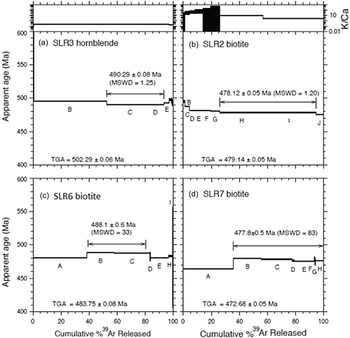
The age spectra of the biotite and hornblende are shown in Figure 7 and analytical results presented in Table S (online Supplementary Material at http://journals.cambridge.org/geo). The age spectra are variably complex and weighted mean dates are calculated for segments of the spectra that are most uniform. Only one sample produced a plateau age that is defined by three consecutive steps comprising >50% of the total 39Ar related. Despite this, the weighted mean and/or total gas ages for both hornblende and biotite grains yield internally consistent results and show that the minerals yield very similar cooling ages. We note that the cited high precision of the preferred ages does not reflect the geological uncertainty or the complexity of the age spectra, but rather is a consequence of the high analytical precision of the data. Thus, we do not attempt to over interpret individual cooling ages, but rather focus on the near concordance of mineral ages when discussing the overall cooling history of the region.
40Ar-39Ar release spectra. (a) Hornblende from the eastern suture, (b) biotite from the HC, (c) and (d) biotite from the VC.

Hornblende from a garnet-rich hornblende gneiss collected within the eastern suture (sample SLR3) yielded a total gas age of 488.70 ± 0.06 Ma and produced a weighted mean age of 490.3 ± 0.1 Ma calculated from 38.4% of 39Ar gas released from two consecutive steps. Biotite from HC charnockitic gneiss (sample SLR2) produced a preferred age of 478.12 ± 0.05 Ma calculated from 68.4% of 39Ar gas released from two consecutive plateau steps and a total gas age of 479.14 ± 0.05 Ma. Biotite from a Vijayan Complex garnet-bearing charnockitic gneiss (sample SLR6) provided a preferred age of 488.1 ± 0.6 Ma calculated from 44.4% of 39Ar released from two consecutive steps and a total gas age of 483.75 ± 0.07 Ma. Lastly, biotite from a Vijayan biotite gneiss (sample SLR7) produced a weighted mean age of 477.76 ± 0.53 Ma calculated from 63.9% of the 39Ar released from seven consecutive steps and total gas age of 472.68 ± 0.05 Ma.
In summary, all four 40Ar-39Ar mineral ages within and near the eastern suture yielded nearly concordant biotite and hornblende ages between 478 and 490 Ma.
7. Discussion
U-Pb zircon geochronology on UHT metapelites and mafic granulite from the western HC (central Sri Lanka) document late Neoproterozoic 580–530 Ma metamorphism associated with final assembly of Gondwana. Our EMP monazite study of the eastern suture region similarly yields a dominance of 600–500 Ma ages in newly grown metamorphic monazite grains and from metamorphic monazite rim overgrowths surrounding Proterozoic-aged cores. The Proterozoic core ages obtained here are consistent with derivation from magmatic protoliths of Palaeoproterozoic, Mesoproterozoic and Neoproterozoic sources determined from U-Pb detrital zircon ages in the HC (Kitano et al. Reference Kitano, Osanai, Nakano, Adachi and Fitzsimons2018; Takamura et al. Reference Takamura, Tsunogae, Santosh, Malaviarachchi and Tsutsumi2016). The middle Neoproterozoic monazite ages from eastern suture rocks may have come from the western peripheral region of the Vijayan complex itself (Ng et al. Reference Ng, Whitehouse, Tam, Jayasingha, Wong, Denyszyn, Yiu and Chang2017).
Yttrium content of monazite depends heavily on reactions involving garnet (Kohn et al. Reference Kohn, Wieland, Parkinson and Upreti2005). Y tends to be sequestered during prograde metamorphism as garnet grows and is released during retrograde reactions that consume garnet (Högdahl et al. Reference Högdahl, Majka, Sjostrom, Nilsson, Claesson and Konečný2011). Our slightly younger, high Y monazite spot ages are consistent with the HC reaching peak metamorphism (M1) at 572 ± 4 Ma followed by lower-crustal near isothermal decompression during retrogression (M2) at 556 ± 5 Ma. In their study of select UHT granulites from the western margin of the HC (central Sri Lanka), Sajeev et al. (Reference Sajeev, Williams and Osani2010) obtained similar Proterozoic SHRIMP U-Pb ages from zircon cores and monazite grains with overgrowths dated at 569 ± 7 Ma and 551 ± 7 Ma (Fig. 8). They interpreted the ca. 570 Ma overgrowths as the age of prograde (M1) metamorphism and the younger ca. 550 Ma overgrowths as the time of retrograde (M2) metamorphism during decompression. Their textural work suggests that early garnet growth during peak metamorphism was followed by garnet consumption during decompression, similar to our interpretation based on chemical age analysis of uniform and textured monazite grains of similar spot ages. The timing of peak and retrograde HC metamorphism obtained in this study and by Sajeev et al. (Reference Sajeev, Williams and Osani2010) are remarkably similar despite the use of different techniques (EMP and SHRIMP) and sample localities that are ca. 50–70 km apart (Fig. 8).
Schematic T-t diagram of long-lived HT orogenic metamorphism followed by rapid early Ordovician deep to mid-crustal exhumation and stabilization, HC, Sri Lanka.

Few intermediate-temperature (500–300 °C) mid-crustal cooling ages of high-grade Sri Lankan basement rocks exist. A dozen Rb-Sr biotite ages reported in Hölzl et al. (Reference Hölzl, Kohler, Kröner, Jaeckel, Liew and Kröner1991) scatter around 470–440 Ma, indicating the time of cooling through a single closure temperature. Interestingly, very large gemstone-quality detrital zircons from sedimentary deposits within the HC (Nasdala et al. Reference Nasdala, Reiners, Garver, Kennedy, Stern, Balan and Wirth2004) yielded Late Ordovician zircon (U-Th)/He ages which scatter around 443±9 Ma, which is consistent with both Rb-Sr biotite and (U-Th)/He in very large zircons having similar effective closure temperatures of about 250–300 °C (Nasdala et al. Reference Nasdala, Reiners, Garver, Kennedy, Stern, Balan and Wirth2004).
Our new 40Ar-39Ar mineral age data from different minerals with significantly different closure temperatures (∼500 °C for hornblende and ∼300 °C for biotite) suggest rapid cooling from above 500 °C to below 300 °C during the Ordovician (at 478–490 Ma; Fig. 8). Braun and Kriegsman (Reference Braun and Kriegsman2003) tentatively suggested that Ordovician cooling of the HC may have been related to thrusting of the HC atop the VC. However, our results indicate that both the HC and the VC rocks, as well as the intervening suture rocks all cooled simultaneously, suggesting cooling after, or at the end of, thrusting.
7.a. Linking high and intermediate-temperature thermal histories
A prolonged period of slow high-temperature cooling of Sri Lanka rocks has been argued for, in part, on the basis of modelling of retrograde diffusion zoning in garnet dated at 550–480 Ma (Sm-Nd ages; Hölzl et al. Reference Hölzl, Kohler, Kröner, Jaeckel, Liew and Kröner1991; Fig. 8). Petrologic modelling by Fernando et al. (Reference Fernando, Hauzenberger, Baumgartner and Hofmeister2003) suggests slow high-T cooling (1–5 °C /Ma) during which garnet diffusion is fast and homogeneously reset. They interpreted ongoing slow cooling at 1–5 °C /Ma to simply reflect slow ascent via low erosion rates associated with isostatic rebound, with final cooling through 300 °C at ∼440 Ma (based on Rb-Sr biotite ages of Hölzl et al. Reference Hölzl, Kohler, Kröner, Jaeckel, Liew and Kröner1991). Our new 40Ar-39Ar mineral age results instead suggest rapid cooling was simultaneous with the cessation of both high-T zircon growth (He et al. Reference He, Hand, Santosh, Kelsey, Morrissey and Tsunogae2018) and garnet growth (Hölzl et al. Reference Hölzl, Kohler, Kröner, Jaeckel, Liew and Kröner1991), and more likely reflects rapid exhumation associated with tectonic-driven uplift, not slow isostatic rebound.
Geologic evidence for rapid mid-crustal exhumation causing accelerated cooling comes from the widespread existence of garnet decomposition textures throughout the HC (Schumacher & Faulhaber, Reference Schumacher and Faulhaber1994), by aluminous metapelites with localized late-stage andalusite (Hiroi et al. Reference Hiroi, Ogo and Namba1994; Raase & Schenk, Reference Raase and Schenk1994) and by local pyrophyllite rims around sillimanite (grown at T <400 °C; Dharmapriya et al. Reference Dharmapriya, Malaviarachchi, Kriegsman, Galli, Sajeev and Zhang2017). Additionally, Hiroi et al. (Reference Hiroi, Yanagi, Kato, Kobayashi, Prame, Hokada, Satish-Kumar, Ishikawa, Adachi, Osanai, Motoyoshi and Shiraishi2014) documented quench textures of felsite inclusions (within garnet) in lower-crustal HC granulites which they interpreted as features associated with fast exhumation of lower-crustal rocks to andalusite stable upper-crustal conditions during continental collision. Beyond these features, there is no petrological evidence that the bedrock of Sri Lanka experienced any widespread low-grade metamorphism after rapid exhumation of HT rocks to the mid-crust. Young brittle upper-crustal faults dated using low-temperature thermochronology (zircon, apatite fission track and U-Th-Sm)/He analyses indicate two main shallow-level exhumation stages at 260–140 Ma and 90±20 Ma related to regional episodes of Gondwana break-up (Emmel et al. Reference Emmel, Lisker and Hewawasam2012). Additionally, ca. 40 Ma zircon fission track ages from Sri Lanka (reported by Garver, Reference Garver2002) may document onset of the most recent shallow-level exhumation leaving Sri Lanka as one of the highest stable regions in the world (Emmel et al. Reference Emmel, Lisker and Hewawasam2012).
7.b. Regional collapse, cooling, and stabilization
Although our new 40Ar-39Ar 490–480 Ma mineral ages are from only southeastern Sri Lanka near and within the eastern suture, initial thermochronologic mineral ages published in the last century hint at its probable regional extent. Early K-Ar biotite ages scattered throughout Sri Lanka are between 550–450 Ma (Cooray, Reference Cooray1969) and Rb-Sr mineral ages (12 biotite and one hornblende are 490–440 Ma (Hölzl et al. Reference Hölzl, Kohler, Kröner, Jaeckel, Liew and Kröner1991; Burton & O’Nions, Reference Burton and O’Nions1990). Additionally, unpublished ages from multiple minerals in a single rock vary from ca. 500–420 Ma (Irwin et al. Reference Irwin, Kirschbaum, Lim, Glassley, Ryerson, Shaw, Niemeyer and Abeysinghe1987). While poorly constrained overall, the lack of K-Ar and Rb-Sr mineral ages younger than 420 Ma from these early thermochronologic datasets seems to suggest regional rapid cooling of Sri Lanka in the early Ordovician with limited to no younger intermediate-temperature cooling or reheating since that time.
He et al. (Reference He, Santosh, Tsunogae, Malaviarachchi and Dharmapriya2016) document early Ordovician (ca. 485 Ma) serpentinite derived from metasomatism of ultramafic magmas along the eastern suture in southern Sri Lanka, noting similar aged serpentinites in southern India and southern Madagascar (on the basis of K-Ar phlogopite ages; Rajesh et al. Reference Rajesh, Arima and Santosh2004; Rakotondrazafy et al. Reference Rakotondrazafy, Pierdzig, Raith and Hoernes1997). He et al. (Reference He, Santosh, Tsunogae, Malaviarachchi and Dharmapriya2016) argue that zircon growth may have occurred during metasomatism related to serpentinization, and may, therefore, post-date crystallization of the ultramafic rocks themselves. If so, it seems that widespread rapid cooling of much of Sri Lanka at ca. 490–480 Ma was concurrent with significant fluidization along the eastern suture after the HC and VC complexes were juxtaposed and metamorphosed (ca. 600–500 Ma). Malaviarachchi & Takasu (Reference Malaviarachchi and Takasu2011) similarly argue for Ordovician fluidization along fractures at 460–480 Ma on the basis of CHIME monazite ages within apparent mesh-like zone fractures within monazite.
Rapid Ordovician exhumation following long-lived high-temperature metamorphism is best interpreted in the context of Sri Lanka’s location within the heart of Gondwana. Indeed, early Palaeozoic orogenic collapse of similar age has been proposed for nearby correlated regions of Gondwana including Dronning Maud Land (DML) and Mozambique (Fig. 1; Jacobs et al. Reference Jacobs, Bingen, Thomas, Buer, Wingate and Feitio2008). Synchronous extensional shearing and granitoid intrusion at 520–485 Ma in those regions is attributed to partial delamination of the orogenic root formed in the interior of Gondwana at the end of supercontinent assembly. Although such late features are largely absent in Sri Lanka, minor late (514 ± 3 Ma) melt crystallization has been documented in the HC by Dharmapriya et al. (Reference Dharmapriya, Malaviarachchi, Kriegsman, Galli, Sajeev and Zhang2017), and the lack of late overprinting collapse structures (i.e. extensional shear zones) could reflect a more deeply exposed level of collapsed crust in Sri Lanka.
8. Conclusions
New 635–595 Ma EMP Chemical Th-U-Pb dates of monazite recorded from rocks within the eastern suture likely formed during shearing at moderate P-T conditions and may, therefore, date the initial juxtaposition of the HC and VC complexes. Ca. 600 Ma arc collision and crustal thickening may have led to a prolonged period of HT metamorphism of much of the HC. Metamorphism which peaked in the eastern HC at 570 Ma was followed by retrogression of these rocks beginning at ca. 560 Ma. Our somewhat older retrogression age from the easternmost HC compared to the western HC (ca. 550 Ma; Sajeev et al. Reference Sajeev, Williams and Osani2010) might indicate earlier onset of exhumation of the deepest eastern HC rocks compared to the western HC. Our new EMP monazite dating results compare well with prior U-Pb zircon geochronologic results (compiled by He et al. Reference He, Hand, Santosh, Kelsey, Morrissey and Tsunogae2018) which suggest that widespread HT metamorphism in the HC was long duration and persisted until at least 520 Ma and possibly until 480 Ma.
Concordant 40Ar-39Ar mineral ages indicate cooling from above ca. 500 °C to below ca. 300 °C of both the HC and VC rocks in southeastern Sri Lanka occurred ca. 490–480 Ma, 30–40 Ma earlier than initially interpreted based on Rb-Sr biotite ages (Hölzl et al. Reference Hölzl, Kohler, Kröner, Jaeckel, Liew and Kröner1991). The cessation of long-lived (>50–100 Ma) HT metamorphism is therefore linked temporally to rapid intermediate-temperature cooling. Fast exhumation-related cooling also occurred simultaneously with region-wide serpentinization of ultramafic plutons tectonically emplaced during construction of Gondwana (He et al. Reference He, Santosh, Tsunogae, Malaviarachchi and Dharmapriya2016; Rajesh et al. Reference Rajesh, Arima and Santosh2004; Rakotondrazafy et al. Reference Rakotondrazafy, Pierdzig, Raith and Hoernes1997). Rapid lower to mid-crustal cooling and associated metasomatism would be expected during collapse of hot over-thickened orogenic Gondwana crust as has been proposed in nearby (at that time) southern India (Rajeesh et al. Reference Rajeesh, Yokoyama, Santosh, Arai, Oh and Kim2006), perhaps facilitated by channel flow (Hiroi et al. Reference Hiroi, Yanagi, Kato, Kobayashi, Prame, Hokada, Satish-Kumar, Ishikawa, Adachi, Osanai, Motoyoshi and Shiraishi2014).
Orogenic collapse is well documented in areas of over-thickened crust, both young and old, and has been viewed as a critical step in the stabilization of continents (Holm et al. Reference Holm, Darrah and Lux1998; Nelson, Reference Nelson1991). Ordovician orogenic collapse of Sri Lanka and its surrounding regions (east Antarctica and Mozambique) after Gondwana assembly is interpreted to reflect the time and process by which this part of Gondwana was stabilized. The absence of late Cambrian-early Ordovician extensional collapse structures and late-tectonic magmatism compared to surrounding regions may simply reflect exposure of more deeply exhumed collapsed crust preserved in Sri Lanka.
Supplementary material
The supplementary material for this article can be found at https://doi.org/10.1017/S0016756825000044
Acknowledgements
We gratefully acknowledge field and sampling support given by the Geological Survey and Mines Bureau (GSMB), Sri Lanka. IW thanks the Department of Earth Sciences and the Graduate Student Senate at Kent State University for help with funding this research. We thank Jarek Makja and an anonymous reviewer for their thoughtful input on an earlier version of this manuscript.
Competing interests
The authors declare none.




 Open access

