

Introduction
In recent years, the Indian American electorate has gained political prominence through demographic expansion and increased civic participation. With a 50% population increase from 2010–2020, this group has become the nation’s second-largest immigrant population by origin country, with nearly all registered voters (96%) expected to cast ballots compared to the national voter turnout of 65.3% (Badrinath et al. Reference Badrinath, Kapur and Vaishnav2024; Census Bureau 2024).
Indian American Electoral Shifts from 2020 to 2024
The Indian American electorate continues to overwhelmingly favor Democrats but shows weakening party loyalty from 2020 to 2024. Democratic support declined from 59% to 55%, while Republican affiliation increased from 21% to 26%. Core Democratic identification fell from 56% to 47%, matched by gains in Republican-leaning voters (Badrinath et al. 2024). The 2024 election reveals a pronounced gender divide: two-thirds of Indian American female voters backed Kamala Harris compared to only half of male voters, while Trump’s support increased to 39% among males versus 22% among females. Among voters under 40, males were nearly evenly split, while females favored Harris by 60% (Wadhwa Reference Wadhwa2024).
This community of 2.6 million voters has outsized political influence and signals potential future competitiveness in traditionally Democratic constituencies (Badrinath et al. Reference Badrinath, Kapur and Vaishnav2024; Wadhwa Reference Wadhwa2024). However, questions arise about the positioning of minority candidates within the Republican Party’s ideological and institutional structures committed to conservative and assimilationist values (RNC 2025). Ann Coulter bluntly expressed in a podcast with Vivek Ramaswamy, who was running for the Republican Presidential nomination in 2024, “Oh, and I agreed with many, many things you said during [your monologue], […] but I still would not have voted for you, because you’re an Indian (Coulter, as quoted in Ramaswamy Reference Ramaswamy2024a).
Background of the Study
Historically, conservatism and American Republicanism were intertwined with the defense of slavery and racial segregation, but contemporary discourse has reoriented toward a color-blind society. This stance advocates race-neutral policies, assuming equitable conditions have already been established (Boilard Reference Boilard2023; Lindsay Reference Lindsay2025).
In his first term (2017–2021) and current second term (2024–2028), President Trump has transgressed normative boundaries of acceptable racial discourse in the United States. His actions and statements have normalized white supremacist ideologies and catalyzed a more confrontational and exclusionary racial narrative. This discourse has emboldened segments of his base to reject progressive frameworks on race and identity, with resistance sometimes manifesting in calls for aggressive reclamation of a perceived lost national identity. Since 2024, Trump has persisted in his attacks on diversity policies, denying systemic racism, sexism, and homophobia, reinforcing attacks on immigrants and immigration, and dismantling civil rights gains for minoritized populations (Agathocleous et al. Reference Agathocleous, Conway and Moore2024).
Given historical racial tensions, the emergence of South Asian Americans to prominent Republican positions has sparked significant interest in understanding their motivations and aspirations. This inquiry foregrounds the conditional nature of inclusion and constraints placed on racialized subjects within systems that remain tethered to normative whiteness and Christian hegemony.
Objectives
The objective of this qualitative study is to explore and understand how prominent Indian American Republican figures, specifically Nikki Haley, Vivek Ramaswamy, Kash Patel, and Harmeet Dhillon, navigate and represent their ethnic, religious, and immigrant identities within a party shaped by assimilationist norms. What does assimilation signify when skin color and religion remain immutable markers of Otherness, and how do they perform identity in a racial climate that is tense, polarized, and hostile to people of color and immigrant backgrounds?
The study is guided by two research questions: (1) How do four Indian American Republican leaders engage with their diasporic identities within a political institution structured in assimilation, whiteness, and nationalism; and (2) What strategies do they use to maximize their belonging to conservative ideologies?
Theoretical Framework
This study draws on two frameworks: Postcolonial Theory and DesiCrit. Postcolonial Theory is a critical framework interrogating colonialism’s enduring legacy in cultural, political, and epistemological domains. Foundational contributions by Aimé Césaire and Frantz Fanon laid the groundwork for postcolonial critique, theorizing the psychological, cultural, and revolutionary dimensions of de/colonization (Césaire Reference Césaire2000; Fanon Reference Fanon2008). Emerging in the 1970s through scholars like Edward Said, Gayatri Spivak, Ashis Nandy, and Homi Bhabha, it challenges Eurocentric narratives by foregrounding formerly colonized peoples’ voices and experiences. Spivak’s subaltern concept (Reference Spivak, Nelson and Grossberg1988) highlights marginalized subjects’ silencing within dominant knowledge systems, while Bhabha’s mimicry (Reference Bhabha, Cooper and Stoler1984) explores how colonized subjects navigate identity through ambivalence and hybridity. Postcolonial Theory draws from Marxism, poststructuralism, and psychoanalysis to examine how power operates through language, representation, and institutions, providing tools for examining how migration and colonial legacies shape identity through assimilation, erasure, and cultural performance (Bhabha Reference Bhabha1994; Bhatia and Ram Reference Bhatia and Ram2001; Spivak Reference Spivak1999).
The second theoretical framework, DesiCrit, was introduced by Indian American legal scholar Vinay Harpalani (Reference Harpalani2013), who studied under Critical Race Theory (CRT) founder Dr. Derrick Bell at New York University School of Law and was significantly influenced by Bell’s work on race (Harpalani Reference Harpalani2009). DesiCrit has roots in CRT, sociological theories of racialization, and subsequently connects to AsianCrit (Iftikar and Museus Reference Iftikar and Museus2018), allowing researchers to focus on South Asian American racialization. Harpalani (Reference Harpalani2021) argues that “Asian” is a problematic label for Asian Americans, as it conceals heterogeneity, reinforces the perpetual foreigner stereotype, and contributes to exoticization and fetishization. Referring to individuals simply as “Asian” oversimplifies complex identity negotiations and perpetuates the perception that Asian Americans are not fully recognized as American. DesiCrit calls for a more sophisticated and contextually grounded understanding of Asian American identities while critiquing broader frameworks that sustain these marginalizing narratives.
CRT is an interdisciplinary framework that examines how racism is embedded within legal systems, institutions, and cultural narratives, not merely as individual bias but as structural and systemic phenomena. Originating in U.S. legal scholarship in the 1970s, CRT was pioneered by scholars like Derrick Bell, Kimberlé Crenshaw, and Richard Delgado, who challenged liberal civil rights approaches and colorblind neutrality in law (Bell Reference Bell1980, Reference Bell1992; Crenshaw et al. Reference Crenshaw, Gotanda, Peller and Thomas1995). Central tenets include permanence of racism, interest convergence (Bell Reference Bell1980), and counter-storytelling to elevate marginalized voices (Delgado and Stefancic Reference Delgado and Stefancic2017). CRT emphasizes intersectionality (Crenshaw Reference Crenshaw1991) to analyze how overlapping identities shape oppression experiences. As noted by Ladson-Billings and Tate (Reference Ladson-Billings and Tate1995), CRT has expanded into education, sociology, politics, and public health, critiquing how dominant ideologies sustain racial hierarchies under the guise of neutrality and meritocracy.
Although “Asian American” may appear as a stable category, it represents a contested and multilayered identity shaped by racialization, ethnonational affiliation, and socio-political context. All Asian Americans carry multiple identity layers often connected to their country of origin, political history, immigration, and settlement difficulties (Yeung Reference Yeung2024). AsianCrit, or Asian Critical Race Theory, is a CRT branch centering the unique racialization and lived experiences of Asian American communities within systems of white supremacy, settler colonialism, and imperialism (Chang Reference Chang1993; Gotanda Reference Gotanda1991).
Many South Asians, however, resist identification with the broader Asian American category, citing racialized distinctions and the marginalization of their specific concerns when subsumed under pan-Asian classifications (Day Reference Day2008; Poojary Reference Poojary2024). As Shankar and Srikanth (Reference Shankar and Srikanth1998) observe, although “Asian American” can be defined through subjective experiences of identity and consciousness, its dominant usage tends to center East and Southeast Asian groups (3). This exclusionary framing contributes to South Asians’ ambivalence toward the Asian American label and their perceived disconnect from its associated discourses (Kibria Reference Kibria, Dhingra and Srikanth1998).
Desi Critical Race Theory or DesiCrit theorizes the racial ambiguity and identity negotiations of South Asian Americans within U.S. racial hierarchies. “South Asia” usually refers to Afghanistan, Bangladesh, Bhutan, India, Sri Lanka, the Maldives, Nepal, and Pakistan (The World Bank n.d.), and Desi (pronounced day-see) refers to people of South Asian descent, derived from the Sanskrit word desh, meaning country (Harpalani Reference Harpalani2013). DesiCrit builds on CRT foundations but analyzes how white supremacy interacts with South Asians in the U.S., examines how South Asians are racialized through shifting classifications from honorary whites to perpetual foreigners or ambiguously nonwhite depending on context (Harpalani Reference Harpalani2013; Reference Harpalani2021). It interrogates how South Asian identities are shaped by colonial legacies, caste, religion, and transnational migration, while critiquing their complicity in anti-Blackness and settler colonialism (Chandrashekar Reference Chandrashekar2018).
Harpalani’s (Reference Harpalani2013) DesiCrit model comprises three central components: (a) formal and informal processes of racialization; (b) negotiation of racial identity through claims and ascriptions; and (c) influence of racial microclimates (Harpalani Reference Harpalani2013). Formal racialization refers to official categories and institutional mechanisms used by governments and authorities for racial classification, such as state-sanctioned categories that historically conferred privileges to those labeled white, especially in the pre-Civil Rights era. In contrast, informal racialization captures racialized symbols and embodied and performative expressions of race, including culturally coded markers like religion, educational attainment, skin color, language, attire, and hairstyles (Rich Reference Rich2004). Desis often navigate this terrain by asserting racial identity in ways that resist assimilation, challenging dominant racial paradigms through the attribution of Otherness and strategic invocation of identity signifiers like religion (Joshi Reference Joshi2006).
The second tenet, negotiation of racial identity through claims and ascriptions, proposes that racialization operates formally and informally through claims to racial identities and ascriptions of racial identities by others. The manner in which claims and ascriptions function depends on a society’s prevailing racial structure and ideology. Consequently, despite their diminished role in the legal construction of race, racial hierarchies continue to provide essential insight into racialization processes and racial ambiguity. For example, Bonilla-Silva (Reference Bonilla-Silva2004) describes three categories of racial hierarchy in the U.S. as whites, honorary whites, and collective Black, and Harris (Reference Harris1993) discusses whiteness in terms of property, legal status, identity, and privileges.
According to Harpalani’s theory, the crucial distinction between claims and ascriptions, both racial projects for Othering, lies in agency: claims involve the racialized individual’s choice, while ascriptions do not. Consequently, people can assert claims to racial status, typically whiteness, as done by Haley and Bobby Jindal, though claims to non-white statuses also occur. Such claims often operate without explicit racial markers as American immigrant groups frequently assimilate by accumulating economic and social capital and implicitly adopting the white majority’s social and cultural practices, without overtly invoking race. Claims and ascriptions represent competition for status in a racialized society (Omi and Winant Reference Omi and Winant1994; Bonilla-Silva Reference Bonilla-Silva2004), and racially ambiguous individuals are better positioned to make claims on whiteness because they can more easily “blend in” (Harpalani Reference Harpalani2013).
The third tenet of racial microclimates, defined as localized sociopolitical and historical contexts that shape racial meaning (Harpalani Reference Harpalani2013), is particularly relevant for racially ambiguous groups whose identities fluctuate in relation to surrounding power structures. Racial microclimes examine racialization not merely as a broad societal phenomenon but as it manifests in specific local contexts, such as the Republican Party herein. Racial structures and ideologies manifest differently across local contexts, which is especially significant for how ambiguous actors, such as Desis, experience racialization. For example, Desi hip hop artists tend to identify as Black within their microclimes influenced by Black musicians and peers (Sharma Reference Sharma2020), while Desi conservatives claim whiteness through religion, values, or ideologies. Attention to local racial microclimes is crucial for understanding how discrimination operates and what interventions would disrupt or remedy this discrimination (Chang Reference Chang2011).
Similar to CRT and AsianCrit, the concept of strategic (anti)essentialism, where identity is selectively activated to accrue legitimacy or avoid racial liability, is central to DesiCrit. By foregrounding counter-narratives and intersectional histories, DesiCrit expands racial discourse to include South Asian experiences often subsumed or erased in broader critical race frameworks (Harpalani Reference Harpalani2013). DesiCrit is especially suited for analyzing Desi conservatives, unpacking how they perform or suppress identity to align with right-wing values and proximity to whiteness by highlighting the politics of selective self-representation as mechanisms for gaining racial capital. White supremacy functions as a complex and continuously evolving system, particularly in how it constructs and positions racialized groups to accommodate changing political and economic circumstances (Omi and Winant Reference Omi and Winant1994). Within this framework, Asian Americans occupy a paradoxical position, simultaneously celebrated as high-achieving model minorities and perceived as potential threats to white dominance.
This article calls for a nuanced examination of Desi identity, focusing specifically on Desi Republicans. Both frameworks, Postcolonial Theory and DesiCrit, critique Eurocentrism and dominant narratives that marginalize Other voices. While Postcolonial Theory maps imperial legacies and diasporic negotiation, DesiCrit anchors those dynamics within contemporary U.S. race relations. Together, they reveal how Desi conservatives strategically navigate immigrant origins and racial ambiguity while performing identity through assimilation, erasure, pride, or religious signaling, all shaped by power, history, and institutional discourse, even as racism has morphed from overt discrimination to a more subtle and indirect ideology that makes it harder to detect (Bonilla-Silva Reference Bonilla-Silva2021).
Literature Review
There is limited empirical research on Desi conservatives, especially outside elite political figures such as Jindal and Haley. Recently, the political engagement of Desis with conservative Republican ideologies has garnered increasing scholarly attention as a location of racial, religious, and ideological negotiation. The broader Asian American electorate leans Democratic, and there are several prominent national Desi leaders such as Ro Khanna, Pramila Jayapal, and Ami Bera. Moreover, Kamala Harris, of Desi and Jamaican descent, was the Democratic presidential candidate in 2024. However, Desi conservatives, although small in numbers, complicate this narrative of left-leaning and liberal immigrants through their strategic alignments with fiscal conservatism, cultural nationalism, and post-9/11 racial discourses (Saito Reference Saito2020; Truschke Reference Truschke2022). Scholars like Mishra (Reference Mishra2016) argue that Desi conservatives construct a uniquely Asian conservatism that both aligns with and resists dominant white conservative discourses.
Earlier scholarship emphasized the liberal orientations of Indian Americans, grounded in support for civil rights, immigration reform, and educational equity (Bass Reference Bass2012). Yet more recent analyses identify a subset of economically successful, upper-middle-class Desis gravitating toward Republican platforms, particularly those emphasizing low taxation, deregulation, and entrepreneurial meritocracy (Dhingra and Rodriguez Reference Dhingra and Rodriguez2014). This change reflects a broader shift where assimilation is brokered through class mobility and neoliberal success narratives (Mishra Reference Mishra2016). Greater wealth makes it easier to move into majority-white suburban communities, moving away from the ethnic enclaves that have been a landing and launching point for many immigrant populations. The rise to prominence of four Desi Republicans solidifies findings from other studies on Asian Americans political participation for immigrant groups that it is a process that can take several years or decades as it requires several factors to be present from citizenship, language skills, context-specific knowledge acquisition, and access to networks and social connections that can support candidates as they work towards leadership (Kistner and Raychaudhari, Reference Kistner and Raychaudhuri2025). Religious ideology has become an increasingly salient factor in this political realignment. Scholars such as Lee (Reference Lee2019) and Mathew (Reference Mathew2000) document the rising influence of Hindu nationalism in India, facilitated by diaspora organizations promoting a politics of cultural exceptionalism that resonates with American conservatism’s valorization of Judeo-Christian values, law and order, and meritocracy.
Despite the visibility of a few elite figures, empirical research on the broader South Asian conservative base remains limited. Desi conservatism seems to have emerged recently at the intersection of economic aspiration and religious transnationalism. As this ideological orientation gains visibility, particularly through high-profile Republicans, it invites deeper inquiry into the mechanisms by which political legitimacy is negotiated across racialized boundaries. More interdisciplinary work is needed to explore how caste, religion, particularly Hindu nationalism, and transnational networks shape conservative ideologies.
Methodology
This study adopts a qualitative, multiple case study approach (Stake Reference Stake2013; Yin Reference Yin2003) as a methodology to explore how four prominent Desi Republican leaders mobilize their ethnic and cultural identities in public discourse. The case study method “explores a real-life, contemporary bounded system (a case) or multiple bounded systems (cases) over time, through detailed, in-depth data collection involving multiple sources of information… and reports a case description and case themes” (Creswell Reference Creswell2013, 97). In a multiple case study design, multiple cases are studied to understand the differences and the similarities between them, even as they allow for a wider exploration of the research questions (Baxter and Jack Reference Baxter and Jack2008; Stake Reference Stake2013). Additionally, data can be analyzed both within each case and across cases (Yin Reference Yin2003).
Participant Selection
While Eisenhardt (Reference Eisenhardt1991) writes that the number of cases depends upon how much is known and how much new information the cases bring, Stake (Reference Stake2013) recommends four to ten cases to gain optimum benefits for a multiple case study. Stake stated that the principal interest in a multiple case study was the common phenomenon exhibited in the cases, which meant all cases needed to have experienced the same phenomenon, being a Desi conservative leader herein. He further stated that each case and the collection of cases must be vigorously understood, individually and collectively, before conclusions are drawn. Stake (Reference Stake2013) provided three main criteria for selecting cases: relevance of case to phenomenon, diversity of cases across contexts, and the ability of each case to provide good opportunities to learn about complexity and contexts.
Four Desi Republicans that rose to prominence between 2020–2025 were purposefully selected for their national visibility, documented engagement with identity politics, and diversity in political rhetoric and presentation. Nikki Haley and Vivek Ramaswamy were selected as the only Desi presidential candidates in a crowded 2024 field. Kash Patel and Harmeet Dhillon were selected based on their nominations to Republican government leadership roles and being ‘firsts’; Patel was the first Desi Federal Bureau of Investigation (FBI) director, and Dhillon the first Desi Assistant Attorney General for Civil Rights. Additionally, all four had substantial social media presence and made claims about systemic racism and meritocracy. Thus, the selection captures a range of approaches to ethnic mobilization within conservative political structures.
-
1. Nikki Haley: Former South Carolina governor and presidential candidate 2024. 116th governor of South Carolina from 2011 to 2017 and 29th U.S. Ambassador to the United Nations from January 2017 to December 2018 (CNN, 2020).
-
2. Vivek Ramaswamy: Biotech entrepreneur, presidential candidate 2024, recently announced his 2026 campaign for Ohio governor. Donald Trump tapped Elon Musk and Vivek Ramaswamy to lead the Department of Government Efficiency. Ramaswamy was let go from the position after 69 days (Wren and Otterbein Reference Wren and Otterbein2025).
-
3. Kash Patel: Ninth Director of the FBI as of February 20, 2025. Mr. Patel began his career in 2005 as a public defender in Florida. In 2020, he transitioned over to serve as the chief of staff to the Department of Defense (FBI.gov n.d.).
-
4. Harmeet Dhillon: Assistant Attorney General for Civil Rights at the U.S. Department of Justice. Nominated by President Trump in December 2024, she was confirmed by the U.S. Senate on April 3, 2025, and sworn in by Attorney General Pam Bondi on April 7, 2025 (Justice.gov 2025).
Data Sources
Primary and secondary data that offer insight into both verbal and visual identity construction were collected from publicly available sources spanning the years 2020–2025, including but not limited to campaign speeches, televised debates, senate hearings, interviews, social media posts, press releases, legal commentaries, national and international news coverage, portraits, and campaign imagery.
The extraordinary use of digital media in this presidential campaign created opportunities for data collection unlike other elections. Consequently, a rich data bank was generated through platforms such as YouTube, X, cable television, podcasts, campaign marketing materials, and interviews (see Appendix). By examining rhetorical and visual strategies through the lenses of DesiCrit and postcolonial thought, this research aims to uncover nuanced patterns of cultural representation and ideological framing.
Data Coding & Thematic Analysis
All data from diverse sources were transcribed and manually coded using open and axial techniques (Creswell Reference Creswell2013; Glaser and Strauss Reference Glaser and Strauss1967; Strauss and Corbin Reference Strauss and Corbin1998), to capture the complexity of participant narratives and patterns of identity negotiation. In a first cycle coding (Saldaña Reference Saldaña2013), codes were assigned to data chunks for information related to representation about race, identity, religion, or ethnicity, and ideologies around meritocracy, assimilation, or erasure. The identified chunks were then coded for patterns and emerging themes in a second cycle of coding (Saldaña Reference Saldaña2013). Each case was analyzed using three techniques: constant comparison analysis (Glaser and Strauss Reference Glaser and Strauss1967; Strauss and Corbin Reference Strauss and Corbin1998), classical content analysis (Berelson Reference Berelson1952), and versus coding (Saldaña Reference Saldaña2013). The codes clustered into four key themes: assimilation, cultural pride, strategic erasure, and religious performativity. These themes reveal not only individual experiences but also the microclimes of racialization and diasporic negotiation in conservative contexts.
Case Studies
Based on the results of constant comparison and classical content analysis coding, a third technique, versus coding (Saldaña Reference Saldaña2013), was applied to each case. Saldaña (Reference Saldaña2013) noted that versus coding was useful in instances where individuals were in conflict within groups or systems, as it helped to identify the elements that were in direct conflict with each other, and is especially appropriate for research that used a critical perspective, as in this study. After every single case was analyzed individually, the data were readied for cross-case analysis. Each individual case will be presented first to create a deeper understanding of the participant, followed by cross-case comparison.
The individual case studies respond to the first research question: How do four Desi Republican leaders engage with their diasporic identities within a political institution structured in assimilation, whiteness, and nationalism? Each case study describes the ethnic and immigrant roots of the candidates, how they rose to prominence, and their strengths and weaknesses.
Nikki Haley
Nikki Haley’s political ascent is a model for strategic assimilation. Born Nimrata Randhawa, she converted to Methodist Christianity like her white husband and adopted the name Nikki early in her career (Foley Reference Foley2023). Her trajectory parallels that of Jindal, one of the early Desi conservatives who was the governor of Louisiana from 2008–2016. Born as Piyush to Hindu parents, he adopted the name Bobby and converted to Catholicism early in his career. As posited by Harpalani, both Jindal and Haley used institutional mechanisms to formalize their racialization (Reference Harpalani2013) through religious conversions and anglicizing their names, thus using religion as a form of honorary whiteness. Haley’s symbolic ethnoreligious gestures, including references to her turban-wearing father and visits to gurdwaras (Sikh places of worship), selectively engage cultural capital while minimizing Sikh affiliation in evangelical contexts, illustrating her strategic assimilation and racial modulation in pursuit of power.
Her messaging as a “Brown girl in a Black and White world” (Haley Reference Haley2020) foregrounds resilience while sidestepping ethnic specificity (Harpalani Reference Harpalani2013). Notably, her self-identification as white on official forms (Mahanta Reference Mahanta2011) signals calculated proximity to whiteness (Harpalani Reference Harpalani2013) within the conservative microclimes and echoes the fraught racial history of Desis once classified as Caucasian yet denied full belonging (Kanwar Reference Kanwar2022). Rejecting identity politics, she selectively invokes heritage to promote hard work and meritocracy and relies on mimicry of whiteness and strategic silencing of race (Bhabha Reference Bhabha, Cooper and Stoler1984) to negotiate a complex balance between representation and assimilation. Through selective identity activation, Haley simultaneously invokes her immigrant background to validate and claim American exceptionalism while denying systemic racism by declaring, “America is not a racist country. This is personal for me. I am the proud daughter of Indian immigrants” (Haley Reference Haley2020). This duality resonates with postcolonial anxieties around belonging (Bhabha Reference Bhabha1994), visible in her handling of the 2015 Confederate flag controversy (Levin Reference Levin2023) when she initially defended it as a symbol of heritage and later denounced it after the Charleston church massacre, demonstrating how the colonized subject can reproduce and later repudiate colonial symbols for political gain.
In 2021, Haley called for every governor to ban CRT funding in K-12 schools, arguing it would lead white children to think they are bad and children of color to think they are never enough and are perpetual victims (Haley Reference Haley2021). Haley’s simplistic explanation, superficial engagement with race, and disavowal of systemic racism stand strong in spite of and despite referencing personal discrimination, experiencing racial microaggressions (Pérez and Solórzano, Reference Pérez Huber and Solorzano2015), and attacks from her own party members. For example, South Carolina Senator Jake Knotts stated, “We got a raghead in Washington (referring to Obama), we don’t need a raghead in the State House (referring to Haley)” (Palmetto Public Records 2012) and then candidate Trump mocked her ethnic name by calling her Nimbra and Nimrada a few times (Barrow Reference Barrow2024); both instances illustrate how some within the microclimes of the Republican Party imply separation between Desis and “real” Americans.
Synthesizing DesiCrit’s insights into racial ambiguity and honorary whiteness adopted by Asians (Tuan 1988), Haley’s calculated erasure of race secures her alignment with conservative power structures, enables insulation from racial scrutiny, and constructs a palatable immigrant narrative that offers symbolic diversity while reaffirming hegemonic ideals. Framed through Postcolonial Theory, particularly Bhabha’s notion of colonial mimicry (Reference Bhabha, Cooper and Stoler1984) Haley’s identity performance reflects a hybrid negotiation wherein assimilation and strategic erasure of racial discourse produce political capital. Her self-presentation as Christian, white, patriotic, and meritocratic, alongside her rejection of identity politics and racialization, mirrors dominant Republican norms while subtly distancing herself from the racialized Other.
Vivek Ramaswamy
Vivek Ramaswamy adopts a paradoxical stance, foregrounding ethnic identity in what DesiCrit terms informal racialization (Harpalani Reference Harpalani2013) while rejecting identity politics. Openly affirming his Hindu faith and cultural visibility by stating “I am a Hindu. I won’t fake my identity” (Bradner et al. Reference Bradner, John and Pellish2023; Ramaswamy Reference Ramaswamy2023c), he positions himself as unapologetically authentic in contrast to Haley. “Easiest thing for me is to call myself Vick Ramsey and pretend to be a Christian (…). I man up and tell you who I am” (Ramaswamy, Brut India, 2024). Yet his political platform champions a colorblind meritocracy and civic nationalism (Gotanda Reference Gotanda1991; Ramaswamy Reference Ramaswamy2021; Yack Reference Yack1996), obscuring the inequities that identity politics aim to address (Harpalani Reference Harpalani2013). His narrative reflects hybridity (Bhabha Reference Bhabha1994), neither fully assimilating nor acknowledging the structural privileges of class and migration. Ramaswamy represents a disruptive Desi conservatism that challenges and reproduces racial capitalism as he deploys his Hindu and immigrant identity strategically to promote conservatism centered on moral values, respect for parents, hard work, marital fidelity, and sexual restraint, presenting these as overlapping with Christian traditions to facilitate ethnoreligious and right-wing alignment. Ramaswamy performs or mimics facets of these identities within what DesiCrit terms as racial microclimes (Harpalani Reference Harpalani2013) and frames them as values that affirm patriotism and liberty but within the confines of Christianity to appease Republican voters, as he summarizes:
“I’m Hindu. I’m not Christian, and we are a nation founded on Judeo-Christian values. But here’s what I can say with confidence: I share those same values in common. I believe I live by those values more so than many self-proclaimed Christian politicians.” (Ramaswamy, in NewsNation 2023)
Ramaswamy’s public affirmations of Judeo-Christian values, use of biblical analogies, and explicit claims that he can advocate for Christian nationalism just as strongly as white Christian candidates reflect a calculated mimicry designed to accrue political legitimacy and belonging within conservative evangelical spaces. By emphasizing similarities between Hinduism and Christianity, Ramaswamy enacts a hybrid identity, enabling participation in Christian nationalist discourse without doctrinal conformity. He embodies the DesiCrit tenet of informal racialization as he engages loudly and strategically with Hinduism only to advance his alignment with conservative Christian values.
Ramaswamy’s critique of diversity, equity, and inclusion (DEI) initiatives further advances a rhetoric of colorblind meritocracy and bootstrapping. In a social media post on X, he criticized American mediocrity and popular culture by calling on people to just work harder (Reference Ramaswamy2023a; Reference Ramaswamy2023c). “[…] rather than wallowing in victimhood & just wishing (or legislating) alternative hiring practices into existence” (Ramaswamy Reference Ramaswamy2024b). This framing dismisses structural intervention, strategically aligning with post-racial ideologies that erase systemic critique. Postcolonial Theory reveals how his rejection of identity politics and labeling of affirmative action as “a cancer on our national soul” (Ramaswamy Reference Ramaswamy2023b) during a Republican fundraiser reflects neocolonial attitudes that valorize individual effort as moral virtue and recast racial inequality as victimhood.
Ramaswamy’s identity performance emerges as a hybrid negotiation and colonial mimicry (Bhabha Reference Bhabha, Cooper and Stoler1984) as he strategically reconfigures his Hinduism. His religious nationalism functions as an ideological translation, selectively engaging to render Hindu identity as legible and palatable to white evangelical voters in order to sustain proximity to power. Through these performative strategies, Ramaswamy exemplifies DesiCrit’s insights into racial ambiguity, accruing racial capital while evading accountability, a negotiation that enables proximity to whiteness, alignment with Christian nationalism, and insulation from critique.
Kash Patel
Kash or Kashyap Patel’s political persona is marked by strategic erasure of Otherness within conservative microclimes. Though his heritage connects to Indian refugees expelled from Africa (Bhadoria Reference Bhadoria2025), Patel rarely invokes ethnic or immigrant identity publicly; instead he aligns with right-wing narratives of American exceptionalism and deep-state critiques (Kashyap P. Patel, Esq., n.d.). Patel frames himself as a defender of “real America” (Faguy Reference Faguy2025), sidestepping ethnicity in favor of ideological alignment, a calculated absence suggesting self-erasure, where belonging is established through ideology rather than heritage. DesiCrit’s strategic erasure (Harpalani Reference Harpalani2013) helps us understand how Patel accesses whiteness (Harris Reference Harris1993) by forgoing ethnic visibility for the most part, a strategy also rooted in postcolonial accommodation (Achebe Reference Achebe1961) whereby racial minorities often suppress difference to remain viable in dominant political structures.
Yet his swearing-in ceremony told a different story. By taking his oath on the Bhagavad Gita, touching his parents’ feet, invoking “Jai Shri Krishna,” and declaring himself “living the American dream” (Mint 2025; The Economic Times 2025), Patel staged what Bhabha (Reference Bhabha, Cooper and Stoler1984) would recognize as mimicry, performing belonging through the master culture’s script while simultaneously inserting markers of diasporic difference. Patel’s ethnic identity management can be understood through a lens of audience differentiation (Goffman Reference Goffman1959) and strategic essentialism (Spivak Reference Spivak, Nelson and Grossberg1988). Patel’s gestures assert diasporic pride, affirm his identity as a Hindu-American, and pander to the influential conservative Hindu-American base but within the confines of American exceptionalism, strategically insulated from political critique and preserving the appearance of cultural authenticity while circumventing systemic interrogation. Spivak (Reference Spivak1999) describes this cultural display as colonial legibility, where the subject becomes readable and less threatening to dominant power structures within sanctioned and permitted narratives as they reinforce resilience, patriotism, and loyalty to colonial institutions.
During President Trump’s inauguration on January 20, 2025, as Kash Patel was introduced as the FBI Director, he said, “I am not here because of the color of my skin; I am here because I earned my place, just as you earned yours”. (Palm Beach Post 2025). This remark was part of a broader narrative emphasizing meritocracy, immigrant resilience, and the American dream. Patel’s posture of playing respectability politics (Higginbotham Reference Higginbotham1994) reflects a paradigm that rewards colonized subjects for rejecting collective resistance in favor of loyalty and self-reliance (Bhabha Reference Bhabha, Cooper and Stoler1984; Spivak Reference Spivak1999). Within conservative microclimes, this strategic erasure of race affirms Patel’s exceptionalism, allowing access to elite networks and symbolic whiteness (Harris Reference Harris1993), without disturbing hegemonic racial hierarchies.
While Patel acknowledges instances of racist hostility including slurs and death threats, his framing reduces these to personal tribulations rather than manifestations of structural injustice. Forced to relocate due to death threats, he said, “I was called a detestable […] and I’ll apologize if I don’t get it all right, but it’s in the record a detestable sand nigger who had no right being in this country”, (Republic World 2025). CRT scholars contend that such framings obscure systemic violence by rendering it episodic and individualized rather than historically embedded and institutionally sustained (Delgado and Stefancic Reference Delgado and Stefancic2017).
Patel publicly ‘broke’ all stereotypes of Desis as docile, shopkeepers, tech experts, elite doctors, professors, or CEOs (Dutta Reference Dutta2025) as a Trump loyalist who is the first Hindu to lead the FBI and author children’s novels about stolen elections and conspiracy theories (Patel Reference Patel2022). His persona reinforces postures of excellence, bravery, self-reliance, and deference to authority. Patel’s “loud, proud, and off-script” (Dutta Reference Dutta2025) persona, while seemingly disruptive, actually valorizes assimilation and punishes collective resistance (Harpalani Reference Harpalani2015; Wu Reference Wu2002). His performative divergence serves to reaffirm, rather than destabilize, dominant ideologies.
His approach to dismantling what he calls the “Deep State” relies heavily on violent imagery. In a movie based on his book, Patel stated, “You cannot destroy the Deep State simply by clipping one or two of the snakes off of Medusa’s head. You have to cut the entire head off the body” (Patel, as quoted by Montgomery Reference Montgomery2024). This combative framing is evident in his 2023 book title “Government Gangsters: The Deep State, the Truth, and the Battle for Our Democracy” (Patel Reference Patel2023), which explicitly positions his political work as warfare. Through these repeated metaphors of armies, enemies, warriors, and battles, Patel constructs his identity as a combatant in an ongoing political war.
Patel’s political ascent illustrates performative militant citizenship and identity deployments that sidestep systemic critique theorized by both DesiCrit and postcolonial scholars. His curated cultural authenticity, coupled with strategic deployment of race and immigration, enables him to embody symbolic diversity while reinforcing the ideological scaffolding of American conservatism through force. Patel’s success signals not disruption but recalibrated compliance, offering representation without transformation.
Harmeet Dhillon
Dhillon navigates identity through strategic essentialism (Spivak et al. Reference Spivak, Nelson and Grossberg1988) and informal racialization (Harpalani Reference Harpalani2013). A practicing Sikh, she opens Republican events with Sikh prayers in Gurmukhi language while covering her head to highlight religious freedom and constitutional values (The Tribune 2024). Yet her legal work is focused on challenging COVID mandates, dismantling DEI in universities, and restricting voter access, positioning her as a cultural warrior defending conservative orthodoxy (Bacon Reference Bacon2025; Marinucci Reference Marinucci2020; Leadership Conference, 2025) within conservative racial microclimes (Harpalani Reference Harpalani2013), where ethnic visibility affirms rather than disrupts hegemonic structures. Dhillon invokes difference when it serves rhetorical goals but defers to institutional conservatism otherwise. Her visible engagement with Sikhism conveys to other Desis that one can be both distinctive and fully incorporated within conservative power structures as long as one delives their ideologies.
Dhillon is not a stranger to racism in the U.S. and has recounted being bullied for her looks and religion and facing a welcome sign for visitors in the name of the United Klans of America; furthermore, her ex-husband was shot in the chest by a racist in New York City (Sharma Reference Sharma2025). Dhillon has also faced racist microaggressions from her own party members, and she responded:
“To be very clear, no amount of threats to me or my team, or bigoted attacks on my faith traceable directly to associates of the chair, will deter me from advancing positive change at the RNC, which includes new standards of accountability, transparency, integrity, and decency.” (Dhillon Reference Dhillon2023)
Even as she deals with racism personally, Dhillon’s agenda is dismantling policies ensuring equity and fairness in institutions. Viewed as President Trump’s weapon against wokeism and DEI initiatives in education and other public institutions (Reid et al. Reference Reid, Cole, Polantz and Gannon2024), Dhillon, as co-chair of Lawyers for Trump, also promoted the campaign’s claims of widespread voter fraud in Pennsylvania during the 2020 election (Wilstein Reference Wilstein2020) and urged Supreme Court intervention.
Dhillon has consistently advocated for stricter voting regulations, furthering conservative electoral gatekeeping. She represented the Georgia Republican Party in defending a rule requiring ink signatures on absentee ballots and supported a Pennsylvania Board of Elections member in contesting a law that would have automatically mailed ballots to all registered voters, an initiative aimed at broadening voter participation (Cohen Reference Cohen2024). Her firm has submitted briefs on behalf of conservative groups supporting a racially discriminatory congressional map of Alabama (RNC Brief 2023) and another in support of the far-right wing independent state legislature theory (Citizens United Brief 2023), both of which were struck down by the Supreme Court.
As a leader of the Civil Rights Division within the Department of Justice, Dhillon has taken on a pro-life, anti-trans, and anti LGBTQ+ agenda favored by the evangelical and conservative members of her party (Allen and Evans Reference Allen and Evans2020; Howard and Foster Reference Howard and Foster2022). “I believe in women’s empowerment, but if that means signing onto an agenda that includes so many different things that are identified with feminism—abortion rights, rejecting traditional marriage, and many other things—I reject those things” (Dhillon, as quoted in Allen and Evans Reference Allen and Evans2020).
DesiCrit helps decode Dhillon’s paradoxical approach to racial identity, equity, and civil rights, revealing how Desis navigate sociopolitical microclimes through selective identity activation (Harpalani Reference Harpalani2013). While embracing her Sikh identity and immigrant story publicly, she consciously undermines equity policies and frameworks. Her success narrative without mention of DEI programs reinforces proximity to whiteness and rejects redress. By positioning herself as a meritocratic, exceptional immigrant who embraces multicultural difference, Dhillon appeals to conservative audiences while avoiding systemic critique. As Spivak terms it, Dhillon becomes a readable native subject (Reference Spivak1999), mirroring Bhabha’s mimicry where colonized subjects adopt dominant norms for legitimacy (Bhabha Reference Bhabha, Cooper and Stoler1984; Fanon Reference Fanon2008). Her dismissal of DEI as divisive reflects postcolonial anxieties about hybridity and belonging, framing conservatism as racially neutral rather than historical.
Dhillon’s ascent also reveals how identity, far from being a site of resistance, can be recalibrated to consolidate conservative power. Similar to Patel, Dhillon’s political and legal persona exemplifies how racial ambiguity and immigrant identity can be wielded not to rupture hegemonic structures, but to reinforce them under the veneer of multicultural constitutionalism.
Cross Case Analysis
Cross-case analysis enables comparison of commonalities and differences in events, activities, and processes across cases (Khan and VanWynsberghe Reference Khan and VanWynsberghe2008), which enhances generalizability while deepening understanding of each case (Miles, Huberman, and Saldaña Reference Miles, Huberman and Saldaña2014). Beginning with thick description to ensure contextual depth, researchers identify emergent patterns in individual cases, then systematically compare presence, absence, or alternatives across other cases. This iterative process revealed common themes and divergences across cases in this study. The cross-case analysis answers the second research question: What strategies do the participants use to maximize their belonging to conservative ideologies?
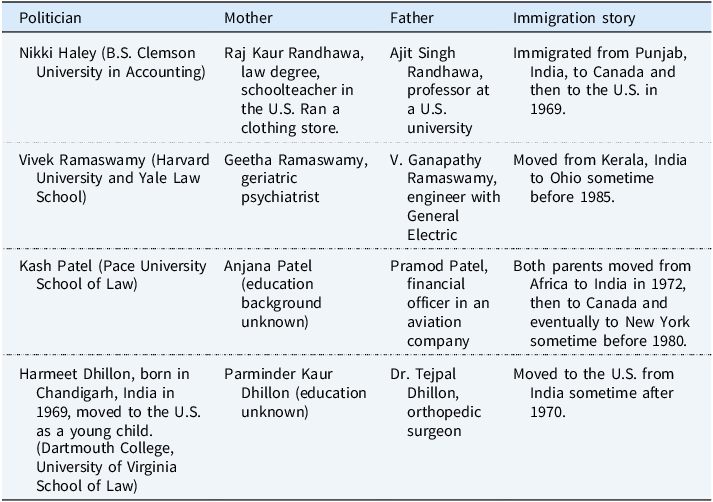
Cross-case analysis revealed relationships between individual cases, helped refine and develop concepts, and offered insights that enriched scholarly understanding. The first comparison of the four cases in Table 1, was about family background, parents’ education, and immigration history. Immigration of all four families was facilitated by the Immigration and Nationality Act of 1965, which abolished the national origins quota that previously favored immigrants from Europe (Chin and Villazor Reference Chin and Villazor2015). This Act is a result of DEI advocacy and lawsuits, and entry of all the families was enabled only after the previous racist policies were abolished. Notably, all parents held at least bachelor’s degrees, and many had professional degrees in medicine and engineering. Six of the eight parents held white-collar jobs that enabled middle-class or higher status and facilitated academic and social capital through private schools and universities for their children (Yosso Reference Yosso2005).
Comparison of parents’ education

Note. Demographic information about: Nikki Haley is from Lakritz Reference Lakritz2024; Vivek Ramaswamy from Stratton and Palin Reference Stratton and Palin2024; Kash Patel from Britannica.com 2025; Harmeet Dhillon from Timesofindia.com, 2024.
The four candidates have benefited from multiple privileges stemming from their parents’ immigration to the U.S. Haley, Patel, and Ramaswamy possess birthright citizenship as natural-born U.S. citizens, while Dhillon acquired citizenship through naturalization. All four accessed elite Ivy League institutions and/or top-ranked universities, facilitating entry into influential political and social networks. All maintain silence about these privileges and accumulated community cultural capital (Yosso Reference Yosso2005), while representing their success through narratives of meritocracy and individual achievement.
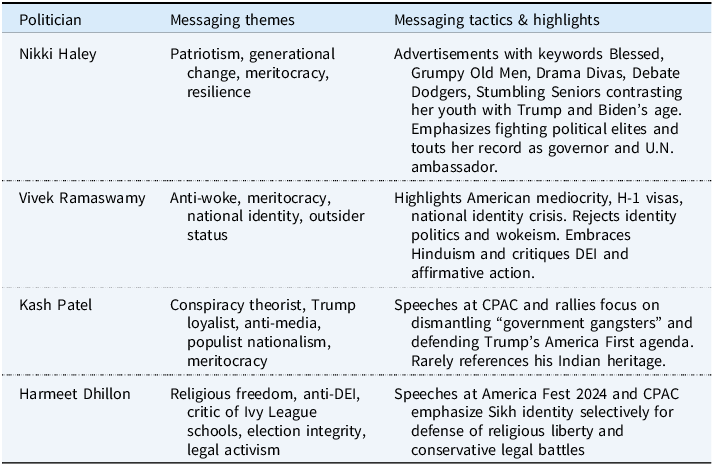
Table 2 below presents a comparative overview of the campaign and publicity advertisements of the four participants, highlighting their thematic strategies and rhetorical positioning. Each candidate foregrounds distinctive platforms: Haley employs generational framing, casting opponents as outdated; Patel relies on nationalist and populist conspiracy theories; Ramaswamy challenges American mediocrity; and Dhillon uses legal systems to decimate civil rights and affirmative action. Despite their divergences, unifying themes emerge across all four: valorization of meritocracy, self-reliance, individual success predicated on hard work, and internal colonization. These themes align with conservative ideological frameworks and function to defend the social and psychological mechanisms of oppression by adopting the colonizer’s path to success (Césaire Reference Césaire2000; Fanon Reference Fanon2008).
Comparison of campaign messaging and advertisements
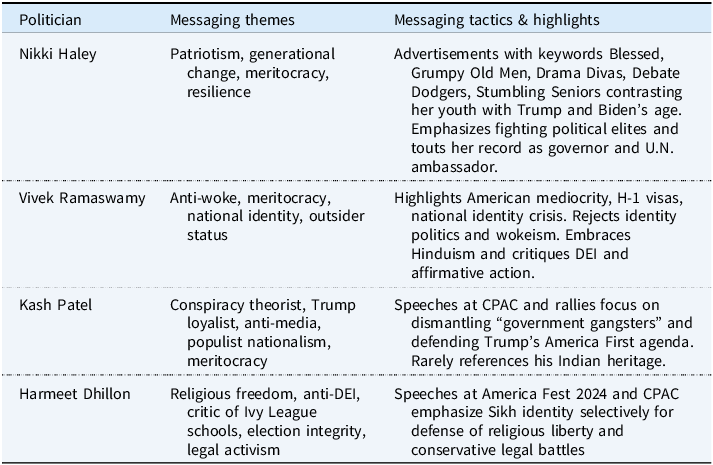
Note. Haley’s campaign advertisements from January and February 2024 (Haley Reference Haley2024; NBC, 2024); Ramaswamy’s reference is from his book 2021; Patel’s reference is from his book, 2023; Dhillon’s reference is from Magno News America Fest (December 2024).
Ramaswamy’s campaign opposed the very systems that enabled his rise, including work visas for foreigners, affirmative action, and woke DEI policies that, according to him, foster mediocrity and bind marginalized populations to divisive ideologies. Patel distinguishes himself with a warrior-like stance, using combative and militaristic language to frame his political identity and mission. At the Conservative Political Action Conference (CPAC), he proclaimed: “We are blessed by God to have Donald Trump be our juggernaut of justice, to be our leader, to be our continued warrior in the arena” (Patel Reference Patel2024). Patel extends his warrior framing to supporters, praising CPAC attendees as Trump’s “army to take this country back” (Patel Reference Patel2024). He depicts politics as a battlefield, claiming opponents have “put their army on the ground” in government agencies, weaponizing justice and politicizing intelligence (Patel Reference Patel2024).
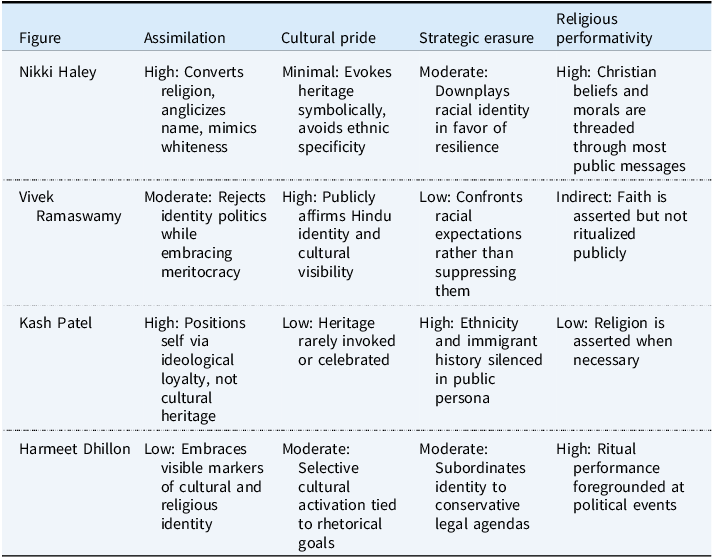
Table 3 compares participants’ identity strategies across the four themes: assimilation, cultural pride, strategic erasure, and religious performativity. Each navigates the sociopolitical terrain of race, ethnicity, and beliefs through distinct representations marked by visibility, suppression, or instrumentalization of identity, revealing complex negotiations of belonging and authenticity.
Comparison of cases across four codes
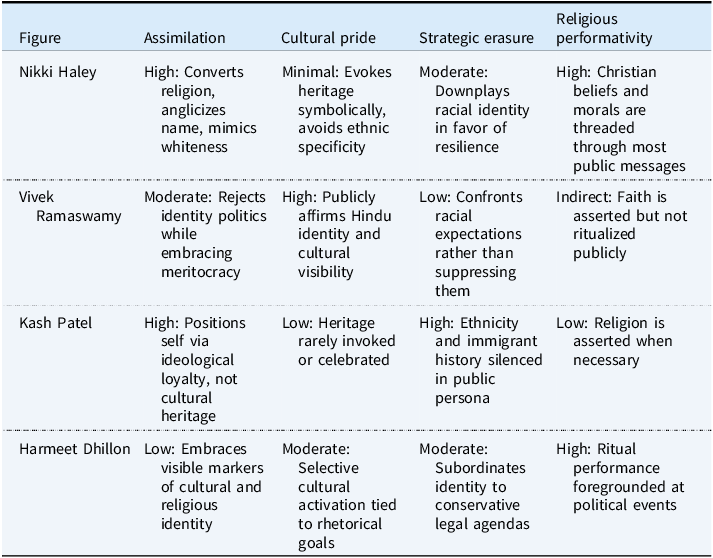
Haley and Patel exemplify high levels of assimilation and strategic erasure, foregrounding ideological loyalty and resilience while minimizing ethnic or religious identification. Haley surpasses Patel by shedding her birth name and religion to align with a party that privileges whiteness and Christianity. She emphasizes her adopted Christianity over her ancestral heritage, thereby establishing a degree of separation from her origins. Haley and Patel avoid racial or ethnic references, opting instead for rhetoric rooted in nationalism, loyalty, and ideological alignment. By mimicking dominant conservative peers, they have gained access to opportunities that might otherwise be unavailable.
Dhillon and Patel avoid explicit discourse on Sikhism or Hinduism, instead asserting identity through the performance of prayer or greetings. Dhillon highlights religious performativity and informal racialization through ceremonial display, strategically engaging cultural markers to bolster political legitimacy and contest prevailing racial hierarchies. This reinforces the conservative narrative of self-reliance, framing success as individual effort rather than systemic inequality, as the nation appears to reward industriousness and assimilation. Ramaswamy challenges racial norms through meritocracy, affirming cultural pride and informal religiosity. His interfaith comparisons, at times absurd, highlight convergences between two disparate religions while minimizing theological differences, thereby appealing to conservative audiences through an emphasis on shared values and collective belonging.
The four conservative figures employ distinct strategies to minimize religious differences from the dominant Christian majority and selectively foreground aspects of their faith in response to contextual demands. Their rhetoric affirms that success is achieved through individual effort and merit alone, not government aid or systemic support. These divergences are indicative of individual agency and calculated strategies oriented toward racial and ideological accommodation, where full assimilation enables political ascent. The tension between silence and celebration reveals how racial ambiguity and visibility are leveraged or muted to secure legitimacy within racially coded landscapes.
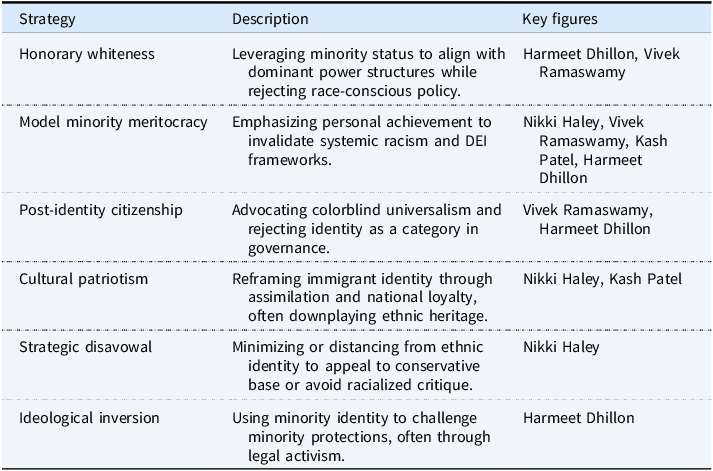
Table 4 below presents six rhetorical strategies used by the four conservative leaders to navigate minoritized identities in right-wing political microclimes. These approaches reflect distinct yet overlapping racial positioning that reframes ethnic identity to affirm ideological and national legitimacy. Dhillon and Ramaswamy embody honorary whiteness by rejecting race-conscious policies to effectively assert assimilation. Furthermore, they advance a colorblind ethos dismissing identity categories as divisive or irrelevant to governance. Haley, Ramaswamy, and Patel embrace the myths of model minority and meritocracy to reinforce neoliberal narratives that personal success disproves systemic inequity. Their speeches elevate post-racial citizenship as politically virtuous and frame resilience and allegiance to American ideals as requiring cultural erasure. Immigration stories are reframed as cultural patriotism to stress loyalty and assimilation. While Haley sidesteps her Desi heritage, Dhillon weaponizes it to oppose minority protections, presenting her Brown identity as evidence of bootstrapping and meritocratic success. These strategies illuminate how racial identity is not merely suppressed but tactically mobilized to align with conservative commitments. They reflect both the elasticity of racial meaning and the calculated performances required to claim political legitimacy in spaces structured by whiteness.
Typology of desi conservative identity strategies

Discussion
Across these case studies, a pattern emerges: Desi Republicans treat identity not as a call for solidarity, but as a flexible instrument of political performance. Their strategies range from mimicry and silencing to assertion and selective essentialism. Haley and Patel avoid sustained engagement with ethnic identity, suggesting success within Republican politics requires proximity to whiteness. Religion serves as a tool of belonging or resistance: Haley converts to Christianity, Ramaswamy asserts Hinduism, and Dhillon employs Sikh rites to claim both assimilation and constitutional freedoms. All four embody personal success as evidence of American meritocracy, avoiding structural critique and reinforcing the “good immigrant” narrative. Assimilation is selectively pursued through dress, speech, faith, and self-identification; yet hybridity exposes the instability of racial performance. Success in Republican politics hinges on proximity to whiteness, with religion signaling either assimilation or resistance, compelling racialized leaders to navigate with caution and calculation.
Respectability politics (Higginbotham Reference Higginbotham1994) shapes how Desi Republicans navigate racialization, belonging, and political legitimacy in the U.S. Seeking acceptance within a narrow political, religious, and cultural order, respectability politics encourages these leaders to consciously abandon controversial aspects of their identity to align with dominant norms of success, morality, and nationalism. Desi Republicans project the model minority image, disciplined, family-oriented, and self-reliant, to affirm individual merit and community compatibility with conservative values, distinguishing themselves from groups portrayed as dependent or oppositional. They valorize assimilationist success and create distance with progressive or working-class Desi populations, marginalizing those whose experiences or politics diverge from the image of the upwardly mobile conservative South Asian. Ultimately, respectability politics enables Desi Republicans to navigate the racial tensions in conservatism, securing partial acceptance while reinforcing racial and cultural hierarchies that keep them conditional insiders.
Limitations
The study highlights the growing presence of Desi Republicans but has several limitations. As a non-experimental design, it cannot establish causality, and findings based on four purposively selected cases limit the scope and generalizability. Reliance on public data excludes participant interviews, and the small, nonrandom sample constrains applicability to other minoritized leaders. While intersectional factors such as gender, caste, religion, class, and colorism remain beyond this study’s scope, my positionality as a Desi immigrant, college-educated woman outside electoral politics may have shaped the interpretation of the data.
Significance of the Study
This study deepens our understanding of a rising wave of minority conservatism by examining how elite Desi leaders negotiate race, power, and ideology through selective identity performance. It advances debates on representation and identity politics while illuminating how privileged actors distance themselves from and willfully forget the legacies of racial exclusion. The findings of this study have broad implications for future political trends as Asian American candidates are better able to achieve crossover support and perform better in districts that are broadly diverse (Lublin and Wright Reference Lublin and Wright2024).
In the light of emerging electoral shifts, particularly among U.S.-born Desi men responding to different political cues from their immigrant predecessors, this study highlights the stakes of assimilation, symbolic use of heritage, and tensions between authenticity and conformity. Though projecting racial diversity, these leaders rarely disrupt dominant power structures, exposing the paradox of representation in conservative politics. This inquiry raises a critical question: what does assimilation signify when skin color and religion remain immutable markers of Otherness? These questions invite a deeper interrogation of the thresholds of acceptability and the racialized economies of belonging that shape contemporary political legitimacy. It is befitting to conclude with a prescient quote from Ann Coulter during her interview with Vivek Ramaswamy:
“[T]here is a core national identity that is the WASP (white Anglo Saxon Protestant) and that doesn’t mean we can’t take anyone else in like a Sri Lankan or a Japanese or an Indian but the core around which the nation’s values are formed is the WASP. (Coulter, as quoted in Ramaswamy Reference Ramaswamy2024a)”
Funding statement
The author declares that she has not received financial support for the research, authorship, and/or publication of this article.
Competing interests
The author declares no competing interest.
Appendix
List of Data Sources
Digital Video Publishers
-
1. Brut India. https://www.youtube.com/brutindia
-
2. YouTube. www.youtube.com
Digital News Platforms
-
1. BBC. www.bbc.com
-
2. Business Insider. www.businessinsider.com
-
3. CNN. Cnn.com
-
4. Divya TV USA. diyatvusa.com
-
5. Democracy Docket. https://www.democracydocket.com/
-
6. The Christian Post. https://www.christianpost.com/
-
7. The Daily Beast. www.thedailybeast.com
-
8. The Daily Signal. https://www.dailysignal.com/
-
9. Fortune. https://fortune.com
-
10. Fox News. www.foxnews.com
-
11. Mint. https://www.livemint.com/
-
12. Politico. www.politico.com
-
13. The Hill. https://thehill.com/
-
14. The New York Times. www.nytimes.com
-
15. The Times of India. Timesofindia.com
-
16. The U.S. Sun. https://www.the-sun.com/
-
17. The Washington Post. https://www.washingtonpost.com
-
18. Time. https://time.com/
Podcasts
-
1. Capitol Weekly. https://capitolweekly.net/category/podcast/
-
2. The Truth. https://www.thetruthpodcast.com/
Political Party Websites
-
1. Fairfax Republicans. https://fairfaxgop.org/
-
2. Republican National Committee. Rnc.com
Social Media Platforms
-
1. X. https://x.com/home
U.S. Government Websites
-
1. Federal Bureau of Investigations. www.fbi.gov
-
2. The Office of the Federal Register. https://www.federalregister.gov/
-
3. United States Census Bureau. https://www.census.gov
-
4. U.S. Department of Justice. https://www.justice.gov/
-
5. U.S. Department of Defense. https://www.defense.gov

 Open access

